CRICOS Provider Code 00301J
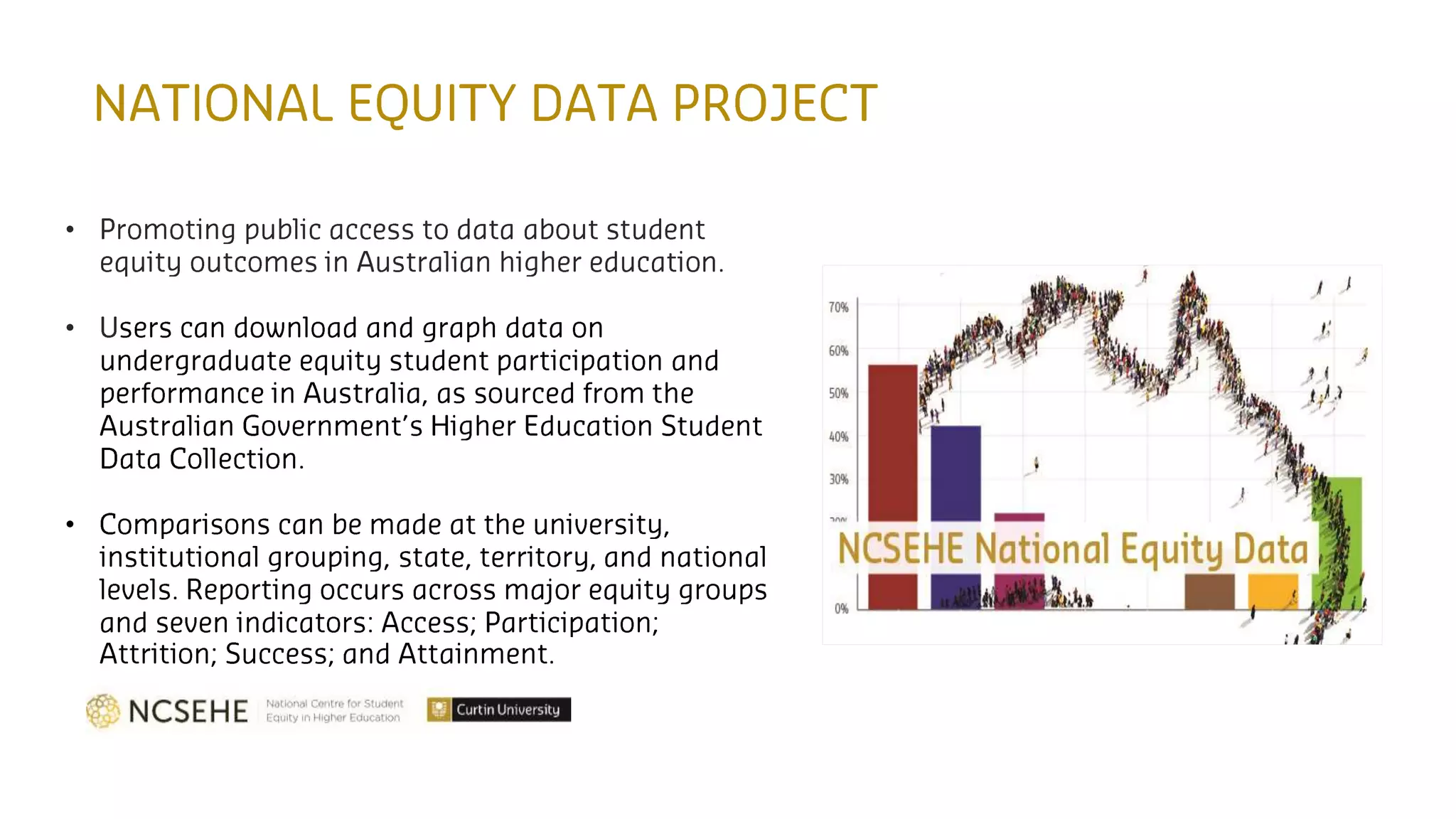
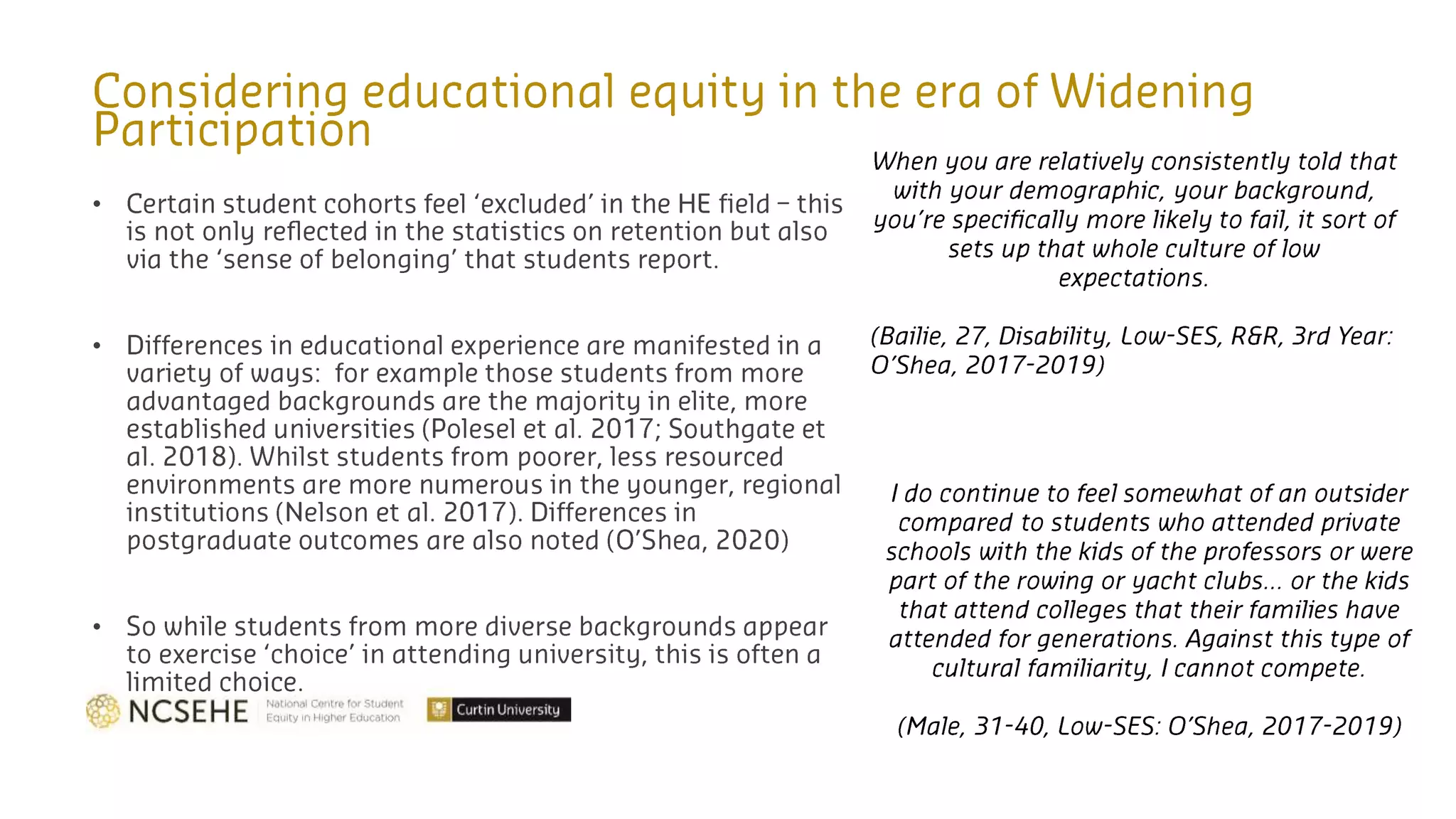
Creating equitable learning environments, fostering
community, and supporting students’ mental wellbeing:
Findings and strategies from NCSEHE research projects
2. Sarah:
3. Janine:
4. Nicole:
•
•
•
•
•
•
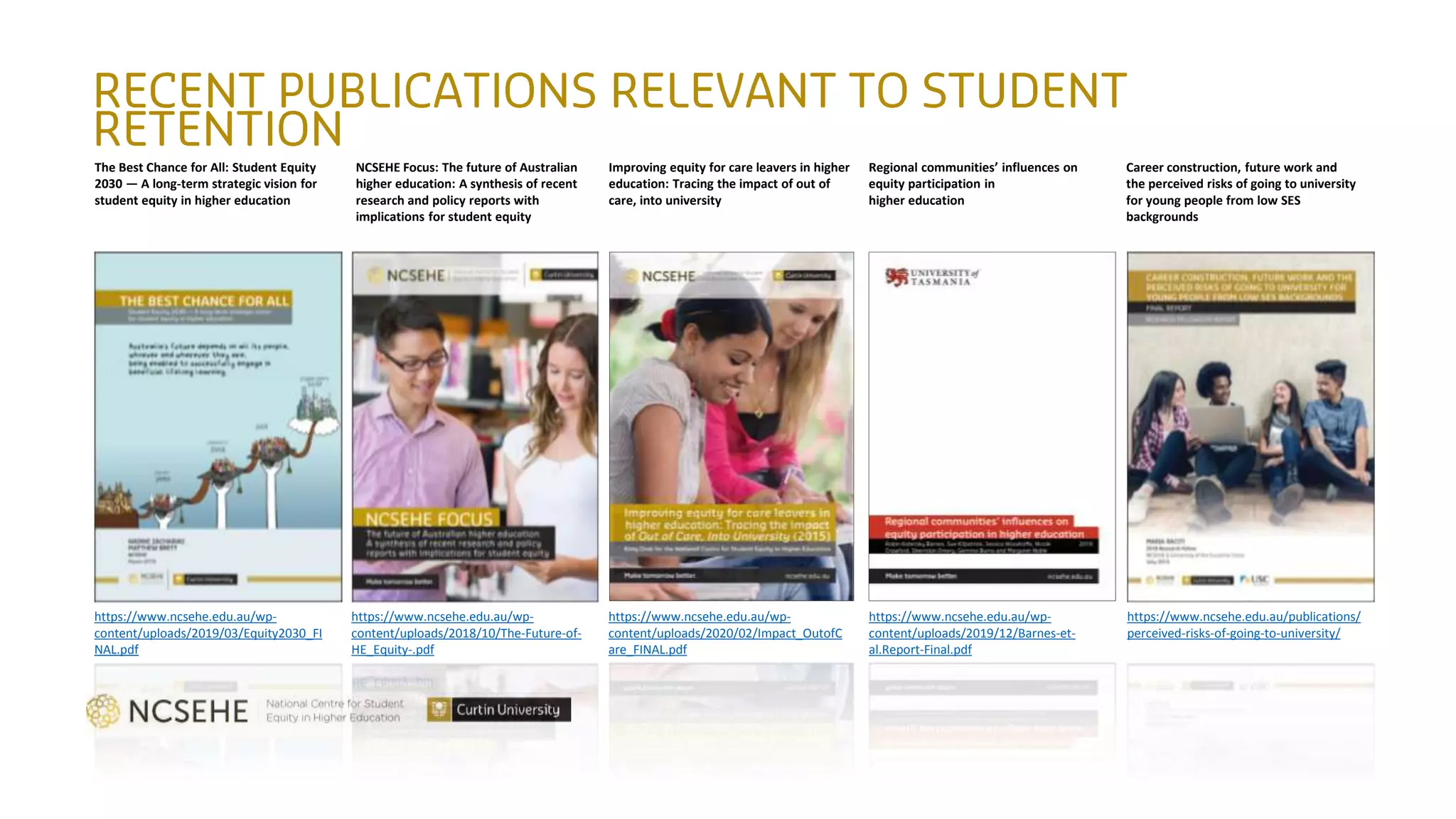
The Best Chance for All: Student Equity
2030 — A long-term strategic vision for
student equity in higher education
NCSEHE Focus: The future of Australian
higher education: A synthesis of recent
research and policy reports with
implications for student equity
Improving equity for care leavers in higher
education: Tracing the impact of out of
care, into university
Career construction, future work and
the perceived risks of going to university
for young people from low SES
backgrounds
Regional communities’ influences on
equity participation in
higher education
https://www.ncsehe.edu.au/wp-
content/uploads/2019/03/Equity2030_FI
NAL.pdf
https://www.ncsehe.edu.au/wp-
content/uploads/2020/02/Impact_OutofC
are_FINAL.pdf
https://www.ncsehe.edu.au/wp-
content/uploads/2018/10/The-Future-of-
HE_Equity-.pdf
https://www.ncsehe.edu.au/wp-
content/uploads/2019/12/Barnes-et-
al.Report-Final.pdf
https://www.ncsehe.edu.au/publications/
perceived-risks-of-going-to-university/
•
•
•
•
•
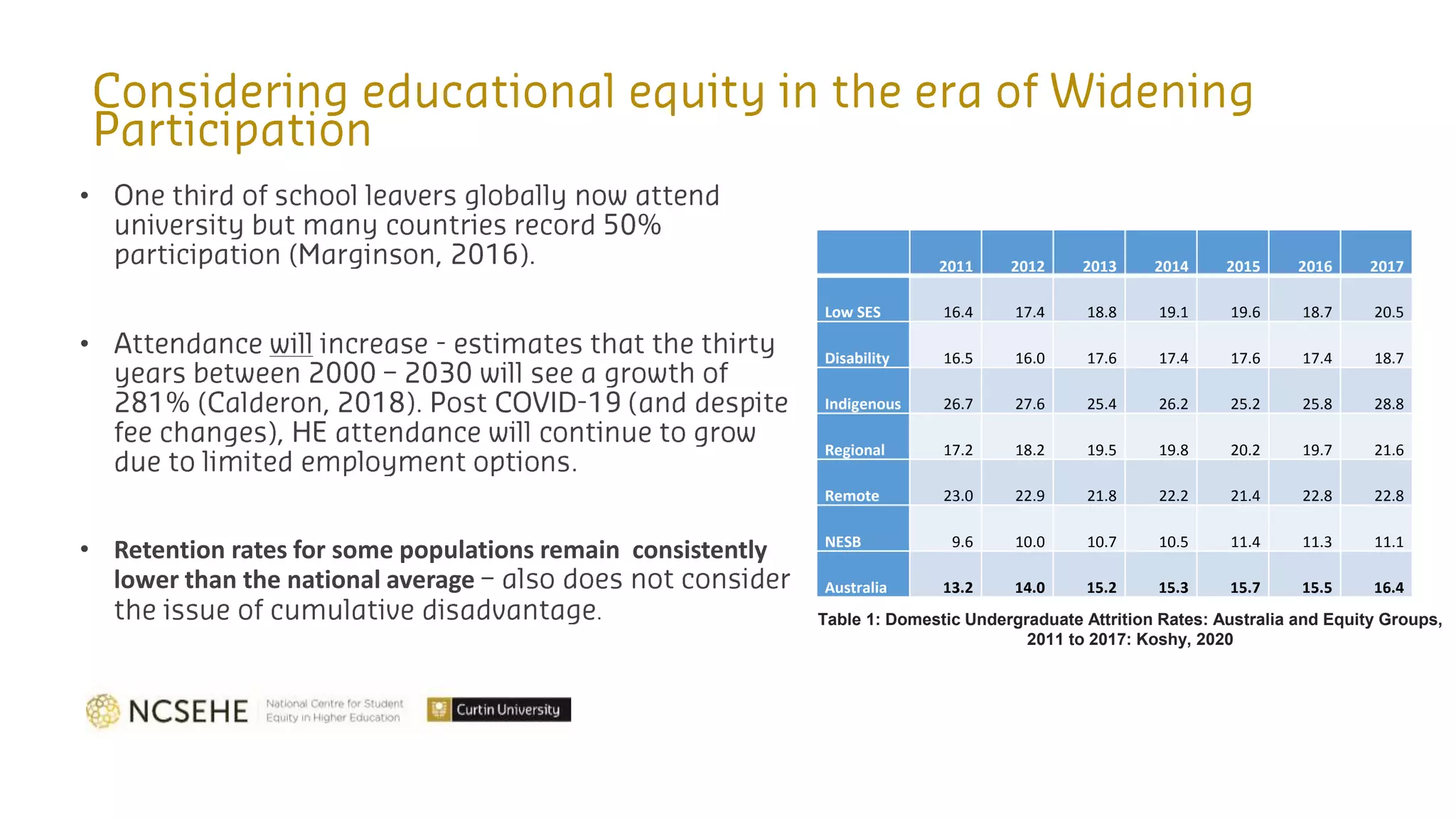
• Retention rates for some populations remain consistently
lower than the national average
2011 2012 2013 2014 2015 2016 2017
Low SES 16.4 17.4 18.8 19.1 19.6 18.7 20.5
Disability 16.5 16.0 17.6 17.4 17.6 17.4 18.7
Indigenous 26.7 27.6 25.4 26.2 25.2 25.8 28.8
Regional 17.2 18.2 19.5 19.8 20.2 19.7 21.6
Remote 23.0 22.9 21.8 22.2 21.4 22.8 22.8
NESB 9.6 10.0 10.7 10.5 11.4 11.3 11.1
Australia 13.2 14.0 15.2 15.3 15.7 15.5 16.4
Table 1: Domestic Undergraduate Attrition Rates: Australia and Equity Groups,
2011 to 2017: Koshy, 2020
•
•
•
•
•
•
•
•
•
•
CRICOS Provider Code 00301J
2020 NCSEHE Equity Fellowship: “You going to
uni”?: Exploring how regional people navigate
into and through higher education
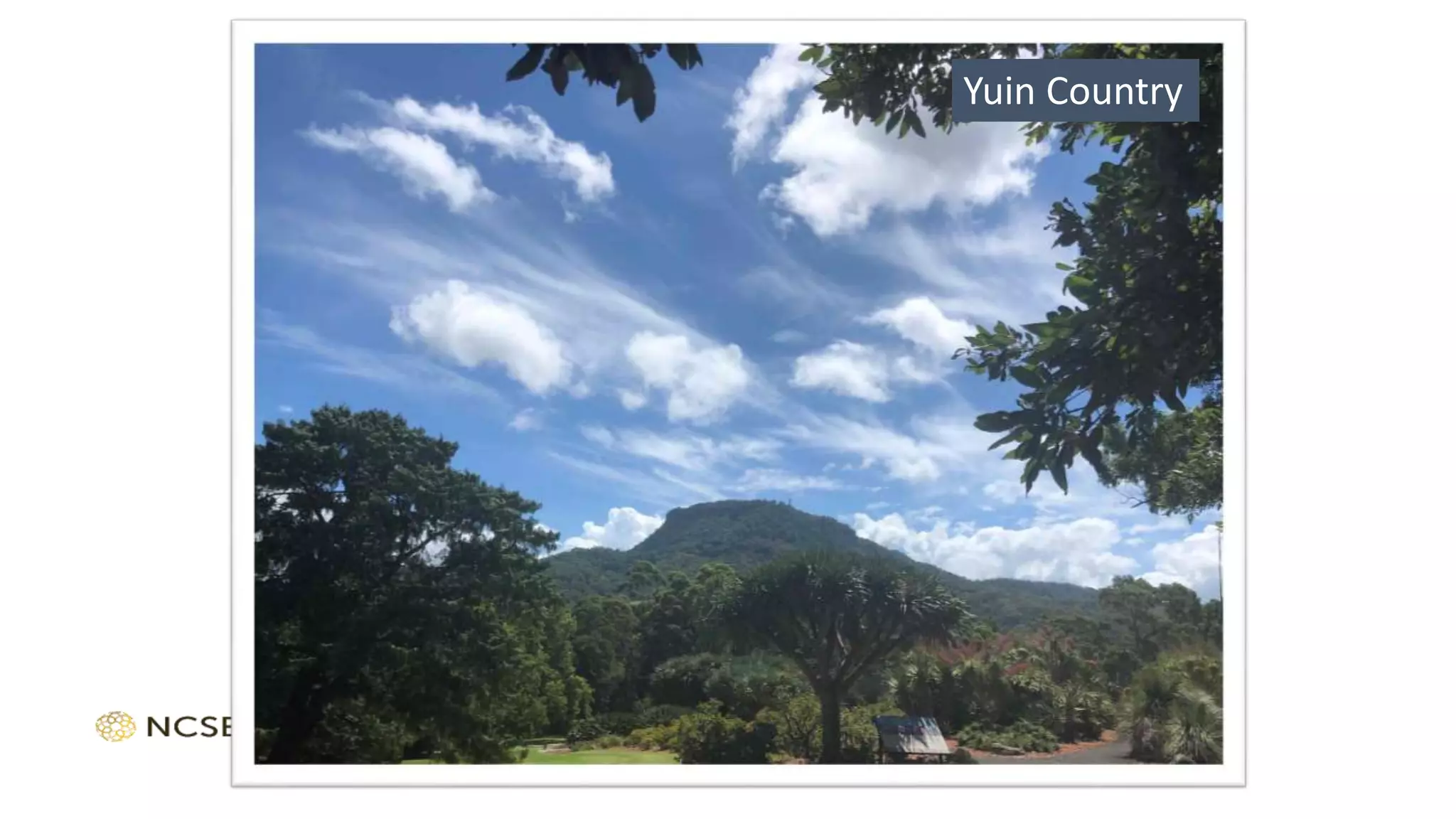
Yuin Country
• Brief overview of my NCSEHE Equity Fellowship project
• Key Findings
• Realities of Location and services accessibility
• Snapshots of strengths and diversity
• Sense of community
• Personal qualities and strengths
• External factors: equity markers, additional responsibilities
• Factoring in human care, connectedness
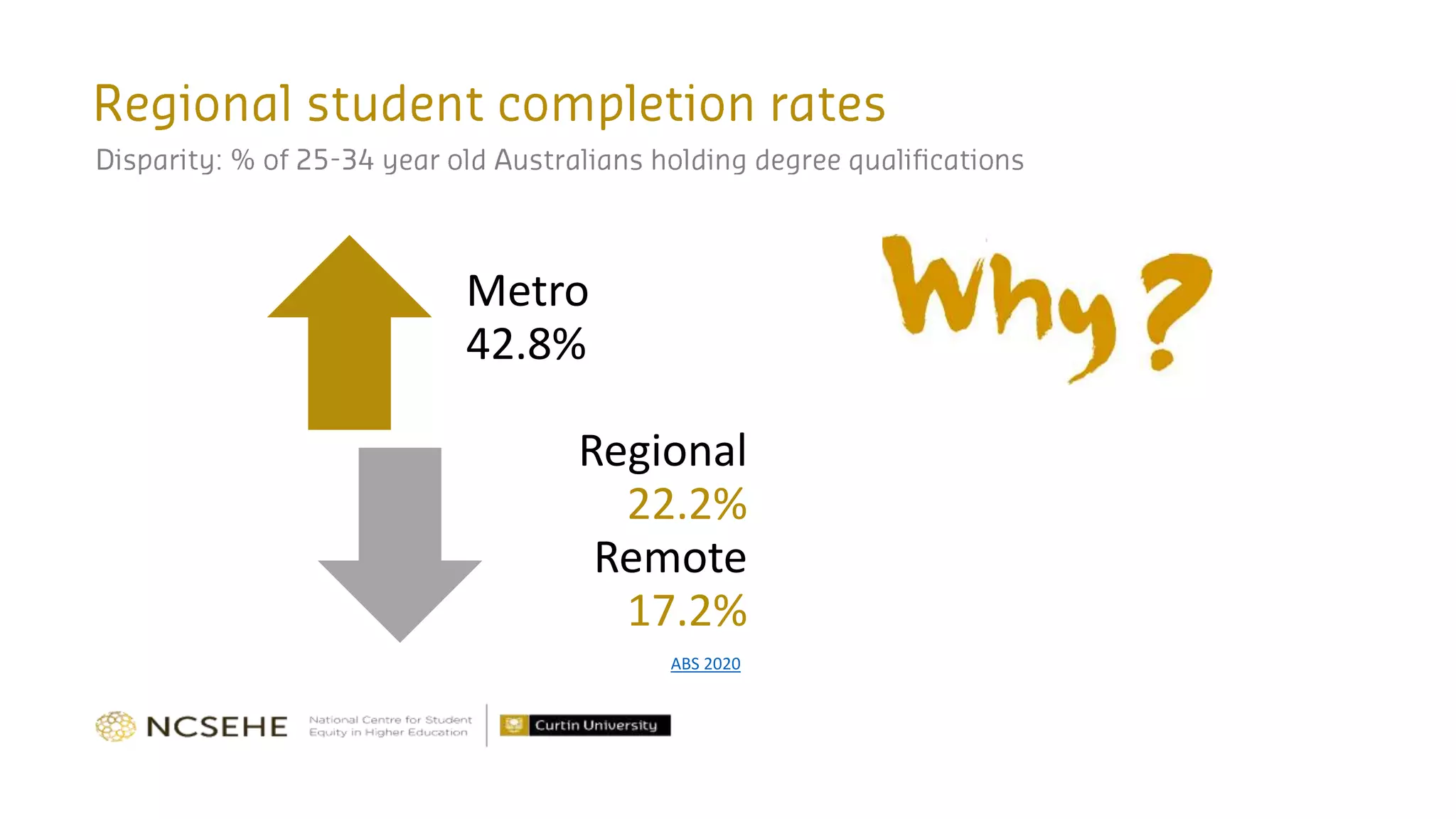
Metro
42.8%
Regional
22.2%
Remote
17.2%
ABS 2020
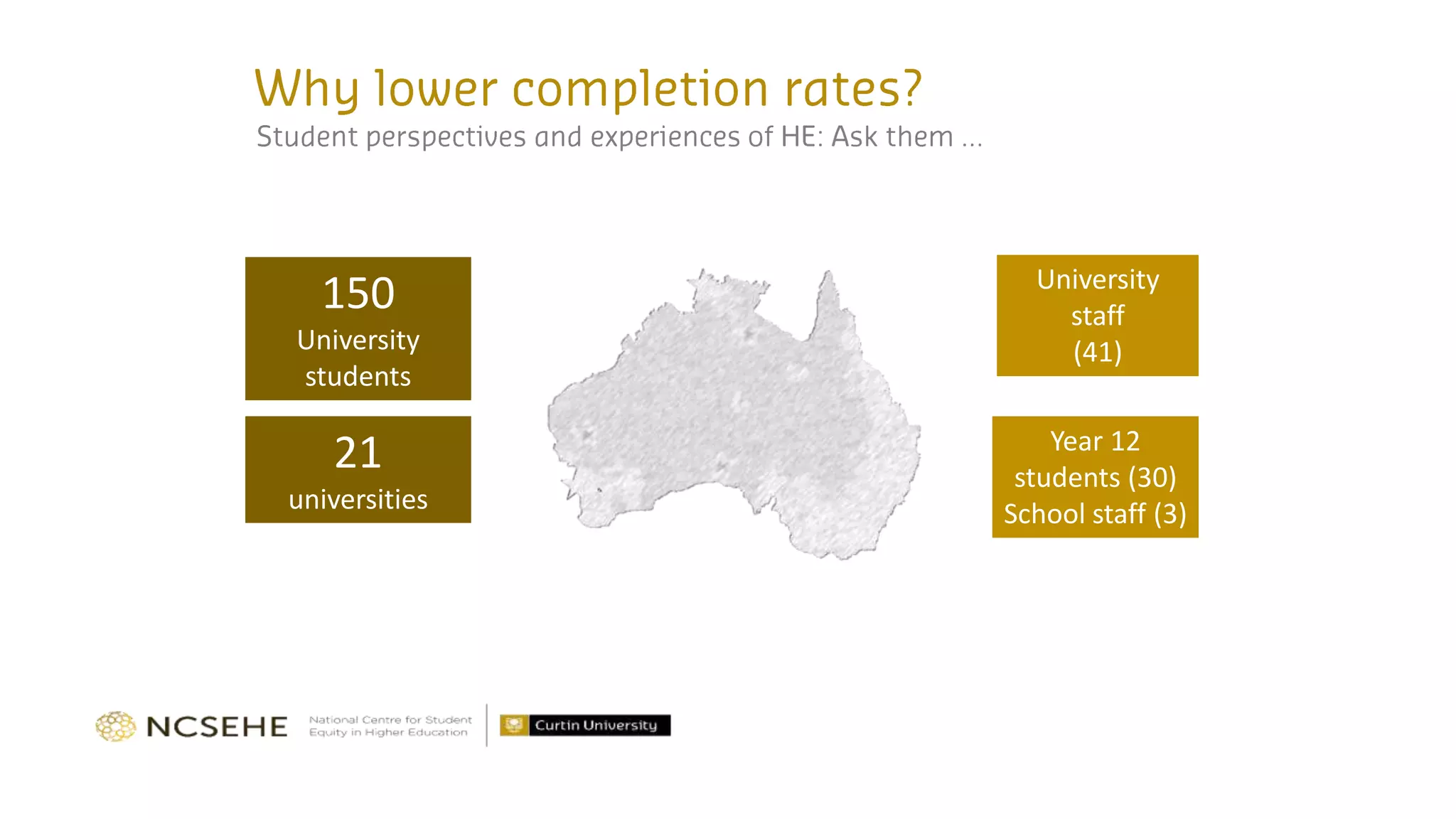
150
University
students
21
universities
University
staff
(41)
Year 12
students (30)
School staff (3)
CRICOS Provider Code 00301J
Key Findings
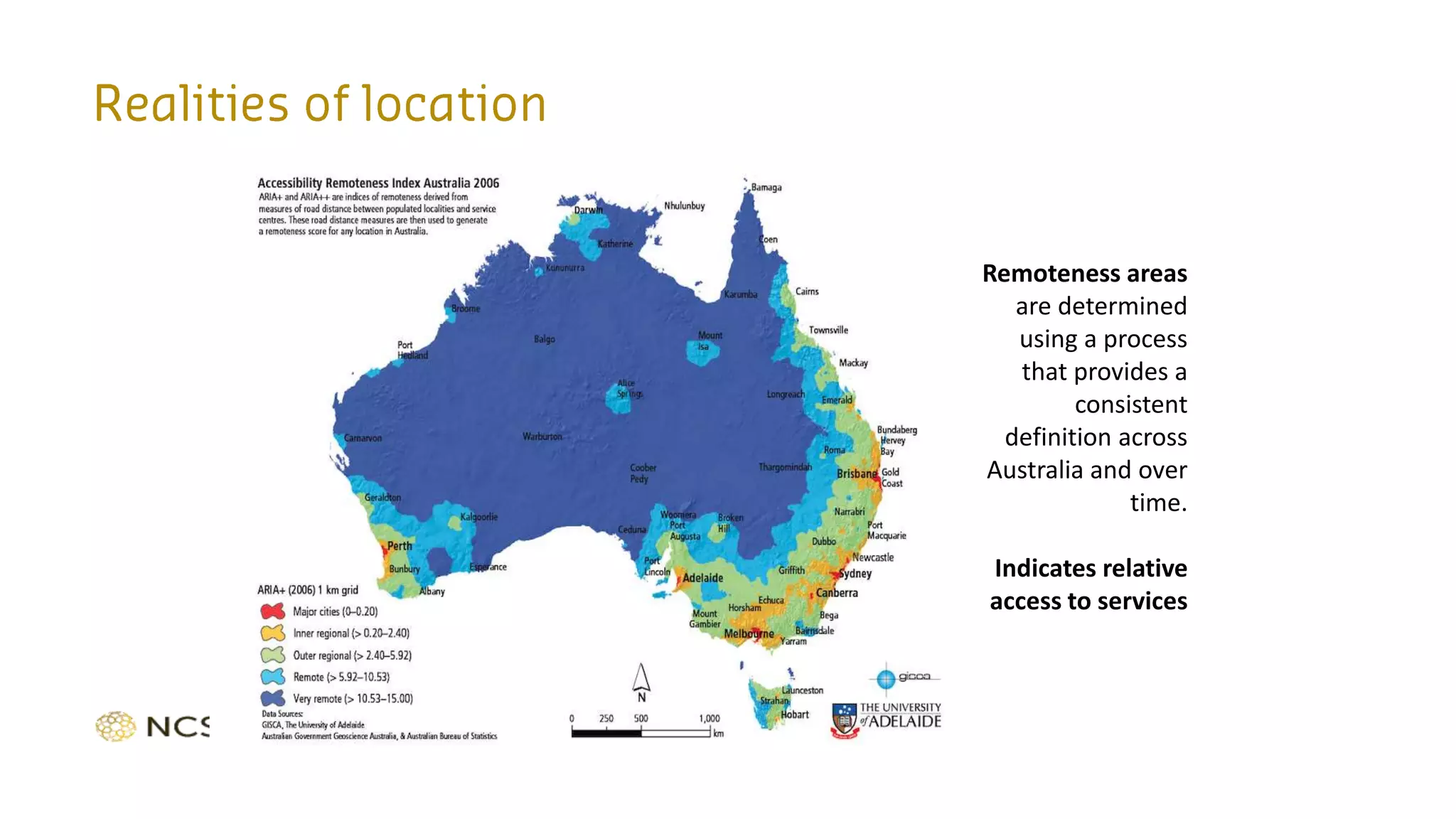
Remoteness areas
are determined
using a process
that provides a
consistent
definition across
Australia and over
time.
Indicates relative
access to services
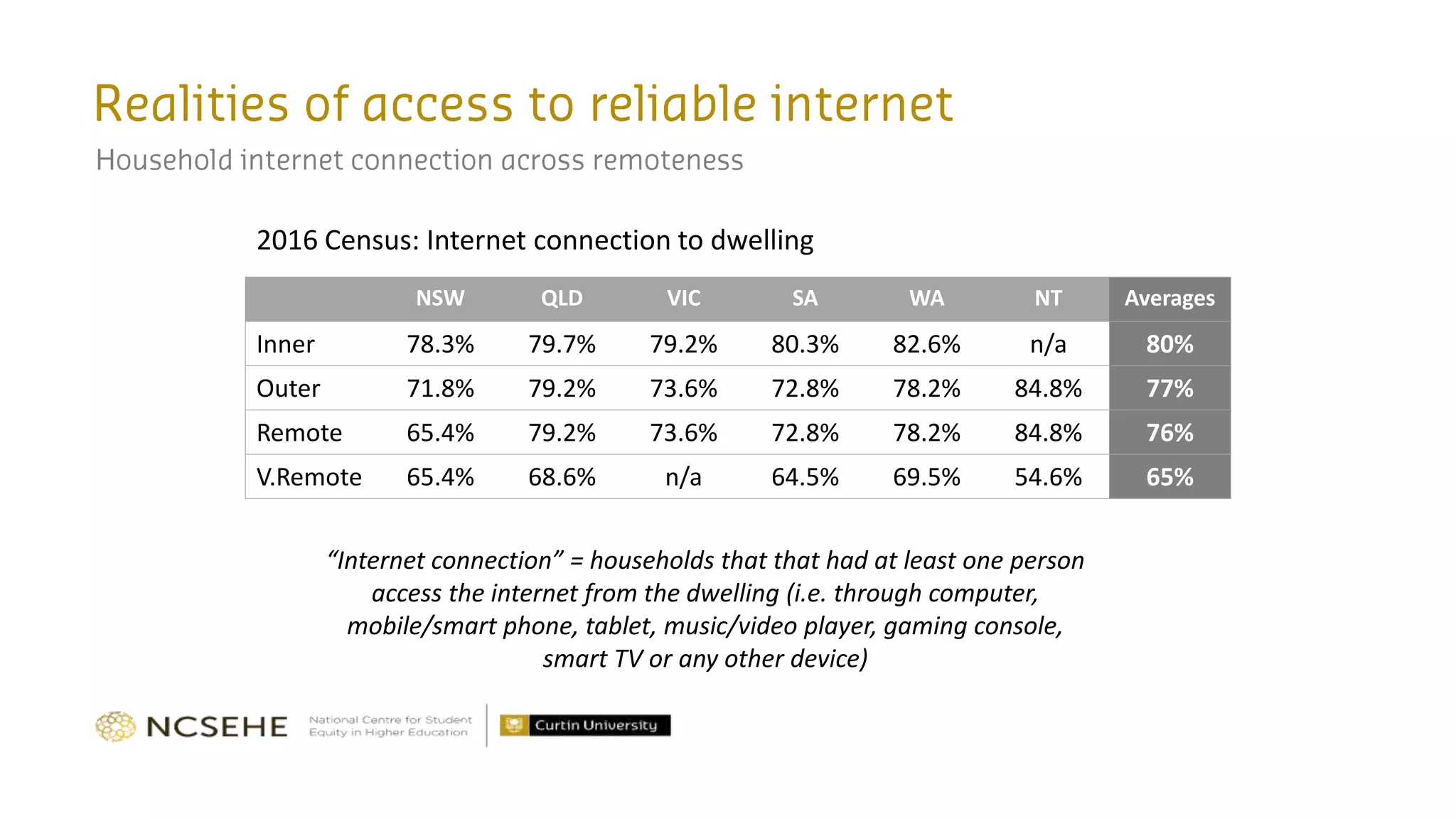
NSW QLD VIC SA WA NT Averages
Inner 78.3% 79.7% 79.2% 80.3% 82.6% n/a 80%
Outer 71.8% 79.2% 73.6% 72.8% 78.2% 84.8% 77%
Remote 65.4% 79.2% 73.6% 72.8% 78.2% 84.8% 76%
V.Remote 65.4% 68.6% n/a 64.5% 69.5% 54.6% 65%
2016 Census: Internet connection to dwelling
“Internet connection” = households that that had at least one person
access the internet from the dwelling (i.e. through computer,
mobile/smart phone, tablet, music/video player, gaming console,
smart TV or any other device)
27
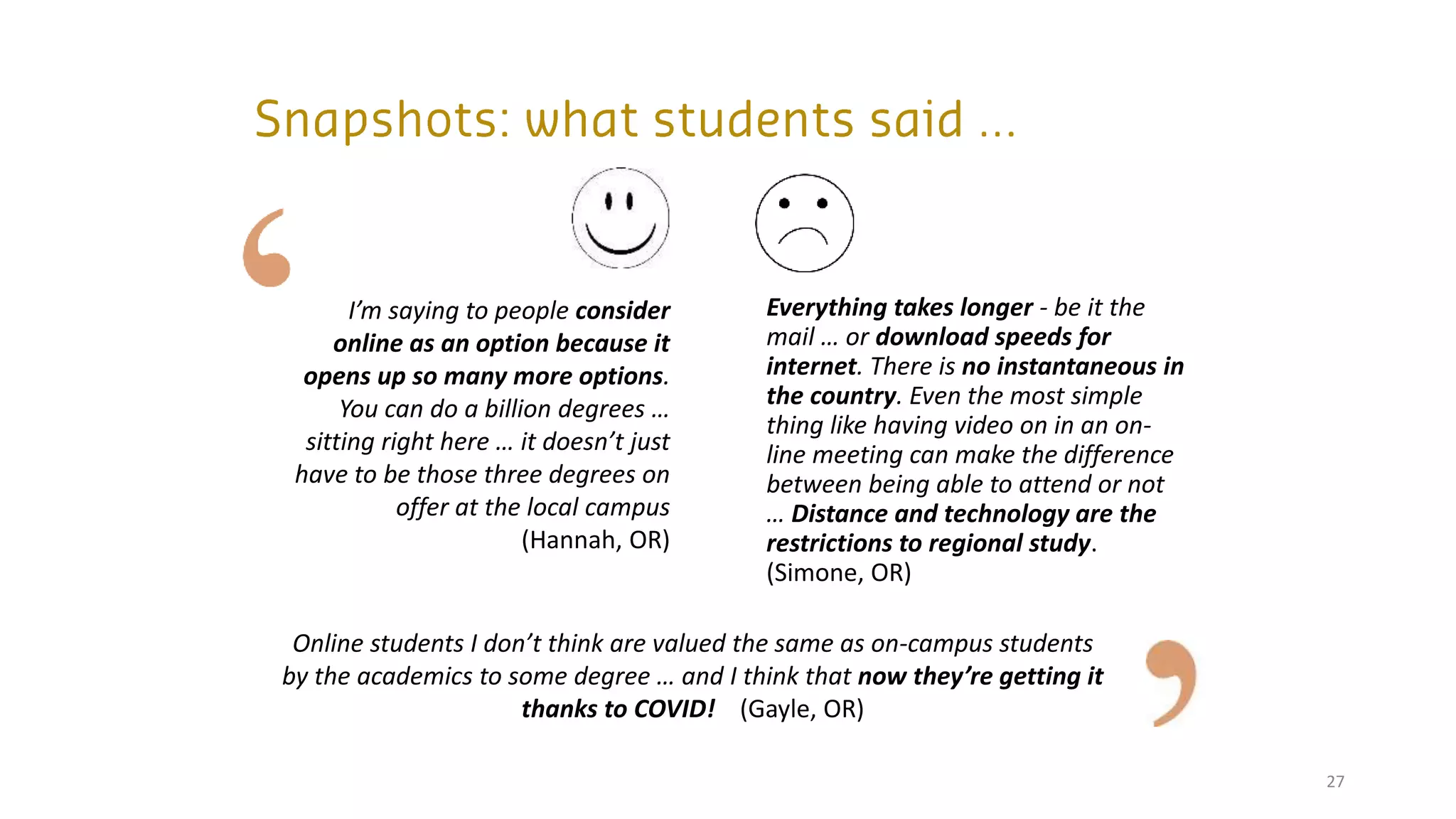
I’m saying to people consider
online as an option because it
opens up so many more options.
You can do a billion degrees …
sitting right here … it doesn’t just
have to be those three degrees on
offer at the local campus
(Hannah, OR)
Online students I don’t think are valued the same as on-campus students
by the academics to some degree … and I think that now they’re getting it
thanks to COVID! (Gayle, OR)
Everything takes longer - be it the
mail … or download speeds for
internet. There is no instantaneous in
the country. Even the most simple
thing like having video on in an on-
line meeting can make the difference
between being able to attend or not
… Distance and technology are the
restrictions to regional study.
(Simone, OR)
28
Community
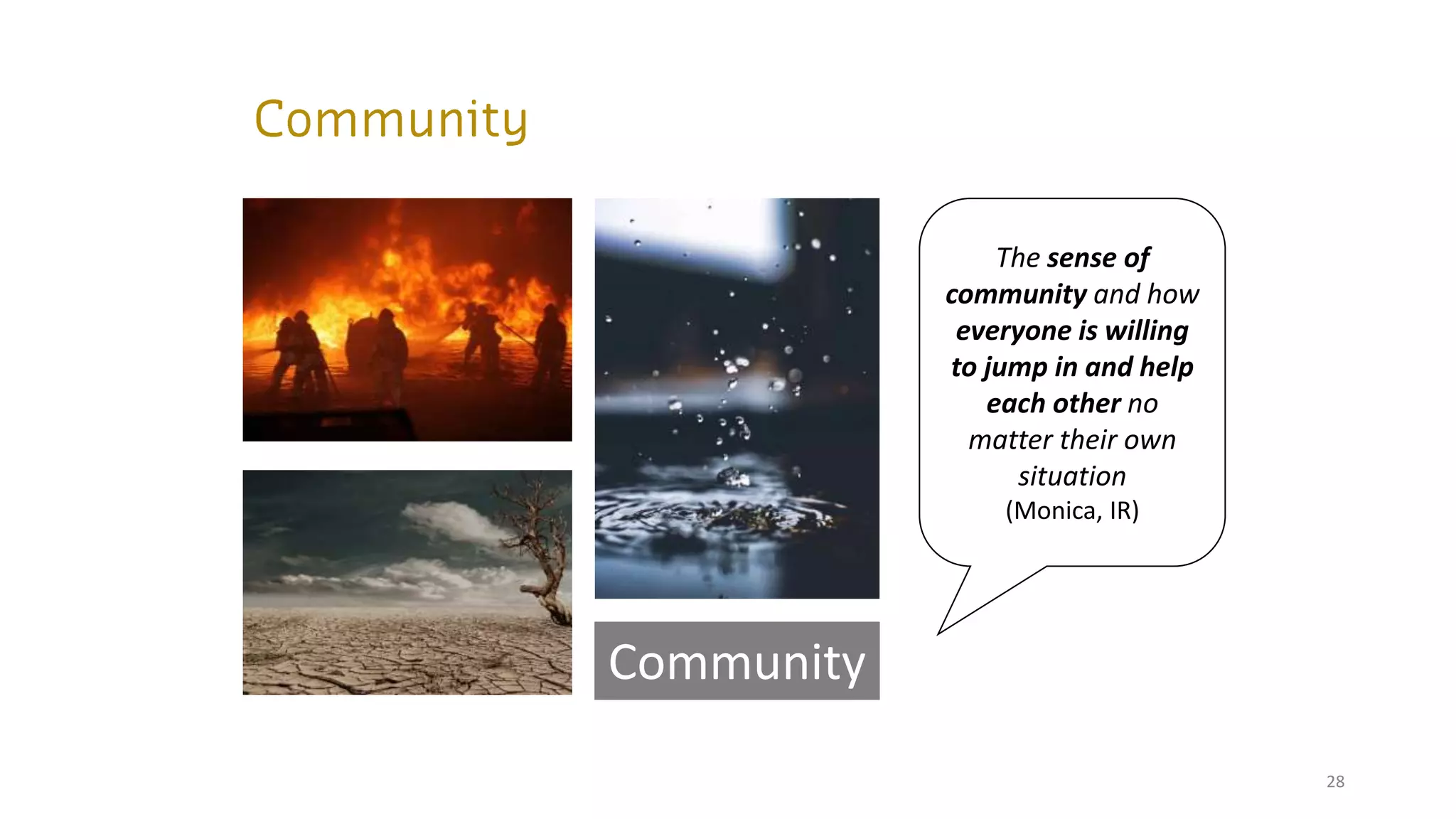
The sense of
community and how
everyone is willing
to jump in and help
each other no
matter their own
situation
(Monica, IR)
29
I think just speaking for the people who I’m currently at
uni with, their sense of community is really strong;
within the university there’s a community but also just
through everything that everyone’s been through this
year … people genuinely care about their fellow
students, their community as a whole … if someone
needs help, there’s always someone who will stand up
and help them … that’s a quality that a lot of people
who grew up in regional areas have … That’s just been
my experience … I think that’s something that the
people here have which is amazing and means that
they’re so much more successful because they always
feel supported and part of something (Sophie, IR)
30
As a regional student, I actually feel that the university is a lot more
approachable, the staff are a lot more approachable, the resources
seem to be more accessible than if I was at a bigger centre, or in
[city]. I did attend [metro university] for a period and it was just
really clinical, distant – I didn’t enjoy the actual experience that
much, whereas here in [regional university], it seems everyone
seems to know each other a lot more. The staff really do seem to
know their students a lot more which is really fantastic (Lucy, IR)
[The Country Universities Centre] are just absolutely invaluable. I
really do feel like I couldn’t have done it without their support and
also that knowing that they’re there, that if I am stuck with
something, that I can make an appointment or I can just turn up,
have a chat to somebody and they can help me work through
whatever it is that I need (Wendy, IR)
willingness
to succeed -
I can do it!
know what
it's like to
truly
struggle
Resilient
Determined
Resourceful
work ethic -
I always saw
everyone
work
“We are
resilient, we
know what it’s
like to truly
struggle.”
“For me, [my work ethic]
was my family. I grew up
in the back of a milk bar
so I saw my family work, I
went to work with my
mum, I went to work with
my dad … so I always saw
everyone work”
“Just that willingness to succeed
and show people that even
though I do come from a
different background … that I can
achieve what I want to achieve
and if I put my mind to it, I can do
it”
32
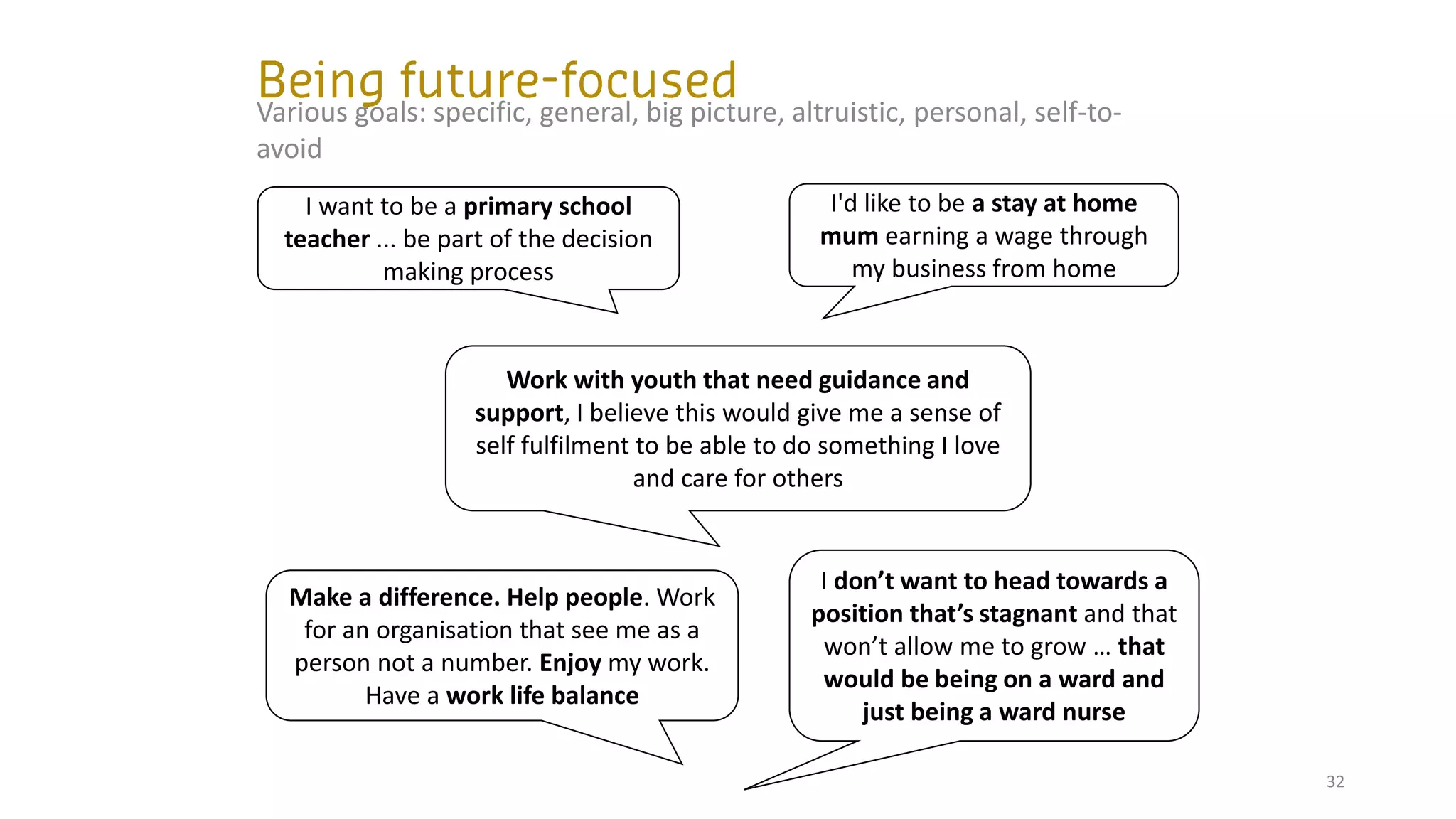
I want to be a primary school
teacher ... be part of the decision
making process
I'd like to be a stay at home
mum earning a wage through
my business from home
Work with youth that need guidance and
support, I believe this would give me a sense of
self fulfilment to be able to do something I love
and care for others
I don’t want to head towards a
position that’s stagnant and that
won’t allow me to grow … that
would be being on a ward and
just being a ward nurse
Make a difference. Help people. Work
for an organisation that see me as a
person not a number. Enjoy my work.
Have a work life balance
Various goals: specific, general, big picture, altruistic, personal, self-to-
avoid
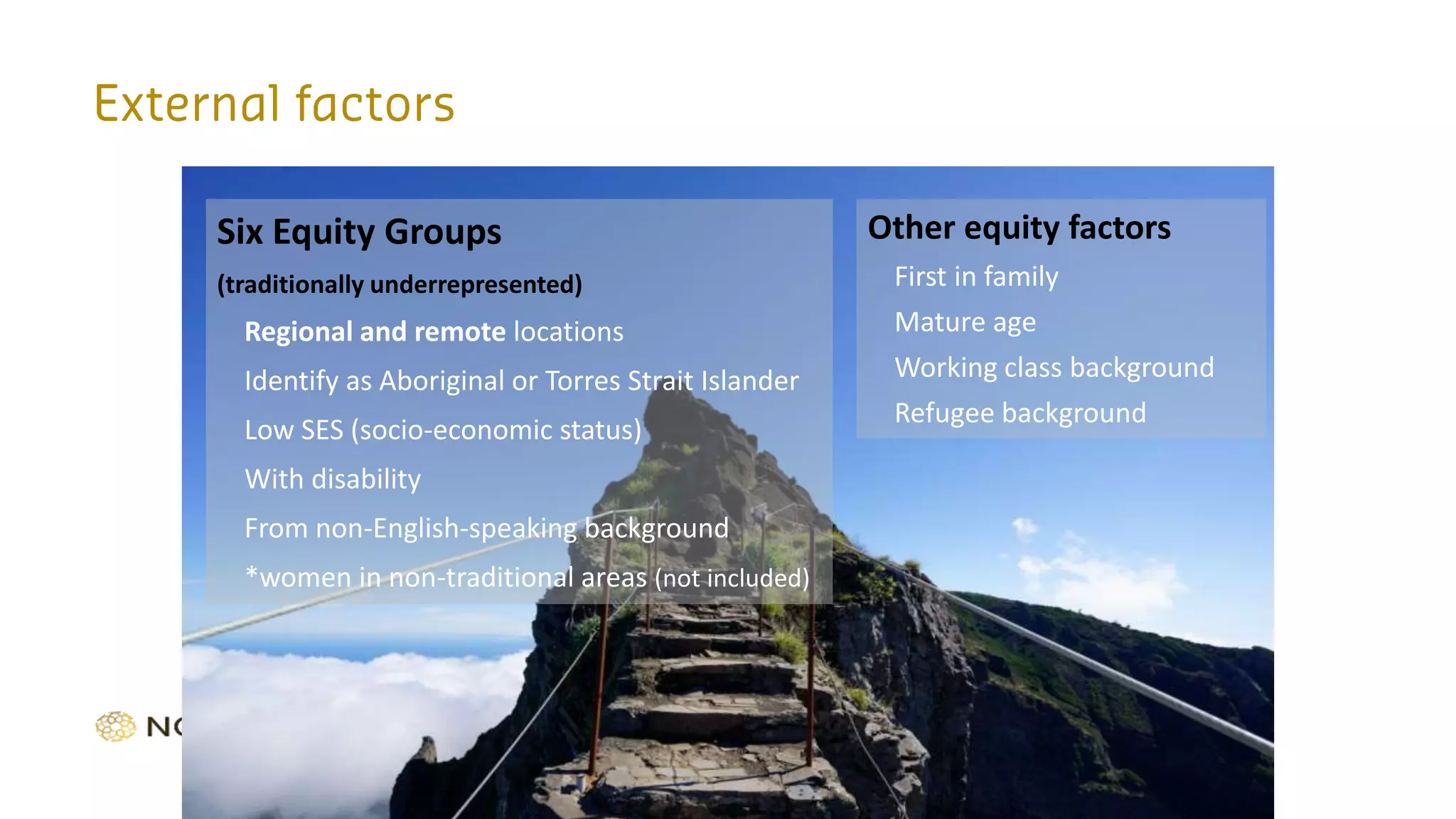
Six Equity Groups
(traditionally underrepresented)
Regional and remote locations
Identify as Aboriginal or Torres Strait Islander
Low SES (socio-economic status)
With disability
From non-English-speaking background
*women in non-traditional areas (not included)
Other equity factors
First in family
Mature age
Working class background
Refugee background
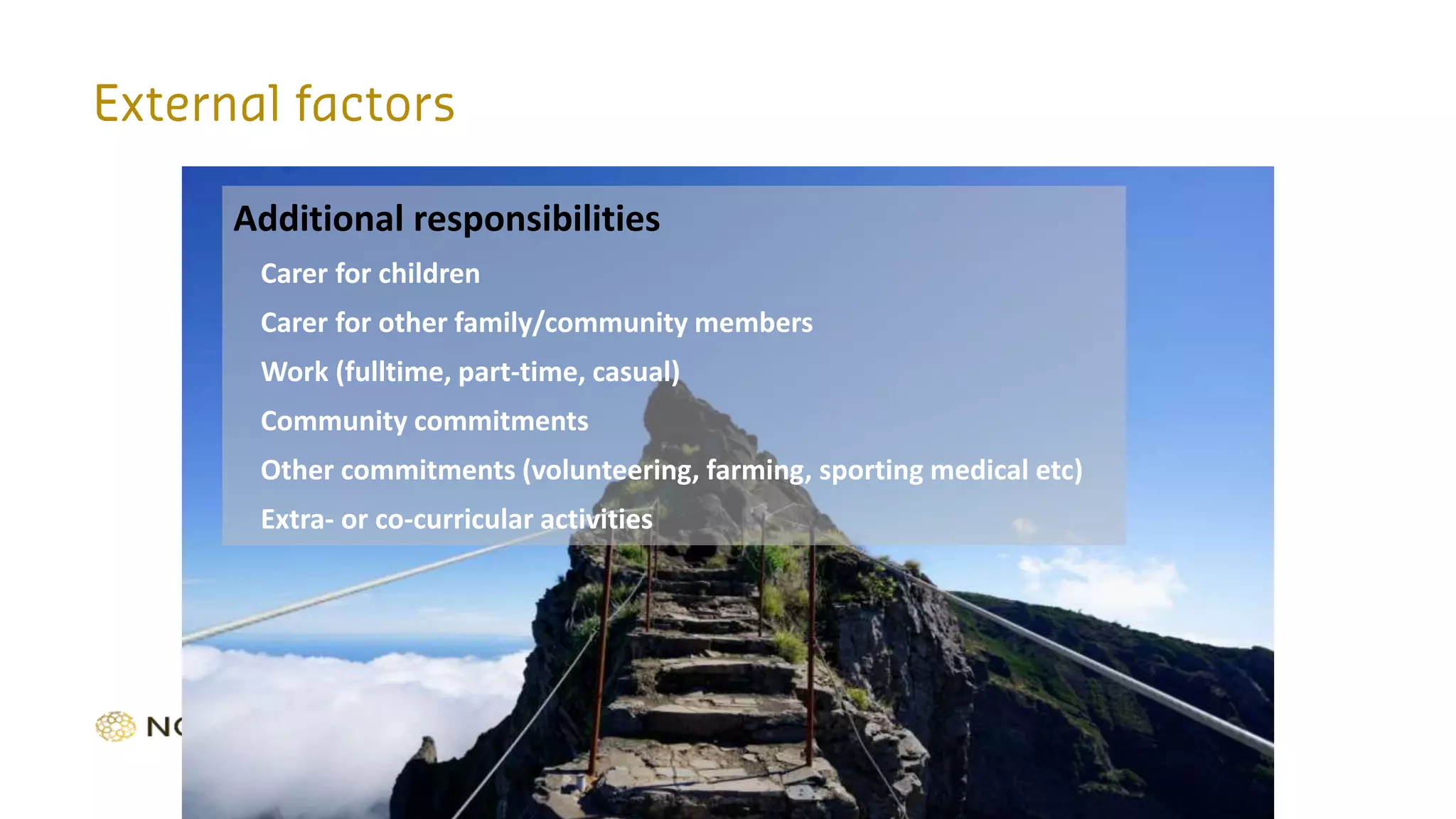
Additional responsibilities
Carer for children
Carer for other family/community members
Work (fulltime, part-time, casual)
Community commitments
Other commitments (volunteering, farming, sporting medical etc)
Extra- or co-curricular activities
35
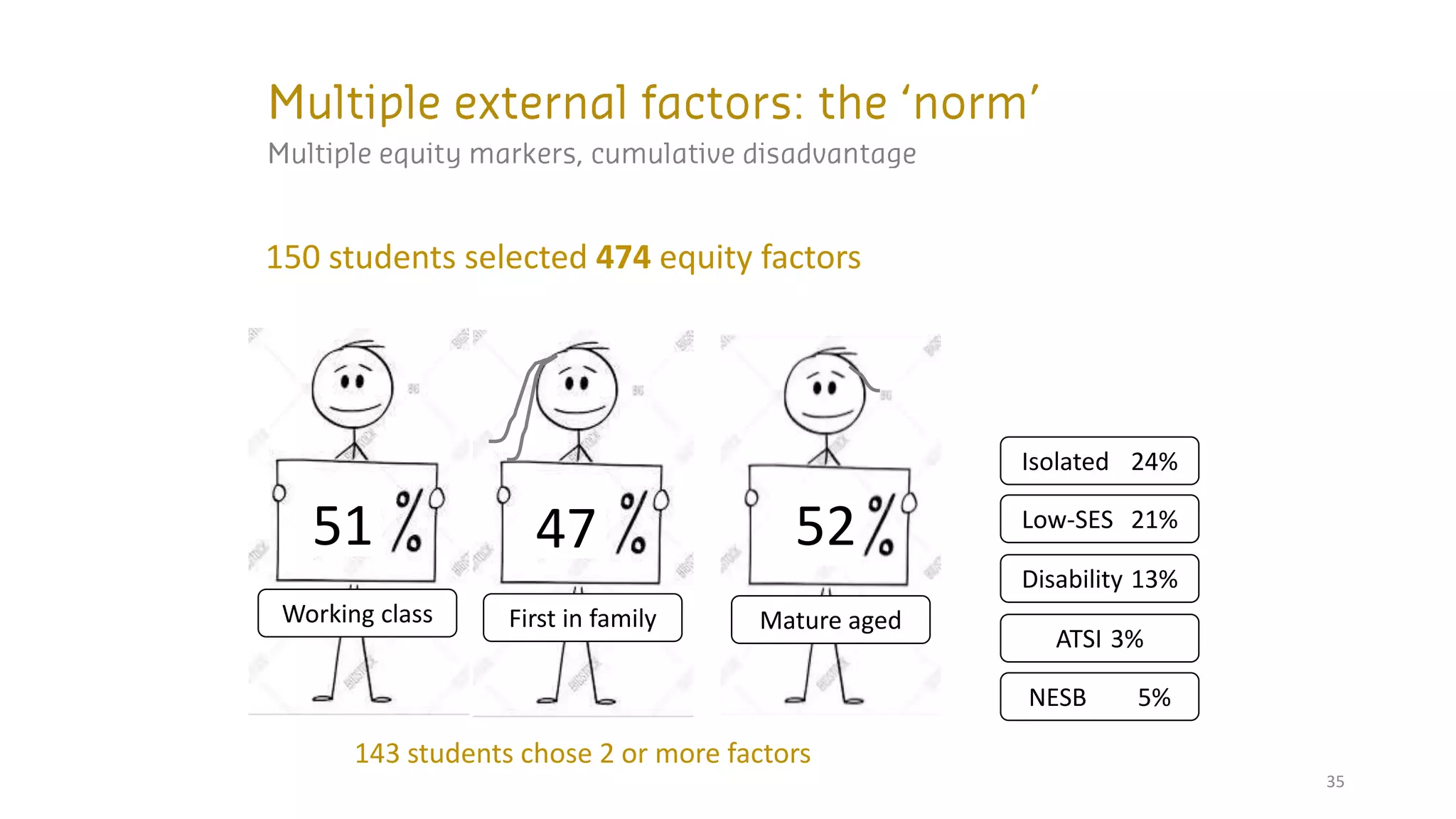
150 students selected 474 equity factors
51
Working class
Low-SES 21%
First in family
47 52
Mature aged
Isolated 24%
Disability 13%
ATSI 3%
NESB 5%
143 students chose 2 or more factors
36
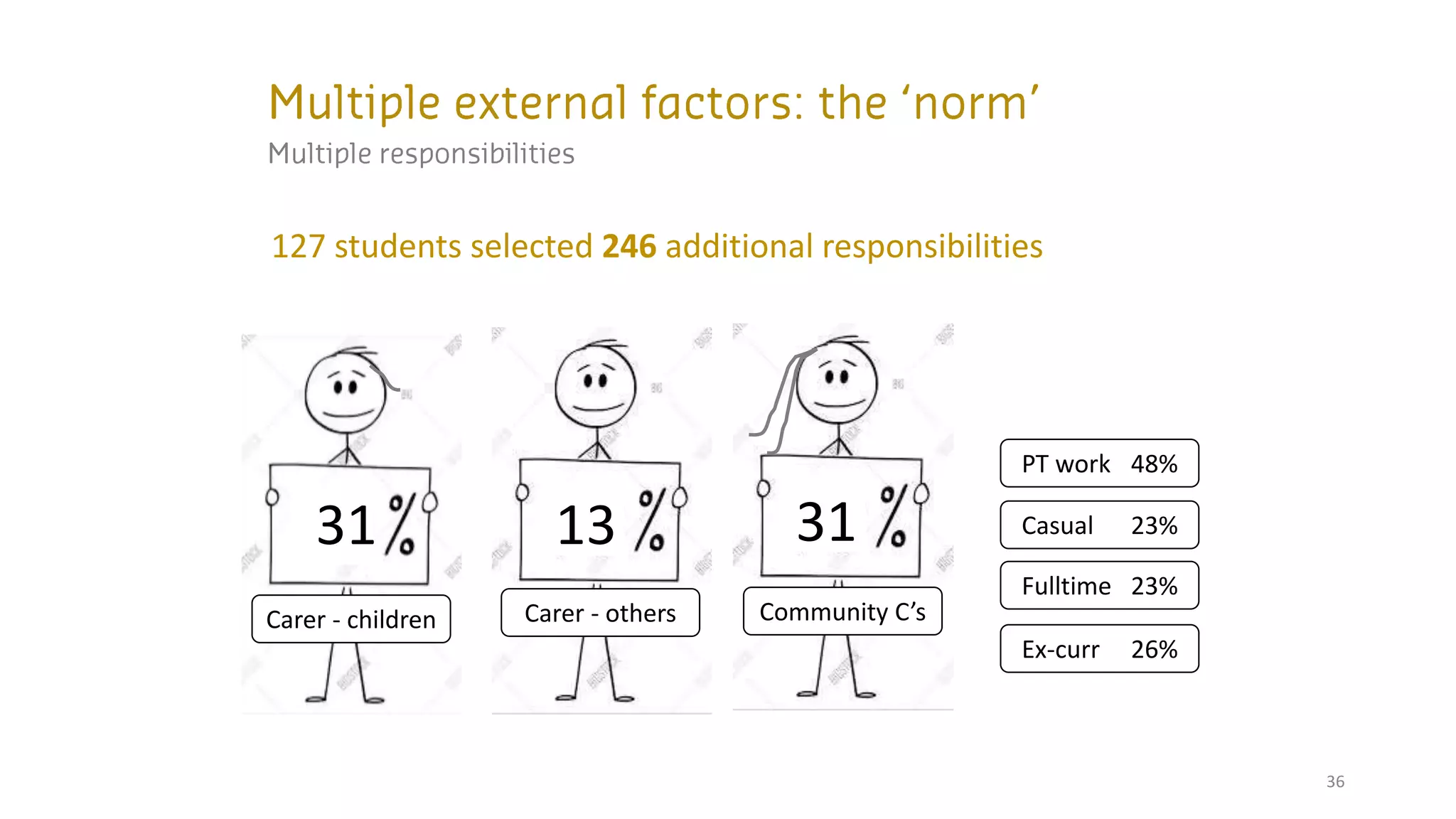
127 students selected 246 additional responsibilities
13
Carer - others
PT work 48%
Community C’s
31
31
Carer - children
Casual 23%
Fulltime 23%
Ex-curr 26%
37
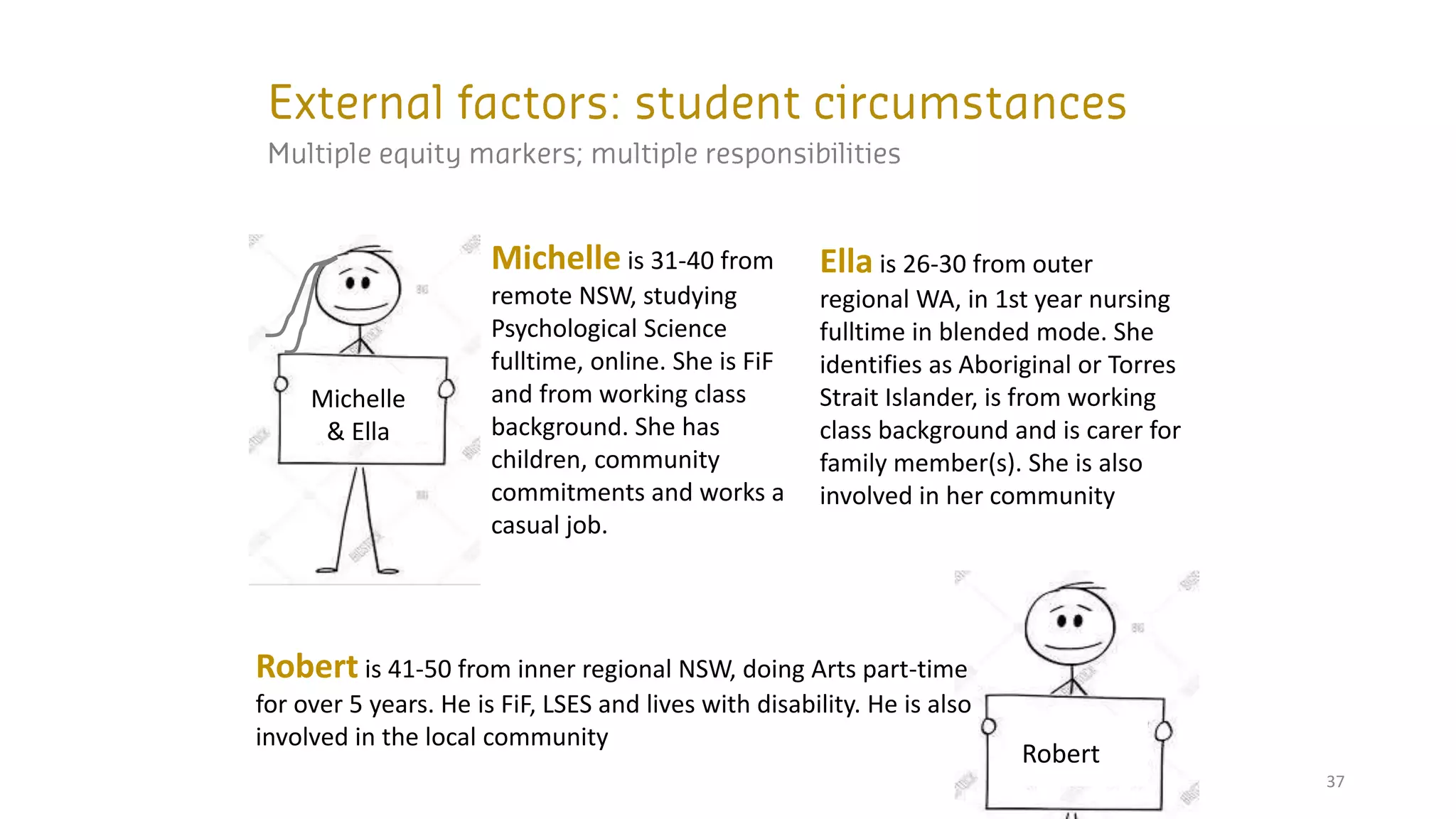
Robert
Michelle
& Ella
Michelle is 31-40 from
remote NSW, studying
Psychological Science
fulltime, online. She is FiF
and from working class
background. She has
children, community
commitments and works a
casual job.
Robert is 41-50 from inner regional NSW, doing Arts part-time
for over 5 years. He is FiF, LSES and lives with disability. He is also
involved in the local community
Ella is 26-30 from outer
regional WA, in 1st year nursing
fulltime in blended mode. She
identifies as Aboriginal or Torres
Strait Islander, is from working
class background and is carer for
family member(s). She is also
involved in her community
38
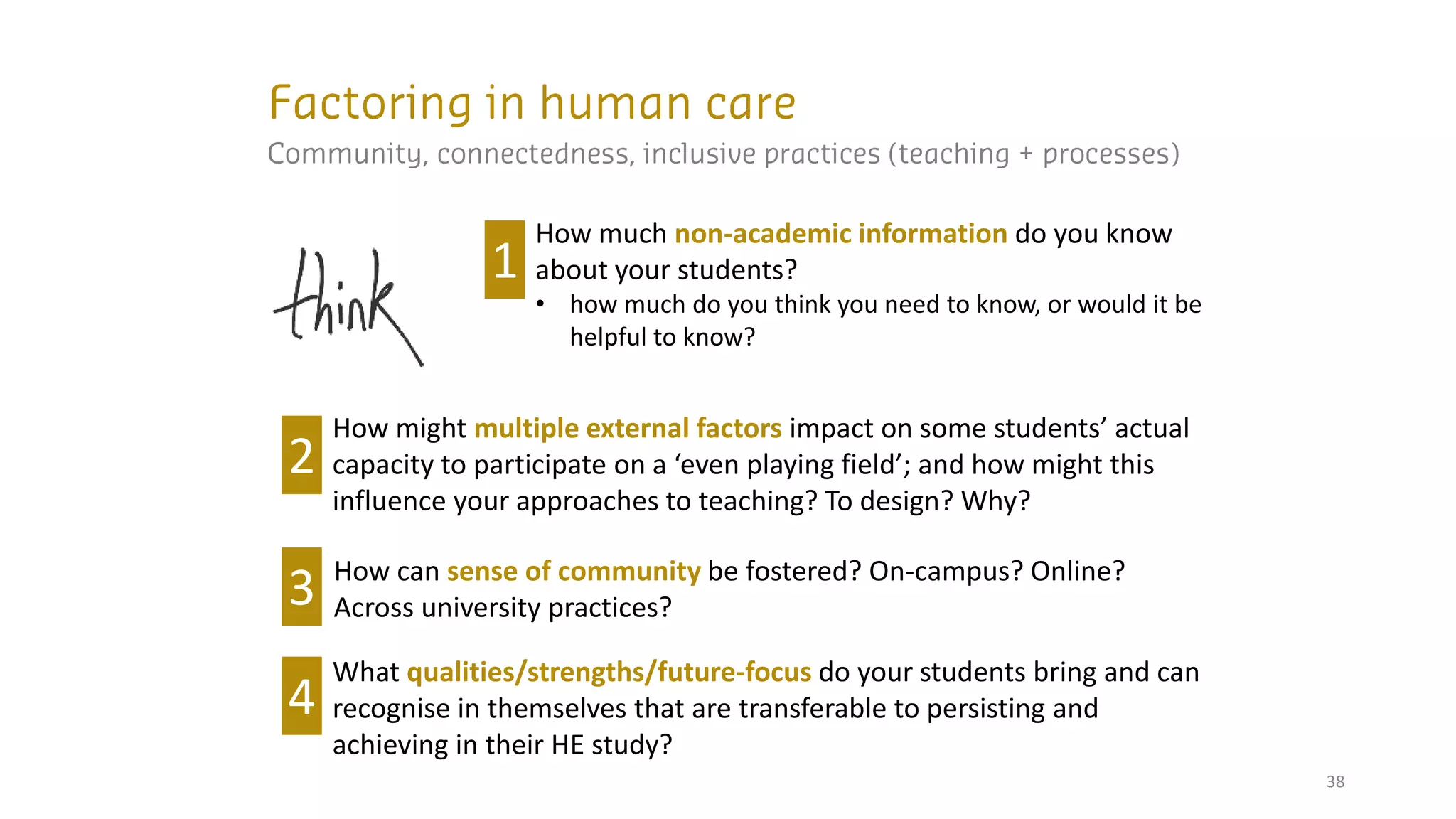
How much non-academic information do you know
about your students?
• how much do you think you need to know, or would it be
helpful to know?
1
How might multiple external factors impact on some students’ actual
capacity to participate on a ‘even playing field’; and how might this
influence your approaches to teaching? To design? Why?
2
How can sense of community be fostered? On-campus? Online?
Across university practices?
3
What qualities/strengths/future-focus do your students bring and can
recognise in themselves that are transferable to persisting and
achieving in their HE study?
4
CRICOS Provider Code 00301J
Thank you
CRICOS Provider Code 00301J
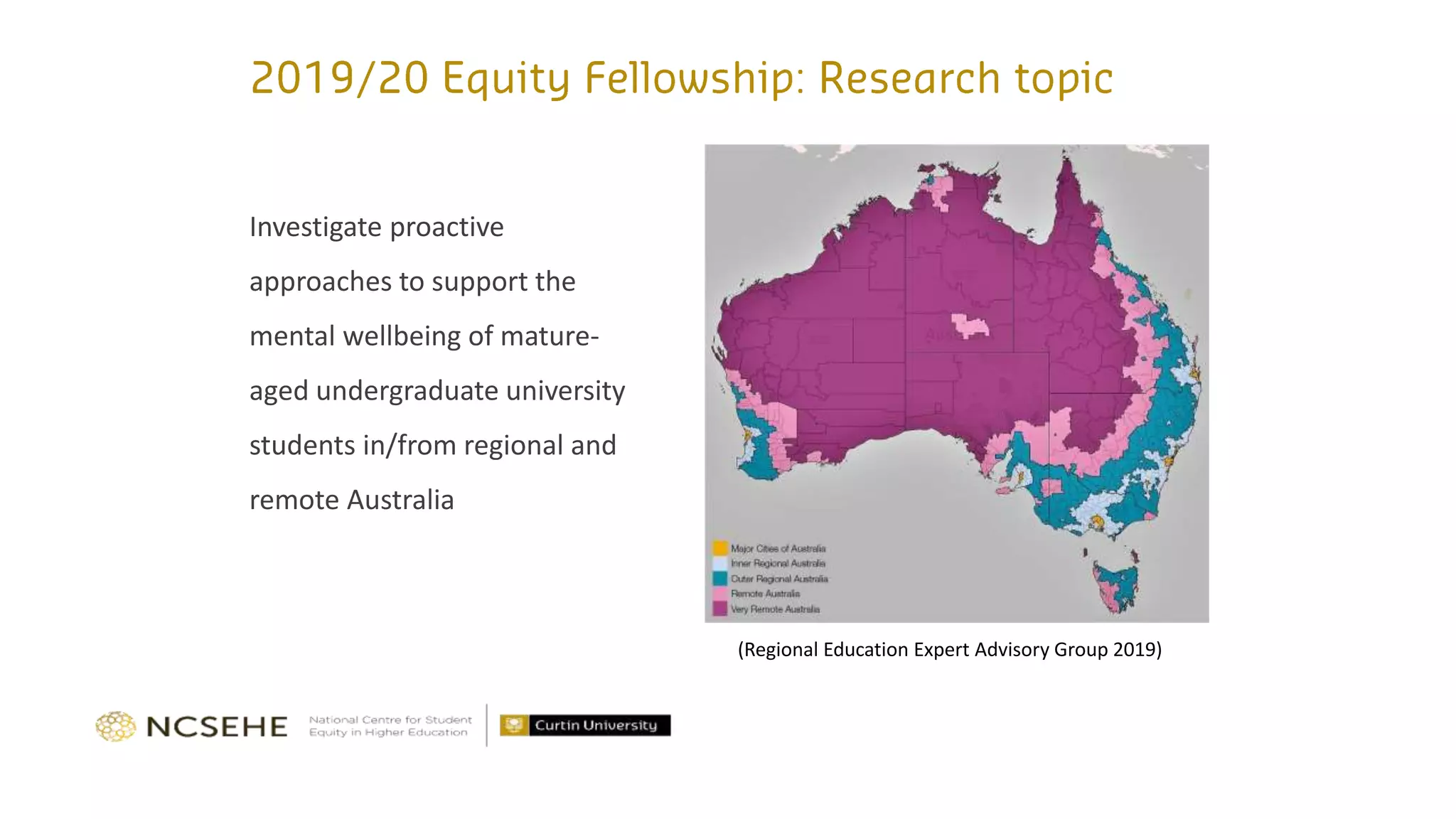
Investigate proactive
approaches to support the
mental wellbeing of mature-
aged undergraduate university
students in/from regional and
remote Australia
(Regional Education Expert Advisory Group 2019)
42
• Student mental health and wellbeing is of national (and international)
concern
• Regional and remote students are in the national spotlight
• Why look at mature-aged students from regional and remote areas?
o Attention is often paid to school leavers (e.g. in the recent national
reviews on regional and remote students)
o Responding to calls for deeper understanding of the diversity and
complexity of equity-group cohorts
o Potential positive influence of mature-aged students on their
families, peers, communities in regional and remote Australia
43
• Recent reports/projects in Australia
o Baik et al. (2016, 2017)
o Orygen (2017)
o Higher Education Standards Panel (HESP), 2018 – Recommendation 8
• International blueprints/approaches/frameworks
o Healthy Universities UK
o Okanagan Charter (2015)
o Orygen (2020)
[Holistic, institution-wide, settings approaches!]
For the purpose of this presentation, we’ll understand “mental wellbeing” as
managing the “normal” stresses of uni and life, being productive, fulfilled and
having a meaningful life… [adapted from the WHO (2014)]
Acknowledging that there are numerous definitions of mental health and models
of wellbeing, my project is informed by the following:
• The WHO’s (2014) definition
• MacKean’s (2011) dual-continuum model
• Ryan and Deci’s (2000) Self-determination
theory and adaptations of it for higher education,
including:
o Baik et al. (2016a, 2016c)
o Woodyatt (2019, 2020)
44
Belonging
Relationships
Connections
Purpose
Motivation
Meaning
Agency
Autonomy
Growth
Competence
Mastery
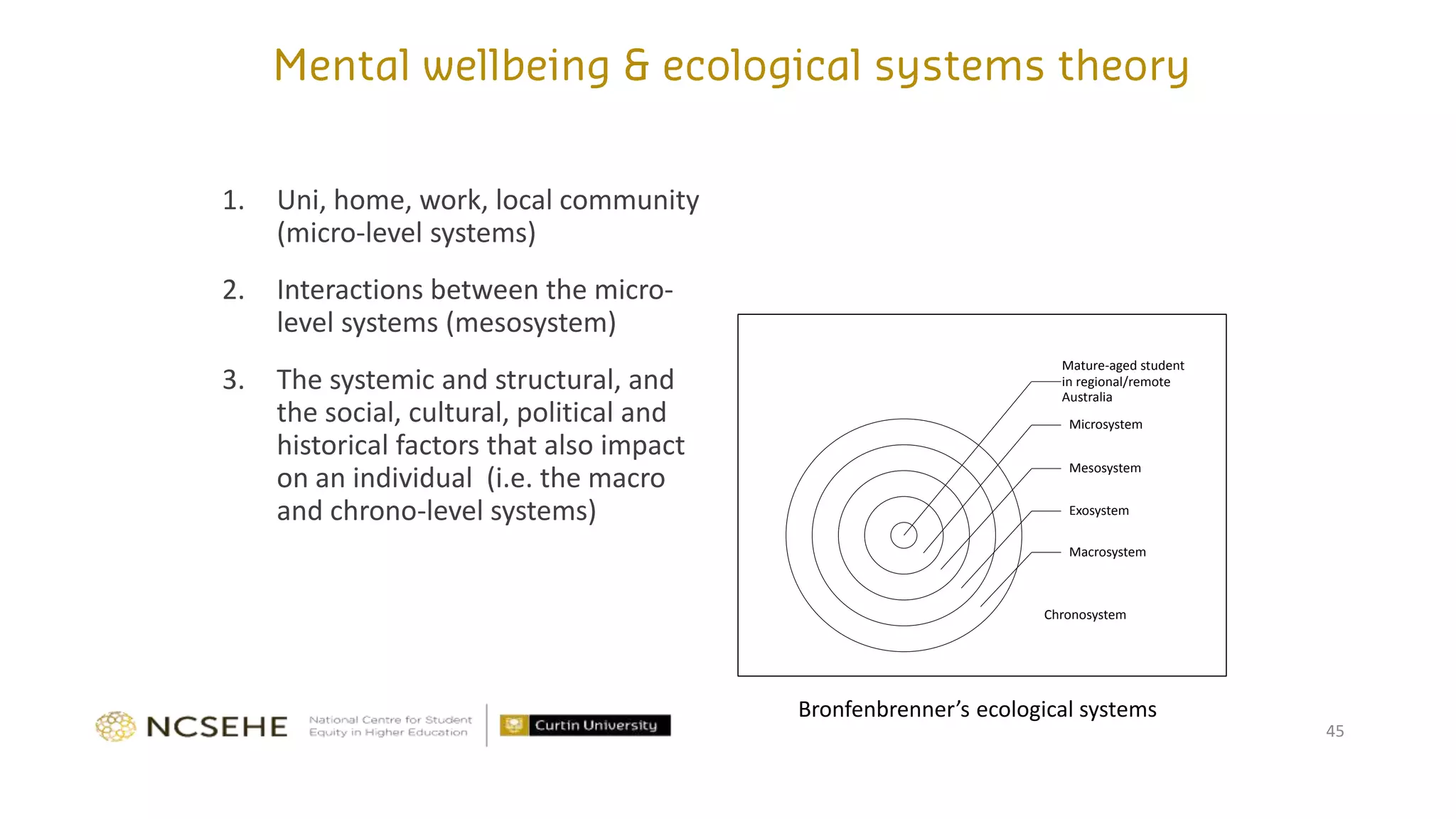
1. Uni, home, work, local community
(micro-level systems)
2. Interactions between the micro-
level systems (mesosystem)
3. The systemic and structural, and
the social, cultural, political and
historical factors that also impact
on an individual (i.e. the macro
and chrono-level systems)
45
Mature-aged student
in regional/remote
Australia
Microsystem
Mesosystem
Exosystem
Macrosystem
Chronosystem
Bronfenbrenner’s ecological systems
1. Australian Government: Department of Education, Skills and
Employment: higher education student data request in 2019
2. Student Survey administered at universities around Australia in
Oct/Nov 2019 (approx. 1,800 respondents answered most questions)
3. Student Interviews (n=51): in-depth, semi-structured, one-on-one (in
Feb, 2020)
46
47
• Compared to metro areas, higher % of
students in regional & remote areas are:
o Older
o Female
o LSES
o Studying online
o Studying part-time
o Aboriginal and Torres Strait Islander
students
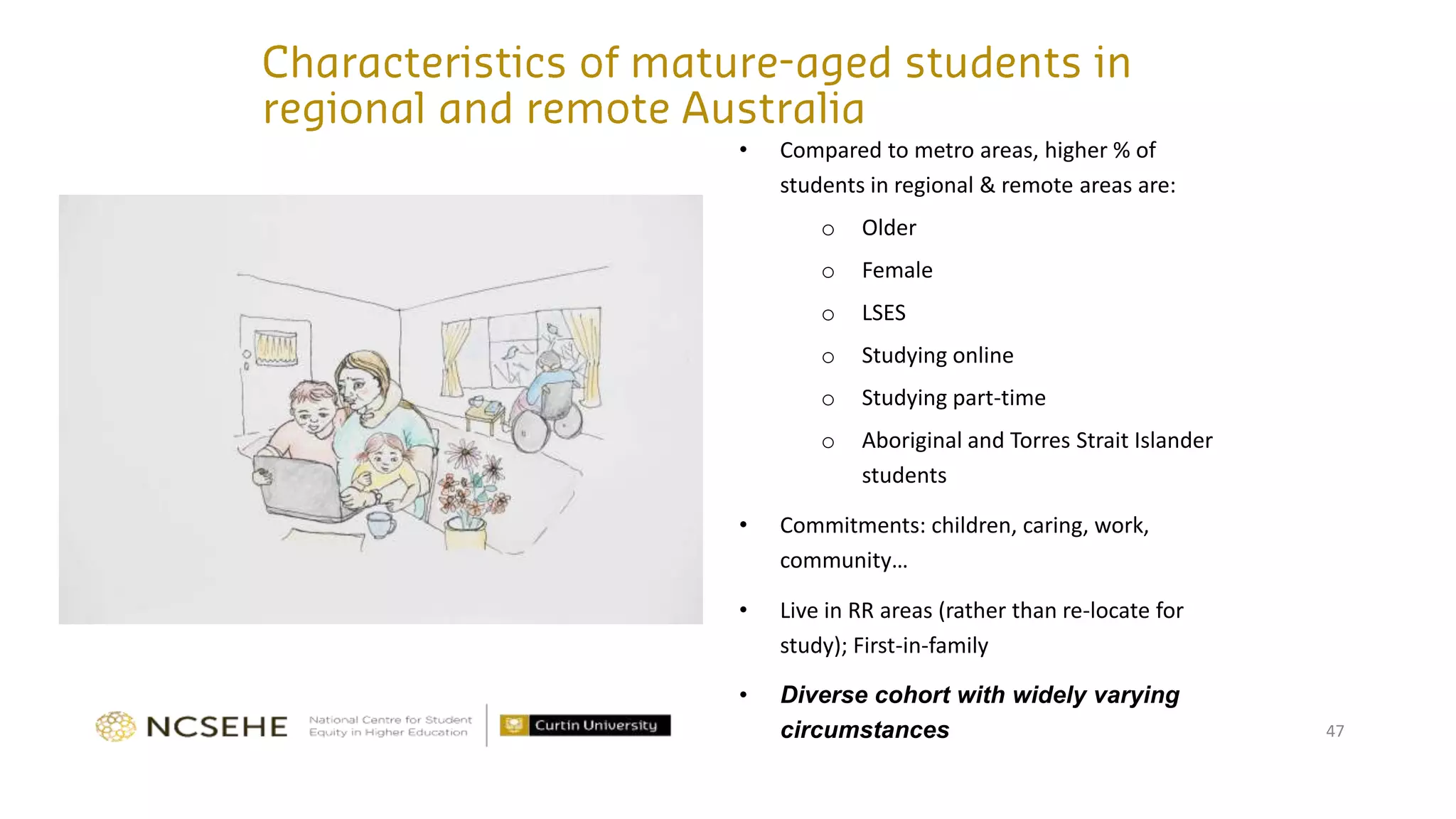
• Commitments: children, caring, work,
community…
• Live in RR areas (rather than re-locate for
study); First-in-family
• Diverse cohort with widely varying
circumstances
48
• Caught in a “juggling act”
• 47.7% (n=883) of the survey
respondents considered withdrawing
or deferring from their studies
• Top five reasons why they considered
withdrawing or deferring:
o stress
o feeling overwhelmed with their
university study-load
o mental health difficulties
o couldn’t fit study in with their
other commitments
o financial difficulties
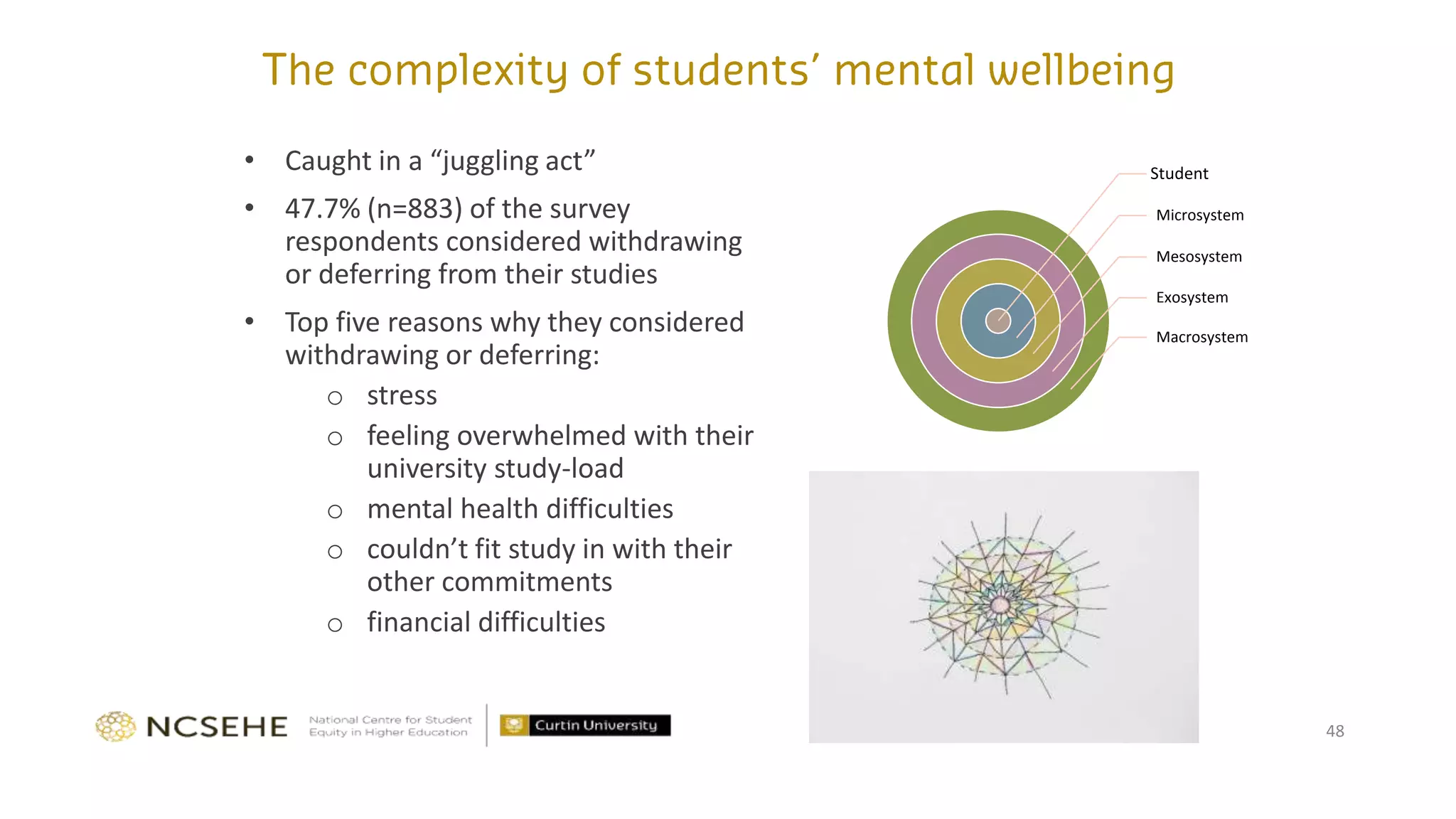
Student
Microsystem
Mesosystem
Exosystem
Macrosystem
The everyday interactions that students have with:
• teaching and support staff;
• their peers;
• the unit/subject content and curriculum; and
• the physical or online classroom
were found to be crucial in supporting students’ mental wellbeing.
49
1. Know students’ needs: understand their diverse circumstances
2. Be aware of practical challenges: e.g. bandwidth
3. Facilitate student connections
4. Provide opportunities for Q&As
5. Check in with students: online learning can be lonely and isolating
6. Promote your university’s student services (e.g. Counselling)
7. The impact of staff is enormous: it’s the small (human) actions that count
50
[My study] is a tiny desk in [the kids’] playroom. And I've got just a little
swivel chair and a tiny little desk, and stuff cluttered around everywhere.
Often I'm listening to a lecture with the kids climbing on top of me... so
concentration can be harder. Sometimes I bring my laptop out and I'll listen
to lectures while I'm doing the dishes, or while I'm cooking dinner. Yeah, it's
tricky.
51
1. Overview of who is
in your
course/subject/unit
from BIUs/data
teams?
2. https://www.ncseh
e.edu.au/data/instit
utional-data/
3. Ask students!
52
[The Internet] does drop out, and we do lose connectivity… afternoons are
worse… And, it’s also impossible to watch a lecture when there’s no
download.
53
The ability to actually talk with other students face to face about an
assignment and how they’re approaching it and how they’ve interpreted a
question and all that; that’s priceless.
54
One of the biggest things that holds you up on assignments is that you’ve got a
question and you post the question to the forum, and you have a look and it
hasn’t been answered, or you don’t really understand it still, and sometimes it
can take a while to get a response.
55
Have someone that can check in with the student from time to time - a
simple call to see how they are progressing or if they need any help.
Speaking from experience, I won't ask for help. I will tackle everything on
my own, which normally means I end up stressed. Some people are too
embarrassed to ask for help.
56
Reminders that support services are available and there is no harm in using
them.
I think the more separated you are, the less likely you are to know of what
you can do or things you can access.
57
Don’t forget the impact of your actions – it’s the little, kind, human things
that really matter!
58
1. Importance of community – a community of care
2. Debriefing with trusted colleagues
3. Bearing witness to students’ transformations
4. Coping strategies and self care
(For suggestions, see: Crawford et al. 2018; Olds et al. 2018.)
59
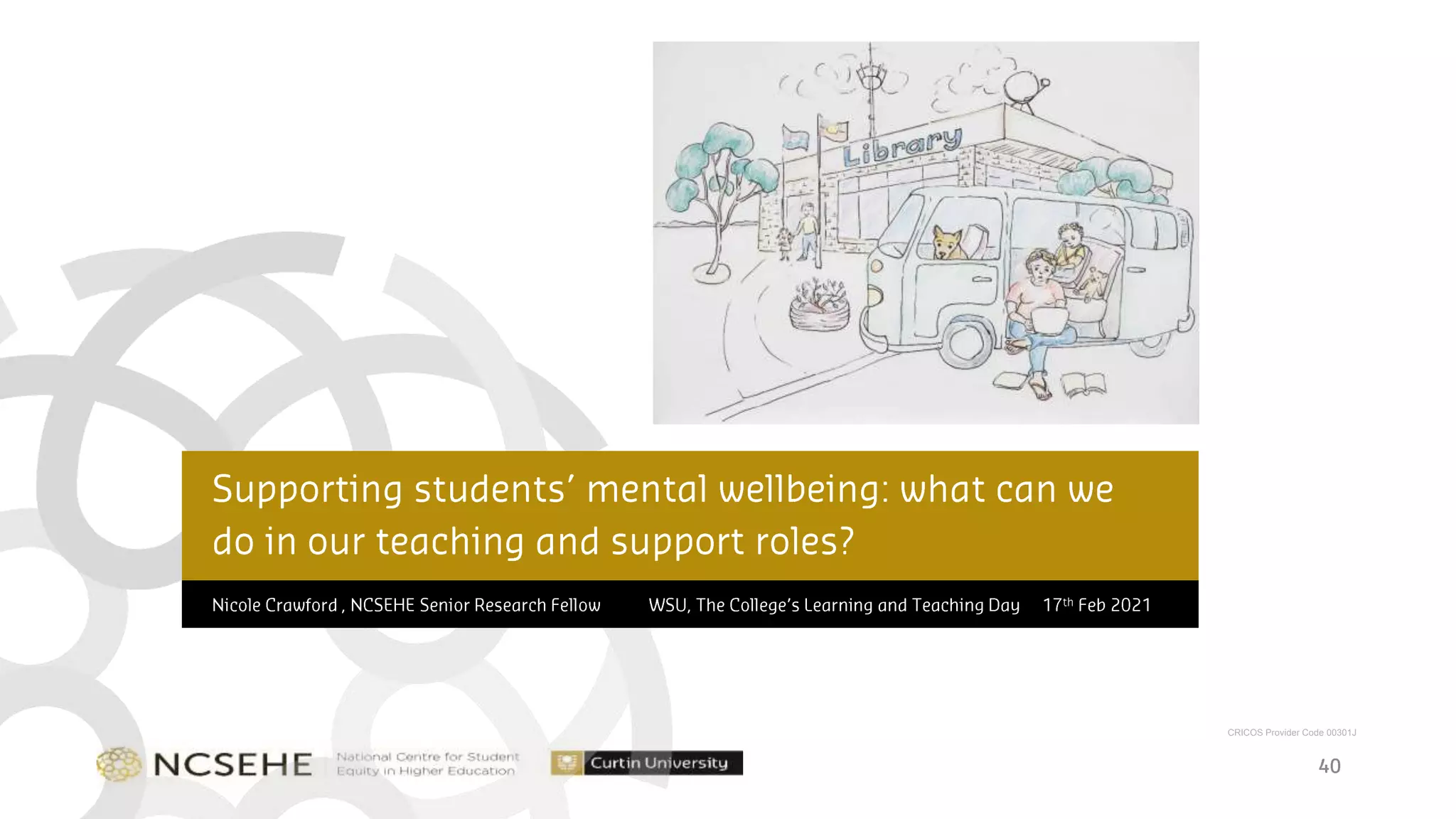
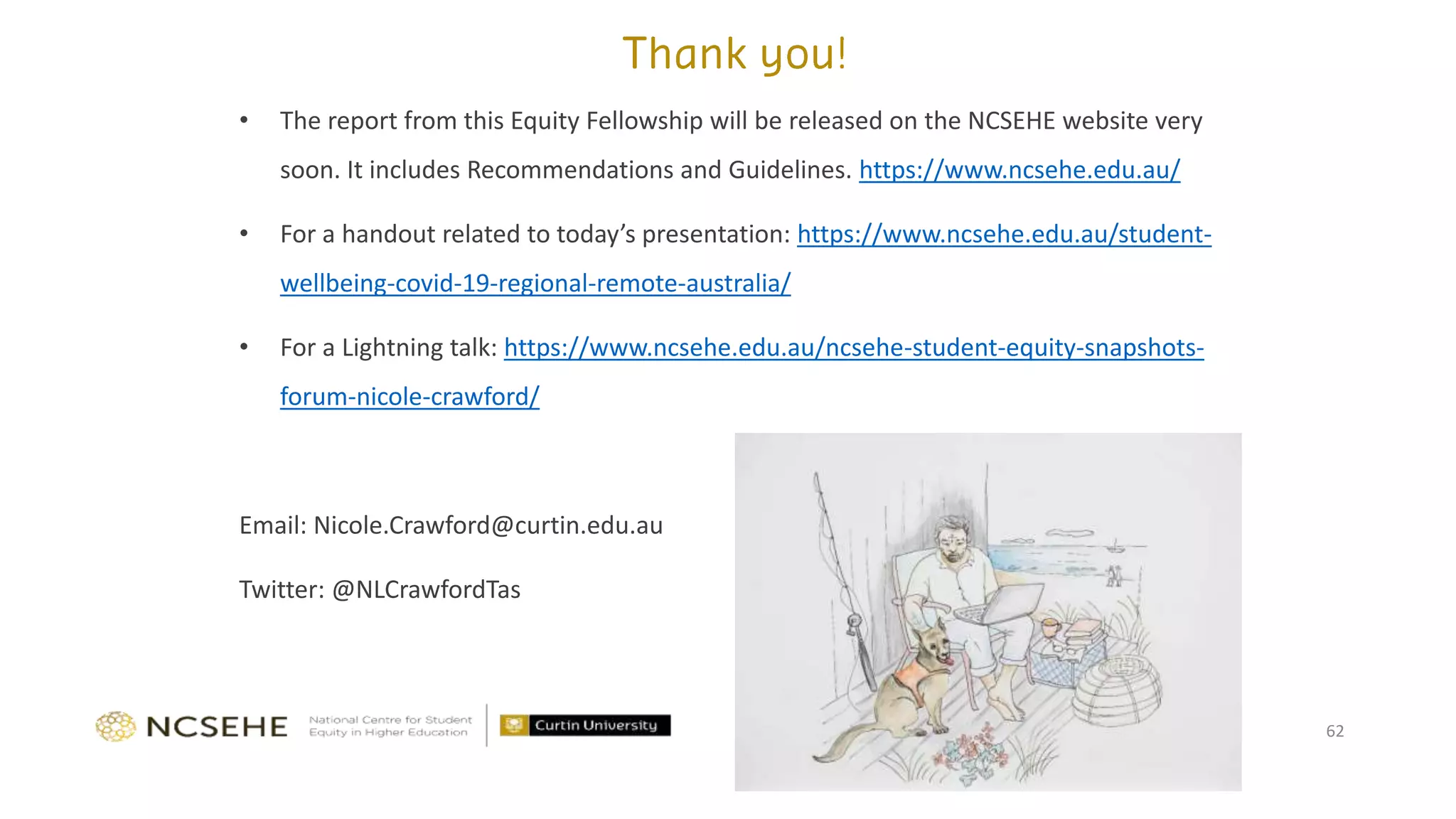
The beautiful illustrations in the Fellowship report and included in this presentation are by Morag
Porteous.
60
Baik, C., Larcombe, W., Brooker, A., Wyn, J., Allen, L., Brett, M., . . . James, R. (2016). Enhancing student
wellbeing. http://unistudentwellbeing.edu.au/
Crawford, N. (2020). Supporting student wellbeing during COVID-19: Tips from regional and remote
Australia. https://www.ncsehe.edu.au/student-wellbeing-covid-19-regional-remote-australia/
Crawford, N., & Johns, S. (2018). An academic’s role? Supporting student wellbeing in pre-university enabling
programs. Journal of University Teaching & Learning Practice, 15(3), 2.
https://ro.uow.edu.au/jutlp/vol15/iss3/2/
Crawford, N., Kift. S, & Jarvis, L. (2019). Supporting student mental wellbeing in enabling education:
practices, pedagogies and a philosophy of care. In Jones, A., Olds, A., & Lisciandro, J (eds),
Transitioning Students in Higher Education, Routledge.
Healthy Universities. (2020). UK Healthy Universities Network. Retrieved from
https://healthyuniversities.ac.uk/
61
Higher Education Standards Panel. (2018). Final report - Improving retention, completion and success in
higher education.
MacKean, G. (2011). Mental health and well-being in post-secondary education settings: A literature and
environmental scan to support planning and action in Canada. Retrieved from Vancouver:
http://citeseerx.ist.psu.edu/viewdoc/download?doi=10.1.1.737.6978&rep=rep1&type=pdf
Okanagan Charter. (2015). Okanagan Charter: an international charter for health promoting universities and colleges.
Retrieved from http://www.healthpromotingcampuses.ca/okanagancharter/
Orygen. (2017). Under the radar: the mental health of Australian university students. Retrieved from Melbourne:
https://www.orygen.org.au/Policy-Advocacy/Policy-Reports/Under-the-radar
Regional Education Expert Advisory Group. (2019). National Regional, Rural and Remote Tertiary Education Strategy:
Final Report.
Ryan, R. M., & Deci, E. L. (2000). Self-determination theory and the facilitation of intrinsic motivation, social
development, and well-being. American psychologist, 55(1), 68-78.
Woodyatt, L. (2019). “Psychological Wellbeing Network” session. STARS Conference 2019, Melbourne.
Woodyatt, L. (2020). NCSEHE webinar — Five meaningful minutes: Small changes to support psychological needs,
wellbeing and motivation online in 2020.
World Health Organization. (2014). Mental health: a state of well-being. Retrieved from
http://origin.who.int/features/factfiles/mental_health/en/
• The report from this Equity Fellowship will be released on the NCSEHE website very
soon. It includes Recommendations and Guidelines. https://www.ncsehe.edu.au/
• For a handout related to today’s presentation: https://www.ncsehe.edu.au/student-
wellbeing-covid-19-regional-remote-australia/
• For a Lightning talk: https://www.ncsehe.edu.au/ncsehe-student-equity-snapshots-
forum-nicole-crawford/
Email: Nicole.Crawford@curtin.edu.au
Twitter: @NLCrawfordTas
62

Creating equitable learning environments, fostering community, and supporting students’ mental wellbeing: Findings and strategies from NCSEHE research projects

  • 1.
    CRICOS Provider Code00301J Creating equitable learning environments, fostering community, and supporting students’ mental wellbeing: Findings and strategies from NCSEHE research projects
  • 2.
  • 4.
  • 6.
    The Best Chancefor All: Student Equity 2030 — A long-term strategic vision for student equity in higher education NCSEHE Focus: The future of Australian higher education: A synthesis of recent research and policy reports with implications for student equity Improving equity for care leavers in higher education: Tracing the impact of out of care, into university Career construction, future work and the perceived risks of going to university for young people from low SES backgrounds Regional communities’ influences on equity participation in higher education https://www.ncsehe.edu.au/wp- content/uploads/2019/03/Equity2030_FI NAL.pdf https://www.ncsehe.edu.au/wp- content/uploads/2020/02/Impact_OutofC are_FINAL.pdf https://www.ncsehe.edu.au/wp- content/uploads/2018/10/The-Future-of- HE_Equity-.pdf https://www.ncsehe.edu.au/wp- content/uploads/2019/12/Barnes-et- al.Report-Final.pdf https://www.ncsehe.edu.au/publications/ perceived-risks-of-going-to-university/
  • 7.
  • 8.
    • • • Retention ratesfor some populations remain consistently lower than the national average 2011 2012 2013 2014 2015 2016 2017 Low SES 16.4 17.4 18.8 19.1 19.6 18.7 20.5 Disability 16.5 16.0 17.6 17.4 17.6 17.4 18.7 Indigenous 26.7 27.6 25.4 26.2 25.2 25.8 28.8 Regional 17.2 18.2 19.5 19.8 20.2 19.7 21.6 Remote 23.0 22.9 21.8 22.2 21.4 22.8 22.8 NESB 9.6 10.0 10.7 10.5 11.4 11.3 11.1 Australia 13.2 14.0 15.2 15.3 15.7 15.5 16.4 Table 1: Domestic Undergraduate Attrition Rates: Australia and Equity Groups, 2011 to 2017: Koshy, 2020
  • 9.
  • 10.
  • 12.
  • 13.
  • 15.
  • 18.
    CRICOS Provider Code00301J 2020 NCSEHE Equity Fellowship: “You going to uni”?: Exploring how regional people navigate into and through higher education
  • 19.
  • 20.
    • Brief overviewof my NCSEHE Equity Fellowship project • Key Findings • Realities of Location and services accessibility • Snapshots of strengths and diversity • Sense of community • Personal qualities and strengths • External factors: equity markers, additional responsibilities • Factoring in human care, connectedness
  • 21.
  • 22.
  • 23.
    CRICOS Provider Code00301J Key Findings
  • 24.
    Remoteness areas are determined usinga process that provides a consistent definition across Australia and over time. Indicates relative access to services
  • 25.
    NSW QLD VICSA WA NT Averages Inner 78.3% 79.7% 79.2% 80.3% 82.6% n/a 80% Outer 71.8% 79.2% 73.6% 72.8% 78.2% 84.8% 77% Remote 65.4% 79.2% 73.6% 72.8% 78.2% 84.8% 76% V.Remote 65.4% 68.6% n/a 64.5% 69.5% 54.6% 65% 2016 Census: Internet connection to dwelling “Internet connection” = households that that had at least one person access the internet from the dwelling (i.e. through computer, mobile/smart phone, tablet, music/video player, gaming console, smart TV or any other device)
  • 27.
    27 I’m saying topeople consider online as an option because it opens up so many more options. You can do a billion degrees … sitting right here … it doesn’t just have to be those three degrees on offer at the local campus (Hannah, OR) Online students I don’t think are valued the same as on-campus students by the academics to some degree … and I think that now they’re getting it thanks to COVID! (Gayle, OR) Everything takes longer - be it the mail … or download speeds for internet. There is no instantaneous in the country. Even the most simple thing like having video on in an on- line meeting can make the difference between being able to attend or not … Distance and technology are the restrictions to regional study. (Simone, OR)
  • 28.
    28 Community The sense of communityand how everyone is willing to jump in and help each other no matter their own situation (Monica, IR)
  • 29.
    29 I think justspeaking for the people who I’m currently at uni with, their sense of community is really strong; within the university there’s a community but also just through everything that everyone’s been through this year … people genuinely care about their fellow students, their community as a whole … if someone needs help, there’s always someone who will stand up and help them … that’s a quality that a lot of people who grew up in regional areas have … That’s just been my experience … I think that’s something that the people here have which is amazing and means that they’re so much more successful because they always feel supported and part of something (Sophie, IR)
  • 30.
    30 As a regionalstudent, I actually feel that the university is a lot more approachable, the staff are a lot more approachable, the resources seem to be more accessible than if I was at a bigger centre, or in [city]. I did attend [metro university] for a period and it was just really clinical, distant – I didn’t enjoy the actual experience that much, whereas here in [regional university], it seems everyone seems to know each other a lot more. The staff really do seem to know their students a lot more which is really fantastic (Lucy, IR) [The Country Universities Centre] are just absolutely invaluable. I really do feel like I couldn’t have done it without their support and also that knowing that they’re there, that if I am stuck with something, that I can make an appointment or I can just turn up, have a chat to somebody and they can help me work through whatever it is that I need (Wendy, IR)
  • 31.
    willingness to succeed - Ican do it! know what it's like to truly struggle Resilient Determined Resourceful work ethic - I always saw everyone work “We are resilient, we know what it’s like to truly struggle.” “For me, [my work ethic] was my family. I grew up in the back of a milk bar so I saw my family work, I went to work with my mum, I went to work with my dad … so I always saw everyone work” “Just that willingness to succeed and show people that even though I do come from a different background … that I can achieve what I want to achieve and if I put my mind to it, I can do it”
  • 32.
    32 I want tobe a primary school teacher ... be part of the decision making process I'd like to be a stay at home mum earning a wage through my business from home Work with youth that need guidance and support, I believe this would give me a sense of self fulfilment to be able to do something I love and care for others I don’t want to head towards a position that’s stagnant and that won’t allow me to grow … that would be being on a ward and just being a ward nurse Make a difference. Help people. Work for an organisation that see me as a person not a number. Enjoy my work. Have a work life balance Various goals: specific, general, big picture, altruistic, personal, self-to- avoid
  • 33.
    Six Equity Groups (traditionallyunderrepresented) Regional and remote locations Identify as Aboriginal or Torres Strait Islander Low SES (socio-economic status) With disability From non-English-speaking background *women in non-traditional areas (not included) Other equity factors First in family Mature age Working class background Refugee background
  • 34.
    Additional responsibilities Carer forchildren Carer for other family/community members Work (fulltime, part-time, casual) Community commitments Other commitments (volunteering, farming, sporting medical etc) Extra- or co-curricular activities
  • 35.
    35 150 students selected474 equity factors 51 Working class Low-SES 21% First in family 47 52 Mature aged Isolated 24% Disability 13% ATSI 3% NESB 5% 143 students chose 2 or more factors
  • 36.
    36 127 students selected246 additional responsibilities 13 Carer - others PT work 48% Community C’s 31 31 Carer - children Casual 23% Fulltime 23% Ex-curr 26%
  • 37.
    37 Robert Michelle & Ella Michelle is31-40 from remote NSW, studying Psychological Science fulltime, online. She is FiF and from working class background. She has children, community commitments and works a casual job. Robert is 41-50 from inner regional NSW, doing Arts part-time for over 5 years. He is FiF, LSES and lives with disability. He is also involved in the local community Ella is 26-30 from outer regional WA, in 1st year nursing fulltime in blended mode. She identifies as Aboriginal or Torres Strait Islander, is from working class background and is carer for family member(s). She is also involved in her community
  • 38.
    38 How much non-academicinformation do you know about your students? • how much do you think you need to know, or would it be helpful to know? 1 How might multiple external factors impact on some students’ actual capacity to participate on a ‘even playing field’; and how might this influence your approaches to teaching? To design? Why? 2 How can sense of community be fostered? On-campus? Online? Across university practices? 3 What qualities/strengths/future-focus do your students bring and can recognise in themselves that are transferable to persisting and achieving in their HE study? 4
  • 39.
    CRICOS Provider Code00301J Thank you
  • 40.
  • 41.
    Investigate proactive approaches tosupport the mental wellbeing of mature- aged undergraduate university students in/from regional and remote Australia (Regional Education Expert Advisory Group 2019)
  • 42.
    42 • Student mentalhealth and wellbeing is of national (and international) concern • Regional and remote students are in the national spotlight • Why look at mature-aged students from regional and remote areas? o Attention is often paid to school leavers (e.g. in the recent national reviews on regional and remote students) o Responding to calls for deeper understanding of the diversity and complexity of equity-group cohorts o Potential positive influence of mature-aged students on their families, peers, communities in regional and remote Australia
  • 43.
    43 • Recent reports/projectsin Australia o Baik et al. (2016, 2017) o Orygen (2017) o Higher Education Standards Panel (HESP), 2018 – Recommendation 8 • International blueprints/approaches/frameworks o Healthy Universities UK o Okanagan Charter (2015) o Orygen (2020) [Holistic, institution-wide, settings approaches!]
  • 44.
    For the purposeof this presentation, we’ll understand “mental wellbeing” as managing the “normal” stresses of uni and life, being productive, fulfilled and having a meaningful life… [adapted from the WHO (2014)] Acknowledging that there are numerous definitions of mental health and models of wellbeing, my project is informed by the following: • The WHO’s (2014) definition • MacKean’s (2011) dual-continuum model • Ryan and Deci’s (2000) Self-determination theory and adaptations of it for higher education, including: o Baik et al. (2016a, 2016c) o Woodyatt (2019, 2020) 44 Belonging Relationships Connections Purpose Motivation Meaning Agency Autonomy Growth Competence Mastery
  • 45.
    1. Uni, home,work, local community (micro-level systems) 2. Interactions between the micro- level systems (mesosystem) 3. The systemic and structural, and the social, cultural, political and historical factors that also impact on an individual (i.e. the macro and chrono-level systems) 45 Mature-aged student in regional/remote Australia Microsystem Mesosystem Exosystem Macrosystem Chronosystem Bronfenbrenner’s ecological systems
  • 46.
    1. Australian Government:Department of Education, Skills and Employment: higher education student data request in 2019 2. Student Survey administered at universities around Australia in Oct/Nov 2019 (approx. 1,800 respondents answered most questions) 3. Student Interviews (n=51): in-depth, semi-structured, one-on-one (in Feb, 2020) 46
  • 47.
    47 • Compared tometro areas, higher % of students in regional & remote areas are: o Older o Female o LSES o Studying online o Studying part-time o Aboriginal and Torres Strait Islander students • Commitments: children, caring, work, community… • Live in RR areas (rather than re-locate for study); First-in-family • Diverse cohort with widely varying circumstances
  • 48.
    48 • Caught ina “juggling act” • 47.7% (n=883) of the survey respondents considered withdrawing or deferring from their studies • Top five reasons why they considered withdrawing or deferring: o stress o feeling overwhelmed with their university study-load o mental health difficulties o couldn’t fit study in with their other commitments o financial difficulties Student Microsystem Mesosystem Exosystem Macrosystem
  • 49.
    The everyday interactionsthat students have with: • teaching and support staff; • their peers; • the unit/subject content and curriculum; and • the physical or online classroom were found to be crucial in supporting students’ mental wellbeing. 49
  • 50.
    1. Know students’needs: understand their diverse circumstances 2. Be aware of practical challenges: e.g. bandwidth 3. Facilitate student connections 4. Provide opportunities for Q&As 5. Check in with students: online learning can be lonely and isolating 6. Promote your university’s student services (e.g. Counselling) 7. The impact of staff is enormous: it’s the small (human) actions that count 50
  • 51.
    [My study] isa tiny desk in [the kids’] playroom. And I've got just a little swivel chair and a tiny little desk, and stuff cluttered around everywhere. Often I'm listening to a lecture with the kids climbing on top of me... so concentration can be harder. Sometimes I bring my laptop out and I'll listen to lectures while I'm doing the dishes, or while I'm cooking dinner. Yeah, it's tricky. 51
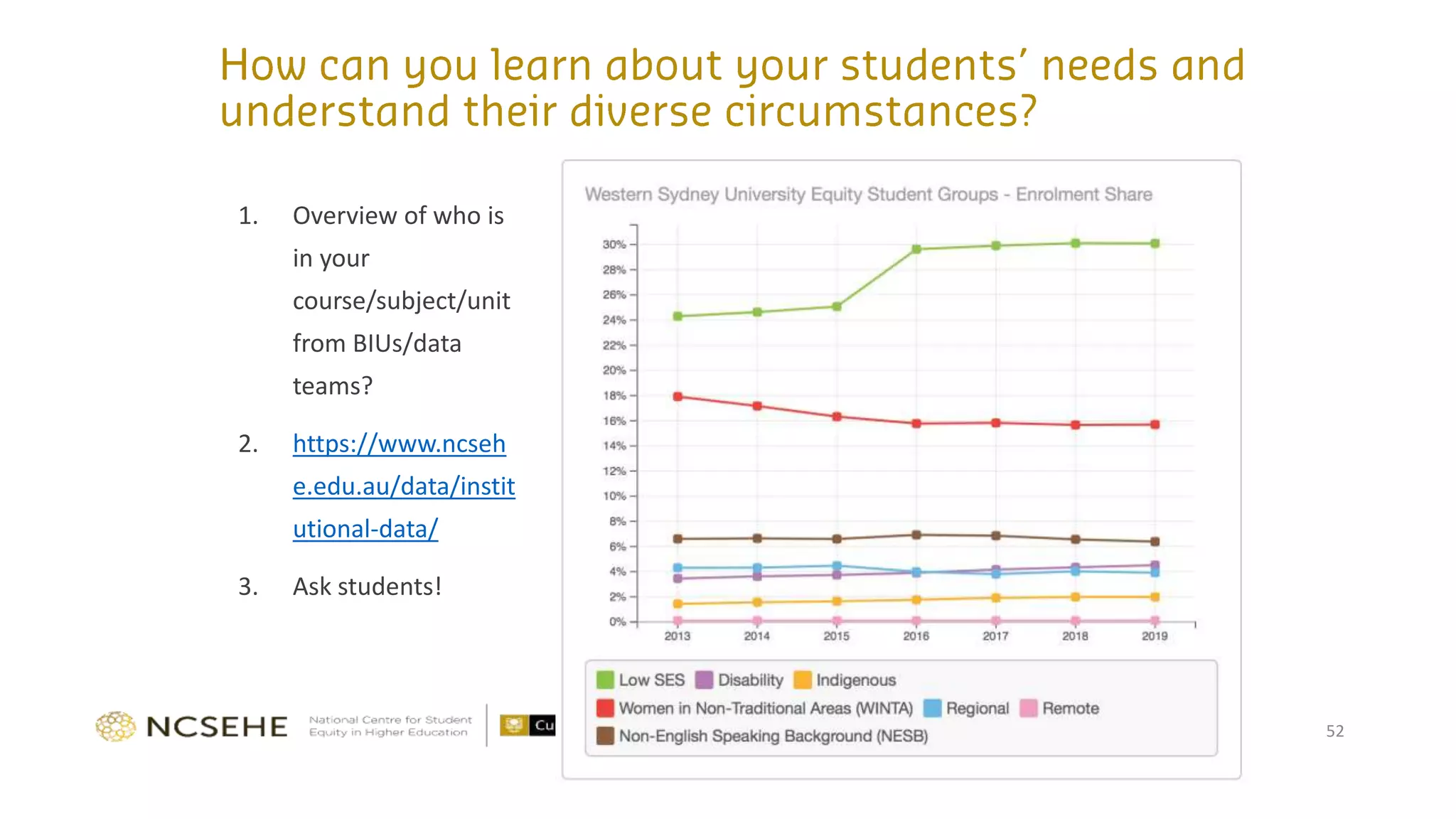
  • 52.
    1. Overview ofwho is in your course/subject/unit from BIUs/data teams? 2. https://www.ncseh e.edu.au/data/instit utional-data/ 3. Ask students! 52
  • 53.
    [The Internet] doesdrop out, and we do lose connectivity… afternoons are worse… And, it’s also impossible to watch a lecture when there’s no download. 53
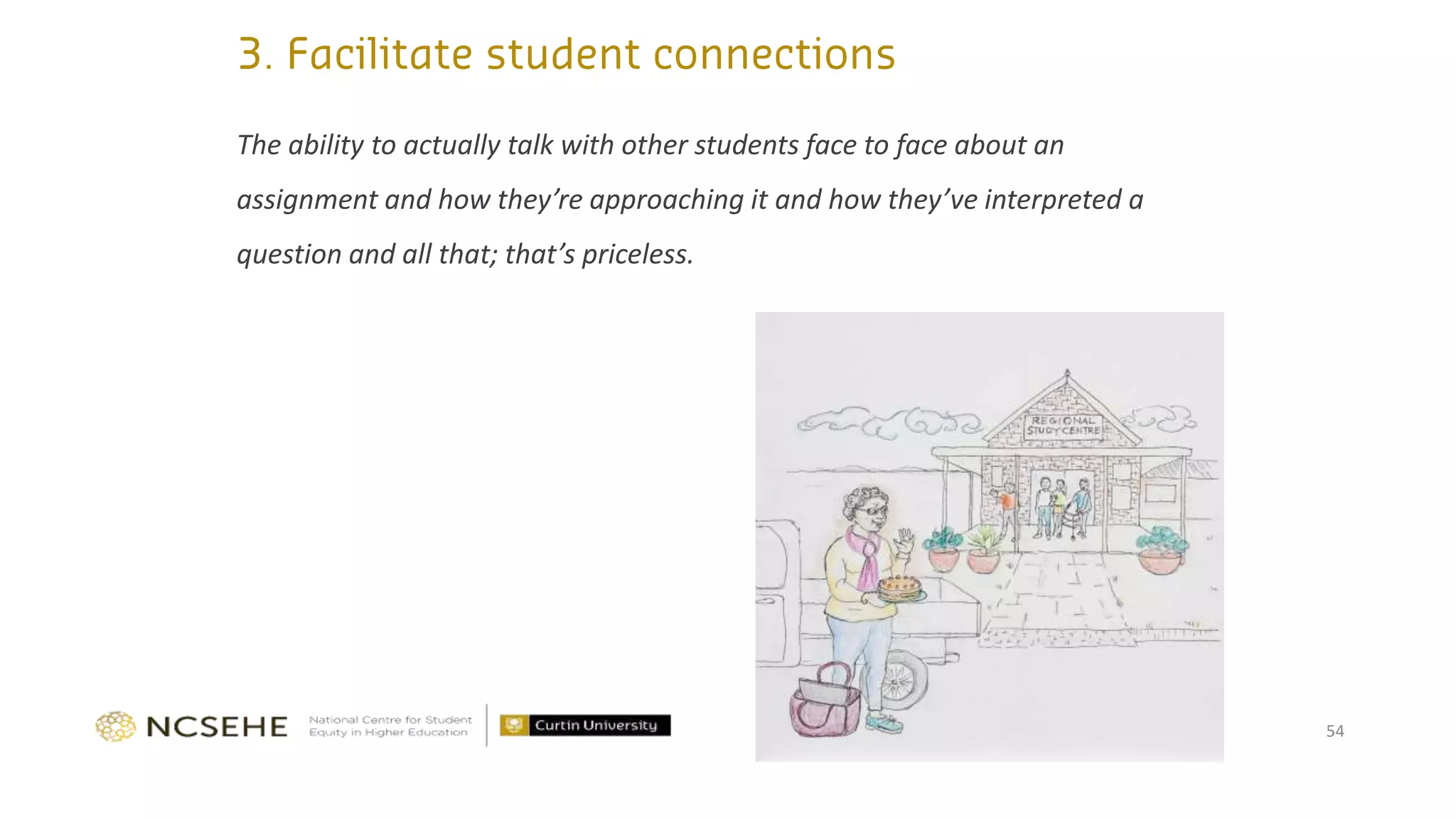
  • 54.
    The ability toactually talk with other students face to face about an assignment and how they’re approaching it and how they’ve interpreted a question and all that; that’s priceless. 54
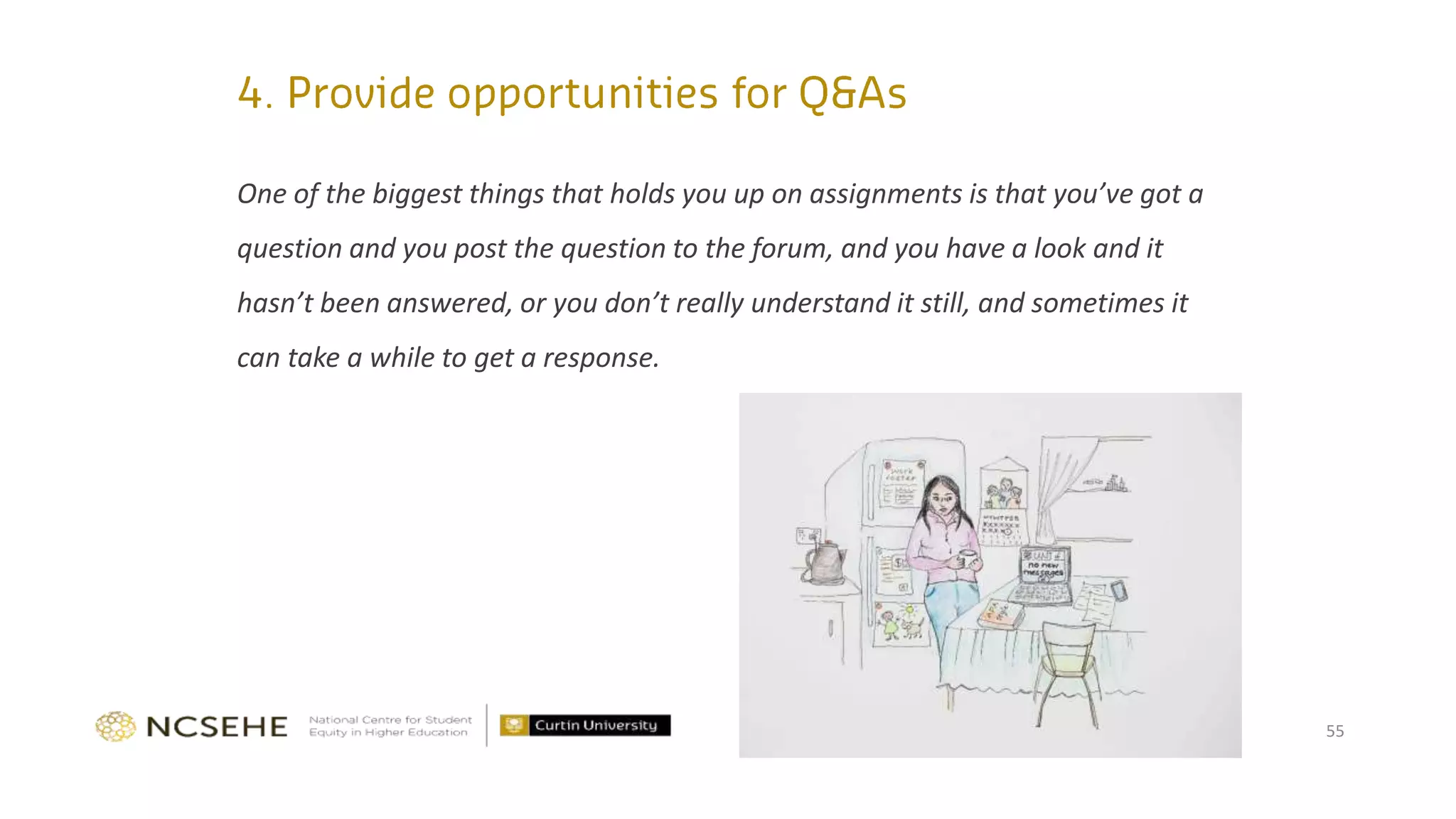
  • 55.
    One of thebiggest things that holds you up on assignments is that you’ve got a question and you post the question to the forum, and you have a look and it hasn’t been answered, or you don’t really understand it still, and sometimes it can take a while to get a response. 55
  • 56.
    Have someone thatcan check in with the student from time to time - a simple call to see how they are progressing or if they need any help. Speaking from experience, I won't ask for help. I will tackle everything on my own, which normally means I end up stressed. Some people are too embarrassed to ask for help. 56
  • 57.
    Reminders that supportservices are available and there is no harm in using them. I think the more separated you are, the less likely you are to know of what you can do or things you can access. 57
  • 58.
    Don’t forget theimpact of your actions – it’s the little, kind, human things that really matter! 58
  • 59.
    1. Importance ofcommunity – a community of care 2. Debriefing with trusted colleagues 3. Bearing witness to students’ transformations 4. Coping strategies and self care (For suggestions, see: Crawford et al. 2018; Olds et al. 2018.) 59
  • 60.
    The beautiful illustrationsin the Fellowship report and included in this presentation are by Morag Porteous. 60 Baik, C., Larcombe, W., Brooker, A., Wyn, J., Allen, L., Brett, M., . . . James, R. (2016). Enhancing student wellbeing. http://unistudentwellbeing.edu.au/ Crawford, N. (2020). Supporting student wellbeing during COVID-19: Tips from regional and remote Australia. https://www.ncsehe.edu.au/student-wellbeing-covid-19-regional-remote-australia/ Crawford, N., & Johns, S. (2018). An academic’s role? Supporting student wellbeing in pre-university enabling programs. Journal of University Teaching & Learning Practice, 15(3), 2. https://ro.uow.edu.au/jutlp/vol15/iss3/2/ Crawford, N., Kift. S, & Jarvis, L. (2019). Supporting student mental wellbeing in enabling education: practices, pedagogies and a philosophy of care. In Jones, A., Olds, A., & Lisciandro, J (eds), Transitioning Students in Higher Education, Routledge. Healthy Universities. (2020). UK Healthy Universities Network. Retrieved from https://healthyuniversities.ac.uk/
  • 61.
    61 Higher Education StandardsPanel. (2018). Final report - Improving retention, completion and success in higher education. MacKean, G. (2011). Mental health and well-being in post-secondary education settings: A literature and environmental scan to support planning and action in Canada. Retrieved from Vancouver: http://citeseerx.ist.psu.edu/viewdoc/download?doi=10.1.1.737.6978&rep=rep1&type=pdf Okanagan Charter. (2015). Okanagan Charter: an international charter for health promoting universities and colleges. Retrieved from http://www.healthpromotingcampuses.ca/okanagancharter/ Orygen. (2017). Under the radar: the mental health of Australian university students. Retrieved from Melbourne: https://www.orygen.org.au/Policy-Advocacy/Policy-Reports/Under-the-radar Regional Education Expert Advisory Group. (2019). National Regional, Rural and Remote Tertiary Education Strategy: Final Report. Ryan, R. M., & Deci, E. L. (2000). Self-determination theory and the facilitation of intrinsic motivation, social development, and well-being. American psychologist, 55(1), 68-78. Woodyatt, L. (2019). “Psychological Wellbeing Network” session. STARS Conference 2019, Melbourne. Woodyatt, L. (2020). NCSEHE webinar — Five meaningful minutes: Small changes to support psychological needs, wellbeing and motivation online in 2020. World Health Organization. (2014). Mental health: a state of well-being. Retrieved from http://origin.who.int/features/factfiles/mental_health/en/
  • 62.
    • The reportfrom this Equity Fellowship will be released on the NCSEHE website very soon. It includes Recommendations and Guidelines. https://www.ncsehe.edu.au/ • For a handout related to today’s presentation: https://www.ncsehe.edu.au/student- wellbeing-covid-19-regional-remote-australia/ • For a Lightning talk: https://www.ncsehe.edu.au/ncsehe-student-equity-snapshots- forum-nicole-crawford/ Email: Nicole.Crawford@curtin.edu.au Twitter: @NLCrawfordTas 62

Editor's Notes

  • #2 Welcome from both Sarah and Olivia Both introduce themselves
  • #35  Photo attribute: <a href='https://www.freepik.com/photos/water'>Water photo created by wirestock - www.freepik.com</a>