Creating and Administering a True Five-Star
Concierge Service
IMN's 2nd Annual Destination Club &
Private Residence Club Industry
Symposium, May 29-30, 2008, Miami, FL
Biographical Information: Ed Powers
• SVP Operations for Ultimate Escapes
• Co-Founder of Private Escapes, LLC
• 21 years of experience in sales, marketing, quality management,
operations management, and consulting
• Formerly with Hewlett-Packard, Sorcia, Center Partners
• BSEE 1987 Illinois Institute of Technology
• Six Sigma Black Belt, Baldrige Examiner, HP Quality Maturity
System Reviewer, American Society for Quality Certified Quality
Manager
• Spoken at Rocky Mountain Quality Conference, American Society for
Quality, Colorado State University, and University of Chicago
• Published in AMA Marketing News, Call Center Solutions magazines
Who are you?
• Industry?
• Functional area?
• Current situation?
Topics
• General Models for Service Quality
• Developing a Quality Strategy
• Lessons from Ritz-Carlton
• Variables in the Destination Club Industry
• Ultimate Escapes Deployment
• Q&A
Service Quality—What is it?
A customer attitude formed by a long-
term, overall evaluation of performance.
Source: Hoffman and Bateson., Essentials of Services Marketing, Second Edition, Harcourt College Publishers, 2002
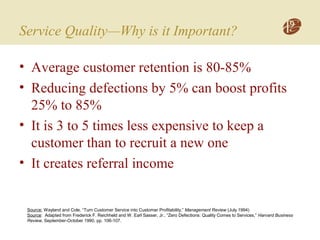
Service Quality—Why is it Important?
• Average customer retention is 80-85%
• Reducing defections by 5% can boost profits
25% to 85%
• It is 3 to 5 times less expensive to keep a
customer than to recruit a new one
• It creates referral income
Source: Wayland and Cole, “Turn Customer Service into Customer Profitability,” Management Review (July 1994)
Source: Adapted from Frederick F. Reichheld and W. Earl Sasser, Jr., “Zero Defections: Quality Comes to Services,” Harvard Business
Review, September-October 1990, pp. 106-107.
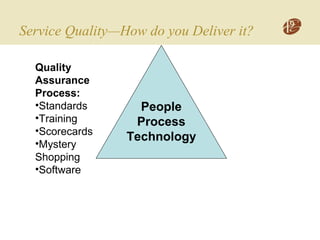
Service Quality—How do you Deliver it?
People
Process
Technology
Quality
Assurance
Process:
•Standards
•Training
•Scorecards
•Mystery
Shopping
•Software
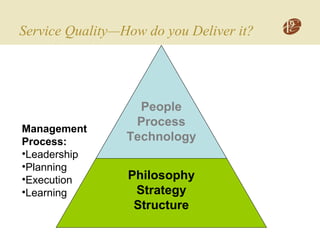
Service Quality—How do you Deliver it?
Philosophy
Strategy
Structure
People
Process
Technology
Management
Process:
•Leadership
•Planning
•Execution
•Learning
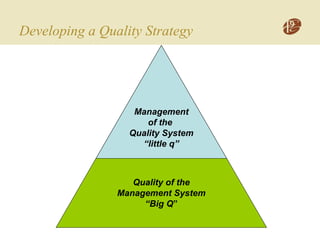
Developing a Quality Strategy
Quality of the
Management System
“Big Q”
Management
of the
Quality System
“little q”
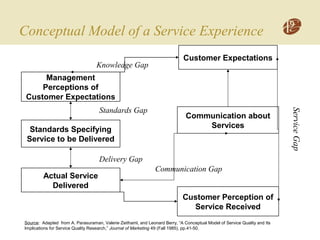
Actual Service
Delivered
Customer Expectations
Source: Adapted from A. Parasuraman, Valerie Zeithaml, and Leonard Berry, “A Conceptual Model of Service Quality and Its
Implications for Service Quality Research,” Journal of Marketing 49 (Fall 1985), pp.41-50.
Customer Perception of
Service Received
Knowledge Gap
Standards Gap
Management
Perceptions of
Customer Expectations
Delivery Gap
Standards Specifying
Service to be Delivered
Communication Gap
Communication about
Services
Conceptual Model of a Service Experience
ServiceGap
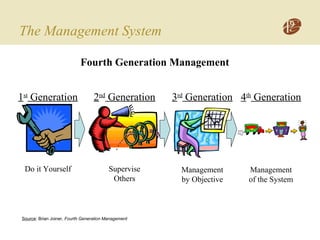
The Management System
Fourth Generation Management
1st
Generation
Do it Yourself
Source: Brian Joiner, Fourth Generation Management
2nd
Generation
Supervise
Others
3rd
Generation
Management
by Objective
4th
Generation
Management
of the System
Baldrige National Quality Award
• Purpose: To enhance the competitiveness,
quality and productivity of U.S.
organizations for the benefit of all residents.
• Established in 1987
• Awarded by the President and Secretary of
Commerce
• Categories: Manufacturing, Service,
Education, Health Care, Small Business,
Non-Profit
Source: National Institute for Standards and Technology (NIST)
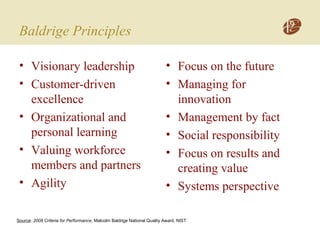
Baldrige Principles
• Visionary leadership
• Customer-driven
excellence
• Organizational and
personal learning
• Valuing workforce
members and partners
• Agility
• Focus on the future
• Managing for
innovation
• Management by fact
• Social responsibility
• Focus on results and
creating value
• Systems perspective
Source: 2008 Criteria for Performance, Malcolm Baldrige National Quality Award, NIST
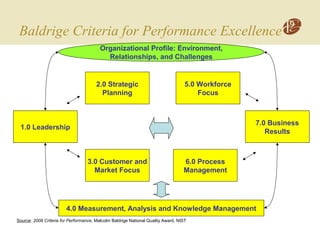
Baldrige Criteria for Performance Excellence
1.0 Leadership
2.0 Strategic
Planning
3.0 Customer and
Market Focus
4.0 Measurement, Analysis and Knowledge Management
5.0 Workforce
Focus
7.0 Business
Results
6.0 Process
Management
Organizational Profile: Environment,
Relationships, and Challenges
Source: 2008 Criteria for Performance, Malcolm Baldrige National Quality Award, NIST
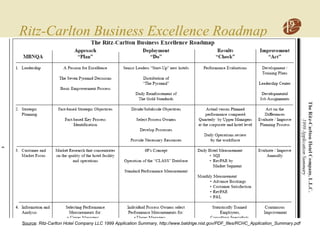
Ritz-Carlton Business Excellence Roadmap
Source: Ritz-Carlton Hotel Company LLC 1999 Application Summary, http://www.baldrige.nist.gov/PDF_files/RCHC_Application_Summary.pdf
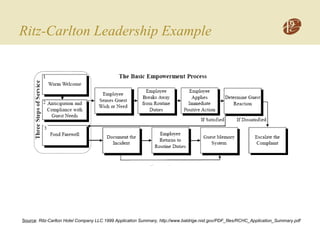
Ritz-Carlton Leadership Example
Source: Ritz-Carlton Hotel Company LLC 1999 Application Summary, http://www.baldrige.nist.gov/PDF_files/RCHC_Application_Summary.pdf
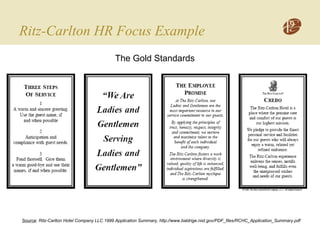
Ritz-Carlton HR Focus Example
The Gold Standards
Source: Ritz-Carlton Hotel Company LLC 1999 Application Summary, http://www.baldrige.nist.gov/PDF_files/RCHC_Application_Summary.pdf
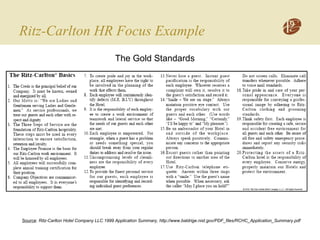
Ritz-Carlton HR Focus Example
The Gold Standards
Source: Ritz-Carlton Hotel Company LLC 1999 Application Summary, http://www.baldrige.nist.gov/PDF_files/RCHC_Application_Summary.pdf
Ritz-Carlton Lessons for DC&PRC Industries
• Aligned and integrated management system
based on criteria for high performance
• Process management and Plan-Do-Check-Act
practice
• The Gold Standards
• CLASS database
• Benchmarking
Source: Ritz-Carlton Hotel Company LLC 1999 Application Summary, http://www.baldrige.nist.gov/PDF_files/RCHC_Application_Summary.pdf
Advantages in the Destination Club Industry
Variable Advantage
New industry Innovation
•Long-term, highly desirable
customers
•Low staff turnover
•Personalization
•Engagement
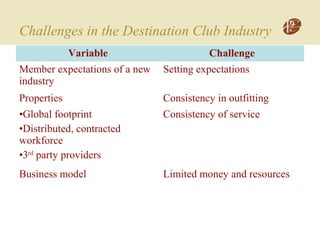
Challenges in the Destination Club Industry
Variable Challenge
Member expectations of a new
industry
Setting expectations
Properties Consistency in outfitting
•Global footprint
•Distributed, contracted
workforce
•3rd
party providers
Consistency of service
Business model Limited money and resources
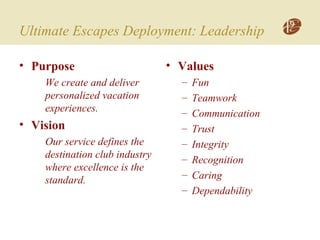
Ultimate Escapes Deployment: Leadership
• Purpose
We create and deliver
personalized vacation
experiences.
• Vision
Our service defines the
destination club industry
where excellence is the
standard.
• Values
– Fun
– Teamwork
– Communication
– Trust
– Integrity
– Recognition
– Caring
– Dependability
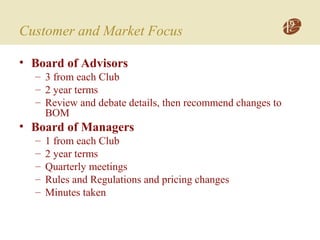
Customer and Market Focus
• Board of Advisors
– 3 from each Club
– 2 year terms
– Review and debate details, then recommend changes to
BOM
• Board of Managers
– 1 from each Club
– 2 year terms
– Quarterly meetings
– Rules and Regulations and pricing changes
– Minutes taken
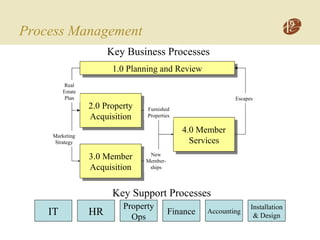
Process Management
1.0 Planning and Review1.0 Planning and Review
2.0 Property
Acquisition
2.0 Property
Acquisition
3.0 Member
Acquisition
3.0 Member
Acquisition
4.0 Member
Services
4.0 Member
Services
Escapes
Real
Estate
Plan
Marketing
Strategy
New
Member-
ships
Furnished
Properties
IT HR
Property
Ops
Finance
Key Support Processes
Accounting
Installation
& Design
Key Business Processes
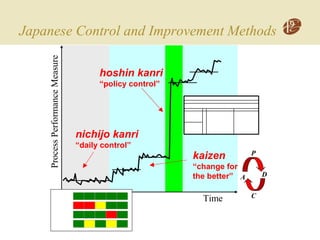
Japanese Control and Improvement Methods
ProcessPerformanceMeasure
Time
hoshin kanri
“policy control”
hoshin kanri
“policy control”
kaizen
“change for
the better”
P
D
C
A
nichijo kanri
“daily control”
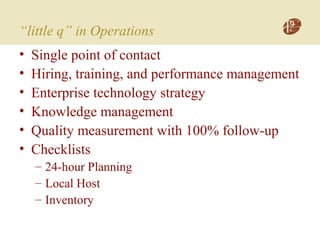
“little q” in Operations
• Single point of contact
• Hiring, training, and performance management
• Enterprise technology strategy
• Knowledge management
• Quality measurement with 100% follow-up
• Checklists
– 24-hour Planning
– Local Host
– Inventory
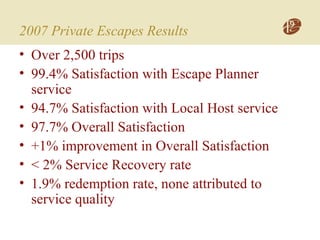
2007 Private Escapes Results
• Over 2,500 trips
• 99.4% Satisfaction with Escape Planner
service
• 94.7% Satisfaction with Local Host service
• 97.7% Overall Satisfaction
• +1% improvement in Overall Satisfaction
• < 2% Service Recovery rate
• 1.9% redemption rate, none attributed to
service quality
Getting Started on “Big Q” with MBNQA
• http://baldrige.nist.gov/
• Self-Assessment Materials
– Getting Started
– Issue Sheets
– Are We Making Progress?
– Are We Making Progress as Leaders?
– Criteria for Performance Excellence
Creating and Administering a True Five-Star Concierge Service

Creating and Administering a True Five-Star Concierge Service

  • 1.
    Creating and Administeringa True Five-Star Concierge Service IMN's 2nd Annual Destination Club & Private Residence Club Industry Symposium, May 29-30, 2008, Miami, FL
  • 2.
    Biographical Information: EdPowers • SVP Operations for Ultimate Escapes • Co-Founder of Private Escapes, LLC • 21 years of experience in sales, marketing, quality management, operations management, and consulting • Formerly with Hewlett-Packard, Sorcia, Center Partners • BSEE 1987 Illinois Institute of Technology • Six Sigma Black Belt, Baldrige Examiner, HP Quality Maturity System Reviewer, American Society for Quality Certified Quality Manager • Spoken at Rocky Mountain Quality Conference, American Society for Quality, Colorado State University, and University of Chicago • Published in AMA Marketing News, Call Center Solutions magazines
  • 3.
    Who are you? •Industry? • Functional area? • Current situation?
  • 4.
    Topics • General Modelsfor Service Quality • Developing a Quality Strategy • Lessons from Ritz-Carlton • Variables in the Destination Club Industry • Ultimate Escapes Deployment • Q&A
  • 5.
    Service Quality—What isit? A customer attitude formed by a long- term, overall evaluation of performance. Source: Hoffman and Bateson., Essentials of Services Marketing, Second Edition, Harcourt College Publishers, 2002
  • 6.
    Service Quality—Why isit Important? • Average customer retention is 80-85% • Reducing defections by 5% can boost profits 25% to 85% • It is 3 to 5 times less expensive to keep a customer than to recruit a new one • It creates referral income Source: Wayland and Cole, “Turn Customer Service into Customer Profitability,” Management Review (July 1994) Source: Adapted from Frederick F. Reichheld and W. Earl Sasser, Jr., “Zero Defections: Quality Comes to Services,” Harvard Business Review, September-October 1990, pp. 106-107.
  • 7.
    Service Quality—How doyou Deliver it? People Process Technology Quality Assurance Process: •Standards •Training •Scorecards •Mystery Shopping •Software
  • 8.
    Service Quality—How doyou Deliver it? Philosophy Strategy Structure People Process Technology Management Process: •Leadership •Planning •Execution •Learning
  • 9.
    Developing a QualityStrategy Quality of the Management System “Big Q” Management of the Quality System “little q”
  • 10.
    Actual Service Delivered Customer Expectations Source:Adapted from A. Parasuraman, Valerie Zeithaml, and Leonard Berry, “A Conceptual Model of Service Quality and Its Implications for Service Quality Research,” Journal of Marketing 49 (Fall 1985), pp.41-50. Customer Perception of Service Received Knowledge Gap Standards Gap Management Perceptions of Customer Expectations Delivery Gap Standards Specifying Service to be Delivered Communication Gap Communication about Services Conceptual Model of a Service Experience ServiceGap
  • 11.
    The Management System FourthGeneration Management 1st Generation Do it Yourself Source: Brian Joiner, Fourth Generation Management 2nd Generation Supervise Others 3rd Generation Management by Objective 4th Generation Management of the System
  • 12.
    Baldrige National QualityAward • Purpose: To enhance the competitiveness, quality and productivity of U.S. organizations for the benefit of all residents. • Established in 1987 • Awarded by the President and Secretary of Commerce • Categories: Manufacturing, Service, Education, Health Care, Small Business, Non-Profit Source: National Institute for Standards and Technology (NIST)
  • 13.
    Baldrige Principles • Visionaryleadership • Customer-driven excellence • Organizational and personal learning • Valuing workforce members and partners • Agility • Focus on the future • Managing for innovation • Management by fact • Social responsibility • Focus on results and creating value • Systems perspective Source: 2008 Criteria for Performance, Malcolm Baldrige National Quality Award, NIST
  • 14.
    Baldrige Criteria forPerformance Excellence 1.0 Leadership 2.0 Strategic Planning 3.0 Customer and Market Focus 4.0 Measurement, Analysis and Knowledge Management 5.0 Workforce Focus 7.0 Business Results 6.0 Process Management Organizational Profile: Environment, Relationships, and Challenges Source: 2008 Criteria for Performance, Malcolm Baldrige National Quality Award, NIST
  • 15.
    Ritz-Carlton Business ExcellenceRoadmap Source: Ritz-Carlton Hotel Company LLC 1999 Application Summary, http://www.baldrige.nist.gov/PDF_files/RCHC_Application_Summary.pdf
  • 16.
    Ritz-Carlton Leadership Example Source:Ritz-Carlton Hotel Company LLC 1999 Application Summary, http://www.baldrige.nist.gov/PDF_files/RCHC_Application_Summary.pdf
  • 17.
    Ritz-Carlton HR FocusExample The Gold Standards Source: Ritz-Carlton Hotel Company LLC 1999 Application Summary, http://www.baldrige.nist.gov/PDF_files/RCHC_Application_Summary.pdf
  • 18.
    Ritz-Carlton HR FocusExample The Gold Standards Source: Ritz-Carlton Hotel Company LLC 1999 Application Summary, http://www.baldrige.nist.gov/PDF_files/RCHC_Application_Summary.pdf
  • 19.
    Ritz-Carlton Lessons forDC&PRC Industries • Aligned and integrated management system based on criteria for high performance • Process management and Plan-Do-Check-Act practice • The Gold Standards • CLASS database • Benchmarking Source: Ritz-Carlton Hotel Company LLC 1999 Application Summary, http://www.baldrige.nist.gov/PDF_files/RCHC_Application_Summary.pdf
  • 20.
    Advantages in theDestination Club Industry Variable Advantage New industry Innovation •Long-term, highly desirable customers •Low staff turnover •Personalization •Engagement
  • 21.
    Challenges in theDestination Club Industry Variable Challenge Member expectations of a new industry Setting expectations Properties Consistency in outfitting •Global footprint •Distributed, contracted workforce •3rd party providers Consistency of service Business model Limited money and resources
  • 22.
    Ultimate Escapes Deployment:Leadership • Purpose We create and deliver personalized vacation experiences. • Vision Our service defines the destination club industry where excellence is the standard. • Values – Fun – Teamwork – Communication – Trust – Integrity – Recognition – Caring – Dependability
  • 23.
    Customer and MarketFocus • Board of Advisors – 3 from each Club – 2 year terms – Review and debate details, then recommend changes to BOM • Board of Managers – 1 from each Club – 2 year terms – Quarterly meetings – Rules and Regulations and pricing changes – Minutes taken
  • 24.
    Process Management 1.0 Planningand Review1.0 Planning and Review 2.0 Property Acquisition 2.0 Property Acquisition 3.0 Member Acquisition 3.0 Member Acquisition 4.0 Member Services 4.0 Member Services Escapes Real Estate Plan Marketing Strategy New Member- ships Furnished Properties IT HR Property Ops Finance Key Support Processes Accounting Installation & Design Key Business Processes
  • 25.
    Japanese Control andImprovement Methods ProcessPerformanceMeasure Time hoshin kanri “policy control” hoshin kanri “policy control” kaizen “change for the better” P D C A nichijo kanri “daily control”
  • 26.
    “little q” inOperations • Single point of contact • Hiring, training, and performance management • Enterprise technology strategy • Knowledge management • Quality measurement with 100% follow-up • Checklists – 24-hour Planning – Local Host – Inventory
  • 27.
    2007 Private EscapesResults • Over 2,500 trips • 99.4% Satisfaction with Escape Planner service • 94.7% Satisfaction with Local Host service • 97.7% Overall Satisfaction • +1% improvement in Overall Satisfaction • < 2% Service Recovery rate • 1.9% redemption rate, none attributed to service quality
  • 28.
    Getting Started on“Big Q” with MBNQA • http://baldrige.nist.gov/ • Self-Assessment Materials – Getting Started – Issue Sheets – Are We Making Progress? – Are We Making Progress as Leaders? – Criteria for Performance Excellence

Editor's Notes

  • #6 As opposed to customer satisfaction, which is a short-term, transaction-specific measure
  • #7 Loyalty! Generally it’s good for business. Retention is even more important in the destination club industry given the economics and cash flow tied up in redeeming deposits. Referral sales take 1/3 as long and cost a fraction of acquiring a new Member.
  • #8 Most people focus on the explicit mechanics, the tactics. Its as much about implicit strategy at the top as it is about the front line. Understanding the organizational context is important before applying operational tactics. If the senior managers don’t see value in high service quality and are instead focused on short-term financial objectives, quality effectiveness is limited. Deming: “Quality begins in the boardroom.” The service quality strategy should be appropriate to the organization context. More on this in a minute.
  • #9 Most people focus on the explicit mechanics, the tactics. Its as much about implicit strategy at the top as it is about the front line. Understanding the organizational context is important before applying operational tactics. If the senior managers don’t see value in high service quality and are instead focused on short-term financial objectives, quality effectiveness is limited. Deming: “Quality begins in the boardroom.” The service quality strategy should be appropriate to the organization context. More on this in a minute.
  • #10 Most people focus on the explicit mechanics, the tactics. Its as much about implicit strategy at the top as it is about the front line. Understanding the organizational context is important before applying operational tactics. If the senior managers don’t see value in high service quality and are instead focused on short-term financial objectives, quality effectiveness is limited. Deming: “Quality begins in the boardroom.” The service quality strategy should be appropriate to the organization context. More on this in a minute.
  • #11 Gaps are problematic—overpromise/underdeliver vs. underpromise/overdeliver. How services and delivered needs to be designed and managed in such as way as to minimize these gaps. System is also dynamic—expectations are constantly changing! Variables in delivery are constantly changing! The service experience is affected by all functional areas: operations, sales, marketing, general management
  • #12 Since service quality depends on all aspects of the business, how does the business operate?
  • #19 Mandatory 2-day training, daily reinforcement