CREATING AI USING
BIOLOGICAL NETWORK
TECHNIQUES
Dr Janet Bastiman, Chief Science Officer Story-Stream.com
STORY-STREAM.COM
“Human subtlety will never
devise an invention more
beautiful, more simple or
more direct than does
nature”
STORY-STREAM.COM
STORY-STREAM.COM
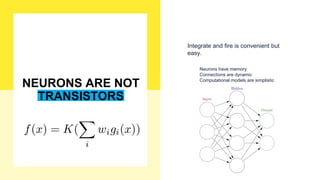
- Neurons have memory
- Connections are dynamic
- Computational models are simplistic
Integrate and fire is convenient but
easy.
NEURONS ARE NOT
TRANSISTORS
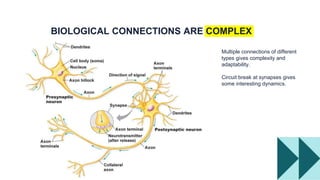
Multiple connections of different
types gives complexity and
adaptability.
Circuit break at synapses gives
some interesting dynamics.
BIOLOGICAL CONNECTIONS ARE COMPLEX
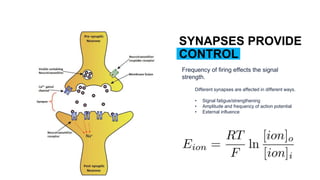
SYNAPSES PROVIDE
CONTROL
Different synapses are affected in different ways.
• Signal fatigue/strengthening
• Amplitude and frequency of action potential
• External influence
Frequency of firing effects the signal
strength.
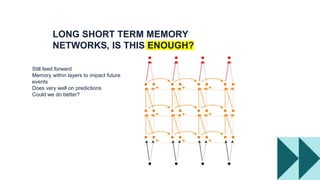
Still feed forward
Memory within layers to impact future
events
Does very well on predictions
Could we do better?
LONG SHORT TERM MEMORY
NETWORKS, IS THIS ENOUGH?
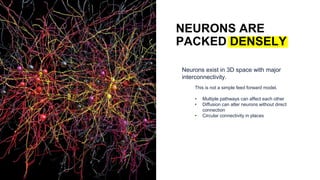
NEURONS ARE
PACKED DENSELY
This is not a simple feed forward model.
• Multiple pathways can affect each other
• Diffusion can alter neurons without direct
connection
• Circular connectivity in places
Neurons exist in 3D space with major
interconnectivity.
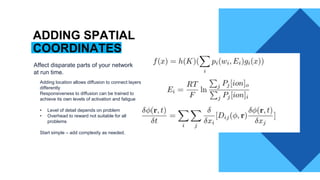
ADDING SPATIAL
COORDINATES
Adding location allows diffusion to connect layers
differently
Responsiveness to diffusion can be trained to
achieve its own levels of activation and fatigue
• Level of detail depends on problem
• Overhead to reward not suitable for all
problems
Start simple – add complexity as needed.
Affect disparate parts of your network
at run time.
General intelligence is hard
Some specific tasks are also difficult with
existing techniques
“More data” not always possible
Biology doesn’t need large amounts of data so
what can we learn
Why make networks more complex
than they already are?
STORY-STREAM.COM
STORY-STREAM.COM
NOBODY WANTS AN
EMOTIONAL CAR, OR
DO WE?
STORY-STREAM.COM
STORY-STREAM.COM
Thank You
@yssybyl
http://janjanjan.uk
linkedin.com/in/janetbastiman

Creating AI using biological network techniques

  • 1.
    CREATING AI USING BIOLOGICALNETWORK TECHNIQUES Dr Janet Bastiman, Chief Science Officer Story-Stream.com STORY-STREAM.COM
  • 2.
    “Human subtlety willnever devise an invention more beautiful, more simple or more direct than does nature” STORY-STREAM.COM STORY-STREAM.COM
  • 3.
    - Neurons havememory - Connections are dynamic - Computational models are simplistic Integrate and fire is convenient but easy. NEURONS ARE NOT TRANSISTORS
  • 4.
    Multiple connections ofdifferent types gives complexity and adaptability. Circuit break at synapses gives some interesting dynamics. BIOLOGICAL CONNECTIONS ARE COMPLEX
  • 5.
    SYNAPSES PROVIDE CONTROL Different synapsesare affected in different ways. • Signal fatigue/strengthening • Amplitude and frequency of action potential • External influence Frequency of firing effects the signal strength.
  • 6.
    Still feed forward Memorywithin layers to impact future events Does very well on predictions Could we do better? LONG SHORT TERM MEMORY NETWORKS, IS THIS ENOUGH?
  • 7.
    NEURONS ARE PACKED DENSELY Thisis not a simple feed forward model. • Multiple pathways can affect each other • Diffusion can alter neurons without direct connection • Circular connectivity in places Neurons exist in 3D space with major interconnectivity.
  • 8.
    ADDING SPATIAL COORDINATES Adding locationallows diffusion to connect layers differently Responsiveness to diffusion can be trained to achieve its own levels of activation and fatigue • Level of detail depends on problem • Overhead to reward not suitable for all problems Start simple – add complexity as needed. Affect disparate parts of your network at run time.
  • 9.
    General intelligence ishard Some specific tasks are also difficult with existing techniques “More data” not always possible Biology doesn’t need large amounts of data so what can we learn Why make networks more complex than they already are?
  • 10.
  • 11.