Create a responsive
social strategy on a
shoestring budget
Michelle Killebrew
July 28, 2017
Michelle Killebrew
@shellkillebrew
Chief Marketing Officer, Nomiku
Marketing Maven (B2B & B2C)
DigitalTransformation
MarketingTechnologist
Agenda
 How to ensure your strategy aligns with your organization's mission
 How to spot, prepare and react to angry customers—before they erupt
 How to know what qualifies as an online crisis—and what doesn't
@shellkillebrew
How to ensure your
strategy aligns with your
organization's mission
@shellkillebrew
@shellkillebrew
DefineYour
Mission
A well-developed mission statement is a great tool for
understanding, developing, and communicating fundamental
business objectives, and should be expressed in just a paragraph or
two. If you read it out loud, it should take about 30 seconds. And it
should answer questions people have about your business, like:
 Who is your company?
 What do you do?What do you stand for?And why do you do it?
 Do you want to make a profit, or is it enough to just make a living?
 What markets are you serving, and what benefits do you offer
them?
 Do you solve a problem for your customers?
 What kind of internal work environment do you want for your
employees?
Source: http://articles.bplans.com/writing-a-mission-statement
@shellkillebrew
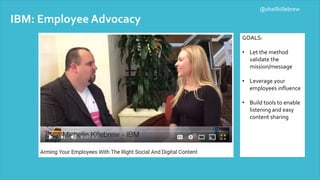
IBM: Employee Advocacy
GOALS:
• Let the method
validate the
mission/message
• Leverage your
employees influence
• Build tools to enable
listening and easy
content sharing
@shellkillebrew
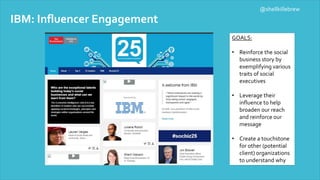
IBM: Influencer Engagement
GOALS:
• Reinforce the social
business story by
exemplifying various
traits of social
executives
• Leverage their
influence to help
broaden our reach
and reinforce our
message
• Create a touchstone
for other (potential
client) organizations
to understand why
@shellkillebrew
Creating Big
BuzzThrough
New ModesOf
Storytelling
Michael Engleman is EVP Marketing,
Digital & Global Brand Strategy
for Syfy & Chiller, both are divisions of
NBCUniversal
Key Insights from Michael Engleman:
 No. 1: Storytelling is for Everyone
• Enabling consumers to actively participate in the storytelling is
increasingly as important as the story itself.
 No. 2:The Blurrier the Lines Between Marketing and Content the
Better
 No. 3:ThankYou for Sharing:The New Rules for Socializing
• Share Early
• Share Often
• Share StuffWorth Sharing
• Share with Influencers
• Listen…storytelling is a two-way street
 No. 4: Innovation Isn't a Perk, It's a Requirement
 No. 5: None of It MattersWithout Authenticity
9Source: http://adage.com/article/syfy/creating-big-buzz-modes-storytelling/245635
@shellkillebrew
Execution &
Optimization
Tactics
What are some of the things that you should think through as you
approach the creation of a center of engagement for your brand?
 Social listening – for customer service, sentiment, product
innovation, trends
 Web analytics – to understand behavior, ensure customer
experience, measure interaction and revenue
 Benchmark data – so you know how you are performing against
your peer competitors
 Business intelligence – for deep comprehension and analysis of
how your efforts translates into bottom-line business results
(conversion rate, acquisition rate, revenue, and profit), and insight
into trends over time
Including visualizations to help drive rapid insight and action from
your engagement response team
@shellkillebrew
Takeaways
Make sure you have a clear mission defined, you must know
‘who you are’ if your strategy is going to align to represent your
mission and objectives
Understand how your mission serves your clients, and translate
it into messages and strategies that keep their interests front and
center
Do your homework, research your segment/competitors, listen
to your prospects/customers, benchmark and optimize your KPIs
Build your strategy, then test and iterate
How to ensure your
strategy aligns with
your organization's
mission
@shellkillebrew
How to spot, prepare
and react to angry
customers—before they
erupt
@shellkillebrew
@shellkillebrew
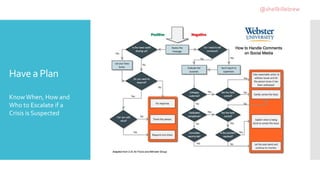
Have a Plan
KnowWhen, How and
Who to Escalate if a
Crisis is Suspected
@shellkillebrew
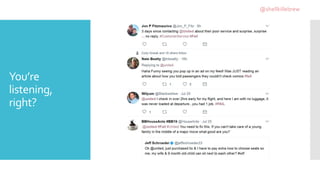
You’re
listening,
right?
@shellkillebrew
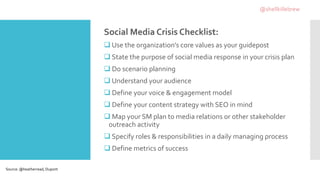
Social Media Crisis Checklist:
 Use the organization’s core values as your guidepost
 State the purpose of social media response in your crisis plan
 Do scenario planning
 Understand your audience
 Define your voice & engagement model
 Define your content strategy with SEO in mind
 Map your SM plan to media relations or other stakeholder
outreach activity
 Specify roles & responsibilities in a daily managing process
 Define metrics of success
Source: @heatherread, Dupont
@shellkillebrew
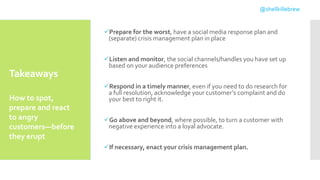
Takeaways
Prepare for the worst, have a social media response plan and
(separate) crisis management plan in place
Listen and monitor, the social channels/handles you have set up
based on your audience preferences
Respond in a timely manner, even if you need to do research for
a full resolution, acknowledge your customer’s complaint and do
your best to right it.
Go above and beyond, where possible, to turn a customer with
negative experience into a loyal advocate.
If necessary, enact your crisis management plan.
How to spot,
prepare and react
to angry
customers—before
they erupt
@shellkillebrew
How to know what
qualifies as an online
crisis—and what doesn't
@shellkillebrew
A social media crisis is an online situation that has, or risks
having, a negative and long- term impact on your business or
organization's reputation and/or bottom-line.
Social media crises usually involve strong, negative emotions
emotions that are relatable and can easily outweigh common
sense.
Source: https://raventools.com/blog/social-media-crisis
@shellkillebrew
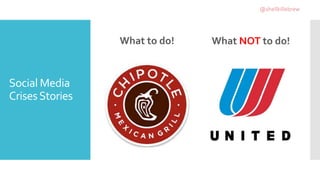
Social Media
CrisesStories
What to do! What NOT to do!
@shellkillebrew
Step 1:
Identify an
Issue
What is a social media issue?
A social media issue is a lesser situation than a social media crisis –
though one that still needs to be addressed and resolved in a prompt and
proper fashion.
Social media issues are negative and potentially viral situations taking
place online about your brand, but they do not threaten any severe long-
term negative impacts on your brand’s reputation or bottom-line.
Some examples of social media issues include, but are not limited to:
 Negative comments or discussions being posted about your brand
online
 Unacceptable comments being posted to your channels
 Negative customer service issues
 Negative press
Source: https://raventools.com/blog/social-media-crisis
@shellkillebrew
Step 2:
Try to Respond
Promptly
What are some characteristics of a social media crisis?
Social media crises risk going viral very quickly, in a very short
period of time.They risk being highly unpredictable and, often,
unforeseeable.
When not responded to promptly and in a proper manner, social
media crises risk having a damaging and lasting negative impact on
your brand’s reputation and bottom-line.
Source: https://raventools.com/blog/social-media-crisis
@shellkillebrew
Step 3:
Identify if the
Situation is
Resolved or
Not
What are the red flags of a social media crisis?
This depends on your company or organization and what a social
media crisis means to your brand. But if you detect an increasing
number of negative mentions or discussions about your brand
online in a short period of time, then this is a definite indication that
something may be going on that you need to look into more closely.
Source: https://raventools.com/blog/social-media-crisis
@shellkillebrew
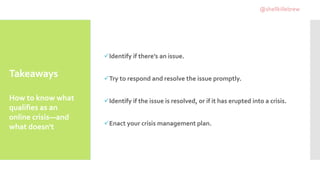
Takeaways
Identify if there’s an issue.
Try to respond and resolve the issue promptly.
Identify if the issue is resolved, or if it has erupted into a crisis.
Enact your crisis management plan.
How to know what
qualifies as an
online crisis—and
what doesn't
@shellkillebrew
Questions?
michelle@michellekillebrew.com
@shellkillebrew

Create a Responsive Social Strategy on a Shoestring Budget

  • 1.
    Create a responsive socialstrategy on a shoestring budget Michelle Killebrew July 28, 2017
  • 2.
    Michelle Killebrew @shellkillebrew Chief MarketingOfficer, Nomiku Marketing Maven (B2B & B2C) DigitalTransformation MarketingTechnologist
  • 3.
    Agenda  How toensure your strategy aligns with your organization's mission  How to spot, prepare and react to angry customers—before they erupt  How to know what qualifies as an online crisis—and what doesn't @shellkillebrew
  • 4.
    How to ensureyour strategy aligns with your organization's mission @shellkillebrew
  • 5.
  • 6.
    DefineYour Mission A well-developed missionstatement is a great tool for understanding, developing, and communicating fundamental business objectives, and should be expressed in just a paragraph or two. If you read it out loud, it should take about 30 seconds. And it should answer questions people have about your business, like:  Who is your company?  What do you do?What do you stand for?And why do you do it?  Do you want to make a profit, or is it enough to just make a living?  What markets are you serving, and what benefits do you offer them?  Do you solve a problem for your customers?  What kind of internal work environment do you want for your employees? Source: http://articles.bplans.com/writing-a-mission-statement @shellkillebrew
  • 7.
    IBM: Employee Advocacy GOALS: •Let the method validate the mission/message • Leverage your employees influence • Build tools to enable listening and easy content sharing @shellkillebrew
  • 8.
    IBM: Influencer Engagement GOALS: •Reinforce the social business story by exemplifying various traits of social executives • Leverage their influence to help broaden our reach and reinforce our message • Create a touchstone for other (potential client) organizations to understand why @shellkillebrew
  • 9.
    Creating Big BuzzThrough New ModesOf Storytelling MichaelEngleman is EVP Marketing, Digital & Global Brand Strategy for Syfy & Chiller, both are divisions of NBCUniversal Key Insights from Michael Engleman:  No. 1: Storytelling is for Everyone • Enabling consumers to actively participate in the storytelling is increasingly as important as the story itself.  No. 2:The Blurrier the Lines Between Marketing and Content the Better  No. 3:ThankYou for Sharing:The New Rules for Socializing • Share Early • Share Often • Share StuffWorth Sharing • Share with Influencers • Listen…storytelling is a two-way street  No. 4: Innovation Isn't a Perk, It's a Requirement  No. 5: None of It MattersWithout Authenticity 9Source: http://adage.com/article/syfy/creating-big-buzz-modes-storytelling/245635 @shellkillebrew
  • 10.
    Execution & Optimization Tactics What aresome of the things that you should think through as you approach the creation of a center of engagement for your brand?  Social listening – for customer service, sentiment, product innovation, trends  Web analytics – to understand behavior, ensure customer experience, measure interaction and revenue  Benchmark data – so you know how you are performing against your peer competitors  Business intelligence – for deep comprehension and analysis of how your efforts translates into bottom-line business results (conversion rate, acquisition rate, revenue, and profit), and insight into trends over time Including visualizations to help drive rapid insight and action from your engagement response team @shellkillebrew
  • 11.
    Takeaways Make sure youhave a clear mission defined, you must know ‘who you are’ if your strategy is going to align to represent your mission and objectives Understand how your mission serves your clients, and translate it into messages and strategies that keep their interests front and center Do your homework, research your segment/competitors, listen to your prospects/customers, benchmark and optimize your KPIs Build your strategy, then test and iterate How to ensure your strategy aligns with your organization's mission @shellkillebrew
  • 12.
    How to spot,prepare and react to angry customers—before they erupt @shellkillebrew
  • 13.
  • 14.
    Have a Plan KnowWhen,How and Who to Escalate if a Crisis is Suspected @shellkillebrew
  • 15.
  • 16.
    Social Media CrisisChecklist:  Use the organization’s core values as your guidepost  State the purpose of social media response in your crisis plan  Do scenario planning  Understand your audience  Define your voice & engagement model  Define your content strategy with SEO in mind  Map your SM plan to media relations or other stakeholder outreach activity  Specify roles & responsibilities in a daily managing process  Define metrics of success Source: @heatherread, Dupont @shellkillebrew
  • 17.
    Takeaways Prepare for theworst, have a social media response plan and (separate) crisis management plan in place Listen and monitor, the social channels/handles you have set up based on your audience preferences Respond in a timely manner, even if you need to do research for a full resolution, acknowledge your customer’s complaint and do your best to right it. Go above and beyond, where possible, to turn a customer with negative experience into a loyal advocate. If necessary, enact your crisis management plan. How to spot, prepare and react to angry customers—before they erupt @shellkillebrew
  • 18.
    How to knowwhat qualifies as an online crisis—and what doesn't @shellkillebrew
  • 19.
    A social mediacrisis is an online situation that has, or risks having, a negative and long- term impact on your business or organization's reputation and/or bottom-line. Social media crises usually involve strong, negative emotions emotions that are relatable and can easily outweigh common sense. Source: https://raventools.com/blog/social-media-crisis @shellkillebrew
  • 20.
    Social Media CrisesStories What todo! What NOT to do! @shellkillebrew
  • 21.
    Step 1: Identify an Issue Whatis a social media issue? A social media issue is a lesser situation than a social media crisis – though one that still needs to be addressed and resolved in a prompt and proper fashion. Social media issues are negative and potentially viral situations taking place online about your brand, but they do not threaten any severe long- term negative impacts on your brand’s reputation or bottom-line. Some examples of social media issues include, but are not limited to:  Negative comments or discussions being posted about your brand online  Unacceptable comments being posted to your channels  Negative customer service issues  Negative press Source: https://raventools.com/blog/social-media-crisis @shellkillebrew
  • 22.
    Step 2: Try toRespond Promptly What are some characteristics of a social media crisis? Social media crises risk going viral very quickly, in a very short period of time.They risk being highly unpredictable and, often, unforeseeable. When not responded to promptly and in a proper manner, social media crises risk having a damaging and lasting negative impact on your brand’s reputation and bottom-line. Source: https://raventools.com/blog/social-media-crisis @shellkillebrew
  • 23.
    Step 3: Identify ifthe Situation is Resolved or Not What are the red flags of a social media crisis? This depends on your company or organization and what a social media crisis means to your brand. But if you detect an increasing number of negative mentions or discussions about your brand online in a short period of time, then this is a definite indication that something may be going on that you need to look into more closely. Source: https://raventools.com/blog/social-media-crisis @shellkillebrew
  • 24.
    Takeaways Identify if there’san issue. Try to respond and resolve the issue promptly. Identify if the issue is resolved, or if it has erupted into a crisis. Enact your crisis management plan. How to know what qualifies as an online crisis—and what doesn't @shellkillebrew
  • 25.

Editor's Notes

  • #6 There are several hilarious DILBERT and Marketoonist comics on most organizations mission statement, so if you are planning on ensuring that your social strategy is aligned with your mission, make sure your mission is tangible.
  • #8 In 2013, IBM dissolved its traditional divisions of Hardware, Software and Service and changed to a category market approach: Social, Mobile, Analytics & Cloud. I was asked to lead the strategy and market positioning for this brand new Social Business category…. For IBM, if we were going to market “Social Business” we had to BE a social business. That meant empowering our employees to advocate for us and help spread the word.
  • #9 The Economist Social Business Leaders: An IBM-sponsored awareness campaign that co-branded with The Economist and celebrated the achievements of social business leaders in a variety of accomplishments, including internal collaboration, sophisticated customer engagement, philanthropic endeavors, and more. The success of this campaign is based on visibility and awareness: social impressions, site visitor data, and influencer engagement.
  • #10 Both "Defiance" and "Sharknado" reveal 5 key insights into how consumers are playing an increasingly active role in storytelling. These insights are extremely relevant "must haves" for any brand seeking to engage their customers, and are now helping guide Syfy's approach going forward. I think this is a great list that Michael Edleman EVP of Marketing and Digital Engagement with NBCUniversal. Here they are: No. 1: Storytelling is for Everyone Enabling consumers to actively participate in the storytelling is increasingly as important as the story itself. No. 2: The Blurrier the Lines Between Marketing and Content the Better No. 3: Thank You for Sharing: The New Rules for Socializing Share Early Share Often Share Stuff Worth Sharing Share with Influencers Listen…storytelling is a two-way street No. 4: Innovation Isn't a Perk, It's a Requirement No. 5: None of It Matters Without Authenticity http://adage.com/article/syfy/creating-big-buzz-modes-storytelling/245635/
  • #11 This doesn’t need to be expensive. Social listening – Hootsuite, Tweetdeck, etc. Web Analytics – Google Analytics BI – can be as simple as XLS; but you should be tracking your performance and what’s influencing that performance
  • #15 Part of your strategy should be developing plans for “what if” scenarios.
  • #16 Customers expect that you are monitoring your social channels, that’s why even for startups and mom&pops it’s important to have a social media/community manager. Customers will use social to voice their frustrations, and expect that you hear them and (minimally) acknowledge them. Many can be turned into loyal fans through an apology and a bit of good will, but that same customer unanswered can turn into an avid ‘hater’. If you’re paying close attention, you’ll notice who needs prompt attention; if not, you’ll be glad you have your plan ready if a ‘situation’ does erupt.
  • #17 Here’s a helpful checklist in case you find yourself in a crisis situation.
  • #21 Chipotle When Chipotle faces an E.coli crisis last fall, they quickly dealt with the social media backlash by releasing a statement letting patrons know they were temporarily shutting down 43 restaurants. They kept customers up to date on everything that was being done to get the situation under control. Founder Steve Ells even took to The Today Show, and bought full-page newspaper ads, to apologize directly to customers who suffered from the crisis. United We all know the story of the now infamous passenger dragged off a United flight and the social firestorm that erupted due to the situation and escalated by the CEO’s poor response and the United Social team’s policy constratints that left the social message feeling cold and unapologetic. And we all know what that poorly handled situation did to their stock price.