ENTREPRENEURS
HIP
Quarter 2 – Module 1
Product
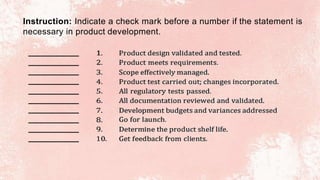
Instruction: Indicate a check mark before a number if the statement is
necessary in product development.
Fundamentals of Product Development (Batisan, 2016)
Before commercializing a new product or service, the
entrepreneur must focus on refining the product or service ad
validate its market acceptability. This new product does not
have to be a totally new product. It can be a new product line
from the existing product. Product development is the process,
testing, and commercializing a product or service with the
ultimate objective of solving the problem of the primary target
market. It is composed of four sequential steps: (1) developing a
product or service description, (2) creating a prototype, (3)
testing the prototype, and (4) validating the market.
Product or Service Development
The product or service description simply describes how a
or service description is important because this will serve as
the blueprint of all business operations. Therefore, the
entrepreneur has to take note of the following regarding the
product or service description:
1.It should directly address the primary target market in a
personal manner using everyday language. The entrepreneur
should put himself or herself in the customer’s shoes, where
the product description will be addressed to.
2.It should highlight the features that will cater to the
customer’s needs or address the customer’s problems.
3.Realistic superlatives should be used for the product
description. Motherhood statements such as “word-class
service or product excellence” may not matter to the
Jolly Spaghetti Product Description
Creating a Prototype of the Product or Service
After defining the product or service, you may now proceed
with one of the most exciting but also very challenging parts of
product or service development: the creation of a prototype. A
prototype is a preliminary model or sample of a new product or
service that is created to test a product concept or service
process. This is an exciting process for the entrepreneur
because he or she will be able to see that his or her ideas will
soon become a tangible reality. The entrepreneur’s creativity
and ingenuity will be used in creating the prototype.
According to Entrepreneur (www.entrepreneur.com), creating
a prototype lessens implementations/commercialization risks
and provides the entrepreneur a bunch ofadvantages as
follows:
1.Creating a prototype enables the entrepreneur to engage in
trial- and-error provides room for improvements, and refines
the functionality of the product design or service process. It
is very expensive and risk-intensive to commercialize a
product without creating a prototype.
2.Creating a prototype provides the entrepreneur a window to
test the performance and specifications of various materials
and service processes. Every detail of the product or service
should be scrutinized carefully, and all flaws be addressed
right way before commercialization.
3.A prototype helps the entrepreneur effectively describe the
product or service to the product team. Members of the
include marketing, operations, engineers, suppliers, business
partners, and legal and human resources. It provides the
product team the information needed to create the right
product or service as planned
4. Creating a prototype elicits respect from key stakeholders
and customers. At the same time, a prototype gives credibility
to the entrepreneur. Some entrepreneurs only present vague
and big ideas but no details as to its feasibility and
implementation.
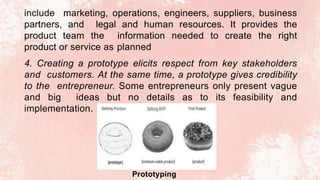
Prototyping
Creating a prototype is the stage where the entrepreneur can
experiment, develop, and make some improvements in the
potential product or service. The objective of the entrepreneur at
this stage is to verify if the product or service concept will work
the simplest, fastest and cheapest way.
One technique for creating the best prototype is by studying the
competitor’s product or service. The entrepreneur will try to
scrutinize the parts and functions, as well as the design and other
attributes of that product, in hopes that he or she will be able to
address some problems in the competitor’s products and come
up with the most efficient and effective prototype. As for the
services, the entrepreneur may try availing the competitor’s
services and will take note of their operations, such as service
delivery, location, facilities, and ambiance. He or she
will than take notes of the pros and cons of the service to create
the prototype, simulate the service by trying it with his or her
friends or relatives, and then get their feedback.
Some entrepreneurs create a video presentation or miniature
prototype, so they will be able to explain the details, if the product
is to be viewed by a panel of specialists (e.g., engineers,
developers, scientists). The scope should be related to the
entrepreneur’s budget. After creating the prototype, he or she
should be ready to testit.
Testing the Product Prototype
All the efforts exerted in the creation of a prototype will be put to
waste if the prototype will not be tested. Testing the prototype is
a vital process before an actual product or service is launched in
the market. Testing the prototype will uncover the final loopholes
need to be fixed before commercialization. It gives the
entrepreneur a leeway to examine and scrutinize the prototype
and provide feedback as to what can be improved before the
launch. These improvements and changes must be completed
first before moving forward to the next step. For a prototype that
has already been refined, testing it for the last time after the
changes have been made will validate its readiness for
commercialization. The following testing methods are applied by
the entrepreneur:
1. Focus group discussion – the participants will provide
relevant insights about the new product or service. The
objective of the FDG is to identify errors, deficiencies, and
issues that may impede the success of the product. Participants
2. Legality and ethical test – Prior to launching, the
entrepreneur must ensure that the product or service complies
with all relevant laws and business. For example, food
products must be cleared first with the Bureau of Food and
Drugs (BFAD) before they are offered to the public. The
entrepreneur must also make sure that the
manufacturing/production of goods or offering of the service
does not generate ethical issues such as being threats to
health, safety, and environment.
3.Safety test – The entrepreneur must ensure that the product
is safe to use, safe to be consumed (food and beverages),
and safe to be applied (cosmetic products). The product
should not in any way harm the customer or put the customer
in peculiar situations. In services, the entrepreneur must
performed by the service provider must not be detrimental to the
safety and health of the customer.
4. Product costing test – The entrepreneur must examine
every stage of the manufacturing process or every process of
the service blueprint to evaluate and finalize the costs involved.
This is the time when the entrepreneur can match the expected
costs versus his or her budget. Modification in the
manufacturing process or service blueprint can still be made at
this point to align with the cost objective of the entrepreneur.
5. Component test – Each component of the product or service
must be tested independently to identify component failures for
goods or service failures for services. Any failure identified must
and tested again until it becomes fully operational and functional.
6. Competitors’ product / service test – The entrepreneur
must test a similar line of products or the competitors’ product or
service itself to compare and get the best practices to be
applied to the new product or service.
Testing the product prototype is mandatory to ensure that the
product or service will not fail the customers and will deliver its
definitive purpose. This will elicit customer satisfaction and,
eventually, customer loyalty and retention. This is the time to
prove that the concept formulated by the entrepreneur will work
and is feasible in real life. All the mistake accounted for and
improvements to be fixed should be performed first prior to
commercialization of the product or service.
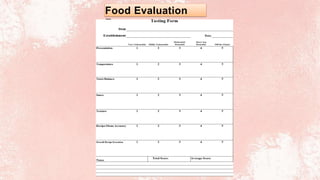
Food Evaluation
Form
Validation of Market Acceptability
Validation of market acceptability is the process of finding out if
the intended primary target market will be buying the product or
availing the service. Market acceptability is a critical factor that
the entrepreneur must validate before launching the product or
service, because this can strongly suggest if the business will
be successful or not. It either validates or disconfirms the
perception of the entrepreneur about the sustainability of the
chosen primary target market. It also tests whether the value
proposition and unique selling proposition are appropriate or
there’s a need to improve on them. This is also the time to
deeply understand the value that the product or service brings
to the customer and their prospective purchase behavior,
because it helps the entrepreneur build a more relevant and
step before the product or service can be introduced to the market.
The following objective questions are more likely you be answered in
the whole process of the market acceptability objective questions are
more likely to be answered in the whole process of market
acceptability validation:
1.Will the primary target market like the product or service?
2.Will the primary target market but the product or service when it is
already in the market?
These questions can easily be answered if the entrepreneur will
perform the following activities:
1.Use the most strategic marketing research tool (FDG), survey,
observation, interview, online survey, e-mail, or a combination of
these research tools, wherein the entrepreneur can get the most
relevant answers in the cheapest way possible.
2. Prepare relevant open-ended questions that answer the
objectives above. Do not go around the bush and be straight
to the point. Keep the questions to a minimum because the
target market might get bored and not finish the
wholequestionnaire.
3. Find market experts who also target the same market but
are not directly competing with the entrepreneur. For
instance, a market expert sells cars to a specific market
segment because they almost have the same demographic
data requirements. The entrepreneur can use these data to
improve theproduct or service.
4. Collate all the data analyze them, and prepare a summative
report that answers the objective questions that were
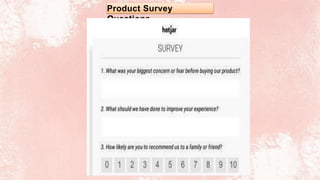
Product Survey
Questions
Assessment
1.Which one of the following best describes the product
development process?
A.the strategy process for original product
B.workachieved by a company's research and development
department
C.recognize opportunities in the marketplace, create and
test
products to take advantage of those opportunities, and
then present the products to the market.
2.Product development starts with
A.Idea generation
B.Idea selection
3. The components of a product or service offer include:
A.customer benefits, attributes or features, warranty, and
potential benefits.
B.core benefits, attributes or features, support and services,
and potential
C.core benefits, attributes or features, support and services,
and
customer loyalty programs.
4.A brand must offer which one of the following to have a
value?
A.Consistency
B.Modest Product
C.Multifaceted Product
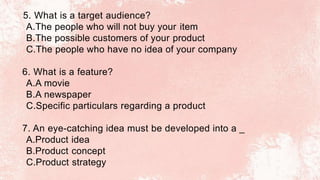
5. What is a target audience?
A.The people who will not buy your item
B.The possible customers of your product
C.The people who have no idea of your company
6. What is a feature?
A.A movie
B.A newspaper
C.Specific particulars regarding a product
7. An eye-catching idea must be developed into a _
A.Product idea
B.Product concept
C.Product strategy
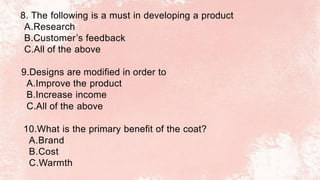
8. The following is a must in developing a product
A.Research
B.Customer’s feedback
C.All of the above
9.Designs are modified in order to
A.Improve the product
B.Increase income
C.All of the above
10.What is the primary benefit of the coat?
A.Brand
B.Cost
C.Warmth
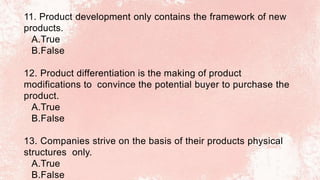
11. Product development only contains the framework of new
products.
A.True
B.False
12. Product differentiation is the making of product
modifications to convince the potential buyer to purchase the
product.
A.True
B.False
13. Companies strive on the basis of their products physical
structures only.
A.True
B.False
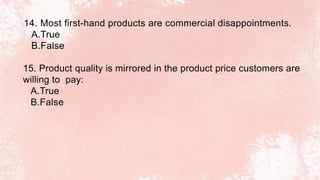
14. Most first-hand products are commercial disappointments.
A.True
B.False
15. Product quality is mirrored in the product price customers are
willing to pay:
A.True
B.False

1_Q2-Entrep.pptx

  • 1.
  • 2.
    Instruction: Indicate acheck mark before a number if the statement is necessary in product development.
  • 3.
    Fundamentals of ProductDevelopment (Batisan, 2016) Before commercializing a new product or service, the entrepreneur must focus on refining the product or service ad validate its market acceptability. This new product does not have to be a totally new product. It can be a new product line from the existing product. Product development is the process, testing, and commercializing a product or service with the ultimate objective of solving the problem of the primary target market. It is composed of four sequential steps: (1) developing a product or service description, (2) creating a prototype, (3) testing the prototype, and (4) validating the market. Product or Service Development The product or service description simply describes how a
  • 4.
    or service descriptionis important because this will serve as the blueprint of all business operations. Therefore, the entrepreneur has to take note of the following regarding the product or service description: 1.It should directly address the primary target market in a personal manner using everyday language. The entrepreneur should put himself or herself in the customer’s shoes, where the product description will be addressed to. 2.It should highlight the features that will cater to the customer’s needs or address the customer’s problems. 3.Realistic superlatives should be used for the product description. Motherhood statements such as “word-class service or product excellence” may not matter to the
  • 5.
  • 6.
    Creating a Prototypeof the Product or Service After defining the product or service, you may now proceed with one of the most exciting but also very challenging parts of product or service development: the creation of a prototype. A prototype is a preliminary model or sample of a new product or service that is created to test a product concept or service process. This is an exciting process for the entrepreneur because he or she will be able to see that his or her ideas will soon become a tangible reality. The entrepreneur’s creativity and ingenuity will be used in creating the prototype. According to Entrepreneur (www.entrepreneur.com), creating a prototype lessens implementations/commercialization risks and provides the entrepreneur a bunch ofadvantages as follows:
  • 7.
    1.Creating a prototypeenables the entrepreneur to engage in trial- and-error provides room for improvements, and refines the functionality of the product design or service process. It is very expensive and risk-intensive to commercialize a product without creating a prototype. 2.Creating a prototype provides the entrepreneur a window to test the performance and specifications of various materials and service processes. Every detail of the product or service should be scrutinized carefully, and all flaws be addressed right way before commercialization. 3.A prototype helps the entrepreneur effectively describe the product or service to the product team. Members of the
  • 8.
    include marketing, operations,engineers, suppliers, business partners, and legal and human resources. It provides the product team the information needed to create the right product or service as planned 4. Creating a prototype elicits respect from key stakeholders and customers. At the same time, a prototype gives credibility to the entrepreneur. Some entrepreneurs only present vague and big ideas but no details as to its feasibility and implementation. Prototyping
  • 9.
    Creating a prototypeis the stage where the entrepreneur can experiment, develop, and make some improvements in the potential product or service. The objective of the entrepreneur at this stage is to verify if the product or service concept will work the simplest, fastest and cheapest way. One technique for creating the best prototype is by studying the competitor’s product or service. The entrepreneur will try to scrutinize the parts and functions, as well as the design and other attributes of that product, in hopes that he or she will be able to address some problems in the competitor’s products and come up with the most efficient and effective prototype. As for the services, the entrepreneur may try availing the competitor’s services and will take note of their operations, such as service delivery, location, facilities, and ambiance. He or she
  • 10.
    will than takenotes of the pros and cons of the service to create the prototype, simulate the service by trying it with his or her friends or relatives, and then get their feedback. Some entrepreneurs create a video presentation or miniature prototype, so they will be able to explain the details, if the product is to be viewed by a panel of specialists (e.g., engineers, developers, scientists). The scope should be related to the entrepreneur’s budget. After creating the prototype, he or she should be ready to testit. Testing the Product Prototype All the efforts exerted in the creation of a prototype will be put to waste if the prototype will not be tested. Testing the prototype is a vital process before an actual product or service is launched in the market. Testing the prototype will uncover the final loopholes
  • 11.
    need to befixed before commercialization. It gives the entrepreneur a leeway to examine and scrutinize the prototype and provide feedback as to what can be improved before the launch. These improvements and changes must be completed first before moving forward to the next step. For a prototype that has already been refined, testing it for the last time after the changes have been made will validate its readiness for commercialization. The following testing methods are applied by the entrepreneur: 1. Focus group discussion – the participants will provide relevant insights about the new product or service. The objective of the FDG is to identify errors, deficiencies, and issues that may impede the success of the product. Participants
  • 12.
    2. Legality andethical test – Prior to launching, the entrepreneur must ensure that the product or service complies with all relevant laws and business. For example, food products must be cleared first with the Bureau of Food and Drugs (BFAD) before they are offered to the public. The entrepreneur must also make sure that the manufacturing/production of goods or offering of the service does not generate ethical issues such as being threats to health, safety, and environment. 3.Safety test – The entrepreneur must ensure that the product is safe to use, safe to be consumed (food and beverages), and safe to be applied (cosmetic products). The product should not in any way harm the customer or put the customer in peculiar situations. In services, the entrepreneur must
  • 13.
    performed by theservice provider must not be detrimental to the safety and health of the customer. 4. Product costing test – The entrepreneur must examine every stage of the manufacturing process or every process of the service blueprint to evaluate and finalize the costs involved. This is the time when the entrepreneur can match the expected costs versus his or her budget. Modification in the manufacturing process or service blueprint can still be made at this point to align with the cost objective of the entrepreneur. 5. Component test – Each component of the product or service must be tested independently to identify component failures for goods or service failures for services. Any failure identified must
  • 14.
    and tested againuntil it becomes fully operational and functional. 6. Competitors’ product / service test – The entrepreneur must test a similar line of products or the competitors’ product or service itself to compare and get the best practices to be applied to the new product or service. Testing the product prototype is mandatory to ensure that the product or service will not fail the customers and will deliver its definitive purpose. This will elicit customer satisfaction and, eventually, customer loyalty and retention. This is the time to prove that the concept formulated by the entrepreneur will work and is feasible in real life. All the mistake accounted for and improvements to be fixed should be performed first prior to commercialization of the product or service.
  • 15.
  • 16.
    Validation of MarketAcceptability Validation of market acceptability is the process of finding out if the intended primary target market will be buying the product or availing the service. Market acceptability is a critical factor that the entrepreneur must validate before launching the product or service, because this can strongly suggest if the business will be successful or not. It either validates or disconfirms the perception of the entrepreneur about the sustainability of the chosen primary target market. It also tests whether the value proposition and unique selling proposition are appropriate or there’s a need to improve on them. This is also the time to deeply understand the value that the product or service brings to the customer and their prospective purchase behavior, because it helps the entrepreneur build a more relevant and
  • 17.
    step before theproduct or service can be introduced to the market. The following objective questions are more likely you be answered in the whole process of the market acceptability objective questions are more likely to be answered in the whole process of market acceptability validation: 1.Will the primary target market like the product or service? 2.Will the primary target market but the product or service when it is already in the market? These questions can easily be answered if the entrepreneur will perform the following activities: 1.Use the most strategic marketing research tool (FDG), survey, observation, interview, online survey, e-mail, or a combination of these research tools, wherein the entrepreneur can get the most relevant answers in the cheapest way possible.
  • 18.
    2. Prepare relevantopen-ended questions that answer the objectives above. Do not go around the bush and be straight to the point. Keep the questions to a minimum because the target market might get bored and not finish the wholequestionnaire. 3. Find market experts who also target the same market but are not directly competing with the entrepreneur. For instance, a market expert sells cars to a specific market segment because they almost have the same demographic data requirements. The entrepreneur can use these data to improve theproduct or service. 4. Collate all the data analyze them, and prepare a summative report that answers the objective questions that were
  • 19.
  • 20.
    Assessment 1.Which one ofthe following best describes the product development process? A.the strategy process for original product B.workachieved by a company's research and development department C.recognize opportunities in the marketplace, create and test products to take advantage of those opportunities, and then present the products to the market. 2.Product development starts with A.Idea generation B.Idea selection
  • 21.
    3. The componentsof a product or service offer include: A.customer benefits, attributes or features, warranty, and potential benefits. B.core benefits, attributes or features, support and services, and potential C.core benefits, attributes or features, support and services, and customer loyalty programs. 4.A brand must offer which one of the following to have a value? A.Consistency B.Modest Product C.Multifaceted Product
  • 22.
    5. What isa target audience? A.The people who will not buy your item B.The possible customers of your product C.The people who have no idea of your company 6. What is a feature? A.A movie B.A newspaper C.Specific particulars regarding a product 7. An eye-catching idea must be developed into a _ A.Product idea B.Product concept C.Product strategy
  • 23.
    8. The followingis a must in developing a product A.Research B.Customer’s feedback C.All of the above 9.Designs are modified in order to A.Improve the product B.Increase income C.All of the above 10.What is the primary benefit of the coat? A.Brand B.Cost C.Warmth
  • 24.
    11. Product developmentonly contains the framework of new products. A.True B.False 12. Product differentiation is the making of product modifications to convince the potential buyer to purchase the product. A.True B.False 13. Companies strive on the basis of their products physical structures only. A.True B.False
  • 25.
    14. Most first-handproducts are commercial disappointments. A.True B.False 15. Product quality is mirrored in the product price customers are willing to pay: A.True B.False