Proceedings of the 2010 CRC PhD Student
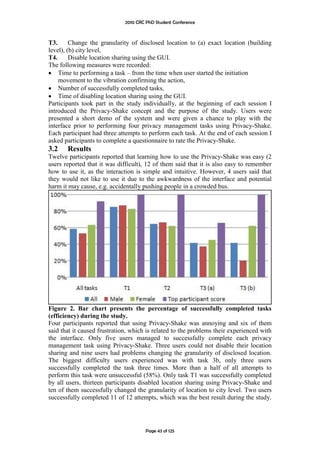
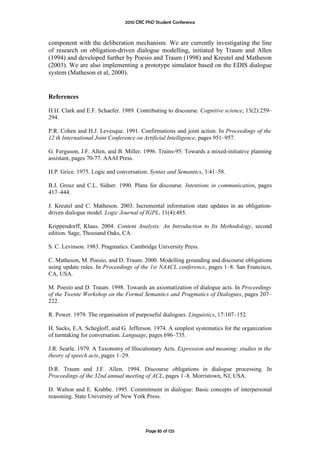
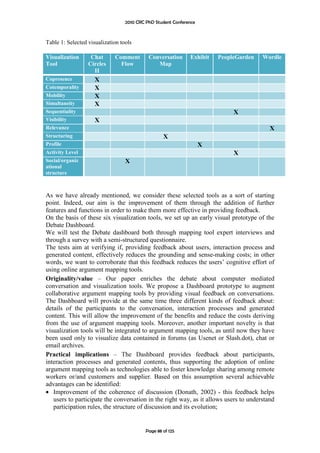
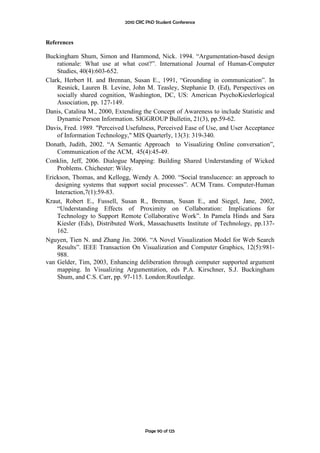
               Conference


   Centre for Research in Computing
         The Open University
             Milton Keynes


            June 3 and 4, 2010
Centre for Research in Computing
      The Open University
        Milton Keynes, UK


    Conference organization:
         Marian Petre
          Robin Laney
       Mathieu D’Aquin
          Paul Piwek
         Debbie Briggs


           May 2010
    Proceedings compiled by
          Paul Piwek
Table of Contents


Mihhail Aizatulin Verifying Implementations of Security      .........   1
                  Protocols
                  in C

Simon Butler        Analysing Semantic Networks of           .........   5
                    Identifier Names to Improve Source
                    Code Maintainability and Quality

Tom Collins         Discovering Translational Patterns in    .........   9
                    Symbolic Representation of Music

Joe Corneli         Semantic Adaptivity and Social           .........   12
                    Networking in Personal Learning
                    Networks

Richard Doust       Investigating narrative “effects”: the   .........   15
                    case of suspense

Francois            Verifying Authentication Properties of   .........   19
Dupressoir          C Security Protocol Code Using
                    General Verifiers

Jennifer Ferreira   Agile development and usability in       .........   23
                    practice: Work cultures of
                    engagement

Michael A           Model Driven Architecture of Large       .........   26
Giddings            Distributed Hard Real Time Systems

Alan Hayes          An Investigation into Design             .........   30
                    Diagrams and Their Implementations

Robina              An Investigation into Interoperability   .........   33
Hetherington        of Data Between Software Packages
                    used to support the Design, Analysis
                    and Visualisation of Low Carbon
                    Buildings

Chris Ireland       Understanding Object-Relational          .........   37
                    Impedance Mismatch: A Framework
                    Based Approach
Lukasz             “Privacy Shake”, a Haptic Interface    .........   41
Jedrzejczyk        for Managing Privacy Settings in
                   Mobile Location Sharing Applications

Stefan             Designing a Climate Change Game for .........      45
Kreitmayer         Interactive Tabletops

Tamara Lopez       Reasoning about Flaws in Software      .........   47
                   Design: Diagnosis and Recovery

Lin Ma             Presupposition Analysis in             .........   51
                   Requirements

Lionel Montrieux   Merging Verifiable and Evolving        .........   55
                   Access Control Properties

Sharon Moyo        Effective Tutoring with Affective      .........   58
                   Embodied Conversational Agents

Brendan Murphy     Evaluating a mobile learning           .........   60
                   environment in a home car domain

Tu Anh Nguyen      Generating Accessible Natural          .........   65
                   Language Explanations for OWL
                   Ontologies

Chwhynny           Supporting the Exploration of          .........   69
Overbeeke          Research Spaces

Nadia Pantidi      Understanding technology-rich          .........   74
                   learning spaces

Aleksandra         How best to support scientific end-    .........   78
Pawlik             user software development?

Brian Pluss        Non-Cooperation in Computational       .........   82
                   Models of Dialogue

Ivana Quinto       A Debate Dashboard to Support the      .........   86
                   Adoption of On-line Argument
                   Mapping Tools

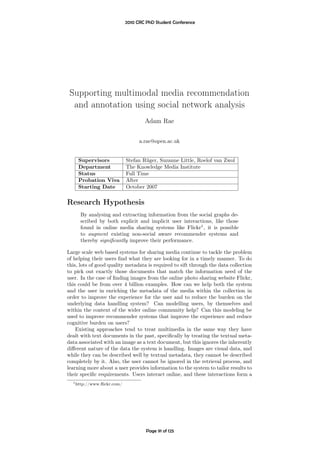
Adam Rae           Supporting multimodal media            .........   91
                   recommendation and annotation
                   using social network analysis

Rien Sach          The effect of Feedback                 .........   95
Stefan            Using Business Process Security        .........    98
Taubenberger      Requirements for IT Security Risk
                  Assessment

Keerthi Thomas    Distilling Privacy Requirements for    .........    102
                  Mobile Applications

Min Q. Tran       Understanding the Influence of 3D      .........    104
                  Virtual Worlds on Perceptions of 2D E-
                  commerce Websites

Thomas Daniel     Supporting Reflection about Web        .........    108
Ullmann           Resources within Mash-Up Learning
                  Environments

Rean van der      Local civic governance using online    .........    110
Merwe             media – a case of consensual problem
                  solving or a recalcitrant pluralism

Katie Wilkie      Analysis of conceptual metaphors to    .........    114
                  inform music interaction designs

Anna Xambo        Issues and techniques for collaborative .........   118
                  music making on multi-touch surfaces

Saad Bin Saleem   A Release Planning Model to Handle     .........    122
                  Security Requirements
2010 CRC PhD Student Conference


Verifying Implementations of Security Protocols in C
                             Mihhail Aizatulin
                           m.aizatulin@open.ac.uk


  Supervisors         Dr Andrew Gordon, adg@microsoft.com,
                      Dr Jan J¨rjens, jan.jurjens@cs.tu-dortmund.de,
                               u
                      Prof Bashar Nuseibeh, B.Nuseibeh@open.ac.uk
  Department          Computing
  Status              Full-time
  Probation viva      Passed
  Starting date       November 2008
     Our goal is verification of cryptographic protocol implementations (such as
 OpenSSL or Kerberos), motivated by the desire to minimise the gap between
 verified and executable code. Very little has been done in this area. There are
 numerous tools to find low-level bugs in code (such as buffer overflows and zero
 division) and there are verifiers for cryptographic protocols that work on fairly
 abstract descriptions, but so far very few attempts have been done to verify
 cryptographic security directly on the code, especially for low-level languages
 like C.
     We attempt to verify the protocol code by extracting an abstract model that
 can be used in high-level cryptographic verification tools such as ProVerif or
 CryptoVerif. This is the first such approach that we are aware of. Currently we
 investigate the feasibility of the approach by extracting the model from running
 code, using the so called concolic (concrete + symbolic) execution. We run
 the protocol implementation normally, but at the same time we record all the
 operations performed on binary values and then replay those operations on
 symbolic values. The resulting symbolic expressions reveal the structure of the
 messages sent to the network and the conditions that are checked for incoming
 messages.
     We are able to produce symbolic execution traces for the handshake imple-
 mented in the OpenSSL library. To give an example of what the extracted traces
 look like, consider a simple request-response protocol, protected by hashing with
 a shared key:
                   A → B : m|hash(‘request’|m, kAB ),
                   B → A : m |hash(‘response’|m|m , kAB ).
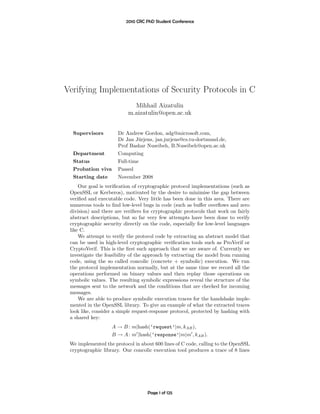
 We implemented the protocol in about 600 lines of C code, calling to the OpenSSL
 cryptographic library. Our concolic execution tool produces a trace of 8 lines


                                   Page 1 of 125
2010 CRC PhD Student Conference


write(i39)
payload1 = payload()
key2 = key()
write(i14|7c|payload1|HMAC(sha1, i7|7c52657175657374|payload1, key2))
msg3 = read()
var4 = msg3{5,23}
branchF((memcmp(msg3{28,20},
                HMAC(sha1, i8|7c526573706f6e7365|i14|7c|payload1|var4, key2)) != i0))
accept(var4)


Figure 1: An excerpt from the symbolic client trace. X{start, len} denotes
the substring of X starting at start of length len. iN is an integer with value N
(width information is omitted), and branchT and branchF are the true or false
branches taken by the code.


for the client side shown in figure 1: we see the client sending the request and
checking the condition on the server response before accepting it.
    We are currently working to implement symbolic handling of buffer lengths
and sound handling of loops as well as making the extracted models compatible
with those understood by ProVerif and CryptoVerif, in particular simplifying
away any remaining arithmetic expressions from the symbolic trace.
    One obvious drawback of concolic execution is that it only follows the single
path that was actually taken by the code. This is enough to produce an accurate
model when there is only one main path, however, libraries like OpenSSL contain
multiple nontrivial paths. Thus, to achieve verification of those libraries, we
plan to move the analysis towards being fully static in future.

Related Work One of the earliest security verification attempts directly
on code is probably CSur [Goubault-Larrecq and Parrennes, 2005] that deals
directly with C protocol implementations. It translates programs into a set
of Horn clauses that are fed directly into a general purpose theorem prover.
Unfortunately, it never went beyond some very simple implementations and has
not been developed since.
    The work [J¨rjens, 2006] describes an approach of translating Java programs
                u
in a manner similar to above. In our work we try to separate reasoning about
pointers and integers from reasoning about cryptography, in hope to achieve
greater scalability.
    Some work has been done on verification of functional language implementa-
tions, either by translating the programs directly into π-calculus [Bhargavan et
al., 2006; Bhargavan et al., 2008] or by designing a type system that enforces
security [Bengtson et al., 2008]. Unfortunately, it is not trivial to adapt such
approaches to C-like languages.
    ASPIER [Chaki and Datta, 2008] is using model checking for verification and
has been applied to OpenSSL. However, it does not truly start from C code: any
code explicitly dealing with pointers needs to be replaced by abstract summaries


                                  Page 2 of 125
2010 CRC PhD Student Conference


that presumably have to be written manually.
    Concolic execution is widely used to drive automatic test generation, like in
[Cadar et al., 2008] or [Godefroid et al., 2008]. One difference in our concolic
execution is that we need to assign symbols to whole bitstrings, whereas the
testing frameworks usually assign symbols to single bytes. We believe that our
work could be adapted for testing of cryptographic software. Usual testing
approaches try to create an input that satisfies a set of equations resulting from
checks in code. In presence of cryptography such equations will (hopefully) be
impossible to solve, so a more abstract model like ours might be useful.
    A separate line of work deals with reconstruction of protocol message formats
from implementation binaries [Caballero et al., 2007; Lin et al., 2008; Wondracek
et al., 2008; Cui et al., 2008; Wang et al., 2009]. The goal is typically to
reconstruct field boundaries of a single message by observing how the binary
processes the message. Our premises and goals are different: we have the
advantage of starting from the source code, but in exchange we aim to reconstruct
the whole protocol flow instead of just a single message. Our reconstruction
needs to be sound to enable verification — all possible protocol flows should be
accounted for.


References
[Bengtson et al., 2008] Jesper Bengtson, Karthikeyan Bhargavan, C´dric Four-
                                                                 e
  net, Andrew D. Gordon, and Sergio Maffeis. Refinement types for secure
  implementations. In CSF ’08: Proceedings of the 2008 21st IEEE Computer
  Security Foundations Symposium, pages 17–32, Washington, DC, USA, 2008.
  IEEE Computer Society.
[Bhargavan et al., 2006] Karthikeyan Bhargavan, C´dric Fournet, Andrew D.
                                                    e
  Gordon, and Stephen Tse. Verified interoperable implementations of security
  protocols. In CSFW ’06: Proceedings of the 19th IEEE workshop on Computer
  Security Foundations, pages 139–152, Washington, DC, USA, 2006. IEEE
  Computer Society.
[Bhargavan et al., 2008] Karthikeyan Bhargavan, C´dric Fournet, Ricardo Corin,
                                                 e
  and Eugen Zalinescu. Cryptographically verified implementations for TLS.
  In CCS ’08: Proceedings of the 15th ACM conference on Computer and
  communications security, pages 459–468, New York, NY, USA, 2008. ACM.
[Caballero et al., 2007] Juan Caballero, Heng Yin, Zhenkai Liang, and Dawn
  Song. Polyglot: automatic extraction of protocol message format using
  dynamic binary analysis. In CCS ’07: Proceedings of the 14th ACM conference
  on Computer and communications security, pages 317–329, New York, NY,
  USA, 2007. ACM.
[Cadar et al., 2008] Cristian Cadar, Daniel Dunbar, and Dawson Engler. Klee:
  Unassisted and automatic generation of high-coverage tests for complex sys-


                                  Page 3 of 125
2010 CRC PhD Student Conference


  tems programs. In USENIX Symposium on Operating Systems Design and
  Implementation (OSDI 2008), San Diego, CA, december 2008.
[Chaki and Datta, 2008] Sagar Chaki and Anupam Datta. Aspier: An auto-
  mated framework for verifying security protocol implementations. Technical
  Report 08-012, Carnegie Mellon University, October 2008.
[Cui et al., 2008] Weidong Cui, Marcus Peinado, Karl Chen, Helen J. Wang, and
   Luis Irun-Briz. Tupni: automatic reverse engineering of input formats. In CCS
  ’08: Proceedings of the 15th ACM conference on Computer and communications
   security, pages 391–402, New York, NY, USA, 2008. ACM.
[DBL, 2008] Proceedings of the Network and Distributed System Security Sympo-
  sium, NDSS 2008, San Diego, California, USA, 10th February - 13th February
  2008. The Internet Society, 2008.
[Godefroid et al., 2008] Patrice Godefroid, Michael Y. Levin, and David A. Mol-
  nar. Automated whitebox fuzz testing. In NDSS [2008].
[Goubault-Larrecq and Parrennes, 2005] J. Goubault-Larrecq and F. Parrennes.
  Cryptographic protocol analysis on real C code. In Proceedings of the 6th
  International Conference on Verification, Model Checking and Abstract Inter-
  pretation (VMCAI’05), volume 3385 of Lecture Notes in Computer Science,
  pages 363–379. Springer, 2005.
[J¨rjens, 2006] Jan J¨ rjens. Security analysis of crypto-based Java programs
  u                  u
  using automated theorem provers. In ASE ’06: Proceedings of the 21st
  IEEE/ACM International Conference on Automated Software Engineering,
  pages 167–176, Washington, DC, USA, 2006. IEEE Computer Society.
[Lin et al., 2008] Zhiqiang Lin, Xuxian Jiang, Dongyan Xu, and Xiangyu Zhang.
  Automatic protocol format reverse engineering through context-aware moni-
   tored execution. In NDSS [2008].
[Wang et al., 2009] Zhi Wang, Xuxian Jiang, Weidong Cui, Xinyuan Wang, and
  Mike Grace. Reformat: Automatic reverse engineering of encrypted messages.
  In Michael Backes and Peng Ning, editors, ESORICS, volume 5789 of Lecture
  Notes in Computer Science, pages 200–215. Springer, 2009.
[Wondracek et al., 2008] Gilbert Wondracek, Paolo Milani Comparetti, Christo-
  pher Kruegel, and Engin Kirda. Automatic Network Protocol Analysis. In
  15th Symposium on Network and Distributed System Security (NDSS), 2008.


                                  Page 4 of 125
2010 CRC PhD Student Conference


    Analysing semantic networks of
identifier names to improve source code
       maintainability and quality
                              Simon Butler
                        sjb792@student.open.ac.uk


    Supervisors                  Michel Wermelinger, Yijun Yu & Helen Sharp
    Department/Institute         Centre for Research in Computing
    Status                       Part-time
    Probation viva               After
    Starting date                October 2008


Source code is the written expression of a software design consisting of identifier
names – natural language phrases that represent concepts being manipulated
by the program – embedded in a framework of keywords and operators provided
by the programming language. Identifiers are crucial for program comprehen-
sion [9], a necessary activity in the development and maintenance of software.
Despite their importance, there is little understanding of the relationship be-
tween identifier names and source code quality and maintainability. Neither is
there automated support for identifier management or the selection of relevant
natural language content for identifiers during software development.
    We will extend current understanding of the relationship between identifier
name quality and source code quality and maintainability by developing tech-
niques to analyse identifiers for meaning, modelling the semantic relationships
between identifiers and empirically validating the models against measures of
maintainability and software quality. We will also apply the analysis and mod-
elling techniques in a tool to support the selection and management of identifier
names during software development, and concept identification and location for
program comprehension.
    The consistent use of clear identifier names is known to aid program com-
prehension [4, 7, 8]. However, despite the advice given in programming conven-
tions and the popular programming literature on the use of meaningful identifier
names in source code, the reality is that identifier names are not always meaning-
ful, may be selected in an ad hoc manner, and do not always follow conventions
[5, 1, 2].
    Researchers in the reverse engineering community have constructed mod-
els to support program comprehension. The models range in complexity from
textual search systems [11], to RDF-OWL ontologies created either solely from
source code and identifier names [8], or with the inclusion of supporting doc-
umentation and source code comments [13]. The ontologies typically focus on


                                   Page 5 of 125
2010 CRC PhD Student Conference


class and method names, and are used for concept identification and location
based on the lexical similarity of identifier names. The approach, however, does
not directly address the quality of identifier names used.
    The development of detailed identifier name analysis has focused on method
names because their visibility and reuse in APIs implies a greater need for them
to contain clear information about their purpose [10]. Caprile and Tonella [3]
derived both a grammar and vocabulary for C function identifiers, sufficient
for the implementation of automated name refactoring. Høst and Østvold [5]
have since analysed Java method names looking for a common vocabulary that
could form the basis of a naming scheme for Java methods. Their analysis of
the method names used in multiple Java projects found common grammatical
forms; however, there were sufficient degenerate forms for them to be unable to
derive a grammar for Java method names.
    The consequences of identifier naming problems have been considered to be
largely confined to the domain of program comprehension. However, Deißenb¨ck   o
and Pizka observed an improvement in maintainability when their rules of con-
cise and consistent naming were applied to a project [4], and our recent work
found statistical associations between identifier name quality and source code
quality [1, 2]. Our studies, however, only looked at the construction of the
identifier names in isolation, and not at the relationships between the meaning
of the natural language content of the identifiers. We hypothesise that a rela-
tionship exists between the quality of identifier names, in terms of their natural
language content and semantic relationships, and the quality of source code,
which can be understood in terms of the functionality, reliability, and usability
of the resulting software, and its maintainability [6]. Accordingly, we seek to
answer the following research question:

         How are the semantic relationships between identifier names, in-
     ferred from their natural language content and programming lan-
     guage structure, related to source code maintainability and quality?

    We will construct models of source code as semantic networks predicated
on both the semantic content of identifier names and the relationships between
identifier names inferred from the programming language structure. For exam-
ple, the simple class Car in Figure 1 may be represented by the semantic network
in Figure 2. Such models can be applied to support empirical investigations of
the relationship between identifier name quality and source code quality and
maintainability. The models may also be used in tools to support the manage-
ment and selection of identifier names during software development, and to aid
concept identification and location during source code maintenance.

public c l a s s Car extends V e h i c l e {
    Engine e n g i n e ;
}

                           Figure 1: The class Car

   We will analyse identifier names mined from open source Java projects to
create a catalogue of identifier structures to understand the mechanisms em-
ployed by developers to encode domain information in identifiers. We will build


                                  Page 6 of 125
2010 CRC PhD Student Conference


on the existing analyses of C function and Java method identifier names [3, 5, 8],
and anticipate the need to develop additional techniques to analyse identifiers,
particularly variable identifier names.

                              extends
                     Car                  Vehicle


                      has a

                                has instance named
                   Engine                               engine


                Figure 2: A semantic network of the class Car


    Modelling of both the structural and semantic relationships between iden-
tifiers can be accomplished using Gellish [12], an extensible controlled natural
language with dictionaries for natural languages – Gellish English being the
variant for the English language. Unlike a conventional dictionary, a Gellish
dictionary includes human- and machine-readable links between entries to de-
fine relationships between concepts – thus making Gellish a semantic network –
and to show hierarchical linguistic relationships such as meronymy, an entity–
component relationship. Gellish dictionaries also permit the creation of multiple
conceptual links for individual entries to define polysemic senses.
    The natural language relationships catalogued in Gellish can be applied to
establish whether the structural relationship between two identifiers implied by
the programming language is consistent with the conventional meaning of the
natural language found in the identifier names. For example, a field is implic-
itly a component of the containing class allowing the inference of a conceptual
and linguistic relationship between class and field identifier names. Any incon-
sistency between the two relationships could indicate potential problems with
either the design or with the natural language content of the identifier names.
    We have assumed a model of source code development and comprehension
predicated on the idea that it is advantageous for coherent and relevant semantic
relationships to exist between identifier names based on their natural language
content. To assess the relevance of our model to real-world source code we
will validate the underlying assumption empirically. We intend to mine both
software repositories and defect reporting systems to identify source code impli-
cated in defect reports and evaluate the source code in terms of the coherence
and consistency of models of its identifiers. To assess maintainability we will
investigate how source code implicated in defect reports develops in successive
versions – e.g. is the code a continuing source of defects? – and monitor areas of
source code modified between versions to determine how well our model predicts
defect-prone and defect-free regions of source code.
    We will apply the results of our research to develop a tool to support the
selection and management of identifier names during software development, as
well as modelling source code to support software maintenance. We will evaluate
and validate the tool with software developers – both industry partners and
FLOSS developers – to establish the value of identifier naming support. While
intended for software developers, the visualisations of source code presented by


                                    Page 7 of 125
2010 CRC PhD Student Conference


the tool will enable stakeholders (e.g. domain experts) who are not literate
in programming or modelling languages (like Java and UML) to examine, and
feedback on, the representation of domain concepts in source code.


References
 [1] S. Butler, M. Wermelinger, Y. Yu, and H. Sharp. Relating identifier naming
     flaws and code quality: an empirical study. In Proc. of the Working Conf.
     on Reverse Engineering, pages 31–35. IEEE Computer Society, 2009.
 [2] S. Butler, M. Wermelinger, Y. Yu, and H. Sharp. Exploring the influence
     of identifier names on code quality: an empirical study. In Proc. of the
     14th European Conf. on Software Maintenance and Reengineering, pages
     159–168. IEEE Computer Society, 2010.
 [3] B. Caprile and P. Tonella. Restructuring program identifier names. In
     Proc. Int’l Conf. on Software Maintenance, pages 97–107. IEEE, 2000.
 [4] F. Deißenb¨ck and M. Pizka. Concise and consistent naming. Software
                o
     Quality Journal, 14(3):261–282, Sep 2006.
 [5] E. W. Høst and B. M. Østvold. The Java programmer’s phrase book.
     In Software Language Engineering, volume 5452 of LNCS, pages 322–341.
     Springer, 2008.
 [6] International Standards Organisation. ISO/IEC 9126-1: Software engineer-
     ing – product quality, 2001.
 [7] D. Lawrie, H. Feild, and D. Binkley. An empirical study of rules for well-
     formed identifiers. Journal of Software Maintenance and Evolution: Re-
     search and Practice, 19(4):205–229, 2007.
 [8] D. Ratiu. Intentional Meaning of Programs. PhD thesis, Technische Uni-
           ¸
     versit¨t M¨nchen, 2009.
           a   u
 [9] V. Rajlich and N. Wilde. The role of concepts in program comprehension.
     In Proc. 10th Int’l Workshop on Program Comprehension, pages 271–278.
     IEEE, 2002.
[10] M. Robillard. What makes APIs hard to learn? Answers from developers.
     IEEE Software, 26(6):27–34, Nov.-Dec. 2009.
[11] G. Sridhara, E. Hill, L. Pollock, and K. Vijay-Shanker. Identifying word
     relations in software: a comparative study of semantic similarity tools. In
     Proc Int’l Conf. on Program Comprehension, pages 123–132. IEEE, June
     2008.
[12] A. S. H. P. van Renssen. Gellish: a generic extensible ontological language.
     Delft University Press, 2005.
[13] R. Witte, Y. Zhang, and J. Rilling. Empowering software maintainers with
     semantic web technologies. In European Semantic Web Conf., pages 37–52,
     2007.


                                  Page 8 of 125
2010 CRC PhD Student Conference


                  Discovering translational patterns
                 in symbolic representations of music

                                   Tom Collins
                        http://users.mct.open.ac.uk/tec69

Supervisors          Robin Laney
                     Alistair Willis
                     Paul Garthwaite
Department/Institute Centre for Research in Computing
Status               Fulltime
Probation viva       After
Starting date        October 2008


                                 RESEARCH QUESTION

How can current methods for pattern discovery in music be improved and integrated
into an automated composition system?

The presentation will address the first half of this research question: how can current
methods for pattern discovery in music be improved?

                          INTRA-OPUS PATTERN DISCOVERY

Suppose that you wish to get to know a particular piece of music, and that you have a
copy of the score of the piece or a MIDI file. (Scores and MIDI files are symbolic
representations of music and are the focus of my presentation, as opposed to sound
recordings.) Typically, to become familiar with a piece, one listens to the MIDI file or
studies/plays through the score, gaining an appreciation of where and how material is
repeated, and perhaps also gaining an appreciation of the underlying structure.

The literature contains several algorithmic approaches to this task, referred to as
‘intra-opus’ pattern discovery [2, 4, 5]. Given a piece of music in a symbolic
representation, the aim is to define and evaluate an algorithm that discovers and
returns patterns occurring within the piece. Some potential applications for such an
algorithm are as follows:

   •   A pattern discovery tool to aid music students.
   •   Comparing an algorithm’s discoveries with those of a music expert as a means
       of investigating human perception of music.
   •   Stylistic composition (the process of writing in the style of another composer
       or period) assisted by using the patterns/structure returned by a pattern
       discovery algorithm [1, 3].


                                       Page 9 of 125
2010 CRC PhD Student Conference


                                 TWO IMPROVEMENTS

Current methods for pattern discovery in music can be improved in two ways:

   1. The way in which the algorithm’s discoveries are displayed for a user can be
      improved.
   2. A new algorithm can be said to improve upon existing algorithms if, according
      to standard metrics, it is the strongest-performing algorithm on a certain task.

Addressing the first area for improvement, suppose that an algorithm has discovered
hundreds of patterns within a piece of music. Now these must be presented to the
user, but in what order? Various formulae have been proposed for rating a discovered
pattern, based on variables that quantify attributes of that pattern and the piece of
music in which it appears [2, 4]. To my knowledge, none have been derived or
validated empirically. So I conducted a study in which music undergraduates
examined excerpts taken from Chopin’s mazurkas and were instructed to rate already-
discovered patterns, giving high ratings to patterns that they thought were noticeable
and/or important. A model useful for relating participants’ ratings to the attributes was
determined using variable selection and cross-validation. This model leads to a new
formula for rating discovered patterns, and the basis for this formula constitutes a
methodological improvement.

Addressing the second area for improvement, I asked a music analyst to analyse two
sonatas by Domenico Scarlatti and two preludes by Johann Sebastian Bach. The brief
was similar to the intra-opus discovery task described above: given a piece of music
in staff notation, discover translational patterns that occur within the piece. Thus, a
benchmark of translational patterns was formed for each piece, the criteria for
benchmark membership being left largely to the analyst’s discretion. Three
algorithms—SIA [5], COSIATEC [4] and my own, SIACT—were run on the same
pieces and their performance was evaluated in terms of recall and precision. If an
algorithm discovers x of the y patterns discovered by the analyst then its recall is x/y.
If the algorithm also returns z patterns that are not in the analyst’s benchmark then the
algorithm’s precision is x/(x + z). It was found that my algorithm, SIACT, out-
performs the existing algorithms with regard to recall and, more often than not,
precision.

My presentation will give the definition of a translational pattern, discuss the
improvements outlined above, and demonstrate how these improvements are being
brought together in a user interface.

                                SELECTED REFERENCES

1. Collins, T., R. Laney, A. Willis, and P.H. Garthwaite, ‘Using discovered,
polyphonic patterns to filter computer-generated music’, in Proceedings of the
International Conference on Computational Creativity, Lisbon (2010), 1-10.

2. Conklin, D., and M. Bergeron, ‘Feature set patterns in music’, in Computer Music
Journal 32(1) (2008), 60-70.


                                       Page 10 of 125
2010 CRC PhD Student Conference


3. Cope, D., Computational models of musical creativity (Cambridge Massachusetts:
MIT Press, 2005).

4. Meredith, D., K. Lemström, and G.A. Wiggins, ‘Algorithms for discovering
repeated patterns in multidimensional representations of polyphonic music’, in
Cambridge Music Processing Colloquium, Cambridge (2003), 11 pages.

5. Meredith, D., K. Lemström, and G.A. Wiggins, ‘Algorithms for discovering
repeated patterns in multidimensional representations of polyphonic music’, in
Journal of New Music Research 31(4) (2002), 321-345.


                                      Page 11 of 125
2010 CRC PhD Student Conference


   Semantic Adaptivity and Social Networking in Personal
                 Learning Environments

                                     Joe Corneli
                              j.a.corneli@open.ac.uk

Supervisors          Alexander Mikroyannidis
                     Peter Scott
Department/Institute Knowledge Media Institute
Status               Fulltime
Probation viva       Before
Starting date        01/01/10


Introductory Remarks

I've decided to deal with "personal learning environments" with an eye towards the
context of their creation and use. This entails looking not just at ways to help support
learning experiences, but also at the complex of experiences and behaviours of the
many stakeholders who are concerned with learning. (E.g. educators, content
providers, software developers, institutional and governmental organizations.)

This broad view is compatible with the idea of a personal learning environment put
forward by the progenitors of the PLE model: "Rather than integrate tools within a
single context, the system should focus instead on coordinating connections between
the user and a wide range of services offered by organizations and other individuals."
(Wilson et al., 2006)

This problem area, which otherwise threatens to become hugely expansive, invites the
creation of a unified methodology and mode of analysis. A key aim of my work is
to develop such a method -- a sort of dynamic cartography. In this frame, the social
roles of stakeholders are to be understood through their constituent actions.

My analysis will then focus on the following question: How can mapping activity
patterns in a social context help us support the learning process more effectively?

Thematic Issues

In order to understand patterns of interaction with data well enough to make useful
maps, we must delve a bit into human sense-making behaviour. A small vocabulary
of actions related to sense-making provides a model we can then use quite
extensively.

People look for simplifying patterns. In a countervailing trend, they look for ways to
become more usefully interconnected and interoperable. To negotiate between
these two types of behaviour, they identify or create "points of coordination" which
provide mechanisms of control. They may do experiments, and then document how


                                       Page 12 of 125
2010 CRC PhD Student Conference


these mechanisms generate effects in a more or less predictable way. Finally, they
developing explicit, shareable, practices which achieve "desirable" effects.

Simplification, interconnection, control, experiment, motivation, and praxis -- these
are the thematic issues that inform my technical investigations.

Proposed Implementation Work

I plan to focus on implementation is that it is an ideal place in which to refine and test
my ideas about dynamic maps. My efforts will be directed largely into
implementation in the following applications.

* Etherpad and other related tools for live online interactions --

Data about social interactions is all interesting and potentially useful, but data about
"live" social interactions is becoming increasingly available in forms that are suitable
for large-scale computational analysis, and real-time use.

* RDF and related techniques for data management --

Marking up complex and changing relationships between objects is standard in e.g.
computer animation and computer games; it is interesting to think about how these
ideas can work in other domains (e.g. to assist with learning).

* Wordnet and Latent Semantic Analysis style approaches for clustering and
annotating data --

There are various techniques for dividing content into thematic clusters (useful for
supporting simplification behaviours needed for sense making), and for annotating
data with new relationships (useful for supporting interconnection behaviours). I will
explore these in various applications, e.g. applying them to the streams of data
identified above.

* Semantic Web style patterns for interoperability --

Content may still be king, but interfaces make up the board on which the game is
played. I plan to use an existing standard for mathematical documents (OMDoc) and
other API-building tools to help make the PlanetMath.org collection of mathematical
resources interoperable with e.g. OU's SocialLearn platform, contributing to the
development of a public service to STEM learners and practitioners worldwide.

* Documentation of technical processes --

PlanetMath.org is an example of a tool that has more content contributors than coders,
and more feature requests than anyone knows what to do with. Good documentation
is part of making hacking easier. Towards this end, I'm planning to build
PlanetComputing.org to document the software used on PlanetMath (and many other
projects).

Conclusion


                                        Page 13 of 125
2010 CRC PhD Student Conference


By the end of my Ph. D. project, I hope to have built a "PLE IDE" -- a tool offering
personalized support for both learners and developers. I hope to have a robust theory
and practice of dynamical mapping that I will have tested out in several domains
related to online learning.

Reference

Wilson, S., Liber, O., Johnson, M., Beauvoir, P., Sharples, P., & Milligan, C. (2006).
Personal Learning Environments: Challenging The Dominant Design Of Educational
Systems. Proceedings of 2nd International Workshop on Learner-Oriented
Knowledge Management and KM-Oriented Learning, In Conjunction With ECTEL
06. (pp. 67-76), Crete, Greece.


                                      Page 14 of 125
2010 CRC PhD Student Conference


                Investigating narrative ‘effects’: the case of suspense
                                     Richard Doust, richard.doust@free.fr

                                 Supervisors              Richard Power, Paul Piwek
                            Department/Institute                 Computing
                                   Status                         Part-time
                               Probation viva                      Before
                                Starting date                   October 2008


1     Introduction
Just how do narrative structures such as a Hitchcock film generate the well-known feeling known as suspense ? Our
goal is to investigate the structures of narratives that produce various narrative effects such as suspense, curiosity,
surprise. The fundamental question guiding this research could be phrased thus:
       What are the minimal requirements on formal descriptions of narratives such that we can capture these
       phenomena and generate new narratives which contain them ?
Clearly, the above phenomena may depend also on extra-narrative features such as music, filming angles, and so
on. These will not be our primary concern here. Our approach consists of two main parts:
    1. We present a simple method for defining a Storybase which for our purposes will serve to produce different
       ‘tellings’ of the same story on which we can test our suspense modelling.
    2. We present a formal approach to generating the understanding of the story as it is told, and then use the
       output of this approach to suggest an algorithm for measuring the suspense level of a given telling of a story.
       We can thus compare different tellings of a story and suggest which ones will have high suspense, and which
       ones low.


2     Suspense
2.1     Existing definitions
Dictionary definitions of the word ’suspense’ suggest that there really ought to be several different words for what
is more like a concept cluster than a single concept. The Collins English dictionary gives three definitions:
    1. apprehension about what is going to happen. . .
    2. an uncertain cognitive state; "the matter remained in suspense for several years" . . .
    3. excited anticipation of an approaching climax; "the play kept the audience in suspense" anticipation, ex-
       pectancy - an expectation.
Gerrig and Bernardo (1994) suggest that reading fiction involves constantly looking for solutions to the plot-based
dilemmas faced by the characters in a story world. One of the suggestions which come out of this work is that
suspense is greater the lower the number of solutions to the hero’s current problem that can be found by the reader.
Cheong and Young’s (2006) narrative generating system uses the idea that a reader’s suspense level depends on
the number and type of solutions she can imagine in order to solve the problems facing the narrative’s preferred
character.
    Generally, it seems that more overarching and precise definitions of suspense are wanting in order to connect
some of the above approaches. The point of view we will assume is that the principles by which literary narratives
are designed are obscured by the lack of sufficiently analytical concepts to define them. We will use as our starting
point work on stories by Brewer and Lichtenstein (1981) which seems fruitful in that it proposes not only a view of
suspense, but also of related narrative phenomena such as surprise and curiosity.
                                                     Page 15 of 125
                                                           1
2010 CRC PhD Student Conference

2.2     Brewer and Lichtenstein’s approach
In Brewer and Lichtenstein (1981) propose that there are three major discourse structures which account for the
enjoyment of a large number of stories: surprise, curiosity and suspense. For suspense, there must be an initiating
event which could lead to significant consequences for one of the characters in the narrative. This event leads to
the reader feeling concern about the outcome for this character, and if this state is maintained over time, then the
reader will feel suspense. As Brewer and Lichtenstein say, often ‘additional discourse material is placed between
the initiating event and the outcome event, to encourage the build up of suspense’ (Brewer and Lichtenstein, 1981,
p.17).
    Much of the current work can be seen as an attempt to formalise and make robust the notions of narrative
understanding that Brewer laid out. We will try to suggest a model of suspense which explains, for example, how
the placing of additional material between the initiating event and the outcome event increases the suspense felt in
a given narrative. We will also suggest ways in which curiosity and surprise could be formally linked to suspense.
We also hope that our approach will be able to shed some light on the techniques for creating suspense presented
in writer’s manuals.


3     The storybase
3.1     Event structure perception
Our starting point for analysing story structure is a list of (verbally described) story events. Some recent studies
(Speer, 2007) claim that people break narratives down into digestible chunks in this way. If this is the case, then
there should expect to discover commonalities between different types of narrative (literature, film, storytelling)
especially as regards phenomena such as suspense. One goal of this work is to discover just these commonalities.

3.2     Storybase : from which we can talk about variants of the ’same’ story.
One of the key points that Brewer and Lichtenstein make is that the phenomena of suspense depends on the order
in which information about the story is released, as well as on which information is released and which withheld.
One might expect, following this account, that telling ‘the same story’ in two different ways might produce different
levels of suspense.
    In order to be able to test different tellings of the same story, we define the notion of a STORYBASE. This
should consist of a set of events, together with some constraints on the set. Any telling of the events which obeys
these constraints should be recognised by most listeners as being ‘the same story’. We define four types of link
between the members of the set of possible events:
    • Starting points, Event links, Causal constraints, Stopping points.
The causal constraints can be positive or negative. They define, for example, which events need to have been
told for others to now be able to be told. Our approach can be seen as a kind of specialised story-grammar for
a particular story. The grammar generates ‘sentences’, and each ‘sentence’ is a different telling of the story. The
approach is different to story schemas. We are not trying to encode information about the world at this stage, any
story form is possible. With this grammar, we can generate potentially all of the possible tellings of a given story
which are recognisably the same story, and in this way, we can test our heuristics for meta-effects such as suspense
on a whole body of stories.


4     Inference
4.1     Inference types
To model the inferential processes which go on when we listen to or read a story, or watch a film, we define three
types of inference:
    1. Inference of basic events from sensory input : a perceived action in the narrative together with an ‘event
       classifier module’ produces a list of ordered events.
    2. Inferences about the current state of the story (or deductions).
    3. Inferences about the future state of the story (or predictions).
                                                     Page 16 of 125
2010 CRC PhD Student Conference

Clearly these inferential processes also rely on general knowledge about about the world or the story domain, and
even about stories themselves.
    So, for each new story event we build up a set of inferences STORYSOFAR of these three types. At each new
story event, new inferences are generated and old inferences rejected. There is a constant process of maintenance
of the logical coherence of the set of inferences as the story is told. To model this formally, we create a set of
‘inferential triples’ of the form: “if X and Y then Z” or X.Y->Z, where X, Y, and Z are Deductions or Predictions.


5     Measuring suspense
5.1    A ‘suspense-grammar’ on top of the storybase
To try to capture phenomena such as suspense, curiosity and surprise, we aim to create and test different algorithms
which take as their input the generated story, together with the inferences generated by the triples mentioned above.
A strong feature of this approach is that we can test our algorithms on a set of very closely related stories which
have been generated automatically.

5.2    Modelling conflicting predictions
Our current model of suspense is based on the existence of conflicting predictions with high salience. (This notion
of the salience of a predicted conflict could be defined in terms of the degree to which whole sets of following
predictions for the characters in the narrative are liable to change. For the moment, intuitively, it relates to how
the whole story might ‘flow’ in a different direction.) For the story domain, we construct the set INCOMP of pairs
of mutually conflicting predictions with a given salience:
      INCOMP = { (P1,NotP1,Salience1), (P2,NotP2,Salience2), . . . }
We can now describe a method for modelling the conflicting predictions triggered by a narrative. If at time T, P1
and NotP1 are members of STORYSOFAR, then we have found two incompatible predictions in our ‘story-so-far’.

5.3    The predictive chain
We need one further definition in order to be able to define our current suspense measure for a story. For a given
prediction P1, we (recursively) define the ’prediction chain’ function C of P1:
      C(P1) is the set of all predicted events P such that P.y -> P’ where P’ is a member of C(P1) for some
      y.

5.4    Distributing salience as a rough heuristic for modelling suspense in a narrative
Suppose we have a predicted conflict between predictionA and predictionB which has a salience of 10. In these
circumstances, it would seem natural to ascribe the salience of 5 to each of the (at least) two predicted events
predictionA and predictionB which produce the conflict. Now suppose that leading back from predictionA there is
another predictionC that needs to be satisfied for the predictionA to occur. How do we spread out the salience of
the conflict over these different predicted events ?

5.5    A ’thermodynamic’ heuristic for creating a suspense measure
A predicted incompatibility as described above triggers the creation of CC(P1,P2,Z), the set of two causal chains
C(P1) and C(P2) which lead up to these incompatible predictions. Now, we have :
      CC(P1,P2,Z) = C(P1) + C(P2)
To determine our suspense heuristic, we first find the size L of CC(P1,P2,Z). And at each story step we define the
suspense level S in relation to the conflicting predictions P1 and P2 as S = Z / L. Intuitively, one might say that
the salience of the predicted incompatibility is ’spread over’ or distributed over the relevant predictions that lead up
to it. We can call this a ‘thermodynamic’ model because it is as if the salience or ‘heat’ of one predicted conflicting
moment is transmitted back down the predictive line to the present moment. All events which could have a bearing
on any of the predictions in the chain are for this reason subject to extra attention.

                                                     Page 17 of 125
2010 CRC PhD Student Conference

   If the set of predictions stays the same over a series of story steps, and in a first approximation, we assume that
the suspensefulness of a narrative is equivalent to the sum of the suspense level of each story step, then we can say
that the narrative in question will have a total suspense level S-total relative to this particular predicted conflict of
      S-total = Z/L + Z/(L-1) + Z/(L-2) + . . . + Z/L
as the number of predictions in CC(P1,P2,Z) decreases each time a prediction is either confirmed or annulled. To
resume we can a working definition of suspense as follows:

5.6     Definition of suspense
      Definition : the suspense level of a narrative depends on the salience of predicted con-
      flicts between two or more possible outcomes and on the amount of story time that these
      predicted conflicts remain unresolved and ‘active’.

From this definition of suspense we would expect two results:
    1. the suspense level at a given story step will increase as the number of predictions necessary to be confirmed
       leading up to the conflict decreases, and
    2. the way to maximise suspense in a narrative is for the narrative to ‘keep active’ predicted incompatibilities
       with a high salience over several story steps.
In fact, this may be just how suspenseful narratives work. One might say,
      suspenseful narratives engineer a spreading of the salience of key moments backwards in
      time, thus maintaining a kind of tension over sufficiently long periods for emotional effects
      to build up in the spectator.


6     Summary
We make two claims:
    1. The notion of a storybase is a simple and powerful to generate variants of the same story.
    2. Meta-effects of narrative can be tested by using formal algorithms on these story variants. These algorithms
       build on modelling of inferential processes and knowledge about the world.


7     References
    • Brewer, W. F. (1996). The nature of narrative suspense and the problem of rereading. In P. Vorderer,
      H. J. Wulff, and M. Friedrichsen (Eds.), Suspense: Conceptualizations, theoretical analyses, and empirical
      explorations. Mahwah, NJ: Lawrence Erlbaum Associates. 107-127.
    • Brewer, W.F., and Lichtenstein, E. H. (1981). Event schemas, story schemas, and story grammars. In J.
      Long and A. Baddeley (Eds.), Attention and Performance IX. Hillsdale, NJ: Lawrence Erlbaum Associates.
      363-379.
    • Cheong, Y.G. and Young, R.M. 2006. A Computational Model of Narrative Generation for Suspense. In
      Computational Aesthetics: Artificial Intelligence Approaches to Beauty and Happiness: Papers from the 2006
      AAAI Workshop, ed. Hugo Liu and Rada Mihalcea, Technical Report WS-06-04. American Association for
      Artificial Intelligence, Menlo Park, California, USA, pp. 8- 15.

    • Gerrig R.J., Bernardo A.B.I. Readers as problem-solvers in the experience of suspense (1994) Poetics, 22 (6), pp. 459-
      472.
    • Speer, N. K., Zacks, J. M., & Reynolds, J. R. (2007). Human brain activity time-locked to narrative event
      boundaries. Psychological Science, 18, 449-455.


                                                     Page 18 of 125
2010 CRC PhD Student Conference


Verifying Authentication Properties of C Security
      Protocol Code Using General Verifiers
                            Fran¸ois Dupressoir
                                c


     Supervisors      Andy Gordon (MSR)
                      Jan J¨rjens (TU Dortmund)
                            u
                      Bashar Nuseibeh (Open University)
     Department       Computing
     Registration     Full-Time
     Probation        Passed

1    Introduction
Directly verifying security protocol code could help prevent major security flaws
in communication systems. C is usually used when implementing security soft-
ware (e.g. OpenSSL, cryptlib, PolarSSL...) because it provides control over
side-channels, performance, and portability all at once, along with being easy
to call from a variety of other languages. But those strengths also make it hard
to reason about, especially when dealing with high-level logical properties such
as authentication.


Verifying high-level code. The most advanced results on verifying imple-
mentations of security protocols tackle high-level languages such as F#. Two
main verification trends can be identified on high-level languages. The first
one aims at soundly extracting models from the program code, and using a
cryptography-specific tool such as ProVerif (e.g. fs2pv [BFGT06]) to verify that
the extracted protocol model is secure with respect to a given attacker model.
The second approach, on the other hand, aims at using general verification tools
such as type systems and static analysis to verify security properties directly
on the program code. Using general verification tools permits a user with less
expert knowledge to verify a program, and also allows a more modular approach
to verification, even in the context of security, as argued in [BFG10].

Verifying C code. But very few widely-used security-oriented programs are
written in such high-level languages, and lower-level languages such as C are
usually favoured. Several approaches have been proposed for analysing C secu-
rity protocol code [GP05, ULF06, CD08], but we believe them unsatisfactory
for several reasons:
    • memory-safety assumptions: all three rely on assuming memory-safety


                                        1


                                  Page 19 of 125
2010 CRC PhD Student Conference


       properties,1
    • trusted manual annotations: all three rely on a large amount of trusted
      manual work,
    • unsoundness: both [CD08] and [ULF06] make unsound abstractions and
      simplifications, which is often not acceptable in a security-criticial context,
    • scalability issues: [CD08] is limited to bounded, small in practice, numbers
      of parallel sessions, and we believe [GP05] is limited to small programs due
      to its whole-program analysis approach.

1.1     Goals
Our goal is to provide a new approach to soundly verify Dolev-Yao security
properties of real C code, with a minimal amount of unverified annotations and
assumptions, so that it is accessible to non-experts. We do not aim at verifying
implementations of encryption algorithms and other cryptographic operations,
but their correct usage in secure communication protocols such as TLS.


2      Framework
Previous approaches to verifying security properties of C programs did not de-
fine attacker models at the level of the programming language, since they were
based on extracting a more abstract model from the analysed C code (CSur and
Aspier), or simply verified compliance of the program to a separate specification
(as in Pistachio). However, to achieve our scalability goals, we choose to define
an attacker model on C programs, that enables a modular verification of the
code.
To avoid issues related to the complex, and often very informal semantics of the
C language, we use the F7 notion of a refined module (see [BFG10]). In F7,
a refined module consists of an imported and an exported interface, contain-
ing function declarations and predicate definitions, along with a piece of type-
checked F# code. The main result states that a refined module with empty
imported interface cannot go wrong, and careful use of assertions allows one
to statically verify correspondence properties of the code. Composition results
can also be used to combine existing refined modules whilst ensuring that their
security properties are preserved.
We define our attacker model on C programs by translating F7 interfaces into
annotated C header files. The F7 notion of an opponent, and the corresponding
security results, can then be transferred to C programs that implement an F7-
translated header. The type-checking phase in F7 is, in the case of C programs,
replaced by a verification phase, in our case using VCC. We trust that VCC is
sound, and claim that verifying that a given C program correctly implements
a given annotated C header entails that there exists an equivalent (in terms of
attacks within our attacker model) F7 implementation of that same interface.
    1 Which   may sometimes be purposefully broken as a source of randomness.


                                        Page 20 of 125
2010 CRC PhD Student Conference


3    Case Study
We show how our approach can be used in practice to verify a simple implemen-
tation of an authenticated Remote Procedure Call protocol, that authenticates
the pair of communicating parties using a pre-shared key, and links requests
and responses together. We show that different styles of C code can be verified
using this approach, with varying levels of required annotations, very few of
which are trusted by the verifier. We argue that a large part of the required
annotations are memory-safety related and would be necessary to verify other
properties of the C code, including to verify the memory-safety assumptions
made by previous approaches.


4    Conclusion
We define an attacker model for C code by interpreting verified C programs as
F7 refined modules. We then describe a method to statically prove the impos-
sibility of attacks against C code in this attacker model using VCC [CDH+ 09],
a general C verifier. This approach does not rely on unverified memory-safety
assumptions, and the amount of trusted annotations is minimal. We also believe
it is as sound and scalable as the verifier that is used. Moreover, we believe our
approach can be adapted for use with any contract-based C verifier, and could
greatly benefit from the important recent developments in that area.


References
[BFG10]    Karthikeyan Bhargavan, C´dric Fournet, and Andrew D. Gordon.
                                      e
           Modular verification of security protocol code by typing. In Proceed-
           ings of the 37th annual ACM SIGPLAN-SIGACT symposium on
           Principles of programming languages - POPL ’10, pages 445—456,
           Madrid, Spain, 2010.
[BFGT06] Karthikeyan Bhargavan, C´dric Fournet, Andrew D. Gordon, and
                                    e
         Stephen Tse. Verified interoperable implementations of security pro-
         tocols. In CSFW ’06: Proceedings of the 19th IEEE workshop on
         Computer Security Foundations, pages 139—-152, Washington, DC,
         USA, 2006. IEEE Computer Society.
[CD08]     Sagar Chaki and Anupam Datta. ASPIER: an automated framework
           for verifying security protocol implementations. Technical CMU-
           CyLab-08-012, CyLab, Carnegie Mellon University, 2008.

[CDH+ 09] Ernie Cohen, Markus Dahlweid, Mark Hillebrand, Dirk Leinenbach,
          Michal Moskal, Thomas Santen, Wolfram Schulte, and Stephan To-
          bies. VCC: a practical system for verifying concurrent C. In Pro-
          ceedings of the 22nd International Conference on Theorem Prov-
          ing in Higher Order Logics, pages 23—42, Munich, Germany, 2009.
          Springer-Verlag.
[GP05]     Jean Goubault-Larrecq and Fabrice Parrennes. Cryptographic pro-
           tocol analysis on real C code. In Proceedings of the 6th International


                                  Page 21 of 125
2010 CRC PhD Student Conference


          Conference on Verification, Model Checking and Abstract Interpre-
          tation (VMCAI’05), volume 3385 of Lecture Notes in Computer Sci-
          ence, page 363–379. Springer, 2005.

[ULF06]   Octavian Udrea, Cristian Lumezanu, and Jeffrey S Foster. Rule-
          Based static analysis of network protocol implementations. IN PRO-
          CEEDINGS OF THE 15TH USENIX SECURITY SYMPOSIUM,
          pages 193—208, 2006.


                                Page 22 of 125
2010 CRC PhD Student Conference


 Agile development and usability in practice: Work cultures
                      of engagement

                                         Jennifer Ferreira
                                      j.ferreira@open.ac.uk

Supervisors          Helen Sharp
                     Hugh Robinson
Department/Institute Computing
Status               Fulltime
Probation viva       After
Starting date        February, 2008


Abstract. Combining usability and Agile development is a complex topic. My academic research,
combined with my research into practice, suggests three perspectives from which the topic can be
usefully examined. The first two (addressing focus and coordination issues) are typically the
perspectives taken in the literature and are popular items for discussion. I propose that there is a third,
largely unexplored perspective that requires attention, that of how developers and designers engage in
the context of their work cultures.
1 Introduction
Both disciplines are still in a state of uncertainty about how one relates to the other — in terms of
whether they are addressing the same underlying issues, whether they belong to and should be
recognised as one “process”, who takes the lead and who adjusts to whom. The complexity of the
problem arises from practitioner and academic contributions to the literature, as well as the varying
perspectives the contributors hold. Complexity further arises from the practical settings in which the
problem plays out, settings characterised by different balances of power and different levels of
influence the designers and developers may have on determining how they work. What is clear, is that
the solutions proposed, follow the ways in which the problem is conceptualised. It certainly matters
how the problem is conceptualised, as this reflects which issues are important enough to address and
the ways to go about doing that. In light of this, we can unpick from the complexity three emerging
strands of discussion that deal with usability in an agile domain.
   For the benefit of the following discussion, I am making the assumption that a developer
constituency exists separately from a designer constituency. Further, that if questioned, a developer
would not consider themselves doing the work of a designer and vice versa. Of course, this is not
always the case in practice. I have encountered Agile teams with no dedicated usability person assigned
to work with the team, where developers were addressing usability-related issues as part of their
everyday work. This illustrates yet another layer of complexity associated with practice that must be
acknowledged, but can not be adequately addressed within the limitations of this paper.
2 A question of focus
In the first perspective, the combination of usability approaches with Agile approaches helps
practitioners focus on important aspects of software development. While Agile approaches focus on
creating working software, usability approaches focus on creating a usable design that may or may not
be in the form of working software. A central concern of this perspective is how to support the
weaknesses of one with the strengths of the other. Agile approaches are seen to lack an awareness of
usability issues, with little guidance for how and when designers contribute to the process. Usability
approaches are seen to lack a structured approach to transforming designs into working software and,
therefore, little guidance on how developers are involved. Therefore, they are seen as complementary
approaches that, used together, improve the outcome of the software development effort. This often
serves as the motivation for combining Agile development and usability in the first place. We find
examples in the literature that combine established Agile approaches, e.g., eXtreme Programming, or


                                               Page 23 of 125
2010 CRC PhD Student Conference


Scrum, with established design approaches, e.g., Usage-Centered Design [6], Usability Engineering
[5]. We also find examples of well-known HCI techniques such as personas [1] and scenarios [3] being
used on Agile projects.
3 A question of coordination
The second perspective on how to bring usability and Agile development together is one where it is
considered a problem of coordination. That is, the central concern is how to allow the designers and
developers to carry out their individual tasks, and bring them together at the appropriate points.
Designers require enough time at the outset of the project to perform user research and sketch out a
coherent design. To fit with the time-boxed Agile cycles, usability techniques are often adapted to fit
within shorter timescales. Advice is generally to have designers remain ahead of the developers, so that
they have enough time to design for what is coming ahead and evaluate what has already been
implemented. In the literature we find examples of process descriptions as a way of addressing this
coordination issue. They provide a way to mesh the activities of both designers and developers, by
specifying the tasks that need to be performed in a temporal sequence (e.g., [4]).
4 Work cultures of engagement
The third perspective addresses practical settings and has received little attention so far. In this
perspective, rather than concentrating on processes or rational plans that abstract away from the
circumstances of the actions, the situatedness of the work of the developers and designers is
emphasised. This perspective encompasses both of those discussed above, while acknowledging that
issues of coordination and focus are inextricably linked with the setting in which practitioners work.
That is, how the developers and designers coordinate their work and how focus is maintained, in
practice is shaped and sustained by their work setting.
  With work culture I specifically mean the “set of solutions produced by a group of people to meet
specific problems posed by the situation that they face in common” [2, p.64], in a work setting. If
developers and designers are brought together by an organisation, they will be working together amid
values and assumptions about the best way to get the work done — the manifestations of a work
culture. I combine work cultures with engagement to bring the point across that how developers and
designers engage with one another depends in essential ways on the embedded values and assumptions
regarding their work and what is considered appropriate behaviour in their circumstances.
   My research into practice has provided evidence for how practical settings shape developers and
designers engaging with one another. We find that developers and designers get the job done through
their localised, contingent and purposeful actions that are not explained by the perspectives above.
Further, the developers and designers can be embedded in the same work culture, such that they share
values, assumptions and behaviours for getting the work done. But we have also encountered examples
where developers and designers are in separate groups and embedded in distinct work cultures.
Engaging in this sense requires that individuals step outside their group boundaries and figure out how
to deal with each other on a daily basis — contending with very different values, assumptions and
behaviours compared to their own.
  This is an important perspective to consider because of the implications for practice that it brings —
highlighting the role of work culture, self-organisation and purposeful work. It is also a significant
perspective, since we are unlikely to encounter teams in practice who are fully self-directed and
independent of other teams, individuals or organisational influences.
5 Concluding remarks
As we work through the problems that crossing disciplinary boundaries suggest, we simultaneously
need an awareness of which conception of the problem is actually being addressed. In this paper I have
identified a third perspective requiring attention, where we take account of the work settings in which
the combination of Agile development and usability is played out. According to this perspective, it
would be unrealistic to expect that one ideal approach would emerge and successfully translate to any
other work setting. Instead, it shifts attention to the work cultures involved in usability and Agile
development in practice. It shows how understanding and supporting the mechanisms of the work
cultures that achieve engagement in that setting, contribute to understanding and supporting the
mechanisms that enable usability in an agile domain.
References
    1. Haikara, J.: Usability in Agile Software Development: Extending the Interaction     Design
         Process with Personas Approach . In: Concas, G., Damiani, E., Scotto, M., Succi, G. (eds.)


                                             Page 24 of 125
2010 CRC PhD Student Conference


    Agile Processes in Software Engineering and Extreme Programming. LNCS, vol. 4536/2007,
    pp. 153–156. Springer, Berlin/Heidelberg (2007)
2. Vaughan, D.: The Challenger Launch Decision: Risky technology, culture and deviance at
    NASA. The University of Chicago Press, Chicago and London (1996)
3. Obendorf, H., Finck, M.: Scenario-based usability engineering techniques in agile
    development processes. In: CHI ’08 Extended Abstracts on Human Factors in Computing
    Systems (Florence, Italy, April 05 - 10, 2008), pp. 2159–2166. ACM, New York, NY (2008)
4. Sy, D.: Adapting usability investigations for Agile user-centered design. Journal of Usability
    Studies 2(3), 112–132 (2007)
5. Kane, D.: Finding a Place for Discount Usability Engineering in Agile Development:
    Throwing Down the Gauntlet. In: Proceedings of the Conference on Agile Development (June
    25 - 28, 2003), pp. 40. IEEE Computer Society, Los Alamitos, CA (2003)
6. Patton, J.: Hitting the target: adding interaction design to agile software development. In:
    OOPSLA 2002 Practitioners Reports (Seattle, Washington, November 04 - 08, 2002), pp. 1-ff.
    ACM, New York, NY (2002)


                                         Page 25 of 125
2010 CRC PhD Student Conference


                 Model Driven Architecture of Large
                 Distributed Hard Real Time Systems

                              Michael A Giddings
                             mag2@tutor.open.ac.uk

Supervisors          Dr Pat Allen
                     Dr Adrian Jackson
                     Dr Jan Jürjens,
                     Dr Blaine Price
Department/Institute Department of Computing
Status               Part-time
Probation viva       Before
Starting date        1 October 2008

1.   Background

Distributed Real-time Process Control Systems are notoriously difficult to develop.
The problems are compounded where there are multiple customers and the design
responsibility is split up between different companies based in different countries. The
customers are typically users rather than developers and the domain expertise resides
within organisations whose domain experts have little software expertise.

Two types of Distributed real-time Process Control Systems are open loop systems
and closed loop systems (with and without feedback). Typical examples are used for
the display of sensor data and control of actuators based on sensor data. Typically
systems contain a mixture of periodic and event driven processing with states
changing much more slowly than individual periodic processing steps.

In addition to the functional requirements, non functional requirements are also
needed to describe the desired operation of the software system. A number of these
requirements may be grouped together as performance requirements. Performance
requirements are varied and depend on the particular system to which they refer. In
early systems performance was managed late in the development process on a ‘fix it
later’ basis. (Smith 1990). As software systems became more sophisticated it became
necessary to manage performance issues as early as possible to avoid the cost impact
of late detected performance failures.

2.   The Problem

The need for modelling performance for the early detection of performance failures is
well established. (Smith 1990). Recent surveys have shown that the adoption of the
Unified Modelling Language (UML) in software systems development remains low at
16% with no expected upturn. The use of trial and error methods in embedded system
development remains at 25%. (Sanchez and Acitores 2009).


                                       Page 26 of 125
2010 CRC PhD Student Conference


A number of summary papers exist that list the performance assessment methods and
tools. (Smith 2007), (Balsamo, Di Marco et al. 2004), (Koziolek 2009) and
(Woodside, Franks et al. 2007). These identify performance assessment methods
suitable for event driven systems, client/server systems, layered queuing networks and
systems with shared resources.

Fifteen performance approaches identified to combat the ‘fix-it-later’ approach have
been summarised. (Balsamo, Di Marco et al. 2004). These methods apply to a broad
range of software systems and performance requirements. In particular they cover
shared resources (Hermanns, Herzog et al. 2002), client/servers (Huhn, Markl et al.
2009) and event driven systems (Staines 2006) (Distefano, Scarpa et al. 2010) and
mainly focus on business systems. Each of these performance methods can contribute
to the performance analysis of Distributed Real-time Process Control Systems but rely
on system architecture and software design being wholly or partly complete.

3.   Proposed Solution

In this paper I propose modelling individual system elements, sensors, actuators,
displays and communication systems as periodic processes associated with a
statistical description of the errors and delays. Existing performance methods based
on MARTE (OMG 2009) using the techniques described above can be used for
individual elements to calculate performance. The proposed methodology, however,
enables models to be developed early for systems which comprise individual
processing elements, sensors, actuators, displays and controls linked by a bus
structure prior to the development of UML models.

System architects establish the components and component communications early in
the system lifecycle. Tools based on SysML 1.1 (OMG 2008) provide a method of
specifying the system architecture. These design decisions frequently occur prior to
any detailed performance assessment. Early performance predictions enable
performance requirements to be established for individual system elements with a
greater confidence than the previous ‘fix-it-later’ approach. (Eeles 2009).

It has been claimed (Lu, Halang et al. 2005; Woodside, Franks et al. 2007) that Model
Driven Architecture (MDA) (OMG 2003) is able to aid in assessing performance. A
periodic processing architecture may enable early assessment of performance by
permitting loosely coupled functional elements to be used as building blocks of a
system. A high level of abstraction and automatic translation between models can be
achieved using functional elements. Platform independent models for the individual
components of the system mixed with scheduling information for each component
may enable the impact of functional changes and real performance to be assessed
early in the development process. Models for individual elements can be combined
taking into account that the iteration schedules for each element are not synchronised
with each other. These models can be animated or performance calculated with
established mathematical methods (Sinha 1994).

One way that MDA may be used to provide early performance assessment is to
develop a functional model similar to CoRE (Mullery 1979) alongside the UML
(OMG 2003) models in the MDA Platform Independent Model. The functional model


                                      Page 27 of 125
2010 CRC PhD Student Conference


can then be developed by domain experts without any knowledge of software
techniques.

For central system computers it can also be used to identify classes and methods in
the MDA Platform Independent Model by a simple semi-automatic process similar to
the traditional noun and verb annunciation methods. It can be used to identify simple
functional elements which can be implemented as part of a periodic iteration
architecture. Animation of these functional elements at the requirements stage may be
undertaken in a way which will reflect the actual performance of the computer.

Non periodic processing elements, bus systems, sensors, actuators, displays and
controls can be represented by abstractions based on an iteration schedule. This model
can be used to specify the requirements for individual elements

Connections between the independent functional elements which represent the
notional data flow across a periodic system can be used to establish functional chains
which can identify all the functional elements that relate to each specific end event.
Each functional chain can then be analysed into a collection of simple sub-chains. Not
all of which will have the same performance requirements when combined to meet the
overall performance requirement. When each of the sub-chains has been allocated its
own performance criteria individual functional elements can be appropriately
scheduled within a scheduling plan with each element only being scheduled to run
sufficiently frequently to meet the highest requirement of each sub-chain. This leads
to a more efficient use of processing capacity than conventional periodic systems.

This provides three opportunities to animate the overall system which should produce
similar results. The first opportunity is to schedule algorithms defined within the
definition of each functional element in the functional model associated with the
MDA Platform Independent Model. The second opportunity is to animate the object
oriented equivalent of the functional chain in the UML models in the MDA Platform
Independent Model (PIM) for the central processing elements. These would combine
sequence diagrams which represent the functional model functional elements and
objects and attributes of objects to represent the notional data flow. These would be
combined with the functional chains for the remaining system elements. The third
opportunity is to replace the functional chains generated from the Platform PIM with
implemented functional elements from the MDA Platform Specific Models PSMs.

Each animation would use standard iteration architectures to execute each functional
element in the right order at the correct moment in accordance with regular
predictable scheduling tables. The iteration parameters can be generated in a form
which can be applied to each animation opportunity and final implementation without
modification.

Functional chains can be extracted from the functional model and animated
independently enabling full end to end models to be animated using modest
computing resources.


                                      Page 28 of 125
2010 CRC PhD Student Conference


4.   Conclusion

The proposed methodology enables performance to be animated or calculated early in
the design process generating models automatically focused on sections of the system
which relate to individual performance end events prior to architectural and software
structures being finalised.

5. References

Balsamo, S., A. Di Marco, et al. (2004). "Model-based performance prediction in
       software development: a survey." Software Engineering, IEEE Transactions
       on 30(5): 295-310.
Distefano, S., M. Scarpa, et al. (2010). "From UML to Petri Nets: the PCM-Based
       Methodology." Software Engineering, IEEE Transactions on PP(99): 1-1.
Eeles, P. C., Peter (2009). The process of Software Architecting, Addison Wesley
       Professional.
Hermanns, H., U. Herzog, et al. (2002). "Process algebra for performance evaluation."
       Theoretical Computer Science 274(1-2): 43-87.
Huhn, O., C. Markl, et al. (2009). "On the predictive performance of queueing
       network models for large-scale distributed transaction processing systems."
       Information Technology & Management 10(2/3): 135-149.
Koziolek, H. (2009). "Performance evaluation of component-based software systems:
       A survey." Performance Evaluation In Press, Corrected Proof.
Lu, S., W. A. Halang, et al. (2005). A component-based UML profile to model
       embedded real-time systems designed by the MDA approach. Embedded and
       Real-Time Computing Systems and Applications, 2005. Proceedings. 11th
       IEEE International Conference on.
Mullery, G. P. (1979). CORE - a method for controlled requirement specification.
       Proceedings of the 4th international conference on Software engineering.
       Munich, Germany, IEEE Press.
OMG. (2003). "MDA Guide Version 1.0.1 OMG/2003-06-01." from
       <http://www.omg.org/docs/omg/03-06-01.pdf>.
OMG. (2003). "UML 1.X and 2.x Object Management Group." from www.uml.org.
OMG (2008). OMG Systems Modelling Language (SysML) 1.1.
OMG (2009). "OMG Profile ‘UML Profile for MARTE’ 1.0."
Sanchez, J. L. F. and G. M. Acitores (2009). Modelling and evaluating real-time
       software architectures. Reliable Software Technologies - Ada-Europe 2009.
       14th Ada-Europe International Conference on Reliable Software Technologies,
       Brest, France, Springer Verlag.
Sinha, N. K., Ed. (1994). Control Systems, New Age International.
Smith, C. (1990). Perfomance Engineering of software systems, Addison Wesley.
Smith, C. (2007). Introduction to Software Performance Engineering: Origins and
       Outstanding Problems. Formal Methods for Performance Evaluation: 395-428.
Staines, T. S. (2006). Using a timed Petri net (TPN) to model a bank ATM.
       Engineering of Computer Based Systems, 2006. ECBS 2006. 13th Annual
       IEEE International Symposium and Workshop on.
Woodside, M., G. Franks, et al. (2007). The Future of Software Performance
       Engineering. Future of Software Engineering, 2007. FOSE '07, Minneapolis,
       MN


                                      Page 29 of 125
2010 CRC PhD Student Conference


        An Investigation Into Design Diagrams and Their
                        Implementations
                                 Alan Hayes
                         alanhayes725@btinternet.com

Supervisors          Dr Pete Thomas
                     Dr Neil Smith
                     Dr Kevin Waugh
Department/Institute Computing Department
Status               Part-time
Probation viva       After
Starting date        1st October 2005

The broad theme of this research is concerned with the application of information
technology tools and techniques to automatically generate formative feedback based
upon a comparison of two separate, but related, artefacts. An artefact is defined as a
mechanism through which a system is described. In the case of comparing two
artefacts, both artefacts describe the same system but do so through the adoption of
differing semantic and modelling constructs. For example, in the case of a student
coursework submission, one artefact would be that of a student-submitted design
diagram (using the syntax and semantics of UML class diagrams) and the second
artefact would be that of the student-submitted accompanying implementation (using
java syntax and semantics). Both artefacts represent the student’s solution to an
assignment brief set by the tutor. The design diagram describes the solution using one
set of semantic representations (UML class diagrams) whilst the implementation
represents the same solution using an alternative set (Java source code). Both artefacts
are describing the same system and represent a solution to the assignment brief. An
alternative example would be that of a student submitting an ERD diagram with an
accompanying SQL implementation.

This research aims to identify the generic mechanisms needed for a tool to be able to
compare two different, but related, artefacts and generate meaningful formative
feedback based upon this comparison. A case study is presented that applies these
components to the case of automatically generating formative assessment feedback to
the students based upon their submission. The specific area of formative feedback
being addresses is based upon a comparison between the submitted design and the
accompanying implementation. Constituent components described within each
artefact are considered to be consistent if, despite the differing modelling constructs,
they describe features that are common to both artefacts. The design (in diagrammatic
format) is viewed as prescribing the structure and function contained within the
implementation, whilst the implementation (source code) is viewed as implementing
the design whilst adhering to its specified structure and function. There are several
major challenges and themes that feed into this issue. The first is how the consistency
between a student-submitted design and its implementation can be measured in such a
way that meaningful formative feedback could be generated. This involves being able
to represent both components of the student submission in a form that facilitates their
comparison. Thomas et al [2005] and Smith et al [2004] describe a method of
reducing a student diagram into meaningful minimum components. Tselonis et al


                                       Page 30 of 125
2010 CRC PhD Student Conference


[2005] adopt a graphical representation mapping entities to nodes and relationships to
arcs. Consequently, one component of this research addresses how the student
submitted design and its source code representation can be reduced to their constituent
meaningful components.

The second challenge associated with this research addresses the problem of how to
facilitate a meaningful comparison between these representations and how the output
of a comparison can be utilised to produce meaningful feedback. This challenge is
further complicated as it is known that the student submission will contain errors.
Smith et al [2004] and Thomas et al [2005] identified that the student diagrams will
contain data that is either missing or extraneous. Thomasson et al [2006] analysed the
designs of novice undergraduate computer programmers and identified a range of
typical errors found in the student design diagrams. Additionally, Bollojou et al
[2006] analysed UML modelling errors made by novice analysts and have identified a
range of typical semantic errors made. Some of these errors will propagate into the
student implementation whilst some will not.

This research investigates how such analysis and classifications can be used to
support the development of a framework that facilitates the automation of the
assessment process. This work will be complemented by an analysis of six data sets
collated for this research. Each data set is comprised of a set of student diagrams and
their accompanying implementations. It is anticipated that this work will be of interest
to academic staff engaged in the teaching, and consequently assessment, of
undergraduate computing programmes. It will also be of interest to academic staff
considering issues surrounding the prevention of plagiarism. Additionally, it will be
of interest to those engaged in the field of software engineering and in particular to
those involved in the auditing of documentation and practice.

References

[1]   Higgins C., Colin A., Gray G., Symeonidis P. and Tsintsifas A. 2005 Automated
      Assessment and Experiences of Teaching Programming. In Journal on
      Educational Resources in Computing (JERIC) Volume 5 Issue 3, September 2005.
      ACM Press

[2]   Thomasson B., Ratcliffe M. and Thomas L., 2005 Identifying Novice Difficulties
      in Object Oriented Design. In Proceedings of Information Technology in
      Computer Science Education (ITiCSE ’06), June 2006, Bologna, Italy.

[3]   Bolloju N. and Leung F. 2006 Assisting Novice Analysts in Developing Quality
      Conceptual Models with UML. In Communications of the ACM June 2006, Vol
      49, No. 7, pp 108-112

[4]   Tselonis C., Sargeant J. and Wood M. 2005 Diagram Matching for Human-
      Computer Collaborative Assessment. In Proceedings of the 9th International
      conference on Computer Assisted Assessment, 2005.


                                       Page 31 of 125
2010 CRC PhD Student Conference


[5]   Smith N., Thomas, P. and Waugh K. (2004) Interpreting Imprecise Diagrams. In
      Proceedings of the Third International Conference in Theory and Applications of
      Diagrams. March 22-24, Cambridge, UK. Springer Lecture Notes in Computer
      Science, eds: Alan Blackwell, Kim Marriott, Atsushi Shimomnja, 2980, 239-241.
      ISBN 3-540-21268-X.

[6]   Thomas P., Waugh K. and Smith N., (2005) Experiments in the Automated
      Marking of ER-Diagrams. In Proceedings of 10th Annual Conference on
      Innovation and Technology in Computer Science Education (ITiCSE 2005)
      (Lisbon, Portugal, June 27-29, 2005).


                                       Page 32 of 125
2010 CRC PhD Student Conference


  An Investigation into Interoperability of Data Between
Software Packages used to Support the Design, Analysis and
          Visualisation of Low Carbon Buildings

                             Robina Hetherington
                         R.E.Hetherington@open.ac.uk

Supervisors          Robin Laney
                     Stephen Peake
Department/Institute Computing
Status               Fulltime
Probation viva       Before
Starting date        January 2010
This paper outlines a preliminary study into the interoperability of building design and
energy analysis software packages. It will form part of a larger study into how
software can support the design of interesting and adventurous low carbon buildings.
The work is interdisciplinary and is concerned with design, climate change and
software engineering.
Research Methodology
The study will involve a blend of research methods. Firstly the key literature
surrounding the study will be critically reviewed. A case study will look at the
modelling of built form, with reflection upon the software and processes used. The
model used in the case study will then be used to enable the analysis of data
movement between software packages. Finally conclusions regarding the structures,
hierarchies and relationships between interoperable languages used in the process will
be drawn. This will inform the larger study into how software can support the design
of interesting and adventurous low carbon buildings.
Research questions:
   1. What are the types of software used to generate building models and conduct
      the analysis of energy performance?
   2. What is the process involved in the movement of data from design software to
      energy analysis software to enable the prediction of the energy demands of
      new buildings?
   3. What are the potential limitations of current interoperable languages used to
      exchange data and visualise the built form?
Context
Software has an important role in tackling climate change, it is “a critical enabling
technology” [1]. Software tools can be used to support decision making surrounding
climate change in three ways; prediction of the medium to long term effects,
formation and analysis of adaptation strategies and support of mitigation methods.
This work falls into the later category, to reduce the sources of greenhouse gases
through energy efficiency and the use of renewable energy sources [2].
Climate change is believed to be caused by increased anthropogenic emissions of
green house gases. One of the major greenhouse gases is carbon dioxide. In the UK


                                       Page 33 of 125
2010 CRC PhD Student Conference


the Climate Change Act of 2008 has set legally binding targets to reduce the emission
of carbon dioxide by 80% from 1990 levels by 2050 [3]. As buildings account for
almost 50% of UK carbon dioxide emissions the necessary alteration of practices
related to the construction and use of buildings will have a significant role in
achieving these targets [4]. In 2007 the UK Government announced the intention that
all new houses would be carbon neutral by 2016 in the “Building a Greener Future:
policy statement”. This is to be achieved by progressive tightening of Building
Regulations legislation over a number of years [4]. Consultations are currently taking
place on the practicalities of legislating for public sector buildings and all new non-
domestic buildings to be carbon neutral by 2018 and 2019 respectively [5]. The
changes in praxis in the next 20-30 years facing the construction industry caused by
this legislation are profound [6].
Software used in building modelling
Architecture has gone through significant changes since the 1980s when CAD
[Computer Aided Draughting/Design] was introduced. The use of software has
significantly altered working practices and enabled imaginative and inspiring designs,
sometimes using complex geometries only achievable through the use of advanced
modelling and engineering computational techniques. However, the advances in
digital design media have created a complex web of multiple types of software,
interfaces, scripting languages and complex data models [7].
The types of software used by architects can be grouped into three main categories:
CAD software that can be used to generate 2D or 3D visualizations of buildings. This
type of software evolved from engineering and draughting practices, using command
line techniques to input geometries. This software is mainly aimed at imitating paper
based practices, with designs printed to either paper or pdf.
Visualization software, generally used in the early design stages for generating high
quality renderings of the project.
BIM [Building Information Modelling] software has been a significant development
in the last few years. BIM software contains the building geometry and spatial
relationship of building elements in 3D. It can also hold geographic information,
quantities and properties of building components, with each component as an ‘object’
recorded in a backend database. Building models of this type are key to the
calculations now required to support zero carbon designs [8]. Examples of BIM
software are Revit by Autodesk[9], and ArchiCAD by Graphisoft[10] and Bentley
Systems [11]
Energy analysis software
Analysis software is used to perform calculations such as heat loss, solar gains,
lighting, acoustics, etc. This type of analysis is usually carried out by a specialist
engineer, often subsequent to the architectural design. The available tools are thus
aimed at the expert engineer who have explicit knowledge to run and interpret the
results of the simulation. This means that, until recent legislative changes, there was
no need for holistic performance assessment to be integrated into design software
[12].
Calculation of energy consumption requires a model of the proposed building to make
the detailed estimates possible. Examples of expert tools that use models for the
calculation are TRNSYS [13], IES Virtual Environment [14], EnergyPlus [15]. One
tool that supports the architectural design process is Ecotect [16], which has a more
intuitive graphical interface and support to conduct a performance analysis [12].


                                      Page 34 of 125
2010 CRC PhD Student Conference


Energy analysis is one-way iterative process, with geometric meshes and data
transferred from the design package to the various analysis tools. Every design
iteration will (or should) involve a re-run of the environmental analysis tool [17]. The
mesh geometry requires manipulation for this movement into the analysis software
from the modelling environment and data such as material properties needs to be re-
entried, with a significant penalty in time and possible loss or corruption of data
[18][19].
Key research into interoperable languages used in the AEC [Architectural
Engineering and Construction] industry
A number of interoperable languages, relating to building designs, have been
developed since the release of version 1.0 of the XML [eXtensible Markup
Languages] standard in February 1998. They include visualisation schemas mainly
used for as the source for the display of models: X3D[eXtensible 3D], based on
VRML [Virtual Reality Modeling Language], CityGML for the representation of 3D
urban objects and COLLADA [COLLAborative Design Activity]. The ifcXML
[Industry Foundation Classes eXtensible Markup Language] specification, developed
by the IAI [Industrial Alliance for Interoperability], was designed to facilitate the
movement of information from and between BIM software. It was designed in a
“relational” manner, as a result of the BIM database concept. Accordingly there is
concern about the potential file size and complexity of the standard arising from the
XML format and the amount of data it can contain [20] [21]. Also, the seamless
interoperability it is intended to support has proved to be elusive. Take up has been
slow and incomplete with software companies not always supportive [22]. A
language designed specifically for interchange of data between design modelling
environments and energy analysis packages is gbXML [Green Building eXtensible
Markup Language]. In comparison with ifcXML it is considerably simpler and easier
to understand [23]. However, it limitations are evident in the geometric detail
contained in the file which inhibits the transfer back to the design package [17].
Next stage – a case study
This paper has set the case study in context and given the key research in the area of
interoperability in AEC projects. In the next stage a small house will be designed in
Revit and the environmental design analysed in Ecotect to gain experience in using the
tools and enable reflection on the software and procedures involved. ifcXML and
gbXML files will be exported and analysed.
Future work
The software used in this study are all developed by commercial organizations,
typically with an incremental, yearly update. New software, such as Ecotect, is often
brought in from an independent developer. However, open platforms are generally
considered to “promote innovation and diversity more effectively than proprietary
ones” [24]. In the field of climate change, given the profound threat to humanity, a
community approach is seen as potentially a better way forward [25]. Future work
will look at how building design software may evolve to meet the challenge of
designing interesting and beautiful low carbon buildings.
References
[1]   S.M. Easterbrook, “First international workshop on software research and climate change,”
      Proceeding of the 24th ACM SIGPLAN conference companion on Object oriented programming
      systems languages and applications - OOPSLA '09, Orlando, Florida, USA: 2009, p. 1057.
[2]   S. Peake and J. Smith, Climate change : from science to sustainability, Milton Keynes


                                          Page 35 of 125
2010 CRC PhD Student Conference


       [England]; Oxford: Open University; Oxford University Press, 2009.
[3]    Great Britain, Climate Change Act of 2008, 2008.
[4]    Department for Communities and Local Government, “Building a Greener Future: policy
       statement,” Jul. 2007.
[5]    Zero Carbon Hub, “Consultation on Zero Carbon Non-Domestic Buildings”
       http://www.zerocarbonhub.org/events_details.aspx?event=3 [Accessed January 28, 2010].
[6]    T. Oreszczyn and R. Lowe, “Challenges for energy and buildings research: objectives, methods
       and funding mechanisms,” Building Research & Information, vol. 38, 2010, pp. 107-122.
[7]    R. Oxman, “Digital architecture as a challenge for design pedagogy: theory, knowledge, models
       and medium,” Design Studies, vol. 29, 2008, pp. 99-120.
[8]    E. Krygiel and B. Nies, Green BIM : successful sustainable design with building information
       modeling, Indianapolis Ind.: Wiley Pub., 2008.
[9]    Autodesk, “Revit Architecture Building Information Modeling Software - Autodesk,” Revit
       Architecture Building Information Modeling Software - Autodesk
       http://usa.autodesk.com/adsk/servlet/pc/index?id=3781831&siteID=123112 [Accessed April 26,
       2010].
[10]   Graphisoft, “ArchiCAD 13 - Overview,” ArchiCAD 13 - Overview
       http://www.graphisoft.com/products/archicad/ [Accessed April 26, 2010].
[11]   Bentley, “Construction Software | Architectural Software | Building Information Modeling,”
       Construction Software | Architectural Software | Building Information Modeling
       http://www.bentley.com/en-US/Solutions/Buildings/ [Accessed April 26, 2010].
[12]   A. Schlueter and F. Thesseling, “Building information model based energy/exergy performance
       assessment in early design stages,” Automation in Construction, vol. 18, 2009, pp. 153-163.
[13]   Transsolar Energietechnik GmbH, “TRANSSOLAR Software | TRNSYS Overview,”
       TRANSSOLAR Software | TRNSYS Overview
       http://www.transsolar.com/__software/docs/trnsys/trnsys_uebersicht_en.htm [Accessed April 26,
       2010].
[14]   IES, “IES - Sustainable 3D Building Design, Architecture Software - Integrated Environmental
       Solutions,” IES - Sustainable 3D Building Design, Architecture Software - Integrated
       Environmental Solutions http://www.iesve.com/content/default.asp?page= [Accessed April 26,
       2010].
[15]   U.S. Department of Energy, “Building Technologies Program: EnergyPlus,” Building
       Technologies Program: EnergyPlus http://apps1.eere.energy.gov/buildings/energyplus/
       [Accessed April 26, 2010].
[16]   Autodesk, “Autodesk - Autodesk Ecotect Analysis,” Autodesk - Autodesk Ecotect Analysis
       http://usa.autodesk.com/adsk/servlet/pc/index?siteID=123112&id=12602821 [Accessed April 26,
       2010].
[17]   N. Hamza and M. Horne, “Building Information Modelling: Empowering Energy Conscious
       Design,” 3rd Int’l ASCAAD Conference on Em‘body’ing Virtual Architecture, Alexandria,
       Egypt: .
[18]   I. Pritchard and E. Willars, Climate Change Toolkit, 05 Low Carbon Design Tools, RIBA, 2007.
[19]   A. Lawton and D. Driver, “Autodesk Sustainable Design Curriculum 2010 – Lesson 1,” 2010.
[20]   V. Bazjanac, “Building energy performance simulation as part of interoperable software
       environments,” Building and Environment, vol. 39, 2004, pp. 879-883.
[21]   R. Howard and B. Bjork, “Building information modelling – Experts’ views on standardisation
       and industry deployment,” Advanced Engineering Informatics, vol. 22, 2008, pp. 271-280.
[22]   R. Jardim-Goncalves and A. Grilo, “Building information modeling and interoperability,”
       Automation in Construction, 2009.
[23]   B. Dong, K. Lam, Y. Huang, and G. Dobbs, “A comparative study of the IFC and gbXML
       informational infrastructures for data
       exchange in computational design support environments,” Tenth International IBPSA
       Conference, Beijing: IBPSA China: 2007.
[24]   S. Johnson, “Rethinking a Gospel of the Web,” The New York Times
       http://www.nytimes.com/2010/04/11/technology/internet/11every.htm?pagewanted=print
       [Accessed April 26, 2010].
[25]   A.A. Voinov, C. DeLuca, R.R. Hood, S. Peckham, C.R. Sherwood, and J.P.M. Syvitski, “A
       Community Approach to Earth Systems Modeling,” Eos, Transactions American Geophysical
       Union, vol. 91, 2010, p. 117.


                                           Page 36 of 125
2010 CRC PhD Student Conference


 Understanding Object-Relational Impedance Mismatch: A
                            Framework Based Approach
                                                             Chris Ireland
                                                  cji26@student.open.ac.uk


Supervisors                   David Bowers
                              Mike Newton
                              Kevin Waugh
Department/Institute          Computing
Status                        5th Year, Part-time
Probation viva                Completed
Starting date                 1 October 2005


Research Question
Object-relational impedance mismatch is the label used to classify the problems faced by the developer
of an object-oriented application that must use a relational database for storage. What is object-
relational impedance mismatch, how do we know if a particular strategy is the most appropriate way to
address the problems it presents and what can be done to improve the situation?


Background
In [1] I describe a framework and classification (Figure 1) that provide new insights into the object-
relational mapping (ORM) strategies used to address problems of an object-relational impedance
mismatch.
                 Concept
                                                                     Conceptual
                              Object Orientation                      Mismatch          Relational
                                                                   (Reconciliation)


                 Language
                                                                       Representation
                              OOPL (e.g. Java)                           Mismatch         SQL
                                                                         (Pattern)


                 Schema
                                                                        Emphasis
                                 Application                            Mismatch        DB Schema
                                                                        (Mapping)
                                      Behaviour


                 Instance
                                                       Insta
                                                                                 e
                                                                              ur


                                                             nce
                                                                            ct


                                                      Mis
                                                  (Tran match
                                                                          ru
                                                                         St


                                                       sform
                                                             ation
                                                                   )

                                   Object                                  State          Row


         Figure 1 - My Conceptual Framework and Classification of Impedance Mismatch
What is not clear are how one uses my framework to understand an ORM strategy, where does one
start, how does one proceed, what can one expect to discover and how do we understand changes that
may improve the situation? Figure 2 provides an overview of one process for using my framework. I


                                                             Page 37 of 125
2010 CRC PhD Student Conference


describe this process in more detail in [5]. The process and framework have been validated by
comparing and contrasting the outcomes with those possible using the classification of Fussell [6].


                             Figure 2 - My Framework Based Approach
The framework may also be used to understand (possible) solutions to problems of an object-relational
impedance mismatch. At the last CRC PhD Student Conference I set an objective to understand the
consequences of changes introduced in Object-Relational SQL (OR-SQL) [7] using my framework.
OR-SQL is a language level change and may be one solution to problems of an object-relational
impedance mismatch. This work is complete and the results have been published in [8]. I found that
OR-SQL does not improve the situation and that the term relational database is now overloaded.


So what…
ORM strategies are not new. There is a body of literature (e.g. Keller [2], Ambler [3], Hohenstein [4])
that provide a description and analysis of each ORM strategy. This analysis is focused on the practical
consequences of combining object and relational artefacts rather than understanding the underlying
issues with an ORM strategy. Achieving an understanding of the underlying issues is the objective of
my framework and process. Analysis using my framework asks that one thinks about an ORM strategy
in a new way. In so doing it helps to provide new insights into an ORM strategy, highlight new issues,
understand cause and effect, and suggest improvements to an ORM strategy.


In [1] (this was awarded a best paper at the conference), [5] and [8] I have shown that the framework
and process do provide new insights. These insights provide an opportunity to improve an ORM
strategy and the context in which that ORM strategy operates, and to understand how best to make use


                                             Page 38 of 125
2010 CRC PhD Student Conference


of new features in OR-SQL. Such information is useful to standards bodies, tools vendors and those
who define an ORM strategy using SQL or OR-SQL. Thinking about the consequences of an ORM
strategy provides information necessary to choose between alternatives. This information is invaluable
to those who implement an ORM strategy.


The Problem
The framework provides guidance on the use of my framework but there is still a need for clear
guidance on how to compare object and relational representations. What is the basis for a comparison
and how might we go about making a comparison?


Current Research Activities
I am exploring how we might explore the different kinds of impedance mismatch described in Figure

1. To that end I am developing a technique based on equivalence. Problems of an impedance mismatch
exist because object and relational representations are different, but how are they equivalent?


An object and a relational design reflect aspects of a universe of discourse ([9], p2-1). That universe of
discourse provides a point of reference common to both object and relational representations. Whilst
each design uses a different conceptual framework, language and structure(s) to describe that universe
they are representations of the same universe. So, whilst object and relational representations are
different, if we are not to lose information in a round-trip between an object-oriented application and a
relational database they must be equivalent descriptions of that universe. The problem is how do we
describe that universe without favouring one conceptual framework over another?


I introduce a third silo into the framework: the reference silo. The reference silo is currently theoretical
and artefacts within it an ideal. In this silo there is a reference concept level, a reference language level,
a reference schema level and a reference instance level. Each level provides artefacts for the description
of some aspect of a universe of discourse. This description does not need to be perfect, but as a
minimum it must be a superset of those semantics and structures that may be described using object
and relational artefacts.
                    Identity                        Entity                       Identity based
                independent of                                                    on value of a
                   attributes                                                         tuple


            Identity is
              implicit                                                                  Identity is
                                  Object           Identify a       Relational            explicit
                                 Schema            particular        Schema
                                                  occurrence
          Identity of an
             object                                                                    Identity of a
                                                                                           row

                                                                                                        
    Figure 3 - Exploring Identity Between Object and Relational Representations of an Entity


                                                Page 39 of 125
2010 CRC PhD Student Conference


Employing the reference silo I can then explore those semantics and structures of a reference
representation that are captured in an object and a relational representation. Each representation is
shown as a set in a Venn diagram (e.g. Figure 3) where, depending on the level of the framework, a
set may contain conceptual building blocks, language structures, design representations or data formats.


In Figure    3 I provide one example that shows that there is little in common between object and
relational representations of identity at the language level. My argument is that only those semantics
and structures that are equivalent i.e. they are captured in both representations, can form part of a no-
loss transformation between object and relational representations. It follows that current pattern
strategies to map identity between object and relational representations (e.g. Blaha [10], p420, Keller
[2], p21 and Fowler, in Ambler [11], p285), are at best misguided.


The work on equivalence will enhance my process (Figure 2) and provide a more robust approach to
exploring individual ORIM problems and ORM strategies. I expect that this will also open up new
avenues for research into the nature and development of the reference silo.


Remaining Work
I have provided a convincing and published body of evidence to support my claims for the framework.
The work on equivalence provides the final piece of work for my thesis and will open up new avenues
for future research. The work on equivalence necessary for my Thesis will be complete by the summer
of 2010. If time permits I would like to publish the work on equivalence before submitting my Thesis
in the summer of 2011.


References
1.    Ireland, C., Bowers, D., Newton, M., Waugh, K.: A Classification of Object-Relational Impedance
      Mismatch. In: Chen, Q., Cuzzocrea, A., Hara, T., Hunt, E., Popescu, M. (eds.): The First International
      Conference on Advances in Databases, Knowledge and Data Applications, Vol. 1. IEEE Computer Society,
      Cancun, Mexico (2009) p36-43
2.    Keller, W.: Mapping Objects to Tables: A Pattern Language. In: Bushman, F., Riehle, D. (eds.): European
      Conference on Pattern Languages of Programming Conference (EuroPLoP), Irsee, Germany (1997)
3.    Ambler, S.: Mapping Objects to Relational Databases: O/R Mapping In Detail. (2006)
4.    Hohenstein, U.: Bridging the Gap between C++ and Relational Databases. In: Cointe, P. (ed.): European
      Conference on Object-Oriented Programming, Vol. Lecture Noted on Computer Science 1098. Springer-
      Verlag, Berlin (1996) 398-420
5.    Ireland, C., Bowers, D., Newton, M., Waugh, K.: Understanding Object-Relational Mapping: A Framework
      Based Approach. International Journal On Advances in Software 2 (2009)
6.    Fussell, M.L.: Foundations of Object Relational Mapping. Vol. 2007. ChiMu Corporation (1997)
7.    Eisenberg, A., Melton, J.: SQL: 1999, formerly known as SQL3. SIGMOD Record 28 (1999) 119-126
8.    Ireland, C., Bowers, D., Newton, M., Waugh, K.: Exploring the use of Mixed Abstractions in SQL:1999 - A
      Framework Based Approach. In: Chen, Q., Cuzzocrea, A., Hara, T., Hunt, E., Popescu, M. (eds.): The
      Second International Conference on Advances in Databases, Knowledge and Data Applications, Vol. 1.
      IEEE Computer Society, Les Menuires, France (2010) TBA
9.    Griethuysen, J.J.v. (ed.): Concepts and Terminology for the Conceptual Schema and the Information Base.
      ISO, New York (1982)
10.   Blaha, M.R., Premerlani, W.J., Rumbaugh, J.E.: Relational database design using an object-oriented
      methodology. Communications of the ACM 31 (1988) 414-427
11.   Ambler, S.W.: Agile Database Techniques - Effective Strategies for the Agile Software Developer. Wiley
      (2003)


                                               Page 40 of 125
2010 CRC PhD Student Conference


 “Privacy-Shake”, a Haptic Interface for Managing Privacy
     Settings in Mobile Location Sharing Applications.

                                Lukasz Jedrzejczyk
                            l.jedrzejczyk@open.ac.uk

Supervisors          Arosha Bandara
                     Bashar Nuseibeh
                     Blaine Price
Department/Institute Computing Dept.
Status               Fulltime
Probation viva       After
Starting date        June 2008


Abstract
I describe the “Privacy-Shake”, a novel interface for managing coarse grained privacy
settings. I built a prototype that enables users of Buddy Tracker, an example location
sharing application, to change their privacy preferences by shaking their phone. Users
can enable or disable location sharing and change the level of granularity of disclosed
location by shaking and sweeping their phone. In this poster I present and motivate
my work on Privacy-Shake and report on a lab-based evaluation of the interface with
16 participants.

1.     INTRODUCTION
The proliferation of location sharing applications raises several concerns related to
personal privacy. Some solutions involving location privacy policies have been
suggested (e.g., [1]). However, prior research shows that end-users have difficulties in
expressing and setting their privacy preferences [2,3]. Setting privacy rules is a time-
consuming process, which many people are unwilling to do until their privacy is
violated. Moreover, privacy preferences vary across the context, and it is hard to
define privacy policy that reflects the dynamic nature of our lives. I see this as a
strong motivation to design interfaces that help users update their privacy settings as a
consequence of their daily tasks within the system. The underlying requirement of my
interface is to provide an efficient, heads-up interface for managing location privacy
that does not overwhelm the configuration over action [4].
In order to fulfil this requirement I developed the Privacy-Shake, a haptic interface [5]
supporting ad-hoc privacy management. To evaluate the Privacy-Shake interface I
conducted a lab-based study to examine its effectiveness and explore users‟ reactions
to that technology. I also evaluated several usability aspects of Privacy-Shake and
compared its performance against graphical user interface. My study confirmed the
potential of haptic interfaces for performing simple privacy tasks and showed that
Privacy-Shake can be faster than the GUI. However, my subjective results suggest
further work on improving the interface, such as support for individual calibration and
personalized gestures for better efficiency.


                                       Page 41 of 125
2010 CRC PhD Student Conference


2.     THE PRIVACY-SHAKE SYSTEM
The current prototype of Privacy-Shake is developed in Java and works on Android
powered mobile devices. It uses the built in accelerometer to monitor the current
position of the device. The application works in a background to save time needed for
switching the phone on.
The current prototype supports the following settings: visibility (user can
enable/disable location sharing) and granularity (changing the level of granularity of
disclosed location from exact location to city level location).
2.1    Haptic interaction
Due to the dynamic nature of the mobile device, every action has to be initiated by a
dynamic, vertical shake. This is required to distinguish the action from the noise
generated by user‟s daily movements, e.g. walking, jogging, using a lift. As the
system recognizes the movement, vibrational feedback is provided to confirm that the
system is ready. Once the system is initiated, a user can change privacy settings by
performing one of the following actions:
•       Vertical movement enables location sharing (Figure 1a),
•       Horizontal movement (left and right) disables location sharing (Figure 1b),
•       By moving the phone forward, a user can change the granularity of disclosed
location to the city level (Figure 1c),
•       User instructs the system to share exact location by approximating the phone
to his body (Figure 1d).
Successful action is confirmed by short vibration (the length depends on the action)
and optional auditory message (e.g. natural language message “Anyone can see you”)
when the user enables location sharing.


Figure 1. Privacy-Shake in action. Arrows present the direction of movement
that triggers a privacy-management task.

3.     In lab evaluation
I conducted a lab-based trial of Privacy-Shake interface to evaluate the usability of the
interface and examine both the potential and vulnerabilities of the current prototype.
3.1    Method
I recruited 16 participants aged from 23 to 45 for the study, 8 women and 8 men.
Most of them had prior experience with motion-capture interaction, mainly from
playing the Nintendo Wii. Eleven participants were graduate students, 4 were
recruited from the university‟s stuff and the remaining user was recruited outside the
university. Participants were asked to complete the following privacy management
tasks using Privacy-Shake (results presented in Figure 2):
T1.     Enable location sharing,
T2.     Disable location sharing,


                                       Page 42 of 125
2010 CRC PhD Student Conference


T3.      Change the granularity of disclosed location to (a) exact location (building
level), (b) city level,
T4.      Disable location sharing using the GUI.
The following measures were recorded:
 Time to performing a task – from the time when user started the initiation
    movement to the vibration confirming the action,
 Number of successfully completed tasks,
 Time of disabling location sharing using the GUI.
Participants took part in the study individually, at the beginning of each session I
introduced the Privacy-Shake concept and the purpose of the study. Users were
presented a short demo of the system and were given a chance to play with the
interface prior to performing four privacy management tasks using Privacy-Shake.
Each participant had three attempts to perform each task. At the end of each session I
asked participants to complete a questionnaire to rate the Privacy-Shake.
3.2    Results
Twelve participants reported that learning how to use the Privacy-Shake was easy (2
users reported that it was difficult), 12 of them said that it is also easy to remember
how to use it, as the interaction is simple and intuitive. However, 4 users said that
they would not like to use it due to the awkwardness of the interface and potential
harm it may cause, e.g. accidentally pushing people in a crowded bus.


Figure 2. Bar chart presents the percentage of successfully completed tasks
(efficiency) during the study.
Four participants reported that using Privacy-Shake was annoying and six of them
said that it caused frustration, which is related to the problems their experienced with
the interface. Only five users managed to successfully complete each privacy
management task using Privacy-Shake. Three users could not disable their location
sharing and nine users had problems changing the granularity of disclosed location.
The biggest difficulty users experienced was with task 3b, only three users
successfully completed the task three times. More than a half of all attempts to
perform this task were unsuccessful (58%). Only task T1 was successfully completed
by all users, thirteen participants disabled location sharing using Privacy-Shake and
ten of them successfully changed the granularity of location to city level. Two users
successfully completed 11 of 12 attempts, which was the best result during the study.


                                       Page 43 of 125
2010 CRC PhD Student Conference


58% of all attempts were successful. I observed that females performed slightly better
at using Privacy-Shake with 64% efficiency versus 53% for males.

4.     CONCLUSIONS AND FUTURE WORK
I presented the concept and initial results of the evaluation of Privacy-Shake, a novel
interface for „heads-up‟ privacy management. The chosen demographic was not broad,
but the study helped me identify both social and technical issues related to the
interface. One of the main issues I found were lack of individual calibration and
support for more discreet movements, which highlights the future research agenda for
my work on Privacy-Shake. Though the actual efficiency is not ideal, the comparison
between the mean time of performing tasks T2 (6 seconds) and T4 (18 seconds)
shows that haptic interface can be successfully used to perform some basic privacy
management tasks faster than the traditional GUI. The Privacy-Shake concept
received a positive feedback, which encourages me to continue the work on
improving the interface and enhancing the user experience. Further work is also
needed to extend the functionality of Privacy-Shake by implementing new gestures
for managing group settings or expressing more fine-grained preferences.

5.     REFERENCES
[1]     G. Myles, A. Friday, and N. Davies, “Preserving Privacy in Environments
with Location-Based Applications,” IEEE Pervasive Computing, vol. 2, 2003, pp. 56-
64.
[2]     L.F. Cranor and S. Garfinkel, Security and usability: designing secure systems
that people can use, O'Reilly Media, Inc., 2005.
[3]     N. Sadeh, J. Hong, L. Cranor, I. Fette, P. Kelley, M. Prabaker, and J. Rao,
“Understanding and capturing people‟s privacy policies in a people finder
application,” The Journal of Personal and Ubiquitous Computing, vol. 13, Aug. 2009,
pp. 401-412.
[4]     S. Lederer, I. Hong, K. Dey, and A. Landay, “Personal privacy through
understanding and action: five pitfalls for designers,” Personal Ubiquitous Computing,
vol. 8, 2004, pp. 440-454.
[5]     S. Robinson, P. Eslambolchilar, and M. Jones, “Sweep-Shake: finding digital
resources in physical environments,” Proc. of Mobile HCI'09, ACM, 2009, p.12.


                                      Page 44 of 125
2010 CRC PhD Student Conference


Designing a Climate Change Game for Interactive Tabletops

                                Stefan Kreitmayer
                             stefan@kreitmayer.com

Supervisors              Dr. Robin Laney
Department/Institute     Computing
Status                   Visiting Research Student
Probation viva           n.a.
Starting date            February – June 2010


During my 4 months visiting studentship I am developing a game that utilises the
affordances of multi-user interaction with tabletop surfaces for a persuasive goal.
Players' beliefs about some of the risks of man-made global climate destabilisation
should be influenced in a way that supports more responsible behaviour.

Persuasive games for personal computers are widespread in practice[1][2], and there
is abundant literature suggesting theoretical frameworks and design guidelines[3].
Similarly, designing applications for interactive tabletops is an active field of
research. However, there are currently not many persuasive games for interactive
tabletops, and emerging design issues have not been fully addressed in the literature.

With a growing awareness of the persuasive potential of computer games, and
interactive tabletops becoming increasingly affordable, it is to be expected that more
game designers will address this medium in the near future. Beyond usability
questions, designers will face questions resulting from contradicting paradigms.
While the affordances of tabletops to support multi-user collaboration are
permanently highlighted[4], the computer game area is only just emerging out of a
long tradition of single-user and competitive gameplay[5]. Currently the vast majority
of persuasive games are designed for browsers and mobile phones, aimed at single
users. Fogg[6] explains fundamental differences in the way persuasion works in single
user interaction as opposed to group interaction, and this can be incorporated into
design for tabletops.

This research aims to contribute towards understanding some of the apparent points of
friction between two media and two areas of research. With this in mind, my research
question can be summarised as follows:

Do players perceive a game's moral message differently depending on whether they
engage in collaborative, cooperative, or competitive gameplay?

As the single message of the game, I chose out of the vast climate change discourse a
fact which is commonly accepted to be true, can be easily conveyed to a broad
audience in a small amount of time, but at the same time is not over-advertised in the
media. The message is as follows: Architectural designs with most of the window area
facing the sun help to save heating energy, thereby supporting CO2 mitigation and
lowering the risk of climate change effects.


                                       Page 45 of 125
2010 CRC PhD Student Conference


I am planning to develop three versions of the tabletop game which all share the same
interface, aesthetic, mechanics, and message. Differences should focus on the
supported gameplay: collaborative, cooperative, or competitive respectively. Here we
define the three concepts according to [5]: Collaborative gameplay implies that goals,
rewards, and penalties are shared among players. Cooperative gameplay differs in that
each player eventually wants to reach their individual goal and reward, but they may
occasionally choose to collaborate, if the collaboration supports their individual goal.
Competitive gameplay means that “the goals of the players are diametrically opposed”
[5]. For the sake of simplicity all three versions of the game are designed for two
players.

A quantitative user study will be conducted to assess the different impacts on players'
opinions, depending on which version of the game they have played.
Experiments could take place in a public space or in the laboratory. I am planning an
experiment with 30 pairs of players, divided into 3 balanced groups, each group
engaging with a different type of gameplay: 10 pairs play the collaborative game, 10
pairs play the cooperative game, and 10 pairs play the competitive game. Before and
after playing, players should answer questionnaires similar in content to those in the
American Climate Values Survey[7]. Using a Likert scale, results can be analysed
quantitatively. For more qualitative results, a second experiment could be done with
the same participants at the same place and time. After a pair has played their game
and completed the questionnaires, they are invited to play the other games as well and
give statements about their impressions of whether and how their opinions have
changed in relation to different types of gameplay.

References:

[1] http://persuasivegames.com/

[2] http://www.valuesatplay.org/

[3] I. Bogost. Persuasive Games: The Expressive Power of Videogames. MIT Press,
2007

[4] E. Hornecker, P. Marshall, N. Dalton, Y. Rogers. Collaboration and interference:
Awareness with mice or touch input. In: Proceedings of the ACM 2008 conference on
Computer supported cooperative work, 8-12 Nov 2008, San Diego, CA, USA.

[5] J. P. Zagal, J. Rick, I. Hsi. Collaborative games: Lessons learned from board
games. SIMULATION & GAMING, Vol. 37 No. 1, March 2006 24-40. Sage
Publications

[6] B. J. Fogg. Persuasive Technology: Using Computers to Change What We Think
and Do. Morgan Kaufmann, 2003

[7] ECOAMERICA.NET. The American Climate Values Survey.
Available at http://www.ecoamerica.org/docs/ecoAmerica_ACVS_Summary.pdf
Last Accessed 26 Mar 2010.


                                       Page 46 of 125
2010 CRC PhD Student Conference


      REASONING ABOUT FLAWS IN SOFTWARE DESIGN:
               DIAGNOSIS AND RECOVERY

                                 TAMARA LOPEZ
                              T.LOPEZ@OPEN.AC.UK


       Supervisors    Marian Petre, Charles Haley and Bashar Nuseibeh
       Department     Computing
            Status    Full-time
    Probation Viva    Before
     Starting Date    February 2010

Since its diagnosis at the 1960’s NATO conferences as one of the key problems in
computing[1, 2], the provision of reliable software has been a core theme in software
engineering research. One strand of this research analyzes software that fails, while
a second develops and tests techniques for ensuring software success.

Despite these efforts, the threat of failure and the quest for a multivalent yet com-
prehensive ”sense” of quality[2] remain powerful drivers for research and provoca-
tive tropes in anecdotal accounts of computing[3]. However, current analytical
approaches tend to result in overly broad accounts of why software fails or in
overly narrow views about what is required to make software succeed. This sug-
gests a need for a different approach toward the study of failure that can address
the complexities of large scale ”systems-of-systems”[4, 5], while accounting for the
effects and trajectories of specific choices made within software initiatives.

To address this gap, this research asks: How does failure manifest in actual soft-
ware development practice? What constitutes a flaw, and what are the conditions
surrounding its occurrence and correction? What can adopting a situational ori-
entation tell us more generally about why some software fails and other software
succeeds?

                                   Background

Within computing literature, failure analysis typically takes two perspectives:


                                      Page 47 of 125
2010 CRC PhD Student Conference


     • Systemic analyses identify weak elements in complex organizational,
       operational and software systems. Within these systems, individual or
       multiple faults become active at a moment in time or within a clearly
       bounded interval of time, and result in catastrophic or spectacular op-
       erational failure[6, 7]. Alternatively, software deemed ”good enough” is
       released into production with significant problems that require costly main-
       tenance, redesign and redevelopment[8, 5].

     • Means analyses treat smaller aspects or attributes of software engi-
       neering as they contribute to the goal of creating dependable software[4].
       These studies develop new or test existing techniques to strengthen all
       stages of development such as requirements engineering[9], architectural
       structuring[10], testing and maintenance [11] and verification and validation[12].

Systemic analyses produce case studies and often do not conclude with specific,
precise reasons for failure. Instead they retrospectively identify the system or sub-
system that failed, and provide general recommendations for improvement going
forward. Even when they do isolate weaknesses in the processes of software creation
or in particular software components, they do not produce general frameworks or
models that can be extended to improve software engineering practice.

Means analyses employ a range of methods including statistical, program analy-
sis, case study development, formal mathematical modeling and systems analysis.
Frequently, they examine a single part of the development process, with a corre-
sponding focus on achieving a single dependability mean[4]. The studies are often
experimental, applying a set of controlled techniques to existing bodies of soft-
ware in an effort to prove, verify and validate that software meets a quantifiable,
pre-determined degree of ”correctness”.


                                  Methodology

This research will produce an analysis of the phenomenon of failure that lies some-
where between the broad, behavioral parameters of systemic analyses and the
narrowly focused goals of means analyses. To do this, it will draw upon recent
software engineering research that combines the socially oriented qualitative ap-
proaches of computer supported cooperative work(CSCW) with existing software


                                      Page 48 of 125
2010 CRC PhD Student Conference


analysis techniques to provide new understandings of longstanding problems in
software engineering. In one such group of studies, de Souza and collaborators
have expanded the notion of dependency beyond its technical emphasis on the
ways in which software components rely on one another, demonstrating that hu-
man and organizational factors are also coupled to and expressed within software
source code[14, 15]. In a study published in 2009, Aranda and Venolia made a case
for developing rich bug histories using qualitative analyses in order to reveal the
complex interdependencies of social, organizational and technical knowledge that
influence and inform software maintenance[16].

In the manner of this and other cooperative and human aspects of software en-
gineering(CHASE) work, the research described here will apply a combination of
analytic and qualitative methods to examine the role of failure in the software
development process as it unfolds. Studies will be designed to allow for analysis
and examination of flaws within a heterogeneous artifact universe, with particu-
lar emphasis given to the interconnections between technical workers and artifacts.
Ethnographically informed techniques will be used to deepen understanding about
how the selected environments operate, and about how notions of failure and re-
covery operate within the development processes under investigation.


                                     References
[1] P. Naur and B. Randell, “Software engineering: Report on a conference sponsored by the
    NATO Science Committee Garmisch, Germany, 7th to 11th October 1968,” NATO Science
    Committee, Scientific Affairs Division NATO Brussels 39 Belgium, Tech. Rep., January
    1969. [Online]. Available: http://homepages.cs.ncl.ac.uk/brian.randell/NATO/
[2] J. Buxton and B. Randell, “Software engineering techniques: Report on a conference
    sponsored by the NATO Science Committee Rome, Italy, 27th to 31st October 1969,” NATO
    Science Committee, Scientific Affairs Division NATO Brussels 39 Belgium, Tech. Rep.,
    April 1970 1970. [Online]. Available: http://homepages.cs.ncl.ac.uk/brian.randell/NATO/
[3] R. Charette, “Why software fails,” IEEE Spectrum, vol. 42, no. 9, pp. 42–49, 2005.
[4] B. Randell, “Dependability-A unifying concept,” in Proceedings of the Conference on Com-
    puter Security, Dependability, and Assurance: From Needs to Solutions. IEEE Computer
    Society Washington, DC, USA, 1998.
[5] ——, “A computer scientist’s reactions to NPfIT,” Journal of Information Technology,
    vol. 22, no. 3, pp. 222–234, 2007.


                                       Page 49 of 125
2010 CRC PhD Student Conference


 [6] N. G. Leveson and C. S. Turner, “Investigation of the Therac-25 accidents,” IEEE Computer,
     vol. 26, no. 7, pp. 18–41, 1993.
 [7] B. Nuseibeh, “Ariane 5: Who dunnit?” IEEE Software, vol. 14, pp. 15–16, 1997.
 [8] D. Ince, “Victoria Climbie, Baby P and the technological shackling of British childrens social
     work,” Open University, Tech. Rep. 2010/01, 2010.
 [9] T. Thein Than, M. Jackson, R. Laney, B. Nuseibeh, and Y. Yu, “Are your lights off? Using
     problem frames to diagnose system failures,” Requirements Engineering, IEEE International
     Conference on, vol. 0, pp. v–ix, 2009.
[10] H. S¨zer, B. Tekinerdoˇan, and M. Ak¸it, “FLORA: A framework for decomposing software
          o                  g               s
     architecture to introduce local recovery,” Software: Practice and Experience, vol. 39, no. 10,
     pp. 869–889, 2009. [Online]. Available: http://dx.doi.org/10.1002/spe.916
[11] F.-Z. Zou, “A change-point perspective on the software failure process,” Software
     Testing, Verification and Reliability, vol. 13, no. 2, pp. 85–93, 2003. [Online]. Available:
     http://dx.doi.org/10.1002/stvr.268
[12] A. Bertolino and L. Strigini, “Assessing the risk due to software faults: Estimates of
     failure rate versus evidence of perfection,” Software Testing, Verification and Reliability,
     vol. 8, no. 3, pp. 155–166, 1998. [Online]. Available: http://dx.doi.org/10.1002/(SICI)1099-
     1689(1998090)8:3¡155::AID-STVR163¿3.0.CO;2-B
[13] Y. Dittrich, D. W. Randall, and J. Singer, “Software engineering as cooperative work,”
     Computer Supported Cooperative Work, vol. 18, no. 5-6, pp. 393–399, 2009.
[14] C. R. B. de Souza, D. Redmiles, L.-T. Cheng, D. Millen, and J. Patterson, “Sometimes
     you need to see through walls: A field study of application programming interfaces,” in
     CSCW ’04: Proceedings of the 2004 ACM conference on Computer supported cooperative
     work. New York, NY, USA: ACM, 2004, pp. 63–71.
[15] C. de Souza, J. Froehlich, and P. Dourish, “Seeking the source: Software source code as a
     social and technical artifact,” in GROUP ’05: Proceedings of the 2005 international ACM
     SIGGROUP conference on Supporting group work. New York, NY, USA: ACM, 2005, pp.
     197–206.
[16] J. Aranda and G. Venolia, “The secret life of bugs: Going past the errors and omissions in
     software repositories,” in Proceedings of the 2009 IEEE 31st International Conference on
     Software Engineering. IEEE Computer Society, 2009, pp. 298–308.


                                           Page 50 of 125
2010 CRC PhD Student Conference


              Presupposition Analysis in Requirements

                                     Lin Ma
                                 l.ma@open.ac.uk

Supervisors          Prof. Bashar Nuseibeh
                     Prof. Anne De Roeck
                     Dr. Paul Piwek
                     Dr. Alistair Willis
Department/Institute Department of Computing
Status               Fulltime
Probation viva       After
Starting date        1-Feb-2009


Motivation

Natural language is the most commonly used representation language in requirements
engineering [1]. However, compared with formal logics, natural language is
inherently ambiguous and lacks a formal semantics [2]. Communicating requirements
perfectly through natural language is thus not easy. Examining the linguistic
phenomena in natural language requirements can help with decoding what a person
means in communication. This method was originally used in psychotherapy and then
adopted in requirements engineering [3]. Presupposition is one of these linguistic
phenomena. It simplifies communication by pointing to references to bits of
knowledge that are taken for granted by the document writer. In requirements
engineering, however, we must know exactly what information we’ve lost by
simplification, or we run the risk of a misunderstanding. For instance, the requirement

(1) Accessibility in the experimental hall is required for changing the piggy board
    where the device will be mounted.

commits the reader to the presuppositions that there is an experimental hall, there is a
piggy board and there is a device. These types of implicit commitments might be
misinterpreted or overlooked due to different background knowledge in the other
stakeholder’s domain. More precisely, for instance, concerning the presupposition that
there is a piggy board in example (1), the reader of this requirement may know a
piggy board A and choose to believe A is the thing that the document writer is writing
about. However, the document writer may mean piggy board B or just any new piggy
board. In this research, we propose to use natural language processing techniques for
automatically detecting such implicit commitments in requirements documents, and
identifying which of those are not made explicit.

Background

Presuppositions are triggered by certain types of syntactic structures – presupposition
triggers [4]. Therefore, presuppositions can be found by identifying the triggers in the


                                       Page 51 of 125
2010 CRC PhD Student Conference


text. The presupposition trigger types can be divided into two general classes –
definite descriptions (noun phrases starting with determiners such as the piggy board
in example (1)) and other trigger types (for example, cleft - It + be + noun +
subordinate clause, stressed constituents - words in italic in texts). Definite
descriptions differ from other trigger types because they occur very frequently in all
styles of natural language [5], are easy to retrieve (because of their distinct structure
with the determiner the) and they often have possible referential relations with earlier
text [6]. We hence focus on presuppositions triggered by definite descriptions in this
research.

One major problem in the study of presupposition is presupposition projection. An
elementary presupposition is a presupposition of part of an utterance. Presupposition
projection, as the name suggests, is the study of whether an elementary presupposition
is a presupposition of the whole utterance (termed as actual presupposition). Here two
examples are given for distinct scenarios in requirements, one where an elementary
presupposition projects out and one where it does not:

(2) a. If funds are inadequate, the system will notify….
   b. If there is a system, the system will notify…

Intuitively, when a reader accepts utterance (2b), he/she does not take the
presupposition that there is a system for granted. The elementary presupposition that
there is a system in the consequent of the conditional somehow does not project. The
same elementary presupposition that there is a system nevertheless projects out in
example (2a), which signals to the reader that the document writer takes for granted
that there is a system.

Methodology

The Binding Theory [7] of presupposition is a widely accepted formal framework for
modelling presupposition, in which presupposition is viewed as anaphora (anaphora
are expressions, such as a pronoun, which depends for its interpretation on a
preceding expression, i.e., an antecedent). Presupposition projection is treated as
looking for a path to an earlier part of the discourse which hosts an antecedent that
can bind the presupposition. Whenever an antecedent is found in the discourse, the
presupposition is bound, and thus does not project out. Therefore, according to the
Binding Theory, the actual presuppositions in a discourse are those which do not have
any antecedent existing earlier in the discourse. We adopt this view as the theoretical
ground.

[8] presents an automated approach for classifying definite descriptions. This
approach is compatible with the Binding Theory. It classifies definite descriptions as:

    Discourse new: those that are independent from previous discourse elements for
    the description interpretation (according to the Binding Theory, discourse new
    definite descriptions introduce actual presuppositions with respect to a discourse,
    because they do not have any antecedent);


                                       Page 52 of 125
2010 CRC PhD Student Conference


     Anaphoric: those that have co-referential 1 (co-reference is defined as multiple
     expressions in a sentence or document have the same referent) antecedents in the
     previous discourse;

     Bridging [9]: those that either (i) have an antecedent denoting the same discourse
     entity, but using a different head noun (e.g. a house . . . the building), or (ii) are
     related by a relation other than identity to an entity already introduced in the
     discourse (e.g. the partial relation between memory…the buffer).

Given example (3), “the experimental hall” has an antecedent in the previous sentence
– “an experiment hall”, so it will be classified as anaphoric. If we somehow have the
knowledge that a piggy board is a small circuit board mounted on a larger board, “the
piggy board” is a bridging definite description referring to part of “PAD boards”.
Finally, “the device” is a discourse new definite description which triggers the actual
presupposition that there is a device with respect to the discourse.

(3) An experimental hall shall be built….
    PAD boards shall be used….
    Accessibility in the experimental hall is required for changing the piggy board
    where the device will be mounted.

In [8], the authors used a set of heuristics based on an empirical study of definite
descriptions [6] for performing the classification task. The heuristics include, for
example:

     For discourse new definite descriptions: one of the heuristics is to examine a list
     of special predicates (e.g. fact). If the head noun of the definite description
     appears in the list, it is classified as discourse new.

     For anaphoric definite descriptions: matching the head noun and modifiers with
     earlier noun phrases. If there is a matching, it is classified as anaphoric. For
     example, An experimental hall…the experimental hall.

     For bridging: one of the heuristics is to use WordNet [10] for identifying relations
     between head nouns with earlier noun phrases. If there is a relation, such as a
     part-of relation, it is classified as bridging. For example, PAD boards…the piggy
     board.

However, as stated by the authors of [8], this approach is insufficient to deal with
complex definite descriptions with modifiers and lacks a good knowledge base to
resolve the bridging definite descriptions (WordNet performed really poor in this
case). In my research, we will further develop this approach and implement a software
system that is able to analyze the projection behavior of presuppositions triggered by
definite descriptions in requirements documents. The development focus is on
analyzing modifiers of definite descriptions and making use of external knowledge
sources (such as ontologies built upon Wikipedia [11]) for resolving bridging definite
descriptions. Especially for bridging definite descriptions, if the relation can be
1
  In a strict sense, the concept of anaphora is different from co-reference because the former requires
the meaning of its antecedents to interpret, but the latter do not. Here they are used as synonymies as
multiple expressions in a sentence or document have the same referent.


                                              Page 53 of 125
2010 CRC PhD Student Conference


identified in the knowledge base, it will help with making a choice between creating a
new discourse entity or picking up an existing antecedent. As a result, the actual
presuppositions (the discourse new definite descriptions) can be identified. The
system will be evaluated through existing corpora with annotated noun phrases, such
as the GNOME corpus [12]. We will also manually annotate several requirements
documents and perform the evaluation on the annotation results.


References

[1] L. Mich and R. Garigliano, “NL-OOPS: A requirements analysis tool based on
     natural language processing,” Proceedings of the 3rd International Conference
     on Data Mining Methods and Databases for Engineering,, Bologna, Italy: 2002.
[2] V. Gervasi and D. Zowghi, “Reasoning about inconsistencies in natural language
     requirements,” ACM Transactions on Software Engineering and Methodology
     (TOSEM), vol. 14, 2005, pp. 277–330.
[3] R. Goetz and C. Rupp, “Psychotherapy for system requirements,” Cognitive
     Informatics, 2003. Proceedings. The Second IEEE International Conference on,
     2003, pp. 75–80.
[4] S.C. Levinson, Pragmatics, Cambridge, UK: Cambridge University Press, 2000.
[5] J. Spenader, “Presuppositions in Spoken Discourse,” Phd. Thesis, Department of
     Linguistics Stockholm University, 2002.
[6] M. Poesio and R. Vieira, “A corpus-based investigation of definite description
     use,” Computational Linguistics, vol. 24, 1998, pp. 183–216.
[7] R.A. Van der Sandt and B. Geurts, “Presupposition, anaphora, and lexical
     content,” Text Understanding in LILOG, O. Herzog and C. Rollinger, Eds.,
     Springer, 1991, pp. 259-296.
[8] R. Vieira and M. Poesio, “An empirically based system for processing definite
     descriptions,” Computational Linguistics, vol. 26, 2000, pp. 539–593.
[9] H.H. Clark, “Bridging,” Thinking, 1977, pp. 411–420.
[10] C. Fellbaum, WordNet: An Electronic Lexical Database, Cambridge, MA: MIT
     press, 1998.
[11] M.C. Müller, M. Mieskes, and M. Strube, “Knowledge Sources for Bridging
     Resolution in Multi-Party Dialog,” Proceedings of the 6th International
     Conference on Language Resources and Evaluation, Marrakech, Morocco:
     2008.
[12] M. Poesio, “Annotating a corpus to develop and evaluate discourse entity
     realization algorithms: issues and preliminary results,” Proc. of the 2nd LREC,
     2000, pp. 211–218.


                                      Page 54 of 125
2010 CRC PhD Student Conference


    Merging Verifiable and Evolving Access Control Properties
                                     Lionel Montrieux
                                L.M.C.Montrieux@open.ac.uk


     Supervisors         Dr Charles B. Haley, C.B.Haley@open.ac.uk
                         Dr Yijun Yu, Y.Yu@open.ac.uk
     Department          Computing
     Status              Full-time
     Probation viva      not passed
     Starting date       October 2009

1     Introduction
  Recent years have seen a strong advance in formal methods for security [J¨r05]. Many success
                                                                           u
have been obtained: many security protocols have been proved to be flawed, and many others to
be correct in a precise sense delimiting exactly their applicability.

  UMLsec is an extension of UML that allows developers to waive security aspects into a standard
UML model. The UMLsec tool [J¨r04] allows them to check that their models satisfy the security
                                 u
properties they want to enforce.

  Yet, the growing demand to evolve systems continuously raises new questions and new research
opportunities. Not only is it necessary to make sure that a system meets security requirements,
but it is also crucial to make sure that those requirements are still met by the system on each
step of its constant evolution. Hence, it is necessary to develop processes and tools that help the
developers ensuring lifelong compliance to security, privacy or dependability requirements.

   Specifically, access control plays an important role in protecting assets from unauthorised access.
Several access control models, like Role-Based Access Control (RBAC) [SFK00] or Organization-
Based Access Control (OrBAC) [ABB+ 03] have been defined to help administrators grant permis-
sions to users in an easy and scalable way, while allowing permission changes to be easily made.
With complex software, maintaining a sound access control infrastructure and ensuring properties
like separation of duty can become a challenge. Processes and tools that can verify such properties
against a given model as well as all of its evolutions are necessary to increase confidence in one’s
access control infrastructure.


2     Verification of Access Control properties in UMLsec
  The verification process we propose is made of three different parts: first, we want to extend
the existing RBAC specification in UMLsec to allow one to specify more complex access control
properties. Then, we want to verify that a given model actually enforces the UMLsec access
control specification. Finally, we generate code that conforms to the access control property that
has previously been defined and verified.


                                             Page 55 of 125
2010 CRC PhD Student Conference


2.1    Extending the UMLsec specification of RBAC
   UMLsec includes a set of properties to specify RBAC permissions, using the RBAC stereotype on
an Activity diagram [J¨r05]. However, it supports only a limited subset of the RBAC standard.
                        u
We want to develop it to include other levels of RBAC standard compliance, as well as other
similar access control models, like OrBAC. We also want to model authentication procedures using
UMLsec, and to allow one to automatically integrate the UMLsec property into other diagrams,
like class diagrams and sequence diagrams, once the initial property has been defined on one or
several activity diagrams.

  Other approaches have been proposed to model RBAC permissions on UML models, like Se-
cureUML [LBD02]. SecureUML differs from UMLsec as it focuses on RBAC only. The way RBAC
properties are represented is also different: instead of using stereotypes and tagged values to an-
notate the model, the SecureUML approach adds classes to a class diagram to describe users,
roles and permissions, and uses OCL [OMG10] to describe additional constraints. access control
directives, like EJB configuration files, can also be generated from a SecureUML model.

2.2    Verifying a UMLsec property
  Once the UMLsec property has been defined, we want to make sure that the model actually
enforces it. Not only do we want to make sure that the model doesn’t allow a user to perform
an operation s/he’s not authorised to perform, but we also want to make sure that rules like
Separation of Duty are actually enforced. Verification of the enforcement of the access control
definition by the model already exists for the current UMLsec RBAC property, but is limited to
activity diagrams. With the extended access control model that we propose come new challenges
to verify the suitability of the model. Not only will we have to verify new properties on the activity
diagram, but we will also have to verify the other diagrams of the model that may contain access
control rules: class diagrams, sequence diagrams, . . .
Since the access control definition might be spread over several diagrams, we will also have to
verify that it doesn’t contain any contradiction.

2.3    Code generation from a UMLsec specification
   Once access control permissions have been defined for a model using UMLsec, we want to
generate code that actually enforces those. We compared two different code generation approaches
from the existing RBAC UMLsec property. The first one produces Object-Oriented code, while the
second one produces Aspect-Oriented code [IKL+ 97] to enforce the access control permissions,
together with Object-Oriented code for the functional code. It seems that the second solution
provides a better implementation, since the access control enforcement code is clearly separated
from the functional code. It also makes further changes to the code easier to perform, and makes
the traceability between the code and the UMLsec access control property easier to maintain.
Moreover, the current implementation only generates code for the JAAS framework [jaa01]. We
would like to offer the possibility to generate code for other frameworks as well.


3     Merging conflicting access control properties
  An interesting case of evolution of a software system is merging conflicting access control prop-
erties. A example might be two companies merging, each running its own software with its own
access control properties. Rationalising the new company’s information system will imply using
only one system, with only one access control property.

  We want to propose a framework, based on UMLsec, to allow one to merge several access control
properties on a given model. Conflicting definition of roles are likely to arise, as well as conflicting
                                             Page 56 of 125
2010 CRC PhD Student Conference


                          Figure 1: Merging access control properties


constraints and assignations. We want to give developers the opportunity to identify possible
conflicts.

  Assuming that we have two different access control properties defined using UMLsec on the
same model. If we can verify that the model enforces both definitions individually, then we want
to merge those two definitions, raise possible conflicts to the user, and, once those conflicts have
been resolved, the resulting access control will also be enforced by the model. This process is
described in figure 1.


References
[ABB+ 03] A. Abou El Kalam, R. El Baida, P. Balbiani, S. Benferhat, F. Cuppens, Y. Deswarte,
          A. Mi`ge, C. Saurel, and G. Trouessin. Organization Based Access Control, June 2003.
               e
[IKL+ 97] John Irwin, Gregor Kiczales, John Lamping, Jean-Marc Loingtier, Chris Maeda,
          Anurag Mendhekar, and Cristina Videira Lopes. Aspect-oriented programming. pro-
          ceedings of the European Conference on Object-Oriented Programming (ECOOP), June
          1997.
[jaa01]    Jaas tutorials, 2001. http://java.sun.com/j2se/1.5.0/docs/guide/security/jaas/ tutori-
           als/index.html (Last accessed September 2009).
[J¨r04]
  u        Jan     J¨rjens.
                    u                  Umlsec     tool,    2004.             Published        at
           http://mcs.open.ac.uk/jj2924/umlsectool/index.html (Accessed Sept. 2008).

[J¨r05]
  u        Jan J¨rjens. Secure Systems Development with UML. Springer-Verlag, 2005.
                u
[LBD02]    Torsten Lodderstedt, David Basin, and J¨rgen Doser. Secureuml: A uml-based mod-
                                                     u
           eling language for model-driven security, 2002.
[OMG10] OMG.         Object    constraint  language     (ocl) 2.2,             February    2010.
        http://www.omg.org/spec/OCL/2.2/ (last accessed May 2010).
[SFK00]    R. Sandhu, D. Ferraiolo, and R. Kuhn. The NIST model for role-based access control:
           towards a unified standard. In Proceedings of the fifth ACM workshop on Role-based
           access control, pages 47–63, 2000.


                                           Page 57 of 125
2010 CRC PhD Student Conference


   Effective Tutoring with Affective Embodied Conversational 
                             Agents 
                                                 
                                                 
                                    Sharon Moyo 
                                menziwa@hotmail.com 
 
Supervisors                Dr Paul Piwek 
                           Dr Neil Smith 
Department/Institute  Computing 
Status                     Part‐time 
Probation viva             After  
Starting date              Oct 2007 
 
This  natural  language  generation  project  aims  to  investigate  the  impact  of  affect 
expression using embodied conversational agents (ECAs) in computer‐based learning 
environments. Based on the idea that there is a link between emotions and learning, 
we  are  developing  an  affect  expression  strategy.  We  will  implement  the  strategy 
within a tutoring system in two domains: Information Technology (IT) and Business 
Studies.  
 
Current research has not firmly established the impact of affect expression strategies 
within  tutorial  feedback  which  supports  learners  in  computer‐based  learning 
environments  [1].  Our  approach  is  to  provide  affective  support  through  empathy. 
Empathy  is  described  as  expressing  emotion  that  is  based  on  another’s  situation 
(target) and not merely one’s own [2]. An individual can show: parallel empathy that 
mirrors  the  target’s  emotion;  or  reactive  empathy  that  might  be  different  to  the 
target’s emotion [2]. 
 
 The empathic tutor interventions will be designed to support positive emotions [3] 
and reduce negative learner emotions [4] using a range of verbal and non‐verbal (or 
multimodal) interventions. These interventions will be combined with corrective and 
meta‐cognitive feedback [5] and presented to users as a hint or summary.  
 
We  will  conduct  a  series  of  studies.  Initially,  we  intend  to  develop  implement  and 
evaluate an algorithm that generates multimodal empathic behaviours using an ECA. 
The  experiment  conditions  will  include  multimodal  channels  of  communication: 
speech  vs.  speech  and  facial  expression  vs.  speech  and  gesture  vs.  speech,  facial 
expression  and  gesture.  We  hypothesize  that  participants  will  identify  the  ECA’s 
expression  most  accurately  in  the  condition  using  three  channels  to  generate 
affective expressions in comparison to the other conditions. 


                                         Page 58 of 125
2010 CRC PhD Student Conference


Additionally we aim to evaluate when and how parallel or reactive empathy can be 
used  to  best  effect  in  learning  environments.  Subsequently,  we  will  integrate  the 
algorithm into a web‐based tutoring environment and conduct an evaluation in the 
domain of Business Studies. Finally, in the main study we will evaluate the empathic 
tutoring  system  in  a  classroom  setting  over  several  weeks  in  the  domain  of 
Information Technology (IT).  
 
We  intend  to  contribute  to  current  research  by  describing  how  an  ECA  can 
effectively  express  multimodal  [6]  empathic  behaviour  within  computer‐based 
learning.  More  specifically,  we  aim  to  create  a  framework  to  model  parallel  and 
reactive empathy and the learning contexts where they can be used in a quiz‐based 
web  environment.  We  intend  to  validate  these  results  through  evaluations  across 
two  domains:  Information  Technology  and  Business  demonstrating  that  the 
framework can be applied to other quiz‐based learning environments.  
 
References: 
 
1.      Arroyo,  I.,  et  al.  Designing  Affective  Support  to  Foster  Learning,  Motivation 
        and Attribution. in AIED 2009. 2009. Brighton, UK: IOS. 

2.      Davis,  M.,  Empathy:  A  Social  Psychological  Approach.  1994,  Madison,  WI: 
        Brown and Benchmark. 

3.      Bickmore, T. and D. Schulman, Practical approaches to comforting users with 
        relational  agents,  in  CHI  '07  extended  abstracts  on  Human  factors  in 
        computing systems. 2007, ACM: San Jose, CA, USA. 

4.      Burleson,  W.,  Affective  learning  companions:  Strategies  for  empathetic 
        agents  with  real‐time  multimodal  affective  sensing  to  foster  meta‐cognitive 
        and  meta‐affective  approaches  to  learning,  motivation,  and  perseverance.  . 
        2006, Massachusetts Institute of Technology: Cambridge, MA. 

5.      Tan,  J.  and  G.  Biswas.  The  Role  of  Feedback  in  Preparation  for  Future 
        Learning:  A  Case  Study  in  Learning  by  Teaching  Environments.  in  ITS  2006. 
        2006: Springer‐Verlag. 

6.      Cassell,  J.,  et  al.  Animated  Conversation:  Rule‐Based  Generation  of  Facial 
        Expression,  Gesture  and  Spoken  Intonation  for  Multiple  Conversational 
        Agents. . in Siggraph 94, ACM SIGGRAPH. 1994: Addison Wesley. 


                                         Page 59 of 125
2010 CRC PhD Student Conference


Evaluating a mobile learning environment in a home care
domain

Brendan Murphy
brendan.murphy@cordia.co.uk

Supervisors          Dr Shailey Minocha
                     Dr Mark Woodroffe
Department/Institute Computing
Status               Part time
Probation viva       After
Starting date        January 2008

BACKGROUND
The growth in wireless mobile infrastructure and the rise in functionality of handheld
smartphones has opened up opportunities for advanced use over traditional voice and
limited data management. One such opportunity is for mobile learning. There has
been a great deal of debate about this subject and the term itself has proved difficult to
define. Substantial amounts of research has been carried out into mobile learning in
the education sector however there has been significantly less carried out relating to
mobile learning in the workplace, and none concerning mobile learning in a home
care 1 environment.

RESEARCH QUESTIONS
My research project sets out to investigate the success of mobile learning in a home
care domain. I am interested to discover if there is a difference in successful learning
outcomes when comparing learning carried out in the classroom to that carried out in
a mobile environment. Understanding the drivers that encourage home care staff to
engage in mobile learning as well as the role played by technology in learning
activities are also of importance.

My research questions are as follows:

         Is learning more successful when carried out in a situated, mobile
         environment, than similar learning completed in the classroom?

         What processes do learners go through to achieve their learning outcomes
         when using mobile technology to learn?

         What conclusions can be drawn from the above to influence the
         development and design of mobile learning environments?


1
 Home care refers to a range of services provided to the elderly and those with care needs on a regular
basis. Services are commissioned by local authorities and provided by qualified home care staff
working in the community.


                                             Page 60 of 125
2010 CRC PhD Student Conference


KEY RESEARCH
Research in the home care domain has been limited to the investigation of using hand
held mobile computing devices for enhanced communication and for access to back-
office client care plans.

In Sweden, the government provided assistant nurses (home help personnel or HHPs)
with PDAs containing patient information and care visit information (scheduling).
This negated the need for carers to visit administrative offices regularly to pick up
work and access client information. A research project looked at the navigational
aspects of the software used on the PDAs and its overall ease of use. This project
focussed on implementing a user interface design that presented a large data set in an
easy to navigate way and made use of tabs of related information that HHPs could
easily navigate. Findings concluded that ease of use was important to the care workers
as was access to integrated patient detail bringing together disparate systems into a
single integrated application. The requirement to use the system to record information
was less important to HHPs than the availability to view information (Scandurra,
Hagglund et al. 2004).

A relevant example of home care research took place in the Saskatoon District Health
jurisdiction in Canada. Here, care workers operate in the same loosely-coupled way
that they do in my own organisation. Loose-coupling refers to carers having
variability in their work schedules, few meetings with team members and a high
degree of work autonomy. A study into the communication that existed between
carers drew interesting conclusions. Carers were found to consider the effort required
to communicate with other team members very difficult and only did so when the
need was urgent; they preferred asynchronous communication routes when
communication was required (allowing them the flexibility to communicate whilst
maintaining total flexibility in their schedule); due to a difficulty in synchronicity of
communication, care workers were judicious and prioritised any communication that
required to be carried out; and learning about other care workers was done through
‘traces’ left in shared work locations such as the homes of the elderly patients they
were visiting. (Pinelle and Gutwin 2003). Findings in this study provides evidence
that home carers themselves chose the best ways to communicate in a loosely-coupled
work environment. These findings may influence my research project in that carers
may chose to learn in the same way that this study shows they communicate,
essentially making personal decisions as and when to learn and whether this learning
is effective.

My research project considers mobile learning, and the literature identifies models
that have been applied conceptually and practically to better understand this area of
learning. Two models that are of relevance to my own research are discussed briefly
below.

Sharples asserts that current theories of learning don’t fully take advantage of the
opportunities provided in a mobile environment. The opportunity that exists to take
learning from the standard classroom environment and place it in the into the learner’s
own environment will make it become more personal, situated, and collaborative
(Sharples, Taylor et al. 2005). The task model of mobile learning considers two
superimposed layers. The semiotic layer is concerned with how the learner gains new
knowledge and skills mediated by the learning environment they are in, and the


                                       Page 61 of 125
2010 CRC PhD Student Conference


technological layer considers how the learner engages with technology to learn. These
two layers enable this model to be used in a flexible way in terms of research, as it
enables focus on the tools used for learning or the success of the actual learning itself.
This model also considers the socio-cultural factors of control, context and
communication related to mobile learning. These are important considerations as
learning is rarely a singular activity, relying on interactions with educators,
technologies and other learners. Frohberg explains these factors describing the
portability of mobile learning as providing the means to learn in context, which in
turn presents the challenge of moderating the learning in some way (control) and
communication increases the success of learning when learners/educators share and
learn together (communication.) (Frohberg, Goth et al. 2009).

A second relevant model is Koole and Ally’s ‘framework for the rational analysis of
mobile education’ (FRAME) model which can be used to help inform a better
understanding of mobile learning. This model was designed to determine the
effectiveness of devices used for mobile learning as well as addressing the
relationship between mobile learning, human capability to learn and social interaction
in learning. The FRAME model helps researchers gain a better understanding of the
complex nature of mobile learning. The model considers three aspects namely; the
device; the learner; and the social aspects of mobile learning. The model asserts that
convergence of these aspects can lead to better collaboration amongst learners, access
to information and a better understanding of learning (Koole and Ally 2006).

RESEARCH METHODOLOGY
Adopting a socially constructed approach to research is important where there is a
requirement to be more absorbed and involved in the research process itself. In
relation to this approach, Saunders determines the importance of understanding the
subjective meaning that motivates actions to fully understand the actions themselves
(Saunders, Lewis et al. 2003). The home care domain is rich and complex and this
makes it suited to this type of approach. Table 1 shows my summary research
activities and proposed methods.

Phase                 Research Question                  Methods Used
ONE                   Is learning more successful        Survey
                      when carried out in a situated,
                      mobile environment, than           Direct observation
                      similar learning completed in
                      the classroom?                     User
                                                         profiles/personas
TWO                   What processes do learners go      Diary study
                      through to achieve their
                      learning outcomes when using
                      mobile technology to learn?
THREE                 What conclusions can be            Focus groups
                      drawn from the above to
                      influence the development
                      and design of mobile learning
                      environments?

Table 1 – proposed research methods


                                        Page 62 of 125
2010 CRC PhD Student Conference


FINDINGS
I have carried out pilot empirical research activities with a small group of home care
staff and managers. Activities included a domain analysis and a user profile. The aim
of these limited activities was to give me a more detailed understanding of the domain
as well as the level of technology deployed and the success of this technology in the
domain.

Domain analysis
The home care service in Glasgow is a complex one that provides a range of services
delivered every day of the year, and for 24 hours each day. Over 3000 carers work in
the service and they are supervised by 220 home care co-ordinators. On a daily basis,
10000 clients receive a service. Clients are largely elderly or are adults with physical
or learning disabilities. Home care co-ordinators are generalists, each carrying out a
full range of care duties. Previously, specialist co-ordinators provided medical tasks
such as wound dressing, cream application and stoma care. These tasks are now
carried out by all home carers. Home care co-ordinators carry out administrative
duties in support of a team of 10 basic home carers though they also provide care
services to a reduced number of clients on a daily basis.

Organising learning in the home care service is difficult and this is principally due to
the logistics of covering duty shifts and the requirement to provide continuity of care
at all times for clients making it undesirable to replace carers on a regular basis. The
organisational learning activities offered to home care staff are delivered from one
purpose-built centre situated in the North of Glasgow. Due to capacity issues in this
learning centre, only statutory learning required by monitoring authorities is offered
to home care co-ordinators.

User profile
The home care user profile identified carers as being largely female, in their mid-40s
with a basic secondary school education. Carers have limited IT ability though this
was largely perceived by the carers themselves (and by the IT staff supporting them) –
and with probing this was not necessarily the case with home carers showing some
technical ability when using personal technologies such as MP3 players, digital TV
and digital cameras.

The principal reason for home carers working in the domain is their inherent desire to
care for those who are elderly and vulnerable. Home carers adopt technology with
relative ease and the use of new technologies at work has made them more disposed
to their adoption.

The role of informal technology champions when new technology is implemented is a
critical one.

ENDS


                                       Page 63 of 125
2010 CRC PhD Student Conference


REFERENCES

Frohberg, D., C. Goth, et al. (2009). "Mobile learning projects - a critical analysis of
the state of the art." Journal of Computer Assisted Learning(25): 307-331.

Koole, M. and M. Ally (2006). Framework for the Rational Analysis of Mobile
Education (FRAME) Model: Revising the ABCs of Educational Practices.
Networking, International Conference on Systems and International Conference on
Mobile Communications and Learning Technologies.

Pinelle, D. and C. Gutwin (2003). Designing for Loose Coupling in Mobile Groups.
GROUP '03. Sanibel Island, Florida, USA, ACM: 75-84.

Saunders, M., P. Lewis, et al. (2003). Research Methods for Business Students.
Harlow, Pearson Education Limited.

Scandurra, I., M. Hagglund, et al. (2004). Integrated Care Plan and Documentation on
Handheld Devices in Mobile Home Care. MobileHCI 2004, Glasgow, Scotland.

Sharples, M., J. Taylor, et al. (2005). "Towards a Theory of Mobile Learning." Centre
for Educational Technology and Distance Learning, University of Birmingham: 9.


                                       Page 64 of 125
2010 CRC PhD Student Conference


     Generating Accessible Natural Language Explanations for OWL
                              Ontologies
                                     Tu Anh Nguyen
                                  t.nguyen@open.ac.uk

          Supervisors                       Richard Power
                                            Paul Piwek
                                            Sandra Williams
          Department/Institute              Computing Department
          Status                            Full-time
          Probation Viva                    Before
          Starting date                     October 2009

Introduction
This research aims to develop a computational approach to generating accessible natural
language explanations for entailments in OWL ontologies. The purpose of it is to support
non-specialists, people who are not expert in description logic and formal ontology lan-
guages, in understanding why an inference or an inconsistency follows from an ontology.
This would help to further improve the ability of users to successfully debug, diagnose and
repair their ontologies. The research is linked to the Semantic Web Authoring Tool (SWAT)
project, the on-going project aiming to provide a natural language interface for ordinary
users to encode knowledge on the semantic web. The research questions are:

   • Do justifications for entailments in OWL ontologies conform to a relatively small
     number of common abstract patterns for which we could generalise the problem to
     generating explanations by patterns?
   • For a certain entailment and its justification, how to produce an explanation in natural
     language that is accessible for non-specialists?

An ontology is a formal, explicit specification of a shared conceptualisation [6]. An ontology
language is a formal language used to encode ontologies. The Web Ontology Language,
OWL [8], is a widely used description logic based ontology language. Since OWL became
a W3C standard, there has been a remarkable increase in the number of people trying to
build and use OWL ontologies. Editing environments such as Prot´g´ [15] and Swoop [13]
                                                                     e e
were developed in order to support users with editing and creating OWL ontologies.
As ontologies have begun to be widely used in real world applications and more expressive
ontologies have been required, there is a significant demand for editing environments that
provide more sophisticated editing and browsing services for debugging and repairing. In
addition to being able to perform standard description logic reasoning services namely sat-
isfiability checking and subsumption testing, description logic reasoners such as FaCT++
[22] and Pellet [20] can compute entailments (e.g., inferences) to improve the users com-
prehension about their ontologies. However, without providing some kind of explanation,
it can be very difficult for users to figure out why entailments are derived from ontologies.
The generation of justifications for entailments has proven enormously helpful for identi-
fying and correcting mistakes or errors in ontologies. Kalyanpur and colleagues defined a


                                         Page 65 of 125
2010 CRC PhD Student Conference


justification for an entailment of an ontology as the precise subset of logical axioms from
the ontology that are responsible for the entailment to hold [12]. Furthermore, he presented
a user study showing that the availability of justifications had a remarkable positive impact
on the ability of users to debug and repair their ontologies [11]. Justifications have also
been recently used for debugging very large ontologies such as SNOMED [1], which size is
too large to be able to debug and repair manually.
There are several recent studies into capturing justifications for entailments in OWL ontolo-
gies [12, 21, 9]. Nevertheless, OWL is a semantic markup language based on RDF and XML,
languages that are oriented toward machine processability rather than human readability.
Moreover, while a justification gathers together the axioms, or premises, sufficient for an
entailment to hold, it is left up to the reader to work out how these premises interplay with
each other to give rise to the entailment in question. Therefore, many users may struggle
to understand how a justification supports an entailment since they are either unfamiliar
with OWL syntax and semantics, or lack of knowledge about the logic underpinning the
ontology. In other words, the ability of users to work out how an entailment arises from a
justification currently depends on their understanding of OWL and description logic.
In recent years, the development of ontologies has been moving from “the realm of artificial
intelligence laboratories to the desktops of domain experts”, who have insightful knowledge
of some domain but no expertise in description logic and formal ontology languages [14].
It is for this reason that the desire to open up OWL ontologies to a wide non-specialist
audience has emerged. Obviously, the wide access to OWL ontologies depends on the devel-
opment of editing environments that use some transparent medium; and natural language
(e.g., English, Italian) text is an appropriate choice since it can be easily comprehended by
the public without training. Rector and colleagues observed common problems that users
frequently encounter in understanding the logical meaning and inferences when working
with OWL-DL ontologies, and expressed the need for a “pedantic but explicit” paraphrase
language to help users grasp the accurate meaning of logical axioms in ontologies [18].
Several research groups have proposed interfaces to encode knowledge in semantics-based
Controlled Natural Languages (CNLs) [19, 4, 10]. These systems allow users to input sen-
tences conforming with a CNL then parse and tranform them into statements in formal
ontology languages. The SWAT project [16] introduces an alternative approach based on
Natural Language Generation. In SWAT, users specify the content of an ontology by “di-
rectly manipulating on a generated feedback text” rather than using text interpretation;
therefore, “editing ontologies on the level of meaning, not text” [17].
Obviously, the above mentioned interfaces are designed for use by non-specialists to build up
ontologies without having to work directly on formal languages and description logic. How-
ever, research on providing more advanced editing and browsing services on these interfaces
to support the debugging and repairing process has not been investigated yet. Despite the
usefulness of providing justifications in the form of sets of OWL axioms, understanding the
reasons why entailments or inconsistencies are drawn from ontologies is still a key problem
for non-specialists. Even for specialists, having a more user-friendly view of ontology with
accessible explanations can be very helpful. Thus, this project seeks to develop a compu-
tational approach to generating accessible natural language explanations for entailments in
OWL ontologies in order to assist users in debugging and repairing their ontologies.
Methodology


                                         Page 66 of 125
2010 CRC PhD Student Conference


The research approach is to identify common abstract patterns of justifications for entail-
ments in OWL ontologies. Having identified such patterns we will focus on generating
accessible explanations in natural languages for most frequently used patterns. A prelim-
inary study to work out the most common justification patterns has been carried out. A
corpus of eighteen real and published OWL ontologies of different expressivity has been
collected from the Manchester TONEs reposistory. In addition, the practical module devel-
oped by Matthew Horridge based on the research on finding all justifications for OWL-DL
ontologies [12, 7] has been used. Justifications are computed then analysed to work out the
most common patterns. Results from the study show that over the total 6772 justifications
collected, more than 70 percent of justifications belongs to the top 20 patterns. Study on
a larger and more general ontology corpus will be carried out in next steps. Moreover, a
user study is planned to investigate whether non-specialists perform better on a task when
reading accessible explanations rather than justifications in the form of OWL axioms.
The research on how to create explanations accessible for non-logicians is informed by studies
on proof presentations. In Natural Deduction [5], how a conclusion is derived from a set of
premises is represented as a series of intermediate statements linking from the premises to
the conclusion. While this approach makes it easy for users to understand how to derive
from one step to the next, it might cause difficulty to understand how those steps linked
together to form the overall picture of the proof. Structured derivations [2], a top-down
calculational proof format that allows inferences to be presented at different levels of detail,
seems to be an alternative approach for presenting proof. It was proposed by researchers
as a method for teaching rigorous mathematical reasoning [3]. Research on whether using
structured derivations would help to improve the accessibility of explanations as well as
where and how intermediate inferences should be added is being investigated.
Conclusion
Since the desire to open up OWL ontologies to a wide non-specialist audience has emerged,
several research groups have proposed interfaces to encode knowledge in semantics-based
CNLs. However, research on providing debugging and repairing services on these inter-
faces has not been investigated yet. Thus, this research seeks to develope a computational
approach to generating accessible explanations to help users in understanding why an entail-
ment follows from a justification. Research work includes identifying common abstract jus-
tification patterns and studying into generating explanations accessible for non-specialists.


References

 [1] F. Baader and B. Suntisrivaraporn. Debugging SNOMED CT Using Axiom Pinpointing
     in the Description Logic EL+. In KR-MED, 2008.

 [2] R. Back, J. Grundy, , and J. von Wright. Structured Calculational Proof. Technical
     report, The Australian National University, 1996.

 [3] R.-J. Back and J. von Wright. A Method for Teaching Rigorous Mathematical Rea-
     soning. In ICTMT4, 1999.

 [4] A. Bernstein and E. Kaufmann. GINO - A Guided Input Natural Language Ontology
     Editor. In ISWC, 2006.


                                          Page 67 of 125
2010 CRC PhD Student Conference


 [5] G. Gentzen. Untersuchungen uber das logische Schließen. II. Mathematische Zeitschrift,
                                ¨
     39:405–431, 1935.
 [6] T. R. Gruber. A translation approach to portable ontology specifications. Knowledge
     Acquisition, 5:199–220, 1993.
 [7] M. Horridge, B. Parsia, and U. Sattler. Laconic and Precise Justifications in OWL. In
     ISWC, pages 323–338, 2008.
 [8] I. Horrocks, P. F. Patel-Schneider, and F. van Harmelen. From SROIQ and RDF to
     OWL: The Making of a Web Ontology Language. J. Web Semantics, 1:7–26, 2003.
 [9] Q. Ji, G. Qi, and P. Haase. A Relevance-Directed Algorithm for Finding Justifications
     of DL Entailments. In ASWC, pages 306–320, 2009.
[10] K. Kaljurand and N. E. Fuchs. Verbalizing OWL in Attempto Controlled English. In
     OWLED, 2007.
[11] A. Kalyanpur. Debugging and repair of OWL ontologies. PhD thesis, University of
     Maryland, 2006.
[12] A. Kalyanpur, B. Parsia, M. Horridge, and E. Sirin. Finding All Justifications of OWL
     DL Entailments. In ISWC, 2007.
[13] A. Kalyanpur, B. Parsia, E. Sirin, B. Cuenca-Grau, and J. A. Hendler. Swoop: A Web
     Ontology Editing Browser. Journal of Web Semantics, 4:144–153, 2006.
[14] N. F. Noy and D. L. McGuinness. Ontology Development 101: A Guide to Creating
     Your First Ontology. Technical report, Stanford University, 2001.
[15] N. F. Noy, M. Sintek, S. Decker, M. Crub´zy, R. W. Fergerson, and M. A. Musen.
                                             e
     Creating Semantic Web Contents with Prot´g´-2000. IEEE Intell. Syst., 16:60–71,
                                               e e
     2001.
[16] R. Power. Towards a generation-based semantic web authoring tool. In ENLG, pages
     9–15, 2009.
[17] R. Power, R. Stevens, D. Scott, and A. Rector. Editing OWL through generated CNL.
     In CNL, 2009.
[18] A. Rector, N. Drummond, M. Horridge, J. Rogers, H. Knublauch, R. Stevens, H. Wang,
     and C. Wroe. OWL Pizzas: Practical Experience of Teaching OWL-DL: Common
     Errors & Common Patterns. In EKAW, 2004.
[19] R. Schwitter and M. Tilbrook. Controlled Natural Language meets the Semantic Web.
     In ALTW, pages 55–62, 2004.
[20] E. Sirin, B. Parsia, B. C. Grau, A. Kalyanpur, and Y. Katz. Pellet: A practical
     OWL-DL reasoner. Journal of Web Semantics, 5:51–53, 2007.
[21] B. Suntisrivaraporn, G. Qi, Q. Ji, and P. Haase. A Modularization-based Approach to
     Finding All Justifications for OWL DL Entailments. In ASWC, pages 1–15, 2008.
[22] D. Tsarkov and I. Horrocks. FaCT++ Description Logic Reasoner: System Description.
     In IJCAR, volume 4130, pages 292–297, 2006.


                                        Page 68 of 125
2010 CRC PhD Student Conference


              Supporting the Exploration of Research Spaces
                                      Chwhynny Overbeeke
                                     c.overbeeke@open.ac.uk


                    Supervisors        Enrico Motta, Tom Heath, Paul Mulholland
                    Department         Knowledge Media Institute
                    Status             Full-time
                    Probation viva     Before
                    Starting date      December 2009


1      Introduction
It is often hard to make sense of what exactly is going on in the research community. What topics
or researchers are new and emerging, gaining popularity, or disappearing? How does this happen
and why? What are the key publications or events in a particular area? How can we understand
whether geographical shifts are occurring in a research area? There are several tools available that
allow users to explore different elements of a research area. However, making sense of the dynamics
of a research area is still a very challenging task. This leads to my research question:

How can we improve the level of support for people to explore the dynamics of a research commu-
nity?


2      Framework and Background
In order to answer this question we first need to identify the different elements, relations and
dimensions that define a research area and put them into a framework. We then need to find
existing tools that address these elements, and categorize them according to our framework in
order to identify gaps in the current level of support. Some elements we already identified are:
people, institutions and organizations, events, activity, popularity, publications, citations, time,
geography, keywords, studentships, funding, impact, and technologies.

The people element is about the researchers that are or were present in the research community,
whilst the institutions and organizations element refers to the research groups, institutions, and
organizations that are active within an area of research, and the affiliations the people within the
community have with them. Events can be workshops, conferences, seminars, competitions, or any
other kind of research-related happening. EventSeer1 is a service that aggregates all the calls for
papers and event announcements that float around the web into one common, searchable tool. It
keeps track of events, people, topics and organizations, and lists the most popular people, topics,
and organizations per week.

    1 http://www.eventseer.net


                                              Page 69 of 125
2010 CRC PhD Student Conference


The activity element refers to how active the researchers, institutions, and organizations are within
the field, for instance event attendance or organization, or the number and frequency of publications
and events. A tool that can be used to explore this is Faceted DBLP2 , a server interface for the
DBLP server3 which provides bibliographic information on major computer science journals and
proceedings [Ley 2002]. Faceted DBLP starts with some keyword and shows the result set along
with a set of facets, e.g. distinguishing publication years, authors, venues, and publication types.
The user can characterize the result set in terms of main research topics and filter it according to
certain subtopics. There are GrowBag graphs available for keywords (number of hits/coverage).

Popularity is about the interest that is displayed in a person, institution or organization, publica-
tion, topic, technology, or event. WikiCFP4 is a service that helps organize and share academic
information. Users can browse and add calls for papers per subject category, and users to add calls
for papers to their own personal user list. Each call for paper has information on the event name,
date, location, and deadline. WikiCFP also provides hourly updated lists of the most popular
categories, calls for papers, and user lists.

One indicator of topic popularity is the number of publications on a topic. There are many tools
that show the number of publications per topic per year. PubSearch is a fully automatic web mining
approach for the identification of research trends that searches and downloads scientific publications
from web sites that typically include academic web pages [Tho et al. 2003]. It extracts citations
which are stored in the tool’s Web Citation Database which is used to generate temporal document
clusters and journal clusters. These clusters are then mined to find their interrelationships, which
are used to detect trends and emerging trends for a specified research area.

Another indicator of popularity is how often a publication or researcher is cited. Citations can
also help identify relations between researchers through analysis of who is citing who and when,
and what their affiliations are. Publish Or Perish is a piece of software that retrieves and analyzes
academic citations [Harzing and Van der Wal 2008]. It uses Google Scholar5 to obtain raw citations,
and analyzes them. It presents a wide range of citation metrics such as the total number of papers
and citations, average number of citations per paper and author, the average number of papers per
author and year, an analysis of number of authors per paper, et cetera.

Topics, interests, and people evolve over time, and the makeup of the research community changes
when people and organizations enter or leave certain research areas or change their direction.
Some topics appear to be more established or densely represented in certain geographical areas,
for instance because a prolific institution is located there and has attracted several experts on a
particular topic, or because many events on a topic are held in that area. AuthorMapper6 is an
online tool for visualizing scientific research. It searches journal articles from the SpringerLink7
and allows users to explore the database by plotting the location of authors, research topics and
institutions on a world map. It also allows users to identify research trends through timeline graphs,
statistics and regions.

Keywords are an important indicator of a research area because they are the labels that have been
put on publications or events by the people and organizations within that research area. Google
  2 http://dblp.l3s.de/
  3 http://dblp.uni-trier.de/
  4 http://www.wikicfp.com/
  5 http://scholar.google.com/
  6 http://www.authormapper.com/
  7 http://www.springerlink.com/


                                            Page 70 of 125
2010 CRC PhD Student Conference


Scholar is a subset of the Google search index consisting of full-text journal articles, technical re-
ports, preprints, thesis, books, and web sites that are deemed ’scholarly’ [Noruzi 2005, Harzing and
Van der Wal 2008]. Google Scholar has crawling and indexing agreements with several publishers.
The system is based on keyword search only and its results are organized by a closely guarded
relevance algorithm. The ’cited-by-x’ feature allows users to see by whom a publication was cited,
and where.

The availability of new studentships indicates that a research area is trying to attract new people.
This may mean that the area is hoping to expand, change direction, or become more established.
The availability of funding within a research area or topic is an indicator of the interest that
is displayed in it, or the level of importance it is deemed to have at a particular time. The
Postgraduate Studentships web site8 offers a search engine as well as a browsable list of study or
funding opportunities organized by subjects, masters, PhD/doctoral and professional doctorates
and a browsable list of general funders, funding universities and featured departments. The site
also lists open days and fairs.

The level of impact of the research carried out by a research group, institution, organization or
individual researcher leads to their establishment in the research community, which in turn could
lead to more citations and event attendance. The technologies element refers to the technologies
that are developed within an area of research, and their impact, popularity and establishment.
Research impact is on a small scale implemented into Scopus (http://www.scopus.com/), currently
a preview-only tool which, amongst other things, identifies and matches an organization with all
its research output, tracks how primary research is practically applied in patents and tracks the
influence of peer-reviewed research on web literature. It covers nearly 18,000 titles from over 5,000
publishers, 40,000,000 records, scientific web pages, and articles-in-press. A tool that ranks publi-
cations is DBPubs, a system for analyzing and exploring the content of database publications by
combining keyword search with OLAP-style aggregations, navigation, and reporting [Baid et al.
2008]. It performs keyword search over the content of publications. The meta data (title, author,
venue, year et cetera) provide OLAP static dimensions, which are combined with dynamic dimen-
sions discovered from the content of the publications in the search result, such as frequent phrases,
relevant phrases and topics. Based on the link structure between documents (i.e. citations) publi-
cation ranks are computed, which are aggregated to find seminal papers, discover trends, and rank
authors.

Finally, we would like to discuss a more generic tool, DBLife9 [DeRose et al. 2007, Goldberg and
Andrzejewski 2007, Doan et al. 2006], which is a prototype of a dynamic portal of current informa-
tion for the database research community. It automatically discovers and revisits web pages and
resources for the community, extracts information from them, and integrates it to present a unified
view of people, organizations, papers, talks, et cetera. For example, it provides a chronological
summary, has a browsable list of organizations and conferences, and it summarizes interesting new
facts for the day such as new publications, events, or projects. It also provides community statistics
including top cited people, top h-indexed people, and top cited publications. DBLife is currently
unfinished and does not have full functionality, but from the prototype alone one can conclude it
will most likely address quite a few elements from our framework.
  8 http://www.postgraduatestudentships.co.uk/
  9 http://dblife.cs.wisc.edu/


                                                 Page 71 of 125
2010 CRC PhD Student Conference


3    Methodology
In order to find out what are the key problems people encounter when trying to make sense of the
dynamics of a research area we will carry out an empirical study, which consists of a task and a
short questionnaire.

The 30 to 40 minute task is to be carried out by around 10 to 12 subjects who will be asked to
investigate a research area that is fairly new to them and write a short report on their findings.
The subjects’ actions will be recorded using screen capture software and the subjects themselves
will be videoed for the duration of the task so that the entire exploration process is documented.
The screen capture will show the actions the subjects take and the tools they use to reach their
goal. The video data will show any reactions the subjects may display during their exploration
process, for example confusion or frustration with a tool they are trying to use. The questionnaire
will be filled out by as many subjects as possible, who will be asked to identify the key elements
of a research area which they would take into account when planning a PhD research. In the
questionnaire people will be made aware of the framework we created, but we will allow for open
answers and additions to the existing framework.

The technical study will consist of an overview, comparison, critical review, and gap analysis of
existing tools that support the exploration of the research community. It will link those tools to
our framework in order to find out to what extent the several elements are covered by the existing
tools.

At this stage we will have highlighted the key elements that define a research area, identified gaps
in the existing support for the exploration of the research community, and gathered evidence to
support this by mapping existing tools to our framework, carrying out a practical task, and sending
out a questionnaire. We will then aim to improve support for people to explore the dynamics of
the research community by implementing novel tools, addressing the gaps that have emerged from
these studies. Our hypothesis is that at least some of these gaps are due to the lack of integration
between different types of data covering different elements of a research area.


References
Baid, A., Balmin, A., Hwang, H., Nijkamp, E., Rao, J., Reinwald, B., Simitsis, A., Sismanis, Y.,
  and Van Ham, F. (2008). DBPubs: Multidimensional Exploration of Database Publications.
  Proceedings of the VLDB Endowment, 1(2):1456–1459.
DeRose, P., Shen, W., Chen, F., Lee, Y., Burdick, D., Doan, A., and Ramakrishnan, R. (2007).
  DBLife: A Community Information Management Platform for the Database Research Commu-
  nity. In Weikum, G., Hellerstein, J., and Stonebraker, M., editors, Proceedings of the 3rd Biennial
  Conference on Innovative Data Systems Research (CIDR 2007), Asilomar, California, USA.
Diederich, J. and Balke, W. (2008). FacetedDBLP - Navigational Access for Digital Libraries.
  Bulletin of the IEEE Technical Committee on Digital Libraries (TCDL), 4(1).
Diederich, J., Balke, W., and Thaden, U. (2007). Demonstrating the Semantic GrowBag: Au-
  tomatically Creating Topic Facets for FacetedDBLP. In Proceedings of the ACM IEEE Joint
  Conference on Digital Libraries (JCDL 2007), Vancouver, British Columbia, Canada.


                                            Page 72 of 125
2010 CRC PhD Student Conference


Doan, A., Ramakrishnan, R., Chen, F., DeRose, P., Lee, Y., McCann, R., Sayyadian, M., and Shen,
 W. (2006). Community Information Management. IEEE Data Engineering Bulletin, Special Issue
 on Probabilistic Databases, 29.

Goldberg, A. and Andrzejewski, D. (2007). Automatic Research Summaries in DBLife. CS 764:
 Topics in Database Management Systems.
Harzing, A. and Van der Wal, R. (2008). Google Scholar as a New Source for Citation Analysis.
 Ethics in Science and Environmental Politics, 8:61–73.

Ley, M. (2002). The DBLP Computer Science Bibliography: Evolution, Research Issues, Perspec-
  tives. In Proceedings of the 9th International Symposium (SPIRE 2002), pages 481–486, Lisbon,
  Portugal.
Noruzi, A. (2005). Google Scholar: The New Generation of Citation Indexes. Libri, 55:170–180.

Tho, Q., Hui, S., and Fong, A. (2003). Web Mining for Identifying Research Trends. In Sembok,
  T., Badioze Zaman, H., Chen, H., Urs, S., and Myaeng, S., editors, Proceedings of the 6th Inter-
 national Conference on Asian Digital Libraries (ICADL 2003), pages 290–301, Kuala Lumpur,
 Malaysia. Springer.


                                           Page 73 of 125
Understanding technology-rich learning
                                                                spaces
                                  Nadia Pantidi                 Yvonne Rogers                        Introduction
                                                                                                     In the last few years, a substantial amount of funding
2010 CRC PhD Student Conference


                                  The Open University,          The Open University,
                                  Walton Hall.                  Walton Hall.                         has been allocated to schools and universities in the
                                  Milton Keynes, MK7 6AA        Milton Keynes, MK76AA                world, but especially the UK, for creating new
                                  k.pantidi@open.ac.uk          y.rogers@open.ac.uk                  ‘technology-rich’ learning spaces. These new spaces


                                                                                                                                                                 Page 74 of 125
                                                                                                     have been proposed as examples of future places for
                                  Hugh Robinson                                                      supporting and enhancing informal and formal learning,
                                  The Open University,                                               collaboration, creativity and socialising [4]. However,
                                  Walton Hall.                                                       little is known as to whether these claims are being
                                  Milton Keynes, MK7 6AA                                             realized in actual practice. This research is examining
                                  h.m.robinson@open.ac.uk                                            how and whether they are used, focusing on the
                                                                                                     interdependence of physical space, furniture and
                                  Abstract                                                           technology configuration.
                                  A number of novel technology-rich learning spaces have
                                  been developed over the last few years. Many claims have           Background
                                  been made in terms of how they can support and enhance             Several studies of technology situated in educational
                                  learning,   collaboration,   community      participation,   and   settings have been carried out that focus on
                                  creativity. This line of research is investigating whether         understanding how technology affects users’ everyday
                                  such learning spaces are living up to such claims. The             life and vice versa; and whether the technology serves
                                  approach is ethnographic; a number of field studies have           the purposes it was designed for. Findings from these
                                  been conducted examining how people use the spaces in              studies have been mixed. For example, Brignull et al.
                                  practice. Findings so far have shown that the positioning of       [1] implemented Dynamo, a large multi-user
                                  the technology, flexibility and a sense of ownership and           interactive surface to enable the sharing and exchange
                                  control over the technology are key issues.                        of a wide variety of digital media, in the common room
                                                                                                     of a high school and report that users appropriated the
                                  Keywords                                                           functionality of the display in a way that was consistent
                                  Technology-rich learning spaces,                ethnographic       with the space’s previous use. Moreover, it did not
                                  approach, designed and actual use
                                  Copyright is held by the author/owner(s).
2
                                  support other uses that the researchers expected.                  How do people interact with each other and the
                                  Similarly, McDonald et al. [3], situated three proactive           technology?
                                  displays in an academic conference to augment the                  What insights emerge for the use of the
                                  participants’ interactions; specifically to enhance the            technology by understanding the use of the
                                  feeling of community, facilitate social networking and             physical space?
                                  future collaborations. Findings from this study showed     To address these questions, in situ ethnographic
                                  that people appropriated the technology by extending       studies have been carried out on three multi-purpose
                                  its use in an innovative and fun way which conflicted      technology-rich settings, called Dspace, Qspace,
                                  with the common practices and social conventions           Cspase. Dspace was designed as a technology-rich
                                  already in place and thus, led to negative comments        space set in a library on a university campus. It was
                                  about the application. More dramatically, a study          created as a creative play area for visitors to
                                  evaluating the use of interactive whiteboards in UK        experiment with and explore new ideas and share
2010 CRC PhD Student Conference


                                  schools found no significant impact on the pupils’         knowledge; a space that brings together new
                                  performance relating to the use of interactive             technologies and ideas on how they could be used for
                                  whiteboards [2].                                           learning and teaching now or in the future. Qspace, is a


                                                                                                                                                        Page 75 of 125
                                                                                             large space that was designed to support a variety of
                                  Much research to date has focused on single technology     planned learning activities (e.g. workshops) to enable
                                  interventions, where a public display or interactive       groups of individuals to come together within a high
                                  whiteboard has been placed in a pre-existing space to      technology environment to communicate their ideas
                                  serve a specific purpose/functionality. However, there     and generate their designs in a creative way. It is a
                                  are learning spaces that have been designed from           blank space that can be re-shaped physically and
                                  scratch to be ‘technology-rich’ and where their spatial    technologically depending on the activity that takes
                                  and technological design is intended to be much            place. The space was deliberately designed to be
                                  broader (e.g. Saltire Center, CILASS). An assortment of    technologically-rich as a means of promoting creativity
                                  new technologies and furniture have been configured to     and supporting collaboration in innovative ways.
                                  create new learning spaces. This research focuses on       Cspace, was designed as a study space for students to
                                  how successful these multi-purpose spaces have been        work together both during lab sessions and in their own
                                  in supporting what they were designed for. The             time. It is a flexible technology-rich working
                                  questions addressed are:                                   environment that allows multiple ‘study’ activities
                                                                                             including     teaching,     programming,      hardware
                                          What are the differences between anticipated
                                                                                             experimentation, and facilitated discussions.
                                          and actual use (if any)?
                                          What is the nature of the interactional work in    Methodology
                                          these novel spaces?
                                                                                             The method used is ethnographic involving participant
                                          How do people behave and interact with the         observation and semi-structured interviews. A series of
                                          space?                                             ethnographic studies was carried out in the different
                                                                                             settings throughout the last 18 months and will
3
                                  continue for another 6 months. The collected data          walk in and use it and students were allowed to ‘plug
                                  consist of fieldnotes (made during or after the            and play’ with their personal devices (laptops, mp3
                                  observational sessions), audio and video recordings,       players, mobiles) and combine them with the existing
                                  still pictures and documents. The data is analyzed and     technology of the space (figure 1). This technological
                                  interpreted in terms of prevailing themes and tensions     flexibility, among other things, contributed to the
                                  occurring between desired, actual and anticipated use.     Cspace becoming a ‘hot spot’; a cosy learning space
                                                                                             where students feel comfortable experimenting with
                                  Findings                                                   technology and at the same time engaging in their
                                  As a result of the ethnographic approach, a rich           everyday social and work activities.
                                  description has been achieved providing a unique
                                  understanding of the three settings’ everyday use. In
                                  general, findings from all settings show how people
2010 CRC PhD Student Conference


                                  appropriate technology-rich learning spaces quite
                                  differently from what the designers or managers have
                                  planned or anticipated. Additionally, a more in depth


                                                                                                                                                               Page 76 of 125
                                  examination of the findings provides a selection of
                                  interdependent vignettes that offer insights on critical
                                  issues such as the use of technology, the appropriation
                                  of the physical space, groupwork and individual work,
                                  private and public aspects of interaction and the
                                  community of users.
                                                                                             Figure 1. On the left students are collaborating by using the
                                                                                             SmartBoard for shared content and the laptops and tablet PCs
                                  Regarding the use of the technology, the insights
                                                                                             for private use; on the right, one of the students is using his
                                  emerging so far suggest that for technology-rich           iPhone and his personal tablet PC in combination with the
                                  learning spaces to be successful, they need to be          existing technology.
                                  flexible (supporting fluid transitions from individual
                                  work to group work and from public to private use),        In contrast, Qspace proved to be rather technologically
                                  lightweight (users moving between the spaces’ and          inflexible. The majority        of activities     involving
                                  their own devices) and accessible (providing to the        technology, during the event observed, were limited to
                                  users the option to control, take ownership over the       the managers of the space manipulating the lights via a
                                  technology). For instance, fieldwork data showed that      display interface. The actual users did not appropriate
                                  Cspace was set up in a way that offered the students       or interact with the technology, as they didn’t have
                                  the freedom to choose how and when to use it. The          direct access to it. The reason for this is that before any
                                  technology in the space consisted both of laptops/tablet   use of the space the managers are pre-setting how the
                                  PCs and SmartBoards providing users the option to          technology can be used depending on the needs of the
                                  switch between individual and group work, and also to      event or the users. In addition, users are discouraged
                                  share (public) or not (private) their work with others.    from using their own laptops or other devices in
                                  Moreover, the technology was ‘out there’ for anyone to     combination with the spaces’ existing technology. In a
4
                                  way, the technology was patrolled and used by the               out in three novel technology-rich learning spaces. Our
                                  managers, and it was only ‘post hoc’ available to the           findings so far suggest that for these spaces to support
                                  actual users.                                                   informal and formal learning, collaboration, creativity
                                                                                                  and socialising, issues such as the spatial arrangement,
                                  Another critical element for successful technology-rich         flexibility and accessibility of the technology need to be
                                  learning spaces seems to be the physical arrangement            considered. Future work involves further in situ studies
                                  of the technology in the space; specific spaces or              to a variety of similar settings with the aim to develop a
                                  physical layouts bear established associations and              set of design guidelines and concerns for those involved
                                  etiquettes that can affect the way users interact with or       in developing ‘learning spaces’ and ‘classrooms of the
                                  appropriate the technology. For example, in Dspace it           future’.
                                  was found that despite the abundance of technology
                                  and the many motivating cues and clues, its use was             References
2010 CRC PhD Student Conference


                                  limited. The technology was not experimented or                 [1] Brignull, H., Izadi, S., Fitzpatrick, G., Rogers, Y.,
                                  played with in the ways planned for [5]. A plausible            and Rodden, T. The introduction of a shared interactive
                                  explanation for this, based on the collected data, has to       surface into a communal space. Proc. CSCW 2004, ACM


                                                                                                                                                               Page 77 of 125
                                  do with the positioning of the technology in the space;         Press (2004).
                                  most of the devices were placed on shelves (Figure 2),
                                  creating the impression that they were for display only,        [2] Hennessy, S., Deaney, R., Ruthven, K., and
                                  thus discouraging potential users from interacting with         Winterbottom, M. Pedagogical strategies for using the
                                  them.                                                           interactive whiteboard to foster learner participation in
                                                                                                  school science. Learning, Media and Technology, 32
                                                                                                  (3), (2007), 283–301.
                                                                                                  [3] McDonald, D.W., McCarthy, J.F., Soroczak, S.,
                                                                                                  Nguyen, D.H., and Rashid, A.M. Proactive displays:
                                                                                                  Supporting awareness in fluid social environments. ACM
                                                                                                  Transactions on Computer- Human Interaction, 14 (4),
                                                                                                  Article 16, (2008).
                                                                                                  [4] Oblinger, D. Learning Spaces. Educause, 2006.
                                  Figure 2. A collection of mobile phones for users to interact
                                  with and experiment are displayed on shelves.
                                                                                                  [5] Pantidi, N., Robinson, H.M., and Rogers, Y. Can
                                  Conclusion                                                      technology-rich spaces support multiple uses?. Proc.
                                  This paper discusses briefly a selection of findings            British CHI Group Annual Conference on HCI (2), BCS
                                  emerging from a series of ethnographic studies carried          (2008), 135-138.
2010 CRC PhD Student Conference


How best to               support         scientific           end-user    software
development?
                               Aleksandra Pawlik
                             a.n.pawlik@open.ac.uk

Supervisors          Dr. Judith Segal
                     Prof. Marian Petre
                     Prof. Helen Sharp
Department/Institute Computing
Status               Full-time
Probation viva       Before
Starting date        October 2009

Introduction

End-user software development has received substantial amounts of attention within
both the academic and software engineering communities [1-3]. One of the sub-
groups that can be distinguished amongst end-user developers is that of scientific end-
user developers [4]. A particular set of characteristics differentiates scientists from
other end-user developers. Firstly, working in the field of science often necessitates
the use of various software packages on a daily basis. Secondly, scientists are familiar
with and utilize formal languages as well as particular modelling techniques.
Additionally, the majority of science degree curriculums offered by universities
contain at least one course in programming. Thus, many scientists have some
experience with coding at a relatively early stage of their academic and professional
career. In many cases, conducting a scientific research project means developing a
tailor-made software tool which will address a particular scientific problem. Therefore,
it may seem that scientists are “predisposed” to being effective and successful end-
user software developers more likely to produce a sustainable end-product software.
However, numerous problematic issues related to scientific end-user software
development have been reported by researchers in computing [5, 6], software
engineers [7] and scientists themselves [8]. For the purpose of my research project, I
will make the distinction between two different contexts within scientific end-user
software development:
    - Limited Context: when software is developed (usually in a purely academic
        environment) in order to address a specific problem within a particular project
        which is being run by a limited group of anticipated users;
    - Extended Context: when it is expected that the software will be reusable,
        maintainable and flexible (i.e. potentially used by an extended group of as yet
        undetermined users).
Scientific end-user software development needs, therefore, relevant and effective
support from the software development professionals’ community. Despite the fact
that some related help exists and is available [9], scientists who develop software and
software engineers who collaborate with them at various levels may find scientific
software development problematic. This indicates that the assistance and support
provided may need adjustments and improvements, an objective that may be
approached from different angles. First of all, it is essential to identify and examine
difficulties which may crop up during scientific end-user software development. The
second approach is to investigate and understand the origins of these problems.


                                      Page 78 of 125
2010 CRC PhD Student Conference


Finally, we need to comprehend why the support available for scientific end-users
provided by the software development professionals’ community does not seem to be
working effectively and what steps should be taken to attempt to remedy this. I argue
that these steps need to involve observing the practices applied during scientific
software development in a number of different contexts.

In my PhD research project, I intend to focus on exploring the tools and methods
which scientific end-user developers employ in their work. The answer to the
question ”What techniques do scientific end-user developers use?” should allow me
to identify the ways in which scientists address issues that emerge during software
development. Additionally, I will pay special attention to the methods which scientific
end-user developers find successful. By “successful” I mean those that were
introduced and maintained during part or indeed the whole cycle of software
development, and which resulted in sustainable software. Thus, my second research
question is “What are the problematic and successful applications of tools and
techniques for supporting end-user software developers?". The results of my study
may potentially provide sufficient information which could be used to tailor and
improve ways of assisting scientific end-user development.

Background

A number of researchers investigated the characteristics and issues related to
scientific end-user development. For example, Segal [10] notes that the software
development process consists of short cycles and proposes an “iterative and
incremental” model of scientific software development which is a result of the fact
that the majority of scientific work remains experimental and is based on
approximation models. Moreover, some scientific projects involve tacit knowledge,
something which creates difficulties in establishing requirements and designing
software packages [11]. The experimental nature of these scientific projects, the
application of tacit knowledge and the approximations generated by mathematical
models create a further problem, that of software testing [12] [13].

Some problems are generated by the fact that many scientific end-user developers
make software within a very limited context of usage. The main aim of scientific
projects is to advance science, deliver and publish the findings. The resources (time,
finances and people) allocated to software development within the framework of a
scientific project tend to be insufficient [14]. Therefore, scientists’ reluctance to
apprehend, for example, object-oriented programming languages, and their preference
to implement code in Fortran seems justified. Moreover, by sticking with familiar
programming languages, scientific end-user developers reduce the risk of errors that
might result from the use of languages which are new or unfamiliar to them [6]. Since,
within the scientific working culture [5], software development is not made a high
priority, scientists who develop software packages do not, as a result, receive relevant
credit, something which tends to discourage them from putting more effort into
creating sustainable software [14]. Other factors which contribute to problems with
scientific end-user software development, such as lack of effective project
management or problems with the labour division, may dissuade developers from
making use of any version control systems or configuration management tools [15].


                                      Page 79 of 125
2010 CRC PhD Student Conference


In fact, tailor-made resources relating directly to software engineering techniques and
methods supporting scientific end-user software development are available and being
continuously developed, mainly by software development professionals [16].
However, these resources only receive rather a poor uptake from the scientific
community, as scientists prefer to teach themselves from, for example, generic
textbooks, colleagues, the Internet, and so on [17] [6]. Additionally, as described by
Kelly [18], the chasm that divides the different approaches to software development
between the communities of scientific end-user developers and software development
professionals only serves to cause further discrepancies in the overall communication
between the two groups.


Methodology

I intend to investigate case studies of scientific end-user software development in
which various software engineering techniques and methods were used in covering
the following:
- The transition of turning purely academic (Limited Context) scientific software
packages into commercial ones;
- The transition of turning purely academic (Limited Context) scientific software
packages into open source (Extended Context) ones;
- The development of scientific software which directly involves software
development professionals (Extended Context).

Since this PhD research project is exploratory in nature, qualitative research methods
would seem to be the most appropriate. Moreover, studies in information systems are
highly context-dependent and interpretative [19], something which requires making
use of methods that allow researchers to investigate issues in depth. I will use
interviews and participant observation as the main methods of data collection. The
interviews will be conducted with both scientific end-user developers and software
development professionals who are directly involved, together with scientists, in
scientific software development teams. The former will constitute the majority of the
respondent group whilst interviews with software development professionals will aim
to provide additional information about the application of methods and techniques for
supporting scientific end-user development. Ideally the interviews will be combined
with participant observation enabling me to obtain a fuller picture of the process and
to perceive any issues related to scientific end-user development. Two things will be
crucial in the sampling of the case studies: being able to obtain maximum variation
within the sample, but also the ability to include convenient sampling (e.g. contacting
respondents, access to the fieldwork etc.), something which will doubtless have an
impact on the final construction of the set of case studies.

References

[1]    B. A. Myers, M. M. Burnett, S. Wiedenbeck, A. J. Ko, and M. B. Rosson,
       "End user software engineering: CHI: 2009 special interest group meeting," in
       Proceedings of the 27th international conference extended abstracts on
       Human factors in computing systems Boston, MA, USA: ACM, 2009.
[2]    H. Lieberman, Paternò, F., Wulf, V., "End user development," Dordrecht, The
       Netherlands: Springer, 2006.


                                      Page 80 of 125
2010 CRC PhD Student Conference


[3]    M. F. Costabile, P. Mussio, L. P. Provenza, and A. Piccinno, "End users as
       unwitting software developers," in Proceedings of the 4th international
       workshop on End-user software engineering Leipzig, Germany: ACM, 2008.
[4]    J. Segal and S. Clarke, "Point/Counterpoint: Software Engineers Don't Know
       Everything about End-User Programming," Software, IEEE, vol. 26, pp. 54-57,
       2009.
[5]    J. Segal, "Software Development Cultures and Cooperation Problems: A field
       Study of the Early Stages of Development of Software for a Scientific
       Community," Computer Supported Cooperative Work (CSCW), vol. 18, pp.
       581-606, 2009.
[6]    R. Sanders and D. Kelly, "Dealing with risk in scientific software
       development," Software, IEEE, pp. 21-28, 2008.
[7]    V. R. Basili, D. Cruzes, J. C. Carver, L. M. Hochstein, J. K. Hollingsworth, M.
       V. Zelkowitz, and F. Shull, "Understanding the high-performance-computing
       community: A software engineer's perspective," Software, IEEE, vol. 25, pp.
       29-36, 2008.
[8]    C. Rickett, S. Choi, C. Rasmussen, and M. Sottile, "Rapid prototyping
       frameworks for developing scientific applications: A case study," The Journal
       of Supercomputing, vol. 36, pp. 123-134, 2006.
[9]    G. Wilson, "Those Who Will Not Learn From History," Computing in Science
       and Engineering, vol. 10, p. 5, 2008.
[10]   J. Segal, "Models of scientific software development," in Workshop on
       Software Engineering in Computational Science and Engineering, Leipzig,
       Germany, 2008
[11]   S. Thew, A. Sutcliffe, R. Procter, O. de Bruijn, J. McNaught, C. C. Venters,
       and I. Buchan, "Requirements Engineering for E-science: Experiences in
       Epidemiology," Software, IEEE, vol. 26, pp. 80-87, 2009.
[12]   D. Hook and D. Kelly, "Testing for trustworthiness in scientific software," in
       Proceedings of the 2009 ICSE Workshop on Software Engineering for
       Computational Science and Engineering: IEEE Computer Society, 2009.
[13]   S. Easterbrook and T. Johns, "Engineering the Software for Understanding
       Climate Change," Computing in Science and Engineering, vol. 26, 2009.
[14]   "Reporting Back - Open Middleware Infrastructure Institute Collaboration
       Workshops 2010," http://www.omii.ac.uk/wiki/CW10ReportingBack, 2010.
[15]   M. Vigder, "End-user software development in a scientific organization," in
       Proceedings of the 2009 ICSE Workshop on Software Engineering
       Foundations for End User Programming: IEEE Computer Society, 2009.
[16]   "Software Carpentry - an intensive introduction to basic software development
       practices for scientists and engineers," http://software-carpentry.org/.
[17]   G. Wilson, "How Do Scientists Really Use Computers?," American Scientist,
       vol. 97, pp. 360-362, 2009.
[18]   D. Kelly, "A software chasm: Software engineering and scientific computing,"
       Software, IEEE, p. 120, 2007.
[19]   H. K. Klein and M. D. Myers, "A set of principles for conducting and
       evaluating interpretive field studies in information systems," MIS Quarterly,
       vol. 23, p. 67(2), 1999.


                                      Page 81 of 125
2010 CRC PhD Student Conference


                        Non-Cooperation in
                   Computational Models of Dialogue

                                         Brian Plüss
                                     b.pluss@open.ac.uk

Supervisors          Paul Piwek
                     Richard Power
Department/Institute Computing Department
Status               Fulltime
Probation viva       After
Starting date        01/10/08


This research is aimed at finding a computable description (i.e., a computational
model) of non-cooperative conversational behaviour in political interviews.
Most approaches to finding computational models of dialogue behaviour are based on
a strong notion of cooperation between the dialogue participants (DPs). Researchers
have proposed models based on DP's intentions (Cohen and Levesque, 1991),
regarded dialogue as a game with strict rules guiding the speaker's actions and the
hearer's interpretation of those actions (Power, 1979), or addressed conversation as
the joint construction of goal-oriented plans that are shared by DPs (Grosz and Sidner,
1990). These models successfully explain dialogue situations in which DPs recognise
each other's intentions and, at least to a certain extent, accept each other's goals when
deciding on their actions. These assumptions are theoretically grounded (Grice, 1975;
Clark and Shaefer, 1989) and also practically sound: dialogue models are usually
implemented in the form of dialogue systems, built for the purpose of providing a
service to their users. Take, for instance, the following exchange from the TRAINS
dialogue system (Ferguson et al. 1996):

         User        I need to get to Detroit, Syracuse, and Montreal.
         System      Ok.
         User        Let's send the trains from Chicago to Detroit.
         System      Ok. [draws route from Chicago to Detroit via Toledo] But the terminal
                     at Toledo is delaying traffic due to bad weather. Trains will take an
                     additional five hours to move through there. [highlights Toledo red]
         User        That's ok. Now let's go from Atlanta up to Syracuse.
         System      Please tell me a route to use to get from Atlanta to Syracuse.
         User        Go via Charleston and Pittsburgh.
                     (...)
         System      No problem. [draws route]
         User        That's great.
         System      I hope it was helpful.

In this scenario, failure to cooperate, either on the side of the system or of the user, is
against the premises on which the system is conceived and used. In everyday


                                          Page 82 of 125
2010 CRC PhD Student Conference


conversation, however, a great many situations escape these arguments. Consider as
an example the following fragment1:

          Paxman      We're joined now from his count in Bethnal Green and Bow by
                      George Galloway. Mr Galloway, are you proud of having got rid of
                      one of the very few black women in Parliament?
          Galloway    What a preposterous question. I know it's very late in the night, but
                      wouldn't you be better starting by congratulating me for one of the
                      most sensational election results in modern history?
          Paxman      Are you proud of having got rid of one of the very few black women
                      in Parliament?
          Galloway    I'm not, Jeremy move on to your next question.
          Paxman      You're not answering that one?
          Galloway    No because I don't believe that people get elected because of the
                      colour of their skin. I believe people get elected because of their record
                      and because of their policies. So move on to your next question.
          Paxman      Are you proud...
          Galloway    Because I've got a lot of people who want to speak to me.
          Paxman      You...
          Galloway    If you ask that question again, I'm going, I warn you now.
          Paxman      Don't try and threaten me Mr Galloway, please.

This research is aimed at shedding light on the nature of non-cooperation in dialogue,
by capturing the intuitions that allow us to differentiate between both conversations in
terms of participant behaviour; and at reproducing such conversational behaviour
involving software agents. In other words, we are looking for an answer to the
following question:
      What properties are needed in a computational model of conversational
      agents so that they can engage in non-cooperative as well as in
      cooperative dialogue, in particular in the domain of political interviews?
Computational models of conversational agents are abstract, computable descriptions
of autonomous agents that are able to engage in conversation (i.e., to participate in a
dialogue displaying adequate conversational behaviour). Developing these models
and their implementation would allow for a better understanding of the workings of
dialogue. This approach is know as analysis-by-synthesis (Levinson, 1982).
Prior to the development of a computational model, it is necessary to identify
precisely the situations under study and the phenomena defining them. We achieved
this by carrying on empirical studies of naturally-occurring data. In our case, we
analysed broadcast political interviews with two main participants.
Our distinction between cooperative and non-cooperative dialogue is based on the
occurrence of particular phenomena, that we call non-cooperative features (NCFs).
Intuitively, they refer to whether participants behave as is expected for the type of
dialogue in which they engage, i.e., whether they follow the obligations imposed upon
their conversational behaviour by the social context in which the exchange takes place
(Traum and Allen, 1994).
1 BBC presenter Jeremy Paxman interviews MP George Galloway, shortly after his victory in the UK
2005 General Election (http://www.youtube.com/watch?v=tD5tunBGmDQ, last access May 2010).


                                           Page 83 of 125
2010 CRC PhD Student Conference


We have chosen political interviews as the the domain for our study, because it
provides a well-defined set of scenarios, scoping the research in a way that is suitable
for a PhD project. At the same time, a wealth of interesting conversational situations
arise in political interviews. In the English-speaking world, journalists are well-known
for their incisive approach to public servants, while politicians are usually well trained
to deliver a set of key messages when speaking in public, and to avoid issues
unfavourable to their image.
For the empirical analysis, we collected a corpus of political interviews with different
levels of conflict between the dialogue participants. We proposed a technique for
measuring non-cooperation in this domain using NCFs The number of occurrences of
these features determines the degree of non-cooperation (DNC) of an exchange.
NCFs are grouped following three aspects of conversation: turn-taking (Sacks et al.,
1974), grounding (Clark and Schaefer, 1989) and speech acts (Searle, 1979). As we
said above, they constitute departures from expected behaviour according to the social
context of the exchange. Examples of NCFs include, among others, interruptions,
overlapped speech, failure to acknowledge each other's contributions, the interviewer
expressing a personal opinion or criticising the interviewee's positions on subjective
grounds and the interviewee asking questions (except for clarification requests) or
making irrelevant comments. The DNC was computed for all the political interviews
in the corpus and preliminary results are encouraging. Adversarial interviews have a
large number of NCFs, thus a high value for the DNC. On the other hand,
collaborative exchanges have low occurrence of NCFs (or none at all).
At the time of writing, we are designing two studies to evaluate the DNC measure.
The first is structured as an annotation exercise in which 6 annotators will code
dialogues from the corpus. The inter-annotator agreement (Krippendorf, 2004) will
indicate whether or not we are describing NCFs to an acceptable level of precision. In
the second study, participants will watch or listen to the dialogues in the corpus and
provide a judgement based on their perception of the DPs behaviour with respect to
what is expected from them in a political interview. The correlation between results
from these studies will provide a level of confidence on the DNC measure.
As for designing the model, dialogue games supporters could say that there is a game
that describes the interaction in which Paxman and Galloway engaged in our second
example. While this might be true, such an approach would force us, in the limit, to
define one game for each possible conversation that would not fit a certain standard.
Walton and Krabbe (1995) attempt a game-based approach in their study of natural
argumentation. They claim that a rigorous model of conversational interaction is
useful, but accept that most of the huge variety of every day conversation escapes it.
Nevertheless, the rules and patterns captured by game models are useful, as they
describe the expected behaviour of the DPs under a certain conversational scenario.
In devising our model, we aim at reconciling two worlds, using the insights from
dialogue games to provide a description of expected behaviour in the form of social
obligations, but looking at naturally occurring cases that deviate from the norm. Our
hypothesis is that non-cooperative behaviour emerges from decisions DPs make based
on conversational obligations and individual goals, with a suitable configuration of
priorities associated with each of them.
The construction of the model will be a formalization of the our hypothesis, including
rules for political interviews, goals, obligations, priorities and a dialogue management


                                       Page 84 of 125
2010 CRC PhD Student Conference


component with the deliberation mechanism. We are currently investigating the line
of research on obligation-driven dialogue modelling, initiated by Traum and Allen
(1994) and developed further by Poesio and Traum (1998) and Kreutel and Matheson
(2003). We are also implementing a prototype simulator based on the EDIS dialogue
system (Matheson et al, 2000).


References

H.H. Clark and E.F. Schaefer. 1989. Contributing to discourse. Cognitive science, 13(2):259–
294.

P.R. Cohen and H.J. Levesque. 1991. Confirmations and joint action. In Proceedings of the
12 th International Joint Conference on Artificial Intelligence, pages 951–957.

G. Ferguson, J.F. Allen, and B. Miller. 1996. Trains-95: Towards a mixed-initiative planning
assistant, pages 70-77. AAAI Press.

H.P. Grice. 1975. Logic and conversation. Syntax and Semantics, 3:41–58.

B.J. Grosz and C.L. Sidner. 1990. Plans for discourse. Intentions in communication, pages
417–444.

J. Kreutel and C. Matheson. 2003. Incremental information state updates in an obligation-
driven dialogue model. Logic Journal of IGPL, 11(4):485.

Krippendorff, Klaus. 2004. Content Analysis: An Introduction to Its Methodology, second
edition. Sage, Thousand Oaks, CA.

S. C. Levinson. 1983. Pragmatics. Cambridge University Press.

C. Matheson, M. Poesio, and D. Traum. 2000. Modelling grounding and discourse obligations
using update rules. In Proceedings of the 1st NAACL conference, pages 1–8. San Francisco,
CA, USA.

M. Poesio and D. Traum. 1998. Towards an axiomatization of dialogue acts. In Proceedings
of the Twente Workshop on the Formal Semantics and Pragmatics of Dialogues, pages 207–
222.

R. Power. 1979. The organisation of purposeful dialogues. Linguistics, 17:107–152.

H. Sacks, E.A. Schegloff, and G. Jefferson. 1974. A simplest systematics for the organization
of turntaking for conversation. Language, pages 696–735.

J.R. Searle. 1979. A Taxonomy of lllocutionary Acts. Expression and meaning: studies in the
theory of speech acts, pages 1–29.

D.R. Traum and J.F. Allen. 1994. Discourse obligations in dialogue processing. In
Proceedings of the 32nd annual meeting of ACL, pages 1–8. Morristown, NJ, USA.

D. Walton and E. Krabbe. 1995. Commitment in dialogue: Basic concepts of interpersonal
reasoning. State University of New York Press.


                                        Page 85 of 125
2010 CRC PhD Student Conference


   A Debate Dashboard to Support the Adoption of On-line
                Argument Mapping Tools

                                   Ivana Quinto
                               ivana.quinto@unina.it

Supervisors          Zollo Giuseppe
                     Iandoli Luca
Department/Institute Department of Business and Managerial Engineering
Status               Fulltime
Probation viva       After
Starting date        February, 2009


Purpose – The literature affirms that an argument map is a representation of reasoning
in which the evidential relationships among claims are made wholly explicit using
graphical or other non-verbal techniques. Several web tools, also known as argument
mapping tools, have been developed so far, which apply an organizational and
visualization approach based on argument mapping (see i.e. Cohere, Deliberatorium,
Debategraph, Truthmapping, etc). Argument mapping provides a logical rather than
time-based debate representation of users’ contributions. This representation model has
proved to provide organizations with several advantages in knowledge sharing and
deliberation, such as: i. encouraging evidence-based reasoning and critical thinking
(Buckingham Shum and Hammond, 2004); ii. improving the understanding of wide
amount of knowledge; iii. driving conversation toward effective deliberation (van
Gelder, 2003); iv. expanding our capacity to grasp more complex discussions (Conklin,
2006).
Nevertheless those technologies still do not have widespread diffusion and the level of
adoption both in small and large scale organizations is low.
The aim of this paper is to investigate new technological solutions to support the
adoption of argument mapping tools as technology able to foster online knowledge
sharing and deliberation processes among remote workers and/or suppliers and
customers.
Literature suggests that the main barrier to adoption of mapping tools is, as for many
mediating tool, the loss of information and feedback during conversation. During a
conversation participants exchange, in addition to information, also evidences and/or
requests for evidences, which help them understanding if listeners have understood or
have not understood what the speakers have said (e.g., head nods or facial expressions).
Ones understood, information will be used to update participants’ shared information
(common ground). This process of making the understood information part of their
common ground is called grounding process (Clark and Brennan, 1991).The grounding
process is crucial for the success of a conversation, because it helps people to
increasingly understand each other. Clark and Brennan claim that a cognitive effort is
required by people in order to ground what speakers have said during a conversation. A
possible way to measure this effort is the evaluation of grounding costs, which may vary
on the basis of the medium used to converse.


                                       Page 86 of 125
2010 CRC PhD Student Conference


Online argument mapping tools leave users blind to a range of information that is
readily available in face-to-face interaction (Smith and Fiore, 2001) and this hamper the
level of acceptance by users.
This suggests that any mediated conversation has a higher grounding cost compared to
face-to-face conversation. Clark and Brennan (1991) and Kraut et al. (2002) identify ten
constraints that a medium can impose on conversation among people. These constraints
are desirable to reduce the ambiguity and grounding costs in conversation. Indeed, when
one of them is missing, there will be a higher grounding cost, since people will be
forced to use alternative grounding techniques.
Argumentation technology adds a further constraint to the conversation because it
forces users to respect pre-established communication formats and rules. Therefore, the
loss of immediacy, due to the formalization, coupled with the lack of information about
users, interaction processes, and generated content, entails the users a higher cognitive
effort and time consuming to learn how to use the tool. This makes the benefit/cost ratio
too low for the average user, thus causing limited adoption (Davis, 1989).
As the Technology Acceptance Model (TAM) suggests, in order a technology to be
adopted, it is necessary that the benefits are higher than the costs deriving from the use
of it.
To tackle this problem, we propose a Debate dashboard in order to provide users with
visual feedback about the interaction between users and the content generated by them.
This feedback aims at reducing grounding costs and making the benefits associated with
using of arguments maps more evident.
The dashboard will be composed of visualization tools which deliver such feedback. We
will distil the Dashboard features by building on results of a literature review on Web
2.0 tools for data visualization. In particular we will select those tools that have proved
to help effectively representing huge amounts of data and to facilitate human
understanding so that salient information becomes apparent (Nguyen & Zhang, 2006).
Design/methodology/approach – We propose a literature review of existing
visualization tools. We analysed thirty visualization tools, which have been classified on
the basis of the kind of feedback they are able to provide. We identify three classes of
feedback: Community feedback (identikit of users), Interaction feedback (about how
users interact) and Absorption feedback (about generated content and its organization).
We have to clarify that we focused on visualization tools already implemented and in
use in real online communities and not on those that were only defined and projected
“on the paper”.
We analysed each of them to understand what are their key features, how they work,
what kind of feedback they provide, and if there are any “best practices”; in other
words, we used them to “inspire” the design and the implementation of the Debate
Dashboard.
As output of literature review, we selected the following six visualization tools (see
table 1):
As main criteria for the selection of the visualization tools, we considered:
• the number of feedback that each of them provides, in order to reduce the number of
   used visualization tools;
• the combination of feedback, in order to provide all individualized ones.


                                        Page 87 of 125
2010 CRC PhD Student Conference


Table 1: Selected visualization tools

Visualization      Chat      Comment        Conversation      Exhibit   PeopleGarden   Wordle
Tool              Circles      Flow            Map
                    II
Copresence           X
Cotemporality        X
Mobility             X
Simultaneity         X
Sequentiality                                                                X
Visibility           X
Relevance                                                                                X
Structuring                                        X
Profile                                                             X
Activity Level                                                               X
Social/organiz                    X
ational
structure


As we have already mentioned, we consider these selected tools as a sort of starting
point. Indeed, our aim is the improvement of them through the addition of further
features and functions in order to make them more effective in providing feedback.
On the basis of these six visualization tools, we set up an early visual prototype of the
Debate Dashboard.
We will test the Debate dashboard both through mapping tool expert interviews and
through a survey with a semi-structured questionnaire.
The tests aim at verifying if, providing feedback about users, interaction process and
generated content, effectively reduces the grounding and sense-making costs; in other
words, we want to corroborate that this feedback reduces the users’ cognitive effort of
using online argument mapping tools.
Originality/value – Our paper enriches the debate about computer mediated
conversation and visualization tools. We propose a Dashboard prototype to augment
collaborative argument mapping tools by providing visual feedback on conversations.
The Dashboard will provide at the same time three different kinds of feedback about:
details of the participants to the conversation, interaction processes and generated
content. This will allow the improvement of the benefits and reduce the costs deriving
from the use of argument mapping tools. Moreover, another important novelty is that
visualization tools will be integrated to argument mapping tools, as until now they have
been used only to visualize data contained in forums (as Usenet or Slash.dot), chat or
email archives.
Practical implications – The Dashboard provides feedback about participants,
interaction processes and generated contents, thus supporting the adoption of online
argument mapping tools as technologies able to foster knowledge sharing among remote
workers or/and customers and supplier. Based on this assumption several achievable
advantages can be identified:
• Improvement of the coherence of discussion (Donath, 2002) - this feedback helps
   users to participate the conversation in the right way, as it allows users to understand
   participation rules, the structure of discussion and its evolution;


                                           Page 88 of 125
2010 CRC PhD Student Conference


• Easy individualization of workers’ knowledge, skills and competencies - this
  happens because in every moment we can know who is talking about what and
  therefore who has that information. This allows one to identify who are the “right”
  people, who have the skills and knowledge to help co-workers and managers achieve
  their goals (Danis, 2000);
• Development/Increase of awareness of presence and activity of other workers
  (Erickson, 2000) - the awareness of activity of collaborators enables people to guide
  their individuals efforts and contribute towards reaching a collaborative goal. This
  plays an important role in enabling effective collaboration among distributed work
  group members;
• Reduction of misunderstanding;
• Reduction of cognitive effort required to use mapping tools;
• Improvement of the exploration and the analysis of the maps - this feedback
  improves the usability of the object (the map) improves, thus allowing users to pitch
  into the conversation in the right place.


Keywords: Debate dashboard, On-Line knowledge sharing, Visualization tools,
grounding cost.


                                       Page 89 of 125
2010 CRC PhD Student Conference


References

Buckingham Shum, Simon and Hammond, Nick. 1994. “Argumentation-based design
     rationale: What use at what cost?”. International Journal of Human-Computer
     Studies, 40(4):603-652.
Clark, Herbert H. and Brennan, Susan E., 1991, “Grounding in communication”. In
     Resnick, Lauren B. Levine, John M. Teasley, Stephanie D. (Ed), Perspectives on
     socially shared cognition, Washington, DC, US: American PsychoKieslerlogical
     Association, pp. 127-149.
Danis, Catalina M., 2000, Extending the Concept of Awareness to include Statistic and
     Dynamic Person Information. SIGGROUP Bulletin, 21(3), pp.59-62.
Davis, Fred. 1989. "Perceived Usefulness, Perceived Ease of Use, and User Acceptance
     of Information Technology," MIS Quarterly, 13(3): 319-340.
Donath, Judith, 2002. “A Semantic Approach to Visualizing Online conversation”,
     Communication of the ACM, 45(4):45-49.
Conklin, Jeff, 2006. Dialogue Mapping: Building Shared Understanding of Wicked
     Problems. Chichester: Wiley.
Erickson, Thomas, and Kellogg, Wendy A. 2000. “Social translucence: an approach to
    designing systems that support social processes”. ACM Trans. Computer-Human
    Interaction,7(1):59-83.
Kraut, Robert E., Fussell, Susan R., Brennan, Susan E., and Siegel, Jane, 2002,
     “Understanding Effects of Proximity on Collaboration: Implications for
     Technology to Support Remote Collaborative Work”. In Pamela Hinds and Sara
     Kiesler (Eds), Distributed Work, Massachusetts Institute of Technology, pp.137-
     162.
Nguyen, Tien N. and Zhang Jin. 2006. “A Novel Visualization Model for Web Search
     Results”. IEEE Transaction On Visualization and Computer Graphics, 12(5):981-
     988.
van Gelder, Tim, 2003, Enhancing deliberation through computer supported argument
     mapping. In Visualizing Argumentation, eds P.A. Kirschner, S.J. Buckingham
     Shum, and C.S. Carr, pp. 97-115. London:Routledge.


                                     Page 90 of 125
2010 CRC PhD Student Conference


 Supporting multimodal media recommendation
  and annotation using social network analysis
                                    Adam Rae


                                  a.rae@open.ac.uk


     Supervisors            Stefan Rüger, Suzanne Little, Roelof van Zwol
     Department             The Knowledge Media Institute
     Status                 Full Time
     Probation Viva         After
     Starting Date          October 2007


Research Hypothesis
      By analysing and extracting information from the social graphs de-
      scribed by both explicit and implicit user interactions, like those
      found in online media sharing systems like Flickr1 , it is possible
      to augment existing non-social aware recommender systems and
      thereby significantly improve their performance.

Large scale web based systems for sharing media continue to tackle the problem
of helping their users find what they are looking for in a timely manner. To do
this, lots of good quality metadata is required to sift through the data collection
to pick out exactly those documents that match the information need of the
user. In the case of finding images from the online photo sharing website Flickr,
this could be from over 4 billion examples. How can we help both the system
and the user in enriching the metadata of the media within the collection in
order to improve the experience for the user and to reduce the burden on the
underlying data handling system? Can modelling users, by themselves and
within the context of the wider online community help? Can this modeling be
used to improve recommender systems that improve the experience and reduce
cognitive burden on users?
    Existing approaches tend to treat multimedia in the same way they have
dealt with text documents in the past, specifically by treating the textual meta-
data associated with an image as a text document, but this ignores the inherently
different nature of the data the system is handling. Images are visual data, and
while they can be described well by textual metadata, they cannot be described
completely by it. Also, the user cannot be ignored in the retrieval process, and
learning more about a user provides information to the system to tailor results to
their specific requirements. Users interact online, and these interactions form a
  1 http://www.flickr.com/


                                     Page 91 of 125
2010 CRC PhD Student Conference


new type of data that has yet to be fully explored nor exploited when modelling
users.
    The work presented here combines the mining of social graphs that occur in
Flickr with visual content and metadata analysis to provide better personalised
photo recommender mechanisms and the following experiment and its analysis
are a major component in my overall thesis.

Interaction Scenario
In order to address this research question, multiple experiments have been car-
ried out, one of which I present here:
       Envisage an incoming stream of photos made available to a user. In
       systems of a scale similar to Flickr, this could be thousands of im-
       ages per second. Can a system that uses cues from the social, visual
       and semantic aspects of these images perform better than one that
       uses the more traditional approach of using only semantic informa-
       tion, according to specifically defined objective metrics? How does
       performance vary between users?
An experiment was carried out that mines data from the social communities in
Flickr, from the visual content of images and from the text based metadata and
uses a machines learning mechanism to merge these signals together to form a
classifier that, given a candidate image and prospective viewing user, decides
whether the user would label that image as a ‘Favourite’2 - see Figure 1.


Related Work
The significant influence that our peers can have on our behaviour online has
been studied by researchers such as Lerman and Jones[3], and the particular
interaction that occurs between users and visual media in particular in the
work of Nov et al.[4]and Kern et al[2]. Their insights into the importance of
understanding more about a user in order to best fulfil their information need
supports the hypothesis that this kind of information can be usefully exploited
to improve systems that try to match that need to a data set supported by social
interaction. Here I extend their ideas by incorporating this valuable social data
into a complementary multimodal framework that takes advantage of multiple
types of data.
    The use of social interaction features in the work of Sigurbjörnsson and van
Zwol[7] and Garg and Weber[1] inspired my more comprehensive feature set
and its analysis. Their findings that aggregating data generated from online
communities is valuable when suggesting tags is important and I believe also
transfers to recommendation in general as well as to the specific task of recom-
mending images. In fact, I demonstrated this in previous work on social media
tag suggestion[6].
    I use some of the human perception based visual features outlined in the
work of San Pedro and Siersdorfer[5], as these have been shown to work well
in similar experimental scenarios and cover a range of visual classes. I extend
them further with a selection of other high performing visual features.
  2A   binary label Flickr users can use to annotate an image they like.


                                        Page 92 of 125
2010 CRC PhD Student Conference


                                         Incoming stream of previously unseen candidate images


                                                     Textual         Social        Visual
                               User information                                                    User information


                                                           Feature Extraction


                   User A                                                                                             User B
           Has tagged beaches before                                                                        Member of urban animals group
                                                               Trained Classifier


                                                                                            Potential Favourite Images
                        Potential Favourite Images                                                  for User B
                                for User A


 Figure 1: Diagram of the image classification system used with Flickr data.


Experimental Work
400 users of varying levels of social activity were selected from Flickr and their
‘Favourite’ labelled images collected. This resulted in a collection of hundreds
of thousands of images. To train my classifier, these images were treated as
positive examples of relevant images. I generated a variety of negative example
sets to reflect realistic system scenarios. For all photo examples we extracted
visual and semantic features, and social features that described the user, the
owner of the photo, any connection between them as well as other behaviour
metrics. We then tested our classifier using previously unseen examples and
measured the performance of the system with a particular emphasis on the
information retrieval metric of precision at 5 and 10 to reflect our envisaged use
case scenario.


Results
An extract of the results from the experiment are shown in Table 1. They can
be summarised thus:
   • It is possible to achieve high levels of precision in selecting our positive
     examples, especially by using social features. This performance increase
     is statistically significantly higher than the baseline Textual run. These
     social signals evidently play a significant rôle when a user labels an image
     a ‘Favourite’ and can be usefully exploited to help them.
   • The value of individual types of features is complex, but complementary.
     The combined systems tend to perform better than the individual ones.
   • It is far easier to classifier photos that are not ‘Favourites’ than those that
     are, as shown by the high negative values. This can be used to narrow
     down the search space for relevant images by removing those that are
     obviously not going to interest the user, thus reduing load on both the
     user and the system.


                                                          Page 93 of 125
2010 CRC PhD Student Conference


      System            Accuracy      + Prec.      + Rec.     - Prec.    - Rec.
     Textual              0.87         0.48         0.18        0.88       0.97
      Visual              0.88         1.00         0.09        0.88       1.00
      Social              0.92         0.80         0.56        0.94       0.98
 Textual+Visual           0.88         0.62         0.27        0.90       0.97
 Textual+Social           0.92         0.77         0.62        0.94       0.97
  Visual+Social           0.93         0.89         0.56        0.94       0.99
 Text+Vis.+Soc.           0.93         0.84         0.62        0.94       0.98

Table 1: Accuracy, precison and recall for various combinations of features using
the experiments most realistic scenario data set. Photos labelled as ‘Favourites’
are positive examples, and those that are not are negative examples. Higher
numbers are better.


   • As is typical in this style of information retrieval experiment, we can trade-
     off between precision and recall depending on our requirements. As we are
     interested in high precision in this particular experiment, we see that the
     combination of the Visual+Social and Text+Visual+Social runs
     give good precision without sacrificing too much recall.


References
[1] Nikhil Garg and Ingmar Weber. Personalized, interactive tag recommenda-
    tion for flickr. In Proceedings of the 2008 ACM Conference on Recommender
    Systems, pages 67–74, Lausanne, Switzerland, October 2008. ACM.
[2] R. Kern, M. Granitzer, and V. Pammer. Extending folksonomies for image
    tagging. In Workshop on Image Analysis for Multimedia Interactive Services,
    2008, pages 126–129, May 2008.
[3] Kristina Lerman and Laurie Jones. Social browsing on flickr. In Proceedings
    of ICWSM, December 2007.
[4] Oded Nov, Mor Naaman, and Chen Ye. What drives content tagging: the
    case of photos on flickr. In Proceeding of the twenty-sixth annual SIGCHI
    conference on Human factors in computing systems, pages 1097–1100, Flo-
    rence, Italy, 2008. ACM.
[5] Jose San Pedro and Stefan Siersdorfer. Ranking and classifying attractive-
    ness of photos in folksonomies. In WWW, Madrid, Spain, April 2009.

[6] Adam Rae, Roelof van Zwol, and Börkur Sigurbjörnsson. Improving tag
    recommendation using social networks. In 9th International conference on
    Adaptivity, Personalization and Fusion of Heterogeneous Information, April
    2010.
[7] Roelof van Zwol. Flickr: Who is looking? In IEEE/WIC/ACM Inter-
    national Conference on Web Intelligence, pages 184–190, Washington, DC,
    USA, 2007. IEEE Computer Society.


                                  Page 94 of 125
2010 CRC PhD Student Conference


     The effect of Feedback on the Motivation of Software
                          Engineers

                                      Rien Sach
                                r.j.sach@open.ac.uk

Supervisors          Helen Sharp
                     Marian Petre
Department/Institute Computing
Status               Fulltime
Probation viva       After
Starting date        October 2009

Motivation is reported as having an effect on crucial aspects of software engineering
such as productivity (Procaccino and Verner 2005), software quality (Boehm 1981),
and a project’s overall success (Frangos 1997). Feedback is a key factor in the most
commonly used theory in reports published on the motivation of software engineers
(Hall et al. 2009), and it is important that we gain a greater understanding of the effect
it has on the motivation of software engineers.

My research is grounded in the question “What are the effects of feedback on the
motivation of software engineers?”, and focuses on feedback conveyed in human
interactions. I believe that before I can focus my question further I will need to begin
some preliminary work to identify how feedback occurs, what types of feedback
occur, and the possible impact of this feedback.

Motivation can be understood in different ways. For example, as a manager you might
consider motivation as something you must maintain in your employees to ensure
they complete work for you as quickly as possible. As an employee you might
consider motivation as the drive that keeps you focused on a task, or it might simply
be what pushes you to get up in the morning and go to work.

Herzberg (1987) describes motivation as “a function of growth from getting intrinsic
rewards out of interesting and challenging work”. That’s quite a nice definition; and
according to Herzberg motivation is intrinsic to one’s self. Ryan and Deci (2000)
describe intrinsic motivation as “the doing of activity for its inherent satisfaction
rather than for some separable consequence” (Page 60).

Herzberg (1987) defines extrinsic factors as movement and distinguishes it from
motivation, stating that “Movement is a function of fear of punishment or failure to
get extrinsic rewards”. Ryan and Deci (2000) state that “Extrinsic motivation is a
construct that pertains whenever an activity is done in order to attain some separable
outcome”.

There are 8 core motivational theories (Hall et al. 2009) and some of the theories
focus on motivation as a “a sequence or process of related activities” (Hall et al. 2009)
called process theories, while others focus on motivation “at a single point in time”
(Couger and Zawacki 1980) called content theories.


                                        Page 95 of 125
2010 CRC PhD Student Conference


As reported in a systematic literature review conducted by Beecham et al (2007), and
their published review of the use of theory inside this review in 2009 (Hall et al 2009),
the three most popular theories used in studies of motivation in Software Engineering
were Hackman and Oldman’s Job Characteristics Theory (68%), Herzberg’s
Motivational Hygiene Theory (41%), and Maslow’s Theory of Needs (21%)1.

Hackman and Oldman’s Job Characteristics Theory focuses on the physical job, and
suggests five characteristics (skill variety, task identity, task significance, autonomy,
and feedback) that lead to three psychological states which in turn lead to higher
internal motivation and higher quality work. Herzberg’s Hygiene Theory suggests that
the only true motivation is intrinsic motivation, and this leads to job satisfaction,
where extrinsic factors are only useful in avoiding job dissatisfaction.

One of the five key job characteristics in Hackman and Oldman’s theory is feedback.
Feedback is not explicitly mentioned in Herzberg’s Motivational Hygiene Theory, but
he notes that it is a part of job enrichment, which he states is “key to designing work
that motivates employees” (Herzberg 1987). However this is a managerial view point.

Software Engineers are considered to be current practitioners working on active
software projects within the industry. This includes programmers, analysts, testers,
and designers who actively work and produce software for real projects in the real
world.

From a management perspective, gaining a greater understanding of what motives
employees could prove invaluable in increasing productivity and software quality, and
from an individual perspective the prospect of being given feedback that motivates
you and makes your job more enjoyable and improves the quality of your work
experience could lead to a more successful and enjoyable work life.

My proposed research is divided into stages. In the first stage I plan to conduct
interviews and diary studies to identify the types of feedback in software engineering
and how feedback is experienced by software engineers. I then plan to conduct
additional studies to identify what impact this feedback has on software engineers and
how that impact is evident. Finally, I plan to observe software engineers at work to
see feedback in context, and to compare those observations to the information
gathered during the first two stages.

At the end of my PhD I hope to accomplish research that leads to a greater
understanding of what feedback is inside software engineering and how it is given or
received. Subsequently I wish to gain an understanding of how this feedback alters the
motivation of software engineers and how this manifests as something such as
behaviour, productivity or attitude.


1
  The percentages are a representative of how many of 92 papers the theories were found to be
explicitly used in. There can be multiple theories used in any one paper, and the 92 papers were part of
a systematic literature review conducted by Hall et al (2007) sampling over 500 players.


                                             Page 96 of 125
2010 CRC PhD Student Conference


References
   B.W. Boehm, Software Engineering Economics, Prentice-Hall, 1981.
   COUGER, J. D. AND ZAWACKI, R. A. 1980. Motivating and Managing Computer Personnel.
   John Wiley & Sons.
   S.A. Frangos, “Motivated Humans for Reliable Software Products,” Microprocessors and
   Microsystems, vol. 21, no. 10, 1997, pp. 605–610.
   Frederick Herzberg, One More Time: How Do You Motivate Employees? (Harvard Business
   School Press, 1987).
   J. Procaccino and J.M. Verner, “What Do Software Practitioners Really Think about Project
   Success: An Exploratory Study,” J. Systems and Software, vol. 78, no. 2, 2005, pp. 194–203.
   Richard M. Ryan and Edward L. Deci, “Intrinsic and Extrinsic Motivations: Classic Definitions
   and New Directions,” Contemporary Educational Psychology 25, no. 1 (January 2000): 54-67.
   Tracy Hall et al., “A systematic review of theory use in studies investigating the motivations of
   software engineers,” ACM Trans. Softw. Eng. Methodol. 18, no. 3 (2009): 1-29.
   Sarah Beecham et al., “Motivation in Software Engineering: A systematic literature review,”
   Information and Software Technology 50, no. 9-10 (August 2008): 860-878.


                                            Page 97 of 125
2010 CRC PhD Student Conference


     Using Business Process Security Requirements for IT
                  Security Risk Assessment

                               Stefan Taubenberger
                           stefan.taubenberger@web.de

Supervisors          Bashar Nuseibeh
                     Jan Jürjens
                     Charles Haley
Department/Institute Computing
Status               Part-time
Probation viva       After
Starting date        October 2007

  Companies and governmental organizations are suffering from information
technology (IT) risks caused by malicious or negligent events and by inappropriate
process designs related to authorization, access control or segregation of duties.
Examples of such events are the loss of two data discs of 25 million child benefit
records in the UK or the trading losses at Société Générale. Many quantitative and
qualitative methods and toolkits for IT security risk analysis have been developed
using e.g. Bayesian probability, Fuzzy theories, Courtney, the Livermore risk analysis
methodology (LRAM)… all of which are based on probabilities and events as risk is
defined e.g. in ISO 27002 as a “combination of the probability of an event and its
consequence” ([3], p. 2). But with these traditional risk analysis approaches, IT risks
often cannot be determined reliably and with precision. Because security events are
difficult to identify in a way that guarantees correctness and completeness of this
process, since the methods provide only general descriptions how to identify them [7].
Probabilities in practice are difficult to estimate with sufficient degree of precision and
reliability as statistical data is missing or outdated [6] and influenced by perception [5].
  IT security risk assessment approaches using business process models and security
requirements provide a way which may overcome these limitations. The usage of
security requirements as well as business or critical assets for risk assessment is not
new and in general described in the ISO 27000 series as well as implemented in
approaches like Octave Allegro [1].
  However, existing standards and approaches like the ISO 27000 series or Octave
Allegro referring to or utilizing security requirements are based on events/threats and
probabilities. Threat based approaches face limitations regarding precision and
reliability as they base on probabilities/impact estimates as well as on correct event
identification. Furthermore, these approaches do not determine the risk of non-
adherence or correct implementation of requirements. Other approaches using security
requirements without threats determine best security solutions for processes [2] or
analyse process security [4] but do not determine risks. Approaches that determine
security solutions or analyze process security are limited as they do not evaluate the
security risk of the current implementation. In addition, most risk assessment
approaches omit risks originating from the business process design and data flow as
well as do not consider any security dependencies as the all evaluate single


                                        Page 98 of 125
2010 CRC PhD Student Conference


decomposed model elements. Additionally, the assessment results are dependent of a
point in time and do not consider the changing environment.
  In contrast to existing approaches we suggest to base a IT security risk assessment
approach on business process security requirements and evaluating corresponding
security controls as well as security processes. We evaluate process security
requirements for a process business object including system, personnel, physical and
execution requirements, we consider security dependencies between processes and
evaluate IT standard security processes. An advantage of such an approach would be
that events and probabilities have not to be determined, business activities sequences
as well as security dependencies are considered and risk results more independent of a
point in time. Furthermore, such an approach would support the understanding and
definition of security requirements from a process and risk view.
Research objective
The objective of our research is to provide insights and knowledge how to conduct a
risk assessment solely based on security requirements verification and implemented
security controls. The main focus of our research is the link between security
requirements and security controls and whether a risk assessment can be based
completely on security requirements rather than identifying risk with events and
probabilities. With our work we like to address the following research questions to
achieve our objective:
    1) Can IT security risks be evaluated only with security requirements without
        using threats and probabilities with the same quality/precision as in traditional
        approaches?
    2) If we use a security requirements based risk assessment approach:
        a) How can the evaluation of security requirements be better supported
            helping to identify risks and evaluate risks?
        b) How can we consider dependencies between security objectives or security
            requirements influencing the risk assessment result?
        c) Can we provide a more time-independent risk assessment results by
            checking security process?

Problems with risk assessments
The issues of traditional risk assessments approaches are related to the definition of
risk consisting of events, probabilities and impact. To identify and to determine each
parameter in a risk assessment we must have comprehensive knowledge about the
direct environment of the risk - e.g. a company - as well as the outside environment -
all others. In reality comprehensive knowledge about the direct and outside
environment is not available, may be compromised and cannot be modelled as the real
world is too complex and unpredictable. Even if it would be possible to get
comprehensive knowledge we currently do not know how to achieve or how to verify
this knowledge. Another fallacy is that we attempt to determine risk exactly with
probabilities. This would require that all parameters, corresponding probabilities as
well as correlations are known, are immediately updated, base on enough statistic data
and could be modelled. In practice this is not the case rather we have to deal with
uncertainty which is not considered in current approaches, incomplete data and
unverified data. Furthermore, risk is about people. Their behaviour is not objective or
rational and may follow personal interests. Especially, in the risk estimation,
evaluation and mitigation phase behavioural biases influence the assessment and
decisions because of knowledge, perception, personal objectives as well as herd


                                       Page 99 of 125
2010 CRC PhD Student Conference


instincts. Therefore, risk results are biased without any indication in what direction. In
addition, risk is taken by people and not by a company or institution. Therefore people
are at risk and not companies. Not the company is at risk rather than managers or
shareholders of that company. For all this various reasons developed methods can
only be attempts to determine risk that we believe are imprecise, biased and never be
accurate.

Our approach
 The objective of our approach is to identify critical risks of a company based on
business process models and security requirements. We assume that business process
models are available as well as up-to-date and use standard methods/concepts of the
software engineering domain. Our approach probably won’t be able to identify all
possible risks as it concentrates on critical ones.


                              Figure 1. SR risk assessment approach.

  Our approach follows in general the risk management and security requirements
elicitation process: to identify assets, to identify requirements and to assess them (fig.
1). The business process model assessment (left side of figure 1) has three stages, the
identification of critical business processes and business objects out of existing
business process models, the definition of the business process security requirements
and the assessment of the security requirements for each data process point. The
second stage of the assessment stage can be restarted and is therefore iterative. The IT
process assessment (right side of figure 1) consists also of three stages: the definition
of the used IT security standard process model, the selection of the assessed security
processes and the assessment of the process. There is a link between the requirements
and the process assessment. Because results of the IT security process assessment can
influence the requirements results as security objectives or requirements might be
violated.
Current work
  Currently, we are completing the validation of our approach. We have chosen to
validate our approach by testing and applied our approach to several real world
examples within a reinsurance company. Our results support our assertion that risks
can be determined by evaluating security requirements. Further work will concentrate
on discussing validation issues as well as describing how our approach could be
integrated and utilized in traditional approaches.


                                        Page 100 of 125
2010 CRC PhD Student Conference


 References
 [1] Richard Caralli, James Stevens, Lisa Young, and William Wilson. Introducing
OCTAVE Allegro: Improving the Information Security Risk Assessment Process. The
Software Engineering Institute, 2007.
 [2] Peter Herrmann and Gaby Herrmann. Security requirement analysis of business
processes. Electron Commerce Research, 6:305– 335, 2006.
  [3] International Organization of Standardization (ISO). ISO 27002 Information
technology - Security techniques - Code of practice for information security
management, International Organization of Standardization (ISO), 2005.
 [4] Alexander W. Roehm, Guenther Pernul, and Gaby Hermann. Modelling secure
and fair electronic commerce. In Proceeding 14th Annual Computer Security
Applications Conference, Phoenix, Arizona, Dec. 7-11, 1998. IEEE Computer Society
Press, 1998.
 [5] Andrew Stewart. On risk: perception and direction. Computers & Security,
23:362–370, 2004.
 [6] Lili Sun, Rajendra Srivastava, and Theodore Mock. An information systems
security risk assessment model under Dempster-Shafer theory of belief functions.
Journal of Management Information Systems, 22(4):109 –142, 2006.
 [7] Stilianos Vidalis. A critical discussion of risk and threat analysis methods and
methodologies. Technical Report CS-04-03, University of Glamorgan, Pontypridd,
2004.


                                     Page 101 of 125
2010 CRC PhD Student Conference


   Distilling Privacy Requirements for Mobile Applications
                                    Keerthi Thomas
                                 k.thomas@open.ac.uk

Supervisors                       Prof. Bashar Nuseibeh
                                  Dr. Arosha Bandara
                                  Mr. Blaine Price
Department/Institute              Computing
Status                            Part-time
Probation viva                    After
Starting date                     Oct. 2008


   As mobile computing applications become commonplace, eliciting and analysing users’
privacy requirements associated with these applications is increasingly important. Such
mobile privacy requirements are closely linked to both the physical and socio-cultural context
in which the applications are used.
   Previous research by Adams and Sasse [1] has highlighted how system designers, policy
makers and organisations can easily become isolated from end-users’ perceptions of privacy
in different contexts. For mobile applications, end-users’ context changes frequently and
Mancini et al.’s observations of such users [2] suggest that changes in users’ context result in
changes in the users’ privacy requirements. Omitting these privacy requirements not only
affects the user’s privacy but also has an impact on how well the system is adopted or utilised.
Moreover, the design of technologies influencing privacy management is often considered
and addressed as an afterthought [3], when in fact the guarantees and assurances of privacy
should have been included in the design right from the outset. The aim of my research is
therefore to ensure that privacy requirements of mobile systems are captured early, together
with the specification of the possible variations in these systems’ operating context.
   Privacy requirements have been analysed from different perspectives by the requirements
engineering community. Anton et al. [4] explored the role of policy and stakeholder privacy
values, Breaux and Anton [5] modelled requirements based on privacy laws such as HIPAA,
and Cranor et al. [6] represented her requirements using privacy policies of various online
organisations. Some researchers have modelled privacy as part of a wider modelling effort.
For example, Yu and Cysneiros [7] characterised privacy as a non-functional requirement in
i* using OECD guidelines [8], and Kalloniatis et al. [9] described a security engineering
method to incorporate privacy requirements early in the system development process.
However, I am not aware of any work that specifically focuses on the challenges of
understanding the privacy requirements associated with mobile computing applications.
    Eliciting end-user privacy requirements for mobile applications is both sensitive and
difficult. Questionnaires do not reveal the ‘real’ choices end-users make because the decisions
are influenced by the emerging context in a particular situation. Shadowing users for long
hours is neither practical nor useful as the experience of being under observation is likely to
change the behaviour of the users in ways that invalidate any observed behaviours that relate
to privacy. Mancini et al.’s prior work [2] showed that privacy preferences and behaviours in
relation to mobile applications are closely linked to socio-cultural, as well as to physical,
boundaries that separate different contexts in which the applications are used. From the
literature survey carried out earlier, I am not aware of any requirements engineering process
that specifically supported the elicitation of privacy requirements for mobile or context-aware
systems. Given the complexities and the need to elicit privacy requirements for mobile
systems, the aim of my research is therefore to address the following questions:


                                         Page 102 of 125
2010 CRC PhD Student Conference


      (i) What are the end-user privacy requirements for mobile applications?
      (ii) How can privacy requirements be elicited for mobile applications? What elicitation
      techniques, requirement models and analysis methods are needed in the privacy
      requirements engineering process?
   To address these research questions, I present a systematic approach to modelling privacy
requirements for mobile computing applications where I demonstrate how requirements are
derived (“distilled”) from raw empirical data gathered from studying users of mobile social
networking applications. I propose the use of a user-centric privacy requirements model that
combines relevant contextual information with the users’ interaction and privacy perceptions
of the mobile application. The development of this model was informed by empirical data
gathered from my previous studies of mobile privacy [2]. Finally, I validate my work by using
the model as the basis for extending existing requirements modelling approaches, such as
Problem Frames. I show how the extended Problem Frames approach can be applied to
capture and analyse privacy requirements for mobile social networking applications.


References
[1]   Adams, A. and Sasse, M.A., Privacy issues in ubiquitous multimedia environments: Wake sleeping
      dogs, or let them lie? in Proc. of INTERACT ’99, Edinburgh, 1999, pp. 214-221J.
[2]   Mancini, C., et al., From spaces to places: emerging contexts in mobile privacy. in Proc. of the
      11th Int, Conf. on Ubiquitous computing, Orlando, FL, 2009, pp. 1-10.
[3]   Anton, A.I. and Earp, J.B., Strategies for Developing Policies and Requirements for Secure
      Electronic Commerce Systems. in 1st ACM Workshop on Security and Privacy in E-Commerce,
      Athens, Greece, 2000, pp. unnumbered pages.
[4]   Anton, A.I., Earp, J.B., Alspaugh, T.A., and Potts, C., The Role of Policy and Stakeholder Privacy
      Values in Requirements Engineering. in Proc. of the 5th IEEE Int. Symp, on Requirements
      Engineering, 2001, pp.138.
[5]   Breaux, T.D. and Anton, A.I., Mining rule semantics to understand legislative compliance. in Proc.
      of the 2005 ACM workshop on Privacy in the electronic society, Alexandria, VA, USA, 2005, pp.
      51 - 54
[6]   Cranor, L.F., 1998. The platform for privacy preferences. Communications of ACM 42 (2), 48–55.
[7]   Yu, E. and L.M. Cysneiros. Designing for Privacy and Other Competing Requirements. in 2nd
      Symp. on Requirements Engineering for Information Security (SREIS'02). 2002. Raleigh, North
      Carolina.
[8]   “Inventory of instruments and mechanisms contributing to the implementation and enforcement of
      the OCDE privacy guidelines on global networks” Head of Publications Services, OECD, 2 rue-
      André-Pascal, 75775 Paris Cedex 16, France.
[9]   Kalloniatis, C., Kavakli, E., and Gritzalis, S. Addressing privacy requirements in system design:
      the PriS method Requirements Engineering, Springer London, 13 (3). pp. 241-255.


                                             Page 103 of 125
2010 CRC PhD Student Conference


Understanding the Influence of 3D Virtual Worlds on Perceptions of
                    2D E-commerce Websites
                                         Minh Q. Tran
                                Centre for Research in Computing
                                      The Open University
                                       m.tran@open.ac.uk
                                               Supervisors
            Dr. Shailey Minocha                                         Prof. Angus Laing
      Centre for Research in Computing                                   Business School
            The Open University                                      Loughborough University
           s.minocha@open.ac.uk                                       a.w.laing@lboro.ac.uk

          Dr. Darren Langdridge                                         Mr. Dave Roberts
          Department of Psychology                               Centre for Research in Computing
             The Open University                                       The Open University
          d.langdridge@open.ac.uk                                      d.roberts@open.ac.uk

                                     Department: Computing
                                     Status: Full-time
                                     Probation viva: Passed July 2009
                                     Starting date: October 2008

Introduction
The aim of our research is to understand consumers’ experiences in 3D virtual worlds (VWs) and how
those experiences influence consumers' expectations of 2D e-commerce websites. As consumers
become familiar with the affordances and capabilities of 3D VWs, do their expectations of 2D e-
commerce websites change? The outcome of this research project will be an understanding of
consumers’ experiences in 3D VWs and 2D e-commerce websites. Furthermore, design guidelines will
be developed for e-commerce in 3D VWs and for the integration of 3D VWs with 2D e-commerce
websites.

3D Virtual Worlds
3D VWs are online, persistent, multi-user environments where users interact through avatars [2].
Avatars are digital self-representations of users. Through avatars, users can walk in simulated physical
spaces, talk to other avatars and interact with the environment. This opens up different possibilities for
interaction; both in terms of human-computer interaction (HCI) and also business-to-consumer (B2C)
interactions. Users may be able to browse through virtual markets, shop with their friends and interact
in real-time with vendors [10]. These features suggest shopping in 3D VWs may be more immersive
compared to shopping on websites [7].

E-commerce in Second Life
Second Life (SL) is a 3D VW. SL does not cost any money to use. It is also an open-ended platform;
users of SL are encouraged to create their own content and design their own activities. Users can sell
any content (objects, scripts, animations) that they make. Content can also be bought from others. As a
consequence, SL has developed its own virtual economy [6], including having virtual stores to shop
from (Figure 1).


Figure 1. Stores in Second Life.


                                              Page 104 of 125
2010 CRC PhD Student Conference


Currently, the economy in SL mainly involves virtual items, such as virtual clothes, avatar models,
homes and land. However, there is potential for real business, involving real world items. Some
companies, such as Coca-Cola and Adidas, have already used SL to advertise their products [12]. As
the popularity of 3D VWs grows, more companies will likely make use of 3D VWs for their e-
commerce beyond marketing and advertising. 3D VWs has the potential to become a platform for
buying and selling real items, just as websites are today. However, successful implementation of e-
commerce in 3D VWs will require an understanding of what influences the user experience [11].

Research Objectives
The goal of this research is to investigate affordances of 3D VWs and their influence on consumer’s
perceptions and expectations of 2D e-commerce websites. This understanding will be used to develop
guidelines for designing positive e-commerce experiences in 3D VWs and 2D e-commerce websites.
The research questions are:

         RQ1: What are consumers’ experiences in 3D VWs?
         RQ2: What are consumers’ perceptions and expectations of 2D e-commerce websites who
         have experience in VWs?
         RQ3: What are the differences in expectations and behaviours between consumers in 3D VWs
         and 2D e-commerce websites?

Online Service Encounter
Consumers’ experiences are based on what occurs during the service encounter. The service encounter
refers to all interactions between a consumer and a service provider for the exchange of a product or
provision of a service. According to the service encounter model, a full understanding of the experience
involves looking at what happens before, during and after a purchase (Figure 1).


Figure 2. Model of the service encounter [3].

Furthermore, consumers now have the option between different commerce channels (websites, high
street, telephone, etc.). Therefore, consumers’ experiences are not based only on the performance of
individual channels, but also how well the channels are integrated to provide a positive and seamless
experience. This research focuses on two commerce channels in particular, 3D VWs and 2D websites.

Affordances of 3D VWs
3D VWs support the service encounter in different ways compared to 2D websites. For example,
having products rendered in 3D can improve product ‘diagnosticity’ [8]. Diagnosticity refers to how
easily a consumer can judge a product to fit their needs. An interactive 3D model of products gives
users more information about its form and function. Therefore, users may be able to make informed
purchase decisions when shopping in VWs because they have a better idea of what the product is like.
Another advantage is the multi-user and synchronous environment. VWs produce the sense ‘being
there’, also referred to as ‘presence’ [13]. A sense of ‘being there’ with others is also possible because
avatars are located in the same virtual space; users can ‘see’ each other. As a result, the e-commerce
experience has a social dimension that is not experienced when shopping on websites.

Affordances of 2D Websites
Websites have their own advantages that VWs do not. Presently, websites can provide more
information compared to VWs as they use text effectively [5]. The advantage of text is that it can
describe many details about a product, such as specifications and warranties, which cannot be easily
conveyed through images or 3D models. The web also has the advantage of being faster than 3D VWs
because of its low bandwidth and CPU requirements.


                                              Page 105 of 125
2010 CRC PhD Student Conference


Methodology
The methodology of this research project is empirical and qualitative. Three studies involving users are
planned (Figure 3). The first two studies are based on in-depth interviews. The interviews will be
conducted in SL. During the interviews, participants are encouraged to describe their own shopping
experiences in detail and from their own subjective viewpoint. The interview technique is based on
phenomenology [4]. Phenomenological interviews, and subsequent phenomenological analysis, allow
the researcher to obtain the structure and content of experience. During the interviews, each participant
is asked to describe the pre-purchase, purchase and post-purchase interactions from a service encounter.
The data consists of descriptions of shopping experiences, including behaviours, thoughts and feelings.

For this project, data analysis includes both descriptive phenomenological analysis [4] and a general
thematic analysis [1]. A descriptive phenomenological analysis of each interview produces use cases
(or individually structured narratives). Thematic analysis produces a set of themes relating to
affordances and user experience. The use cases and themes provide grounding to reason about design
implications and design guidelines. Design guidelines will be validated through a third study. The
guidelines will be evaluated by users who have experience creating content in 3D VWs and websites.
Part of the validation study will involve making the guidelines usable for the intended audience of
designers and marketers.


Figure 3. Project methodology

Preliminary Findings
The first study is now complete. A list of themes based on affordances and use cases are being
compiled. The aim is to provide a comprehensive list of affordances in 3D VWs for designers to think
about when designing e-commerce systems. The long-term goal is to provide guidance on how to best
use these affordances to create positive experiences. Some affordances identified so far are the ability
to:
• navigate through 3D environments facilitated by the spatial metaphor in a 3D VW
• browse pre-arranged displays similar to a real-world store
• interact with others in real-time as avatars
• blend the 3D virtual world experience with 2D websites

Through further analysis, a set of use qualities and their design implications will be derived. Use
qualities relate to emotional aspects (sensations, feelings, meaning-making) [9]. For example, some use
qualities that characterize the 3D virtual world experience are:


                                             Page 106 of 125
2010 CRC PhD Student Conference


•   Disembodied presence: presence and interaction in VWs requires a combination of interaction
    metaphors, some from avatar-centred (or game-based) interactions and some from pointer-based
    (WIMP-desktop) interactions.
•   Touristy shopping: VWs are still a relatively new technology. Consumers are open to the idea of
    simply enjoying the sights and sounds through visiting new store. The element of discovery and
    wonder partly contributes to the positive feelings associated with the shopping experience.
•   Effortful: consumers perceive the shopping experience as requiring non-trivial effort. This may be
    due to the difficulty of finding stores or the time required to travel through the virtual world
    because of ‘lag’. The way that consumers describe shopping experience in 3D VWs suggests
    shopping is more difficult in VWs compared to shopping on websites.
•   Socially situated: consumers are not alone in VWs. The motivation and consequence of
    consumer’s actions are influenced by their social network and activity. For example, consumers
    often choose to buy products because they see someone else with the product. Or, they buy
    products so that they can share it with others in the virtual world.

Further Work
The second and third empirical studies will be completed within the next year. The final outcome will
be design guidelines for usability of e-commerce in VWs and on websites. Additionally, the guidelines
will address how to integrate 3D and 2D e-commerce environments for a positive and seamless
consumer experience. The outcome of this research will benefit designers and marketers by providing
guidance and a framework for designing positive e-commerce experiences. Consumers will also benefit
by having e-commerce systems that meet their requirements and address their expectations.

References
1. Braun, V. and Clarke, V. Using thematic analysis in psychology. Qualitative research in
    psychology 3(2), 2006, 77–101.
2. Castronova, E. Synthetic Worlds - The Business and Culture of Online Games. University of
    Chicago Press, London, 2005.
3. Gabbott, M. and Hogg, G. Consumers and Services. Wiley UK, 1998.
4. Giorgi, A. P. and Giorgi, B. Phenomenological psychology. In Willig, C. and Rogers. W.S. eds.
    The SAGE Handbook of Qualitative Research in Psychology. SAGE Ltd, London, 2008.
5. Goel, L. and Prokopec, S. If you build it will they come?—An empirical investigation of consumer
    perceptions and strategy in VWs. Electronic Commerce Research, 9(2), 115-134.
6. Hale, T. 2009 End of Year Second Life Economy Wrap up (including Q4 Economy in Detail).
    Retrieved March 10, 2010, from Second Life Official Blog:
    http://blogs.secondlife.com/community/features/blog/2010/01/19/2009-end-of-year-second-life-
    economy-wrap-up-including-q4-economy-in-detail.
7. Hemp, P. Are You Ready for E-tailing 2.0? Harvard Business Review 84, 1028-29.
8. Jiang, Z. and Benbasat, I. Virtual Product Experience: Effects of Visual and Functional Control of
    Products on Perceived Diagnosticity and Flow in Electronic Shopping. Journal of Management
    Information Systems, 21(3), 111-147.
9. Löwgren, J. and Stolterman, E. Thoughtful Interaction Design. The MIT Press, Cambridge, MA,
    2004.
10. Maamar, Z. Commerce, E-Commerce, and M-Commerce: What Comes Next? Communications of
    the ACM 46, 12, 2003, 251-257.
11. Petre, M., Minocha, S. and Roberts, D. Usability Beyond the Website: an Empirically-Grounded
    E-commerce Evaluation Instrument for the Total Customer Experience. Behaviour and
    Information Technology, 25(2), 189-203.
12. Rymaszewski, M., Au, W. J., Ondrejka, C., Platel, R., Gorden, S. V., Cezanne, J., Batston-
    Cunningham, B., Krotoski, A., Trollop, C. and Rossignol, J. Second Life: The Official Guide
    (Second Ed.). Wiley Publishing Inc, Indiana, 2008.
13. Taylor, T. Living Digitally: Embodiment in VWs. In R. Schroeder, The Social Life of Avatars:
    Presence and Interaction in Shared Virtual Environments. Springer-Verlag London Ltd., London,
    2002, 40–62.

Note: All studies involving participants has been approved by The Open University’s Human
Participants and Materials Ethics Committee (HPMEC). The study protocol is consistent with
guidelines from the British Psychological Association (http://www.bps.org.uk) and Second Life
Community Standards (http://secondlife.com/corporate/cs.php).


                                            Page 107 of 125
2010 CRC PhD Student Conference


 Supporting Reflection about Web Resources within Mash-
               Up Learning Environments

                              Thomas Daniel Ullmann
                               t.ullmann@open.ac.uk

Supervisors          Peter Scott
                     Fridolin Wild
Department/Institute Knowledge Media Institute – The Open University
Status               Fulltime
Probation viva       Before
Starting date        October 2010


The proposed PhD thesis addresses the problem of how to empower users to reflect
about resources, helping them to make informed decisions. The goal of the PhD is to
develop a framework of a mash-up learning environment that takes into account the
reflection of users about resources.

Mashups are usually seen as software applications that merge separate APIs or data
sources (Zang, Rosson, and Nasser 2008). They compose new applications based on
existing data services and user interfaces. Mashups are “a combination of pre-existing,
integrated units of technology, glued together to achieve new functionality, as
opposed to creating that functionality from scratch” (Hartmann, Doorley, and
Klemmer 2006). They are the manifestation of the programmable web (Maximilien,
Ranabahu, and Gomadam 2008).

Learners looking at the wealth of available learning resources need strategies to deal
with its complexity. The abilities to reflect about information, to rate, and to review it,
seem to be important skills to cope with this. Many tools are available on the web
addressing these challenges. For example, search engines, one of the major backbones
of the web, deliver a ranked result set of more or less relevant information.
Recommendation services aggregate opinions of users to top lists of items or use
collaborative filtering mechanisms to make predictions about future interests of users.

While these services lack connectivity and do not explicitly address reflective practice,
Mashup Personal Learning Environments (MUPPLEs) (Wild, Mödritscher, and
Sigurdarson 2008) enable learners to construct their own learning space through
facilities to mash up services and tools from different sources to support collaborative
and individual learning activities.

Research carried out in the context of reflection (e.g. (Dewey 1933); (Boud, Keogh,
and Walker 1985); (Schön 1983); (Moon 1999)(Moon 2004)) finds its application in
mash-up personal learning environments in form of indicators (Glahn 2009).
Indicators are usually small widgets embedded in a learning system, which represents
information for the learners for example about their activity level or performance
measure. While indicators focus on the visualization of interaction footprints, methods


                                       Page 108 of 125
2010 CRC PhD Student Conference


coming from evaluation research (Thierau and Wottawa 1990), especially of
qualitative (Stake, Denzin, and Lincoln 2005) and quantitative (Neuman 2005)
research are considered as possible reflection points about (web) resources.

The goal is to provide users these functionalities in a mash-up environment. In order
to reflect about a topic the proposed system takes into account manually added
indicators as well as automatically added criteria fostering reflection. The later are
partly derived from the data services and tools of the Science 2.0 infrastructure ((Wild
and Ullmann 2010) and (Wild and Ullmann 2009)) for researchers in technology-
enhanced learning.


References:
Boud, David, Rosemary Keogh, and David Walker. 1985. Reflection: Turning
       Experience into Learning. Routledge, April 1.
Dewey, J. 1933. How we think: A restatement of the relation of reflective thinking to
       the educative process. DC Heath Boston.
Glahn, Christian. 2009. Contextual support of social engagement and reflection on the
       Web. http://dspace.ou.nl/handle/1820/2062.
Hartmann, Björn, Scott Doorley, and Scott R Klemmer. 2006. Hacking, Mashing,
       Gluing: A Study of Opportunistic Design and Development.
       http://citeseerx.ist.psu.edu/viewdoc/summary?doi=10.1.1.66.1603.
Maximilien, E.M., A. Ranabahu, and K. Gomadam. 2008. An Online Platform for
       Web APIs and Service Mashups. Internet Computing, IEEE 12, no. 5: 32-43.
       doi:10.1109/MIC.2008.92.
Moon, Jennifer A. 1999. Reflection in learning & professional development.
       Routledge.
———. 2004. A handbook of reflective and experiential learning. Routledge, June 15.
Neuman, W. L. 2005. Social research methods: Quantitative and qualitative
       approaches. Allyn and Bacon.
Schön, D. A. 1983. The reflective practitioner. Basic Books New York.
Stake, R. E, N. K. Denzin, and Y. S. Lincoln. 2005. The Sage handbook of qualitative
       research. Sage Thousand Oaks, CA.
Thierau, H., and H. Wottawa. 1990. Lehrbuch Evaluation. Bern, Stuttgart, Toronto:
       Huber.
Wild, Fridolin, Felix Mödritscher, and Steinn Sigurdarson. 2008. Designing for
       Change: Mash-Up Personal Learning Environments. eLearning Papers 9.
       http://www.elearningeuropa.info/files/media/media15972.pdf.
Wild, Fridolin, and T. D. Ullmann. 2009. Science 2.0 Mash-Ups. STELLAR
       Deliverable 6.3.
       http://www.stellarnet.eu/kmi/deliverables/20100120_stellar___d6-3.pdf.
———. 2010. The STELLAR Science 2.0 Mash-Up Infrastructure. In Accepted paper
       for the 10th IEEE International Conference on Advanced Learning
       Technologies. Sousse, Tunisia.
Zang, Nan, Mary Beth Rosson, and Vincent Nasser. 2008. Mashups: who? what?
       why? In CHI '08 extended abstracts on Human factors in computing systems,
       3171-3176. Florence, Italy: ACM. doi:10.1145/1358628.1358826.
       http://portal.acm.org/citation.cfm?id=1358826.


                                      Page 109 of 125
2010 CRC PhD Student Conference


    Local civic governance using online media – a case of
   consensual problem solving or a recalcitrant pluralism?

                               Rean van der Merwe
                           r.vandermerwe@open.ac.uk

Supervisors          Anthony Meehan
                     Engin Isin
Department/Institute Computing, HCI
                     Centre for citizenship, identities and governance
Status               Full time
Probation viva       After
Starting date        October 2008


This presentation reports on a component of a PhD research project exploring the role
of online social media in local governance. It discusses the investigation and analysis
of distinct patterns of 'governance conversation' observed on a discussion list that was
developed and maintained to support local governance. One interesting finding is that
making ‘binding decisions’, which has been seen as a key attribute of deliberative
democratic processes (Gutmann & Thompson, 2004), is almost entirely absent from
the observed online interactions. Nonetheless, the interactions appear to be relevant
and useful to the more broadly deliberative process of local governance.

The investigation makes a case study of a small, geographically co-located
community - where residents make use of simple online tools to discuss issues of
local importance. In this sense, the case study presents an example of "neighbourhood
democracy" (Leighninger, 2008). However, it should be distinguished from other
examples of online neighbourhood democracy, or more broadly online deliberative
governance, where the research focus is on the interaction of citizens with
government, and where policy formulation in its various forms is both key object and
output of communication. In this instance, the online discussion spaces were
conceived, set up and are maintained entirely as a spontaneous volunteer effort by
members of the community; formal government, e.g. the city municipality, are neither
the object of, nor significant participant in the conversations. Dialogue is between
residents and largely concerns how they and their Residents Association might
directly resolve local issues. Accordingly, residents understand the problems under
discussion well and are often personally affected - and so highly motivated to
participate in governance action.

Case selection logic follows two principles discussed by Yin (2003) which may
initially appear contradictory – the case is both typical of villages and neighbourhoods
of a given size that exist throughout the world, and relatively unusual in what appears
to be a successful ‘bottom up’ implementation of online media to support local, direct
governance. The scope of this study is to investigate the sorts of interaction that
practically occur as a result, the relationship between online tools and social action,
and the potential impact that the online interactions have on local governance.


                                      Page 110 of 125
2010 CRC PhD Student Conference


The study draws on a combination of online discussion archives, field notes and
interviews with key participants, and follows an approach based on the Structured
Case methodological framework (Carroll & Swatman, 2000). The development of
theory has much in common with the grounded theory methodology (Heath & Cowley,
2004), though structured case in particular makes provision for an initial conceptual
framework, to be refined, extended and tested through grounded observation. The
initial framework employed here has two significant components: an understanding of
deliberative governance as much broader process than rational decision making
dialogue; and the recognition of deliberation that may equally be valued as
instrumental or expressive, a process potentially leading to consensual decision
making or to the accommodation of pluralism (Gutmann & Thompson, 2004).

Analysis of discussion archives presents five patterns of ‘governance conversation’
which all play a significant role in local governance within the case community.
Considering the size and nature of the sample, the analysis does not propose anything
near a comprehensive typology. In stead, the patterns are used as a mechanism to be
able to analyse and discuss this particular case and the range of contributions therein.

Briefly, the five patterns are:
• Announcement – participants share governance information or advertise an event.
• Feedback – participants provide or request information in response to a governance
   initiative.
• Coordination – participants coordinate a local response to an externally initiated
   governance process.
• Deliberative mediation – participants informally mediate the direct resolution of
   local governance problems.
• Deliberative management – participants engage in sustained, pluralist discussion of
   a complex governance problem.

In reference to the initial theoretical, the ‘announcement,’ feedback’, ‘coordination,
and ‘deliberative mediation’ patterns make the most evident instrumental
contributions, but also provide less overt expressive contributions. ‘Deliberative
management’ most clearly supports expressive dialogue. In turn, the expressiveness of
deliberation appears to be instrumental to the shared understanding required to
manage inherently pluralist, complex governance problems. The evidence proposes
that the online discussions are driven by a combination of the two modes of
interaction, the instrumental and expressive. The findings support Guttman and
Thompson (2004), that a complete framework of deliberative governance must
integrate the two perspectives.

Though the investigation does not show evidence of overt decision-making, there is a
strong case that the online conversations significantly support governance action. It
appears that the online discussions rarely “create” consensus, but are effective to
support action where some level of implicit consensus exists - as we observed in the
‘feedback’, ‘coordination’ and ‘deliberative mediation’ patterns. Furthermore, online
deliberation appeared to be particularly suited to manage the sometimes unavoidable
pluralism that complex issues introduce to local governance (Cohen, 1998). The case
analysis supported not only that expressive communication online creates mutual
respect (Guttman & Thompson, 2004), but that it potentially allows participants to


                                       Page 111 of 125
2010 CRC PhD Student Conference


identify shared interests with respect to an issue, which makes a mutually acceptable
management solution possible. There is further a case that, in the context of local
governance, the asynchronous and responsive nature of the online medium (Wellman
et al., 2003) seems particularly suited to supporting such an ad hoc, pluralist
management process.

While this single case study presents a very specific context of deliberation, the
patterns of “governance conversation” observed are recognisable in, and the issues
they pertain to have underlying themes that are very possibly common to the
deliberations of communities the world over. Further, the online tools used by the
case community are relatively unsophisticated, widely used and easily adopted. The
case proposes the potential value of an infrequently investigated context of online
deliberation – that of citizen-to-citizen deliberation pertaining to geographically local
issues; and additionally of a broader conception of the role of the ‘online’ in
particularly local deliberation, where formal decision making is frequently over
privileged in existing research.

Where the evolved theoretical frame is applied to the technology supporting
governance interaction, it seems that an instrumental view of deliberation predisposes
to an instrumental view of technology - as a "tool" primarily to reduce the
coordinative overheads (Cordella, 1997) associated with direct deliberative decision
making, and potentially to assist in the process of forming consensus. An expressive
view in stead encourages the researcher to consider the extent to which technology
fulfils a broader social function by "extending" the public sphere (Klein & Huynh,
2004), creating an environment where the plural values and meaning underlying
issues can be understood. Rather than proposing one or the other as "ideal," this
project sets out to understand how interaction practically happens, given the
theoretical perspective we have outlined, and what this means for the toolsets we
design to support the process.

References
Carroll, J. M., & Swatman, P. A. (2000). Structured-case: a methodological
        framework for building theory in information systems research. Eur. J. Inf.
        Syst., 9(4), 235-242.
Cohen, J., & Sabel, C. (1997). Directly Deliberative Polyarchy. European Law
        Journal, 3(4), 313-340.
Cordella, A., Simon, K.A. (1997). The Impact of Information Technology on
        Transaction and Coordination Cost. Paper presented at the Conference on
        Information Systems Research in Scandinavia
Gutmann, A., & Thompson, D. F. (2004). Why deliberative democracy? : Princeton
        University Press.
Heath, H., & Cowley, S. (2004). Developing a grounded theory approach: a
        comparison of Glaser and Strauss. International Journal of Nursing Studies,
        41, 141-150.
Klein, H. K., & Huynh, Q. H. (2004). The critical social theory of Jürgen Habermas
        and its implications for IS research. In J. Mingers & L. P. Willcocks (Eds.),
        Social Theory and Philosophy for Information Systems (pp. 157-237): Wiley.


                                       Page 112 of 125
2010 CRC PhD Student Conference


Leighninger, M. (2008). The promise and challenge of Neighbourhood Democracy:
       Deliberative Democracy Consortium. (D. D. Consortium o. Document
       Number)
Wellman, B., Quan-Haase, A., Boase, J., Chen, W., Hampton, K., DÌaz, I., et al.
       (2003). The Social Affordances of the Internet for Networked Individualism.
       Journal of Computer-Mediated Communication, 8(3), 0-0.
Yin, R. K. (2003). Case study research: Design and methods. London: Sage
       Publications.


                                     Page 113 of 125
2010 CRC PhD Student Conference


       Analysis of conceptual metaphors to inform music
                       interaction designs
                                Katie Wilkie
                           k.l.wilkie@open.ac.uk

Supervisors          Dr Simon Holland
                     Dr Paul Mulholland
Department/Institute Music Computing
Status               Part-time
Probation viva       After
Starting date        April 2008

Music is interwoven through many facets of our daily lives and experiences,
from the deep to the trivial. It can be both an art form providing a conduit by
which emotions and ideas can be communicated, and a means to
communicate personal tastes through, for example, the choice of a mobile
ringtone. Despite the ubiquity of music, opportunities for non-experts to
interact with music in meaningful ways, to understand it and to affect it by,
for example creating and manipulating melodies and harmonic progressions,
are limited.
Popular and pervasive though music is, understanding and analysing the
structural properties of musical artifacts often requires knowledge of domain
terminology and notation. Such specialist knowledge is generally restricted to
highly trained domain experts who have pursued a path of detailed academic
study. In particular, musical concepts such as harmonic progression and voice
leading, which make use of a number of different terms and notations to
describe various parameters and aspects, can be difficult to understand and
describe. Furthermore, providing ways of interacting with music that are
sufficiently expressive for experts whilst still being usable by non-experts
remains an open challenge. We hypothesise that if we can represent this
specialist knowledge in a form that exploits pre-existing and universally held
sensory-motor experiences, we will be able to lower some of the barriers to
musical expression. Thus we believe that music interactions designed in this
manner would lessen the requirement for specialist domain knowledge and
be more intuitive to both domain experts and novices alike.
The identification of image schemas, exposed through linguistic constructs,
provides a promising foundation for this work. Image schemas are defined by
Johnson (2005) as “recurring patterns of our sensory-motor experience” where
the experiences Johnson is referring to are those of interacting with other
bodies, space and forces within our environment. Johnson further
hypothesises that these image schemas can be applied to other, often abstract,
domains through the creation of conceptual metaphors, enabling us to
develop our understanding of more complex abstract concepts.
Image schema and conceptual metaphor theories have already been applied
to a number of different domains such as arithmetic (Lakoff, Nunez 2007),
musical concepts (Saslaw 1996, 1997, Zbikowski 1997a, 1997b, Brower 2000,
Larson 1997, Johnson 1997, Johnson, Larson 2003, Eitan, Granot 2006, Eitan,
Timmers 2006), user interface design (Hurtienne, Blessing 2007) and music


                                    Page 114 of 125
2010 CRC PhD Student Conference


interaction design (Antle et al. 2008, 2009). In the domain of user interface
design for example, Hurtienne and Blessing (2007) carried out experiments
attempting to determine whether user interface controls which were
configured to support simple conceptual metaphors such as MORE IS UP, a
metaphorical extension of the UP-DOWN image schema, would be more
intuitive to use. Their results do appear to support this hypothesis to an
extent, however only a small number of user interface controls and
conceptual metaphors were tested.
In the domain of music theory, work by Saslaw (1996, 1997), Zbikowski
(1997a, 1997b), Brower (2000), Larson (1997), Johnson (1997, Johnson, Larson
2003) and Eitan et al. (Eitan, Granot 2006, Eitan, Timmers 2006) has used
image schemas and conceptual metaphors in an attempt to increase our
theoretical understanding of musical concepts. This has yielded promising
results indicating that musical concepts can be understood in terms of image
schemas and conceptual metaphors.
Antle et al. (2008, 2009) designed an interactive sound generation system
based on embodied metaphors that allowed users to generate sounds and
modify simple sound parameters through body movement. They ran a series
of experiments attempting to establish whether this approach to interaction
design enhanced the ability of children to learn about sound concepts.
Although the results were inconclusive, they did highlight the importance of
discoverability of the embodied metaphors used in the interaction model.
This research draws upon these works, aiming to establish if the conceptual
metaphors elicited from dialogues between musicians discussing various
musical concepts can be used to inform interaction designs for
communicating information about, expressing and manipulating complex
musical concepts such as harmony and melody. Thus, the specific questions
this research aims to address are as follows:
   1. How can conceptual metaphors aid our understanding of the musical
      concepts of pitch, melody and harmony?
   2. How can the conceptual metaphors identified be used to inform and
      evaluate the design of music interactions for communicating
      information about and manipulating pitch, melody and harmony?
Methodology
In order to address the question of the ways in which conceptual metaphors
aid our understanding of the musical concepts of pitch, melody and harmony,
we must first identify the conceptual metaphors that experienced musicians
use to understand, define and describe such phenomena. A series of studies
have been planned involving musicians from both classical and popular
traditions. The participants will be provided with musical artifacts in different
representation formats (e.g. musical score, audio file and piano roll) and
asked to discuss aspects of the artifacts in order to elicit a dialogue which can
then be analysed to identify the conceptual metaphors in use. Once a
collection of commonly used musical conceptual metaphors has been
identified, it is planned to validate these with a wider audience through the
use of an online questionnaire.
The second research question, regarding the use of conceptual metaphors to
evaluate and inform music interaction designs, will be addressed by firstly
evaluating a number of existing music interaction designs using the identified


                                    Page 115 of 125
2010 CRC PhD Student Conference


musical conceptual metaphors. The results of these evaluations will be used to
generate a series of guidelines for designing music interactions. In order to
validate the guidelines, example music interactions will be developed based
on the guidelines and subsequently evaluated with participants to establish
their suitability.
A summary of the work plan for these tasks is provided in the table below.
Dates                   Task
May 2010 – Dec 2010     Identify and validate the musical conceptual
                        metaphors used by musicians through a series
                        of studies and an online questionnaire.
Jan 2011 – Apr 2011     Evaluate existing music interaction designs
                        using the identified musical conceptual
                        metaphors and establish a series of design
                        guidelines/patterns for designing future music
                        interactions.
May 2011 – Dec 2011     Implement a number of small-scale solutions
                        based on the defined design guidelines and
                        evaluate these solutions to further improve the
                        guidelines.
Jan 2012 – Jun 2013     Write-up.


At this stage, one study has already been completed (Wilkie, Holland and
Mulholland 2009) and further studies are in the process of planning.
Contributions
It is envisaged that this research will provide the following contributions to
the field:
     1. Increase knowledge of how conceptual metaphors aid understanding
        of musical concepts such as pitch, melody and harmony. This will be
        achieved through identifying and validating the conceptual
        metaphors used by musicians when discussing various aspects of
        music.
     2. Some preliminary indication of how different musical representation
        formats affect and align with the conceptual metaphors elicited
        during discussions.
     3. Improve knowledge of how musical conceptual metaphors can be
        used to evaluate and inform the designs of intuitive music
        interactions. This will be achieved through the development of a
        series of design guidelines aimed at assisting designers to make
        decisions about the most appropriate manner for communicating
        information about and manipulating specific musical parameters.
References
ANTLE, A.N., CORNESS, G. and DROUMEVA, M., 2009. Human-computer-
intuition? Exploring the cognitive basis for intuition in embodied interaction.
International Journal of Arts and Technology, 2(3), 235-254.
ANTLE, A.N., DROUMEVA, M. and CORNESS, G., 2008. Playing with the


                                    Page 116 of 125
2010 CRC PhD Student Conference


sound maker: do embodied metaphors help children learn? Proceedings of the
7th international conference on Interaction design and children, 2008, ACM pp178-
185.
BROWER, C., 2000. A cognitive theory of musical meaning. Journal of Music
Theory, 44(2), 323-379.
EITAN, Z. and GRANOT, R.Y., 2006. How Music Moves: Musical Parameters
and Listeners' Images of Motion. Music Perception, 23(3), 221-247.
EITAN, Z. and TIMMERS, R., 2006. Beethoven’s last piano sonata and those
who follow crocodiles: Cross-domain mappings of auditory pitch in a musical
context, Proceedings of the 9th International Conference on Music Perception and
Cognition, 2006, pp875-882.
HURTIENNE, J. and BLESSING, L., 2007. Design for Intuitive Use - Testing
Image Schema Theory for User Interface Design, Proceedings of the 16th
International Conference on Engineering Design, 2007, pp1-12.
JOHNSON, M., 2005. The philosophical significance of image schemas. In: B.
HAMPE and J. GRADY, eds, From Perception to Meaning: Image Schemas in
Cognitive Linguistics. Berlin: Walter de Gruyter, pp. 15-33.
JOHNSON, M., 1997. Embodied Musical Meaning. Theory and Practice, 22-23,
95-102.
JOHNSON, M.L. and LARSON, S., 2003. Something in the Way She Moves-
Metaphors of Musical Motion. Metaphor and Symbol, 18(2), 63-84.
LAKOFF, G. and NUNEZ, R.E., 2000. Where Mathematics Comes From. Basic
Books.
LARSON, S., 1997. Musical forces and melodic patterns. Theory and Practice,
22-23, 55-71.
SASLAW, J., 1996. Forces, Containers, and Paths: The Role of Body-Derived
Image Schemas in the Conceptualization of Music. Journal of Music Theory,
40(2), 217-243.
SASLAW, J.K., 1997. Life Forces: Conceptual Structures in Schenker’s Free
Composition and Schoenberg's The Musical Idea. Theory and Practice, 22-23,
17-34.
WILKIE, K., HOLLAND, S. and MULHOLLAND, P., 2009. Evaluating
Musical Software Using Conceptual Metaphors, Proceedings of the 23rd British
Computer Society Conference on Human Computer Interaction, 2009, British
Computer Society pp232-237.
ZBIKOWSKI, L.M., 1997a. Conceptual Models and Cross-Domain Mapping:
New Perspective on Theories of Music and Hierarchy. Journal of Music Theory,
41(2), 193-225.
ZBIKOWSKI, L.M., 1997b. Des Herzraums Abschied: Mark Johnson's Theory
of Embodied Knowledge and Music Theory. Theory and Practice, 22-23, 1-16.


                                     Page 117 of 125
2010 CRC PhD Student Conference


Issues and techniques for collaborative music making
               on multi-touch surfaces

                               Anna Xambó
                           a.xambo@open.ac.uk
Supervisors              Robin Laney
Department/Institute     Department of Computing
Status                   Visiting research student (4 months)
Probation viva           -
Starting date            -


A range of applications exist for collaborative music making on multi-touch
surfaces. Some of them have been highly successful, but currently there is no
systematic way of designing them, to maximize collaboration for a particular
user group. We are specially interested in applications that will engage
novices and experts. Traditionally the challenge in collaborative music
instruments is to satisfy the needs of both [1]. For that purpose, we developed
a collaborative music making prototype for multi-touch surfaces and evaluated
its creative engagement.

Applications for musical multi-touch surfaces are not new. A pioneering work
is the ReacTable [2, 3], which allows a group of people to share control of a
modular synthesizer by manipulating physical objects on a round table. Iwai’s
Composition on the Table [4] allows users to create music and visuals by
interacting with four tables which display switches, dials, turntables and
sliders. Stereotronic Multi-Synth Orchestra [5] uses a multi-touch interface
based on a concentric sequencer where notes can be placed. What is less
addressed is the evaluation of creative engagement in these applications.
There are numerous theoretical accounts of the nature of emotional
engagements with art and artefacts. Current models are based on a
pragmatist view, which conceptualises the aesthetic and affective value of an
object as lying not in the object itself, but in an individual’s or a group’s rich
set of interactions with it [6, 7]. In the context of pleasurable creative
engagement and the collective composition of music, Bryan-Kinns et al. [8]
see attunement to others’ contributions as the central principle of creative
engagement. The phenomena of personal full immersion in an activity, also
known as ’fow’ [7], has been extended to groups as means of heightening
group productivity [9].

Our approach is, frst, to study the issues and techniques of multi-user
instruments and multi-touch applications in general, second, to design a
simple application in an initial attempt to clearly analyse some of these issues,
and third, to evaluate its creative engagement. For that purpose, a prototype
was built which allowed groups of up to four users to express themselves in
collaborative music making using pre-composed materials. By
keeping the prototype minimal, we were able to investigate the essential
aspects of engaging interaction.

Case studies were video recorded and analysed using two techniques derived
from Grounded Theory (GT) and Content Analysis (CA). For the GT, which is
a qualitative research method employed in the social sciences that derives
theoretical explanations from the data without having hypotheses in mind [10],
we adopted an open coding strategy of identifying key moments of the video


                                     Page 118 of 125
2010 CRC PhD Student Conference


interactions; grouping the codes by concepts and generating general
explanations from the categorization of the concepts. Given that this approach
is based on creative interpretation, we added more evidence by
complementing GT with CA. Content Analysis (CA) is defned by Holsti (1969)
as ”any technique for making inferences by objectively and systematically
identifying specifed characteristics of messages” [10]. This defnition includes
content analysis of text, videos, music or drawings. There are varied
approaches to CA using quantitative, qualitative or both techniques. Our
approach is derived from ethnographic content analysis or qualitative content
analysis [11], an approach to documents that emphasises the role of the
investigator in the construction of the meaning of texts. We took same steps
as in the open coding, but in the frst step we used instead structured codes to
help us identify key points of the video-recorded interactions.


The case study protocol was the following: The users were expected to
perform three musical tasks of different character as well as an informal
discussion in order to generate suffcient data to analyse several aspects of
behaviours using the prototype. A questionnaire was also conducted and
evaluated. The main focus of the analysis was on the evaluation of the
collaborative interactions enabled by the prototype. The questions we wanted
to address were:
    1. What were the modes participants found to collaborate with one
       another;
    2. What were the diffculties that participants encountered and the extent
       to which they found the exercise engaging;
    3. What was the degree of satisfaction at the end result.

From transcription of the video speech and behaviours, and then the process
of open coding, we identifed the following concepts: collaboration, musical
aesthetics, learning process and system design. After that, we analysed the
same data using the nomenclature chosen from two existing theoretical
frameworks. The frst one is a general framework of tangible social interaction
which includes the concepts of tangible manipulation, spatial interaction,
embodied facilitation or expressive representation [12]. The second one is
focused on the engagement between participants in music collaboration,
which considers the following features: mutual awareness, shared and
consistent representations, mutual modifability and annotation [8]. We found
that some of the content analysed was already discussed in the open coding
process, which provides consistency. Data was also collected using a
questionnaire, which was designed to probe such issues as how aware each
participant had been of other instruments; the diffculty of the tasks, and how
much they felt they had enjoyed and concentrated on them; and the extent to
which they considered they had operated as a team and felt part of a
collaborative process. Responses were recorded using numerical scores, but
the questionnaire also asked for qualitative feedback on how participants
organised themselves as a group and the nature of any rules they created.
We also recorded anonymously the participants age, gender, previous
experience, love of music, and the instrument they had been allocated on the
table.

Within a user-centered design approach of active participation of users in the
process of designing the prototype, the most prominent aspects that have
emerged as enhancements of multi-touch applications in music collaboration
are:
   • Responsiveness. The responsiveness determines the perceived
       emotiveness. This parameter should be adequately related to the


                                    Page 119 of 125
2010 CRC PhD Student Conference


       application performance in terms of time and computer resources used.
       A consistent audiovisual feedback will enhance the perceived response
       of the application.
   •   Shared vs. individual controls. Both shared and individual spaces are
       needed. Shared features would strength mutual awareness and mutual
       modifability. Individual spaces would strength personal opinion,
       musical identity and musical expression.

The fndings of this study help us understand engagement in music
collaboration. Qualitative video analysis and the questionnaires provide
indication of participants having mutual engaging interaction in terms of being
engaged with the music collaboratively produced and also being engaged with
others in the activity. High degree of satisfaction at the end result is evidenced
mostly by the gestural mode. The evidence found of participants exchanging
ideas constantly indicates that the prototype strongly facilitates conversation,
which, as noted earlier, is important in terms of group productivity.

In the future, we are interested in how many, and what type of, affordances
such applications should offer in order to maximise engagement. We are also
interested in validating our evaluation method. To that end, there is scope to
improve the responsiveness of the prototype and to redesign the distribution
of shared and individual controls. Furthermore, there is a plan to add
individual continuous controls for sound parameter modifcations in order to
encourage a process-oriented composition. The mutual experience might be
enhanced and collaboration deepened, by adding common controls, as well. A
balance between adding more features and keeping simplicity must be kept in
order to attract both novices and experts alike.


[1] T. Blaine and S. Fels, “Collaborative musical experiences for novices,”
Journal of New Music Research, vol. 32, no. 4, pp. 411–428, 2003.

[2] S. Jordà, M. Kaltenbrunner, G. Geiger, and R. Bencina, “The reacTable*,”
in Proceedings of the International Computer Music Conference (ICMC 2005),
(Barcelona, Spain), 2005.


[3] S. Jordà, G. Geiger, M. Alonso, and M. Kaltenbrunner, “The reacTable:
Exploring the synergy between live music performance and tabletop tangible
interfaces,” in TEI ’07: Proceedings of the 1st international conference on
Tangible and embedded interaction, (New York, NY, USA), pp. 139–146, ACM,
2007.

[4] T. Iwai, “Composition on the table,” in International Conference on
Computer Graphics and Interactive Techniques, SIGGRAPH: ACM Special
Interest Group on Computer Graphics and Interactive Techniques, ACM,
1999.

[5] http://www.fashionbuddha.com/, 15/3/2010.

[6] M. Blythe and M. Hassenzahl, The semantics of fun: differentiating
enjoyable experiences, pp. 91–100. Norwell, MA, USA: Kluwer Academic
Publishers, 2004.

[7] M. Csikszentmihalyi, Beyond Boredom and Anxiety: Experiencing Flow in
Work and Play. Jossey-Bass, 1975.


                                    Page 120 of 125
2010 CRC PhD Student Conference


[8] N. Bryan-Kinns and F. Hamilton, “Identifying mutual engagement,”
Behaviour and Information Technology, 2009.

[9] K. Sawyer, Group Genius: The Creative Power of Collaboration. Basic
Books, 2007.

[10] J. Lazar, J. Feng, and H. Hochheiser, Research Methods in Human-
Computer Interaction. Wiley, 2010.

[11] D. L. Altheide, “Ethnographic content analysis,” Qualitative Sociology, vol.
10, pp. 65–77, 1987.

[12] E. Hornecker and J. Buur, “Getting a grip on tangible interaction: A
framework on physical space and social interaction,” in CHI ’06: Proceedings
of the SIGCHI conference on Human Factors in computing systems, (New
York, NY, USA), pp. 437–446, ACM Press, 2006.


                                     Page 121 of 125
2010 CRC PhD Student Conference


            A Release Planning Model to Handle Security
                          Requirements
                                        Saad Bin Saleem
                       Center of Research in Computing, Open University
                                    s.b.saleem@open.ac.uk


Basic information

Supervisors:                       Dr. Charles Haley
                                   Dr. Yijun Yu
                                   Professor Bashar Nuseibeh
                                   Professor Anne De Roeck
Department:                        Computing
Status:                            Full-time Research Student
Probation Viva:                    Probably in November, 2010
Starting Date:                     Joined OU at 1st February 2010


Background
Nowadays usage of computer technology is growing rapidly and almost everybody in the world is
depending on computer systems [1]. More and more people and organizations are using computer
systems to process, store and manage their highly sensitive data [2]. Any loss, theft and alteration of
this data from computer systems can cause a serious incident, which may consequently cause to
human disasters. Therefore, proper security of computer systems is very important to avoid any kind
of unlikely events.
Software is an important component of any computer system and a software security failure can cause
malfunction of overall system [1]. It is reported by many scientists and engineers that software
security related problems are increasing over the years and secure software development is still a
challenging area for software community [3, 4].
For the development of secure software, an early inclusion of security concerns in the Software
Development Life Cycle (SDLC) is suggested by many researchers [1, 4]. They consider that it will be
very helpful to improve overall software security and can be useful to solve common security threats
at design and architecture level [1, 4]. For this purpose, understanding of security requirements at
early stages of SDLC is very important, as security requirements are ignored in most of the cases [5,
6]. It is also considered that software security is much related to confidentiality, availability and
integrity [7]. But in some cases security is much more than that and depends on many other constraints
like stakeholders, etc [6, 7]. To elicit all kinds of security requirements, a systematic procedure named
Security Requirements Engineering (SRE) is suggested in the literature [5]. This process insures that
elicited security requirements should be complete, consistent and easy to understand [5].
A Requirement Engineering (RE) process consists of many stages from elicitation to requirements
validation and Release Planning (RP). RP is considered an important phase of RE in bespoke and
market driven software development. RP is divided into two major subtypes named as strategic RP
and operational RP [9, 12]. The idea of selecting an optimum set of features or requirements to deliver
in a release is called strategic RP or road-mapping and it is performed at product level [9, 10]. On the
other hand allocation of resources for realization of a product is called operational RP and performed
to decide when a product release should be delivered [10].
In the RP process, it is a common phenomenon to select as much functional requirements or features
in a release and deliver to customer or market as soon as possible [11]. In this way, there is a chance


                                              Page 122 of 125
2010 CRC PhD Student Conference


to compromise some quality requirements in general and security requirements in particular which
consequently lead to compromise with many threats to software [15]. Some existing models of RP
deals with quality requirements as technical constraints in general (hard constraints) but not
specifically consider these requirements for prioritization with other functional requirements [11, 12, 9
and 15]. Therefore, identifying and fixing any security concerns during selection of requirements for a
release, and before deciding time to delivery, can make software less prone to security failures. It can
also help in delivering incremental security as organizations cannot hundred percent claim about the
security of software product and always need to improve further.
Based on the above discussion, it is observed that security requirements needs to be consider in RP for
better product strategies and delivery of secure software to customer. So, there is a need to align
security requirements with RP by developing a model which treats security requirements separately
for strategic and operational RP to release secure software

Current research in SRE is aiming to improve existing methods to elicit, analyze, specify, validate and
manage security requirements [3, 13]. Like Charles et al have proposed a framework for eliciting
security requirements and highlighted some further research directions in the area [3]. Similarly in
RP, Ruhe et al have extended the existing approach Evolve+ with three parameters (time dependent
value functions, flexible release dates, and adjusted time dependent resource capacities) for more
improved planning. Saad & Usman had identified the need to improve existing models of RP
according to the needs of Industry [8].

So, this study will contribute in the SRE & RP research, as purpose of this study is to develop a model
which treats security requirements in conjunction with functional requirement for strategic and
operational RP. The research will be conducted in three phases. In first phase, impact of security
requirements on strategic and operational RP will be analyzed. In second phase of research a model
will be developed based on the results of first phase. In third phase, the developed model will be
validated to verify model’s effectiveness.


Research Questions
Following are preliminary research questions based on the purpose of study.

   RQ1. What existing practices are in the literature to deal security requirements for strategic and
        operational RP?
   RQ2. What are implications of security requirements on strategic and operational RP as compare to
        functional requirements and/or other quality requirements?
   RQ3. Which is an appropriate mechanism for developing a model to treat security requirements
        as separate requirements instead constraints for prioritization of functional requirements?
   RQ4. What kind of other constraints the model should consider for developing strategic and
         operational RP?
   RQ5. To what extent the proposed model is effective?

Research Methodology
Qualitative and quantitative research methodologies will be selected to conduct the research in two
different stages [14]. The literature review and Industrial Interviews will be used as strategies of
inquiry in first stage of research. For example, literature review will be used to know existing practices
to deal security requirements during strategic and operational RP, to analyze existing models of
strategic and operational RP and to identify any constraints that should be consider for strategic and
operational RP based on security and all other kinds of requirements. Similarly, industrial interviews
will be used beside with literature review to know any implications of security requirements on
strategic and operational RP. In second stage of research, Industrial Interviews and experiments will
be adopted as strategies of inquiry to validate the model’s functionality.


                                              Page 123 of 125
2010 CRC PhD Student Conference


References
[1] Mc-Graw, G “Software Security”, IEEE Computer Society (Privacy and Security), 2004

[2] C. Irvine, T. Levin, J. Wilson, D. Shifflet, & B. Peireira, “An Approach to Security Requirements
Engineering for a High Assurance System”, Journal of Requirements Engineering Journal, Vol. 7,
No. 4, pp.192-206, 2002

[3] Haley, B. C., Laney, R., Moffett, J., Nuseibeh, B., "Security Requirements Engineering: A
Framework for Representation and Analysis," IEEE Transactions on Software Engineering, vol.34,
no.1, pp.133-153, 2008

[4] Hassan, R., Bohner, S., and El-Kassas, S., “Formal Derivation of Security Design Specifications
From Security Requirements”, In Proceedings of the 4th Annual Workshop on Cyber Security and
information intelligence Research: Developing Strategies To Meet the Cyber Security and information
intelligence Challenges Ahead, pp.1-3, 2008

[5] Mellado, D., Fernández-Medina, E., & Piattini, M., “Applying a Security Requirements
Engineering Process”, Computer Security–ESORICS, Springer, pp. 192-206, 2006

[6] B. H. Cheng and J. M. Atlee, "Research Directions in Requirements Engineering," Future of
Software Engineering, (FOSE07), pp. 285-303, 2007

[7] A. Avizienis, J. C. Laprie, B. Randell, and C. Landwehr, "Basic Concepts and Taxonomy of
Dependable and Secure Computing," IEEE Transactions on Dependable and Secure Computing,
vol. 1, no. 1, pp. 11-33, 2004

[8] Saleem, B. S., Shafique. M.U., “A Study on Strategic Release Planning Models of Academia &
Industry”, Master Thesis, Blekinge Institute of Technology, Sweden, pp.1-81, 2008

[9] Al-Emran, A., Pfahl, D., “Operational Planning, Re-planning and Risk Analysis for Software
Releases”, Proceedings of the 8th International Conference on Product Focused Software Process
Improvement (PROFES), pp. 315-329, 2007


[10] Ruhe, G., Momoh, J., "Strategic Release Planning and Evaluation of Operational Feasibility, "In
Proceedings of the 38th Annual Hawaii International Conference on System Sciences (HICSS), vol.9,
pp. 313b, 2005

 [11] Tondel, I.A.; Jaatun, M.G.; Meland, P.H., "Security Requirements for the Rest of Us: A Survey",
IEEE Software, vol.25, no.1, pp.20-27, 2008

[12] Ngo-The, A., and Ruhe, G., “A Systematic Approach for Solving the Wicked Problem of
Software Release Planning”, Soft Comput, vol. 12, no.1, pp. 95-108, 2007

[13] Jing-Song Cui; Da Zhang, "The Research and Application of Security Requirements Analysis
Methodology of Information Systems”, 2nd International Conference on Anti-counterfeiting, Security
and Identification, pp.30-36, 2008

[14] Creswell, W. J., Research Design: Qualitative, Quantitative, and Mixed Method Approaches,
Second Edition, Thousand Oaks: Sage, pp.1-246, 2003


                                             Page 124 of 125
2010 CRC PhD Student Conference


[15] Svahnberg, M., Gorschek, Feldt, R., Torkar, R., Saleem, B. S., and Shafique, U. M., “A
systematic review on strategic release planning models,” Information and Software Technology, vol.
52, no.3, pp. 237-248, 2010

[16] Elroy, J., and Ruhe, G., “When-to-release decisions for features with time-dependent value
functions,” To be Appeared in Journal of Requirements Engineering, 2010


                                          Page 125 of 125

CRC Conference proceedings

  • 1.
    Proceedings of the2010 CRC PhD Student Conference Centre for Research in Computing The Open University Milton Keynes June 3 and 4, 2010
  • 3.
    Centre for Researchin Computing The Open University Milton Keynes, UK Conference organization: Marian Petre Robin Laney Mathieu D’Aquin Paul Piwek Debbie Briggs May 2010 Proceedings compiled by Paul Piwek
  • 5.
    Table of Contents MihhailAizatulin Verifying Implementations of Security ......... 1 Protocols in C Simon Butler Analysing Semantic Networks of ......... 5 Identifier Names to Improve Source Code Maintainability and Quality Tom Collins Discovering Translational Patterns in ......... 9 Symbolic Representation of Music Joe Corneli Semantic Adaptivity and Social ......... 12 Networking in Personal Learning Networks Richard Doust Investigating narrative “effects”: the ......... 15 case of suspense Francois Verifying Authentication Properties of ......... 19 Dupressoir C Security Protocol Code Using General Verifiers Jennifer Ferreira Agile development and usability in ......... 23 practice: Work cultures of engagement Michael A Model Driven Architecture of Large ......... 26 Giddings Distributed Hard Real Time Systems Alan Hayes An Investigation into Design ......... 30 Diagrams and Their Implementations Robina An Investigation into Interoperability ......... 33 Hetherington of Data Between Software Packages used to support the Design, Analysis and Visualisation of Low Carbon Buildings Chris Ireland Understanding Object-Relational ......... 37 Impedance Mismatch: A Framework Based Approach
  • 6.
    Lukasz “Privacy Shake”, a Haptic Interface ......... 41 Jedrzejczyk for Managing Privacy Settings in Mobile Location Sharing Applications Stefan Designing a Climate Change Game for ......... 45 Kreitmayer Interactive Tabletops Tamara Lopez Reasoning about Flaws in Software ......... 47 Design: Diagnosis and Recovery Lin Ma Presupposition Analysis in ......... 51 Requirements Lionel Montrieux Merging Verifiable and Evolving ......... 55 Access Control Properties Sharon Moyo Effective Tutoring with Affective ......... 58 Embodied Conversational Agents Brendan Murphy Evaluating a mobile learning ......... 60 environment in a home car domain Tu Anh Nguyen Generating Accessible Natural ......... 65 Language Explanations for OWL Ontologies Chwhynny Supporting the Exploration of ......... 69 Overbeeke Research Spaces Nadia Pantidi Understanding technology-rich ......... 74 learning spaces Aleksandra How best to support scientific end- ......... 78 Pawlik user software development? Brian Pluss Non-Cooperation in Computational ......... 82 Models of Dialogue Ivana Quinto A Debate Dashboard to Support the ......... 86 Adoption of On-line Argument Mapping Tools Adam Rae Supporting multimodal media ......... 91 recommendation and annotation using social network analysis Rien Sach The effect of Feedback ......... 95
  • 7.
    Stefan Using Business Process Security ......... 98 Taubenberger Requirements for IT Security Risk Assessment Keerthi Thomas Distilling Privacy Requirements for ......... 102 Mobile Applications Min Q. Tran Understanding the Influence of 3D ......... 104 Virtual Worlds on Perceptions of 2D E- commerce Websites Thomas Daniel Supporting Reflection about Web ......... 108 Ullmann Resources within Mash-Up Learning Environments Rean van der Local civic governance using online ......... 110 Merwe media – a case of consensual problem solving or a recalcitrant pluralism Katie Wilkie Analysis of conceptual metaphors to ......... 114 inform music interaction designs Anna Xambo Issues and techniques for collaborative ......... 118 music making on multi-touch surfaces Saad Bin Saleem A Release Planning Model to Handle ......... 122 Security Requirements
  • 8.
    2010 CRC PhDStudent Conference Verifying Implementations of Security Protocols in C Mihhail Aizatulin m.aizatulin@open.ac.uk Supervisors Dr Andrew Gordon, adg@microsoft.com, Dr Jan J¨rjens, jan.jurjens@cs.tu-dortmund.de, u Prof Bashar Nuseibeh, B.Nuseibeh@open.ac.uk Department Computing Status Full-time Probation viva Passed Starting date November 2008 Our goal is verification of cryptographic protocol implementations (such as OpenSSL or Kerberos), motivated by the desire to minimise the gap between verified and executable code. Very little has been done in this area. There are numerous tools to find low-level bugs in code (such as buffer overflows and zero division) and there are verifiers for cryptographic protocols that work on fairly abstract descriptions, but so far very few attempts have been done to verify cryptographic security directly on the code, especially for low-level languages like C. We attempt to verify the protocol code by extracting an abstract model that can be used in high-level cryptographic verification tools such as ProVerif or CryptoVerif. This is the first such approach that we are aware of. Currently we investigate the feasibility of the approach by extracting the model from running code, using the so called concolic (concrete + symbolic) execution. We run the protocol implementation normally, but at the same time we record all the operations performed on binary values and then replay those operations on symbolic values. The resulting symbolic expressions reveal the structure of the messages sent to the network and the conditions that are checked for incoming messages. We are able to produce symbolic execution traces for the handshake imple- mented in the OpenSSL library. To give an example of what the extracted traces look like, consider a simple request-response protocol, protected by hashing with a shared key: A → B : m|hash(‘request’|m, kAB ), B → A : m |hash(‘response’|m|m , kAB ). We implemented the protocol in about 600 lines of C code, calling to the OpenSSL cryptographic library. Our concolic execution tool produces a trace of 8 lines Page 1 of 125
  • 9.
    2010 CRC PhDStudent Conference write(i39) payload1 = payload() key2 = key() write(i14|7c|payload1|HMAC(sha1, i7|7c52657175657374|payload1, key2)) msg3 = read() var4 = msg3{5,23} branchF((memcmp(msg3{28,20}, HMAC(sha1, i8|7c526573706f6e7365|i14|7c|payload1|var4, key2)) != i0)) accept(var4) Figure 1: An excerpt from the symbolic client trace. X{start, len} denotes the substring of X starting at start of length len. iN is an integer with value N (width information is omitted), and branchT and branchF are the true or false branches taken by the code. for the client side shown in figure 1: we see the client sending the request and checking the condition on the server response before accepting it. We are currently working to implement symbolic handling of buffer lengths and sound handling of loops as well as making the extracted models compatible with those understood by ProVerif and CryptoVerif, in particular simplifying away any remaining arithmetic expressions from the symbolic trace. One obvious drawback of concolic execution is that it only follows the single path that was actually taken by the code. This is enough to produce an accurate model when there is only one main path, however, libraries like OpenSSL contain multiple nontrivial paths. Thus, to achieve verification of those libraries, we plan to move the analysis towards being fully static in future. Related Work One of the earliest security verification attempts directly on code is probably CSur [Goubault-Larrecq and Parrennes, 2005] that deals directly with C protocol implementations. It translates programs into a set of Horn clauses that are fed directly into a general purpose theorem prover. Unfortunately, it never went beyond some very simple implementations and has not been developed since. The work [J¨rjens, 2006] describes an approach of translating Java programs u in a manner similar to above. In our work we try to separate reasoning about pointers and integers from reasoning about cryptography, in hope to achieve greater scalability. Some work has been done on verification of functional language implementa- tions, either by translating the programs directly into π-calculus [Bhargavan et al., 2006; Bhargavan et al., 2008] or by designing a type system that enforces security [Bengtson et al., 2008]. Unfortunately, it is not trivial to adapt such approaches to C-like languages. ASPIER [Chaki and Datta, 2008] is using model checking for verification and has been applied to OpenSSL. However, it does not truly start from C code: any code explicitly dealing with pointers needs to be replaced by abstract summaries Page 2 of 125
  • 10.
    2010 CRC PhDStudent Conference that presumably have to be written manually. Concolic execution is widely used to drive automatic test generation, like in [Cadar et al., 2008] or [Godefroid et al., 2008]. One difference in our concolic execution is that we need to assign symbols to whole bitstrings, whereas the testing frameworks usually assign symbols to single bytes. We believe that our work could be adapted for testing of cryptographic software. Usual testing approaches try to create an input that satisfies a set of equations resulting from checks in code. In presence of cryptography such equations will (hopefully) be impossible to solve, so a more abstract model like ours might be useful. A separate line of work deals with reconstruction of protocol message formats from implementation binaries [Caballero et al., 2007; Lin et al., 2008; Wondracek et al., 2008; Cui et al., 2008; Wang et al., 2009]. The goal is typically to reconstruct field boundaries of a single message by observing how the binary processes the message. Our premises and goals are different: we have the advantage of starting from the source code, but in exchange we aim to reconstruct the whole protocol flow instead of just a single message. Our reconstruction needs to be sound to enable verification — all possible protocol flows should be accounted for. References [Bengtson et al., 2008] Jesper Bengtson, Karthikeyan Bhargavan, C´dric Four- e net, Andrew D. Gordon, and Sergio Maffeis. Refinement types for secure implementations. In CSF ’08: Proceedings of the 2008 21st IEEE Computer Security Foundations Symposium, pages 17–32, Washington, DC, USA, 2008. IEEE Computer Society. [Bhargavan et al., 2006] Karthikeyan Bhargavan, C´dric Fournet, Andrew D. e Gordon, and Stephen Tse. Verified interoperable implementations of security protocols. In CSFW ’06: Proceedings of the 19th IEEE workshop on Computer Security Foundations, pages 139–152, Washington, DC, USA, 2006. IEEE Computer Society. [Bhargavan et al., 2008] Karthikeyan Bhargavan, C´dric Fournet, Ricardo Corin, e and Eugen Zalinescu. Cryptographically verified implementations for TLS. In CCS ’08: Proceedings of the 15th ACM conference on Computer and communications security, pages 459–468, New York, NY, USA, 2008. ACM. [Caballero et al., 2007] Juan Caballero, Heng Yin, Zhenkai Liang, and Dawn Song. Polyglot: automatic extraction of protocol message format using dynamic binary analysis. In CCS ’07: Proceedings of the 14th ACM conference on Computer and communications security, pages 317–329, New York, NY, USA, 2007. ACM. [Cadar et al., 2008] Cristian Cadar, Daniel Dunbar, and Dawson Engler. Klee: Unassisted and automatic generation of high-coverage tests for complex sys- Page 3 of 125
  • 11.
    2010 CRC PhDStudent Conference tems programs. In USENIX Symposium on Operating Systems Design and Implementation (OSDI 2008), San Diego, CA, december 2008. [Chaki and Datta, 2008] Sagar Chaki and Anupam Datta. Aspier: An auto- mated framework for verifying security protocol implementations. Technical Report 08-012, Carnegie Mellon University, October 2008. [Cui et al., 2008] Weidong Cui, Marcus Peinado, Karl Chen, Helen J. Wang, and Luis Irun-Briz. Tupni: automatic reverse engineering of input formats. In CCS ’08: Proceedings of the 15th ACM conference on Computer and communications security, pages 391–402, New York, NY, USA, 2008. ACM. [DBL, 2008] Proceedings of the Network and Distributed System Security Sympo- sium, NDSS 2008, San Diego, California, USA, 10th February - 13th February 2008. The Internet Society, 2008. [Godefroid et al., 2008] Patrice Godefroid, Michael Y. Levin, and David A. Mol- nar. Automated whitebox fuzz testing. In NDSS [2008]. [Goubault-Larrecq and Parrennes, 2005] J. Goubault-Larrecq and F. Parrennes. Cryptographic protocol analysis on real C code. In Proceedings of the 6th International Conference on Verification, Model Checking and Abstract Inter- pretation (VMCAI’05), volume 3385 of Lecture Notes in Computer Science, pages 363–379. Springer, 2005. [J¨rjens, 2006] Jan J¨ rjens. Security analysis of crypto-based Java programs u u using automated theorem provers. In ASE ’06: Proceedings of the 21st IEEE/ACM International Conference on Automated Software Engineering, pages 167–176, Washington, DC, USA, 2006. IEEE Computer Society. [Lin et al., 2008] Zhiqiang Lin, Xuxian Jiang, Dongyan Xu, and Xiangyu Zhang. Automatic protocol format reverse engineering through context-aware moni- tored execution. In NDSS [2008]. [Wang et al., 2009] Zhi Wang, Xuxian Jiang, Weidong Cui, Xinyuan Wang, and Mike Grace. Reformat: Automatic reverse engineering of encrypted messages. In Michael Backes and Peng Ning, editors, ESORICS, volume 5789 of Lecture Notes in Computer Science, pages 200–215. Springer, 2009. [Wondracek et al., 2008] Gilbert Wondracek, Paolo Milani Comparetti, Christo- pher Kruegel, and Engin Kirda. Automatic Network Protocol Analysis. In 15th Symposium on Network and Distributed System Security (NDSS), 2008. Page 4 of 125
  • 12.
    2010 CRC PhDStudent Conference Analysing semantic networks of identifier names to improve source code maintainability and quality Simon Butler sjb792@student.open.ac.uk Supervisors Michel Wermelinger, Yijun Yu & Helen Sharp Department/Institute Centre for Research in Computing Status Part-time Probation viva After Starting date October 2008 Source code is the written expression of a software design consisting of identifier names – natural language phrases that represent concepts being manipulated by the program – embedded in a framework of keywords and operators provided by the programming language. Identifiers are crucial for program comprehen- sion [9], a necessary activity in the development and maintenance of software. Despite their importance, there is little understanding of the relationship be- tween identifier names and source code quality and maintainability. Neither is there automated support for identifier management or the selection of relevant natural language content for identifiers during software development. We will extend current understanding of the relationship between identifier name quality and source code quality and maintainability by developing tech- niques to analyse identifiers for meaning, modelling the semantic relationships between identifiers and empirically validating the models against measures of maintainability and software quality. We will also apply the analysis and mod- elling techniques in a tool to support the selection and management of identifier names during software development, and concept identification and location for program comprehension. The consistent use of clear identifier names is known to aid program com- prehension [4, 7, 8]. However, despite the advice given in programming conven- tions and the popular programming literature on the use of meaningful identifier names in source code, the reality is that identifier names are not always meaning- ful, may be selected in an ad hoc manner, and do not always follow conventions [5, 1, 2]. Researchers in the reverse engineering community have constructed mod- els to support program comprehension. The models range in complexity from textual search systems [11], to RDF-OWL ontologies created either solely from source code and identifier names [8], or with the inclusion of supporting doc- umentation and source code comments [13]. The ontologies typically focus on Page 5 of 125
  • 13.
    2010 CRC PhDStudent Conference class and method names, and are used for concept identification and location based on the lexical similarity of identifier names. The approach, however, does not directly address the quality of identifier names used. The development of detailed identifier name analysis has focused on method names because their visibility and reuse in APIs implies a greater need for them to contain clear information about their purpose [10]. Caprile and Tonella [3] derived both a grammar and vocabulary for C function identifiers, sufficient for the implementation of automated name refactoring. Høst and Østvold [5] have since analysed Java method names looking for a common vocabulary that could form the basis of a naming scheme for Java methods. Their analysis of the method names used in multiple Java projects found common grammatical forms; however, there were sufficient degenerate forms for them to be unable to derive a grammar for Java method names. The consequences of identifier naming problems have been considered to be largely confined to the domain of program comprehension. However, Deißenb¨ck o and Pizka observed an improvement in maintainability when their rules of con- cise and consistent naming were applied to a project [4], and our recent work found statistical associations between identifier name quality and source code quality [1, 2]. Our studies, however, only looked at the construction of the identifier names in isolation, and not at the relationships between the meaning of the natural language content of the identifiers. We hypothesise that a rela- tionship exists between the quality of identifier names, in terms of their natural language content and semantic relationships, and the quality of source code, which can be understood in terms of the functionality, reliability, and usability of the resulting software, and its maintainability [6]. Accordingly, we seek to answer the following research question: How are the semantic relationships between identifier names, in- ferred from their natural language content and programming lan- guage structure, related to source code maintainability and quality? We will construct models of source code as semantic networks predicated on both the semantic content of identifier names and the relationships between identifier names inferred from the programming language structure. For exam- ple, the simple class Car in Figure 1 may be represented by the semantic network in Figure 2. Such models can be applied to support empirical investigations of the relationship between identifier name quality and source code quality and maintainability. The models may also be used in tools to support the manage- ment and selection of identifier names during software development, and to aid concept identification and location during source code maintenance. public c l a s s Car extends V e h i c l e { Engine e n g i n e ; } Figure 1: The class Car We will analyse identifier names mined from open source Java projects to create a catalogue of identifier structures to understand the mechanisms em- ployed by developers to encode domain information in identifiers. We will build Page 6 of 125
  • 14.
    2010 CRC PhDStudent Conference on the existing analyses of C function and Java method identifier names [3, 5, 8], and anticipate the need to develop additional techniques to analyse identifiers, particularly variable identifier names. extends Car Vehicle has a has instance named Engine engine Figure 2: A semantic network of the class Car Modelling of both the structural and semantic relationships between iden- tifiers can be accomplished using Gellish [12], an extensible controlled natural language with dictionaries for natural languages – Gellish English being the variant for the English language. Unlike a conventional dictionary, a Gellish dictionary includes human- and machine-readable links between entries to de- fine relationships between concepts – thus making Gellish a semantic network – and to show hierarchical linguistic relationships such as meronymy, an entity– component relationship. Gellish dictionaries also permit the creation of multiple conceptual links for individual entries to define polysemic senses. The natural language relationships catalogued in Gellish can be applied to establish whether the structural relationship between two identifiers implied by the programming language is consistent with the conventional meaning of the natural language found in the identifier names. For example, a field is implic- itly a component of the containing class allowing the inference of a conceptual and linguistic relationship between class and field identifier names. Any incon- sistency between the two relationships could indicate potential problems with either the design or with the natural language content of the identifier names. We have assumed a model of source code development and comprehension predicated on the idea that it is advantageous for coherent and relevant semantic relationships to exist between identifier names based on their natural language content. To assess the relevance of our model to real-world source code we will validate the underlying assumption empirically. We intend to mine both software repositories and defect reporting systems to identify source code impli- cated in defect reports and evaluate the source code in terms of the coherence and consistency of models of its identifiers. To assess maintainability we will investigate how source code implicated in defect reports develops in successive versions – e.g. is the code a continuing source of defects? – and monitor areas of source code modified between versions to determine how well our model predicts defect-prone and defect-free regions of source code. We will apply the results of our research to develop a tool to support the selection and management of identifier names during software development, as well as modelling source code to support software maintenance. We will evaluate and validate the tool with software developers – both industry partners and FLOSS developers – to establish the value of identifier naming support. While intended for software developers, the visualisations of source code presented by Page 7 of 125
  • 15.
    2010 CRC PhDStudent Conference the tool will enable stakeholders (e.g. domain experts) who are not literate in programming or modelling languages (like Java and UML) to examine, and feedback on, the representation of domain concepts in source code. References [1] S. Butler, M. Wermelinger, Y. Yu, and H. Sharp. Relating identifier naming flaws and code quality: an empirical study. In Proc. of the Working Conf. on Reverse Engineering, pages 31–35. IEEE Computer Society, 2009. [2] S. Butler, M. Wermelinger, Y. Yu, and H. Sharp. Exploring the influence of identifier names on code quality: an empirical study. In Proc. of the 14th European Conf. on Software Maintenance and Reengineering, pages 159–168. IEEE Computer Society, 2010. [3] B. Caprile and P. Tonella. Restructuring program identifier names. In Proc. Int’l Conf. on Software Maintenance, pages 97–107. IEEE, 2000. [4] F. Deißenb¨ck and M. Pizka. Concise and consistent naming. Software o Quality Journal, 14(3):261–282, Sep 2006. [5] E. W. Høst and B. M. Østvold. The Java programmer’s phrase book. In Software Language Engineering, volume 5452 of LNCS, pages 322–341. Springer, 2008. [6] International Standards Organisation. ISO/IEC 9126-1: Software engineer- ing – product quality, 2001. [7] D. Lawrie, H. Feild, and D. Binkley. An empirical study of rules for well- formed identifiers. Journal of Software Maintenance and Evolution: Re- search and Practice, 19(4):205–229, 2007. [8] D. Ratiu. Intentional Meaning of Programs. PhD thesis, Technische Uni- ¸ versit¨t M¨nchen, 2009. a u [9] V. Rajlich and N. Wilde. The role of concepts in program comprehension. In Proc. 10th Int’l Workshop on Program Comprehension, pages 271–278. IEEE, 2002. [10] M. Robillard. What makes APIs hard to learn? Answers from developers. IEEE Software, 26(6):27–34, Nov.-Dec. 2009. [11] G. Sridhara, E. Hill, L. Pollock, and K. Vijay-Shanker. Identifying word relations in software: a comparative study of semantic similarity tools. In Proc Int’l Conf. on Program Comprehension, pages 123–132. IEEE, June 2008. [12] A. S. H. P. van Renssen. Gellish: a generic extensible ontological language. Delft University Press, 2005. [13] R. Witte, Y. Zhang, and J. Rilling. Empowering software maintainers with semantic web technologies. In European Semantic Web Conf., pages 37–52, 2007. Page 8 of 125
  • 16.
    2010 CRC PhDStudent Conference Discovering translational patterns in symbolic representations of music Tom Collins http://users.mct.open.ac.uk/tec69 Supervisors Robin Laney Alistair Willis Paul Garthwaite Department/Institute Centre for Research in Computing Status Fulltime Probation viva After Starting date October 2008 RESEARCH QUESTION How can current methods for pattern discovery in music be improved and integrated into an automated composition system? The presentation will address the first half of this research question: how can current methods for pattern discovery in music be improved? INTRA-OPUS PATTERN DISCOVERY Suppose that you wish to get to know a particular piece of music, and that you have a copy of the score of the piece or a MIDI file. (Scores and MIDI files are symbolic representations of music and are the focus of my presentation, as opposed to sound recordings.) Typically, to become familiar with a piece, one listens to the MIDI file or studies/plays through the score, gaining an appreciation of where and how material is repeated, and perhaps also gaining an appreciation of the underlying structure. The literature contains several algorithmic approaches to this task, referred to as ‘intra-opus’ pattern discovery [2, 4, 5]. Given a piece of music in a symbolic representation, the aim is to define and evaluate an algorithm that discovers and returns patterns occurring within the piece. Some potential applications for such an algorithm are as follows: • A pattern discovery tool to aid music students. • Comparing an algorithm’s discoveries with those of a music expert as a means of investigating human perception of music. • Stylistic composition (the process of writing in the style of another composer or period) assisted by using the patterns/structure returned by a pattern discovery algorithm [1, 3]. Page 9 of 125
  • 17.
    2010 CRC PhDStudent Conference TWO IMPROVEMENTS Current methods for pattern discovery in music can be improved in two ways: 1. The way in which the algorithm’s discoveries are displayed for a user can be improved. 2. A new algorithm can be said to improve upon existing algorithms if, according to standard metrics, it is the strongest-performing algorithm on a certain task. Addressing the first area for improvement, suppose that an algorithm has discovered hundreds of patterns within a piece of music. Now these must be presented to the user, but in what order? Various formulae have been proposed for rating a discovered pattern, based on variables that quantify attributes of that pattern and the piece of music in which it appears [2, 4]. To my knowledge, none have been derived or validated empirically. So I conducted a study in which music undergraduates examined excerpts taken from Chopin’s mazurkas and were instructed to rate already- discovered patterns, giving high ratings to patterns that they thought were noticeable and/or important. A model useful for relating participants’ ratings to the attributes was determined using variable selection and cross-validation. This model leads to a new formula for rating discovered patterns, and the basis for this formula constitutes a methodological improvement. Addressing the second area for improvement, I asked a music analyst to analyse two sonatas by Domenico Scarlatti and two preludes by Johann Sebastian Bach. The brief was similar to the intra-opus discovery task described above: given a piece of music in staff notation, discover translational patterns that occur within the piece. Thus, a benchmark of translational patterns was formed for each piece, the criteria for benchmark membership being left largely to the analyst’s discretion. Three algorithms—SIA [5], COSIATEC [4] and my own, SIACT—were run on the same pieces and their performance was evaluated in terms of recall and precision. If an algorithm discovers x of the y patterns discovered by the analyst then its recall is x/y. If the algorithm also returns z patterns that are not in the analyst’s benchmark then the algorithm’s precision is x/(x + z). It was found that my algorithm, SIACT, out- performs the existing algorithms with regard to recall and, more often than not, precision. My presentation will give the definition of a translational pattern, discuss the improvements outlined above, and demonstrate how these improvements are being brought together in a user interface. SELECTED REFERENCES 1. Collins, T., R. Laney, A. Willis, and P.H. Garthwaite, ‘Using discovered, polyphonic patterns to filter computer-generated music’, in Proceedings of the International Conference on Computational Creativity, Lisbon (2010), 1-10. 2. Conklin, D., and M. Bergeron, ‘Feature set patterns in music’, in Computer Music Journal 32(1) (2008), 60-70. Page 10 of 125
  • 18.
    2010 CRC PhDStudent Conference 3. Cope, D., Computational models of musical creativity (Cambridge Massachusetts: MIT Press, 2005). 4. Meredith, D., K. Lemström, and G.A. Wiggins, ‘Algorithms for discovering repeated patterns in multidimensional representations of polyphonic music’, in Cambridge Music Processing Colloquium, Cambridge (2003), 11 pages. 5. Meredith, D., K. Lemström, and G.A. Wiggins, ‘Algorithms for discovering repeated patterns in multidimensional representations of polyphonic music’, in Journal of New Music Research 31(4) (2002), 321-345. Page 11 of 125
  • 19.
    2010 CRC PhDStudent Conference Semantic Adaptivity and Social Networking in Personal Learning Environments Joe Corneli j.a.corneli@open.ac.uk Supervisors Alexander Mikroyannidis Peter Scott Department/Institute Knowledge Media Institute Status Fulltime Probation viva Before Starting date 01/01/10 Introductory Remarks I've decided to deal with "personal learning environments" with an eye towards the context of their creation and use. This entails looking not just at ways to help support learning experiences, but also at the complex of experiences and behaviours of the many stakeholders who are concerned with learning. (E.g. educators, content providers, software developers, institutional and governmental organizations.) This broad view is compatible with the idea of a personal learning environment put forward by the progenitors of the PLE model: "Rather than integrate tools within a single context, the system should focus instead on coordinating connections between the user and a wide range of services offered by organizations and other individuals." (Wilson et al., 2006) This problem area, which otherwise threatens to become hugely expansive, invites the creation of a unified methodology and mode of analysis. A key aim of my work is to develop such a method -- a sort of dynamic cartography. In this frame, the social roles of stakeholders are to be understood through their constituent actions. My analysis will then focus on the following question: How can mapping activity patterns in a social context help us support the learning process more effectively? Thematic Issues In order to understand patterns of interaction with data well enough to make useful maps, we must delve a bit into human sense-making behaviour. A small vocabulary of actions related to sense-making provides a model we can then use quite extensively. People look for simplifying patterns. In a countervailing trend, they look for ways to become more usefully interconnected and interoperable. To negotiate between these two types of behaviour, they identify or create "points of coordination" which provide mechanisms of control. They may do experiments, and then document how Page 12 of 125
  • 20.
    2010 CRC PhDStudent Conference these mechanisms generate effects in a more or less predictable way. Finally, they developing explicit, shareable, practices which achieve "desirable" effects. Simplification, interconnection, control, experiment, motivation, and praxis -- these are the thematic issues that inform my technical investigations. Proposed Implementation Work I plan to focus on implementation is that it is an ideal place in which to refine and test my ideas about dynamic maps. My efforts will be directed largely into implementation in the following applications. * Etherpad and other related tools for live online interactions -- Data about social interactions is all interesting and potentially useful, but data about "live" social interactions is becoming increasingly available in forms that are suitable for large-scale computational analysis, and real-time use. * RDF and related techniques for data management -- Marking up complex and changing relationships between objects is standard in e.g. computer animation and computer games; it is interesting to think about how these ideas can work in other domains (e.g. to assist with learning). * Wordnet and Latent Semantic Analysis style approaches for clustering and annotating data -- There are various techniques for dividing content into thematic clusters (useful for supporting simplification behaviours needed for sense making), and for annotating data with new relationships (useful for supporting interconnection behaviours). I will explore these in various applications, e.g. applying them to the streams of data identified above. * Semantic Web style patterns for interoperability -- Content may still be king, but interfaces make up the board on which the game is played. I plan to use an existing standard for mathematical documents (OMDoc) and other API-building tools to help make the PlanetMath.org collection of mathematical resources interoperable with e.g. OU's SocialLearn platform, contributing to the development of a public service to STEM learners and practitioners worldwide. * Documentation of technical processes -- PlanetMath.org is an example of a tool that has more content contributors than coders, and more feature requests than anyone knows what to do with. Good documentation is part of making hacking easier. Towards this end, I'm planning to build PlanetComputing.org to document the software used on PlanetMath (and many other projects). Conclusion Page 13 of 125
  • 21.
    2010 CRC PhDStudent Conference By the end of my Ph. D. project, I hope to have built a "PLE IDE" -- a tool offering personalized support for both learners and developers. I hope to have a robust theory and practice of dynamical mapping that I will have tested out in several domains related to online learning. Reference Wilson, S., Liber, O., Johnson, M., Beauvoir, P., Sharples, P., & Milligan, C. (2006). Personal Learning Environments: Challenging The Dominant Design Of Educational Systems. Proceedings of 2nd International Workshop on Learner-Oriented Knowledge Management and KM-Oriented Learning, In Conjunction With ECTEL 06. (pp. 67-76), Crete, Greece. Page 14 of 125
  • 22.
    2010 CRC PhDStudent Conference Investigating narrative ‘effects’: the case of suspense Richard Doust, richard.doust@free.fr Supervisors Richard Power, Paul Piwek Department/Institute Computing Status Part-time Probation viva Before Starting date October 2008 1 Introduction Just how do narrative structures such as a Hitchcock film generate the well-known feeling known as suspense ? Our goal is to investigate the structures of narratives that produce various narrative effects such as suspense, curiosity, surprise. The fundamental question guiding this research could be phrased thus: What are the minimal requirements on formal descriptions of narratives such that we can capture these phenomena and generate new narratives which contain them ? Clearly, the above phenomena may depend also on extra-narrative features such as music, filming angles, and so on. These will not be our primary concern here. Our approach consists of two main parts: 1. We present a simple method for defining a Storybase which for our purposes will serve to produce different ‘tellings’ of the same story on which we can test our suspense modelling. 2. We present a formal approach to generating the understanding of the story as it is told, and then use the output of this approach to suggest an algorithm for measuring the suspense level of a given telling of a story. We can thus compare different tellings of a story and suggest which ones will have high suspense, and which ones low. 2 Suspense 2.1 Existing definitions Dictionary definitions of the word ’suspense’ suggest that there really ought to be several different words for what is more like a concept cluster than a single concept. The Collins English dictionary gives three definitions: 1. apprehension about what is going to happen. . . 2. an uncertain cognitive state; "the matter remained in suspense for several years" . . . 3. excited anticipation of an approaching climax; "the play kept the audience in suspense" anticipation, ex- pectancy - an expectation. Gerrig and Bernardo (1994) suggest that reading fiction involves constantly looking for solutions to the plot-based dilemmas faced by the characters in a story world. One of the suggestions which come out of this work is that suspense is greater the lower the number of solutions to the hero’s current problem that can be found by the reader. Cheong and Young’s (2006) narrative generating system uses the idea that a reader’s suspense level depends on the number and type of solutions she can imagine in order to solve the problems facing the narrative’s preferred character. Generally, it seems that more overarching and precise definitions of suspense are wanting in order to connect some of the above approaches. The point of view we will assume is that the principles by which literary narratives are designed are obscured by the lack of sufficiently analytical concepts to define them. We will use as our starting point work on stories by Brewer and Lichtenstein (1981) which seems fruitful in that it proposes not only a view of suspense, but also of related narrative phenomena such as surprise and curiosity. Page 15 of 125 1
  • 23.
    2010 CRC PhDStudent Conference 2.2 Brewer and Lichtenstein’s approach In Brewer and Lichtenstein (1981) propose that there are three major discourse structures which account for the enjoyment of a large number of stories: surprise, curiosity and suspense. For suspense, there must be an initiating event which could lead to significant consequences for one of the characters in the narrative. This event leads to the reader feeling concern about the outcome for this character, and if this state is maintained over time, then the reader will feel suspense. As Brewer and Lichtenstein say, often ‘additional discourse material is placed between the initiating event and the outcome event, to encourage the build up of suspense’ (Brewer and Lichtenstein, 1981, p.17). Much of the current work can be seen as an attempt to formalise and make robust the notions of narrative understanding that Brewer laid out. We will try to suggest a model of suspense which explains, for example, how the placing of additional material between the initiating event and the outcome event increases the suspense felt in a given narrative. We will also suggest ways in which curiosity and surprise could be formally linked to suspense. We also hope that our approach will be able to shed some light on the techniques for creating suspense presented in writer’s manuals. 3 The storybase 3.1 Event structure perception Our starting point for analysing story structure is a list of (verbally described) story events. Some recent studies (Speer, 2007) claim that people break narratives down into digestible chunks in this way. If this is the case, then there should expect to discover commonalities between different types of narrative (literature, film, storytelling) especially as regards phenomena such as suspense. One goal of this work is to discover just these commonalities. 3.2 Storybase : from which we can talk about variants of the ’same’ story. One of the key points that Brewer and Lichtenstein make is that the phenomena of suspense depends on the order in which information about the story is released, as well as on which information is released and which withheld. One might expect, following this account, that telling ‘the same story’ in two different ways might produce different levels of suspense. In order to be able to test different tellings of the same story, we define the notion of a STORYBASE. This should consist of a set of events, together with some constraints on the set. Any telling of the events which obeys these constraints should be recognised by most listeners as being ‘the same story’. We define four types of link between the members of the set of possible events: • Starting points, Event links, Causal constraints, Stopping points. The causal constraints can be positive or negative. They define, for example, which events need to have been told for others to now be able to be told. Our approach can be seen as a kind of specialised story-grammar for a particular story. The grammar generates ‘sentences’, and each ‘sentence’ is a different telling of the story. The approach is different to story schemas. We are not trying to encode information about the world at this stage, any story form is possible. With this grammar, we can generate potentially all of the possible tellings of a given story which are recognisably the same story, and in this way, we can test our heuristics for meta-effects such as suspense on a whole body of stories. 4 Inference 4.1 Inference types To model the inferential processes which go on when we listen to or read a story, or watch a film, we define three types of inference: 1. Inference of basic events from sensory input : a perceived action in the narrative together with an ‘event classifier module’ produces a list of ordered events. 2. Inferences about the current state of the story (or deductions). 3. Inferences about the future state of the story (or predictions). Page 16 of 125
  • 24.
    2010 CRC PhDStudent Conference Clearly these inferential processes also rely on general knowledge about about the world or the story domain, and even about stories themselves. So, for each new story event we build up a set of inferences STORYSOFAR of these three types. At each new story event, new inferences are generated and old inferences rejected. There is a constant process of maintenance of the logical coherence of the set of inferences as the story is told. To model this formally, we create a set of ‘inferential triples’ of the form: “if X and Y then Z” or X.Y->Z, where X, Y, and Z are Deductions or Predictions. 5 Measuring suspense 5.1 A ‘suspense-grammar’ on top of the storybase To try to capture phenomena such as suspense, curiosity and surprise, we aim to create and test different algorithms which take as their input the generated story, together with the inferences generated by the triples mentioned above. A strong feature of this approach is that we can test our algorithms on a set of very closely related stories which have been generated automatically. 5.2 Modelling conflicting predictions Our current model of suspense is based on the existence of conflicting predictions with high salience. (This notion of the salience of a predicted conflict could be defined in terms of the degree to which whole sets of following predictions for the characters in the narrative are liable to change. For the moment, intuitively, it relates to how the whole story might ‘flow’ in a different direction.) For the story domain, we construct the set INCOMP of pairs of mutually conflicting predictions with a given salience: INCOMP = { (P1,NotP1,Salience1), (P2,NotP2,Salience2), . . . } We can now describe a method for modelling the conflicting predictions triggered by a narrative. If at time T, P1 and NotP1 are members of STORYSOFAR, then we have found two incompatible predictions in our ‘story-so-far’. 5.3 The predictive chain We need one further definition in order to be able to define our current suspense measure for a story. For a given prediction P1, we (recursively) define the ’prediction chain’ function C of P1: C(P1) is the set of all predicted events P such that P.y -> P’ where P’ is a member of C(P1) for some y. 5.4 Distributing salience as a rough heuristic for modelling suspense in a narrative Suppose we have a predicted conflict between predictionA and predictionB which has a salience of 10. In these circumstances, it would seem natural to ascribe the salience of 5 to each of the (at least) two predicted events predictionA and predictionB which produce the conflict. Now suppose that leading back from predictionA there is another predictionC that needs to be satisfied for the predictionA to occur. How do we spread out the salience of the conflict over these different predicted events ? 5.5 A ’thermodynamic’ heuristic for creating a suspense measure A predicted incompatibility as described above triggers the creation of CC(P1,P2,Z), the set of two causal chains C(P1) and C(P2) which lead up to these incompatible predictions. Now, we have : CC(P1,P2,Z) = C(P1) + C(P2) To determine our suspense heuristic, we first find the size L of CC(P1,P2,Z). And at each story step we define the suspense level S in relation to the conflicting predictions P1 and P2 as S = Z / L. Intuitively, one might say that the salience of the predicted incompatibility is ’spread over’ or distributed over the relevant predictions that lead up to it. We can call this a ‘thermodynamic’ model because it is as if the salience or ‘heat’ of one predicted conflicting moment is transmitted back down the predictive line to the present moment. All events which could have a bearing on any of the predictions in the chain are for this reason subject to extra attention. Page 17 of 125
  • 25.
    2010 CRC PhDStudent Conference If the set of predictions stays the same over a series of story steps, and in a first approximation, we assume that the suspensefulness of a narrative is equivalent to the sum of the suspense level of each story step, then we can say that the narrative in question will have a total suspense level S-total relative to this particular predicted conflict of S-total = Z/L + Z/(L-1) + Z/(L-2) + . . . + Z/L as the number of predictions in CC(P1,P2,Z) decreases each time a prediction is either confirmed or annulled. To resume we can a working definition of suspense as follows: 5.6 Definition of suspense Definition : the suspense level of a narrative depends on the salience of predicted con- flicts between two or more possible outcomes and on the amount of story time that these predicted conflicts remain unresolved and ‘active’. From this definition of suspense we would expect two results: 1. the suspense level at a given story step will increase as the number of predictions necessary to be confirmed leading up to the conflict decreases, and 2. the way to maximise suspense in a narrative is for the narrative to ‘keep active’ predicted incompatibilities with a high salience over several story steps. In fact, this may be just how suspenseful narratives work. One might say, suspenseful narratives engineer a spreading of the salience of key moments backwards in time, thus maintaining a kind of tension over sufficiently long periods for emotional effects to build up in the spectator. 6 Summary We make two claims: 1. The notion of a storybase is a simple and powerful to generate variants of the same story. 2. Meta-effects of narrative can be tested by using formal algorithms on these story variants. These algorithms build on modelling of inferential processes and knowledge about the world. 7 References • Brewer, W. F. (1996). The nature of narrative suspense and the problem of rereading. In P. Vorderer, H. J. Wulff, and M. Friedrichsen (Eds.), Suspense: Conceptualizations, theoretical analyses, and empirical explorations. Mahwah, NJ: Lawrence Erlbaum Associates. 107-127. • Brewer, W.F., and Lichtenstein, E. H. (1981). Event schemas, story schemas, and story grammars. In J. Long and A. Baddeley (Eds.), Attention and Performance IX. Hillsdale, NJ: Lawrence Erlbaum Associates. 363-379. • Cheong, Y.G. and Young, R.M. 2006. A Computational Model of Narrative Generation for Suspense. In Computational Aesthetics: Artificial Intelligence Approaches to Beauty and Happiness: Papers from the 2006 AAAI Workshop, ed. Hugo Liu and Rada Mihalcea, Technical Report WS-06-04. American Association for Artificial Intelligence, Menlo Park, California, USA, pp. 8- 15. • Gerrig R.J., Bernardo A.B.I. Readers as problem-solvers in the experience of suspense (1994) Poetics, 22 (6), pp. 459- 472. • Speer, N. K., Zacks, J. M., & Reynolds, J. R. (2007). Human brain activity time-locked to narrative event boundaries. Psychological Science, 18, 449-455. Page 18 of 125
  • 26.
    2010 CRC PhDStudent Conference Verifying Authentication Properties of C Security Protocol Code Using General Verifiers Fran¸ois Dupressoir c Supervisors Andy Gordon (MSR) Jan J¨rjens (TU Dortmund) u Bashar Nuseibeh (Open University) Department Computing Registration Full-Time Probation Passed 1 Introduction Directly verifying security protocol code could help prevent major security flaws in communication systems. C is usually used when implementing security soft- ware (e.g. OpenSSL, cryptlib, PolarSSL...) because it provides control over side-channels, performance, and portability all at once, along with being easy to call from a variety of other languages. But those strengths also make it hard to reason about, especially when dealing with high-level logical properties such as authentication. Verifying high-level code. The most advanced results on verifying imple- mentations of security protocols tackle high-level languages such as F#. Two main verification trends can be identified on high-level languages. The first one aims at soundly extracting models from the program code, and using a cryptography-specific tool such as ProVerif (e.g. fs2pv [BFGT06]) to verify that the extracted protocol model is secure with respect to a given attacker model. The second approach, on the other hand, aims at using general verification tools such as type systems and static analysis to verify security properties directly on the program code. Using general verification tools permits a user with less expert knowledge to verify a program, and also allows a more modular approach to verification, even in the context of security, as argued in [BFG10]. Verifying C code. But very few widely-used security-oriented programs are written in such high-level languages, and lower-level languages such as C are usually favoured. Several approaches have been proposed for analysing C secu- rity protocol code [GP05, ULF06, CD08], but we believe them unsatisfactory for several reasons: • memory-safety assumptions: all three rely on assuming memory-safety 1 Page 19 of 125
  • 27.
    2010 CRC PhDStudent Conference properties,1 • trusted manual annotations: all three rely on a large amount of trusted manual work, • unsoundness: both [CD08] and [ULF06] make unsound abstractions and simplifications, which is often not acceptable in a security-criticial context, • scalability issues: [CD08] is limited to bounded, small in practice, numbers of parallel sessions, and we believe [GP05] is limited to small programs due to its whole-program analysis approach. 1.1 Goals Our goal is to provide a new approach to soundly verify Dolev-Yao security properties of real C code, with a minimal amount of unverified annotations and assumptions, so that it is accessible to non-experts. We do not aim at verifying implementations of encryption algorithms and other cryptographic operations, but their correct usage in secure communication protocols such as TLS. 2 Framework Previous approaches to verifying security properties of C programs did not de- fine attacker models at the level of the programming language, since they were based on extracting a more abstract model from the analysed C code (CSur and Aspier), or simply verified compliance of the program to a separate specification (as in Pistachio). However, to achieve our scalability goals, we choose to define an attacker model on C programs, that enables a modular verification of the code. To avoid issues related to the complex, and often very informal semantics of the C language, we use the F7 notion of a refined module (see [BFG10]). In F7, a refined module consists of an imported and an exported interface, contain- ing function declarations and predicate definitions, along with a piece of type- checked F# code. The main result states that a refined module with empty imported interface cannot go wrong, and careful use of assertions allows one to statically verify correspondence properties of the code. Composition results can also be used to combine existing refined modules whilst ensuring that their security properties are preserved. We define our attacker model on C programs by translating F7 interfaces into annotated C header files. The F7 notion of an opponent, and the corresponding security results, can then be transferred to C programs that implement an F7- translated header. The type-checking phase in F7 is, in the case of C programs, replaced by a verification phase, in our case using VCC. We trust that VCC is sound, and claim that verifying that a given C program correctly implements a given annotated C header entails that there exists an equivalent (in terms of attacks within our attacker model) F7 implementation of that same interface. 1 Which may sometimes be purposefully broken as a source of randomness. Page 20 of 125
  • 28.
    2010 CRC PhDStudent Conference 3 Case Study We show how our approach can be used in practice to verify a simple implemen- tation of an authenticated Remote Procedure Call protocol, that authenticates the pair of communicating parties using a pre-shared key, and links requests and responses together. We show that different styles of C code can be verified using this approach, with varying levels of required annotations, very few of which are trusted by the verifier. We argue that a large part of the required annotations are memory-safety related and would be necessary to verify other properties of the C code, including to verify the memory-safety assumptions made by previous approaches. 4 Conclusion We define an attacker model for C code by interpreting verified C programs as F7 refined modules. We then describe a method to statically prove the impos- sibility of attacks against C code in this attacker model using VCC [CDH+ 09], a general C verifier. This approach does not rely on unverified memory-safety assumptions, and the amount of trusted annotations is minimal. We also believe it is as sound and scalable as the verifier that is used. Moreover, we believe our approach can be adapted for use with any contract-based C verifier, and could greatly benefit from the important recent developments in that area. References [BFG10] Karthikeyan Bhargavan, C´dric Fournet, and Andrew D. Gordon. e Modular verification of security protocol code by typing. In Proceed- ings of the 37th annual ACM SIGPLAN-SIGACT symposium on Principles of programming languages - POPL ’10, pages 445—456, Madrid, Spain, 2010. [BFGT06] Karthikeyan Bhargavan, C´dric Fournet, Andrew D. Gordon, and e Stephen Tse. Verified interoperable implementations of security pro- tocols. In CSFW ’06: Proceedings of the 19th IEEE workshop on Computer Security Foundations, pages 139—-152, Washington, DC, USA, 2006. IEEE Computer Society. [CD08] Sagar Chaki and Anupam Datta. ASPIER: an automated framework for verifying security protocol implementations. Technical CMU- CyLab-08-012, CyLab, Carnegie Mellon University, 2008. [CDH+ 09] Ernie Cohen, Markus Dahlweid, Mark Hillebrand, Dirk Leinenbach, Michal Moskal, Thomas Santen, Wolfram Schulte, and Stephan To- bies. VCC: a practical system for verifying concurrent C. In Pro- ceedings of the 22nd International Conference on Theorem Prov- ing in Higher Order Logics, pages 23—42, Munich, Germany, 2009. Springer-Verlag. [GP05] Jean Goubault-Larrecq and Fabrice Parrennes. Cryptographic pro- tocol analysis on real C code. In Proceedings of the 6th International Page 21 of 125
  • 29.
    2010 CRC PhDStudent Conference Conference on Verification, Model Checking and Abstract Interpre- tation (VMCAI’05), volume 3385 of Lecture Notes in Computer Sci- ence, page 363–379. Springer, 2005. [ULF06] Octavian Udrea, Cristian Lumezanu, and Jeffrey S Foster. Rule- Based static analysis of network protocol implementations. IN PRO- CEEDINGS OF THE 15TH USENIX SECURITY SYMPOSIUM, pages 193—208, 2006. Page 22 of 125
  • 30.
    2010 CRC PhDStudent Conference Agile development and usability in practice: Work cultures of engagement Jennifer Ferreira j.ferreira@open.ac.uk Supervisors Helen Sharp Hugh Robinson Department/Institute Computing Status Fulltime Probation viva After Starting date February, 2008 Abstract. Combining usability and Agile development is a complex topic. My academic research, combined with my research into practice, suggests three perspectives from which the topic can be usefully examined. The first two (addressing focus and coordination issues) are typically the perspectives taken in the literature and are popular items for discussion. I propose that there is a third, largely unexplored perspective that requires attention, that of how developers and designers engage in the context of their work cultures. 1 Introduction Both disciplines are still in a state of uncertainty about how one relates to the other — in terms of whether they are addressing the same underlying issues, whether they belong to and should be recognised as one “process”, who takes the lead and who adjusts to whom. The complexity of the problem arises from practitioner and academic contributions to the literature, as well as the varying perspectives the contributors hold. Complexity further arises from the practical settings in which the problem plays out, settings characterised by different balances of power and different levels of influence the designers and developers may have on determining how they work. What is clear, is that the solutions proposed, follow the ways in which the problem is conceptualised. It certainly matters how the problem is conceptualised, as this reflects which issues are important enough to address and the ways to go about doing that. In light of this, we can unpick from the complexity three emerging strands of discussion that deal with usability in an agile domain. For the benefit of the following discussion, I am making the assumption that a developer constituency exists separately from a designer constituency. Further, that if questioned, a developer would not consider themselves doing the work of a designer and vice versa. Of course, this is not always the case in practice. I have encountered Agile teams with no dedicated usability person assigned to work with the team, where developers were addressing usability-related issues as part of their everyday work. This illustrates yet another layer of complexity associated with practice that must be acknowledged, but can not be adequately addressed within the limitations of this paper. 2 A question of focus In the first perspective, the combination of usability approaches with Agile approaches helps practitioners focus on important aspects of software development. While Agile approaches focus on creating working software, usability approaches focus on creating a usable design that may or may not be in the form of working software. A central concern of this perspective is how to support the weaknesses of one with the strengths of the other. Agile approaches are seen to lack an awareness of usability issues, with little guidance for how and when designers contribute to the process. Usability approaches are seen to lack a structured approach to transforming designs into working software and, therefore, little guidance on how developers are involved. Therefore, they are seen as complementary approaches that, used together, improve the outcome of the software development effort. This often serves as the motivation for combining Agile development and usability in the first place. We find examples in the literature that combine established Agile approaches, e.g., eXtreme Programming, or Page 23 of 125
  • 31.
    2010 CRC PhDStudent Conference Scrum, with established design approaches, e.g., Usage-Centered Design [6], Usability Engineering [5]. We also find examples of well-known HCI techniques such as personas [1] and scenarios [3] being used on Agile projects. 3 A question of coordination The second perspective on how to bring usability and Agile development together is one where it is considered a problem of coordination. That is, the central concern is how to allow the designers and developers to carry out their individual tasks, and bring them together at the appropriate points. Designers require enough time at the outset of the project to perform user research and sketch out a coherent design. To fit with the time-boxed Agile cycles, usability techniques are often adapted to fit within shorter timescales. Advice is generally to have designers remain ahead of the developers, so that they have enough time to design for what is coming ahead and evaluate what has already been implemented. In the literature we find examples of process descriptions as a way of addressing this coordination issue. They provide a way to mesh the activities of both designers and developers, by specifying the tasks that need to be performed in a temporal sequence (e.g., [4]). 4 Work cultures of engagement The third perspective addresses practical settings and has received little attention so far. In this perspective, rather than concentrating on processes or rational plans that abstract away from the circumstances of the actions, the situatedness of the work of the developers and designers is emphasised. This perspective encompasses both of those discussed above, while acknowledging that issues of coordination and focus are inextricably linked with the setting in which practitioners work. That is, how the developers and designers coordinate their work and how focus is maintained, in practice is shaped and sustained by their work setting. With work culture I specifically mean the “set of solutions produced by a group of people to meet specific problems posed by the situation that they face in common” [2, p.64], in a work setting. If developers and designers are brought together by an organisation, they will be working together amid values and assumptions about the best way to get the work done — the manifestations of a work culture. I combine work cultures with engagement to bring the point across that how developers and designers engage with one another depends in essential ways on the embedded values and assumptions regarding their work and what is considered appropriate behaviour in their circumstances. My research into practice has provided evidence for how practical settings shape developers and designers engaging with one another. We find that developers and designers get the job done through their localised, contingent and purposeful actions that are not explained by the perspectives above. Further, the developers and designers can be embedded in the same work culture, such that they share values, assumptions and behaviours for getting the work done. But we have also encountered examples where developers and designers are in separate groups and embedded in distinct work cultures. Engaging in this sense requires that individuals step outside their group boundaries and figure out how to deal with each other on a daily basis — contending with very different values, assumptions and behaviours compared to their own. This is an important perspective to consider because of the implications for practice that it brings — highlighting the role of work culture, self-organisation and purposeful work. It is also a significant perspective, since we are unlikely to encounter teams in practice who are fully self-directed and independent of other teams, individuals or organisational influences. 5 Concluding remarks As we work through the problems that crossing disciplinary boundaries suggest, we simultaneously need an awareness of which conception of the problem is actually being addressed. In this paper I have identified a third perspective requiring attention, where we take account of the work settings in which the combination of Agile development and usability is played out. According to this perspective, it would be unrealistic to expect that one ideal approach would emerge and successfully translate to any other work setting. Instead, it shifts attention to the work cultures involved in usability and Agile development in practice. It shows how understanding and supporting the mechanisms of the work cultures that achieve engagement in that setting, contribute to understanding and supporting the mechanisms that enable usability in an agile domain. References 1. Haikara, J.: Usability in Agile Software Development: Extending the Interaction Design Process with Personas Approach . In: Concas, G., Damiani, E., Scotto, M., Succi, G. (eds.) Page 24 of 125
  • 32.
    2010 CRC PhDStudent Conference Agile Processes in Software Engineering and Extreme Programming. LNCS, vol. 4536/2007, pp. 153–156. Springer, Berlin/Heidelberg (2007) 2. Vaughan, D.: The Challenger Launch Decision: Risky technology, culture and deviance at NASA. The University of Chicago Press, Chicago and London (1996) 3. Obendorf, H., Finck, M.: Scenario-based usability engineering techniques in agile development processes. In: CHI ’08 Extended Abstracts on Human Factors in Computing Systems (Florence, Italy, April 05 - 10, 2008), pp. 2159–2166. ACM, New York, NY (2008) 4. Sy, D.: Adapting usability investigations for Agile user-centered design. Journal of Usability Studies 2(3), 112–132 (2007) 5. Kane, D.: Finding a Place for Discount Usability Engineering in Agile Development: Throwing Down the Gauntlet. In: Proceedings of the Conference on Agile Development (June 25 - 28, 2003), pp. 40. IEEE Computer Society, Los Alamitos, CA (2003) 6. Patton, J.: Hitting the target: adding interaction design to agile software development. In: OOPSLA 2002 Practitioners Reports (Seattle, Washington, November 04 - 08, 2002), pp. 1-ff. ACM, New York, NY (2002) Page 25 of 125
  • 33.
    2010 CRC PhDStudent Conference Model Driven Architecture of Large Distributed Hard Real Time Systems Michael A Giddings mag2@tutor.open.ac.uk Supervisors Dr Pat Allen Dr Adrian Jackson Dr Jan Jürjens, Dr Blaine Price Department/Institute Department of Computing Status Part-time Probation viva Before Starting date 1 October 2008 1. Background Distributed Real-time Process Control Systems are notoriously difficult to develop. The problems are compounded where there are multiple customers and the design responsibility is split up between different companies based in different countries. The customers are typically users rather than developers and the domain expertise resides within organisations whose domain experts have little software expertise. Two types of Distributed real-time Process Control Systems are open loop systems and closed loop systems (with and without feedback). Typical examples are used for the display of sensor data and control of actuators based on sensor data. Typically systems contain a mixture of periodic and event driven processing with states changing much more slowly than individual periodic processing steps. In addition to the functional requirements, non functional requirements are also needed to describe the desired operation of the software system. A number of these requirements may be grouped together as performance requirements. Performance requirements are varied and depend on the particular system to which they refer. In early systems performance was managed late in the development process on a ‘fix it later’ basis. (Smith 1990). As software systems became more sophisticated it became necessary to manage performance issues as early as possible to avoid the cost impact of late detected performance failures. 2. The Problem The need for modelling performance for the early detection of performance failures is well established. (Smith 1990). Recent surveys have shown that the adoption of the Unified Modelling Language (UML) in software systems development remains low at 16% with no expected upturn. The use of trial and error methods in embedded system development remains at 25%. (Sanchez and Acitores 2009). Page 26 of 125
  • 34.
    2010 CRC PhDStudent Conference A number of summary papers exist that list the performance assessment methods and tools. (Smith 2007), (Balsamo, Di Marco et al. 2004), (Koziolek 2009) and (Woodside, Franks et al. 2007). These identify performance assessment methods suitable for event driven systems, client/server systems, layered queuing networks and systems with shared resources. Fifteen performance approaches identified to combat the ‘fix-it-later’ approach have been summarised. (Balsamo, Di Marco et al. 2004). These methods apply to a broad range of software systems and performance requirements. In particular they cover shared resources (Hermanns, Herzog et al. 2002), client/servers (Huhn, Markl et al. 2009) and event driven systems (Staines 2006) (Distefano, Scarpa et al. 2010) and mainly focus on business systems. Each of these performance methods can contribute to the performance analysis of Distributed Real-time Process Control Systems but rely on system architecture and software design being wholly or partly complete. 3. Proposed Solution In this paper I propose modelling individual system elements, sensors, actuators, displays and communication systems as periodic processes associated with a statistical description of the errors and delays. Existing performance methods based on MARTE (OMG 2009) using the techniques described above can be used for individual elements to calculate performance. The proposed methodology, however, enables models to be developed early for systems which comprise individual processing elements, sensors, actuators, displays and controls linked by a bus structure prior to the development of UML models. System architects establish the components and component communications early in the system lifecycle. Tools based on SysML 1.1 (OMG 2008) provide a method of specifying the system architecture. These design decisions frequently occur prior to any detailed performance assessment. Early performance predictions enable performance requirements to be established for individual system elements with a greater confidence than the previous ‘fix-it-later’ approach. (Eeles 2009). It has been claimed (Lu, Halang et al. 2005; Woodside, Franks et al. 2007) that Model Driven Architecture (MDA) (OMG 2003) is able to aid in assessing performance. A periodic processing architecture may enable early assessment of performance by permitting loosely coupled functional elements to be used as building blocks of a system. A high level of abstraction and automatic translation between models can be achieved using functional elements. Platform independent models for the individual components of the system mixed with scheduling information for each component may enable the impact of functional changes and real performance to be assessed early in the development process. Models for individual elements can be combined taking into account that the iteration schedules for each element are not synchronised with each other. These models can be animated or performance calculated with established mathematical methods (Sinha 1994). One way that MDA may be used to provide early performance assessment is to develop a functional model similar to CoRE (Mullery 1979) alongside the UML (OMG 2003) models in the MDA Platform Independent Model. The functional model Page 27 of 125
  • 35.
    2010 CRC PhDStudent Conference can then be developed by domain experts without any knowledge of software techniques. For central system computers it can also be used to identify classes and methods in the MDA Platform Independent Model by a simple semi-automatic process similar to the traditional noun and verb annunciation methods. It can be used to identify simple functional elements which can be implemented as part of a periodic iteration architecture. Animation of these functional elements at the requirements stage may be undertaken in a way which will reflect the actual performance of the computer. Non periodic processing elements, bus systems, sensors, actuators, displays and controls can be represented by abstractions based on an iteration schedule. This model can be used to specify the requirements for individual elements Connections between the independent functional elements which represent the notional data flow across a periodic system can be used to establish functional chains which can identify all the functional elements that relate to each specific end event. Each functional chain can then be analysed into a collection of simple sub-chains. Not all of which will have the same performance requirements when combined to meet the overall performance requirement. When each of the sub-chains has been allocated its own performance criteria individual functional elements can be appropriately scheduled within a scheduling plan with each element only being scheduled to run sufficiently frequently to meet the highest requirement of each sub-chain. This leads to a more efficient use of processing capacity than conventional periodic systems. This provides three opportunities to animate the overall system which should produce similar results. The first opportunity is to schedule algorithms defined within the definition of each functional element in the functional model associated with the MDA Platform Independent Model. The second opportunity is to animate the object oriented equivalent of the functional chain in the UML models in the MDA Platform Independent Model (PIM) for the central processing elements. These would combine sequence diagrams which represent the functional model functional elements and objects and attributes of objects to represent the notional data flow. These would be combined with the functional chains for the remaining system elements. The third opportunity is to replace the functional chains generated from the Platform PIM with implemented functional elements from the MDA Platform Specific Models PSMs. Each animation would use standard iteration architectures to execute each functional element in the right order at the correct moment in accordance with regular predictable scheduling tables. The iteration parameters can be generated in a form which can be applied to each animation opportunity and final implementation without modification. Functional chains can be extracted from the functional model and animated independently enabling full end to end models to be animated using modest computing resources. Page 28 of 125
  • 36.
    2010 CRC PhDStudent Conference 4. Conclusion The proposed methodology enables performance to be animated or calculated early in the design process generating models automatically focused on sections of the system which relate to individual performance end events prior to architectural and software structures being finalised. 5. References Balsamo, S., A. Di Marco, et al. (2004). "Model-based performance prediction in software development: a survey." Software Engineering, IEEE Transactions on 30(5): 295-310. Distefano, S., M. Scarpa, et al. (2010). "From UML to Petri Nets: the PCM-Based Methodology." Software Engineering, IEEE Transactions on PP(99): 1-1. Eeles, P. C., Peter (2009). The process of Software Architecting, Addison Wesley Professional. Hermanns, H., U. Herzog, et al. (2002). "Process algebra for performance evaluation." Theoretical Computer Science 274(1-2): 43-87. Huhn, O., C. Markl, et al. (2009). "On the predictive performance of queueing network models for large-scale distributed transaction processing systems." Information Technology & Management 10(2/3): 135-149. Koziolek, H. (2009). "Performance evaluation of component-based software systems: A survey." Performance Evaluation In Press, Corrected Proof. Lu, S., W. A. Halang, et al. (2005). A component-based UML profile to model embedded real-time systems designed by the MDA approach. Embedded and Real-Time Computing Systems and Applications, 2005. Proceedings. 11th IEEE International Conference on. Mullery, G. P. (1979). CORE - a method for controlled requirement specification. Proceedings of the 4th international conference on Software engineering. Munich, Germany, IEEE Press. OMG. (2003). "MDA Guide Version 1.0.1 OMG/2003-06-01." from <http://www.omg.org/docs/omg/03-06-01.pdf>. OMG. (2003). "UML 1.X and 2.x Object Management Group." from www.uml.org. OMG (2008). OMG Systems Modelling Language (SysML) 1.1. OMG (2009). "OMG Profile ‘UML Profile for MARTE’ 1.0." Sanchez, J. L. F. and G. M. Acitores (2009). Modelling and evaluating real-time software architectures. Reliable Software Technologies - Ada-Europe 2009. 14th Ada-Europe International Conference on Reliable Software Technologies, Brest, France, Springer Verlag. Sinha, N. K., Ed. (1994). Control Systems, New Age International. Smith, C. (1990). Perfomance Engineering of software systems, Addison Wesley. Smith, C. (2007). Introduction to Software Performance Engineering: Origins and Outstanding Problems. Formal Methods for Performance Evaluation: 395-428. Staines, T. S. (2006). Using a timed Petri net (TPN) to model a bank ATM. Engineering of Computer Based Systems, 2006. ECBS 2006. 13th Annual IEEE International Symposium and Workshop on. Woodside, M., G. Franks, et al. (2007). The Future of Software Performance Engineering. Future of Software Engineering, 2007. FOSE '07, Minneapolis, MN Page 29 of 125
  • 37.
    2010 CRC PhDStudent Conference An Investigation Into Design Diagrams and Their Implementations Alan Hayes alanhayes725@btinternet.com Supervisors Dr Pete Thomas Dr Neil Smith Dr Kevin Waugh Department/Institute Computing Department Status Part-time Probation viva After Starting date 1st October 2005 The broad theme of this research is concerned with the application of information technology tools and techniques to automatically generate formative feedback based upon a comparison of two separate, but related, artefacts. An artefact is defined as a mechanism through which a system is described. In the case of comparing two artefacts, both artefacts describe the same system but do so through the adoption of differing semantic and modelling constructs. For example, in the case of a student coursework submission, one artefact would be that of a student-submitted design diagram (using the syntax and semantics of UML class diagrams) and the second artefact would be that of the student-submitted accompanying implementation (using java syntax and semantics). Both artefacts represent the student’s solution to an assignment brief set by the tutor. The design diagram describes the solution using one set of semantic representations (UML class diagrams) whilst the implementation represents the same solution using an alternative set (Java source code). Both artefacts are describing the same system and represent a solution to the assignment brief. An alternative example would be that of a student submitting an ERD diagram with an accompanying SQL implementation. This research aims to identify the generic mechanisms needed for a tool to be able to compare two different, but related, artefacts and generate meaningful formative feedback based upon this comparison. A case study is presented that applies these components to the case of automatically generating formative assessment feedback to the students based upon their submission. The specific area of formative feedback being addresses is based upon a comparison between the submitted design and the accompanying implementation. Constituent components described within each artefact are considered to be consistent if, despite the differing modelling constructs, they describe features that are common to both artefacts. The design (in diagrammatic format) is viewed as prescribing the structure and function contained within the implementation, whilst the implementation (source code) is viewed as implementing the design whilst adhering to its specified structure and function. There are several major challenges and themes that feed into this issue. The first is how the consistency between a student-submitted design and its implementation can be measured in such a way that meaningful formative feedback could be generated. This involves being able to represent both components of the student submission in a form that facilitates their comparison. Thomas et al [2005] and Smith et al [2004] describe a method of reducing a student diagram into meaningful minimum components. Tselonis et al Page 30 of 125
  • 38.
    2010 CRC PhDStudent Conference [2005] adopt a graphical representation mapping entities to nodes and relationships to arcs. Consequently, one component of this research addresses how the student submitted design and its source code representation can be reduced to their constituent meaningful components. The second challenge associated with this research addresses the problem of how to facilitate a meaningful comparison between these representations and how the output of a comparison can be utilised to produce meaningful feedback. This challenge is further complicated as it is known that the student submission will contain errors. Smith et al [2004] and Thomas et al [2005] identified that the student diagrams will contain data that is either missing or extraneous. Thomasson et al [2006] analysed the designs of novice undergraduate computer programmers and identified a range of typical errors found in the student design diagrams. Additionally, Bollojou et al [2006] analysed UML modelling errors made by novice analysts and have identified a range of typical semantic errors made. Some of these errors will propagate into the student implementation whilst some will not. This research investigates how such analysis and classifications can be used to support the development of a framework that facilitates the automation of the assessment process. This work will be complemented by an analysis of six data sets collated for this research. Each data set is comprised of a set of student diagrams and their accompanying implementations. It is anticipated that this work will be of interest to academic staff engaged in the teaching, and consequently assessment, of undergraduate computing programmes. It will also be of interest to academic staff considering issues surrounding the prevention of plagiarism. Additionally, it will be of interest to those engaged in the field of software engineering and in particular to those involved in the auditing of documentation and practice. References [1] Higgins C., Colin A., Gray G., Symeonidis P. and Tsintsifas A. 2005 Automated Assessment and Experiences of Teaching Programming. In Journal on Educational Resources in Computing (JERIC) Volume 5 Issue 3, September 2005. ACM Press [2] Thomasson B., Ratcliffe M. and Thomas L., 2005 Identifying Novice Difficulties in Object Oriented Design. In Proceedings of Information Technology in Computer Science Education (ITiCSE ’06), June 2006, Bologna, Italy. [3] Bolloju N. and Leung F. 2006 Assisting Novice Analysts in Developing Quality Conceptual Models with UML. In Communications of the ACM June 2006, Vol 49, No. 7, pp 108-112 [4] Tselonis C., Sargeant J. and Wood M. 2005 Diagram Matching for Human- Computer Collaborative Assessment. In Proceedings of the 9th International conference on Computer Assisted Assessment, 2005. Page 31 of 125
  • 39.
    2010 CRC PhDStudent Conference [5] Smith N., Thomas, P. and Waugh K. (2004) Interpreting Imprecise Diagrams. In Proceedings of the Third International Conference in Theory and Applications of Diagrams. March 22-24, Cambridge, UK. Springer Lecture Notes in Computer Science, eds: Alan Blackwell, Kim Marriott, Atsushi Shimomnja, 2980, 239-241. ISBN 3-540-21268-X. [6] Thomas P., Waugh K. and Smith N., (2005) Experiments in the Automated Marking of ER-Diagrams. In Proceedings of 10th Annual Conference on Innovation and Technology in Computer Science Education (ITiCSE 2005) (Lisbon, Portugal, June 27-29, 2005). Page 32 of 125
  • 40.
    2010 CRC PhDStudent Conference An Investigation into Interoperability of Data Between Software Packages used to Support the Design, Analysis and Visualisation of Low Carbon Buildings Robina Hetherington R.E.Hetherington@open.ac.uk Supervisors Robin Laney Stephen Peake Department/Institute Computing Status Fulltime Probation viva Before Starting date January 2010 This paper outlines a preliminary study into the interoperability of building design and energy analysis software packages. It will form part of a larger study into how software can support the design of interesting and adventurous low carbon buildings. The work is interdisciplinary and is concerned with design, climate change and software engineering. Research Methodology The study will involve a blend of research methods. Firstly the key literature surrounding the study will be critically reviewed. A case study will look at the modelling of built form, with reflection upon the software and processes used. The model used in the case study will then be used to enable the analysis of data movement between software packages. Finally conclusions regarding the structures, hierarchies and relationships between interoperable languages used in the process will be drawn. This will inform the larger study into how software can support the design of interesting and adventurous low carbon buildings. Research questions: 1. What are the types of software used to generate building models and conduct the analysis of energy performance? 2. What is the process involved in the movement of data from design software to energy analysis software to enable the prediction of the energy demands of new buildings? 3. What are the potential limitations of current interoperable languages used to exchange data and visualise the built form? Context Software has an important role in tackling climate change, it is “a critical enabling technology” [1]. Software tools can be used to support decision making surrounding climate change in three ways; prediction of the medium to long term effects, formation and analysis of adaptation strategies and support of mitigation methods. This work falls into the later category, to reduce the sources of greenhouse gases through energy efficiency and the use of renewable energy sources [2]. Climate change is believed to be caused by increased anthropogenic emissions of green house gases. One of the major greenhouse gases is carbon dioxide. In the UK Page 33 of 125
  • 41.
    2010 CRC PhDStudent Conference the Climate Change Act of 2008 has set legally binding targets to reduce the emission of carbon dioxide by 80% from 1990 levels by 2050 [3]. As buildings account for almost 50% of UK carbon dioxide emissions the necessary alteration of practices related to the construction and use of buildings will have a significant role in achieving these targets [4]. In 2007 the UK Government announced the intention that all new houses would be carbon neutral by 2016 in the “Building a Greener Future: policy statement”. This is to be achieved by progressive tightening of Building Regulations legislation over a number of years [4]. Consultations are currently taking place on the practicalities of legislating for public sector buildings and all new non- domestic buildings to be carbon neutral by 2018 and 2019 respectively [5]. The changes in praxis in the next 20-30 years facing the construction industry caused by this legislation are profound [6]. Software used in building modelling Architecture has gone through significant changes since the 1980s when CAD [Computer Aided Draughting/Design] was introduced. The use of software has significantly altered working practices and enabled imaginative and inspiring designs, sometimes using complex geometries only achievable through the use of advanced modelling and engineering computational techniques. However, the advances in digital design media have created a complex web of multiple types of software, interfaces, scripting languages and complex data models [7]. The types of software used by architects can be grouped into three main categories: CAD software that can be used to generate 2D or 3D visualizations of buildings. This type of software evolved from engineering and draughting practices, using command line techniques to input geometries. This software is mainly aimed at imitating paper based practices, with designs printed to either paper or pdf. Visualization software, generally used in the early design stages for generating high quality renderings of the project. BIM [Building Information Modelling] software has been a significant development in the last few years. BIM software contains the building geometry and spatial relationship of building elements in 3D. It can also hold geographic information, quantities and properties of building components, with each component as an ‘object’ recorded in a backend database. Building models of this type are key to the calculations now required to support zero carbon designs [8]. Examples of BIM software are Revit by Autodesk[9], and ArchiCAD by Graphisoft[10] and Bentley Systems [11] Energy analysis software Analysis software is used to perform calculations such as heat loss, solar gains, lighting, acoustics, etc. This type of analysis is usually carried out by a specialist engineer, often subsequent to the architectural design. The available tools are thus aimed at the expert engineer who have explicit knowledge to run and interpret the results of the simulation. This means that, until recent legislative changes, there was no need for holistic performance assessment to be integrated into design software [12]. Calculation of energy consumption requires a model of the proposed building to make the detailed estimates possible. Examples of expert tools that use models for the calculation are TRNSYS [13], IES Virtual Environment [14], EnergyPlus [15]. One tool that supports the architectural design process is Ecotect [16], which has a more intuitive graphical interface and support to conduct a performance analysis [12]. Page 34 of 125
  • 42.
    2010 CRC PhDStudent Conference Energy analysis is one-way iterative process, with geometric meshes and data transferred from the design package to the various analysis tools. Every design iteration will (or should) involve a re-run of the environmental analysis tool [17]. The mesh geometry requires manipulation for this movement into the analysis software from the modelling environment and data such as material properties needs to be re- entried, with a significant penalty in time and possible loss or corruption of data [18][19]. Key research into interoperable languages used in the AEC [Architectural Engineering and Construction] industry A number of interoperable languages, relating to building designs, have been developed since the release of version 1.0 of the XML [eXtensible Markup Languages] standard in February 1998. They include visualisation schemas mainly used for as the source for the display of models: X3D[eXtensible 3D], based on VRML [Virtual Reality Modeling Language], CityGML for the representation of 3D urban objects and COLLADA [COLLAborative Design Activity]. The ifcXML [Industry Foundation Classes eXtensible Markup Language] specification, developed by the IAI [Industrial Alliance for Interoperability], was designed to facilitate the movement of information from and between BIM software. It was designed in a “relational” manner, as a result of the BIM database concept. Accordingly there is concern about the potential file size and complexity of the standard arising from the XML format and the amount of data it can contain [20] [21]. Also, the seamless interoperability it is intended to support has proved to be elusive. Take up has been slow and incomplete with software companies not always supportive [22]. A language designed specifically for interchange of data between design modelling environments and energy analysis packages is gbXML [Green Building eXtensible Markup Language]. In comparison with ifcXML it is considerably simpler and easier to understand [23]. However, it limitations are evident in the geometric detail contained in the file which inhibits the transfer back to the design package [17]. Next stage – a case study This paper has set the case study in context and given the key research in the area of interoperability in AEC projects. In the next stage a small house will be designed in Revit and the environmental design analysed in Ecotect to gain experience in using the tools and enable reflection on the software and procedures involved. ifcXML and gbXML files will be exported and analysed. Future work The software used in this study are all developed by commercial organizations, typically with an incremental, yearly update. New software, such as Ecotect, is often brought in from an independent developer. However, open platforms are generally considered to “promote innovation and diversity more effectively than proprietary ones” [24]. In the field of climate change, given the profound threat to humanity, a community approach is seen as potentially a better way forward [25]. Future work will look at how building design software may evolve to meet the challenge of designing interesting and beautiful low carbon buildings. References [1] S.M. Easterbrook, “First international workshop on software research and climate change,” Proceeding of the 24th ACM SIGPLAN conference companion on Object oriented programming systems languages and applications - OOPSLA '09, Orlando, Florida, USA: 2009, p. 1057. [2] S. Peake and J. Smith, Climate change : from science to sustainability, Milton Keynes Page 35 of 125
  • 43.
    2010 CRC PhDStudent Conference [England]; Oxford: Open University; Oxford University Press, 2009. [3] Great Britain, Climate Change Act of 2008, 2008. [4] Department for Communities and Local Government, “Building a Greener Future: policy statement,” Jul. 2007. [5] Zero Carbon Hub, “Consultation on Zero Carbon Non-Domestic Buildings” http://www.zerocarbonhub.org/events_details.aspx?event=3 [Accessed January 28, 2010]. [6] T. Oreszczyn and R. Lowe, “Challenges for energy and buildings research: objectives, methods and funding mechanisms,” Building Research & Information, vol. 38, 2010, pp. 107-122. [7] R. Oxman, “Digital architecture as a challenge for design pedagogy: theory, knowledge, models and medium,” Design Studies, vol. 29, 2008, pp. 99-120. [8] E. Krygiel and B. Nies, Green BIM : successful sustainable design with building information modeling, Indianapolis Ind.: Wiley Pub., 2008. [9] Autodesk, “Revit Architecture Building Information Modeling Software - Autodesk,” Revit Architecture Building Information Modeling Software - Autodesk http://usa.autodesk.com/adsk/servlet/pc/index?id=3781831&siteID=123112 [Accessed April 26, 2010]. [10] Graphisoft, “ArchiCAD 13 - Overview,” ArchiCAD 13 - Overview http://www.graphisoft.com/products/archicad/ [Accessed April 26, 2010]. [11] Bentley, “Construction Software | Architectural Software | Building Information Modeling,” Construction Software | Architectural Software | Building Information Modeling http://www.bentley.com/en-US/Solutions/Buildings/ [Accessed April 26, 2010]. [12] A. Schlueter and F. Thesseling, “Building information model based energy/exergy performance assessment in early design stages,” Automation in Construction, vol. 18, 2009, pp. 153-163. [13] Transsolar Energietechnik GmbH, “TRANSSOLAR Software | TRNSYS Overview,” TRANSSOLAR Software | TRNSYS Overview http://www.transsolar.com/__software/docs/trnsys/trnsys_uebersicht_en.htm [Accessed April 26, 2010]. [14] IES, “IES - Sustainable 3D Building Design, Architecture Software - Integrated Environmental Solutions,” IES - Sustainable 3D Building Design, Architecture Software - Integrated Environmental Solutions http://www.iesve.com/content/default.asp?page= [Accessed April 26, 2010]. [15] U.S. Department of Energy, “Building Technologies Program: EnergyPlus,” Building Technologies Program: EnergyPlus http://apps1.eere.energy.gov/buildings/energyplus/ [Accessed April 26, 2010]. [16] Autodesk, “Autodesk - Autodesk Ecotect Analysis,” Autodesk - Autodesk Ecotect Analysis http://usa.autodesk.com/adsk/servlet/pc/index?siteID=123112&id=12602821 [Accessed April 26, 2010]. [17] N. Hamza and M. Horne, “Building Information Modelling: Empowering Energy Conscious Design,” 3rd Int’l ASCAAD Conference on Em‘body’ing Virtual Architecture, Alexandria, Egypt: . [18] I. Pritchard and E. Willars, Climate Change Toolkit, 05 Low Carbon Design Tools, RIBA, 2007. [19] A. Lawton and D. Driver, “Autodesk Sustainable Design Curriculum 2010 – Lesson 1,” 2010. [20] V. Bazjanac, “Building energy performance simulation as part of interoperable software environments,” Building and Environment, vol. 39, 2004, pp. 879-883. [21] R. Howard and B. Bjork, “Building information modelling – Experts’ views on standardisation and industry deployment,” Advanced Engineering Informatics, vol. 22, 2008, pp. 271-280. [22] R. Jardim-Goncalves and A. Grilo, “Building information modeling and interoperability,” Automation in Construction, 2009. [23] B. Dong, K. Lam, Y. Huang, and G. Dobbs, “A comparative study of the IFC and gbXML informational infrastructures for data exchange in computational design support environments,” Tenth International IBPSA Conference, Beijing: IBPSA China: 2007. [24] S. Johnson, “Rethinking a Gospel of the Web,” The New York Times http://www.nytimes.com/2010/04/11/technology/internet/11every.htm?pagewanted=print [Accessed April 26, 2010]. [25] A.A. Voinov, C. DeLuca, R.R. Hood, S. Peckham, C.R. Sherwood, and J.P.M. Syvitski, “A Community Approach to Earth Systems Modeling,” Eos, Transactions American Geophysical Union, vol. 91, 2010, p. 117. Page 36 of 125
  • 44.
    2010 CRC PhDStudent Conference Understanding Object-Relational Impedance Mismatch: A Framework Based Approach Chris Ireland cji26@student.open.ac.uk Supervisors David Bowers Mike Newton Kevin Waugh Department/Institute Computing Status 5th Year, Part-time Probation viva Completed Starting date 1 October 2005 Research Question Object-relational impedance mismatch is the label used to classify the problems faced by the developer of an object-oriented application that must use a relational database for storage. What is object- relational impedance mismatch, how do we know if a particular strategy is the most appropriate way to address the problems it presents and what can be done to improve the situation? Background In [1] I describe a framework and classification (Figure 1) that provide new insights into the object- relational mapping (ORM) strategies used to address problems of an object-relational impedance mismatch. Concept Conceptual Object Orientation Mismatch Relational (Reconciliation) Language Representation OOPL (e.g. Java) Mismatch SQL (Pattern) Schema Emphasis Application Mismatch DB Schema (Mapping) Behaviour Instance Insta e ur nce ct Mis (Tran match ru St sform ation ) Object State Row Figure 1 - My Conceptual Framework and Classification of Impedance Mismatch What is not clear are how one uses my framework to understand an ORM strategy, where does one start, how does one proceed, what can one expect to discover and how do we understand changes that may improve the situation? Figure 2 provides an overview of one process for using my framework. I Page 37 of 125
  • 45.
    2010 CRC PhDStudent Conference describe this process in more detail in [5]. The process and framework have been validated by comparing and contrasting the outcomes with those possible using the classification of Fussell [6]. Figure 2 - My Framework Based Approach The framework may also be used to understand (possible) solutions to problems of an object-relational impedance mismatch. At the last CRC PhD Student Conference I set an objective to understand the consequences of changes introduced in Object-Relational SQL (OR-SQL) [7] using my framework. OR-SQL is a language level change and may be one solution to problems of an object-relational impedance mismatch. This work is complete and the results have been published in [8]. I found that OR-SQL does not improve the situation and that the term relational database is now overloaded. So what… ORM strategies are not new. There is a body of literature (e.g. Keller [2], Ambler [3], Hohenstein [4]) that provide a description and analysis of each ORM strategy. This analysis is focused on the practical consequences of combining object and relational artefacts rather than understanding the underlying issues with an ORM strategy. Achieving an understanding of the underlying issues is the objective of my framework and process. Analysis using my framework asks that one thinks about an ORM strategy in a new way. In so doing it helps to provide new insights into an ORM strategy, highlight new issues, understand cause and effect, and suggest improvements to an ORM strategy. In [1] (this was awarded a best paper at the conference), [5] and [8] I have shown that the framework and process do provide new insights. These insights provide an opportunity to improve an ORM strategy and the context in which that ORM strategy operates, and to understand how best to make use Page 38 of 125
  • 46.
    2010 CRC PhDStudent Conference of new features in OR-SQL. Such information is useful to standards bodies, tools vendors and those who define an ORM strategy using SQL or OR-SQL. Thinking about the consequences of an ORM strategy provides information necessary to choose between alternatives. This information is invaluable to those who implement an ORM strategy. The Problem The framework provides guidance on the use of my framework but there is still a need for clear guidance on how to compare object and relational representations. What is the basis for a comparison and how might we go about making a comparison? Current Research Activities I am exploring how we might explore the different kinds of impedance mismatch described in Figure 1. To that end I am developing a technique based on equivalence. Problems of an impedance mismatch exist because object and relational representations are different, but how are they equivalent? An object and a relational design reflect aspects of a universe of discourse ([9], p2-1). That universe of discourse provides a point of reference common to both object and relational representations. Whilst each design uses a different conceptual framework, language and structure(s) to describe that universe they are representations of the same universe. So, whilst object and relational representations are different, if we are not to lose information in a round-trip between an object-oriented application and a relational database they must be equivalent descriptions of that universe. The problem is how do we describe that universe without favouring one conceptual framework over another? I introduce a third silo into the framework: the reference silo. The reference silo is currently theoretical and artefacts within it an ideal. In this silo there is a reference concept level, a reference language level, a reference schema level and a reference instance level. Each level provides artefacts for the description of some aspect of a universe of discourse. This description does not need to be perfect, but as a minimum it must be a superset of those semantics and structures that may be described using object and relational artefacts. Identity Entity Identity based independent of on value of a attributes tuple Identity is implicit Identity is Object Identify a Relational explicit Schema particular Schema occurrence Identity of an object Identity of a row   Figure 3 - Exploring Identity Between Object and Relational Representations of an Entity Page 39 of 125
  • 47.
    2010 CRC PhDStudent Conference Employing the reference silo I can then explore those semantics and structures of a reference representation that are captured in an object and a relational representation. Each representation is shown as a set in a Venn diagram (e.g. Figure 3) where, depending on the level of the framework, a set may contain conceptual building blocks, language structures, design representations or data formats. In Figure 3 I provide one example that shows that there is little in common between object and relational representations of identity at the language level. My argument is that only those semantics and structures that are equivalent i.e. they are captured in both representations, can form part of a no- loss transformation between object and relational representations. It follows that current pattern strategies to map identity between object and relational representations (e.g. Blaha [10], p420, Keller [2], p21 and Fowler, in Ambler [11], p285), are at best misguided. The work on equivalence will enhance my process (Figure 2) and provide a more robust approach to exploring individual ORIM problems and ORM strategies. I expect that this will also open up new avenues for research into the nature and development of the reference silo. Remaining Work I have provided a convincing and published body of evidence to support my claims for the framework. The work on equivalence provides the final piece of work for my thesis and will open up new avenues for future research. The work on equivalence necessary for my Thesis will be complete by the summer of 2010. If time permits I would like to publish the work on equivalence before submitting my Thesis in the summer of 2011. References 1. Ireland, C., Bowers, D., Newton, M., Waugh, K.: A Classification of Object-Relational Impedance Mismatch. In: Chen, Q., Cuzzocrea, A., Hara, T., Hunt, E., Popescu, M. (eds.): The First International Conference on Advances in Databases, Knowledge and Data Applications, Vol. 1. IEEE Computer Society, Cancun, Mexico (2009) p36-43 2. Keller, W.: Mapping Objects to Tables: A Pattern Language. In: Bushman, F., Riehle, D. (eds.): European Conference on Pattern Languages of Programming Conference (EuroPLoP), Irsee, Germany (1997) 3. Ambler, S.: Mapping Objects to Relational Databases: O/R Mapping In Detail. (2006) 4. Hohenstein, U.: Bridging the Gap between C++ and Relational Databases. In: Cointe, P. (ed.): European Conference on Object-Oriented Programming, Vol. Lecture Noted on Computer Science 1098. Springer- Verlag, Berlin (1996) 398-420 5. Ireland, C., Bowers, D., Newton, M., Waugh, K.: Understanding Object-Relational Mapping: A Framework Based Approach. International Journal On Advances in Software 2 (2009) 6. Fussell, M.L.: Foundations of Object Relational Mapping. Vol. 2007. ChiMu Corporation (1997) 7. Eisenberg, A., Melton, J.: SQL: 1999, formerly known as SQL3. SIGMOD Record 28 (1999) 119-126 8. Ireland, C., Bowers, D., Newton, M., Waugh, K.: Exploring the use of Mixed Abstractions in SQL:1999 - A Framework Based Approach. In: Chen, Q., Cuzzocrea, A., Hara, T., Hunt, E., Popescu, M. (eds.): The Second International Conference on Advances in Databases, Knowledge and Data Applications, Vol. 1. IEEE Computer Society, Les Menuires, France (2010) TBA 9. Griethuysen, J.J.v. (ed.): Concepts and Terminology for the Conceptual Schema and the Information Base. ISO, New York (1982) 10. Blaha, M.R., Premerlani, W.J., Rumbaugh, J.E.: Relational database design using an object-oriented methodology. Communications of the ACM 31 (1988) 414-427 11. Ambler, S.W.: Agile Database Techniques - Effective Strategies for the Agile Software Developer. Wiley (2003) Page 40 of 125
  • 48.
    2010 CRC PhDStudent Conference “Privacy-Shake”, a Haptic Interface for Managing Privacy Settings in Mobile Location Sharing Applications. Lukasz Jedrzejczyk l.jedrzejczyk@open.ac.uk Supervisors Arosha Bandara Bashar Nuseibeh Blaine Price Department/Institute Computing Dept. Status Fulltime Probation viva After Starting date June 2008 Abstract I describe the “Privacy-Shake”, a novel interface for managing coarse grained privacy settings. I built a prototype that enables users of Buddy Tracker, an example location sharing application, to change their privacy preferences by shaking their phone. Users can enable or disable location sharing and change the level of granularity of disclosed location by shaking and sweeping their phone. In this poster I present and motivate my work on Privacy-Shake and report on a lab-based evaluation of the interface with 16 participants. 1. INTRODUCTION The proliferation of location sharing applications raises several concerns related to personal privacy. Some solutions involving location privacy policies have been suggested (e.g., [1]). However, prior research shows that end-users have difficulties in expressing and setting their privacy preferences [2,3]. Setting privacy rules is a time- consuming process, which many people are unwilling to do until their privacy is violated. Moreover, privacy preferences vary across the context, and it is hard to define privacy policy that reflects the dynamic nature of our lives. I see this as a strong motivation to design interfaces that help users update their privacy settings as a consequence of their daily tasks within the system. The underlying requirement of my interface is to provide an efficient, heads-up interface for managing location privacy that does not overwhelm the configuration over action [4]. In order to fulfil this requirement I developed the Privacy-Shake, a haptic interface [5] supporting ad-hoc privacy management. To evaluate the Privacy-Shake interface I conducted a lab-based study to examine its effectiveness and explore users‟ reactions to that technology. I also evaluated several usability aspects of Privacy-Shake and compared its performance against graphical user interface. My study confirmed the potential of haptic interfaces for performing simple privacy tasks and showed that Privacy-Shake can be faster than the GUI. However, my subjective results suggest further work on improving the interface, such as support for individual calibration and personalized gestures for better efficiency. Page 41 of 125
  • 49.
    2010 CRC PhDStudent Conference 2. THE PRIVACY-SHAKE SYSTEM The current prototype of Privacy-Shake is developed in Java and works on Android powered mobile devices. It uses the built in accelerometer to monitor the current position of the device. The application works in a background to save time needed for switching the phone on. The current prototype supports the following settings: visibility (user can enable/disable location sharing) and granularity (changing the level of granularity of disclosed location from exact location to city level location). 2.1 Haptic interaction Due to the dynamic nature of the mobile device, every action has to be initiated by a dynamic, vertical shake. This is required to distinguish the action from the noise generated by user‟s daily movements, e.g. walking, jogging, using a lift. As the system recognizes the movement, vibrational feedback is provided to confirm that the system is ready. Once the system is initiated, a user can change privacy settings by performing one of the following actions: • Vertical movement enables location sharing (Figure 1a), • Horizontal movement (left and right) disables location sharing (Figure 1b), • By moving the phone forward, a user can change the granularity of disclosed location to the city level (Figure 1c), • User instructs the system to share exact location by approximating the phone to his body (Figure 1d). Successful action is confirmed by short vibration (the length depends on the action) and optional auditory message (e.g. natural language message “Anyone can see you”) when the user enables location sharing. Figure 1. Privacy-Shake in action. Arrows present the direction of movement that triggers a privacy-management task. 3. In lab evaluation I conducted a lab-based trial of Privacy-Shake interface to evaluate the usability of the interface and examine both the potential and vulnerabilities of the current prototype. 3.1 Method I recruited 16 participants aged from 23 to 45 for the study, 8 women and 8 men. Most of them had prior experience with motion-capture interaction, mainly from playing the Nintendo Wii. Eleven participants were graduate students, 4 were recruited from the university‟s stuff and the remaining user was recruited outside the university. Participants were asked to complete the following privacy management tasks using Privacy-Shake (results presented in Figure 2): T1. Enable location sharing, T2. Disable location sharing, Page 42 of 125
  • 50.
    2010 CRC PhDStudent Conference T3. Change the granularity of disclosed location to (a) exact location (building level), (b) city level, T4. Disable location sharing using the GUI. The following measures were recorded:  Time to performing a task – from the time when user started the initiation movement to the vibration confirming the action,  Number of successfully completed tasks,  Time of disabling location sharing using the GUI. Participants took part in the study individually, at the beginning of each session I introduced the Privacy-Shake concept and the purpose of the study. Users were presented a short demo of the system and were given a chance to play with the interface prior to performing four privacy management tasks using Privacy-Shake. Each participant had three attempts to perform each task. At the end of each session I asked participants to complete a questionnaire to rate the Privacy-Shake. 3.2 Results Twelve participants reported that learning how to use the Privacy-Shake was easy (2 users reported that it was difficult), 12 of them said that it is also easy to remember how to use it, as the interaction is simple and intuitive. However, 4 users said that they would not like to use it due to the awkwardness of the interface and potential harm it may cause, e.g. accidentally pushing people in a crowded bus. Figure 2. Bar chart presents the percentage of successfully completed tasks (efficiency) during the study. Four participants reported that using Privacy-Shake was annoying and six of them said that it caused frustration, which is related to the problems their experienced with the interface. Only five users managed to successfully complete each privacy management task using Privacy-Shake. Three users could not disable their location sharing and nine users had problems changing the granularity of disclosed location. The biggest difficulty users experienced was with task 3b, only three users successfully completed the task three times. More than a half of all attempts to perform this task were unsuccessful (58%). Only task T1 was successfully completed by all users, thirteen participants disabled location sharing using Privacy-Shake and ten of them successfully changed the granularity of location to city level. Two users successfully completed 11 of 12 attempts, which was the best result during the study. Page 43 of 125
  • 51.
    2010 CRC PhDStudent Conference 58% of all attempts were successful. I observed that females performed slightly better at using Privacy-Shake with 64% efficiency versus 53% for males. 4. CONCLUSIONS AND FUTURE WORK I presented the concept and initial results of the evaluation of Privacy-Shake, a novel interface for „heads-up‟ privacy management. The chosen demographic was not broad, but the study helped me identify both social and technical issues related to the interface. One of the main issues I found were lack of individual calibration and support for more discreet movements, which highlights the future research agenda for my work on Privacy-Shake. Though the actual efficiency is not ideal, the comparison between the mean time of performing tasks T2 (6 seconds) and T4 (18 seconds) shows that haptic interface can be successfully used to perform some basic privacy management tasks faster than the traditional GUI. The Privacy-Shake concept received a positive feedback, which encourages me to continue the work on improving the interface and enhancing the user experience. Further work is also needed to extend the functionality of Privacy-Shake by implementing new gestures for managing group settings or expressing more fine-grained preferences. 5. REFERENCES [1] G. Myles, A. Friday, and N. Davies, “Preserving Privacy in Environments with Location-Based Applications,” IEEE Pervasive Computing, vol. 2, 2003, pp. 56- 64. [2] L.F. Cranor and S. Garfinkel, Security and usability: designing secure systems that people can use, O'Reilly Media, Inc., 2005. [3] N. Sadeh, J. Hong, L. Cranor, I. Fette, P. Kelley, M. Prabaker, and J. Rao, “Understanding and capturing people‟s privacy policies in a people finder application,” The Journal of Personal and Ubiquitous Computing, vol. 13, Aug. 2009, pp. 401-412. [4] S. Lederer, I. Hong, K. Dey, and A. Landay, “Personal privacy through understanding and action: five pitfalls for designers,” Personal Ubiquitous Computing, vol. 8, 2004, pp. 440-454. [5] S. Robinson, P. Eslambolchilar, and M. Jones, “Sweep-Shake: finding digital resources in physical environments,” Proc. of Mobile HCI'09, ACM, 2009, p.12. Page 44 of 125
  • 52.
    2010 CRC PhDStudent Conference Designing a Climate Change Game for Interactive Tabletops Stefan Kreitmayer stefan@kreitmayer.com Supervisors Dr. Robin Laney Department/Institute Computing Status Visiting Research Student Probation viva n.a. Starting date February – June 2010 During my 4 months visiting studentship I am developing a game that utilises the affordances of multi-user interaction with tabletop surfaces for a persuasive goal. Players' beliefs about some of the risks of man-made global climate destabilisation should be influenced in a way that supports more responsible behaviour. Persuasive games for personal computers are widespread in practice[1][2], and there is abundant literature suggesting theoretical frameworks and design guidelines[3]. Similarly, designing applications for interactive tabletops is an active field of research. However, there are currently not many persuasive games for interactive tabletops, and emerging design issues have not been fully addressed in the literature. With a growing awareness of the persuasive potential of computer games, and interactive tabletops becoming increasingly affordable, it is to be expected that more game designers will address this medium in the near future. Beyond usability questions, designers will face questions resulting from contradicting paradigms. While the affordances of tabletops to support multi-user collaboration are permanently highlighted[4], the computer game area is only just emerging out of a long tradition of single-user and competitive gameplay[5]. Currently the vast majority of persuasive games are designed for browsers and mobile phones, aimed at single users. Fogg[6] explains fundamental differences in the way persuasion works in single user interaction as opposed to group interaction, and this can be incorporated into design for tabletops. This research aims to contribute towards understanding some of the apparent points of friction between two media and two areas of research. With this in mind, my research question can be summarised as follows: Do players perceive a game's moral message differently depending on whether they engage in collaborative, cooperative, or competitive gameplay? As the single message of the game, I chose out of the vast climate change discourse a fact which is commonly accepted to be true, can be easily conveyed to a broad audience in a small amount of time, but at the same time is not over-advertised in the media. The message is as follows: Architectural designs with most of the window area facing the sun help to save heating energy, thereby supporting CO2 mitigation and lowering the risk of climate change effects. Page 45 of 125
  • 53.
    2010 CRC PhDStudent Conference I am planning to develop three versions of the tabletop game which all share the same interface, aesthetic, mechanics, and message. Differences should focus on the supported gameplay: collaborative, cooperative, or competitive respectively. Here we define the three concepts according to [5]: Collaborative gameplay implies that goals, rewards, and penalties are shared among players. Cooperative gameplay differs in that each player eventually wants to reach their individual goal and reward, but they may occasionally choose to collaborate, if the collaboration supports their individual goal. Competitive gameplay means that “the goals of the players are diametrically opposed” [5]. For the sake of simplicity all three versions of the game are designed for two players. A quantitative user study will be conducted to assess the different impacts on players' opinions, depending on which version of the game they have played. Experiments could take place in a public space or in the laboratory. I am planning an experiment with 30 pairs of players, divided into 3 balanced groups, each group engaging with a different type of gameplay: 10 pairs play the collaborative game, 10 pairs play the cooperative game, and 10 pairs play the competitive game. Before and after playing, players should answer questionnaires similar in content to those in the American Climate Values Survey[7]. Using a Likert scale, results can be analysed quantitatively. For more qualitative results, a second experiment could be done with the same participants at the same place and time. After a pair has played their game and completed the questionnaires, they are invited to play the other games as well and give statements about their impressions of whether and how their opinions have changed in relation to different types of gameplay. References: [1] http://persuasivegames.com/ [2] http://www.valuesatplay.org/ [3] I. Bogost. Persuasive Games: The Expressive Power of Videogames. MIT Press, 2007 [4] E. Hornecker, P. Marshall, N. Dalton, Y. Rogers. Collaboration and interference: Awareness with mice or touch input. In: Proceedings of the ACM 2008 conference on Computer supported cooperative work, 8-12 Nov 2008, San Diego, CA, USA. [5] J. P. Zagal, J. Rick, I. Hsi. Collaborative games: Lessons learned from board games. SIMULATION & GAMING, Vol. 37 No. 1, March 2006 24-40. Sage Publications [6] B. J. Fogg. Persuasive Technology: Using Computers to Change What We Think and Do. Morgan Kaufmann, 2003 [7] ECOAMERICA.NET. The American Climate Values Survey. Available at http://www.ecoamerica.org/docs/ecoAmerica_ACVS_Summary.pdf Last Accessed 26 Mar 2010. Page 46 of 125
  • 54.
    2010 CRC PhDStudent Conference REASONING ABOUT FLAWS IN SOFTWARE DESIGN: DIAGNOSIS AND RECOVERY TAMARA LOPEZ T.LOPEZ@OPEN.AC.UK Supervisors Marian Petre, Charles Haley and Bashar Nuseibeh Department Computing Status Full-time Probation Viva Before Starting Date February 2010 Since its diagnosis at the 1960’s NATO conferences as one of the key problems in computing[1, 2], the provision of reliable software has been a core theme in software engineering research. One strand of this research analyzes software that fails, while a second develops and tests techniques for ensuring software success. Despite these efforts, the threat of failure and the quest for a multivalent yet com- prehensive ”sense” of quality[2] remain powerful drivers for research and provoca- tive tropes in anecdotal accounts of computing[3]. However, current analytical approaches tend to result in overly broad accounts of why software fails or in overly narrow views about what is required to make software succeed. This sug- gests a need for a different approach toward the study of failure that can address the complexities of large scale ”systems-of-systems”[4, 5], while accounting for the effects and trajectories of specific choices made within software initiatives. To address this gap, this research asks: How does failure manifest in actual soft- ware development practice? What constitutes a flaw, and what are the conditions surrounding its occurrence and correction? What can adopting a situational ori- entation tell us more generally about why some software fails and other software succeeds? Background Within computing literature, failure analysis typically takes two perspectives: Page 47 of 125
  • 55.
    2010 CRC PhDStudent Conference • Systemic analyses identify weak elements in complex organizational, operational and software systems. Within these systems, individual or multiple faults become active at a moment in time or within a clearly bounded interval of time, and result in catastrophic or spectacular op- erational failure[6, 7]. Alternatively, software deemed ”good enough” is released into production with significant problems that require costly main- tenance, redesign and redevelopment[8, 5]. • Means analyses treat smaller aspects or attributes of software engi- neering as they contribute to the goal of creating dependable software[4]. These studies develop new or test existing techniques to strengthen all stages of development such as requirements engineering[9], architectural structuring[10], testing and maintenance [11] and verification and validation[12]. Systemic analyses produce case studies and often do not conclude with specific, precise reasons for failure. Instead they retrospectively identify the system or sub- system that failed, and provide general recommendations for improvement going forward. Even when they do isolate weaknesses in the processes of software creation or in particular software components, they do not produce general frameworks or models that can be extended to improve software engineering practice. Means analyses employ a range of methods including statistical, program analy- sis, case study development, formal mathematical modeling and systems analysis. Frequently, they examine a single part of the development process, with a corre- sponding focus on achieving a single dependability mean[4]. The studies are often experimental, applying a set of controlled techniques to existing bodies of soft- ware in an effort to prove, verify and validate that software meets a quantifiable, pre-determined degree of ”correctness”. Methodology This research will produce an analysis of the phenomenon of failure that lies some- where between the broad, behavioral parameters of systemic analyses and the narrowly focused goals of means analyses. To do this, it will draw upon recent software engineering research that combines the socially oriented qualitative ap- proaches of computer supported cooperative work(CSCW) with existing software Page 48 of 125
  • 56.
    2010 CRC PhDStudent Conference analysis techniques to provide new understandings of longstanding problems in software engineering. In one such group of studies, de Souza and collaborators have expanded the notion of dependency beyond its technical emphasis on the ways in which software components rely on one another, demonstrating that hu- man and organizational factors are also coupled to and expressed within software source code[14, 15]. In a study published in 2009, Aranda and Venolia made a case for developing rich bug histories using qualitative analyses in order to reveal the complex interdependencies of social, organizational and technical knowledge that influence and inform software maintenance[16]. In the manner of this and other cooperative and human aspects of software en- gineering(CHASE) work, the research described here will apply a combination of analytic and qualitative methods to examine the role of failure in the software development process as it unfolds. Studies will be designed to allow for analysis and examination of flaws within a heterogeneous artifact universe, with particu- lar emphasis given to the interconnections between technical workers and artifacts. Ethnographically informed techniques will be used to deepen understanding about how the selected environments operate, and about how notions of failure and re- covery operate within the development processes under investigation. References [1] P. Naur and B. Randell, “Software engineering: Report on a conference sponsored by the NATO Science Committee Garmisch, Germany, 7th to 11th October 1968,” NATO Science Committee, Scientific Affairs Division NATO Brussels 39 Belgium, Tech. Rep., January 1969. [Online]. Available: http://homepages.cs.ncl.ac.uk/brian.randell/NATO/ [2] J. Buxton and B. Randell, “Software engineering techniques: Report on a conference sponsored by the NATO Science Committee Rome, Italy, 27th to 31st October 1969,” NATO Science Committee, Scientific Affairs Division NATO Brussels 39 Belgium, Tech. Rep., April 1970 1970. [Online]. Available: http://homepages.cs.ncl.ac.uk/brian.randell/NATO/ [3] R. Charette, “Why software fails,” IEEE Spectrum, vol. 42, no. 9, pp. 42–49, 2005. [4] B. Randell, “Dependability-A unifying concept,” in Proceedings of the Conference on Com- puter Security, Dependability, and Assurance: From Needs to Solutions. IEEE Computer Society Washington, DC, USA, 1998. [5] ——, “A computer scientist’s reactions to NPfIT,” Journal of Information Technology, vol. 22, no. 3, pp. 222–234, 2007. Page 49 of 125
  • 57.
    2010 CRC PhDStudent Conference [6] N. G. Leveson and C. S. Turner, “Investigation of the Therac-25 accidents,” IEEE Computer, vol. 26, no. 7, pp. 18–41, 1993. [7] B. Nuseibeh, “Ariane 5: Who dunnit?” IEEE Software, vol. 14, pp. 15–16, 1997. [8] D. Ince, “Victoria Climbie, Baby P and the technological shackling of British childrens social work,” Open University, Tech. Rep. 2010/01, 2010. [9] T. Thein Than, M. Jackson, R. Laney, B. Nuseibeh, and Y. Yu, “Are your lights off? Using problem frames to diagnose system failures,” Requirements Engineering, IEEE International Conference on, vol. 0, pp. v–ix, 2009. [10] H. S¨zer, B. Tekinerdoˇan, and M. Ak¸it, “FLORA: A framework for decomposing software o g s architecture to introduce local recovery,” Software: Practice and Experience, vol. 39, no. 10, pp. 869–889, 2009. [Online]. Available: http://dx.doi.org/10.1002/spe.916 [11] F.-Z. Zou, “A change-point perspective on the software failure process,” Software Testing, Verification and Reliability, vol. 13, no. 2, pp. 85–93, 2003. [Online]. Available: http://dx.doi.org/10.1002/stvr.268 [12] A. Bertolino and L. Strigini, “Assessing the risk due to software faults: Estimates of failure rate versus evidence of perfection,” Software Testing, Verification and Reliability, vol. 8, no. 3, pp. 155–166, 1998. [Online]. Available: http://dx.doi.org/10.1002/(SICI)1099- 1689(1998090)8:3¡155::AID-STVR163¿3.0.CO;2-B [13] Y. Dittrich, D. W. Randall, and J. Singer, “Software engineering as cooperative work,” Computer Supported Cooperative Work, vol. 18, no. 5-6, pp. 393–399, 2009. [14] C. R. B. de Souza, D. Redmiles, L.-T. Cheng, D. Millen, and J. Patterson, “Sometimes you need to see through walls: A field study of application programming interfaces,” in CSCW ’04: Proceedings of the 2004 ACM conference on Computer supported cooperative work. New York, NY, USA: ACM, 2004, pp. 63–71. [15] C. de Souza, J. Froehlich, and P. Dourish, “Seeking the source: Software source code as a social and technical artifact,” in GROUP ’05: Proceedings of the 2005 international ACM SIGGROUP conference on Supporting group work. New York, NY, USA: ACM, 2005, pp. 197–206. [16] J. Aranda and G. Venolia, “The secret life of bugs: Going past the errors and omissions in software repositories,” in Proceedings of the 2009 IEEE 31st International Conference on Software Engineering. IEEE Computer Society, 2009, pp. 298–308. Page 50 of 125
  • 58.
    2010 CRC PhDStudent Conference Presupposition Analysis in Requirements Lin Ma l.ma@open.ac.uk Supervisors Prof. Bashar Nuseibeh Prof. Anne De Roeck Dr. Paul Piwek Dr. Alistair Willis Department/Institute Department of Computing Status Fulltime Probation viva After Starting date 1-Feb-2009 Motivation Natural language is the most commonly used representation language in requirements engineering [1]. However, compared with formal logics, natural language is inherently ambiguous and lacks a formal semantics [2]. Communicating requirements perfectly through natural language is thus not easy. Examining the linguistic phenomena in natural language requirements can help with decoding what a person means in communication. This method was originally used in psychotherapy and then adopted in requirements engineering [3]. Presupposition is one of these linguistic phenomena. It simplifies communication by pointing to references to bits of knowledge that are taken for granted by the document writer. In requirements engineering, however, we must know exactly what information we’ve lost by simplification, or we run the risk of a misunderstanding. For instance, the requirement (1) Accessibility in the experimental hall is required for changing the piggy board where the device will be mounted. commits the reader to the presuppositions that there is an experimental hall, there is a piggy board and there is a device. These types of implicit commitments might be misinterpreted or overlooked due to different background knowledge in the other stakeholder’s domain. More precisely, for instance, concerning the presupposition that there is a piggy board in example (1), the reader of this requirement may know a piggy board A and choose to believe A is the thing that the document writer is writing about. However, the document writer may mean piggy board B or just any new piggy board. In this research, we propose to use natural language processing techniques for automatically detecting such implicit commitments in requirements documents, and identifying which of those are not made explicit. Background Presuppositions are triggered by certain types of syntactic structures – presupposition triggers [4]. Therefore, presuppositions can be found by identifying the triggers in the Page 51 of 125
  • 59.
    2010 CRC PhDStudent Conference text. The presupposition trigger types can be divided into two general classes – definite descriptions (noun phrases starting with determiners such as the piggy board in example (1)) and other trigger types (for example, cleft - It + be + noun + subordinate clause, stressed constituents - words in italic in texts). Definite descriptions differ from other trigger types because they occur very frequently in all styles of natural language [5], are easy to retrieve (because of their distinct structure with the determiner the) and they often have possible referential relations with earlier text [6]. We hence focus on presuppositions triggered by definite descriptions in this research. One major problem in the study of presupposition is presupposition projection. An elementary presupposition is a presupposition of part of an utterance. Presupposition projection, as the name suggests, is the study of whether an elementary presupposition is a presupposition of the whole utterance (termed as actual presupposition). Here two examples are given for distinct scenarios in requirements, one where an elementary presupposition projects out and one where it does not: (2) a. If funds are inadequate, the system will notify…. b. If there is a system, the system will notify… Intuitively, when a reader accepts utterance (2b), he/she does not take the presupposition that there is a system for granted. The elementary presupposition that there is a system in the consequent of the conditional somehow does not project. The same elementary presupposition that there is a system nevertheless projects out in example (2a), which signals to the reader that the document writer takes for granted that there is a system. Methodology The Binding Theory [7] of presupposition is a widely accepted formal framework for modelling presupposition, in which presupposition is viewed as anaphora (anaphora are expressions, such as a pronoun, which depends for its interpretation on a preceding expression, i.e., an antecedent). Presupposition projection is treated as looking for a path to an earlier part of the discourse which hosts an antecedent that can bind the presupposition. Whenever an antecedent is found in the discourse, the presupposition is bound, and thus does not project out. Therefore, according to the Binding Theory, the actual presuppositions in a discourse are those which do not have any antecedent existing earlier in the discourse. We adopt this view as the theoretical ground. [8] presents an automated approach for classifying definite descriptions. This approach is compatible with the Binding Theory. It classifies definite descriptions as: Discourse new: those that are independent from previous discourse elements for the description interpretation (according to the Binding Theory, discourse new definite descriptions introduce actual presuppositions with respect to a discourse, because they do not have any antecedent); Page 52 of 125
  • 60.
    2010 CRC PhDStudent Conference Anaphoric: those that have co-referential 1 (co-reference is defined as multiple expressions in a sentence or document have the same referent) antecedents in the previous discourse; Bridging [9]: those that either (i) have an antecedent denoting the same discourse entity, but using a different head noun (e.g. a house . . . the building), or (ii) are related by a relation other than identity to an entity already introduced in the discourse (e.g. the partial relation between memory…the buffer). Given example (3), “the experimental hall” has an antecedent in the previous sentence – “an experiment hall”, so it will be classified as anaphoric. If we somehow have the knowledge that a piggy board is a small circuit board mounted on a larger board, “the piggy board” is a bridging definite description referring to part of “PAD boards”. Finally, “the device” is a discourse new definite description which triggers the actual presupposition that there is a device with respect to the discourse. (3) An experimental hall shall be built…. PAD boards shall be used…. Accessibility in the experimental hall is required for changing the piggy board where the device will be mounted. In [8], the authors used a set of heuristics based on an empirical study of definite descriptions [6] for performing the classification task. The heuristics include, for example: For discourse new definite descriptions: one of the heuristics is to examine a list of special predicates (e.g. fact). If the head noun of the definite description appears in the list, it is classified as discourse new. For anaphoric definite descriptions: matching the head noun and modifiers with earlier noun phrases. If there is a matching, it is classified as anaphoric. For example, An experimental hall…the experimental hall. For bridging: one of the heuristics is to use WordNet [10] for identifying relations between head nouns with earlier noun phrases. If there is a relation, such as a part-of relation, it is classified as bridging. For example, PAD boards…the piggy board. However, as stated by the authors of [8], this approach is insufficient to deal with complex definite descriptions with modifiers and lacks a good knowledge base to resolve the bridging definite descriptions (WordNet performed really poor in this case). In my research, we will further develop this approach and implement a software system that is able to analyze the projection behavior of presuppositions triggered by definite descriptions in requirements documents. The development focus is on analyzing modifiers of definite descriptions and making use of external knowledge sources (such as ontologies built upon Wikipedia [11]) for resolving bridging definite descriptions. Especially for bridging definite descriptions, if the relation can be 1 In a strict sense, the concept of anaphora is different from co-reference because the former requires the meaning of its antecedents to interpret, but the latter do not. Here they are used as synonymies as multiple expressions in a sentence or document have the same referent. Page 53 of 125
  • 61.
    2010 CRC PhDStudent Conference identified in the knowledge base, it will help with making a choice between creating a new discourse entity or picking up an existing antecedent. As a result, the actual presuppositions (the discourse new definite descriptions) can be identified. The system will be evaluated through existing corpora with annotated noun phrases, such as the GNOME corpus [12]. We will also manually annotate several requirements documents and perform the evaluation on the annotation results. References [1] L. Mich and R. Garigliano, “NL-OOPS: A requirements analysis tool based on natural language processing,” Proceedings of the 3rd International Conference on Data Mining Methods and Databases for Engineering,, Bologna, Italy: 2002. [2] V. Gervasi and D. Zowghi, “Reasoning about inconsistencies in natural language requirements,” ACM Transactions on Software Engineering and Methodology (TOSEM), vol. 14, 2005, pp. 277–330. [3] R. Goetz and C. Rupp, “Psychotherapy for system requirements,” Cognitive Informatics, 2003. Proceedings. The Second IEEE International Conference on, 2003, pp. 75–80. [4] S.C. Levinson, Pragmatics, Cambridge, UK: Cambridge University Press, 2000. [5] J. Spenader, “Presuppositions in Spoken Discourse,” Phd. Thesis, Department of Linguistics Stockholm University, 2002. [6] M. Poesio and R. Vieira, “A corpus-based investigation of definite description use,” Computational Linguistics, vol. 24, 1998, pp. 183–216. [7] R.A. Van der Sandt and B. Geurts, “Presupposition, anaphora, and lexical content,” Text Understanding in LILOG, O. Herzog and C. Rollinger, Eds., Springer, 1991, pp. 259-296. [8] R. Vieira and M. Poesio, “An empirically based system for processing definite descriptions,” Computational Linguistics, vol. 26, 2000, pp. 539–593. [9] H.H. Clark, “Bridging,” Thinking, 1977, pp. 411–420. [10] C. Fellbaum, WordNet: An Electronic Lexical Database, Cambridge, MA: MIT press, 1998. [11] M.C. Müller, M. Mieskes, and M. Strube, “Knowledge Sources for Bridging Resolution in Multi-Party Dialog,” Proceedings of the 6th International Conference on Language Resources and Evaluation, Marrakech, Morocco: 2008. [12] M. Poesio, “Annotating a corpus to develop and evaluate discourse entity realization algorithms: issues and preliminary results,” Proc. of the 2nd LREC, 2000, pp. 211–218. Page 54 of 125
  • 62.
    2010 CRC PhDStudent Conference Merging Verifiable and Evolving Access Control Properties Lionel Montrieux L.M.C.Montrieux@open.ac.uk Supervisors Dr Charles B. Haley, C.B.Haley@open.ac.uk Dr Yijun Yu, Y.Yu@open.ac.uk Department Computing Status Full-time Probation viva not passed Starting date October 2009 1 Introduction Recent years have seen a strong advance in formal methods for security [J¨r05]. Many success u have been obtained: many security protocols have been proved to be flawed, and many others to be correct in a precise sense delimiting exactly their applicability. UMLsec is an extension of UML that allows developers to waive security aspects into a standard UML model. The UMLsec tool [J¨r04] allows them to check that their models satisfy the security u properties they want to enforce. Yet, the growing demand to evolve systems continuously raises new questions and new research opportunities. Not only is it necessary to make sure that a system meets security requirements, but it is also crucial to make sure that those requirements are still met by the system on each step of its constant evolution. Hence, it is necessary to develop processes and tools that help the developers ensuring lifelong compliance to security, privacy or dependability requirements. Specifically, access control plays an important role in protecting assets from unauthorised access. Several access control models, like Role-Based Access Control (RBAC) [SFK00] or Organization- Based Access Control (OrBAC) [ABB+ 03] have been defined to help administrators grant permis- sions to users in an easy and scalable way, while allowing permission changes to be easily made. With complex software, maintaining a sound access control infrastructure and ensuring properties like separation of duty can become a challenge. Processes and tools that can verify such properties against a given model as well as all of its evolutions are necessary to increase confidence in one’s access control infrastructure. 2 Verification of Access Control properties in UMLsec The verification process we propose is made of three different parts: first, we want to extend the existing RBAC specification in UMLsec to allow one to specify more complex access control properties. Then, we want to verify that a given model actually enforces the UMLsec access control specification. Finally, we generate code that conforms to the access control property that has previously been defined and verified. Page 55 of 125
  • 63.
    2010 CRC PhDStudent Conference 2.1 Extending the UMLsec specification of RBAC UMLsec includes a set of properties to specify RBAC permissions, using the RBAC stereotype on an Activity diagram [J¨r05]. However, it supports only a limited subset of the RBAC standard. u We want to develop it to include other levels of RBAC standard compliance, as well as other similar access control models, like OrBAC. We also want to model authentication procedures using UMLsec, and to allow one to automatically integrate the UMLsec property into other diagrams, like class diagrams and sequence diagrams, once the initial property has been defined on one or several activity diagrams. Other approaches have been proposed to model RBAC permissions on UML models, like Se- cureUML [LBD02]. SecureUML differs from UMLsec as it focuses on RBAC only. The way RBAC properties are represented is also different: instead of using stereotypes and tagged values to an- notate the model, the SecureUML approach adds classes to a class diagram to describe users, roles and permissions, and uses OCL [OMG10] to describe additional constraints. access control directives, like EJB configuration files, can also be generated from a SecureUML model. 2.2 Verifying a UMLsec property Once the UMLsec property has been defined, we want to make sure that the model actually enforces it. Not only do we want to make sure that the model doesn’t allow a user to perform an operation s/he’s not authorised to perform, but we also want to make sure that rules like Separation of Duty are actually enforced. Verification of the enforcement of the access control definition by the model already exists for the current UMLsec RBAC property, but is limited to activity diagrams. With the extended access control model that we propose come new challenges to verify the suitability of the model. Not only will we have to verify new properties on the activity diagram, but we will also have to verify the other diagrams of the model that may contain access control rules: class diagrams, sequence diagrams, . . . Since the access control definition might be spread over several diagrams, we will also have to verify that it doesn’t contain any contradiction. 2.3 Code generation from a UMLsec specification Once access control permissions have been defined for a model using UMLsec, we want to generate code that actually enforces those. We compared two different code generation approaches from the existing RBAC UMLsec property. The first one produces Object-Oriented code, while the second one produces Aspect-Oriented code [IKL+ 97] to enforce the access control permissions, together with Object-Oriented code for the functional code. It seems that the second solution provides a better implementation, since the access control enforcement code is clearly separated from the functional code. It also makes further changes to the code easier to perform, and makes the traceability between the code and the UMLsec access control property easier to maintain. Moreover, the current implementation only generates code for the JAAS framework [jaa01]. We would like to offer the possibility to generate code for other frameworks as well. 3 Merging conflicting access control properties An interesting case of evolution of a software system is merging conflicting access control prop- erties. A example might be two companies merging, each running its own software with its own access control properties. Rationalising the new company’s information system will imply using only one system, with only one access control property. We want to propose a framework, based on UMLsec, to allow one to merge several access control properties on a given model. Conflicting definition of roles are likely to arise, as well as conflicting Page 56 of 125
  • 64.
    2010 CRC PhDStudent Conference Figure 1: Merging access control properties constraints and assignations. We want to give developers the opportunity to identify possible conflicts. Assuming that we have two different access control properties defined using UMLsec on the same model. If we can verify that the model enforces both definitions individually, then we want to merge those two definitions, raise possible conflicts to the user, and, once those conflicts have been resolved, the resulting access control will also be enforced by the model. This process is described in figure 1. References [ABB+ 03] A. Abou El Kalam, R. El Baida, P. Balbiani, S. Benferhat, F. Cuppens, Y. Deswarte, A. Mi`ge, C. Saurel, and G. Trouessin. Organization Based Access Control, June 2003. e [IKL+ 97] John Irwin, Gregor Kiczales, John Lamping, Jean-Marc Loingtier, Chris Maeda, Anurag Mendhekar, and Cristina Videira Lopes. Aspect-oriented programming. pro- ceedings of the European Conference on Object-Oriented Programming (ECOOP), June 1997. [jaa01] Jaas tutorials, 2001. http://java.sun.com/j2se/1.5.0/docs/guide/security/jaas/ tutori- als/index.html (Last accessed September 2009). [J¨r04] u Jan J¨rjens. u Umlsec tool, 2004. Published at http://mcs.open.ac.uk/jj2924/umlsectool/index.html (Accessed Sept. 2008). [J¨r05] u Jan J¨rjens. Secure Systems Development with UML. Springer-Verlag, 2005. u [LBD02] Torsten Lodderstedt, David Basin, and J¨rgen Doser. Secureuml: A uml-based mod- u eling language for model-driven security, 2002. [OMG10] OMG. Object constraint language (ocl) 2.2, February 2010. http://www.omg.org/spec/OCL/2.2/ (last accessed May 2010). [SFK00] R. Sandhu, D. Ferraiolo, and R. Kuhn. The NIST model for role-based access control: towards a unified standard. In Proceedings of the fifth ACM workshop on Role-based access control, pages 47–63, 2000. Page 57 of 125
  • 65.
    2010 CRC PhDStudent Conference Effective Tutoring with Affective Embodied Conversational  Agents      Sharon Moyo  menziwa@hotmail.com    Supervisors  Dr Paul Piwek  Dr Neil Smith  Department/Institute  Computing  Status  Part‐time  Probation viva   After   Starting date  Oct 2007    This  natural  language  generation  project  aims  to  investigate  the  impact  of  affect  expression using embodied conversational agents (ECAs) in computer‐based learning  environments. Based on the idea that there is a link between emotions and learning,  we  are  developing  an  affect  expression  strategy.  We  will  implement  the  strategy  within a tutoring system in two domains: Information Technology (IT) and Business  Studies.     Current research has not firmly established the impact of affect expression strategies  within  tutorial  feedback  which  supports  learners  in  computer‐based  learning  environments  [1].  Our  approach  is  to  provide  affective  support  through  empathy.  Empathy  is  described  as  expressing  emotion  that  is  based  on  another’s  situation  (target) and not merely one’s own [2]. An individual can show: parallel empathy that  mirrors  the  target’s  emotion;  or  reactive  empathy  that  might  be  different  to  the  target’s emotion [2].     The empathic tutor interventions will be designed to support positive emotions [3]  and reduce negative learner emotions [4] using a range of verbal and non‐verbal (or  multimodal) interventions. These interventions will be combined with corrective and  meta‐cognitive feedback [5] and presented to users as a hint or summary.     We  will  conduct  a  series  of  studies.  Initially,  we  intend  to  develop  implement  and  evaluate an algorithm that generates multimodal empathic behaviours using an ECA.  The  experiment  conditions  will  include  multimodal  channels  of  communication:  speech  vs.  speech  and  facial  expression  vs.  speech  and  gesture  vs.  speech,  facial  expression  and  gesture.  We  hypothesize  that  participants  will  identify  the  ECA’s  expression  most  accurately  in  the  condition  using  three  channels  to  generate  affective expressions in comparison to the other conditions.            Page 58 of 125
  • 66.
    2010 CRC PhDStudent Conference   Additionally we aim to evaluate when and how parallel or reactive empathy can be  used  to  best  effect  in  learning  environments.  Subsequently,  we  will  integrate  the  algorithm into a web‐based tutoring environment and conduct an evaluation in the  domain of Business Studies. Finally, in the main study we will evaluate the empathic  tutoring  system  in  a  classroom  setting  over  several  weeks  in  the  domain  of  Information Technology (IT).     We  intend  to  contribute  to  current  research  by  describing  how  an  ECA  can  effectively  express  multimodal  [6]  empathic  behaviour  within  computer‐based  learning.  More  specifically,  we  aim  to  create  a  framework  to  model  parallel  and  reactive empathy and the learning contexts where they can be used in a quiz‐based  web  environment.  We  intend  to  validate  these  results  through  evaluations  across  two  domains:  Information  Technology  and  Business  demonstrating  that  the  framework can be applied to other quiz‐based learning environments.     References:    1.  Arroyo,  I.,  et  al.  Designing  Affective  Support  to  Foster  Learning,  Motivation  and Attribution. in AIED 2009. 2009. Brighton, UK: IOS.  2.  Davis,  M.,  Empathy:  A  Social  Psychological  Approach.  1994,  Madison,  WI:  Brown and Benchmark.  3.  Bickmore, T. and D. Schulman, Practical approaches to comforting users with  relational  agents,  in  CHI  '07  extended  abstracts  on  Human  factors  in  computing systems. 2007, ACM: San Jose, CA, USA.  4.  Burleson,  W.,  Affective  learning  companions:  Strategies  for  empathetic  agents  with  real‐time  multimodal  affective  sensing  to  foster  meta‐cognitive  and  meta‐affective  approaches  to  learning,  motivation,  and  perseverance.  .  2006, Massachusetts Institute of Technology: Cambridge, MA.  5.  Tan,  J.  and  G.  Biswas.  The  Role  of  Feedback  in  Preparation  for  Future  Learning:  A  Case  Study  in  Learning  by  Teaching  Environments.  in  ITS  2006.  2006: Springer‐Verlag.  6.  Cassell,  J.,  et  al.  Animated  Conversation:  Rule‐Based  Generation  of  Facial  Expression,  Gesture  and  Spoken  Intonation  for  Multiple  Conversational  Agents. . in Siggraph 94, ACM SIGGRAPH. 1994: Addison Wesley.      Page 59 of 125
  • 67.
    2010 CRC PhDStudent Conference Evaluating a mobile learning environment in a home care domain Brendan Murphy brendan.murphy@cordia.co.uk Supervisors Dr Shailey Minocha Dr Mark Woodroffe Department/Institute Computing Status Part time Probation viva After Starting date January 2008 BACKGROUND The growth in wireless mobile infrastructure and the rise in functionality of handheld smartphones has opened up opportunities for advanced use over traditional voice and limited data management. One such opportunity is for mobile learning. There has been a great deal of debate about this subject and the term itself has proved difficult to define. Substantial amounts of research has been carried out into mobile learning in the education sector however there has been significantly less carried out relating to mobile learning in the workplace, and none concerning mobile learning in a home care 1 environment. RESEARCH QUESTIONS My research project sets out to investigate the success of mobile learning in a home care domain. I am interested to discover if there is a difference in successful learning outcomes when comparing learning carried out in the classroom to that carried out in a mobile environment. Understanding the drivers that encourage home care staff to engage in mobile learning as well as the role played by technology in learning activities are also of importance. My research questions are as follows: Is learning more successful when carried out in a situated, mobile environment, than similar learning completed in the classroom? What processes do learners go through to achieve their learning outcomes when using mobile technology to learn? What conclusions can be drawn from the above to influence the development and design of mobile learning environments? 1 Home care refers to a range of services provided to the elderly and those with care needs on a regular basis. Services are commissioned by local authorities and provided by qualified home care staff working in the community. Page 60 of 125
  • 68.
    2010 CRC PhDStudent Conference KEY RESEARCH Research in the home care domain has been limited to the investigation of using hand held mobile computing devices for enhanced communication and for access to back- office client care plans. In Sweden, the government provided assistant nurses (home help personnel or HHPs) with PDAs containing patient information and care visit information (scheduling). This negated the need for carers to visit administrative offices regularly to pick up work and access client information. A research project looked at the navigational aspects of the software used on the PDAs and its overall ease of use. This project focussed on implementing a user interface design that presented a large data set in an easy to navigate way and made use of tabs of related information that HHPs could easily navigate. Findings concluded that ease of use was important to the care workers as was access to integrated patient detail bringing together disparate systems into a single integrated application. The requirement to use the system to record information was less important to HHPs than the availability to view information (Scandurra, Hagglund et al. 2004). A relevant example of home care research took place in the Saskatoon District Health jurisdiction in Canada. Here, care workers operate in the same loosely-coupled way that they do in my own organisation. Loose-coupling refers to carers having variability in their work schedules, few meetings with team members and a high degree of work autonomy. A study into the communication that existed between carers drew interesting conclusions. Carers were found to consider the effort required to communicate with other team members very difficult and only did so when the need was urgent; they preferred asynchronous communication routes when communication was required (allowing them the flexibility to communicate whilst maintaining total flexibility in their schedule); due to a difficulty in synchronicity of communication, care workers were judicious and prioritised any communication that required to be carried out; and learning about other care workers was done through ‘traces’ left in shared work locations such as the homes of the elderly patients they were visiting. (Pinelle and Gutwin 2003). Findings in this study provides evidence that home carers themselves chose the best ways to communicate in a loosely-coupled work environment. These findings may influence my research project in that carers may chose to learn in the same way that this study shows they communicate, essentially making personal decisions as and when to learn and whether this learning is effective. My research project considers mobile learning, and the literature identifies models that have been applied conceptually and practically to better understand this area of learning. Two models that are of relevance to my own research are discussed briefly below. Sharples asserts that current theories of learning don’t fully take advantage of the opportunities provided in a mobile environment. The opportunity that exists to take learning from the standard classroom environment and place it in the into the learner’s own environment will make it become more personal, situated, and collaborative (Sharples, Taylor et al. 2005). The task model of mobile learning considers two superimposed layers. The semiotic layer is concerned with how the learner gains new knowledge and skills mediated by the learning environment they are in, and the Page 61 of 125
  • 69.
    2010 CRC PhDStudent Conference technological layer considers how the learner engages with technology to learn. These two layers enable this model to be used in a flexible way in terms of research, as it enables focus on the tools used for learning or the success of the actual learning itself. This model also considers the socio-cultural factors of control, context and communication related to mobile learning. These are important considerations as learning is rarely a singular activity, relying on interactions with educators, technologies and other learners. Frohberg explains these factors describing the portability of mobile learning as providing the means to learn in context, which in turn presents the challenge of moderating the learning in some way (control) and communication increases the success of learning when learners/educators share and learn together (communication.) (Frohberg, Goth et al. 2009). A second relevant model is Koole and Ally’s ‘framework for the rational analysis of mobile education’ (FRAME) model which can be used to help inform a better understanding of mobile learning. This model was designed to determine the effectiveness of devices used for mobile learning as well as addressing the relationship between mobile learning, human capability to learn and social interaction in learning. The FRAME model helps researchers gain a better understanding of the complex nature of mobile learning. The model considers three aspects namely; the device; the learner; and the social aspects of mobile learning. The model asserts that convergence of these aspects can lead to better collaboration amongst learners, access to information and a better understanding of learning (Koole and Ally 2006). RESEARCH METHODOLOGY Adopting a socially constructed approach to research is important where there is a requirement to be more absorbed and involved in the research process itself. In relation to this approach, Saunders determines the importance of understanding the subjective meaning that motivates actions to fully understand the actions themselves (Saunders, Lewis et al. 2003). The home care domain is rich and complex and this makes it suited to this type of approach. Table 1 shows my summary research activities and proposed methods. Phase Research Question Methods Used ONE Is learning more successful Survey when carried out in a situated, mobile environment, than Direct observation similar learning completed in the classroom? User profiles/personas TWO What processes do learners go Diary study through to achieve their learning outcomes when using mobile technology to learn? THREE What conclusions can be Focus groups drawn from the above to influence the development and design of mobile learning environments? Table 1 – proposed research methods Page 62 of 125
  • 70.
    2010 CRC PhDStudent Conference FINDINGS I have carried out pilot empirical research activities with a small group of home care staff and managers. Activities included a domain analysis and a user profile. The aim of these limited activities was to give me a more detailed understanding of the domain as well as the level of technology deployed and the success of this technology in the domain. Domain analysis The home care service in Glasgow is a complex one that provides a range of services delivered every day of the year, and for 24 hours each day. Over 3000 carers work in the service and they are supervised by 220 home care co-ordinators. On a daily basis, 10000 clients receive a service. Clients are largely elderly or are adults with physical or learning disabilities. Home care co-ordinators are generalists, each carrying out a full range of care duties. Previously, specialist co-ordinators provided medical tasks such as wound dressing, cream application and stoma care. These tasks are now carried out by all home carers. Home care co-ordinators carry out administrative duties in support of a team of 10 basic home carers though they also provide care services to a reduced number of clients on a daily basis. Organising learning in the home care service is difficult and this is principally due to the logistics of covering duty shifts and the requirement to provide continuity of care at all times for clients making it undesirable to replace carers on a regular basis. The organisational learning activities offered to home care staff are delivered from one purpose-built centre situated in the North of Glasgow. Due to capacity issues in this learning centre, only statutory learning required by monitoring authorities is offered to home care co-ordinators. User profile The home care user profile identified carers as being largely female, in their mid-40s with a basic secondary school education. Carers have limited IT ability though this was largely perceived by the carers themselves (and by the IT staff supporting them) – and with probing this was not necessarily the case with home carers showing some technical ability when using personal technologies such as MP3 players, digital TV and digital cameras. The principal reason for home carers working in the domain is their inherent desire to care for those who are elderly and vulnerable. Home carers adopt technology with relative ease and the use of new technologies at work has made them more disposed to their adoption. The role of informal technology champions when new technology is implemented is a critical one. ENDS Page 63 of 125
  • 71.
    2010 CRC PhDStudent Conference REFERENCES Frohberg, D., C. Goth, et al. (2009). "Mobile learning projects - a critical analysis of the state of the art." Journal of Computer Assisted Learning(25): 307-331. Koole, M. and M. Ally (2006). Framework for the Rational Analysis of Mobile Education (FRAME) Model: Revising the ABCs of Educational Practices. Networking, International Conference on Systems and International Conference on Mobile Communications and Learning Technologies. Pinelle, D. and C. Gutwin (2003). Designing for Loose Coupling in Mobile Groups. GROUP '03. Sanibel Island, Florida, USA, ACM: 75-84. Saunders, M., P. Lewis, et al. (2003). Research Methods for Business Students. Harlow, Pearson Education Limited. Scandurra, I., M. Hagglund, et al. (2004). Integrated Care Plan and Documentation on Handheld Devices in Mobile Home Care. MobileHCI 2004, Glasgow, Scotland. Sharples, M., J. Taylor, et al. (2005). "Towards a Theory of Mobile Learning." Centre for Educational Technology and Distance Learning, University of Birmingham: 9. Page 64 of 125
  • 72.
    2010 CRC PhDStudent Conference Generating Accessible Natural Language Explanations for OWL Ontologies Tu Anh Nguyen t.nguyen@open.ac.uk Supervisors Richard Power Paul Piwek Sandra Williams Department/Institute Computing Department Status Full-time Probation Viva Before Starting date October 2009 Introduction This research aims to develop a computational approach to generating accessible natural language explanations for entailments in OWL ontologies. The purpose of it is to support non-specialists, people who are not expert in description logic and formal ontology lan- guages, in understanding why an inference or an inconsistency follows from an ontology. This would help to further improve the ability of users to successfully debug, diagnose and repair their ontologies. The research is linked to the Semantic Web Authoring Tool (SWAT) project, the on-going project aiming to provide a natural language interface for ordinary users to encode knowledge on the semantic web. The research questions are: • Do justifications for entailments in OWL ontologies conform to a relatively small number of common abstract patterns for which we could generalise the problem to generating explanations by patterns? • For a certain entailment and its justification, how to produce an explanation in natural language that is accessible for non-specialists? An ontology is a formal, explicit specification of a shared conceptualisation [6]. An ontology language is a formal language used to encode ontologies. The Web Ontology Language, OWL [8], is a widely used description logic based ontology language. Since OWL became a W3C standard, there has been a remarkable increase in the number of people trying to build and use OWL ontologies. Editing environments such as Prot´g´ [15] and Swoop [13] e e were developed in order to support users with editing and creating OWL ontologies. As ontologies have begun to be widely used in real world applications and more expressive ontologies have been required, there is a significant demand for editing environments that provide more sophisticated editing and browsing services for debugging and repairing. In addition to being able to perform standard description logic reasoning services namely sat- isfiability checking and subsumption testing, description logic reasoners such as FaCT++ [22] and Pellet [20] can compute entailments (e.g., inferences) to improve the users com- prehension about their ontologies. However, without providing some kind of explanation, it can be very difficult for users to figure out why entailments are derived from ontologies. The generation of justifications for entailments has proven enormously helpful for identi- fying and correcting mistakes or errors in ontologies. Kalyanpur and colleagues defined a Page 65 of 125
  • 73.
    2010 CRC PhDStudent Conference justification for an entailment of an ontology as the precise subset of logical axioms from the ontology that are responsible for the entailment to hold [12]. Furthermore, he presented a user study showing that the availability of justifications had a remarkable positive impact on the ability of users to debug and repair their ontologies [11]. Justifications have also been recently used for debugging very large ontologies such as SNOMED [1], which size is too large to be able to debug and repair manually. There are several recent studies into capturing justifications for entailments in OWL ontolo- gies [12, 21, 9]. Nevertheless, OWL is a semantic markup language based on RDF and XML, languages that are oriented toward machine processability rather than human readability. Moreover, while a justification gathers together the axioms, or premises, sufficient for an entailment to hold, it is left up to the reader to work out how these premises interplay with each other to give rise to the entailment in question. Therefore, many users may struggle to understand how a justification supports an entailment since they are either unfamiliar with OWL syntax and semantics, or lack of knowledge about the logic underpinning the ontology. In other words, the ability of users to work out how an entailment arises from a justification currently depends on their understanding of OWL and description logic. In recent years, the development of ontologies has been moving from “the realm of artificial intelligence laboratories to the desktops of domain experts”, who have insightful knowledge of some domain but no expertise in description logic and formal ontology languages [14]. It is for this reason that the desire to open up OWL ontologies to a wide non-specialist audience has emerged. Obviously, the wide access to OWL ontologies depends on the devel- opment of editing environments that use some transparent medium; and natural language (e.g., English, Italian) text is an appropriate choice since it can be easily comprehended by the public without training. Rector and colleagues observed common problems that users frequently encounter in understanding the logical meaning and inferences when working with OWL-DL ontologies, and expressed the need for a “pedantic but explicit” paraphrase language to help users grasp the accurate meaning of logical axioms in ontologies [18]. Several research groups have proposed interfaces to encode knowledge in semantics-based Controlled Natural Languages (CNLs) [19, 4, 10]. These systems allow users to input sen- tences conforming with a CNL then parse and tranform them into statements in formal ontology languages. The SWAT project [16] introduces an alternative approach based on Natural Language Generation. In SWAT, users specify the content of an ontology by “di- rectly manipulating on a generated feedback text” rather than using text interpretation; therefore, “editing ontologies on the level of meaning, not text” [17]. Obviously, the above mentioned interfaces are designed for use by non-specialists to build up ontologies without having to work directly on formal languages and description logic. How- ever, research on providing more advanced editing and browsing services on these interfaces to support the debugging and repairing process has not been investigated yet. Despite the usefulness of providing justifications in the form of sets of OWL axioms, understanding the reasons why entailments or inconsistencies are drawn from ontologies is still a key problem for non-specialists. Even for specialists, having a more user-friendly view of ontology with accessible explanations can be very helpful. Thus, this project seeks to develop a compu- tational approach to generating accessible natural language explanations for entailments in OWL ontologies in order to assist users in debugging and repairing their ontologies. Methodology Page 66 of 125
  • 74.
    2010 CRC PhDStudent Conference The research approach is to identify common abstract patterns of justifications for entail- ments in OWL ontologies. Having identified such patterns we will focus on generating accessible explanations in natural languages for most frequently used patterns. A prelim- inary study to work out the most common justification patterns has been carried out. A corpus of eighteen real and published OWL ontologies of different expressivity has been collected from the Manchester TONEs reposistory. In addition, the practical module devel- oped by Matthew Horridge based on the research on finding all justifications for OWL-DL ontologies [12, 7] has been used. Justifications are computed then analysed to work out the most common patterns. Results from the study show that over the total 6772 justifications collected, more than 70 percent of justifications belongs to the top 20 patterns. Study on a larger and more general ontology corpus will be carried out in next steps. Moreover, a user study is planned to investigate whether non-specialists perform better on a task when reading accessible explanations rather than justifications in the form of OWL axioms. The research on how to create explanations accessible for non-logicians is informed by studies on proof presentations. In Natural Deduction [5], how a conclusion is derived from a set of premises is represented as a series of intermediate statements linking from the premises to the conclusion. While this approach makes it easy for users to understand how to derive from one step to the next, it might cause difficulty to understand how those steps linked together to form the overall picture of the proof. Structured derivations [2], a top-down calculational proof format that allows inferences to be presented at different levels of detail, seems to be an alternative approach for presenting proof. It was proposed by researchers as a method for teaching rigorous mathematical reasoning [3]. Research on whether using structured derivations would help to improve the accessibility of explanations as well as where and how intermediate inferences should be added is being investigated. Conclusion Since the desire to open up OWL ontologies to a wide non-specialist audience has emerged, several research groups have proposed interfaces to encode knowledge in semantics-based CNLs. However, research on providing debugging and repairing services on these inter- faces has not been investigated yet. Thus, this research seeks to develope a computational approach to generating accessible explanations to help users in understanding why an entail- ment follows from a justification. Research work includes identifying common abstract jus- tification patterns and studying into generating explanations accessible for non-specialists. References [1] F. Baader and B. Suntisrivaraporn. Debugging SNOMED CT Using Axiom Pinpointing in the Description Logic EL+. In KR-MED, 2008. [2] R. Back, J. Grundy, , and J. von Wright. Structured Calculational Proof. Technical report, The Australian National University, 1996. [3] R.-J. Back and J. von Wright. A Method for Teaching Rigorous Mathematical Rea- soning. In ICTMT4, 1999. [4] A. Bernstein and E. Kaufmann. GINO - A Guided Input Natural Language Ontology Editor. In ISWC, 2006. Page 67 of 125
  • 75.
    2010 CRC PhDStudent Conference [5] G. Gentzen. Untersuchungen uber das logische Schließen. II. Mathematische Zeitschrift, ¨ 39:405–431, 1935. [6] T. R. Gruber. A translation approach to portable ontology specifications. Knowledge Acquisition, 5:199–220, 1993. [7] M. Horridge, B. Parsia, and U. Sattler. Laconic and Precise Justifications in OWL. In ISWC, pages 323–338, 2008. [8] I. Horrocks, P. F. Patel-Schneider, and F. van Harmelen. From SROIQ and RDF to OWL: The Making of a Web Ontology Language. J. Web Semantics, 1:7–26, 2003. [9] Q. Ji, G. Qi, and P. Haase. A Relevance-Directed Algorithm for Finding Justifications of DL Entailments. In ASWC, pages 306–320, 2009. [10] K. Kaljurand and N. E. Fuchs. Verbalizing OWL in Attempto Controlled English. In OWLED, 2007. [11] A. Kalyanpur. Debugging and repair of OWL ontologies. PhD thesis, University of Maryland, 2006. [12] A. Kalyanpur, B. Parsia, M. Horridge, and E. Sirin. Finding All Justifications of OWL DL Entailments. In ISWC, 2007. [13] A. Kalyanpur, B. Parsia, E. Sirin, B. Cuenca-Grau, and J. A. Hendler. Swoop: A Web Ontology Editing Browser. Journal of Web Semantics, 4:144–153, 2006. [14] N. F. Noy and D. L. McGuinness. Ontology Development 101: A Guide to Creating Your First Ontology. Technical report, Stanford University, 2001. [15] N. F. Noy, M. Sintek, S. Decker, M. Crub´zy, R. W. Fergerson, and M. A. Musen. e Creating Semantic Web Contents with Prot´g´-2000. IEEE Intell. Syst., 16:60–71, e e 2001. [16] R. Power. Towards a generation-based semantic web authoring tool. In ENLG, pages 9–15, 2009. [17] R. Power, R. Stevens, D. Scott, and A. Rector. Editing OWL through generated CNL. In CNL, 2009. [18] A. Rector, N. Drummond, M. Horridge, J. Rogers, H. Knublauch, R. Stevens, H. Wang, and C. Wroe. OWL Pizzas: Practical Experience of Teaching OWL-DL: Common Errors & Common Patterns. In EKAW, 2004. [19] R. Schwitter and M. Tilbrook. Controlled Natural Language meets the Semantic Web. In ALTW, pages 55–62, 2004. [20] E. Sirin, B. Parsia, B. C. Grau, A. Kalyanpur, and Y. Katz. Pellet: A practical OWL-DL reasoner. Journal of Web Semantics, 5:51–53, 2007. [21] B. Suntisrivaraporn, G. Qi, Q. Ji, and P. Haase. A Modularization-based Approach to Finding All Justifications for OWL DL Entailments. In ASWC, pages 1–15, 2008. [22] D. Tsarkov and I. Horrocks. FaCT++ Description Logic Reasoner: System Description. In IJCAR, volume 4130, pages 292–297, 2006. Page 68 of 125
  • 76.
    2010 CRC PhDStudent Conference Supporting the Exploration of Research Spaces Chwhynny Overbeeke c.overbeeke@open.ac.uk Supervisors Enrico Motta, Tom Heath, Paul Mulholland Department Knowledge Media Institute Status Full-time Probation viva Before Starting date December 2009 1 Introduction It is often hard to make sense of what exactly is going on in the research community. What topics or researchers are new and emerging, gaining popularity, or disappearing? How does this happen and why? What are the key publications or events in a particular area? How can we understand whether geographical shifts are occurring in a research area? There are several tools available that allow users to explore different elements of a research area. However, making sense of the dynamics of a research area is still a very challenging task. This leads to my research question: How can we improve the level of support for people to explore the dynamics of a research commu- nity? 2 Framework and Background In order to answer this question we first need to identify the different elements, relations and dimensions that define a research area and put them into a framework. We then need to find existing tools that address these elements, and categorize them according to our framework in order to identify gaps in the current level of support. Some elements we already identified are: people, institutions and organizations, events, activity, popularity, publications, citations, time, geography, keywords, studentships, funding, impact, and technologies. The people element is about the researchers that are or were present in the research community, whilst the institutions and organizations element refers to the research groups, institutions, and organizations that are active within an area of research, and the affiliations the people within the community have with them. Events can be workshops, conferences, seminars, competitions, or any other kind of research-related happening. EventSeer1 is a service that aggregates all the calls for papers and event announcements that float around the web into one common, searchable tool. It keeps track of events, people, topics and organizations, and lists the most popular people, topics, and organizations per week. 1 http://www.eventseer.net Page 69 of 125
  • 77.
    2010 CRC PhDStudent Conference The activity element refers to how active the researchers, institutions, and organizations are within the field, for instance event attendance or organization, or the number and frequency of publications and events. A tool that can be used to explore this is Faceted DBLP2 , a server interface for the DBLP server3 which provides bibliographic information on major computer science journals and proceedings [Ley 2002]. Faceted DBLP starts with some keyword and shows the result set along with a set of facets, e.g. distinguishing publication years, authors, venues, and publication types. The user can characterize the result set in terms of main research topics and filter it according to certain subtopics. There are GrowBag graphs available for keywords (number of hits/coverage). Popularity is about the interest that is displayed in a person, institution or organization, publica- tion, topic, technology, or event. WikiCFP4 is a service that helps organize and share academic information. Users can browse and add calls for papers per subject category, and users to add calls for papers to their own personal user list. Each call for paper has information on the event name, date, location, and deadline. WikiCFP also provides hourly updated lists of the most popular categories, calls for papers, and user lists. One indicator of topic popularity is the number of publications on a topic. There are many tools that show the number of publications per topic per year. PubSearch is a fully automatic web mining approach for the identification of research trends that searches and downloads scientific publications from web sites that typically include academic web pages [Tho et al. 2003]. It extracts citations which are stored in the tool’s Web Citation Database which is used to generate temporal document clusters and journal clusters. These clusters are then mined to find their interrelationships, which are used to detect trends and emerging trends for a specified research area. Another indicator of popularity is how often a publication or researcher is cited. Citations can also help identify relations between researchers through analysis of who is citing who and when, and what their affiliations are. Publish Or Perish is a piece of software that retrieves and analyzes academic citations [Harzing and Van der Wal 2008]. It uses Google Scholar5 to obtain raw citations, and analyzes them. It presents a wide range of citation metrics such as the total number of papers and citations, average number of citations per paper and author, the average number of papers per author and year, an analysis of number of authors per paper, et cetera. Topics, interests, and people evolve over time, and the makeup of the research community changes when people and organizations enter or leave certain research areas or change their direction. Some topics appear to be more established or densely represented in certain geographical areas, for instance because a prolific institution is located there and has attracted several experts on a particular topic, or because many events on a topic are held in that area. AuthorMapper6 is an online tool for visualizing scientific research. It searches journal articles from the SpringerLink7 and allows users to explore the database by plotting the location of authors, research topics and institutions on a world map. It also allows users to identify research trends through timeline graphs, statistics and regions. Keywords are an important indicator of a research area because they are the labels that have been put on publications or events by the people and organizations within that research area. Google 2 http://dblp.l3s.de/ 3 http://dblp.uni-trier.de/ 4 http://www.wikicfp.com/ 5 http://scholar.google.com/ 6 http://www.authormapper.com/ 7 http://www.springerlink.com/ Page 70 of 125
  • 78.
    2010 CRC PhDStudent Conference Scholar is a subset of the Google search index consisting of full-text journal articles, technical re- ports, preprints, thesis, books, and web sites that are deemed ’scholarly’ [Noruzi 2005, Harzing and Van der Wal 2008]. Google Scholar has crawling and indexing agreements with several publishers. The system is based on keyword search only and its results are organized by a closely guarded relevance algorithm. The ’cited-by-x’ feature allows users to see by whom a publication was cited, and where. The availability of new studentships indicates that a research area is trying to attract new people. This may mean that the area is hoping to expand, change direction, or become more established. The availability of funding within a research area or topic is an indicator of the interest that is displayed in it, or the level of importance it is deemed to have at a particular time. The Postgraduate Studentships web site8 offers a search engine as well as a browsable list of study or funding opportunities organized by subjects, masters, PhD/doctoral and professional doctorates and a browsable list of general funders, funding universities and featured departments. The site also lists open days and fairs. The level of impact of the research carried out by a research group, institution, organization or individual researcher leads to their establishment in the research community, which in turn could lead to more citations and event attendance. The technologies element refers to the technologies that are developed within an area of research, and their impact, popularity and establishment. Research impact is on a small scale implemented into Scopus (http://www.scopus.com/), currently a preview-only tool which, amongst other things, identifies and matches an organization with all its research output, tracks how primary research is practically applied in patents and tracks the influence of peer-reviewed research on web literature. It covers nearly 18,000 titles from over 5,000 publishers, 40,000,000 records, scientific web pages, and articles-in-press. A tool that ranks publi- cations is DBPubs, a system for analyzing and exploring the content of database publications by combining keyword search with OLAP-style aggregations, navigation, and reporting [Baid et al. 2008]. It performs keyword search over the content of publications. The meta data (title, author, venue, year et cetera) provide OLAP static dimensions, which are combined with dynamic dimen- sions discovered from the content of the publications in the search result, such as frequent phrases, relevant phrases and topics. Based on the link structure between documents (i.e. citations) publi- cation ranks are computed, which are aggregated to find seminal papers, discover trends, and rank authors. Finally, we would like to discuss a more generic tool, DBLife9 [DeRose et al. 2007, Goldberg and Andrzejewski 2007, Doan et al. 2006], which is a prototype of a dynamic portal of current informa- tion for the database research community. It automatically discovers and revisits web pages and resources for the community, extracts information from them, and integrates it to present a unified view of people, organizations, papers, talks, et cetera. For example, it provides a chronological summary, has a browsable list of organizations and conferences, and it summarizes interesting new facts for the day such as new publications, events, or projects. It also provides community statistics including top cited people, top h-indexed people, and top cited publications. DBLife is currently unfinished and does not have full functionality, but from the prototype alone one can conclude it will most likely address quite a few elements from our framework. 8 http://www.postgraduatestudentships.co.uk/ 9 http://dblife.cs.wisc.edu/ Page 71 of 125
  • 79.
    2010 CRC PhDStudent Conference 3 Methodology In order to find out what are the key problems people encounter when trying to make sense of the dynamics of a research area we will carry out an empirical study, which consists of a task and a short questionnaire. The 30 to 40 minute task is to be carried out by around 10 to 12 subjects who will be asked to investigate a research area that is fairly new to them and write a short report on their findings. The subjects’ actions will be recorded using screen capture software and the subjects themselves will be videoed for the duration of the task so that the entire exploration process is documented. The screen capture will show the actions the subjects take and the tools they use to reach their goal. The video data will show any reactions the subjects may display during their exploration process, for example confusion or frustration with a tool they are trying to use. The questionnaire will be filled out by as many subjects as possible, who will be asked to identify the key elements of a research area which they would take into account when planning a PhD research. In the questionnaire people will be made aware of the framework we created, but we will allow for open answers and additions to the existing framework. The technical study will consist of an overview, comparison, critical review, and gap analysis of existing tools that support the exploration of the research community. It will link those tools to our framework in order to find out to what extent the several elements are covered by the existing tools. At this stage we will have highlighted the key elements that define a research area, identified gaps in the existing support for the exploration of the research community, and gathered evidence to support this by mapping existing tools to our framework, carrying out a practical task, and sending out a questionnaire. We will then aim to improve support for people to explore the dynamics of the research community by implementing novel tools, addressing the gaps that have emerged from these studies. Our hypothesis is that at least some of these gaps are due to the lack of integration between different types of data covering different elements of a research area. References Baid, A., Balmin, A., Hwang, H., Nijkamp, E., Rao, J., Reinwald, B., Simitsis, A., Sismanis, Y., and Van Ham, F. (2008). DBPubs: Multidimensional Exploration of Database Publications. Proceedings of the VLDB Endowment, 1(2):1456–1459. DeRose, P., Shen, W., Chen, F., Lee, Y., Burdick, D., Doan, A., and Ramakrishnan, R. (2007). DBLife: A Community Information Management Platform for the Database Research Commu- nity. In Weikum, G., Hellerstein, J., and Stonebraker, M., editors, Proceedings of the 3rd Biennial Conference on Innovative Data Systems Research (CIDR 2007), Asilomar, California, USA. Diederich, J. and Balke, W. (2008). FacetedDBLP - Navigational Access for Digital Libraries. Bulletin of the IEEE Technical Committee on Digital Libraries (TCDL), 4(1). Diederich, J., Balke, W., and Thaden, U. (2007). Demonstrating the Semantic GrowBag: Au- tomatically Creating Topic Facets for FacetedDBLP. In Proceedings of the ACM IEEE Joint Conference on Digital Libraries (JCDL 2007), Vancouver, British Columbia, Canada. Page 72 of 125
  • 80.
    2010 CRC PhDStudent Conference Doan, A., Ramakrishnan, R., Chen, F., DeRose, P., Lee, Y., McCann, R., Sayyadian, M., and Shen, W. (2006). Community Information Management. IEEE Data Engineering Bulletin, Special Issue on Probabilistic Databases, 29. Goldberg, A. and Andrzejewski, D. (2007). Automatic Research Summaries in DBLife. CS 764: Topics in Database Management Systems. Harzing, A. and Van der Wal, R. (2008). Google Scholar as a New Source for Citation Analysis. Ethics in Science and Environmental Politics, 8:61–73. Ley, M. (2002). The DBLP Computer Science Bibliography: Evolution, Research Issues, Perspec- tives. In Proceedings of the 9th International Symposium (SPIRE 2002), pages 481–486, Lisbon, Portugal. Noruzi, A. (2005). Google Scholar: The New Generation of Citation Indexes. Libri, 55:170–180. Tho, Q., Hui, S., and Fong, A. (2003). Web Mining for Identifying Research Trends. In Sembok, T., Badioze Zaman, H., Chen, H., Urs, S., and Myaeng, S., editors, Proceedings of the 6th Inter- national Conference on Asian Digital Libraries (ICADL 2003), pages 290–301, Kuala Lumpur, Malaysia. Springer. Page 73 of 125
  • 81.
    Understanding technology-rich learning spaces Nadia Pantidi Yvonne Rogers Introduction In the last few years, a substantial amount of funding 2010 CRC PhD Student Conference The Open University, The Open University, Walton Hall. Walton Hall. has been allocated to schools and universities in the Milton Keynes, MK7 6AA Milton Keynes, MK76AA world, but especially the UK, for creating new k.pantidi@open.ac.uk y.rogers@open.ac.uk ‘technology-rich’ learning spaces. These new spaces Page 74 of 125 have been proposed as examples of future places for Hugh Robinson supporting and enhancing informal and formal learning, The Open University, collaboration, creativity and socialising [4]. However, Walton Hall. little is known as to whether these claims are being Milton Keynes, MK7 6AA realized in actual practice. This research is examining h.m.robinson@open.ac.uk how and whether they are used, focusing on the interdependence of physical space, furniture and Abstract technology configuration. A number of novel technology-rich learning spaces have been developed over the last few years. Many claims have Background been made in terms of how they can support and enhance Several studies of technology situated in educational learning, collaboration, community participation, and settings have been carried out that focus on creativity. This line of research is investigating whether understanding how technology affects users’ everyday such learning spaces are living up to such claims. The life and vice versa; and whether the technology serves approach is ethnographic; a number of field studies have the purposes it was designed for. Findings from these been conducted examining how people use the spaces in studies have been mixed. For example, Brignull et al. practice. Findings so far have shown that the positioning of [1] implemented Dynamo, a large multi-user the technology, flexibility and a sense of ownership and interactive surface to enable the sharing and exchange control over the technology are key issues. of a wide variety of digital media, in the common room of a high school and report that users appropriated the Keywords functionality of the display in a way that was consistent Technology-rich learning spaces, ethnographic with the space’s previous use. Moreover, it did not approach, designed and actual use Copyright is held by the author/owner(s).
  • 82.
    2 support other uses that the researchers expected. How do people interact with each other and the Similarly, McDonald et al. [3], situated three proactive technology? displays in an academic conference to augment the What insights emerge for the use of the participants’ interactions; specifically to enhance the technology by understanding the use of the feeling of community, facilitate social networking and physical space? future collaborations. Findings from this study showed To address these questions, in situ ethnographic that people appropriated the technology by extending studies have been carried out on three multi-purpose its use in an innovative and fun way which conflicted technology-rich settings, called Dspace, Qspace, with the common practices and social conventions Cspase. Dspace was designed as a technology-rich already in place and thus, led to negative comments space set in a library on a university campus. It was about the application. More dramatically, a study created as a creative play area for visitors to evaluating the use of interactive whiteboards in UK experiment with and explore new ideas and share 2010 CRC PhD Student Conference schools found no significant impact on the pupils’ knowledge; a space that brings together new performance relating to the use of interactive technologies and ideas on how they could be used for whiteboards [2]. learning and teaching now or in the future. Qspace, is a Page 75 of 125 large space that was designed to support a variety of Much research to date has focused on single technology planned learning activities (e.g. workshops) to enable interventions, where a public display or interactive groups of individuals to come together within a high whiteboard has been placed in a pre-existing space to technology environment to communicate their ideas serve a specific purpose/functionality. However, there and generate their designs in a creative way. It is a are learning spaces that have been designed from blank space that can be re-shaped physically and scratch to be ‘technology-rich’ and where their spatial technologically depending on the activity that takes and technological design is intended to be much place. The space was deliberately designed to be broader (e.g. Saltire Center, CILASS). An assortment of technologically-rich as a means of promoting creativity new technologies and furniture have been configured to and supporting collaboration in innovative ways. create new learning spaces. This research focuses on Cspace, was designed as a study space for students to how successful these multi-purpose spaces have been work together both during lab sessions and in their own in supporting what they were designed for. The time. It is a flexible technology-rich working questions addressed are: environment that allows multiple ‘study’ activities including teaching, programming, hardware What are the differences between anticipated experimentation, and facilitated discussions. and actual use (if any)? What is the nature of the interactional work in Methodology these novel spaces? The method used is ethnographic involving participant How do people behave and interact with the observation and semi-structured interviews. A series of space? ethnographic studies was carried out in the different settings throughout the last 18 months and will
  • 83.
    3 continue for another 6 months. The collected data walk in and use it and students were allowed to ‘plug consist of fieldnotes (made during or after the and play’ with their personal devices (laptops, mp3 observational sessions), audio and video recordings, players, mobiles) and combine them with the existing still pictures and documents. The data is analyzed and technology of the space (figure 1). This technological interpreted in terms of prevailing themes and tensions flexibility, among other things, contributed to the occurring between desired, actual and anticipated use. Cspace becoming a ‘hot spot’; a cosy learning space where students feel comfortable experimenting with Findings technology and at the same time engaging in their As a result of the ethnographic approach, a rich everyday social and work activities. description has been achieved providing a unique understanding of the three settings’ everyday use. In general, findings from all settings show how people 2010 CRC PhD Student Conference appropriate technology-rich learning spaces quite differently from what the designers or managers have planned or anticipated. Additionally, a more in depth Page 76 of 125 examination of the findings provides a selection of interdependent vignettes that offer insights on critical issues such as the use of technology, the appropriation of the physical space, groupwork and individual work, private and public aspects of interaction and the community of users. Figure 1. On the left students are collaborating by using the SmartBoard for shared content and the laptops and tablet PCs Regarding the use of the technology, the insights for private use; on the right, one of the students is using his emerging so far suggest that for technology-rich iPhone and his personal tablet PC in combination with the learning spaces to be successful, they need to be existing technology. flexible (supporting fluid transitions from individual work to group work and from public to private use), In contrast, Qspace proved to be rather technologically lightweight (users moving between the spaces’ and inflexible. The majority of activities involving their own devices) and accessible (providing to the technology, during the event observed, were limited to users the option to control, take ownership over the the managers of the space manipulating the lights via a technology). For instance, fieldwork data showed that display interface. The actual users did not appropriate Cspace was set up in a way that offered the students or interact with the technology, as they didn’t have the freedom to choose how and when to use it. The direct access to it. The reason for this is that before any technology in the space consisted both of laptops/tablet use of the space the managers are pre-setting how the PCs and SmartBoards providing users the option to technology can be used depending on the needs of the switch between individual and group work, and also to event or the users. In addition, users are discouraged share (public) or not (private) their work with others. from using their own laptops or other devices in Moreover, the technology was ‘out there’ for anyone to combination with the spaces’ existing technology. In a
  • 84.
    4 way, the technology was patrolled and used by the out in three novel technology-rich learning spaces. Our managers, and it was only ‘post hoc’ available to the findings so far suggest that for these spaces to support actual users. informal and formal learning, collaboration, creativity and socialising, issues such as the spatial arrangement, Another critical element for successful technology-rich flexibility and accessibility of the technology need to be learning spaces seems to be the physical arrangement considered. Future work involves further in situ studies of the technology in the space; specific spaces or to a variety of similar settings with the aim to develop a physical layouts bear established associations and set of design guidelines and concerns for those involved etiquettes that can affect the way users interact with or in developing ‘learning spaces’ and ‘classrooms of the appropriate the technology. For example, in Dspace it future’. was found that despite the abundance of technology and the many motivating cues and clues, its use was References 2010 CRC PhD Student Conference limited. The technology was not experimented or [1] Brignull, H., Izadi, S., Fitzpatrick, G., Rogers, Y., played with in the ways planned for [5]. A plausible and Rodden, T. The introduction of a shared interactive explanation for this, based on the collected data, has to surface into a communal space. Proc. CSCW 2004, ACM Page 77 of 125 do with the positioning of the technology in the space; Press (2004). most of the devices were placed on shelves (Figure 2), creating the impression that they were for display only, [2] Hennessy, S., Deaney, R., Ruthven, K., and thus discouraging potential users from interacting with Winterbottom, M. Pedagogical strategies for using the them. interactive whiteboard to foster learner participation in school science. Learning, Media and Technology, 32 (3), (2007), 283–301. [3] McDonald, D.W., McCarthy, J.F., Soroczak, S., Nguyen, D.H., and Rashid, A.M. Proactive displays: Supporting awareness in fluid social environments. ACM Transactions on Computer- Human Interaction, 14 (4), Article 16, (2008). [4] Oblinger, D. Learning Spaces. Educause, 2006. Figure 2. A collection of mobile phones for users to interact with and experiment are displayed on shelves. [5] Pantidi, N., Robinson, H.M., and Rogers, Y. Can Conclusion technology-rich spaces support multiple uses?. Proc. This paper discusses briefly a selection of findings British CHI Group Annual Conference on HCI (2), BCS emerging from a series of ethnographic studies carried (2008), 135-138.
  • 85.
    2010 CRC PhDStudent Conference How best to support scientific end-user software development? Aleksandra Pawlik a.n.pawlik@open.ac.uk Supervisors Dr. Judith Segal Prof. Marian Petre Prof. Helen Sharp Department/Institute Computing Status Full-time Probation viva Before Starting date October 2009 Introduction End-user software development has received substantial amounts of attention within both the academic and software engineering communities [1-3]. One of the sub- groups that can be distinguished amongst end-user developers is that of scientific end- user developers [4]. A particular set of characteristics differentiates scientists from other end-user developers. Firstly, working in the field of science often necessitates the use of various software packages on a daily basis. Secondly, scientists are familiar with and utilize formal languages as well as particular modelling techniques. Additionally, the majority of science degree curriculums offered by universities contain at least one course in programming. Thus, many scientists have some experience with coding at a relatively early stage of their academic and professional career. In many cases, conducting a scientific research project means developing a tailor-made software tool which will address a particular scientific problem. Therefore, it may seem that scientists are “predisposed” to being effective and successful end- user software developers more likely to produce a sustainable end-product software. However, numerous problematic issues related to scientific end-user software development have been reported by researchers in computing [5, 6], software engineers [7] and scientists themselves [8]. For the purpose of my research project, I will make the distinction between two different contexts within scientific end-user software development: - Limited Context: when software is developed (usually in a purely academic environment) in order to address a specific problem within a particular project which is being run by a limited group of anticipated users; - Extended Context: when it is expected that the software will be reusable, maintainable and flexible (i.e. potentially used by an extended group of as yet undetermined users). Scientific end-user software development needs, therefore, relevant and effective support from the software development professionals’ community. Despite the fact that some related help exists and is available [9], scientists who develop software and software engineers who collaborate with them at various levels may find scientific software development problematic. This indicates that the assistance and support provided may need adjustments and improvements, an objective that may be approached from different angles. First of all, it is essential to identify and examine difficulties which may crop up during scientific end-user software development. The second approach is to investigate and understand the origins of these problems. Page 78 of 125
  • 86.
    2010 CRC PhDStudent Conference Finally, we need to comprehend why the support available for scientific end-users provided by the software development professionals’ community does not seem to be working effectively and what steps should be taken to attempt to remedy this. I argue that these steps need to involve observing the practices applied during scientific software development in a number of different contexts. In my PhD research project, I intend to focus on exploring the tools and methods which scientific end-user developers employ in their work. The answer to the question ”What techniques do scientific end-user developers use?” should allow me to identify the ways in which scientists address issues that emerge during software development. Additionally, I will pay special attention to the methods which scientific end-user developers find successful. By “successful” I mean those that were introduced and maintained during part or indeed the whole cycle of software development, and which resulted in sustainable software. Thus, my second research question is “What are the problematic and successful applications of tools and techniques for supporting end-user software developers?". The results of my study may potentially provide sufficient information which could be used to tailor and improve ways of assisting scientific end-user development. Background A number of researchers investigated the characteristics and issues related to scientific end-user development. For example, Segal [10] notes that the software development process consists of short cycles and proposes an “iterative and incremental” model of scientific software development which is a result of the fact that the majority of scientific work remains experimental and is based on approximation models. Moreover, some scientific projects involve tacit knowledge, something which creates difficulties in establishing requirements and designing software packages [11]. The experimental nature of these scientific projects, the application of tacit knowledge and the approximations generated by mathematical models create a further problem, that of software testing [12] [13]. Some problems are generated by the fact that many scientific end-user developers make software within a very limited context of usage. The main aim of scientific projects is to advance science, deliver and publish the findings. The resources (time, finances and people) allocated to software development within the framework of a scientific project tend to be insufficient [14]. Therefore, scientists’ reluctance to apprehend, for example, object-oriented programming languages, and their preference to implement code in Fortran seems justified. Moreover, by sticking with familiar programming languages, scientific end-user developers reduce the risk of errors that might result from the use of languages which are new or unfamiliar to them [6]. Since, within the scientific working culture [5], software development is not made a high priority, scientists who develop software packages do not, as a result, receive relevant credit, something which tends to discourage them from putting more effort into creating sustainable software [14]. Other factors which contribute to problems with scientific end-user software development, such as lack of effective project management or problems with the labour division, may dissuade developers from making use of any version control systems or configuration management tools [15]. Page 79 of 125
  • 87.
    2010 CRC PhDStudent Conference In fact, tailor-made resources relating directly to software engineering techniques and methods supporting scientific end-user software development are available and being continuously developed, mainly by software development professionals [16]. However, these resources only receive rather a poor uptake from the scientific community, as scientists prefer to teach themselves from, for example, generic textbooks, colleagues, the Internet, and so on [17] [6]. Additionally, as described by Kelly [18], the chasm that divides the different approaches to software development between the communities of scientific end-user developers and software development professionals only serves to cause further discrepancies in the overall communication between the two groups. Methodology I intend to investigate case studies of scientific end-user software development in which various software engineering techniques and methods were used in covering the following: - The transition of turning purely academic (Limited Context) scientific software packages into commercial ones; - The transition of turning purely academic (Limited Context) scientific software packages into open source (Extended Context) ones; - The development of scientific software which directly involves software development professionals (Extended Context). Since this PhD research project is exploratory in nature, qualitative research methods would seem to be the most appropriate. Moreover, studies in information systems are highly context-dependent and interpretative [19], something which requires making use of methods that allow researchers to investigate issues in depth. I will use interviews and participant observation as the main methods of data collection. The interviews will be conducted with both scientific end-user developers and software development professionals who are directly involved, together with scientists, in scientific software development teams. The former will constitute the majority of the respondent group whilst interviews with software development professionals will aim to provide additional information about the application of methods and techniques for supporting scientific end-user development. Ideally the interviews will be combined with participant observation enabling me to obtain a fuller picture of the process and to perceive any issues related to scientific end-user development. Two things will be crucial in the sampling of the case studies: being able to obtain maximum variation within the sample, but also the ability to include convenient sampling (e.g. contacting respondents, access to the fieldwork etc.), something which will doubtless have an impact on the final construction of the set of case studies. References [1] B. A. Myers, M. M. Burnett, S. Wiedenbeck, A. J. Ko, and M. B. Rosson, "End user software engineering: CHI: 2009 special interest group meeting," in Proceedings of the 27th international conference extended abstracts on Human factors in computing systems Boston, MA, USA: ACM, 2009. [2] H. Lieberman, Paternò, F., Wulf, V., "End user development," Dordrecht, The Netherlands: Springer, 2006. Page 80 of 125
  • 88.
    2010 CRC PhDStudent Conference [3] M. F. Costabile, P. Mussio, L. P. Provenza, and A. Piccinno, "End users as unwitting software developers," in Proceedings of the 4th international workshop on End-user software engineering Leipzig, Germany: ACM, 2008. [4] J. Segal and S. Clarke, "Point/Counterpoint: Software Engineers Don't Know Everything about End-User Programming," Software, IEEE, vol. 26, pp. 54-57, 2009. [5] J. Segal, "Software Development Cultures and Cooperation Problems: A field Study of the Early Stages of Development of Software for a Scientific Community," Computer Supported Cooperative Work (CSCW), vol. 18, pp. 581-606, 2009. [6] R. Sanders and D. Kelly, "Dealing with risk in scientific software development," Software, IEEE, pp. 21-28, 2008. [7] V. R. Basili, D. Cruzes, J. C. Carver, L. M. Hochstein, J. K. Hollingsworth, M. V. Zelkowitz, and F. Shull, "Understanding the high-performance-computing community: A software engineer's perspective," Software, IEEE, vol. 25, pp. 29-36, 2008. [8] C. Rickett, S. Choi, C. Rasmussen, and M. Sottile, "Rapid prototyping frameworks for developing scientific applications: A case study," The Journal of Supercomputing, vol. 36, pp. 123-134, 2006. [9] G. Wilson, "Those Who Will Not Learn From History," Computing in Science and Engineering, vol. 10, p. 5, 2008. [10] J. Segal, "Models of scientific software development," in Workshop on Software Engineering in Computational Science and Engineering, Leipzig, Germany, 2008 [11] S. Thew, A. Sutcliffe, R. Procter, O. de Bruijn, J. McNaught, C. C. Venters, and I. Buchan, "Requirements Engineering for E-science: Experiences in Epidemiology," Software, IEEE, vol. 26, pp. 80-87, 2009. [12] D. Hook and D. Kelly, "Testing for trustworthiness in scientific software," in Proceedings of the 2009 ICSE Workshop on Software Engineering for Computational Science and Engineering: IEEE Computer Society, 2009. [13] S. Easterbrook and T. Johns, "Engineering the Software for Understanding Climate Change," Computing in Science and Engineering, vol. 26, 2009. [14] "Reporting Back - Open Middleware Infrastructure Institute Collaboration Workshops 2010," http://www.omii.ac.uk/wiki/CW10ReportingBack, 2010. [15] M. Vigder, "End-user software development in a scientific organization," in Proceedings of the 2009 ICSE Workshop on Software Engineering Foundations for End User Programming: IEEE Computer Society, 2009. [16] "Software Carpentry - an intensive introduction to basic software development practices for scientists and engineers," http://software-carpentry.org/. [17] G. Wilson, "How Do Scientists Really Use Computers?," American Scientist, vol. 97, pp. 360-362, 2009. [18] D. Kelly, "A software chasm: Software engineering and scientific computing," Software, IEEE, p. 120, 2007. [19] H. K. Klein and M. D. Myers, "A set of principles for conducting and evaluating interpretive field studies in information systems," MIS Quarterly, vol. 23, p. 67(2), 1999. Page 81 of 125
  • 89.
    2010 CRC PhDStudent Conference Non-Cooperation in Computational Models of Dialogue Brian Plüss b.pluss@open.ac.uk Supervisors Paul Piwek Richard Power Department/Institute Computing Department Status Fulltime Probation viva After Starting date 01/10/08 This research is aimed at finding a computable description (i.e., a computational model) of non-cooperative conversational behaviour in political interviews. Most approaches to finding computational models of dialogue behaviour are based on a strong notion of cooperation between the dialogue participants (DPs). Researchers have proposed models based on DP's intentions (Cohen and Levesque, 1991), regarded dialogue as a game with strict rules guiding the speaker's actions and the hearer's interpretation of those actions (Power, 1979), or addressed conversation as the joint construction of goal-oriented plans that are shared by DPs (Grosz and Sidner, 1990). These models successfully explain dialogue situations in which DPs recognise each other's intentions and, at least to a certain extent, accept each other's goals when deciding on their actions. These assumptions are theoretically grounded (Grice, 1975; Clark and Shaefer, 1989) and also practically sound: dialogue models are usually implemented in the form of dialogue systems, built for the purpose of providing a service to their users. Take, for instance, the following exchange from the TRAINS dialogue system (Ferguson et al. 1996): User I need to get to Detroit, Syracuse, and Montreal. System Ok. User Let's send the trains from Chicago to Detroit. System Ok. [draws route from Chicago to Detroit via Toledo] But the terminal at Toledo is delaying traffic due to bad weather. Trains will take an additional five hours to move through there. [highlights Toledo red] User That's ok. Now let's go from Atlanta up to Syracuse. System Please tell me a route to use to get from Atlanta to Syracuse. User Go via Charleston and Pittsburgh. (...) System No problem. [draws route] User That's great. System I hope it was helpful. In this scenario, failure to cooperate, either on the side of the system or of the user, is against the premises on which the system is conceived and used. In everyday Page 82 of 125
  • 90.
    2010 CRC PhDStudent Conference conversation, however, a great many situations escape these arguments. Consider as an example the following fragment1: Paxman We're joined now from his count in Bethnal Green and Bow by George Galloway. Mr Galloway, are you proud of having got rid of one of the very few black women in Parliament? Galloway What a preposterous question. I know it's very late in the night, but wouldn't you be better starting by congratulating me for one of the most sensational election results in modern history? Paxman Are you proud of having got rid of one of the very few black women in Parliament? Galloway I'm not, Jeremy move on to your next question. Paxman You're not answering that one? Galloway No because I don't believe that people get elected because of the colour of their skin. I believe people get elected because of their record and because of their policies. So move on to your next question. Paxman Are you proud... Galloway Because I've got a lot of people who want to speak to me. Paxman You... Galloway If you ask that question again, I'm going, I warn you now. Paxman Don't try and threaten me Mr Galloway, please. This research is aimed at shedding light on the nature of non-cooperation in dialogue, by capturing the intuitions that allow us to differentiate between both conversations in terms of participant behaviour; and at reproducing such conversational behaviour involving software agents. In other words, we are looking for an answer to the following question: What properties are needed in a computational model of conversational agents so that they can engage in non-cooperative as well as in cooperative dialogue, in particular in the domain of political interviews? Computational models of conversational agents are abstract, computable descriptions of autonomous agents that are able to engage in conversation (i.e., to participate in a dialogue displaying adequate conversational behaviour). Developing these models and their implementation would allow for a better understanding of the workings of dialogue. This approach is know as analysis-by-synthesis (Levinson, 1982). Prior to the development of a computational model, it is necessary to identify precisely the situations under study and the phenomena defining them. We achieved this by carrying on empirical studies of naturally-occurring data. In our case, we analysed broadcast political interviews with two main participants. Our distinction between cooperative and non-cooperative dialogue is based on the occurrence of particular phenomena, that we call non-cooperative features (NCFs). Intuitively, they refer to whether participants behave as is expected for the type of dialogue in which they engage, i.e., whether they follow the obligations imposed upon their conversational behaviour by the social context in which the exchange takes place (Traum and Allen, 1994). 1 BBC presenter Jeremy Paxman interviews MP George Galloway, shortly after his victory in the UK 2005 General Election (http://www.youtube.com/watch?v=tD5tunBGmDQ, last access May 2010). Page 83 of 125
  • 91.
    2010 CRC PhDStudent Conference We have chosen political interviews as the the domain for our study, because it provides a well-defined set of scenarios, scoping the research in a way that is suitable for a PhD project. At the same time, a wealth of interesting conversational situations arise in political interviews. In the English-speaking world, journalists are well-known for their incisive approach to public servants, while politicians are usually well trained to deliver a set of key messages when speaking in public, and to avoid issues unfavourable to their image. For the empirical analysis, we collected a corpus of political interviews with different levels of conflict between the dialogue participants. We proposed a technique for measuring non-cooperation in this domain using NCFs The number of occurrences of these features determines the degree of non-cooperation (DNC) of an exchange. NCFs are grouped following three aspects of conversation: turn-taking (Sacks et al., 1974), grounding (Clark and Schaefer, 1989) and speech acts (Searle, 1979). As we said above, they constitute departures from expected behaviour according to the social context of the exchange. Examples of NCFs include, among others, interruptions, overlapped speech, failure to acknowledge each other's contributions, the interviewer expressing a personal opinion or criticising the interviewee's positions on subjective grounds and the interviewee asking questions (except for clarification requests) or making irrelevant comments. The DNC was computed for all the political interviews in the corpus and preliminary results are encouraging. Adversarial interviews have a large number of NCFs, thus a high value for the DNC. On the other hand, collaborative exchanges have low occurrence of NCFs (or none at all). At the time of writing, we are designing two studies to evaluate the DNC measure. The first is structured as an annotation exercise in which 6 annotators will code dialogues from the corpus. The inter-annotator agreement (Krippendorf, 2004) will indicate whether or not we are describing NCFs to an acceptable level of precision. In the second study, participants will watch or listen to the dialogues in the corpus and provide a judgement based on their perception of the DPs behaviour with respect to what is expected from them in a political interview. The correlation between results from these studies will provide a level of confidence on the DNC measure. As for designing the model, dialogue games supporters could say that there is a game that describes the interaction in which Paxman and Galloway engaged in our second example. While this might be true, such an approach would force us, in the limit, to define one game for each possible conversation that would not fit a certain standard. Walton and Krabbe (1995) attempt a game-based approach in their study of natural argumentation. They claim that a rigorous model of conversational interaction is useful, but accept that most of the huge variety of every day conversation escapes it. Nevertheless, the rules and patterns captured by game models are useful, as they describe the expected behaviour of the DPs under a certain conversational scenario. In devising our model, we aim at reconciling two worlds, using the insights from dialogue games to provide a description of expected behaviour in the form of social obligations, but looking at naturally occurring cases that deviate from the norm. Our hypothesis is that non-cooperative behaviour emerges from decisions DPs make based on conversational obligations and individual goals, with a suitable configuration of priorities associated with each of them. The construction of the model will be a formalization of the our hypothesis, including rules for political interviews, goals, obligations, priorities and a dialogue management Page 84 of 125
  • 92.
    2010 CRC PhDStudent Conference component with the deliberation mechanism. We are currently investigating the line of research on obligation-driven dialogue modelling, initiated by Traum and Allen (1994) and developed further by Poesio and Traum (1998) and Kreutel and Matheson (2003). We are also implementing a prototype simulator based on the EDIS dialogue system (Matheson et al, 2000). References H.H. Clark and E.F. Schaefer. 1989. Contributing to discourse. Cognitive science, 13(2):259– 294. P.R. Cohen and H.J. Levesque. 1991. Confirmations and joint action. In Proceedings of the 12 th International Joint Conference on Artificial Intelligence, pages 951–957. G. Ferguson, J.F. Allen, and B. Miller. 1996. Trains-95: Towards a mixed-initiative planning assistant, pages 70-77. AAAI Press. H.P. Grice. 1975. Logic and conversation. Syntax and Semantics, 3:41–58. B.J. Grosz and C.L. Sidner. 1990. Plans for discourse. Intentions in communication, pages 417–444. J. Kreutel and C. Matheson. 2003. Incremental information state updates in an obligation- driven dialogue model. Logic Journal of IGPL, 11(4):485. Krippendorff, Klaus. 2004. Content Analysis: An Introduction to Its Methodology, second edition. Sage, Thousand Oaks, CA. S. C. Levinson. 1983. Pragmatics. Cambridge University Press. C. Matheson, M. Poesio, and D. Traum. 2000. Modelling grounding and discourse obligations using update rules. In Proceedings of the 1st NAACL conference, pages 1–8. San Francisco, CA, USA. M. Poesio and D. Traum. 1998. Towards an axiomatization of dialogue acts. In Proceedings of the Twente Workshop on the Formal Semantics and Pragmatics of Dialogues, pages 207– 222. R. Power. 1979. The organisation of purposeful dialogues. Linguistics, 17:107–152. H. Sacks, E.A. Schegloff, and G. Jefferson. 1974. A simplest systematics for the organization of turntaking for conversation. Language, pages 696–735. J.R. Searle. 1979. A Taxonomy of lllocutionary Acts. Expression and meaning: studies in the theory of speech acts, pages 1–29. D.R. Traum and J.F. Allen. 1994. Discourse obligations in dialogue processing. In Proceedings of the 32nd annual meeting of ACL, pages 1–8. Morristown, NJ, USA. D. Walton and E. Krabbe. 1995. Commitment in dialogue: Basic concepts of interpersonal reasoning. State University of New York Press. Page 85 of 125
  • 93.
    2010 CRC PhDStudent Conference A Debate Dashboard to Support the Adoption of On-line Argument Mapping Tools Ivana Quinto ivana.quinto@unina.it Supervisors Zollo Giuseppe Iandoli Luca Department/Institute Department of Business and Managerial Engineering Status Fulltime Probation viva After Starting date February, 2009 Purpose – The literature affirms that an argument map is a representation of reasoning in which the evidential relationships among claims are made wholly explicit using graphical or other non-verbal techniques. Several web tools, also known as argument mapping tools, have been developed so far, which apply an organizational and visualization approach based on argument mapping (see i.e. Cohere, Deliberatorium, Debategraph, Truthmapping, etc). Argument mapping provides a logical rather than time-based debate representation of users’ contributions. This representation model has proved to provide organizations with several advantages in knowledge sharing and deliberation, such as: i. encouraging evidence-based reasoning and critical thinking (Buckingham Shum and Hammond, 2004); ii. improving the understanding of wide amount of knowledge; iii. driving conversation toward effective deliberation (van Gelder, 2003); iv. expanding our capacity to grasp more complex discussions (Conklin, 2006). Nevertheless those technologies still do not have widespread diffusion and the level of adoption both in small and large scale organizations is low. The aim of this paper is to investigate new technological solutions to support the adoption of argument mapping tools as technology able to foster online knowledge sharing and deliberation processes among remote workers and/or suppliers and customers. Literature suggests that the main barrier to adoption of mapping tools is, as for many mediating tool, the loss of information and feedback during conversation. During a conversation participants exchange, in addition to information, also evidences and/or requests for evidences, which help them understanding if listeners have understood or have not understood what the speakers have said (e.g., head nods or facial expressions). Ones understood, information will be used to update participants’ shared information (common ground). This process of making the understood information part of their common ground is called grounding process (Clark and Brennan, 1991).The grounding process is crucial for the success of a conversation, because it helps people to increasingly understand each other. Clark and Brennan claim that a cognitive effort is required by people in order to ground what speakers have said during a conversation. A possible way to measure this effort is the evaluation of grounding costs, which may vary on the basis of the medium used to converse. Page 86 of 125
  • 94.
    2010 CRC PhDStudent Conference Online argument mapping tools leave users blind to a range of information that is readily available in face-to-face interaction (Smith and Fiore, 2001) and this hamper the level of acceptance by users. This suggests that any mediated conversation has a higher grounding cost compared to face-to-face conversation. Clark and Brennan (1991) and Kraut et al. (2002) identify ten constraints that a medium can impose on conversation among people. These constraints are desirable to reduce the ambiguity and grounding costs in conversation. Indeed, when one of them is missing, there will be a higher grounding cost, since people will be forced to use alternative grounding techniques. Argumentation technology adds a further constraint to the conversation because it forces users to respect pre-established communication formats and rules. Therefore, the loss of immediacy, due to the formalization, coupled with the lack of information about users, interaction processes, and generated content, entails the users a higher cognitive effort and time consuming to learn how to use the tool. This makes the benefit/cost ratio too low for the average user, thus causing limited adoption (Davis, 1989). As the Technology Acceptance Model (TAM) suggests, in order a technology to be adopted, it is necessary that the benefits are higher than the costs deriving from the use of it. To tackle this problem, we propose a Debate dashboard in order to provide users with visual feedback about the interaction between users and the content generated by them. This feedback aims at reducing grounding costs and making the benefits associated with using of arguments maps more evident. The dashboard will be composed of visualization tools which deliver such feedback. We will distil the Dashboard features by building on results of a literature review on Web 2.0 tools for data visualization. In particular we will select those tools that have proved to help effectively representing huge amounts of data and to facilitate human understanding so that salient information becomes apparent (Nguyen & Zhang, 2006). Design/methodology/approach – We propose a literature review of existing visualization tools. We analysed thirty visualization tools, which have been classified on the basis of the kind of feedback they are able to provide. We identify three classes of feedback: Community feedback (identikit of users), Interaction feedback (about how users interact) and Absorption feedback (about generated content and its organization). We have to clarify that we focused on visualization tools already implemented and in use in real online communities and not on those that were only defined and projected “on the paper”. We analysed each of them to understand what are their key features, how they work, what kind of feedback they provide, and if there are any “best practices”; in other words, we used them to “inspire” the design and the implementation of the Debate Dashboard. As output of literature review, we selected the following six visualization tools (see table 1): As main criteria for the selection of the visualization tools, we considered: • the number of feedback that each of them provides, in order to reduce the number of used visualization tools; • the combination of feedback, in order to provide all individualized ones. Page 87 of 125
  • 95.
    2010 CRC PhDStudent Conference Table 1: Selected visualization tools Visualization Chat Comment Conversation Exhibit PeopleGarden Wordle Tool Circles Flow Map II Copresence X Cotemporality X Mobility X Simultaneity X Sequentiality X Visibility X Relevance X Structuring X Profile X Activity Level X Social/organiz X ational structure As we have already mentioned, we consider these selected tools as a sort of starting point. Indeed, our aim is the improvement of them through the addition of further features and functions in order to make them more effective in providing feedback. On the basis of these six visualization tools, we set up an early visual prototype of the Debate Dashboard. We will test the Debate dashboard both through mapping tool expert interviews and through a survey with a semi-structured questionnaire. The tests aim at verifying if, providing feedback about users, interaction process and generated content, effectively reduces the grounding and sense-making costs; in other words, we want to corroborate that this feedback reduces the users’ cognitive effort of using online argument mapping tools. Originality/value – Our paper enriches the debate about computer mediated conversation and visualization tools. We propose a Dashboard prototype to augment collaborative argument mapping tools by providing visual feedback on conversations. The Dashboard will provide at the same time three different kinds of feedback about: details of the participants to the conversation, interaction processes and generated content. This will allow the improvement of the benefits and reduce the costs deriving from the use of argument mapping tools. Moreover, another important novelty is that visualization tools will be integrated to argument mapping tools, as until now they have been used only to visualize data contained in forums (as Usenet or Slash.dot), chat or email archives. Practical implications – The Dashboard provides feedback about participants, interaction processes and generated contents, thus supporting the adoption of online argument mapping tools as technologies able to foster knowledge sharing among remote workers or/and customers and supplier. Based on this assumption several achievable advantages can be identified: • Improvement of the coherence of discussion (Donath, 2002) - this feedback helps users to participate the conversation in the right way, as it allows users to understand participation rules, the structure of discussion and its evolution; Page 88 of 125
  • 96.
    2010 CRC PhDStudent Conference • Easy individualization of workers’ knowledge, skills and competencies - this happens because in every moment we can know who is talking about what and therefore who has that information. This allows one to identify who are the “right” people, who have the skills and knowledge to help co-workers and managers achieve their goals (Danis, 2000); • Development/Increase of awareness of presence and activity of other workers (Erickson, 2000) - the awareness of activity of collaborators enables people to guide their individuals efforts and contribute towards reaching a collaborative goal. This plays an important role in enabling effective collaboration among distributed work group members; • Reduction of misunderstanding; • Reduction of cognitive effort required to use mapping tools; • Improvement of the exploration and the analysis of the maps - this feedback improves the usability of the object (the map) improves, thus allowing users to pitch into the conversation in the right place. Keywords: Debate dashboard, On-Line knowledge sharing, Visualization tools, grounding cost. Page 89 of 125
  • 97.
    2010 CRC PhDStudent Conference References Buckingham Shum, Simon and Hammond, Nick. 1994. “Argumentation-based design rationale: What use at what cost?”. International Journal of Human-Computer Studies, 40(4):603-652. Clark, Herbert H. and Brennan, Susan E., 1991, “Grounding in communication”. In Resnick, Lauren B. Levine, John M. Teasley, Stephanie D. (Ed), Perspectives on socially shared cognition, Washington, DC, US: American PsychoKieslerlogical Association, pp. 127-149. Danis, Catalina M., 2000, Extending the Concept of Awareness to include Statistic and Dynamic Person Information. SIGGROUP Bulletin, 21(3), pp.59-62. Davis, Fred. 1989. "Perceived Usefulness, Perceived Ease of Use, and User Acceptance of Information Technology," MIS Quarterly, 13(3): 319-340. Donath, Judith, 2002. “A Semantic Approach to Visualizing Online conversation”, Communication of the ACM, 45(4):45-49. Conklin, Jeff, 2006. Dialogue Mapping: Building Shared Understanding of Wicked Problems. Chichester: Wiley. Erickson, Thomas, and Kellogg, Wendy A. 2000. “Social translucence: an approach to designing systems that support social processes”. ACM Trans. Computer-Human Interaction,7(1):59-83. Kraut, Robert E., Fussell, Susan R., Brennan, Susan E., and Siegel, Jane, 2002, “Understanding Effects of Proximity on Collaboration: Implications for Technology to Support Remote Collaborative Work”. In Pamela Hinds and Sara Kiesler (Eds), Distributed Work, Massachusetts Institute of Technology, pp.137- 162. Nguyen, Tien N. and Zhang Jin. 2006. “A Novel Visualization Model for Web Search Results”. IEEE Transaction On Visualization and Computer Graphics, 12(5):981- 988. van Gelder, Tim, 2003, Enhancing deliberation through computer supported argument mapping. In Visualizing Argumentation, eds P.A. Kirschner, S.J. Buckingham Shum, and C.S. Carr, pp. 97-115. London:Routledge. Page 90 of 125
  • 98.
    2010 CRC PhDStudent Conference Supporting multimodal media recommendation and annotation using social network analysis Adam Rae a.rae@open.ac.uk Supervisors Stefan Rüger, Suzanne Little, Roelof van Zwol Department The Knowledge Media Institute Status Full Time Probation Viva After Starting Date October 2007 Research Hypothesis By analysing and extracting information from the social graphs de- scribed by both explicit and implicit user interactions, like those found in online media sharing systems like Flickr1 , it is possible to augment existing non-social aware recommender systems and thereby significantly improve their performance. Large scale web based systems for sharing media continue to tackle the problem of helping their users find what they are looking for in a timely manner. To do this, lots of good quality metadata is required to sift through the data collection to pick out exactly those documents that match the information need of the user. In the case of finding images from the online photo sharing website Flickr, this could be from over 4 billion examples. How can we help both the system and the user in enriching the metadata of the media within the collection in order to improve the experience for the user and to reduce the burden on the underlying data handling system? Can modelling users, by themselves and within the context of the wider online community help? Can this modeling be used to improve recommender systems that improve the experience and reduce cognitive burden on users? Existing approaches tend to treat multimedia in the same way they have dealt with text documents in the past, specifically by treating the textual meta- data associated with an image as a text document, but this ignores the inherently different nature of the data the system is handling. Images are visual data, and while they can be described well by textual metadata, they cannot be described completely by it. Also, the user cannot be ignored in the retrieval process, and learning more about a user provides information to the system to tailor results to their specific requirements. Users interact online, and these interactions form a 1 http://www.flickr.com/ Page 91 of 125
  • 99.
    2010 CRC PhDStudent Conference new type of data that has yet to be fully explored nor exploited when modelling users. The work presented here combines the mining of social graphs that occur in Flickr with visual content and metadata analysis to provide better personalised photo recommender mechanisms and the following experiment and its analysis are a major component in my overall thesis. Interaction Scenario In order to address this research question, multiple experiments have been car- ried out, one of which I present here: Envisage an incoming stream of photos made available to a user. In systems of a scale similar to Flickr, this could be thousands of im- ages per second. Can a system that uses cues from the social, visual and semantic aspects of these images perform better than one that uses the more traditional approach of using only semantic informa- tion, according to specifically defined objective metrics? How does performance vary between users? An experiment was carried out that mines data from the social communities in Flickr, from the visual content of images and from the text based metadata and uses a machines learning mechanism to merge these signals together to form a classifier that, given a candidate image and prospective viewing user, decides whether the user would label that image as a ‘Favourite’2 - see Figure 1. Related Work The significant influence that our peers can have on our behaviour online has been studied by researchers such as Lerman and Jones[3], and the particular interaction that occurs between users and visual media in particular in the work of Nov et al.[4]and Kern et al[2]. Their insights into the importance of understanding more about a user in order to best fulfil their information need supports the hypothesis that this kind of information can be usefully exploited to improve systems that try to match that need to a data set supported by social interaction. Here I extend their ideas by incorporating this valuable social data into a complementary multimodal framework that takes advantage of multiple types of data. The use of social interaction features in the work of Sigurbjörnsson and van Zwol[7] and Garg and Weber[1] inspired my more comprehensive feature set and its analysis. Their findings that aggregating data generated from online communities is valuable when suggesting tags is important and I believe also transfers to recommendation in general as well as to the specific task of recom- mending images. In fact, I demonstrated this in previous work on social media tag suggestion[6]. I use some of the human perception based visual features outlined in the work of San Pedro and Siersdorfer[5], as these have been shown to work well in similar experimental scenarios and cover a range of visual classes. I extend them further with a selection of other high performing visual features. 2A binary label Flickr users can use to annotate an image they like. Page 92 of 125
  • 100.
    2010 CRC PhDStudent Conference Incoming stream of previously unseen candidate images Textual Social Visual User information User information Feature Extraction User A User B Has tagged beaches before Member of urban animals group Trained Classifier Potential Favourite Images Potential Favourite Images for User B for User A Figure 1: Diagram of the image classification system used with Flickr data. Experimental Work 400 users of varying levels of social activity were selected from Flickr and their ‘Favourite’ labelled images collected. This resulted in a collection of hundreds of thousands of images. To train my classifier, these images were treated as positive examples of relevant images. I generated a variety of negative example sets to reflect realistic system scenarios. For all photo examples we extracted visual and semantic features, and social features that described the user, the owner of the photo, any connection between them as well as other behaviour metrics. We then tested our classifier using previously unseen examples and measured the performance of the system with a particular emphasis on the information retrieval metric of precision at 5 and 10 to reflect our envisaged use case scenario. Results An extract of the results from the experiment are shown in Table 1. They can be summarised thus: • It is possible to achieve high levels of precision in selecting our positive examples, especially by using social features. This performance increase is statistically significantly higher than the baseline Textual run. These social signals evidently play a significant rôle when a user labels an image a ‘Favourite’ and can be usefully exploited to help them. • The value of individual types of features is complex, but complementary. The combined systems tend to perform better than the individual ones. • It is far easier to classifier photos that are not ‘Favourites’ than those that are, as shown by the high negative values. This can be used to narrow down the search space for relevant images by removing those that are obviously not going to interest the user, thus reduing load on both the user and the system. Page 93 of 125
  • 101.
    2010 CRC PhDStudent Conference System Accuracy + Prec. + Rec. - Prec. - Rec. Textual 0.87 0.48 0.18 0.88 0.97 Visual 0.88 1.00 0.09 0.88 1.00 Social 0.92 0.80 0.56 0.94 0.98 Textual+Visual 0.88 0.62 0.27 0.90 0.97 Textual+Social 0.92 0.77 0.62 0.94 0.97 Visual+Social 0.93 0.89 0.56 0.94 0.99 Text+Vis.+Soc. 0.93 0.84 0.62 0.94 0.98 Table 1: Accuracy, precison and recall for various combinations of features using the experiments most realistic scenario data set. Photos labelled as ‘Favourites’ are positive examples, and those that are not are negative examples. Higher numbers are better. • As is typical in this style of information retrieval experiment, we can trade- off between precision and recall depending on our requirements. As we are interested in high precision in this particular experiment, we see that the combination of the Visual+Social and Text+Visual+Social runs give good precision without sacrificing too much recall. References [1] Nikhil Garg and Ingmar Weber. Personalized, interactive tag recommenda- tion for flickr. In Proceedings of the 2008 ACM Conference on Recommender Systems, pages 67–74, Lausanne, Switzerland, October 2008. ACM. [2] R. Kern, M. Granitzer, and V. Pammer. Extending folksonomies for image tagging. In Workshop on Image Analysis for Multimedia Interactive Services, 2008, pages 126–129, May 2008. [3] Kristina Lerman and Laurie Jones. Social browsing on flickr. In Proceedings of ICWSM, December 2007. [4] Oded Nov, Mor Naaman, and Chen Ye. What drives content tagging: the case of photos on flickr. In Proceeding of the twenty-sixth annual SIGCHI conference on Human factors in computing systems, pages 1097–1100, Flo- rence, Italy, 2008. ACM. [5] Jose San Pedro and Stefan Siersdorfer. Ranking and classifying attractive- ness of photos in folksonomies. In WWW, Madrid, Spain, April 2009. [6] Adam Rae, Roelof van Zwol, and Börkur Sigurbjörnsson. Improving tag recommendation using social networks. In 9th International conference on Adaptivity, Personalization and Fusion of Heterogeneous Information, April 2010. [7] Roelof van Zwol. Flickr: Who is looking? In IEEE/WIC/ACM Inter- national Conference on Web Intelligence, pages 184–190, Washington, DC, USA, 2007. IEEE Computer Society. Page 94 of 125
  • 102.
    2010 CRC PhDStudent Conference The effect of Feedback on the Motivation of Software Engineers Rien Sach r.j.sach@open.ac.uk Supervisors Helen Sharp Marian Petre Department/Institute Computing Status Fulltime Probation viva After Starting date October 2009 Motivation is reported as having an effect on crucial aspects of software engineering such as productivity (Procaccino and Verner 2005), software quality (Boehm 1981), and a project’s overall success (Frangos 1997). Feedback is a key factor in the most commonly used theory in reports published on the motivation of software engineers (Hall et al. 2009), and it is important that we gain a greater understanding of the effect it has on the motivation of software engineers. My research is grounded in the question “What are the effects of feedback on the motivation of software engineers?”, and focuses on feedback conveyed in human interactions. I believe that before I can focus my question further I will need to begin some preliminary work to identify how feedback occurs, what types of feedback occur, and the possible impact of this feedback. Motivation can be understood in different ways. For example, as a manager you might consider motivation as something you must maintain in your employees to ensure they complete work for you as quickly as possible. As an employee you might consider motivation as the drive that keeps you focused on a task, or it might simply be what pushes you to get up in the morning and go to work. Herzberg (1987) describes motivation as “a function of growth from getting intrinsic rewards out of interesting and challenging work”. That’s quite a nice definition; and according to Herzberg motivation is intrinsic to one’s self. Ryan and Deci (2000) describe intrinsic motivation as “the doing of activity for its inherent satisfaction rather than for some separable consequence” (Page 60). Herzberg (1987) defines extrinsic factors as movement and distinguishes it from motivation, stating that “Movement is a function of fear of punishment or failure to get extrinsic rewards”. Ryan and Deci (2000) state that “Extrinsic motivation is a construct that pertains whenever an activity is done in order to attain some separable outcome”. There are 8 core motivational theories (Hall et al. 2009) and some of the theories focus on motivation as a “a sequence or process of related activities” (Hall et al. 2009) called process theories, while others focus on motivation “at a single point in time” (Couger and Zawacki 1980) called content theories. Page 95 of 125
  • 103.
    2010 CRC PhDStudent Conference As reported in a systematic literature review conducted by Beecham et al (2007), and their published review of the use of theory inside this review in 2009 (Hall et al 2009), the three most popular theories used in studies of motivation in Software Engineering were Hackman and Oldman’s Job Characteristics Theory (68%), Herzberg’s Motivational Hygiene Theory (41%), and Maslow’s Theory of Needs (21%)1. Hackman and Oldman’s Job Characteristics Theory focuses on the physical job, and suggests five characteristics (skill variety, task identity, task significance, autonomy, and feedback) that lead to three psychological states which in turn lead to higher internal motivation and higher quality work. Herzberg’s Hygiene Theory suggests that the only true motivation is intrinsic motivation, and this leads to job satisfaction, where extrinsic factors are only useful in avoiding job dissatisfaction. One of the five key job characteristics in Hackman and Oldman’s theory is feedback. Feedback is not explicitly mentioned in Herzberg’s Motivational Hygiene Theory, but he notes that it is a part of job enrichment, which he states is “key to designing work that motivates employees” (Herzberg 1987). However this is a managerial view point. Software Engineers are considered to be current practitioners working on active software projects within the industry. This includes programmers, analysts, testers, and designers who actively work and produce software for real projects in the real world. From a management perspective, gaining a greater understanding of what motives employees could prove invaluable in increasing productivity and software quality, and from an individual perspective the prospect of being given feedback that motivates you and makes your job more enjoyable and improves the quality of your work experience could lead to a more successful and enjoyable work life. My proposed research is divided into stages. In the first stage I plan to conduct interviews and diary studies to identify the types of feedback in software engineering and how feedback is experienced by software engineers. I then plan to conduct additional studies to identify what impact this feedback has on software engineers and how that impact is evident. Finally, I plan to observe software engineers at work to see feedback in context, and to compare those observations to the information gathered during the first two stages. At the end of my PhD I hope to accomplish research that leads to a greater understanding of what feedback is inside software engineering and how it is given or received. Subsequently I wish to gain an understanding of how this feedback alters the motivation of software engineers and how this manifests as something such as behaviour, productivity or attitude. 1 The percentages are a representative of how many of 92 papers the theories were found to be explicitly used in. There can be multiple theories used in any one paper, and the 92 papers were part of a systematic literature review conducted by Hall et al (2007) sampling over 500 players. Page 96 of 125
  • 104.
    2010 CRC PhDStudent Conference References B.W. Boehm, Software Engineering Economics, Prentice-Hall, 1981. COUGER, J. D. AND ZAWACKI, R. A. 1980. Motivating and Managing Computer Personnel. John Wiley & Sons. S.A. Frangos, “Motivated Humans for Reliable Software Products,” Microprocessors and Microsystems, vol. 21, no. 10, 1997, pp. 605–610. Frederick Herzberg, One More Time: How Do You Motivate Employees? (Harvard Business School Press, 1987). J. Procaccino and J.M. Verner, “What Do Software Practitioners Really Think about Project Success: An Exploratory Study,” J. Systems and Software, vol. 78, no. 2, 2005, pp. 194–203. Richard M. Ryan and Edward L. Deci, “Intrinsic and Extrinsic Motivations: Classic Definitions and New Directions,” Contemporary Educational Psychology 25, no. 1 (January 2000): 54-67. Tracy Hall et al., “A systematic review of theory use in studies investigating the motivations of software engineers,” ACM Trans. Softw. Eng. Methodol. 18, no. 3 (2009): 1-29. Sarah Beecham et al., “Motivation in Software Engineering: A systematic literature review,” Information and Software Technology 50, no. 9-10 (August 2008): 860-878. Page 97 of 125
  • 105.
    2010 CRC PhDStudent Conference Using Business Process Security Requirements for IT Security Risk Assessment Stefan Taubenberger stefan.taubenberger@web.de Supervisors Bashar Nuseibeh Jan Jürjens Charles Haley Department/Institute Computing Status Part-time Probation viva After Starting date October 2007 Companies and governmental organizations are suffering from information technology (IT) risks caused by malicious or negligent events and by inappropriate process designs related to authorization, access control or segregation of duties. Examples of such events are the loss of two data discs of 25 million child benefit records in the UK or the trading losses at Société Générale. Many quantitative and qualitative methods and toolkits for IT security risk analysis have been developed using e.g. Bayesian probability, Fuzzy theories, Courtney, the Livermore risk analysis methodology (LRAM)… all of which are based on probabilities and events as risk is defined e.g. in ISO 27002 as a “combination of the probability of an event and its consequence” ([3], p. 2). But with these traditional risk analysis approaches, IT risks often cannot be determined reliably and with precision. Because security events are difficult to identify in a way that guarantees correctness and completeness of this process, since the methods provide only general descriptions how to identify them [7]. Probabilities in practice are difficult to estimate with sufficient degree of precision and reliability as statistical data is missing or outdated [6] and influenced by perception [5]. IT security risk assessment approaches using business process models and security requirements provide a way which may overcome these limitations. The usage of security requirements as well as business or critical assets for risk assessment is not new and in general described in the ISO 27000 series as well as implemented in approaches like Octave Allegro [1]. However, existing standards and approaches like the ISO 27000 series or Octave Allegro referring to or utilizing security requirements are based on events/threats and probabilities. Threat based approaches face limitations regarding precision and reliability as they base on probabilities/impact estimates as well as on correct event identification. Furthermore, these approaches do not determine the risk of non- adherence or correct implementation of requirements. Other approaches using security requirements without threats determine best security solutions for processes [2] or analyse process security [4] but do not determine risks. Approaches that determine security solutions or analyze process security are limited as they do not evaluate the security risk of the current implementation. In addition, most risk assessment approaches omit risks originating from the business process design and data flow as well as do not consider any security dependencies as the all evaluate single Page 98 of 125
  • 106.
    2010 CRC PhDStudent Conference decomposed model elements. Additionally, the assessment results are dependent of a point in time and do not consider the changing environment. In contrast to existing approaches we suggest to base a IT security risk assessment approach on business process security requirements and evaluating corresponding security controls as well as security processes. We evaluate process security requirements for a process business object including system, personnel, physical and execution requirements, we consider security dependencies between processes and evaluate IT standard security processes. An advantage of such an approach would be that events and probabilities have not to be determined, business activities sequences as well as security dependencies are considered and risk results more independent of a point in time. Furthermore, such an approach would support the understanding and definition of security requirements from a process and risk view. Research objective The objective of our research is to provide insights and knowledge how to conduct a risk assessment solely based on security requirements verification and implemented security controls. The main focus of our research is the link between security requirements and security controls and whether a risk assessment can be based completely on security requirements rather than identifying risk with events and probabilities. With our work we like to address the following research questions to achieve our objective: 1) Can IT security risks be evaluated only with security requirements without using threats and probabilities with the same quality/precision as in traditional approaches? 2) If we use a security requirements based risk assessment approach: a) How can the evaluation of security requirements be better supported helping to identify risks and evaluate risks? b) How can we consider dependencies between security objectives or security requirements influencing the risk assessment result? c) Can we provide a more time-independent risk assessment results by checking security process? Problems with risk assessments The issues of traditional risk assessments approaches are related to the definition of risk consisting of events, probabilities and impact. To identify and to determine each parameter in a risk assessment we must have comprehensive knowledge about the direct environment of the risk - e.g. a company - as well as the outside environment - all others. In reality comprehensive knowledge about the direct and outside environment is not available, may be compromised and cannot be modelled as the real world is too complex and unpredictable. Even if it would be possible to get comprehensive knowledge we currently do not know how to achieve or how to verify this knowledge. Another fallacy is that we attempt to determine risk exactly with probabilities. This would require that all parameters, corresponding probabilities as well as correlations are known, are immediately updated, base on enough statistic data and could be modelled. In practice this is not the case rather we have to deal with uncertainty which is not considered in current approaches, incomplete data and unverified data. Furthermore, risk is about people. Their behaviour is not objective or rational and may follow personal interests. Especially, in the risk estimation, evaluation and mitigation phase behavioural biases influence the assessment and decisions because of knowledge, perception, personal objectives as well as herd Page 99 of 125
  • 107.
    2010 CRC PhDStudent Conference instincts. Therefore, risk results are biased without any indication in what direction. In addition, risk is taken by people and not by a company or institution. Therefore people are at risk and not companies. Not the company is at risk rather than managers or shareholders of that company. For all this various reasons developed methods can only be attempts to determine risk that we believe are imprecise, biased and never be accurate. Our approach The objective of our approach is to identify critical risks of a company based on business process models and security requirements. We assume that business process models are available as well as up-to-date and use standard methods/concepts of the software engineering domain. Our approach probably won’t be able to identify all possible risks as it concentrates on critical ones. Figure 1. SR risk assessment approach. Our approach follows in general the risk management and security requirements elicitation process: to identify assets, to identify requirements and to assess them (fig. 1). The business process model assessment (left side of figure 1) has three stages, the identification of critical business processes and business objects out of existing business process models, the definition of the business process security requirements and the assessment of the security requirements for each data process point. The second stage of the assessment stage can be restarted and is therefore iterative. The IT process assessment (right side of figure 1) consists also of three stages: the definition of the used IT security standard process model, the selection of the assessed security processes and the assessment of the process. There is a link between the requirements and the process assessment. Because results of the IT security process assessment can influence the requirements results as security objectives or requirements might be violated. Current work Currently, we are completing the validation of our approach. We have chosen to validate our approach by testing and applied our approach to several real world examples within a reinsurance company. Our results support our assertion that risks can be determined by evaluating security requirements. Further work will concentrate on discussing validation issues as well as describing how our approach could be integrated and utilized in traditional approaches. Page 100 of 125
  • 108.
    2010 CRC PhDStudent Conference References [1] Richard Caralli, James Stevens, Lisa Young, and William Wilson. Introducing OCTAVE Allegro: Improving the Information Security Risk Assessment Process. The Software Engineering Institute, 2007. [2] Peter Herrmann and Gaby Herrmann. Security requirement analysis of business processes. Electron Commerce Research, 6:305– 335, 2006. [3] International Organization of Standardization (ISO). ISO 27002 Information technology - Security techniques - Code of practice for information security management, International Organization of Standardization (ISO), 2005. [4] Alexander W. Roehm, Guenther Pernul, and Gaby Hermann. Modelling secure and fair electronic commerce. In Proceeding 14th Annual Computer Security Applications Conference, Phoenix, Arizona, Dec. 7-11, 1998. IEEE Computer Society Press, 1998. [5] Andrew Stewart. On risk: perception and direction. Computers & Security, 23:362–370, 2004. [6] Lili Sun, Rajendra Srivastava, and Theodore Mock. An information systems security risk assessment model under Dempster-Shafer theory of belief functions. Journal of Management Information Systems, 22(4):109 –142, 2006. [7] Stilianos Vidalis. A critical discussion of risk and threat analysis methods and methodologies. Technical Report CS-04-03, University of Glamorgan, Pontypridd, 2004. Page 101 of 125
  • 109.
    2010 CRC PhDStudent Conference Distilling Privacy Requirements for Mobile Applications Keerthi Thomas k.thomas@open.ac.uk Supervisors Prof. Bashar Nuseibeh Dr. Arosha Bandara Mr. Blaine Price Department/Institute Computing Status Part-time Probation viva After Starting date Oct. 2008 As mobile computing applications become commonplace, eliciting and analysing users’ privacy requirements associated with these applications is increasingly important. Such mobile privacy requirements are closely linked to both the physical and socio-cultural context in which the applications are used. Previous research by Adams and Sasse [1] has highlighted how system designers, policy makers and organisations can easily become isolated from end-users’ perceptions of privacy in different contexts. For mobile applications, end-users’ context changes frequently and Mancini et al.’s observations of such users [2] suggest that changes in users’ context result in changes in the users’ privacy requirements. Omitting these privacy requirements not only affects the user’s privacy but also has an impact on how well the system is adopted or utilised. Moreover, the design of technologies influencing privacy management is often considered and addressed as an afterthought [3], when in fact the guarantees and assurances of privacy should have been included in the design right from the outset. The aim of my research is therefore to ensure that privacy requirements of mobile systems are captured early, together with the specification of the possible variations in these systems’ operating context. Privacy requirements have been analysed from different perspectives by the requirements engineering community. Anton et al. [4] explored the role of policy and stakeholder privacy values, Breaux and Anton [5] modelled requirements based on privacy laws such as HIPAA, and Cranor et al. [6] represented her requirements using privacy policies of various online organisations. Some researchers have modelled privacy as part of a wider modelling effort. For example, Yu and Cysneiros [7] characterised privacy as a non-functional requirement in i* using OECD guidelines [8], and Kalloniatis et al. [9] described a security engineering method to incorporate privacy requirements early in the system development process. However, I am not aware of any work that specifically focuses on the challenges of understanding the privacy requirements associated with mobile computing applications. Eliciting end-user privacy requirements for mobile applications is both sensitive and difficult. Questionnaires do not reveal the ‘real’ choices end-users make because the decisions are influenced by the emerging context in a particular situation. Shadowing users for long hours is neither practical nor useful as the experience of being under observation is likely to change the behaviour of the users in ways that invalidate any observed behaviours that relate to privacy. Mancini et al.’s prior work [2] showed that privacy preferences and behaviours in relation to mobile applications are closely linked to socio-cultural, as well as to physical, boundaries that separate different contexts in which the applications are used. From the literature survey carried out earlier, I am not aware of any requirements engineering process that specifically supported the elicitation of privacy requirements for mobile or context-aware systems. Given the complexities and the need to elicit privacy requirements for mobile systems, the aim of my research is therefore to address the following questions: Page 102 of 125
  • 110.
    2010 CRC PhDStudent Conference (i) What are the end-user privacy requirements for mobile applications? (ii) How can privacy requirements be elicited for mobile applications? What elicitation techniques, requirement models and analysis methods are needed in the privacy requirements engineering process? To address these research questions, I present a systematic approach to modelling privacy requirements for mobile computing applications where I demonstrate how requirements are derived (“distilled”) from raw empirical data gathered from studying users of mobile social networking applications. I propose the use of a user-centric privacy requirements model that combines relevant contextual information with the users’ interaction and privacy perceptions of the mobile application. The development of this model was informed by empirical data gathered from my previous studies of mobile privacy [2]. Finally, I validate my work by using the model as the basis for extending existing requirements modelling approaches, such as Problem Frames. I show how the extended Problem Frames approach can be applied to capture and analyse privacy requirements for mobile social networking applications. References [1] Adams, A. and Sasse, M.A., Privacy issues in ubiquitous multimedia environments: Wake sleeping dogs, or let them lie? in Proc. of INTERACT ’99, Edinburgh, 1999, pp. 214-221J. [2] Mancini, C., et al., From spaces to places: emerging contexts in mobile privacy. in Proc. of the 11th Int, Conf. on Ubiquitous computing, Orlando, FL, 2009, pp. 1-10. [3] Anton, A.I. and Earp, J.B., Strategies for Developing Policies and Requirements for Secure Electronic Commerce Systems. in 1st ACM Workshop on Security and Privacy in E-Commerce, Athens, Greece, 2000, pp. unnumbered pages. [4] Anton, A.I., Earp, J.B., Alspaugh, T.A., and Potts, C., The Role of Policy and Stakeholder Privacy Values in Requirements Engineering. in Proc. of the 5th IEEE Int. Symp, on Requirements Engineering, 2001, pp.138. [5] Breaux, T.D. and Anton, A.I., Mining rule semantics to understand legislative compliance. in Proc. of the 2005 ACM workshop on Privacy in the electronic society, Alexandria, VA, USA, 2005, pp. 51 - 54 [6] Cranor, L.F., 1998. The platform for privacy preferences. Communications of ACM 42 (2), 48–55. [7] Yu, E. and L.M. Cysneiros. Designing for Privacy and Other Competing Requirements. in 2nd Symp. on Requirements Engineering for Information Security (SREIS'02). 2002. Raleigh, North Carolina. [8] “Inventory of instruments and mechanisms contributing to the implementation and enforcement of the OCDE privacy guidelines on global networks” Head of Publications Services, OECD, 2 rue- André-Pascal, 75775 Paris Cedex 16, France. [9] Kalloniatis, C., Kavakli, E., and Gritzalis, S. Addressing privacy requirements in system design: the PriS method Requirements Engineering, Springer London, 13 (3). pp. 241-255. Page 103 of 125
  • 111.
    2010 CRC PhDStudent Conference Understanding the Influence of 3D Virtual Worlds on Perceptions of 2D E-commerce Websites Minh Q. Tran Centre for Research in Computing The Open University m.tran@open.ac.uk Supervisors Dr. Shailey Minocha Prof. Angus Laing Centre for Research in Computing Business School The Open University Loughborough University s.minocha@open.ac.uk a.w.laing@lboro.ac.uk Dr. Darren Langdridge Mr. Dave Roberts Department of Psychology Centre for Research in Computing The Open University The Open University d.langdridge@open.ac.uk d.roberts@open.ac.uk Department: Computing Status: Full-time Probation viva: Passed July 2009 Starting date: October 2008 Introduction The aim of our research is to understand consumers’ experiences in 3D virtual worlds (VWs) and how those experiences influence consumers' expectations of 2D e-commerce websites. As consumers become familiar with the affordances and capabilities of 3D VWs, do their expectations of 2D e- commerce websites change? The outcome of this research project will be an understanding of consumers’ experiences in 3D VWs and 2D e-commerce websites. Furthermore, design guidelines will be developed for e-commerce in 3D VWs and for the integration of 3D VWs with 2D e-commerce websites. 3D Virtual Worlds 3D VWs are online, persistent, multi-user environments where users interact through avatars [2]. Avatars are digital self-representations of users. Through avatars, users can walk in simulated physical spaces, talk to other avatars and interact with the environment. This opens up different possibilities for interaction; both in terms of human-computer interaction (HCI) and also business-to-consumer (B2C) interactions. Users may be able to browse through virtual markets, shop with their friends and interact in real-time with vendors [10]. These features suggest shopping in 3D VWs may be more immersive compared to shopping on websites [7]. E-commerce in Second Life Second Life (SL) is a 3D VW. SL does not cost any money to use. It is also an open-ended platform; users of SL are encouraged to create their own content and design their own activities. Users can sell any content (objects, scripts, animations) that they make. Content can also be bought from others. As a consequence, SL has developed its own virtual economy [6], including having virtual stores to shop from (Figure 1). Figure 1. Stores in Second Life. Page 104 of 125
  • 112.
    2010 CRC PhDStudent Conference Currently, the economy in SL mainly involves virtual items, such as virtual clothes, avatar models, homes and land. However, there is potential for real business, involving real world items. Some companies, such as Coca-Cola and Adidas, have already used SL to advertise their products [12]. As the popularity of 3D VWs grows, more companies will likely make use of 3D VWs for their e- commerce beyond marketing and advertising. 3D VWs has the potential to become a platform for buying and selling real items, just as websites are today. However, successful implementation of e- commerce in 3D VWs will require an understanding of what influences the user experience [11]. Research Objectives The goal of this research is to investigate affordances of 3D VWs and their influence on consumer’s perceptions and expectations of 2D e-commerce websites. This understanding will be used to develop guidelines for designing positive e-commerce experiences in 3D VWs and 2D e-commerce websites. The research questions are: RQ1: What are consumers’ experiences in 3D VWs? RQ2: What are consumers’ perceptions and expectations of 2D e-commerce websites who have experience in VWs? RQ3: What are the differences in expectations and behaviours between consumers in 3D VWs and 2D e-commerce websites? Online Service Encounter Consumers’ experiences are based on what occurs during the service encounter. The service encounter refers to all interactions between a consumer and a service provider for the exchange of a product or provision of a service. According to the service encounter model, a full understanding of the experience involves looking at what happens before, during and after a purchase (Figure 1). Figure 2. Model of the service encounter [3]. Furthermore, consumers now have the option between different commerce channels (websites, high street, telephone, etc.). Therefore, consumers’ experiences are not based only on the performance of individual channels, but also how well the channels are integrated to provide a positive and seamless experience. This research focuses on two commerce channels in particular, 3D VWs and 2D websites. Affordances of 3D VWs 3D VWs support the service encounter in different ways compared to 2D websites. For example, having products rendered in 3D can improve product ‘diagnosticity’ [8]. Diagnosticity refers to how easily a consumer can judge a product to fit their needs. An interactive 3D model of products gives users more information about its form and function. Therefore, users may be able to make informed purchase decisions when shopping in VWs because they have a better idea of what the product is like. Another advantage is the multi-user and synchronous environment. VWs produce the sense ‘being there’, also referred to as ‘presence’ [13]. A sense of ‘being there’ with others is also possible because avatars are located in the same virtual space; users can ‘see’ each other. As a result, the e-commerce experience has a social dimension that is not experienced when shopping on websites. Affordances of 2D Websites Websites have their own advantages that VWs do not. Presently, websites can provide more information compared to VWs as they use text effectively [5]. The advantage of text is that it can describe many details about a product, such as specifications and warranties, which cannot be easily conveyed through images or 3D models. The web also has the advantage of being faster than 3D VWs because of its low bandwidth and CPU requirements. Page 105 of 125
  • 113.
    2010 CRC PhDStudent Conference Methodology The methodology of this research project is empirical and qualitative. Three studies involving users are planned (Figure 3). The first two studies are based on in-depth interviews. The interviews will be conducted in SL. During the interviews, participants are encouraged to describe their own shopping experiences in detail and from their own subjective viewpoint. The interview technique is based on phenomenology [4]. Phenomenological interviews, and subsequent phenomenological analysis, allow the researcher to obtain the structure and content of experience. During the interviews, each participant is asked to describe the pre-purchase, purchase and post-purchase interactions from a service encounter. The data consists of descriptions of shopping experiences, including behaviours, thoughts and feelings. For this project, data analysis includes both descriptive phenomenological analysis [4] and a general thematic analysis [1]. A descriptive phenomenological analysis of each interview produces use cases (or individually structured narratives). Thematic analysis produces a set of themes relating to affordances and user experience. The use cases and themes provide grounding to reason about design implications and design guidelines. Design guidelines will be validated through a third study. The guidelines will be evaluated by users who have experience creating content in 3D VWs and websites. Part of the validation study will involve making the guidelines usable for the intended audience of designers and marketers. Figure 3. Project methodology Preliminary Findings The first study is now complete. A list of themes based on affordances and use cases are being compiled. The aim is to provide a comprehensive list of affordances in 3D VWs for designers to think about when designing e-commerce systems. The long-term goal is to provide guidance on how to best use these affordances to create positive experiences. Some affordances identified so far are the ability to: • navigate through 3D environments facilitated by the spatial metaphor in a 3D VW • browse pre-arranged displays similar to a real-world store • interact with others in real-time as avatars • blend the 3D virtual world experience with 2D websites Through further analysis, a set of use qualities and their design implications will be derived. Use qualities relate to emotional aspects (sensations, feelings, meaning-making) [9]. For example, some use qualities that characterize the 3D virtual world experience are: Page 106 of 125
  • 114.
    2010 CRC PhDStudent Conference • Disembodied presence: presence and interaction in VWs requires a combination of interaction metaphors, some from avatar-centred (or game-based) interactions and some from pointer-based (WIMP-desktop) interactions. • Touristy shopping: VWs are still a relatively new technology. Consumers are open to the idea of simply enjoying the sights and sounds through visiting new store. The element of discovery and wonder partly contributes to the positive feelings associated with the shopping experience. • Effortful: consumers perceive the shopping experience as requiring non-trivial effort. This may be due to the difficulty of finding stores or the time required to travel through the virtual world because of ‘lag’. The way that consumers describe shopping experience in 3D VWs suggests shopping is more difficult in VWs compared to shopping on websites. • Socially situated: consumers are not alone in VWs. The motivation and consequence of consumer’s actions are influenced by their social network and activity. For example, consumers often choose to buy products because they see someone else with the product. Or, they buy products so that they can share it with others in the virtual world. Further Work The second and third empirical studies will be completed within the next year. The final outcome will be design guidelines for usability of e-commerce in VWs and on websites. Additionally, the guidelines will address how to integrate 3D and 2D e-commerce environments for a positive and seamless consumer experience. The outcome of this research will benefit designers and marketers by providing guidance and a framework for designing positive e-commerce experiences. Consumers will also benefit by having e-commerce systems that meet their requirements and address their expectations. References 1. Braun, V. and Clarke, V. Using thematic analysis in psychology. Qualitative research in psychology 3(2), 2006, 77–101. 2. Castronova, E. Synthetic Worlds - The Business and Culture of Online Games. University of Chicago Press, London, 2005. 3. Gabbott, M. and Hogg, G. Consumers and Services. Wiley UK, 1998. 4. Giorgi, A. P. and Giorgi, B. Phenomenological psychology. In Willig, C. and Rogers. W.S. eds. The SAGE Handbook of Qualitative Research in Psychology. SAGE Ltd, London, 2008. 5. Goel, L. and Prokopec, S. If you build it will they come?—An empirical investigation of consumer perceptions and strategy in VWs. Electronic Commerce Research, 9(2), 115-134. 6. Hale, T. 2009 End of Year Second Life Economy Wrap up (including Q4 Economy in Detail). Retrieved March 10, 2010, from Second Life Official Blog: http://blogs.secondlife.com/community/features/blog/2010/01/19/2009-end-of-year-second-life- economy-wrap-up-including-q4-economy-in-detail. 7. Hemp, P. Are You Ready for E-tailing 2.0? Harvard Business Review 84, 1028-29. 8. Jiang, Z. and Benbasat, I. Virtual Product Experience: Effects of Visual and Functional Control of Products on Perceived Diagnosticity and Flow in Electronic Shopping. Journal of Management Information Systems, 21(3), 111-147. 9. Löwgren, J. and Stolterman, E. Thoughtful Interaction Design. The MIT Press, Cambridge, MA, 2004. 10. Maamar, Z. Commerce, E-Commerce, and M-Commerce: What Comes Next? Communications of the ACM 46, 12, 2003, 251-257. 11. Petre, M., Minocha, S. and Roberts, D. Usability Beyond the Website: an Empirically-Grounded E-commerce Evaluation Instrument for the Total Customer Experience. Behaviour and Information Technology, 25(2), 189-203. 12. Rymaszewski, M., Au, W. J., Ondrejka, C., Platel, R., Gorden, S. V., Cezanne, J., Batston- Cunningham, B., Krotoski, A., Trollop, C. and Rossignol, J. Second Life: The Official Guide (Second Ed.). Wiley Publishing Inc, Indiana, 2008. 13. Taylor, T. Living Digitally: Embodiment in VWs. In R. Schroeder, The Social Life of Avatars: Presence and Interaction in Shared Virtual Environments. Springer-Verlag London Ltd., London, 2002, 40–62. Note: All studies involving participants has been approved by The Open University’s Human Participants and Materials Ethics Committee (HPMEC). The study protocol is consistent with guidelines from the British Psychological Association (http://www.bps.org.uk) and Second Life Community Standards (http://secondlife.com/corporate/cs.php). Page 107 of 125
  • 115.
    2010 CRC PhDStudent Conference Supporting Reflection about Web Resources within Mash- Up Learning Environments Thomas Daniel Ullmann t.ullmann@open.ac.uk Supervisors Peter Scott Fridolin Wild Department/Institute Knowledge Media Institute – The Open University Status Fulltime Probation viva Before Starting date October 2010 The proposed PhD thesis addresses the problem of how to empower users to reflect about resources, helping them to make informed decisions. The goal of the PhD is to develop a framework of a mash-up learning environment that takes into account the reflection of users about resources. Mashups are usually seen as software applications that merge separate APIs or data sources (Zang, Rosson, and Nasser 2008). They compose new applications based on existing data services and user interfaces. Mashups are “a combination of pre-existing, integrated units of technology, glued together to achieve new functionality, as opposed to creating that functionality from scratch” (Hartmann, Doorley, and Klemmer 2006). They are the manifestation of the programmable web (Maximilien, Ranabahu, and Gomadam 2008). Learners looking at the wealth of available learning resources need strategies to deal with its complexity. The abilities to reflect about information, to rate, and to review it, seem to be important skills to cope with this. Many tools are available on the web addressing these challenges. For example, search engines, one of the major backbones of the web, deliver a ranked result set of more or less relevant information. Recommendation services aggregate opinions of users to top lists of items or use collaborative filtering mechanisms to make predictions about future interests of users. While these services lack connectivity and do not explicitly address reflective practice, Mashup Personal Learning Environments (MUPPLEs) (Wild, Mödritscher, and Sigurdarson 2008) enable learners to construct their own learning space through facilities to mash up services and tools from different sources to support collaborative and individual learning activities. Research carried out in the context of reflection (e.g. (Dewey 1933); (Boud, Keogh, and Walker 1985); (Schön 1983); (Moon 1999)(Moon 2004)) finds its application in mash-up personal learning environments in form of indicators (Glahn 2009). Indicators are usually small widgets embedded in a learning system, which represents information for the learners for example about their activity level or performance measure. While indicators focus on the visualization of interaction footprints, methods Page 108 of 125
  • 116.
    2010 CRC PhDStudent Conference coming from evaluation research (Thierau and Wottawa 1990), especially of qualitative (Stake, Denzin, and Lincoln 2005) and quantitative (Neuman 2005) research are considered as possible reflection points about (web) resources. The goal is to provide users these functionalities in a mash-up environment. In order to reflect about a topic the proposed system takes into account manually added indicators as well as automatically added criteria fostering reflection. The later are partly derived from the data services and tools of the Science 2.0 infrastructure ((Wild and Ullmann 2010) and (Wild and Ullmann 2009)) for researchers in technology- enhanced learning. References: Boud, David, Rosemary Keogh, and David Walker. 1985. Reflection: Turning Experience into Learning. Routledge, April 1. Dewey, J. 1933. How we think: A restatement of the relation of reflective thinking to the educative process. DC Heath Boston. Glahn, Christian. 2009. Contextual support of social engagement and reflection on the Web. http://dspace.ou.nl/handle/1820/2062. Hartmann, Björn, Scott Doorley, and Scott R Klemmer. 2006. Hacking, Mashing, Gluing: A Study of Opportunistic Design and Development. http://citeseerx.ist.psu.edu/viewdoc/summary?doi=10.1.1.66.1603. Maximilien, E.M., A. Ranabahu, and K. Gomadam. 2008. An Online Platform for Web APIs and Service Mashups. Internet Computing, IEEE 12, no. 5: 32-43. doi:10.1109/MIC.2008.92. Moon, Jennifer A. 1999. Reflection in learning & professional development. Routledge. ———. 2004. A handbook of reflective and experiential learning. Routledge, June 15. Neuman, W. L. 2005. Social research methods: Quantitative and qualitative approaches. Allyn and Bacon. Schön, D. A. 1983. The reflective practitioner. Basic Books New York. Stake, R. E, N. K. Denzin, and Y. S. Lincoln. 2005. The Sage handbook of qualitative research. Sage Thousand Oaks, CA. Thierau, H., and H. Wottawa. 1990. Lehrbuch Evaluation. Bern, Stuttgart, Toronto: Huber. Wild, Fridolin, Felix Mödritscher, and Steinn Sigurdarson. 2008. Designing for Change: Mash-Up Personal Learning Environments. eLearning Papers 9. http://www.elearningeuropa.info/files/media/media15972.pdf. Wild, Fridolin, and T. D. Ullmann. 2009. Science 2.0 Mash-Ups. STELLAR Deliverable 6.3. http://www.stellarnet.eu/kmi/deliverables/20100120_stellar___d6-3.pdf. ———. 2010. The STELLAR Science 2.0 Mash-Up Infrastructure. In Accepted paper for the 10th IEEE International Conference on Advanced Learning Technologies. Sousse, Tunisia. Zang, Nan, Mary Beth Rosson, and Vincent Nasser. 2008. Mashups: who? what? why? In CHI '08 extended abstracts on Human factors in computing systems, 3171-3176. Florence, Italy: ACM. doi:10.1145/1358628.1358826. http://portal.acm.org/citation.cfm?id=1358826. Page 109 of 125
  • 117.
    2010 CRC PhDStudent Conference Local civic governance using online media – a case of consensual problem solving or a recalcitrant pluralism? Rean van der Merwe r.vandermerwe@open.ac.uk Supervisors Anthony Meehan Engin Isin Department/Institute Computing, HCI Centre for citizenship, identities and governance Status Full time Probation viva After Starting date October 2008 This presentation reports on a component of a PhD research project exploring the role of online social media in local governance. It discusses the investigation and analysis of distinct patterns of 'governance conversation' observed on a discussion list that was developed and maintained to support local governance. One interesting finding is that making ‘binding decisions’, which has been seen as a key attribute of deliberative democratic processes (Gutmann & Thompson, 2004), is almost entirely absent from the observed online interactions. Nonetheless, the interactions appear to be relevant and useful to the more broadly deliberative process of local governance. The investigation makes a case study of a small, geographically co-located community - where residents make use of simple online tools to discuss issues of local importance. In this sense, the case study presents an example of "neighbourhood democracy" (Leighninger, 2008). However, it should be distinguished from other examples of online neighbourhood democracy, or more broadly online deliberative governance, where the research focus is on the interaction of citizens with government, and where policy formulation in its various forms is both key object and output of communication. In this instance, the online discussion spaces were conceived, set up and are maintained entirely as a spontaneous volunteer effort by members of the community; formal government, e.g. the city municipality, are neither the object of, nor significant participant in the conversations. Dialogue is between residents and largely concerns how they and their Residents Association might directly resolve local issues. Accordingly, residents understand the problems under discussion well and are often personally affected - and so highly motivated to participate in governance action. Case selection logic follows two principles discussed by Yin (2003) which may initially appear contradictory – the case is both typical of villages and neighbourhoods of a given size that exist throughout the world, and relatively unusual in what appears to be a successful ‘bottom up’ implementation of online media to support local, direct governance. The scope of this study is to investigate the sorts of interaction that practically occur as a result, the relationship between online tools and social action, and the potential impact that the online interactions have on local governance. Page 110 of 125
  • 118.
    2010 CRC PhDStudent Conference The study draws on a combination of online discussion archives, field notes and interviews with key participants, and follows an approach based on the Structured Case methodological framework (Carroll & Swatman, 2000). The development of theory has much in common with the grounded theory methodology (Heath & Cowley, 2004), though structured case in particular makes provision for an initial conceptual framework, to be refined, extended and tested through grounded observation. The initial framework employed here has two significant components: an understanding of deliberative governance as much broader process than rational decision making dialogue; and the recognition of deliberation that may equally be valued as instrumental or expressive, a process potentially leading to consensual decision making or to the accommodation of pluralism (Gutmann & Thompson, 2004). Analysis of discussion archives presents five patterns of ‘governance conversation’ which all play a significant role in local governance within the case community. Considering the size and nature of the sample, the analysis does not propose anything near a comprehensive typology. In stead, the patterns are used as a mechanism to be able to analyse and discuss this particular case and the range of contributions therein. Briefly, the five patterns are: • Announcement – participants share governance information or advertise an event. • Feedback – participants provide or request information in response to a governance initiative. • Coordination – participants coordinate a local response to an externally initiated governance process. • Deliberative mediation – participants informally mediate the direct resolution of local governance problems. • Deliberative management – participants engage in sustained, pluralist discussion of a complex governance problem. In reference to the initial theoretical, the ‘announcement,’ feedback’, ‘coordination, and ‘deliberative mediation’ patterns make the most evident instrumental contributions, but also provide less overt expressive contributions. ‘Deliberative management’ most clearly supports expressive dialogue. In turn, the expressiveness of deliberation appears to be instrumental to the shared understanding required to manage inherently pluralist, complex governance problems. The evidence proposes that the online discussions are driven by a combination of the two modes of interaction, the instrumental and expressive. The findings support Guttman and Thompson (2004), that a complete framework of deliberative governance must integrate the two perspectives. Though the investigation does not show evidence of overt decision-making, there is a strong case that the online conversations significantly support governance action. It appears that the online discussions rarely “create” consensus, but are effective to support action where some level of implicit consensus exists - as we observed in the ‘feedback’, ‘coordination’ and ‘deliberative mediation’ patterns. Furthermore, online deliberation appeared to be particularly suited to manage the sometimes unavoidable pluralism that complex issues introduce to local governance (Cohen, 1998). The case analysis supported not only that expressive communication online creates mutual respect (Guttman & Thompson, 2004), but that it potentially allows participants to Page 111 of 125
  • 119.
    2010 CRC PhDStudent Conference identify shared interests with respect to an issue, which makes a mutually acceptable management solution possible. There is further a case that, in the context of local governance, the asynchronous and responsive nature of the online medium (Wellman et al., 2003) seems particularly suited to supporting such an ad hoc, pluralist management process. While this single case study presents a very specific context of deliberation, the patterns of “governance conversation” observed are recognisable in, and the issues they pertain to have underlying themes that are very possibly common to the deliberations of communities the world over. Further, the online tools used by the case community are relatively unsophisticated, widely used and easily adopted. The case proposes the potential value of an infrequently investigated context of online deliberation – that of citizen-to-citizen deliberation pertaining to geographically local issues; and additionally of a broader conception of the role of the ‘online’ in particularly local deliberation, where formal decision making is frequently over privileged in existing research. Where the evolved theoretical frame is applied to the technology supporting governance interaction, it seems that an instrumental view of deliberation predisposes to an instrumental view of technology - as a "tool" primarily to reduce the coordinative overheads (Cordella, 1997) associated with direct deliberative decision making, and potentially to assist in the process of forming consensus. An expressive view in stead encourages the researcher to consider the extent to which technology fulfils a broader social function by "extending" the public sphere (Klein & Huynh, 2004), creating an environment where the plural values and meaning underlying issues can be understood. Rather than proposing one or the other as "ideal," this project sets out to understand how interaction practically happens, given the theoretical perspective we have outlined, and what this means for the toolsets we design to support the process. References Carroll, J. M., & Swatman, P. A. (2000). Structured-case: a methodological framework for building theory in information systems research. Eur. J. Inf. Syst., 9(4), 235-242. Cohen, J., & Sabel, C. (1997). Directly Deliberative Polyarchy. European Law Journal, 3(4), 313-340. Cordella, A., Simon, K.A. (1997). The Impact of Information Technology on Transaction and Coordination Cost. Paper presented at the Conference on Information Systems Research in Scandinavia Gutmann, A., & Thompson, D. F. (2004). Why deliberative democracy? : Princeton University Press. Heath, H., & Cowley, S. (2004). Developing a grounded theory approach: a comparison of Glaser and Strauss. International Journal of Nursing Studies, 41, 141-150. Klein, H. K., & Huynh, Q. H. (2004). The critical social theory of Jürgen Habermas and its implications for IS research. In J. Mingers & L. P. Willcocks (Eds.), Social Theory and Philosophy for Information Systems (pp. 157-237): Wiley. Page 112 of 125
  • 120.
    2010 CRC PhDStudent Conference Leighninger, M. (2008). The promise and challenge of Neighbourhood Democracy: Deliberative Democracy Consortium. (D. D. Consortium o. Document Number) Wellman, B., Quan-Haase, A., Boase, J., Chen, W., Hampton, K., DÌaz, I., et al. (2003). The Social Affordances of the Internet for Networked Individualism. Journal of Computer-Mediated Communication, 8(3), 0-0. Yin, R. K. (2003). Case study research: Design and methods. London: Sage Publications. Page 113 of 125
  • 121.
    2010 CRC PhDStudent Conference Analysis of conceptual metaphors to inform music interaction designs Katie Wilkie k.l.wilkie@open.ac.uk Supervisors Dr Simon Holland Dr Paul Mulholland Department/Institute Music Computing Status Part-time Probation viva After Starting date April 2008 Music is interwoven through many facets of our daily lives and experiences, from the deep to the trivial. It can be both an art form providing a conduit by which emotions and ideas can be communicated, and a means to communicate personal tastes through, for example, the choice of a mobile ringtone. Despite the ubiquity of music, opportunities for non-experts to interact with music in meaningful ways, to understand it and to affect it by, for example creating and manipulating melodies and harmonic progressions, are limited. Popular and pervasive though music is, understanding and analysing the structural properties of musical artifacts often requires knowledge of domain terminology and notation. Such specialist knowledge is generally restricted to highly trained domain experts who have pursued a path of detailed academic study. In particular, musical concepts such as harmonic progression and voice leading, which make use of a number of different terms and notations to describe various parameters and aspects, can be difficult to understand and describe. Furthermore, providing ways of interacting with music that are sufficiently expressive for experts whilst still being usable by non-experts remains an open challenge. We hypothesise that if we can represent this specialist knowledge in a form that exploits pre-existing and universally held sensory-motor experiences, we will be able to lower some of the barriers to musical expression. Thus we believe that music interactions designed in this manner would lessen the requirement for specialist domain knowledge and be more intuitive to both domain experts and novices alike. The identification of image schemas, exposed through linguistic constructs, provides a promising foundation for this work. Image schemas are defined by Johnson (2005) as “recurring patterns of our sensory-motor experience” where the experiences Johnson is referring to are those of interacting with other bodies, space and forces within our environment. Johnson further hypothesises that these image schemas can be applied to other, often abstract, domains through the creation of conceptual metaphors, enabling us to develop our understanding of more complex abstract concepts. Image schema and conceptual metaphor theories have already been applied to a number of different domains such as arithmetic (Lakoff, Nunez 2007), musical concepts (Saslaw 1996, 1997, Zbikowski 1997a, 1997b, Brower 2000, Larson 1997, Johnson 1997, Johnson, Larson 2003, Eitan, Granot 2006, Eitan, Timmers 2006), user interface design (Hurtienne, Blessing 2007) and music Page 114 of 125
  • 122.
    2010 CRC PhDStudent Conference interaction design (Antle et al. 2008, 2009). In the domain of user interface design for example, Hurtienne and Blessing (2007) carried out experiments attempting to determine whether user interface controls which were configured to support simple conceptual metaphors such as MORE IS UP, a metaphorical extension of the UP-DOWN image schema, would be more intuitive to use. Their results do appear to support this hypothesis to an extent, however only a small number of user interface controls and conceptual metaphors were tested. In the domain of music theory, work by Saslaw (1996, 1997), Zbikowski (1997a, 1997b), Brower (2000), Larson (1997), Johnson (1997, Johnson, Larson 2003) and Eitan et al. (Eitan, Granot 2006, Eitan, Timmers 2006) has used image schemas and conceptual metaphors in an attempt to increase our theoretical understanding of musical concepts. This has yielded promising results indicating that musical concepts can be understood in terms of image schemas and conceptual metaphors. Antle et al. (2008, 2009) designed an interactive sound generation system based on embodied metaphors that allowed users to generate sounds and modify simple sound parameters through body movement. They ran a series of experiments attempting to establish whether this approach to interaction design enhanced the ability of children to learn about sound concepts. Although the results were inconclusive, they did highlight the importance of discoverability of the embodied metaphors used in the interaction model. This research draws upon these works, aiming to establish if the conceptual metaphors elicited from dialogues between musicians discussing various musical concepts can be used to inform interaction designs for communicating information about, expressing and manipulating complex musical concepts such as harmony and melody. Thus, the specific questions this research aims to address are as follows: 1. How can conceptual metaphors aid our understanding of the musical concepts of pitch, melody and harmony? 2. How can the conceptual metaphors identified be used to inform and evaluate the design of music interactions for communicating information about and manipulating pitch, melody and harmony? Methodology In order to address the question of the ways in which conceptual metaphors aid our understanding of the musical concepts of pitch, melody and harmony, we must first identify the conceptual metaphors that experienced musicians use to understand, define and describe such phenomena. A series of studies have been planned involving musicians from both classical and popular traditions. The participants will be provided with musical artifacts in different representation formats (e.g. musical score, audio file and piano roll) and asked to discuss aspects of the artifacts in order to elicit a dialogue which can then be analysed to identify the conceptual metaphors in use. Once a collection of commonly used musical conceptual metaphors has been identified, it is planned to validate these with a wider audience through the use of an online questionnaire. The second research question, regarding the use of conceptual metaphors to evaluate and inform music interaction designs, will be addressed by firstly evaluating a number of existing music interaction designs using the identified Page 115 of 125
  • 123.
    2010 CRC PhDStudent Conference musical conceptual metaphors. The results of these evaluations will be used to generate a series of guidelines for designing music interactions. In order to validate the guidelines, example music interactions will be developed based on the guidelines and subsequently evaluated with participants to establish their suitability. A summary of the work plan for these tasks is provided in the table below. Dates Task May 2010 – Dec 2010 Identify and validate the musical conceptual metaphors used by musicians through a series of studies and an online questionnaire. Jan 2011 – Apr 2011 Evaluate existing music interaction designs using the identified musical conceptual metaphors and establish a series of design guidelines/patterns for designing future music interactions. May 2011 – Dec 2011 Implement a number of small-scale solutions based on the defined design guidelines and evaluate these solutions to further improve the guidelines. Jan 2012 – Jun 2013 Write-up. At this stage, one study has already been completed (Wilkie, Holland and Mulholland 2009) and further studies are in the process of planning. Contributions It is envisaged that this research will provide the following contributions to the field: 1. Increase knowledge of how conceptual metaphors aid understanding of musical concepts such as pitch, melody and harmony. This will be achieved through identifying and validating the conceptual metaphors used by musicians when discussing various aspects of music. 2. Some preliminary indication of how different musical representation formats affect and align with the conceptual metaphors elicited during discussions. 3. Improve knowledge of how musical conceptual metaphors can be used to evaluate and inform the designs of intuitive music interactions. This will be achieved through the development of a series of design guidelines aimed at assisting designers to make decisions about the most appropriate manner for communicating information about and manipulating specific musical parameters. References ANTLE, A.N., CORNESS, G. and DROUMEVA, M., 2009. Human-computer- intuition? Exploring the cognitive basis for intuition in embodied interaction. International Journal of Arts and Technology, 2(3), 235-254. ANTLE, A.N., DROUMEVA, M. and CORNESS, G., 2008. Playing with the Page 116 of 125
  • 124.
    2010 CRC PhDStudent Conference sound maker: do embodied metaphors help children learn? Proceedings of the 7th international conference on Interaction design and children, 2008, ACM pp178- 185. BROWER, C., 2000. A cognitive theory of musical meaning. Journal of Music Theory, 44(2), 323-379. EITAN, Z. and GRANOT, R.Y., 2006. How Music Moves: Musical Parameters and Listeners' Images of Motion. Music Perception, 23(3), 221-247. EITAN, Z. and TIMMERS, R., 2006. Beethoven’s last piano sonata and those who follow crocodiles: Cross-domain mappings of auditory pitch in a musical context, Proceedings of the 9th International Conference on Music Perception and Cognition, 2006, pp875-882. HURTIENNE, J. and BLESSING, L., 2007. Design for Intuitive Use - Testing Image Schema Theory for User Interface Design, Proceedings of the 16th International Conference on Engineering Design, 2007, pp1-12. JOHNSON, M., 2005. The philosophical significance of image schemas. In: B. HAMPE and J. GRADY, eds, From Perception to Meaning: Image Schemas in Cognitive Linguistics. Berlin: Walter de Gruyter, pp. 15-33. JOHNSON, M., 1997. Embodied Musical Meaning. Theory and Practice, 22-23, 95-102. JOHNSON, M.L. and LARSON, S., 2003. Something in the Way She Moves- Metaphors of Musical Motion. Metaphor and Symbol, 18(2), 63-84. LAKOFF, G. and NUNEZ, R.E., 2000. Where Mathematics Comes From. Basic Books. LARSON, S., 1997. Musical forces and melodic patterns. Theory and Practice, 22-23, 55-71. SASLAW, J., 1996. Forces, Containers, and Paths: The Role of Body-Derived Image Schemas in the Conceptualization of Music. Journal of Music Theory, 40(2), 217-243. SASLAW, J.K., 1997. Life Forces: Conceptual Structures in Schenker’s Free Composition and Schoenberg's The Musical Idea. Theory and Practice, 22-23, 17-34. WILKIE, K., HOLLAND, S. and MULHOLLAND, P., 2009. Evaluating Musical Software Using Conceptual Metaphors, Proceedings of the 23rd British Computer Society Conference on Human Computer Interaction, 2009, British Computer Society pp232-237. ZBIKOWSKI, L.M., 1997a. Conceptual Models and Cross-Domain Mapping: New Perspective on Theories of Music and Hierarchy. Journal of Music Theory, 41(2), 193-225. ZBIKOWSKI, L.M., 1997b. Des Herzraums Abschied: Mark Johnson's Theory of Embodied Knowledge and Music Theory. Theory and Practice, 22-23, 1-16. Page 117 of 125
  • 125.
    2010 CRC PhDStudent Conference Issues and techniques for collaborative music making on multi-touch surfaces Anna Xambó a.xambo@open.ac.uk Supervisors Robin Laney Department/Institute Department of Computing Status Visiting research student (4 months) Probation viva - Starting date - A range of applications exist for collaborative music making on multi-touch surfaces. Some of them have been highly successful, but currently there is no systematic way of designing them, to maximize collaboration for a particular user group. We are specially interested in applications that will engage novices and experts. Traditionally the challenge in collaborative music instruments is to satisfy the needs of both [1]. For that purpose, we developed a collaborative music making prototype for multi-touch surfaces and evaluated its creative engagement. Applications for musical multi-touch surfaces are not new. A pioneering work is the ReacTable [2, 3], which allows a group of people to share control of a modular synthesizer by manipulating physical objects on a round table. Iwai’s Composition on the Table [4] allows users to create music and visuals by interacting with four tables which display switches, dials, turntables and sliders. Stereotronic Multi-Synth Orchestra [5] uses a multi-touch interface based on a concentric sequencer where notes can be placed. What is less addressed is the evaluation of creative engagement in these applications. There are numerous theoretical accounts of the nature of emotional engagements with art and artefacts. Current models are based on a pragmatist view, which conceptualises the aesthetic and affective value of an object as lying not in the object itself, but in an individual’s or a group’s rich set of interactions with it [6, 7]. In the context of pleasurable creative engagement and the collective composition of music, Bryan-Kinns et al. [8] see attunement to others’ contributions as the central principle of creative engagement. The phenomena of personal full immersion in an activity, also known as ’fow’ [7], has been extended to groups as means of heightening group productivity [9]. Our approach is, frst, to study the issues and techniques of multi-user instruments and multi-touch applications in general, second, to design a simple application in an initial attempt to clearly analyse some of these issues, and third, to evaluate its creative engagement. For that purpose, a prototype was built which allowed groups of up to four users to express themselves in collaborative music making using pre-composed materials. By keeping the prototype minimal, we were able to investigate the essential aspects of engaging interaction. Case studies were video recorded and analysed using two techniques derived from Grounded Theory (GT) and Content Analysis (CA). For the GT, which is a qualitative research method employed in the social sciences that derives theoretical explanations from the data without having hypotheses in mind [10], we adopted an open coding strategy of identifying key moments of the video Page 118 of 125
  • 126.
    2010 CRC PhDStudent Conference interactions; grouping the codes by concepts and generating general explanations from the categorization of the concepts. Given that this approach is based on creative interpretation, we added more evidence by complementing GT with CA. Content Analysis (CA) is defned by Holsti (1969) as ”any technique for making inferences by objectively and systematically identifying specifed characteristics of messages” [10]. This defnition includes content analysis of text, videos, music or drawings. There are varied approaches to CA using quantitative, qualitative or both techniques. Our approach is derived from ethnographic content analysis or qualitative content analysis [11], an approach to documents that emphasises the role of the investigator in the construction of the meaning of texts. We took same steps as in the open coding, but in the frst step we used instead structured codes to help us identify key points of the video-recorded interactions. The case study protocol was the following: The users were expected to perform three musical tasks of different character as well as an informal discussion in order to generate suffcient data to analyse several aspects of behaviours using the prototype. A questionnaire was also conducted and evaluated. The main focus of the analysis was on the evaluation of the collaborative interactions enabled by the prototype. The questions we wanted to address were: 1. What were the modes participants found to collaborate with one another; 2. What were the diffculties that participants encountered and the extent to which they found the exercise engaging; 3. What was the degree of satisfaction at the end result. From transcription of the video speech and behaviours, and then the process of open coding, we identifed the following concepts: collaboration, musical aesthetics, learning process and system design. After that, we analysed the same data using the nomenclature chosen from two existing theoretical frameworks. The frst one is a general framework of tangible social interaction which includes the concepts of tangible manipulation, spatial interaction, embodied facilitation or expressive representation [12]. The second one is focused on the engagement between participants in music collaboration, which considers the following features: mutual awareness, shared and consistent representations, mutual modifability and annotation [8]. We found that some of the content analysed was already discussed in the open coding process, which provides consistency. Data was also collected using a questionnaire, which was designed to probe such issues as how aware each participant had been of other instruments; the diffculty of the tasks, and how much they felt they had enjoyed and concentrated on them; and the extent to which they considered they had operated as a team and felt part of a collaborative process. Responses were recorded using numerical scores, but the questionnaire also asked for qualitative feedback on how participants organised themselves as a group and the nature of any rules they created. We also recorded anonymously the participants age, gender, previous experience, love of music, and the instrument they had been allocated on the table. Within a user-centered design approach of active participation of users in the process of designing the prototype, the most prominent aspects that have emerged as enhancements of multi-touch applications in music collaboration are: • Responsiveness. The responsiveness determines the perceived emotiveness. This parameter should be adequately related to the Page 119 of 125
  • 127.
    2010 CRC PhDStudent Conference application performance in terms of time and computer resources used. A consistent audiovisual feedback will enhance the perceived response of the application. • Shared vs. individual controls. Both shared and individual spaces are needed. Shared features would strength mutual awareness and mutual modifability. Individual spaces would strength personal opinion, musical identity and musical expression. The fndings of this study help us understand engagement in music collaboration. Qualitative video analysis and the questionnaires provide indication of participants having mutual engaging interaction in terms of being engaged with the music collaboratively produced and also being engaged with others in the activity. High degree of satisfaction at the end result is evidenced mostly by the gestural mode. The evidence found of participants exchanging ideas constantly indicates that the prototype strongly facilitates conversation, which, as noted earlier, is important in terms of group productivity. In the future, we are interested in how many, and what type of, affordances such applications should offer in order to maximise engagement. We are also interested in validating our evaluation method. To that end, there is scope to improve the responsiveness of the prototype and to redesign the distribution of shared and individual controls. Furthermore, there is a plan to add individual continuous controls for sound parameter modifcations in order to encourage a process-oriented composition. The mutual experience might be enhanced and collaboration deepened, by adding common controls, as well. A balance between adding more features and keeping simplicity must be kept in order to attract both novices and experts alike. [1] T. Blaine and S. Fels, “Collaborative musical experiences for novices,” Journal of New Music Research, vol. 32, no. 4, pp. 411–428, 2003. [2] S. Jordà, M. Kaltenbrunner, G. Geiger, and R. Bencina, “The reacTable*,” in Proceedings of the International Computer Music Conference (ICMC 2005), (Barcelona, Spain), 2005. [3] S. Jordà, G. Geiger, M. Alonso, and M. Kaltenbrunner, “The reacTable: Exploring the synergy between live music performance and tabletop tangible interfaces,” in TEI ’07: Proceedings of the 1st international conference on Tangible and embedded interaction, (New York, NY, USA), pp. 139–146, ACM, 2007. [4] T. Iwai, “Composition on the table,” in International Conference on Computer Graphics and Interactive Techniques, SIGGRAPH: ACM Special Interest Group on Computer Graphics and Interactive Techniques, ACM, 1999. [5] http://www.fashionbuddha.com/, 15/3/2010. [6] M. Blythe and M. Hassenzahl, The semantics of fun: differentiating enjoyable experiences, pp. 91–100. Norwell, MA, USA: Kluwer Academic Publishers, 2004. [7] M. Csikszentmihalyi, Beyond Boredom and Anxiety: Experiencing Flow in Work and Play. Jossey-Bass, 1975. Page 120 of 125
  • 128.
    2010 CRC PhDStudent Conference [8] N. Bryan-Kinns and F. Hamilton, “Identifying mutual engagement,” Behaviour and Information Technology, 2009. [9] K. Sawyer, Group Genius: The Creative Power of Collaboration. Basic Books, 2007. [10] J. Lazar, J. Feng, and H. Hochheiser, Research Methods in Human- Computer Interaction. Wiley, 2010. [11] D. L. Altheide, “Ethnographic content analysis,” Qualitative Sociology, vol. 10, pp. 65–77, 1987. [12] E. Hornecker and J. Buur, “Getting a grip on tangible interaction: A framework on physical space and social interaction,” in CHI ’06: Proceedings of the SIGCHI conference on Human Factors in computing systems, (New York, NY, USA), pp. 437–446, ACM Press, 2006. Page 121 of 125
  • 129.
    2010 CRC PhDStudent Conference A Release Planning Model to Handle Security Requirements Saad Bin Saleem Center of Research in Computing, Open University s.b.saleem@open.ac.uk Basic information Supervisors: Dr. Charles Haley Dr. Yijun Yu Professor Bashar Nuseibeh Professor Anne De Roeck Department: Computing Status: Full-time Research Student Probation Viva: Probably in November, 2010 Starting Date: Joined OU at 1st February 2010 Background Nowadays usage of computer technology is growing rapidly and almost everybody in the world is depending on computer systems [1]. More and more people and organizations are using computer systems to process, store and manage their highly sensitive data [2]. Any loss, theft and alteration of this data from computer systems can cause a serious incident, which may consequently cause to human disasters. Therefore, proper security of computer systems is very important to avoid any kind of unlikely events. Software is an important component of any computer system and a software security failure can cause malfunction of overall system [1]. It is reported by many scientists and engineers that software security related problems are increasing over the years and secure software development is still a challenging area for software community [3, 4]. For the development of secure software, an early inclusion of security concerns in the Software Development Life Cycle (SDLC) is suggested by many researchers [1, 4]. They consider that it will be very helpful to improve overall software security and can be useful to solve common security threats at design and architecture level [1, 4]. For this purpose, understanding of security requirements at early stages of SDLC is very important, as security requirements are ignored in most of the cases [5, 6]. It is also considered that software security is much related to confidentiality, availability and integrity [7]. But in some cases security is much more than that and depends on many other constraints like stakeholders, etc [6, 7]. To elicit all kinds of security requirements, a systematic procedure named Security Requirements Engineering (SRE) is suggested in the literature [5]. This process insures that elicited security requirements should be complete, consistent and easy to understand [5]. A Requirement Engineering (RE) process consists of many stages from elicitation to requirements validation and Release Planning (RP). RP is considered an important phase of RE in bespoke and market driven software development. RP is divided into two major subtypes named as strategic RP and operational RP [9, 12]. The idea of selecting an optimum set of features or requirements to deliver in a release is called strategic RP or road-mapping and it is performed at product level [9, 10]. On the other hand allocation of resources for realization of a product is called operational RP and performed to decide when a product release should be delivered [10]. In the RP process, it is a common phenomenon to select as much functional requirements or features in a release and deliver to customer or market as soon as possible [11]. In this way, there is a chance Page 122 of 125
  • 130.
    2010 CRC PhDStudent Conference to compromise some quality requirements in general and security requirements in particular which consequently lead to compromise with many threats to software [15]. Some existing models of RP deals with quality requirements as technical constraints in general (hard constraints) but not specifically consider these requirements for prioritization with other functional requirements [11, 12, 9 and 15]. Therefore, identifying and fixing any security concerns during selection of requirements for a release, and before deciding time to delivery, can make software less prone to security failures. It can also help in delivering incremental security as organizations cannot hundred percent claim about the security of software product and always need to improve further. Based on the above discussion, it is observed that security requirements needs to be consider in RP for better product strategies and delivery of secure software to customer. So, there is a need to align security requirements with RP by developing a model which treats security requirements separately for strategic and operational RP to release secure software Current research in SRE is aiming to improve existing methods to elicit, analyze, specify, validate and manage security requirements [3, 13]. Like Charles et al have proposed a framework for eliciting security requirements and highlighted some further research directions in the area [3]. Similarly in RP, Ruhe et al have extended the existing approach Evolve+ with three parameters (time dependent value functions, flexible release dates, and adjusted time dependent resource capacities) for more improved planning. Saad & Usman had identified the need to improve existing models of RP according to the needs of Industry [8]. So, this study will contribute in the SRE & RP research, as purpose of this study is to develop a model which treats security requirements in conjunction with functional requirement for strategic and operational RP. The research will be conducted in three phases. In first phase, impact of security requirements on strategic and operational RP will be analyzed. In second phase of research a model will be developed based on the results of first phase. In third phase, the developed model will be validated to verify model’s effectiveness. Research Questions Following are preliminary research questions based on the purpose of study. RQ1. What existing practices are in the literature to deal security requirements for strategic and operational RP? RQ2. What are implications of security requirements on strategic and operational RP as compare to functional requirements and/or other quality requirements? RQ3. Which is an appropriate mechanism for developing a model to treat security requirements as separate requirements instead constraints for prioritization of functional requirements? RQ4. What kind of other constraints the model should consider for developing strategic and operational RP? RQ5. To what extent the proposed model is effective? Research Methodology Qualitative and quantitative research methodologies will be selected to conduct the research in two different stages [14]. The literature review and Industrial Interviews will be used as strategies of inquiry in first stage of research. For example, literature review will be used to know existing practices to deal security requirements during strategic and operational RP, to analyze existing models of strategic and operational RP and to identify any constraints that should be consider for strategic and operational RP based on security and all other kinds of requirements. Similarly, industrial interviews will be used beside with literature review to know any implications of security requirements on strategic and operational RP. In second stage of research, Industrial Interviews and experiments will be adopted as strategies of inquiry to validate the model’s functionality. Page 123 of 125
  • 131.
    2010 CRC PhDStudent Conference References [1] Mc-Graw, G “Software Security”, IEEE Computer Society (Privacy and Security), 2004 [2] C. Irvine, T. Levin, J. Wilson, D. Shifflet, & B. Peireira, “An Approach to Security Requirements Engineering for a High Assurance System”, Journal of Requirements Engineering Journal, Vol. 7, No. 4, pp.192-206, 2002 [3] Haley, B. C., Laney, R., Moffett, J., Nuseibeh, B., "Security Requirements Engineering: A Framework for Representation and Analysis," IEEE Transactions on Software Engineering, vol.34, no.1, pp.133-153, 2008 [4] Hassan, R., Bohner, S., and El-Kassas, S., “Formal Derivation of Security Design Specifications From Security Requirements”, In Proceedings of the 4th Annual Workshop on Cyber Security and information intelligence Research: Developing Strategies To Meet the Cyber Security and information intelligence Challenges Ahead, pp.1-3, 2008 [5] Mellado, D., Fernández-Medina, E., & Piattini, M., “Applying a Security Requirements Engineering Process”, Computer Security–ESORICS, Springer, pp. 192-206, 2006 [6] B. H. Cheng and J. M. Atlee, "Research Directions in Requirements Engineering," Future of Software Engineering, (FOSE07), pp. 285-303, 2007 [7] A. Avizienis, J. C. Laprie, B. Randell, and C. Landwehr, "Basic Concepts and Taxonomy of Dependable and Secure Computing," IEEE Transactions on Dependable and Secure Computing, vol. 1, no. 1, pp. 11-33, 2004 [8] Saleem, B. S., Shafique. M.U., “A Study on Strategic Release Planning Models of Academia & Industry”, Master Thesis, Blekinge Institute of Technology, Sweden, pp.1-81, 2008 [9] Al-Emran, A., Pfahl, D., “Operational Planning, Re-planning and Risk Analysis for Software Releases”, Proceedings of the 8th International Conference on Product Focused Software Process Improvement (PROFES), pp. 315-329, 2007 [10] Ruhe, G., Momoh, J., "Strategic Release Planning and Evaluation of Operational Feasibility, "In Proceedings of the 38th Annual Hawaii International Conference on System Sciences (HICSS), vol.9, pp. 313b, 2005 [11] Tondel, I.A.; Jaatun, M.G.; Meland, P.H., "Security Requirements for the Rest of Us: A Survey", IEEE Software, vol.25, no.1, pp.20-27, 2008 [12] Ngo-The, A., and Ruhe, G., “A Systematic Approach for Solving the Wicked Problem of Software Release Planning”, Soft Comput, vol. 12, no.1, pp. 95-108, 2007 [13] Jing-Song Cui; Da Zhang, "The Research and Application of Security Requirements Analysis Methodology of Information Systems”, 2nd International Conference on Anti-counterfeiting, Security and Identification, pp.30-36, 2008 [14] Creswell, W. J., Research Design: Qualitative, Quantitative, and Mixed Method Approaches, Second Edition, Thousand Oaks: Sage, pp.1-246, 2003 Page 124 of 125
  • 132.
    2010 CRC PhDStudent Conference [15] Svahnberg, M., Gorschek, Feldt, R., Torkar, R., Saleem, B. S., and Shafique, U. M., “A systematic review on strategic release planning models,” Information and Software Technology, vol. 52, no.3, pp. 237-248, 2010 [16] Elroy, J., and Ruhe, G., “When-to-release decisions for features with time-dependent value functions,” To be Appeared in Journal of Requirements Engineering, 2010 Page 125 of 125