CRC and its effectiveness
         Part 1
  Martin Brenn, 28.04.2012
     brenn@depon.net


           Depon.Net
Messages
• Messages are sent everywhere and
  everyday.

• For example:
  – CAN (created by automotive industry)
  – SPI (Inter-CPU)
  – Wired Ethernet (LAN)
  – Wireless LAN (IEEE 80211.x)
  – And many many more
Corruption
• Corruption of messages occurs everywhere and
  every day!
• Typical failure modes:
  –   Loss
  –   Repetition
  –   Wrong order of packets (especially in Internet)
  –   Manipulation of content
       • Bit flips (0->1 or 1-0)
       • Duplication or omission of bits (11100->1100)
  – Disagreement about communication parameters
       • „What he says?“ or „Ariane 5 Flight 501“
Ariane 5


                                        Result of converting a 64-Bit float to 16-bit Integer
                                        without check for Arithmetic Overflow
                                        • http://en.wikipedia.org/wiki/Ariane_5_Flight_501

Source of images:
1)    http://www.capcomespace.net/dossiers/espace_europeen/ariane/ariane
      5/AR501/V88%20explosion%2003.jpg
2)    http://de.wikipedia.org/wiki/Ariane_5
Scope

• Today, we just take care of manipulation of
  data

• Competition against systematic failures is
  also quite interesting but not in my today‘s
  scope.
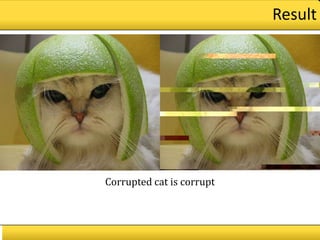
Result


Corrupted cat is corrupt
Manipulation types
• Typical Effects:
  – Single bit error: Just one bit flips
     • 0100 1011 -> 0101 1011
  – Double bit error: Two bits flips
     • 0100 1011 -> 1110 1011
     • 0100 1011 -> 0100 1000
  – Multiple bit error: More bit errors
     • 0100 1011 -> 1001 0011
  – Burst error: Multiple bits flip or get a new value
     • 0100 1011 -> 1111 1011
What do?
• Create redundandy!
  – Simple: Repeat message twice and check if
    content is the same
  – Problem: 6 Mbit-DSL will just give 3 Mbit.
  – Does duplication really help against systematic
    failures?
  – i.e. Dual-Channel FlexRay
• Usually, information about validity of
  message is enough!
  – Add checksum for detection!
Checksum vs. CRC
• Checksums are not checksums!
• Typically, „checksums“: are a summation of
  all values multiplied with factors depending
  on their position:
  – Checksum = Sum(Value[n] * Lookup[n%m])
  – Not very effective (i.e: TCP)
• CRC:
  – Quite funny thing, difficult to explain
  – http://en.wikipedia.org/wiki/Computation_of_
    CRC
Properties of CRC
• Main Properties of a CRC:
  – Polynomial, implying the length of CRC
  – Seed [Not Seeed (Dickes B)]
  – Inverting, +1, etc…

• The calculated CRC will be appended to
  message
• CRC increases hamming distance of
  messages.
  – Corruption can be detected!
Choice of Polynomial
• So, let‘s choose a CRC…
• Where to start?
• For example:
  – http://www.ece.cmu.edu/~koopman/roses/ds
    n04/koopman04_crc_poly_embedded.pdf
  – Nice work!
Task
• Task:
  – Find the probability that a corrupted message
    will be assumed as corrupt!

  – We will use „Monte Carlo Method“
     •   http://en.wikipedia.org/wiki/Monte_Carlo_method
     •   Simple things need complex words!
     •   Do random guessing and take this as the truth
     •   Simple, quite effective
• Part 1 completed!
• Part 2 will present the application!

CRC and its effective

  • 1.
    CRC and itseffectiveness Part 1 Martin Brenn, 28.04.2012 brenn@depon.net Depon.Net
  • 2.
    Messages • Messages aresent everywhere and everyday. • For example: – CAN (created by automotive industry) – SPI (Inter-CPU) – Wired Ethernet (LAN) – Wireless LAN (IEEE 80211.x) – And many many more
  • 3.
    Corruption • Corruption ofmessages occurs everywhere and every day! • Typical failure modes: – Loss – Repetition – Wrong order of packets (especially in Internet) – Manipulation of content • Bit flips (0->1 or 1-0) • Duplication or omission of bits (11100->1100) – Disagreement about communication parameters • „What he says?“ or „Ariane 5 Flight 501“
  • 4.
    Ariane 5 Result of converting a 64-Bit float to 16-bit Integer without check for Arithmetic Overflow • http://en.wikipedia.org/wiki/Ariane_5_Flight_501 Source of images: 1) http://www.capcomespace.net/dossiers/espace_europeen/ariane/ariane 5/AR501/V88%20explosion%2003.jpg 2) http://de.wikipedia.org/wiki/Ariane_5
  • 5.
    Scope • Today, wejust take care of manipulation of data • Competition against systematic failures is also quite interesting but not in my today‘s scope.
  • 6.
  • 7.
    Manipulation types • TypicalEffects: – Single bit error: Just one bit flips • 0100 1011 -> 0101 1011 – Double bit error: Two bits flips • 0100 1011 -> 1110 1011 • 0100 1011 -> 0100 1000 – Multiple bit error: More bit errors • 0100 1011 -> 1001 0011 – Burst error: Multiple bits flip or get a new value • 0100 1011 -> 1111 1011
  • 8.
    What do? • Createredundandy! – Simple: Repeat message twice and check if content is the same – Problem: 6 Mbit-DSL will just give 3 Mbit. – Does duplication really help against systematic failures? – i.e. Dual-Channel FlexRay • Usually, information about validity of message is enough! – Add checksum for detection!
  • 9.
    Checksum vs. CRC •Checksums are not checksums! • Typically, „checksums“: are a summation of all values multiplied with factors depending on their position: – Checksum = Sum(Value[n] * Lookup[n%m]) – Not very effective (i.e: TCP) • CRC: – Quite funny thing, difficult to explain – http://en.wikipedia.org/wiki/Computation_of_ CRC
  • 10.
    Properties of CRC •Main Properties of a CRC: – Polynomial, implying the length of CRC – Seed [Not Seeed (Dickes B)] – Inverting, +1, etc… • The calculated CRC will be appended to message • CRC increases hamming distance of messages. – Corruption can be detected!
  • 11.
    Choice of Polynomial •So, let‘s choose a CRC… • Where to start? • For example: – http://www.ece.cmu.edu/~koopman/roses/ds n04/koopman04_crc_poly_embedded.pdf – Nice work!
  • 12.
    Task • Task: – Find the probability that a corrupted message will be assumed as corrupt! – We will use „Monte Carlo Method“ • http://en.wikipedia.org/wiki/Monte_Carlo_method • Simple things need complex words! • Do random guessing and take this as the truth • Simple, quite effective
  • 13.
    • Part 1completed! • Part 2 will present the application!