Reasons to Use the Dissection Video and
Accompanying PowerPoint Presentation
 Reduce the number of specimens used by a class
 Increase the quality of the dissection for the students
 Review opportunity, increasing the learning experience
for the students
 Student unable to dissect due to pregnancy or
hypersensitivity to the preservatives
 Student chooses not to dissect due to ethical/moral
reasons
Dissection 101:
Click
Dissection 101:
As an educator you are responsible for the implementation
of the dissection activity described in the video and
PowerPoint. You must have safety procedures and rules
established for your classroom and make sure all of the
students follow the rules to ensure a safe environment.
South Dakota Public Broadcasting and Dakota State
University cannot in any way be responsible or liable for
any injury as a result of performing the described
dissection. Complete the dissection if you feel it is
appropriate and safe for your individual class.
Have fun and stay safe!
Click
Safety Considerations
 Age appropriate activity for the children in your care
 Safety Data Sheet (SDS) available for accident reference
 Poison control number/phone readily available
 Latex free gloves, eye protection and apron/lab coat
 Eyewash station, shower and sink
 Sharp instruments (cut away from self and others)
 Sharps and specimen(s) disposal
 Encourage students to report all accidents
 Basic science laboratory rules (strictly enforced)
Click
Dissection 101:Crayfish
Crayfish are arthropods, which are the most
diverse and abundant group of animals on
earth. There are more species of arthropods
than all other animals combined.
Click
Dissection 101:Crayfish
Arthropod characteristics:
o Jointed appendages – bend to move in specific directions
and specialized for specific jobs
o Exoskeleton – hardened cuticle, which is an outside layer of
skin; it is nonliving tissue called chitin that does not grow
with the body and must be removed for growth in a process
called molting (shedding)
o Body segmentation – specific regions
Segmented Body Plan (2 main regions)
Cephalothorax – head and thorax region
Abdomen – segmented tail
Exterior of the Crayfish
Click
The telson and uropods form the
flipper-like structure at the end of the
abdomen (tail); used to propel the
crayfish in a backward direction by
whipping the tail forward
(third law of motion)
Telson
Uropods
Tail movement
Crayfish movement
Exterior of the Crayfish
Chelipeds (pinchers) – 1st of the
paired walking legs; modified for
defense, fighting, and capturing
prey (can regenerate, but slow)
Carapace -
specialized
portion of the
exoskeleton;
covers the head
and thorax
regions
Antennae – 2 pair, smaller
anterior paired called antennules;
used for taste (chemicals in
water) & touch
Rostrum – anterior section of
carapace; protects eyes/head
Walking legs – 4 pair of
jointed legs for movement
Smaller regenerated
cheliped
1st pair of smaller walking
legs also has a pincher
Click
Ventral
view
Click
Exterior of the Crayfish
Maxillipeds – 3 pair
of larger appendages
near mouth; handle
food
Mandibles – Jaw like
structure; break
food apart; move
side to side
Videos of Mouthparts (Parts / Eating)
Click
Exterior of the Crayfish
Male (R) – First 2 pair of
swimmerets are
hardened/enlarged
(copulatory swimmerets);
used to deposit sperm
from opening of sperm
duct to seminal receptacle
of female
Swimmerets - structures
used to help propel
crayfish through the
water; move water across
gills; hold fertilized eggs
and larva in females
Female (L) – Has a
seminal receptacle which
is an opening to the
female reproductive
system (eggs expelled
and held by swimmerets
after they are fertilized)
Female Northern Crayfish Carrying Eggs
(Photo courtesy Missouri Department of Conservation)
Anus – Complete digestive system
Click
Getting Started
 Use water to rinse the excess preservative from
your specimen
Dissection 101: Crayfish
(YouTube Version)
Click
Getting Started – Initial Cuts
Dissection 101: Crayfish
Click
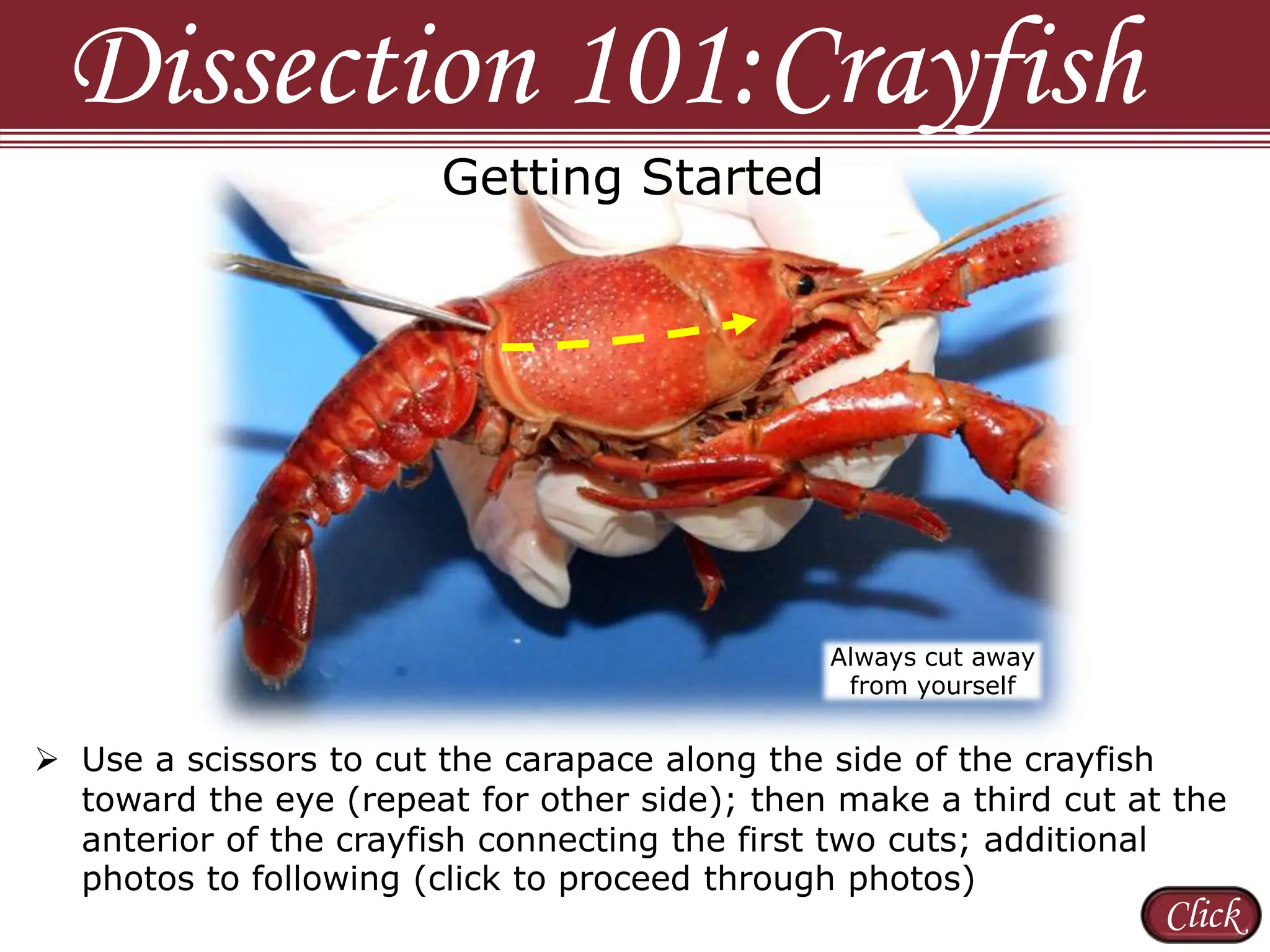
Getting Started
 Use a scissors to cut the carapace along the side of the crayfish
toward the eye (repeat for other side); then make a third cut at the
anterior of the crayfish connecting the first two cuts; additional
photos to following (click to proceed through photos)
Dissection 101:Crayfish
Always cut away
from yourself
Dissection 101:Crayfish
Click
Repeat for other side
Connect the first two cuts
Carefully remove the carapace
Cut the carapace along the side
Click
Dissection 101:Crayfish
Gills - Feather-like structures (increased surface area)
used for respiration; remove oxygen from water
Click
Dissection 101:Crayfish
Heart (may be attached to the carapace) Gills have been
removed; open circulatory system; keeps blood moving
under low pressure
Click
Dissection 101:Crayfish
Digestive gland – Produce enzymes to digest food;
also absorption of nutrients
Click
Dissection 101:Crayfish
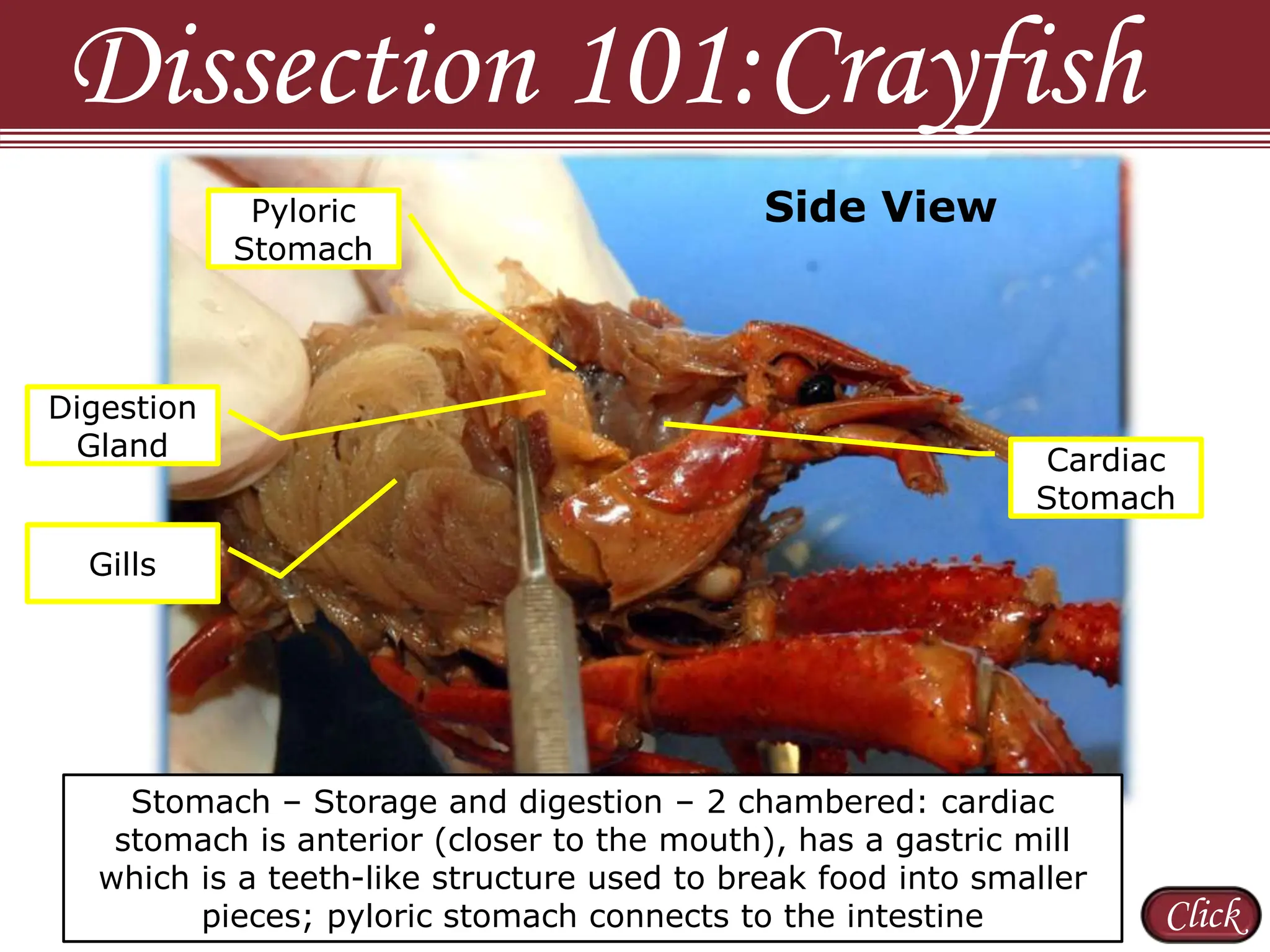
Cardiac
Stomach
Pyloric
Stomach
Cardiac
Stomach
Pyloric
Stomach
Side View
Digestion
Gland
Gills
Stomach – Storage and digestion – 2 chambered: cardiac
stomach is anterior (closer to the mouth), has a gastric mill
which is a teeth-like structure used to break food into smaller
pieces; pyloric stomach connects to the intestine
Dissection 101:Crayfish
Exposing the Antennal Glands
(YouTube Version)
Click
Dissection 101:Crayfish
Click
Stomach removed
Closeup of gastric mill found
within the cardiac stomach
Dissection 101:Crayfish
Crayfish with Stomach Removed
Antennal glands (green glands) -
Paired; excretion of body wastes
(equivalent to urine)
Click
Ganglia:
Nervous
tissue
Dissection 101:Crayfish
Exposing the Intestine
(YouTube Version)
Click
Click
Dissection 101:Crayfish
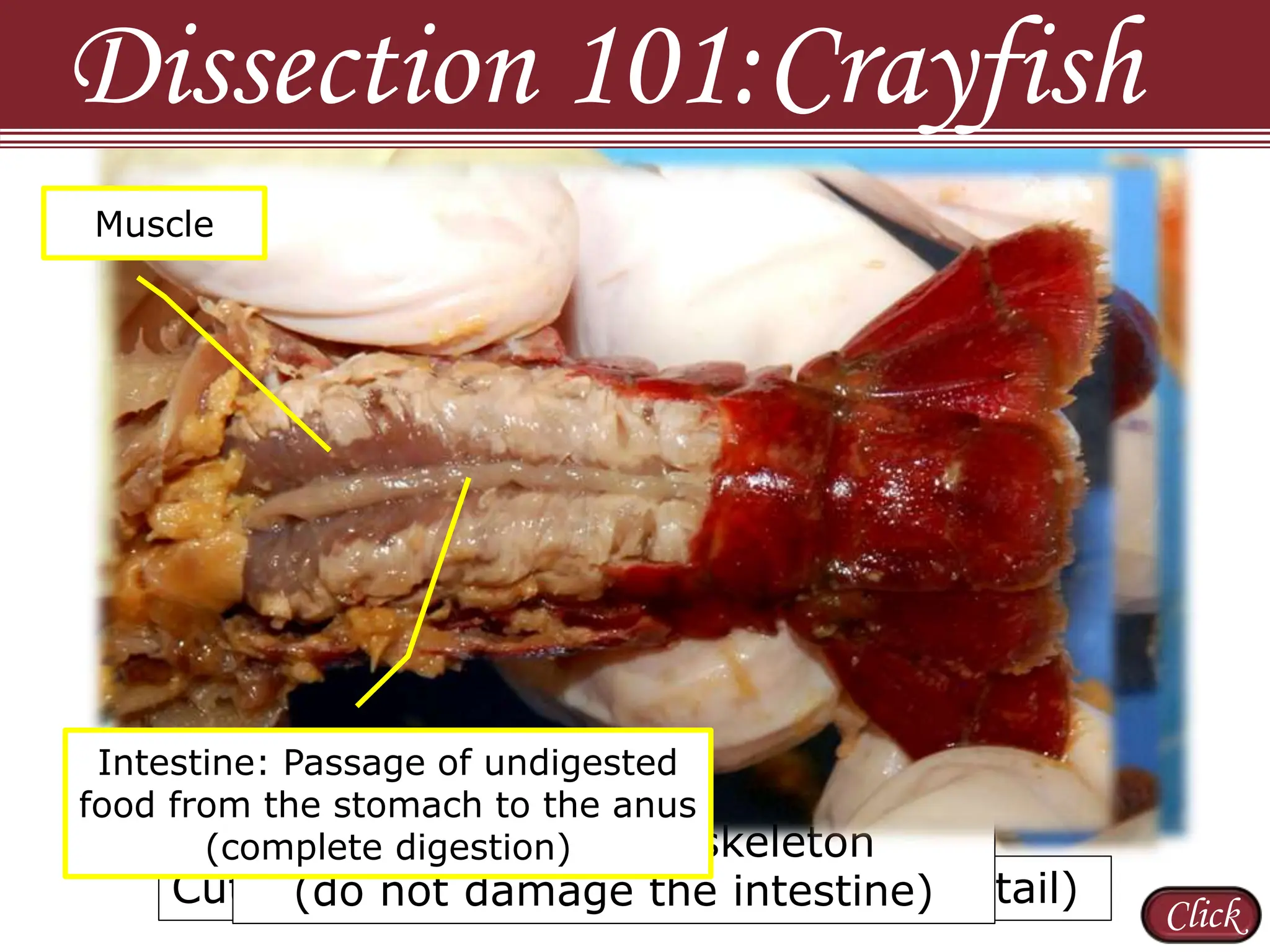
Cut along both sides of the abdomen (tail)
Remove the exoskeleton
(do not damage the intestine)
Intestine: Passage of undigested
food from the stomach to the anus
(complete digestion)
Muscle
Dissection 101:
Produced by Dakota State University
and South Dakota Public Broadcasting
Crayfish
Science Steve Sponsors

Crayfish Dissection Powerpoint Presentation

  • 1.
    Reasons to Usethe Dissection Video and Accompanying PowerPoint Presentation  Reduce the number of specimens used by a class  Increase the quality of the dissection for the students  Review opportunity, increasing the learning experience for the students  Student unable to dissect due to pregnancy or hypersensitivity to the preservatives  Student chooses not to dissect due to ethical/moral reasons Dissection 101: Click
  • 2.
    Dissection 101: As aneducator you are responsible for the implementation of the dissection activity described in the video and PowerPoint. You must have safety procedures and rules established for your classroom and make sure all of the students follow the rules to ensure a safe environment. South Dakota Public Broadcasting and Dakota State University cannot in any way be responsible or liable for any injury as a result of performing the described dissection. Complete the dissection if you feel it is appropriate and safe for your individual class. Have fun and stay safe! Click Safety Considerations  Age appropriate activity for the children in your care  Safety Data Sheet (SDS) available for accident reference  Poison control number/phone readily available  Latex free gloves, eye protection and apron/lab coat  Eyewash station, shower and sink  Sharp instruments (cut away from self and others)  Sharps and specimen(s) disposal  Encourage students to report all accidents  Basic science laboratory rules (strictly enforced)
  • 3.
    Click Dissection 101:Crayfish Crayfish arearthropods, which are the most diverse and abundant group of animals on earth. There are more species of arthropods than all other animals combined.
  • 4.
    Click Dissection 101:Crayfish Arthropod characteristics: oJointed appendages – bend to move in specific directions and specialized for specific jobs o Exoskeleton – hardened cuticle, which is an outside layer of skin; it is nonliving tissue called chitin that does not grow with the body and must be removed for growth in a process called molting (shedding) o Body segmentation – specific regions
  • 5.
    Segmented Body Plan(2 main regions) Cephalothorax – head and thorax region Abdomen – segmented tail Exterior of the Crayfish Click The telson and uropods form the flipper-like structure at the end of the abdomen (tail); used to propel the crayfish in a backward direction by whipping the tail forward (third law of motion) Telson Uropods Tail movement Crayfish movement
  • 6.
    Exterior of theCrayfish Chelipeds (pinchers) – 1st of the paired walking legs; modified for defense, fighting, and capturing prey (can regenerate, but slow) Carapace - specialized portion of the exoskeleton; covers the head and thorax regions Antennae – 2 pair, smaller anterior paired called antennules; used for taste (chemicals in water) & touch Rostrum – anterior section of carapace; protects eyes/head Walking legs – 4 pair of jointed legs for movement Smaller regenerated cheliped 1st pair of smaller walking legs also has a pincher Click Ventral view
  • 7.
    Click Exterior of theCrayfish Maxillipeds – 3 pair of larger appendages near mouth; handle food Mandibles – Jaw like structure; break food apart; move side to side Videos of Mouthparts (Parts / Eating)
  • 8.
    Click Exterior of theCrayfish Male (R) – First 2 pair of swimmerets are hardened/enlarged (copulatory swimmerets); used to deposit sperm from opening of sperm duct to seminal receptacle of female Swimmerets - structures used to help propel crayfish through the water; move water across gills; hold fertilized eggs and larva in females Female (L) – Has a seminal receptacle which is an opening to the female reproductive system (eggs expelled and held by swimmerets after they are fertilized) Female Northern Crayfish Carrying Eggs (Photo courtesy Missouri Department of Conservation) Anus – Complete digestive system
  • 9.
    Click Getting Started  Usewater to rinse the excess preservative from your specimen Dissection 101: Crayfish
  • 10.
    (YouTube Version) Click Getting Started– Initial Cuts Dissection 101: Crayfish
  • 11.
    Click Getting Started  Usea scissors to cut the carapace along the side of the crayfish toward the eye (repeat for other side); then make a third cut at the anterior of the crayfish connecting the first two cuts; additional photos to following (click to proceed through photos) Dissection 101:Crayfish Always cut away from yourself
  • 12.
    Dissection 101:Crayfish Click Repeat forother side Connect the first two cuts Carefully remove the carapace Cut the carapace along the side
  • 13.
    Click Dissection 101:Crayfish Gills -Feather-like structures (increased surface area) used for respiration; remove oxygen from water
  • 14.
    Click Dissection 101:Crayfish Heart (maybe attached to the carapace) Gills have been removed; open circulatory system; keeps blood moving under low pressure
  • 15.
    Click Dissection 101:Crayfish Digestive gland– Produce enzymes to digest food; also absorption of nutrients
  • 16.
    Click Dissection 101:Crayfish Cardiac Stomach Pyloric Stomach Cardiac Stomach Pyloric Stomach Side View Digestion Gland Gills Stomach– Storage and digestion – 2 chambered: cardiac stomach is anterior (closer to the mouth), has a gastric mill which is a teeth-like structure used to break food into smaller pieces; pyloric stomach connects to the intestine
  • 17.
    Dissection 101:Crayfish Exposing theAntennal Glands (YouTube Version) Click
  • 18.
    Dissection 101:Crayfish Click Stomach removed Closeupof gastric mill found within the cardiac stomach
  • 19.
    Dissection 101:Crayfish Crayfish withStomach Removed Antennal glands (green glands) - Paired; excretion of body wastes (equivalent to urine) Click Ganglia: Nervous tissue
  • 20.
    Dissection 101:Crayfish Exposing theIntestine (YouTube Version) Click
  • 21.
    Click Dissection 101:Crayfish Cut alongboth sides of the abdomen (tail) Remove the exoskeleton (do not damage the intestine) Intestine: Passage of undigested food from the stomach to the anus (complete digestion) Muscle
  • 22.
    Dissection 101: Produced byDakota State University and South Dakota Public Broadcasting Crayfish Science Steve Sponsors