Crafting
Integrative
Performance
Task
Division Training on Crafting
Integrative Performance Tasks
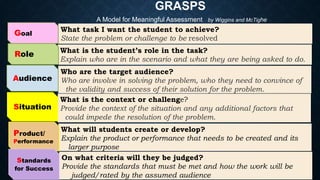
GRASPS
A Model for Meaningful Assessment by Wiggins and McTighe
What task I want the student to achieve?
State the problem or challenge to be resolved
Goal
What is the student’s role in the task?
Explain who are in the scenario and what they are being asked to do.
Role
Who are the target audience?
Who are involve in solving the problem, who they need to convince of
the validity and success of their solution for the problem.
Audience
What is the context or challenge?
Provide the context of the situation and any additional factors that
could impede the resolution of the problem.
Situation
What will students create or develop?
Explain the product or performance that needs to be created and its
larger purpose
Product/
Performance
On what criteria will they be judged?
Provide the standards that must be met and how the work will be
judged/rated by the assumed audience
Standards
for Success
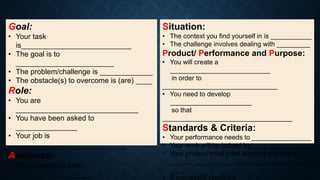
Goal:
• Your task
is___________________________
• The goal is to
________________________
• The problem/challenge is _____________
• The obstacle(s) to overcome is (are) ____
Role:
• You are
______________________________
• You have been asked to
_______________
• Your job is
___________________________
Audience:
• Your client(s) is (are)
__________________
Situation:
• The context you find yourself in is ___________
• The challenge involves dealing with _________
Product/ Performance and Purpose:
• You will create a
___________________________
in order to
_______________________________
• You need to develop
______________________
so that
___________________________________
Standards & Criteria:
• Your performance needs to ________________
• Your work will be judged by _______________
• Your product must meet learning standards
______________________________________
____
• A successful result will
Possible STUDENT ROLES and AUDIENCES
• Actor
• Advertiser
• Artist
• Astronaut
• Author
• Biographer
• Board member
• Boss
• Boy/girl scout
• Business person
• Candidate
• Carpenter
• Cartoon character
• Caterer
• Celebrity
• Chairperson
• Chef
• Choreographer
• CEO
• Coach
• Community member
• Composer
• Client/customer
• Construction worker
• Dancer
• Designer
• Detective
• Doctor
• Editor
• Elected official
• Embassy staff
• Engineer
• Stenographer
• Expert (in)
• Eye witness
• Farmer
• Filmmaker
• Fire fighter
• Forest anger
• Friend
• Geographer
• Geologist
• Government official
• Historian
• Historical figure
• Elected official
• Embassy staff
• Engineer
• Stenographer
• Expert (in)
• Eye witness
• Farmer
• Filmmaker
Possible STUDENT ROLES and AUDIENCES
• Museum goer
• Neighbor
• Newscaster
• Novelist
• Nurse
• Nutritionist
• Panelist
• Photographer
• Pilot
• Playwright
• Poet
• Policeman
• Radio listener
• Reader
• Reporter
• Researcher
• Reviewer
• Soldier
• School official
• scientist
• Ship captain
• Social scientist
• Social worker
• Statistician
• Storyteller
• Student
• Taxi driver
• Teacher
• TV viewer
• Tour guide
• Travel agent
• Traveler
• TV movie character
• Tutor
• Viewer
• Visitor
• Web designer
• Zoo keeper
• Fire fighter
• Forest anger
• Friend
• Geographer
• Geologist
• Government official
• Historian
• Historical figure
• Illustrator
• Intern
• Interviewer
• Inventor
• Judge
• Jury
• Lawyer
• Literary critic
• Lobbyist
• Museum director/curator
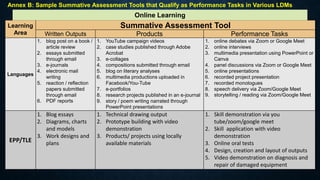
Learning
Area
Summative Assessment Tool
Written Outputs Products Performance Tasks
Languages
1. blog post on a book /
article review
2. essays submitted
through email
3. e-journals
4. electronic mail
writing
5. reaction / reflection
papers submitted
through email
6. PDF reports
1. YouTube campaign videos
2. case studies published through Adobe
Acrobat
3. e-collages
4. compositions submitted through email
5. blog on literary analyses
6. multimedia productions uploaded in
Facebook/You-Tube
7. e-portfolios
8. research projects published in an e-journal
9. story / poem writing narrated through
PowerPoint presentations
1. online debates via Zoom or Google Meet
2. online interviews
3. multimedia presentation using PowerPoint or
Canva
4. panel discussions via Zoom or Google Meet
5. online presentations
6. recorded project presentation
7. recorded monologues
8. speech delivery via Zoom/Google Meet
9. storytelling / reading via Zoom/Google Meet
EPP/TLE
1. Blog essays
2. Diagrams, charts
and models
3. Work designs and
plans
1. Technical drawing output
2. Prototype building with video
demonstration
3. Products/ projects using locally
available materials
1. Skill demonstration via you
tube/zoom/google meet
2. Skill application with video
demonstration
3. Online oral tests
4. Design, creation and layout of outputs
5. Video demonstration on diagnosis and
repair of damaged equipment
Annex B: Sample Summative Assessment Tools that Qualify as Performance Tasks in Various LDMs
Online Learning
Learning
Area
Summative Assessment Tools
Written Outputs Products Performance Tasks
Math
1. data recording and
analyses
2. geometric and
statistical analyses
3. graphs, charts, or
maps
4. problem sets
5. surveys
1. diagrams
2. mathematical investigatory
projects
3. models / making models of
geometric figures
4. number representations
5. portfolio
1. constructing graphs from surveys conducted
2. outdoor math
3. probability experiments
4. problem-posing
5. reasoning and proof
6. using manipulatives to show math concepts /
solve problems
MAPEH
1. Essays
2. Reaction/reflectio
n papers
3. Research paper
4. Journal/article
review
1. Musical arrangement
2. Musical/song analysis
3. Musical research
4. Writing program notes
5. Art criticism and
appreciation
6. Art exhibits
7. art project
8. Portfolio
9. Article/journal review
10.Personal fitness and health
logs
11.Journal responses
1. Multimedia presentation
2. Musical presentation
3. Skill demonstration (singing, playing
instruments, drawing, coloring, painting)
4. Art production
5. Portfolio
6. Personalized exercise programs
7. Physical activity participation
8. Physical activity/fitness assessment
9. Personalized fitness and health program
10.Issue awareness campaigns
Annex B: Sample Summative Assessment Tools that Qualify as Performance Tasks in Various LDMs
Digital/Printed Modular Distance Learning, TVBI, RBI
Possible PRODUCTS and PERFORMANCE
WRITTEN
• Advertisement * Biography
• Blog * book report/review
• Brochure * crossword puzzle
• Editorial * essay
• Historical fiction * journal
• Journal * lab report
• Letter * magazine article
• Memo * newscast
• Newspaper article * play
• Poem * research report
• Proposal * script
• Screen play * test
• Story
• position paper/policy brief
ORAL
• Conversation
• debate
• discussion
• dramatization
• Dramatic reading
• infomercial
• interview
• radio script
• Oral presentation
• oral report
• Poetry reading
• puppet show
• rap
• speech
• song
• teach a lesson
Possible PRODUCTS and PERFORMANCE
WRITTEN
• Advertisement * book/cd cover
• cartoon * collage
• Computer graphic * data display
• design * diagram
• display * drawing
• Facebook/My space page * flowchart
• flyer * game
• graph * map
• model * power point show
• photograph * questionnaire
• painting * poster
• scrapbook * sculpture
• Storyboard *videotape
• Web site
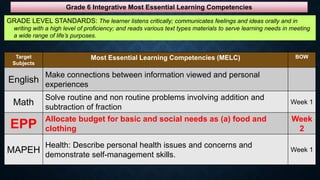
Grade 6 Integrative Most Essential Learning Competencies
Target
Subjects
Most Essential Learning Competencies (MELC) BOW
English
Make connections between information viewed and personal
experiences
Math
Solve routine and non routine problems involving addition and
subtraction of fraction
Week 1
EPP
Allocate budget for basic and social needs as (a) food and
clothing
Week
2
MAPEH
Health: Describe personal health issues and concerns and
demonstrate self-management skills.
Week 1
GRADE LEVEL STANDARDS: The learner listens critically; communicates feelings and ideas orally and in
writing with a high level of proficiency; and reads various text types materials to serve learning needs in meeting
a wide range of life’s purposes.
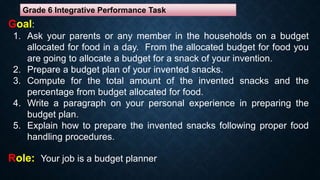
Goal:
1. Ask your parents or any member in the households on a budget
allocated for food in a day. From the allocated budget for food you
are going to allocate a budget for a snack of your invention.
2. Prepare a budget plan of your invented snacks.
3. Compute for the total amount of the invented snacks and the
percentage from budget allocated for food.
4. Write a paragraph on your personal experience in preparing the
budget plan.
5. Explain how to prepare the invented snacks following proper food
handling procedures.
Grade 6 Integrative Performance Task
Role: Your job is a budget planner
Situation: You are a budget planner and you are to prepare a budget plan
for your invented snacks out of the available local materials found in
your community or locally made in the Philippines.
Products:
a. Budget plan of invented snacks
b. One paragraph on your personal experience in preparing the budget plan
c. One paragraph stating the steps in preparing the invented snacks following
proper food handling procedures
Standard: The performance task is to be assessed using the attached rubric
Audience: You need to convince any family member to be interviewed
and local store seller/ in-charge
Budget Plan for Invented Snacks
Item Quantity Unit Price Total Price
Total amount
Sample Outputs
Paragraph on the steps in
preparing invented snacks following
the proper food handling procedures
Paragraph on personal
experience
Please click the link
https://bit.ly/2YCOD5X for your
feedback in the conduct of Division
Training on Crafting Integrative
Performance Tasks. Thank you.
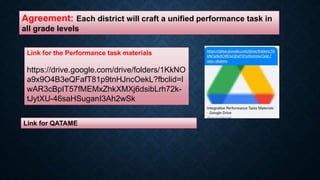
Agreement: Each district will craft a unified performance task in
all grade levels
Link for the Performance task materials
https://drive.google.com/drive/folders/1KkNO
a9x9O4B3eQFafT81p9tnHJncOekL?fbclid=I
wAR3cBpIT57fMEMxZhkXMXj6dsibLrh72k-
tJytXU-46saHSuganI3Ah2wSk
Link for QATAME
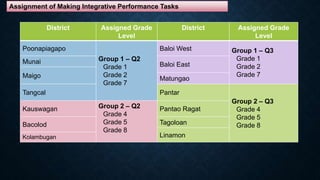
Assignment of Making Integrative Performance Tasks
District Assigned Grade
Level
District Assigned Grade
Level
Poonapiagapo
Group 1 – Q2
Grade 1
Grade 2
Grade 7
Baloi West Group 1 – Q3
Grade 1
Grade 2
Grade 7
Munai Baloi East
Maigo Matungao
Tangcal Pantar
Group 2 – Q3
Grade 4
Grade 5
Grade 8
Kauswagan Group 2 – Q2
Grade 4
Grade 5
Grade 8
Pantao Ragat
Bacolod Tagoloan
Linamon
Kolambugan
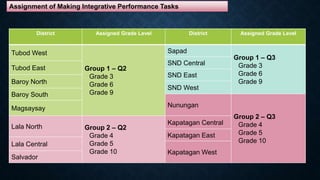
Assignment of Making Integrative Performance Tasks
District Assigned Grade Level District Assigned Grade Level
Tubod West
Group 1 – Q2
Grade 3
Grade 6
Grade 9
Sapad
Group 1 – Q3
Grade 3
Grade 6
Grade 9
SND Central
Tubod East
SND East
Baroy North
SND West
Baroy South
Nunungan
Group 2 – Q3
Grade 4
Grade 5
Grade 10
Magsaysay
Lala North Group 2 – Q2
Grade 4
Grade 5
Grade 10
Kapatagan Central
Kapatagan East
Lala Central
Kapatagan West
Salvador

Crafting-Integrative-Performance-Tasks-revised-1.pptx

  • 1.
    Crafting Integrative Performance Task Division Training onCrafting Integrative Performance Tasks
  • 2.
    GRASPS A Model forMeaningful Assessment by Wiggins and McTighe What task I want the student to achieve? State the problem or challenge to be resolved Goal What is the student’s role in the task? Explain who are in the scenario and what they are being asked to do. Role Who are the target audience? Who are involve in solving the problem, who they need to convince of the validity and success of their solution for the problem. Audience What is the context or challenge? Provide the context of the situation and any additional factors that could impede the resolution of the problem. Situation What will students create or develop? Explain the product or performance that needs to be created and its larger purpose Product/ Performance On what criteria will they be judged? Provide the standards that must be met and how the work will be judged/rated by the assumed audience Standards for Success
  • 3.
    Goal: • Your task is___________________________ •The goal is to ________________________ • The problem/challenge is _____________ • The obstacle(s) to overcome is (are) ____ Role: • You are ______________________________ • You have been asked to _______________ • Your job is ___________________________ Audience: • Your client(s) is (are) __________________ Situation: • The context you find yourself in is ___________ • The challenge involves dealing with _________ Product/ Performance and Purpose: • You will create a ___________________________ in order to _______________________________ • You need to develop ______________________ so that ___________________________________ Standards & Criteria: • Your performance needs to ________________ • Your work will be judged by _______________ • Your product must meet learning standards ______________________________________ ____ • A successful result will
  • 4.
    Possible STUDENT ROLESand AUDIENCES • Actor • Advertiser • Artist • Astronaut • Author • Biographer • Board member • Boss • Boy/girl scout • Business person • Candidate • Carpenter • Cartoon character • Caterer • Celebrity • Chairperson • Chef • Choreographer • CEO • Coach • Community member • Composer • Client/customer • Construction worker • Dancer • Designer • Detective • Doctor • Editor • Elected official • Embassy staff • Engineer • Stenographer • Expert (in) • Eye witness • Farmer • Filmmaker • Fire fighter • Forest anger • Friend • Geographer • Geologist • Government official • Historian • Historical figure • Elected official • Embassy staff • Engineer • Stenographer • Expert (in) • Eye witness • Farmer • Filmmaker
  • 5.
    Possible STUDENT ROLESand AUDIENCES • Museum goer • Neighbor • Newscaster • Novelist • Nurse • Nutritionist • Panelist • Photographer • Pilot • Playwright • Poet • Policeman • Radio listener • Reader • Reporter • Researcher • Reviewer • Soldier • School official • scientist • Ship captain • Social scientist • Social worker • Statistician • Storyteller • Student • Taxi driver • Teacher • TV viewer • Tour guide • Travel agent • Traveler • TV movie character • Tutor • Viewer • Visitor • Web designer • Zoo keeper • Fire fighter • Forest anger • Friend • Geographer • Geologist • Government official • Historian • Historical figure • Illustrator • Intern • Interviewer • Inventor • Judge • Jury • Lawyer • Literary critic • Lobbyist • Museum director/curator
  • 6.
    Learning Area Summative Assessment Tool WrittenOutputs Products Performance Tasks Languages 1. blog post on a book / article review 2. essays submitted through email 3. e-journals 4. electronic mail writing 5. reaction / reflection papers submitted through email 6. PDF reports 1. YouTube campaign videos 2. case studies published through Adobe Acrobat 3. e-collages 4. compositions submitted through email 5. blog on literary analyses 6. multimedia productions uploaded in Facebook/You-Tube 7. e-portfolios 8. research projects published in an e-journal 9. story / poem writing narrated through PowerPoint presentations 1. online debates via Zoom or Google Meet 2. online interviews 3. multimedia presentation using PowerPoint or Canva 4. panel discussions via Zoom or Google Meet 5. online presentations 6. recorded project presentation 7. recorded monologues 8. speech delivery via Zoom/Google Meet 9. storytelling / reading via Zoom/Google Meet EPP/TLE 1. Blog essays 2. Diagrams, charts and models 3. Work designs and plans 1. Technical drawing output 2. Prototype building with video demonstration 3. Products/ projects using locally available materials 1. Skill demonstration via you tube/zoom/google meet 2. Skill application with video demonstration 3. Online oral tests 4. Design, creation and layout of outputs 5. Video demonstration on diagnosis and repair of damaged equipment Annex B: Sample Summative Assessment Tools that Qualify as Performance Tasks in Various LDMs Online Learning
  • 7.
    Learning Area Summative Assessment Tools WrittenOutputs Products Performance Tasks Math 1. data recording and analyses 2. geometric and statistical analyses 3. graphs, charts, or maps 4. problem sets 5. surveys 1. diagrams 2. mathematical investigatory projects 3. models / making models of geometric figures 4. number representations 5. portfolio 1. constructing graphs from surveys conducted 2. outdoor math 3. probability experiments 4. problem-posing 5. reasoning and proof 6. using manipulatives to show math concepts / solve problems MAPEH 1. Essays 2. Reaction/reflectio n papers 3. Research paper 4. Journal/article review 1. Musical arrangement 2. Musical/song analysis 3. Musical research 4. Writing program notes 5. Art criticism and appreciation 6. Art exhibits 7. art project 8. Portfolio 9. Article/journal review 10.Personal fitness and health logs 11.Journal responses 1. Multimedia presentation 2. Musical presentation 3. Skill demonstration (singing, playing instruments, drawing, coloring, painting) 4. Art production 5. Portfolio 6. Personalized exercise programs 7. Physical activity participation 8. Physical activity/fitness assessment 9. Personalized fitness and health program 10.Issue awareness campaigns Annex B: Sample Summative Assessment Tools that Qualify as Performance Tasks in Various LDMs Digital/Printed Modular Distance Learning, TVBI, RBI
  • 8.
    Possible PRODUCTS andPERFORMANCE WRITTEN • Advertisement * Biography • Blog * book report/review • Brochure * crossword puzzle • Editorial * essay • Historical fiction * journal • Journal * lab report • Letter * magazine article • Memo * newscast • Newspaper article * play • Poem * research report • Proposal * script • Screen play * test • Story • position paper/policy brief ORAL • Conversation • debate • discussion • dramatization • Dramatic reading • infomercial • interview • radio script • Oral presentation • oral report • Poetry reading • puppet show • rap • speech • song • teach a lesson
  • 9.
    Possible PRODUCTS andPERFORMANCE WRITTEN • Advertisement * book/cd cover • cartoon * collage • Computer graphic * data display • design * diagram • display * drawing • Facebook/My space page * flowchart • flyer * game • graph * map • model * power point show • photograph * questionnaire • painting * poster • scrapbook * sculpture • Storyboard *videotape • Web site
  • 10.
    Grade 6 IntegrativeMost Essential Learning Competencies Target Subjects Most Essential Learning Competencies (MELC) BOW English Make connections between information viewed and personal experiences Math Solve routine and non routine problems involving addition and subtraction of fraction Week 1 EPP Allocate budget for basic and social needs as (a) food and clothing Week 2 MAPEH Health: Describe personal health issues and concerns and demonstrate self-management skills. Week 1 GRADE LEVEL STANDARDS: The learner listens critically; communicates feelings and ideas orally and in writing with a high level of proficiency; and reads various text types materials to serve learning needs in meeting a wide range of life’s purposes.
  • 11.
    Goal: 1. Ask yourparents or any member in the households on a budget allocated for food in a day. From the allocated budget for food you are going to allocate a budget for a snack of your invention. 2. Prepare a budget plan of your invented snacks. 3. Compute for the total amount of the invented snacks and the percentage from budget allocated for food. 4. Write a paragraph on your personal experience in preparing the budget plan. 5. Explain how to prepare the invented snacks following proper food handling procedures. Grade 6 Integrative Performance Task Role: Your job is a budget planner
  • 12.
    Situation: You area budget planner and you are to prepare a budget plan for your invented snacks out of the available local materials found in your community or locally made in the Philippines. Products: a. Budget plan of invented snacks b. One paragraph on your personal experience in preparing the budget plan c. One paragraph stating the steps in preparing the invented snacks following proper food handling procedures Standard: The performance task is to be assessed using the attached rubric Audience: You need to convince any family member to be interviewed and local store seller/ in-charge
  • 13.
    Budget Plan forInvented Snacks Item Quantity Unit Price Total Price Total amount Sample Outputs Paragraph on the steps in preparing invented snacks following the proper food handling procedures Paragraph on personal experience
  • 16.
    Please click thelink https://bit.ly/2YCOD5X for your feedback in the conduct of Division Training on Crafting Integrative Performance Tasks. Thank you.
  • 17.
    Agreement: Each districtwill craft a unified performance task in all grade levels Link for the Performance task materials https://drive.google.com/drive/folders/1KkNO a9x9O4B3eQFafT81p9tnHJncOekL?fbclid=I wAR3cBpIT57fMEMxZhkXMXj6dsibLrh72k- tJytXU-46saHSuganI3Ah2wSk Link for QATAME
  • 18.
    Assignment of MakingIntegrative Performance Tasks District Assigned Grade Level District Assigned Grade Level Poonapiagapo Group 1 – Q2 Grade 1 Grade 2 Grade 7 Baloi West Group 1 – Q3 Grade 1 Grade 2 Grade 7 Munai Baloi East Maigo Matungao Tangcal Pantar Group 2 – Q3 Grade 4 Grade 5 Grade 8 Kauswagan Group 2 – Q2 Grade 4 Grade 5 Grade 8 Pantao Ragat Bacolod Tagoloan Linamon Kolambugan
  • 19.
    Assignment of MakingIntegrative Performance Tasks District Assigned Grade Level District Assigned Grade Level Tubod West Group 1 – Q2 Grade 3 Grade 6 Grade 9 Sapad Group 1 – Q3 Grade 3 Grade 6 Grade 9 SND Central Tubod East SND East Baroy North SND West Baroy South Nunungan Group 2 – Q3 Grade 4 Grade 5 Grade 10 Magsaysay Lala North Group 2 – Q2 Grade 4 Grade 5 Grade 10 Kapatagan Central Kapatagan East Lala Central Kapatagan West Salvador

Editor's Notes

  • #4 We have here a sample prompts in formulating the performance tasks using GRASPS. More details on this you can browse in the internet for sample prompts for GRASPS by Wiggins
  • #5 We have also here possible student roles and audiences, again you can browse the internet for possible roles & audiences for performance tasks using GRASPS model by Wiggins
  • #7 Annex B of DepEd order 31 provides us with several summative assessment tools that qualify as performance tasks in various learning delivery modalities in all learning areas.
  • #8 For the other learning areas please refer to the annex B attached to this DO
  • #13 Read the content
  • #14 Read the sample output
  • #18 Read the sample output
  • #19 Read the sample output
  • #20 Read the sample output