CQRS != Event Sourcing
Henrik Møller Rasmussen
Founder and CTO
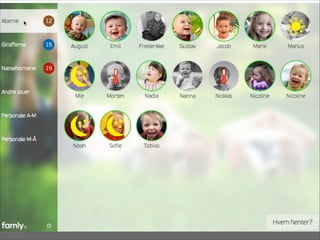
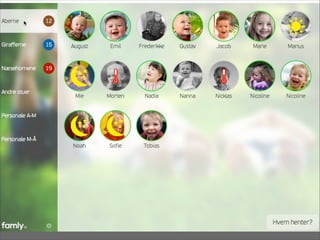
The digital daycare
The digital daycare
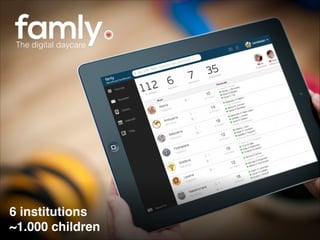
6 institutions!
~1.000 children
What is CQRS?
Command Query Responsibility Segregation
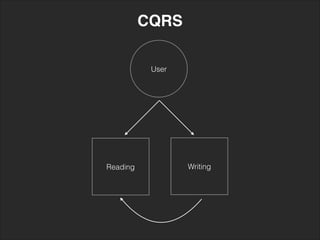
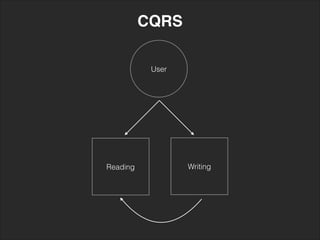
CQRS
WritingReading
User
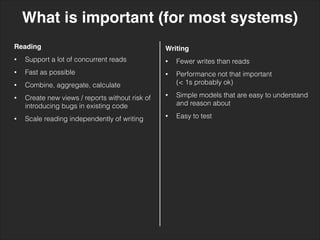
What is important (for most systems)
Reading!
• Support a lot of concurrent reads
• Fast as possible
• Combine, aggregate, calculate
• Create new views / reports without risk of
introducing bugs in existing code
• Scale reading independently of writing
Writing!
• Fewer writes than reads
• Performance not that important

(< 1s probably ok)
• Simple models that are easy to understand
and reason about
• Easy to test
CQRS
WritingReading
User
What is Event Sourcing?
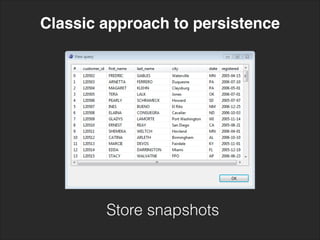
Classic approach to persistence
Store snapshots
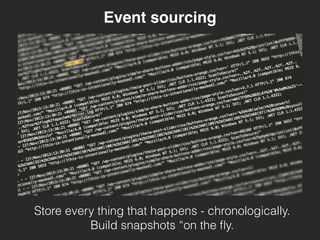
Event sourcing
Store every thing that happens - chronologically.

Build snapshots “on the fly.
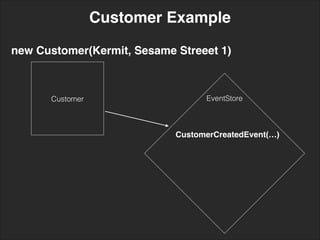
EventStore
Customer Example
Customer
new Customer(Kermit, Sesame Streeet 1)
CustomerCreatedEvent(…)
EventStore
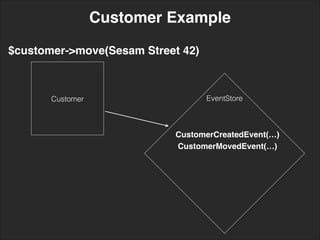
Customer Example
Customer
$customer->move(Sesam Street 42)
CustomerCreatedEvent(…)
CustomerMovedEvent(…)
EventStore
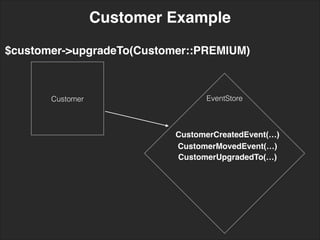
Customer Example
Customer
$customer->upgradeTo(Customer::PREMIUM)
CustomerCreatedEvent(…)
CustomerMovedEvent(…)
CustomerUpgradedTo(…)
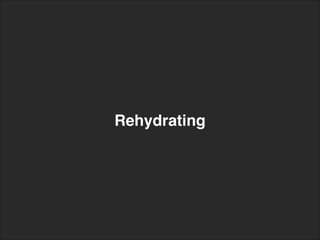
Rehydrating
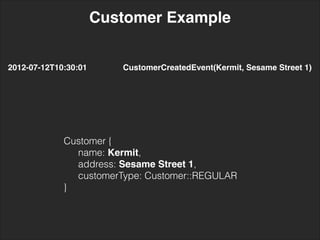
Customer Example
Customer {
name: Kermit,
address: Sesame Street 1,
customerType: Customer::REGULAR
}
2012-07-12T10:30:01! ! ! CustomerCreatedEvent(Kermit, Sesame Street 1)
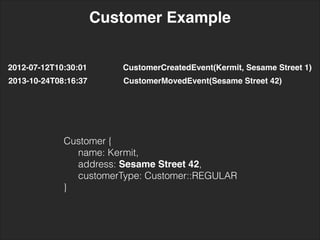
Customer {
name: Kermit,
address: Sesame Street 42,
customerType: Customer::REGULAR
}
2013-10-24T08:16:37! ! ! CustomerMovedEvent(Sesame Street 42)
Customer Example
2012-07-12T10:30:01! ! ! CustomerCreatedEvent(Kermit, Sesame Street 1)
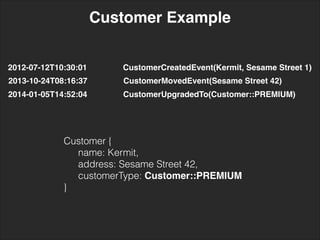
2014-01-05T14:52:04! ! ! CustomerUpgradedTo(Customer::PREMIUM)
Customer {
name: Kermit,
address: Sesame Street 42,
customerType: Customer::PREMIUM
}
Customer Example
2012-07-12T10:30:01! ! ! CustomerCreatedEvent(Kermit, Sesame Street 1)
2013-10-24T08:16:37! ! ! CustomerMovedEvent(Sesame Street 42)
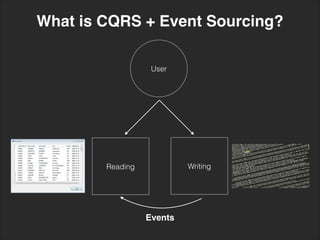
What is CQRS + Event Sourcing?
Reading
User
Writing
Events
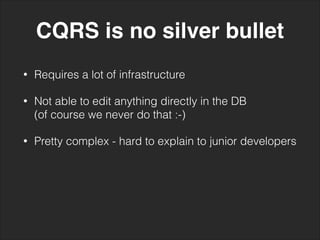
CQRS is no silver bullet
• Requires a lot of infrastructure
• Not able to edit anything directly in the DB

(of course we never do that :-)
• Pretty complex - hard to explain to junior developers
CQRS != Event Sourcing
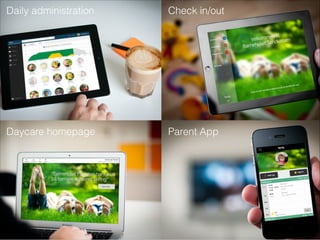
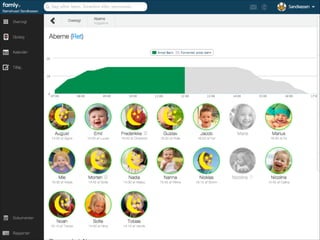
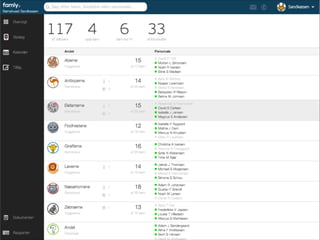
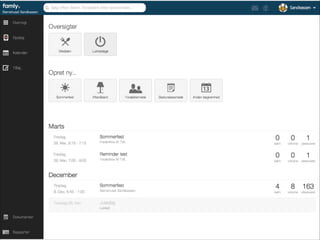
Daily administration Check in/out
Daycare homepage Parent App
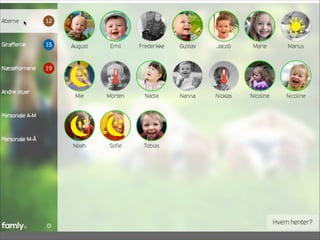
LIVE DEMO FROM FAMLY.DK
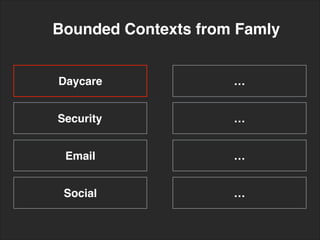
Security
Email
Social
…Daycare
…
…
…
Bounded Contexts from Famly
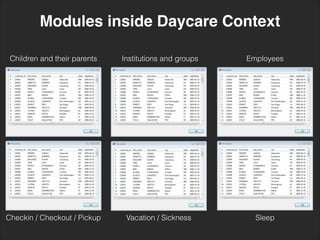
Children and their parents
Checkin / Checkout / Pickup Vacation / Sickness
Modules inside Daycare Context
Institutions and groups
Sleep
Employees
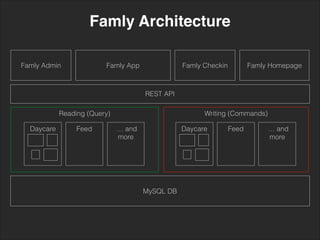
REST API
Famly Admin Famly App Famly Checkin Famly Homepage
Writing (Commands)Reading (Query)
Feed … and
more
Daycare
MySQL DB
Feed … and
more
Daycare
Famly Architecture
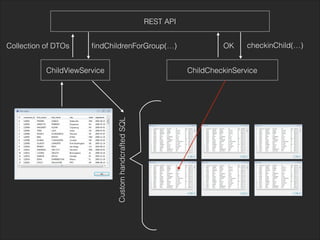
REST API
ChildCheckinService
checkinChild(…)
ChildViewService
OKfindChildrenForGroup(…)
CustomhandcraftedSQL
Collection of DTOs
LIVE DEMO FROM FAMLY.DK
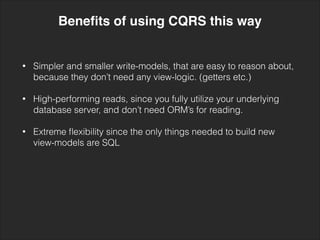
• Simpler and smaller write-models, that are easy to reason about,
because they don’t need any view-logic. (getters etc.)

• High-performing reads, since you fully utilize your underlying
database server, and don’t need ORM’s for reading.

• Extreme flexibility since the only things needed to build new
view-models are SQL
Benefits of using CQRS this way
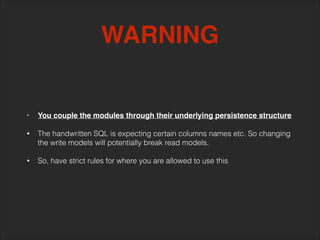
• You couple the modules through their underlying persistence structure!
!
• The handwritten SQL is expecting certain columns names etc. So changing
the write models will potentially break read models.

• So, have strict rules for where you are allowed to use this
WARNING
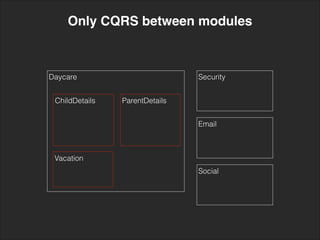
Daycare
ChildDetails ParentDetails
Vacation
Security
Email
Social
Only CQRS between modules
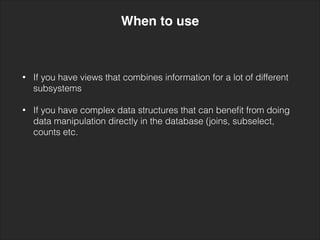
• If you have views that combines information for a lot of different
subsystems

• If you have complex data structures that can benefit from doing
data manipulation directly in the database (joins, subselect,
counts etc.
When to use
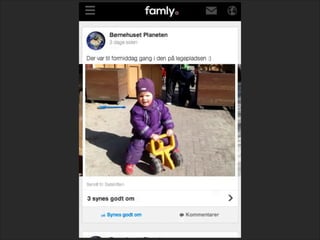
• Even though the app communicates with a lot of underlying
subsystems, it only fetches data for a single child, and
performance therefore is not a problem.
CQRS not needed for the app
Henrik Møller Rasmussen!
hmr@famly.dk


Twitter: @heinodk
IRC: Come join us at #ddd
The digital daycare