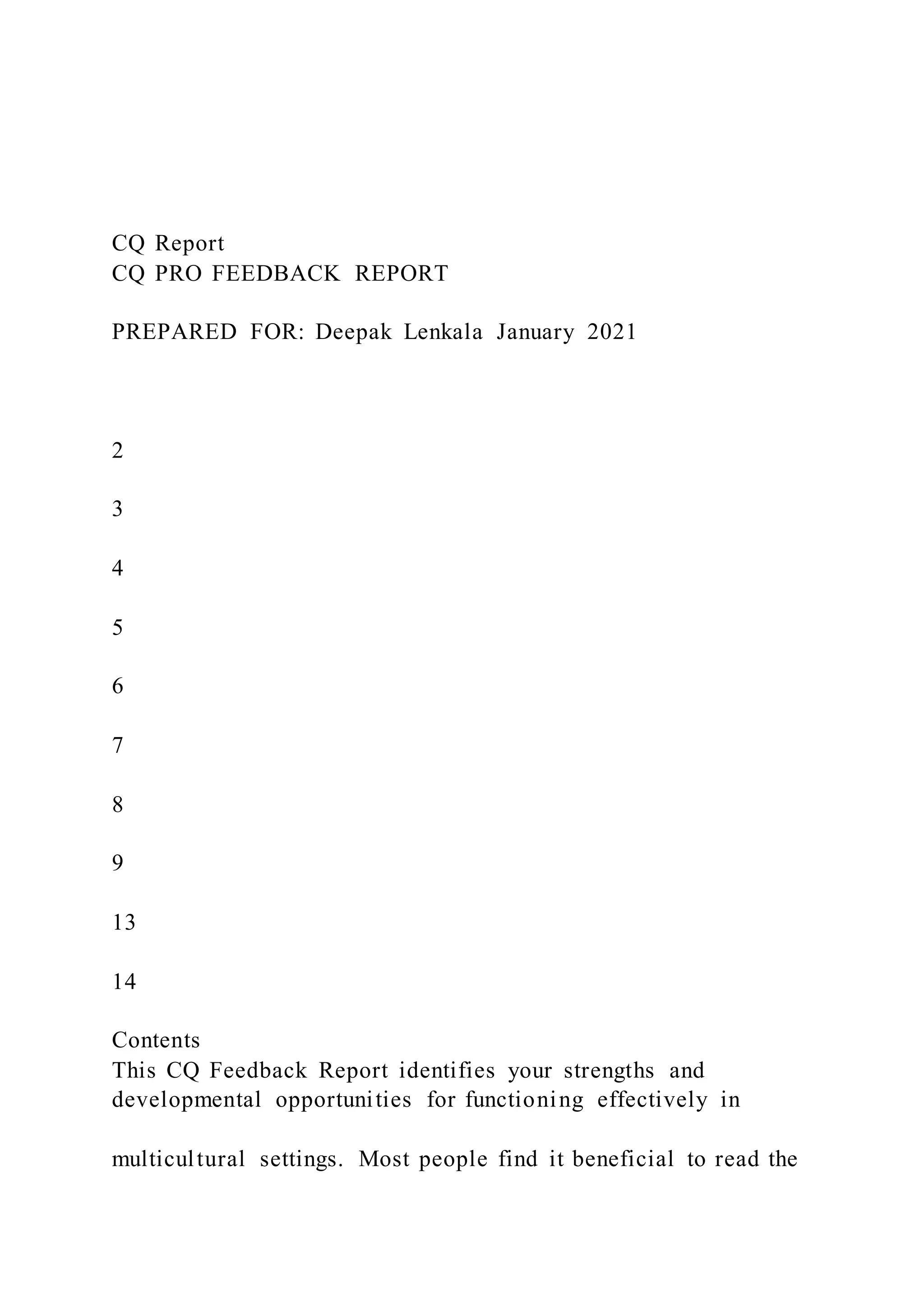
CQ Report
CQ PRO FEEDBACK REPORT
PREPARED FOR: Deepak Lenkala January 2021
2
3
4
5
6
7
8
9
13
14
Contents
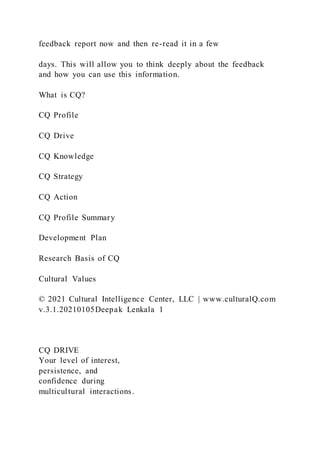
This CQ Feedback Report identifies your strengths and
developmental opportunities for functioning effectively in
multicultural settings. Most people find it beneficial to read the
feedback report now and then re-read it in a few
days. This will allow you to think deeply about the feedback
and how you can use this information.
What is CQ?
CQ Profile
CQ Drive
CQ Knowledge
CQ Strategy
CQ Action
CQ Profile Summary
Development Plan
Research Basis of CQ
Cultural Values
© 2021 Cultural Intelligence Center, LLC | www.culturalQ.com
v.3.1.20210105Deepak Lenkala 1
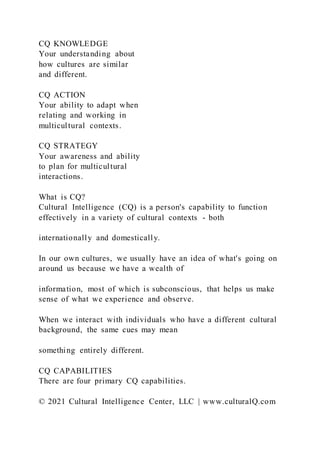
CQ DRIVE
Your level of interest,
persistence, and
confidence during
multicultural interactions.
CQ KNOWLEDGE
Your understanding about
how cultures are similar
and different.
CQ ACTION
Your ability to adapt when
relating and working in
multicultural contexts.
CQ STRATEGY
Your awareness and ability
to plan for multicultural
interactions.
What is CQ?
Cultural Intelligence (CQ) is a person's capability to function
effectively in a variety of cultural contexts - both
internationally and domestically.
In our own cultures, we usually have an idea of what's going on
around us because we have a wealth of
information, most of which is subconscious, that helps us make
sense of what we experience and observe.
When we interact with individuals who have a different cultural
background, the same cues may mean
something entirely different.
CQ CAPABILITIES
There are four primary CQ capabilities.
© 2021 Cultural Intelligence Center, LLC | www.culturalQ.com
v.3.1.20210105Deepak Lenkala 2
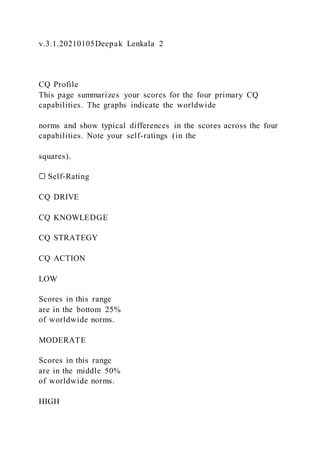
CQ Profile
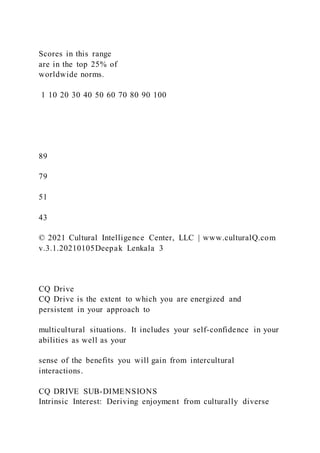
This page summarizes your scores for the four primary CQ
capabilities. The graphs indicate the worldwide
norms and show typical differences in the scores across the four
capabilities. Note your self-ratings (in the
squares).
▢ Self-Rating
CQ DRIVE
CQ KNOWLEDGE
CQ STRATEGY
CQ ACTION
LOW
Scores in this range
are in the bottom 25%
of worldwide norms.
MODERATE
Scores in this range
are in the middle 50%
of worldwide norms.
HIGH
Scores in this range
are in the top 25% of
worldwide norms.
1 10 20 30 40 50 60 70 80 90 100
89
79
51
43
© 2021 Cultural Intelligence Center, LLC | www.culturalQ.com
v.3.1.20210105Deepak Lenkala 3
CQ Drive
CQ Drive is the extent to which you are energized and
persistent in your approach to
multicultural situations. It includes your self-confidence in your
abilities as well as your
sense of the benefits you will gain from intercultural
interactions.
CQ DRIVE SUB-DIMENSIONS
Intrinsic Interest: Deriving enjoyment from culturally diverse
experiences.
Extrinsic Interest: Gaining benefits from culturally diverse
experiences.
Self-Efficacy: Having the confidence to be effective in
culturally diverse situations.
WHAT DOES HIGH CQ DRIVE LOOK LIKE?
Individuals with high CQ Drive are motivated to learn and adapt
to new and diverse cultural settings. Their
confidence in their adaptive abilities influences the way they
perform in multicultural situations.
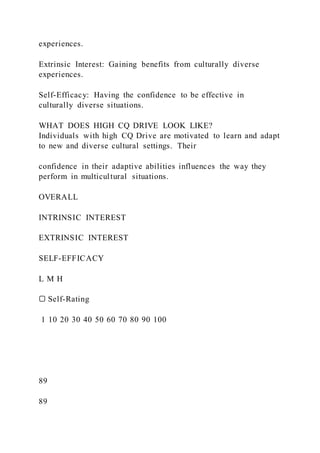
OVERALL
INTRINSIC INTEREST
EXTRINSIC INTEREST
SELF-EFFICACY
L M H
▢ Self-Rating
1 10 20 30 40 50 60 70 80 90 100
89
89
84
95
© 2021 Cultural Intelligence Center, LLC | www.culturalQ.com
v.3.1.20210105Deepak Lenkala 4
CQ Knowledge
CQ Knowledge is the degree to which you understand how
culture influences how
people think and behave and your level of familiarity with how
cultures are similar and
different.
CQ KNOWLEDGE SUB-DIMENSIONS
Business: Knowledge about economic and legal systems.
Values & Norms: Knowledge about values, social interaction
norms, and religious beliefs.
Socio-Linguistic: Knowledge about language and
communication norms.
Leadership: Knowledge about managing people and
relationships across cultures. (Context Specific)
WHAT DOES HIGH CQ KNOWLEDGE LOOK LIKE?
Individuals with high CQ Knowledge have a rich, well-
organized understanding of culture and how it affects
the way people think and behave. They possess a repertoire of
knowledge of how cultures are similar and
how they are different. They understand how culture shapes
behavior.
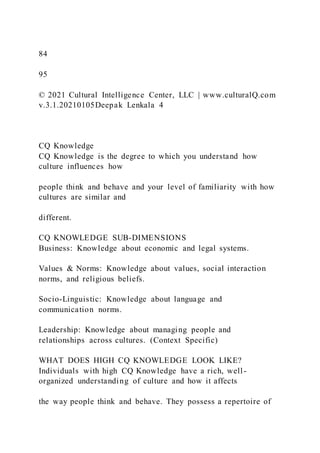
OVERALL
BUSINESS
VALUES & NORMS
SOCIO-LINGUISTIC
LEADERSHIP
L M H
▢ Self-Rating
1 10 20 30 40 50 60 70 80 90 100
79
67
73
98
77
© 2021 Cultural Intelligence Center, LLC | www.culturalQ.co m
v.3.1.20210105Deepak Lenkala 5
CQ Strategy
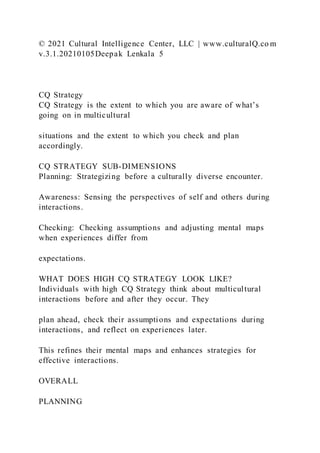
CQ Strategy is the extent to which you are aware of what’s
going on in multicultural
situations and the extent to which you check and plan
accordingly.
CQ STRATEGY SUB-DIMENSIONS
Planning: Strategizing before a culturally diverse encounter.
Awareness: Sensing the perspectives of self and others during
interactions.
Checking: Checking assumptions and adjusting mental maps
when experiences differ from
expectations.
WHAT DOES HIGH CQ STRATEGY LOOK LIKE?
Individuals with high CQ Strategy think about multicultural
interactions before and after they occur. They
plan ahead, check their assumptions and expectations during
interactions, and reflect on experiences later.
This refines their mental maps and enhances strategies for
effective interactions.
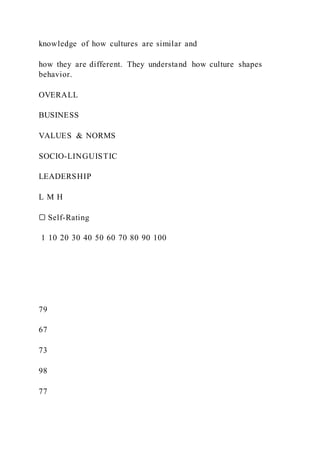
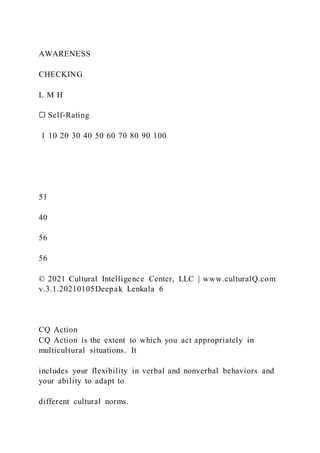
OVERALL
PLANNING
AWARENESS
CHECKING
L M H
▢ Self-Rating
1 10 20 30 40 50 60 70 80 90 100
51
40
56
56
© 2021 Cultural Intelligence Center, LLC | www.culturalQ.com
v.3.1.20210105Deepak Lenkala 6
CQ Action
CQ Action is the extent to which you act appropriately in
multicultural situations. It
includes your flexibility in verbal and nonverbal behaviors and
your ability to adapt to
different cultural norms.
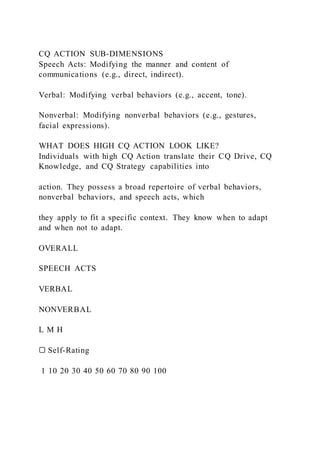
CQ ACTION SUB-DIMENSIONS
Speech Acts: Modifying the manner and content of
communications (e.g., direct, indirect).
Verbal: Modifying verbal behaviors (e.g., accent, tone).
Nonverbal: Modifying nonverbal behaviors (e.g., gestures,
facial expressions).
WHAT DOES HIGH CQ ACTION LOOK LIKE?
Individuals with high CQ Action translate their CQ Drive, CQ
Knowledge, and CQ Strategy capabilities into
action. They possess a broad repertoire of verbal behaviors,
nonverbal behaviors, and speech acts, which
they apply to fit a specific context. They know when to adapt
and when not to adapt.
OVERALL
SPEECH ACTS
VERBAL
NONVERBAL
L M H
▢ Self-Rating
1 10 20 30 40 50 60 70 80 90 100
43
51
51
29
© 2021 Cultural Intelligence Center, LLC | www.culturalQ.com
v.3.1.20210105Deepak Lenkala 7
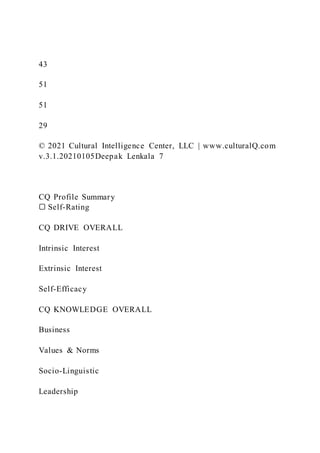
CQ Profile Summary
▢ Self-Rating
CQ DRIVE OVERALL
Intrinsic Interest
Extrinsic Interest
Self-Efficacy
CQ KNOWLEDGE OVERALL
Business
Values & Norms
Socio-Linguistic
Leadership
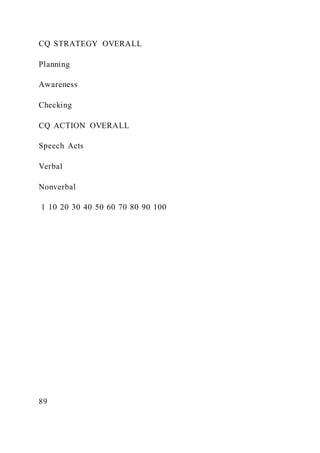
CQ STRATEGY OVERALL
Planning
Awareness
Checking
CQ ACTION OVERALL
Speech Acts
Verbal
Nonverbal
1 10 20 30 40 50 60 70 80 90 100
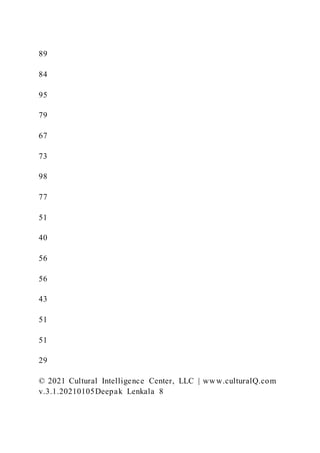
89
89
84
95
79
67
73
98
77
51
40
56
56
43
51
51
29
© 2021 Cultural Intelligence Center, LLC | www.culturalQ.com
v.3.1.20210105Deepak Lenkala 8
Development Plan
Your CQ is not fixed. With some simple but intentional goals
and strategies, you can enhance your CQ. The
next few pages give you a chance to reflect on your CQ
capabilities, your multicultural challenges and
opportunities, and your CQ feedback. Then you will have a
chance to develop an action plan.
YOUR CQ
Describe your self-rated CQ scores in your own words.
_____________________________________________________
_____________________________
_____________________________________________________
_____________________________
PRESENT CHALLENGES
What intercultural challenges are you currently facing?
(e.g. working with someone who has different cultural values,
cultural misunderstandings, etc.)
_____________________________________________________
_____________________________
_____________________________________________________
_____________________________
_____________________________________________________
_____________________________
FUTURE OPPORTUNITIES
What multicultural or global opportunities do you want to
pursue?
(e.g. global leadership, teaching a diverse population of
students, multicultural management, etc.)
_____________________________________________________
_____________________________
_____________________________________________________
_____________________________
_____________________________________________________
_____________________________
© 2021 Cultural Intelligence Center, LLC | www.culturalQ.com
v.3.1.20210105Deepak Lenkala 9
YOUR STRONGEST CQ CAPABILITIES
Your strongest CQ capabilities are based on your self scores in
comparison to the worldwide median, not
simply based on the highest numerical scores.
Your strongest self-rating in the four CQ capabilities is
CQ KNOWLEDGE
Write down one example of how you have used CQ Knowledge
in the last 6 months.
_____________________________________________________
_____________________________
_____________________________________________________
_____________________________
_____________________________________________________
_____________________________
HIGHEST SUB-DIMENSIONS, SELF-RATINGS:
Socio-Linguistic
Knowledge about language and communication norms.
Leadership
Knowledge about managing people and relationships across
cultures.
Self-Efficacy
Having the confidence to be effective in culturally diverse
situations.
How, if at all, does your current role allow you to use your
highest sub-dimensions?
_____________________________________________________
_____________________________
_____________________________________________________
_____________________________
© 2021 Cultural Intelligence Center, LLC | www.culturalQ.com
v.3.1.20210105Deepak Lenkala 10
YOUR WEAKEST CQ CAPABILITIES
Your weakest CQ capabilities are based on your self scores in
comparison to the worldwide median, not
simply based on the lowest numerical scores.
Your weakest self-rating in the four CQ capabilities is
CQ ACTION
Write down one example of how your CQ Action may have
caused problems for you in the past 6 months.
_____________________________________________________
_____________________________
_____________________________________________________
_____________________________
_____________________________________________________
_____________________________
LOWEST SUB-DIMENSIONS, SELF-RATINGS:
Nonverbal
Modifying nonverbal behaviors (e.g., gestures, facial
expressions).
Awareness
Sensing the perspectives of self and others.
Planning
Strategizing before a culturally diverse encounter.
How might your level of CQ on these sub-dimensions be
holding you back from greater effectiveness
working in culturally diverse contexts?
_____________________________________________________
_____________________________
_____________________________________________________
_____________________________
© 2021 Cultural Intelligence Center, LLC | www.culturalQ.com
v.3.1.20210105Deepak Lenkala 11
ACTION STEPS
List one, specific multicultural skill you would like to improve
over the next year. Consider the challenges
and opportunities you described earlier in this section.
(Examples include teaching a diverse population of
students, efficiently implementing global solutions, accurately
analyzing risk and opportunity in culturally
diverse segments, etc.)
_____________________________________________________
_____________________________
_____________________________________________________
_____________________________
STRENGTH - CQ KNOWLEDGE
USING YOUR CQ Knowledge
Specific Action Steps Target Date
List specific, challenging action steps you can take to use your
strongest
self-rated CQ capability.
Next 4 Weeks
1.
2.
Next 8 Weeks
1.
2.
AREA FOR IMPROVEMENT - CQ ACTION
IMPROVING YOUR CQ Action
Specific Action Steps Target Date
List specific, challenging action steps you can take to enhance
your
weakest self-rated CQ capability so that it does not interfere
with
developing the multicultural skill you identified at the top of
this page.
Next 4 Weeks
1.
2.
Next 8 Weeks
1.
2.
ACCOUNTABILITY
With whom will you share this plan in the next 2 weeks?
How can this person help you accomplish your goals? (e.g.
following up with you; checking on your
progress; etc.)
© 2021 Cultural Intelligence Center, LLC | www.culturalQ.com
v.3.1.20210105Deepak Lenkala 12
Research Basis of CQ
THE RESEARCH BASIS FOR ASSESSING CULTURAL
INTELLIGENCE
Cultural Intelligence is conceptualized as a multi-dimensional
construct based on application of Robert
Sternberg's integrative theoretical framework of different "loci"
of intelligence. The dimensions of Cultural
Intelligence represent qualitatively different aspects of the
overall capability to function and manage
effectively in culturally diverse settings.
CULTURAL INTELLIGENCE IS ...
Cultural Intelligence is a malleable capability that can be
enhanced by multicultural experiences, training and
self-awareness programs, travel and education.
Cultural Intelligence is distinct from stable individual
differences such as personality, which describe
what a person typically does across time and across situations.
Cultural Intelligence is also different from emotional
intelligence because it focuses specifically on
capabilities in multicultural contexts.
Cultural Intelligence has predictive validity over and above
demographic characteristics, personality, general
mental ability, emotional intelligence, cross-cultural
adaptability inventory, rhetorical sensitivity, cross-cultural
experience, and social desirability.
The Cultural Intelligence Scale has excellent psychometric
properties.
Published scholarly research demonstrates the factor structure
of the scale is stable across samples,
across time, and across cultures.
In addition, self-rated scores are positively correlated with
observer-rated scores, and multi-trait multi-
method analysis supports the convergent and discriminant
validity of the scale.
Reliabilities of the four factors and sub-dimensions exceed the
standard cut-off of .70.
Most important, research demonstrates that cultural intelligence
predicts adjustment, well-being, cultural
judgment and decision-making, and task performance in
culturally diverse settings.
Visit culturalQ.com/research for more information.
© 2021 Cultural Intelligence Center, LLC | www.culturalQ.com
v.3.1.20210105Deepak Lenkala 13
Below are definitions of the ten cultural value orientations.
TERMS
Individualism Emphasis on individual goals and individual
rights
Collectivism Emphasis on group goals and personal
relationships
Low Power Distance Emphasis on equality; shared decision-
making
High Power Distance Emphasis on differences in status;
superiors make decisions
Low Uncertainty Avoidance Emphasis on flexibility and
adaptability
High Uncertainty Avoidance Emphasis on planning and
predictability
Cooperative Emphasis on collaboration, nurturing, and family
Competitive Emphasis on competition, assertiveness, and
achievement
Short Term Emphasis on immediate outcomes (success now)
Long Term Emphasis on long term planning (success later)
Low Context / Direct Emphasis on explicit communication
(words)
High Context / Indirect Emphasis on indirect communication
(tone, context)
Being Emphasis on quality of life
Doing Emphasis on being busy and meeting goals
Universalism Emphasis on rules; standards that apply to
everyone
Particularism Emphasis on specifics; unique standards based on
relationships
Neutral / Non-Expressive Emphasis on non-emotional
communication; hiding feelings
Affective / Expressive Emphasis on expressive communication;
sharing feelings
Monochronic / Linear Emphasis on one thing at a time;
punctuality; work and personal life separate
Polychronic / Non-Linear Emphasis on multitasking;
interruptions ok; work and personal combined
Cultural Values
© 2021 Cultural Intelligence Center, LLC | www.culturalQ.com
v.3.1.20210105Deepak Lenkala 14
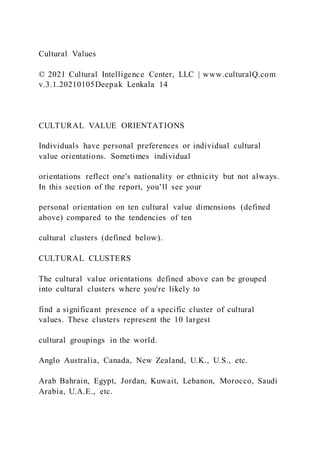
CULTURAL VALUE ORIENTATIONS
Individuals have personal preferences or individual cultural
value orientations. Sometimes individual
orientations reflect one's nationality or ethnicity but not always.
In this section of the report, you’ll see your
personal orientation on ten cultural value dimensions (defined
above) compared to the tendencies of ten
cultural clusters (defined below).
CULTURAL CLUSTERS
The cultural value orientations defined above can be grouped
into cultural clusters where you're likely to
find a significant presence of a specific cluster of cultural
values. These clusters represent the 10 largest
cultural groupings in the world.
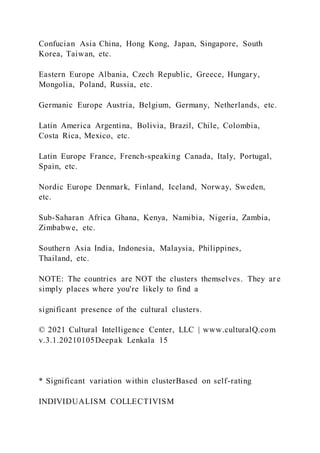
Anglo Australia, Canada, New Zealand, U.K., U.S., etc.
Arab Bahrain, Egypt, Jordan, Kuwait, Lebanon, Morocco, Saudi
Arabia, U.A.E., etc.
Confucian Asia China, Hong Kong, Japan, Singapore, South
Korea, Taiwan, etc.
Eastern Europe Albania, Czech Republic, Greece, Hungary,
Mongolia, Poland, Russia, etc.
Germanic Europe Austria, Belgium, Germany, Netherlands, etc.
Latin America Argentina, Bolivia, Brazil, Chile, Colombia,
Costa Rica, Mexico, etc.
Latin Europe France, French-speaking Canada, Italy, Portugal,
Spain, etc.
Nordic Europe Denmark, Finland, Iceland, Norway, Sweden,
etc.
Sub-Saharan Africa Ghana, Kenya, Namibia, Nigeria, Zambia,
Zimbabwe, etc.
Southern Asia India, Indonesia, Malaysia, Philippines,
Thailand, etc.
NOTE: The countries are NOT the clusters themselves. They ar e
simply places where you're likely to find a
significant presence of the cultural clusters.
© 2021 Cultural Intelligence Center, LLC | www.culturalQ.com
v.3.1.20210105Deepak Lenkala 15
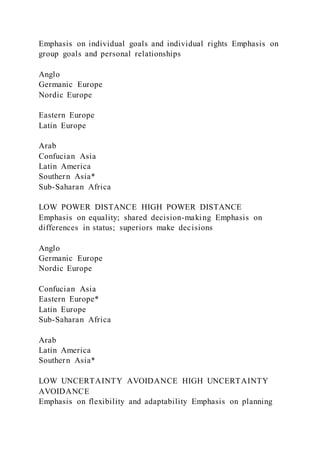
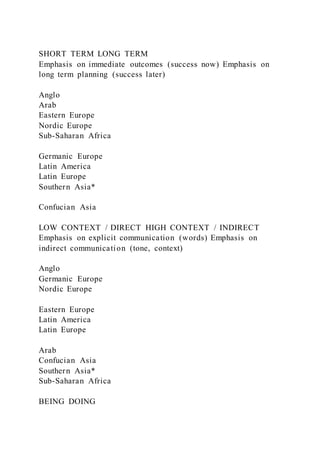
* Significant variation within clusterBased on self-rating
INDIVIDUALISM COLLECTIVISM
Emphasis on individual goals and individual rights Emphasis on
group goals and personal relationships
Anglo
Germanic Europe
Nordic Europe
Eastern Europe
Latin Europe
Arab
Confucian Asia
Latin America
Southern Asia*
Sub-Saharan Africa
LOW POWER DISTANCE HIGH POWER DISTANCE
Emphasis on equality; shared decision-making Emphasis on
differences in status; superiors make decisions
Anglo
Germanic Europe
Nordic Europe
Confucian Asia
Eastern Europe*
Latin Europe
Sub-Saharan Africa
Arab
Latin America
Southern Asia*
LOW UNCERTAINTY AVOIDANCE HIGH UNCERTAINTY
AVOIDANCE
Emphasis on flexibility and adaptability Emphasis on planning
and predictability
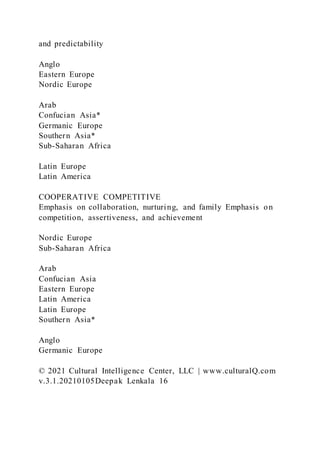
Anglo
Eastern Europe
Nordic Europe
Arab
Confucian Asia*
Germanic Europe
Southern Asia*
Sub-Saharan Africa
Latin Europe
Latin America
COOPERATIVE COMPETITIVE
Emphasis on collaboration, nurturing, and family Emphasis on
competition, assertiveness, and achievement
Nordic Europe
Sub-Saharan Africa
Arab
Confucian Asia
Eastern Europe
Latin America
Latin Europe
Southern Asia*
Anglo
Germanic Europe
© 2021 Cultural Intelligence Center, LLC | www.culturalQ.com
v.3.1.20210105Deepak Lenkala 16
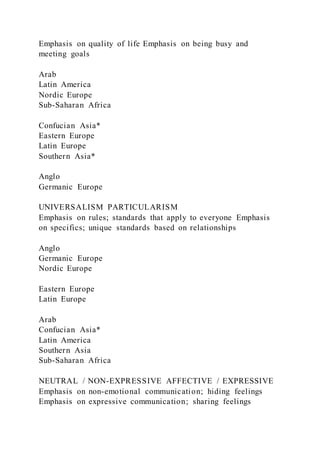
SHORT TERM LONG TERM
Emphasis on immediate outcomes (success now) Emphasis on
long term planning (success later)
Anglo
Arab
Eastern Europe
Nordic Europe
Sub-Saharan Africa
Germanic Europe
Latin America
Latin Europe
Southern Asia*
Confucian Asia
LOW CONTEXT / DIRECT HIGH CONTEXT / INDIRECT
Emphasis on explicit communication (words) Emphasis on
indirect communication (tone, context)
Anglo
Germanic Europe
Nordic Europe
Eastern Europe
Latin America
Latin Europe
Arab
Confucian Asia
Southern Asia*
Sub-Saharan Africa
BEING DOING
Emphasis on quality of life Emphasis on being busy and
meeting goals
Arab
Latin America
Nordic Europe
Sub-Saharan Africa
Confucian Asia*
Eastern Europe
Latin Europe
Southern Asia*
Anglo
Germanic Europe
UNIVERSALISM PARTICULARISM
Emphasis on rules; standards that apply to everyone Emphasis
on specifics; unique standards based on relationships
Anglo
Germanic Europe
Nordic Europe
Eastern Europe
Latin Europe
Arab
Confucian Asia*
Latin America
Southern Asia
Sub-Saharan Africa
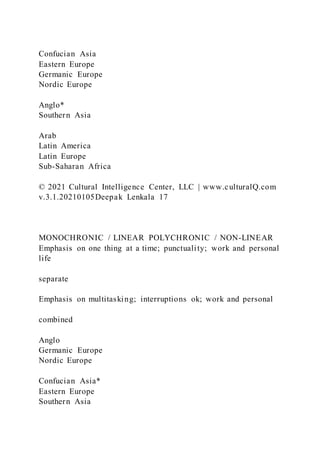
NEUTRAL / NON-EXPRESSIVE AFFECTIVE / EXPRESSIVE
Emphasis on non-emotional communication; hiding feelings
Emphasis on expressive communication; sharing feelings
Confucian Asia
Eastern Europe
Germanic Europe
Nordic Europe
Anglo*
Southern Asia
Arab
Latin America
Latin Europe
Sub-Saharan Africa
© 2021 Cultural Intelligence Center, LLC | www.culturalQ.com
v.3.1.20210105Deepak Lenkala 17
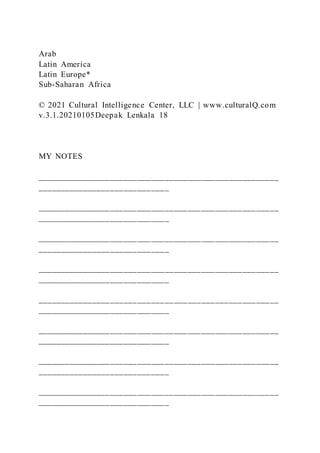
MONOCHRONIC / LINEAR POLYCHRONIC / NON-LINEAR
Emphasis on one thing at a time; punctuality; work and personal
life
separate
Emphasis on multitasking; interruptions ok; work and personal
combined
Anglo
Germanic Europe
Nordic Europe
Confucian Asia*
Eastern Europe
Southern Asia
Arab
Latin America
Latin Europe*
Sub-Saharan Africa
© 2021 Cultural Intelligence Center, LLC | www.culturalQ.com
v.3.1.20210105Deepak Lenkala 18
MY NOTES
_____________________________________________________
_____________________________
_____________________________________________________
_____________________________
_____________________________________________________
_____________________________
_____________________________________________________
_____________________________
_____________________________________________________
_____________________________
_____________________________________________________
_____________________________
_____________________________________________________
_____________________________
_____________________________________________________
_____________________________
_____________________________________________________
_____________________________
_____________________________________________________
_____________________________
_____________________________________________________
_____________________________
_____________________________________________________
_____________________________
© 2021 Cultural Intelligence Center, LLC | www.culturalQ.com
v.3.1.20210105Deepak Lenkala 19
MY NOTES
_____________________________________________________
_____________________________
_____________________________________________________
_____________________________
_____________________________________________________
_____________________________
_____________________________________________________
_____________________________
_____________________________________________________
_____________________________
_____________________________________________________
_____________________________
_____________________________________________________
_____________________________
_____________________________________________________
_____________________________
_____________________________________________________
_____________________________
_____________________________________________________
_____________________________
_____________________________________________________
_____________________________
_____________________________________________________
_____________________________
© 2021 Cultural Intelligence Center, LLC | www.culturalQ.com
v.3.1.20210105Deepak Lenkala 20
CQ ReportCQ PRO FEEDBACK REPORTContentsWhat is
CQ?CQ CAPABILITIESCQ DRIVECQ KNOWLEDGECQ
ACTIONCQ STRATEGYCQ ProfileLOWMODERATEHIGHCQ
DRIVECQ KNOWLEDGECQ STRATEGYCQ ACTIONCQ
DriveCQ DRIVE SUB-DIMENSIONSWHAT DOES HIGH CQ
DRIVE LOOK LIKE?OVERALLINTRINSIC
INTERESTEXTRINSIC INTERESTSELF-EFFICACYCQ
KnowledgeCQ KNOWLEDGE SUB-DIMENSIONSWHAT
DOES HIGH CQ KNOWLEDGE LOOK
LIKE?OVERALLBUSINESSVALUES & NORMSSOCIO-
LINGUISTICLEADERSHIPCQ StrategyCQ STRATEGY SUB-
DIMENSIONSWHAT DOES HIGH CQ STRATEGY LOOK
LIKE?OVERALLPLANNINGAWARENESSCHECKINGCQ
ActionCQ ACTION SUB-DIMENSIONSWHAT DOES HIGH
CQ ACTION LOOK LIKE?OVERALLSPEECH
ACTSVERBALNONVERBALCQ Profile SummaryCQ DRIVE
OVERALLIntrinsic InterestExtrinsic InterestSelf-EfficacyCQ
KNOWLEDGE OVERALLBusinessValues & NormsSocio-
LinguisticLeadershipCQ STRATEGY
OVERALLPlanningAwarenessCheckingCQ ACTION
OVERALLSpeech ActsVerbalNonverbalDevelopment
PlanYOUR CQDescribe your self-rated CQ scores in your own
words.PRESENT CHALLENGESWhat intercultural challenges
are you currently facing?FUTURE OPPORTUNITIESWhat
multicultural or global opportunities do you want to
pursue?YOUR STRONGEST CQ CAPABILITIESYour strongest
self-rating in the four CQ capabilities isCQ
KNOWLEDGEHIGHEST SUB-DIMENSIONS, SELF-
RATINGS:Socio-LinguisticLeadershipSelf-EfficacyYOUR
WEAKEST CQ CAPABILITIESYour weakest self-rating in the
four CQ capabilities isCQ ACTIONLOWEST SUB-
DIMENSIONS, SELF-
RATINGS:NonverbalAwarenessPlanningACTION
STEPSSTRENGTH - CQ KNOWLEDGEAREA FOR
IMPROVEMENT - CQ ACTIONACCOUNTABILITYResearch
Basis of CQTHE RESEARCH BASIS FOR ASSESSING
CULTURAL INTELLIGENCECULTURAL INTELLIGENCE IS
...Cultural ValuesTERMSCULTURAL VALUE
ORIENTATIONSCULTURAL
CLUSTERSINDIVIDUALISMCOLLECTIVISMLOW POWER
DISTANCEHIGH POWER DISTANCELOW UNCERTAINTY
AVOIDANCEHIGH UNCERTAINTY
AVOIDANCECOOPERATIVECOMPETITIVESHORT
TERMLONG TERMLOW CONTEXT / DIRECTHIGH
CONTEXT /
INDIRECTBEINGDOINGUNIVERSALISMPARTICULARISM
NEUTRAL / NON-EXPRESSIVEAFFECTIVE /
EXPRESSIVEMONOCHRONIC / LINEARPOLYCHRONIC /
NON-LINEARMY NOTESMY NOTES

Cq report cq pro feedback reportprepared for deepak lenk

  • 1.
    CQ Report CQ PROFEEDBACK REPORT PREPARED FOR: Deepak Lenkala January 2021 2 3 4 5 6 7 8 9 13 14 Contents This CQ Feedback Report identifies your strengths and developmental opportunities for functioning effectively in multicultural settings. Most people find it beneficial to read the
  • 2.
    feedback report nowand then re-read it in a few days. This will allow you to think deeply about the feedback and how you can use this information. What is CQ? CQ Profile CQ Drive CQ Knowledge CQ Strategy CQ Action CQ Profile Summary Development Plan Research Basis of CQ Cultural Values © 2021 Cultural Intelligence Center, LLC | www.culturalQ.com v.3.1.20210105Deepak Lenkala 1 CQ DRIVE Your level of interest, persistence, and confidence during multicultural interactions.
  • 3.
    CQ KNOWLEDGE Your understandingabout how cultures are similar and different. CQ ACTION Your ability to adapt when relating and working in multicultural contexts. CQ STRATEGY Your awareness and ability to plan for multicultural interactions. What is CQ? Cultural Intelligence (CQ) is a person's capability to function effectively in a variety of cultural contexts - both internationally and domestically. In our own cultures, we usually have an idea of what's going on around us because we have a wealth of information, most of which is subconscious, that helps us make sense of what we experience and observe. When we interact with individuals who have a different cultural background, the same cues may mean something entirely different. CQ CAPABILITIES There are four primary CQ capabilities. © 2021 Cultural Intelligence Center, LLC | www.culturalQ.com
  • 4.
    v.3.1.20210105Deepak Lenkala 2 CQProfile This page summarizes your scores for the four primary CQ capabilities. The graphs indicate the worldwide norms and show typical differences in the scores across the four capabilities. Note your self-ratings (in the squares). ▢ Self-Rating CQ DRIVE CQ KNOWLEDGE CQ STRATEGY CQ ACTION LOW Scores in this range are in the bottom 25% of worldwide norms. MODERATE Scores in this range are in the middle 50% of worldwide norms. HIGH
  • 5.
    Scores in thisrange are in the top 25% of worldwide norms. 1 10 20 30 40 50 60 70 80 90 100 89 79 51 43 © 2021 Cultural Intelligence Center, LLC | www.culturalQ.com v.3.1.20210105Deepak Lenkala 3 CQ Drive CQ Drive is the extent to which you are energized and persistent in your approach to multicultural situations. It includes your self-confidence in your abilities as well as your sense of the benefits you will gain from intercultural interactions. CQ DRIVE SUB-DIMENSIONS Intrinsic Interest: Deriving enjoyment from culturally diverse
  • 6.
    experiences. Extrinsic Interest: Gainingbenefits from culturally diverse experiences. Self-Efficacy: Having the confidence to be effective in culturally diverse situations. WHAT DOES HIGH CQ DRIVE LOOK LIKE? Individuals with high CQ Drive are motivated to learn and adapt to new and diverse cultural settings. Their confidence in their adaptive abilities influences the way they perform in multicultural situations. OVERALL INTRINSIC INTEREST EXTRINSIC INTEREST SELF-EFFICACY L M H ▢ Self-Rating 1 10 20 30 40 50 60 70 80 90 100 89 89
  • 7.
    84 95 © 2021 CulturalIntelligence Center, LLC | www.culturalQ.com v.3.1.20210105Deepak Lenkala 4 CQ Knowledge CQ Knowledge is the degree to which you understand how culture influences how people think and behave and your level of familiarity with how cultures are similar and different. CQ KNOWLEDGE SUB-DIMENSIONS Business: Knowledge about economic and legal systems. Values & Norms: Knowledge about values, social interaction norms, and religious beliefs. Socio-Linguistic: Knowledge about language and communication norms. Leadership: Knowledge about managing people and relationships across cultures. (Context Specific) WHAT DOES HIGH CQ KNOWLEDGE LOOK LIKE? Individuals with high CQ Knowledge have a rich, well- organized understanding of culture and how it affects the way people think and behave. They possess a repertoire of
  • 8.
    knowledge of howcultures are similar and how they are different. They understand how culture shapes behavior. OVERALL BUSINESS VALUES & NORMS SOCIO-LINGUISTIC LEADERSHIP L M H ▢ Self-Rating 1 10 20 30 40 50 60 70 80 90 100 79 67 73 98 77
  • 9.
    © 2021 CulturalIntelligence Center, LLC | www.culturalQ.co m v.3.1.20210105Deepak Lenkala 5 CQ Strategy CQ Strategy is the extent to which you are aware of what’s going on in multicultural situations and the extent to which you check and plan accordingly. CQ STRATEGY SUB-DIMENSIONS Planning: Strategizing before a culturally diverse encounter. Awareness: Sensing the perspectives of self and others during interactions. Checking: Checking assumptions and adjusting mental maps when experiences differ from expectations. WHAT DOES HIGH CQ STRATEGY LOOK LIKE? Individuals with high CQ Strategy think about multicultural interactions before and after they occur. They plan ahead, check their assumptions and expectations during interactions, and reflect on experiences later. This refines their mental maps and enhances strategies for effective interactions. OVERALL PLANNING
  • 10.
    AWARENESS CHECKING L M H ▢Self-Rating 1 10 20 30 40 50 60 70 80 90 100 51 40 56 56 © 2021 Cultural Intelligence Center, LLC | www.culturalQ.com v.3.1.20210105Deepak Lenkala 6 CQ Action CQ Action is the extent to which you act appropriately in multicultural situations. It includes your flexibility in verbal and nonverbal behaviors and your ability to adapt to different cultural norms.
  • 11.
    CQ ACTION SUB-DIMENSIONS SpeechActs: Modifying the manner and content of communications (e.g., direct, indirect). Verbal: Modifying verbal behaviors (e.g., accent, tone). Nonverbal: Modifying nonverbal behaviors (e.g., gestures, facial expressions). WHAT DOES HIGH CQ ACTION LOOK LIKE? Individuals with high CQ Action translate their CQ Drive, CQ Knowledge, and CQ Strategy capabilities into action. They possess a broad repertoire of verbal behaviors, nonverbal behaviors, and speech acts, which they apply to fit a specific context. They know when to adapt and when not to adapt. OVERALL SPEECH ACTS VERBAL NONVERBAL L M H ▢ Self-Rating 1 10 20 30 40 50 60 70 80 90 100
  • 12.
    43 51 51 29 © 2021 CulturalIntelligence Center, LLC | www.culturalQ.com v.3.1.20210105Deepak Lenkala 7 CQ Profile Summary ▢ Self-Rating CQ DRIVE OVERALL Intrinsic Interest Extrinsic Interest Self-Efficacy CQ KNOWLEDGE OVERALL Business Values & Norms Socio-Linguistic Leadership
  • 13.
    CQ STRATEGY OVERALL Planning Awareness Checking CQACTION OVERALL Speech Acts Verbal Nonverbal 1 10 20 30 40 50 60 70 80 90 100 89
  • 14.
    89 84 95 79 67 73 98 77 51 40 56 56 43 51 51 29 © 2021 CulturalIntelligence Center, LLC | www.culturalQ.com v.3.1.20210105Deepak Lenkala 8
  • 15.
    Development Plan Your CQis not fixed. With some simple but intentional goals and strategies, you can enhance your CQ. The next few pages give you a chance to reflect on your CQ capabilities, your multicultural challenges and opportunities, and your CQ feedback. Then you will have a chance to develop an action plan. YOUR CQ Describe your self-rated CQ scores in your own words. _____________________________________________________ _____________________________ _____________________________________________________ _____________________________ PRESENT CHALLENGES What intercultural challenges are you currently facing? (e.g. working with someone who has different cultural values, cultural misunderstandings, etc.) _____________________________________________________ _____________________________ _____________________________________________________ _____________________________ _____________________________________________________ _____________________________
  • 16.
    FUTURE OPPORTUNITIES What multiculturalor global opportunities do you want to pursue? (e.g. global leadership, teaching a diverse population of students, multicultural management, etc.) _____________________________________________________ _____________________________ _____________________________________________________ _____________________________ _____________________________________________________ _____________________________ © 2021 Cultural Intelligence Center, LLC | www.culturalQ.com v.3.1.20210105Deepak Lenkala 9 YOUR STRONGEST CQ CAPABILITIES Your strongest CQ capabilities are based on your self scores in comparison to the worldwide median, not simply based on the highest numerical scores. Your strongest self-rating in the four CQ capabilities is CQ KNOWLEDGE Write down one example of how you have used CQ Knowledge in the last 6 months. _____________________________________________________ _____________________________
  • 17.
    _____________________________________________________ _____________________________ _____________________________________________________ _____________________________ HIGHEST SUB-DIMENSIONS, SELF-RATINGS: Socio-Linguistic Knowledgeabout language and communication norms. Leadership Knowledge about managing people and relationships across cultures. Self-Efficacy Having the confidence to be effective in culturally diverse situations. How, if at all, does your current role allow you to use your highest sub-dimensions? _____________________________________________________ _____________________________ _____________________________________________________ _____________________________ © 2021 Cultural Intelligence Center, LLC | www.culturalQ.com v.3.1.20210105Deepak Lenkala 10 YOUR WEAKEST CQ CAPABILITIES Your weakest CQ capabilities are based on your self scores in comparison to the worldwide median, not
  • 18.
    simply based onthe lowest numerical scores. Your weakest self-rating in the four CQ capabilities is CQ ACTION Write down one example of how your CQ Action may have caused problems for you in the past 6 months. _____________________________________________________ _____________________________ _____________________________________________________ _____________________________ _____________________________________________________ _____________________________ LOWEST SUB-DIMENSIONS, SELF-RATINGS: Nonverbal Modifying nonverbal behaviors (e.g., gestures, facial expressions). Awareness Sensing the perspectives of self and others. Planning Strategizing before a culturally diverse encounter. How might your level of CQ on these sub-dimensions be holding you back from greater effectiveness working in culturally diverse contexts? _____________________________________________________
  • 19.
    _____________________________ _____________________________________________________ _____________________________ © 2021 CulturalIntelligence Center, LLC | www.culturalQ.com v.3.1.20210105Deepak Lenkala 11 ACTION STEPS List one, specific multicultural skill you would like to improve over the next year. Consider the challenges and opportunities you described earlier in this section. (Examples include teaching a diverse population of students, efficiently implementing global solutions, accurately analyzing risk and opportunity in culturally diverse segments, etc.) _____________________________________________________ _____________________________ _____________________________________________________ _____________________________ STRENGTH - CQ KNOWLEDGE USING YOUR CQ Knowledge Specific Action Steps Target Date List specific, challenging action steps you can take to use your strongest
  • 20.
    self-rated CQ capability. Next4 Weeks 1. 2. Next 8 Weeks 1. 2. AREA FOR IMPROVEMENT - CQ ACTION IMPROVING YOUR CQ Action Specific Action Steps Target Date List specific, challenging action steps you can take to enhance your weakest self-rated CQ capability so that it does not interfere with developing the multicultural skill you identified at the top of this page. Next 4 Weeks 1. 2. Next 8 Weeks 1.
  • 21.
    2. ACCOUNTABILITY With whom willyou share this plan in the next 2 weeks? How can this person help you accomplish your goals? (e.g. following up with you; checking on your progress; etc.) © 2021 Cultural Intelligence Center, LLC | www.culturalQ.com v.3.1.20210105Deepak Lenkala 12 Research Basis of CQ THE RESEARCH BASIS FOR ASSESSING CULTURAL INTELLIGENCE Cultural Intelligence is conceptualized as a multi-dimensional construct based on application of Robert Sternberg's integrative theoretical framework of different "loci" of intelligence. The dimensions of Cultural Intelligence represent qualitatively different aspects of the overall capability to function and manage effectively in culturally diverse settings. CULTURAL INTELLIGENCE IS ... Cultural Intelligence is a malleable capability that can be enhanced by multicultural experiences, training and
  • 22.
    self-awareness programs, traveland education. Cultural Intelligence is distinct from stable individual differences such as personality, which describe what a person typically does across time and across situations. Cultural Intelligence is also different from emotional intelligence because it focuses specifically on capabilities in multicultural contexts. Cultural Intelligence has predictive validity over and above demographic characteristics, personality, general mental ability, emotional intelligence, cross-cultural adaptability inventory, rhetorical sensitivity, cross-cultural experience, and social desirability. The Cultural Intelligence Scale has excellent psychometric properties. Published scholarly research demonstrates the factor structure of the scale is stable across samples, across time, and across cultures. In addition, self-rated scores are positively correlated with observer-rated scores, and multi-trait multi- method analysis supports the convergent and discriminant validity of the scale. Reliabilities of the four factors and sub-dimensions exceed the standard cut-off of .70.
  • 23.
    Most important, researchdemonstrates that cultural intelligence predicts adjustment, well-being, cultural judgment and decision-making, and task performance in culturally diverse settings. Visit culturalQ.com/research for more information. © 2021 Cultural Intelligence Center, LLC | www.culturalQ.com v.3.1.20210105Deepak Lenkala 13 Below are definitions of the ten cultural value orientations. TERMS Individualism Emphasis on individual goals and individual rights Collectivism Emphasis on group goals and personal relationships Low Power Distance Emphasis on equality; shared decision- making High Power Distance Emphasis on differences in status; superiors make decisions Low Uncertainty Avoidance Emphasis on flexibility and adaptability High Uncertainty Avoidance Emphasis on planning and predictability
  • 24.
    Cooperative Emphasis oncollaboration, nurturing, and family Competitive Emphasis on competition, assertiveness, and achievement Short Term Emphasis on immediate outcomes (success now) Long Term Emphasis on long term planning (success later) Low Context / Direct Emphasis on explicit communication (words) High Context / Indirect Emphasis on indirect communication (tone, context) Being Emphasis on quality of life Doing Emphasis on being busy and meeting goals Universalism Emphasis on rules; standards that apply to everyone Particularism Emphasis on specifics; unique standards based on relationships Neutral / Non-Expressive Emphasis on non-emotional communication; hiding feelings Affective / Expressive Emphasis on expressive communication; sharing feelings Monochronic / Linear Emphasis on one thing at a time; punctuality; work and personal life separate Polychronic / Non-Linear Emphasis on multitasking; interruptions ok; work and personal combined
  • 25.
    Cultural Values © 2021Cultural Intelligence Center, LLC | www.culturalQ.com v.3.1.20210105Deepak Lenkala 14 CULTURAL VALUE ORIENTATIONS Individuals have personal preferences or individual cultural value orientations. Sometimes individual orientations reflect one's nationality or ethnicity but not always. In this section of the report, you’ll see your personal orientation on ten cultural value dimensions (defined above) compared to the tendencies of ten cultural clusters (defined below). CULTURAL CLUSTERS The cultural value orientations defined above can be grouped into cultural clusters where you're likely to find a significant presence of a specific cluster of cultural values. These clusters represent the 10 largest cultural groupings in the world. Anglo Australia, Canada, New Zealand, U.K., U.S., etc. Arab Bahrain, Egypt, Jordan, Kuwait, Lebanon, Morocco, Saudi Arabia, U.A.E., etc.
  • 26.
    Confucian Asia China,Hong Kong, Japan, Singapore, South Korea, Taiwan, etc. Eastern Europe Albania, Czech Republic, Greece, Hungary, Mongolia, Poland, Russia, etc. Germanic Europe Austria, Belgium, Germany, Netherlands, etc. Latin America Argentina, Bolivia, Brazil, Chile, Colombia, Costa Rica, Mexico, etc. Latin Europe France, French-speaking Canada, Italy, Portugal, Spain, etc. Nordic Europe Denmark, Finland, Iceland, Norway, Sweden, etc. Sub-Saharan Africa Ghana, Kenya, Namibia, Nigeria, Zambia, Zimbabwe, etc. Southern Asia India, Indonesia, Malaysia, Philippines, Thailand, etc. NOTE: The countries are NOT the clusters themselves. They ar e simply places where you're likely to find a significant presence of the cultural clusters. © 2021 Cultural Intelligence Center, LLC | www.culturalQ.com v.3.1.20210105Deepak Lenkala 15 * Significant variation within clusterBased on self-rating INDIVIDUALISM COLLECTIVISM
  • 27.
    Emphasis on individualgoals and individual rights Emphasis on group goals and personal relationships Anglo Germanic Europe Nordic Europe Eastern Europe Latin Europe Arab Confucian Asia Latin America Southern Asia* Sub-Saharan Africa LOW POWER DISTANCE HIGH POWER DISTANCE Emphasis on equality; shared decision-making Emphasis on differences in status; superiors make decisions Anglo Germanic Europe Nordic Europe Confucian Asia Eastern Europe* Latin Europe Sub-Saharan Africa Arab Latin America Southern Asia* LOW UNCERTAINTY AVOIDANCE HIGH UNCERTAINTY AVOIDANCE Emphasis on flexibility and adaptability Emphasis on planning
  • 28.
    and predictability Anglo Eastern Europe NordicEurope Arab Confucian Asia* Germanic Europe Southern Asia* Sub-Saharan Africa Latin Europe Latin America COOPERATIVE COMPETITIVE Emphasis on collaboration, nurturing, and family Emphasis on competition, assertiveness, and achievement Nordic Europe Sub-Saharan Africa Arab Confucian Asia Eastern Europe Latin America Latin Europe Southern Asia* Anglo Germanic Europe © 2021 Cultural Intelligence Center, LLC | www.culturalQ.com v.3.1.20210105Deepak Lenkala 16
  • 29.
    SHORT TERM LONGTERM Emphasis on immediate outcomes (success now) Emphasis on long term planning (success later) Anglo Arab Eastern Europe Nordic Europe Sub-Saharan Africa Germanic Europe Latin America Latin Europe Southern Asia* Confucian Asia LOW CONTEXT / DIRECT HIGH CONTEXT / INDIRECT Emphasis on explicit communication (words) Emphasis on indirect communication (tone, context) Anglo Germanic Europe Nordic Europe Eastern Europe Latin America Latin Europe Arab Confucian Asia Southern Asia* Sub-Saharan Africa BEING DOING
  • 30.
    Emphasis on qualityof life Emphasis on being busy and meeting goals Arab Latin America Nordic Europe Sub-Saharan Africa Confucian Asia* Eastern Europe Latin Europe Southern Asia* Anglo Germanic Europe UNIVERSALISM PARTICULARISM Emphasis on rules; standards that apply to everyone Emphasis on specifics; unique standards based on relationships Anglo Germanic Europe Nordic Europe Eastern Europe Latin Europe Arab Confucian Asia* Latin America Southern Asia Sub-Saharan Africa NEUTRAL / NON-EXPRESSIVE AFFECTIVE / EXPRESSIVE Emphasis on non-emotional communication; hiding feelings Emphasis on expressive communication; sharing feelings
  • 31.
    Confucian Asia Eastern Europe GermanicEurope Nordic Europe Anglo* Southern Asia Arab Latin America Latin Europe Sub-Saharan Africa © 2021 Cultural Intelligence Center, LLC | www.culturalQ.com v.3.1.20210105Deepak Lenkala 17 MONOCHRONIC / LINEAR POLYCHRONIC / NON-LINEAR Emphasis on one thing at a time; punctuality; work and personal life separate Emphasis on multitasking; interruptions ok; work and personal combined Anglo Germanic Europe Nordic Europe Confucian Asia* Eastern Europe Southern Asia
  • 32.
    Arab Latin America Latin Europe* Sub-SaharanAfrica © 2021 Cultural Intelligence Center, LLC | www.culturalQ.com v.3.1.20210105Deepak Lenkala 18 MY NOTES _____________________________________________________ _____________________________ _____________________________________________________ _____________________________ _____________________________________________________ _____________________________ _____________________________________________________ _____________________________ _____________________________________________________ _____________________________ _____________________________________________________ _____________________________ _____________________________________________________ _____________________________ _____________________________________________________ _____________________________
  • 33.
    _____________________________________________________ _____________________________ _____________________________________________________ _____________________________ _____________________________________________________ _____________________________ _____________________________________________________ _____________________________ © 2021 CulturalIntelligence Center, LLC | www.culturalQ.com v.3.1.20210105Deepak Lenkala 19 MY NOTES _____________________________________________________ _____________________________ _____________________________________________________ _____________________________ _____________________________________________________ _____________________________ _____________________________________________________ _____________________________ _____________________________________________________ _____________________________ _____________________________________________________
  • 34.
    _____________________________ _____________________________________________________ _____________________________ _____________________________________________________ _____________________________ _____________________________________________________ _____________________________ _____________________________________________________ _____________________________ _____________________________________________________ _____________________________ _____________________________________________________ _____________________________ © 2021 CulturalIntelligence Center, LLC | www.culturalQ.com v.3.1.20210105Deepak Lenkala 20 CQ ReportCQ PRO FEEDBACK REPORTContentsWhat is CQ?CQ CAPABILITIESCQ DRIVECQ KNOWLEDGECQ ACTIONCQ STRATEGYCQ ProfileLOWMODERATEHIGHCQ DRIVECQ KNOWLEDGECQ STRATEGYCQ ACTIONCQ DriveCQ DRIVE SUB-DIMENSIONSWHAT DOES HIGH CQ DRIVE LOOK LIKE?OVERALLINTRINSIC INTERESTEXTRINSIC INTERESTSELF-EFFICACYCQ KnowledgeCQ KNOWLEDGE SUB-DIMENSIONSWHAT DOES HIGH CQ KNOWLEDGE LOOK LIKE?OVERALLBUSINESSVALUES & NORMSSOCIO- LINGUISTICLEADERSHIPCQ StrategyCQ STRATEGY SUB- DIMENSIONSWHAT DOES HIGH CQ STRATEGY LOOK
  • 35.
    LIKE?OVERALLPLANNINGAWARENESSCHECKINGCQ ActionCQ ACTION SUB-DIMENSIONSWHATDOES HIGH CQ ACTION LOOK LIKE?OVERALLSPEECH ACTSVERBALNONVERBALCQ Profile SummaryCQ DRIVE OVERALLIntrinsic InterestExtrinsic InterestSelf-EfficacyCQ KNOWLEDGE OVERALLBusinessValues & NormsSocio- LinguisticLeadershipCQ STRATEGY OVERALLPlanningAwarenessCheckingCQ ACTION OVERALLSpeech ActsVerbalNonverbalDevelopment PlanYOUR CQDescribe your self-rated CQ scores in your own words.PRESENT CHALLENGESWhat intercultural challenges are you currently facing?FUTURE OPPORTUNITIESWhat multicultural or global opportunities do you want to pursue?YOUR STRONGEST CQ CAPABILITIESYour strongest self-rating in the four CQ capabilities isCQ KNOWLEDGEHIGHEST SUB-DIMENSIONS, SELF- RATINGS:Socio-LinguisticLeadershipSelf-EfficacyYOUR WEAKEST CQ CAPABILITIESYour weakest self-rating in the four CQ capabilities isCQ ACTIONLOWEST SUB- DIMENSIONS, SELF- RATINGS:NonverbalAwarenessPlanningACTION STEPSSTRENGTH - CQ KNOWLEDGEAREA FOR IMPROVEMENT - CQ ACTIONACCOUNTABILITYResearch Basis of CQTHE RESEARCH BASIS FOR ASSESSING CULTURAL INTELLIGENCECULTURAL INTELLIGENCE IS ...Cultural ValuesTERMSCULTURAL VALUE ORIENTATIONSCULTURAL CLUSTERSINDIVIDUALISMCOLLECTIVISMLOW POWER DISTANCEHIGH POWER DISTANCELOW UNCERTAINTY AVOIDANCEHIGH UNCERTAINTY AVOIDANCECOOPERATIVECOMPETITIVESHORT TERMLONG TERMLOW CONTEXT / DIRECTHIGH CONTEXT / INDIRECTBEINGDOINGUNIVERSALISMPARTICULARISM NEUTRAL / NON-EXPRESSIVEAFFECTIVE /
  • 36.
    EXPRESSIVEMONOCHRONIC / LINEARPOLYCHRONIC/ NON-LINEARMY NOTESMY NOTES