Trudie Steyn 
Implementing continuing 
professional teacher 
development: policy and practice 
First submission: 28 August 2009 
Acceptance: 16 September 2010 
It is important for South African teachers to be appropriately equipped to meet the 
growing needs and challenges of the country. The dire need for suitably qualified 
teachers is addressed in South Africa’s National Policy Framework for Teacher 
Education and Development. This article attempts to address the problem of 
how Continuing Professional Teacher Development (CPTD), as stipulated by the 
National Policy Framework, can be implemented to create a collaborative learning 
culture in schools. The article uses the conceptual frameworks for collective learning 
to interpret the literature and the findings. 
Die implementering van professionele 
onderwysersontwikkeling: beleid en praktyk 
Dit is belangrik vir Suid-Afrikaanse onderwysers om goed opgelei te word om 
in die groeiende behoeftes en uitdagings van die land te voorsien. Die ernstige 
behoefte om in die nood van toepaslik gekwalifiseerde onderwysers te voorsien, 
word aangespreek deur die Suid-Afrikaanse Nasionale Beleidsraamwerk vir 
Onderwysdersopleiding en Ontwikkeling. Hierdie artikel poog om die probleem 
van hoe Voortgesette Professionele Onderwysersopleiding, soos gestipuleer deur 
die Beleidsraamwerk, geïmplementeer kan word om ’n kollaboratiewe leerkultuur 
in skole te skep, aan te spreek. Die artikel gebruik die konsepsuele raamwerke vir 
kollektiewe leer om die literatuur en bevindinge te interpreteer. 
Prof GM Steyn, Dept of Further Teacher Education, University of South Africa, P 
O Box 392, Unisa 0003; E-mail: steyngm1@unisa.ac.za 
Acta Academica 
2011 43(1): 210-232 
ISSN 0587-2405 
© UV/UFS 
<http://www.ufs.ac.za/ActaAcademica>
Steyn/Implementing continuing professional teacher development: 
The twenty-first century demands that all professionals in or-ganisations 
learn to meet the challenges and cope with the 
changes that are rapidly taking place in their environments 
(cf Retna 2007, Vemić 2007). The quality of teaching and learning 
in such environments is also being severely challenged (cf Doring 
2002, Smith & Gillespie 2007). Research corroborates the conten-tion 
that highly skilled teachers do make a difference to the qual-ity 
of teaching (cf King & Newman 2001, Van Eekelen et al 2006, 
Teachers for the 21st century – making the difference 2008). There is also 
widespread agreement that developing teachers professionally is 
the optimal answer and is indispensable to bringing about sustain-able 
school improvement, for the ultimate improvement of student 
211 
learning.1 
Recent studies clearly point to professional development 
(PD) that is linked to subject content and pedagogy as the key 
to improved learner performance (cf Smith & Gillespie 2007, 
Vemić 2007). In addition, teachers “who engaged in sustained, 
collaborative professional development around specific concepts 
in their curriculum were more likely to change their teaching 
practice in ways associated with greater student achievement” 
(Negroni 2005: 72). The school context itself is an important 
element influencing the extent of the impact of professional 
development (Meiers & Ingvarsin 2005). This implies the need 
for professional learning communities in which teachers learn and 
work together and focus on student learning (Sparks 2003). 
When learning is viewed as a social activity, individuals will 
experience improved learning as members of a team or group. 
Rose (Doring 2002: 7) mentions that focusing on individuals 
is incorrect. The approach should rather be on the school as a 
whole where the “associated emergence of a ‘team culture’ with 
an instrumental function of improving teaching and learning 
becomes a key component of professional growth” (Doring 2002: 
7). The movement for teacher professional communities within 
schools grew from the belief that one cannot take individual 
1 Cf Boyle et al 2005, CPDT 2006, Desimone et al 2006, Meiers & Ingvarsin 
2005, Vemić 2007.
Acta Academica 2010: 42(4) 
teachers out of their environment, train and change them, then 
put them back into the same environment and expect them to 
change that environment (Smith & Gillespie 2007). Rather, 
teachers need a community of like-minded teachers within the 
school, so that they can learn together about their work as they 
apply that learning. 
South African schools are viewed as being in “in crisis” (Paton 
2006: 1) and in “a state of disaster” (Bloch 2008: 19) with more 
than enough reason to be discouraged (Beeld 2008: 16). In this 
regard Paton (2006: 1) declares: “Poor quality teaching is the 
key reason why the education system is failing so many schools”. 
The Report of the Ministerial Committee on Rural Education (2005) 
regarded the limited access of teachers to PD as a critical area for 
change (RSA 2007: 5). The National policy framework for teacher 
education and development is an attempt to address the need for 
suitably qualified teachers in South Africa (RSA 2007: 5). This 
policy focuses on two complementary subsystems, namely initial 
professional education of teachers, and Continuing Professional 
Teacher Development (CPTD) (RSA 2007: 2). For the purpose of 
this article the focus will be on CPTD since teachers in the current 
system are not equipped with the necessary knowledge and skills. 
In Steyn’s study participants were of the opinion that official PD 
programmes presented by the Department of Education “had little 
or no impact on their schools” since they were too theoretical in 
nature with little practical value for teachers (Steyn 2010: 356). 
Although constructive contributions have been made to 
under-standing the professional development of teachers in 
general, limited research has been done to indicate how CPTD, 
as stipulated by the National Policy Framework, can expand 
individual teacher development to include a contribution to 
the creation of a collaborative learning culture in schools for 
the sake of quality education. How can CPTD, as stipulated 
by the National Policy Framework, be implemented to create a 
collaborative learning culture in schools? Addressing this issue 
may influence the implementation of the policy. 
212
Steyn/Implementing continuing professional teacher development: 
A policy analysis (McMillan & Schumacher 2006: 448) of 
CPTD in the National Policy Framework was done to determine 
its contribution to improving teacher learning by including a 
collective learning culture in schools apart from focusing on 
the development of individual teachers. As such, a qualitative 
research design was employed to address the research question. 
The approach involved a case study since it examined a bounded 
system, namely the CPTD in the National Policy Framework 
(McMillan & Schumacher 2006: 26): “A case study promotes 
better understanding of a practice or issue and facilitates informed 
decision-making” (McMillan & Schumacher 2006: 333). The 
research problem was approached from a pragmatic perspective 
since the effectiveness of the CPTD’s implementation in practice 
is considered crucial. This is also supported by Mundry (2005: 
14) who states that policymakers and education managers should 
invest in these more “practice-based” approaches to professional 
learning for teachers (Mundry 2005: 14). For this study the 
data collection method included a policy analysis (McMillan & 
Schumacher 2006: 448) of CPTD, in particular, and other relevant 
documents and studies. Using documents as a data collection 
technique may shed light on the phenomenon being investigated 
(Nieuwenhuis 2010: 82), in this instance the means in which 
CPDT can be effectively implemented to create a learning culture 
in schools. 
The National Policy Framework states that the new CPTD 
system attempts to ensure that current initiatives devoted to the 
PD of teachers contribute more effectively and directly to the 
quality of teaching (RSA 2007: 25). In addition, the underlying 
principle for continuing professional development is that 
“teachers, individually and collectively, will have a high degree 
of responsibility for their own development” (RSA 2007: 26). 
Meiers & Ingvarson (2005: 16) support this view, stating that 
collective learning is important for positive changes to occur in 
schools. The present article therefore aims to indicate how CPTD, 
as described in the National Policy Framework, can be utilised to 
create a collective learning culture in schools. The success of the 
213
Acta Academica 2010: 42(4) 
Policy Framework cannot be guaranteed unless collective learning 
within schools has been considered. 
1. Theoretical framework 
In current literature, learning in organisations is repeatedly 
presented on two levels, the individual and the collective, This 
implies that individual learning is an essential but inadequate 
prerequisite for collaborative learning in and development of 
organisations.2 Lee & Roth (2007) argue that previous theories on 
learning in organisations ignore the fact that individual learning 
and learning in organisations mutually support each other. 
They succinctly add that “dynamic and expansively learning 
organizations presuppose dynamic and expansive individuals; 
dynamic and expansive individuals presuppose dynamic and 
expansively learning organizations” (Lee & Roth 2007: 104-5). 
Stacey (2003) argues that individuals cannot learn in isolation 
since learning is in essence an activity of interdependent people. 
Moreover, when staff members learn collectively, they are in a 
better position to react to external challenges. Doring (2002: 7) 
believes that the “associated emergence of a ‘team culture’ with 
an instrumental function of improving teaching and learning 
becomes a key component of professional growth”, which may 
assist staff in addressing the challenges they are facing. 
According to the situated learning theory, there are two basic 
principles: active learning takes place as a function of the context, 
culture and activity in which it occurs, and social participation 
is a critical element of situated learning (cf Wenger 1999, 2000 
& 2007). Wenger (2000: 227) defines learning as an interaction 
between personal experience and social competence. He identifies 
various ways “to take charge of learning, to direct it, to demand 
it or to accelerate it” which inter alia include CPTD programmes 
(Wenger 1999: 33). Communities of practice form when people 
“engage in a process of collective learning in a shared domain of 
2 Cf Curado 2006, Hodkinson & Hodkinson 2005, Lee & Roth 2007, Senge 
214 
1990.
Steyn/Implementing continuing professional teacher development: 
human endeavour” (Wenger 2007: 1). He believes that “commu-nities 
of practice” represent a prerequisite for learning and are also 
at the centre of individuals’ meaningful learning (Wenger 2000: 
229). 
Wenger’s viewpoint is in line with that of Senge (1990) who 
suggests that learning should be placed in the context of the lived 
experience of people’s participation in the world. Senge (1990) 
identifies five “components”, each of which develops separately 
and provides a critical dimension in organisations that can 
positively influence learning: 
215 
• Systems thinking 
The underlying notion is that when the members of an organisa-tion 
are “thinking” systematically, underlying patterns of events, 
trends and responses can be identified and changed. In this ap-proach 
the organisation is the basic unit of analysis. 
• Personal mastery 
Personal mastery requires people to begin building an organisa-tion 
by viewing themselves as individuals first. It is the discipline 
of “continually clarifying and deepening our personal vision, of 
focussing our energies, of developing patience, and of seeing real-ity 
objectively” (Senge 1990: 7). 
• Mental models 
Mental models are deeply ingrained assumptions, and generali-sations 
that influence people’s understanding of the world. They 
affect the way in which people act. To take advantage of accelerated 
learning within organisations, people need to expose their own 
mental models to the thinking influence of others. 
• Building a shared vision 
This involves the skills of finding shared “pictures of the future” 
that foster genuine commitment rather than compliance (Senge 
1990: 9). Such a vision has the ability to uplift staff and to encour-age 
innovation and experimentation.
Acta Academica 2010: 42(4) 
216 
• Team learning 
The “team learning” dimension of the Senge model is in accord-ance 
with Wenger’s communities of practice and draws on the view 
that teams constitute an effective means whereby organisations 
learn and people are able to enhance their personal mastery skills. 
In line with Senge’s model, Goh (2003) identifies five key charac-teristics 
as conditions for effective learning to occur in organisations: 
a clear vision and mission of the organisation should be articulated to 
members in the organisation/school because all individuals should 
understand their contribution towards realising the vision and mis-sion; 
school leaders should be committed to the learning process, 
they need to empower teachers to become involved in their own 
learning and to develop a collective learning culture in the school; 
it is necessary to continuously experiment with new methods to 
improve practice, but such experimentation should also be encour-aged 
and acknowledged; effective communication plays a key role 
in transferring knowledge; teamwork and group problem-solving is 
important for individuals so that they can assist one another in de-veloping 
the necessary knowledge and skills and accomplishing the 
organisation’s goals. In summary the different models support the 
necessity for teamwork and collective learning for the sake of quality 
teaching and learning. 
2. Continuing professional development (CPD) 
The traditional professional development model that has 
dominated PD for decades is characterised by one-session 
workshops, seminars, lectures and courses3. This model is based 
on the assumption that learners will benefit when teachers acquire 
knowledge and skills by attending these one-session workshops, 
seminars, lectures and courses. Although this model has some 
advantages, studies show that short-term workshops and training 
sessions have not been effective (Robinson & Carrington 2002, 
Smith & Gillespie 2007). In addition, CPD should not only be 
3 Cf Boyle et al 2005, CPDTS 2001, Lee 2005, Smith & Gillespie 2007.
Steyn/Implementing continuing professional teacher development: 
associated with attending training courses/formal programmes 
after or outside school (CPDT 2006). 
Effective CPD of teachers can be described as learning that 
occurs in everyday practice within schools, is linked to the 
learners’ and teachers’ learning needs, is adapted to meet the 
specific conditions or contexts of participants, and continues 
over a period of time (Silins et al 2002). “Building bridges” in 
What is Professional Learning? (2007) succinctly describes CPD as 
follows: It is “the bridge between where (we) are now and where 
(we) need to be to meet the new challenges of guiding all students 
in achieving higher standards of learning and development’”. 
This view is also supported by Gray (2005), Vemić (2007) and 
the anonymous author of Teachers for the 21st century (2008) who 
emphasise CPD as continuous and lifelong learning so that 
learning may contribute to improve quality and performance in 
schools. In this process teachers accept greater responsibility for 
their own learning and development and develop a greater sense 
of collaboration to improve teaching and learning in schools and 
ultimately improve learners’ performance (Ingvarson 2005). 
In line with the conceptual framework based on Wenger, Senge 
and Goh, there are essential elements for CPD. It is necessary that 
the education system supports schools to embed CPD effectively 
in their school practices. This support includes contextual factors 
such as education system policies, school-wide factors and the 
supportiveness of the school community which may influence 
the development of teachers’ professional knowledge and skills 
(Meiers & Ingvarson 2005: 42). In addition, linking CPD with 
school development is crucial for the effectiveness of learning 
in schools. This implies that effective CPD programmes need 
to focus on the subject content and pedagogical skills as well 
as agreed student learning outcomes in CPD programmes (cf 
Desimone et al 2006, Mundry 2005, RSA 2007). Within such 
programmes school leaders play a key role in the learning process, 
and they need to collect evidence that the CPD of teachers has 
taken place (Dymoke & Harrison 2006). Their role is to promote 
a culture that honours teachers’ learning and to encourage them 
217
Acta Academica 2010: 42(4) 
to share their learning with colleagues. This may ultimately lead 
to positive changes in the CPD culture and practice of the school. 
Apart from the important role of leaders, teachers are responsible 
for their own growth and development, they need to reflect on 
their teaching practices and they have to work with other staff 
members to improve their teaching strategies (cf Teachers for the 
21st Century 2008, Van Eekelen et al 2006). This implies the 
creation of a collegial culture where teachers continuously utilise 
their strengths and complement one another’s knowledge and 
skills to advance a deeper awareness of practice and to improve 
the quality of education.4 Such a collegial culture creates more 
effective teaching and an ownership of teachers’ professional 
learning (Boyle et al 2005). Within this conceptual framework 
feedback is an indispensable element of learning since there is 
no guarantee that staff will learn from their professional actions 
without appropriate feedback (Lam & Pang 2003. 
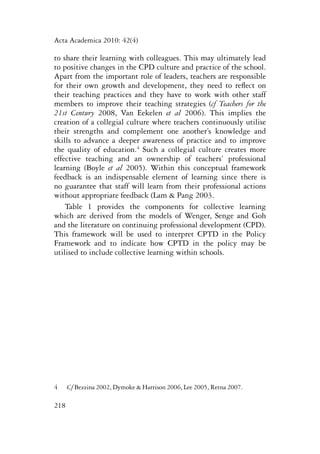
Table 1 provides the components for collective learning 
which are derived from the models of Wenger, Senge and Goh 
and the literature on continuing professional development (CPD). 
This framework will be used to interpret CPTD in the Policy 
Framework and to indicate how CPTD in the policy may be 
utilised to include collective learning within schools. 
4 Cf Bezzina 2002, Dymoke & Harrison 2006, Lee 2005, Retna 2007. 
218
Steyn/Implementing continuing professional teacher development: 
Table 1: Expanding individual learning to include collective learning 
219 
Collective learning 
Context (Workplace) 
• Quality leadership and empowerment 
• Conditions conducive to collaboration 
• Teachers’ commitment 
• Shared vision 
Activities 
• Active participation 
• Problem solving 
• Experimentation 
• Reflective dialogue 
• Teamwork 
In the light of the theoretical framework and the literature on 
CPD, it is important to provide a brief overview of continuing 
professional teacher development (CPTD) in the National policy 
framework for teacher education and development in South Africa 
in order to address the research question. 
3. The national policy framework for teacher edu-cation 
and development in South Africa with 
special reference to CPTD 
CPTD endeavours to suitably equip teachers to meet the 
demands and challenges of a democratic South Africa (RSA 
2007: 1). It ultimately aims to allow learners to “learn well and 
equip themselves for further learning and for satisfying lives 
as productive citizens, for the benefit of their families, their 
communities and our nation” (RSA 2007: 25). The CPTD system 
inter alia strives to contribute to the improvement of teachers’ 
teaching skills by equipping teachers to effectively execute their 
demanding and challenging tasks; continually improve teachers’ 
performance, thus providing quality education, and adequately 
equip teachers by improving their professional confidence, subject 
knowledge and pedagogical skills (RSA 2007: 1, 21).
Acta Academica 2010: 42(4) 
The policy acknowledges the importance of content and 
pedagogical knowledge and teachers’ willingness to reflect 
upon their practice (RSA 2007: 16). As a result, CPTD must 
predominantly focus on content knowledge, but not to the 
exclusion of pedagogical knowledge and skills (RSA 2007). All 
South African teachers must be registered with the South African 
Council for Educators (SACE), the statutory body for professional 
teachers, as a condition for practising as a teacher (RSA 2007: 
18). It is also the overall responsibility of the SACE to ensure 
quality and to implement and manage CPTD (RSA 2007: 19). As 
such, the SACE will accredit professional development activities, 
programmes and courses if these meet specified criteria (RSA 
2007: 19). All registered teachers have to earn PD points by 
choosing approved professional development programmes to meet 
their development needs (RSA 2007: 18). The implementation 
of the point system is planned for January 2011 (SATU 2009). 
Teachers can accumulate PD points by means of school-led, 
employer-led, qualification and/or self-chosen programmes offered 
by approved providers (RSA 2007: 17). 
The CPTD policy predominantly focuses on individual 
learning due to the fact that individual teachers receive PD points 
when participating in activities, programmes and courses offered 
by approved providers. Awarding PD points for attendance may 
reward passivity among staff members. Crediting staff should 
rather be made once a technique has been implemented and 
assessed. In addition, Vemić’s study (2007) shows that requiring 
PD points may also have a negative impact. Staff members in 
Vemić’s study viewed CPD as an imposed requirement rather than 
an approach to improving their potential. They “do not realize 
that by improving their performance they may contribute to the 
results of the organisation in which they work” (Vemić 2007: 13). 
220
Steyn/Implementing continuing professional teacher development: 
221 
4. Developing a collective learning culture in 
schools 
The long-established culture of teacher isolation and the limited 
time available for interaction among staff members have not 
promoted interaction and cooperation between teachers (Robinson 
& Carrington 2002). The model for collaboration among teachers 
expects isolation among teachers to end so that they can work 
together as professionals (Bezzina 2002). This model attempts to 
develop a more collegial culture in schools, thus nurturing CPD 
opportunities through numerous activities where teachers reflect as 
individuals and in teams on matters that influence their everyday 
worklife (Bezzina 2002). The following conditions need to be met 
in order to create a collective learning culture in schools: 
4.1 Establish shared norms and values 
Staff members collectively identify and determine the values that 
are key to the existence of the school, helping them to attain 
the goals of the school (Bezzina 2002). A strong school culture 
consists of a shared purpose for learners’ learning; collaboration 
between staff to achieve the purpose; reflective dialogue to address 
challenges in the school, and opportunities for staff to influence 
the school’s activities and policies (King & Newman 2001). This 
condition is also supported by Senge (1990) and Goh (2003). 
CPTD does not explicitly indicate the establishment of shared 
norms and values for collective learning in schools. However, it 
attempts to provide teachers with clear guidelines about CPD 
activities for their personal growth and an expansion of a wide 
range of such activities to assist them in their professional growth 
(RSA 2007: 17). 
4.2 Institute a school policy relating to CPD 
A report from the Office of Her Majesty’s Chief Inspector of 
Schools in Britain indicates that the lack of a school policy 
relating to CPD was a significant obstacle to school improvement 
(CPDT 2001). This implies the need for teachers to participate
Acta Academica 2010: 42(4) 
in formulating the policy and instituting corresponding action 
plans. The active involvement of teachers in this process must be 
acknowledged and counted towards CPD (CPDT 2006: 7). As 
national policy, CPDT lacks clear emphasis on the institution of 
school policies to enhance CPD in schools. The poor performance 
of learners, according to the 2003 TIMMS report (RSA 2007: 17), 
may serve as driving force behind the focus on individuals and 
their professional development, but negates the importance of 
other factors in the professional development of teachers. 
4.3 Introduce reflective dialogue 
Reflection develops a deeper awareness of the teaching practice 
(Bezzina 2002). Collective commitment to reflection implies 
that staff members should have regular meetings to discuss their 
practices. Kirkwood & Price (2006) are of the opinion that it 
may be difficult for staff members to engage in reflecting upon 
their classroom practices. It therefore requires time and effort 
on the part of the school to support reflective dialogue and to 
accommodate “possible hostility from staff members who may 
find reflection very uncomfortable” (Kirkwood & Price 2006: 9). 
Wenger (2007), Senge (1990) and Goh (2003) support dialogue 
between staff members. CPTD does not explicitly recognise 
the value of collaborative learning in sustaining CPD, since its 
main focus is to develop individual teachers and reward them 
accordingly. Although it acknowledges school-driven CPD 
programmes as relevant activities (RSA 2007: 18), schools may 
experience difficulties in endorsing such programmes to earn 
points for individual teachers. This policy therefore neglects to 
explicitly acknowledge the necessity of a collaborative learning 
culture in schools for the sake of improved teacher learning. 
4.4 Initiate collaboration among staff members 
Collaboration between teachers is crucial to the learning of 
professionals.5 It will therefore contribute towards developing a 
5 Cf Dymoke & Harrison 2006, Boyle et al 2005, Lee 2005, Ingvarson 2005, 
222
Steyn/Implementing continuing professional teacher development: 
positive school culture that is committed to the creation of better 
learning opportunities for all (Robinson & Carrington 2002: 
240). As mentioned earlier, CPTD focuses on the growth of 
individual teachers. As such the initiating collaboration among 
staff members in schools does not receive the attention it requires 
for effective CPD. 
In schools where there is collaboration among staff, teachers re-gard 
one another as resources with the shared value of providing 
high-quality education for all learners (Robinson & Carrington 
2002). They utilise one another’s strengths and complement one 
another’s skills and knowledge, which establishes ownership of their 
own professional learning and leads to more effective teaching and 
learning (cf Robinson & Carrington 2002, King & Newman 2001). 
Collective learning serves to bridge the gap between the individual 
and the organisation because by “developing individual and team 
learning, the organisation will begin to become a learning one”. 
What is a learning organisation? This implies that colleagues have 
to engage in regular informal and formal collaborative interactions 
relating to topics identified by the group or team, with opportu-nities 
to examine new information, reflect on classroom practices 
and analyse outcomes (Meiers & Ingvarson 2005). Wenger’s (2007) 
“communities of practice”, Senge’s (1990) “team learning” compo-nent, 
Goh’s (2003) “teamwork and group problem solving” charac-teristic 
and Hodkinson & Hodkinson’s (2003) “social structures in 
the workplace” support the need for collaboration and teamwork. 
A school culture may hinder opportunities for professional 
discourse about teaching and collaboration among colleagues 
(Doring 2002: 6). Although teachers may be willing to reflect 
on their practice and work with others and focus on teaching and 
learning and learner performance, there may not be sufficient 
support in the form of allocating time, resources and supportive 
leadership for them to do it. It is therefore a challenge for schools 
to deliberately create an effective learning culture among their 
staff. A collaborative learning culture aims to develop a shared 
223 
Meiers & Ingvarson 2005.
Acta Academica 2010: 42(4) 
understanding among staff members by means of ongoing and 
regular discussions concerning teaching practice (Campbell & 
Uys 2005). The ideal in a school is therefore to develop among 
staff members’ knowledge and skills that are beyond what can be 
achieved by a single individual (Campbell & Uys 2005). 
Although the CPTD does not explicitly mention collaborative 
learning, certain methods can be considered to enhance a culture 
of learning among teachers in schools. First, different types 
of meetings can be conducted (Smith & Gillespie 2007) and 
various school-arranged PD activities can be instituted. These 
include professional sharing meetings (by grade level), subject/ 
content development meetings, and monthly whole staff training/ 
sharing sessions to provide teachers with regular opportunities for 
professional learning that is closely tied with the school’s goals 
of quality teaching and learning (CPDT 2006: 24). Secondly, 
teachers can arrange to participate in co-teaching (CPDT 2006). 
Jointly they need to prepare thoroughly, conduct evaluation 
sessions after lessons together and record their learning reflections 
in diaries on collaborative teaching. When PD is built into these 
routine practices, it may address teachers’ professional needs 
more effectively (Meiers & Ingvarson 2005). Lastly, inexperienced 
teachers may be paired with experienced teachers to observe their 
lessons (CPDT 2006). Peer observation may lead to improved 
collaboration among colleagues (CPDT 2006). Gray’s study 
(2005) indicates that teachers were very enthusiastic about 
observing peers teaching the same or similar subjects. 
4.5 Establish conditions conducive to collaboration in 
224 
CPD 
Meiers & Ingvarson (2005: 16) are of the opinion that to 
improve “teacher capabilities without changing the conditions 
that influence the opportunities to use these capabilities is often 
counter-productive”. Certain conditions for collaboration in CPD 
can be considered. 
First, a special CPD committee can be established within the 
school. This committee can serve a dual purpose: planning and
Steyn/Implementing continuing professional teacher development: 
organising school-based PD activities for teachers and “acting as 
a bridge” between school management and staff members (CPDT 
2006: 32). It can disseminate information, collect views in the proc-ess 
of formulating a school-based CPD policy and plan how to deal 
225 
with CPD issues. 
Allowing time for collaboration in CPD can be considered a 
second condition conducive to collaboration in CPD. Although 
cooperative learning for learners is encouraged, teachers very 
often are not provided with the time and the necessary support to 
promote collaborative learning (Silins et al 2002). Blocks of time 
need to be scheduled to allow time for teachers’ participation in 
CPD (CPDT 2006). Smith & Gillespie (2007) believe that, if no 
time or little time for synthesis, integration and planning beyond 
PD programmes is provided, this may result in inadequate 
preparation for application. In addition, when CPD has a longer 
duration it helps teachers to learn more about their practice, 
especially if it includes follow-up and feedback (Smith & Gillespie 
2007). 
Thirdly, feedback on CPD is crucial for creating collaboration 
in schools. Feedback to teachers on their professional development 
is widely supported.6 As mentioned earlier, CPD is most effective 
when it is a continuous process that involves individual follow-up 
through supportive observation and feedback, staff dialogues, 
mentoring and peer coaching (Robinson & Carrington 2002). 
Mentoring is considered a fourth condition to enhance 
collaboration in CPD. According to Meiers & Ingvarson (2005: 
16), CPD “should incorporate evaluation of multiple sources of 
information on learning outcomes for students and the instruction 
and other processes that are involved in implementing the lessons 
learned through professional development”. As a result of their 
CPD and subsequent teaching teachers are able to show that, 
compared to previous performances, their learners improved their 
results, made progress which is “as good as or better than other 
6 Cf Lam & Pang 2003, Birman et al 2000, Ingvarson 2005, Meiers & Ingvarson 
2005.
Acta Academica 2010: 42(4) 
learners nationally”, are “motivated, enthusiastic and respond 
positively to challenge and high expectations” and “as a result, 
have high standards of behaviour” (CPDTS 2001: 26). 
Fifthly, teacher commitment to CPD is important for collabo-ration 
226 
to CPD. Teachers are responsible for planning their profes-sional 
learning (Negrioni 2005). They need to draw up their in-dividual 
professional development needs based on self-evaluation, 
and integrate their needs with school development needs (CPDT 
2006). 
Lastly, effective leadership plays a vital role in enhancing 
collaboration to CPT. CPT requires a rethinking of school leaders’ 
role. School leaders should view themselves as “learning leaders” 
responsible for helping schools develop the capacity to attain 
their shared vision and mission (Lashway 1998). They should 
be committed to the goal of learning which implies that leaders 
should empower staff to attain this goal (Karsten et al 2000). 
Effective leadership entails the involvement of school leaders in 
the learning process, which requires a reflection of teaching and 
learning practices in the school and a collection of evidence that 
CPD has taken place (Dymoke & Harrison 2006). It also involves 
the commitment of leaders to identifying the development needs 
of staff and appropriate training to meet these needs (Lee 2005). 
The Policy Framework refers to “sustained leadership and support” 
for quality education (RSA 2007: 3) and CPTD acknowledges 
“school-led programmes” for teachers’ professional development 
(RSA 2007: 18), but the role and active involvement of school 
leaders in CPTD are not explicitly explained or encouraged. 
5. Conclusion 
Although there is a difference between individual learning and 
collective learning, individuals are important in collective learning 
since individuals who learn create collective learning cultures that 
learn (Lam & Pang 2003). In addition, schools can benefit from 
the active involvement of individual teachers in personal learning. 
According to Lee (2005: 47), effective CPD should create “an
Steyn/Implementing continuing professional teacher development: 
appropriate level of challenge and support, provide activities 
demonstrating new ways to teach and learn, build internal 
capacity, use a team approach, provide time for reflection and 
evaluate the effectiveness and impact of its activities”. 
When instituting PD points for individual staff members, 
school management should ensure that it is contextualised, work-embedded 
and content-specific. This implies that school managers 
must play a major role in moving individual-focused PD into a 
learning community-based effort. 
Schools need to adapt to a constantly changing environment 
and effectively develop learning opportunities that go beyond 
CPTD, as proposed by the National Policy on Teacher 
Development. As articulated in this article, many critical factors 
need to be considered to expand individual learning to include 
collective learning among teachers in schools. To develop a 
collective learning culture in schools the following conditions 
apply: establish shared norms and values; institute a school 
policy relating to CPD; introduce reflective dialogue; initiate 
collaboration among staff members, and establish conditions 
conducive to CPT. Exploring learning to include a collaborative 
learning culture in school for the sake of successful CPTD makes 
it obvious that developing opportunities for effective learning in 
the school can be very complex. For CDP to be effective it should 
therefore address several challenges. 
More research is required in order to understand the 
relationship between learner achievement and CPD, teachers’ 
backgrounds and working conditions (Boyle et al 2005, Smith 
& Gillespie 2007). Such findings can guide decisions about the 
design of appropriate CPD programmes to improve the quality of 
learning. With the knowledge already gained much can be done 
“to promote more effective research-based approaches to teacher 
professional development” (Smith & Gillespie 2007: 239). 
227
Acta Academica 2010: 42(4) 
Bibliography 
Anonymous 
2001/2002. New staff develop-ment 
228 
standards issued. Reading 
Today 19(3): 17-8. 
Beeld 
2008. Onderwys. Beeld 19 
September:16. 
Bezzina C 
2002. Preparing a model of 
professional development schools 
in Malta. Curriculum and Teaching 
17(2): 73-84. 
Birman B F, L Desimone, A C Por-ter 
& M S Garet 
2000. Designing professional de-velopment 
that works. Educational 
Leadership 57(8): 28-33. 
Bloch G 
2008. SA in the midst of an educa-tion 
crisis. The Star, 31 July: 19. 
Boyle B, I Lamprianou & T Boyle 
2005. A longitudinal study of 
teacher change: what makes pro-fessional 
development effective? 
Report of the second year of the 
study. School Effectiveness and School 
Improvement 16(1): 1-27. 
Campbell M & P Uys 
2005. Building learning com-munities 
of practice for profes-sional 
development in open and 
distance learning: the CELT 
experience. <http://www.odlaa. 
org/events/2005conf/nonref/od-laaa2005CampbellUys. 
pdf. > 
Continuing Professional Devel-opment 
for Teachers in Schools 
(CPDTS) 
2001. A report from the office of 
Her Majesty’s chief inspector of 
schools. <http://www.ofsted.gov. 
uk/assets/29.pdf.> 
Continuing Professional Devel-opment 
of Teachers (CPDT) 
2006. The Education Bureau, 
Government of Hong Kong. 
<http://www.edb.gov.hk/index. 
aspx?langno=1&nodeid=1309> 
Curado C 
2006. Organisational learning and 
organizational design. The Learn-ing 
Organization 13(1): 25-48. 
Desimone L M, T M Smith & K 
Ueno 
2006. Are teachers who sustained, 
content-focused professional 
development getting it? An ad-ministrator’s 
dilemma. Educational 
Administration Quarterly 42(2): 
179-215. 
De Vos A S, H Strydom, C B 
FouchÉ & C S L Delport 
2005. Research at grassroots for 
the social sciences and human service 
professions. 3rd ed. Pretoria: Van 
Schaik. 
Doring A 
2002. Lifelong learning for teach-ers: 
rhetoric or reality? Challenging 
futures? Changing agendas in teacher 
education. February 3-7, Armidale, 
New South Wales. <http://scs.une.
Steyn/Implementing continuing professional teacher development: 
229 
edu.au/CF/Papers/pdf/ADoring. 
pdf> 
Dymoke S & J K Harrison 
2006. Professional development 
and the beginning teacher: issues 
of teacher autonomy and institu-tional 
conformity in the perform-ance 
review process. Journal of 
Education for Teaching 32(1): 71-92. 
Goh S C 
2003. Improving organizational 
learning capability: lessons from 
two case studies. The Learning 
Organization 10(4): 216-27. 
Gray S L 
2005. An enquiry into continu-ing 
professional development for 
teachers. <http://www.esmeefair-bairn. 
org.uk/docs/Education-Rep. 
pdf> 
Hodkinson H & P Hodkinson 
2003. Individual community of 
practice: school teachers learning 
in the workplace. Studies in Con-tinuing 
Education 25(1): 3-21. 
2005. Improving schoolteachers’ 
workplace learning. Research Papers 
in Education 20(2): 109-31. 
Ingvarson L 
2005. Getting professional devel-opment 
right. ACER Annual Con-ference 
Proceedings 2005. Using 
data to support student learning. 
Melbourne: ACER Press. <http:// 
www.acer.edu.au/documents/ 
RC2005_Ingvarson.pdf> 
Karsten S, E Voncken & M 
Voorthuis 
2000. Dutch primary schools and 
the concept of the learning organi-zation. 
The Learning Organization 
7(2): 145-55. 
King M B & F M Newman 
2001. Building school capacity 
through professional develop-ment: 
conceptual and empirical 
considerations. The International 
Journal of Educational Management 
15(2): 86-94. 
Kirkwood A & L Price 
2006. Adaptation for a changing 
environment: developing learning 
and teaching with information and 
communication technology. Inter-national 
Review of Research in Open 
and Distance Learning 7(2): 1-14. 
Lam Y L J & S K N Pang 
2003. The relative effects of envi-ronmental, 
internal and contextual 
factors on organisational learning: 
the case of Hong Kong schools 
under reforms. The Learning Or-ganisation 
10(2): 83-97. 
Langer J A 
2000. Excellence in English in 
middle and high school: how 
teachers’ professional lives support 
student achievement. American 
Educational Research Journal 37(2): 
397-439.
Acta Academica 2010: 42(4) 
Lashway L 
1998. Creating a learning organi-zation. 
230 
<http://cepm.uoregon.edu/ 
pdf/digests/digest121.pdf> 
Lee H L 
2005. Developing a professional 
development programme model 
based on teachers’ needs. The Pro-fessional 
Educator 27(1 & 2): 39-49. 
Lee Y-J & W-M Roth 
2007. The individual/collective 
dialectic in the learning organiza-tion. 
The Learning Organization 
14(2): 92-107. 
Maree K (ed) 
2010. Steps in research. Pretoria: 
Van Schaik. 
McMillan J H & S Schumacher 
2006. Research in education: evidence-based 
inquiry. 6th ed. Boston: 
Pearson Education. 
Meiers M & L Ingvarsin 
2005. Investigating the 
links between teacher pro-fessional 
development and 
student learning outcomes. 
<http://www.dest.gov.au/NR/ 
rdonlyres/993A693A-3604-400F-AB81- 
57F70A8A83A6/8039/ 
Vol1Rev_Final_26Sept05.pdf> 
Mundry S 
2005. Changing perspectives in 
professional development. Science 
Educator 14(1): 9-15. 
Negroni P J 
2005. Another teacher professional 
development day? Lose another 
day of class time? Can we afford 
this? Journal of Staff Development 
26(1): 58, 72. 
Nieuwenhuis J 
2010. Qualitative research designs 
and data gathering techniques. 
Maree (ed) 2010: 69-97. 
Paton C 
2006. Education in crisis: a lot to 
learn. Financial Mail 
8 September: 1. 
Republic of South Africa (RSA) 
2007. National policy framework for 
teacher education and development in 
South Africa. Government Gazette 
503(29868), 4 May 2007. Preto-ria: 
Government Printer. 
Retna K S 
2007. The learning organization: 
a school’s journey towards critical 
and creative thinking. <http:// 
www.d/su.ed.ph/research/journals/ 
taper/pdf/200706/retna.pdf.> 
Robinson R & S Carrington 
2002. Professional development 
for inclusive schooling. Internation-al 
Journal of Educational Manage-ment 
16(5): 239-47. 
Senge P 
1990. The fifth discipline. New 
York: Doubleday.
Steyn/Implementing continuing professional teacher development: 
231 
Silins H, S Zarins & B Mulford 
2002. What characteristics and 
processes define a school as a 
learning organisation? Is this a 
useful concept to apply to schools? 
International Education Journal 
3(1):24-32. 
Smith C & M Gillespie 
2007. Research on professional 
development and teacher change: 
implications for adult basic 
education. <http://www.ncsall. 
net/fileadmin/resources/ann_rev/ 
smith-gillespie-07.pdf> 
South African Teachers’ Union 
2009. Continuous professional de-velopment 
(CPTD). 27/02/2009. 
Sparks D 
2003. Change agent. Journal of 
Staff Development 24(1): 55-9. 
Stacey R 
2003. Learning as an activity of in-terdependent 
people. The Learning 
Organization 10(6): 325-31. 
Steyn G M 
2010. Educators’ perceptions of 
continuing professional develop-ment 
for teachers in South Africa: a 
qualitative study. African Education 
Review 7(1): 343-65. 
Strydom H & C S L Delport 
2005. Information collection: 
document study and second-ary 
analysis. De Vos et al 2005: 
314-25. 
Teachers for the 21st century – 
making the difference 
2008. Australian Government; 
Department of Education, 
Employment and Workplace 
Relations. <http://www.dest.gov. 
au/sectors/school_education/pol-icy_ 
initiatives_reviews/reviews/ 
previous_reviews/teachers_for_ 
the_21st_century.htm> 
Van Eekelen I M, J D Vermunt & 
H P A Boshuizen 
2006. Exploring teachers’ will to 
learn. Teaching and Teacher Educa-tion 
22: 408-23. 
Vemić J 
2007. Employee training and 
development and the learning 
organization UDC331.363. 
iFacta Universitatis. Economics and 
Organization 4(2): 209-16. 
Wenger E 
1999. Learning as social participa-tion. 
Knowledge Management Review 
6: 30-3. 
2000. Communities of practice 
and social learning systems. 
Organization, SAGE Social Science 
Collection 7(2): 225-46. 
2007. Communities of practice. 
Third annual National Qualifica-tions 
Framework colloquium, 5 
June 2007. Velmore Conference 
Estate.
Acta Academica 2010: 42(4) 
What is a learning organisation? 
[s a] <Ftp://Ntftp2.Pearsoned- 
Ema.Com/Samplechaps/ 
Ftph/027363254X.Pdf > 
232 
What is professional learning? 
2007. <http://www.deet.nt.gov. 
au/education/professional_learn-ing/ 
docs/what_is_prof_learning. 
pdf>

Cpdt policy acta acad 2011

  • 1.
    Trudie Steyn Implementingcontinuing professional teacher development: policy and practice First submission: 28 August 2009 Acceptance: 16 September 2010 It is important for South African teachers to be appropriately equipped to meet the growing needs and challenges of the country. The dire need for suitably qualified teachers is addressed in South Africa’s National Policy Framework for Teacher Education and Development. This article attempts to address the problem of how Continuing Professional Teacher Development (CPTD), as stipulated by the National Policy Framework, can be implemented to create a collaborative learning culture in schools. The article uses the conceptual frameworks for collective learning to interpret the literature and the findings. Die implementering van professionele onderwysersontwikkeling: beleid en praktyk Dit is belangrik vir Suid-Afrikaanse onderwysers om goed opgelei te word om in die groeiende behoeftes en uitdagings van die land te voorsien. Die ernstige behoefte om in die nood van toepaslik gekwalifiseerde onderwysers te voorsien, word aangespreek deur die Suid-Afrikaanse Nasionale Beleidsraamwerk vir Onderwysdersopleiding en Ontwikkeling. Hierdie artikel poog om die probleem van hoe Voortgesette Professionele Onderwysersopleiding, soos gestipuleer deur die Beleidsraamwerk, geïmplementeer kan word om ’n kollaboratiewe leerkultuur in skole te skep, aan te spreek. Die artikel gebruik die konsepsuele raamwerke vir kollektiewe leer om die literatuur en bevindinge te interpreteer. Prof GM Steyn, Dept of Further Teacher Education, University of South Africa, P O Box 392, Unisa 0003; E-mail: steyngm1@unisa.ac.za Acta Academica 2011 43(1): 210-232 ISSN 0587-2405 © UV/UFS <http://www.ufs.ac.za/ActaAcademica>
  • 2.
    Steyn/Implementing continuing professionalteacher development: The twenty-first century demands that all professionals in or-ganisations learn to meet the challenges and cope with the changes that are rapidly taking place in their environments (cf Retna 2007, Vemić 2007). The quality of teaching and learning in such environments is also being severely challenged (cf Doring 2002, Smith & Gillespie 2007). Research corroborates the conten-tion that highly skilled teachers do make a difference to the qual-ity of teaching (cf King & Newman 2001, Van Eekelen et al 2006, Teachers for the 21st century – making the difference 2008). There is also widespread agreement that developing teachers professionally is the optimal answer and is indispensable to bringing about sustain-able school improvement, for the ultimate improvement of student 211 learning.1 Recent studies clearly point to professional development (PD) that is linked to subject content and pedagogy as the key to improved learner performance (cf Smith & Gillespie 2007, Vemić 2007). In addition, teachers “who engaged in sustained, collaborative professional development around specific concepts in their curriculum were more likely to change their teaching practice in ways associated with greater student achievement” (Negroni 2005: 72). The school context itself is an important element influencing the extent of the impact of professional development (Meiers & Ingvarsin 2005). This implies the need for professional learning communities in which teachers learn and work together and focus on student learning (Sparks 2003). When learning is viewed as a social activity, individuals will experience improved learning as members of a team or group. Rose (Doring 2002: 7) mentions that focusing on individuals is incorrect. The approach should rather be on the school as a whole where the “associated emergence of a ‘team culture’ with an instrumental function of improving teaching and learning becomes a key component of professional growth” (Doring 2002: 7). The movement for teacher professional communities within schools grew from the belief that one cannot take individual 1 Cf Boyle et al 2005, CPDT 2006, Desimone et al 2006, Meiers & Ingvarsin 2005, Vemić 2007.
  • 3.
    Acta Academica 2010:42(4) teachers out of their environment, train and change them, then put them back into the same environment and expect them to change that environment (Smith & Gillespie 2007). Rather, teachers need a community of like-minded teachers within the school, so that they can learn together about their work as they apply that learning. South African schools are viewed as being in “in crisis” (Paton 2006: 1) and in “a state of disaster” (Bloch 2008: 19) with more than enough reason to be discouraged (Beeld 2008: 16). In this regard Paton (2006: 1) declares: “Poor quality teaching is the key reason why the education system is failing so many schools”. The Report of the Ministerial Committee on Rural Education (2005) regarded the limited access of teachers to PD as a critical area for change (RSA 2007: 5). The National policy framework for teacher education and development is an attempt to address the need for suitably qualified teachers in South Africa (RSA 2007: 5). This policy focuses on two complementary subsystems, namely initial professional education of teachers, and Continuing Professional Teacher Development (CPTD) (RSA 2007: 2). For the purpose of this article the focus will be on CPTD since teachers in the current system are not equipped with the necessary knowledge and skills. In Steyn’s study participants were of the opinion that official PD programmes presented by the Department of Education “had little or no impact on their schools” since they were too theoretical in nature with little practical value for teachers (Steyn 2010: 356). Although constructive contributions have been made to under-standing the professional development of teachers in general, limited research has been done to indicate how CPTD, as stipulated by the National Policy Framework, can expand individual teacher development to include a contribution to the creation of a collaborative learning culture in schools for the sake of quality education. How can CPTD, as stipulated by the National Policy Framework, be implemented to create a collaborative learning culture in schools? Addressing this issue may influence the implementation of the policy. 212
  • 4.
    Steyn/Implementing continuing professionalteacher development: A policy analysis (McMillan & Schumacher 2006: 448) of CPTD in the National Policy Framework was done to determine its contribution to improving teacher learning by including a collective learning culture in schools apart from focusing on the development of individual teachers. As such, a qualitative research design was employed to address the research question. The approach involved a case study since it examined a bounded system, namely the CPTD in the National Policy Framework (McMillan & Schumacher 2006: 26): “A case study promotes better understanding of a practice or issue and facilitates informed decision-making” (McMillan & Schumacher 2006: 333). The research problem was approached from a pragmatic perspective since the effectiveness of the CPTD’s implementation in practice is considered crucial. This is also supported by Mundry (2005: 14) who states that policymakers and education managers should invest in these more “practice-based” approaches to professional learning for teachers (Mundry 2005: 14). For this study the data collection method included a policy analysis (McMillan & Schumacher 2006: 448) of CPTD, in particular, and other relevant documents and studies. Using documents as a data collection technique may shed light on the phenomenon being investigated (Nieuwenhuis 2010: 82), in this instance the means in which CPDT can be effectively implemented to create a learning culture in schools. The National Policy Framework states that the new CPTD system attempts to ensure that current initiatives devoted to the PD of teachers contribute more effectively and directly to the quality of teaching (RSA 2007: 25). In addition, the underlying principle for continuing professional development is that “teachers, individually and collectively, will have a high degree of responsibility for their own development” (RSA 2007: 26). Meiers & Ingvarson (2005: 16) support this view, stating that collective learning is important for positive changes to occur in schools. The present article therefore aims to indicate how CPTD, as described in the National Policy Framework, can be utilised to create a collective learning culture in schools. The success of the 213
  • 5.
    Acta Academica 2010:42(4) Policy Framework cannot be guaranteed unless collective learning within schools has been considered. 1. Theoretical framework In current literature, learning in organisations is repeatedly presented on two levels, the individual and the collective, This implies that individual learning is an essential but inadequate prerequisite for collaborative learning in and development of organisations.2 Lee & Roth (2007) argue that previous theories on learning in organisations ignore the fact that individual learning and learning in organisations mutually support each other. They succinctly add that “dynamic and expansively learning organizations presuppose dynamic and expansive individuals; dynamic and expansive individuals presuppose dynamic and expansively learning organizations” (Lee & Roth 2007: 104-5). Stacey (2003) argues that individuals cannot learn in isolation since learning is in essence an activity of interdependent people. Moreover, when staff members learn collectively, they are in a better position to react to external challenges. Doring (2002: 7) believes that the “associated emergence of a ‘team culture’ with an instrumental function of improving teaching and learning becomes a key component of professional growth”, which may assist staff in addressing the challenges they are facing. According to the situated learning theory, there are two basic principles: active learning takes place as a function of the context, culture and activity in which it occurs, and social participation is a critical element of situated learning (cf Wenger 1999, 2000 & 2007). Wenger (2000: 227) defines learning as an interaction between personal experience and social competence. He identifies various ways “to take charge of learning, to direct it, to demand it or to accelerate it” which inter alia include CPTD programmes (Wenger 1999: 33). Communities of practice form when people “engage in a process of collective learning in a shared domain of 2 Cf Curado 2006, Hodkinson & Hodkinson 2005, Lee & Roth 2007, Senge 214 1990.
  • 6.
    Steyn/Implementing continuing professionalteacher development: human endeavour” (Wenger 2007: 1). He believes that “commu-nities of practice” represent a prerequisite for learning and are also at the centre of individuals’ meaningful learning (Wenger 2000: 229). Wenger’s viewpoint is in line with that of Senge (1990) who suggests that learning should be placed in the context of the lived experience of people’s participation in the world. Senge (1990) identifies five “components”, each of which develops separately and provides a critical dimension in organisations that can positively influence learning: 215 • Systems thinking The underlying notion is that when the members of an organisa-tion are “thinking” systematically, underlying patterns of events, trends and responses can be identified and changed. In this ap-proach the organisation is the basic unit of analysis. • Personal mastery Personal mastery requires people to begin building an organisa-tion by viewing themselves as individuals first. It is the discipline of “continually clarifying and deepening our personal vision, of focussing our energies, of developing patience, and of seeing real-ity objectively” (Senge 1990: 7). • Mental models Mental models are deeply ingrained assumptions, and generali-sations that influence people’s understanding of the world. They affect the way in which people act. To take advantage of accelerated learning within organisations, people need to expose their own mental models to the thinking influence of others. • Building a shared vision This involves the skills of finding shared “pictures of the future” that foster genuine commitment rather than compliance (Senge 1990: 9). Such a vision has the ability to uplift staff and to encour-age innovation and experimentation.
  • 7.
    Acta Academica 2010:42(4) 216 • Team learning The “team learning” dimension of the Senge model is in accord-ance with Wenger’s communities of practice and draws on the view that teams constitute an effective means whereby organisations learn and people are able to enhance their personal mastery skills. In line with Senge’s model, Goh (2003) identifies five key charac-teristics as conditions for effective learning to occur in organisations: a clear vision and mission of the organisation should be articulated to members in the organisation/school because all individuals should understand their contribution towards realising the vision and mis-sion; school leaders should be committed to the learning process, they need to empower teachers to become involved in their own learning and to develop a collective learning culture in the school; it is necessary to continuously experiment with new methods to improve practice, but such experimentation should also be encour-aged and acknowledged; effective communication plays a key role in transferring knowledge; teamwork and group problem-solving is important for individuals so that they can assist one another in de-veloping the necessary knowledge and skills and accomplishing the organisation’s goals. In summary the different models support the necessity for teamwork and collective learning for the sake of quality teaching and learning. 2. Continuing professional development (CPD) The traditional professional development model that has dominated PD for decades is characterised by one-session workshops, seminars, lectures and courses3. This model is based on the assumption that learners will benefit when teachers acquire knowledge and skills by attending these one-session workshops, seminars, lectures and courses. Although this model has some advantages, studies show that short-term workshops and training sessions have not been effective (Robinson & Carrington 2002, Smith & Gillespie 2007). In addition, CPD should not only be 3 Cf Boyle et al 2005, CPDTS 2001, Lee 2005, Smith & Gillespie 2007.
  • 8.
    Steyn/Implementing continuing professionalteacher development: associated with attending training courses/formal programmes after or outside school (CPDT 2006). Effective CPD of teachers can be described as learning that occurs in everyday practice within schools, is linked to the learners’ and teachers’ learning needs, is adapted to meet the specific conditions or contexts of participants, and continues over a period of time (Silins et al 2002). “Building bridges” in What is Professional Learning? (2007) succinctly describes CPD as follows: It is “the bridge between where (we) are now and where (we) need to be to meet the new challenges of guiding all students in achieving higher standards of learning and development’”. This view is also supported by Gray (2005), Vemić (2007) and the anonymous author of Teachers for the 21st century (2008) who emphasise CPD as continuous and lifelong learning so that learning may contribute to improve quality and performance in schools. In this process teachers accept greater responsibility for their own learning and development and develop a greater sense of collaboration to improve teaching and learning in schools and ultimately improve learners’ performance (Ingvarson 2005). In line with the conceptual framework based on Wenger, Senge and Goh, there are essential elements for CPD. It is necessary that the education system supports schools to embed CPD effectively in their school practices. This support includes contextual factors such as education system policies, school-wide factors and the supportiveness of the school community which may influence the development of teachers’ professional knowledge and skills (Meiers & Ingvarson 2005: 42). In addition, linking CPD with school development is crucial for the effectiveness of learning in schools. This implies that effective CPD programmes need to focus on the subject content and pedagogical skills as well as agreed student learning outcomes in CPD programmes (cf Desimone et al 2006, Mundry 2005, RSA 2007). Within such programmes school leaders play a key role in the learning process, and they need to collect evidence that the CPD of teachers has taken place (Dymoke & Harrison 2006). Their role is to promote a culture that honours teachers’ learning and to encourage them 217
  • 9.
    Acta Academica 2010:42(4) to share their learning with colleagues. This may ultimately lead to positive changes in the CPD culture and practice of the school. Apart from the important role of leaders, teachers are responsible for their own growth and development, they need to reflect on their teaching practices and they have to work with other staff members to improve their teaching strategies (cf Teachers for the 21st Century 2008, Van Eekelen et al 2006). This implies the creation of a collegial culture where teachers continuously utilise their strengths and complement one another’s knowledge and skills to advance a deeper awareness of practice and to improve the quality of education.4 Such a collegial culture creates more effective teaching and an ownership of teachers’ professional learning (Boyle et al 2005). Within this conceptual framework feedback is an indispensable element of learning since there is no guarantee that staff will learn from their professional actions without appropriate feedback (Lam & Pang 2003. Table 1 provides the components for collective learning which are derived from the models of Wenger, Senge and Goh and the literature on continuing professional development (CPD). This framework will be used to interpret CPTD in the Policy Framework and to indicate how CPTD in the policy may be utilised to include collective learning within schools. 4 Cf Bezzina 2002, Dymoke & Harrison 2006, Lee 2005, Retna 2007. 218
  • 10.
    Steyn/Implementing continuing professionalteacher development: Table 1: Expanding individual learning to include collective learning 219 Collective learning Context (Workplace) • Quality leadership and empowerment • Conditions conducive to collaboration • Teachers’ commitment • Shared vision Activities • Active participation • Problem solving • Experimentation • Reflective dialogue • Teamwork In the light of the theoretical framework and the literature on CPD, it is important to provide a brief overview of continuing professional teacher development (CPTD) in the National policy framework for teacher education and development in South Africa in order to address the research question. 3. The national policy framework for teacher edu-cation and development in South Africa with special reference to CPTD CPTD endeavours to suitably equip teachers to meet the demands and challenges of a democratic South Africa (RSA 2007: 1). It ultimately aims to allow learners to “learn well and equip themselves for further learning and for satisfying lives as productive citizens, for the benefit of their families, their communities and our nation” (RSA 2007: 25). The CPTD system inter alia strives to contribute to the improvement of teachers’ teaching skills by equipping teachers to effectively execute their demanding and challenging tasks; continually improve teachers’ performance, thus providing quality education, and adequately equip teachers by improving their professional confidence, subject knowledge and pedagogical skills (RSA 2007: 1, 21).
  • 11.
    Acta Academica 2010:42(4) The policy acknowledges the importance of content and pedagogical knowledge and teachers’ willingness to reflect upon their practice (RSA 2007: 16). As a result, CPTD must predominantly focus on content knowledge, but not to the exclusion of pedagogical knowledge and skills (RSA 2007). All South African teachers must be registered with the South African Council for Educators (SACE), the statutory body for professional teachers, as a condition for practising as a teacher (RSA 2007: 18). It is also the overall responsibility of the SACE to ensure quality and to implement and manage CPTD (RSA 2007: 19). As such, the SACE will accredit professional development activities, programmes and courses if these meet specified criteria (RSA 2007: 19). All registered teachers have to earn PD points by choosing approved professional development programmes to meet their development needs (RSA 2007: 18). The implementation of the point system is planned for January 2011 (SATU 2009). Teachers can accumulate PD points by means of school-led, employer-led, qualification and/or self-chosen programmes offered by approved providers (RSA 2007: 17). The CPTD policy predominantly focuses on individual learning due to the fact that individual teachers receive PD points when participating in activities, programmes and courses offered by approved providers. Awarding PD points for attendance may reward passivity among staff members. Crediting staff should rather be made once a technique has been implemented and assessed. In addition, Vemić’s study (2007) shows that requiring PD points may also have a negative impact. Staff members in Vemić’s study viewed CPD as an imposed requirement rather than an approach to improving their potential. They “do not realize that by improving their performance they may contribute to the results of the organisation in which they work” (Vemić 2007: 13). 220
  • 12.
    Steyn/Implementing continuing professionalteacher development: 221 4. Developing a collective learning culture in schools The long-established culture of teacher isolation and the limited time available for interaction among staff members have not promoted interaction and cooperation between teachers (Robinson & Carrington 2002). The model for collaboration among teachers expects isolation among teachers to end so that they can work together as professionals (Bezzina 2002). This model attempts to develop a more collegial culture in schools, thus nurturing CPD opportunities through numerous activities where teachers reflect as individuals and in teams on matters that influence their everyday worklife (Bezzina 2002). The following conditions need to be met in order to create a collective learning culture in schools: 4.1 Establish shared norms and values Staff members collectively identify and determine the values that are key to the existence of the school, helping them to attain the goals of the school (Bezzina 2002). A strong school culture consists of a shared purpose for learners’ learning; collaboration between staff to achieve the purpose; reflective dialogue to address challenges in the school, and opportunities for staff to influence the school’s activities and policies (King & Newman 2001). This condition is also supported by Senge (1990) and Goh (2003). CPTD does not explicitly indicate the establishment of shared norms and values for collective learning in schools. However, it attempts to provide teachers with clear guidelines about CPD activities for their personal growth and an expansion of a wide range of such activities to assist them in their professional growth (RSA 2007: 17). 4.2 Institute a school policy relating to CPD A report from the Office of Her Majesty’s Chief Inspector of Schools in Britain indicates that the lack of a school policy relating to CPD was a significant obstacle to school improvement (CPDT 2001). This implies the need for teachers to participate
  • 13.
    Acta Academica 2010:42(4) in formulating the policy and instituting corresponding action plans. The active involvement of teachers in this process must be acknowledged and counted towards CPD (CPDT 2006: 7). As national policy, CPDT lacks clear emphasis on the institution of school policies to enhance CPD in schools. The poor performance of learners, according to the 2003 TIMMS report (RSA 2007: 17), may serve as driving force behind the focus on individuals and their professional development, but negates the importance of other factors in the professional development of teachers. 4.3 Introduce reflective dialogue Reflection develops a deeper awareness of the teaching practice (Bezzina 2002). Collective commitment to reflection implies that staff members should have regular meetings to discuss their practices. Kirkwood & Price (2006) are of the opinion that it may be difficult for staff members to engage in reflecting upon their classroom practices. It therefore requires time and effort on the part of the school to support reflective dialogue and to accommodate “possible hostility from staff members who may find reflection very uncomfortable” (Kirkwood & Price 2006: 9). Wenger (2007), Senge (1990) and Goh (2003) support dialogue between staff members. CPTD does not explicitly recognise the value of collaborative learning in sustaining CPD, since its main focus is to develop individual teachers and reward them accordingly. Although it acknowledges school-driven CPD programmes as relevant activities (RSA 2007: 18), schools may experience difficulties in endorsing such programmes to earn points for individual teachers. This policy therefore neglects to explicitly acknowledge the necessity of a collaborative learning culture in schools for the sake of improved teacher learning. 4.4 Initiate collaboration among staff members Collaboration between teachers is crucial to the learning of professionals.5 It will therefore contribute towards developing a 5 Cf Dymoke & Harrison 2006, Boyle et al 2005, Lee 2005, Ingvarson 2005, 222
  • 14.
    Steyn/Implementing continuing professionalteacher development: positive school culture that is committed to the creation of better learning opportunities for all (Robinson & Carrington 2002: 240). As mentioned earlier, CPTD focuses on the growth of individual teachers. As such the initiating collaboration among staff members in schools does not receive the attention it requires for effective CPD. In schools where there is collaboration among staff, teachers re-gard one another as resources with the shared value of providing high-quality education for all learners (Robinson & Carrington 2002). They utilise one another’s strengths and complement one another’s skills and knowledge, which establishes ownership of their own professional learning and leads to more effective teaching and learning (cf Robinson & Carrington 2002, King & Newman 2001). Collective learning serves to bridge the gap between the individual and the organisation because by “developing individual and team learning, the organisation will begin to become a learning one”. What is a learning organisation? This implies that colleagues have to engage in regular informal and formal collaborative interactions relating to topics identified by the group or team, with opportu-nities to examine new information, reflect on classroom practices and analyse outcomes (Meiers & Ingvarson 2005). Wenger’s (2007) “communities of practice”, Senge’s (1990) “team learning” compo-nent, Goh’s (2003) “teamwork and group problem solving” charac-teristic and Hodkinson & Hodkinson’s (2003) “social structures in the workplace” support the need for collaboration and teamwork. A school culture may hinder opportunities for professional discourse about teaching and collaboration among colleagues (Doring 2002: 6). Although teachers may be willing to reflect on their practice and work with others and focus on teaching and learning and learner performance, there may not be sufficient support in the form of allocating time, resources and supportive leadership for them to do it. It is therefore a challenge for schools to deliberately create an effective learning culture among their staff. A collaborative learning culture aims to develop a shared 223 Meiers & Ingvarson 2005.
  • 15.
    Acta Academica 2010:42(4) understanding among staff members by means of ongoing and regular discussions concerning teaching practice (Campbell & Uys 2005). The ideal in a school is therefore to develop among staff members’ knowledge and skills that are beyond what can be achieved by a single individual (Campbell & Uys 2005). Although the CPTD does not explicitly mention collaborative learning, certain methods can be considered to enhance a culture of learning among teachers in schools. First, different types of meetings can be conducted (Smith & Gillespie 2007) and various school-arranged PD activities can be instituted. These include professional sharing meetings (by grade level), subject/ content development meetings, and monthly whole staff training/ sharing sessions to provide teachers with regular opportunities for professional learning that is closely tied with the school’s goals of quality teaching and learning (CPDT 2006: 24). Secondly, teachers can arrange to participate in co-teaching (CPDT 2006). Jointly they need to prepare thoroughly, conduct evaluation sessions after lessons together and record their learning reflections in diaries on collaborative teaching. When PD is built into these routine practices, it may address teachers’ professional needs more effectively (Meiers & Ingvarson 2005). Lastly, inexperienced teachers may be paired with experienced teachers to observe their lessons (CPDT 2006). Peer observation may lead to improved collaboration among colleagues (CPDT 2006). Gray’s study (2005) indicates that teachers were very enthusiastic about observing peers teaching the same or similar subjects. 4.5 Establish conditions conducive to collaboration in 224 CPD Meiers & Ingvarson (2005: 16) are of the opinion that to improve “teacher capabilities without changing the conditions that influence the opportunities to use these capabilities is often counter-productive”. Certain conditions for collaboration in CPD can be considered. First, a special CPD committee can be established within the school. This committee can serve a dual purpose: planning and
  • 16.
    Steyn/Implementing continuing professionalteacher development: organising school-based PD activities for teachers and “acting as a bridge” between school management and staff members (CPDT 2006: 32). It can disseminate information, collect views in the proc-ess of formulating a school-based CPD policy and plan how to deal 225 with CPD issues. Allowing time for collaboration in CPD can be considered a second condition conducive to collaboration in CPD. Although cooperative learning for learners is encouraged, teachers very often are not provided with the time and the necessary support to promote collaborative learning (Silins et al 2002). Blocks of time need to be scheduled to allow time for teachers’ participation in CPD (CPDT 2006). Smith & Gillespie (2007) believe that, if no time or little time for synthesis, integration and planning beyond PD programmes is provided, this may result in inadequate preparation for application. In addition, when CPD has a longer duration it helps teachers to learn more about their practice, especially if it includes follow-up and feedback (Smith & Gillespie 2007). Thirdly, feedback on CPD is crucial for creating collaboration in schools. Feedback to teachers on their professional development is widely supported.6 As mentioned earlier, CPD is most effective when it is a continuous process that involves individual follow-up through supportive observation and feedback, staff dialogues, mentoring and peer coaching (Robinson & Carrington 2002). Mentoring is considered a fourth condition to enhance collaboration in CPD. According to Meiers & Ingvarson (2005: 16), CPD “should incorporate evaluation of multiple sources of information on learning outcomes for students and the instruction and other processes that are involved in implementing the lessons learned through professional development”. As a result of their CPD and subsequent teaching teachers are able to show that, compared to previous performances, their learners improved their results, made progress which is “as good as or better than other 6 Cf Lam & Pang 2003, Birman et al 2000, Ingvarson 2005, Meiers & Ingvarson 2005.
  • 17.
    Acta Academica 2010:42(4) learners nationally”, are “motivated, enthusiastic and respond positively to challenge and high expectations” and “as a result, have high standards of behaviour” (CPDTS 2001: 26). Fifthly, teacher commitment to CPD is important for collabo-ration 226 to CPD. Teachers are responsible for planning their profes-sional learning (Negrioni 2005). They need to draw up their in-dividual professional development needs based on self-evaluation, and integrate their needs with school development needs (CPDT 2006). Lastly, effective leadership plays a vital role in enhancing collaboration to CPT. CPT requires a rethinking of school leaders’ role. School leaders should view themselves as “learning leaders” responsible for helping schools develop the capacity to attain their shared vision and mission (Lashway 1998). They should be committed to the goal of learning which implies that leaders should empower staff to attain this goal (Karsten et al 2000). Effective leadership entails the involvement of school leaders in the learning process, which requires a reflection of teaching and learning practices in the school and a collection of evidence that CPD has taken place (Dymoke & Harrison 2006). It also involves the commitment of leaders to identifying the development needs of staff and appropriate training to meet these needs (Lee 2005). The Policy Framework refers to “sustained leadership and support” for quality education (RSA 2007: 3) and CPTD acknowledges “school-led programmes” for teachers’ professional development (RSA 2007: 18), but the role and active involvement of school leaders in CPTD are not explicitly explained or encouraged. 5. Conclusion Although there is a difference between individual learning and collective learning, individuals are important in collective learning since individuals who learn create collective learning cultures that learn (Lam & Pang 2003). In addition, schools can benefit from the active involvement of individual teachers in personal learning. According to Lee (2005: 47), effective CPD should create “an
  • 18.
    Steyn/Implementing continuing professionalteacher development: appropriate level of challenge and support, provide activities demonstrating new ways to teach and learn, build internal capacity, use a team approach, provide time for reflection and evaluate the effectiveness and impact of its activities”. When instituting PD points for individual staff members, school management should ensure that it is contextualised, work-embedded and content-specific. This implies that school managers must play a major role in moving individual-focused PD into a learning community-based effort. Schools need to adapt to a constantly changing environment and effectively develop learning opportunities that go beyond CPTD, as proposed by the National Policy on Teacher Development. As articulated in this article, many critical factors need to be considered to expand individual learning to include collective learning among teachers in schools. To develop a collective learning culture in schools the following conditions apply: establish shared norms and values; institute a school policy relating to CPD; introduce reflective dialogue; initiate collaboration among staff members, and establish conditions conducive to CPT. Exploring learning to include a collaborative learning culture in school for the sake of successful CPTD makes it obvious that developing opportunities for effective learning in the school can be very complex. For CDP to be effective it should therefore address several challenges. More research is required in order to understand the relationship between learner achievement and CPD, teachers’ backgrounds and working conditions (Boyle et al 2005, Smith & Gillespie 2007). Such findings can guide decisions about the design of appropriate CPD programmes to improve the quality of learning. With the knowledge already gained much can be done “to promote more effective research-based approaches to teacher professional development” (Smith & Gillespie 2007: 239). 227
  • 19.
    Acta Academica 2010:42(4) Bibliography Anonymous 2001/2002. New staff develop-ment 228 standards issued. Reading Today 19(3): 17-8. Beeld 2008. Onderwys. Beeld 19 September:16. Bezzina C 2002. Preparing a model of professional development schools in Malta. Curriculum and Teaching 17(2): 73-84. Birman B F, L Desimone, A C Por-ter & M S Garet 2000. Designing professional de-velopment that works. Educational Leadership 57(8): 28-33. Bloch G 2008. SA in the midst of an educa-tion crisis. The Star, 31 July: 19. Boyle B, I Lamprianou & T Boyle 2005. A longitudinal study of teacher change: what makes pro-fessional development effective? Report of the second year of the study. School Effectiveness and School Improvement 16(1): 1-27. Campbell M & P Uys 2005. Building learning com-munities of practice for profes-sional development in open and distance learning: the CELT experience. <http://www.odlaa. org/events/2005conf/nonref/od-laaa2005CampbellUys. pdf. > Continuing Professional Devel-opment for Teachers in Schools (CPDTS) 2001. A report from the office of Her Majesty’s chief inspector of schools. <http://www.ofsted.gov. uk/assets/29.pdf.> Continuing Professional Devel-opment of Teachers (CPDT) 2006. The Education Bureau, Government of Hong Kong. <http://www.edb.gov.hk/index. aspx?langno=1&nodeid=1309> Curado C 2006. Organisational learning and organizational design. The Learn-ing Organization 13(1): 25-48. Desimone L M, T M Smith & K Ueno 2006. Are teachers who sustained, content-focused professional development getting it? An ad-ministrator’s dilemma. Educational Administration Quarterly 42(2): 179-215. De Vos A S, H Strydom, C B FouchÉ & C S L Delport 2005. Research at grassroots for the social sciences and human service professions. 3rd ed. Pretoria: Van Schaik. Doring A 2002. Lifelong learning for teach-ers: rhetoric or reality? Challenging futures? Changing agendas in teacher education. February 3-7, Armidale, New South Wales. <http://scs.une.
  • 20.
    Steyn/Implementing continuing professionalteacher development: 229 edu.au/CF/Papers/pdf/ADoring. pdf> Dymoke S & J K Harrison 2006. Professional development and the beginning teacher: issues of teacher autonomy and institu-tional conformity in the perform-ance review process. Journal of Education for Teaching 32(1): 71-92. Goh S C 2003. Improving organizational learning capability: lessons from two case studies. The Learning Organization 10(4): 216-27. Gray S L 2005. An enquiry into continu-ing professional development for teachers. <http://www.esmeefair-bairn. org.uk/docs/Education-Rep. pdf> Hodkinson H & P Hodkinson 2003. Individual community of practice: school teachers learning in the workplace. Studies in Con-tinuing Education 25(1): 3-21. 2005. Improving schoolteachers’ workplace learning. Research Papers in Education 20(2): 109-31. Ingvarson L 2005. Getting professional devel-opment right. ACER Annual Con-ference Proceedings 2005. Using data to support student learning. Melbourne: ACER Press. <http:// www.acer.edu.au/documents/ RC2005_Ingvarson.pdf> Karsten S, E Voncken & M Voorthuis 2000. Dutch primary schools and the concept of the learning organi-zation. The Learning Organization 7(2): 145-55. King M B & F M Newman 2001. Building school capacity through professional develop-ment: conceptual and empirical considerations. The International Journal of Educational Management 15(2): 86-94. Kirkwood A & L Price 2006. Adaptation for a changing environment: developing learning and teaching with information and communication technology. Inter-national Review of Research in Open and Distance Learning 7(2): 1-14. Lam Y L J & S K N Pang 2003. The relative effects of envi-ronmental, internal and contextual factors on organisational learning: the case of Hong Kong schools under reforms. The Learning Or-ganisation 10(2): 83-97. Langer J A 2000. Excellence in English in middle and high school: how teachers’ professional lives support student achievement. American Educational Research Journal 37(2): 397-439.
  • 21.
    Acta Academica 2010:42(4) Lashway L 1998. Creating a learning organi-zation. 230 <http://cepm.uoregon.edu/ pdf/digests/digest121.pdf> Lee H L 2005. Developing a professional development programme model based on teachers’ needs. The Pro-fessional Educator 27(1 & 2): 39-49. Lee Y-J & W-M Roth 2007. The individual/collective dialectic in the learning organiza-tion. The Learning Organization 14(2): 92-107. Maree K (ed) 2010. Steps in research. Pretoria: Van Schaik. McMillan J H & S Schumacher 2006. Research in education: evidence-based inquiry. 6th ed. Boston: Pearson Education. Meiers M & L Ingvarsin 2005. Investigating the links between teacher pro-fessional development and student learning outcomes. <http://www.dest.gov.au/NR/ rdonlyres/993A693A-3604-400F-AB81- 57F70A8A83A6/8039/ Vol1Rev_Final_26Sept05.pdf> Mundry S 2005. Changing perspectives in professional development. Science Educator 14(1): 9-15. Negroni P J 2005. Another teacher professional development day? Lose another day of class time? Can we afford this? Journal of Staff Development 26(1): 58, 72. Nieuwenhuis J 2010. Qualitative research designs and data gathering techniques. Maree (ed) 2010: 69-97. Paton C 2006. Education in crisis: a lot to learn. Financial Mail 8 September: 1. Republic of South Africa (RSA) 2007. National policy framework for teacher education and development in South Africa. Government Gazette 503(29868), 4 May 2007. Preto-ria: Government Printer. Retna K S 2007. The learning organization: a school’s journey towards critical and creative thinking. <http:// www.d/su.ed.ph/research/journals/ taper/pdf/200706/retna.pdf.> Robinson R & S Carrington 2002. Professional development for inclusive schooling. Internation-al Journal of Educational Manage-ment 16(5): 239-47. Senge P 1990. The fifth discipline. New York: Doubleday.
  • 22.
    Steyn/Implementing continuing professionalteacher development: 231 Silins H, S Zarins & B Mulford 2002. What characteristics and processes define a school as a learning organisation? Is this a useful concept to apply to schools? International Education Journal 3(1):24-32. Smith C & M Gillespie 2007. Research on professional development and teacher change: implications for adult basic education. <http://www.ncsall. net/fileadmin/resources/ann_rev/ smith-gillespie-07.pdf> South African Teachers’ Union 2009. Continuous professional de-velopment (CPTD). 27/02/2009. Sparks D 2003. Change agent. Journal of Staff Development 24(1): 55-9. Stacey R 2003. Learning as an activity of in-terdependent people. The Learning Organization 10(6): 325-31. Steyn G M 2010. Educators’ perceptions of continuing professional develop-ment for teachers in South Africa: a qualitative study. African Education Review 7(1): 343-65. Strydom H & C S L Delport 2005. Information collection: document study and second-ary analysis. De Vos et al 2005: 314-25. Teachers for the 21st century – making the difference 2008. Australian Government; Department of Education, Employment and Workplace Relations. <http://www.dest.gov. au/sectors/school_education/pol-icy_ initiatives_reviews/reviews/ previous_reviews/teachers_for_ the_21st_century.htm> Van Eekelen I M, J D Vermunt & H P A Boshuizen 2006. Exploring teachers’ will to learn. Teaching and Teacher Educa-tion 22: 408-23. Vemić J 2007. Employee training and development and the learning organization UDC331.363. iFacta Universitatis. Economics and Organization 4(2): 209-16. Wenger E 1999. Learning as social participa-tion. Knowledge Management Review 6: 30-3. 2000. Communities of practice and social learning systems. Organization, SAGE Social Science Collection 7(2): 225-46. 2007. Communities of practice. Third annual National Qualifica-tions Framework colloquium, 5 June 2007. Velmore Conference Estate.
  • 23.
    Acta Academica 2010:42(4) What is a learning organisation? [s a] <Ftp://Ntftp2.Pearsoned- Ema.Com/Samplechaps/ Ftph/027363254X.Pdf > 232 What is professional learning? 2007. <http://www.deet.nt.gov. au/education/professional_learn-ing/ docs/what_is_prof_learning. pdf>