Pensee Journal Vol 76, No. 5;May 2014 
Teachers’ perceptions of staff collaboration at South African 
inviting schools: a case study 
Prof GM Steyn 
Department of Educational Leadership and Management 
University of South Africa, P O Box 392, Pretoria, 0003, South Africa. 
As rated researcher, the research has been supported by the National Research Foundation in South 
Africa 
Abstract 
This study reports on staff members’ perceptions of teacher collaboration at two South African schools 
that received the inviting school award from the International Alliance for Invitational Education. The 
inviting school survey assesses the invitational qualities based on the four assumptions of the Invitational 
Education theory. Although these assumptions are harmoniously related, this article primarily focuses on 
the second assumption: that education is a collaborative cooperative activity. A quantitative research 
design was deemed most appropriate for this study. The five dimensions of Hord’s model were used to 
determine staff’s perceptions of collaborations at these schools; (1) shared leadership; (2) a shared vision 
and values; (3) individual and shared learning; (4) shared practice; and (5) supportive conditions. The 
results revealed that the five dimensions of Hord’s model were evident at both these schools, which 
confirmed the existence of teacher collaboration at these schools. The significant contribution of this 
study lies in the verification and validation of invitational education in Hord’s model. 
Keywords: Invitational education; teacher collaboration; Hord’s model; professional learning 
communities 
1. Introduction 
In the last two decades there has been extensive research on the importance of teacher collaboration for 
the sake of quality education; and teacher collaboration as an essential requirement for school 
improvement through its constructive impact on teachers’ learning and practice and the performance of 
students (Brouwer, 2011:7; Ertesvåg, 2011:1; Goddard & Britton, 2011:5; Goddard, Goddard & 
Tschannen-Moran, 2008:878; Lockhorst, Van der Pol & Admiraal, 2008:253; Nehring & Fitzsimons, 
2011:516). However, numerous studies indicate that the sphere of influence of teachers is confined to 
their classroom walls, and limited opportunities are provided for collaboration (Brouwer, 2010:7; 
Darling-Hammond, Wei, Andree, Richardson, & Orphanos, 2009:57; Ertesvåg, 2011:1; Printy, 2010: 125; 
Sigurðardóttir, 2010:407). Therefore, to meet the needs and challenges of students, solo-practice needs to 
be replaced by a collaborative system where teachers frequently engage in in-depth dialogue (Fulton & 
Britton, 2011:5). Moreover, recent school reforms have focussed on teacher collaboration as a tool for 
improving the quality of schools (Brouwer, 2011:21; McLauglin &Talbert, 2010:35; Lockhorst et al., 
2008:253), even in South Africa (Republic of South Africa, 2011:13). 
Professional learning communities, through teacher collaboration, are currently viewed as a framework to 
enhance teacher collaboration, a shared vision, reflective dialogue and applied learning in order to 
improve student performance (Blacklock, 2009:10; Nelson, Deuel, Slavit, Kennedy, 2010: 175). This has 
stimulated scholars to continue their exploration into the role of professional learning within school 
contexts (Williams, 2010:3). Although a number of studies described the design of professional learning 
communities, and more studies on professional learning communities, as a means for teachers’ continuing 
professional growth, are required (Brouwer, 2011:9; Katz & Earl, 2010:27,28). Moreover, the Department 
216 office@penseejournal.com
Pensee Journal Vol 76, No. 5;May 2014 
of Education (2011:82) in South Africa recommended the development of guidelines to establish and 
develop professional learning communities for schools. Such studies on professional learning 
communities are necessary to inform educational policies and contribute towards steering the professional 
learning community phenomenon (Christianakis, 2010:110). 
The researcher was instrumental in assisting the two schools in the study to obtain the prestigious inviting 
school award from the International Alliance for Invitational Education. She also gained insight into these 
two schools from previous studies. Invitational Education considers collaboration and collectivity among 
role players as one of the crucial assumptions to ensure an inviting school environment. This study which 
is also part of a research project attempted to gain an understanding of how the staff at these schools 
perceived the existence of professional learning communities at their schools. 
2. Conceptual framework 
Various models that describe and define professional learning communities and teacher collaboration 
have been developed (Chappuis, Chappuis & Stiggins, 2009; Katz & Earl, 2010.; Hord, 1997; Hord, 
2004). The following models are highlighted for the purpose of this study: The four basic assumptions of 
Invitational Education; Mitchell and Sackney’s model of capacity building for a learning community 
(2001); and Hord’s Professional Learning Community model (1997). 
Invitational Education is viewed as an ethical theory of practice that centres around a set of consistent 
assumptions about human behaviour and thinking (Shaw, Siegel & Schoen, line n.d.:5). This approach 
attempts to authentically create and sustain a welcoming school environment that is intentionally founded 
on respect, trust, optimism and care for the sake of increased learning outcomes; and the personal growth 
of all role players (Shaw et al, n.d.:5). Although the primary focus of this study is on the second 
assumption of the four basic assumptions of Invitational Education that are harmoniously related (Shaw et 
al, n.d.: 5; Purkey & Siegel, 2003:7-24): 
1. People are able, valuable and responsible and should be treated accordingly. 
2. Helping others is a collaborative, cooperative association in which the process is as important as the 
product. 
3. People have relatively untapped capacities in all aspects of individual development. 
4. Individual capacities can be best achieved by the 4 Ps (places, policies and programmes) that are 
intentionally developed to enhance individual growth, and by people who continue to realise their 
capacities in themselves and others, both personally and professionally. 
The third lens for interpreting this study was Mitchell and Sackney’s model (2001) of capacity building 
for a learning community. This model focuses on building three essential capacities, namely personal, 
interpersonal and organisational capacities. From a school perspective, personal capacity refers to a 
combination of embedded values, beliefs; and knowledge and skills that teachers possess; and the skilled 
networks by means of which they interact. In order to build interpersonal capacity, the emphasis moves 
from the individual to a group with mutual relationships and collaborative practice at its centre. Since new 
methods and shared values take time to develop, it can be expected that collaboration will develop 
through different phases that are characterised in team development (Mitchell & Sackney, 2001). 
Moreover, a particular kind of communication is required to form a collaborative team that encourages 
the development of shared understandings and engagement in collective inquiry to create new objectives 
for professional operations at a school (Mitchell & Sackney, 2001). The third capacity of Mitchell and 
Sackney’s model (2001) refers to building organisational capacity that begins with the awareness that 
structural arrangements could inhibit collaboration or could remove isolation between teachers. It means 
that a professional learning community at a school requires a unique kind of organisational structure that 
could have an impact on personal and interpersonal capacity building. For Mitchell and Sackney (2001) 
the first walls to be broken down from an organisational structure point of view are those negative 
attitudes that exist in the minds of individuals. It is also necessary to provide structural opportunities for 
professionals to interact. Once sufficient trust has developed among staff members, it may enhance 
constructive dialogue and reduce or remove conditions that negatively influence professional learning in 
teams. Leadership is also shared among staff members where individuals undertake leadership roles at the 
school. 
The third model on which the study on teachers’ collaborative learning was based is Hord’s Professional 
217 office@penseejournal.com
Pensee Journal Vol 76, No. 5;May 2014 
Learning Community model (1997). Professional learning community models aim at designing structures 
that reduce or remove the isolation of teachers and enhance collective learning among them to attain 
shared objectives for student learning (Piccardi, 2005: 6; Williams, 2010:139). Hord’s model (1997) 
identifies the following five dimensions of a professional learning community which are also supported 
by various other scholars: 
Dimension 1: Supportive and shared leadership: Changing a school into a learning community requires 
the leadership of principals to create a school environment for the continuous collective learning of 
teachers. (Fulton & Britton, 2011:14; Hord, 1997:2; Hord, 2007:8; Cranston, 2009:2; Hargreaves, 
2007:187; Katz & Earl, 2010:27; Stoll, Bolam, Mcmahon, Wallace & Thomas, 2006:235; Richardson, 
2009:29; Williams, 2010:4). 
Dimension 2: Shared values and vision: Sharing a vision is considered to be a mental picture of what is 
essential to both individuals and the school (Hord, 2007:8; Greer, 2012:8; Katz & Earl, 2010:27). It is 
necessary that teachers are committed and willing to focus strongly on the primary goal of improving 
their teaching practice for the sake of improved student learning (Fulton & Britton, 2011:14; Greer, 2012: 
8). According to Fulton and Britton (2011:14), this dimension is the most critical factor for effective 
teacher collaboration. 
Dimension 3: Individual and collective learning: In a professional learning community teachers work and 
learn collectively by sharing their professional skills and knowledge and by applying innovative teaching 
methods to ensure effective student learning (Blacklock, 2009: 135; Katz & Earl, 2010:27). 
Dimension 3: Dimension 4: Shared personal practice: To develop a shared practice, teachers need to 
observe and visit one another’s classrooms regularly to discuss observations constructively (Hord, 
1997:4; Greer, 2012: 8). Mutual trust and respect are also basic elements for an effective learning 
community in the shared practice of staff (Cranston, 2009:10; Fulton & Britton, 2011:7). 
Dimension 5: Supportive conditions: Hord (2007:10) distinguishes between two factors of supportive 
conditions, namely structural and physical factors and human capabilities. Structural and physical 
arrangements include aspects such as appropriate scheduled time to meet; access to resources and 
structures to improve communication; and reduce isolation among teachers (Chenoweth, 2009:41; Fulton 
& Britton, 2011:14; Greer, 2012:8; Katz & Earl, 2010:28; Williams, 2010:18). Building trust requires 
ample time for teachers to develop mutual norms and language for the team to operate (Fulton & Britton, 
2011:15; Hord, 1997:4; Katz & Earl, 2010:28). 
3. The school contexts 
The researcher was instrumental in assisting the two schools to become inviting schools. Both these 
schools received the prestigious award from the International Alliance for Invitational Education; School 
A in 1993 and School B in 2010. The nomination for the inviting school award in 1993 entailed the 
completion of an Inviting School Survey by all role players which focusing on the existence of the so-called 
four Ps (people, places, policies, and programmes) in invitational education. The ISS survey which 
was a product of WW Purkey, the co-founder of Invitational Education, was originally a 100-item Likert-type, 
hand-scored instrument without psychometrics, such as reliability and validity indices and norms to 
support the instrument (Smith, 2012). Since then applications for the inviting school award were revised 
and School B had to complete the Inviting School Survey-revised (ISS-R) and submit a portfolio that 
attended to five dimensions: people, places, policies, programmes and processes (Shaw et al., n.d: 15; 
Smith, 2012; Steyn, 2013: 560). The ISS-R is a 50-item Likert-type five-point survey that was completed 
by students, teachers and parents at the school (Shaw et al., n.d: 15). 
In 2010 a new principal took over at School A which led to an even stronger focus on teacher learning 
and academic performance of students and School B intentionally started to adhere to the assumptions of 
invitational education after its nomination as an inviting school in 2009. The study particularly focused 
on the second assumption: Education is a collaborative, cooperative activity. 
Schools A and School B were urban schools located in the eastern and southern suburb respectively in 
Gauteng, South Africa. School A had approximately 1750 students and School B approximately 1790 
students. The socioeconomic environments of these schools ranged from average to above average 
although a number of students are exempted from school fees. The school visions of both schools 
focussed on current and future directed student learning through quality teaching. At School A the 
218 office@penseejournal.com
Pensee Journal Vol 76, No. 5;May 2014 
professional learning structure became prominent in the second year of the appointment of a new 
principal who placed huge emphasis on teacher collaboration and who also played a key role in creating a 
learning community at the school (Steyn, 2014a; Steyn, 2014b). School A reduced the number of 
students in the Grade 5 to 7 Mathematics classes to 15 students per class and school B appointed 16 class 
assistants for Grade 4 to 7 classes in the main subjects– Mathematics, Afrikaans and English to help with 
discipline, marking papers and the identification of learning problems in these classes. The school profile 
of both schools showed stability and homogeneity of the teachers and students. Of the 95 staff members 
at School A, 40 teachers were departmental and 55 governing body appointments, while School B had 66 
staff members of which 41 were departmental and 25 governing body appointments. 
4. Research design 
The two inviting schools of the study were purposefully selected since previous studies revealed 
collaborative learning cultures at these schools (Steyn, 2013a; Steyn, 2013b; Steyn, 2013c; Steyn, 2014a: 
in press; Steyn, 2014b: In press). For the purpose of this study a quantitative research design, particularly 
a descriptive case study, was chosen to explore the perceptions of staff members with regard the existence 
of teacher collaborative practices at their schools. 
Hord’s (1996) “School professional staff as a learning community questionnaire” which was most 
appropriate to answer the research question, was administered. It was designed to assess the development 
and maturity of teacher collaboration in a professional learning community (Meehan, Orletsky & Sattes, 
1997:iv). The items were based on the staff’s perceptions of the existence of teacher collaboration in a 
professional learning community at the schools. The survey comprised 17 items; and the staff members at 
both schools were invited to complete it. According to Meehan and others (1997:4) there are five major 
dimensions of a professional learning community: (1) the involvement and facilitation of the principal 
who shares leadership, power and decision-making with his staff members (with two descriptors); (2) a 
shared vision and values which show staff members’ dedication to student learning which is continuously 
communicated and put into operation in the work of staff members (with three descriptors); (3) teachers’ 
collaborative learning during which solutions are developed to attend to the needs of students (with five 
descriptors); (4) the analysis and inquiry into teachers’ classroom practices by colleagues with a view to 
assist and provide feedback for individual and school improvement (with two descriptors); and (5) 
Supportive conditions which comprise physical circumstances and human capabilities that promote staff’s 
collaborative operations (with five descriptors). Each of these dimensions with its sub-items consists of 
descriptors on a Likert response scale of 5 (strongly agree and high) to 1 (strongly disagree and low). 
Higher scores show a more positive and confirmed view of a specific dimension in the collaborative 
practices of a school as a learning community (Gaspar, 2010:26.) 
The data from the Hord’s study showed that the School Professional Staff as a Learning Community 
(SPSaLC) instrument revealed suitable reliability and validity measures that were applicable to similar 
studies (Meehan et al 1997:29, 33). According to Meehan and others (1997:45) the concurrent validity of 
Hord’s instrument “does possess satisfactory correlation with the school climate instrument used in this 
field test”. Cronbach’s Alpha that determined the reliability of the total instrument revealed a score of 
0.9389 (Meehan et al., 1997:29). The content, concurrent and construct validity were also studied and 
considered to be acceptable (Meehan et al., 1997:36-38). In order to ensure content validity of this 
instrument, three different stages were used. After an extensive literature review Hord constructed the 
five dimensions in the first stage which consisted of 17 descriptors and 51 indicators (Meehan et al., 
1997:36). Three Appalachia Educational Laboratory (AEL) staff members completed the content validity 
assessment in the second stage to reformat Hord’s instrument which had been used in the pilot test of an 
AEL project (Meehan et al., 1997:36). Another check on the content was done in the third stage when 
staff of the AEL gave their reformatted instrument to the initial designer (Meehan et al., 1997:36). 
The researcher applied for and received ethical approval from two bodies; The Gauteng Department of 
Education and the University of South Africa to conduct the study. Moreover, the Southwest Educational 
Development Laboratory (SDEL) gave written permission to use Hord’s (1997) questionnaire for this 
study. Both principals also agreed to continue studies at their schools. Staff completed the survey 
anonymously and the participation of staff in the study was voluntary. 
At School A, a total of 52 questionnaires out of 95 were returned at the end of 2013 which represents a 
return rate of 54.73%. Considering the fact that only 40 staff members were permanent, departmental 
219 office@penseejournal.com
Pensee Journal Vol 76, No. 5;May 2014 
appointments and the rest governing body appointments, it could be considered as a relatively high return 
rate. At School B a total of 41 questionnaires out of 66 were returned which represents a return rate of 
67%. As in the case of School B, the return rate was relatively high considering that 41 posts were 
departmental appointments and the rest (25) governing body appointments. This study’s investigation, 
therefore, totalled the number of questionnaires ( 93) at the two schools for the purpose of this study. 
For the purpose of this study the internal consistency of scale responses of both schools was assessed by 
Cronbach’s Alpha, since the study focussed on how collaboration manifested in two inviting South 
African schools. The overall Cronbach Alpha coefficients were 0.75 for supportive and shared leadership; 
0.78 for developing shared values and a vision; 0.83 for collective learning and application; 0.81 for 
shared personal practice; and 0.83 for supportive school conditions at both schools. The data analysis for 
this study was done by means of SAS JMP (version) 10.0. A limitation of this exploratory study was that 
it employed a quantitative design that measured frequencies of dimensions and not the quality of 
collaboration or types of collaboration that existed in these two schools. 
5. Findings 
The descriptive study used in this study investigated the status of the five dimensions of Hord’s Learning 
Community Model (1996) at two inviting primary schools in South Africa. The data collected from the 
study revealed that staff rated themselves above average as a professional learning community at these 
two schools as explained below. 
Dimension 1: Supportive and shared leadership of Hord’s survey, attempted to determine whether the 
principals involved teachers to share power, authority and decision-making (Hord 1996:1). 
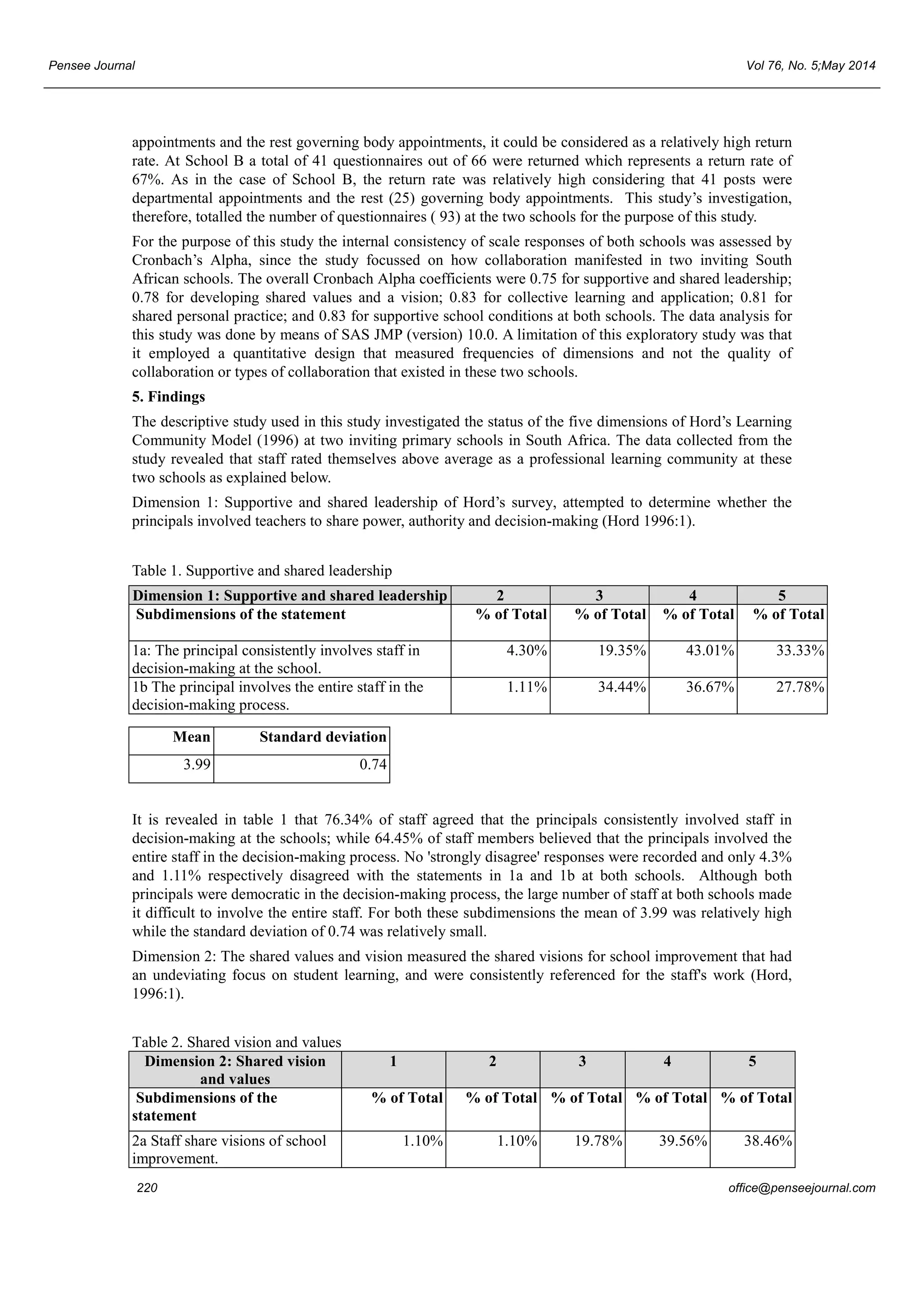
Table 1. Supportive and shared leadership 
Dimension 1: Supportive and shared leadership 2 3 4 5 
Subdimensions of the statement % of Total % of Total % of Total % of Total 
1a: The principal consistently involves staff in 
decision-making at the school. 
4.30% 19.35% 43.01% 33.33% 
1b The principal involves the entire staff in the 
decision-making process. 
1.11% 34.44% 36.67% 27.78% 
Mean Standard deviation 
3.99 0.74 
It is revealed in table 1 that 76.34% of staff agreed that the principals consistently involved staff in 
decision-making at the schools; while 64.45% of staff members believed that the principals involved the 
entire staff in the decision-making process. No 'strongly disagree' responses were recorded and only 4.3% 
and 1.11% respectively disagreed with the statements in 1a and 1b at both schools. Although both 
principals were democratic in the decision-making process, the large number of staff at both schools made 
it difficult to involve the entire staff. For both these subdimensions the mean of 3.99 was relatively high 
while the standard deviation of 0.74 was relatively small. 
Dimension 2: The shared values and vision measured the shared visions for school improvement that had 
an undeviating focus on student learning, and were consistently referenced for the staff's work (Hord, 
1996:1). 
Table 2. Shared vision and values 
Dimension 2: Shared vision 
and values 
1 2 3 4 5 
Subdimensions of the 
statement 
% of Total % of Total % of Total % of Total % of Total 
2a Staff share visions of school 
improvement. 
1.10% 1.10% 19.78% 39.56% 38.46% 
220 office@penseejournal.com
Pensee Journal Vol 76, No. 5;May 2014 
Dimension 2: Shared vision 
and values 
1 2 3 4 5 
Subdimensions of the 
statement 
% of Total % of Total % of Total % of Total % of Total 
2b Visions of improvement 
focussed on students, teaching 
and learning 
1.09% 0.00% 3.26% 29.35% 66.30% 
2c Visions of improvement with 
quality learning for all students 
as target 
0.00% 3.23% 8.60% 22.58% 65.59% 
Mean Standard deviation 
4.42 0.64 
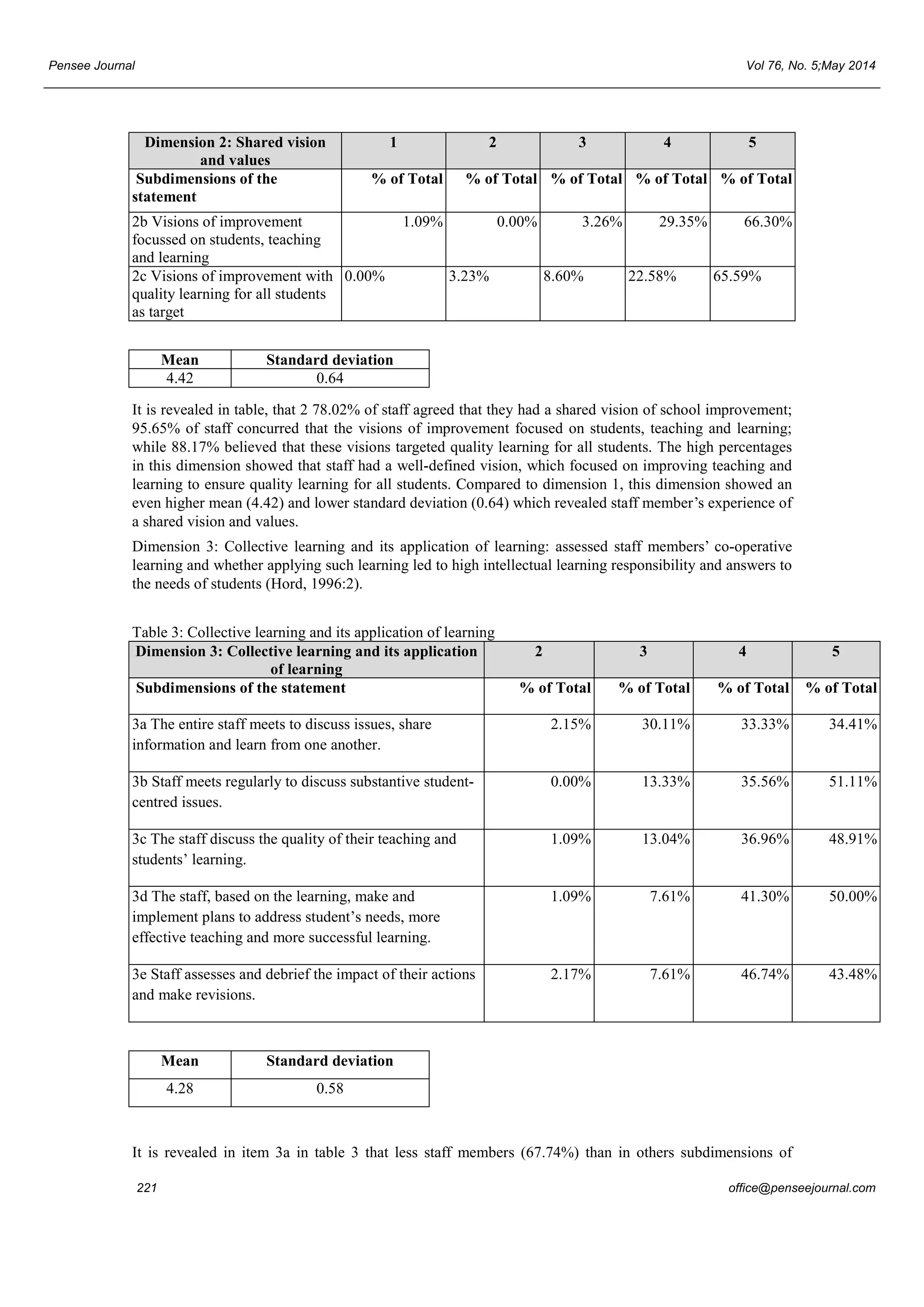
It is revealed in table, that 2 78.02% of staff agreed that they had a shared vision of school improvement; 
95.65% of staff concurred that the visions of improvement focused on students, teaching and learning; 
while 88.17% believed that these visions targeted quality learning for all students. The high percentages 
in this dimension showed that staff had a well-defined vision, which focused on improving teaching and 
learning to ensure quality learning for all students. Compared to dimension 1, this dimension showed an 
even higher mean (4.42) and lower standard deviation (0.64) which revealed staff member’s experience of 
a shared vision and values. 
Dimension 3: Collective learning and its application of learning: assessed staff members’ co-operative 
learning and whether applying such learning led to high intellectual learning responsibility and answers to 
the needs of students (Hord, 1996:2). 
Table 3: Collective learning and its application of learning 
Dimension 3: Collective learning and its application 
of learning 
2 3 4 5 
Subdimensions of the statement % of Total % of Total % of Total % of Total 
3a The entire staff meets to discuss issues, share 
information and learn from one another. 
2.15% 30.11% 33.33% 34.41% 
3b Staff meets regularly to discuss substantive student-centred 
issues. 
0.00% 13.33% 35.56% 51.11% 
3c The staff discuss the quality of their teaching and 
students’ learning. 
1.09% 13.04% 36.96% 48.91% 
3d The staff, based on the learning, make and 
implement plans to address student’s needs, more 
effective teaching and more successful learning. 
1.09% 7.61% 41.30% 50.00% 
3e Staff assesses and debrief the impact of their actions 
and make revisions. 
2.17% 7.61% 46.74% 43.48% 
Mean Standard deviation 
4.28 0.58 
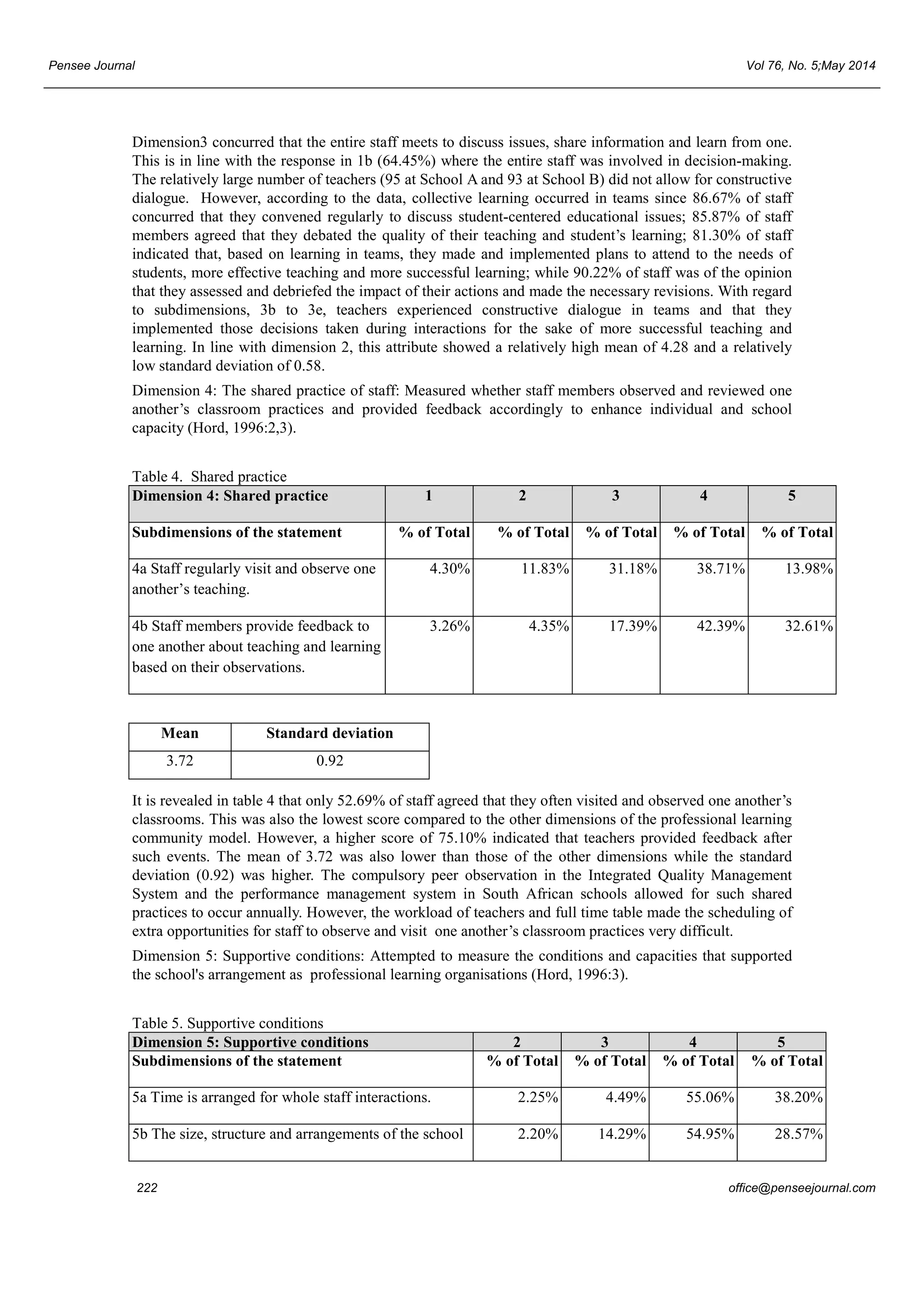
It is revealed in item 3a in table 3 that less staff members (67.74%) than in others subdimensions of 
221 office@penseejournal.com
Pensee Journal Vol 76, No. 5;May 2014 
Dimension3 concurred that the entire staff meets to discuss issues, share information and learn from one. 
This is in line with the response in 1b (64.45%) where the entire staff was involved in decision-making. 
The relatively large number of teachers (95 at School A and 93 at School B) did not allow for constructive 
dialogue. However, according to the data, collective learning occurred in teams since 86.67% of staff 
concurred that they convened regularly to discuss student-centered educational issues; 85.87% of staff 
members agreed that they debated the quality of their teaching and student’s learning; 81.30% of staff 
indicated that, based on learning in teams, they made and implemented plans to attend to the needs of 
students, more effective teaching and more successful learning; while 90.22% of staff was of the opinion 
that they assessed and debriefed the impact of their actions and made the necessary revisions. With regard 
to subdimensions, 3b to 3e, teachers experienced constructive dialogue in teams and that they 
implemented those decisions taken during interactions for the sake of more successful teaching and 
learning. In line with dimension 2, this attribute showed a relatively high mean of 4.28 and a relatively 
low standard deviation of 0.58. 
Dimension 4: The shared practice of staff: Measured whether staff members observed and reviewed one 
another’s classroom practices and provided feedback accordingly to enhance individual and school 
capacity (Hord, 1996:2,3). 
Table 4. Shared practice 
Dimension 4: Shared practice 1 2 3 4 5 
Subdimensions of the statement % of Total % of Total % of Total % of Total % of Total 
4a Staff regularly visit and observe one 
another’s teaching. 
4.30% 11.83% 31.18% 38.71% 13.98% 
4b Staff members provide feedback to 
one another about teaching and learning 
based on their observations. 
3.26% 4.35% 17.39% 42.39% 32.61% 
Mean Standard deviation 
3.72 0.92 
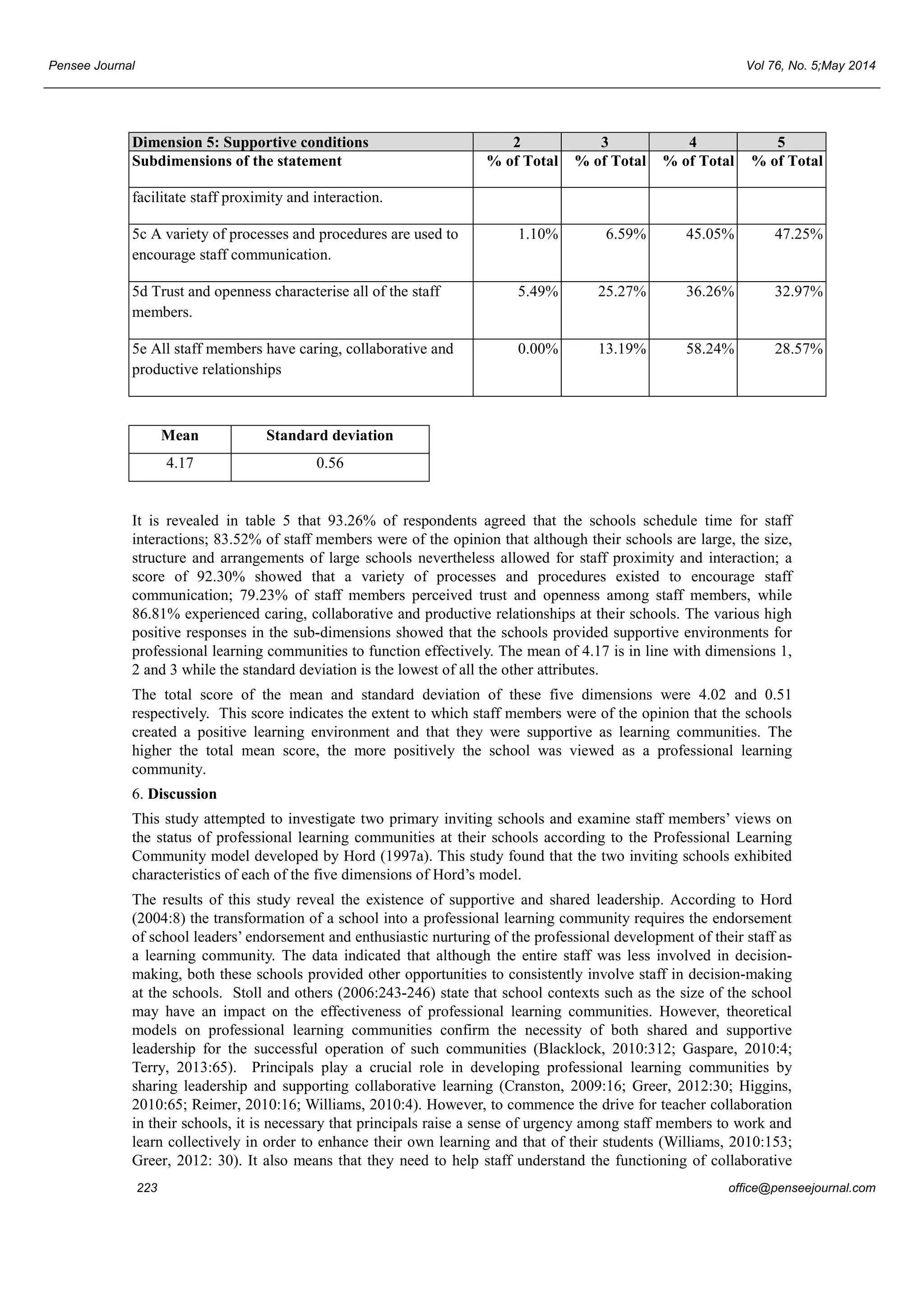
It is revealed in table 4 that only 52.69% of staff agreed that they often visited and observed one another’s 
classrooms. This was also the lowest score compared to the other dimensions of the professional learning 
community model. However, a higher score of 75.10% indicated that teachers provided feedback after 
such events. The mean of 3.72 was also lower than those of the other dimensions while the standard 
deviation (0.92) was higher. The compulsory peer observation in the Integrated Quality Management 
System and the performance management system in South African schools allowed for such shared 
practices to occur annually. However, the workload of teachers and full time table made the scheduling of 
extra opportunities for staff to observe and visit one another’s classroom practices very difficult. 
Dimension 5: Supportive conditions: Attempted to measure the conditions and capacities that supported 
the school's arrangement as professional learning organisations (Hord, 1996:3). 
Table 5. Supportive conditions 
Dimension 5: Supportive conditions 2 3 4 5 
Subdimensions of the statement % of Total % of Total % of Total % of Total 
5a Time is arranged for whole staff interactions. 2.25% 4.49% 55.06% 38.20% 
5b The size, structure and arrangements of the school 2.20% 14.29% 54.95% 28.57% 
222 office@penseejournal.com
Pensee Journal Vol 76, No. 5;May 2014 
Dimension 5: Supportive conditions 2 3 4 5 
Subdimensions of the statement % of Total % of Total % of Total % of Total 
facilitate staff proximity and interaction. 
5c A variety of processes and procedures are used to 
encourage staff communication. 
1.10% 6.59% 45.05% 47.25% 
5d Trust and openness characterise all of the staff 
members. 
5.49% 25.27% 36.26% 32.97% 
5e All staff members have caring, collaborative and 
productive relationships 
0.00% 13.19% 58.24% 28.57% 
Mean Standard deviation 
4.17 0.56 
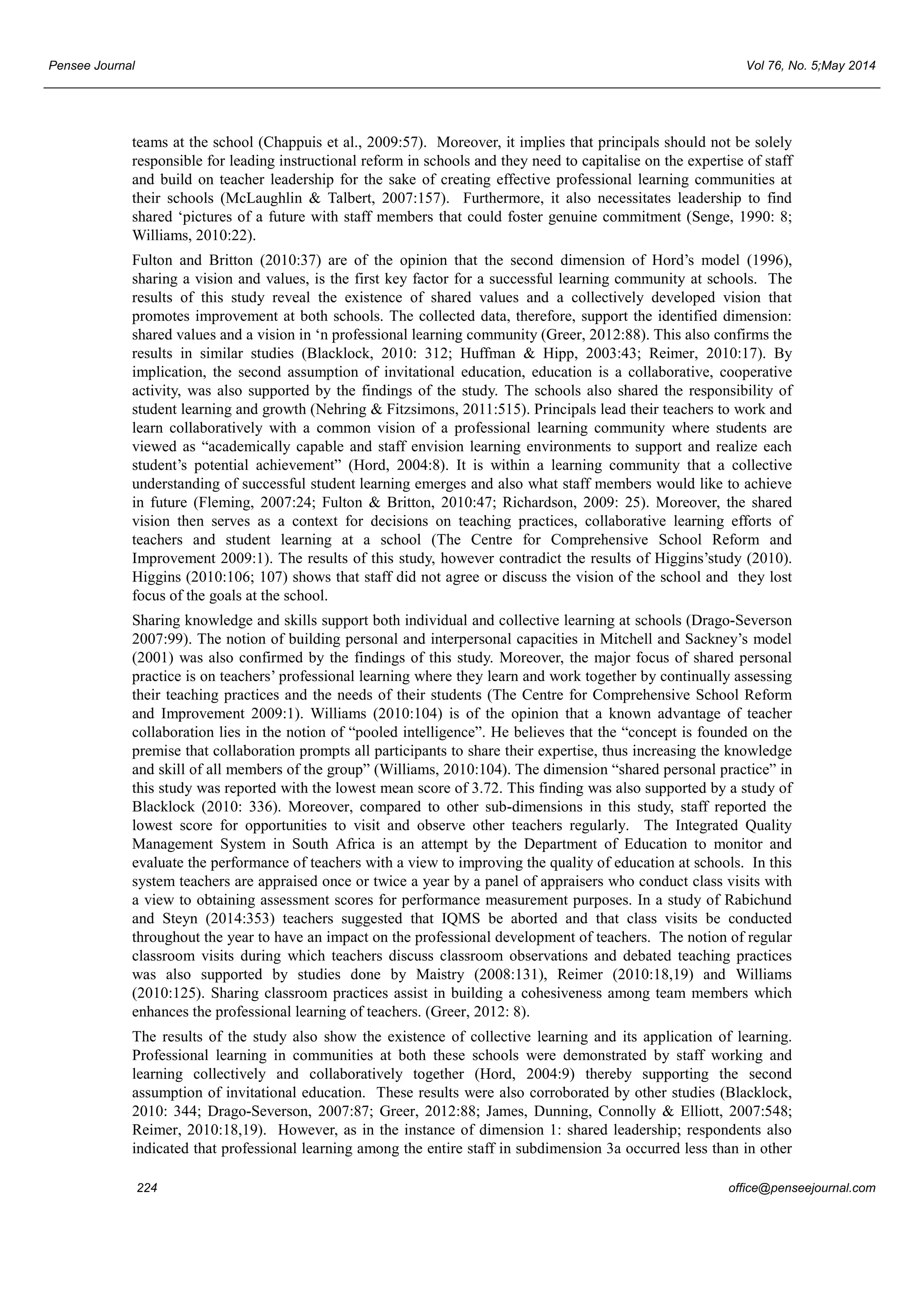
It is revealed in table 5 that 93.26% of respondents agreed that the schools schedule time for staff 
interactions; 83.52% of staff members were of the opinion that although their schools are large, the size, 
structure and arrangements of large schools nevertheless allowed for staff proximity and interaction; a 
score of 92.30% showed that a variety of processes and procedures existed to encourage staff 
communication; 79.23% of staff members perceived trust and openness among staff members, while 
86.81% experienced caring, collaborative and productive relationships at their schools. The various high 
positive responses in the sub-dimensions showed that the schools provided supportive environments for 
professional learning communities to function effectively. The mean of 4.17 is in line with dimensions 1, 
2 and 3 while the standard deviation is the lowest of all the other attributes. 
The total score of the mean and standard deviation of these five dimensions were 4.02 and 0.51 
respectively. This score indicates the extent to which staff members were of the opinion that the schools 
created a positive learning environment and that they were supportive as learning communities. The 
higher the total mean score, the more positively the school was viewed as a professional learning 
community. 
6. Discussion 
This study attempted to investigate two primary inviting schools and examine staff members’ views on 
the status of professional learning communities at their schools according to the Professional Learning 
Community model developed by Hord (1997a). This study found that the two inviting schools exhibited 
characteristics of each of the five dimensions of Hord’s model. 
The results of this study reveal the existence of supportive and shared leadership. According to Hord 
(2004:8) the transformation of a school into a professional learning community requires the endorsement 
of school leaders’ endorsement and enthusiastic nurturing of the professional development of their staff as 
a learning community. The data indicated that although the entire staff was less involved in decision-making, 
both these schools provided other opportunities to consistently involve staff in decision-making 
at the schools. Stoll and others (2006:243-246) state that school contexts such as the size of the school 
may have an impact on the effectiveness of professional learning communities. However, theoretical 
models on professional learning communities confirm the necessity of both shared and supportive 
leadership for the successful operation of such communities (Blacklock, 2010:312; Gaspare, 2010:4; 
Terry, 2013:65). Principals play a crucial role in developing professional learning communities by 
sharing leadership and supporting collaborative learning (Cranston, 2009:16; Greer, 2012:30; Higgins, 
2010:65; Reimer, 2010:16; Williams, 2010:4). However, to commence the drive for teacher collaboration 
in their schools, it is necessary that principals raise a sense of urgency among staff members to work and 
learn collectively in order to enhance their own learning and that of their students (Williams, 2010:153; 
Greer, 2012: 30). It also means that they need to help staff understand the functioning of collaborative 
223 office@penseejournal.com
Pensee Journal Vol 76, No. 5;May 2014 
teams at the school (Chappuis et al., 2009:57). Moreover, it implies that principals should not be solely 
responsible for leading instructional reform in schools and they need to capitalise on the expertise of staff 
and build on teacher leadership for the sake of creating effective professional learning communities at 
their schools (McLaughlin & Talbert, 2007:157). Furthermore, it also necessitates leadership to find 
shared ‘pictures of a future with staff members that could foster genuine commitment (Senge, 1990: 8; 
Williams, 2010:22). 
Fulton and Britton (2010:37) are of the opinion that the second dimension of Hord’s model (1996), 
sharing a vision and values, is the first key factor for a successful learning community at schools. The 
results of this study reveal the existence of shared values and a collectively developed vision that 
promotes improvement at both schools. The collected data, therefore, support the identified dimension: 
shared values and a vision in ‘n professional learning community (Greer, 2012:88). This also confirms the 
results in similar studies (Blacklock, 2010: 312; Huffman & Hipp, 2003:43; Reimer, 2010:17). By 
implication, the second assumption of invitational education, education is a collaborative, cooperative 
activity, was also supported by the findings of the study. The schools also shared the responsibility of 
student learning and growth (Nehring & Fitzsimons, 2011:515). Principals lead their teachers to work and 
learn collaboratively with a common vision of a professional learning community where students are 
viewed as “academically capable and staff envision learning environments to support and realize each 
student’s potential achievement” (Hord, 2004:8). It is within a learning community that a collective 
understanding of successful student learning emerges and also what staff members would like to achieve 
in future (Fleming, 2007:24; Fulton & Britton, 2010:47; Richardson, 2009: 25). Moreover, the shared 
vision then serves as a context for decisions on teaching practices, collaborative learning efforts of 
teachers and student learning at a school (The Centre for Comprehensive School Reform and 
Improvement 2009:1). The results of this study, however contradict the results of Higgins’study (2010). 
Higgins (2010:106; 107) shows that staff did not agree or discuss the vision of the school and they lost 
focus of the goals at the school. 
Sharing knowledge and skills support both individual and collective learning at schools (Drago-Severson 
2007:99). The notion of building personal and interpersonal capacities in Mitchell and Sackney’s model 
(2001) was also confirmed by the findings of this study. Moreover, the major focus of shared personal 
practice is on teachers’ professional learning where they learn and work together by continually assessing 
their teaching practices and the needs of their students (The Centre for Comprehensive School Reform 
and Improvement 2009:1). Williams (2010:104) is of the opinion that a known advantage of teacher 
collaboration lies in the notion of “pooled intelligence”. He believes that the “concept is founded on the 
premise that collaboration prompts all participants to share their expertise, thus increasing the knowledge 
and skill of all members of the group” (Williams, 2010:104). The dimension “shared personal practice” in 
this study was reported with the lowest mean score of 3.72. This finding was also supported by a study of 
Blacklock (2010: 336). Moreover, compared to other sub-dimensions in this study, staff reported the 
lowest score for opportunities to visit and observe other teachers regularly. The Integrated Quality 
Management System in South Africa is an attempt by the Department of Education to monitor and 
evaluate the performance of teachers with a view to improving the quality of education at schools. In this 
system teachers are appraised once or twice a year by a panel of appraisers who conduct class visits with 
a view to obtaining assessment scores for performance measurement purposes. In a study of Rabichund 
and Steyn (2014:353) teachers suggested that IQMS be aborted and that class visits be conducted 
throughout the year to have an impact on the professional development of teachers. The notion of regular 
classroom visits during which teachers discuss classroom observations and debated teaching practices 
was also supported by studies done by Maistry (2008:131), Reimer (2010:18,19) and Williams 
(2010:125). Sharing classroom practices assist in building a cohesiveness among team members which 
enhances the professional learning of teachers. (Greer, 2012: 8). 
The results of the study also show the existence of collective learning and its application of learning. 
Professional learning in communities at both these schools were demonstrated by staff working and 
learning collectively and collaboratively together (Hord, 2004:9) thereby supporting the second 
assumption of invitational education. These results were also corroborated by other studies (Blacklock, 
2010: 344; Drago-Severson, 2007:87; Greer, 2012:88; James, Dunning, Connolly & Elliott, 2007:548; 
Reimer, 2010:18,19). However, as in the instance of dimension 1: shared leadership; respondents also 
indicated that professional learning among the entire staff in subdimension 3a occurred less than in other 
224 office@penseejournal.com
Pensee Journal Vol 76, No. 5;May 2014 
subdimensions. The fact that both schools were relatively large in size explains their responses (Stoll et 
al., 2006:243-246). In order to meet the learning needs of students, the historically solo-practices of 
teachers need to change to collaborative practices whereby teachers continuously engage in teams to 
develop their knowledge and skills (Darling-Hammond, Wei, Andree, Richardson, & Orphanos, S 2009: 
2; Ertesvåg, 2011:1; Fulton & Britton, 2011:5; Nehring & Fitzsimons, 2011:526). Staff who intentionally 
focus on learning attempt to search for and create the necessary support activities and opportunities to 
move beyond the current status quo (Katz & Earl, 2010:32). Moreover, within professional learning 
communities a culture of learning is valued, supported and encouraged by all staff members (Blacklock, 
2010: 345). The results of this study are contradicted by Higgins (2010:107) which indicated that staff 
did not apply learning experiences from interactions with other teachers and they also did not value the 
importance of such interactions. In line with this view McLaughlin and Talbert (2007:160) state that staff 
from different departments often think that they have little in common to share. 
An appropriate, supportive learning environment where staff at schools can collaborate as a unit to learn, 
make decisions, solve problems and work creatively is required (Fulton & Britton, 2011:14; Hord, 2004: 
10; Hord, 2007:11). Blacklock (2010: 319) states that organisational structures at schools which provide 
supportive conditions play an essential and integral role to ensure the effectiveness of professional 
learning communities. Staff members in this study reported that their school schedule and organisation 
allowed staff to collaborate effectively. These findings, therefore, support the building of organisational 
capacities as identified by Mitchell and Sackney’s model (2001) and also the fourth assumption of 
invitational education: that individual capacities in the school’s organisation are intentionally developed 
to promote individual development, personally and professionally. Although both schools are large they 
nevertheless succeeded in providing a variety of processes and procedures to encourage staff 
communication. The supporting conditions for effective professional learning communities also require 
caring, collaborative and productive relationships which include trust and openness among staff members 
(Cranston, 2009:10; Fulton & Britton, 2011:7; Katz & Earl, 2010:29, 30). In this regard Hargreaves 
(2007:187), Higgins (2010:109) and Fleming (2007:28) maintain that developing trust is critical for 
sustaining professional learning communities. The data, therefore, supports the identified characteristic of 
this dimension in the professional learning community. The findings of this study are also supported by 
those of Greer (2012: 89), James, and others (2007:548) and Blacklock (2009: 183). 
7. Conclusion 
With the teaching profession’s emphasis on communities of learners, schools need to implement 
collaborative models of professional development. The findings of this study suggest the existence of the 
five professional learning community dimensions of collective learning of Hord’s model at two South 
African inviting schools. Learning more about the collaborative culture of these successful schools and 
studying them through the theoretical framework of the Professional Learning Community model, 
elaborated on the practices which promoted the success of these schools. 
The collaboration model at these schools revealed a well-developed structure for the professional 
collaboration which all staff members understood and respected. The following implications can be 
drawn from this study: 
• Strong leadership capacities in communicating and sharing the vision for building and maintaining 
professional learning communities at schools are required. As instructional leaders, the principals need 
to be committed to teachers’ professional learning by sharing school leadership at the schools. It 
implies that principals should acknowledge the expertise of staff members and ensure their active 
participation in the functioning of the school. 
• Staff requires a strong understanding of the purpose of collaboration which implies the necessity to 
share values and a vision that is focussed on improved teaching practices for the sake of improved 
student learning. 
• Collective learning occurs when individual teachers work together in collaborative relationships to 
develop professionally and enhance student learning. The teachers need to develop the necessary skills 
and processes to collaborate effectively for the sake of improving their individual learning and that of 
their students. 
• Shared practice requires the building of trust and respect among staff members and also commitment 
and willingness to share their practices. By implication it means to abandon competition among staff 
members and to break down any barriers that are created by isolation at schools. 
225 office@penseejournal.com
Pensee Journal Vol 76, No. 5;May 2014 
• Supportive, conducive conditions are required at schools for professional learning communities to 
function effectively. This implies the institution of structural and physical conditions to ensure teacher 
collaboration. The necessary time for teachers to meet regularly on a sustained basis with a hectic 
school time table remains a challenge for schools. Moreover, such regular scheduled opportunities are 
required since it takes time to build teacher qualities, such as care, trust, and respect to ensure 
effective collegial, collaborative relationships. 
The findings of this study might help policymakers to design appropriate professional development 
programmes that focus on teacher collaboration. However, a limitation of the study is that it focussed on a 
single case study: professional learning communities at two South African inviting schools. Based on the 
findings of this study; and considering the fact that school contexts differ, the following studies are 
recommended: (1 A study that compares the views of staff in the two inviting schools to show similarities 
and differences in the professional learning communities at the schools. (2) A study at inviting schools in 
other countries on how the dimensions of Professional Learning Communities in Hord’s model (1996) are 
revealed (3) A study on how the factors in different school contexts influence the development and 
existence of professional learning communities at schools may contribute to the current body of 
knowledge in transforming schools into professional learning communities. 
References 
Blacklock, P.J. (2009). The five dimensions of professional learning communities in 
improving exemplary Texas elementary schools: a descriptive study. Unpublished Ph.D Dissertation. 
Texas: University of North Texas. 
Brouwer, P. (2011). Collaboration in teams. Ph.D Thesis, Unpublished. Utrecht, Netherlands: 
University of Utrecht. 
Chappuis, S., Chappuis, J., & R. Stiggins. (2009). Supporting teacher learning teams. Educational 
Leadership, February, 66(5), 56–60. 
Chenoweth, K. (2009). It can be done, it's being done, and here's how. Phi Delta Kappan, 91(1), 38- 
43. 
Cranston, J. (2009). Holding the reins of the professional learning community: eight themes from 
research on principals’ perceptions of professional learning communities. Canadian Journal of 
Educational Administration and Policy, February, 90, 1-22. 
Creswell, J.W. (2007). Qualitative inquiry and research design. Choosing among five approaches. 
(2nd ed.). Thousand Oaks, California: Sage Publications. 
Christianakis M (2010). Collaborative research and teacher education. Issues in Teacher Education, 
19(2), 109 – 125. 
Darling-Hammond, L., Wei, R.C., Andree, A., Richardson, N. & Orphanos, S. (2009). Professional 
learning in the learning profession: a status report on teacher development in the United States and 
abroad. Dallas, TX: National Staff Development Council. [Online] Available: 
http://www.nsdc.org/news/NSDCstudy2009.pdf (April 1, 2014). 
Department of Education, 2011. Integrated Strategic Planning Framework for Teacher Education 
and Development in South Africa. Technical Report: Basic Education and Higher Education and 
Training. [Online] Available: http://getideas.org/resource/integrated-strategic-planning-framework-teacher- 
education-and-development-south-af/ (January 21, 2014). 
Drago-Severson, E. (2007) Helping teachers learn: principals as professional development leaders. 
Teachers College Record, 109(1), 70-125. 
Ertesvåg, S.K. (2011). Improving teacher collaboration: the role of classroom characteristics and 
individual factors on teachers’ collaboration: a latent Growth Curve Approach. Paper presented at the 
ICSEI Congress 2011 International Congress for School effectiveness and Improvement. Linking 
Research, Policy and Practice to Promote Quality in Education, Limassol Cyprus. 4-7 January. 
[Online] Available: http://www.icsei.net/icsei2011/Full%20Papers/0090.pdf (November 9, 2013 ). 
Fulton, K. & Britton, T. (2010). STEM teachers in professional learning communities: A knowledge 
226 office@penseejournal.com
Pensee Journal Vol 76, No. 5;May 2014 
synthesis. [Online] Available: 
http://www.wested.org/online_pubs/resource1097.pdf(November 9, 2013 ). 
Fulton, K. & Britton, T. (2011). STEM teachers in professional learning communities: From Good 
teachers to great teaching. [Online] Available: http://nctaf.org/wp-content/uploads/2012/01/1098- 
executive-summary.pdf (November 9, 2013). 
Gaspar, S. (2010). Leadership and the professional learning community. Ph. D. Thesis, Unpublished. 
Lincoln, NE: University of Nebraska. 
Goddard, Y.L., Goddard, R.D. & Tschannen-Moran, M. (2008). A theoretical and empirical 
investigation of teacher collaboration for school improvement and student achievement in public 
elementary schools. Teachers College Record, April, 109(4), 877-896. 
Greer, J.A. (2012). Professional learning and collaboration. Ph. D Thesis, Unpublished. Virginia: 
Virginia Polytechnic Institute and State University. 
Hargreaves, A. (2007). Sustainable professsional learning communities. In Professional learning 
communities: divergence, depth and dilemmas, edited by L Stoll, KS Louis (Eds.): Maidenhead, UK: 
Open University Press, pp, 181–195. 
Higgins, K.E. (2010) An investigation of professional learning communities in North Carolina. 
Unpublished doctoral thesis, Fayetteville State University: Fayetteville, North Carolina. 
Hord, S.M. (1996). School professional staff as learning community questionnaire. Austin, TX: 
Southwest Educational Development Laboratory. Available by permission from: SEDL Information 
Resource Center-Copyright Permissions4700 Mueller Blvd.Austin, TX 78723 
www.sedl.org/about/copyright_request.html (Reprinted by Trudy Steyn with permission from 
SEDL) 
Hord S.M. (1997). Professional Learning Communities: What are they and Why are they important? 
Issues... about Change, 6(1), 1-8. 
Hord, S.M. (ed.). (2004). Learning together, leading together. New York: Teachers College Press. 
Hord, S.M. (2004). Professional learning communities: An overview. In Hord (ed) 2004. (Chapter 1). 
Huffman, J.B. & Hipp K.K. (eds.) 2003. Reculturing schools as professional learning 
communities.Oxford: ScarecrowEducation. 
James, C.R., Dunning, G., Connolly, M. & Elliott, T. (2007). Collaborative practice: A model of 
successful working in schools. Journal of Educational Administration, 45(5), 541-555. 
Katz, S. & Earl, L. (2010). Learning about networked learning communities. School Effectiveness 
and School Improvement, March, 21(1), 27-51. 
Lockhorst, D., Van der Pol, J. & Admiraal W. (2008). A descriptive model of teacher communities. 
Proceedings of the 6th International Conference on Networked Learning, ISBN No: 978-1-86220- 
206-1: 253-261. [Online] Available at : 
http://igitur-archive.library.uu.nl/ivlos/2009-0106-200613/lockhorst%20- 
%20a%20descriptive%20model.pdf (February 13, 2014). 
Maistry, S.M. (2008). Towards collaboration rather than co-operation for effective teacher 
professional development in South Africa: Insights from social practice theory. Southern African 
Review of Education, 14(1), 119-142. 
McLaughlin, M.L. & Talbert, J E. (2007). Building professional learning communities. In high 
schools: challenges and promising practices, edited by Stoll & Louis, Chapter 11 
McLaughlin, M.L. & Talbert, J.E. (2010). Professional learning communities: Building blocks for 
school culture and student learning. Voices in Urban Education, Spring, 35-45. [Online] Available : 
http://www.stanford.edu/group/suse-crc/cgi-bin/ 
drupal/sites/default/files/Professional_Learning_Communities.pdf (November 12, 2013). 
Meehan, M.L., Orletsky, S.R. & Sattes, B. (1997). Field test of an instrument measuring the concept 
of professional learning communities in schools. Appalachia Educational Laboratory: Charleston, 
West Virginia. 
227 office@penseejournal.com
Pensee Journal Vol 76, No. 5;May 2014 
Mitchell, D. &. Sackney. L. (2001). Building Capacity for a Learning Community. Canadian Journal 
of Educational Administration and Policy (19). [Online] Available : 
http://www.umanitoba.ca/publications/cjeap/articles/mitchellandsackney.html (no page numbers). 
(November 6, 2013). 
Moller, G. (2006). Teacher leadership emerges within professional learning communities. Journal of 
School Leadership, 16(5), 520-533. 
Nehring J. & Fitzsimons, G. (2011). The professional learning community as subversive activity: 
countering the culture of conventional schooling. Professional Development in Education, 
September, 37(4), 513–535. 
Nelson, T.H., Deuel, A., Slavit, D. & Kennedy, A. (2010). Leading deep conversations in 
collaborative inquiry groups. The Clearing House, 83, 175–179, 
Norris, C.J., Barnett, B.G., Basom, M.R. & Yerkes. D.M. (2002). Developing school leaders. A 
working model: The learning community in action. New York, NY: Teachers’ College, Columbia 
University 
Piccardi, J.M. (2005). Principals' perceptions of factors affecting teacher collaboration in elementary 
schools. Ongepubliseerde Doktorsgraad proefskrif. Whales Universiteit: Rhode Island, Engeland. 
Purkey, W.W.& Siegel, B. (2003). Becoming an invitational leader: A new approach to professional 
and personal success. Atlanta: Humanics Trade Group. 
Printy, S. (2010). Principals’ influence on instructional quality: insights from US schools. School 
Leadership and Management, April, 30(2), 111-126. 
Rabichund, S. & Steyn, G.M. (2014). The contribution of the Integrated Quality Management 
System to whole school development in South Africa. The Mediterranean Journal of Social 
Sciences, 5(4), 348-358 
Republic of South Africa. (2011). Technical Report: Integrated Strategic Planning Framework for 
Teacher Education and Development in South Africa. Pretoria: Department of Basic Education and 
Department of Higher Education and Training. [Online] Available : 
http://getideas.org/resource/integrated-strategic-planning-framework-teacher-education-and-development- 
south-af/ (February 19, 2014) 
Reimer, L. (2010) A study on the principal’s role in the development of professional learning 
communities in elementary schools that ‘beat the odds’ in reading. Unpublished doctoral thesis, 
University of Minnesota: Minneapolis, MN. 
Richardson, M.A. (2009). Perceptions of Principals from High and Low Performing Elementary 
Schools Concerning Schools as Professional Learning Communities. Ph.D. Thesis, Unpublished. 
Minneapolis, Minnisota: Walden University. 
Sigurðardóttir, A.K. (2010). Professional Learning Community in Relation to School Effectiveness. 
Scandinavian Journal of Educational Research, October, 54(5), 395–412. 
Senge, P. 1990. The fifth discipline. New York, NY: Doubleday. 
Shaw, D., Siegel, B. & Schoenline, A. n.d. Basic tenets of invitational theory and practice (ITP): An 
invitational glossary manuscript. Unpublished manuscript. 
Smith, K. (2012).The History and Development of the Inviting School Survey: 1995-2012. Journal 
of Invitational Theory and Practice , January, 18,57-64 
Steyn, G.M. (2010). Creating intentionally inviting schools through professional development: an 
appreciative inquiry. Koers, 76(4), 873-897 
Steyn, G.M. (2013a). Principal succession: The sosialisation of a primary school principal in South 
Africa, Koers: Bulletin for Christian Science. [Online] Available: 78(1), Art. #426, 9 pages. 
http://dx.doi. org/10.4102/koers.v78i1.426 (February 19, 2014) 
Steyn, G.M. (2013b). Principal succession in a South African primary school: a narrative inquiry. 
Loyola Journal of Social Sciences, XXWI(2), 271-291 
Steyn, G.M. (2013c). Using visual ethnography to explore a principal’s perceptions of innovations 
228 office@penseejournal.com
Pensee Journal Vol 76, No. 5;May 2014 
made in a South African primary school. African Education Review, 10 (3), 557-580. 
Steyn, G.M. (2014a). Creating a teacher collaborative practice in a South African primary school: 
The role of the principal. In press The Journal of Asian and African Studies 
Steyn, G.M. (2014b). Teacher collaboration and invitational leadership in a South African primary 
school. In press: Education and Urban Society. 
Stoll, L. & Louis, K.S. (eds.). Professional learning communities: Divergence, depth and dilemmas. 
Berkshire, England: Open University Press. 
The Centre for Comprehensive School Reform and Improvement 2009. Professional learning 
communities: What is a PLC? [Online] Available: http://www.centerforcsri.org/plc/literature.html 
(January 21, 2013). 
Stoll, L., Bolam, R., Mcmahon, A., Wallace, M. & Thomas, S. (2006). Professional learning 
communities: a review of the literature. Journal of Educational Change, 7, 221–258. 
Terry, W. (2013). Shared leadership. Educational Leadership, 71(2), 62-67. 
Williams, S.M. (2009). The Impact of Collaborative, Scaffolded Learning in K-12 Schools: A Meta- 
Analysis. The Metiri Group, Cisco Systems, Inc. [Online] Available: 
http://www.cisco.com/web/about/citizenship/socio-economic/ 
docs/Metiri_Classroom_Collaboration_Research.pdf (January 23, 2014). 
Williams, M.L. (2010). Teacher collaboration as professional development in a large, suburban high 
school. Unpublished PhD thesis. Lincoln, Omaha: University of Nebraska. 
229 office@penseejournal.com

Pensee teachers' perceptions 2014

  • 1.
    Pensee Journal Vol76, No. 5;May 2014 Teachers’ perceptions of staff collaboration at South African inviting schools: a case study Prof GM Steyn Department of Educational Leadership and Management University of South Africa, P O Box 392, Pretoria, 0003, South Africa. As rated researcher, the research has been supported by the National Research Foundation in South Africa Abstract This study reports on staff members’ perceptions of teacher collaboration at two South African schools that received the inviting school award from the International Alliance for Invitational Education. The inviting school survey assesses the invitational qualities based on the four assumptions of the Invitational Education theory. Although these assumptions are harmoniously related, this article primarily focuses on the second assumption: that education is a collaborative cooperative activity. A quantitative research design was deemed most appropriate for this study. The five dimensions of Hord’s model were used to determine staff’s perceptions of collaborations at these schools; (1) shared leadership; (2) a shared vision and values; (3) individual and shared learning; (4) shared practice; and (5) supportive conditions. The results revealed that the five dimensions of Hord’s model were evident at both these schools, which confirmed the existence of teacher collaboration at these schools. The significant contribution of this study lies in the verification and validation of invitational education in Hord’s model. Keywords: Invitational education; teacher collaboration; Hord’s model; professional learning communities 1. Introduction In the last two decades there has been extensive research on the importance of teacher collaboration for the sake of quality education; and teacher collaboration as an essential requirement for school improvement through its constructive impact on teachers’ learning and practice and the performance of students (Brouwer, 2011:7; Ertesvåg, 2011:1; Goddard & Britton, 2011:5; Goddard, Goddard & Tschannen-Moran, 2008:878; Lockhorst, Van der Pol & Admiraal, 2008:253; Nehring & Fitzsimons, 2011:516). However, numerous studies indicate that the sphere of influence of teachers is confined to their classroom walls, and limited opportunities are provided for collaboration (Brouwer, 2010:7; Darling-Hammond, Wei, Andree, Richardson, & Orphanos, 2009:57; Ertesvåg, 2011:1; Printy, 2010: 125; Sigurðardóttir, 2010:407). Therefore, to meet the needs and challenges of students, solo-practice needs to be replaced by a collaborative system where teachers frequently engage in in-depth dialogue (Fulton & Britton, 2011:5). Moreover, recent school reforms have focussed on teacher collaboration as a tool for improving the quality of schools (Brouwer, 2011:21; McLauglin &Talbert, 2010:35; Lockhorst et al., 2008:253), even in South Africa (Republic of South Africa, 2011:13). Professional learning communities, through teacher collaboration, are currently viewed as a framework to enhance teacher collaboration, a shared vision, reflective dialogue and applied learning in order to improve student performance (Blacklock, 2009:10; Nelson, Deuel, Slavit, Kennedy, 2010: 175). This has stimulated scholars to continue their exploration into the role of professional learning within school contexts (Williams, 2010:3). Although a number of studies described the design of professional learning communities, and more studies on professional learning communities, as a means for teachers’ continuing professional growth, are required (Brouwer, 2011:9; Katz & Earl, 2010:27,28). Moreover, the Department 216 office@penseejournal.com
  • 2.
    Pensee Journal Vol76, No. 5;May 2014 of Education (2011:82) in South Africa recommended the development of guidelines to establish and develop professional learning communities for schools. Such studies on professional learning communities are necessary to inform educational policies and contribute towards steering the professional learning community phenomenon (Christianakis, 2010:110). The researcher was instrumental in assisting the two schools in the study to obtain the prestigious inviting school award from the International Alliance for Invitational Education. She also gained insight into these two schools from previous studies. Invitational Education considers collaboration and collectivity among role players as one of the crucial assumptions to ensure an inviting school environment. This study which is also part of a research project attempted to gain an understanding of how the staff at these schools perceived the existence of professional learning communities at their schools. 2. Conceptual framework Various models that describe and define professional learning communities and teacher collaboration have been developed (Chappuis, Chappuis & Stiggins, 2009; Katz & Earl, 2010.; Hord, 1997; Hord, 2004). The following models are highlighted for the purpose of this study: The four basic assumptions of Invitational Education; Mitchell and Sackney’s model of capacity building for a learning community (2001); and Hord’s Professional Learning Community model (1997). Invitational Education is viewed as an ethical theory of practice that centres around a set of consistent assumptions about human behaviour and thinking (Shaw, Siegel & Schoen, line n.d.:5). This approach attempts to authentically create and sustain a welcoming school environment that is intentionally founded on respect, trust, optimism and care for the sake of increased learning outcomes; and the personal growth of all role players (Shaw et al, n.d.:5). Although the primary focus of this study is on the second assumption of the four basic assumptions of Invitational Education that are harmoniously related (Shaw et al, n.d.: 5; Purkey & Siegel, 2003:7-24): 1. People are able, valuable and responsible and should be treated accordingly. 2. Helping others is a collaborative, cooperative association in which the process is as important as the product. 3. People have relatively untapped capacities in all aspects of individual development. 4. Individual capacities can be best achieved by the 4 Ps (places, policies and programmes) that are intentionally developed to enhance individual growth, and by people who continue to realise their capacities in themselves and others, both personally and professionally. The third lens for interpreting this study was Mitchell and Sackney’s model (2001) of capacity building for a learning community. This model focuses on building three essential capacities, namely personal, interpersonal and organisational capacities. From a school perspective, personal capacity refers to a combination of embedded values, beliefs; and knowledge and skills that teachers possess; and the skilled networks by means of which they interact. In order to build interpersonal capacity, the emphasis moves from the individual to a group with mutual relationships and collaborative practice at its centre. Since new methods and shared values take time to develop, it can be expected that collaboration will develop through different phases that are characterised in team development (Mitchell & Sackney, 2001). Moreover, a particular kind of communication is required to form a collaborative team that encourages the development of shared understandings and engagement in collective inquiry to create new objectives for professional operations at a school (Mitchell & Sackney, 2001). The third capacity of Mitchell and Sackney’s model (2001) refers to building organisational capacity that begins with the awareness that structural arrangements could inhibit collaboration or could remove isolation between teachers. It means that a professional learning community at a school requires a unique kind of organisational structure that could have an impact on personal and interpersonal capacity building. For Mitchell and Sackney (2001) the first walls to be broken down from an organisational structure point of view are those negative attitudes that exist in the minds of individuals. It is also necessary to provide structural opportunities for professionals to interact. Once sufficient trust has developed among staff members, it may enhance constructive dialogue and reduce or remove conditions that negatively influence professional learning in teams. Leadership is also shared among staff members where individuals undertake leadership roles at the school. The third model on which the study on teachers’ collaborative learning was based is Hord’s Professional 217 office@penseejournal.com
  • 3.
    Pensee Journal Vol76, No. 5;May 2014 Learning Community model (1997). Professional learning community models aim at designing structures that reduce or remove the isolation of teachers and enhance collective learning among them to attain shared objectives for student learning (Piccardi, 2005: 6; Williams, 2010:139). Hord’s model (1997) identifies the following five dimensions of a professional learning community which are also supported by various other scholars: Dimension 1: Supportive and shared leadership: Changing a school into a learning community requires the leadership of principals to create a school environment for the continuous collective learning of teachers. (Fulton & Britton, 2011:14; Hord, 1997:2; Hord, 2007:8; Cranston, 2009:2; Hargreaves, 2007:187; Katz & Earl, 2010:27; Stoll, Bolam, Mcmahon, Wallace & Thomas, 2006:235; Richardson, 2009:29; Williams, 2010:4). Dimension 2: Shared values and vision: Sharing a vision is considered to be a mental picture of what is essential to both individuals and the school (Hord, 2007:8; Greer, 2012:8; Katz & Earl, 2010:27). It is necessary that teachers are committed and willing to focus strongly on the primary goal of improving their teaching practice for the sake of improved student learning (Fulton & Britton, 2011:14; Greer, 2012: 8). According to Fulton and Britton (2011:14), this dimension is the most critical factor for effective teacher collaboration. Dimension 3: Individual and collective learning: In a professional learning community teachers work and learn collectively by sharing their professional skills and knowledge and by applying innovative teaching methods to ensure effective student learning (Blacklock, 2009: 135; Katz & Earl, 2010:27). Dimension 3: Dimension 4: Shared personal practice: To develop a shared practice, teachers need to observe and visit one another’s classrooms regularly to discuss observations constructively (Hord, 1997:4; Greer, 2012: 8). Mutual trust and respect are also basic elements for an effective learning community in the shared practice of staff (Cranston, 2009:10; Fulton & Britton, 2011:7). Dimension 5: Supportive conditions: Hord (2007:10) distinguishes between two factors of supportive conditions, namely structural and physical factors and human capabilities. Structural and physical arrangements include aspects such as appropriate scheduled time to meet; access to resources and structures to improve communication; and reduce isolation among teachers (Chenoweth, 2009:41; Fulton & Britton, 2011:14; Greer, 2012:8; Katz & Earl, 2010:28; Williams, 2010:18). Building trust requires ample time for teachers to develop mutual norms and language for the team to operate (Fulton & Britton, 2011:15; Hord, 1997:4; Katz & Earl, 2010:28). 3. The school contexts The researcher was instrumental in assisting the two schools to become inviting schools. Both these schools received the prestigious award from the International Alliance for Invitational Education; School A in 1993 and School B in 2010. The nomination for the inviting school award in 1993 entailed the completion of an Inviting School Survey by all role players which focusing on the existence of the so-called four Ps (people, places, policies, and programmes) in invitational education. The ISS survey which was a product of WW Purkey, the co-founder of Invitational Education, was originally a 100-item Likert-type, hand-scored instrument without psychometrics, such as reliability and validity indices and norms to support the instrument (Smith, 2012). Since then applications for the inviting school award were revised and School B had to complete the Inviting School Survey-revised (ISS-R) and submit a portfolio that attended to five dimensions: people, places, policies, programmes and processes (Shaw et al., n.d: 15; Smith, 2012; Steyn, 2013: 560). The ISS-R is a 50-item Likert-type five-point survey that was completed by students, teachers and parents at the school (Shaw et al., n.d: 15). In 2010 a new principal took over at School A which led to an even stronger focus on teacher learning and academic performance of students and School B intentionally started to adhere to the assumptions of invitational education after its nomination as an inviting school in 2009. The study particularly focused on the second assumption: Education is a collaborative, cooperative activity. Schools A and School B were urban schools located in the eastern and southern suburb respectively in Gauteng, South Africa. School A had approximately 1750 students and School B approximately 1790 students. The socioeconomic environments of these schools ranged from average to above average although a number of students are exempted from school fees. The school visions of both schools focussed on current and future directed student learning through quality teaching. At School A the 218 office@penseejournal.com
  • 4.
    Pensee Journal Vol76, No. 5;May 2014 professional learning structure became prominent in the second year of the appointment of a new principal who placed huge emphasis on teacher collaboration and who also played a key role in creating a learning community at the school (Steyn, 2014a; Steyn, 2014b). School A reduced the number of students in the Grade 5 to 7 Mathematics classes to 15 students per class and school B appointed 16 class assistants for Grade 4 to 7 classes in the main subjects– Mathematics, Afrikaans and English to help with discipline, marking papers and the identification of learning problems in these classes. The school profile of both schools showed stability and homogeneity of the teachers and students. Of the 95 staff members at School A, 40 teachers were departmental and 55 governing body appointments, while School B had 66 staff members of which 41 were departmental and 25 governing body appointments. 4. Research design The two inviting schools of the study were purposefully selected since previous studies revealed collaborative learning cultures at these schools (Steyn, 2013a; Steyn, 2013b; Steyn, 2013c; Steyn, 2014a: in press; Steyn, 2014b: In press). For the purpose of this study a quantitative research design, particularly a descriptive case study, was chosen to explore the perceptions of staff members with regard the existence of teacher collaborative practices at their schools. Hord’s (1996) “School professional staff as a learning community questionnaire” which was most appropriate to answer the research question, was administered. It was designed to assess the development and maturity of teacher collaboration in a professional learning community (Meehan, Orletsky & Sattes, 1997:iv). The items were based on the staff’s perceptions of the existence of teacher collaboration in a professional learning community at the schools. The survey comprised 17 items; and the staff members at both schools were invited to complete it. According to Meehan and others (1997:4) there are five major dimensions of a professional learning community: (1) the involvement and facilitation of the principal who shares leadership, power and decision-making with his staff members (with two descriptors); (2) a shared vision and values which show staff members’ dedication to student learning which is continuously communicated and put into operation in the work of staff members (with three descriptors); (3) teachers’ collaborative learning during which solutions are developed to attend to the needs of students (with five descriptors); (4) the analysis and inquiry into teachers’ classroom practices by colleagues with a view to assist and provide feedback for individual and school improvement (with two descriptors); and (5) Supportive conditions which comprise physical circumstances and human capabilities that promote staff’s collaborative operations (with five descriptors). Each of these dimensions with its sub-items consists of descriptors on a Likert response scale of 5 (strongly agree and high) to 1 (strongly disagree and low). Higher scores show a more positive and confirmed view of a specific dimension in the collaborative practices of a school as a learning community (Gaspar, 2010:26.) The data from the Hord’s study showed that the School Professional Staff as a Learning Community (SPSaLC) instrument revealed suitable reliability and validity measures that were applicable to similar studies (Meehan et al 1997:29, 33). According to Meehan and others (1997:45) the concurrent validity of Hord’s instrument “does possess satisfactory correlation with the school climate instrument used in this field test”. Cronbach’s Alpha that determined the reliability of the total instrument revealed a score of 0.9389 (Meehan et al., 1997:29). The content, concurrent and construct validity were also studied and considered to be acceptable (Meehan et al., 1997:36-38). In order to ensure content validity of this instrument, three different stages were used. After an extensive literature review Hord constructed the five dimensions in the first stage which consisted of 17 descriptors and 51 indicators (Meehan et al., 1997:36). Three Appalachia Educational Laboratory (AEL) staff members completed the content validity assessment in the second stage to reformat Hord’s instrument which had been used in the pilot test of an AEL project (Meehan et al., 1997:36). Another check on the content was done in the third stage when staff of the AEL gave their reformatted instrument to the initial designer (Meehan et al., 1997:36). The researcher applied for and received ethical approval from two bodies; The Gauteng Department of Education and the University of South Africa to conduct the study. Moreover, the Southwest Educational Development Laboratory (SDEL) gave written permission to use Hord’s (1997) questionnaire for this study. Both principals also agreed to continue studies at their schools. Staff completed the survey anonymously and the participation of staff in the study was voluntary. At School A, a total of 52 questionnaires out of 95 were returned at the end of 2013 which represents a return rate of 54.73%. Considering the fact that only 40 staff members were permanent, departmental 219 office@penseejournal.com
  • 5.
    Pensee Journal Vol76, No. 5;May 2014 appointments and the rest governing body appointments, it could be considered as a relatively high return rate. At School B a total of 41 questionnaires out of 66 were returned which represents a return rate of 67%. As in the case of School B, the return rate was relatively high considering that 41 posts were departmental appointments and the rest (25) governing body appointments. This study’s investigation, therefore, totalled the number of questionnaires ( 93) at the two schools for the purpose of this study. For the purpose of this study the internal consistency of scale responses of both schools was assessed by Cronbach’s Alpha, since the study focussed on how collaboration manifested in two inviting South African schools. The overall Cronbach Alpha coefficients were 0.75 for supportive and shared leadership; 0.78 for developing shared values and a vision; 0.83 for collective learning and application; 0.81 for shared personal practice; and 0.83 for supportive school conditions at both schools. The data analysis for this study was done by means of SAS JMP (version) 10.0. A limitation of this exploratory study was that it employed a quantitative design that measured frequencies of dimensions and not the quality of collaboration or types of collaboration that existed in these two schools. 5. Findings The descriptive study used in this study investigated the status of the five dimensions of Hord’s Learning Community Model (1996) at two inviting primary schools in South Africa. The data collected from the study revealed that staff rated themselves above average as a professional learning community at these two schools as explained below. Dimension 1: Supportive and shared leadership of Hord’s survey, attempted to determine whether the principals involved teachers to share power, authority and decision-making (Hord 1996:1). Table 1. Supportive and shared leadership Dimension 1: Supportive and shared leadership 2 3 4 5 Subdimensions of the statement % of Total % of Total % of Total % of Total 1a: The principal consistently involves staff in decision-making at the school. 4.30% 19.35% 43.01% 33.33% 1b The principal involves the entire staff in the decision-making process. 1.11% 34.44% 36.67% 27.78% Mean Standard deviation 3.99 0.74 It is revealed in table 1 that 76.34% of staff agreed that the principals consistently involved staff in decision-making at the schools; while 64.45% of staff members believed that the principals involved the entire staff in the decision-making process. No 'strongly disagree' responses were recorded and only 4.3% and 1.11% respectively disagreed with the statements in 1a and 1b at both schools. Although both principals were democratic in the decision-making process, the large number of staff at both schools made it difficult to involve the entire staff. For both these subdimensions the mean of 3.99 was relatively high while the standard deviation of 0.74 was relatively small. Dimension 2: The shared values and vision measured the shared visions for school improvement that had an undeviating focus on student learning, and were consistently referenced for the staff's work (Hord, 1996:1). Table 2. Shared vision and values Dimension 2: Shared vision and values 1 2 3 4 5 Subdimensions of the statement % of Total % of Total % of Total % of Total % of Total 2a Staff share visions of school improvement. 1.10% 1.10% 19.78% 39.56% 38.46% 220 office@penseejournal.com
  • 6.
    Pensee Journal Vol76, No. 5;May 2014 Dimension 2: Shared vision and values 1 2 3 4 5 Subdimensions of the statement % of Total % of Total % of Total % of Total % of Total 2b Visions of improvement focussed on students, teaching and learning 1.09% 0.00% 3.26% 29.35% 66.30% 2c Visions of improvement with quality learning for all students as target 0.00% 3.23% 8.60% 22.58% 65.59% Mean Standard deviation 4.42 0.64 It is revealed in table, that 2 78.02% of staff agreed that they had a shared vision of school improvement; 95.65% of staff concurred that the visions of improvement focused on students, teaching and learning; while 88.17% believed that these visions targeted quality learning for all students. The high percentages in this dimension showed that staff had a well-defined vision, which focused on improving teaching and learning to ensure quality learning for all students. Compared to dimension 1, this dimension showed an even higher mean (4.42) and lower standard deviation (0.64) which revealed staff member’s experience of a shared vision and values. Dimension 3: Collective learning and its application of learning: assessed staff members’ co-operative learning and whether applying such learning led to high intellectual learning responsibility and answers to the needs of students (Hord, 1996:2). Table 3: Collective learning and its application of learning Dimension 3: Collective learning and its application of learning 2 3 4 5 Subdimensions of the statement % of Total % of Total % of Total % of Total 3a The entire staff meets to discuss issues, share information and learn from one another. 2.15% 30.11% 33.33% 34.41% 3b Staff meets regularly to discuss substantive student-centred issues. 0.00% 13.33% 35.56% 51.11% 3c The staff discuss the quality of their teaching and students’ learning. 1.09% 13.04% 36.96% 48.91% 3d The staff, based on the learning, make and implement plans to address student’s needs, more effective teaching and more successful learning. 1.09% 7.61% 41.30% 50.00% 3e Staff assesses and debrief the impact of their actions and make revisions. 2.17% 7.61% 46.74% 43.48% Mean Standard deviation 4.28 0.58 It is revealed in item 3a in table 3 that less staff members (67.74%) than in others subdimensions of 221 office@penseejournal.com
  • 7.
    Pensee Journal Vol76, No. 5;May 2014 Dimension3 concurred that the entire staff meets to discuss issues, share information and learn from one. This is in line with the response in 1b (64.45%) where the entire staff was involved in decision-making. The relatively large number of teachers (95 at School A and 93 at School B) did not allow for constructive dialogue. However, according to the data, collective learning occurred in teams since 86.67% of staff concurred that they convened regularly to discuss student-centered educational issues; 85.87% of staff members agreed that they debated the quality of their teaching and student’s learning; 81.30% of staff indicated that, based on learning in teams, they made and implemented plans to attend to the needs of students, more effective teaching and more successful learning; while 90.22% of staff was of the opinion that they assessed and debriefed the impact of their actions and made the necessary revisions. With regard to subdimensions, 3b to 3e, teachers experienced constructive dialogue in teams and that they implemented those decisions taken during interactions for the sake of more successful teaching and learning. In line with dimension 2, this attribute showed a relatively high mean of 4.28 and a relatively low standard deviation of 0.58. Dimension 4: The shared practice of staff: Measured whether staff members observed and reviewed one another’s classroom practices and provided feedback accordingly to enhance individual and school capacity (Hord, 1996:2,3). Table 4. Shared practice Dimension 4: Shared practice 1 2 3 4 5 Subdimensions of the statement % of Total % of Total % of Total % of Total % of Total 4a Staff regularly visit and observe one another’s teaching. 4.30% 11.83% 31.18% 38.71% 13.98% 4b Staff members provide feedback to one another about teaching and learning based on their observations. 3.26% 4.35% 17.39% 42.39% 32.61% Mean Standard deviation 3.72 0.92 It is revealed in table 4 that only 52.69% of staff agreed that they often visited and observed one another’s classrooms. This was also the lowest score compared to the other dimensions of the professional learning community model. However, a higher score of 75.10% indicated that teachers provided feedback after such events. The mean of 3.72 was also lower than those of the other dimensions while the standard deviation (0.92) was higher. The compulsory peer observation in the Integrated Quality Management System and the performance management system in South African schools allowed for such shared practices to occur annually. However, the workload of teachers and full time table made the scheduling of extra opportunities for staff to observe and visit one another’s classroom practices very difficult. Dimension 5: Supportive conditions: Attempted to measure the conditions and capacities that supported the school's arrangement as professional learning organisations (Hord, 1996:3). Table 5. Supportive conditions Dimension 5: Supportive conditions 2 3 4 5 Subdimensions of the statement % of Total % of Total % of Total % of Total 5a Time is arranged for whole staff interactions. 2.25% 4.49% 55.06% 38.20% 5b The size, structure and arrangements of the school 2.20% 14.29% 54.95% 28.57% 222 office@penseejournal.com
  • 8.
    Pensee Journal Vol76, No. 5;May 2014 Dimension 5: Supportive conditions 2 3 4 5 Subdimensions of the statement % of Total % of Total % of Total % of Total facilitate staff proximity and interaction. 5c A variety of processes and procedures are used to encourage staff communication. 1.10% 6.59% 45.05% 47.25% 5d Trust and openness characterise all of the staff members. 5.49% 25.27% 36.26% 32.97% 5e All staff members have caring, collaborative and productive relationships 0.00% 13.19% 58.24% 28.57% Mean Standard deviation 4.17 0.56 It is revealed in table 5 that 93.26% of respondents agreed that the schools schedule time for staff interactions; 83.52% of staff members were of the opinion that although their schools are large, the size, structure and arrangements of large schools nevertheless allowed for staff proximity and interaction; a score of 92.30% showed that a variety of processes and procedures existed to encourage staff communication; 79.23% of staff members perceived trust and openness among staff members, while 86.81% experienced caring, collaborative and productive relationships at their schools. The various high positive responses in the sub-dimensions showed that the schools provided supportive environments for professional learning communities to function effectively. The mean of 4.17 is in line with dimensions 1, 2 and 3 while the standard deviation is the lowest of all the other attributes. The total score of the mean and standard deviation of these five dimensions were 4.02 and 0.51 respectively. This score indicates the extent to which staff members were of the opinion that the schools created a positive learning environment and that they were supportive as learning communities. The higher the total mean score, the more positively the school was viewed as a professional learning community. 6. Discussion This study attempted to investigate two primary inviting schools and examine staff members’ views on the status of professional learning communities at their schools according to the Professional Learning Community model developed by Hord (1997a). This study found that the two inviting schools exhibited characteristics of each of the five dimensions of Hord’s model. The results of this study reveal the existence of supportive and shared leadership. According to Hord (2004:8) the transformation of a school into a professional learning community requires the endorsement of school leaders’ endorsement and enthusiastic nurturing of the professional development of their staff as a learning community. The data indicated that although the entire staff was less involved in decision-making, both these schools provided other opportunities to consistently involve staff in decision-making at the schools. Stoll and others (2006:243-246) state that school contexts such as the size of the school may have an impact on the effectiveness of professional learning communities. However, theoretical models on professional learning communities confirm the necessity of both shared and supportive leadership for the successful operation of such communities (Blacklock, 2010:312; Gaspare, 2010:4; Terry, 2013:65). Principals play a crucial role in developing professional learning communities by sharing leadership and supporting collaborative learning (Cranston, 2009:16; Greer, 2012:30; Higgins, 2010:65; Reimer, 2010:16; Williams, 2010:4). However, to commence the drive for teacher collaboration in their schools, it is necessary that principals raise a sense of urgency among staff members to work and learn collectively in order to enhance their own learning and that of their students (Williams, 2010:153; Greer, 2012: 30). It also means that they need to help staff understand the functioning of collaborative 223 office@penseejournal.com
  • 9.
    Pensee Journal Vol76, No. 5;May 2014 teams at the school (Chappuis et al., 2009:57). Moreover, it implies that principals should not be solely responsible for leading instructional reform in schools and they need to capitalise on the expertise of staff and build on teacher leadership for the sake of creating effective professional learning communities at their schools (McLaughlin & Talbert, 2007:157). Furthermore, it also necessitates leadership to find shared ‘pictures of a future with staff members that could foster genuine commitment (Senge, 1990: 8; Williams, 2010:22). Fulton and Britton (2010:37) are of the opinion that the second dimension of Hord’s model (1996), sharing a vision and values, is the first key factor for a successful learning community at schools. The results of this study reveal the existence of shared values and a collectively developed vision that promotes improvement at both schools. The collected data, therefore, support the identified dimension: shared values and a vision in ‘n professional learning community (Greer, 2012:88). This also confirms the results in similar studies (Blacklock, 2010: 312; Huffman & Hipp, 2003:43; Reimer, 2010:17). By implication, the second assumption of invitational education, education is a collaborative, cooperative activity, was also supported by the findings of the study. The schools also shared the responsibility of student learning and growth (Nehring & Fitzsimons, 2011:515). Principals lead their teachers to work and learn collaboratively with a common vision of a professional learning community where students are viewed as “academically capable and staff envision learning environments to support and realize each student’s potential achievement” (Hord, 2004:8). It is within a learning community that a collective understanding of successful student learning emerges and also what staff members would like to achieve in future (Fleming, 2007:24; Fulton & Britton, 2010:47; Richardson, 2009: 25). Moreover, the shared vision then serves as a context for decisions on teaching practices, collaborative learning efforts of teachers and student learning at a school (The Centre for Comprehensive School Reform and Improvement 2009:1). The results of this study, however contradict the results of Higgins’study (2010). Higgins (2010:106; 107) shows that staff did not agree or discuss the vision of the school and they lost focus of the goals at the school. Sharing knowledge and skills support both individual and collective learning at schools (Drago-Severson 2007:99). The notion of building personal and interpersonal capacities in Mitchell and Sackney’s model (2001) was also confirmed by the findings of this study. Moreover, the major focus of shared personal practice is on teachers’ professional learning where they learn and work together by continually assessing their teaching practices and the needs of their students (The Centre for Comprehensive School Reform and Improvement 2009:1). Williams (2010:104) is of the opinion that a known advantage of teacher collaboration lies in the notion of “pooled intelligence”. He believes that the “concept is founded on the premise that collaboration prompts all participants to share their expertise, thus increasing the knowledge and skill of all members of the group” (Williams, 2010:104). The dimension “shared personal practice” in this study was reported with the lowest mean score of 3.72. This finding was also supported by a study of Blacklock (2010: 336). Moreover, compared to other sub-dimensions in this study, staff reported the lowest score for opportunities to visit and observe other teachers regularly. The Integrated Quality Management System in South Africa is an attempt by the Department of Education to monitor and evaluate the performance of teachers with a view to improving the quality of education at schools. In this system teachers are appraised once or twice a year by a panel of appraisers who conduct class visits with a view to obtaining assessment scores for performance measurement purposes. In a study of Rabichund and Steyn (2014:353) teachers suggested that IQMS be aborted and that class visits be conducted throughout the year to have an impact on the professional development of teachers. The notion of regular classroom visits during which teachers discuss classroom observations and debated teaching practices was also supported by studies done by Maistry (2008:131), Reimer (2010:18,19) and Williams (2010:125). Sharing classroom practices assist in building a cohesiveness among team members which enhances the professional learning of teachers. (Greer, 2012: 8). The results of the study also show the existence of collective learning and its application of learning. Professional learning in communities at both these schools were demonstrated by staff working and learning collectively and collaboratively together (Hord, 2004:9) thereby supporting the second assumption of invitational education. These results were also corroborated by other studies (Blacklock, 2010: 344; Drago-Severson, 2007:87; Greer, 2012:88; James, Dunning, Connolly & Elliott, 2007:548; Reimer, 2010:18,19). However, as in the instance of dimension 1: shared leadership; respondents also indicated that professional learning among the entire staff in subdimension 3a occurred less than in other 224 office@penseejournal.com
  • 10.
    Pensee Journal Vol76, No. 5;May 2014 subdimensions. The fact that both schools were relatively large in size explains their responses (Stoll et al., 2006:243-246). In order to meet the learning needs of students, the historically solo-practices of teachers need to change to collaborative practices whereby teachers continuously engage in teams to develop their knowledge and skills (Darling-Hammond, Wei, Andree, Richardson, & Orphanos, S 2009: 2; Ertesvåg, 2011:1; Fulton & Britton, 2011:5; Nehring & Fitzsimons, 2011:526). Staff who intentionally focus on learning attempt to search for and create the necessary support activities and opportunities to move beyond the current status quo (Katz & Earl, 2010:32). Moreover, within professional learning communities a culture of learning is valued, supported and encouraged by all staff members (Blacklock, 2010: 345). The results of this study are contradicted by Higgins (2010:107) which indicated that staff did not apply learning experiences from interactions with other teachers and they also did not value the importance of such interactions. In line with this view McLaughlin and Talbert (2007:160) state that staff from different departments often think that they have little in common to share. An appropriate, supportive learning environment where staff at schools can collaborate as a unit to learn, make decisions, solve problems and work creatively is required (Fulton & Britton, 2011:14; Hord, 2004: 10; Hord, 2007:11). Blacklock (2010: 319) states that organisational structures at schools which provide supportive conditions play an essential and integral role to ensure the effectiveness of professional learning communities. Staff members in this study reported that their school schedule and organisation allowed staff to collaborate effectively. These findings, therefore, support the building of organisational capacities as identified by Mitchell and Sackney’s model (2001) and also the fourth assumption of invitational education: that individual capacities in the school’s organisation are intentionally developed to promote individual development, personally and professionally. Although both schools are large they nevertheless succeeded in providing a variety of processes and procedures to encourage staff communication. The supporting conditions for effective professional learning communities also require caring, collaborative and productive relationships which include trust and openness among staff members (Cranston, 2009:10; Fulton & Britton, 2011:7; Katz & Earl, 2010:29, 30). In this regard Hargreaves (2007:187), Higgins (2010:109) and Fleming (2007:28) maintain that developing trust is critical for sustaining professional learning communities. The data, therefore, supports the identified characteristic of this dimension in the professional learning community. The findings of this study are also supported by those of Greer (2012: 89), James, and others (2007:548) and Blacklock (2009: 183). 7. Conclusion With the teaching profession’s emphasis on communities of learners, schools need to implement collaborative models of professional development. The findings of this study suggest the existence of the five professional learning community dimensions of collective learning of Hord’s model at two South African inviting schools. Learning more about the collaborative culture of these successful schools and studying them through the theoretical framework of the Professional Learning Community model, elaborated on the practices which promoted the success of these schools. The collaboration model at these schools revealed a well-developed structure for the professional collaboration which all staff members understood and respected. The following implications can be drawn from this study: • Strong leadership capacities in communicating and sharing the vision for building and maintaining professional learning communities at schools are required. As instructional leaders, the principals need to be committed to teachers’ professional learning by sharing school leadership at the schools. It implies that principals should acknowledge the expertise of staff members and ensure their active participation in the functioning of the school. • Staff requires a strong understanding of the purpose of collaboration which implies the necessity to share values and a vision that is focussed on improved teaching practices for the sake of improved student learning. • Collective learning occurs when individual teachers work together in collaborative relationships to develop professionally and enhance student learning. The teachers need to develop the necessary skills and processes to collaborate effectively for the sake of improving their individual learning and that of their students. • Shared practice requires the building of trust and respect among staff members and also commitment and willingness to share their practices. By implication it means to abandon competition among staff members and to break down any barriers that are created by isolation at schools. 225 office@penseejournal.com
  • 11.
    Pensee Journal Vol76, No. 5;May 2014 • Supportive, conducive conditions are required at schools for professional learning communities to function effectively. This implies the institution of structural and physical conditions to ensure teacher collaboration. The necessary time for teachers to meet regularly on a sustained basis with a hectic school time table remains a challenge for schools. Moreover, such regular scheduled opportunities are required since it takes time to build teacher qualities, such as care, trust, and respect to ensure effective collegial, collaborative relationships. The findings of this study might help policymakers to design appropriate professional development programmes that focus on teacher collaboration. However, a limitation of the study is that it focussed on a single case study: professional learning communities at two South African inviting schools. Based on the findings of this study; and considering the fact that school contexts differ, the following studies are recommended: (1 A study that compares the views of staff in the two inviting schools to show similarities and differences in the professional learning communities at the schools. (2) A study at inviting schools in other countries on how the dimensions of Professional Learning Communities in Hord’s model (1996) are revealed (3) A study on how the factors in different school contexts influence the development and existence of professional learning communities at schools may contribute to the current body of knowledge in transforming schools into professional learning communities. References Blacklock, P.J. (2009). The five dimensions of professional learning communities in improving exemplary Texas elementary schools: a descriptive study. Unpublished Ph.D Dissertation. Texas: University of North Texas. Brouwer, P. (2011). Collaboration in teams. Ph.D Thesis, Unpublished. Utrecht, Netherlands: University of Utrecht. Chappuis, S., Chappuis, J., & R. Stiggins. (2009). Supporting teacher learning teams. Educational Leadership, February, 66(5), 56–60. Chenoweth, K. (2009). It can be done, it's being done, and here's how. Phi Delta Kappan, 91(1), 38- 43. Cranston, J. (2009). Holding the reins of the professional learning community: eight themes from research on principals’ perceptions of professional learning communities. Canadian Journal of Educational Administration and Policy, February, 90, 1-22. Creswell, J.W. (2007). Qualitative inquiry and research design. Choosing among five approaches. (2nd ed.). Thousand Oaks, California: Sage Publications. Christianakis M (2010). Collaborative research and teacher education. Issues in Teacher Education, 19(2), 109 – 125. Darling-Hammond, L., Wei, R.C., Andree, A., Richardson, N. & Orphanos, S. (2009). Professional learning in the learning profession: a status report on teacher development in the United States and abroad. Dallas, TX: National Staff Development Council. [Online] Available: http://www.nsdc.org/news/NSDCstudy2009.pdf (April 1, 2014). Department of Education, 2011. Integrated Strategic Planning Framework for Teacher Education and Development in South Africa. Technical Report: Basic Education and Higher Education and Training. [Online] Available: http://getideas.org/resource/integrated-strategic-planning-framework-teacher- education-and-development-south-af/ (January 21, 2014). Drago-Severson, E. (2007) Helping teachers learn: principals as professional development leaders. Teachers College Record, 109(1), 70-125. Ertesvåg, S.K. (2011). Improving teacher collaboration: the role of classroom characteristics and individual factors on teachers’ collaboration: a latent Growth Curve Approach. Paper presented at the ICSEI Congress 2011 International Congress for School effectiveness and Improvement. Linking Research, Policy and Practice to Promote Quality in Education, Limassol Cyprus. 4-7 January. [Online] Available: http://www.icsei.net/icsei2011/Full%20Papers/0090.pdf (November 9, 2013 ). Fulton, K. & Britton, T. (2010). STEM teachers in professional learning communities: A knowledge 226 office@penseejournal.com
  • 12.
    Pensee Journal Vol76, No. 5;May 2014 synthesis. [Online] Available: http://www.wested.org/online_pubs/resource1097.pdf(November 9, 2013 ). Fulton, K. & Britton, T. (2011). STEM teachers in professional learning communities: From Good teachers to great teaching. [Online] Available: http://nctaf.org/wp-content/uploads/2012/01/1098- executive-summary.pdf (November 9, 2013). Gaspar, S. (2010). Leadership and the professional learning community. Ph. D. Thesis, Unpublished. Lincoln, NE: University of Nebraska. Goddard, Y.L., Goddard, R.D. & Tschannen-Moran, M. (2008). A theoretical and empirical investigation of teacher collaboration for school improvement and student achievement in public elementary schools. Teachers College Record, April, 109(4), 877-896. Greer, J.A. (2012). Professional learning and collaboration. Ph. D Thesis, Unpublished. Virginia: Virginia Polytechnic Institute and State University. Hargreaves, A. (2007). Sustainable professsional learning communities. In Professional learning communities: divergence, depth and dilemmas, edited by L Stoll, KS Louis (Eds.): Maidenhead, UK: Open University Press, pp, 181–195. Higgins, K.E. (2010) An investigation of professional learning communities in North Carolina. Unpublished doctoral thesis, Fayetteville State University: Fayetteville, North Carolina. Hord, S.M. (1996). School professional staff as learning community questionnaire. Austin, TX: Southwest Educational Development Laboratory. Available by permission from: SEDL Information Resource Center-Copyright Permissions4700 Mueller Blvd.Austin, TX 78723 www.sedl.org/about/copyright_request.html (Reprinted by Trudy Steyn with permission from SEDL) Hord S.M. (1997). Professional Learning Communities: What are they and Why are they important? Issues... about Change, 6(1), 1-8. Hord, S.M. (ed.). (2004). Learning together, leading together. New York: Teachers College Press. Hord, S.M. (2004). Professional learning communities: An overview. In Hord (ed) 2004. (Chapter 1). Huffman, J.B. & Hipp K.K. (eds.) 2003. Reculturing schools as professional learning communities.Oxford: ScarecrowEducation. James, C.R., Dunning, G., Connolly, M. & Elliott, T. (2007). Collaborative practice: A model of successful working in schools. Journal of Educational Administration, 45(5), 541-555. Katz, S. & Earl, L. (2010). Learning about networked learning communities. School Effectiveness and School Improvement, March, 21(1), 27-51. Lockhorst, D., Van der Pol, J. & Admiraal W. (2008). A descriptive model of teacher communities. Proceedings of the 6th International Conference on Networked Learning, ISBN No: 978-1-86220- 206-1: 253-261. [Online] Available at : http://igitur-archive.library.uu.nl/ivlos/2009-0106-200613/lockhorst%20- %20a%20descriptive%20model.pdf (February 13, 2014). Maistry, S.M. (2008). Towards collaboration rather than co-operation for effective teacher professional development in South Africa: Insights from social practice theory. Southern African Review of Education, 14(1), 119-142. McLaughlin, M.L. & Talbert, J E. (2007). Building professional learning communities. In high schools: challenges and promising practices, edited by Stoll & Louis, Chapter 11 McLaughlin, M.L. & Talbert, J.E. (2010). Professional learning communities: Building blocks for school culture and student learning. Voices in Urban Education, Spring, 35-45. [Online] Available : http://www.stanford.edu/group/suse-crc/cgi-bin/ drupal/sites/default/files/Professional_Learning_Communities.pdf (November 12, 2013). Meehan, M.L., Orletsky, S.R. & Sattes, B. (1997). Field test of an instrument measuring the concept of professional learning communities in schools. Appalachia Educational Laboratory: Charleston, West Virginia. 227 office@penseejournal.com
  • 13.
    Pensee Journal Vol76, No. 5;May 2014 Mitchell, D. &. Sackney. L. (2001). Building Capacity for a Learning Community. Canadian Journal of Educational Administration and Policy (19). [Online] Available : http://www.umanitoba.ca/publications/cjeap/articles/mitchellandsackney.html (no page numbers). (November 6, 2013). Moller, G. (2006). Teacher leadership emerges within professional learning communities. Journal of School Leadership, 16(5), 520-533. Nehring J. & Fitzsimons, G. (2011). The professional learning community as subversive activity: countering the culture of conventional schooling. Professional Development in Education, September, 37(4), 513–535. Nelson, T.H., Deuel, A., Slavit, D. & Kennedy, A. (2010). Leading deep conversations in collaborative inquiry groups. The Clearing House, 83, 175–179, Norris, C.J., Barnett, B.G., Basom, M.R. & Yerkes. D.M. (2002). Developing school leaders. A working model: The learning community in action. New York, NY: Teachers’ College, Columbia University Piccardi, J.M. (2005). Principals' perceptions of factors affecting teacher collaboration in elementary schools. Ongepubliseerde Doktorsgraad proefskrif. Whales Universiteit: Rhode Island, Engeland. Purkey, W.W.& Siegel, B. (2003). Becoming an invitational leader: A new approach to professional and personal success. Atlanta: Humanics Trade Group. Printy, S. (2010). Principals’ influence on instructional quality: insights from US schools. School Leadership and Management, April, 30(2), 111-126. Rabichund, S. & Steyn, G.M. (2014). The contribution of the Integrated Quality Management System to whole school development in South Africa. The Mediterranean Journal of Social Sciences, 5(4), 348-358 Republic of South Africa. (2011). Technical Report: Integrated Strategic Planning Framework for Teacher Education and Development in South Africa. Pretoria: Department of Basic Education and Department of Higher Education and Training. [Online] Available : http://getideas.org/resource/integrated-strategic-planning-framework-teacher-education-and-development- south-af/ (February 19, 2014) Reimer, L. (2010) A study on the principal’s role in the development of professional learning communities in elementary schools that ‘beat the odds’ in reading. Unpublished doctoral thesis, University of Minnesota: Minneapolis, MN. Richardson, M.A. (2009). Perceptions of Principals from High and Low Performing Elementary Schools Concerning Schools as Professional Learning Communities. Ph.D. Thesis, Unpublished. Minneapolis, Minnisota: Walden University. Sigurðardóttir, A.K. (2010). Professional Learning Community in Relation to School Effectiveness. Scandinavian Journal of Educational Research, October, 54(5), 395–412. Senge, P. 1990. The fifth discipline. New York, NY: Doubleday. Shaw, D., Siegel, B. & Schoenline, A. n.d. Basic tenets of invitational theory and practice (ITP): An invitational glossary manuscript. Unpublished manuscript. Smith, K. (2012).The History and Development of the Inviting School Survey: 1995-2012. Journal of Invitational Theory and Practice , January, 18,57-64 Steyn, G.M. (2010). Creating intentionally inviting schools through professional development: an appreciative inquiry. Koers, 76(4), 873-897 Steyn, G.M. (2013a). Principal succession: The sosialisation of a primary school principal in South Africa, Koers: Bulletin for Christian Science. [Online] Available: 78(1), Art. #426, 9 pages. http://dx.doi. org/10.4102/koers.v78i1.426 (February 19, 2014) Steyn, G.M. (2013b). Principal succession in a South African primary school: a narrative inquiry. Loyola Journal of Social Sciences, XXWI(2), 271-291 Steyn, G.M. (2013c). Using visual ethnography to explore a principal’s perceptions of innovations 228 office@penseejournal.com
  • 14.
    Pensee Journal Vol76, No. 5;May 2014 made in a South African primary school. African Education Review, 10 (3), 557-580. Steyn, G.M. (2014a). Creating a teacher collaborative practice in a South African primary school: The role of the principal. In press The Journal of Asian and African Studies Steyn, G.M. (2014b). Teacher collaboration and invitational leadership in a South African primary school. In press: Education and Urban Society. Stoll, L. & Louis, K.S. (eds.). Professional learning communities: Divergence, depth and dilemmas. Berkshire, England: Open University Press. The Centre for Comprehensive School Reform and Improvement 2009. Professional learning communities: What is a PLC? [Online] Available: http://www.centerforcsri.org/plc/literature.html (January 21, 2013). Stoll, L., Bolam, R., Mcmahon, A., Wallace, M. & Thomas, S. (2006). Professional learning communities: a review of the literature. Journal of Educational Change, 7, 221–258. Terry, W. (2013). Shared leadership. Educational Leadership, 71(2), 62-67. Williams, S.M. (2009). The Impact of Collaborative, Scaffolded Learning in K-12 Schools: A Meta- Analysis. The Metiri Group, Cisco Systems, Inc. [Online] Available: http://www.cisco.com/web/about/citizenship/socio-economic/ docs/Metiri_Classroom_Collaboration_Research.pdf (January 23, 2014). Williams, M.L. (2010). Teacher collaboration as professional development in a large, suburban high school. Unpublished PhD thesis. Lincoln, Omaha: University of Nebraska. 229 office@penseejournal.com