COVID-19 Return to Work Plan:
Who Returns, When, Where & How
April 28, 2021
2
Presenters
Camille Hamilton Pating
Principal
(510) 808-2000
cpating@meyersnave.com
Arlene Yang
Principal
(619) 330-1700
ayang@meyersnave.com
3
• The information in this presentation is
subject to change.
• This is an informative presentation and
not intended as legal advice.
• Please consult with an attorney for
assistance with a particular issue or
problem.
4
• Returning To Work
• Vaccination Issues
• Employees Who Refuse
• Workplace Safety
• Anticipating Potential COVID-19 Litigation
• Diversity, Equity & Inclusion Impacts
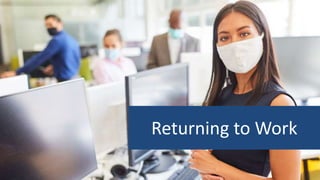
Returning to Work
6
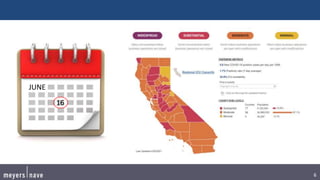
JUNE
16
7
Poll #1
Does your company/organization have
a Return-to-Work plan?
a) Yes
b) No
c) Working on it
d) Haven’t started yet
8
Make a Written Return To Work Plan
Detail:
• Who will be returning
• When will they be returning
• Precautions in place to keep
employees and the public safe
9
Determine Who Returns To Work
Identify:
 Essential services employees
 Mission-critical employees
 Employees who can continue to work from home
Consider:
 Which roles transitioned smoothly to work from home
 Surveying employees
10
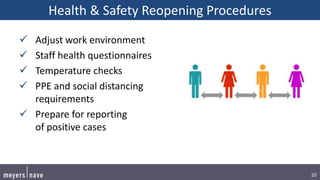
Health & Safety Reopening Procedures
 Adjust work environment
 Staff health questionnaires
 Temperature checks
 PPE and social distancing
requirements
 Prepare for reporting
of positive cases
11
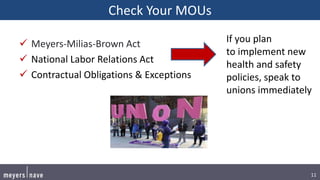
Check Your MOUs
 Meyers-Milias-Brown Act
 National Labor Relations Act
 Contractual Obligations & Exceptions
If you plan
to implement new
health and safety
policies, speak to
unions immediately
12
Remember
• Staff needs time to adapt to new ways of working
post-pandemic.
• Make sure employees understand expectations and steps
taken to protect their health.
• Potential uptick in personnel and compliance complaints.
• Effective communication is essential to:
 re-acclimate an onsite workforce;
 identify potential problems; and,
 strengthen culture, increase employee engagement,
productivity and loyalty.
13
Takeaways For Employers
Key Components: Written Return-to-Work Plan
 Assess needs
 Unionized employers begin meet and confer
 Build trust regarding employee health and safety
 Plan for accommodation, privacy and health & safety
 Lead with empathy
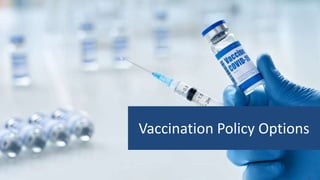
Vaccination Policy Options
15
Poll #2
What type of COVID-19 vaccination policy
does your company/organization?
a) Mandatory
b) Voluntary
c) Incentive Plan
d) We won’t/don’t have a policy
e) We don’t know yet
16
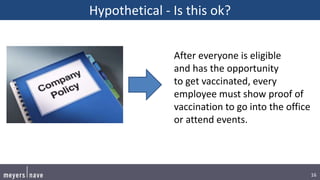
Hypothetical - Is this ok?
After everyone is eligible
and has the opportunity
to get vaccinated, every
employee must show proof of
vaccination to go into the office
or attend events.
17
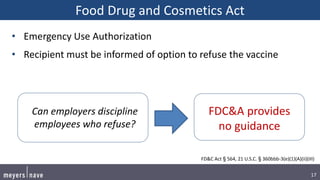
Food Drug and Cosmetics Act
• Emergency Use Authorization
• Recipient must be informed of option to refuse the vaccine
FD&C Act § 564, 21 U.S.C. § 360bbb-3(e)(1)(A)(ii)(III)
FDC&A provides
no guidance
Can employers discipline
employees who refuse?
18
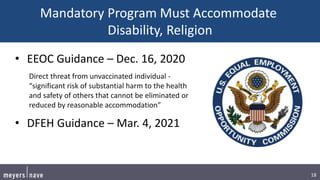
Mandatory Program Must Accommodate
Disability, Religion
• EEOC Guidance – Dec. 16, 2020
Direct threat from unvaccinated individual -
“significant risk of substantial harm to the health
and safety of others that cannot be eliminated or
reduced by reasonable accommodation”
• DFEH Guidance – Mar. 4, 2021
19
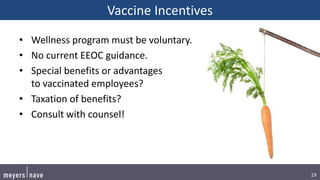
Vaccine Incentives
• Wellness program must be voluntary.
• No current EEOC guidance.
• Special benefits or advantages
to vaccinated employees?
• Taxation of benefits?
• Consult with counsel!
20
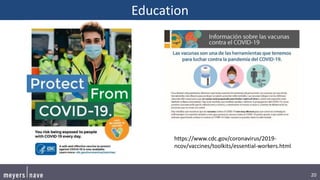
Education
https://www.cdc.gov/coronavirus/2019-
ncov/vaccines/toolkits/essential-workers.html
21
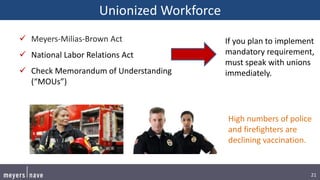
Unionized Workforce
 Meyers-Milias-Brown Act
 National Labor Relations Act
 Check Memorandum of Understanding
(“MOUs”)
High numbers of police
and firefighters are
declining vaccination.
If you plan to implement
mandatory requirement,
must speak with unions
immediately.
22
Additional Vaccine Policy Considerations
 Wage and hour implications
 California Consumer Privacy Act
and privacy considerations
 Employee cooperation
 Impact on recruiting,
business and brand
 Masks/social distancing remain
Employees Who Refuse the Vaccine
or to Return to Work
24
Refusal to Return to Work
Does employee have a protected reason?
• Use “interactive process” approach
• Identify other reasons employee
may have for protected leave
• Document, document, document
25
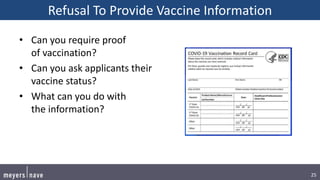
Refusal To Provide Vaccine Information
• Can you require proof
of vaccination?
• Can you ask applicants their
vaccine status?
• What can you do with
the information?
26
Hypothetical
An employee objects to your vaccination program and asks
for an accommodation on the ground that they believe that
the COVID-19 vaccine is dangerous and ineffective.
27
Takeaways For Employers
• Consider the risks of
– discipline or termination of a large number of employees.
– creating multiple individual exceptions that may lead to
litigation.
• Public Agencies: Comply with due process before taking
corrective action against employees as a result of a refusal to
be vaccinated.
Workplace Safety
29
New Cal/OSHA Emergency Temporary COVID-19 Standards
• Nov. 30, 2020 - May 29, 2021
possibly extended
• Written Prevention Plan
• Exclusions:
• 1 employee/no contact
• Working from home
• Cal/OSHA’s Aerosol
Transmissible
Diseases standard
30
SB 1159 – Workers’ Compensation COVID-19 Presumption
• March 19 - July 5, 2020
– Disputable presumption on-the-job injury for all mandatory on-site workers
• July 6, 2020 - January 1, 2023
– Disputable presumption for (1) first responders and health care workers
or (2) “outbreak”
• Outbreak
– 4 + tests if ≤ 100 employees,
– 4% at location if >100 employees, or
– ordered closed due to risk of infection
• Mandatory Reporting to work comp. claims administrator within 3 business days
COVID-19 Leave and Reporting
32
SB 95 - Supplemental Paid Sick Leave
• Effective Jan. 1 – Sep. 30, 2021.
• Paid sick leave for COVID-related
absences in addition to paid time
off benefits
• Public and private employers
with 26 or more employees
Don’t forget:
• Include SPSL on wage
statements
• Training
• Post/Distribute Notice
https://www.dir.ca.gov/dlse/2021-COVID-19-Supplemental-Paid-Sick-Leave.pdf
33
AB 685 - Notice to Employees of Potential COVID-19 Exposure
• Notice Requirements:
 Written
 Within 1 day
 To employees, subcontracted employees,
union rep.
 Information about COVID-19 related benefits
 Disinfection and safety plan
• Recordkeeping – preserve notices for 3 years
• “Outbreak” – notify local public health agency within 48 hours
Prepare ahead!
• Letter
• Gather contact
information
• Training
• How to report
Reducing Liability for Potential Claims
35
Trends In COVID-19 Litigation
• Wrongful Termination
• Workplace Safety
• Paid Sick Leave
• FMLA Leave
• Failure to Accommodate Disabilities
• Wage and Hour Issues/PAGA
Consider Diversity, Equity and Inclusion Impacts
37
Questions Regarding COVID-19 Exposure Risk
• Black/Indigenous/Persons of Color (BIPOC) employees are
disproportionately frontline “essential” workers
• BIPOC communities and preexisting health risks
• Can employees walk/bike to work or face long commutes?
• Consider how policies impact BIPOC employees
38
Takeaways For Employers
 Update policies
 Document, document, document
 Communicate your consideration and empathy while
maintaining employment standards
 Consistent application of the policies
 Consult HR and legal department/counsel early
 Arbitration agreements
 Class action waivers
39
Camille Hamilton Pating
Principal
(510) 808-2000
cpating@meyersnave.com
Arlene Yang
Principal
(619) 330-1700
ayang@meyersnave.com

COVID-19 Return to Work Plan: Who Returns, When, Where & How

  • 1.
    COVID-19 Return toWork Plan: Who Returns, When, Where & How April 28, 2021
  • 2.
    2 Presenters Camille Hamilton Pating Principal (510)808-2000 cpating@meyersnave.com Arlene Yang Principal (619) 330-1700 ayang@meyersnave.com
  • 3.
    3 • The informationin this presentation is subject to change. • This is an informative presentation and not intended as legal advice. • Please consult with an attorney for assistance with a particular issue or problem.
  • 4.
    4 • Returning ToWork • Vaccination Issues • Employees Who Refuse • Workplace Safety • Anticipating Potential COVID-19 Litigation • Diversity, Equity & Inclusion Impacts
  • 5.
  • 6.
  • 7.
    7 Poll #1 Does yourcompany/organization have a Return-to-Work plan? a) Yes b) No c) Working on it d) Haven’t started yet
  • 8.
    8 Make a WrittenReturn To Work Plan Detail: • Who will be returning • When will they be returning • Precautions in place to keep employees and the public safe
  • 9.
    9 Determine Who ReturnsTo Work Identify:  Essential services employees  Mission-critical employees  Employees who can continue to work from home Consider:  Which roles transitioned smoothly to work from home  Surveying employees
  • 10.
    10 Health & SafetyReopening Procedures  Adjust work environment  Staff health questionnaires  Temperature checks  PPE and social distancing requirements  Prepare for reporting of positive cases
  • 11.
    11 Check Your MOUs Meyers-Milias-Brown Act  National Labor Relations Act  Contractual Obligations & Exceptions If you plan to implement new health and safety policies, speak to unions immediately
  • 12.
    12 Remember • Staff needstime to adapt to new ways of working post-pandemic. • Make sure employees understand expectations and steps taken to protect their health. • Potential uptick in personnel and compliance complaints. • Effective communication is essential to:  re-acclimate an onsite workforce;  identify potential problems; and,  strengthen culture, increase employee engagement, productivity and loyalty.
  • 13.
    13 Takeaways For Employers KeyComponents: Written Return-to-Work Plan  Assess needs  Unionized employers begin meet and confer  Build trust regarding employee health and safety  Plan for accommodation, privacy and health & safety  Lead with empathy
  • 14.
  • 15.
    15 Poll #2 What typeof COVID-19 vaccination policy does your company/organization? a) Mandatory b) Voluntary c) Incentive Plan d) We won’t/don’t have a policy e) We don’t know yet
  • 16.
    16 Hypothetical - Isthis ok? After everyone is eligible and has the opportunity to get vaccinated, every employee must show proof of vaccination to go into the office or attend events.
  • 17.
    17 Food Drug andCosmetics Act • Emergency Use Authorization • Recipient must be informed of option to refuse the vaccine FD&C Act § 564, 21 U.S.C. § 360bbb-3(e)(1)(A)(ii)(III) FDC&A provides no guidance Can employers discipline employees who refuse?
  • 18.
    18 Mandatory Program MustAccommodate Disability, Religion • EEOC Guidance – Dec. 16, 2020 Direct threat from unvaccinated individual - “significant risk of substantial harm to the health and safety of others that cannot be eliminated or reduced by reasonable accommodation” • DFEH Guidance – Mar. 4, 2021
  • 19.
    19 Vaccine Incentives • Wellnessprogram must be voluntary. • No current EEOC guidance. • Special benefits or advantages to vaccinated employees? • Taxation of benefits? • Consult with counsel!
  • 20.
  • 21.
    21 Unionized Workforce  Meyers-Milias-BrownAct  National Labor Relations Act  Check Memorandum of Understanding (“MOUs”) High numbers of police and firefighters are declining vaccination. If you plan to implement mandatory requirement, must speak with unions immediately.
  • 22.
    22 Additional Vaccine PolicyConsiderations  Wage and hour implications  California Consumer Privacy Act and privacy considerations  Employee cooperation  Impact on recruiting, business and brand  Masks/social distancing remain
  • 23.
    Employees Who Refusethe Vaccine or to Return to Work
  • 24.
    24 Refusal to Returnto Work Does employee have a protected reason? • Use “interactive process” approach • Identify other reasons employee may have for protected leave • Document, document, document
  • 25.
    25 Refusal To ProvideVaccine Information • Can you require proof of vaccination? • Can you ask applicants their vaccine status? • What can you do with the information?
  • 26.
    26 Hypothetical An employee objectsto your vaccination program and asks for an accommodation on the ground that they believe that the COVID-19 vaccine is dangerous and ineffective.
  • 27.
    27 Takeaways For Employers •Consider the risks of – discipline or termination of a large number of employees. – creating multiple individual exceptions that may lead to litigation. • Public Agencies: Comply with due process before taking corrective action against employees as a result of a refusal to be vaccinated.
  • 28.
  • 29.
    29 New Cal/OSHA EmergencyTemporary COVID-19 Standards • Nov. 30, 2020 - May 29, 2021 possibly extended • Written Prevention Plan • Exclusions: • 1 employee/no contact • Working from home • Cal/OSHA’s Aerosol Transmissible Diseases standard
  • 30.
    30 SB 1159 –Workers’ Compensation COVID-19 Presumption • March 19 - July 5, 2020 – Disputable presumption on-the-job injury for all mandatory on-site workers • July 6, 2020 - January 1, 2023 – Disputable presumption for (1) first responders and health care workers or (2) “outbreak” • Outbreak – 4 + tests if ≤ 100 employees, – 4% at location if >100 employees, or – ordered closed due to risk of infection • Mandatory Reporting to work comp. claims administrator within 3 business days
  • 31.
  • 32.
    32 SB 95 -Supplemental Paid Sick Leave • Effective Jan. 1 – Sep. 30, 2021. • Paid sick leave for COVID-related absences in addition to paid time off benefits • Public and private employers with 26 or more employees Don’t forget: • Include SPSL on wage statements • Training • Post/Distribute Notice https://www.dir.ca.gov/dlse/2021-COVID-19-Supplemental-Paid-Sick-Leave.pdf
  • 33.
    33 AB 685 -Notice to Employees of Potential COVID-19 Exposure • Notice Requirements:  Written  Within 1 day  To employees, subcontracted employees, union rep.  Information about COVID-19 related benefits  Disinfection and safety plan • Recordkeeping – preserve notices for 3 years • “Outbreak” – notify local public health agency within 48 hours Prepare ahead! • Letter • Gather contact information • Training • How to report
  • 34.
    Reducing Liability forPotential Claims
  • 35.
    35 Trends In COVID-19Litigation • Wrongful Termination • Workplace Safety • Paid Sick Leave • FMLA Leave • Failure to Accommodate Disabilities • Wage and Hour Issues/PAGA
  • 36.
    Consider Diversity, Equityand Inclusion Impacts
  • 37.
    37 Questions Regarding COVID-19Exposure Risk • Black/Indigenous/Persons of Color (BIPOC) employees are disproportionately frontline “essential” workers • BIPOC communities and preexisting health risks • Can employees walk/bike to work or face long commutes? • Consider how policies impact BIPOC employees
  • 38.
    38 Takeaways For Employers Update policies  Document, document, document  Communicate your consideration and empathy while maintaining employment standards  Consistent application of the policies  Consult HR and legal department/counsel early  Arbitration agreements  Class action waivers
  • 39.
    39 Camille Hamilton Pating Principal (510)808-2000 cpating@meyersnave.com Arlene Yang Principal (619) 330-1700 ayang@meyersnave.com

Editor's Notes

  • #2 STEPHANIE
  • #3 CAMILLE
  • #4 CAMILLE
  • #5 CAMILLE 1 Returning To Work: determine Who Returns, When, Where & How. What about Accommodation Requirements. Who has to be accommodated regarding RTW and who does not? 2 Vaccination Issues: what will your policy be – mandatory vaccination, vaccination education, asking employees if they have been vaccinated. And how will you act on the vaccination information. 3 Employees Who Refuse: what about employees who refuse to comply with your vaccination requirements or policy. What about employees who refuse to return to work and demand to WFH? 4 Workplace Safety: What are the Requirements, What about Mandated Legal Reporting of COVID at work 5 Anticipating Potential COVID-19 Litigation Diversity, Equity & Inclusion Impacts 6 COVID-19 Employment Litigation Claims 7 Diversity, Equity & Inclusion Impacts
  • #6 ARLENE
  • #7 ARLENE
  • #8 ARLENE
  • #9 CAMILLE Public and private employers will be returning to work in stages with some employees who may continue to work part-time or full time from home for an extended period of time. This new hybrid workplace is like to become the norm over the next several years. Instead of allowing this to happen in a haphazard way, create a written RTW plan, detailing: Who will be returning When will they be returning Precautions in place to keep employees and the public safe Many of these steps will take time, so start planning early
  • #10 CAMILLE Focus on getting employees who really need to be at the job site, in the office or on the work floor back onsite as soon as it is safe and practical to do so Identify: Essential services employees Mission-critical employees Employees who can continue to work from home Consider: Which roles transitioned smoothly to WFH Consider surveying employees, especially the group who can continue to WFH, to determine who wants to return, who does not want to return and who has medical or childcare issues that they believe prevents their return.
  • #11 CAMILLE Adjust work environment for health and safety reception areas workstation areas conference and collaboration areas ancillary spaces training rooms Provide PPE: masks, gloves, sanitizer stations, cleaning supplies and any other and any other PPE needed for workplace Provide for daily Health checks: the CDC and CalOSHA recommend that all employers consider some kind of health check for all employees coming in the workplace other than home. Several Counties have issued Health Orders instructing all employers to create policies that require employees to complete a health check b4 coming into the office Temperature checks and COVID 19 Tests: Employers are allowed to conduct temperature checks and to require employees to take COVID 19 tests at employers expense. Employers should plan for positive COVID 19 testing –AB 685 – which I discussed later in this program
  • #12 CAMILLE
  • #13 CAMILLE
  • #14 CAMILLE
  • #15 ARLENE
  • #16 ARLENE
  • #17 ARLENE
  • #18 ARLENE
  • #19 ARLENE Title VII of the Civil Rights Act – sincerely held religious belief Americans with Disability Act Reasonable Accommodations Interactive Process Undue Hardship What if objection is not based on religion or disability?
  • #20  OUT? expected to issue guMandatory = 30% health ins. discount (AARP v. U.S.EEOC, 267 F. Supp.3d 29 (D.D.C. 2017) Voluntary = water bottle or gift card (proposed ADA regs. 29 CFR Part 1630) https://www.eeoc.gov/regulations/proposed-rule-amendments-regulations-under-americans-disabilities-act#
  • #21  Arlene is this OUT
  • #22 ARLENE/CAMILLE Jacobson v. Massachusetts, 197 U.S. 12 (1905) - states have the police power to mandate vaccinations. Firefighters and police
  • #24 CAMILLE
  • #25 When you contact employees to return to work, it is possible they will not want to return for various reasons. Employers must take a measured and documented approach to make sure employees do not have a protected reason to refuse to return. Example: employees who refuse to return bc they believe employer hasn’t done enough to protect against COVID 19 exposure may be protected as union concerted activity. Be reasonable when discussing concerns held by employees and approach these questions in the same manner as good faith interactive process. This is not legally required but it is a good way to document that the employer has acted reasonably to determine that the employee does not have reasonable grounds to refuse to return to work. NOTE: this interactive RTW conversation may reveal other reasons the employee may have to take protected leave, such as voluntary FFCRA leave through September 30th, FMLA or CFRA leave, or other accommodations under FEHA and ADA. Employees who are on unemployment will no longer qualify if they refuse to RTW.
  • #26 CAMILLE Employers who want to ensure a safe and smooth reentry into the workplace may want to know whether their employees have been vaccinated. The public and co-workers may want to know whether those they’re interacting with have been vaccinated. 1. Can you require proof of vaccination? YES. Can you Ask? YES, But Employers under have the right (according to the EEOC, under federal law) to require the COVID-19 vaccine, and to ask employees if they received the shot (vaccine status) or request proof of the shot. But keep in mind that only federal law has spoken on this matter. State law may further regulate whether an employer may require or mandate COVID-19 vaccination or proof of vaccination. State legislation will supersede federal guidance. 2. When an employee has not been vaccinated, employers must be careful not to ask why, particularly in situations in which vaccinations are voluntary and not required for the job. This can lead to a medical inquiry protected under the ADA. Medical inquiries are only permitted where they are necessary for the job. Employers may require employees to provide proof of vaccination but cannot mandate that the employee provide any additional medical information as part of the proof. 3. What can you do with the information?-ADA protected information. Must be kept separate from personnel files – same with lists of who is vaccinated
  • #27 CAMILLE: Must be religious belief – same with view s against wearing masks or other PPE
  • #28 CAMILLE
  • #29 ARLENE
  • #30 ARLENE Written, detailed COVID-19 Prevention Plan, including: Communicating system ID and evaluation of hazards Investigation and response to cases Correcting hazards Return to work criteria Recording requirement Testing and notification
  • #31 ARLENE
  • #32 ARLENE
  • #33 ARLENE
  • #34 ARLENE Policies, advice and counsel for implementation Update your handbook Train managers and supervisors Minimize and limit risk
  • #35 ARLENE
  • #36 ARLENE
  • #37 CAMILLE
  • #38 CAMILLE CDC Data indicates an increased risk of COVID-19 infection in Black populations, which ranged from 1.5 to 3.5 times higher than the risk for white people. Studies that evaluated hospitalization rates found a similar disparity. Excess death rate compares the percentage of COVID-19 deaths among African Americans to their percentage in the US population. This data showed a 15% excess death rate for Black Americans. CDC data were less conclusive for Hispanic people because rates varied by geographic location but showed moderate disproportionately high infection and hospitalization rates. The excess death for Hispanic COVID patients was 21%.
  • #39 CAMILLE/ARLENE