Business opportunities in Ludhiana The phenomenal growth of industry in Ludhiana is emulated as a role model across India. The textiles and hosiery are the main industries, which the major part of the Ludhiana’s population depend upon. The other key industries are however, cycle manufacturers, manufacturer of the cycle parts, sewing machine manufacturers, auto parts manufacturers, machine tools manufacturers, manufacturers of electronic goods, tyres and tubes industries. Among the other major industries there are industries of vanaspathi, beer, sugar, flour, rice, rice bran oil, and even cattle foods makers. At the moment Ludhiana and the rest of the Punjab fall within the jurisdiction of Small Scale Service Institution, Ludhiana – known to SISI for short. SISI of Ludhiana provides several services for new and up coming entrepreneurs. The list of some of the valued programs of SISI includes “Entrepreneurship Development Programs – EDP for short”, “Specialized Training Programs”, “Intensive Motivational Campaigns” and etc.
Entrepreneurship Harleen Mahajan
Enterprise   involves measures to encourage individuals to become entrepreneurs and equip them with the necessary skills to make a business successful   Entrepreneurship   is an activity which leads to the creation and management of a new organisation designed to pursue a unique, innovative opportunity  Intrapreneurship is the art of working within an organisation to effect change, by developing new ideas, procedures or products, by innovating practice and thereby enhancing the business  Registered Office The address where a company is officially registered with the Register of Companies. (Not necessarily the trading address). SME Small and Medium-sized Enterprise. The technical definition covers companies that have less than 250 employees, (50 for a small business) and are less than 25% foreign owned.  Glossary of Entrepreneurship-related Terms
Classroom Policies Attendance will not be marked if the student is late by more than 5 min in the class. 75 % of the attendance is required to appear in the final exams. Late assignments will not be accepted.  All the topics of presentation are already in the mail so 100 % attendance is required on presentation day. No make up test will be there for Hourly’s and MSE’s. The 100 marks of the project will be awarded only if the project will be according to this course and other instructions .
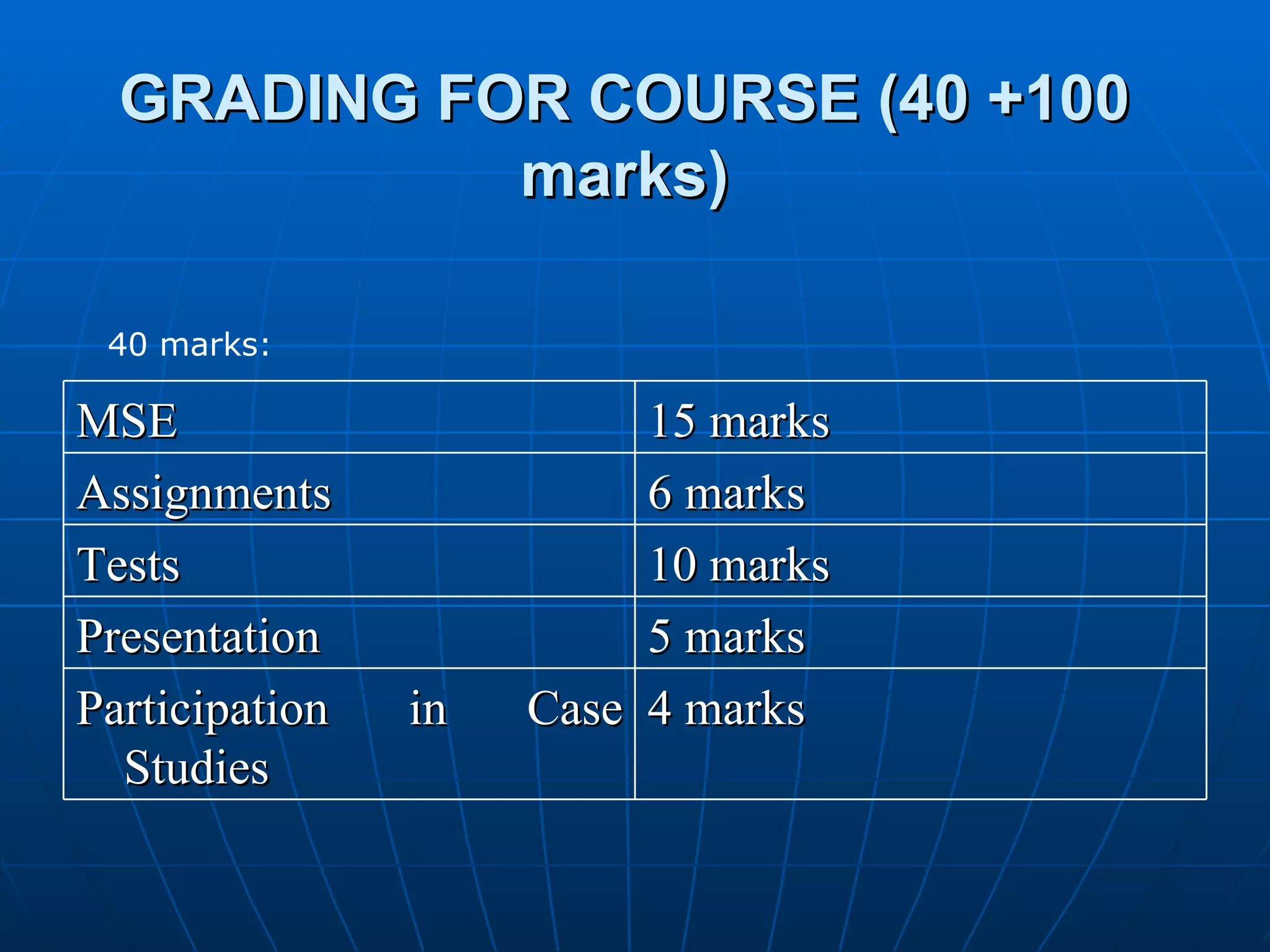
GRADING FOR COURSE (40 +100 marks) 40 marks: MSE 15 marks Assignments 6 marks Tests 10 marks Presentation 5 marks Participation in Case Studies 4 marks
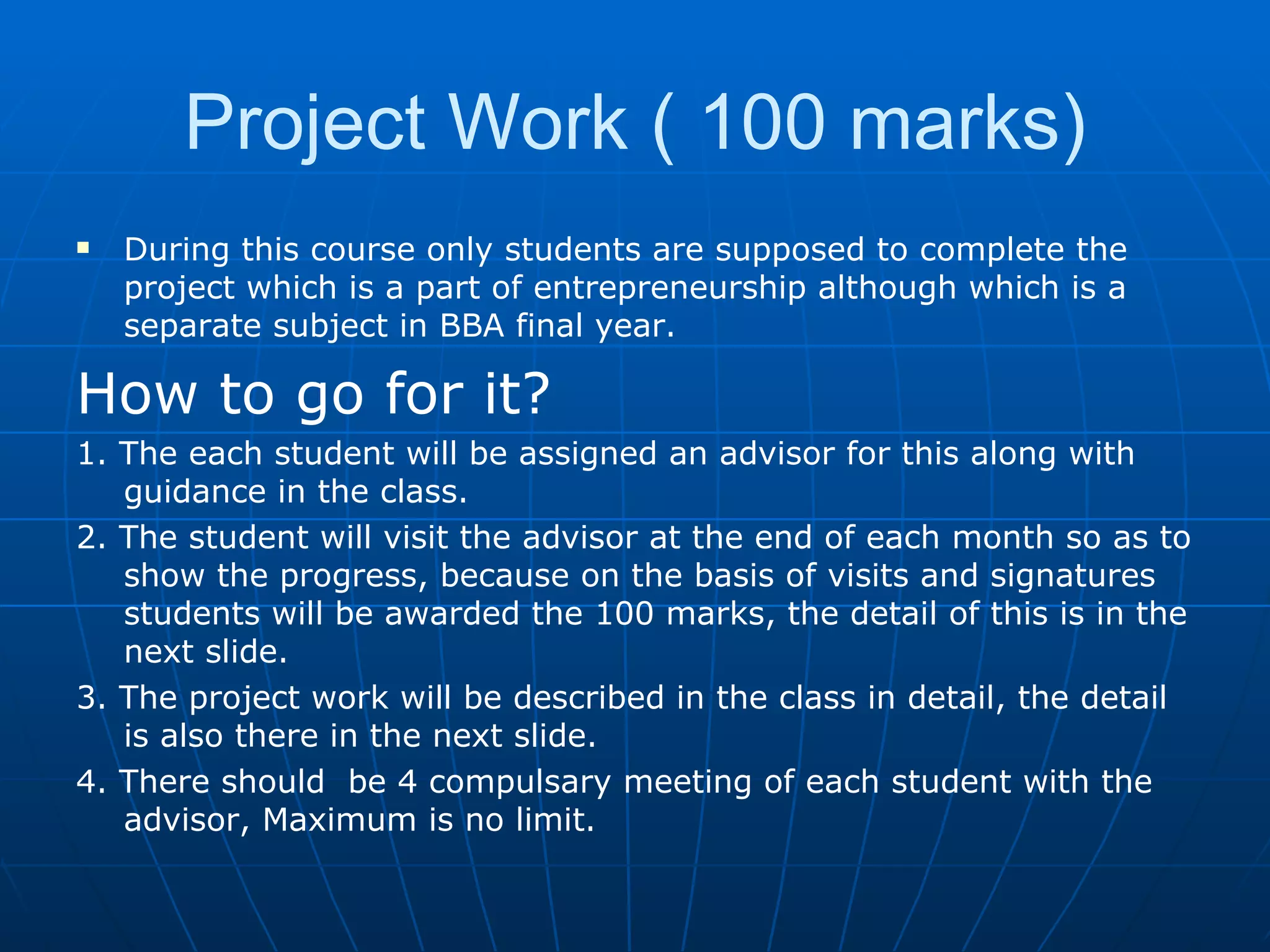
Project Work ( 100 marks) During this course only students are supposed to complete the project which is a part of entrepreneurship although which is a separate subject in BBA final year. How to go for it? 1. The each student will be assigned an advisor for this along with guidance in the class. 2. The student will visit the advisor at the end of each month so as to show the progress, because on the basis of visits and signatures students will be awarded the 100 marks, the detail of this is in the next slide. 3. The project work will be described in the class in detail, the detail is also there in the next slide. 4. There should  be 4 compulsary meeting of each student with the advisor, Maximum is no limit.
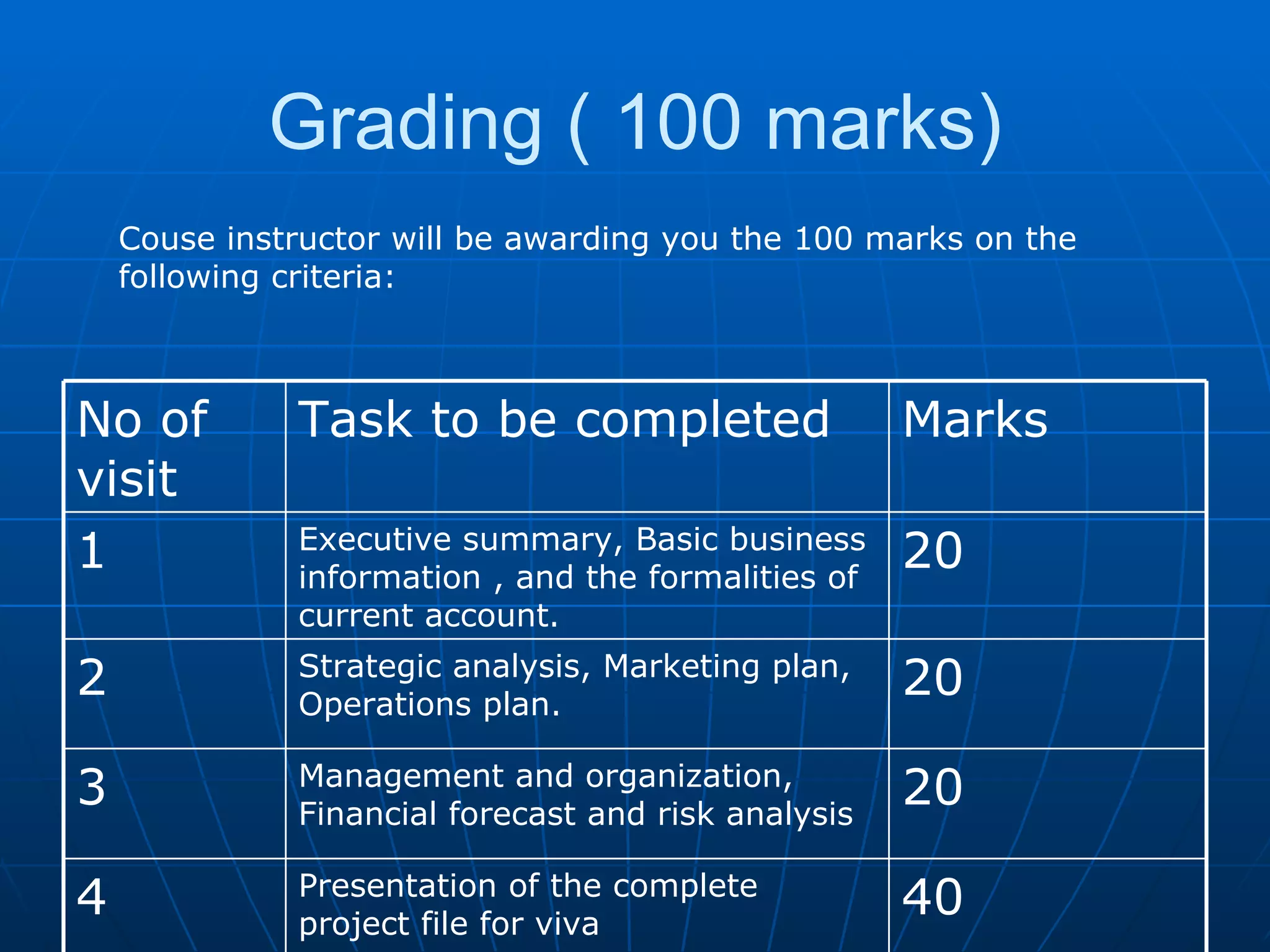
Grading ( 100 marks) Couse instructor will be awarding you the 100 marks on the following criteria: 40 Presentation of the complete project file for viva 4 20 Management and organization, Financial forecast and risk analysis 3 20 Strategic analysis, Marketing plan, Operations plan. 2 20 Executive summary, Basic business information , and the formalities of current account. 1 Marks Task to be completed No of visit
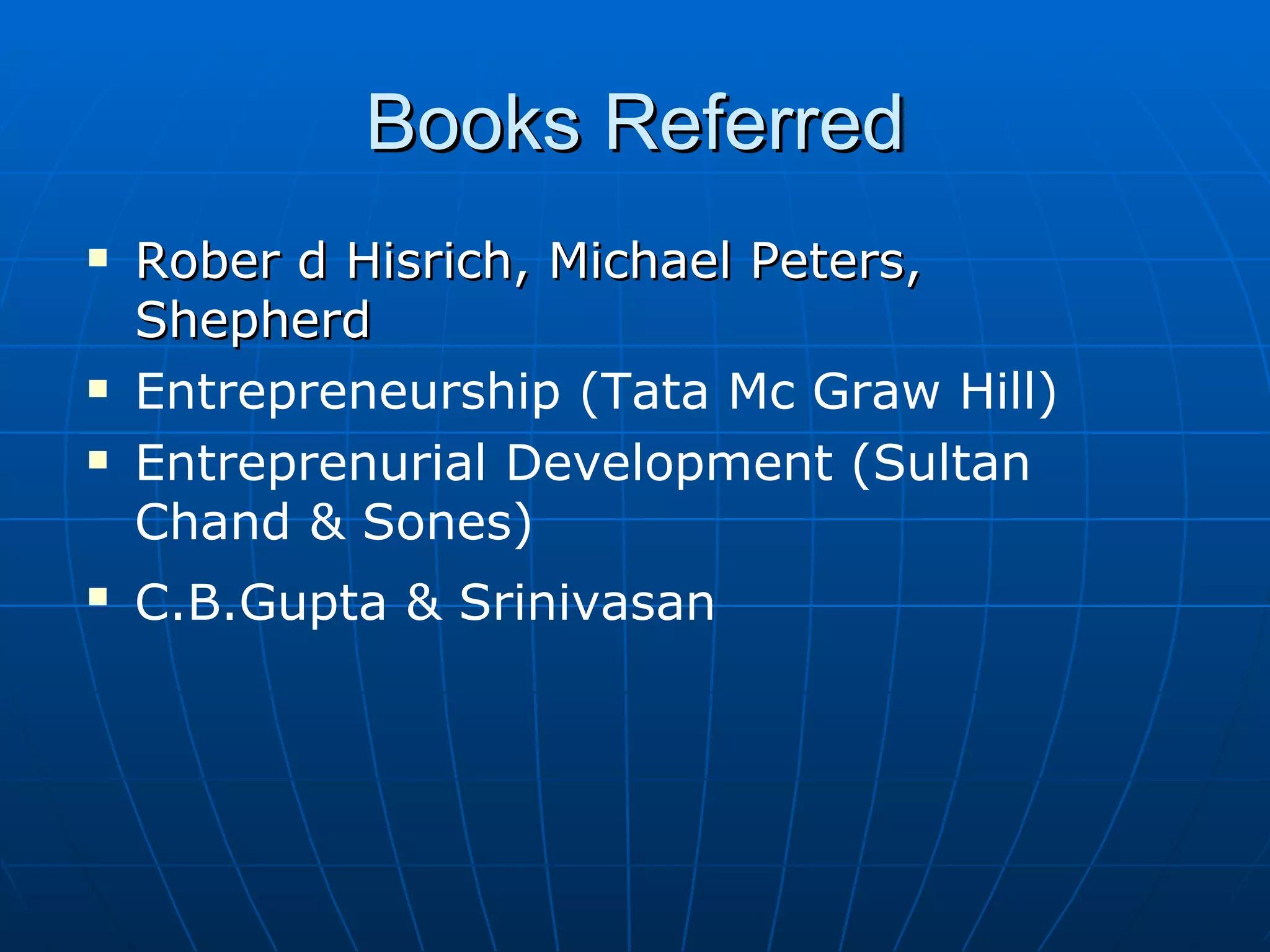
Books Referred Rober d Hisrich, Michael Peters, Shepherd   Entrepreneurship (Tata Mc Graw Hill)  Entreprenurial Development (Sultan Chand & Sones) C.B.Gupta & Srinivasan
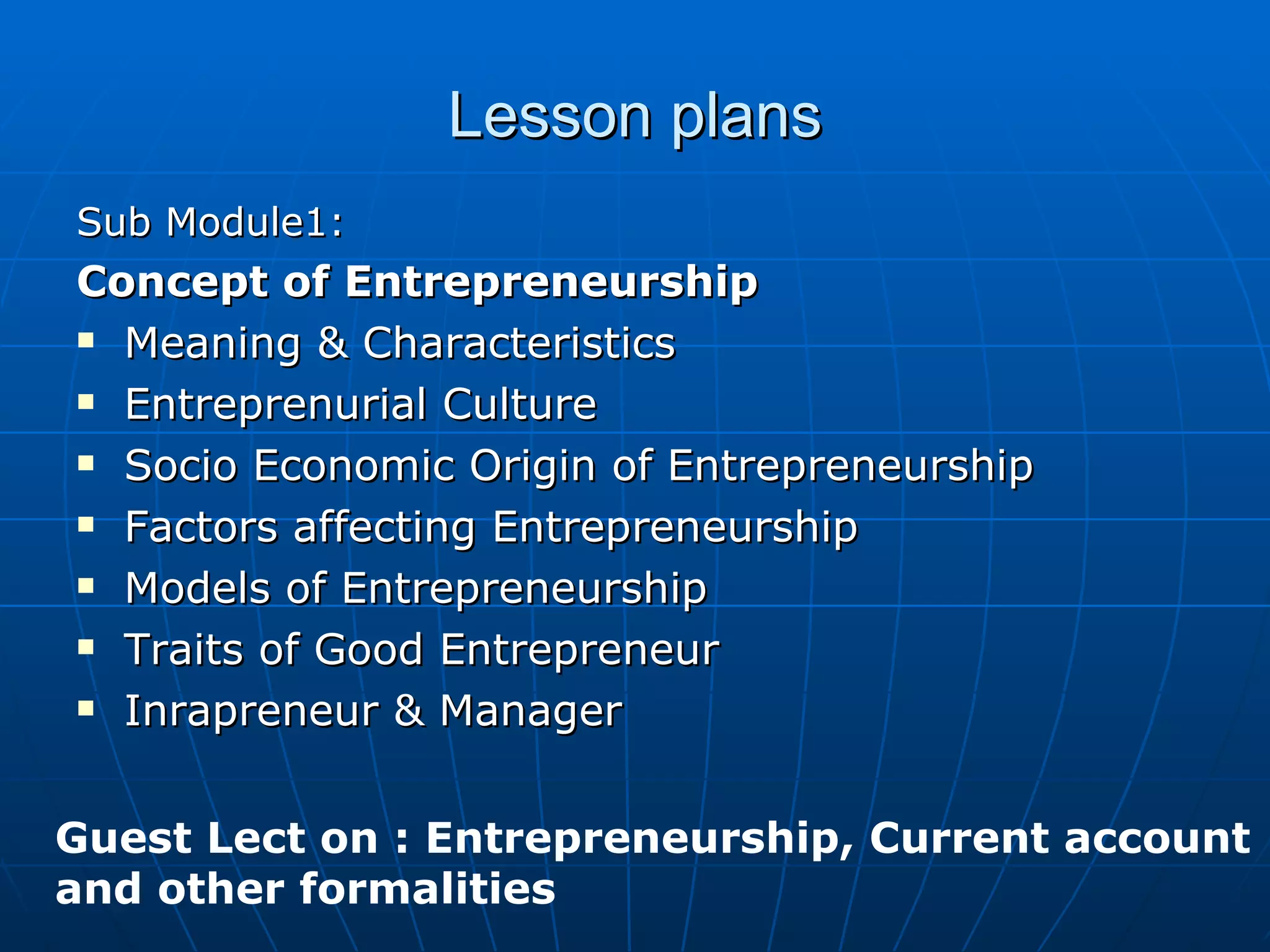
Lesson plans Sub Module1: Concept of Entrepreneurship Meaning & Characteristics Entreprenurial Culture Socio Economic Origin of Entrepreneurship Factors affecting Entrepreneurship Models of Entrepreneurship Traits of Good Entrepreneur Inrapreneur & Manager Guest Lect on : Entrepreneurship, Current account and other formalities
Sub Module 2 Contents: Establishment of Entrepreneurial systems Search, Processing and selection of Idea Input Requirements Small Scale Industry Meaning, Importance, Characteristics Problems of SSIs Steps for starting small industry Guidelines for project report Registration as SSI Guest Lect on : Sources of Loans and other finances
Sub Module 3 Entreprenurial Motivation Motivating Factors Compelling & Facilitating Factors Entreprenurial ambition Achievement Motivation Theory Kakinada Experiment Guest Lect on Entrepreneurship motivation and challenges
Sub Module 4 Assistance to SSI Need for incentives & subsidies Need for institutional support Role of govt. & other institutions  Guest Lect on Various incentives, schemes and benefits for small scale industries in India
Assignments Ask 5 entrepreneurs that what the term entrepreneurship mean to them and from where they have got the business idea. Then they are supposed to bring out the commonalities and difference in the definition along with the sources of the ideas. To fulfill all the requirements to open up a current account i.e identification proof, residence proof, companies letter head with the stamp, along with the form. Students will be asked to make a group of 5 each and take part in the exhibition for students in which they will be having their stall and they have to earn profit by trading some unique items to the college students. Create the logo for the new company by visiting the online resources available. Create the visiting card of yours as the proprietary  firm by using the online resource.
Presentation Topics B plan being made by the individuals with the stages being completed till the time of presentation. (Essential requirement: Signature of the advisor on the project file, otherwise the presentation will not be taken.)

Course module entrepreneurship

  • 1.
    Business opportunities inLudhiana The phenomenal growth of industry in Ludhiana is emulated as a role model across India. The textiles and hosiery are the main industries, which the major part of the Ludhiana’s population depend upon. The other key industries are however, cycle manufacturers, manufacturer of the cycle parts, sewing machine manufacturers, auto parts manufacturers, machine tools manufacturers, manufacturers of electronic goods, tyres and tubes industries. Among the other major industries there are industries of vanaspathi, beer, sugar, flour, rice, rice bran oil, and even cattle foods makers. At the moment Ludhiana and the rest of the Punjab fall within the jurisdiction of Small Scale Service Institution, Ludhiana – known to SISI for short. SISI of Ludhiana provides several services for new and up coming entrepreneurs. The list of some of the valued programs of SISI includes “Entrepreneurship Development Programs – EDP for short”, “Specialized Training Programs”, “Intensive Motivational Campaigns” and etc.
  • 2.
  • 3.
    Enterprise involves measures to encourage individuals to become entrepreneurs and equip them with the necessary skills to make a business successful Entrepreneurship is an activity which leads to the creation and management of a new organisation designed to pursue a unique, innovative opportunity Intrapreneurship is the art of working within an organisation to effect change, by developing new ideas, procedures or products, by innovating practice and thereby enhancing the business Registered Office The address where a company is officially registered with the Register of Companies. (Not necessarily the trading address). SME Small and Medium-sized Enterprise. The technical definition covers companies that have less than 250 employees, (50 for a small business) and are less than 25% foreign owned. Glossary of Entrepreneurship-related Terms
  • 4.
    Classroom Policies Attendancewill not be marked if the student is late by more than 5 min in the class. 75 % of the attendance is required to appear in the final exams. Late assignments will not be accepted. All the topics of presentation are already in the mail so 100 % attendance is required on presentation day. No make up test will be there for Hourly’s and MSE’s. The 100 marks of the project will be awarded only if the project will be according to this course and other instructions .
  • 5.
    GRADING FOR COURSE(40 +100 marks) 40 marks: MSE 15 marks Assignments 6 marks Tests 10 marks Presentation 5 marks Participation in Case Studies 4 marks
  • 6.
    Project Work (100 marks) During this course only students are supposed to complete the project which is a part of entrepreneurship although which is a separate subject in BBA final year. How to go for it? 1. The each student will be assigned an advisor for this along with guidance in the class. 2. The student will visit the advisor at the end of each month so as to show the progress, because on the basis of visits and signatures students will be awarded the 100 marks, the detail of this is in the next slide. 3. The project work will be described in the class in detail, the detail is also there in the next slide. 4. There should be 4 compulsary meeting of each student with the advisor, Maximum is no limit.
  • 7.
    Grading ( 100marks) Couse instructor will be awarding you the 100 marks on the following criteria: 40 Presentation of the complete project file for viva 4 20 Management and organization, Financial forecast and risk analysis 3 20 Strategic analysis, Marketing plan, Operations plan. 2 20 Executive summary, Basic business information , and the formalities of current account. 1 Marks Task to be completed No of visit
  • 8.
    Books Referred Roberd Hisrich, Michael Peters, Shepherd Entrepreneurship (Tata Mc Graw Hill) Entreprenurial Development (Sultan Chand & Sones) C.B.Gupta & Srinivasan
  • 9.
    Lesson plans SubModule1: Concept of Entrepreneurship Meaning & Characteristics Entreprenurial Culture Socio Economic Origin of Entrepreneurship Factors affecting Entrepreneurship Models of Entrepreneurship Traits of Good Entrepreneur Inrapreneur & Manager Guest Lect on : Entrepreneurship, Current account and other formalities
  • 10.
    Sub Module 2Contents: Establishment of Entrepreneurial systems Search, Processing and selection of Idea Input Requirements Small Scale Industry Meaning, Importance, Characteristics Problems of SSIs Steps for starting small industry Guidelines for project report Registration as SSI Guest Lect on : Sources of Loans and other finances
  • 11.
    Sub Module 3Entreprenurial Motivation Motivating Factors Compelling & Facilitating Factors Entreprenurial ambition Achievement Motivation Theory Kakinada Experiment Guest Lect on Entrepreneurship motivation and challenges
  • 12.
    Sub Module 4Assistance to SSI Need for incentives & subsidies Need for institutional support Role of govt. & other institutions Guest Lect on Various incentives, schemes and benefits for small scale industries in India
  • 13.
    Assignments Ask 5entrepreneurs that what the term entrepreneurship mean to them and from where they have got the business idea. Then they are supposed to bring out the commonalities and difference in the definition along with the sources of the ideas. To fulfill all the requirements to open up a current account i.e identification proof, residence proof, companies letter head with the stamp, along with the form. Students will be asked to make a group of 5 each and take part in the exhibition for students in which they will be having their stall and they have to earn profit by trading some unique items to the college students. Create the logo for the new company by visiting the online resources available. Create the visiting card of yours as the proprietary firm by using the online resource.
  • 14.
    Presentation Topics Bplan being made by the individuals with the stages being completed till the time of presentation. (Essential requirement: Signature of the advisor on the project file, otherwise the presentation will not be taken.)