Careers and Personal
Development
Course Handbook
Please keep this document safe to
support you with your studies.
We would like to welcome you to the Careers and
Personal Development course.
The purpose of this handbook is to outline the structure
of the course and to introduce you to Fareham College.
To help with your induction into the programme we’ve
included a list of “who’s who” under the title of college
structure at the back of the booklet.
We hope that you enjoy the course and find it interesting
and rewarding.
The emphasis on this course is in learner participation
and personal development. We also stress that proper
time keeping, interpersonal skills and team work are
essential as these are all qualities needed in achieving
your short, medium and long term goals.
Although this may sound daunting and very different from
your previous learning experiences, we promise to assist
you in any way we can to achieve your goals.
Sharlene Lawrence is the Course Leader for this L1
course, please contact her with any concerns or for further
information if requires
013 2981 5263
Sharlene.lawrence@fareham.ac.uk
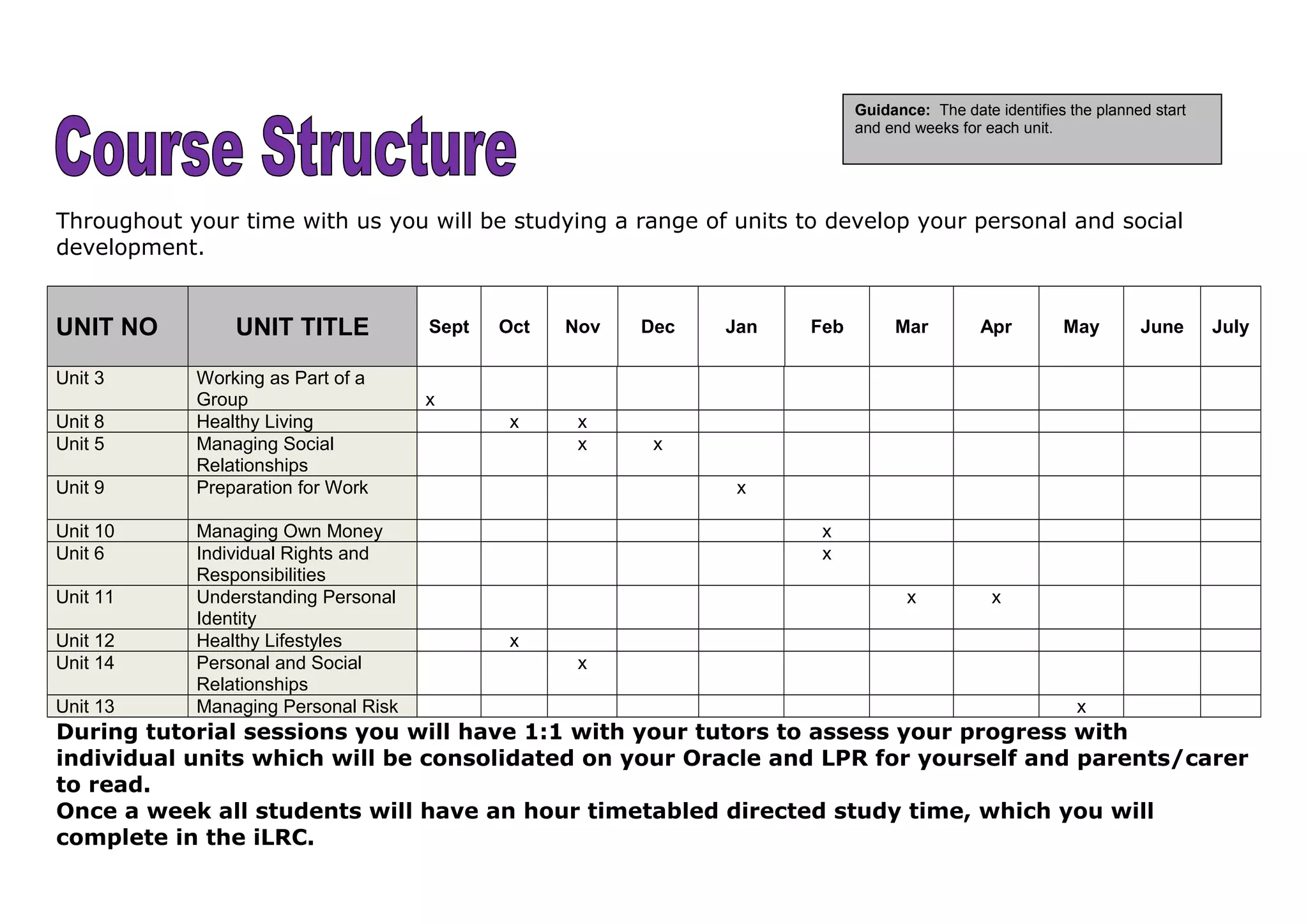
Throughout your time with us you will be studying a range of units to develop your personal and social
development.
UNIT NO UNIT TITLE Sept Oct Nov Dec Jan Feb Mar Apr May June July
Unit 3 Working as Part of a
Group x
Unit 8 Healthy Living x x
Unit 5 Managing Social
Relationships
x x
Unit 9 Preparation for Work x
Unit 10 Managing Own Money x
Unit 6 Individual Rights and
Responsibilities
x
Unit 11 Understanding Personal
Identity
x x
Unit 12 Healthy Lifestyles x
Unit 14 Personal and Social
Relationships
x
Unit 13 Managing Personal Risk x
During tutorial sessions you will have 1:1 with your tutors to assess your progress with
individual units which will be consolidated on your Oracle and LPR for yourself and parents/carer
to read.
Once a week all students will have an hour timetabled directed study time, which you will
complete in the iLRC.
Guidance: The date identifies the planned start
and end weeks for each unit.
We expect certain behaviour to be followed to make your learning and
the learning of your peers more enjoyable. We also expect a certain
level of behaviour that reflects your future ambitions as professionals.
This is why the following rules must be adhered to:
• Mobile phones must be on silent or switched off in class unless
discussed previously with lecturer
• Do not bring food into the lecture areas
• Do not wear headphones unless agreed with your lecturer
• All personal items such as bags and coats should be stowed
appropriately in lecture rooms, Using hall hooks where available
• Health and Safety should be adhered to at all times, e.g. no
standing on tables
• Abusive, foul or discriminatory language to either lecturing staff or
your peers will not be accepted and may constitute bullying. If this
occurs disciplinary procedures may be instigated by the faculty
• Although you can meet other learners in the campus areas between
the blocks we must remind you that people in surrounding areas can
hear you. You must refrain from shouting or using abusive and
discriminatory language while on the campus. Non Fareham College
students should not be on the campus.
• Please see your vision and commitments displayed in the corridor.
We have a commitment to providing you with any extra support you
might need, to assist you in completing your studies, from printing your
hand-outs on colour paper, or arranging a Learning Support Assistant to
help you in lectures.
Please speak to your personal tutor or course leader if you think you
need any extra help. This team is based in the iLRC. There is also a study
centre available to support you with your studies, this is a quiet study
area for you to drop into, this is also within the iLRC.
If you need any assistance with finance we have a Student Services team
who can help. We also have a confidential counselling service you can use
if there’s anything you want to talk about, that you don’t want, or feel
comfortable discussing with your personal tutor.
If you ask at main reception, they’ll point you in the right direction.
In the event of you having to be absent, you or your legal guardian must
contact the faculty administration officer on 013 2981 5200 by 9am. You
must also provide either the administration officer or your course tutor
with a letter from your legal guardian confirming this if you are under the
age of 18. Your attendance will be strictly
monitored throughout your studies.
Your college timetable will indicate what times your breaks will be
throughout your studies.
You can use either of the restaurants that are located on the ground floor
of C Building.
You need to make sure you are not late back from
your breaks. If you are late you may miss valuable
information. You may also risk disciplinary action if
you are persistently late to lessons.
Some of you will choose to work with children or vulnerable adults on the
course. If this is the case, you must have a DBS (Disclosure and Barring
Service) check before going on work placement in Childcare or Health
and Social Care settings.
Although the DBS aim to complete their checks within 10 days to 4
weeks, it can take more time depending on demand. Therefore it is
imperative that you follow the DBS application process carefully.
A DBS application form will be provided for you during induction. You will
need to provide the evidence for your disclosure before we allow you to
go out into placement.
You will be expected to attend a day in another department or participate
in a voluntary work placement one day a week. It is important for you to
remember you may be working with members of the public, children/
vulnerable adults or other college students therefore it is important you
are a good role model.
Your day in department is to get a taster of what it you might do if you
were to enrol on the course and whether it is not the right area for you.
If you are unable to attend your department day you must notify the
college by 9.00am.
Please make yourself familiar with the policies about conduct whilst on
college campus. These are available on the Oracle. Please remember you
have signed your learner agreement to declare you will adhere to these.
The work you do during your course may be assessed in a variety of
manners including written essays, exams, presentations, role plays and
portfolios as appropriate.
It is important that you submit the work as requested by your lecturers
on time, as failure to do so can result in you falling behind or even
disciplinary procedures being implemented. It is therefore extremely
important that any concerns you have over assignment work is discussed
with the lecturer who is handing out the assignment as soon as possible.
Days before submission will not be accepted.
Throughout the course you will have a variety of formative assessment
deadlines to meet. Please look at the tutorial notice board for hand in
dates for your coursework and ensure you are regularly checking your
emails and Oracle.
College policy states there is a three week turn around on submitting and
marking coursework. You will receive your coursework back with clear
feedback on what you have achieved and what may still need editing.
You will also complete homework tasks which will support you with your
studies and prepare you for future lessons and any potential exams.
Please treat your homework the same as coursework tasks. Failure to
complete will possibly lead to disciplinary procedures.
Extensions of up to two weeks may be granted in exceptional cases (e.g.
ill-health or learning difficulty or disability) when appropriate evidence
(e.g. a medical certificate) has been provided and negotiation has taken
place. An extension can only be granted once the reasons are discussed
with your lecturer. Paperwork will be completed for this to show the
awarding body.
If you do not agree with the assessment decision of the person marking
your work, you can appeal. A slightly abridged version of the assessment
appeals procedure can be found on Oracle
Please ensure you keep all homework tasks and notes in an organised
manner as these can be used within your coursework submissions.
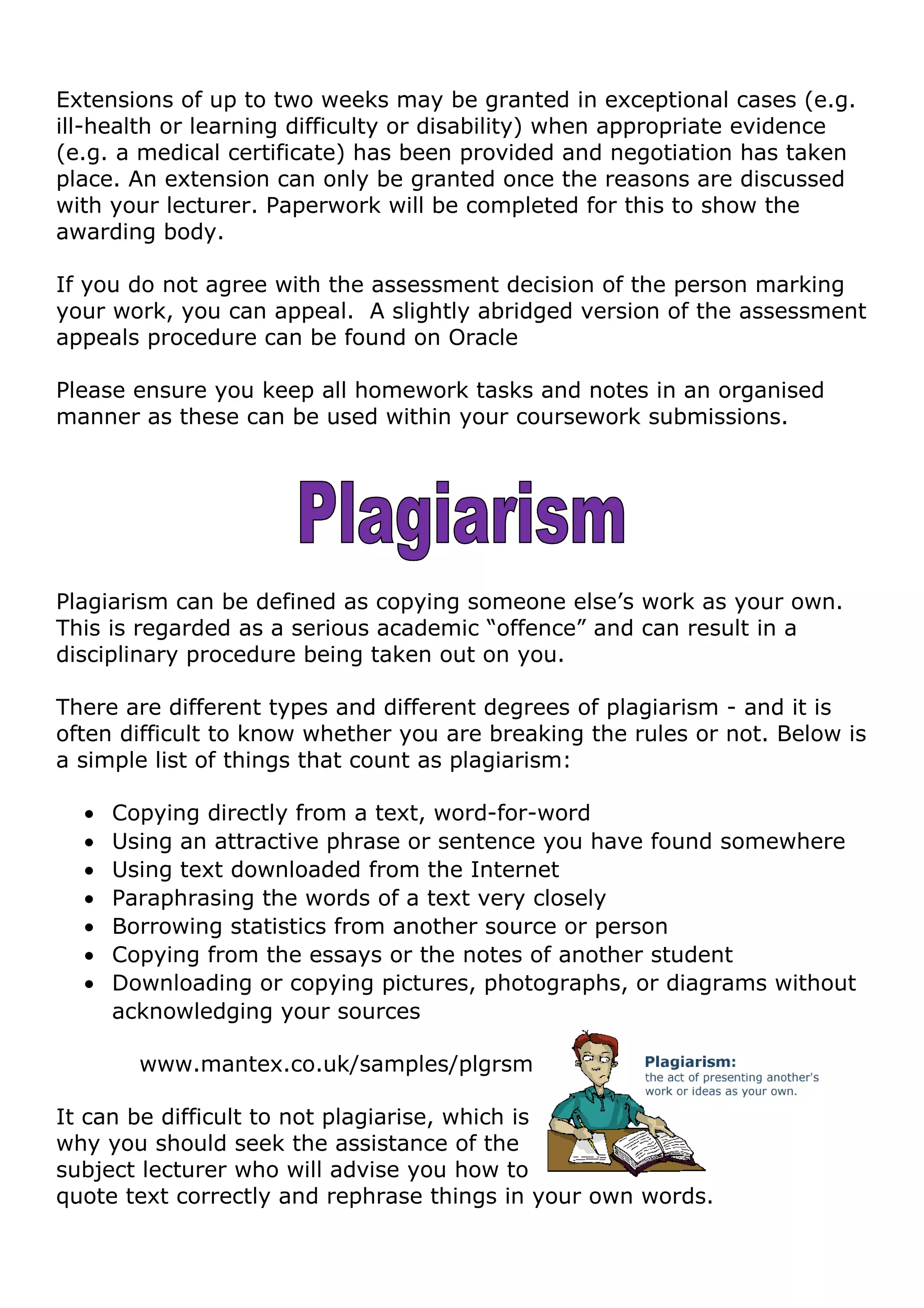
Plagiarism can be defined as copying someone else’s work as your own.
This is regarded as a serious academic “offence” and can result in a
disciplinary procedure being taken out on you.
There are different types and different degrees of plagiarism - and it is
often difficult to know whether you are breaking the rules or not. Below is
a simple list of things that count as plagiarism:
• Copying directly from a text, word-for-word
• Using an attractive phrase or sentence you have found somewhere
• Using text downloaded from the Internet
• Paraphrasing the words of a text very closely
• Borrowing statistics from another source or person
• Copying from the essays or the notes of another student
• Downloading or copying pictures, photographs, or diagrams without
acknowledging your sources
www.mantex.co.uk/samples/plgrsm
It can be difficult to not plagiarise, which is
why you should seek the assistance of the
subject lecturer who will advise you how to
quote text correctly and rephrase things in your own words.
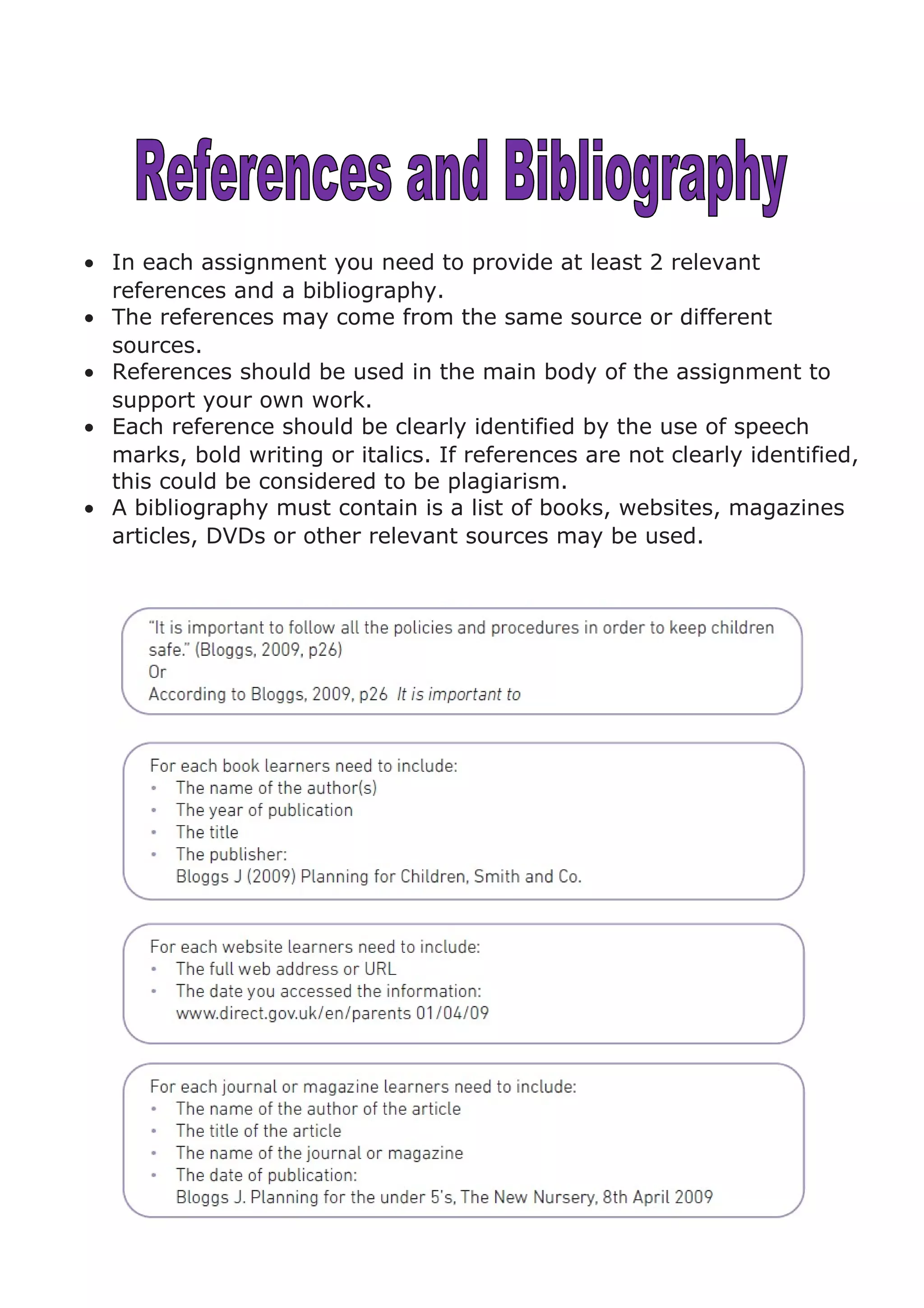
• In each assignment you need to provide at least 2 relevant
references and a bibliography.
• The references may come from the same source or different
sources.
• References should be used in the main body of the assignment to
support your own work.
• Each reference should be clearly identified by the use of speech
marks, bold writing or italics. If references are not clearly identified,
this could be considered to be plagiarism.
• A bibliography must contain is a list of books, websites, magazines
articles, DVDs or other relevant sources may be used.
Every week you will have tutorial sessions with your personal tutor.
Tutorials happen as a group and on a 1:1 basis. During tutorials you will
be exploring a range of topics to assist you with your studies, but also
everyday life skills. Your 1:1 tutorials will be recorded on Oracle for you
and your parents/carers/guardians to access at any time.
From observing your performance in both placement and college, we will
be able to put the correct support in place for you should you require it.
If at any time you feel you are struggling, it is important you inform your
tutor so we can be there to support you, or refer you if we need to.
LPR’s
Fareham College believe it is important to work in partnership with
yourselves and your family, for you to get the best out of your course.
You will have regular 1:1 to discuss your performance which will
transform into your Learner Progress Review (LPR).
Every term an LPR will be produced for your family to read so they are
able to see how you are performing on your course. The LPR’s are made
in conjunction with you so you know what is written. If you are over the
age of 18 these LPR’s will be sent directly to you.
Fareham College 013 2981 5200
Faculty Office – Attendance Line 013 2981 5200 – option 1
iLRC 013 2981 5322
HCEY Department Staff Office 013 2981 5167
Head of Department - Michelle Young 013 2981 5325
michelle.young@fareham.ac.uk
• 1x A4 level arch files for placement portfolio and coursework
• Pens/highlighters
• Paper
• Memory stick to save work
• Plastic wallets to hand work in
• Dividers x 10
You are welcome to bring your own laptop to use in college; however this
will be your responsibility to keep safe. These will also require you to
have this PAT tested for health and safety purposes.
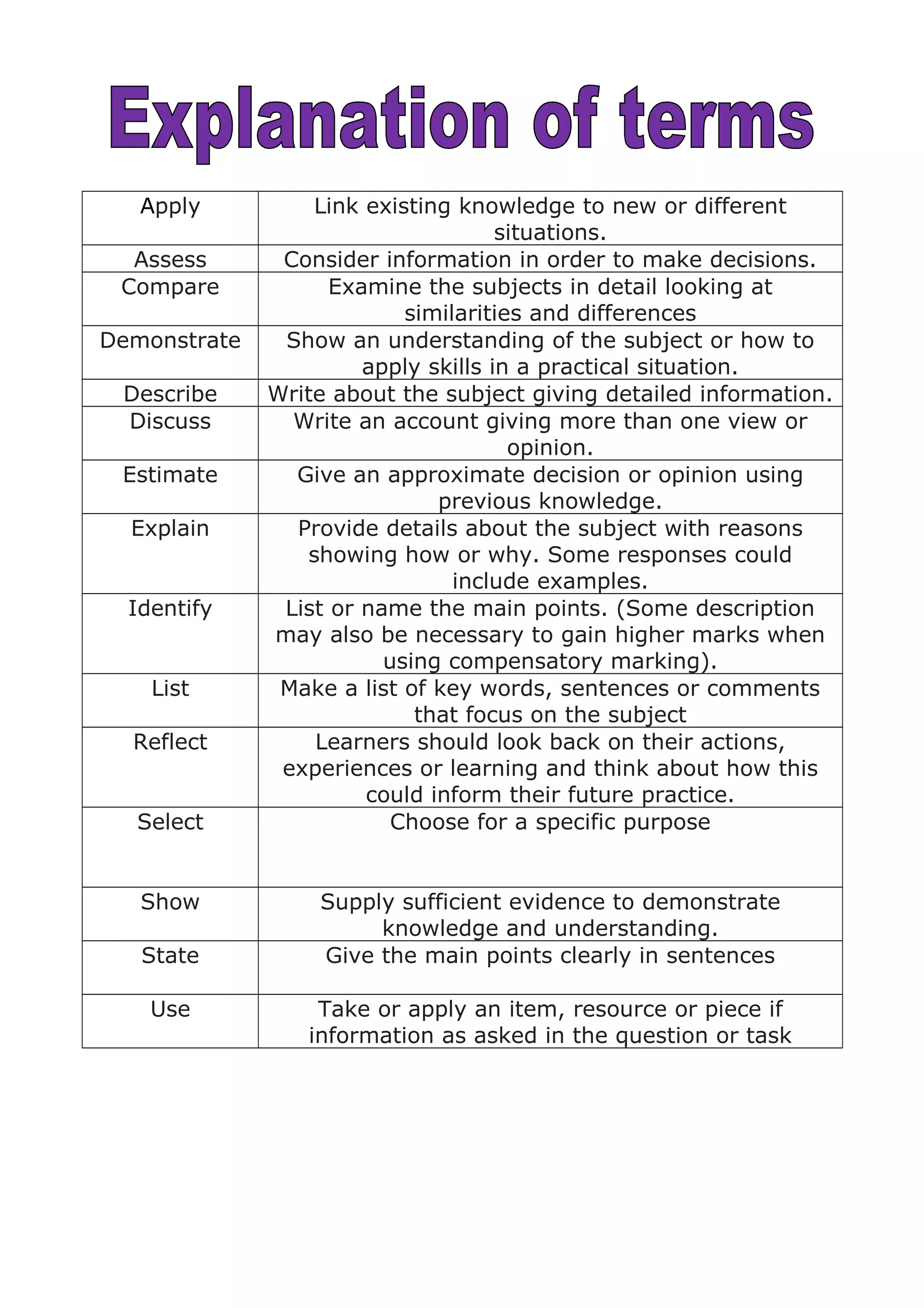
Apply Link existing knowledge to new or different
situations.
Assess Consider information in order to make decisions.
Compare Examine the subjects in detail looking at
similarities and differences
Demonstrate Show an understanding of the subject or how to
apply skills in a practical situation.
Describe Write about the subject giving detailed information.
Discuss Write an account giving more than one view or
opinion.
Estimate Give an approximate decision or opinion using
previous knowledge.
Explain Provide details about the subject with reasons
showing how or why. Some responses could
include examples.
Identify List or name the main points. (Some description
may also be necessary to gain higher marks when
using compensatory marking).
List Make a list of key words, sentences or comments
that focus on the subject
Reflect Learners should look back on their actions,
experiences or learning and think about how this
could inform their future practice.
Select Choose for a specific purpose
Show Supply sufficient evidence to demonstrate
knowledge and understanding.
State Give the main points clearly in sentences
Use Take or apply an item, resource or piece if
information as asked in the question or task
Course handbook cpd

Course handbook cpd

  • 1.
    Careers and Personal Development CourseHandbook Please keep this document safe to support you with your studies.
  • 2.
    We would liketo welcome you to the Careers and Personal Development course. The purpose of this handbook is to outline the structure of the course and to introduce you to Fareham College. To help with your induction into the programme we’ve included a list of “who’s who” under the title of college structure at the back of the booklet. We hope that you enjoy the course and find it interesting and rewarding. The emphasis on this course is in learner participation and personal development. We also stress that proper time keeping, interpersonal skills and team work are essential as these are all qualities needed in achieving your short, medium and long term goals. Although this may sound daunting and very different from your previous learning experiences, we promise to assist you in any way we can to achieve your goals. Sharlene Lawrence is the Course Leader for this L1 course, please contact her with any concerns or for further information if requires 013 2981 5263 Sharlene.lawrence@fareham.ac.uk
  • 3.
    Throughout your timewith us you will be studying a range of units to develop your personal and social development. UNIT NO UNIT TITLE Sept Oct Nov Dec Jan Feb Mar Apr May June July Unit 3 Working as Part of a Group x Unit 8 Healthy Living x x Unit 5 Managing Social Relationships x x Unit 9 Preparation for Work x Unit 10 Managing Own Money x Unit 6 Individual Rights and Responsibilities x Unit 11 Understanding Personal Identity x x Unit 12 Healthy Lifestyles x Unit 14 Personal and Social Relationships x Unit 13 Managing Personal Risk x During tutorial sessions you will have 1:1 with your tutors to assess your progress with individual units which will be consolidated on your Oracle and LPR for yourself and parents/carer to read. Once a week all students will have an hour timetabled directed study time, which you will complete in the iLRC. Guidance: The date identifies the planned start and end weeks for each unit.
  • 4.
    We expect certainbehaviour to be followed to make your learning and the learning of your peers more enjoyable. We also expect a certain level of behaviour that reflects your future ambitions as professionals. This is why the following rules must be adhered to: • Mobile phones must be on silent or switched off in class unless discussed previously with lecturer • Do not bring food into the lecture areas • Do not wear headphones unless agreed with your lecturer • All personal items such as bags and coats should be stowed appropriately in lecture rooms, Using hall hooks where available • Health and Safety should be adhered to at all times, e.g. no standing on tables • Abusive, foul or discriminatory language to either lecturing staff or your peers will not be accepted and may constitute bullying. If this occurs disciplinary procedures may be instigated by the faculty • Although you can meet other learners in the campus areas between the blocks we must remind you that people in surrounding areas can hear you. You must refrain from shouting or using abusive and discriminatory language while on the campus. Non Fareham College students should not be on the campus. • Please see your vision and commitments displayed in the corridor.
  • 5.
    We have acommitment to providing you with any extra support you might need, to assist you in completing your studies, from printing your hand-outs on colour paper, or arranging a Learning Support Assistant to help you in lectures. Please speak to your personal tutor or course leader if you think you need any extra help. This team is based in the iLRC. There is also a study centre available to support you with your studies, this is a quiet study area for you to drop into, this is also within the iLRC. If you need any assistance with finance we have a Student Services team who can help. We also have a confidential counselling service you can use if there’s anything you want to talk about, that you don’t want, or feel comfortable discussing with your personal tutor. If you ask at main reception, they’ll point you in the right direction.
  • 6.
    In the eventof you having to be absent, you or your legal guardian must contact the faculty administration officer on 013 2981 5200 by 9am. You must also provide either the administration officer or your course tutor with a letter from your legal guardian confirming this if you are under the age of 18. Your attendance will be strictly monitored throughout your studies. Your college timetable will indicate what times your breaks will be throughout your studies. You can use either of the restaurants that are located on the ground floor of C Building. You need to make sure you are not late back from your breaks. If you are late you may miss valuable information. You may also risk disciplinary action if you are persistently late to lessons.
  • 7.
    Some of youwill choose to work with children or vulnerable adults on the course. If this is the case, you must have a DBS (Disclosure and Barring Service) check before going on work placement in Childcare or Health and Social Care settings. Although the DBS aim to complete their checks within 10 days to 4 weeks, it can take more time depending on demand. Therefore it is imperative that you follow the DBS application process carefully. A DBS application form will be provided for you during induction. You will need to provide the evidence for your disclosure before we allow you to go out into placement. You will be expected to attend a day in another department or participate in a voluntary work placement one day a week. It is important for you to remember you may be working with members of the public, children/ vulnerable adults or other college students therefore it is important you are a good role model. Your day in department is to get a taster of what it you might do if you were to enrol on the course and whether it is not the right area for you. If you are unable to attend your department day you must notify the college by 9.00am.
  • 8.
    Please make yourselffamiliar with the policies about conduct whilst on college campus. These are available on the Oracle. Please remember you have signed your learner agreement to declare you will adhere to these. The work you do during your course may be assessed in a variety of manners including written essays, exams, presentations, role plays and portfolios as appropriate. It is important that you submit the work as requested by your lecturers on time, as failure to do so can result in you falling behind or even disciplinary procedures being implemented. It is therefore extremely important that any concerns you have over assignment work is discussed with the lecturer who is handing out the assignment as soon as possible. Days before submission will not be accepted. Throughout the course you will have a variety of formative assessment deadlines to meet. Please look at the tutorial notice board for hand in dates for your coursework and ensure you are regularly checking your emails and Oracle. College policy states there is a three week turn around on submitting and marking coursework. You will receive your coursework back with clear feedback on what you have achieved and what may still need editing. You will also complete homework tasks which will support you with your studies and prepare you for future lessons and any potential exams. Please treat your homework the same as coursework tasks. Failure to complete will possibly lead to disciplinary procedures.
  • 9.
    Extensions of upto two weeks may be granted in exceptional cases (e.g. ill-health or learning difficulty or disability) when appropriate evidence (e.g. a medical certificate) has been provided and negotiation has taken place. An extension can only be granted once the reasons are discussed with your lecturer. Paperwork will be completed for this to show the awarding body. If you do not agree with the assessment decision of the person marking your work, you can appeal. A slightly abridged version of the assessment appeals procedure can be found on Oracle Please ensure you keep all homework tasks and notes in an organised manner as these can be used within your coursework submissions. Plagiarism can be defined as copying someone else’s work as your own. This is regarded as a serious academic “offence” and can result in a disciplinary procedure being taken out on you. There are different types and different degrees of plagiarism - and it is often difficult to know whether you are breaking the rules or not. Below is a simple list of things that count as plagiarism: • Copying directly from a text, word-for-word • Using an attractive phrase or sentence you have found somewhere • Using text downloaded from the Internet • Paraphrasing the words of a text very closely • Borrowing statistics from another source or person • Copying from the essays or the notes of another student • Downloading or copying pictures, photographs, or diagrams without acknowledging your sources www.mantex.co.uk/samples/plgrsm It can be difficult to not plagiarise, which is why you should seek the assistance of the subject lecturer who will advise you how to quote text correctly and rephrase things in your own words.
  • 10.
    • In eachassignment you need to provide at least 2 relevant references and a bibliography. • The references may come from the same source or different sources. • References should be used in the main body of the assignment to support your own work. • Each reference should be clearly identified by the use of speech marks, bold writing or italics. If references are not clearly identified, this could be considered to be plagiarism. • A bibliography must contain is a list of books, websites, magazines articles, DVDs or other relevant sources may be used.
  • 11.
    Every week youwill have tutorial sessions with your personal tutor. Tutorials happen as a group and on a 1:1 basis. During tutorials you will be exploring a range of topics to assist you with your studies, but also everyday life skills. Your 1:1 tutorials will be recorded on Oracle for you and your parents/carers/guardians to access at any time. From observing your performance in both placement and college, we will be able to put the correct support in place for you should you require it. If at any time you feel you are struggling, it is important you inform your tutor so we can be there to support you, or refer you if we need to. LPR’s Fareham College believe it is important to work in partnership with yourselves and your family, for you to get the best out of your course. You will have regular 1:1 to discuss your performance which will transform into your Learner Progress Review (LPR). Every term an LPR will be produced for your family to read so they are able to see how you are performing on your course. The LPR’s are made in conjunction with you so you know what is written. If you are over the age of 18 these LPR’s will be sent directly to you.
  • 12.
    Fareham College 0132981 5200 Faculty Office – Attendance Line 013 2981 5200 – option 1 iLRC 013 2981 5322 HCEY Department Staff Office 013 2981 5167 Head of Department - Michelle Young 013 2981 5325 michelle.young@fareham.ac.uk • 1x A4 level arch files for placement portfolio and coursework • Pens/highlighters • Paper • Memory stick to save work • Plastic wallets to hand work in • Dividers x 10 You are welcome to bring your own laptop to use in college; however this will be your responsibility to keep safe. These will also require you to have this PAT tested for health and safety purposes.
  • 13.
    Apply Link existingknowledge to new or different situations. Assess Consider information in order to make decisions. Compare Examine the subjects in detail looking at similarities and differences Demonstrate Show an understanding of the subject or how to apply skills in a practical situation. Describe Write about the subject giving detailed information. Discuss Write an account giving more than one view or opinion. Estimate Give an approximate decision or opinion using previous knowledge. Explain Provide details about the subject with reasons showing how or why. Some responses could include examples. Identify List or name the main points. (Some description may also be necessary to gain higher marks when using compensatory marking). List Make a list of key words, sentences or comments that focus on the subject Reflect Learners should look back on their actions, experiences or learning and think about how this could inform their future practice. Select Choose for a specific purpose Show Supply sufficient evidence to demonstrate knowledge and understanding. State Give the main points clearly in sentences Use Take or apply an item, resource or piece if information as asked in the question or task