Cost-Based Query
Optimization in
DBMS
Query optimization is a fundamental aspect of database management
systems, enabling efficient execution of user queries by choosing the most
effective execution plan.
B.VINAYAK
CSD-A
23B81A6760
Introduction to Query
Optimization
Query optimization aims to find the most efficient way to execute a query,
considering factors like data access, join ordering, and index usage.
1 Reduce Query
Execution Time
Finding the fastest way to
retrieve data from a
database.
2 Minimize Resource
Consumption
Reducing the strain on
system resources like CPU
and memory.
3 Enhance Scalability
Allowing the system to handle larger data volumes and more
complex queries.
Cost Model and Estimation Techniques
A cost model estimates the resources required for different query execution plans.
I/O Cost
The number of disk accesses required.
CPU Cost
The amount of computation needed.
Memory Cost
The amount of memory required to
store intermediate results.
Access Path Selection
Selecting the most efficient way to access data, considering factors like
indexes, table scans, and clustered indexes.
1 Index Scan
Using an index to quickly locate data based on specific
values.
2 Table Scan
Reading the entire table to find the required data.
3 Clustered Index Scan
Reading the data in the order of the clustered index, often
efficient for range queries.
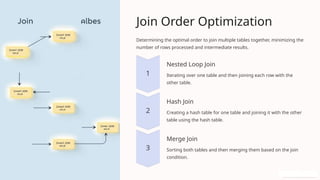
Join Order Optimization
Determining the optimal order to join multiple tables together, minimizing the
number of rows processed and intermediate results.
Nested Loop Join
Iterating over one table and then joining each row with the
other table.
Hash Join
Creating a hash table for one table and joining it with the other
table using the hash table.
Merge Join
Sorting both tables and then merging them based on the join
condition.
Index Selection and
Utilization
Choosing the appropriate indexes for a query to accelerate data access
and improve performance.
Index Type Use Cases
B-tree Index Equality and range queries
Hash Index Equality queries
Bitmap Index Queries on low cardinality
columns
Materialized Views and Query
Rewriting
Materialized views pre-compute common query results, allowing for faster execution of
related queries.
Pre-Computed Results
Faster retrieval of common data patterns.
Improved Query Performance
Reduced query execution time for related queries.
Data Consistency
Ensuring consistent data across different queries.
Conclusion and Future
Directions
Cost-based query optimization is a key technology for efficient database
management.
Advancements in
Machine Learning
Utilizing AI to optimize query
execution plans automatically.
Cloud-Based Databases
Optimizing query performance in
distributed and scalable cloud
environments.
Data Analytics and Big Data
Optimizing queries for large datasets and complex data analytics tasks.

Cost-Based-Query-Optimization-in-DBMS.pptx

  • 1.
    Cost-Based Query Optimization in DBMS Queryoptimization is a fundamental aspect of database management systems, enabling efficient execution of user queries by choosing the most effective execution plan. B.VINAYAK CSD-A 23B81A6760
  • 2.
    Introduction to Query Optimization Queryoptimization aims to find the most efficient way to execute a query, considering factors like data access, join ordering, and index usage. 1 Reduce Query Execution Time Finding the fastest way to retrieve data from a database. 2 Minimize Resource Consumption Reducing the strain on system resources like CPU and memory. 3 Enhance Scalability Allowing the system to handle larger data volumes and more complex queries.
  • 3.
    Cost Model andEstimation Techniques A cost model estimates the resources required for different query execution plans. I/O Cost The number of disk accesses required. CPU Cost The amount of computation needed. Memory Cost The amount of memory required to store intermediate results.
  • 4.
    Access Path Selection Selectingthe most efficient way to access data, considering factors like indexes, table scans, and clustered indexes. 1 Index Scan Using an index to quickly locate data based on specific values. 2 Table Scan Reading the entire table to find the required data. 3 Clustered Index Scan Reading the data in the order of the clustered index, often efficient for range queries.
  • 5.
    Join Order Optimization Determiningthe optimal order to join multiple tables together, minimizing the number of rows processed and intermediate results. Nested Loop Join Iterating over one table and then joining each row with the other table. Hash Join Creating a hash table for one table and joining it with the other table using the hash table. Merge Join Sorting both tables and then merging them based on the join condition.
  • 6.
    Index Selection and Utilization Choosingthe appropriate indexes for a query to accelerate data access and improve performance. Index Type Use Cases B-tree Index Equality and range queries Hash Index Equality queries Bitmap Index Queries on low cardinality columns
  • 7.
    Materialized Views andQuery Rewriting Materialized views pre-compute common query results, allowing for faster execution of related queries. Pre-Computed Results Faster retrieval of common data patterns. Improved Query Performance Reduced query execution time for related queries. Data Consistency Ensuring consistent data across different queries.
  • 8.
    Conclusion and Future Directions Cost-basedquery optimization is a key technology for efficient database management. Advancements in Machine Learning Utilizing AI to optimize query execution plans automatically. Cloud-Based Databases Optimizing query performance in distributed and scalable cloud environments. Data Analytics and Big Data Optimizing queries for large datasets and complex data analytics tasks.