Cost and Energy Reduction Evaluation
    for ARM Based Web Servers

         Olle Svanfeldt-Winter, Sébastien Lafond, Johan Lilius

                                 Sébastien Lafond
                                 sebastien.lafond@abo.fi


  13.12.2011        Åbo Akademi University - Department of Information Technologies   1
Outlines
Motivations
Energy consumption
Total energy consumption
Energy propositional computing
Data Centers Costs
Evaluated HW
Benchmarks
Results
Conclusion

  13.12.2011   Åbo Akademi University - Department of Information Technologies         2
Motivations
Energy consumption of data centers is both an
economical and environmental issue
– important impact on the possibility to construct or
  expend data centres
– cooling infrastructures are expensive


Models for data centre costs exists
– It is possible to determine the relationship between the
  total cost of a data center and the energy consumption of
  its server


  13.12.2011   Åbo Akademi University - Department of Information Technologies   3
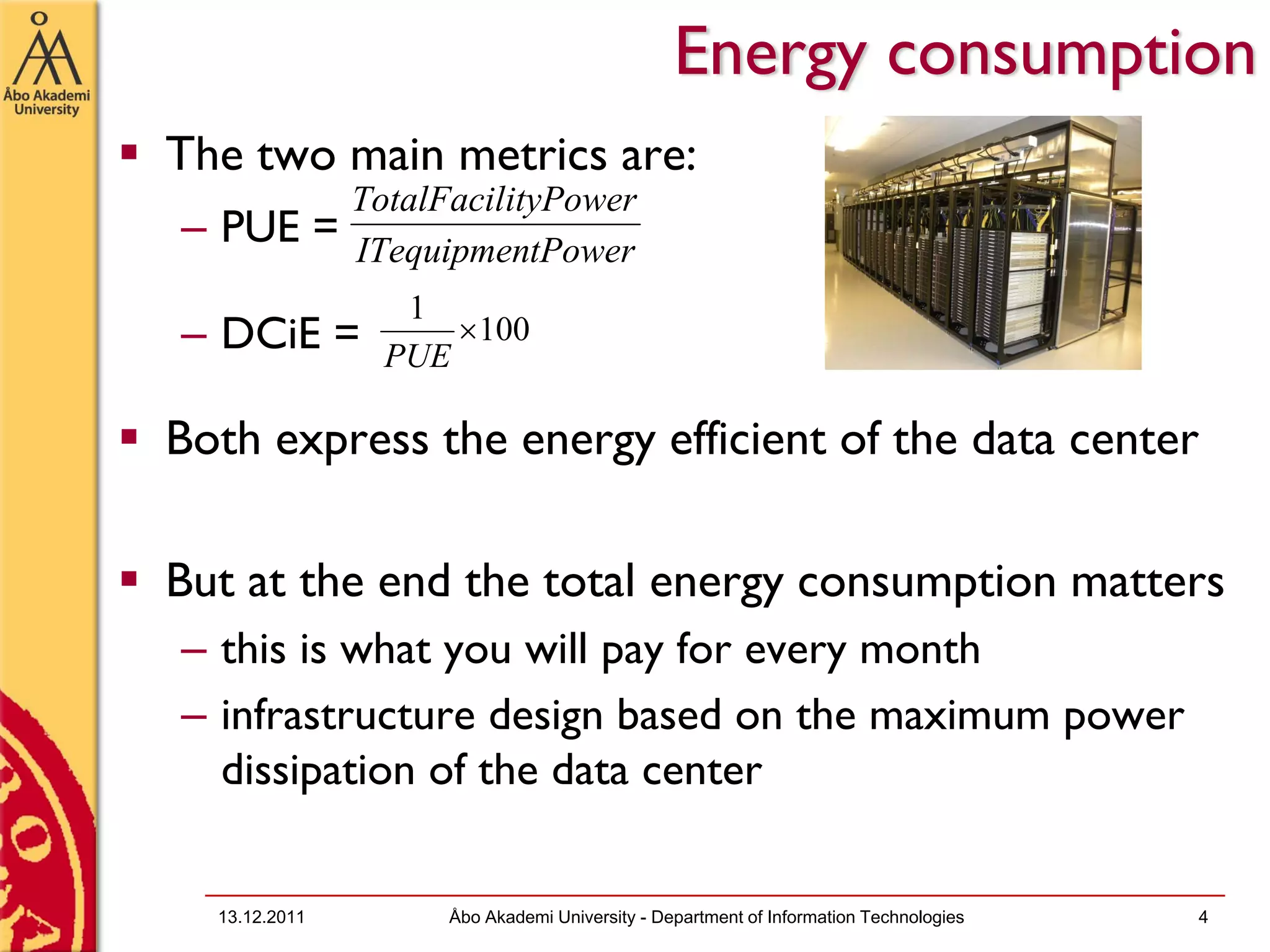
Energy consumption
The two main metrics are:
               TotalFacilityPower
– PUE =        ITequipmentPower
                  1
– DCiE =             ×100
                 PUE

Both express the energy efficient of the data center

But at the end the total energy consumption matters
– this is what you will pay for every month
– infrastructure design based on the maximum power
  dissipation of the data center


  13.12.2011         Åbo Akademi University - Department of Information Technologies   4
Total energy consumption
  According to [1] the processors in a typical server
  contributed to:
    – 45% of the total power dissipation at peak
      performance
    – 27% when idle

  Power dissipation is application specific, but on
  average the dissipation is 72% of the peak power
  Google server containers are reported to house
  1160 servers and dissipate 250KW each.

[1] L. Barroso and U. Holzle, “The case for energy-proportional computing,” Computer,
vol. 40, no. 12, pp. 33–37, December 2007.
       13.12.2011        Åbo Akademi University - Department of Information Technologies   5
Energy propositional computing
Ideally the energy consumption of data centers
should be proportional to the required performance
– this is unfortunately far from being true
– energy efficiency is best at peak performance
– however typical servers operate most of
   the time at 10 to 50% of their capacity

Using low-end and cheaper processors might be an
answer for better energy proportionality
– increase the granularity of power management steps


  13.12.2011      Åbo Akademi University - Department of Information Technologies   6
Data Centers Costs
    Based on Hamilton analysis [1,2]

                                                                                  • $0,07 per KWh
                                                                                  • 80% average load usage
                                                                                  • 50k servers
                                                                                  • 165 W per server
                                                                                  • 5% cost of money


 • 10 year amortization time
 • 4 year amortization time for the network
 • 3 year amortization time for the server


[1] J. Hamilton, “Cooperative expendable micro-slice servers (cems): Low cost, low power servers for internet-scale
services,” in Proceedings of CIDR 09, January 2009.
[2] “Overall data center costs. http://perspectives.mvdirona.com/2010/09/18/overalldatacentercosts.aspx,” James
Hamilton, September 2010

         13.12.2011               Åbo Akademi University - Department of Information Technologies                 7
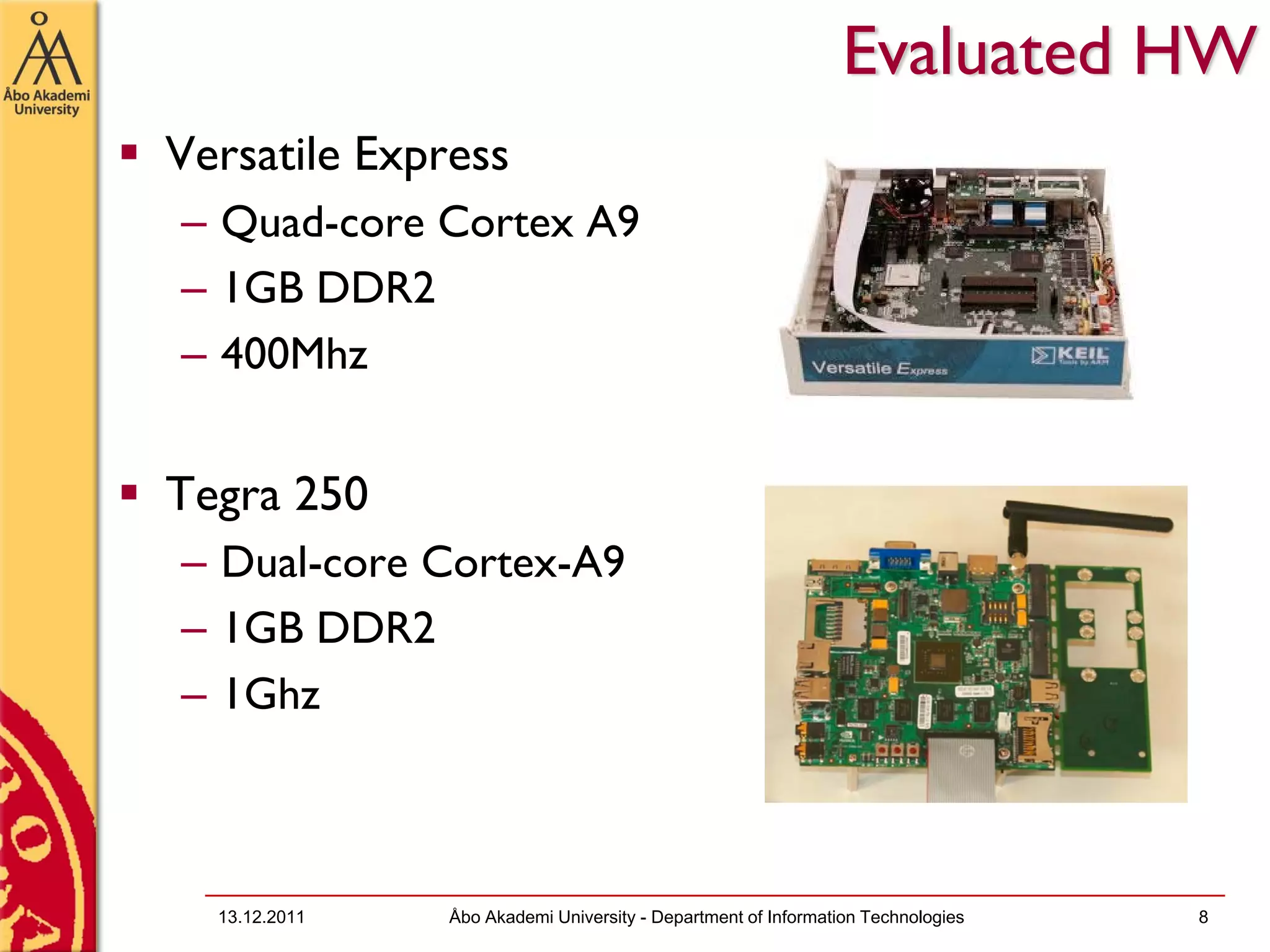
Evaluated HW
Versatile Express
– Quad-core Cortex A9
– 1GB DDR2
– 400Mhz


Tegra 250
– Dual-core Cortex-A9
– 1GB DDR2
– 1Ghz


  13.12.2011   Åbo Akademi University - Department of Information Technologies   8
Benchmarks
Autobench and Apache 2 HTTP server
– static web pages


SPECweb2005
– more demanding web services

Erlang
– micro benchmarks
– real world SIP proxy


  13.12.2011   Åbo Akademi University - Department of Information Technologies   9
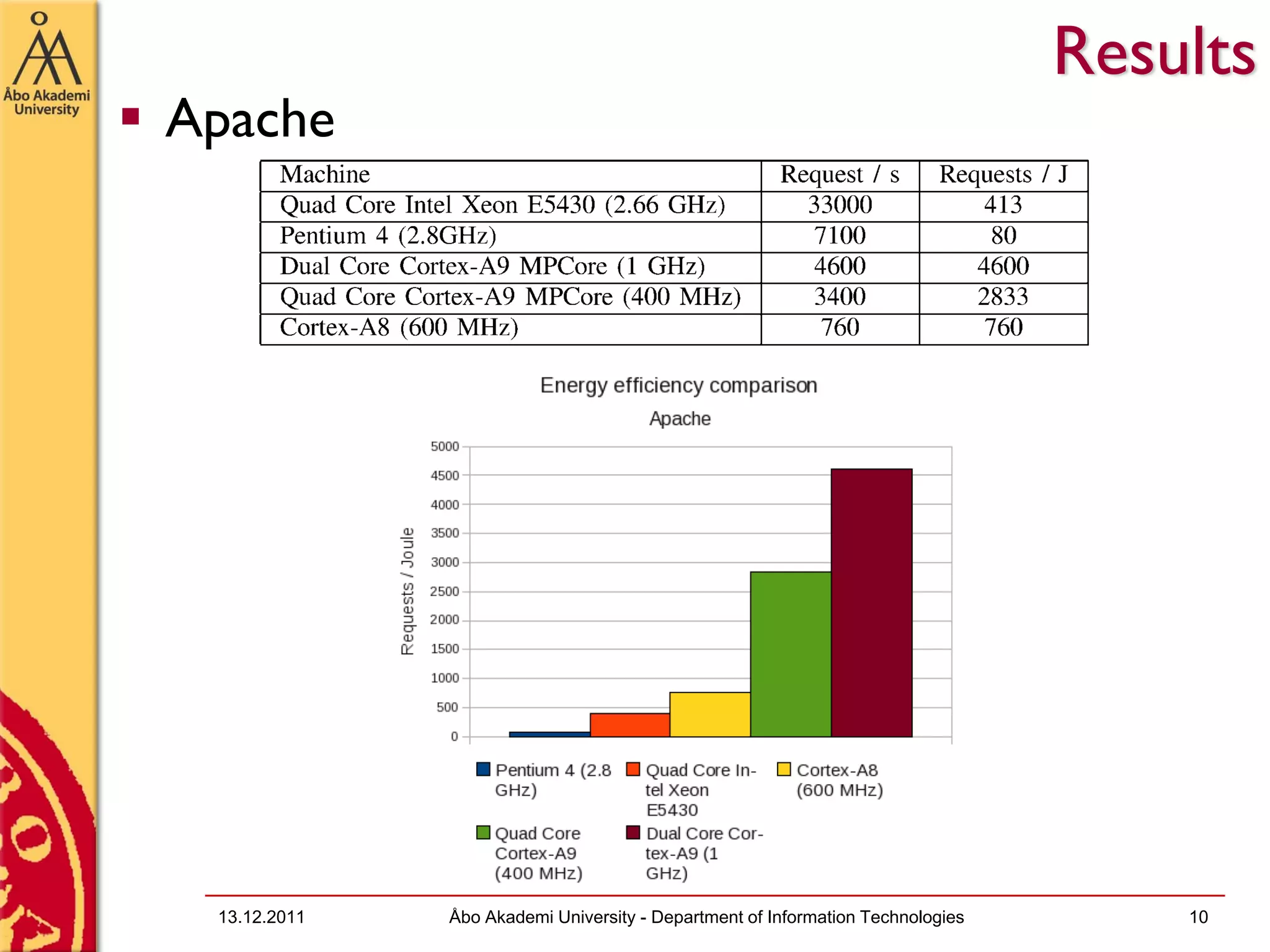
Results
Apache


 13.12.2011   Åbo Akademi University - Department of Information Technologies       10
Results
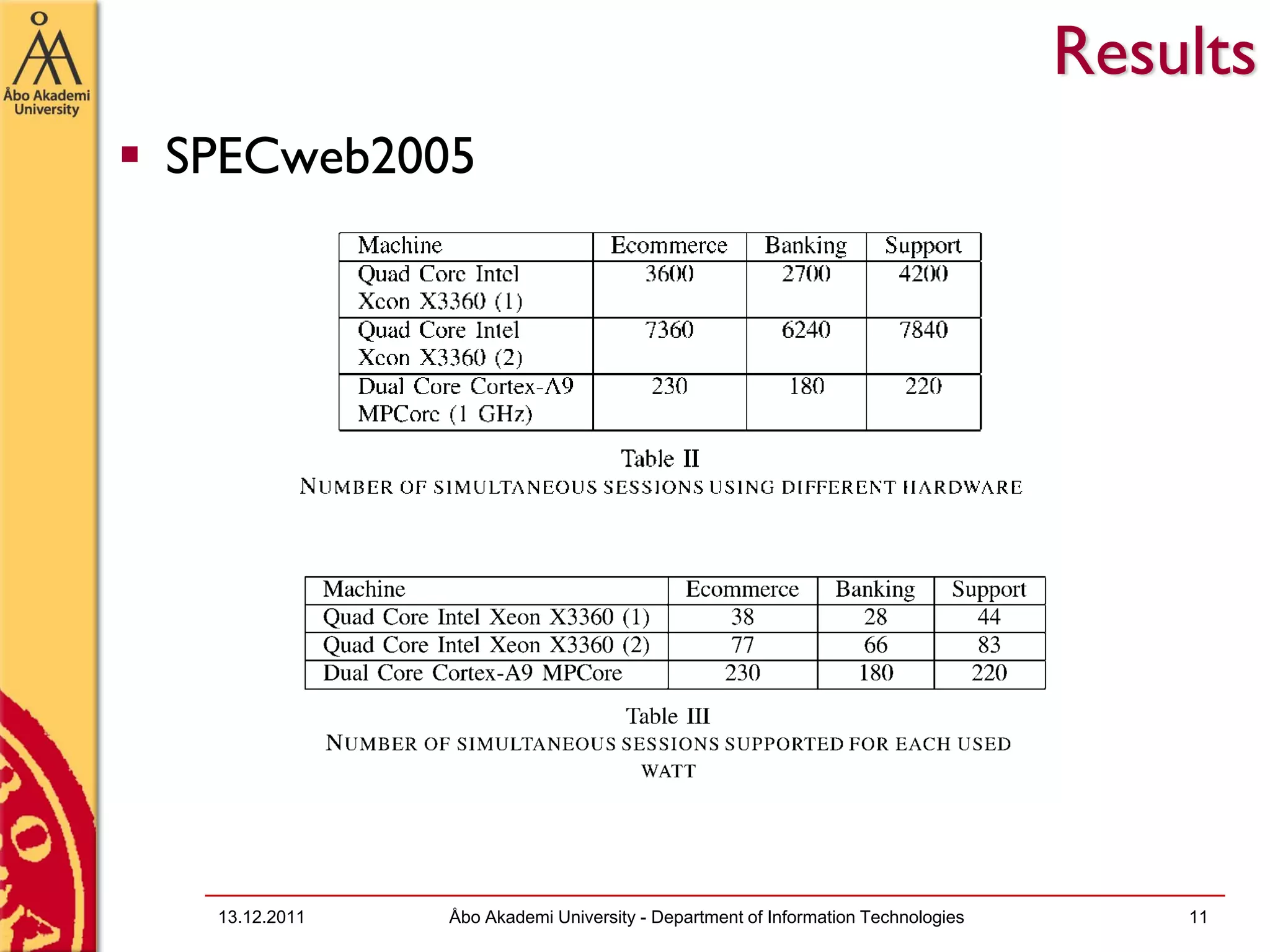
SPECweb2005


 13.12.2011   Åbo Akademi University - Department of Information Technologies       11
Results
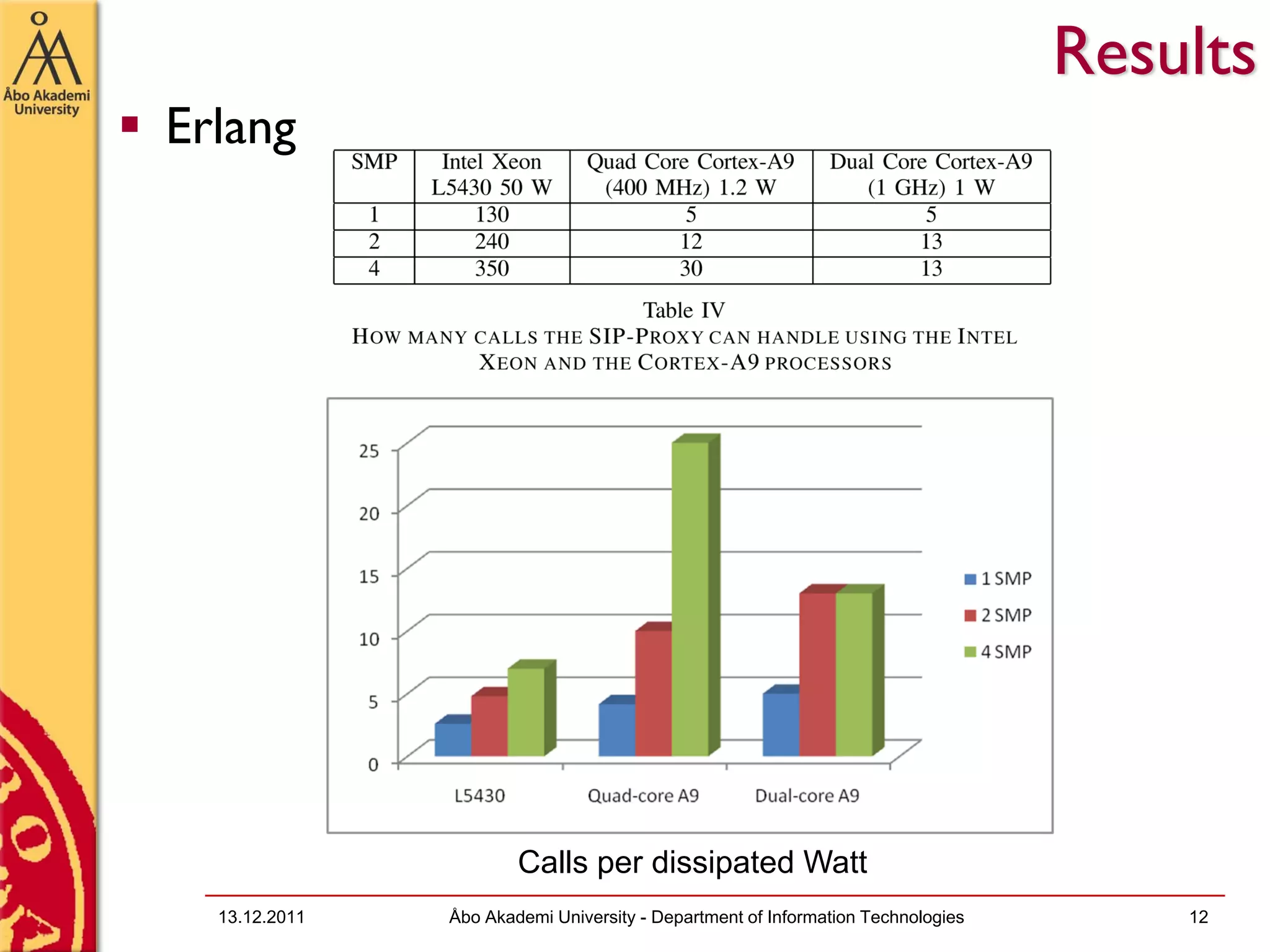
Erlang


                       Calls per dissipated Watt
  13.12.2011   Åbo Akademi University - Department of Information Technologies       12
Conclusion
The performance of 2 ARMv7 based ARM cortex-A9
was measured and evaluated and compared to Xeon
processors

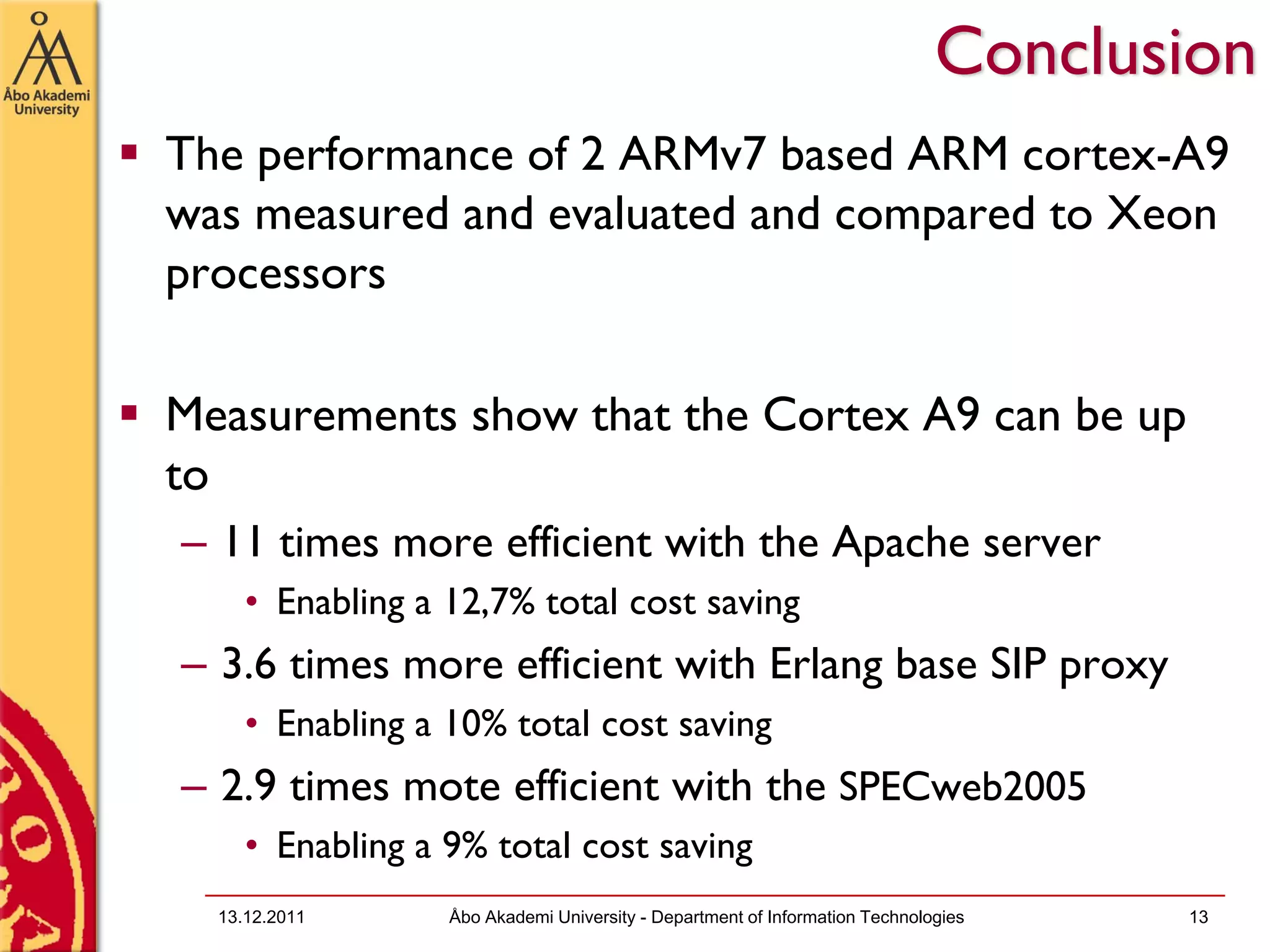
Measurements show that the Cortex A9 can be up
to
– 11 times more efficient with the Apache server
     • Enabling a 12,7% total cost saving
– 3.6 times more efficient with Erlang base SIP proxy
     • Enabling a 10% total cost saving
– 2.9 times mote efficient with the SPECweb2005
     • Enabling a 9% total cost saving
  13.12.2011      Åbo Akademi University - Department of Information Technologies   13
Questions ?

13.12.2011   Åbo Akademi University - Department of Information Technologies   14

Cost and Energy Reduction Evaluation for ARM Based Web Servers

  • 1.
    Cost and EnergyReduction Evaluation for ARM Based Web Servers Olle Svanfeldt-Winter, Sébastien Lafond, Johan Lilius Sébastien Lafond sebastien.lafond@abo.fi 13.12.2011 Åbo Akademi University - Department of Information Technologies 1
  • 2.
    Outlines Motivations Energy consumption Total energyconsumption Energy propositional computing Data Centers Costs Evaluated HW Benchmarks Results Conclusion 13.12.2011 Åbo Akademi University - Department of Information Technologies 2
  • 3.
    Motivations Energy consumption ofdata centers is both an economical and environmental issue – important impact on the possibility to construct or expend data centres – cooling infrastructures are expensive Models for data centre costs exists – It is possible to determine the relationship between the total cost of a data center and the energy consumption of its server 13.12.2011 Åbo Akademi University - Department of Information Technologies 3
  • 4.
    Energy consumption The twomain metrics are: TotalFacilityPower – PUE = ITequipmentPower 1 – DCiE = ×100 PUE Both express the energy efficient of the data center But at the end the total energy consumption matters – this is what you will pay for every month – infrastructure design based on the maximum power dissipation of the data center 13.12.2011 Åbo Akademi University - Department of Information Technologies 4
  • 5.
    Total energy consumption According to [1] the processors in a typical server contributed to: – 45% of the total power dissipation at peak performance – 27% when idle Power dissipation is application specific, but on average the dissipation is 72% of the peak power Google server containers are reported to house 1160 servers and dissipate 250KW each. [1] L. Barroso and U. Holzle, “The case for energy-proportional computing,” Computer, vol. 40, no. 12, pp. 33–37, December 2007. 13.12.2011 Åbo Akademi University - Department of Information Technologies 5
  • 6.
    Energy propositional computing Ideallythe energy consumption of data centers should be proportional to the required performance – this is unfortunately far from being true – energy efficiency is best at peak performance – however typical servers operate most of the time at 10 to 50% of their capacity Using low-end and cheaper processors might be an answer for better energy proportionality – increase the granularity of power management steps 13.12.2011 Åbo Akademi University - Department of Information Technologies 6
  • 7.
    Data Centers Costs Based on Hamilton analysis [1,2] • $0,07 per KWh • 80% average load usage • 50k servers • 165 W per server • 5% cost of money • 10 year amortization time • 4 year amortization time for the network • 3 year amortization time for the server [1] J. Hamilton, “Cooperative expendable micro-slice servers (cems): Low cost, low power servers for internet-scale services,” in Proceedings of CIDR 09, January 2009. [2] “Overall data center costs. http://perspectives.mvdirona.com/2010/09/18/overalldatacentercosts.aspx,” James Hamilton, September 2010 13.12.2011 Åbo Akademi University - Department of Information Technologies 7
  • 8.
    Evaluated HW Versatile Express –Quad-core Cortex A9 – 1GB DDR2 – 400Mhz Tegra 250 – Dual-core Cortex-A9 – 1GB DDR2 – 1Ghz 13.12.2011 Åbo Akademi University - Department of Information Technologies 8
  • 9.
    Benchmarks Autobench and Apache2 HTTP server – static web pages SPECweb2005 – more demanding web services Erlang – micro benchmarks – real world SIP proxy 13.12.2011 Åbo Akademi University - Department of Information Technologies 9
  • 10.
    Results Apache 13.12.2011 Åbo Akademi University - Department of Information Technologies 10
  • 11.
    Results SPECweb2005 13.12.2011 Åbo Akademi University - Department of Information Technologies 11
  • 12.
    Results Erlang Calls per dissipated Watt 13.12.2011 Åbo Akademi University - Department of Information Technologies 12
  • 13.
    Conclusion The performance of2 ARMv7 based ARM cortex-A9 was measured and evaluated and compared to Xeon processors Measurements show that the Cortex A9 can be up to – 11 times more efficient with the Apache server • Enabling a 12,7% total cost saving – 3.6 times more efficient with Erlang base SIP proxy • Enabling a 10% total cost saving – 2.9 times mote efficient with the SPECweb2005 • Enabling a 9% total cost saving 13.12.2011 Åbo Akademi University - Department of Information Technologies 13
  • 14.
    Questions ? 13.12.2011 Åbo Akademi University - Department of Information Technologies 14