Correlation of Simulation Models
using Concept Modeling
Dr. Jörgen Hilmann, Joe Abramczyk   Ford Motor Company
Dr. Salvatore Scalera               RLE International
Andreas Arlt                        SFE GmbH Berlin
Correlation of Simulation Models using Concept Modeling
Dr. Jörgen Hilmann, Joe Abramczyk, Ford Motor Company
Dr. Salvatore Scalera, RLE International; Andreas Arlt, SFE GmbH Berlin
Keywords: RADIOSS, HyperMesh, MotionView, SFE Concept, Correlation, Front Impact, Side Impact

ABSTRACT
Pre-requisite for efficient vehicle programs is the CAE driven development process as described in [1], [2] "Up Front CAE". Both CAD and CAE models
based on special Concept Software as SFE CONCEPT are used to analyze the attribute performance as safety, NVH or durability and commodity studies
concerning the weight, manufacturing, or package. A database of concept models is used to minimize the modeling effort and to maximize the re-usability of
components [3]. The accuracy of the models increases over time and leads to an increasing amount of available Concept models in databases. Due to the
increased acceleration of the development process, these models are critical in providing direction on vehicle architecture in the early stages of a program.
Due to the high importance of these decisions it is mandatory to trust the results of this early CAE models. Correlation of this Concept models to test or
reference mainstream CAE models creates the confidence in this approach. The correlation focuses on two aspects: 1. the level of detail required to capture
the detailed folding characteristic of the structure (e.g. siderail or B-Pillar) and 2. the process chain used to process the raw output from SFE Concept into
RADIOSS Include files (e.g. gap, contacts, spot-welding, adhesives, bolts). This process chain is implemented using HyperMesh in batch mode, details may
be found in [4]. This process chain is tuned to latest program modeling approaches and to meet the desired correlation status.
In this presentation RADIOSS safety concept models are correlated to different impact modes. Tools and methods are explained focusing on both the
automated evaluation of simulation output and the judgment of the correlation quality. The main criteria defining the correlation fitness are video overlay of
vehicle and dummies kinematics, curve comparison of vehicles acceleration, velocity, and intrusion. Furthermore the dummy sensors have been evaluated.
The combination of the above mentioned steps enable an accelerated and more confident concept phase allowing for more alternatives being analyzed in a
more holistic and detailed manner as described in [5], [3]. This is a pre-requisite for the creation of efficient designs under the constraints of an increasingly
accelerated development process.

BIBLIOGRAPHY
[1] E. Schelkle and H. Elsenhans,
    "Virtual Vehicle Development in the Concept Stage – Current Status of CAE and Outlook on the Future", 3rd MSC Worldwide Aerospace
    Conference & Technology Showcase in Toulouse 2001
[2] Jörgen Hilmann (Ford) und Uwe Wagner (Ford),
    „CAE driven development process for the early vehicle development phase.“ IABC Confernce 2007 in Berlin
[3] Michael Keimes, Dr. Jörgen Hilmann, Martin Lichter, Dr. Uwe Wagner,
    "Optimierungsstrategien für Leichtbauprojekte" VDI Leichtbaukonfernz Ludwigsburg, 2011.
[4] Jörgen Hilmann (Ford) und Hans Zimmer (SFE GmbH)
    „Development and application of an automated model built process chain for the Preprogram and Concept phase using SFE CONCEPT and the Altair
    Hyperworks package.“ EHTC Konferenz in Strassbourg 2008
[5] K.H. Volz and H.Zimmer,
    "Optimizing Topology and Shape for Crashworthiness in Vehicle Product Development", IABC Confernce 2007 in Berlin

                       2011 European HyperWorks Technology Conference
                       Jörgen Hilmann, Joe Abramczyk, Salvatore Scalera Andreas Arlt
Correlation of Simulation Models using Concept Modeling

Contents

•   Introduction
•   Motivation for Concept Modeling
•   Concept Models & Libraries
•   Model built and Include Files

•   Correlation quality: Procedure and Criteria
•   Vehicle Samples
•   Q&A


             2011 European HyperWorks Technology Conference
             Jörgen Hilmann, Joe Abramczyk, Salvatore Scalera Andreas Arlt
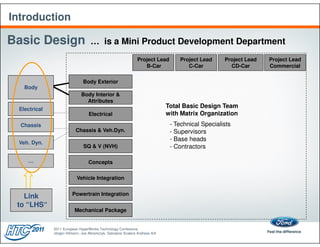
Introduction

Basic Design                       … is a Mini Product Development Department
                                                               Project Lead       Project Lead     Project Lead   Project Lead
                                                                  B-Car              C-Car           CD-Car       Commercial

                               Body Exterior
   Body
                              Body Interior &
                                Attributes
 Electrical
                                                                              Total Basic Design Team
                                  Electrical                                  with Matrix Organization
  Chassis                                                                      - Technical Specialists
                           Chassis & Veh.Dyn.                                  - Supervisors
                                                                               - Base heads
 Veh. Dyn.
                               SQ & V (NVH)                                    - Contractors

    …                             Concepts

                           Vehicle Integration

                         Powertrain Integration
   Link
 to “LHS“
                          Mechanical Package


              2011 European HyperWorks Technology Conference
              Jörgen Hilmann, Joe Abramczyk, Salvatore Scalera Andreas Arlt
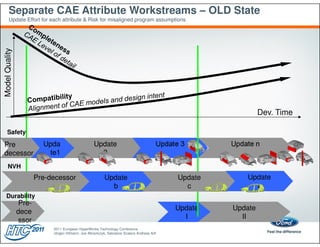
Separate CAE Attribute Workstreams – OLD State
       Update Effort for each attribute & Risk for misaligned program assumptions
Model Quality


                                                                                                                 Dev. Time

    Safety

Pre                       Upda                      Update                               Update 3       Update n
decessor                   te1                        2
     NVH
                        Pre-decessor                       Update                              Update       Update
                                                             b                                   c            x
   Durability
                 Pre-
                                                                                              Update    Update
                dece
                                                                                                I         II
                ssor
                             2011 European HyperWorks Technology Conference
                             Jörgen Hilmann, Joe Abramczyk, Salvatore Scalera Andreas Arlt
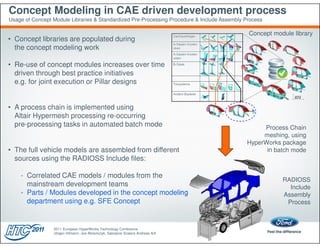
Concept Modeling in CAE driven development process
Usage of Concept Module Libraries & Standardized Pre-Processing Procedure & Include Assembly Process

                                                                                              Concept module library
• Concept libraries are populated during
  the concept modeling work

• Re-use of concept modules increases over time
  driven through best practice initiatives
  e.g. for joint execution or Pillar designs


• A process chain is implemented using
  Altair Hypermesh processing re-occurring
  pre-processing tasks in automated batch mode                                                    Process Chain
                                                                                                  meshing, using
                                                                                             HyperWorks package
• The full vehicle models are assembled from different                                             in batch mode
  sources using the RADIOSS Include files:

    - Correlated CAE models / modules from the
                                                                                                         RADIOSS
      mainstream development teams                                                                         Include
    - Parts / Modules developed in the concept modeling                                                  Assembly
      department using e.g. SFE Concept                                                                   Process


                 2011 European HyperWorks Technology Conference
                 Jörgen Hilmann, Joe Abramczyk, Salvatore Scalera Andreas Arlt
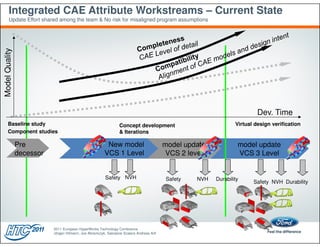
Integrated CAE Attribute Workstreams – Current State
       Update Effort shared among the team & No risk for misaligned program assumptions
Model Quality


                                                                                                                           Dev. Time
     Baseline study                                               Concept development                             Virtual design verification
     Component studies                                            & Iterations

                Pre                                       New model                        model update            model update
                decessor                                 VCS 1 Level                        VCS 2 level            VCS 3 Level


                                                         Safety NVH                        Safety   NVH   Durability
                                                                                                                         Safety NVH Durability


                           2011 European HyperWorks Technology Conference
                           Jörgen Hilmann, Joe Abramczyk, Salvatore Scalera Andreas Arlt
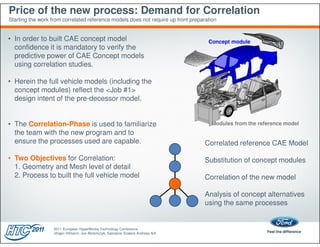
Price of the new process: Demand for Correlation
Starting the work from correlated reference models does not require up front preparation


• In order to built CAE concept model                                               Concept module
  confidence it is mandatory to verify the
  predictive power of CAE Concept models
  using correlation studies.

• Herein the full vehicle models (including the
  concept modules) reflect the <Job #1>
  design intent of the pre-decessor model.


• The Correlation-Phase is used to familiarize                                        Modules from the reference model
  the team with the new program and to
  ensure the processes used are capable.                                           Correlated reference CAE Model

• Two Objectives for Correlation:                                                  Substitution of concept modules
  1. Geometry and Mesh level of detail
  2. Process to built the full vehicle model                                       Correlation of the new model

                                                                                   Analysis of concept alternatives
                                                                                   using the same processes


                   2011 European HyperWorks Technology Conference
                   Jörgen Hilmann, Joe Abramczyk, Salvatore Scalera Andreas Arlt
Correlation types
Starting the work from correlated reference models does not require up front preparation


 Difficult to standardize the correlation approach,
 due to differentiation through:
 • Application to geometry or the model built process chain; or both.

 • Applied Car Line: B-CAR / C-CAR / CD-CAR / Light Commercial Vehicles

 • Availability of reference data: Mainstream CAE and/or real test results

 • Different Impact Modes: Front, Side, Rear, …

 • Different Requirements / Markets

 As a consequence the correlation task is challenging and
 the required timing difficult to predict.


                   2011 European HyperWorks Technology Conference
                   Jörgen Hilmann, Joe Abramczyk, Salvatore Scalera Andreas Arlt
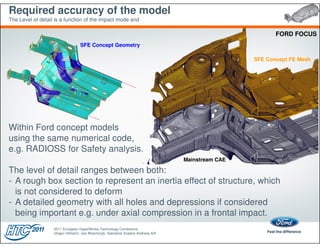
Required accuracy of the model
The Level of detail is a function of the impact mode and

                                                                                                           FORD FOCUS
                                  SFE Concept Geometry

                                                                                                    SFE Concept FE Mesh


Within Ford concept models
using the same numerical code,
e.g. RADIOSS for Safety analysis.
                                                                                   Mainstream CAE

The level of detail ranges between both:
- A rough box section to represent an inertia effect of structure, which
  is not considered to deform
- A detailed geometry with all holes and depressions if considered
  being important e.g. under axial compression in a frontal impact.
                   2011 European HyperWorks Technology Conference
                   Jörgen Hilmann, Joe Abramczyk, Salvatore Scalera Andreas Arlt
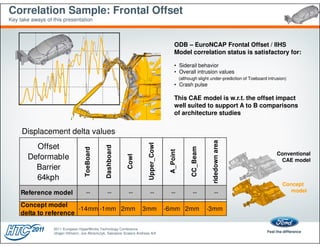
Correlation Sample: Frontal Offset
Key take aways of this presentation


                                                                                            ODB – EuroNCAP Frontal Offset / IIHS
                                                                                            Model correlation status is satisfactory for:

                                                                                            • Siderail behavior
                                                                                            • Overall intrusion values
                                                                                                  (although slight under-prediction of Toeboard intrusion)
                                                                                            • Crash pulse

                                                                                            This CAE model is w.r.t. the offset impact
                                                                                            well suited to support A to B comparisons
                                                                                            of architecture studies


     Displacement delta values


                                                                                                                   ridedown area
                                                                          Upper_Cowl
         Offset
                                                 Dashboard


                                                                                                        CC_Beam
                                    ToeBoard


                                                                                        A_Point
                                                                                                                                                     Conventional
       Deformable
                                                              Cowl


                                                                                                                                                      CAE model
         Barrier
         64kph
                                                                                                                                                       Concept
     Reference model                 --           --          --           --            --              --          --                                  model

     Concept model
                        -14mm -1mm 2mm                                3mm              -6mm 2mm                   -3mm
     delta to reference

                  2011 European HyperWorks Technology Conference
                  Jörgen Hilmann, Joe Abramczyk, Salvatore Scalera Andreas Arlt
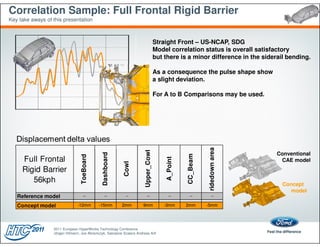
Correlation Sample: Full Frontal Rigid Barrier
Key take aways of this presentation


                                                                                     Straight Front – US-NCAP, SDG
                                                                                     Model correlation status is overall satisfactory
                                                                                     but there is a minor difference in the siderail bending.

                                                                                     As a consequence the pulse shape show
                                                                                     a slight deviation.

                                                                                     For A to B Comparisons may be used.


                                                                                                             ridedown area
                                                                        Upper_Cowl
                                                                                                                                 Conventional
                                               Dashboard


                                                                                                   CC_Beam
                                  ToeBoard


     Full Frontal
                                                                                         A_Point
                                                                                                                                  CAE model
                                                           Cowl


     Rigid Barrier
        56kph                                                                                                                      Concept
                                                                                                                                     model
   Reference model                  --           --         --             --              --        --         --

   Concept model                -12mm        -15mm         2mm         9mm               -3mm      2mm       -5mm


                  2011 European HyperWorks Technology Conference
                  Jörgen Hilmann, Joe Abramczyk, Salvatore Scalera Andreas Arlt
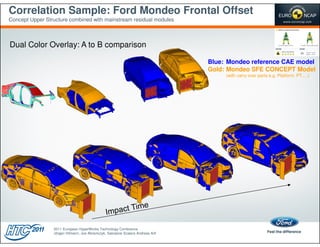
Correlation Sample: Ford Mondeo Frontal Offset
Concept Upper Structure combined with mainstream residual modules


Dual Color Overlay: A to B comparison

                                                                                 Blue: Mondeo reference CAE model
                                                                                 Gold: Mondeo SFE CONCEPT Model
                                                                                      (with carry over parts e.g. Platform, PT,…)


                 2011 European HyperWorks Technology Conference
                 Jörgen Hilmann, Joe Abramczyk, Salvatore Scalera Andreas Arlt
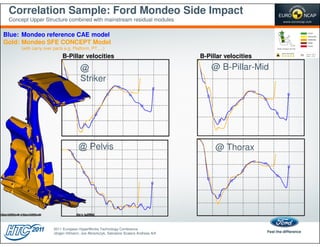
Correlation Sample: Ford Mondeo Side Impact
 Concept Upper Structure combined with mainstream residual modules

Blue: Mondeo reference CAE model
Gold: Mondeo SFE CONCEPT Model
     (with carry over parts e.g. Platform, PT,…)
                          B-Pillar velocities                                        B-Pillar velocities

                                    @                                                    @ B-Pillar-Mid
                                    Striker


  Door                             @ Pelvis                                               @ Thorax
  velocities


                     2011 European HyperWorks Technology Conference
                     Jörgen Hilmann, Joe Abramczyk, Salvatore Scalera Andreas Arlt
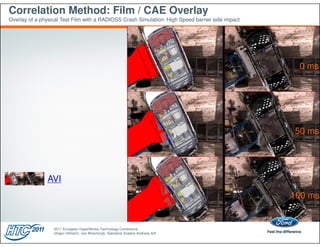
Correlation Method: Film / CAE Overlay
Overlay of a physical Test Film with a RADIOSS Crash Simulation: High Speed barrier side impact


                                                                                                   0 ms


                                                                                                  50 ms


               AVI
                                                                                                  100 ms


                  2011 European HyperWorks Technology Conference
                  Jörgen Hilmann, Joe Abramczyk, Salvatore Scalera Andreas Arlt
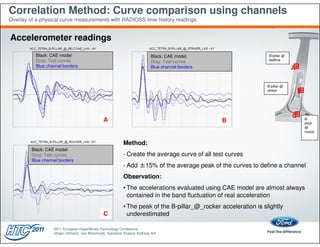
Correlation Method: Curve comparison using channels
Overlay of a physical curve measurements with RADIOSS time history readings


Accelerometer readings
          Black: CAE model                                                  Black: CAE model                       B-pillar @
          Gray: Test curves                                                                                        beltline
                                                                            Gray: Test curves
          Blue channel borders                                              Blue channel borders                                A

                                                                                                                  B-pillar @
                                                                                                                  striker           B


                                                                                                                                C
                                                A                                                  B                                    B-
                                                                                                                                        pillar
                                                                                                                                        @
                                                                                                                                        rocker


                                                            Method:
         Black: CAE model
         Gray: Test curves                                  - Create the average curve of all test curves
         Blue channel borders
                                                            - Add ±15% of the average peak of the curves to define a channel
                                                            Observation:
                                                            • The accelerations evaluated using CAE model are almost always
                                                              contained in the band fluctuation of real acceleration
                                                            • The peak of the B-pillar_@_rocker acceleration is slightly
                                                C             underestimated

                   2011 European HyperWorks Technology Conference
                   Jörgen Hilmann, Joe Abramczyk, Salvatore Scalera Andreas Arlt
Correlation Method: Peak curve comparison
Overlay of a physical curve measurements with RADIOSS time history readings

Normalization: The bar charts represent the max. injury criteria
                       divided by the arithmetic mean of available test max. injury criteria.
                       “1” being the average of the available test curve maxima for this criteria, e.g. HIC36

Test Variation: The CAE results (orange bar) are in the range of test values,
                       except the Pubic Load for the 1st row and Spine Acceleration in the 2nd row.


 1,45                                                                                       1,55
 1,40
 1,35
                                                                             1st row        1,50
                                                                                            1,45
                                                                                                                                                                                                              2nd row
 1,30                                                                                       1,40

 1,25                                                                                       1,35
                                                                                            1,30
 1,20
                                                                                            1,25
 1,15
                                                                                            1,20
 1,10
                                                                                            1,15
 1,05
                                                                                            1,10
 1,00                                                                                       1,05
 0,95                                                                                       1,00
 0,90                                                                                       0,95
 0,85                                                                                       0,90
 0,80                                                                                       0,85
 0,75                                                                                       0,80
                                                                                            0,75
 0,70
                                                                                            0,70
 0,65
                                                                                            0,65
 0,60
                                                                                            0,60
 0,55
                                                                                            0,55
 0,50                                                                                       0,50
 0,45                                                                                       0,45
 0,40                                                                                       0,40
 0,35                                                                                       0,35
 0,30                                                                                       0,30
 0,25                                                                                       0,25

 0,20                                                                                       0,20
                                                                                            0,15
 0,15
                                                                                            0,10
 0,10
                                                                                            0,05
 0,05
                                                                                            0,00
 0,00                                                                                                                          Ave5RibDis [mm]                                                           Iliac Fy
        HIC36   MaxThoRib   Abdomen Force   Spine lowe     Pelvis acceleration   Pubic Fy          HIC36                                                     T12 acceleration [g´s]
                                            acceleration                                                   Shoulder deflection [mm]         T1 acceleration [g´s]            Pelvis acceleration [g´s]              Acetabulum Fy


                       2011 European HyperWorks Technology Conference
                       Jörgen Hilmann, Joe Abramczyk, Salvatore Scalera Andreas Arlt
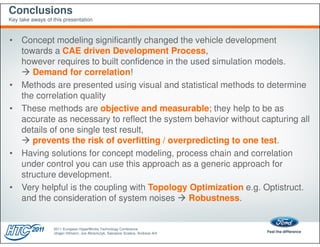
Conclusions
Key take aways of this presentation


•    Concept modeling significantly changed the vehicle development
     towards a CAE driven Development Process,
     however requires to built confidence in the used simulation models.
        Demand for correlation!
•    Methods are presented using visual and statistical methods to determine
     the correlation quality
•    These methods are objective and measurable; they help to be as
     accurate as necessary to reflect the system behavior without capturing all
     details of one single test result,
        prevents the risk of overfitting / overpredicting to one test.
•    Having solutions for concept modeling, process chain and correlation
     under control you can use this approach as a generic approach for
     structure development.
•    Very helpful is the coupling with Topology Optimization e.g. Optistruct.
     and the consideration of system noises     Robustness.


                  2011 European HyperWorks Technology Conference
                  Jörgen Hilmann, Joe Abramczyk, Salvatore Scalera, Andreas Arlt
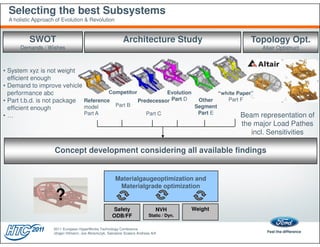
Selecting the best Subsystems
 A holistic Approach of Evolution & Revolution


         SWOT                                                Architecture Study                        Topology Opt.
     Demands / Wishes                                                                                      Altair Optistruct


• System xyz is not weight
  efficient enough
• Demand to improve vehicle
  performance abc                     Competitor           Evolution         “white Paper”
• Part t.b.d. is not package Reference           Predecessor Part D   Other     Part F
                             model      Part B                       Segment
  efficient enough
                             Part A                 Part C            Part E
•…                                                                                   Beam representation of
                                                                                                     the major Load Pathes
                                                                                                        incl. Sensitivities

                    Concept development considering all available findings


                                                        Materialgaugeoptimization and
                                                         Materialgrade optimization
                     ?
                                                      Safety                    NVH         Weight
                                                      ODB/FF                Static / Dyn.

                    2011 European HyperWorks Technology Conference
                    Jörgen Hilmann, Joe Abramczyk, Salvatore Scalera Andreas Arlt
Thanks for your attention!

Correlation of Simulation Models using
Concept Modeling


Team of Authors:
Dr. Jörgen Hilmann, Joe Abramczyk   Ford Motor Company
Dr. Salvatore Scalera               RLE International
Andreas Arlt                        SFE GmbH Berlin

Correlation of simulation_models_using_concept_modeling

  • 1.
    Correlation of SimulationModels using Concept Modeling Dr. Jörgen Hilmann, Joe Abramczyk Ford Motor Company Dr. Salvatore Scalera RLE International Andreas Arlt SFE GmbH Berlin
  • 2.
    Correlation of SimulationModels using Concept Modeling Dr. Jörgen Hilmann, Joe Abramczyk, Ford Motor Company Dr. Salvatore Scalera, RLE International; Andreas Arlt, SFE GmbH Berlin Keywords: RADIOSS, HyperMesh, MotionView, SFE Concept, Correlation, Front Impact, Side Impact ABSTRACT Pre-requisite for efficient vehicle programs is the CAE driven development process as described in [1], [2] "Up Front CAE". Both CAD and CAE models based on special Concept Software as SFE CONCEPT are used to analyze the attribute performance as safety, NVH or durability and commodity studies concerning the weight, manufacturing, or package. A database of concept models is used to minimize the modeling effort and to maximize the re-usability of components [3]. The accuracy of the models increases over time and leads to an increasing amount of available Concept models in databases. Due to the increased acceleration of the development process, these models are critical in providing direction on vehicle architecture in the early stages of a program. Due to the high importance of these decisions it is mandatory to trust the results of this early CAE models. Correlation of this Concept models to test or reference mainstream CAE models creates the confidence in this approach. The correlation focuses on two aspects: 1. the level of detail required to capture the detailed folding characteristic of the structure (e.g. siderail or B-Pillar) and 2. the process chain used to process the raw output from SFE Concept into RADIOSS Include files (e.g. gap, contacts, spot-welding, adhesives, bolts). This process chain is implemented using HyperMesh in batch mode, details may be found in [4]. This process chain is tuned to latest program modeling approaches and to meet the desired correlation status. In this presentation RADIOSS safety concept models are correlated to different impact modes. Tools and methods are explained focusing on both the automated evaluation of simulation output and the judgment of the correlation quality. The main criteria defining the correlation fitness are video overlay of vehicle and dummies kinematics, curve comparison of vehicles acceleration, velocity, and intrusion. Furthermore the dummy sensors have been evaluated. The combination of the above mentioned steps enable an accelerated and more confident concept phase allowing for more alternatives being analyzed in a more holistic and detailed manner as described in [5], [3]. This is a pre-requisite for the creation of efficient designs under the constraints of an increasingly accelerated development process. BIBLIOGRAPHY [1] E. Schelkle and H. Elsenhans, "Virtual Vehicle Development in the Concept Stage – Current Status of CAE and Outlook on the Future", 3rd MSC Worldwide Aerospace Conference & Technology Showcase in Toulouse 2001 [2] Jörgen Hilmann (Ford) und Uwe Wagner (Ford), „CAE driven development process for the early vehicle development phase.“ IABC Confernce 2007 in Berlin [3] Michael Keimes, Dr. Jörgen Hilmann, Martin Lichter, Dr. Uwe Wagner, "Optimierungsstrategien für Leichtbauprojekte" VDI Leichtbaukonfernz Ludwigsburg, 2011. [4] Jörgen Hilmann (Ford) und Hans Zimmer (SFE GmbH) „Development and application of an automated model built process chain for the Preprogram and Concept phase using SFE CONCEPT and the Altair Hyperworks package.“ EHTC Konferenz in Strassbourg 2008 [5] K.H. Volz and H.Zimmer, "Optimizing Topology and Shape for Crashworthiness in Vehicle Product Development", IABC Confernce 2007 in Berlin 2011 European HyperWorks Technology Conference Jörgen Hilmann, Joe Abramczyk, Salvatore Scalera Andreas Arlt
  • 3.
    Correlation of SimulationModels using Concept Modeling Contents • Introduction • Motivation for Concept Modeling • Concept Models & Libraries • Model built and Include Files • Correlation quality: Procedure and Criteria • Vehicle Samples • Q&A 2011 European HyperWorks Technology Conference Jörgen Hilmann, Joe Abramczyk, Salvatore Scalera Andreas Arlt
  • 4.
    Introduction Basic Design … is a Mini Product Development Department Project Lead Project Lead Project Lead Project Lead B-Car C-Car CD-Car Commercial Body Exterior Body Body Interior & Attributes Electrical Total Basic Design Team Electrical with Matrix Organization Chassis - Technical Specialists Chassis & Veh.Dyn. - Supervisors - Base heads Veh. Dyn. SQ & V (NVH) - Contractors … Concepts Vehicle Integration Powertrain Integration Link to “LHS“ Mechanical Package 2011 European HyperWorks Technology Conference Jörgen Hilmann, Joe Abramczyk, Salvatore Scalera Andreas Arlt
  • 5.
    Separate CAE AttributeWorkstreams – OLD State Update Effort for each attribute & Risk for misaligned program assumptions Model Quality Dev. Time Safety Pre Upda Update Update 3 Update n decessor te1 2 NVH Pre-decessor Update Update Update b c x Durability Pre- Update Update dece I II ssor 2011 European HyperWorks Technology Conference Jörgen Hilmann, Joe Abramczyk, Salvatore Scalera Andreas Arlt
  • 6.
    Concept Modeling inCAE driven development process Usage of Concept Module Libraries & Standardized Pre-Processing Procedure & Include Assembly Process Concept module library • Concept libraries are populated during the concept modeling work • Re-use of concept modules increases over time driven through best practice initiatives e.g. for joint execution or Pillar designs • A process chain is implemented using Altair Hypermesh processing re-occurring pre-processing tasks in automated batch mode Process Chain meshing, using HyperWorks package • The full vehicle models are assembled from different in batch mode sources using the RADIOSS Include files: - Correlated CAE models / modules from the RADIOSS mainstream development teams Include - Parts / Modules developed in the concept modeling Assembly department using e.g. SFE Concept Process 2011 European HyperWorks Technology Conference Jörgen Hilmann, Joe Abramczyk, Salvatore Scalera Andreas Arlt
  • 7.
    Integrated CAE AttributeWorkstreams – Current State Update Effort shared among the team & No risk for misaligned program assumptions Model Quality Dev. Time Baseline study Concept development Virtual design verification Component studies & Iterations Pre New model model update model update decessor VCS 1 Level VCS 2 level VCS 3 Level Safety NVH Safety NVH Durability Safety NVH Durability 2011 European HyperWorks Technology Conference Jörgen Hilmann, Joe Abramczyk, Salvatore Scalera Andreas Arlt
  • 8.
    Price of thenew process: Demand for Correlation Starting the work from correlated reference models does not require up front preparation • In order to built CAE concept model Concept module confidence it is mandatory to verify the predictive power of CAE Concept models using correlation studies. • Herein the full vehicle models (including the concept modules) reflect the <Job #1> design intent of the pre-decessor model. • The Correlation-Phase is used to familiarize Modules from the reference model the team with the new program and to ensure the processes used are capable. Correlated reference CAE Model • Two Objectives for Correlation: Substitution of concept modules 1. Geometry and Mesh level of detail 2. Process to built the full vehicle model Correlation of the new model Analysis of concept alternatives using the same processes 2011 European HyperWorks Technology Conference Jörgen Hilmann, Joe Abramczyk, Salvatore Scalera Andreas Arlt
  • 9.
    Correlation types Starting thework from correlated reference models does not require up front preparation Difficult to standardize the correlation approach, due to differentiation through: • Application to geometry or the model built process chain; or both. • Applied Car Line: B-CAR / C-CAR / CD-CAR / Light Commercial Vehicles • Availability of reference data: Mainstream CAE and/or real test results • Different Impact Modes: Front, Side, Rear, … • Different Requirements / Markets As a consequence the correlation task is challenging and the required timing difficult to predict. 2011 European HyperWorks Technology Conference Jörgen Hilmann, Joe Abramczyk, Salvatore Scalera Andreas Arlt
  • 10.
    Required accuracy ofthe model The Level of detail is a function of the impact mode and FORD FOCUS SFE Concept Geometry SFE Concept FE Mesh Within Ford concept models using the same numerical code, e.g. RADIOSS for Safety analysis. Mainstream CAE The level of detail ranges between both: - A rough box section to represent an inertia effect of structure, which is not considered to deform - A detailed geometry with all holes and depressions if considered being important e.g. under axial compression in a frontal impact. 2011 European HyperWorks Technology Conference Jörgen Hilmann, Joe Abramczyk, Salvatore Scalera Andreas Arlt
  • 11.
    Correlation Sample: FrontalOffset Key take aways of this presentation ODB – EuroNCAP Frontal Offset / IIHS Model correlation status is satisfactory for: • Siderail behavior • Overall intrusion values (although slight under-prediction of Toeboard intrusion) • Crash pulse This CAE model is w.r.t. the offset impact well suited to support A to B comparisons of architecture studies Displacement delta values ridedown area Upper_Cowl Offset Dashboard CC_Beam ToeBoard A_Point Conventional Deformable Cowl CAE model Barrier 64kph Concept Reference model -- -- -- -- -- -- -- model Concept model -14mm -1mm 2mm 3mm -6mm 2mm -3mm delta to reference 2011 European HyperWorks Technology Conference Jörgen Hilmann, Joe Abramczyk, Salvatore Scalera Andreas Arlt
  • 12.
    Correlation Sample: FullFrontal Rigid Barrier Key take aways of this presentation Straight Front – US-NCAP, SDG Model correlation status is overall satisfactory but there is a minor difference in the siderail bending. As a consequence the pulse shape show a slight deviation. For A to B Comparisons may be used. ridedown area Upper_Cowl Conventional Dashboard CC_Beam ToeBoard Full Frontal A_Point CAE model Cowl Rigid Barrier 56kph Concept model Reference model -- -- -- -- -- -- -- Concept model -12mm -15mm 2mm 9mm -3mm 2mm -5mm 2011 European HyperWorks Technology Conference Jörgen Hilmann, Joe Abramczyk, Salvatore Scalera Andreas Arlt
  • 13.
    Correlation Sample: FordMondeo Frontal Offset Concept Upper Structure combined with mainstream residual modules Dual Color Overlay: A to B comparison Blue: Mondeo reference CAE model Gold: Mondeo SFE CONCEPT Model (with carry over parts e.g. Platform, PT,…) 2011 European HyperWorks Technology Conference Jörgen Hilmann, Joe Abramczyk, Salvatore Scalera Andreas Arlt
  • 14.
    Correlation Sample: FordMondeo Side Impact Concept Upper Structure combined with mainstream residual modules Blue: Mondeo reference CAE model Gold: Mondeo SFE CONCEPT Model (with carry over parts e.g. Platform, PT,…) B-Pillar velocities B-Pillar velocities @ @ B-Pillar-Mid Striker Door @ Pelvis @ Thorax velocities 2011 European HyperWorks Technology Conference Jörgen Hilmann, Joe Abramczyk, Salvatore Scalera Andreas Arlt
  • 15.
    Correlation Method: Film/ CAE Overlay Overlay of a physical Test Film with a RADIOSS Crash Simulation: High Speed barrier side impact 0 ms 50 ms AVI 100 ms 2011 European HyperWorks Technology Conference Jörgen Hilmann, Joe Abramczyk, Salvatore Scalera Andreas Arlt
  • 16.
    Correlation Method: Curvecomparison using channels Overlay of a physical curve measurements with RADIOSS time history readings Accelerometer readings Black: CAE model Black: CAE model B-pillar @ Gray: Test curves beltline Gray: Test curves Blue channel borders Blue channel borders A B-pillar @ striker B C A B B- pillar @ rocker Method: Black: CAE model Gray: Test curves - Create the average curve of all test curves Blue channel borders - Add ±15% of the average peak of the curves to define a channel Observation: • The accelerations evaluated using CAE model are almost always contained in the band fluctuation of real acceleration • The peak of the B-pillar_@_rocker acceleration is slightly C underestimated 2011 European HyperWorks Technology Conference Jörgen Hilmann, Joe Abramczyk, Salvatore Scalera Andreas Arlt
  • 17.
    Correlation Method: Peakcurve comparison Overlay of a physical curve measurements with RADIOSS time history readings Normalization: The bar charts represent the max. injury criteria divided by the arithmetic mean of available test max. injury criteria. “1” being the average of the available test curve maxima for this criteria, e.g. HIC36 Test Variation: The CAE results (orange bar) are in the range of test values, except the Pubic Load for the 1st row and Spine Acceleration in the 2nd row. 1,45 1,55 1,40 1,35 1st row 1,50 1,45 2nd row 1,30 1,40 1,25 1,35 1,30 1,20 1,25 1,15 1,20 1,10 1,15 1,05 1,10 1,00 1,05 0,95 1,00 0,90 0,95 0,85 0,90 0,80 0,85 0,75 0,80 0,75 0,70 0,70 0,65 0,65 0,60 0,60 0,55 0,55 0,50 0,50 0,45 0,45 0,40 0,40 0,35 0,35 0,30 0,30 0,25 0,25 0,20 0,20 0,15 0,15 0,10 0,10 0,05 0,05 0,00 0,00 Ave5RibDis [mm] Iliac Fy HIC36 MaxThoRib Abdomen Force Spine lowe Pelvis acceleration Pubic Fy HIC36 T12 acceleration [g´s] acceleration Shoulder deflection [mm] T1 acceleration [g´s] Pelvis acceleration [g´s] Acetabulum Fy 2011 European HyperWorks Technology Conference Jörgen Hilmann, Joe Abramczyk, Salvatore Scalera Andreas Arlt
  • 18.
    Conclusions Key take awaysof this presentation • Concept modeling significantly changed the vehicle development towards a CAE driven Development Process, however requires to built confidence in the used simulation models. Demand for correlation! • Methods are presented using visual and statistical methods to determine the correlation quality • These methods are objective and measurable; they help to be as accurate as necessary to reflect the system behavior without capturing all details of one single test result, prevents the risk of overfitting / overpredicting to one test. • Having solutions for concept modeling, process chain and correlation under control you can use this approach as a generic approach for structure development. • Very helpful is the coupling with Topology Optimization e.g. Optistruct. and the consideration of system noises Robustness. 2011 European HyperWorks Technology Conference Jörgen Hilmann, Joe Abramczyk, Salvatore Scalera, Andreas Arlt
  • 19.
    Selecting the bestSubsystems A holistic Approach of Evolution & Revolution SWOT Architecture Study Topology Opt. Demands / Wishes Altair Optistruct • System xyz is not weight efficient enough • Demand to improve vehicle performance abc Competitor Evolution “white Paper” • Part t.b.d. is not package Reference Predecessor Part D Other Part F model Part B Segment efficient enough Part A Part C Part E •… Beam representation of the major Load Pathes incl. Sensitivities Concept development considering all available findings Materialgaugeoptimization and Materialgrade optimization ? Safety NVH Weight ODB/FF Static / Dyn. 2011 European HyperWorks Technology Conference Jörgen Hilmann, Joe Abramczyk, Salvatore Scalera Andreas Arlt
  • 20.
    Thanks for yourattention! Correlation of Simulation Models using Concept Modeling Team of Authors: Dr. Jörgen Hilmann, Joe Abramczyk Ford Motor Company Dr. Salvatore Scalera RLE International Andreas Arlt SFE GmbH Berlin