Great Leaders take Risk
                              Building a
World-Class Software Product Development
                            Team in India


                            Sanjeev Kumar
   VP, Engineering & Head, India Technology Center
                           BEA Systems India
                               August 2007


   BEA Confidential. | 1
BEA Systems Inc. – Introduction
  The Middleware Company
      “BMW” of Infrastructure Software Industry

      “Software that customers use to build their software”

      FedEx, DHL, WFB, PG&E, eTrade, Verizon, NYT, ideaCellular, Railways

  Brands & Products
      WebLogic: WL Platform, WLS, WLW, WLP, WLI, WLCP, WLEvS

      AquaLogic: ALSB, ALBPM, ALUI, ALER, ALDSP, ALES, ALSR

      Tuxedo: Core (/T, /Q, /WS, /Domain, /M, /HA), SALT, Jolt
BEA – A History of Risk Taking

 1995: Tuxedo Purchase from Novell
     Helped crystallize the middleware market-segment

 1998: WebLogic Inc.
     Bet-the-company acquisition, created J2EE app server market
     Best value-creation via acquisition (till VMWare acquisition)

 2001: CrossGain & Westside
     Web Services, Controls & IDE; Did not meet expectations

 2006: WebLogic Integration (WLI) in India
     All engineering functions to be done in Bangalore
WLI Move to BEA, Bangalore
   India R&D Center
      About four years in operation
      Initial teams focused on sustaining engineering
      Currently 2:1 split in favor of mainline projects

   WLI Functions at BLR Lab in 2006
      40% of development projects
      Most of QA, sustaining engineering and backline support

   Risks
      Ownership of overall design and code-base
      No prior record in release and program management
      High degree of interactions and dependencies (“chatty-ness”)
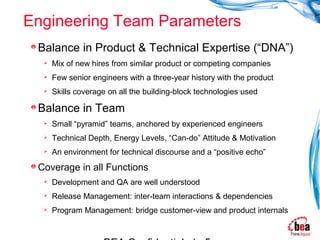
Engineering Team Parameters
 Balance in Product & Technical Expertise (“DNA”)
     Mix of new hires from similar product or competing companies
     Few senior engineers with a three-year history with the product
     Skills coverage on all the building-block technologies used

 Balance in Team
     Small “pyramid” teams, anchored by experienced engineers
     Technical Depth, Energy Levels, “Can-do” Attitude & Motivation
     An environment for technical discourse and a “positive echo”
 Coverage in all Functions
     Development and QA are well understood
     Release Management: inter-team interactions & dependencies
     Program Management: bridge customer-view and product internals
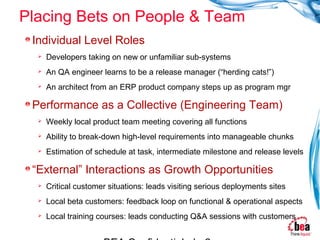
Placing Bets on People & Team
 Individual Level Roles
     Developers taking on new or unfamiliar sub-systems
     An QA engineer learns to be a release manager (“herding cats!”)
     An architect from an ERP product company steps up as program mgr

 Performance as a Collective (Engineering Team)
     Weekly local product team meeting covering all functions
     Ability to break-down high-level requirements into manageable chunks
     Estimation of schedule at task, intermediate milestone and release levels

 “External” Interactions as Growth Opportunities
     Critical customer situations: leads visiting serious deployments sites
     Local beta customers: feedback loop on functional & operational aspects
     Local training courses: leads conducting Q&A sessions with customers

Building a World-Class Software Product Team in India

  • 1.
    Great Leaders takeRisk Building a World-Class Software Product Development Team in India Sanjeev Kumar VP, Engineering & Head, India Technology Center BEA Systems India August 2007 BEA Confidential. | 1
  • 2.
    BEA Systems Inc.– Introduction The Middleware Company  “BMW” of Infrastructure Software Industry  “Software that customers use to build their software”  FedEx, DHL, WFB, PG&E, eTrade, Verizon, NYT, ideaCellular, Railways Brands & Products  WebLogic: WL Platform, WLS, WLW, WLP, WLI, WLCP, WLEvS  AquaLogic: ALSB, ALBPM, ALUI, ALER, ALDSP, ALES, ALSR  Tuxedo: Core (/T, /Q, /WS, /Domain, /M, /HA), SALT, Jolt
  • 3.
    BEA – AHistory of Risk Taking 1995: Tuxedo Purchase from Novell  Helped crystallize the middleware market-segment 1998: WebLogic Inc.  Bet-the-company acquisition, created J2EE app server market  Best value-creation via acquisition (till VMWare acquisition) 2001: CrossGain & Westside  Web Services, Controls & IDE; Did not meet expectations 2006: WebLogic Integration (WLI) in India  All engineering functions to be done in Bangalore
  • 4.
    WLI Move toBEA, Bangalore India R&D Center  About four years in operation  Initial teams focused on sustaining engineering  Currently 2:1 split in favor of mainline projects WLI Functions at BLR Lab in 2006  40% of development projects  Most of QA, sustaining engineering and backline support Risks  Ownership of overall design and code-base  No prior record in release and program management  High degree of interactions and dependencies (“chatty-ness”)
  • 5.
    Engineering Team Parameters Balance in Product & Technical Expertise (“DNA”)  Mix of new hires from similar product or competing companies  Few senior engineers with a three-year history with the product  Skills coverage on all the building-block technologies used Balance in Team  Small “pyramid” teams, anchored by experienced engineers  Technical Depth, Energy Levels, “Can-do” Attitude & Motivation  An environment for technical discourse and a “positive echo” Coverage in all Functions  Development and QA are well understood  Release Management: inter-team interactions & dependencies  Program Management: bridge customer-view and product internals
  • 6.
    Placing Bets onPeople & Team Individual Level Roles  Developers taking on new or unfamiliar sub-systems  An QA engineer learns to be a release manager (“herding cats!”)  An architect from an ERP product company steps up as program mgr Performance as a Collective (Engineering Team)  Weekly local product team meeting covering all functions  Ability to break-down high-level requirements into manageable chunks  Estimation of schedule at task, intermediate milestone and release levels “External” Interactions as Growth Opportunities  Critical customer situations: leads visiting serious deployments sites  Local beta customers: feedback loop on functional & operational aspects  Local training courses: leads conducting Q&A sessions with customers