Corrective Maintenance (CM)
R. M. SHAHBAB
Lecturer, Department of IPE, BUET
Email: sshahbab@ipe.buet.ac.bd
Reference
Chapter 5 - Engineering Maintenance, A Modern
Approach,
B.S. Dhillon, CRC Press, 2002
Thread Standards and Definitions
Introduction
 Corrective maintenance may be defined as the remedial action carried out
due to failure or deficiencies discovered during preventive maintenance,
to repair an equipment/item to its operational state.
 Corrective maintenance is an unscheduled maintenance action, composed
of unpredictable maintenance needs.
Thread Standards and Definitions
Corrective Maintenance Types
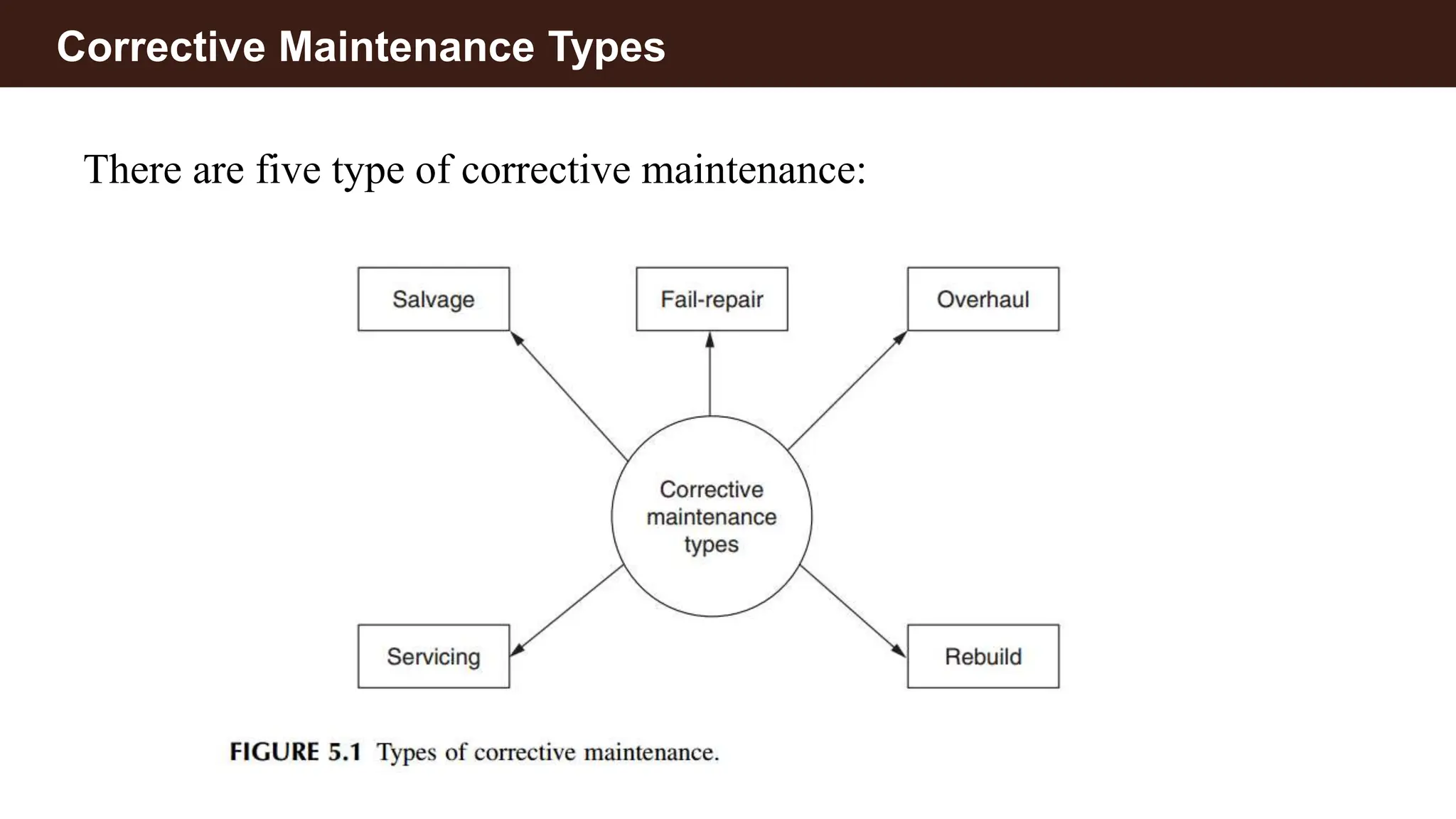
There are five type of corrective maintenance:
Thread Standards and Definitions
Corrective Maintenance Types
 Fail-repair: The failed item is restored to its operational state.
 Salvage: This element of corrective maintenance is concerned with
disposal of nonrepairable material and use of salvaged material from
nonrepairable equipment/item in the repair, overhaul, or rebuild
programs.
 Rebuild: This is concerned with restoring an item to a standard as close
as possible to original state in performance, life expectancy, and
appearance. This is achieved through complete disassembly, examination
of all components, repair and replacement of worn/unserviceable parts as
per original specifications and manufacturing tolerances, and reassembly
and testing to original production guidelines
Thread Standards and Definitions
Corrective Maintenance Types
 Overhaul: Restoring an item to its total serviceable state as per
maintenance serviceability standards, using the “inspect and repair only
as appropriate” approach.
 Servicing: Servicing may be needed because of the corrective
maintenance action, for example, engine repair can lead to crankcase
refill, welding on, etc. Another example could be that the replacement of
an air bottle may require system recharging.
Thread Standards and Definitions
Corrective Maintenance Steps
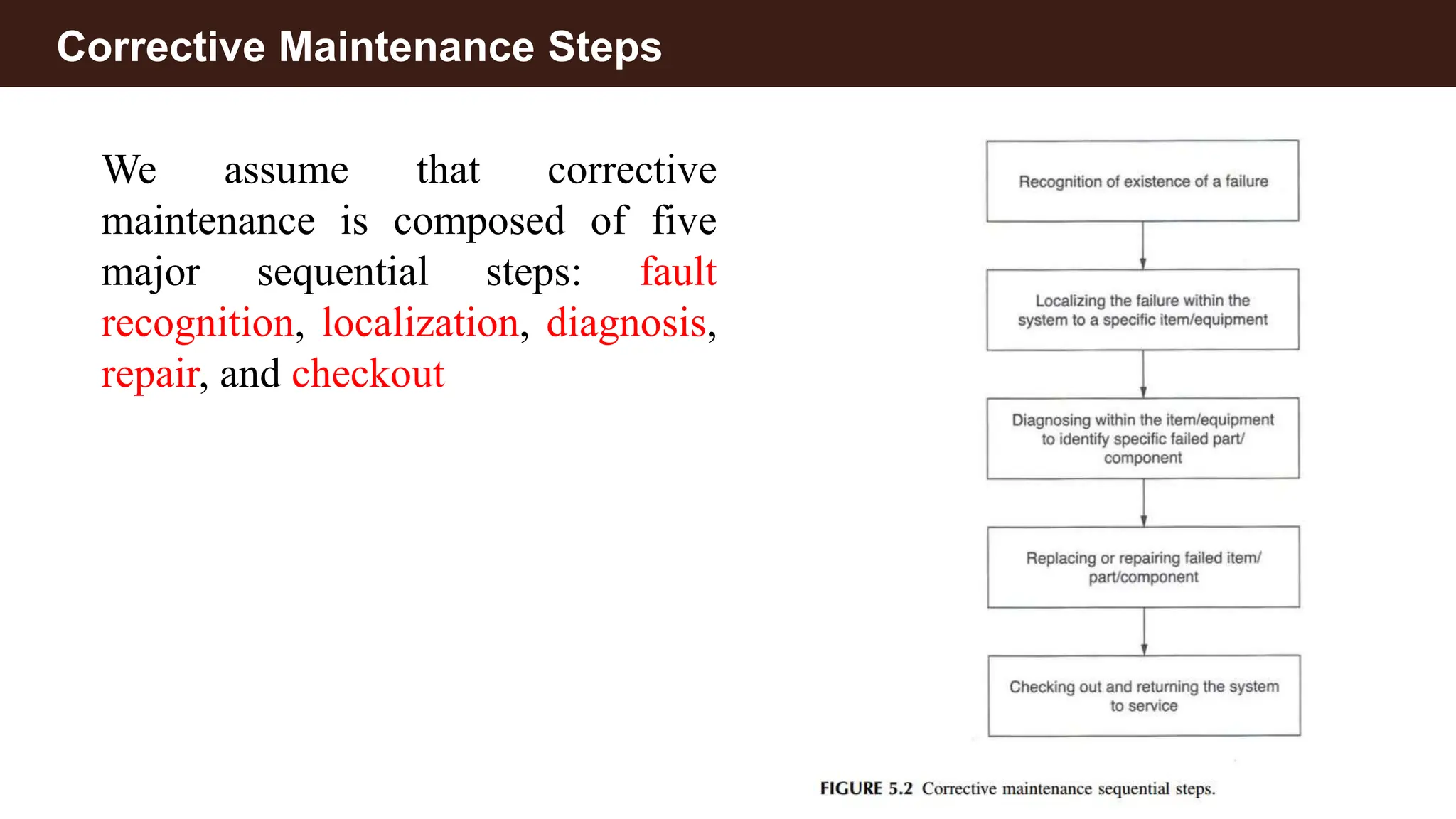
We assume that corrective
maintenance is composed of five
major sequential steps: fault
recognition, localization, diagnosis,
repair, and checkout
Thread Standards and Definitions
CM Downtime Components
Major downtime components are:
 Active repair time:
 Preparation time
 Fault location time
 Spare item obtainment time
 Fault correction time
 Adjustment and calibration time
 Checkout time
 Administrative and logistic time
 Delay time

Corrective-Maintenance_Engineerings.pptx

  • 1.
    Corrective Maintenance (CM) R.M. SHAHBAB Lecturer, Department of IPE, BUET Email: sshahbab@ipe.buet.ac.bd
  • 2.
    Reference Chapter 5 -Engineering Maintenance, A Modern Approach, B.S. Dhillon, CRC Press, 2002
  • 3.
    Thread Standards andDefinitions Introduction  Corrective maintenance may be defined as the remedial action carried out due to failure or deficiencies discovered during preventive maintenance, to repair an equipment/item to its operational state.  Corrective maintenance is an unscheduled maintenance action, composed of unpredictable maintenance needs.
  • 4.
    Thread Standards andDefinitions Corrective Maintenance Types There are five type of corrective maintenance:
  • 5.
    Thread Standards andDefinitions Corrective Maintenance Types  Fail-repair: The failed item is restored to its operational state.  Salvage: This element of corrective maintenance is concerned with disposal of nonrepairable material and use of salvaged material from nonrepairable equipment/item in the repair, overhaul, or rebuild programs.  Rebuild: This is concerned with restoring an item to a standard as close as possible to original state in performance, life expectancy, and appearance. This is achieved through complete disassembly, examination of all components, repair and replacement of worn/unserviceable parts as per original specifications and manufacturing tolerances, and reassembly and testing to original production guidelines
  • 6.
    Thread Standards andDefinitions Corrective Maintenance Types  Overhaul: Restoring an item to its total serviceable state as per maintenance serviceability standards, using the “inspect and repair only as appropriate” approach.  Servicing: Servicing may be needed because of the corrective maintenance action, for example, engine repair can lead to crankcase refill, welding on, etc. Another example could be that the replacement of an air bottle may require system recharging.
  • 7.
    Thread Standards andDefinitions Corrective Maintenance Steps We assume that corrective maintenance is composed of five major sequential steps: fault recognition, localization, diagnosis, repair, and checkout
  • 8.
    Thread Standards andDefinitions CM Downtime Components Major downtime components are:  Active repair time:  Preparation time  Fault location time  Spare item obtainment time  Fault correction time  Adjustment and calibration time  Checkout time  Administrative and logistic time  Delay time