STRATEGY
• Strategy is defined as the determination of the basic long-term
objectives & goals of an enterprise and the adoption of courses of
action and allocation of resources necessary to accomplish these
goals.
FORMULATION OF STRATEGY
• ww
1) Competitor
2) Customer
3) Supplier
4) Regulator
5) Social/political
1) Technology know how
2) Manufacturing
3) Marketing
4) Distribution network
5) Logistics
6) Infrastructure
Opportunities & Threats
Identify Opportunity
Strengths & Weakness
Identify Core Competence
Fit internal competence with external opportunities
Firm’s Strategy
Environment Analysis Internal Analysis
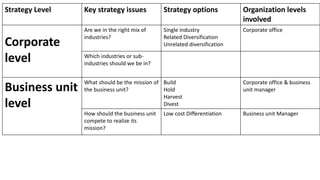
Strategy Level Key strategy issues Strategy options Organization levels
involved
Corporate
level
Are we in the right mix of
industries?
Single industry
Related Diversification
Unrelated diversification
Corporate office
Which industries or sub-
industries should we be in?
Business unit
level
What should be the mission of
the business unit?
Build
Hold
Harvest
Divest
Corporate office & business
unit manager
How should the business unit
compete to realize its
mission?
Low cost Differentiation Business unit Manager
CONTROL FOR
DIFFERENTIATED
STRATEGIES
CORPORATE LEVEL STRATEGY
• Corporate strategy sheds light on how one should manage the business one is
in and intends to be in so as to achieve the target levels of corporate
performance.
• Corporate level strategy represents the pattern of entrepreneurial actions &
intends underlying the organization’s strategic interests in different business,
divisions, product lines, technologies, customer groups & customer needs.
ROLE OF CORPORATE STRATEGY
• Ensures right environmental fit
• Helps to fill the firm’s strategic planning gap, selecting the appropriate
strategy route.
• Helps in building competitive advantages.
CONSTITUENTS OF CORPORATE STRATEGY
• Product-Market Posture.
• Competitive Advantage & Synergy
• Corporate Strategy Of A Firm Can Be Stated In Concrete & Precise
• Actual Task Of Formulating The Strategy
IMPLICATIONS OF MANAGEMENT CONTROL
• Any organization, however well aligned its structures is to the chosen
strategy, cannot effectively implement its strategies without a
consistent management control system.
• While organization structure defines the reporting relationship and
responsibilities and authorities of different mangers, it needed an
appropriately designed control system to the function effectively.
• Different corporate strategies imply the following differences in the context in
which control systems need to be designed:
1. As firms become more diversified, corporate level managers may not have
significant knowledge of, or experience in, the activities of the company’s
various business unit. If so, corporate level managers for highly diversifies
firms cannot expect to control the different business on the basis of intimate
knowledge of their activities & performance evaluation tends to be carried
out at arm’s length.
2. Single industry & related diversification firms possess corporate wide core
competencies on which the business units are based. Communication
channels & transfer of competencies across business units. Therefore, are
critical in such firms.
In contrast, there are low levels of interdependence among the business units of
unrelated diversified firms. This implies that as firm becomes more diversified, it
maybe desirables to the change the balance in control system from an emphasis
on fostering co-operation to an emphasis on encouraging entrepreneurial spirit.
BUSINESS LEVEL STRATEGY
Strategy
Options
Goal Applies to SBU Managers
approach
Implication Evaluation Criteria
Build Increase Market share Low Market share
in a High growth
industry
Sacrifices short
term cash flow
and earnings
Increases
production &
additional use of
Firm’s resources
On achieving a
targeted increase
in sales or market
share.
Hold Maximize short term
cash flow and
earnings
High Market share
in a Low growth
industry
To supplement
earnings with
other business
unit
ROI, EVA.
Harvest Profit oriented High Market share
in a High growth
industry
Use of
accounting &
Non-financial
measures
Feedback of
customers,
market share &
profit.
Divest Maximize cash flows Low Market share
in a Low growth
industry
Slow withdrawal
or outright sale
End of lifecycle
stage
BUSINESS LEVEL STRATEGY
Strategy
Options
Goal Action Evaluation Criteria
Low Cost
Competitive
Strategy
Achieve lower costs relative
to competitors
Taking advantage of economies
of scale, reducing customer
service, research &
development, advertising etc.
Cost standards, cycle time
& inventory turnover.
Differentiation
Strategy
To create a unique & exclusive
product
Increase Brand loyalty,
customer service, product
design & technology.
Checking the investments,
technology and customers
feedback
Focus Strategy Targeting narrow competitive
market within an industry
segment
Low cost or differentiation
strategy
Tailored to the selected
objective
Defender
Strategy
Stable environment Compete through cost &
Quality control
cost & Quality control

Strategy

  • 1.
    STRATEGY • Strategy isdefined as the determination of the basic long-term objectives & goals of an enterprise and the adoption of courses of action and allocation of resources necessary to accomplish these goals.
  • 2.
    FORMULATION OF STRATEGY •ww 1) Competitor 2) Customer 3) Supplier 4) Regulator 5) Social/political 1) Technology know how 2) Manufacturing 3) Marketing 4) Distribution network 5) Logistics 6) Infrastructure Opportunities & Threats Identify Opportunity Strengths & Weakness Identify Core Competence Fit internal competence with external opportunities Firm’s Strategy Environment Analysis Internal Analysis
  • 3.
    Strategy Level Keystrategy issues Strategy options Organization levels involved Corporate level Are we in the right mix of industries? Single industry Related Diversification Unrelated diversification Corporate office Which industries or sub- industries should we be in? Business unit level What should be the mission of the business unit? Build Hold Harvest Divest Corporate office & business unit manager How should the business unit compete to realize its mission? Low cost Differentiation Business unit Manager
  • 4.
  • 5.
    CORPORATE LEVEL STRATEGY •Corporate strategy sheds light on how one should manage the business one is in and intends to be in so as to achieve the target levels of corporate performance. • Corporate level strategy represents the pattern of entrepreneurial actions & intends underlying the organization’s strategic interests in different business, divisions, product lines, technologies, customer groups & customer needs.
  • 6.
    ROLE OF CORPORATESTRATEGY • Ensures right environmental fit • Helps to fill the firm’s strategic planning gap, selecting the appropriate strategy route. • Helps in building competitive advantages.
  • 7.
    CONSTITUENTS OF CORPORATESTRATEGY • Product-Market Posture. • Competitive Advantage & Synergy • Corporate Strategy Of A Firm Can Be Stated In Concrete & Precise • Actual Task Of Formulating The Strategy
  • 8.
    IMPLICATIONS OF MANAGEMENTCONTROL • Any organization, however well aligned its structures is to the chosen strategy, cannot effectively implement its strategies without a consistent management control system. • While organization structure defines the reporting relationship and responsibilities and authorities of different mangers, it needed an appropriately designed control system to the function effectively.
  • 9.
    • Different corporatestrategies imply the following differences in the context in which control systems need to be designed: 1. As firms become more diversified, corporate level managers may not have significant knowledge of, or experience in, the activities of the company’s various business unit. If so, corporate level managers for highly diversifies firms cannot expect to control the different business on the basis of intimate knowledge of their activities & performance evaluation tends to be carried out at arm’s length. 2. Single industry & related diversification firms possess corporate wide core competencies on which the business units are based. Communication channels & transfer of competencies across business units. Therefore, are critical in such firms. In contrast, there are low levels of interdependence among the business units of unrelated diversified firms. This implies that as firm becomes more diversified, it maybe desirables to the change the balance in control system from an emphasis on fostering co-operation to an emphasis on encouraging entrepreneurial spirit.
  • 10.
    BUSINESS LEVEL STRATEGY Strategy Options GoalApplies to SBU Managers approach Implication Evaluation Criteria Build Increase Market share Low Market share in a High growth industry Sacrifices short term cash flow and earnings Increases production & additional use of Firm’s resources On achieving a targeted increase in sales or market share. Hold Maximize short term cash flow and earnings High Market share in a Low growth industry To supplement earnings with other business unit ROI, EVA. Harvest Profit oriented High Market share in a High growth industry Use of accounting & Non-financial measures Feedback of customers, market share & profit. Divest Maximize cash flows Low Market share in a Low growth industry Slow withdrawal or outright sale End of lifecycle stage
  • 11.
    BUSINESS LEVEL STRATEGY Strategy Options GoalAction Evaluation Criteria Low Cost Competitive Strategy Achieve lower costs relative to competitors Taking advantage of economies of scale, reducing customer service, research & development, advertising etc. Cost standards, cycle time & inventory turnover. Differentiation Strategy To create a unique & exclusive product Increase Brand loyalty, customer service, product design & technology. Checking the investments, technology and customers feedback Focus Strategy Targeting narrow competitive market within an industry segment Low cost or differentiation strategy Tailored to the selected objective Defender Strategy Stable environment Compete through cost & Quality control cost & Quality control