Corporate Social Responsibility
(CSR)
Muhammad Ali Baber
BBA (Hons)
UST Bannu
Overview
 Definition of CSR and Basic concept
 Reasons of CSR
 Stages of maturity
 Should organizations be socially involved?
(Benefits and Drawbacks of CSR)
 Different approaches CSR
Corporate social responsibility
 Corporate Social Responsibility is a management
concept whereby companies integrate social and
environmental concerns in their business operations
and interactions with their stakeholders.
The concept of social responsibility has been described in
two different ways
1. Profit making only
2. Going beyond the profit making
This concept can be better understand when comparing this
with two similar concepts
Social obligation
Social responsiveness
SOCIAL OBLIGATION:
Is when a firm engages in social actions because of its
obligations to meet certain economic and legal
obligations.
The organization does what it’s obligated to do nothing
more.
This idea reflects the classical view of social
responsibility, which says that management’s only
social responsibility is to maximize profits.
Social responsiveness
Is when a company engages in social actions in
response to some popular social need. Managers are
guided by social norms and values and make practical,
market-oriented decisions about their actions.
Reasons for CSR
 CSR activities are mostly expected by the public.
 CSR activities help organizations to hire and retain the
people they want.
 CSR activities contribute to business performance.
Five stages of maturity
1.DEFENSIVE
“It is not our responsibility”
2.COMPLIANCE
“We’ll do what we have to do”
3.MANAGERIAL
Embed the societal issue into core management
processes.
4.STRATEGIC
Competitive advantage
5.CIVIL
Promote broad industry participation in CR ("We need
to make sure everybody does it’’
Should Organization Be Socially
Involved?
 There are different arguments for and against the social
responsibility.
Arguments in favor of social involvement are
 Public expectations
 Stockholder interests
 Long-run profits
 Ethical obligation
 Public image
 Better environment
 Discouragement of further governmental regulation
Arguments against of social responsibility
 Violation of profit maximization
 Dilution of purpose
 Costs
 Lack of skills
How Organizations go green
By the term green means that how much an organization is
socially responsible
There are FOUR DIFFERENT APPROACHES for the
organization to become dark green from light green.
1. Legal (light green) approach.
2. Market approach
3. Stakeholder approach
4. Activist (dark green approach)
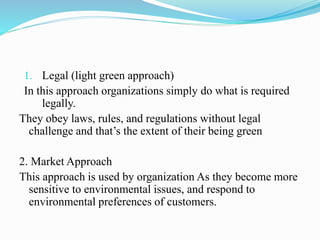
1. Legal (light green approach)
In this approach organizations simply do what is required
legally.
They obey laws, rules, and regulations without legal
challenge and that’s the extent of their being green
2. Market Approach
This approach is used by organization As they become more
sensitive to environmental issues, and respond to
environmental preferences of customers.
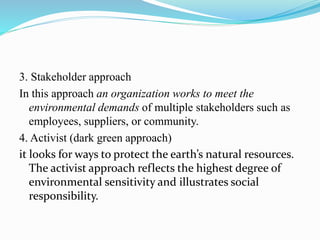
3. Stakeholder approach
In this approach an organization works to meet the
environmental demands of multiple stakeholders such as
employees, suppliers, or community.
4. Activist (dark green approach)
it looks for ways to protect the earth’s natural resources.
The activist approach reflects the highest degree of
environmental sensitivity and illustrates social
responsibility.
Corporate social responsibility

Corporate social responsibility

  • 2.
    Corporate Social Responsibility (CSR) MuhammadAli Baber BBA (Hons) UST Bannu
  • 3.
    Overview  Definition ofCSR and Basic concept  Reasons of CSR  Stages of maturity  Should organizations be socially involved? (Benefits and Drawbacks of CSR)  Different approaches CSR
  • 4.
    Corporate social responsibility Corporate Social Responsibility is a management concept whereby companies integrate social and environmental concerns in their business operations and interactions with their stakeholders.
  • 5.
    The concept ofsocial responsibility has been described in two different ways 1. Profit making only 2. Going beyond the profit making This concept can be better understand when comparing this with two similar concepts Social obligation Social responsiveness
  • 6.
    SOCIAL OBLIGATION: Is whena firm engages in social actions because of its obligations to meet certain economic and legal obligations. The organization does what it’s obligated to do nothing more. This idea reflects the classical view of social responsibility, which says that management’s only social responsibility is to maximize profits.
  • 7.
    Social responsiveness Is whena company engages in social actions in response to some popular social need. Managers are guided by social norms and values and make practical, market-oriented decisions about their actions.
  • 8.
    Reasons for CSR CSR activities are mostly expected by the public.  CSR activities help organizations to hire and retain the people they want.  CSR activities contribute to business performance.
  • 9.
    Five stages ofmaturity 1.DEFENSIVE “It is not our responsibility” 2.COMPLIANCE “We’ll do what we have to do” 3.MANAGERIAL Embed the societal issue into core management processes.
  • 10.
    4.STRATEGIC Competitive advantage 5.CIVIL Promote broadindustry participation in CR ("We need to make sure everybody does it’’
  • 11.
    Should Organization BeSocially Involved?  There are different arguments for and against the social responsibility. Arguments in favor of social involvement are  Public expectations  Stockholder interests  Long-run profits  Ethical obligation  Public image  Better environment  Discouragement of further governmental regulation
  • 12.
    Arguments against ofsocial responsibility  Violation of profit maximization  Dilution of purpose  Costs  Lack of skills
  • 13.
    How Organizations gogreen By the term green means that how much an organization is socially responsible There are FOUR DIFFERENT APPROACHES for the organization to become dark green from light green. 1. Legal (light green) approach. 2. Market approach 3. Stakeholder approach 4. Activist (dark green approach)
  • 14.
    1. Legal (lightgreen approach) In this approach organizations simply do what is required legally. They obey laws, rules, and regulations without legal challenge and that’s the extent of their being green 2. Market Approach This approach is used by organization As they become more sensitive to environmental issues, and respond to environmental preferences of customers.
  • 15.
    3. Stakeholder approach Inthis approach an organization works to meet the environmental demands of multiple stakeholders such as employees, suppliers, or community. 4. Activist (dark green approach) it looks for ways to protect the earth’s natural resources. The activist approach reflects the highest degree of environmental sensitivity and illustrates social responsibility.