Value through Gold  June 2011
1Forward Looking InformationThis Presentation contains ‘‘forward-looking information’’ within the meaning of applicable Canadian securities legislation and the United States Private Securities Litigation Reform Act of 1995.  Forward-looking information may include, but is not limited to, information with respect to the anticipated production and developments in our operations in future periods, our planned exploration and development activities, the adequacy of our financial resources, the estimation of mineral resources, realization of mineral resource estimates, costs and timing of development of the projects we currently intend to acquire (the “Projects”), costs and timing of future exploration, results of future exploration and drilling, timing and receipt of approvals, consents and permits under applicable legislation, our executive compensation approach and practice, the composition of our board of directors and committees, and adequacy of financial resources. Wherever possible, words such as ‘‘plans’’, ‘‘expects’’ or ‘‘does not expect’’, ‘‘budget’’, ‘‘scheduled’’, ‘‘estimates’’, ‘‘forecasts’’, ‘‘anticipate’’ or ‘‘does not anticipate’’, ‘‘believe’’, ‘‘intend’’ and similar expressions or statements that certain actions, events or results ‘‘may’’, ‘‘could’’, ‘‘would’’, ‘‘might’’ or ‘‘will’’ be taken, occur or be achieved, have been used to identify forward-looking information. Statements concerning mineral resource estimates may also be deemed to constitute forward-looking information to the extent that they involve estimates of the mineralization that will be encountered if the property is developed. Any statements that express or involve discussions with respect to predictions, expectations, beliefs, plans, projections, objectives, assumptions or future events or performance (often, but not always, using words or phrases such as ‘‘expects’’, ‘‘anticipates’’, ‘‘plans’’, ‘‘projects’’, ‘‘estimates’’, ‘‘assumes’’, ‘‘intends’’, ‘‘strategy’’, ‘‘goals’’, ‘‘objectives’’, ‘‘potential’’ or variations thereof, or stating that certain actions, events or results ‘‘may’’, ‘‘could’’, ‘‘would’’, ‘‘might’’ or ‘‘will’’ be taken, occur or be achieved, or the negative of any of these terms and similar expressions) are not statements of historical fact and may be forward-looking information. Forward-looking information is subject to a variety of known and unknown risks, uncertainties and other factors that could cause actual events or results to differ from those expressed or implied by the forward-looking information.  Many of these risks are listed and described in our final short-form prospectus dated April 4, 2011 (the “Prospectus”), which is available for review on SEDAR at www.sedar.com under our profile. Although we have attempted to identify important factors that could cause actual results to differ materially from those contained in forward-looking information, there may be other factors that cause results not to be as anticipated, estimated or intended. There can be no assurance that such information will prove to be accurate, as actual results and future events could differ materially from those anticipated in such information. Forward-looking information involves statements about the future and is inherently uncertain, and our actual achievements or other future events or conditions may differ materially from those reflected in the forward-looking information due to a variety of risks, uncertainties and other factors, including, without limitation, those referred to in the Prospectus under the heading ‘‘Risk Factors’’. Our forward-looking information is based on the beliefs, expectations and opinions of management on the date the statements are made, and we do not assume any obligation to update forward-looking information, whether as a result of new information, future events or otherwise, other than as required by applicable law.   For the reasons set forth above, prospective investors should not place undue reliance on forward-looking information.National Instrument 43-101Technical and scientific information contained herein relating to the Projects is derived from National Instrument 43-101 (“NI 43-101”) compliant technical reports “Technical Report and Updated Resource Estimate on the Snowfield Property” and “Technical Report and Updated Resource Estimate on the Brucejack Property” dated February 18, 2011, a preliminary economic assessment entitled ‘‘Technical Report and Preliminary Economic Assessment of the Snowfield Brucejack Project’’ dated October 28, 2010 (the “Preliminary Assessment”) and a preliminary economic assessment dated June 3, 2011 on the Brucejack Project.  We have filed the Technical Reports and Preliminary Assessment under our profile at www.sedar.com.   Technical and scientific information not contained within the Preliminary Assessment and Technical Reports for the Projects have been prepared under the supervision of Mr. Kenneth C. McNaughton, an independent “qualified person” under NI 43-101.This presentation uses the terms “measured resources”, “indicated resources” (together “M&I”) and “inferred resources”. Although these terms are recognized and required by Canadian regulations (under NI 43-101), the United States Securities and Exchange Commission does not recognize them.    Mineral resources which are not mineral reserves do not have demonstrated economic viability. The estimate of mineral resources may be materially affected by environmental, permitting, legal, title, taxation, socio-political, marketing, or other relevant issues.  There is no guarantee that all or any part of the mineral resource will be converted into mineral reserves.In addition, “inferred resources” have a great amount of uncertainty as to their existence, and economic and legal feasibility. It cannot be assumed that all or any part of an inferred mineral resource will ever be upgraded to a higher category. Under Canadian rules, estimates of inferred mineral resources may not form the basis of feasibility or pre feasibility studies, or economic studies, except for a Preliminary Assessment as defined under NI43 101. Investors are cautioned not to assume that part or all of an inferred resource exists, or is economically or legally mineable. U.S. Securities Law DisclaimerOur securities have not been and will not be registered under the United States Securities Act of 1933, as amended (the "Securities Act"), or the securities laws of any state of the United States and, subject to certain exceptions, may not be offered or sold within the United States. Investors resident in the United States will be required to acknowledge that the securities are "restricted securities" within the meaning of Rule 144, and that if in the future an investor decides to offer, resell, pledge or otherwise transfer any of the securities, it may do so only (a) to the Corporation; (b) outside the United States in accordance with Rule 904 of Regulation S under the Securities Act and in compliance with applicable Canadian and provincial laws and regulations; (c) within the United States in accordance with Rule 144, if available, and in compliance with any applicable state securities laws of the United States; or (d) in another transaction that does not require registration under the Securities Act or any applicable state securities laws of the United States.Our securities have not been approved or disapproved by the United States Securities and Exchange Commission or by any state securities commission or regulatory authority, nor have any of the foregoing authorities passed on the accuracy or adequacy of any offering document provided in connection with the offering of these securities.CurrencyUnless otherwise indicated, all dollar values herein are in Canadian $.Disclaimer
Why Pretivm?Adjacent projects in northern British Columbia are delivering value through goldBrucejack ProjectPotential to host a high-gradegold-silverdepositQuickest path to production
Meaningful high grade ounces present
Economics potentially very favorable
PEA completedJune 2011; possiblystraight to feasibility study
Lower capital requirements; can be financed alone
Quicker development scheduleSnowfield ProjectBulk-tonnage presentslong-term value in goldJoint engineering study underway to examine economics of combining Snowfield and Seabridge’s KSM project in one operation
Long-term gold call option
Rare asset of its size worldwide in favorable geography 2
Gold: supply and demand3Source: GFMS Gold Survey
4Gold: Physical Bars
Gold: Impact of China5
6Large-Scale North American Gold Projects(NDM)(SEA)(PVG)(NG/ABX)(DGC)(OSK)(CKG)(ITH)(WRN)(RMX)
Brucejack and Snowfield Properties7
Brucejack and Snowfield8
Brucejack High-Grade History9908 drill holes
120,000 meters of drilling
5.3 kilometers of underground development
Previously permitted for production
High-grade resource 1960-1980	        1980-1985						1986-1989						1990											1992											1999-2000							2009-2010   													2011		Preliminary Economic Assessment on Brucejack high-grade gold completed. Exploration permit and road permits granted.  (Pretivm)Exploration resumes with drilling at Galena Hill, the newly-discovered Bridge Zone, Gossan Hill and SG zones.  Holes at  Galena Hill encounter visible gold.  Follow-up drilling in 2010 encounters further visible gold. Brucejack Project acquired by Pretivm.(Silver Standard)Acquisition of Newhawk by Silver Standard Resources Inc. and 60% of project; remaining 40% in 2001. Care and maintenance.(Silver Standard)Extensive exploration resulting in identification of several zones. Drilling then focuses on southern areas of property including West Zone. (Esso)Feasibility study completed for West Zone. From 1986 to 1990, $21 million spent developing West Zone and other small veins. Road construction permit granted in 1991.     (Newhawk JV) Mine Development Certificate granted. Further exploration in 1994; care and maintenance.   (NewhawkJV) Exploration of known base and precious metals targets north and northwest of Brucejack Lake. (Granduc)Underground development of West Zone (5,276 meters) completed in 1989. (Newhawk JV)
10Brucejack ProjectIntrusion-related gold/silver vein systems
+50,000 meters of drilling planned for 2011
Resources increased 134% from 2010 to 2011
Mineralization remains open in ALL directionsBrucejack Bulk-Tonnage Resource Summary - February 2011(1)(Based on a cut-off of 0.30 grams of gold-equivalent/tonne)(1) Metal price and recoveries assumptions are: Au US$1,025/oz. (71%); Ag US$16.60/oz. (70%)
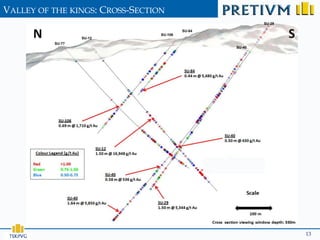
11Brucejack – High-GradeMulti-kilo gold intercepts
5km existing underground development
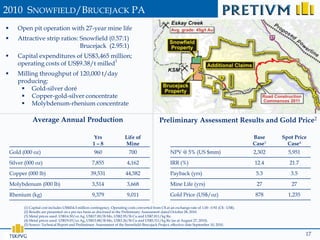
High-grade PEA completed June 2011; update to commence after 2011 drilling Brucejack 5.0g/t Grade & Tonnage Resource Summary - February 2011(1)(3)(1)@ 5.0 g/t cut-off  within the 0.30 grams of au-equiv/tonne optimized pit shell.   (3) Metal price and recoveries assumptions are: Au US$1,025/oz. (71%); Ag US$16.60/oz. (70%)

Corporate Presentation June 2011

  • 1.
  • 2.
    1Forward Looking InformationThisPresentation contains ‘‘forward-looking information’’ within the meaning of applicable Canadian securities legislation and the United States Private Securities Litigation Reform Act of 1995. Forward-looking information may include, but is not limited to, information with respect to the anticipated production and developments in our operations in future periods, our planned exploration and development activities, the adequacy of our financial resources, the estimation of mineral resources, realization of mineral resource estimates, costs and timing of development of the projects we currently intend to acquire (the “Projects”), costs and timing of future exploration, results of future exploration and drilling, timing and receipt of approvals, consents and permits under applicable legislation, our executive compensation approach and practice, the composition of our board of directors and committees, and adequacy of financial resources. Wherever possible, words such as ‘‘plans’’, ‘‘expects’’ or ‘‘does not expect’’, ‘‘budget’’, ‘‘scheduled’’, ‘‘estimates’’, ‘‘forecasts’’, ‘‘anticipate’’ or ‘‘does not anticipate’’, ‘‘believe’’, ‘‘intend’’ and similar expressions or statements that certain actions, events or results ‘‘may’’, ‘‘could’’, ‘‘would’’, ‘‘might’’ or ‘‘will’’ be taken, occur or be achieved, have been used to identify forward-looking information. Statements concerning mineral resource estimates may also be deemed to constitute forward-looking information to the extent that they involve estimates of the mineralization that will be encountered if the property is developed. Any statements that express or involve discussions with respect to predictions, expectations, beliefs, plans, projections, objectives, assumptions or future events or performance (often, but not always, using words or phrases such as ‘‘expects’’, ‘‘anticipates’’, ‘‘plans’’, ‘‘projects’’, ‘‘estimates’’, ‘‘assumes’’, ‘‘intends’’, ‘‘strategy’’, ‘‘goals’’, ‘‘objectives’’, ‘‘potential’’ or variations thereof, or stating that certain actions, events or results ‘‘may’’, ‘‘could’’, ‘‘would’’, ‘‘might’’ or ‘‘will’’ be taken, occur or be achieved, or the negative of any of these terms and similar expressions) are not statements of historical fact and may be forward-looking information. Forward-looking information is subject to a variety of known and unknown risks, uncertainties and other factors that could cause actual events or results to differ from those expressed or implied by the forward-looking information. Many of these risks are listed and described in our final short-form prospectus dated April 4, 2011 (the “Prospectus”), which is available for review on SEDAR at www.sedar.com under our profile. Although we have attempted to identify important factors that could cause actual results to differ materially from those contained in forward-looking information, there may be other factors that cause results not to be as anticipated, estimated or intended. There can be no assurance that such information will prove to be accurate, as actual results and future events could differ materially from those anticipated in such information. Forward-looking information involves statements about the future and is inherently uncertain, and our actual achievements or other future events or conditions may differ materially from those reflected in the forward-looking information due to a variety of risks, uncertainties and other factors, including, without limitation, those referred to in the Prospectus under the heading ‘‘Risk Factors’’. Our forward-looking information is based on the beliefs, expectations and opinions of management on the date the statements are made, and we do not assume any obligation to update forward-looking information, whether as a result of new information, future events or otherwise, other than as required by applicable law. For the reasons set forth above, prospective investors should not place undue reliance on forward-looking information.National Instrument 43-101Technical and scientific information contained herein relating to the Projects is derived from National Instrument 43-101 (“NI 43-101”) compliant technical reports “Technical Report and Updated Resource Estimate on the Snowfield Property” and “Technical Report and Updated Resource Estimate on the Brucejack Property” dated February 18, 2011, a preliminary economic assessment entitled ‘‘Technical Report and Preliminary Economic Assessment of the Snowfield Brucejack Project’’ dated October 28, 2010 (the “Preliminary Assessment”) and a preliminary economic assessment dated June 3, 2011 on the Brucejack Project. We have filed the Technical Reports and Preliminary Assessment under our profile at www.sedar.com. Technical and scientific information not contained within the Preliminary Assessment and Technical Reports for the Projects have been prepared under the supervision of Mr. Kenneth C. McNaughton, an independent “qualified person” under NI 43-101.This presentation uses the terms “measured resources”, “indicated resources” (together “M&I”) and “inferred resources”. Although these terms are recognized and required by Canadian regulations (under NI 43-101), the United States Securities and Exchange Commission does not recognize them. Mineral resources which are not mineral reserves do not have demonstrated economic viability. The estimate of mineral resources may be materially affected by environmental, permitting, legal, title, taxation, socio-political, marketing, or other relevant issues. There is no guarantee that all or any part of the mineral resource will be converted into mineral reserves.In addition, “inferred resources” have a great amount of uncertainty as to their existence, and economic and legal feasibility. It cannot be assumed that all or any part of an inferred mineral resource will ever be upgraded to a higher category. Under Canadian rules, estimates of inferred mineral resources may not form the basis of feasibility or pre feasibility studies, or economic studies, except for a Preliminary Assessment as defined under NI43 101. Investors are cautioned not to assume that part or all of an inferred resource exists, or is economically or legally mineable. U.S. Securities Law DisclaimerOur securities have not been and will not be registered under the United States Securities Act of 1933, as amended (the "Securities Act"), or the securities laws of any state of the United States and, subject to certain exceptions, may not be offered or sold within the United States. Investors resident in the United States will be required to acknowledge that the securities are "restricted securities" within the meaning of Rule 144, and that if in the future an investor decides to offer, resell, pledge or otherwise transfer any of the securities, it may do so only (a) to the Corporation; (b) outside the United States in accordance with Rule 904 of Regulation S under the Securities Act and in compliance with applicable Canadian and provincial laws and regulations; (c) within the United States in accordance with Rule 144, if available, and in compliance with any applicable state securities laws of the United States; or (d) in another transaction that does not require registration under the Securities Act or any applicable state securities laws of the United States.Our securities have not been approved or disapproved by the United States Securities and Exchange Commission or by any state securities commission or regulatory authority, nor have any of the foregoing authorities passed on the accuracy or adequacy of any offering document provided in connection with the offering of these securities.CurrencyUnless otherwise indicated, all dollar values herein are in Canadian $.Disclaimer
  • 3.
    Why Pretivm?Adjacent projectsin northern British Columbia are delivering value through goldBrucejack ProjectPotential to host a high-gradegold-silverdepositQuickest path to production
  • 4.
    Meaningful high gradeounces present
  • 5.
  • 6.
    PEA completedJune 2011;possiblystraight to feasibility study
  • 7.
    Lower capital requirements;can be financed alone
  • 8.
    Quicker development scheduleSnowfieldProjectBulk-tonnage presentslong-term value in goldJoint engineering study underway to examine economics of combining Snowfield and Seabridge’s KSM project in one operation
  • 9.
  • 10.
    Rare asset ofits size worldwide in favorable geography 2
  • 11.
    Gold: supply anddemand3Source: GFMS Gold Survey
  • 12.
  • 13.
  • 14.
    6Large-Scale North AmericanGold Projects(NDM)(SEA)(PVG)(NG/ABX)(DGC)(OSK)(CKG)(ITH)(WRN)(RMX)
  • 15.
  • 16.
  • 17.
  • 18.
  • 19.
    5.3 kilometers ofunderground development
  • 20.
  • 21.
    High-grade resource 1960-1980 1980-1985 1986-1989 1990 1992 1999-2000 2009-2010 2011 Preliminary Economic Assessment on Brucejack high-grade gold completed. Exploration permit and road permits granted. (Pretivm)Exploration resumes with drilling at Galena Hill, the newly-discovered Bridge Zone, Gossan Hill and SG zones. Holes at Galena Hill encounter visible gold. Follow-up drilling in 2010 encounters further visible gold. Brucejack Project acquired by Pretivm.(Silver Standard)Acquisition of Newhawk by Silver Standard Resources Inc. and 60% of project; remaining 40% in 2001. Care and maintenance.(Silver Standard)Extensive exploration resulting in identification of several zones. Drilling then focuses on southern areas of property including West Zone. (Esso)Feasibility study completed for West Zone. From 1986 to 1990, $21 million spent developing West Zone and other small veins. Road construction permit granted in 1991. (Newhawk JV) Mine Development Certificate granted. Further exploration in 1994; care and maintenance. (NewhawkJV) Exploration of known base and precious metals targets north and northwest of Brucejack Lake. (Granduc)Underground development of West Zone (5,276 meters) completed in 1989. (Newhawk JV)
  • 22.
  • 23.
    +50,000 meters ofdrilling planned for 2011
  • 24.
    Resources increased 134%from 2010 to 2011
  • 25.
    Mineralization remains openin ALL directionsBrucejack Bulk-Tonnage Resource Summary - February 2011(1)(Based on a cut-off of 0.30 grams of gold-equivalent/tonne)(1) Metal price and recoveries assumptions are: Au US$1,025/oz. (71%); Ag US$16.60/oz. (70%)
  • 26.
  • 27.
  • 28.
    High-grade PEA completedJune 2011; update to commence after 2011 drilling Brucejack 5.0g/t Grade & Tonnage Resource Summary - February 2011(1)(3)(1)@ 5.0 g/t cut-off within the 0.30 grams of au-equiv/tonne optimized pit shell. (3) Metal price and recoveries assumptions are: Au US$1,025/oz. (71%); Ag US$16.60/oz. (70%)