EMEA Corporate Occupier Conditions - Q4 2011


Falling sentiment increases
pressure on CRE teams
The intensification of the Eurozone crisis has further damaged
corporate confidence. Amid renewed uncertainty, CRE teams
have once again been tasked with driving both cost saving and
transformation agendas.


Room for manoeuvre is limited. A lack of quality supply in the
markets is encouraging landlords, having made concessions
during the global financial crisis, to hold pricing firm.


Transformation is also challenging. Development pipelines are
impoverished. Access to quality office space will often require
pre-letting strategies to be employed. Corporate reluctance to
authorise capital expenditure is also a clear constraint.
2 On Point • EMEA Corporate Occupier Conditions – Q4 2011


Introduction
Back to the future                                                         already been picked. The route to the promised land of real estate
                                                                           transformation and ongoing cost effectiveness requires teams to
It is rare for corporate real estate professionals to look back. Our
                                                                           tread new paths.
industry is about preparing for and facilitating the future. It is about
responding to operational and organisational changes through the
                                                                           Preparing for the future
effective use of real estate assets. What happened in the past most
often remains in the past. A forward looking gaze is the default           So next year – an Olympic year – will be a year where teams and
setting for CRE professionals. Yet perhaps now, as we approach             individuals will seek to rise above challenges and excel. But
the closing month of another challenging year, represents a good           success will not be guaranteed. Those that have failed to prepare
time to look back and reflect.                                             well; are unable to articulate a clear strategy with implementable
                                                                           tactics; or have not taken themselves to the leading edge of best
It is a year since we conducted an industry first – a truly global         practice will be consigned to the role of also-rans.
survey of corporate real estate leaders. We were keen to
understand how the front runners of our industry were facing up to         Our dedicated corporate occupier research programme is designed
the unprecedented challenges of a global financial crisis and the first    to offer you a competitive edge. Through our thought leadership
global recession since World War II. For the record, we identified         programme, we will be focusing down on the prime issues in the
four themes that were shaping CRE team strategy and behaviour:             development and ultimate success of transformative real estate
                                                                           strategies – workplace productivity. In an environment of limited
      1.    A strong push towards more productive and better utilised      cash and limited market options, how can investment in real estate
            real estate portfolios                                         be maximised by driving a more productive and ultimately more
                                                                           profitable workplace? Our research programme will outline the
      2.    The pressures of balancing growth and right-sizing on a
            global scale                                                   opportunity, the options and the obstacles.

      3.    A further progression towards partnership with outsourced      Our market research will remain forensic and focused but we will be
            real estate service providers                                  enhancing our delivery channels in order to provide you instant and
                                                                           customisable access to the very latest market views. This
      4.    A battle to access or obtain fresh real estate talent          publication, EMEA Corporate Occupier Conditions (Offices) will
            accommodated within more appropriate CRE team                  become a six monthly publication, issued in February and
            structures with stronger mandates
                                                                           November, alongside its counterpart focusing on the industrial
A year on and a different but no less significant operational              sector. Instead, regular updates of market conditions will be
challenge exists. The intensifying Eurozone crisis, the threat of          available though our Global Bespoke Report Generator. This on-
sovereign debt contagion and associated market turbulence paints           line tool will enable you as the user to focus down on just those
another dramatic back-drop for CRE teams and will have lasting             markets you are interested in at any moment in time and construct a
impact upon the corporate operating environment. The themes                consistent, high quality market report at the touch of a button.
highlighted in our survey have taken on even greater importance.           Contact those named on the back of this report or your Corporate
They need to be addressed. But they emerge at a time when the              Solutions contact for more information on how you can access this
real estate markets of EMEA offer less opportunity for the occupier        innovative and valuable reporting tool.
than 12-24 months ago. The shortage of high quality office
                                                                           All that remains is for me to offer you the warmest Seasons
solutions in the markets provides occupiers with little opportunity to
                                                                           Greetings. I sincerely hope that you have a peaceful and enjoyable
upgrade their space to deliver productivity gains whilst
                                                                           festive period and look forward to working with you in 2012.
simultaneously being cost effective. This same shortage has
encouraged landlords to hold firm on rents and bring-in incentives.
Costs are rising or at best static across most markets at a time when                     Vincent Lottefier
CRE teams are being charged with a new round of cost saves.                               Chief Executive Officer
Moreover, many CRE teams have already made cost saves through                             EMEA Corporate Solutions
renewal and renegotiation strategies. The low hanging fruit has
On Point • EMEA Corporate Occupier Conditions – Q4 2011 3


EMEA Corporate Occupier Market Conditions: Summary
Exhibit 1: Current economic fragility reflected in lower but diverse growth trajectories in 2012
 •        The fragility of the economic recovery in Europe has been in the
          spotlight since late July.                                                                                        9   %                           2010            2011              2012
                                                                                                                            8
 •        Sovereign debt problems and fear of contagion has led to                                                          7
                                                                                                                            6
          heightened financial market turmoil, reducing consumer and                                                        5
          business confidence and the downgrading of growth forecasts.                                                      4
                                                                                                                            3
 •        Disparities across Europe are extending. While Germany, the                                                       2
          Nordics and parts of CEE remain strong, Southern Europe is facing                                                 1
          more severe headwinds.                                                                                            0
                                                                                                                           -1


                                                                                                                                                                                                    Italy
                                                                                                                                                                                          Ireland
                                                                                                                                                                      Germany
                                                                                                                                                                                Hungary


                                                                                                                                                                                                            Netherlands


                                                                                                                                                                                                                                                                                Turkey
                                                                                                                                Belgium


                                                                                                                                                                                                                                                     UK
                                                                                                                                          Czech
                                                                                                                                                  Finland
                                                                                                                                                             France


                                                                                                                                                                                                                          Poland
                                                                                                                                                                                                                                    Spain


                                                                                                                                                                                                                                                          Eurozone
                                                                                                                                                                                                                                                                     European


                                                                                                                                                                                                                                                                                         Russia
                                                                                                                                                                                                                                            Sweden
 •        The continued need for fiscal consolidation in most countries and
          weak global recovery suggests growth will slow in 2012 and
          uncertainties about the future outlook remain.


Exhibit 2: Corporate confidence trends downwards to early 2010 levels
 120                                                                                                             50        •     Corporate confidence has taken a hit against this back-drop.
                                                                                                                           •     Having rallied previously following blips in sentiment, a more marked
                                                                                                                 25              downturn in confidence occurred during Q3.
 100
                                                                                                                           •     Overall business confidence has returned to levels seen at the start
                                                                                                                 0               of 2010 and sits marginally below the long-term average.
     80                                                                                                                    •     Declines in sentiment have been particularly marked in the engine-
                                                                                                                 -25
                                                                                                                                 room markets of Germany and the United Kingdom.

     60                                                                                                          -50       •     Uncertainty and declining sentiment increases the risk of corporate
       2006             2007            2008              2009                2010                2011                           occupiers putting expansion and portfolio strategies on hold.
                        Economic Sentiment (LHS)                            Retail Trade Confidence
                        Service Sector Confidence                           Industrial Confidence


Exhibit 3: Take-up levels were sustained q-on-q but are under downward pressure
 •        Despite a worsening outlook, demand for office space across
          Europe actually improved q-on-q with 2.9 million sq m of take-up.                                                               ’000 m²                                                                                                          ’000 m²                   14,000
                                                                                                                           4,000

 •        This was also an increase of 16% on volumes seen in the market a                                                                                                                                                                                                           12,000
          year ago.                                                                                                        3,000                                                                                                                                                     10,000

 •        More negative sentiment impacted Q3 performance, with many                                                                                                                                                                                                                 8,000
          leasing deals completed early in the quarter and commenced during                                                2,000
                                                                                                                                                                                                                                                                                     6,000
          Q2 when sentiment was strong.
                                                                                                                                                                                                                                                                                     4,000
 •        European take-up levels were supported by good quarterly                                                         1,000
          performance in Brussels, Hamburg and Paris.                                                                                                                                                                                                                                2,000

 •        Take-up over the period Q1-Q3 is 10% above the same period a                                                          0                                                                                                                                                    0
          year ago. We expect total year end volumes to be on a par with                                                            3Q01 3Q02 3Q03 3Q04 3Q05 3Q06 3Q07 3Q08 3Q09 3Q10 3Q11
          2010 given declining corporate confidence.                                                                                                   CEE                      Western Europe                                     12 Month Rolling (RHA)


Exhibit 4: Net absorption trending downwards on the basis of market churn, consolidation & further disposals
              ’000 m²                                                                                                      •     Much activity witnessed in Q3 and anticipated for the remainder of
 7,000                                                                                                                           the year is driven by lease events and will have little positive impact
                                                                                                                                 on net absorption.
 5,000
                                                                                                                           •     Annual net absorption levels remained positive at 2.9 million sq m
 3,000                                                                                                                           but this was a decline of 24% compared with Q2 and annual net
                                                                                                                                 absorption stands 20% below the 10 year average.
 1,000
                                                                                                                           •     Declining sentiment and corporate restructuring will fuel the further
 -1,000                                                                                                                          disposal of surplus assets. This, together with increased
                                                                                                                                 consolidation activity, will serve as a negative influence on net
           Q3 2004


                          Q3 2005


                                       Q3 2006


                                                    Q3 2007


                                                                  Q3 2008


                                                                                     Q3 2009


                                                                                                       Q3 2010


                                                                                                                 Q3 2011


                                                                                                                                 absorption.

                            Western Europe                       CEE                           Total
4 On Point • EMEA Corporate Occupier Conditions – Q4 2011


Exhibit 5: Vacancy rates are stable and reflect the availability of large volumes of poor quality stock
  •      The European vacancy rate remained static at 10.2%.
  •      The Western European aggregate vacancy rate remained
         unchanged at 9.7% whilst the Central & Eastern European
         aggregate vacancy rate decreased by 20bps to stand at 14.9%.
                                                                                                                                                         Vacancy Rates Q1 2011                                                                                         9.8%
                                                                                                                                                                 15 – 25%                                                           7.5%
                                                                                                                                                                                                                                                                                  13.1%
                                                                                                                                                                 10 – 15%

  •      Only two markets within our core European markets recorded                                                                                              5 – 10%
                                                                                                                                                                 0 – 5%
                                                                                                                                                                                                                                                 10.5%
                                                                                                                                                                                                                                                                                                  17.0%
         increases in vacancy rates – Dublin and Brussels – where the                                                                                                               18.9%
                                                                                                                                                                                                                                   8.6%


         aggregate rate increased by 10bps q-on-q.                                                                                                                                                  6.3%
                                                                                                                                                                                                                     17.1%       8.8%
                                                                                                                                                                                                                                                       10.3%

                                                                                                                                                                                                                                        8.8%                                                                         Johannesburg
                                                                                                                                                                                                                                                          6.7%
  •      The greatest fall in vacancy was recorded in Prague (-30bps).                                                                                                                                            10.9%
                                                                                                                                                                                                                           13.6%                                8.4%
                                                                                                                                                                                                                                                                                          12.0%
                                                                                                                                                                                                                                                                                                                                    10.5%

         Moscow’s rate also fell (-20bps) and there were minor reductions in                                                                                                                               6.8%
                                                                                                                                                                                                                                  10.1%
                                                                                                                                                                                                                                               11.8%
                                                                                                                                                                                                                                                        10.8%

         Rotterdam, The Hague, Utrecht and Warsaw.                                                                                                                                                          6.5%
                                                                                                                                                                                                                          4.6%                           20.7%

                                                                                                                                                                                                                             10.1%              9.5%                          16.0%

  •      We expect vacancy rates to remain around current levels at year                                                                                      11.7%         10.6%
                                                                                                                                                                                            13.4%
                                                                                                                                                                                                                                                                22%                                       3-4%

                                                                                                                                                                                                                                                                                                                                    20% 44%

         end and be stable throughout 2012.                                                                                                                                                                                                6.3%
                                                                                                                                                                                                                                                                                          9.1%
                                                                                                                                                                                                                                                                                                          35%
                                                                                                                                                                                                                                                                                                                         12%

                                                                                                                                                                                                                                                                   15.8%                                           15%

  •      2nd hand space released by occupiers following upgrades earlier in
         the year continues to trade sluggishly and will limit decreases in
         overall vacancy rates.

Exhibit 6: The development pipeline is moderate and could reduce further due to scheme cancellations or postponements

  Completions (millions sq m)                                                                                                  Vacancy rate (%)
                                                                                                                                                          •           Completions of new office space remain low. In Q3 there was
  8                                                                                                                                          12
                                                                                                                                                                      720,000 sq m of new office space completed.
  7
                                                                                                                                                    10    •           The volume of new space released over Q1-3 was 2.3 million sq m –
  6                                                                                                                                                                   some 45% below the 10 year average.
                                                                                                                                                    8
  5
                                                                                                                                                          •           Western Europe saw a particularly low level of new completions over
  4                                                                                                                                                 6
                                                                                                                                                                      Q3 with the lowest volumes witnessed since the mid 1990s.
  3
                                                                                                                                                    4
  2                                                                                                                                                       •           We anticipate 3.6 million sq m of new office space to complete
                                                                                                                                                    2                 across the region by year end although further cancellations or
  1
  0                                                                                                                                                 0                 postponements of pipeline projects are likely given the economic
                                                                                                                                                                      outlook.
        1995
               1996
                      1997
                             1998
                                    1999
                                           2000
                                                  2001
                                                         2002
                                                                2003
                                                                       2004
                                                                              2005
                                                                                     2006
                                                                                            2007
                                                                                                   2008
                                                                                                          2009
                                                                                                                 2010
                                                                                                                        2011
                                                                                                                               2012
                                                                                                                                      2013
                                                                                                                                             2014


                             Completions                          Future Completions                             Vacancy Rate RHS


Exhibit 7: Western European Red, Amber, Green Matrix (RAG)
  •      Our RAG charts provide a sense of 5 year forward looking market
         conditions.                                                                                                                                                                                                         2012                                          2013                                  2014

  •      Based on a combination of prime econometric rental forecasts and                                                                                 Amsterdam
         local market sentiment we identify whether markets are landlord                                                                                  Frankfurt
         favourable (red), tenant favourable (green) or balanced (amber).
                                                                                                                                                          London City
  •      For mature Western European markets future conditions are mixed
                                                                                                                                                          Milan
         but, owing to shortages of quality supply, conditions have hardened
         markedly with prime rental increases likely sooner as limited quality                                                                            Paris
         supply is eroded quickly as demand returns.                                                                                                      Zurich

                                                                                                                                                              Landlord Favourable Market                                                Balanced Market                                    Tenant Favourable Market


Exhibit 8: CEE and MEA sub-region Red, Amber, Green Matrix (RAG)
                                                                                                                                                          •           In the CEE sub-region, prime rental increases have been marked q-
                                                         2012                               2013                               2014                                   on-q and this has led to markets such as Moscow and Warsaw
 Bucharest                                                                                                                                                            turning further in favour of the landlord.
 Moscow                                                                                                                                                   •           This is very much a function of supply. Despite having reasonably
 Warsaw
                                                                                                                                                                      large development pipelines, developers do not tend to build large
                                                                                                                                                                      volumes of space at international quality putting such space at a
 Cairo                                                                                                                                                                premium, particularly given improving demand.
 Dubai
                                                                                                                                                          •           Markets such as Dubai and Abu Dhabi are over-supplied and as
 Istanbul                                                                                                                                                             such underlying conditions remain firmly in favour of the occupier.

      Landlord Favourable Market                                Balanced Market                           Tenant Favourable Market
On Point • EMEA Corporate Occupier Conditions – Q4 2011 5


Exhibit 9: EMEA Office Occupier Clock

                          Landlord’s Market                                                                 Tenant’s Market

 Rental Growth Slowing                                                                                                                              Rents Falling


                Oslo, Zurich, Moscow
                         London City               Rental Growth                 Rents
           London West End, Helsinki                     Slowing                 Falling

                       Paris, Tel Aviv

                          Casablanca
                              Algiers
                                                   Rental Growth                 Rents
            Düsseldorf, Geneva, Lyon,               Accelerating                 Bottoming Out                   Cairo, Abu Dhabi, Zagreb
                 Stockholm, Stuttgart

        Gothenburg, Hamburg, Munich                                                                              Doha, Dubai, Jeddah
                                                                                                                 Athens
              Berlin, Cologne, Warsaw                                                                            Antwerp, Barcelona, Lisbon, Riyadh
                               Malmo                                                                             Belgrade, Brussels, Dublin,
                                                                                                                 Edinburgh, Leeds, Madrid
          Krakow, Copenhagen, Milan                                                                              Bucharest, Budapest, Sofia, Amsterdam, Utrecht,
                                                                                                                 Luxembourg, Rotterdam, The Hague, Eindhoven
          St. Petersburg, Manchester,                                                                            Rome, Tri-City
                     Western Corridor                                                                            Birmingham, Bristol, Cardiff, Frankfurt, Glasgow,
                                                                                                                 Bratislava, Kiev, Prague, Istanbul,
                                                                                                                 Johannesburg, Tunis
 Rents Rising                                                                                                                                   Decline Slowing

      Western Europe
      Central and Eastern Europe
      Middle East & Africa


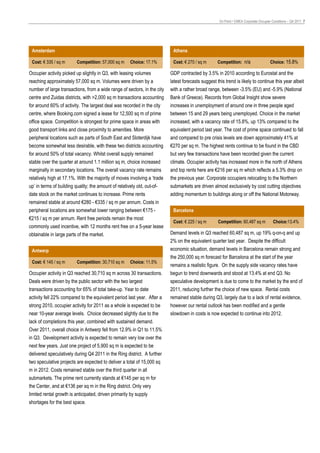
  •     Prime rents barely changed q-on-q with our European Office Index remaining static q-on-q.

  •     This apparent stability masks upward and downward changes in rents which effectively cancelled each other out in Western Europe. Prime rents
        increased q-on-q in Stockholm (2.4%), The Hague (2.4%), Hamburg (2.2%) and Milan (1.9%). This contrasts with rental decreases in Brussels (-
        3.2%), Dublin (-3.0%), Madrid (-1.9%) and Edinburgh (-1.8%).

  •     Outside of core European markets and across the year to date rents have decreased most markedly in Athens (-11.8%) and Dublin (-8.6%). Y-
        on-Y rental growth has been strongest in Moscow (41.2%), Oslo (20%), Lyon (17.4%) and Warsaw (13.6%).

  •     The current economic outlook suggests that regional differences together with a wide spread in pricing between prime and secondary rents will
        remain and intensify over 2012.

  •     As shown by the EMEA Office Occupier Clock above, 39 of the 67 markets covered within this report occupy a clock position at or beyond 6
        o’clock and as such reflect conditions of escalating prime rental costs.

  •     5 markets are positioned at or beyond 9 o’clock indicating that the rate of rental growth in these markets is slowing although rises in prime rents
        continue.
6 On Point • EMEA Corporate Occupier Conditions – Q4 2011


WESTERN EUROPE:                                                             remain stable into and throughout 2012, reflecting a two tiered
                                                                            market of limited Grade A availability and a plentiful supply of
Corporate Occupier                                                          lower quality stock which keeps vacancy rates inflated. Limited
                                                                            choice of high quality stock is being sustained by an
Conditions                                                                  impoverished development pipeline with Q3 completion volumes
                                                                            at levels not seen since the mid 1990s. The economic backdrop
The fragility of the economic recovery has been in the spotlight            suggests further downside risk on development completions, with
since late July. Sovereign debt problems and the risk of                    the prospects of current development projects being cancelled or
contagion has brought heightened turmoil in the financial markets           postponed significantly heightened.
and is weighing down on consumer and business confidence.
Regional economic disparities persist with marked contrasts                 Aggregate European prime rents hardly changed during Q3 2011
between Germany and the Southern European economies. The                    although there was variance in performance across Western
continued need for fiscal consolidation in most countries and               Europe. Prime rents increased in Stockholm and The Hague
weak global recovery suggests growth will be slow and moderate              (2.4% q-on-q), Hamburg (2.2%) and Milan (1.9%) whereas rents
in 2012 with uncertainties over the future outlook remaining.               decreased in Brussels (-3.2%), Dublin (-3.0%), Madrid (-1.9%)
                                                                            and Edinburgh (-1.8%). All other Western European markets
Demand for office space across Europe actually improved q-on-q              saw prime rents unchanged q-on-q.
with 2.9 million sq m of take-up across the continent,
representing an increase of 6% q-on-q and 16% on the same
period a year ago. Western European markets contributed to this
improved picture with good quarterly volumes being recorded in
Brussels, Hamburg and Paris. We would however caution that
many of the deals signed during Q3 occurred early in the quarter
and were founded on negotiations that commenced during Q2
when sentiment was stronger.

There was no change to the overall vacancy rate in Western
Europe with only minor increases being experienced in Dublin
and Brussels (+10bps). This was offset by decreases of -10bps
in the The Hague and Utrecht. We expect vacancy rates to


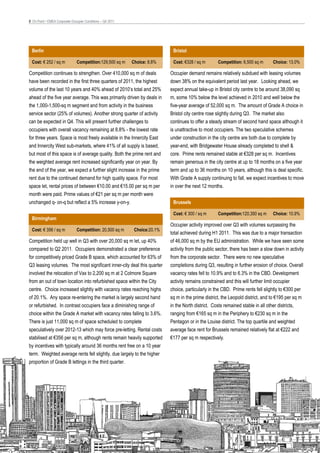
Exhibit 10: Western Europe Office Occupier Clock


                           Oslo, Zurich
                           London City
                                                       Rental Growth   Rents
                                                             Slowing   Falling
            Helsinki, London West End


                                  Paris


                                                       Rental Growth   Rents
             Düsseldorf, Geneva, Lyon,                  Accelerating   Bottoming Out
                  Stockholm, Stuttgart

        Gothenburg, Hamburg, Munich
                                                                                                 Athens
                       Berlin, Cologne                                                           Antwerp, Barcelona, Lisbon
                                 Malmo                                                           Brussels, Dublin, Edinburgh, Leeds, Madrid
                    Copenhagen, Milan                                                            Amsterdam, Eindhoven, Luxembourg,
                                                                                                 Rotterdam, The Hague, Utrecht
         Manchester, Western Corridor                                                            Rome
                                                                                                 Birmingham, Bristol, Cardiff, Frankfurt,
                                                                                                 Glasgow
On Point • EMEA Corporate Occupier Conditions – Q4 2011 7


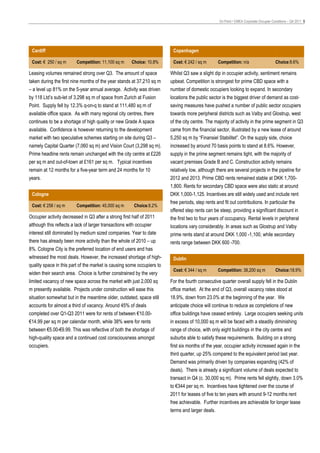
 Amsterdam                                                                 Athens

 Cost: € 335 / sq m      Competition: 57,000 sq m    Choice: 17.1%         Cost: € 270 / sq m       Competition: n/a                  Choice: 15.8%

Occupier activity picked up slightly in Q3, with leasing volumes          GDP contracted by 3.5% in 2010 according to Eurostat and the
reaching approximately 57,000 sq m. Volumes were driven by a              latest forecasts suggest this trend is likely to continue this year albeit
number of large transactions, from a wide range of sectors, in the city   with a rather broad range, between -3.5% (EU) and -5.9% (National
centre and Zuidas districts, with >2,000 sq m transactions accounting     Bank of Greece). Records from Global Insight show severe
for around 60% of activity. The largest deal was recorded in the city     increases in unemployment of around one in three people aged
centre, where Booking.com signed a lease for 12,500 sq m of prime         between 15 and 29 years being unemployed. Choice in the market
office space. Competition is strongest for prime space in areas with      increased, with a vacancy rate of 15.8%, up 13% compared to the
good transport links and close proximity to amenities. More               equivalent period last year. The cost of prime space continued to fall
peripheral locations such as parts of South East and Sloterdijk have      and compared to pre crisis levels are down approximately 41% at
become somewhat less desirable, with these two districts accounting       €270 per sq m. The highest rents continue to be found in the CBD
for around 50% of total vacancy. Whilst overall supply remained           but very few transactions have been recorded given the current
stable over the quarter at around 1.1 million sq m, choice increased      climate. Occupier activity has increased more in the north of Athens
marginally in secondary locations. The overall vacancy rate remains       and top rents here are €216 per sq m which reflects a 5.3% drop on
relatively high at 17.1%. With the majority of moves involving a ‘trade   the previous year. Corporate occupiers relocating to the Northern
up’ in terms of building quality; the amount of relatively old, out-of-   submarkets are driven almost exclusively by cost cutting objectives
date stock on the market continues to increase. Prime rents               adding momentum to buildings along or off the National Motorway.
remained stable at around €280 - €335 / sq m per annum. Costs in
peripheral locations are somewhat lower ranging between €175 -             Barcelona
€215 / sq m per annum. Rent free periods remain the most
                                                                           Cost: € 225 / sq m       Competition: 60,487 sq m            Choice:13.4%
commonly used incentive, with 12 months rent free on a 5-year lease
obtainable in large parts of the market.                                  Demand levels in Q3 reached 60,487 sq m, up 19% q-on-q and up
                                                                          2% on the equivalent quarter last year. Despite the difficult
 Antwerp                                                                  economic situation, demand levels in Barcelona remain strong and
                                                                          the 250,000 sq m forecast for Barcelona at the start of the year
 Cost: € 145 / sq m      Competition: 30,710 sq m    Choice: 11.5%
                                                                          remains a realistic figure. On the supply side vacancy rates have
Occupier activity in Q3 reached 30,710 sq m across 30 transactions.       begun to trend downwards and stood at 13.4% at end Q3. No
Deals were driven by the public sector with the two largest               speculative development is due to come to the market by the end of
transactions accounting for 65% of total take-up. Year to date            2011, reducing further the choice of new space. Rental costs
activity fell 22% compared to the equivalent period last year. After a    remained stable during Q3, largely due to a lack of rental evidence,
strong 2010, occupier activity for 2011 as a whole is expected to be      however our rental outlook has been modified and a gentle
near 10-year average levels. Choice decreased slightly due to the         slowdown in costs is now expected to continue into 2012.
lack of completions this year, combined with sustained demand.
Over 2011, overall choice in Antwerp fell from 12.9% in Q1 to 11.5%
in Q3. Development activity is expected to remain very low over the
next few years. Just one project of 5,900 sq m is expected to be
delivered speculatively during Q4 2011 in the Ring district. A further
two speculative projects are expected to deliver a total of 15,000 sq
m in 2012. Costs remained stable over the third quarter in all
submarkets. The prime rent currently stands at €145 per sq m for
the Center, and at €136 per sq m in the Ring district. Only very
limited rental growth is anticipated, driven primarily by supply
shortages for the best space.
8 On Point • EMEA Corporate Occupier Conditions – Q4 2011


  Berlin                                                                     Bristol

  Cost: € 252 / sq m           Competition:129,500 sq m     Choice: 8.8%     Cost: €328 / sq m       Competition: 6,500 sq m      Choice: 13.0%

Competition continues to strengthen. Over 410,000 sq m of deals             Occupier demand remains relatively subdued with leasing volumes
have been recorded in the first three quarters of 2011, the highest         down 38% on the equivalent period last year. Looking ahead, we
volume of the last 10 years and 40% ahead of 2010’s total and 25%           expect annual take-up in Bristol city centre to be around 38,090 sq
ahead of the five year average. This was primarily driven by deals in       m, some 10% below the level achieved in 2010 and well below the
the 1,000-1,500-sq m segment and from activity in the business              five-year average of 52,000 sq m. The amount of Grade A choice in
service sector (25% of volumes). Another strong quarter of activity         Bristol city centre rose slightly during Q3. The market also
can be expected in Q4. This will present further challenges to              continues to offer a steady stream of second hand space although it
occupiers with overall vacancy remaining at 8.8% - the lowest rate          is unattractive to most occupiers. The two speculative schemes
for three years. Space is most freely available in the Innercity East       under construction in the city centre are both due to complete by
and Innercity West sub-markets, where 41% of all supply is based,           year-end, with Bridgewater House already completed to shell &
but most of this space is of average quality. Both the prime rent and       core. Prime rents remained stable at €328 per sq m. Incentives
the weighted average rent increased significantly year on year. By          remain generous in the city centre at up to 18 months on a five year
the end of the year, we expect a further slight increase in the prime       term and up to 36 months on 10 years, although this is deal specific.
rent due to the continued demand for high quality space. For most           With Grade A supply continuing to fall, we expect incentives to move
space let, rental prices of between €10.00 and €15.00 per sq m per          in over the next 12 months.
month were paid. Prime values of €21 per sq m per month were
unchanged q- on-q but reflect a 5% increase y-on-y.                          Brussels

                                                                             Cost: € 300 / sq m      Competition:120,350 sq m     Choice: 10.9%
  Birmingham
                                                                            Occupier activity improved over Q3 with volumes surpassing the
  Cost: € 356 / sq m           Competition: 20,500 sq m      Choice:20.1%
                                                                            total achieved during H1 2011. This was due to a major transaction
Competition held up well in Q3 with over 20,000 sq m let, up 40%            of 46,000 sq m by the EU administration. While we have seen some
compared to Q2 2011. Occupiers demonstrated a clear preference              activity from the public sector, there has been a slow down in activity
for competitively priced Grade B space, which accounted for 63% of          from the corporate sector. There were no new speculative
Q3 leasing volumes. The most significant inner-city deal this quarter       completions during Q3, resulting in further erosion of choice. Overall
involved the relocation of Vax to 2,200 sq m at 2 Colmore Square            vacancy rates fell to 10.9% and to 6.3% in the CBD. Development
from an out of town location into refurbished space within the City         activity remains constrained and this will further limit occupier
centre. Choice increased slightly with vacancy rates reaching highs         choice, particularly in the CBD. Prime rents fell slightly to €300 per
of 20.1%. Any space re-entering the market is largely second hand           sq m in the prime district, the Leopold district, and to €195 per sq m
or refurbished. In contrast occupiers face a diminishing range of           in the North district. Costs remained stable in all other districts,
choice within the Grade A market with vacancy rates falling to 3.6%.        ranging from €165 sq m in the Periphery to €230 sq m in the
There is just 11,000 sq m of space scheduled to complete                    Pentagon or in the Louise district. The top quartile and weighted
speculatively over 2012-13 which may force pre-letting. Rental costs        average face rent for Brussels remained relatively flat at €222 and
stabilised at €356 per sq m, although rents remain heavily supported        €177 per sq m respectively.
by incentives with typically around 36 months rent free on a 10 year
term. Weighted average rents fell slightly, due largely to the higher
proportion of Grade B lettings in the third quarter.
On Point • EMEA Corporate Occupier Conditions – Q4 2011 9


 Cardiff                                                                 Copenhagen

 Cost: € 250 / sq m     Competition: 11,100 sq m     Choice: 10.8%       Cost: € 242 / sq m      Competition: n/a                      Choice:8.6%

Leasing volumes remained strong over Q3. The amount of space            Whilst Q3 saw a slight dip in occupier activity, sentiment remains
taken during the first nine months of the year stands at 37,210 sq m    upbeat. Competition is strongest for prime CBD space with a
– a level up 81% on the 5-year annual average. Activity was driven      number of domestic occupiers looking to expand. In secondary
by 118 Ltd’s sub-let of 3,298 sq m of space from Zurich at Fusion       locations the public sector is the biggest driver of demand as cost-
Point. Supply fell by 12.3% q-on-q to stand at 111,480 sq m of          saving measures have pushed a number of public sector occupiers
available office space. As with many regional city centres, there       towards more peripheral districts such as Valby and Glostrup, west
continues to be a shortage of high quality or new Grade A space         of the city centre. The majority of activity in the prime segment in Q3
available. Confidence is however returning to the development           came from the financial sector, illustrated by a new lease of around
market with two speculative schemes starting on site during Q3 –        5,250 sq m by “Finansiel Stabilitet”. On the supply side, choice
namely Capital Quarter (7,060 sq m) and Vision Court (3,298 sq m).      increased by around 70 basis points to stand at 8.6%. However,
Prime headline rents remain unchanged with the city centre at £226      supply in the prime segment remains tight, with the majority of
per sq m and out-of-town at £161 per sq m. Typical incentives           vacant premises Grade B and C. Construction activity remains
remain at 12 months for a five-year term and 24 months for 10           relatively low, although there are several projects in the pipeline for
years.                                                                  2012 and 2013. Prime CBD rents remained stable at DKK 1,700-
                                                                        1,800. Rents for secondary CBD space were also static at around
 Cologne                                                                DKK 1,000-1,125. Incentives are still widely used and include rent
                                                                        free periods, step rents and fit out contributions. In particular the
 Cost: € 258 / sq m     Competition: 45,000 sq m      Choice:8.2%
                                                                        offered step rents can be steep, providing a significant discount in
Occupier activity decreased in Q3 after a strong first half of 2011     the first two to four years of occupancy. Rental levels in peripheral
although this reflects a lack of larger transactions with occupier      locations vary considerably. In areas such as Glostrup and Valby
interest still dominated by medium sized companies. Year to date        prime rents stand at around DKK 1,000 -1,100, while secondary
there has already been more activity than the whole of 2010 – up        rents range between DKK 600 -700.
8%. Cologne City is the preferred location of end users and has
witnessed the most deals. However, the increased shortage of high-       Dublin
quality space in this part of the market is causing some occupiers to
                                                                         Cost: € 344 / sq m      Competition: 38,200 sq m              Choice:18.9%
widen their search area. Choice is further constrained by the very
limited vacancy of new space across the market with just 2,000 sq       For the fourth consecutive quarter overall supply fell in the Dublin
m presently available. Projects under construction will ease this       office market. At the end of Q3, overall vacancy rates stood at
situation somewhat but in the meantime older, outdated, space still     18.9%, down from 23.0% at the beginning of the year. We
accounts for almost a third of vacancy. Around 45% of deals             anticipate choice will continue to reduce as completions of new
completed over Q1-Q3 2011 were for rents of between €10.00-             office buildings have ceased entirely. Large occupiers seeking units
€14.99 per sq m per calendar month, while 38% were for rents            in excess of 10,000 sq m will be faced with a steadily diminishing
between €5.00-€9.99. This was reflective of both the shortage of        range of choice, with only eight buildings in the city centre and
high-quality space and a continued cost consciousness amongst           suburbs able to satisfy these requirements. Building on a strong
occupiers.                                                              first six months of the year, occupier activity increased again in the
                                                                        third quarter, up 25% compared to the equivalent period last year.
                                                                        Demand was primarily driven by companies expanding (42% of
                                                                        deals). There is already a significant volume of deals expected to
                                                                        transact in Q4 (c. 30,000 sq m). Prime rents fell slightly, down 3.0%
                                                                        to €344 per sq m. Incentives have tightened over the course of
                                                                        2011 for leases of five to ten years with around 9-12 months rent
                                                                        free achievable. Further incentives are achievable for longer lease
                                                                        terms and larger deals.
10 On Point • EMEA Corporate Occupier Conditions – Q4 2011


 Dusseldorf                                                                   Eindhoven

 Cost: € 282 / sq m            Competition: 91,300 sq m      Choice:11.9%     Cost: € 185 / sq m     Competition: 7,400 sq m       Choice:13.2%

Deal volumes are running at average levels, but the number of deals          Occupier sentiment worsened in Q3 with a number of occupiers
is 25% ahead of average as we are seeing more activity, particularly         removing their requirements from the market. Whilst the 3,000 sq m
in the 1,000 sq m to 5,000 sq m market. The City was the most                deal by IT company 2B interactive in the Western periphery of
sought-after sub-market and accounted for 17 % of all activity. The          Eindhoven boosted activity, leasing volumes were down
amount of choice continued to erode but is still above the 1-million         considerably on the first half of 2011. Overall vacancy increased to
sq m mark with 800,000 sq m available in Düsseldorf city alone. By           around 13.2%, up from 12% in Q2. Choice increased in both the
the end of the year a further 33,000 sq m of office space will be built,     Grade A and C segment over the quarter. However, Grade A office
of which 27 % will be available, but we still expect choice to decline       space remains particularly tight with a vacancy of around 1.2%.
next year. In terms of costs, prime rents have remained stable for           Availability of Grade B and C space is higher at 9.4% and 2.6%
the last six months after increasing twice in succession. Due to             respectively. The development pipeline remains limited with just a
competition for high-quality space, a further increase to €24.00 per         small amount of speculative office space being developed at Strijp
sq m per month is expected by year end. For most spaces, rental              S. Costs remained unchanged in Q3, with prime city centre rents at
prices are between €10.00 and €15.00 per sq m per month.                     around €175 - €185 per sq m. Whilst no significant increase in rental
                                                                             levels is expected in the foreseeable future, the tight supply and
 Edinburgh                                                                   limited development pipeline should support prime rents at their
                                                                             current level. Prime rents for office space in secondary locations
 Cost: € 337 / sq m            Competition: 13,790 sq m       Choice: 6.0%
                                                                             range between €120 and €160 per sq m per annum. Rent free
Costs softened slightly in Q3 as occupier demand remained                    periods have remained unchanged at 12 – 15 months assuming a 5
cautious. Prime rents fell 1.8% over the quarter, with incentives still      year lease.
generous at around 32-36 months rent free achievable on a 10 year
term. Rents are expected to remain broadly stable but, as the level           Frankfurt
of supply gradually declines, we could see further upward pressure.
                                                                              Cost: € 396 / sq m     Competition: 88,600 sq m     Choice:13.6%
Deal volumes were boosted by FNZ, who consolidated three
existing properties into 1,600 sq m of space at Tanfield. Improved           Occupier activity slowed in Q3 with deal volumes of around 88,600
occupier activity drove down the level of available supply. Supply           sq m. Sentiment is still strong, however, and the deals done
also fell as a result of some Grade B space being withdrawn for              illustrated the preference for quality space: 60% of volumes were
refurbishment. Overall vacancy rates fell to 6.0%, with Grade A              “high-quality”. Geographically, occupier preference has been for the
supply falling to just 3.2%. Within the city centre, there are just four     City, Banking District and Westend (all with double-digit percentage
buildings capable of satisfying Grade A requirements of greater than         shares this year). The largest deal in Q3 was the 18,400-sqm letting
5,000 sq m. Despite this, there has been little change to the                by Deutsche Lufthansa in the Squaire at the airport. All other deals
development pipeline, with Site HI, scheduled to complete in 2013,           remained below 10,000 sq m. The amount of choice fell with
the only scheme under construction speculatively.                            vacancy rates dropping from 14.3% to 13.6%. Around 36% of
                                                                             supply is considered high quality, and this percentage has remained
                                                                             more or less unchanged this year, however only c.35,000 sq m of
                                                                             high-quality space will be brought onto the market in 2012, so we
                                                                             expect further reductions in choice. While demand for quality
                                                                             remains high, enquiries in the prime segment have dropped off
                                                                             somewhat and the prime rent therefore remained unchanged at
                                                                             €396 per sq m per annum. Rents across the sub-markets also
                                                                             remained stable with average rents from Frankfurt at c. €227 per sq
                                                                             m per annum.
On Point • EMEA Corporate Occupier Conditions – Q4 2011 11


 Geneva                                                                 Gothenburg

 Cost: € 862 / sq m     Competition: n/a              Choice: 0.3%      Cost: € 250 / sq m      Competition: 25,500 sq m              Choice: 8.2%

Demand for the best office space remains high in the Geneva office     The occupational market recorded a strong Q3, with leasing
market particularly from financial institutions, wealth managers and   volumes reaching 25,500 sq m, up 45% on Q2. Occupiers from the
associated service providers as well as international organisations    IT- and Telecom sector accounted for a large share of activity,
such as the Red Cross and the United Nations. Supply remains           mainly due to large transactions by ÅF, EA and Saab Security. The
tight, however, particularly in the limited CBD area. The few          public sector also remains an active market player. With no
opportunities that exist are usually in the range of up to 250 sq m    completions in Q3, overall vacancy declined to 8.2%, down from
with units of more than 500 sq m being extremely rare. Office          8.7% in Q2. A further reduction in choice is anticipated in Q4, with
vacancy rates in the city centre are at levels of sub 1% and there     no new developments due to be completed in 2011. As at the end of
are limited development opportunities, compounded by a restrictive     Q3 2011, around 52,000 sq m of new office space is under
planning process. Some companies are considering peripheral            construction, the majority of which is due to be delivered in the next
locations in order to secure larger and less expensive space. New      12 months. Costs for prime CBD space continued to rise q-on-q with
space is predominantly constructed south of the CBD and around         prime rents up 2.2% to stand at SEK 2,300 per sq m. In the wider
the airport. The most notable project is the “SOVALP” – a large        city centre, costs for Grade A office space moved up as well and
scale development that will provide some 100,000 sq m once             range between SEK 2,000 – 2,200 per sq m. Rental levels for office
completed in 2014. Competition for space remains high and finding      space in more peripheral areas range between SEK 1,200-1,500 per
suitable space solutions, especially for larger unit sizes, can be     sq m. The number of speculative schemes currently under
challenging. The existing shortage in the central areas is expected    construction should ease competition for prime space.
to drive prime rental growth. Prime rents in the CBD currently stand
at CHF 1100 per sq m per annum but office space overlooking Lake        Hamburg
Geneva usually trades at a premium to this.
                                                                        Cost: € 282 / sq m      Competition: 172,700 sq m            Choice: 8.8%

 Glasgow                                                               Occupier demand is expected to remain strong throughout this year
                                                                       with an annual volume of 500,000 sq m expected. However the
 Cost: € 344 / sq m     Competition: 8,560 sq m     Choice: 10.6%
                                                                       ongoing euro crisis and potential effects on the economy could
Occupier activity increased in Q3, totalling over 8,500 sq m. The      damage sentiment. Occupier activity in Q3 was driven by business
majority consisted of churn in smaller deals. Economic uncertainty     service providers, followed by public administration – with the State
continues to constrain decision making however and we anticipate       Ministry for Urban Development and the Environment’s move to
year end leasing volumes to be in line with 2010. The Banking and      Wilhelmsburg representing a considerable 45,000 sq m transaction.
Finance sector dominated in Q3, accounting for 73% of occupier         Preference remains on the city centre (Innenstadt) and the adjoining
activity. Overall vacancy rates increased slightly to 10.6% but        sub-markets of City South (core area), Habour and HafenCity. In
Grade A choice remains far more constrained with vacancy rates         terms of supply, the SPIEGEL building among others was
falling from 3.3% to 3.1%. Occupier controlled space increased by      completed in HafenCity and total completions over the year to date
10% over the quarter to 58,000 sq m, with the likes of Shell           now amount to 120,000 sq m. A further 68,000 sq m is in the
releasing c.2,000 sq m at 141 Bothwell Street. Construction has        pipeline for the remainder of the year, of which around half is
resumed at the speculative Copenhagen building, which is on track      speculative. Development is expected to remain stable until the end
to deliver c. 6,000 sq m by early 2012. Prime rents remained stable    of the year. Prime and average rents grew further in Q3 to reach
at €344 per sq m, although rent free periods remain generous at        €282 per sq m per annum and €167.76 per sq m per annum
between 24-30 months based on a 10 year lease. Incentives              respectively. Further increases can be expected next year.
remain under pressure for the very best space. As the supply of
Grade A space begins to decline we expect incentives to harden
further and prime rents to slowly rise.
12 On Point • EMEA Corporate Occupier Conditions – Q4 2011


 Helsinki                                                                         Lisbon

 Cost: €294 / sq m             Competition: n/a              Choice: 10.0%        Cost: € 228 / sq m     Competition: 14,040 sq m    Choice:11.7%

Occupier activity remained fairly stable in the third quarter of 2011,           Portugal’s economic woes continued to impact on occupier
although competition from international occupiers decreased                      confidence. Activity remained weak resulting in just 14,040 sq m let
somewhat in reaction to the European debt crisis and fears                       in Q3. Year to date leasing volumes are 63% below five year
regarding the economic recovery. Whilst prime space in the CBD is                average levels. The majority of activity was concentrated in Zone 6,
most popular with occupiers, choice remains limited. Large floor                 which accounted for around 40% of total floor space let in Q3.
plates are virtually non-existent, increasingly driving occupiers to the         Activity continues to be driven by an increase in renegotiations and
business park hubs in areas such as Ruoholahti, Keilaniemi and                   renewals. There were no new completions in Q3. Consequently,
Leppävaara. Furthermore, new developments in the bay area                        occupier choice fell with vacancy rates moving from 11.9% in Q2 to
adjacent to the CBD (Töölönlahti) have attracted strong occupier                 11.7%. Despite the weak dynamics, prime rents held up at €228 per
interest. The overall vacancy rate remained relatively stable q-on-q             sq m over the third quarter. However, landlords continue to
at around 10%. Choice in the CBD is much lower at around 4.5%.                   compete by offering generous fit out packages and increasing levels
The development pipeline is considerable at 230,000 sq m for 2012                of incentives. Incentives for prime space are in the range of 1 to 3
and 2013. However, competition for this new space has been strong                months rent free, based on a three to five year lease. Across the
and overall these schemes are expected to be around 90% prelet on                wider market incentives are more generous with around 3 to 6
completion. Prime CBD rents remained stable at €24.50 per sq m                   months rent free achievable on a three to five year term. Rents in
per month. In the more peripheral office districts, rents range                  the secondary market also remained stable, however we do
between €192 - €204 per sq m per annum. However, if competition                  anticipate downward pressure on secondary rents from the
for space in the new developments slows, rents will most likely see              beginning of next year.
some falls.
                                                                                  London City
 Leeds
                                                                                  Cost: € 688 / sq m    Competition: 88,900 sq m     Choice: 7.6%
 Cost: € 323 / sq m            Competition: 10,770 sq m           Choice:10.6%
                                                                                 Occupier activity improved upon Q2 levels but was still weak and
Occupier choice fell slightly over Q3, but remains inflated at 6.1%              represented the lowest Q3 total since 2003. Although 1.4 million sq
above the level at the end of 2010. While there was little change to             ft remained under offer, with confidence subdued, occupiers are
overall supply, the availability of Grade A space fell much faster with          likely to delay decisions into 2012. Active requirement volumes
vacancy rates falling from 5.6% in Q2 to just 4.9% at the end of Q3.             continued to increase, however, with demand from the Service
Work has commenced at 2 Bond Court which is due to deliver                       industry dominating volumes. Choice increased 10% as several
around 1,500 sq m of space on a speculative basis by 2012. The                   refurbished and a new build scheme (Cannon Place, EC4) came
signing of a pre-let to Clarion in Q2 for 1,500 sq m, has also allowed           online. As a result, overall vacancy rates increased to 7.6% with
development to start at Elizabeth House which will deliver around                Grade A at 4.4%. Prime rents remained stable, with rent free
1,000 sq m speculatively. The most significant deal in Q3 involved               periods assuming a 10 year term at 22 months. With the lack of
the acquisition of 2,400 sq m by Yorkshire Housing at Dyson                      quality prime space, we do anticipate further rental growth, however
Chambers. Prime rents were stable at €323 per sq m. Incentives                   expectations have been tempered significantly by economic
remain stable but generous with around 30 months rent-free                       uncertainty.
achievable on a 10 year term. We expect some hardening of
incentives as the availability of Grade A supply begins to tighten,
however this is somewhat dependent on the level of new demand.
On Point • EMEA Corporate Occupier Conditions – Q4 2011 13


 London West End                                                           Lyon

 Cost: € 1187 sq m       Competition: 60,500 sq m      Choice: 4.4%        Cost: € 270 / sq m      Competition: 43,970 sq m              Choice: 6.5%

There was 60,500 sq m let across 42 deals in Q3, which represents         There was a slowdown in occupier activity in Q3 with just under
a 22% decrease q-on-q. This brings the total for the year-to-date to      44,000 sq m let, a 40% reduction on the very strong Q2. Year to
198,100 sq m which is 22% lower than the equivalent period last           date volumes are slightly softer than 2010 – a modest 2% reduction.
year and reflects a more cautious sentiment in the market. The most       The amount of choice for occupiers has continued to decline with
notable deal of the quarter was Debenhams plc’s 13,470 sq m pre-          supply dropping 3.6% over the quarter and volumes over 6% lower
let at British Land’s 10 Brock Street (Regent’s Place), NW1.The           than the end of 2010. Vacancy rates are now 6.3%, down from the
Service sector again dominated take-up accounting for 54% of take-        cyclical high of 6.8% reached in early 2010. Prime rents in Lyon
up across 18 deals, with the TMT sub-sector accounting for 22% of         have remained at €270 per sq m for the second successive quarter
the total. Overall demand decreased slightly to 410,200 sq m, and         after the market witnessed very strong growth in H1. The annual
the TMT sub-sector dominated this also, accounting for 25% of the         rate of rental growth remains at 17.4%. In the wider market weighted
total with new requirements from Linkedin, O2 and Gamesys. With           average rents are around €150 per sq m and have been relatively
limited moderate take-up and limited development completions,             flat this year reflecting a widening differential. Incentives have also
overall supply fell by -5% to 369,950 sq m, which equates to a            been flat, at around 6 months for a 6-9 year lease.
vacancy rate of 4.4% (from 4.6% last quarter). Grade A vacancy
also fell to 2.2%, its lowest level since mid-2007. Overall, the volume    Madrid
of space under construction speculatively remained stable at
                                                                           Cost: € 312 / sq m      Competition: 71,579 sq m              Choice:10.6%
173,400 sq m with the Debenhams’ pre-let offsetting new
commencements at 79-97 Wigmore Street, W1, and 6 Agar Street,             Leasing volumes were typical for Q3, the quiet quarter of the year,
WC2. Prime rents stabilised at €1,187 / sq m, while rent-free periods     and stood at 71,579 sq m (excluding high-tech space). Five
remained at 16 months, assuming a 10-year lease. We expect rents          transactions of greater than 5,000 sq m completed and accounted
to increase again in the latter half of next year.                        for 42% of total take-up in Q3. The Periphery dominated demand
                                                                          with occupiers focusing on well-located and good quality business
 Luxembourg                                                               centres. The average size of space leased ranges between 800-
                                                                          850 sq m. Overall office vacancy increased slightly during Q3 to
 Cost: € 456 / sq m      Competition: 38,470 sq m      Choice: 6.7%
                                                                          10.6%. However, the CBD saw a slight decrease in choice as no
Occupier activity over the year to date increased 51% compared            new product is on the market and the level of demand in this market
with the equivalent period last year. Pre-lets and acquisitions           area has remained relatively strong. New supply is concentrated in
accounted for around a third of all take-up activity in 2011, which       the Periphery (Julián Camarillo area) and Satellite market areas.
underpins confidence in the market. The business services sector,         We expect a trend of occupiers moving towards the periphery which
together with Banking & Finance were responsible for 72% of deals.        would impact on vacancy rates in the CBD. There is limited future
There were no new completions during Q3 and occupier choice               supply in the pipeline as projects are being delayed and there is a
diminished further with vacancy rates falling to 6.7%. The                lack of defined schemes from 2013 onwards. Prime rents continued
development pipeline remains constrained with just 24,000 sq m            to decline over Q3, down 1.9% to €312 per sq m, because of the
due to be delivered speculatively over the remainder of 2011.             disequilibrium between supply and demand, even for the best
Thereafter, the development pipeline is expected to decrease further      quality products.
to a low level of 48,000 sq m in 2012, of which 33,000 sq m is
speculative and this will drive choice lower. Costs remained stable
across all submarkets in the third quarter, peaking at €456 per sq m
in the CBD. We expect the prime rent to remain relatively flat over
2011, however incentives have begun to tighten. Given declining
levels of supply, we expect upward pressure on prime rents,
although forecasts currently remain modest.
14 On Point • EMEA Corporate Occupier Conditions – Q4 2011


 Malmö                                                                        Milan

 Cost: € 228 / sq m            Competition: 12,500 sq m      Choice: 7.1%     Cost: € 530 / sq m     Competition: 58,460 sq m      Choice:10.1%

The occupational market registered a drop in activity in Q3, with            Occupier activity this year has been broadly in line with 2010. Q3
leasing activity totalling at around 12,500 sq m. Nevertheless, so far       witnessed few large deals, with the most significant deal of the
in 2011, competition has been significantly higher compared to 2010          quarter involving AXA, who acquired 10,000 sq m in the Semi-centre
and year-end leasing volumes are forecast to be up over 50% on a             area. IT company, Reply also leased around 8,000 sq m in the
y-on-y basis. The high activity can partially be explained by choice -       Lorenteggio area. Prime rents increased by 1.9% over the quarter
new developments offering modern and highly efficient office space.          to €530 per sq m. Rental levels remain high in the centre,
Occupiers from the IT sector have been particularly active in Q3,            particularly for transactions involving banks. Despite this, around
accounting for a large share of volumes. On the supply side, no new          70% of deals in Q3 were at rents of below €300 sq m and
choice was added to the market in Q3 2011, although in the Lund              transactions involving rents of over €500 per sq m, accounted for
district a 7,400 sq m project is due to be completed in Q4. In 2012          only 14% of the total deals. Q3 witnessed around 30,000 sq m of
around 60,000 sq m will complete. Consequently, the overall                  new completions. Consequently the vacancy rate increased to
vacancy rate of 7.1% should increase next year. Prime CBD rents              10.1% over the quarter, however, this was driven primarily by
remained stable in Q3 and range between SEK 1,800 – 2,100 per                increasing supply in the Periphery and Hinterland. Occupier choice
sq m. Furthermore, occupiers are often offered substantial                   within the Centre remained broadly stable. There have been no
incentives such as rent free periods (depending on lease length) or          new development commencements.
rebates. Rental levels for good quality space in the peripheral office
districts remained stable at around SEK 1,200 – 1,500 per sq m.               Munich
Some further upward pressure at the very prime end of the market is
                                                                              Cost: € 360 / sq m   Competition: 233,100 sq m     Choice:10.1%
expected towards the end of 2011.
                                                                             Occupier activity remains very strong with 230,000 sq m let and a
 Manchester                                                                  year to date volume the strongest since 2001. Many lettings were
                                                                             driven by expansion leading to a net reduction in choice. Most
 Cost: € 379 / sq m            Competition: 14,570 sq m      Choice: 11.9%
                                                                             activity has been witnessed in the city centre and across all unit
Overall choice in Manchester city centre fell 5.2% over the third            sizes. Industrial corporate occupiers have been the largest takers of
quarter, to 245,700 sq m. Vacancy rates were down from 12.5% in              space this year, while business service providers closed the largest
Q2 to 11.9% at the end of Q3. This was driven by declining levels of         number of deals. In the third quarter there was again evidence of
both Grade A and Grade B supply which fell by 4.0% and 7.0%                  occupiers pursuing prelet options, such as the NUOFFICE project in
respectively. Grade A choice, remains far more constrained,                  Schwabing-North. Following high levels of building activity in the
reflecting a vacancy rate of just 2.9%. There was little change to the       period from 2008- 2010, when up to 300,000 sq m was completed
development pipeline over Q3, with no new speculative starts and             per year, completions will be much lower this year and especially
nothing under construction on a speculative basis. However, we do            next year and further restrictions in choice can be expected. Prime
anticipate construction to commence soon at 1 St Peters Square on            rents and incentives have remained stable at €360 per sq m but
the back of a 6,000 sq m pre-let to KPMG. Activity was modest due            further increases can be expected next year. Average rents ended
to the absence of any larger deals, with just two transactions over          the quarter at €164 per sq m.
1,000 sq m. There are just two schemes currently capable of
satisfying Grade A requirements of greater than 5,000 sq m. Given
declining levels of supply, prime rents increased by 5.3% over the
quarter to €379 per sq m. Incentives however remain generous with
30 months rent-free still achievable on a 10 year term.
On Point • EMEA Corporate Occupier Conditions – Q4 2011 15


 Oslo                                                                      Paris La Defense

 Cost: € 457/ sq m       Competition: 172,000        Choice: 7.5%          Cost: € 590 / sq m      Competition: 20,650                    Choice: 5.0%

Occupier activity increased considerably with leasing volumes up          The La Défense market was one of the few European markets to
23% on Q2. Competition is strongest for prime office space in the         show strong rental growth in Q3 with prime rents increasing 7% to
CBD and western fringe of Oslo. There is a drive, in particular from      reach €590 per sq m. Average second hand rents ended the quarter
the larger occupiers, towards more efficient office space, which can      at €492 per sq m, a 17% discount to prime reflecting a more
usually only be found in new developments. Besides ministries,            standard quality of accommodation in this submarket. The rental
occupiers from the IT and oil related sectors are the main drivers.       increases were driven by further erosion in choice, with vacancy
On the supply side, Oslo has seen a relatively low volume of new          rates declining from 5.4% to 5.0% - the lowest level since Q1 2010.
construction in 2011 with just 60,000 sq m of office space added to       The leasing market, however, has seen a relative lack of large deals
the market. Consequently, choice has gradually declined over the          and volumes are down 14% compared with last year with just over
year, with an overall vacancy rate of around 7.5%, the lowest in          20,000 sq m let in Q3. Demand remains fragile and going forward
almost two years. 2012 is expected to see around 300,000 sq m of          prospects of an economic slowdown are encouraging participants to
new office space added, however choice is expected to remain              be cautious as well as extremely selective. A difficult end to the year
relatively constrained with the majority of the development already       is therefore expected generally, but the lack of choice in the La
pre-let. Prime rents remained stable in Q3 2011 at NOK 3,600 per          Défense market will support pricing and incentives although the
sq m. Strong demand for prime office space has pushed up rents by         growth witnessed in Q3 is unlikely to be repeated next year.
15% over the year. Secondary locations did not record any rental
growth over the last 12 months. Rents for good quality space in the        Rome
city centre range between NOK 2,800 – 2,200 per sq m.
                                                                           Cost: € 420 / sq m      Competition: 29,900 sq m              Choice:6.3%
Competition for prime space in the CBD is considerable and
incentives in this part of the market are low to non-existent. Outside    Occupier activity reached almost 30,000 sq m in Q3, down on the
the CBD rent free periods of 6-12 months are achievable.                  start of 2011 but year to date volumes were up nearly 50%
                                                                          compared to the equivalent period in 2010. Occupiers continued to
 Paris CBD                                                                focus primarily on the CBD and central areas, with around 50% of
                                                                          Q3 take-up in these areas. The remainder of activity was focused
 Cost: € 750 / sq m      Competition: 115,840 sq m      Choice: 4.5%
                                                                          on the EUR area. Occupiers demonstrated a clear preference for
While occupier activity in Greater Paris increased significantly in Q3,   Grade A space. The most active sectors in Q3 were the Services
it was driven by deals completing that had been in negotiations for       and Manufacturing sectors. The Public sector, which has
some time and the CBD region itself, although it witnessed an 11%         traditionally played a leading role in Rome’s office market,
q-on-q increase, is running around 2% below the Q1-3 volumes of           substantially reduced the amount of space taken up, a reflection of
last year. Deals were constrained by the low amount of choice in the      the necessary rationalisation of the public real estate portfolio. This
CBD. Vacancy declined to just 4.5%, the lowest amount since 2008.         is likely to have a significant impact on Rome’s office market. The
In addition to a lack of choice impacting occupiers’ ability to move,     vacancy rate increased to 6.3%, due largely to the release of
the effect of austerity was increasingly felt, particularly for large     second hand space in the Tiburtina area. The development pipeline
companies, which are looking to curtail their real-estate costs and       remains relatively stable, with several completions expected in Q4,
consolidate locations. Prime rents were unchanged at €750 per sq          but there are no new significant projects to add to those already
m and there is a sense that the market will become quieter with           envisaged out to 2014. Prime rents and incentives are generally
occupiers increasingly hesitant given the Eurozone concerns.              stable, with the prime rent remaining at €420 per sq m.
Average second-hand rent was recorded at €501 in the CBD region,
a 33% discount to prime. Rent free periods have been unchanged
all year at between 9 and 15 months assuming a 6-9 year lease.
16 On Point • EMEA Corporate Occupier Conditions – Q4 2011


 Rotterdam                                                                   Stuttgart

 Cost: € 195 / sq m            Competition: 20,100 sq m      Choice:16.3%    Cost: € 216 / sq m      Competition: 78,100 sq m      Choice:6.5%

Occupier activity decreased by around 52% in Q3. This was mainly            The Stuttgart market has not reflected the cooling economic mood.
due to the absence of any large scale transactions, rather than a           While deal volumes declined on Q2, on a y-on-y basis take-up
shift in sentiment. The upturn in competition seen in 2011 can, to          increased by 71% to 200,000 sq m. Generally, small deals have
some extent, be explained by the levelling in prices (headline rents        dominated leasing volumes and the majority of deals were of
and / or incentives) in some segments of the market between the             average quality. Since certain large requirements remain active, we
wider Rotterdam region and some smaller, more regional cities.              expect take-up to remain strong over Q4 and forecast total volumes
Choice increased for the fifth consecutive quarter. The overall             of around 250,000 sq m for 2011 as a whole. Occupier activity has
vacancy rate stands at 16.3% as at the end of Q3, up from 15.7% in          driven a further decline in the vacancy rate by 0.5 percentage points
the previous quarter. The development pipeline remains significant.         in the third quarter. The prime rent remains unchanged at €216 per
Whilst most developments have high pre-let rates, there are a               sq m, with average rents showing little change at €138 per sq m.
number of speculative schemes expected to be added to the market            Around half the year to date completion volumes occurred in Q3. In
in the second half of 2012. Rental levels remained virtually                Q4 further completions of around 40,000 sq m are expected. Next
unchanged with prime rents at €195 per sq m and no change in                year we expect vacancy rates to stabilise.
incentives. The only rental movement recorded in Q3 was in the
‘Modern Scheepvaartkwartier’ district, where rents edged up by               The Hague
2.9% to stand at €180 per sq m. Costs in the peripheral office areas
                                                                             Cost: € 215 / sq m      Competition:5,488 sq m     Choice: 10.9%
North and South of the city remained stable with prime rents at
around €150 - €170 per sq m. Rental conditions are expected to              Overall occupier sentiment remained relatively subdued in Q3, with
remain stable in the foreseeable future.                                    leasing volumes down on the first half of the year. Competition is
                                                                            strongest for Grade A office space in the city centre districts such as
 Stockholm                                                                  the Beatrixkwartier, with occupiers in the public administration,
                                                                            transport and education sector most active. On the supply side,
 Cost: € 456 / sq m            Competition: 73,050 sq m      Choice:10.5%
                                                                            choice continued to increase with overall vacancy at a record high of
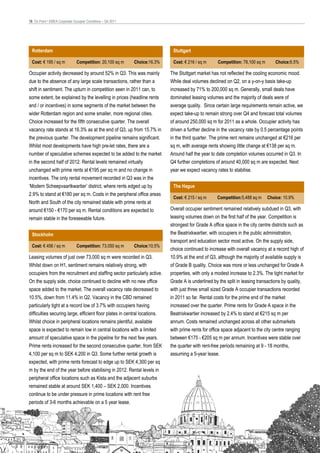
Leasing volumes of just over 73,000 sq m were recorded in Q3.               10.9% at the end of Q3, although the majority of available supply is
Whilst down on H1, sentiment remains relatively strong, with                of Grade B quality. Choice was more or less unchanged for Grade A
occupiers from the recruitment and staffing sector particularly active.     properties, with only a modest increase to 2.3%. The tight market for
On the supply side, choice continued to decline with no new office          Grade A is underlined by the split in leasing transactions by quality,
space added to the market. The overall vacancy rate decreased to            with just three small sized Grade A occupier transactions recorded
10.5%, down from 11.4% in Q2. Vacancy in the CBD remained                   in 2011 so far. Rental costs for the prime end of the market
particularly tight at a record low of 3.7% with occupiers having            increased over the quarter. Prime rents for Grade A space in the
difficulties securing large, efficient floor plates in central locations.   Beatrixkwartier increased by 2.4% to stand at €215 sq m per
Whilst choice in peripheral locations remains plentiful, available          annum. Costs remained unchanged across all other submarkets
space is expected to remain low in central locations with a limited         with prime rents for office space adjacent to the city centre ranging
amount of speculative space in the pipeline for the next few years.         between €175 - €205 sq m per annum. Incentives were stable over
Prime rents increased for the second consecutive quarter, from SEK          the quarter with rent-free periods remaining at 9 - 18 months,
4,100 per sq m to SEK 4,200 in Q3. Some further rental growth is            assuming a 5-year lease.
expected, with prime rents forecast to edge up to SEK 4,300 per sq
m by the end of the year before stabilising in 2012. Rental levels in
peripheral office locations such as Kista and the adjacent suburbs
remained stable at around SEK 1,400 – SEK 2,000. Incentives
continue to be under pressure in prime locations with rent free
periods of 3-6 months achievable on a 5 year lease.
On Point • EMEA Corporate Occupier Conditions – Q4 2011 17


 Utrecht                                                                 Zurich

 Cost: € 220 / sq m     Competition: 22,400 sq m      Choice:13.9%       Cost: € 902 / sq m      Competition: n / a             Choice: 4.6%

The occupier market recorded a relatively slow quarter with six         Strong demand for office space in recent quarters has led to rising
transactions reported. However, the total leasing volume was up by      rents and low levels of availability. The market will also see a large
around 60% over the quarter, due to the 18,000 sq m transaction by      volume of new supply. Over the next four years around 400,000 sq
Danone in the Rijnsweerd district. Competition for the best office      m of new office space will be delivered mainly in Zurich West and
space in the city centre continues to be strong, in particular from     Zurich Nord. Much of the new space has been taken by occupiers
banking, finance and public administration sector occupiers.            present in the market already which are currently actively relocating
However, the absence of choice holds back activity with vacancy         to this new, modern space from their CBD locations and gradually
estimated at just 2%. Choice is not expected to increase in the short   releasing their former space. The new supply is expected to ease
term in the city centre. In the wider market choice increased in Q3,    competition for space and increase choice in the CBD. Hence, the
with around 22,000 sq m of new office space added to Utrecht.           Zurich CBD will soon face vacancies of an unprecedented quantity
Overall vacancy increased to 13.9%, the highest level ever              which will put pressure on cost. Prime rents are at around CHF 1100
recorded. The majority of choice is located in peripheral locations     per sq m. Expectations are that rents might see a further slight
such as the Papendorp district which accounts for roughly 20% of        increase towards the end of the year but this may be short-lived.
total vacant office space. Whilst costs remained stable at the prime    Outside the prime segment, rents range from CHF 350 to CHF 800
end, office space in secondary locations became less expensive in       per sq m depending on location and quality, with second-hand
Q3. Prime rents in the city centre range between €190 - €220 per sq     space seeing the biggest discounts.
m. Rental levels in the secondary/ peripheral locations such as
Kanaleneiland, Overvecht and Lage Weide/ Catesiusweg saw a
further 3%-4% decrease to range between €125 – 145 per sq m.

 Western Corridor

 Cost: € 330 / sq m     Competition: 55,900 sq m      Choice:13.8%

The level of active named occupier requirements stabilised in Q3 at
c.300,000 sq m and continues to be dominated by the
Manufacturing and Services sectors, which together accounted for
around 88% of named enquiries in Q3. Deal activity improved to
reach 55,925 sq m, 9% higher than the five-year quarterly average.
Supply levels continue to be slowly eroded, driven in particular by
declining Grade A stock. This is most pronounced in the West
London submarket where the vacancy rate stands at just 2.9%, the
lowest level for nearly 10 years. There is currently around 33,305 sq
m of speculative space under construction, with only 3,902 sq m due
to complete before year-end. Prime rents increased marginally,
driven by upward pressure in Reading town centre and Chiswick.
Incentives were stable at 30 months rent free on a 10 year lease in
the Thames Valley and 24 months in West London. We expect
annual prime rental growth of 1.4% over 2011 as a whole.
18 On Point • EMEA Corporate Occupier Conditions – Q4 2011


Western European Corporate Occupier Markets at a glance


                                            Competition
                                                                            Choice (% Vacancy Rate)           Costs (Rents EUR / sq m / pa)
                                      (Take-up as a % of stock)
   Market                            Q3 2011            12-month outlook   Q3 2011       12-month outlook   Prime, Q3 2011    12-month outlook
   WE
   Amsterdam                            0.9                                 17.1                                 335
   Antwerp                              1.6                                 11.5                                 145
   Athens                               n/a                                 15.8                                 270
   Barcelona                            1.0                                 13.4                                 225
   Berlin                               0.8                                  8.8                                 252
   Birmingham                           1.3                                 20.1                                 356
   Bristol                              0.4                                 13.0                                 328
   Brussels                             0.9                                 10.9                                 300
   Cardiff                              1.1                                 10.8                                 250
   Cologne                              n/a                                  8.2                                 258
   Copenhagen                           n/a                                  8.6                                 242
   Dublin                               1.1                                 18.9                                 344
   Dusseldorf                           1.0                                 11.9                                 282
   Edinburgh                            0.6                                  6.0                                 337
   Eindhoven                            0.5                                 13.2                                 185
   Frankfurt                            0.7                                 13.6                                 396
   Geneva                               n/a                   n/a            0.3                                 862
   Glasgow                              0.6                                 10.6                                 344
   Gothenburg                           0.8                                  8.2                                 250
   Hamburg                              1.2                                  8.8                                 282
   Helsinki                             n/a                                 10.0                                 294
   Leeds                                0.9                                 10.6                                 323
   Lisbon                               0.3                                 11.7                                 228
   London City                          0.9                                  7.6                                688
   London West End                      0.7                                  4.4                                1187
   Luxembourg                           1.2                                  6.7                                456
   Lyon                                 0.8                                  6.5                                270
   Madrid                               0.5                                 10.6                                312
   Malmö                                0.6                                  7.1                                228
   Manchester                           0.4                                 11.9                                379
   Milan                                0.5                                 10.1                                530
   Munich                               1.2                                 10.1                                 360
   Oslo                                 n/a                                  7.5                                 457
   Paris CBD                            1.7                                  4.5                                 750
   Paris La Defense                     0.5                                  5.0                                 590
   Rome                                 0.2                                  6.3                                 420
   Rotterdam                            0.6                                 16.3                                 195
   Stockholm                            0.6                                 10.5                                 456
   Stuttgart                            1.0                                  6.5                                 216
   The Hague                            0.1                                 10.9                                 215
   Utrecht                              0.9                                 13.9                                 220
   Western Corridor                     0.7                                 13.8                                 330
   Zurich                               n/a                   n/a            4.6                                 902
On Point • EMEA Corporate Occupier Conditions – Q4 2011 19


CENTRAL AND                                                             levels in the CEE region are a third higher than in the same
                                                                        period last year, and volumes are anticipated to be well above
EASTERN EUROPE:                                                         2010 levels by the end of the year. How long this demand will be
                                                                        sustained, in light of recent macroeconomic turbulence is
Corporate Occupier                                                      uncertain. Across Europe, uncertainty and declining sentiment
Conditions                                                              are increasing the chances of corporate occupiers putting
                                                                        expansion and relocation plans on hold. Strong domestic
                                                                        demand will be crucial if CEE is to maintain current activity levels.
The intensifying Eurozone crisis, the threat of sovereign debt
contagion and associated market turbulence continues to                 With development finance still severely constrained, international
dominate news flow across Europe and set the back-drop for              occupiers continue to face challenges in CEE sourcing
corporate real estate teams operating across the EMEA region.           appropriate Grade A product in central locations. Development
Against this backdrop, Central and Eastern Europe has                   pipelines in Moscow and Warsaw in particular look well-stocked
continued to perform strongly. Forecasts point to a continued           over the medium term, but in the short term, prime options
divide in the pace of growth between advanced and emerging              remain much more limited than headline vacancy rates suggest.
economies. While GDP growth in the Eurozone has decelerated
and other activity indicators have worsened markedly in Q3,             Prime rents remained stable over the quarter in all Central and
growth in Emerging Europe has been better than anticipated,             Eastern European markets. However this stability comes after
partly due to the strong performance of CEE economies. Poland           double digit percentage increases earlier in the year in Moscow,
in particular is forecast to see GDP growth at 4.2% in 2011, well       Warsaw, and St Petersburg. Expectations for 2012 are likely to
above the European average, with the Czech republic and                 be dampened by the ongoing Eurozone crisis. Deflated
Hungary anticipated to record 2.0 and 1.0 % GDP growth                  confidence levels are beginning to feed through to net absorption
respectively this year. Russia too, is forecast to see solid GDP        and leasing volumes in Western Europe, although the impacts
growth of 3.8% in 2011.                                                 have so far been uneven. An escalation of sovereign debt and
                                                                        financial sector troubles to the core euro area would be likely to
Across Europe and despite a sombre economic backdrop,                   undermine growth in Central and Eastern Europe, given tight
demand for office space has held up well. The overall European          financial and economic linkages. But to date, both economic
market is on track to at least match last year’s total take-up.         growth and demand for office space have proven more resilient
However, the demand picture is becoming more mixed. Take-up             in CEE markets than in their Western European neighbours.

*Central Europe and the Balkans


Exhibit 11: Central & Eastern Europe Office Occupier Clock


                             Moscow
                                            Rental Growth           Rents
                                                  Slowing           Falling


                                            Rental Growth           Rents
                                             Accelerating           Bottoming Out
                                                                                                Zagreb


                             Warsaw
                                                                                               Belgrade
                              Krakow                                                           Bucharest, Budapest, Sofia
                       St. Petersburg                                                          Tri-City
                                                                                                Bratislava, Kiev, Prague
20 On Point • EMEA Corporate Occupier Conditions – Q4 2011


 Belgrade                                                                     Bucharest

 Cost: € 186 sq m                                            Choice: 22%      Cost: € 228 / sq m                              Choice: 16.0%

Occupier activity remained fairly stable in Q3 2011, with a handful of       Occupier activity reached almost 65,000 sq m in Q3 with most
transactions pushing total leasing volumes to around 4,500 sq m.             activity in the centre north (including CBD), capturing 32% of take-
Competition is strongest for floor plates up to 700 sq m in the New          up. Office activity (including renewals and renegotiations) so far in
Belgrade business district, where most of the Grade A stock has              2011 reached 212,000 sq m, the same levels as the whole of 2010.
been delivered in the last six years. Small to medium sized legal and        No new completions were delivered to the market in Bucharest
media firms have been particularly active in recent quarters. On the         leaving stock levels close to 1.85million sq m. In the last quarter we
supply side, the overall vacancy for Grade A and B office stock              expect the completion of an additional 54,000sq m of space from six
declined to 22%, down from 23% in Q2. Prime rents remained                   buildings (50% being already pre-leased). The pipeline in 2012 is
stable at €15.50 per sq m per month for Grade A space in the                 limited to 120,000 sq m (50% preleased) comprising of some
Downtown area. Rental levels for Grade B space in the wider city             projects delayed from 2011.The cost of prime space is still in the
centre also remained unchanged at around €10 - €13 per sq m per              region of €19 per sq m per month with no major fluctuations
month. Incentives are still widely used with 3-months rent free (on a        expected over the next three quarters.. The overall vacancy rate
5-year lease) achievable. Furthermore, reduced parking fees or the           dropped to 16% with large leases being signed in existing buildings
allocation of free parking lots are increasingly used incentives to          located in decentralized submarkets. Choice will continue to decline
attract occupiers.                                                           due to the limited pipeline over 2012 to H1 2013. The overall
                                                                             incentive package is mainly applicable to large pre-leases which is
 Bratislava                                                                  crucial for any project to attract finance and commence construction
                                                                             work.
 Cost: € 198 sq m                                            Choice: 10.8%

Occupier activity decreased over the quarter, with total leasing              Budapest
volumes of 21,100 sq m, down 32% on q-on-q. However, at 64,500
                                                                              Cost: € 240 / sq m                                  Choice: 20.7%
sq m for the year so far, competition is strong compared to 2010.
Occupiers in the IT and telecommunications sectors have been                 Office activity increased by 39% q-o-q in Budapest to 65,950 sq m
most active, accounting for almost 40% of leasing volumes. On the            with the highest demand recorded in Pest Central South submarket.
supply side, just over 40,000 sq m was added in Q3, with the                 There were no new completions released on to the market. Despite
completion of the Westend Square project (17,800 sq m) in                    the lack of new supply, choice remained relatively stable with a
Bratislava IV and the City Business Centre III – V (22,600 sq m) in          vacancy rate of 20.7% at the end of the quarter. The highest
Bratislava II. Choice increased to 10.8% but the polarisation                availability is still registered at the Pest Non-Central submarket,
between Grade A and B space continues to increase with choice for            however the vacancy rate managed to decrease the most in this
Grade A space much more constrained. Whilst Q4 will not see any              submarket (by 200 bps to 32%). The lowest speculative office
speculative completions, there are several projects currently under          vacancy rate is registered at Buda North at 17.4%. Prime office
construction for next year, increasing choice in a number of districts.      rents have been stable, standing at €20 per sq m per month.
Costs for prime office space in Bratislava’s best locations remained         Average headline rents are in the range of €10-13.50 per sq m per
stable in Q3, with rents ranging around €14 - €17 per sq m per               month depending on location.
month. Rental levels in the Inner City zone range between €10.5 -
€12.5 per sq m per month, while rents in the Outer City district have
stabilised between €8 -€10 per sq m per month. Costs are expected
to remain stable in the short term.
On Point • EMEA Corporate Occupier Conditions – Q4 2011 21


 Kiev                                                                       Moscow

 Cost: € 313 / sq m                                 Choice: 12.0%           Cost: € 894 / sq m                                          Choice: 16.6%

Occupier activity was relatively stable compared to last quarter with      Moscow continued to witness strong demand in Q3 2011, 30%
take-up levels reaching 22,934 sq m. Activity was dominated mainly         higher than the equivalent period last year. Despite the recently
by international companies with the manufacturing and business             announced city-centre construction restrictions, the current pipeline
service companies the most active. Demand for office space is still        is relatively high compared to other European cities with 2.5m sq m
price sensitive in the Kiev market, with the highest demand for            still planned to come into the market by 2014. However International
Grade B stock. There has been a steady increase in total office            occupiers looking for core prime space still have limited options as
stock over the last few years and in Q3 2011 the volume of                 only 20% of the current pipeline located is inside the CBD. In terms
completions was 31,950 sq m. There were four new Class B                   of choice, the vacancy rate decreased slightly to 16.6%, 20bps
business centres delivered to the market and still potential for further   down from the previous quarter. The cost of prime space also
office stock development. The largest will be Premium Centre               remained unchanged at US$1,000- 1,200 per sq m per annum
(36,000 sq m) located on the “Right Bank”. Choice declined with the        (excluding operational expenses and VAT), Class A base rents
vacancy rate falling 50 bps to 12.0% driven by increased market            amounted to US$600-850 per sq m per annum; Class B+ base rents
activity. Prime rents remained stable at US$420 / per sq m per             amounted to US$400-600 per sq m per annum; and Class B- base
annum and no change is expected before the end of 2011.                    rents were US$300-400 per sq m per annum. The less competitive
                                                                           buildings attract occupiers by additional incentives given by
 Krakow                                                                    landlords that include lower rental rates for the first year; a rent free
                                                                           period (4-6 months) and partial fit-out compensation. The average
 Cost: € 180 / sq m                                    Choice: 8.4%
                                                                           lease length is currently 5-7 years.
Krakow witnessed an increase in occupier activity in Q3 2011. There
were rising numbers of enquiries from occupiers seeking new office          Prague
space with a short notice period of around 3-6 months. High levels
                                                                            Cost: € 252 / sq m                                       Choice: 11.8%
of demand are therefore anticipated in the next two quarters.
Occupiers’ enquiries are also focused on space under construction.         Occupier activity was fairly subdued with volumes of 27,323 sq m,
The largest recent transaction signed was for 6,700 sq m in Bonarka        down 10% from the equivalent period last year. Six new properties
4 Business, building B. Choice is relatively stable, however over          were delivered to the market in Q3 2011, totalling 47,980 sq m. A
60,000 sq m is currently under construction. The cost of prime             further 161,000 sq m is now under construction with completion
space in Krakow’s core central locations is stable at €14-15 per sq        scheduled between Q4 2011 and Q1 2013. The cost of prime space
m per month. Effective rents remain lower than headline rents by           has remained stable over nine consecutive quarters, although there
approximately €1.50 – 2.50 per sq m per month, especially for pre-         are some signs that landlords of the very best space are considering
lets. Additionally, occupiers may receive cash contributions, moving       higher asking prices. For the time being prime rents stand at €252.
cost coverage and fit-out contribution depending on the initial            Rental levels on non prime buildings have also remained stable with
standard of a building and individual clients' requirement.                Inner City projects commanding between €14.90-17.50 per sq m per
                                                                           month and Outer City locations ranging between €13-14.50 per sq
                                                                           m per month. Second hand products in all submarkets stand at
                                                                           approximately €1.50 below the above mentioned ranges. The
                                                                           pressure to provide incentives differs significantly from property to
                                                                           property, depending on both the situation within the submarket and
                                                                           the length of vacant period in the property itself.
22 On Point • EMEA Corporate Occupier Conditions – Q4 2011


 St Petersburg                                                                   Warsaw

 Cost: €410 sq m                                             Choice: 13.1 %      Cost: € 300 / sq m                                    Choice: 6.7%

The total volume of new choice entering the market in Q3 was                    Occupier activity in Q3 2011 reached 95,000 sq m, 22% up from the
67,200 sq m, the highest since the beginning of 2011. Six new office            previous quarter. Demand is strong in the city with pre-lease
projects were delivered to the market in the last three months,                 agreements also picking up, with a 24% share this quarter. In terms
including the speculative part of a large-scale Class A project St.             of choice, around 60,000 sq m was delivered to the market.
Petersburg Plaza (37,600 sq m of leasable space). The future office             Although this may seem fairly robust, in reality 2011 is likely to see
projects currently under construction are limited with 100,000 sq m             the lowest number of completions for six years with only 130,000 sq
scheduled for completion by the end of 2011 and only 150,000 sq m               m delivered in total. Some new developments have been initiated on
is scheduled for completion next year. Occupier activity was                    a speculative basis as developers become more confident. At the
subdued in Q3 2011, reflecting the seasonally quieter summer                    end of Q3 2011, approximately 6.7% of the modern office stock in
months. Choice in the market has risen slightly with a vacancy rate             Warsaw was vacant (7.0% in the CBD, 7.3% in the City Centre
of 13.1%. This upward movement is temporary and we expect the                   Fringe and 6.4% in Non-Central locations). In spite of a slight
trend to start falling as space is absorbed, although rental growth is          increase in choice this quarter, Warsaw’s vacancy is still expected to
expected to remain limited amidst the high vacancy levels. Costs                continue the downward trend. Prime headline rents remained
remained stable in Q3 with only minor changes explained by                      unchanged this quarter and prime office space in Warsaw City
currency rate at US$330-400 for Class A and US$250-320 for Class                Centre can now be secured from € 22 to € 25 per sq m per month
B office buildings.                                                             although some exceptional buildings are quoting rents even higher
                                                                                than this. The best Non-Central locations, such as Mokotów, are
 Tri-City                                                                       being leased at € 15.00 to € 15.50 per sq m per month.

 Cost: € 144-174 / sq m                                         Choice: 10.3%
                                                                                 Zagreb
Although office leasing activity is slightly ahead of last year most of
                                                                                 Cost: € 180 / sq m                                    Choice: 9.5%
the take up now is from relocations from older buildings into newer
stock rather than into the City from outside. Only one new office               Sentiment remains subdued, with just a handful of small lease
building of 1,550 sq m was released to the market in Q3 2011,                   transactions and renewals recorded in Q3. Occupiers are focused
leaving the level of choice relatively stable at 10.3% compared to              on better quality / more efficient space, rather than actual
10.2% last quarter. Vacancy is expected to remain stable in Q4                  expansion. On the supply side, choice increased to 9.5%, up from
2011; although it may increase slightly in 2012 as five buildings               8.5% in Q2. Furthermore, choice is likely to increase in the next two
providing over 30,000 sq m of available space are planned for                   years, with around 157,000 sq m currently under construction of
delivery in 2012. Prime rents are falling but we expect them to                 which approximately 23,000 sq m will be delivered before the end of
bottom out shortly. In Gdynia, prime rents are at ca. €14 per sq m              2011 with the completion of the Green Gold office building. Choice
per month. Sopot and Gdansk are slightly cheaper at €12 -€13 per                is considerably lower in prime CBD locations as competition is
sq m per month.                                                                 strongest for modern office space in central locations. Costs
                                                                                remained stable in Q3, with rents for Grade A office space ranging
                                                                                from €12 per sq m per month in the out-of-town locations to around
                                                                                €17 per sq m per month for the best space in prime CBD locations.
                                                                                Landlords remain reluctant to offer any tenant incentives, but with an
                                                                                improved position, occupiers are now able to achieve rent free
                                                                                periods of up to 2/3 months on a 5-year lease as well as
                                                                                contributions towards fit out costs. The occupier negotiating position
                                                                                is set to strengthen further in 2012, with choice expected to increase
                                                                                amidst stable completion.
On Point • EMEA Corporate Occupier Conditions – Q4 2011 23


Central & Eastern Europe Corporate Occupier Markets at a glance


                                        Choice (% Vacancy Rate)                        Costs (Rents EUR/sq m/pa)
  Market                      Q3 2011                 12-month outlook   Prime, Q3 2011                   12-month outlook
  CEE
  Belgrade                       22                                           186
  Bratislava                    10.8                                          198
  Bucharest                     16.0                                          228
  Budapest                      20.7                                          240
  Kiev                          12.0                                          313
  Krakow                        8.4                                           180
  Moscow                        16.6                                          894
  Prague                        11.8                                          252
  St Petersburg                 13.1                                          410
  Tri-City                      10.3                                        144-174
  Warsaw                        6.7                                           300
  Zagreb                        9.5                                           180
24 On Point • EMEA Corporate Occupier Conditions – Q4 2011


MIDDLE EAST AND                                                         education. These are translating into new expansionary office
                                                                        demand. In Riyadh for example, the General Organisation for
AFRICA: Corporate                                                       Social Insurance is negotiating for a single tenant deal for some
                                                                        80,000 sq m. A similar situation is apparent in Doha. Against a
Occupier Conditions                                                     backdrop of the Arab Spring, GDP growth of 13% and substantial
                                                                        exports of liquefied gas, the state is equipped to spend.
                                                                        Government agencies and affiliated companies continue to control
The region is very mixed in terms of economic and market outlook
                                                                        much of the new and high quality stock and maintain rents at high
with political and social unrest hampering business investment. The
                                                                        levels.
UAE has generally positioned itself as a safe haven from the
troubles and is better protected than most due to its oil output and
                                                                        The markets in the UAE remain oversupplied and there is no clear
increased government spending. The finalisation of Dubai’s debt
                                                                        end to this dynamic, although the future supply pipeline continues to
deal has also improved confidence and lifted the outlook. GDP
                                                                        diminish. Many development projects are delayed given the
growth is forecast to be 5.1% over 2011 and 5.0% next year. In
                                                                        economic environment. It should also be noted that much of the
Egypt, the Interim Government which took power in February is
                                                                        emerging supply is located in areas outside of the well-connected
facing up to serious social and policy challenges which are creating
                                                                        inner city areas demand by international occupiers or the licensed
a difficult operating environment for business. GDP forecasts have
                                                                        sub-markets that are a pre-requisite for many financial occupiers.
been dramatically lowered to just 0.3% growth for 2011 compared
with a forecast of 5.8% at the start of the year. Forecasts have also
                                                                        Real estate costs are also varied across the MEA region. Two
been downgraded in Morocco as regional unrest creates
                                                                        markets, Casablanca and Istanbul, are predicted to witness rental
uncertainty.
                                                                        growth over the next 12 months. Four of the sub-regions markets
                                                                        are likely to witness rental stability whilst oversupplied markets such
In a number of the regions markets, demand levels have been
                                                                        as Abu Dhabi, Doha, Jeddah and Riyadh will see rents under
inflated by an active government sector. The Kingdom of Saudi
                                                                        downward pressure.
Arabia continues to display strong public spending and is
generously funding public services such as health care and


Exhibit 12: MEA Office Occupier Clock


                                                    Rental Growth   Rents
                                                          Slowing   Falling


                            Tel Aviv
                        Casablanca
                             Algiers
                                                    Rental Growth   Rents
                                                     Accelerating   Bottoming Out
                                                                                                Cairo, Abu Dhabi

                                                                                                Doha, Dubai, Jeddah


                                                                                                Riyadh

                                                                                                Istanbul, Johannesburg, Tunis
On Point • EMEA Corporate Occupier Conditions – Q4 2011 25


 Abu Dhabi                                                                Cairo

 Cost: € 355 / sq m                             Choice: 20.0%             Cost: € 367 / sq m                                             Choice: 35%

While estimations of the future supply for the market continue to be     The Cairo office market is expected to see high volumes of
scaled back as developers cancel or delay projects, more than 1.1        completions, increasing stock from c. 700,000 sq m now to over 2.9
million sq m of additional office space could still enter the market     million sq m by the year 2015. New choice will continue to be added
before the end of 2013. Overall choice increased to approximately        to the new, preferred satellite areas. These areas have grown in
20% and is expected to rise further. Government entities and state-      popularity and see the majority of demand as they offer modern
owned occupiers currently comprise the majority of competition for       office stock, access to business services, amenities for staff,
large requirements. However, this has limited impact on demand in        enhanced security and the opportunity to avoid the congested and
private developments as they typically occupy purpose built sites.       polluted downtown areas of Cairo. However, accessibility is vital and
Competition for private sector buildings is dominated by the             dedicated business parks on the outskirts of Cairo continue to see
professional services and financial sectors, along with engineering      vacancies because of poor access. While activity is returning it
and construction firms and those in the energy sector. In the short      continues to be focused on upgrading and yet many occupiers
term, occupier activity will be driven by existing occupiers upgrading   remain in a “wait-and-see” mode until the medium future becomes
their space but many occupiers are also delaying decision making         more obvious. As choice increases the balance of power has shifted
until the market has adjusted for further supply deliveries. Overall     more towards the occupier, evident in increasing flexibility of
costs decreased over the quarter, with Grade A rents down in Q3 to       landlords on rental terms. Asking rents for the Nile City Tower are at
AED 1,750 per sq m per annum, while rents for Grade B space              US$50 per sq m per month and at US$44 per sq m per month for the
remained unchanged in Q3 (AED 1,300 per sq m per annum). Whilst          Star Capital building. However average Grade A rents in Central
rents for both grades are expected to decline, Grade B quality rents     Cairo are around US$41 per sq m per month and around US$22 per
are likely to drop at a greater pace. The expanding choice of high       sq m per month in New Cairo.
quality space is making Abu Dhabi’s office market increasingly tenant
favourable and this will lead to further rental incentives and            Casablanca
inducements.
                                                                          Cost: € 220 / sq m                                         Choice: 10%

 Algiers                                                                 The market continues to lack international Grade A quality space,
                                                                         with the majority of new supply of Grade B or A- quality and designed
 Cost: € 480 / sq m                             Choice: 4%
                                                                         to suit local demand. While the supply situation is likely to improve
Demand for office space is starting to become increasingly driven by     over the medium term, a lack of quality stock continues to be a
established foreign companies and those looking to hurdle the            market constraint and it remains difficult for occupiers to find larger
legislative and authority constraints in setting up a business.          single floor plates. Larger lots are more frequently available in larger
International Grade A office space still remains very scarce and         developments such as the Marina or Anfa Place, which will be
supply of new space is often limited to residential conversions. The     developed on euro-norm standards, alongside some singular
centre of Algiers continues to suffer from a poor operational            developments in the area of Sidi-Maârouf. The latter continues to be
environment. Modern space is sporadic around the city apart from         a popular office area alongside isolated developments in the CBD.
Bab Ezzouar, which is moving slowly towards a financial and              The first deliveries of the Casablanca Marina are expected in 2012
business hub benefiting from good infrastructure, modern office          but the pricing may be prohibitive to many given high costs of land
space and good accessibility. The ongoing construction of additional     acquisition. Occupier demand remains high especially for larger and
towers will increase choice and bring larger floor plate availability.   high quality space, but also as an effect of the decline in the
There are also signs of new, fully serviced properties starting to be    business confidence in other countries in the area. In the core areas
planned around the Les Pins area as well as the Bab Ezzouar area.        rents are around MAD 210 per sq m per month and continue to grow.
Overall Grade A office space is available at rents of DZD 3,500 -        Rents for new Grade A new space in non-central areas have
4,200 per sq m per month. Good Grade B space which continues to          remained at marginally to MAD 150 per sq m per month.
compete with Grade A space given its low availability remains at
levels of DZD 2,500-3,000 per sq m per month.
26 On Point • EMEA Corporate Occupier Conditions – Q4 2011


 Doha                                                                        Istanbul

 Cost: € 435/ sq m                                           Choice: 20 %    Cost: € 360 / sq m                              Choice: 9.1 %

Recent turmoil in other countries in the region has not affected            The Istanbul office market continues to see high volumes of new
Doha. Total city-wide office stock is currently estimated at 3.4 million    supply. Since the beginning of the year 227,000 sq m has been
sq m with the majority of Grade A stock, approximately 1.2 million sq       added, compared to a mere 62,000 sq m in the same period last
m, located in the Diplomatic District and West Bay. Office buildings        year. For the rest of the year, another 190,000 sq m is expected to
in these areas continue to lead the prime market, housing major             complete with a total volume of new supply of 793,000 sq m.
government bodies, financial institutions, oil and gas and other            242,000 sq m of this will be located on the Asian-side and 551,000
multinationals and can command a cost premium of up to 35%                  sq m on the European side. On the demand side, take-up remains
above average asking rental rates. Despite Qatar’s strong economic          strong with 18,000 sq m leased in Q3. The total take-up for Q1-Q3
fundamentals, the market continues to see oversupply due to a               2011 reached 85,000 sq m, 46% higher than in the same period last
marked slowdown in competition and smaller requirement sizes.               year. Despite this, the increase in demand wasn’t able to absorb the
Choice in West Bay has increased significantly and rents are under          high levels of supply and vacancy rates increased further. While the
pressure. The overall vacancy rate stands at around 20%.                    vacancy for the overall market now stands at 9.1%, vacancy in the
Government sector activity has led to some stabilisation in costs           CBD remains low at 3.2%. Prime rents remained stable at €30 per
with prime office rents now QAR 190 per sq m per month. Although            sq m per month and are expected to remain stable until mid 2012.
government entities will continue to provide the major proportion of        The completion of a few landmark projects are however expected to
office demand, we will see an increasing number of construction,            lead to an increase in prime rents.
engineering and professional services occupiers setting up in Doha
to expand their regional operations, to service the large amount of          Jeddah
infrastructure work in advance of the 2022 World Cup.
                                                                             Cost: € 209 / sq m                            Choice: 15%

 Dubai                                                                      The office market continues to see new completions with 15,000 sq
                                                                            m completed in Q3. The current estimate for completions by end
 Cost: € 328 / sq m                                          Choice: 44%
                                                                            2013 is approximately 1.1 million sq m. However, actual deliveries
The future development pipeline has reduced significantly but               might be lower as projects continue to be cancelled and delayed.
despite the welcome slowdown, the future supply pipeline for 2012           Nevertheless, the market will experience a major increase in supply
and 2013 still totals 1.3 million sq m, though consisting largely of        in 2012 when Zahran business centre and Headquarter will be
strata-title properties in non-CBD areas. Despite increased supply,         completed. Most of the pipeline supply will increase the availability
overall choice remained relatively unchanged at 44% city-wide (27%          of quality space and increase competition amongst landlords for
for CBD Single Ownership Properties) indicating positive absorption         tenants resulting in further incentives. The private sector remains
levels. On the demand side, foreign occupiers continue to be                the major driver of competition which is focused on the CBD. Choice
cautious and delaying decision making. Occupiers remain selective           in the CBD decreased from 29% in Q2 to 26% in Q3. However,
preferring single-ownership buildings in well-connected CBD                 citywide choice averaged at more or less same level of 15% during
locations. Competition in the short term will remain driven by              Q3 2011. The high volume of supply is certainly not being able to be
occupiers looking to upgrade to better quality and / or locations at        absorbed by future demand and vacancy is expected to increase.
lower rents. Costs remained unchanged on the quarter, with prime            Office rents remained stable in Q3. Overall, Grade A rents are
rents in the CBD stable at AED 1,615 per sq m per annum although            around SAR 1,050, per sq m per month while Grade B rents
the range of buildings being able to attract these rents has                average SAR 882 per sq m per month. Average city-wide rents
decreased. Rents in the DIFC remained stable, too, at AED 1,615-            stabilized around SAR 700 per sq m per month during Q3 2011.
2,370 per sq m per annum. Space outside the CBD or DIFC
decreased to AED 1,060 per sq m per annum in Q3 2011. While the
lower end of asking rents remained stable, the higher range reduced
in many parts as landlords compete aggressively for occupiers,
offering generous incentives which continues to widen the gap
between asking and achievable rents.
On Point • EMEA Corporate Occupier Conditions – Q4 2011 27


 Johannesburg                                                            Tel Aviv

 Cost: € 205 / sq m                            Choice: 10.5%             Cost: € 307 / sq m                                       Choice: 3-4%

Competition for office space in Q3 2011 was strongest in secondary      Israel’s economy continues its expansion course despite the weaker
sub-markets which offer a rental discount relative to prime.            prospects for the Eurozone and the US. The worries about the
Accessibility remains a key factor and nodes within reach of the new    outlook for the Eurozone and the US are mainly of relevance for a
Gautrain transport network, are expected to see an increase in          few international occupiers that are reviewing earlier expansion
deals, with enquiries already increasing. Office supply in              plans. However these headwinds have not had any effects on local
Johannesburg increased by 97,000 sq m, to total nearly 8.5 million      businesses or developers and the market for commercial properties
sq m. In the current climate, the new stock offers occupiers            remains characterised by ongoing strong demand for office space
increased opportunities to upgrade. Vacancies in Q3 demonstrated        and low volumes of new supply. Supply – existing and new - is very
a marginal decline from 11.1% to 10.5. Choice varies between            tight, especially in the City centre and occupiers struggle to find
nodes with areas such as Illovo, Morningside, Houghton and Milpark      Grade A space especially if looking for larger floor plates. At ILS 125
witnessing rates below 6% with more secondary nodes (notably the        per sq m per month, prime rents increased slightly over the quarter.
Johannesburg CBD and Randburg) with rates as high as 15%.               However landlords face increased reluctance from occupiers to pay
Average gross rents for Grade A offices range around ZAR 140 -          these levels. Rents in areas such as Herzliya or Ra’anana in the
150 per sq m per month. Occupiers are increasingly focussed on          North of Tel Aviv offer modern office space too, but at a significant
consolidation, increased space utilisation and in some cases are        discount to prime with ILS 70-80 per sq m per month and ILS 65-70
prepared to relocate from prime to secondary nodes in an attempt to     per sq m per month respectively. These areas prove particularly
alleviate the increasing cost of occupancy. Gross rentals for Prime     popular with occupiers from the software and high-tech industry.
A+ office space appear to have reached a ceiling in 2010 and
corporate occupiers have offered strong resistance in 2011 to move       Tunis
beyond that level, particularly as costs for utilities continue to
                                                                         Cost: € 80 / sq m                                        Choice: 12 -15%
increase. Prime rents in Q3 2011 remained at ZAR 185 per sq m
per month.                                                              Tunis is in the early stages of evolving towards an office market of
                                                                        international standard and many developers have restarted
 Riyadh                                                                 development projects. The majority of the existing stock does not
                                                                        meet international standards and only a fraction of the market is
 Cost: € 397/ sq m                                     Choice: 12%
                                                                        available for lease as the dominating local private developers
Office space in Riyadh increased by 20,000 sq m over the quarter        continue to prefer selling a building after completion for owner
and the market is expected to experience a supply shock of c 1.4        occupation. While this is likely to persist over the near future, leasing
million sq m when Granada Business Park, KAFD, and Olaya Tower          is now becoming an accepted practice considered for international
complete in 2013/2014. Actual deliveries may be lower or delayed        occupiers. The main area for new construction of Grade A office
as developers are finding it difficult to meet their deadlines due to   space remains around the “Lac de Tunis” which is increasingly seen
the huge work load for contracting firms. On the demand side,           as the new prime office area offering a more secure environment
Riyadh is usually heavily influenced by public sector activity          and is seen as the main business location. Vacancy in the “Lac de
although the private sector was more active over Q3. Choice             Tunis” area in the past has been considerably lower than in other
remained at Q2 levels, with city-wide vacancies of 12% and              parts of Tunis and will be more so given the operational advantage
vacancies inside the CBD decreasing to 16%. Office rents were           of the area. This will accelerate possible business relocations from
almost at the same level as Q2 with average rents paid for CBD          the city centre and also the development of other neighbouring
space are c. SAR 1,060 per sq m per month with prime Grade A            business centres of around Lac de Tunis. For the short term, rents
space commanding asking rents of SAR 2,000 per sq m per month           are expected to remain unchanged at around TND 160 per sq m per
compared to high quality space which usually trades around SAR          annum with current occupiers cautious about timing.
1,300 per sq m per month. Grade B rents average SAR 1,075 per sq
m per month. With new supply being delivered early next year,
rental levels are likely to face further downward pressure.
28 On Point • EMEA Corporate Occupier Conditions – Q4 2011


Middle East and African Corporate Occupier Markets at a glance


                                                   Choice (% Vacancy Rate)                            Costs (Rents EUR/sq m/pa)

   Market                                  Q3 2011                       12-month outlook   Prime, Q3 2011              12-month outlook
   MEA
   Abu Dhabi                                  20.0                                               355
   Algiers                                     4                                                 480
   Cairo                                35 (Grade A: 5)                                          367
   Casablanca                                  10                                                220
   Doha                                        20                                                465
   Dubai                                       44                                                328
   Istanbul                                   9.1                                                360
   Jeddah                                      15                                                209
   Johannesburg                               10.5                                               205
   Riyadh                                      12                                                397
   Tel Aviv                                   3-4                                                307
   Tunis                                     12-15                                               80
Business Contact: Corporate Solutions

Vincent Lottefier
Chief Executive Officer
EMEA Corporate Solutions
Paris
+33 1 40 55 49 92
vincent.lottefier@eu.jll.com


Report Contacts: Research

Dr Lee Elliott
Director
EMEA Research
London
+44 (0)20 3147 1206
lee.elliott@eu.jll.com

Tom Carroll
Associate Director
EMEA Research
London
+44 (0)20 3147 1207
tom.carroll@eu.jll.com


Acknowledgements:
We gratefully acknowledge the help and assistance of the following Jones Lang LaSalle alliance partner firms in the preparation of some of
this material: Akershus Eiendom AS, Athens Economics and Sadolin & Albæk.


EMEA Corporate Occupier Conditions – November 2011
OnPoint reports from Jones Lang LaSalle include quarterly and annual highlights of real estate activity, performance and specialised
surveys and forecasts that uncover emerging trends.

www.joneslanglasalle.eu


COPYRIGHT © JONES LANG LASALLE IP, INC. 2011. All rights reserved. No part of this publication may be reproduced or transmitted in any form or by any means without prior written consent of
Jones Lang LaSalle. It is based on material that we believe to be reliable. Whilst every effort has been made to ensure its accuracy, we cannot offer any warranty that it contains no factual errors. We
would like to be told of any such errors in order to correct them.

Corporate occupier conditions

  • 1.
    EMEA Corporate OccupierConditions - Q4 2011 Falling sentiment increases pressure on CRE teams The intensification of the Eurozone crisis has further damaged corporate confidence. Amid renewed uncertainty, CRE teams have once again been tasked with driving both cost saving and transformation agendas. Room for manoeuvre is limited. A lack of quality supply in the markets is encouraging landlords, having made concessions during the global financial crisis, to hold pricing firm. Transformation is also challenging. Development pipelines are impoverished. Access to quality office space will often require pre-letting strategies to be employed. Corporate reluctance to authorise capital expenditure is also a clear constraint.
  • 2.
    2 On Point• EMEA Corporate Occupier Conditions – Q4 2011 Introduction Back to the future already been picked. The route to the promised land of real estate transformation and ongoing cost effectiveness requires teams to It is rare for corporate real estate professionals to look back. Our tread new paths. industry is about preparing for and facilitating the future. It is about responding to operational and organisational changes through the Preparing for the future effective use of real estate assets. What happened in the past most often remains in the past. A forward looking gaze is the default So next year – an Olympic year – will be a year where teams and setting for CRE professionals. Yet perhaps now, as we approach individuals will seek to rise above challenges and excel. But the closing month of another challenging year, represents a good success will not be guaranteed. Those that have failed to prepare time to look back and reflect. well; are unable to articulate a clear strategy with implementable tactics; or have not taken themselves to the leading edge of best It is a year since we conducted an industry first – a truly global practice will be consigned to the role of also-rans. survey of corporate real estate leaders. We were keen to understand how the front runners of our industry were facing up to Our dedicated corporate occupier research programme is designed the unprecedented challenges of a global financial crisis and the first to offer you a competitive edge. Through our thought leadership global recession since World War II. For the record, we identified programme, we will be focusing down on the prime issues in the four themes that were shaping CRE team strategy and behaviour: development and ultimate success of transformative real estate strategies – workplace productivity. In an environment of limited 1. A strong push towards more productive and better utilised cash and limited market options, how can investment in real estate real estate portfolios be maximised by driving a more productive and ultimately more profitable workplace? Our research programme will outline the 2. The pressures of balancing growth and right-sizing on a global scale opportunity, the options and the obstacles. 3. A further progression towards partnership with outsourced Our market research will remain forensic and focused but we will be real estate service providers enhancing our delivery channels in order to provide you instant and customisable access to the very latest market views. This 4. A battle to access or obtain fresh real estate talent publication, EMEA Corporate Occupier Conditions (Offices) will accommodated within more appropriate CRE team become a six monthly publication, issued in February and structures with stronger mandates November, alongside its counterpart focusing on the industrial A year on and a different but no less significant operational sector. Instead, regular updates of market conditions will be challenge exists. The intensifying Eurozone crisis, the threat of available though our Global Bespoke Report Generator. This on- sovereign debt contagion and associated market turbulence paints line tool will enable you as the user to focus down on just those another dramatic back-drop for CRE teams and will have lasting markets you are interested in at any moment in time and construct a impact upon the corporate operating environment. The themes consistent, high quality market report at the touch of a button. highlighted in our survey have taken on even greater importance. Contact those named on the back of this report or your Corporate They need to be addressed. But they emerge at a time when the Solutions contact for more information on how you can access this real estate markets of EMEA offer less opportunity for the occupier innovative and valuable reporting tool. than 12-24 months ago. The shortage of high quality office All that remains is for me to offer you the warmest Seasons solutions in the markets provides occupiers with little opportunity to Greetings. I sincerely hope that you have a peaceful and enjoyable upgrade their space to deliver productivity gains whilst festive period and look forward to working with you in 2012. simultaneously being cost effective. This same shortage has encouraged landlords to hold firm on rents and bring-in incentives. Costs are rising or at best static across most markets at a time when Vincent Lottefier CRE teams are being charged with a new round of cost saves. Chief Executive Officer Moreover, many CRE teams have already made cost saves through EMEA Corporate Solutions renewal and renegotiation strategies. The low hanging fruit has
  • 3.
    On Point •EMEA Corporate Occupier Conditions – Q4 2011 3 EMEA Corporate Occupier Market Conditions: Summary Exhibit 1: Current economic fragility reflected in lower but diverse growth trajectories in 2012 • The fragility of the economic recovery in Europe has been in the spotlight since late July. 9 % 2010 2011 2012 8 • Sovereign debt problems and fear of contagion has led to 7 6 heightened financial market turmoil, reducing consumer and 5 business confidence and the downgrading of growth forecasts. 4 3 • Disparities across Europe are extending. While Germany, the 2 Nordics and parts of CEE remain strong, Southern Europe is facing 1 more severe headwinds. 0 -1 Italy Ireland Germany Hungary Netherlands Turkey Belgium UK Czech Finland France Poland Spain Eurozone European Russia Sweden • The continued need for fiscal consolidation in most countries and weak global recovery suggests growth will slow in 2012 and uncertainties about the future outlook remain. Exhibit 2: Corporate confidence trends downwards to early 2010 levels 120 50 • Corporate confidence has taken a hit against this back-drop. • Having rallied previously following blips in sentiment, a more marked 25 downturn in confidence occurred during Q3. 100 • Overall business confidence has returned to levels seen at the start 0 of 2010 and sits marginally below the long-term average. 80 • Declines in sentiment have been particularly marked in the engine- -25 room markets of Germany and the United Kingdom. 60 -50 • Uncertainty and declining sentiment increases the risk of corporate 2006 2007 2008 2009 2010 2011 occupiers putting expansion and portfolio strategies on hold. Economic Sentiment (LHS) Retail Trade Confidence Service Sector Confidence Industrial Confidence Exhibit 3: Take-up levels were sustained q-on-q but are under downward pressure • Despite a worsening outlook, demand for office space across Europe actually improved q-on-q with 2.9 million sq m of take-up. ’000 m² ’000 m² 14,000 4,000 • This was also an increase of 16% on volumes seen in the market a 12,000 year ago. 3,000 10,000 • More negative sentiment impacted Q3 performance, with many 8,000 leasing deals completed early in the quarter and commenced during 2,000 6,000 Q2 when sentiment was strong. 4,000 • European take-up levels were supported by good quarterly 1,000 performance in Brussels, Hamburg and Paris. 2,000 • Take-up over the period Q1-Q3 is 10% above the same period a 0 0 year ago. We expect total year end volumes to be on a par with 3Q01 3Q02 3Q03 3Q04 3Q05 3Q06 3Q07 3Q08 3Q09 3Q10 3Q11 2010 given declining corporate confidence. CEE Western Europe 12 Month Rolling (RHA) Exhibit 4: Net absorption trending downwards on the basis of market churn, consolidation & further disposals ’000 m² • Much activity witnessed in Q3 and anticipated for the remainder of 7,000 the year is driven by lease events and will have little positive impact on net absorption. 5,000 • Annual net absorption levels remained positive at 2.9 million sq m 3,000 but this was a decline of 24% compared with Q2 and annual net absorption stands 20% below the 10 year average. 1,000 • Declining sentiment and corporate restructuring will fuel the further -1,000 disposal of surplus assets. This, together with increased consolidation activity, will serve as a negative influence on net Q3 2004 Q3 2005 Q3 2006 Q3 2007 Q3 2008 Q3 2009 Q3 2010 Q3 2011 absorption. Western Europe CEE Total
  • 4.
    4 On Point• EMEA Corporate Occupier Conditions – Q4 2011 Exhibit 5: Vacancy rates are stable and reflect the availability of large volumes of poor quality stock • The European vacancy rate remained static at 10.2%. • The Western European aggregate vacancy rate remained unchanged at 9.7% whilst the Central & Eastern European aggregate vacancy rate decreased by 20bps to stand at 14.9%. Vacancy Rates Q1 2011 9.8% 15 – 25% 7.5% 13.1% 10 – 15% • Only two markets within our core European markets recorded 5 – 10% 0 – 5% 10.5% 17.0% increases in vacancy rates – Dublin and Brussels – where the 18.9% 8.6% aggregate rate increased by 10bps q-on-q. 6.3% 17.1% 8.8% 10.3% 8.8% Johannesburg 6.7% • The greatest fall in vacancy was recorded in Prague (-30bps). 10.9% 13.6% 8.4% 12.0% 10.5% Moscow’s rate also fell (-20bps) and there were minor reductions in 6.8% 10.1% 11.8% 10.8% Rotterdam, The Hague, Utrecht and Warsaw. 6.5% 4.6% 20.7% 10.1% 9.5% 16.0% • We expect vacancy rates to remain around current levels at year 11.7% 10.6% 13.4% 22% 3-4% 20% 44% end and be stable throughout 2012. 6.3% 9.1% 35% 12% 15.8% 15% • 2nd hand space released by occupiers following upgrades earlier in the year continues to trade sluggishly and will limit decreases in overall vacancy rates. Exhibit 6: The development pipeline is moderate and could reduce further due to scheme cancellations or postponements Completions (millions sq m) Vacancy rate (%) • Completions of new office space remain low. In Q3 there was 8 12 720,000 sq m of new office space completed. 7 10 • The volume of new space released over Q1-3 was 2.3 million sq m – 6 some 45% below the 10 year average. 8 5 • Western Europe saw a particularly low level of new completions over 4 6 Q3 with the lowest volumes witnessed since the mid 1990s. 3 4 2 • We anticipate 3.6 million sq m of new office space to complete 2 across the region by year end although further cancellations or 1 0 0 postponements of pipeline projects are likely given the economic outlook. 1995 1996 1997 1998 1999 2000 2001 2002 2003 2004 2005 2006 2007 2008 2009 2010 2011 2012 2013 2014 Completions Future Completions Vacancy Rate RHS Exhibit 7: Western European Red, Amber, Green Matrix (RAG) • Our RAG charts provide a sense of 5 year forward looking market conditions. 2012 2013 2014 • Based on a combination of prime econometric rental forecasts and Amsterdam local market sentiment we identify whether markets are landlord Frankfurt favourable (red), tenant favourable (green) or balanced (amber). London City • For mature Western European markets future conditions are mixed Milan but, owing to shortages of quality supply, conditions have hardened markedly with prime rental increases likely sooner as limited quality Paris supply is eroded quickly as demand returns. Zurich Landlord Favourable Market Balanced Market Tenant Favourable Market Exhibit 8: CEE and MEA sub-region Red, Amber, Green Matrix (RAG) • In the CEE sub-region, prime rental increases have been marked q- 2012 2013 2014 on-q and this has led to markets such as Moscow and Warsaw Bucharest turning further in favour of the landlord. Moscow • This is very much a function of supply. Despite having reasonably Warsaw large development pipelines, developers do not tend to build large volumes of space at international quality putting such space at a Cairo premium, particularly given improving demand. Dubai • Markets such as Dubai and Abu Dhabi are over-supplied and as Istanbul such underlying conditions remain firmly in favour of the occupier. Landlord Favourable Market Balanced Market Tenant Favourable Market
  • 5.
    On Point •EMEA Corporate Occupier Conditions – Q4 2011 5 Exhibit 9: EMEA Office Occupier Clock Landlord’s Market Tenant’s Market Rental Growth Slowing Rents Falling Oslo, Zurich, Moscow London City Rental Growth Rents London West End, Helsinki Slowing Falling Paris, Tel Aviv Casablanca Algiers Rental Growth Rents Düsseldorf, Geneva, Lyon, Accelerating Bottoming Out Cairo, Abu Dhabi, Zagreb Stockholm, Stuttgart Gothenburg, Hamburg, Munich Doha, Dubai, Jeddah Athens Berlin, Cologne, Warsaw Antwerp, Barcelona, Lisbon, Riyadh Malmo Belgrade, Brussels, Dublin, Edinburgh, Leeds, Madrid Krakow, Copenhagen, Milan Bucharest, Budapest, Sofia, Amsterdam, Utrecht, Luxembourg, Rotterdam, The Hague, Eindhoven St. Petersburg, Manchester, Rome, Tri-City Western Corridor Birmingham, Bristol, Cardiff, Frankfurt, Glasgow, Bratislava, Kiev, Prague, Istanbul, Johannesburg, Tunis Rents Rising Decline Slowing Western Europe Central and Eastern Europe Middle East & Africa • Prime rents barely changed q-on-q with our European Office Index remaining static q-on-q. • This apparent stability masks upward and downward changes in rents which effectively cancelled each other out in Western Europe. Prime rents increased q-on-q in Stockholm (2.4%), The Hague (2.4%), Hamburg (2.2%) and Milan (1.9%). This contrasts with rental decreases in Brussels (- 3.2%), Dublin (-3.0%), Madrid (-1.9%) and Edinburgh (-1.8%). • Outside of core European markets and across the year to date rents have decreased most markedly in Athens (-11.8%) and Dublin (-8.6%). Y- on-Y rental growth has been strongest in Moscow (41.2%), Oslo (20%), Lyon (17.4%) and Warsaw (13.6%). • The current economic outlook suggests that regional differences together with a wide spread in pricing between prime and secondary rents will remain and intensify over 2012. • As shown by the EMEA Office Occupier Clock above, 39 of the 67 markets covered within this report occupy a clock position at or beyond 6 o’clock and as such reflect conditions of escalating prime rental costs. • 5 markets are positioned at or beyond 9 o’clock indicating that the rate of rental growth in these markets is slowing although rises in prime rents continue.
  • 6.
    6 On Point• EMEA Corporate Occupier Conditions – Q4 2011 WESTERN EUROPE: remain stable into and throughout 2012, reflecting a two tiered market of limited Grade A availability and a plentiful supply of Corporate Occupier lower quality stock which keeps vacancy rates inflated. Limited choice of high quality stock is being sustained by an Conditions impoverished development pipeline with Q3 completion volumes at levels not seen since the mid 1990s. The economic backdrop The fragility of the economic recovery has been in the spotlight suggests further downside risk on development completions, with since late July. Sovereign debt problems and the risk of the prospects of current development projects being cancelled or contagion has brought heightened turmoil in the financial markets postponed significantly heightened. and is weighing down on consumer and business confidence. Regional economic disparities persist with marked contrasts Aggregate European prime rents hardly changed during Q3 2011 between Germany and the Southern European economies. The although there was variance in performance across Western continued need for fiscal consolidation in most countries and Europe. Prime rents increased in Stockholm and The Hague weak global recovery suggests growth will be slow and moderate (2.4% q-on-q), Hamburg (2.2%) and Milan (1.9%) whereas rents in 2012 with uncertainties over the future outlook remaining. decreased in Brussels (-3.2%), Dublin (-3.0%), Madrid (-1.9%) and Edinburgh (-1.8%). All other Western European markets Demand for office space across Europe actually improved q-on-q saw prime rents unchanged q-on-q. with 2.9 million sq m of take-up across the continent, representing an increase of 6% q-on-q and 16% on the same period a year ago. Western European markets contributed to this improved picture with good quarterly volumes being recorded in Brussels, Hamburg and Paris. We would however caution that many of the deals signed during Q3 occurred early in the quarter and were founded on negotiations that commenced during Q2 when sentiment was stronger. There was no change to the overall vacancy rate in Western Europe with only minor increases being experienced in Dublin and Brussels (+10bps). This was offset by decreases of -10bps in the The Hague and Utrecht. We expect vacancy rates to Exhibit 10: Western Europe Office Occupier Clock Oslo, Zurich London City Rental Growth Rents Slowing Falling Helsinki, London West End Paris Rental Growth Rents Düsseldorf, Geneva, Lyon, Accelerating Bottoming Out Stockholm, Stuttgart Gothenburg, Hamburg, Munich Athens Berlin, Cologne Antwerp, Barcelona, Lisbon Malmo Brussels, Dublin, Edinburgh, Leeds, Madrid Copenhagen, Milan Amsterdam, Eindhoven, Luxembourg, Rotterdam, The Hague, Utrecht Manchester, Western Corridor Rome Birmingham, Bristol, Cardiff, Frankfurt, Glasgow
  • 7.
    On Point •EMEA Corporate Occupier Conditions – Q4 2011 7 Amsterdam Athens Cost: € 335 / sq m Competition: 57,000 sq m Choice: 17.1% Cost: € 270 / sq m Competition: n/a Choice: 15.8% Occupier activity picked up slightly in Q3, with leasing volumes GDP contracted by 3.5% in 2010 according to Eurostat and the reaching approximately 57,000 sq m. Volumes were driven by a latest forecasts suggest this trend is likely to continue this year albeit number of large transactions, from a wide range of sectors, in the city with a rather broad range, between -3.5% (EU) and -5.9% (National centre and Zuidas districts, with >2,000 sq m transactions accounting Bank of Greece). Records from Global Insight show severe for around 60% of activity. The largest deal was recorded in the city increases in unemployment of around one in three people aged centre, where Booking.com signed a lease for 12,500 sq m of prime between 15 and 29 years being unemployed. Choice in the market office space. Competition is strongest for prime space in areas with increased, with a vacancy rate of 15.8%, up 13% compared to the good transport links and close proximity to amenities. More equivalent period last year. The cost of prime space continued to fall peripheral locations such as parts of South East and Sloterdijk have and compared to pre crisis levels are down approximately 41% at become somewhat less desirable, with these two districts accounting €270 per sq m. The highest rents continue to be found in the CBD for around 50% of total vacancy. Whilst overall supply remained but very few transactions have been recorded given the current stable over the quarter at around 1.1 million sq m, choice increased climate. Occupier activity has increased more in the north of Athens marginally in secondary locations. The overall vacancy rate remains and top rents here are €216 per sq m which reflects a 5.3% drop on relatively high at 17.1%. With the majority of moves involving a ‘trade the previous year. Corporate occupiers relocating to the Northern up’ in terms of building quality; the amount of relatively old, out-of- submarkets are driven almost exclusively by cost cutting objectives date stock on the market continues to increase. Prime rents adding momentum to buildings along or off the National Motorway. remained stable at around €280 - €335 / sq m per annum. Costs in peripheral locations are somewhat lower ranging between €175 - Barcelona €215 / sq m per annum. Rent free periods remain the most Cost: € 225 / sq m Competition: 60,487 sq m Choice:13.4% commonly used incentive, with 12 months rent free on a 5-year lease obtainable in large parts of the market. Demand levels in Q3 reached 60,487 sq m, up 19% q-on-q and up 2% on the equivalent quarter last year. Despite the difficult Antwerp economic situation, demand levels in Barcelona remain strong and the 250,000 sq m forecast for Barcelona at the start of the year Cost: € 145 / sq m Competition: 30,710 sq m Choice: 11.5% remains a realistic figure. On the supply side vacancy rates have Occupier activity in Q3 reached 30,710 sq m across 30 transactions. begun to trend downwards and stood at 13.4% at end Q3. No Deals were driven by the public sector with the two largest speculative development is due to come to the market by the end of transactions accounting for 65% of total take-up. Year to date 2011, reducing further the choice of new space. Rental costs activity fell 22% compared to the equivalent period last year. After a remained stable during Q3, largely due to a lack of rental evidence, strong 2010, occupier activity for 2011 as a whole is expected to be however our rental outlook has been modified and a gentle near 10-year average levels. Choice decreased slightly due to the slowdown in costs is now expected to continue into 2012. lack of completions this year, combined with sustained demand. Over 2011, overall choice in Antwerp fell from 12.9% in Q1 to 11.5% in Q3. Development activity is expected to remain very low over the next few years. Just one project of 5,900 sq m is expected to be delivered speculatively during Q4 2011 in the Ring district. A further two speculative projects are expected to deliver a total of 15,000 sq m in 2012. Costs remained stable over the third quarter in all submarkets. The prime rent currently stands at €145 per sq m for the Center, and at €136 per sq m in the Ring district. Only very limited rental growth is anticipated, driven primarily by supply shortages for the best space.
  • 8.
    8 On Point• EMEA Corporate Occupier Conditions – Q4 2011 Berlin Bristol Cost: € 252 / sq m Competition:129,500 sq m Choice: 8.8% Cost: €328 / sq m Competition: 6,500 sq m Choice: 13.0% Competition continues to strengthen. Over 410,000 sq m of deals Occupier demand remains relatively subdued with leasing volumes have been recorded in the first three quarters of 2011, the highest down 38% on the equivalent period last year. Looking ahead, we volume of the last 10 years and 40% ahead of 2010’s total and 25% expect annual take-up in Bristol city centre to be around 38,090 sq ahead of the five year average. This was primarily driven by deals in m, some 10% below the level achieved in 2010 and well below the the 1,000-1,500-sq m segment and from activity in the business five-year average of 52,000 sq m. The amount of Grade A choice in service sector (25% of volumes). Another strong quarter of activity Bristol city centre rose slightly during Q3. The market also can be expected in Q4. This will present further challenges to continues to offer a steady stream of second hand space although it occupiers with overall vacancy remaining at 8.8% - the lowest rate is unattractive to most occupiers. The two speculative schemes for three years. Space is most freely available in the Innercity East under construction in the city centre are both due to complete by and Innercity West sub-markets, where 41% of all supply is based, year-end, with Bridgewater House already completed to shell & but most of this space is of average quality. Both the prime rent and core. Prime rents remained stable at €328 per sq m. Incentives the weighted average rent increased significantly year on year. By remain generous in the city centre at up to 18 months on a five year the end of the year, we expect a further slight increase in the prime term and up to 36 months on 10 years, although this is deal specific. rent due to the continued demand for high quality space. For most With Grade A supply continuing to fall, we expect incentives to move space let, rental prices of between €10.00 and €15.00 per sq m per in over the next 12 months. month were paid. Prime values of €21 per sq m per month were unchanged q- on-q but reflect a 5% increase y-on-y. Brussels Cost: € 300 / sq m Competition:120,350 sq m Choice: 10.9% Birmingham Occupier activity improved over Q3 with volumes surpassing the Cost: € 356 / sq m Competition: 20,500 sq m Choice:20.1% total achieved during H1 2011. This was due to a major transaction Competition held up well in Q3 with over 20,000 sq m let, up 40% of 46,000 sq m by the EU administration. While we have seen some compared to Q2 2011. Occupiers demonstrated a clear preference activity from the public sector, there has been a slow down in activity for competitively priced Grade B space, which accounted for 63% of from the corporate sector. There were no new speculative Q3 leasing volumes. The most significant inner-city deal this quarter completions during Q3, resulting in further erosion of choice. Overall involved the relocation of Vax to 2,200 sq m at 2 Colmore Square vacancy rates fell to 10.9% and to 6.3% in the CBD. Development from an out of town location into refurbished space within the City activity remains constrained and this will further limit occupier centre. Choice increased slightly with vacancy rates reaching highs choice, particularly in the CBD. Prime rents fell slightly to €300 per of 20.1%. Any space re-entering the market is largely second hand sq m in the prime district, the Leopold district, and to €195 per sq m or refurbished. In contrast occupiers face a diminishing range of in the North district. Costs remained stable in all other districts, choice within the Grade A market with vacancy rates falling to 3.6%. ranging from €165 sq m in the Periphery to €230 sq m in the There is just 11,000 sq m of space scheduled to complete Pentagon or in the Louise district. The top quartile and weighted speculatively over 2012-13 which may force pre-letting. Rental costs average face rent for Brussels remained relatively flat at €222 and stabilised at €356 per sq m, although rents remain heavily supported €177 per sq m respectively. by incentives with typically around 36 months rent free on a 10 year term. Weighted average rents fell slightly, due largely to the higher proportion of Grade B lettings in the third quarter.
  • 9.
    On Point •EMEA Corporate Occupier Conditions – Q4 2011 9 Cardiff Copenhagen Cost: € 250 / sq m Competition: 11,100 sq m Choice: 10.8% Cost: € 242 / sq m Competition: n/a Choice:8.6% Leasing volumes remained strong over Q3. The amount of space Whilst Q3 saw a slight dip in occupier activity, sentiment remains taken during the first nine months of the year stands at 37,210 sq m upbeat. Competition is strongest for prime CBD space with a – a level up 81% on the 5-year annual average. Activity was driven number of domestic occupiers looking to expand. In secondary by 118 Ltd’s sub-let of 3,298 sq m of space from Zurich at Fusion locations the public sector is the biggest driver of demand as cost- Point. Supply fell by 12.3% q-on-q to stand at 111,480 sq m of saving measures have pushed a number of public sector occupiers available office space. As with many regional city centres, there towards more peripheral districts such as Valby and Glostrup, west continues to be a shortage of high quality or new Grade A space of the city centre. The majority of activity in the prime segment in Q3 available. Confidence is however returning to the development came from the financial sector, illustrated by a new lease of around market with two speculative schemes starting on site during Q3 – 5,250 sq m by “Finansiel Stabilitet”. On the supply side, choice namely Capital Quarter (7,060 sq m) and Vision Court (3,298 sq m). increased by around 70 basis points to stand at 8.6%. However, Prime headline rents remain unchanged with the city centre at £226 supply in the prime segment remains tight, with the majority of per sq m and out-of-town at £161 per sq m. Typical incentives vacant premises Grade B and C. Construction activity remains remain at 12 months for a five-year term and 24 months for 10 relatively low, although there are several projects in the pipeline for years. 2012 and 2013. Prime CBD rents remained stable at DKK 1,700- 1,800. Rents for secondary CBD space were also static at around Cologne DKK 1,000-1,125. Incentives are still widely used and include rent free periods, step rents and fit out contributions. In particular the Cost: € 258 / sq m Competition: 45,000 sq m Choice:8.2% offered step rents can be steep, providing a significant discount in Occupier activity decreased in Q3 after a strong first half of 2011 the first two to four years of occupancy. Rental levels in peripheral although this reflects a lack of larger transactions with occupier locations vary considerably. In areas such as Glostrup and Valby interest still dominated by medium sized companies. Year to date prime rents stand at around DKK 1,000 -1,100, while secondary there has already been more activity than the whole of 2010 – up rents range between DKK 600 -700. 8%. Cologne City is the preferred location of end users and has witnessed the most deals. However, the increased shortage of high- Dublin quality space in this part of the market is causing some occupiers to Cost: € 344 / sq m Competition: 38,200 sq m Choice:18.9% widen their search area. Choice is further constrained by the very limited vacancy of new space across the market with just 2,000 sq For the fourth consecutive quarter overall supply fell in the Dublin m presently available. Projects under construction will ease this office market. At the end of Q3, overall vacancy rates stood at situation somewhat but in the meantime older, outdated, space still 18.9%, down from 23.0% at the beginning of the year. We accounts for almost a third of vacancy. Around 45% of deals anticipate choice will continue to reduce as completions of new completed over Q1-Q3 2011 were for rents of between €10.00- office buildings have ceased entirely. Large occupiers seeking units €14.99 per sq m per calendar month, while 38% were for rents in excess of 10,000 sq m will be faced with a steadily diminishing between €5.00-€9.99. This was reflective of both the shortage of range of choice, with only eight buildings in the city centre and high-quality space and a continued cost consciousness amongst suburbs able to satisfy these requirements. Building on a strong occupiers. first six months of the year, occupier activity increased again in the third quarter, up 25% compared to the equivalent period last year. Demand was primarily driven by companies expanding (42% of deals). There is already a significant volume of deals expected to transact in Q4 (c. 30,000 sq m). Prime rents fell slightly, down 3.0% to €344 per sq m. Incentives have tightened over the course of 2011 for leases of five to ten years with around 9-12 months rent free achievable. Further incentives are achievable for longer lease terms and larger deals.
  • 10.
    10 On Point• EMEA Corporate Occupier Conditions – Q4 2011 Dusseldorf Eindhoven Cost: € 282 / sq m Competition: 91,300 sq m Choice:11.9% Cost: € 185 / sq m Competition: 7,400 sq m Choice:13.2% Deal volumes are running at average levels, but the number of deals Occupier sentiment worsened in Q3 with a number of occupiers is 25% ahead of average as we are seeing more activity, particularly removing their requirements from the market. Whilst the 3,000 sq m in the 1,000 sq m to 5,000 sq m market. The City was the most deal by IT company 2B interactive in the Western periphery of sought-after sub-market and accounted for 17 % of all activity. The Eindhoven boosted activity, leasing volumes were down amount of choice continued to erode but is still above the 1-million considerably on the first half of 2011. Overall vacancy increased to sq m mark with 800,000 sq m available in Düsseldorf city alone. By around 13.2%, up from 12% in Q2. Choice increased in both the the end of the year a further 33,000 sq m of office space will be built, Grade A and C segment over the quarter. However, Grade A office of which 27 % will be available, but we still expect choice to decline space remains particularly tight with a vacancy of around 1.2%. next year. In terms of costs, prime rents have remained stable for Availability of Grade B and C space is higher at 9.4% and 2.6% the last six months after increasing twice in succession. Due to respectively. The development pipeline remains limited with just a competition for high-quality space, a further increase to €24.00 per small amount of speculative office space being developed at Strijp sq m per month is expected by year end. For most spaces, rental S. Costs remained unchanged in Q3, with prime city centre rents at prices are between €10.00 and €15.00 per sq m per month. around €175 - €185 per sq m. Whilst no significant increase in rental levels is expected in the foreseeable future, the tight supply and Edinburgh limited development pipeline should support prime rents at their current level. Prime rents for office space in secondary locations Cost: € 337 / sq m Competition: 13,790 sq m Choice: 6.0% range between €120 and €160 per sq m per annum. Rent free Costs softened slightly in Q3 as occupier demand remained periods have remained unchanged at 12 – 15 months assuming a 5 cautious. Prime rents fell 1.8% over the quarter, with incentives still year lease. generous at around 32-36 months rent free achievable on a 10 year term. Rents are expected to remain broadly stable but, as the level Frankfurt of supply gradually declines, we could see further upward pressure. Cost: € 396 / sq m Competition: 88,600 sq m Choice:13.6% Deal volumes were boosted by FNZ, who consolidated three existing properties into 1,600 sq m of space at Tanfield. Improved Occupier activity slowed in Q3 with deal volumes of around 88,600 occupier activity drove down the level of available supply. Supply sq m. Sentiment is still strong, however, and the deals done also fell as a result of some Grade B space being withdrawn for illustrated the preference for quality space: 60% of volumes were refurbishment. Overall vacancy rates fell to 6.0%, with Grade A “high-quality”. Geographically, occupier preference has been for the supply falling to just 3.2%. Within the city centre, there are just four City, Banking District and Westend (all with double-digit percentage buildings capable of satisfying Grade A requirements of greater than shares this year). The largest deal in Q3 was the 18,400-sqm letting 5,000 sq m. Despite this, there has been little change to the by Deutsche Lufthansa in the Squaire at the airport. All other deals development pipeline, with Site HI, scheduled to complete in 2013, remained below 10,000 sq m. The amount of choice fell with the only scheme under construction speculatively. vacancy rates dropping from 14.3% to 13.6%. Around 36% of supply is considered high quality, and this percentage has remained more or less unchanged this year, however only c.35,000 sq m of high-quality space will be brought onto the market in 2012, so we expect further reductions in choice. While demand for quality remains high, enquiries in the prime segment have dropped off somewhat and the prime rent therefore remained unchanged at €396 per sq m per annum. Rents across the sub-markets also remained stable with average rents from Frankfurt at c. €227 per sq m per annum.
  • 11.
    On Point •EMEA Corporate Occupier Conditions – Q4 2011 11 Geneva Gothenburg Cost: € 862 / sq m Competition: n/a Choice: 0.3% Cost: € 250 / sq m Competition: 25,500 sq m Choice: 8.2% Demand for the best office space remains high in the Geneva office The occupational market recorded a strong Q3, with leasing market particularly from financial institutions, wealth managers and volumes reaching 25,500 sq m, up 45% on Q2. Occupiers from the associated service providers as well as international organisations IT- and Telecom sector accounted for a large share of activity, such as the Red Cross and the United Nations. Supply remains mainly due to large transactions by ÅF, EA and Saab Security. The tight, however, particularly in the limited CBD area. The few public sector also remains an active market player. With no opportunities that exist are usually in the range of up to 250 sq m completions in Q3, overall vacancy declined to 8.2%, down from with units of more than 500 sq m being extremely rare. Office 8.7% in Q2. A further reduction in choice is anticipated in Q4, with vacancy rates in the city centre are at levels of sub 1% and there no new developments due to be completed in 2011. As at the end of are limited development opportunities, compounded by a restrictive Q3 2011, around 52,000 sq m of new office space is under planning process. Some companies are considering peripheral construction, the majority of which is due to be delivered in the next locations in order to secure larger and less expensive space. New 12 months. Costs for prime CBD space continued to rise q-on-q with space is predominantly constructed south of the CBD and around prime rents up 2.2% to stand at SEK 2,300 per sq m. In the wider the airport. The most notable project is the “SOVALP” – a large city centre, costs for Grade A office space moved up as well and scale development that will provide some 100,000 sq m once range between SEK 2,000 – 2,200 per sq m. Rental levels for office completed in 2014. Competition for space remains high and finding space in more peripheral areas range between SEK 1,200-1,500 per suitable space solutions, especially for larger unit sizes, can be sq m. The number of speculative schemes currently under challenging. The existing shortage in the central areas is expected construction should ease competition for prime space. to drive prime rental growth. Prime rents in the CBD currently stand at CHF 1100 per sq m per annum but office space overlooking Lake Hamburg Geneva usually trades at a premium to this. Cost: € 282 / sq m Competition: 172,700 sq m Choice: 8.8% Glasgow Occupier demand is expected to remain strong throughout this year with an annual volume of 500,000 sq m expected. However the Cost: € 344 / sq m Competition: 8,560 sq m Choice: 10.6% ongoing euro crisis and potential effects on the economy could Occupier activity increased in Q3, totalling over 8,500 sq m. The damage sentiment. Occupier activity in Q3 was driven by business majority consisted of churn in smaller deals. Economic uncertainty service providers, followed by public administration – with the State continues to constrain decision making however and we anticipate Ministry for Urban Development and the Environment’s move to year end leasing volumes to be in line with 2010. The Banking and Wilhelmsburg representing a considerable 45,000 sq m transaction. Finance sector dominated in Q3, accounting for 73% of occupier Preference remains on the city centre (Innenstadt) and the adjoining activity. Overall vacancy rates increased slightly to 10.6% but sub-markets of City South (core area), Habour and HafenCity. In Grade A choice remains far more constrained with vacancy rates terms of supply, the SPIEGEL building among others was falling from 3.3% to 3.1%. Occupier controlled space increased by completed in HafenCity and total completions over the year to date 10% over the quarter to 58,000 sq m, with the likes of Shell now amount to 120,000 sq m. A further 68,000 sq m is in the releasing c.2,000 sq m at 141 Bothwell Street. Construction has pipeline for the remainder of the year, of which around half is resumed at the speculative Copenhagen building, which is on track speculative. Development is expected to remain stable until the end to deliver c. 6,000 sq m by early 2012. Prime rents remained stable of the year. Prime and average rents grew further in Q3 to reach at €344 per sq m, although rent free periods remain generous at €282 per sq m per annum and €167.76 per sq m per annum between 24-30 months based on a 10 year lease. Incentives respectively. Further increases can be expected next year. remain under pressure for the very best space. As the supply of Grade A space begins to decline we expect incentives to harden further and prime rents to slowly rise.
  • 12.
    12 On Point• EMEA Corporate Occupier Conditions – Q4 2011 Helsinki Lisbon Cost: €294 / sq m Competition: n/a Choice: 10.0% Cost: € 228 / sq m Competition: 14,040 sq m Choice:11.7% Occupier activity remained fairly stable in the third quarter of 2011, Portugal’s economic woes continued to impact on occupier although competition from international occupiers decreased confidence. Activity remained weak resulting in just 14,040 sq m let somewhat in reaction to the European debt crisis and fears in Q3. Year to date leasing volumes are 63% below five year regarding the economic recovery. Whilst prime space in the CBD is average levels. The majority of activity was concentrated in Zone 6, most popular with occupiers, choice remains limited. Large floor which accounted for around 40% of total floor space let in Q3. plates are virtually non-existent, increasingly driving occupiers to the Activity continues to be driven by an increase in renegotiations and business park hubs in areas such as Ruoholahti, Keilaniemi and renewals. There were no new completions in Q3. Consequently, Leppävaara. Furthermore, new developments in the bay area occupier choice fell with vacancy rates moving from 11.9% in Q2 to adjacent to the CBD (Töölönlahti) have attracted strong occupier 11.7%. Despite the weak dynamics, prime rents held up at €228 per interest. The overall vacancy rate remained relatively stable q-on-q sq m over the third quarter. However, landlords continue to at around 10%. Choice in the CBD is much lower at around 4.5%. compete by offering generous fit out packages and increasing levels The development pipeline is considerable at 230,000 sq m for 2012 of incentives. Incentives for prime space are in the range of 1 to 3 and 2013. However, competition for this new space has been strong months rent free, based on a three to five year lease. Across the and overall these schemes are expected to be around 90% prelet on wider market incentives are more generous with around 3 to 6 completion. Prime CBD rents remained stable at €24.50 per sq m months rent free achievable on a three to five year term. Rents in per month. In the more peripheral office districts, rents range the secondary market also remained stable, however we do between €192 - €204 per sq m per annum. However, if competition anticipate downward pressure on secondary rents from the for space in the new developments slows, rents will most likely see beginning of next year. some falls. London City Leeds Cost: € 688 / sq m Competition: 88,900 sq m Choice: 7.6% Cost: € 323 / sq m Competition: 10,770 sq m Choice:10.6% Occupier activity improved upon Q2 levels but was still weak and Occupier choice fell slightly over Q3, but remains inflated at 6.1% represented the lowest Q3 total since 2003. Although 1.4 million sq above the level at the end of 2010. While there was little change to ft remained under offer, with confidence subdued, occupiers are overall supply, the availability of Grade A space fell much faster with likely to delay decisions into 2012. Active requirement volumes vacancy rates falling from 5.6% in Q2 to just 4.9% at the end of Q3. continued to increase, however, with demand from the Service Work has commenced at 2 Bond Court which is due to deliver industry dominating volumes. Choice increased 10% as several around 1,500 sq m of space on a speculative basis by 2012. The refurbished and a new build scheme (Cannon Place, EC4) came signing of a pre-let to Clarion in Q2 for 1,500 sq m, has also allowed online. As a result, overall vacancy rates increased to 7.6% with development to start at Elizabeth House which will deliver around Grade A at 4.4%. Prime rents remained stable, with rent free 1,000 sq m speculatively. The most significant deal in Q3 involved periods assuming a 10 year term at 22 months. With the lack of the acquisition of 2,400 sq m by Yorkshire Housing at Dyson quality prime space, we do anticipate further rental growth, however Chambers. Prime rents were stable at €323 per sq m. Incentives expectations have been tempered significantly by economic remain stable but generous with around 30 months rent-free uncertainty. achievable on a 10 year term. We expect some hardening of incentives as the availability of Grade A supply begins to tighten, however this is somewhat dependent on the level of new demand.
  • 13.
    On Point •EMEA Corporate Occupier Conditions – Q4 2011 13 London West End Lyon Cost: € 1187 sq m Competition: 60,500 sq m Choice: 4.4% Cost: € 270 / sq m Competition: 43,970 sq m Choice: 6.5% There was 60,500 sq m let across 42 deals in Q3, which represents There was a slowdown in occupier activity in Q3 with just under a 22% decrease q-on-q. This brings the total for the year-to-date to 44,000 sq m let, a 40% reduction on the very strong Q2. Year to 198,100 sq m which is 22% lower than the equivalent period last date volumes are slightly softer than 2010 – a modest 2% reduction. year and reflects a more cautious sentiment in the market. The most The amount of choice for occupiers has continued to decline with notable deal of the quarter was Debenhams plc’s 13,470 sq m pre- supply dropping 3.6% over the quarter and volumes over 6% lower let at British Land’s 10 Brock Street (Regent’s Place), NW1.The than the end of 2010. Vacancy rates are now 6.3%, down from the Service sector again dominated take-up accounting for 54% of take- cyclical high of 6.8% reached in early 2010. Prime rents in Lyon up across 18 deals, with the TMT sub-sector accounting for 22% of have remained at €270 per sq m for the second successive quarter the total. Overall demand decreased slightly to 410,200 sq m, and after the market witnessed very strong growth in H1. The annual the TMT sub-sector dominated this also, accounting for 25% of the rate of rental growth remains at 17.4%. In the wider market weighted total with new requirements from Linkedin, O2 and Gamesys. With average rents are around €150 per sq m and have been relatively limited moderate take-up and limited development completions, flat this year reflecting a widening differential. Incentives have also overall supply fell by -5% to 369,950 sq m, which equates to a been flat, at around 6 months for a 6-9 year lease. vacancy rate of 4.4% (from 4.6% last quarter). Grade A vacancy also fell to 2.2%, its lowest level since mid-2007. Overall, the volume Madrid of space under construction speculatively remained stable at Cost: € 312 / sq m Competition: 71,579 sq m Choice:10.6% 173,400 sq m with the Debenhams’ pre-let offsetting new commencements at 79-97 Wigmore Street, W1, and 6 Agar Street, Leasing volumes were typical for Q3, the quiet quarter of the year, WC2. Prime rents stabilised at €1,187 / sq m, while rent-free periods and stood at 71,579 sq m (excluding high-tech space). Five remained at 16 months, assuming a 10-year lease. We expect rents transactions of greater than 5,000 sq m completed and accounted to increase again in the latter half of next year. for 42% of total take-up in Q3. The Periphery dominated demand with occupiers focusing on well-located and good quality business Luxembourg centres. The average size of space leased ranges between 800- 850 sq m. Overall office vacancy increased slightly during Q3 to Cost: € 456 / sq m Competition: 38,470 sq m Choice: 6.7% 10.6%. However, the CBD saw a slight decrease in choice as no Occupier activity over the year to date increased 51% compared new product is on the market and the level of demand in this market with the equivalent period last year. Pre-lets and acquisitions area has remained relatively strong. New supply is concentrated in accounted for around a third of all take-up activity in 2011, which the Periphery (Julián Camarillo area) and Satellite market areas. underpins confidence in the market. The business services sector, We expect a trend of occupiers moving towards the periphery which together with Banking & Finance were responsible for 72% of deals. would impact on vacancy rates in the CBD. There is limited future There were no new completions during Q3 and occupier choice supply in the pipeline as projects are being delayed and there is a diminished further with vacancy rates falling to 6.7%. The lack of defined schemes from 2013 onwards. Prime rents continued development pipeline remains constrained with just 24,000 sq m to decline over Q3, down 1.9% to €312 per sq m, because of the due to be delivered speculatively over the remainder of 2011. disequilibrium between supply and demand, even for the best Thereafter, the development pipeline is expected to decrease further quality products. to a low level of 48,000 sq m in 2012, of which 33,000 sq m is speculative and this will drive choice lower. Costs remained stable across all submarkets in the third quarter, peaking at €456 per sq m in the CBD. We expect the prime rent to remain relatively flat over 2011, however incentives have begun to tighten. Given declining levels of supply, we expect upward pressure on prime rents, although forecasts currently remain modest.
  • 14.
    14 On Point• EMEA Corporate Occupier Conditions – Q4 2011 Malmö Milan Cost: € 228 / sq m Competition: 12,500 sq m Choice: 7.1% Cost: € 530 / sq m Competition: 58,460 sq m Choice:10.1% The occupational market registered a drop in activity in Q3, with Occupier activity this year has been broadly in line with 2010. Q3 leasing activity totalling at around 12,500 sq m. Nevertheless, so far witnessed few large deals, with the most significant deal of the in 2011, competition has been significantly higher compared to 2010 quarter involving AXA, who acquired 10,000 sq m in the Semi-centre and year-end leasing volumes are forecast to be up over 50% on a area. IT company, Reply also leased around 8,000 sq m in the y-on-y basis. The high activity can partially be explained by choice - Lorenteggio area. Prime rents increased by 1.9% over the quarter new developments offering modern and highly efficient office space. to €530 per sq m. Rental levels remain high in the centre, Occupiers from the IT sector have been particularly active in Q3, particularly for transactions involving banks. Despite this, around accounting for a large share of volumes. On the supply side, no new 70% of deals in Q3 were at rents of below €300 sq m and choice was added to the market in Q3 2011, although in the Lund transactions involving rents of over €500 per sq m, accounted for district a 7,400 sq m project is due to be completed in Q4. In 2012 only 14% of the total deals. Q3 witnessed around 30,000 sq m of around 60,000 sq m will complete. Consequently, the overall new completions. Consequently the vacancy rate increased to vacancy rate of 7.1% should increase next year. Prime CBD rents 10.1% over the quarter, however, this was driven primarily by remained stable in Q3 and range between SEK 1,800 – 2,100 per increasing supply in the Periphery and Hinterland. Occupier choice sq m. Furthermore, occupiers are often offered substantial within the Centre remained broadly stable. There have been no incentives such as rent free periods (depending on lease length) or new development commencements. rebates. Rental levels for good quality space in the peripheral office districts remained stable at around SEK 1,200 – 1,500 per sq m. Munich Some further upward pressure at the very prime end of the market is Cost: € 360 / sq m Competition: 233,100 sq m Choice:10.1% expected towards the end of 2011. Occupier activity remains very strong with 230,000 sq m let and a Manchester year to date volume the strongest since 2001. Many lettings were driven by expansion leading to a net reduction in choice. Most Cost: € 379 / sq m Competition: 14,570 sq m Choice: 11.9% activity has been witnessed in the city centre and across all unit Overall choice in Manchester city centre fell 5.2% over the third sizes. Industrial corporate occupiers have been the largest takers of quarter, to 245,700 sq m. Vacancy rates were down from 12.5% in space this year, while business service providers closed the largest Q2 to 11.9% at the end of Q3. This was driven by declining levels of number of deals. In the third quarter there was again evidence of both Grade A and Grade B supply which fell by 4.0% and 7.0% occupiers pursuing prelet options, such as the NUOFFICE project in respectively. Grade A choice, remains far more constrained, Schwabing-North. Following high levels of building activity in the reflecting a vacancy rate of just 2.9%. There was little change to the period from 2008- 2010, when up to 300,000 sq m was completed development pipeline over Q3, with no new speculative starts and per year, completions will be much lower this year and especially nothing under construction on a speculative basis. However, we do next year and further restrictions in choice can be expected. Prime anticipate construction to commence soon at 1 St Peters Square on rents and incentives have remained stable at €360 per sq m but the back of a 6,000 sq m pre-let to KPMG. Activity was modest due further increases can be expected next year. Average rents ended to the absence of any larger deals, with just two transactions over the quarter at €164 per sq m. 1,000 sq m. There are just two schemes currently capable of satisfying Grade A requirements of greater than 5,000 sq m. Given declining levels of supply, prime rents increased by 5.3% over the quarter to €379 per sq m. Incentives however remain generous with 30 months rent-free still achievable on a 10 year term.
  • 15.
    On Point •EMEA Corporate Occupier Conditions – Q4 2011 15 Oslo Paris La Defense Cost: € 457/ sq m Competition: 172,000 Choice: 7.5% Cost: € 590 / sq m Competition: 20,650 Choice: 5.0% Occupier activity increased considerably with leasing volumes up The La Défense market was one of the few European markets to 23% on Q2. Competition is strongest for prime office space in the show strong rental growth in Q3 with prime rents increasing 7% to CBD and western fringe of Oslo. There is a drive, in particular from reach €590 per sq m. Average second hand rents ended the quarter the larger occupiers, towards more efficient office space, which can at €492 per sq m, a 17% discount to prime reflecting a more usually only be found in new developments. Besides ministries, standard quality of accommodation in this submarket. The rental occupiers from the IT and oil related sectors are the main drivers. increases were driven by further erosion in choice, with vacancy On the supply side, Oslo has seen a relatively low volume of new rates declining from 5.4% to 5.0% - the lowest level since Q1 2010. construction in 2011 with just 60,000 sq m of office space added to The leasing market, however, has seen a relative lack of large deals the market. Consequently, choice has gradually declined over the and volumes are down 14% compared with last year with just over year, with an overall vacancy rate of around 7.5%, the lowest in 20,000 sq m let in Q3. Demand remains fragile and going forward almost two years. 2012 is expected to see around 300,000 sq m of prospects of an economic slowdown are encouraging participants to new office space added, however choice is expected to remain be cautious as well as extremely selective. A difficult end to the year relatively constrained with the majority of the development already is therefore expected generally, but the lack of choice in the La pre-let. Prime rents remained stable in Q3 2011 at NOK 3,600 per Défense market will support pricing and incentives although the sq m. Strong demand for prime office space has pushed up rents by growth witnessed in Q3 is unlikely to be repeated next year. 15% over the year. Secondary locations did not record any rental growth over the last 12 months. Rents for good quality space in the Rome city centre range between NOK 2,800 – 2,200 per sq m. Cost: € 420 / sq m Competition: 29,900 sq m Choice:6.3% Competition for prime space in the CBD is considerable and incentives in this part of the market are low to non-existent. Outside Occupier activity reached almost 30,000 sq m in Q3, down on the the CBD rent free periods of 6-12 months are achievable. start of 2011 but year to date volumes were up nearly 50% compared to the equivalent period in 2010. Occupiers continued to Paris CBD focus primarily on the CBD and central areas, with around 50% of Q3 take-up in these areas. The remainder of activity was focused Cost: € 750 / sq m Competition: 115,840 sq m Choice: 4.5% on the EUR area. Occupiers demonstrated a clear preference for While occupier activity in Greater Paris increased significantly in Q3, Grade A space. The most active sectors in Q3 were the Services it was driven by deals completing that had been in negotiations for and Manufacturing sectors. The Public sector, which has some time and the CBD region itself, although it witnessed an 11% traditionally played a leading role in Rome’s office market, q-on-q increase, is running around 2% below the Q1-3 volumes of substantially reduced the amount of space taken up, a reflection of last year. Deals were constrained by the low amount of choice in the the necessary rationalisation of the public real estate portfolio. This CBD. Vacancy declined to just 4.5%, the lowest amount since 2008. is likely to have a significant impact on Rome’s office market. The In addition to a lack of choice impacting occupiers’ ability to move, vacancy rate increased to 6.3%, due largely to the release of the effect of austerity was increasingly felt, particularly for large second hand space in the Tiburtina area. The development pipeline companies, which are looking to curtail their real-estate costs and remains relatively stable, with several completions expected in Q4, consolidate locations. Prime rents were unchanged at €750 per sq but there are no new significant projects to add to those already m and there is a sense that the market will become quieter with envisaged out to 2014. Prime rents and incentives are generally occupiers increasingly hesitant given the Eurozone concerns. stable, with the prime rent remaining at €420 per sq m. Average second-hand rent was recorded at €501 in the CBD region, a 33% discount to prime. Rent free periods have been unchanged all year at between 9 and 15 months assuming a 6-9 year lease.
  • 16.
    16 On Point• EMEA Corporate Occupier Conditions – Q4 2011 Rotterdam Stuttgart Cost: € 195 / sq m Competition: 20,100 sq m Choice:16.3% Cost: € 216 / sq m Competition: 78,100 sq m Choice:6.5% Occupier activity decreased by around 52% in Q3. This was mainly The Stuttgart market has not reflected the cooling economic mood. due to the absence of any large scale transactions, rather than a While deal volumes declined on Q2, on a y-on-y basis take-up shift in sentiment. The upturn in competition seen in 2011 can, to increased by 71% to 200,000 sq m. Generally, small deals have some extent, be explained by the levelling in prices (headline rents dominated leasing volumes and the majority of deals were of and / or incentives) in some segments of the market between the average quality. Since certain large requirements remain active, we wider Rotterdam region and some smaller, more regional cities. expect take-up to remain strong over Q4 and forecast total volumes Choice increased for the fifth consecutive quarter. The overall of around 250,000 sq m for 2011 as a whole. Occupier activity has vacancy rate stands at 16.3% as at the end of Q3, up from 15.7% in driven a further decline in the vacancy rate by 0.5 percentage points the previous quarter. The development pipeline remains significant. in the third quarter. The prime rent remains unchanged at €216 per Whilst most developments have high pre-let rates, there are a sq m, with average rents showing little change at €138 per sq m. number of speculative schemes expected to be added to the market Around half the year to date completion volumes occurred in Q3. In in the second half of 2012. Rental levels remained virtually Q4 further completions of around 40,000 sq m are expected. Next unchanged with prime rents at €195 per sq m and no change in year we expect vacancy rates to stabilise. incentives. The only rental movement recorded in Q3 was in the ‘Modern Scheepvaartkwartier’ district, where rents edged up by The Hague 2.9% to stand at €180 per sq m. Costs in the peripheral office areas Cost: € 215 / sq m Competition:5,488 sq m Choice: 10.9% North and South of the city remained stable with prime rents at around €150 - €170 per sq m. Rental conditions are expected to Overall occupier sentiment remained relatively subdued in Q3, with remain stable in the foreseeable future. leasing volumes down on the first half of the year. Competition is strongest for Grade A office space in the city centre districts such as Stockholm the Beatrixkwartier, with occupiers in the public administration, transport and education sector most active. On the supply side, Cost: € 456 / sq m Competition: 73,050 sq m Choice:10.5% choice continued to increase with overall vacancy at a record high of Leasing volumes of just over 73,000 sq m were recorded in Q3. 10.9% at the end of Q3, although the majority of available supply is Whilst down on H1, sentiment remains relatively strong, with of Grade B quality. Choice was more or less unchanged for Grade A occupiers from the recruitment and staffing sector particularly active. properties, with only a modest increase to 2.3%. The tight market for On the supply side, choice continued to decline with no new office Grade A is underlined by the split in leasing transactions by quality, space added to the market. The overall vacancy rate decreased to with just three small sized Grade A occupier transactions recorded 10.5%, down from 11.4% in Q2. Vacancy in the CBD remained in 2011 so far. Rental costs for the prime end of the market particularly tight at a record low of 3.7% with occupiers having increased over the quarter. Prime rents for Grade A space in the difficulties securing large, efficient floor plates in central locations. Beatrixkwartier increased by 2.4% to stand at €215 sq m per Whilst choice in peripheral locations remains plentiful, available annum. Costs remained unchanged across all other submarkets space is expected to remain low in central locations with a limited with prime rents for office space adjacent to the city centre ranging amount of speculative space in the pipeline for the next few years. between €175 - €205 sq m per annum. Incentives were stable over Prime rents increased for the second consecutive quarter, from SEK the quarter with rent-free periods remaining at 9 - 18 months, 4,100 per sq m to SEK 4,200 in Q3. Some further rental growth is assuming a 5-year lease. expected, with prime rents forecast to edge up to SEK 4,300 per sq m by the end of the year before stabilising in 2012. Rental levels in peripheral office locations such as Kista and the adjacent suburbs remained stable at around SEK 1,400 – SEK 2,000. Incentives continue to be under pressure in prime locations with rent free periods of 3-6 months achievable on a 5 year lease.
  • 17.
    On Point •EMEA Corporate Occupier Conditions – Q4 2011 17 Utrecht Zurich Cost: € 220 / sq m Competition: 22,400 sq m Choice:13.9% Cost: € 902 / sq m Competition: n / a Choice: 4.6% The occupier market recorded a relatively slow quarter with six Strong demand for office space in recent quarters has led to rising transactions reported. However, the total leasing volume was up by rents and low levels of availability. The market will also see a large around 60% over the quarter, due to the 18,000 sq m transaction by volume of new supply. Over the next four years around 400,000 sq Danone in the Rijnsweerd district. Competition for the best office m of new office space will be delivered mainly in Zurich West and space in the city centre continues to be strong, in particular from Zurich Nord. Much of the new space has been taken by occupiers banking, finance and public administration sector occupiers. present in the market already which are currently actively relocating However, the absence of choice holds back activity with vacancy to this new, modern space from their CBD locations and gradually estimated at just 2%. Choice is not expected to increase in the short releasing their former space. The new supply is expected to ease term in the city centre. In the wider market choice increased in Q3, competition for space and increase choice in the CBD. Hence, the with around 22,000 sq m of new office space added to Utrecht. Zurich CBD will soon face vacancies of an unprecedented quantity Overall vacancy increased to 13.9%, the highest level ever which will put pressure on cost. Prime rents are at around CHF 1100 recorded. The majority of choice is located in peripheral locations per sq m. Expectations are that rents might see a further slight such as the Papendorp district which accounts for roughly 20% of increase towards the end of the year but this may be short-lived. total vacant office space. Whilst costs remained stable at the prime Outside the prime segment, rents range from CHF 350 to CHF 800 end, office space in secondary locations became less expensive in per sq m depending on location and quality, with second-hand Q3. Prime rents in the city centre range between €190 - €220 per sq space seeing the biggest discounts. m. Rental levels in the secondary/ peripheral locations such as Kanaleneiland, Overvecht and Lage Weide/ Catesiusweg saw a further 3%-4% decrease to range between €125 – 145 per sq m. Western Corridor Cost: € 330 / sq m Competition: 55,900 sq m Choice:13.8% The level of active named occupier requirements stabilised in Q3 at c.300,000 sq m and continues to be dominated by the Manufacturing and Services sectors, which together accounted for around 88% of named enquiries in Q3. Deal activity improved to reach 55,925 sq m, 9% higher than the five-year quarterly average. Supply levels continue to be slowly eroded, driven in particular by declining Grade A stock. This is most pronounced in the West London submarket where the vacancy rate stands at just 2.9%, the lowest level for nearly 10 years. There is currently around 33,305 sq m of speculative space under construction, with only 3,902 sq m due to complete before year-end. Prime rents increased marginally, driven by upward pressure in Reading town centre and Chiswick. Incentives were stable at 30 months rent free on a 10 year lease in the Thames Valley and 24 months in West London. We expect annual prime rental growth of 1.4% over 2011 as a whole.
  • 18.
    18 On Point• EMEA Corporate Occupier Conditions – Q4 2011 Western European Corporate Occupier Markets at a glance Competition Choice (% Vacancy Rate) Costs (Rents EUR / sq m / pa) (Take-up as a % of stock) Market Q3 2011 12-month outlook Q3 2011 12-month outlook Prime, Q3 2011 12-month outlook WE Amsterdam 0.9 17.1 335 Antwerp 1.6 11.5 145 Athens n/a 15.8 270 Barcelona 1.0 13.4 225 Berlin 0.8 8.8 252 Birmingham 1.3 20.1 356 Bristol 0.4 13.0 328 Brussels 0.9 10.9 300 Cardiff 1.1 10.8 250 Cologne n/a 8.2 258 Copenhagen n/a 8.6 242 Dublin 1.1 18.9 344 Dusseldorf 1.0 11.9 282 Edinburgh 0.6 6.0 337 Eindhoven 0.5 13.2 185 Frankfurt 0.7 13.6 396 Geneva n/a n/a 0.3 862 Glasgow 0.6 10.6 344 Gothenburg 0.8 8.2 250 Hamburg 1.2 8.8 282 Helsinki n/a 10.0 294 Leeds 0.9 10.6 323 Lisbon 0.3 11.7 228 London City 0.9 7.6 688 London West End 0.7 4.4 1187 Luxembourg 1.2 6.7 456 Lyon 0.8 6.5 270 Madrid 0.5 10.6 312 Malmö 0.6 7.1 228 Manchester 0.4 11.9 379 Milan 0.5 10.1 530 Munich 1.2 10.1 360 Oslo n/a 7.5 457 Paris CBD 1.7 4.5 750 Paris La Defense 0.5 5.0 590 Rome 0.2 6.3 420 Rotterdam 0.6 16.3 195 Stockholm 0.6 10.5 456 Stuttgart 1.0 6.5 216 The Hague 0.1 10.9 215 Utrecht 0.9 13.9 220 Western Corridor 0.7 13.8 330 Zurich n/a n/a 4.6 902
  • 19.
    On Point •EMEA Corporate Occupier Conditions – Q4 2011 19 CENTRAL AND levels in the CEE region are a third higher than in the same period last year, and volumes are anticipated to be well above EASTERN EUROPE: 2010 levels by the end of the year. How long this demand will be sustained, in light of recent macroeconomic turbulence is Corporate Occupier uncertain. Across Europe, uncertainty and declining sentiment Conditions are increasing the chances of corporate occupiers putting expansion and relocation plans on hold. Strong domestic demand will be crucial if CEE is to maintain current activity levels. The intensifying Eurozone crisis, the threat of sovereign debt contagion and associated market turbulence continues to With development finance still severely constrained, international dominate news flow across Europe and set the back-drop for occupiers continue to face challenges in CEE sourcing corporate real estate teams operating across the EMEA region. appropriate Grade A product in central locations. Development Against this backdrop, Central and Eastern Europe has pipelines in Moscow and Warsaw in particular look well-stocked continued to perform strongly. Forecasts point to a continued over the medium term, but in the short term, prime options divide in the pace of growth between advanced and emerging remain much more limited than headline vacancy rates suggest. economies. While GDP growth in the Eurozone has decelerated and other activity indicators have worsened markedly in Q3, Prime rents remained stable over the quarter in all Central and growth in Emerging Europe has been better than anticipated, Eastern European markets. However this stability comes after partly due to the strong performance of CEE economies. Poland double digit percentage increases earlier in the year in Moscow, in particular is forecast to see GDP growth at 4.2% in 2011, well Warsaw, and St Petersburg. Expectations for 2012 are likely to above the European average, with the Czech republic and be dampened by the ongoing Eurozone crisis. Deflated Hungary anticipated to record 2.0 and 1.0 % GDP growth confidence levels are beginning to feed through to net absorption respectively this year. Russia too, is forecast to see solid GDP and leasing volumes in Western Europe, although the impacts growth of 3.8% in 2011. have so far been uneven. An escalation of sovereign debt and financial sector troubles to the core euro area would be likely to Across Europe and despite a sombre economic backdrop, undermine growth in Central and Eastern Europe, given tight demand for office space has held up well. The overall European financial and economic linkages. But to date, both economic market is on track to at least match last year’s total take-up. growth and demand for office space have proven more resilient However, the demand picture is becoming more mixed. Take-up in CEE markets than in their Western European neighbours. *Central Europe and the Balkans Exhibit 11: Central & Eastern Europe Office Occupier Clock Moscow Rental Growth Rents Slowing Falling Rental Growth Rents Accelerating Bottoming Out Zagreb Warsaw Belgrade Krakow Bucharest, Budapest, Sofia St. Petersburg Tri-City Bratislava, Kiev, Prague
  • 20.
    20 On Point• EMEA Corporate Occupier Conditions – Q4 2011 Belgrade Bucharest Cost: € 186 sq m Choice: 22% Cost: € 228 / sq m Choice: 16.0% Occupier activity remained fairly stable in Q3 2011, with a handful of Occupier activity reached almost 65,000 sq m in Q3 with most transactions pushing total leasing volumes to around 4,500 sq m. activity in the centre north (including CBD), capturing 32% of take- Competition is strongest for floor plates up to 700 sq m in the New up. Office activity (including renewals and renegotiations) so far in Belgrade business district, where most of the Grade A stock has 2011 reached 212,000 sq m, the same levels as the whole of 2010. been delivered in the last six years. Small to medium sized legal and No new completions were delivered to the market in Bucharest media firms have been particularly active in recent quarters. On the leaving stock levels close to 1.85million sq m. In the last quarter we supply side, the overall vacancy for Grade A and B office stock expect the completion of an additional 54,000sq m of space from six declined to 22%, down from 23% in Q2. Prime rents remained buildings (50% being already pre-leased). The pipeline in 2012 is stable at €15.50 per sq m per month for Grade A space in the limited to 120,000 sq m (50% preleased) comprising of some Downtown area. Rental levels for Grade B space in the wider city projects delayed from 2011.The cost of prime space is still in the centre also remained unchanged at around €10 - €13 per sq m per region of €19 per sq m per month with no major fluctuations month. Incentives are still widely used with 3-months rent free (on a expected over the next three quarters.. The overall vacancy rate 5-year lease) achievable. Furthermore, reduced parking fees or the dropped to 16% with large leases being signed in existing buildings allocation of free parking lots are increasingly used incentives to located in decentralized submarkets. Choice will continue to decline attract occupiers. due to the limited pipeline over 2012 to H1 2013. The overall incentive package is mainly applicable to large pre-leases which is Bratislava crucial for any project to attract finance and commence construction work. Cost: € 198 sq m Choice: 10.8% Occupier activity decreased over the quarter, with total leasing Budapest volumes of 21,100 sq m, down 32% on q-on-q. However, at 64,500 Cost: € 240 / sq m Choice: 20.7% sq m for the year so far, competition is strong compared to 2010. Occupiers in the IT and telecommunications sectors have been Office activity increased by 39% q-o-q in Budapest to 65,950 sq m most active, accounting for almost 40% of leasing volumes. On the with the highest demand recorded in Pest Central South submarket. supply side, just over 40,000 sq m was added in Q3, with the There were no new completions released on to the market. Despite completion of the Westend Square project (17,800 sq m) in the lack of new supply, choice remained relatively stable with a Bratislava IV and the City Business Centre III – V (22,600 sq m) in vacancy rate of 20.7% at the end of the quarter. The highest Bratislava II. Choice increased to 10.8% but the polarisation availability is still registered at the Pest Non-Central submarket, between Grade A and B space continues to increase with choice for however the vacancy rate managed to decrease the most in this Grade A space much more constrained. Whilst Q4 will not see any submarket (by 200 bps to 32%). The lowest speculative office speculative completions, there are several projects currently under vacancy rate is registered at Buda North at 17.4%. Prime office construction for next year, increasing choice in a number of districts. rents have been stable, standing at €20 per sq m per month. Costs for prime office space in Bratislava’s best locations remained Average headline rents are in the range of €10-13.50 per sq m per stable in Q3, with rents ranging around €14 - €17 per sq m per month depending on location. month. Rental levels in the Inner City zone range between €10.5 - €12.5 per sq m per month, while rents in the Outer City district have stabilised between €8 -€10 per sq m per month. Costs are expected to remain stable in the short term.
  • 21.
    On Point •EMEA Corporate Occupier Conditions – Q4 2011 21 Kiev Moscow Cost: € 313 / sq m Choice: 12.0% Cost: € 894 / sq m Choice: 16.6% Occupier activity was relatively stable compared to last quarter with Moscow continued to witness strong demand in Q3 2011, 30% take-up levels reaching 22,934 sq m. Activity was dominated mainly higher than the equivalent period last year. Despite the recently by international companies with the manufacturing and business announced city-centre construction restrictions, the current pipeline service companies the most active. Demand for office space is still is relatively high compared to other European cities with 2.5m sq m price sensitive in the Kiev market, with the highest demand for still planned to come into the market by 2014. However International Grade B stock. There has been a steady increase in total office occupiers looking for core prime space still have limited options as stock over the last few years and in Q3 2011 the volume of only 20% of the current pipeline located is inside the CBD. In terms completions was 31,950 sq m. There were four new Class B of choice, the vacancy rate decreased slightly to 16.6%, 20bps business centres delivered to the market and still potential for further down from the previous quarter. The cost of prime space also office stock development. The largest will be Premium Centre remained unchanged at US$1,000- 1,200 per sq m per annum (36,000 sq m) located on the “Right Bank”. Choice declined with the (excluding operational expenses and VAT), Class A base rents vacancy rate falling 50 bps to 12.0% driven by increased market amounted to US$600-850 per sq m per annum; Class B+ base rents activity. Prime rents remained stable at US$420 / per sq m per amounted to US$400-600 per sq m per annum; and Class B- base annum and no change is expected before the end of 2011. rents were US$300-400 per sq m per annum. The less competitive buildings attract occupiers by additional incentives given by Krakow landlords that include lower rental rates for the first year; a rent free period (4-6 months) and partial fit-out compensation. The average Cost: € 180 / sq m Choice: 8.4% lease length is currently 5-7 years. Krakow witnessed an increase in occupier activity in Q3 2011. There were rising numbers of enquiries from occupiers seeking new office Prague space with a short notice period of around 3-6 months. High levels Cost: € 252 / sq m Choice: 11.8% of demand are therefore anticipated in the next two quarters. Occupiers’ enquiries are also focused on space under construction. Occupier activity was fairly subdued with volumes of 27,323 sq m, The largest recent transaction signed was for 6,700 sq m in Bonarka down 10% from the equivalent period last year. Six new properties 4 Business, building B. Choice is relatively stable, however over were delivered to the market in Q3 2011, totalling 47,980 sq m. A 60,000 sq m is currently under construction. The cost of prime further 161,000 sq m is now under construction with completion space in Krakow’s core central locations is stable at €14-15 per sq scheduled between Q4 2011 and Q1 2013. The cost of prime space m per month. Effective rents remain lower than headline rents by has remained stable over nine consecutive quarters, although there approximately €1.50 – 2.50 per sq m per month, especially for pre- are some signs that landlords of the very best space are considering lets. Additionally, occupiers may receive cash contributions, moving higher asking prices. For the time being prime rents stand at €252. cost coverage and fit-out contribution depending on the initial Rental levels on non prime buildings have also remained stable with standard of a building and individual clients' requirement. Inner City projects commanding between €14.90-17.50 per sq m per month and Outer City locations ranging between €13-14.50 per sq m per month. Second hand products in all submarkets stand at approximately €1.50 below the above mentioned ranges. The pressure to provide incentives differs significantly from property to property, depending on both the situation within the submarket and the length of vacant period in the property itself.
  • 22.
    22 On Point• EMEA Corporate Occupier Conditions – Q4 2011 St Petersburg Warsaw Cost: €410 sq m Choice: 13.1 % Cost: € 300 / sq m Choice: 6.7% The total volume of new choice entering the market in Q3 was Occupier activity in Q3 2011 reached 95,000 sq m, 22% up from the 67,200 sq m, the highest since the beginning of 2011. Six new office previous quarter. Demand is strong in the city with pre-lease projects were delivered to the market in the last three months, agreements also picking up, with a 24% share this quarter. In terms including the speculative part of a large-scale Class A project St. of choice, around 60,000 sq m was delivered to the market. Petersburg Plaza (37,600 sq m of leasable space). The future office Although this may seem fairly robust, in reality 2011 is likely to see projects currently under construction are limited with 100,000 sq m the lowest number of completions for six years with only 130,000 sq scheduled for completion by the end of 2011 and only 150,000 sq m m delivered in total. Some new developments have been initiated on is scheduled for completion next year. Occupier activity was a speculative basis as developers become more confident. At the subdued in Q3 2011, reflecting the seasonally quieter summer end of Q3 2011, approximately 6.7% of the modern office stock in months. Choice in the market has risen slightly with a vacancy rate Warsaw was vacant (7.0% in the CBD, 7.3% in the City Centre of 13.1%. This upward movement is temporary and we expect the Fringe and 6.4% in Non-Central locations). In spite of a slight trend to start falling as space is absorbed, although rental growth is increase in choice this quarter, Warsaw’s vacancy is still expected to expected to remain limited amidst the high vacancy levels. Costs continue the downward trend. Prime headline rents remained remained stable in Q3 with only minor changes explained by unchanged this quarter and prime office space in Warsaw City currency rate at US$330-400 for Class A and US$250-320 for Class Centre can now be secured from € 22 to € 25 per sq m per month B office buildings. although some exceptional buildings are quoting rents even higher than this. The best Non-Central locations, such as Mokotów, are Tri-City being leased at € 15.00 to € 15.50 per sq m per month. Cost: € 144-174 / sq m Choice: 10.3% Zagreb Although office leasing activity is slightly ahead of last year most of Cost: € 180 / sq m Choice: 9.5% the take up now is from relocations from older buildings into newer stock rather than into the City from outside. Only one new office Sentiment remains subdued, with just a handful of small lease building of 1,550 sq m was released to the market in Q3 2011, transactions and renewals recorded in Q3. Occupiers are focused leaving the level of choice relatively stable at 10.3% compared to on better quality / more efficient space, rather than actual 10.2% last quarter. Vacancy is expected to remain stable in Q4 expansion. On the supply side, choice increased to 9.5%, up from 2011; although it may increase slightly in 2012 as five buildings 8.5% in Q2. Furthermore, choice is likely to increase in the next two providing over 30,000 sq m of available space are planned for years, with around 157,000 sq m currently under construction of delivery in 2012. Prime rents are falling but we expect them to which approximately 23,000 sq m will be delivered before the end of bottom out shortly. In Gdynia, prime rents are at ca. €14 per sq m 2011 with the completion of the Green Gold office building. Choice per month. Sopot and Gdansk are slightly cheaper at €12 -€13 per is considerably lower in prime CBD locations as competition is sq m per month. strongest for modern office space in central locations. Costs remained stable in Q3, with rents for Grade A office space ranging from €12 per sq m per month in the out-of-town locations to around €17 per sq m per month for the best space in prime CBD locations. Landlords remain reluctant to offer any tenant incentives, but with an improved position, occupiers are now able to achieve rent free periods of up to 2/3 months on a 5-year lease as well as contributions towards fit out costs. The occupier negotiating position is set to strengthen further in 2012, with choice expected to increase amidst stable completion.
  • 23.
    On Point •EMEA Corporate Occupier Conditions – Q4 2011 23 Central & Eastern Europe Corporate Occupier Markets at a glance Choice (% Vacancy Rate) Costs (Rents EUR/sq m/pa) Market Q3 2011 12-month outlook Prime, Q3 2011 12-month outlook CEE Belgrade 22 186 Bratislava 10.8 198 Bucharest 16.0 228 Budapest 20.7 240 Kiev 12.0 313 Krakow 8.4 180 Moscow 16.6 894 Prague 11.8 252 St Petersburg 13.1 410 Tri-City 10.3 144-174 Warsaw 6.7 300 Zagreb 9.5 180
  • 24.
    24 On Point• EMEA Corporate Occupier Conditions – Q4 2011 MIDDLE EAST AND education. These are translating into new expansionary office demand. In Riyadh for example, the General Organisation for AFRICA: Corporate Social Insurance is negotiating for a single tenant deal for some 80,000 sq m. A similar situation is apparent in Doha. Against a Occupier Conditions backdrop of the Arab Spring, GDP growth of 13% and substantial exports of liquefied gas, the state is equipped to spend. Government agencies and affiliated companies continue to control The region is very mixed in terms of economic and market outlook much of the new and high quality stock and maintain rents at high with political and social unrest hampering business investment. The levels. UAE has generally positioned itself as a safe haven from the troubles and is better protected than most due to its oil output and The markets in the UAE remain oversupplied and there is no clear increased government spending. The finalisation of Dubai’s debt end to this dynamic, although the future supply pipeline continues to deal has also improved confidence and lifted the outlook. GDP diminish. Many development projects are delayed given the growth is forecast to be 5.1% over 2011 and 5.0% next year. In economic environment. It should also be noted that much of the Egypt, the Interim Government which took power in February is emerging supply is located in areas outside of the well-connected facing up to serious social and policy challenges which are creating inner city areas demand by international occupiers or the licensed a difficult operating environment for business. GDP forecasts have sub-markets that are a pre-requisite for many financial occupiers. been dramatically lowered to just 0.3% growth for 2011 compared with a forecast of 5.8% at the start of the year. Forecasts have also Real estate costs are also varied across the MEA region. Two been downgraded in Morocco as regional unrest creates markets, Casablanca and Istanbul, are predicted to witness rental uncertainty. growth over the next 12 months. Four of the sub-regions markets are likely to witness rental stability whilst oversupplied markets such In a number of the regions markets, demand levels have been as Abu Dhabi, Doha, Jeddah and Riyadh will see rents under inflated by an active government sector. The Kingdom of Saudi downward pressure. Arabia continues to display strong public spending and is generously funding public services such as health care and Exhibit 12: MEA Office Occupier Clock Rental Growth Rents Slowing Falling Tel Aviv Casablanca Algiers Rental Growth Rents Accelerating Bottoming Out Cairo, Abu Dhabi Doha, Dubai, Jeddah Riyadh Istanbul, Johannesburg, Tunis
  • 25.
    On Point •EMEA Corporate Occupier Conditions – Q4 2011 25 Abu Dhabi Cairo Cost: € 355 / sq m Choice: 20.0% Cost: € 367 / sq m Choice: 35% While estimations of the future supply for the market continue to be The Cairo office market is expected to see high volumes of scaled back as developers cancel or delay projects, more than 1.1 completions, increasing stock from c. 700,000 sq m now to over 2.9 million sq m of additional office space could still enter the market million sq m by the year 2015. New choice will continue to be added before the end of 2013. Overall choice increased to approximately to the new, preferred satellite areas. These areas have grown in 20% and is expected to rise further. Government entities and state- popularity and see the majority of demand as they offer modern owned occupiers currently comprise the majority of competition for office stock, access to business services, amenities for staff, large requirements. However, this has limited impact on demand in enhanced security and the opportunity to avoid the congested and private developments as they typically occupy purpose built sites. polluted downtown areas of Cairo. However, accessibility is vital and Competition for private sector buildings is dominated by the dedicated business parks on the outskirts of Cairo continue to see professional services and financial sectors, along with engineering vacancies because of poor access. While activity is returning it and construction firms and those in the energy sector. In the short continues to be focused on upgrading and yet many occupiers term, occupier activity will be driven by existing occupiers upgrading remain in a “wait-and-see” mode until the medium future becomes their space but many occupiers are also delaying decision making more obvious. As choice increases the balance of power has shifted until the market has adjusted for further supply deliveries. Overall more towards the occupier, evident in increasing flexibility of costs decreased over the quarter, with Grade A rents down in Q3 to landlords on rental terms. Asking rents for the Nile City Tower are at AED 1,750 per sq m per annum, while rents for Grade B space US$50 per sq m per month and at US$44 per sq m per month for the remained unchanged in Q3 (AED 1,300 per sq m per annum). Whilst Star Capital building. However average Grade A rents in Central rents for both grades are expected to decline, Grade B quality rents Cairo are around US$41 per sq m per month and around US$22 per are likely to drop at a greater pace. The expanding choice of high sq m per month in New Cairo. quality space is making Abu Dhabi’s office market increasingly tenant favourable and this will lead to further rental incentives and Casablanca inducements. Cost: € 220 / sq m Choice: 10% Algiers The market continues to lack international Grade A quality space, with the majority of new supply of Grade B or A- quality and designed Cost: € 480 / sq m Choice: 4% to suit local demand. While the supply situation is likely to improve Demand for office space is starting to become increasingly driven by over the medium term, a lack of quality stock continues to be a established foreign companies and those looking to hurdle the market constraint and it remains difficult for occupiers to find larger legislative and authority constraints in setting up a business. single floor plates. Larger lots are more frequently available in larger International Grade A office space still remains very scarce and developments such as the Marina or Anfa Place, which will be supply of new space is often limited to residential conversions. The developed on euro-norm standards, alongside some singular centre of Algiers continues to suffer from a poor operational developments in the area of Sidi-Maârouf. The latter continues to be environment. Modern space is sporadic around the city apart from a popular office area alongside isolated developments in the CBD. Bab Ezzouar, which is moving slowly towards a financial and The first deliveries of the Casablanca Marina are expected in 2012 business hub benefiting from good infrastructure, modern office but the pricing may be prohibitive to many given high costs of land space and good accessibility. The ongoing construction of additional acquisition. Occupier demand remains high especially for larger and towers will increase choice and bring larger floor plate availability. high quality space, but also as an effect of the decline in the There are also signs of new, fully serviced properties starting to be business confidence in other countries in the area. In the core areas planned around the Les Pins area as well as the Bab Ezzouar area. rents are around MAD 210 per sq m per month and continue to grow. Overall Grade A office space is available at rents of DZD 3,500 - Rents for new Grade A new space in non-central areas have 4,200 per sq m per month. Good Grade B space which continues to remained at marginally to MAD 150 per sq m per month. compete with Grade A space given its low availability remains at levels of DZD 2,500-3,000 per sq m per month.
  • 26.
    26 On Point• EMEA Corporate Occupier Conditions – Q4 2011 Doha Istanbul Cost: € 435/ sq m Choice: 20 % Cost: € 360 / sq m Choice: 9.1 % Recent turmoil in other countries in the region has not affected The Istanbul office market continues to see high volumes of new Doha. Total city-wide office stock is currently estimated at 3.4 million supply. Since the beginning of the year 227,000 sq m has been sq m with the majority of Grade A stock, approximately 1.2 million sq added, compared to a mere 62,000 sq m in the same period last m, located in the Diplomatic District and West Bay. Office buildings year. For the rest of the year, another 190,000 sq m is expected to in these areas continue to lead the prime market, housing major complete with a total volume of new supply of 793,000 sq m. government bodies, financial institutions, oil and gas and other 242,000 sq m of this will be located on the Asian-side and 551,000 multinationals and can command a cost premium of up to 35% sq m on the European side. On the demand side, take-up remains above average asking rental rates. Despite Qatar’s strong economic strong with 18,000 sq m leased in Q3. The total take-up for Q1-Q3 fundamentals, the market continues to see oversupply due to a 2011 reached 85,000 sq m, 46% higher than in the same period last marked slowdown in competition and smaller requirement sizes. year. Despite this, the increase in demand wasn’t able to absorb the Choice in West Bay has increased significantly and rents are under high levels of supply and vacancy rates increased further. While the pressure. The overall vacancy rate stands at around 20%. vacancy for the overall market now stands at 9.1%, vacancy in the Government sector activity has led to some stabilisation in costs CBD remains low at 3.2%. Prime rents remained stable at €30 per with prime office rents now QAR 190 per sq m per month. Although sq m per month and are expected to remain stable until mid 2012. government entities will continue to provide the major proportion of The completion of a few landmark projects are however expected to office demand, we will see an increasing number of construction, lead to an increase in prime rents. engineering and professional services occupiers setting up in Doha to expand their regional operations, to service the large amount of Jeddah infrastructure work in advance of the 2022 World Cup. Cost: € 209 / sq m Choice: 15% Dubai The office market continues to see new completions with 15,000 sq m completed in Q3. The current estimate for completions by end Cost: € 328 / sq m Choice: 44% 2013 is approximately 1.1 million sq m. However, actual deliveries The future development pipeline has reduced significantly but might be lower as projects continue to be cancelled and delayed. despite the welcome slowdown, the future supply pipeline for 2012 Nevertheless, the market will experience a major increase in supply and 2013 still totals 1.3 million sq m, though consisting largely of in 2012 when Zahran business centre and Headquarter will be strata-title properties in non-CBD areas. Despite increased supply, completed. Most of the pipeline supply will increase the availability overall choice remained relatively unchanged at 44% city-wide (27% of quality space and increase competition amongst landlords for for CBD Single Ownership Properties) indicating positive absorption tenants resulting in further incentives. The private sector remains levels. On the demand side, foreign occupiers continue to be the major driver of competition which is focused on the CBD. Choice cautious and delaying decision making. Occupiers remain selective in the CBD decreased from 29% in Q2 to 26% in Q3. However, preferring single-ownership buildings in well-connected CBD citywide choice averaged at more or less same level of 15% during locations. Competition in the short term will remain driven by Q3 2011. The high volume of supply is certainly not being able to be occupiers looking to upgrade to better quality and / or locations at absorbed by future demand and vacancy is expected to increase. lower rents. Costs remained unchanged on the quarter, with prime Office rents remained stable in Q3. Overall, Grade A rents are rents in the CBD stable at AED 1,615 per sq m per annum although around SAR 1,050, per sq m per month while Grade B rents the range of buildings being able to attract these rents has average SAR 882 per sq m per month. Average city-wide rents decreased. Rents in the DIFC remained stable, too, at AED 1,615- stabilized around SAR 700 per sq m per month during Q3 2011. 2,370 per sq m per annum. Space outside the CBD or DIFC decreased to AED 1,060 per sq m per annum in Q3 2011. While the lower end of asking rents remained stable, the higher range reduced in many parts as landlords compete aggressively for occupiers, offering generous incentives which continues to widen the gap between asking and achievable rents.
  • 27.
    On Point •EMEA Corporate Occupier Conditions – Q4 2011 27 Johannesburg Tel Aviv Cost: € 205 / sq m Choice: 10.5% Cost: € 307 / sq m Choice: 3-4% Competition for office space in Q3 2011 was strongest in secondary Israel’s economy continues its expansion course despite the weaker sub-markets which offer a rental discount relative to prime. prospects for the Eurozone and the US. The worries about the Accessibility remains a key factor and nodes within reach of the new outlook for the Eurozone and the US are mainly of relevance for a Gautrain transport network, are expected to see an increase in few international occupiers that are reviewing earlier expansion deals, with enquiries already increasing. Office supply in plans. However these headwinds have not had any effects on local Johannesburg increased by 97,000 sq m, to total nearly 8.5 million businesses or developers and the market for commercial properties sq m. In the current climate, the new stock offers occupiers remains characterised by ongoing strong demand for office space increased opportunities to upgrade. Vacancies in Q3 demonstrated and low volumes of new supply. Supply – existing and new - is very a marginal decline from 11.1% to 10.5. Choice varies between tight, especially in the City centre and occupiers struggle to find nodes with areas such as Illovo, Morningside, Houghton and Milpark Grade A space especially if looking for larger floor plates. At ILS 125 witnessing rates below 6% with more secondary nodes (notably the per sq m per month, prime rents increased slightly over the quarter. Johannesburg CBD and Randburg) with rates as high as 15%. However landlords face increased reluctance from occupiers to pay Average gross rents for Grade A offices range around ZAR 140 - these levels. Rents in areas such as Herzliya or Ra’anana in the 150 per sq m per month. Occupiers are increasingly focussed on North of Tel Aviv offer modern office space too, but at a significant consolidation, increased space utilisation and in some cases are discount to prime with ILS 70-80 per sq m per month and ILS 65-70 prepared to relocate from prime to secondary nodes in an attempt to per sq m per month respectively. These areas prove particularly alleviate the increasing cost of occupancy. Gross rentals for Prime popular with occupiers from the software and high-tech industry. A+ office space appear to have reached a ceiling in 2010 and corporate occupiers have offered strong resistance in 2011 to move Tunis beyond that level, particularly as costs for utilities continue to Cost: € 80 / sq m Choice: 12 -15% increase. Prime rents in Q3 2011 remained at ZAR 185 per sq m per month. Tunis is in the early stages of evolving towards an office market of international standard and many developers have restarted Riyadh development projects. The majority of the existing stock does not meet international standards and only a fraction of the market is Cost: € 397/ sq m Choice: 12% available for lease as the dominating local private developers Office space in Riyadh increased by 20,000 sq m over the quarter continue to prefer selling a building after completion for owner and the market is expected to experience a supply shock of c 1.4 occupation. While this is likely to persist over the near future, leasing million sq m when Granada Business Park, KAFD, and Olaya Tower is now becoming an accepted practice considered for international complete in 2013/2014. Actual deliveries may be lower or delayed occupiers. The main area for new construction of Grade A office as developers are finding it difficult to meet their deadlines due to space remains around the “Lac de Tunis” which is increasingly seen the huge work load for contracting firms. On the demand side, as the new prime office area offering a more secure environment Riyadh is usually heavily influenced by public sector activity and is seen as the main business location. Vacancy in the “Lac de although the private sector was more active over Q3. Choice Tunis” area in the past has been considerably lower than in other remained at Q2 levels, with city-wide vacancies of 12% and parts of Tunis and will be more so given the operational advantage vacancies inside the CBD decreasing to 16%. Office rents were of the area. This will accelerate possible business relocations from almost at the same level as Q2 with average rents paid for CBD the city centre and also the development of other neighbouring space are c. SAR 1,060 per sq m per month with prime Grade A business centres of around Lac de Tunis. For the short term, rents space commanding asking rents of SAR 2,000 per sq m per month are expected to remain unchanged at around TND 160 per sq m per compared to high quality space which usually trades around SAR annum with current occupiers cautious about timing. 1,300 per sq m per month. Grade B rents average SAR 1,075 per sq m per month. With new supply being delivered early next year, rental levels are likely to face further downward pressure.
  • 28.
    28 On Point• EMEA Corporate Occupier Conditions – Q4 2011 Middle East and African Corporate Occupier Markets at a glance Choice (% Vacancy Rate) Costs (Rents EUR/sq m/pa) Market Q3 2011 12-month outlook Prime, Q3 2011 12-month outlook MEA Abu Dhabi 20.0 355 Algiers 4 480 Cairo 35 (Grade A: 5) 367 Casablanca 10 220 Doha 20 465 Dubai 44 328 Istanbul 9.1 360 Jeddah 15 209 Johannesburg 10.5 205 Riyadh 12 397 Tel Aviv 3-4 307 Tunis 12-15 80
  • 29.
    Business Contact: CorporateSolutions Vincent Lottefier Chief Executive Officer EMEA Corporate Solutions Paris +33 1 40 55 49 92 vincent.lottefier@eu.jll.com Report Contacts: Research Dr Lee Elliott Director EMEA Research London +44 (0)20 3147 1206 lee.elliott@eu.jll.com Tom Carroll Associate Director EMEA Research London +44 (0)20 3147 1207 tom.carroll@eu.jll.com Acknowledgements: We gratefully acknowledge the help and assistance of the following Jones Lang LaSalle alliance partner firms in the preparation of some of this material: Akershus Eiendom AS, Athens Economics and Sadolin & Albæk. EMEA Corporate Occupier Conditions – November 2011 OnPoint reports from Jones Lang LaSalle include quarterly and annual highlights of real estate activity, performance and specialised surveys and forecasts that uncover emerging trends. www.joneslanglasalle.eu COPYRIGHT © JONES LANG LASALLE IP, INC. 2011. All rights reserved. No part of this publication may be reproduced or transmitted in any form or by any means without prior written consent of Jones Lang LaSalle. It is based on material that we believe to be reliable. Whilst every effort has been made to ensure its accuracy, we cannot offer any warranty that it contains no factual errors. We would like to be told of any such errors in order to correct them.