Corporate Culture
and Its Relation to Organizational Development
and Operational Excellence
Operational Excellence Series is an informative set of
documents prepared by Simple and Pragmatic Consultancy
Simple and Pragmatic
Consultancy
What is this document about?
Competition in business-life obviously
increasing.
A simple research shows that, most of the
top-100 companies in the world 60 years ago are
not in the list anymore.
Speed of change is increasing globally and
companies need to adapt better than ever.
Actually, adapting only helps survival.
Companies need to lead change in today’s world.
In the previous presentation we discussed what
should be done before starting operational
excellence efforts in the company. Additionally we
also defined the Shingo principles which are
regarded as pillars of operational excellence.
Human factors as well as technical factors
influence achieving operational excellence. The
social climate in the organisation, behavioural
patterns of employees and their values are all very
important for achieving desired OpEx levels.
Corporate culture therefore remains as an
important topic to be covered for those who want
to understand and carry out operational
excellence practices.
Without understanding corporate culture, it
becomes very difficult to design and run OpEx
projects. In the end, all these efforts require
employees to adapt their way of thinking and
behaviours to new and better ways of doing the
company’s job.
Therefore, we will briefly introduce the concept of
corporate culture in this document.
Organisational Culture is a very important
factor affecting OpEx projects
What is culture?
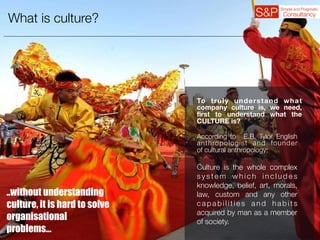
To truly understand what
company culture is, we need,
first to understand what the
CULTURE is?
According to   E.B. Tylor, English
anthropologist and founder
of cultural anthropology;
Culture is the whole complex
s y s t e m w h i c h i n c l u d e s
knowledge, belief, art, morals,
law, custom and any other
c a p a b i l i t i e s a n d h a b i t s
acquired by man as a member
of society.
..without understanding
culture, it is hard to solve
organisational
problems…
What is corporate culture?
..without understanding
culture, it is hard to solve
organisational
problems…
Shortly, culture is the values and practices shared
by the members of the group. 
Company Culture, therefore, can be defined as
the shared values and practices of the company's
employees. Exceptional organizations create and
sustain a culture that engages and motivates their
employees.
Creating a company culture requires :
• Meaningful work
• Deep employee engagement
• Job and organizational fit
• Strong leadership
How to transform corporate culture?
..transforming the
company on purpose and
with control is critical…
In reality, every organization is
n a t u r a l l y i n s o m e s t a t e o f
transformation.
The critical question is, to what end
i s t h e o r g a n i z a t i o n b e i n g
transformed and who are the
architects of the transformation?
5 Steps to transform company
culture are :
• Figure out what aspect of culture
needs to change
• Identify the influencers in the
organization and bring them “in”
• Start walking the talk in small
steps
• Be courageous in weeding out
behaviors that do not align with
the Company Culture
• Communicate and celebrate the
winning culture
How to create a continuous
improvement culture?
In order to achieve success in
operational excellence efforts,
corporate culture should be
t r a n s f o r m e d t o s o c a l l e d
“ c o n t i n u o u s i m p r o v e m e n t
culture” (CIC).
In creating CIC, it is critical to get
employees committed and involved
in the change process of the
company. Every employee needs to
share the CI vision, which is about
focusing on the customer and
making the word “improvement”
part of the company’s DNA.
The executives may demonstrate
their commitment to CIC by,
• Setting clear objectives and
priorities
• Identifying the right team
• Continuously developing CI skills
within company
• Preventing from excuses when
deviations happen from the plan.
Continuous improvement begins
by clearly defining value through
the eyes of customers.
The four goals of improvement
must be making things;
• Easier
• Better
• Faster
• Cheaper
for the customers.
..continuous improvement culture should
be embedded in the corporate DNA…
How to create employee
involvement in continuous improvement?
Employee involvement is central to the
philosophy of continuous improvement.
CI involvement is about:
• Leading by doing
• Asking the right questions
• Listening to all ideas
• Regularly reviewing key CI projects
• Empowering all employees to make
improvements
Operational excellence requires a
widespread commitment throughout the
organisation.
A culture must be developed where every
person in the organisation demonstrates a
high level of respect for every other person.
..continuous improvement
culture should be embedded in
the corporate DNA…
Shingo principles revisited
As you might recall from previous
presentation, Shingo Principles were
regarded as pillars of operational
excellence. To remind you shortly the
Shingo Principles, they are;
1. Respect every individual
2. Lead with humility
3. Seek perfection
4. Assure quality at the source
5. Flow and pull value
6. Embrace scientific thinking
7. Focus on process
8. Think systemically
9. Create constancy of purpose
10.Create value for the customer
All the items above are related with CIC.
Especially the first three have a direct impact
on the culture. Therefore we are going to
mention these shortly in the following
section.
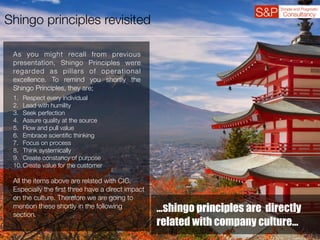
…shingo principles are directly
related with company culture…
Shingo principle 1 - Respecting every individual
..without respect as a
fundamental value in an
organisation, sustainable
outcomes are impossible…
Respect is a principle that enables the
development of people and creates an
e n v i r o n m e n t f o r e m p o w e r e d
associates to improve the processes
that they “own.”
Respect for every individual naturally
includes respect for customers, for
suppliers, for the community and for
society in general.
Some examples to respect as a
corporate value are as follows:
• Because we respect every individual (the
principle); therefore, we always place safety
first (the value).
• Because we have respect for every individual
(the principle); therefore, we empower people
to act independently (the value)
• Because we have respect for every individual
(the principle); therefore, we make all of our
key communications open
Why and how to lead with humility
Humility is an enabling principle that
precedes learning and
improvement.
A leader’s willingness to seek input,
listen carefully and continuously learn
creates an environment where
associates feel respected and energized
and give freely of their creative abilities.
Some examples to leading with humility
as a corporate value are as follows:
• Because I lead with humility (the principle);
therefore, I am open to good ideas and
innovation from anywhere in the organization
(the value).
• Because I lead with humility (the principle);
therefore, I accept responsibility and enable
change (the value).
• Because I possess humility (the principle);
therefore, I seek,
• trust and follow the direction of those with a
responsibility to lead (the value).
..humility makes employees feel respected
and energized and give freely of their
creative abilities…
Seeking perfection and
continuous improvement
The third principle of Shingo is seeking perfection.
Excellence is a non-ending journey. Improvement
from a certain level to another is achieved and this
success for sure deserves an appreciation.
However, the final destination to excellence is never
reached.
Keeping this in mind, the motivation and focus of
everyone in the company should be aligned for a
never ending continuous improvement.
A powerful incentive for employees at this stage is
an improvement and learning opportunity for
themselves. At first sight, efforts for perfection
seems for only company’s wellbeing.
However, continuous improvement efforts should
be designed and introduced also as opportunities
for improvement of the employees.
..seeking for perfection and
continuous improvement
culture should be embedded
in the corporate DNA…
CI is an improvement
opportunity for employees as
well as the company…
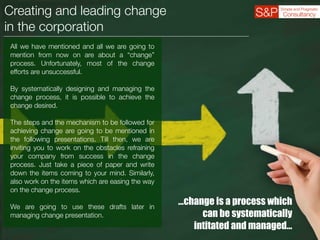
Creating and leading change
in the corporation
All we have mentioned and all we are going to
mention from now on are about a “change”
process. Unfortunately, most of the change
efforts are unsuccessful.
By systematically designing and managing the
change process, it is possible to achieve the
change desired.
The steps and the mechanism to be followed for
achieving change are going to be mentioned in
the following presentations. Till then, we are
inviting you to work on the obstacles refraining
your company from success in the change
process. Just take a piece of paper and write
down the items coming to your mind. Similarly,
also work on the items which are easing the way
on the change process.
We are going to use these drafts later in
managing change presentation.
…change is a process which
can be systematically
intitated and managed…
To be continued with other
Shingo principles
So back to Shingo principles; they are:
1. Respect every individual
2. Lead with humility
3. Seek perfection
4. Assure quality at the source
5. Flow and pull value
6. Embrace scientific thinking
7. Focus on process
8. Think systemically
9. Create constancy of purpose
10.Create value for the customer
Our following presentations aim to mention
all these items and give you a simple and
pragmatic understanding to apply the
principles in your organisation.
We have covered the first three items. We
are continuing explaining the rest of the
principles in our following presentations.
Additional topics related to OpEx are going
to be available as well.
About us
Simple and Pragmatic
Consultancy
S&P is a common initiative of
Leannovative and Performance
Club consultancy companies.
Our aim is to simplify things for
professionals and for our clients.
For more information about our
projects and for support please
contact us via e-mail through:
edursun@leannovative.com
tansu@kariyer-kulubu.com
Additional contact details and our
web page will be available soon.

Corporate culture v002

  • 1.
    Corporate Culture and ItsRelation to Organizational Development and Operational Excellence Operational Excellence Series is an informative set of documents prepared by Simple and Pragmatic Consultancy Simple and Pragmatic Consultancy
  • 2.
    What is thisdocument about? Competition in business-life obviously increasing. A simple research shows that, most of the top-100 companies in the world 60 years ago are not in the list anymore. Speed of change is increasing globally and companies need to adapt better than ever. Actually, adapting only helps survival. Companies need to lead change in today’s world. In the previous presentation we discussed what should be done before starting operational excellence efforts in the company. Additionally we also defined the Shingo principles which are regarded as pillars of operational excellence. Human factors as well as technical factors influence achieving operational excellence. The social climate in the organisation, behavioural patterns of employees and their values are all very important for achieving desired OpEx levels. Corporate culture therefore remains as an important topic to be covered for those who want to understand and carry out operational excellence practices. Without understanding corporate culture, it becomes very difficult to design and run OpEx projects. In the end, all these efforts require employees to adapt their way of thinking and behaviours to new and better ways of doing the company’s job. Therefore, we will briefly introduce the concept of corporate culture in this document. Organisational Culture is a very important factor affecting OpEx projects
  • 3.
    What is culture? Totruly understand what company culture is, we need, first to understand what the CULTURE is? According to   E.B. Tylor, English anthropologist and founder of cultural anthropology; Culture is the whole complex s y s t e m w h i c h i n c l u d e s knowledge, belief, art, morals, law, custom and any other c a p a b i l i t i e s a n d h a b i t s acquired by man as a member of society. ..without understanding culture, it is hard to solve organisational problems…
  • 4.
    What is corporateculture? ..without understanding culture, it is hard to solve organisational problems… Shortly, culture is the values and practices shared by the members of the group.  Company Culture, therefore, can be defined as the shared values and practices of the company's employees. Exceptional organizations create and sustain a culture that engages and motivates their employees. Creating a company culture requires : • Meaningful work • Deep employee engagement • Job and organizational fit • Strong leadership
  • 5.
    How to transformcorporate culture? ..transforming the company on purpose and with control is critical… In reality, every organization is n a t u r a l l y i n s o m e s t a t e o f transformation. The critical question is, to what end i s t h e o r g a n i z a t i o n b e i n g transformed and who are the architects of the transformation? 5 Steps to transform company culture are : • Figure out what aspect of culture needs to change • Identify the influencers in the organization and bring them “in” • Start walking the talk in small steps • Be courageous in weeding out behaviors that do not align with the Company Culture • Communicate and celebrate the winning culture
  • 6.
    How to createa continuous improvement culture? In order to achieve success in operational excellence efforts, corporate culture should be t r a n s f o r m e d t o s o c a l l e d “ c o n t i n u o u s i m p r o v e m e n t culture” (CIC). In creating CIC, it is critical to get employees committed and involved in the change process of the company. Every employee needs to share the CI vision, which is about focusing on the customer and making the word “improvement” part of the company’s DNA. The executives may demonstrate their commitment to CIC by, • Setting clear objectives and priorities • Identifying the right team • Continuously developing CI skills within company • Preventing from excuses when deviations happen from the plan. Continuous improvement begins by clearly defining value through the eyes of customers. The four goals of improvement must be making things; • Easier • Better • Faster • Cheaper for the customers. ..continuous improvement culture should be embedded in the corporate DNA…
  • 7.
    How to createemployee involvement in continuous improvement? Employee involvement is central to the philosophy of continuous improvement. CI involvement is about: • Leading by doing • Asking the right questions • Listening to all ideas • Regularly reviewing key CI projects • Empowering all employees to make improvements Operational excellence requires a widespread commitment throughout the organisation. A culture must be developed where every person in the organisation demonstrates a high level of respect for every other person. ..continuous improvement culture should be embedded in the corporate DNA…
  • 8.
    Shingo principles revisited Asyou might recall from previous presentation, Shingo Principles were regarded as pillars of operational excellence. To remind you shortly the Shingo Principles, they are; 1. Respect every individual 2. Lead with humility 3. Seek perfection 4. Assure quality at the source 5. Flow and pull value 6. Embrace scientific thinking 7. Focus on process 8. Think systemically 9. Create constancy of purpose 10.Create value for the customer All the items above are related with CIC. Especially the first three have a direct impact on the culture. Therefore we are going to mention these shortly in the following section. …shingo principles are directly related with company culture…
  • 9.
    Shingo principle 1- Respecting every individual ..without respect as a fundamental value in an organisation, sustainable outcomes are impossible… Respect is a principle that enables the development of people and creates an e n v i r o n m e n t f o r e m p o w e r e d associates to improve the processes that they “own.” Respect for every individual naturally includes respect for customers, for suppliers, for the community and for society in general. Some examples to respect as a corporate value are as follows: • Because we respect every individual (the principle); therefore, we always place safety first (the value). • Because we have respect for every individual (the principle); therefore, we empower people to act independently (the value) • Because we have respect for every individual (the principle); therefore, we make all of our key communications open
  • 10.
    Why and howto lead with humility Humility is an enabling principle that precedes learning and improvement. A leader’s willingness to seek input, listen carefully and continuously learn creates an environment where associates feel respected and energized and give freely of their creative abilities. Some examples to leading with humility as a corporate value are as follows: • Because I lead with humility (the principle); therefore, I am open to good ideas and innovation from anywhere in the organization (the value). • Because I lead with humility (the principle); therefore, I accept responsibility and enable change (the value). • Because I possess humility (the principle); therefore, I seek, • trust and follow the direction of those with a responsibility to lead (the value). ..humility makes employees feel respected and energized and give freely of their creative abilities…
  • 11.
    Seeking perfection and continuousimprovement The third principle of Shingo is seeking perfection. Excellence is a non-ending journey. Improvement from a certain level to another is achieved and this success for sure deserves an appreciation. However, the final destination to excellence is never reached. Keeping this in mind, the motivation and focus of everyone in the company should be aligned for a never ending continuous improvement. A powerful incentive for employees at this stage is an improvement and learning opportunity for themselves. At first sight, efforts for perfection seems for only company’s wellbeing. However, continuous improvement efforts should be designed and introduced also as opportunities for improvement of the employees. ..seeking for perfection and continuous improvement culture should be embedded in the corporate DNA… CI is an improvement opportunity for employees as well as the company…
  • 12.
    Creating and leadingchange in the corporation All we have mentioned and all we are going to mention from now on are about a “change” process. Unfortunately, most of the change efforts are unsuccessful. By systematically designing and managing the change process, it is possible to achieve the change desired. The steps and the mechanism to be followed for achieving change are going to be mentioned in the following presentations. Till then, we are inviting you to work on the obstacles refraining your company from success in the change process. Just take a piece of paper and write down the items coming to your mind. Similarly, also work on the items which are easing the way on the change process. We are going to use these drafts later in managing change presentation. …change is a process which can be systematically intitated and managed…
  • 13.
    To be continuedwith other Shingo principles So back to Shingo principles; they are: 1. Respect every individual 2. Lead with humility 3. Seek perfection 4. Assure quality at the source 5. Flow and pull value 6. Embrace scientific thinking 7. Focus on process 8. Think systemically 9. Create constancy of purpose 10.Create value for the customer Our following presentations aim to mention all these items and give you a simple and pragmatic understanding to apply the principles in your organisation. We have covered the first three items. We are continuing explaining the rest of the principles in our following presentations. Additional topics related to OpEx are going to be available as well.
  • 14.
    About us Simple andPragmatic Consultancy S&P is a common initiative of Leannovative and Performance Club consultancy companies. Our aim is to simplify things for professionals and for our clients. For more information about our projects and for support please contact us via e-mail through: edursun@leannovative.com tansu@kariyer-kulubu.com Additional contact details and our web page will be available soon.