TABLE OF CONTENTS


COR POR AT E R E A L E STAT E


  2011
     STAT E - OF-T H E -I N DUST RY

                           REPORT


       “ T R E N DI NG TOWA R D R ECOV ERY ”
TABLE OF CONTENTS

Section i                 EXECUTIVE SUMMARY


Section ii                2011 STATE OF THE INDUSTRY
                          •	 introduction
                          •	 AsiaPac Leads the Way
                          • Global economy on the Mend
                          •	 Leading Markets in the new Decade
                          •	 current State of corporate Real estate (cRe)
                          •	 Let’s Bridge that Gap
                          •	 Gaining a Seat at the table
                          •	 technology “to the Desktop”
                          •	 So, What’s the “new normal?”
                          •	 War for talent in cRe - Upskilling?
                          •	 Work Force of the Future
                          •	 What’s next?


Section iii               INDUSTRY CLOSE-UP: THE FASB
                          EFFECT


Section iV                APPENDIX — RELATED CONTENT &
                          LINKS


CoreNet Globa’s 2011 State-of-the-Industry report provides an outlook on global markets
worldwide and corporate real estate as it relates to current trends and issues throughout the
United States, Canada, EMEA, and Asia Pacific.

This year’s report reflects the views of numerous CoreNet Global members who were inter-
viewed from across the globe as part of the research process for this report. Interviewees
represent a wide range of industry experts including end users, service providers, consultants
and advisers.

To all who helped, CoreNet Global extends sincere thanks for sharing valuable time and ex-
pertise. Without the involvement of our members, this report would not have been possible.

“ T R E N DI NG T OWA R D R E C OV E RY ”   2 011 S TAT E - OF -T H E -I N DU S T RY R E P ORT
EXECUTIVE SUMMARY
SE C T ION I


                   2011 CoreNet Global State-of-the-Industry Report
                             eXecUtiVe SUMMARY – 25 March 2011

                                            © corenet Global 2011
We have successfully survived another challenging year within our sector, but this time the
pendulum has shifted and expectations are high that brighter days are indeed ahead as we
continue into 2011. the global economy is now almost 24 months into recovery, and most
forecasts point to the growth momentum continuing, albeit at an uneven pace, as some re-
gions and cities are recovering faster than others.
corenet Global’s 2011 State-of-the-industry Report covers events, trends and practices over
the	course	of	2010	and	into	the	First	Quarter	of	2011,	a	period	defined	by	marked	economic	
improvement.
Considering	the	fast-changing	nature	of	the	current	landscape,	the	findings	and	observa-
tions contained within this report may take on different outcomes or appear to have shifted
yet again in future weeks or months, as compared to the snapshot or baseline offered at this
time.
this State-of-the-industry Report captures the duality of the moment: how corporate real es-
tate (cRe) is playing the role of both value protector and value creator against the backdrop
of this improving economy.
in our newly-published report posted for members only, the focus this year is on fresh input
from corenet Global members regarding the global economic recovery, the state of cRe,
technology and real estate, workplace innovation, the war for talent in cRe and other trends
they	identified.	Some	key	takeaways	include:

        - FASB 13: “This is going to be the Sarbanes Oxley for CRE – a real game changer
        because a lot more work will be required of CRE departments in order to comply with
        these standards since the accounting implications are very significant. The portfolio
        management and data implications are large and require more manpower to properly
        manage the day-to-day data that will arise from the new standards.”

        - Global Recovery: “Growth and activity that started in 2010 is expected to continue
        and strengthen into 2011 in the world’s major leading markets. However, there is
        cause for alarm by some global economists, as the recent Middle East tensions,
        surge in interest rates, inflation, the sovereign debt issues in Europe and the recent
        natural disasters in Japan, Australia and New Zealand could possibly dampen the
        momentum that was started a few short months ago.”

        - Support Growth but Reduce Costs: “CRE now has more visibility and pressure to
        perform due to the growth opportunity and pressure in Asia Pacific. Specifically, cost
        pressure, as well as growth ambitions and needs, are twin challenges CRE now
        faces.”


“ T R E N DI NG T OWA R D R E C OV E RY ”    2 011 S TAT E - OF -T H E -I N DU S T RY R E P ORT
EXECUTIVE SUMMARY
SE C T ION I


- Growth Mode Again?: “There is a great deal of pent-up demand now for
projects that had been deferred the past few years. Capital that companies had
been hoarding previously is now looking to be spent.”

- New, Emerging Markets: “There are new emerging markets companies are
looking at now known as CIVETS [Colombia, Indonesia, Vietnam, Egypt,
Turkey and South Africa]. These countries have the potential to be leading
markets this decade and generate the same kind of results Brazil, Russia,
India and China produced the past 10 years.”

- State of CRE, Positive Outcomes: “Even though the CRE industry has gone
through a rocky road the past few years, there’s a silver lining for the CRE
professional: there is now a crystallized mandate to drive savings and centralize
the CRE function, an opportunity presents itself for a much stronger and
strategic relationship with the C-suite, and upskilling as it relates to the
skill sets the CRE professional will need as this role continues to evolve in the
coming years.”

- Gaining a Seat at the Table: “As opposed to being a passive ‘order taker,’
CRE must transform itself into a proactive business partner because the CRE
function has the potential to be a key strategic enabler and be the ‘glue’ and
‘mortar’ for the business it supports.”

- Technology in the Workplace: “Social networks will continue to be a common
everyday feature and driver in the workplace, especially as Gen X, Y and the
Millennials rise up through the ranks of power. As such, CRE must quickly
adapt to their workplace needs and wants.”

- Workplace Mobility: “Employees are now spending less and less time at their
desks, and the growing trend is indeed a shift toward working anywhere,
anyplace and at anytime.”

AWS: “A smaller footprint equals reduced carbon footprint, heightened
corporate responsibility and greater workplace flexibility.”
SE C T ION I I


IntroductIon
As we begin a new year for corporate real estate (crE), the positives far outweigh the nega-
tives when you compare where we are today with the past few years. Albeit at a slow and
steady pace, hiring is starting up again and numerous economists are forecasting growth
across most of the globe, although it will most likely be at an uneven pace. As a result, this
should lead to a marked improvement in property fundamentals.

“Even though we must still work through significant financial, political and economic risks
in 2011, we’re clearly back on track with a number of positive, long-term real estate trends,”
says Angela Cain, CEO of CoreNet Global. “It’s a remarkably different feeling than this
time last year. Last year, there was still fear of a double-dip recession and the recovery
was unstable. Now, companies are more confident due in part to the solid economic growth
that’s beginning to permeate across all economies. Businesses are investing again, and in
the crE world we’re seeing a steady recovery in most leading markets.”


                                      “Even though we must still work through
                                    significant financial, political and economic
                                   risks in 2011, we’re clearly back on track with
                                     a number of positive, long-term real estate
                                                       trends.”
                                            - Angela Cain, CoreNet Global


So, now that we’ve come through the worst economic downturn since the Great depression,
it’s time to get our heads back on straight and determine exactly where crE is headed and
how this industry will change and evolve as we embark on a new era. So please join us as
corenet Global sorts through these signals and provides strategic direction going forward.

the proverbial mood among large companies across the globe is mostly positive. In fact,
many are beginning to move into a growth and investment mode with companies in Asia
taking the lead with the West following suit, as companies in all sectors provide the final
market demand for demand and space.

AsiaPac Leads the Way in recovery and Growth
the global economy is on the mend, and that’s to be expected as expansion follows reces-
sionary periods, and we are now tiptoeing into that phase. consumption is up, and there
has been private sector job growth. Although weak, it’s been steady and stable. For the
U.S., exports and imports are back to pre-recession levels, which again is a reflection of
the demand. As such, there are a number of indicators that suggest the economy is mov-
ing in the right direction.


“ t R e n Di ng t oWa R D R e c oV e RY ” 2 011 S TAT E - OF -T H E -I N DU S T RY R E P ORT   Section ii
                                                                                                  Page 1
AsiaPac Leads the Way
                                  SE C T ION I I

                          A lot of growth is and will
                          continue to be driven by
                          the economies of china,
                          India and even Brazil.
                          they have become domi-
                          nant markets and lead
                          the real estate upswing,
                          ahead of developed na-
                          tions in Western Europe
                          and the u.S., which are
                          improving but at a much
                          slower pace. Activity in
                          the world’s major com-
                          mercial real estate mar-
                          kets is expected to con-
                          tinue to strengthen dur-
                          ing 2011, building upon
                          the progress made in
                          2010.

                          there are, however, a
                          few caveats that could
                          slow or derail the recov-
 “The global financial    ery. A surge in interest
crisis raised the focus   rates; the sovereign debt issues in Europe; inflation; the most recent Middle East tensions;
on costs in corporates,   and natural disasters in Japan, Australia and new Zealand are concerns economists and
 including real estate.   research teams are tracking closely.
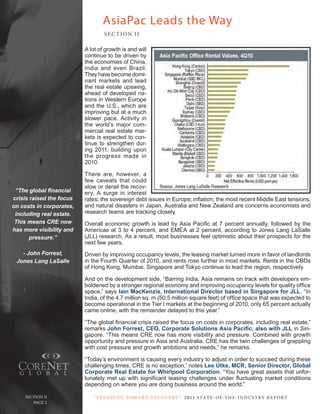
 This means CRE now       Overall economic growth is lead by Asia Pacific at 7 percent annually, followed by the
has more visibility and   Americas at 3 to 4 percent, and EMEA at 2 percent, according to Jones Lang LaSalle
       pressure.”         (JLL) research. As a result, most businesses feel optimistic about their prospects for the
                          next few years.
   - John Forrest,        driven by improving occupancy levels, the leasing market turned more in favor of landlords
 Jones Lang LaSalle       in the Fourth Quarter of 2010, and rents rose further in most markets. rents in the cBds
                          of Hong Kong, Mumbai, Singapore and Tokyo continue to lead the region, respectively.

                          And on the development side, “Barring India, Asia remains on track with developers em-
                          boldened by a stronger regional economy and improving occupancy levels for quality office
                          space,” says Iain MacKenzie, International Director based in Singapore for JLL. “In
                          India, of the 4.7 million sq. m (50.5 million square feet) of office space that was expected to
                          become operational in the Tier I markets at the beginning of 2010, only 65 percent actually
                          came online, with the remainder delayed to this year.”

                          “The global financial crisis raised the focus on costs in corporates, including real estate,”
                          remarks John Forrest, CEO, Corporate Solutions Asia Pacific, also with JLL in Sin-
                          gapore. “this means crE now has more visibility and pressure. combined with growth
                          opportunity and pressure in Asia and Australia, crE has the twin challenges of grappling
                          with cost pressure and growth ambitions and needs,” he remarks.

                          “today’s environment is causing every industry to adjust in order to succeed during these
                          challenging times. crE is no exception,” notes Lee Utke, MCR, Senior Director, Global
                          Corporate Real Estate for Whirlpool Corporation. “You have great assets that unfor-
                          tunately met up with significant leasing challenges under fluctuating market conditions
                          depending on where you are doing business around the world.”

     Section ii              “ t R e n Di ng t oWa R D R e c oV e RY ” 2 011 S TAT E - OF -T H E -I N DU S T RY R E P ORT
  Page 2
       Page 2
SE C T ION I I


                          Global Economy on the Mend
                          “this is a story of the haves and have-nots, and this is primarily due to job growth,” notes
                          Craig Robinson, MBA, President, Corporate Services for Cassidy Turley. “those
                          global cities where we see the strongest job growth will in turn provide the strongest real
                          estate recovery.”

                          Deep-pocketed real-estate investors are taking note of signs of stability in the office market
                          and making bets in cities where office buildings were hit hard by the recession.

                          But as businesses gain confidence
                          about their growth prospects amid
                          a strengthening economy, mar-
                          kets across the globe are seeing
                          signs of improvement.

                          “the industry has turned a corner
                          and is getting back into a growth
                          mode, albeit at a slow and steady
                          pace,” adds Larry Ebert, Execu-
                          tive Vice President and National
                          Head of Project Management
“This is a story of the   for Grubb & Ellis. “there is a
haves and have-nots,      great deal of pent-up demand for
                          projects that have been deferred;
 and this is primarily
                          there’s capital that corporations
 due to job growth.”
                          have been hoarding, and they’re
                          starting to spend that now.”
  - Craig Robinson,
    Cassidy Turley        What shape best describes the glob-
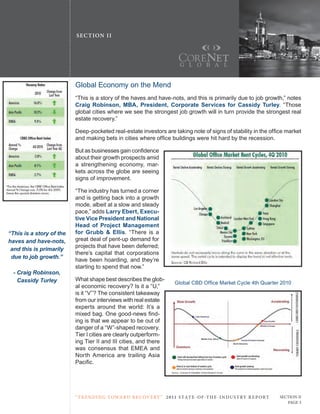
                                                                         Global CBD Office Market Cycle 4th Quarter 2010
                          al economic recovery? Is it a “u,”
                          is it “V”? the consistent takeaway
                          from our interviews with real estate
                          experts around the world: It’s a
                          mixed bag. One good-news find-
                          ing is that we appear to be out of
                          danger of a “W”-shaped recovery.
                          tier I cities are clearly outperform-
                          ing tier II and III cities, and there
                          was consensus that EMEA and
                          north America are trailing Asia
                          Pacific.


                          “ t R e n Di ng t oWa R D R e c oV e RY ” 2 011 S TAT E - OF -T H E -I N DU S T RY R E P ORT   Section ii
                                                                                                                            Page 3
Global Economy on the Mend
                      SE C T ION I I

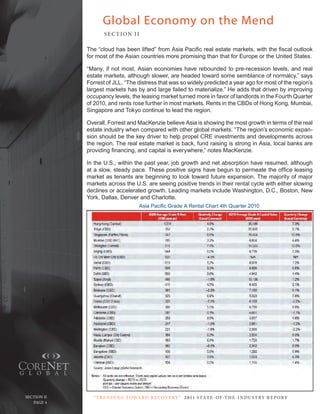
               The “cloud has been lifted” from Asia Pacific real estate markets, with the fiscal outlook
               for most of the Asian countries more promising than that for Europe or the united States.

               “Many, if not most, Asian economies have rebounded to pre-recession levels, and real
               estate markets, although slower, are headed toward some semblance of normalcy,” says
               Forrest of JLL. “the distress that was so widely predicted a year ago for most of the region’s
               largest markets has by and large failed to materialize.” He adds that driven by improving
               occupancy levels, the leasing market turned more in favor of landlords in the Fourth Quarter
               of 2010, and rents rose further in most markets. Rents in the CBDs of Hong Kong, Mumbai,
               Singapore and tokyo continue to lead the region.

               Overall, Forrest and MacKenzie believe Asia is showing the most growth in terms of the real
               estate industry when compared with other global markets. “the region’s economic expan-
               sion should be the key driver to help propel crE investments and developments across
               the region. the real estate market is back, fund raising is strong in Asia, local banks are
               providing financing, and capital is everywhere,” notes MacKenzie.

               In the u.S., within the past year, job growth and net absorption have resumed, although
               at a slow, steady pace. These positive signs have begun to permeate the office leasing
               market as tenants are beginning to look toward future expansion. the majority of major
               markets across the u.S. are seeing positive trends in their rental cycle with either slowing
               declines or accelerated growth. Leading markets include Washington, d.c., Boston, new
               York, dallas, denver and charlotte.
                                      Asia Pacific Grade A Rental Chart 4th Quarter 2010


  Section ii     “ t R e n Di ng t oWa R D R e c oV e RY ” 2 011 S TAT E - OF -T H E -I N DU S T RY R E P ORT
Page 4
     Page 4
SE C T ION I I


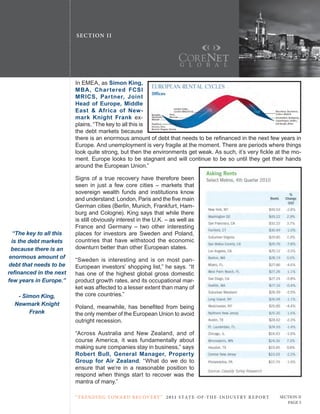
                         In EMEA, as Simon King,
                         MBA, Char tered FCSI
                         MRICS, Par tner, Joint
                         Head of Europe, Middle
                         East & Africa of New-
                         mark Knight Frank ex-
                         plains, “the key to all this is
                         the debt markets because
                         there is an enormous amount of debt that needs to be refinanced in the next few years in
                         Europe. And unemployment is very fragile at the moment. there are periods where things
                         look quite strong, but then the environments get weak. As such, it’s very fickle at the mo-
                         ment. Europe looks to be stagnant and will continue to be so until they get their hands
                         around the European union.”

                         Signs of a true recovery have therefore been
                         seen in just a few core cities – markets that
                         sovereign wealth funds and institutions know
                         and understand: London, Paris and the five main
                         German cities (Berlin, Munich, Frankfurt, Ham-
                         burg and cologne). King says that while there
                         is still obviously interest in the u.K. – as well as
                         France and Germany – two other interesting
  “The key to all this   places for investors are Sweden and Poland,
 is the debt markets     countries that have withstood the economic
 because there is an     downturn better than other European states.
enormous amount of
                         “Sweden is interesting and is on most pan-
debt that needs to be    European investors’ shopping list,” he says. “It
refinanced in the next   has one of the highest global gross domestic
few years in Europe.”    product growth rates, and its occupational mar-
                         ket was affected to a lesser extent than many of
   - Simon King,         the core countries.”
  Newmark Knight
                         Poland, meanwhile, has benefited from being
       Frank             the only member of the European union to avoid
                         outright recession.

                         “Across Australia and new Zealand, and of
                         course America, it was fundamentally about
                         making sure companies stay in business,” says
                         Robert Bull, General Manager, Property
                         Group for Air Zealand. “What do we do to
                         ensure that we’re in a reasonable position to
                         respond when things start to recover was the
                         mantra of many.”

                         “ t R e n Di ng t oWa R D R e c oV e RY ” 2 011 S TAT E - OF -T H E -I N DU S T RY R E P ORT   Section ii
                                                                                                                           Page 5
Leading Markets in the New Decade
                                 SE C T ION I I

                         the uncertainty continues to broaden the window of opportunity for those that have a need
                         to reposition themselves. “We’ve been in crisis mode for a few years now, and I’ve always
                         said you never want to miss a crisis,” adds Peter Affleck, Executive General Manager,
                         Real Estate for Suncorp Business Services. “And turn that crisis into an opportunity.”

                         Affleck and Bull both attest that in general, Australia and New Zealand are both quite
                         healthy in relation to the global economy. there have been periods where it has been up
                         and down, particularly in the mining industry, which underpins a large portion of Australia’s
                         wealth. Affleck explains once the mining industry “kicks off,” everything else follows suit.
                         But overall, the direction of the economy is quite healthy. In fact, the tragedy of the recent
                         floods and earthquake actually breeds new work across construction and other industries.

                         Leading Markets in the New Decade
                         Given this trend of economic growth, firms are aggressively looking for expansion in
                         developing countries even as they invest modestly in Europe and the u.S. the biggest
                         opportunities are in India and china. As such, these major sophisticated countries, that
  “We now have new
                         contain some 40 percent of the world’s population, now have a seat at the table in world
  emerging markets       economic and political affairs.
   known as CIVETS
[Colombia, Indonesia,    With their roughly 10 percent growth rates, economic clout and relevance, china and India
Vietnam, Egypt, Turkey   have grown substantially over the past five years. However, the shock caused by the re-
  and South Africa].     cession and global financial crisis of the past few years covered up the progress they were
                         making, economically and politically. And as the recession becomes more a thing of the
  These are the new
                         past, these countries are taking a new and more confident stance and look at the world
 markets corporations    from a different lens, from the position of their own success and bright outlook.
    are looking at.”
                         In the next 10 years, India will actually exceed the population of china. As such, India has
  - Simon O’Reilly,      become the emerging two-headed dragon. And Brazil is a very quiet giant right now. It has
Cushman & Wakefield      the equivalent GdP of every other country combined in South America.

                         Simon O’Reilly, Partner, Client Solutions, Cushman & Wakefield, LLP, adds that while
                         the markets of Eastern Europe, russia, India, china and Brazil are still attractive, they’re
                         now stabilized mature markets. He says, “We now have new emerging markets known as
                         cIVEtS [colombia, Indonesia, Vietnam, Egypt, turkey and South Africa]. these are the
                         new markets corporations are looking at.”

                         And he expects cIVEtS to be among the world’s hottest markets in the decade to come.
                         “they have the potential to generate the same kind of windfall wealth as the BrIc [Brazil,
                         russia, India and china] markets did over the last 10 years.”


    Section ii              “ t R e n Di ng t oWa R D R e c oV e RY ” 2 011 S TAT E - OF -T H E -I N DU S T RY R E P ORT
  Page 6
       Page 6
SE C T ION I I


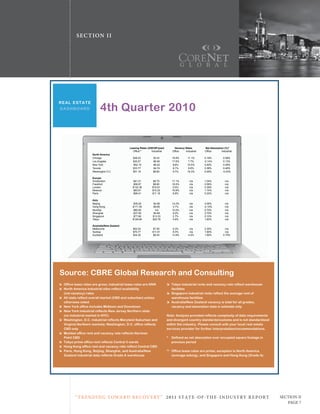
rea l e s t a t e
das h b o a r d           4th Quarter 2010


                                              Leasing Rates (USD/SF/year)        Vacancy Rates        Net Absorption (%)*
                                                Office**       Industrial       Office   Industrial   Office       Industrial
                     North America
                     Chicago                    $26.03          $3.91           19.9%       11.1%     0.18%          0.08%
                     Los Angeles                $30.57          $6.60           17.6%        7.7%     -0.14%         0.13%
                     New York                   $52.15          $6.42            8.6%       10.5%     0.40%          0.09%
                     Toronto                    $33.77          $4.74            9.1%        6.6%     0.36%          0.46%
                     Washington D.C             $51.19          $8.80            9.7%       16.3%     0.48%          -0.43%

                     Europe
                     Amsterdam                  $41.01          $8.70           17.1%        n/a      1.04%            n/a
                     Frankfurt                  $56.67          $8.80           18.4%        n/a      0.58%            n/a
                     London                     $132.36        $18.91           5.5%         n/a      0.39%            n/a
                     Moscow                     $83.61         $10.22           16.8%        n/a      1.74%            n/a
                     Paris                      $99.41         $11.18           6.8%         n/a      0.22%            n/a

                     Asia
                     Beijing                    $39.28           $4.86          14.2%        n/a       4.06%           n/a
                     Hong Kong                  $171.55          $9.65          3.1%         n/a      -0.10%           n/a
                     Mumbai                     $80.09            n/a           10.0%        n/a       0.70%           n/a
                     Shanghai                   $37.09           $4.69          9.2%         n/a       2.70%           n/a
                     Singapore                  $77.66          $13.33          2.7%         n/a       0.10%           n/a
                     Tokyo                      $128.84         $22.78          4.9%         n/a       1.82%           n/a

                     Australia/New Zealand
                     Melbourne                  $52.54         $7.59             6.3%        n/a      2.35%            n/a
                     Sydney                     $70.77         $11.91            8.3%        n/a      1.90%            n/a
                     Auckland                   $34.30         $8.40            13.8%       4.5%      1.90%          0.79%


source: cbre Global research and consulting
 office lease rates are gross; industrial lease rates are NNN               tokyo industrial rents and vacancy rate reflect warehouse
 North america industrial sites reflect availability                         facilities
  (not vacancy) rates                                                        singapore industrial rents reflect the average rent of
 all stats reflect overall market (cbd and suburban) unless                  warehouse facilities
  otherwise noted                                                            australia/New Zealand vacancy is total for all grades;
 New York office includes midtown and downtown                               vacancy and absorption data is estimate only
 New York industrial reflects New Jersey Northern stats
  (no industrial market in NYc)                                             Note: analysis provided reflects complexity of data requirements
 Washington, d.c. industrial reflects maryland suburban and                and divergent country standards/customs and is not standardized
  Virginia Northern markets; Washington, d.c. office reflects               within the industry. please consult with your local real estate
  cbd only                                                                  services provider for further interpretation/recommendations.
 mumbai office rent and vacancy rate reflects Nariman
  point cbd                                                                 *   defined as net absorption over occupied square footage in
 tokyo prime office rent reflects central 5 wards                              previous period
 hong Kong office rent and vacancy rate reflect central cbd
 paris, hong Kong, beijing, shanghai, and australia/New                    ** office lease rates are prime; exception is North america
  Zealand industrial data reflects Grade a warehouse                           (average asking), and singapore and hong Kong (Grade a)


                                             2011 the leader             80     march / april


          “ t R e n Di ng t oWa R D R e c oV e RY ” 2 011 S TAT E - OF -T H E -I N DU S T RY R E P ORT                                         Section ii
                                                                                                                                                  Page 7
Current State of CRE
                       SE C T ION I I

               current State of crE
               “We are very optimistic about the state of the crE and workplace industry,” remarks rob-
               inson of cassidy turley. “Although we’ve experienced economic woes the past few years,
               I would suggest there’s a silver lining for the crE professional.”

               Positive Outcomes for CRE

                   •   Crystallized mandate to drive savings and centralize the CRE function
                   •   the opportunity for a much closer and strategic relationship with the c-suite
                       within the enterprise

                   •   Business alignment and a seat at the table – stronger relationships between crE
                       and businesses it supports
                   •   upskilling in terms of the skill sets that crE leaders have and will need as the
                       crE function evolves and becomes more strategic
               this all represents a positive shift in crE and the workplace industry.

               “the industry is certainly alive and well,” adds Bull of Air new Zealand.

               the strength of the crE function has been growing based on improved knowledge and
               experience for a number of years now. “Staying ahead of trends in markets, workplace
               design and environmental solutions are all part of the tools we possess,” says Denis
               DeCamp, Manager, Corporate Real Estate for AkzoNobel. In today’s landscape, there’s
               clearly a strategic opportunity for CRE to reach out, touch and influence the core business
               drivers for companies. In years past, what would have been considered non-core attributes
               or off limits to crE departments, today mean an opportunity to not only lower optimized oc-
               cupancy costs, but also have the ability to optimize the business model from a productivity
               standpoint for employees and affect the recruiting process for new young talent.

               utke of Whirlpool corporation explains that these variables all tie back into the strategic
               nature of the business. “We can’t afford to get lost in the day-to-day rhetoric and forget that
               tactical decisions still need to get made on a timely basis. therefore, we need to continue
               to focus on what’s going to drive the broader success and provide a road map, per se, that
               shows where you want to take the company and how you can get the company to a higher
               level of performance. that will absolutely get the attention of senior management.”

               Affleck adds, “Quite frankly, being lost in the day-to-day responsibilities is really an outcome
               of poor leadership and poor planning because that is a strategic road map itself. It’s as
               simple as that. If crE strategically plans and shares ownership of the business, that will
               allow us to come to the table and inform the c-suite early on.”

               For Ebert with Grubb & Ellis, the focus should be not only about operational efficiency, but
               on how real estate and the workplace enable people to be more productive.


  Section ii      “ t R e n Di ng t oWa R D R e c oV e RY ” 2 011 S TAT E - OF -T H E -I N DU S T RY R E P ORT
Page 8
     Page 8
SE C T ION I I


                        “We need to continue to push the boundaries to ensure that all working environments
                        are truly integrated with technology and people considerations,” says Colin King, MBA,
                        FRICS, MCIOB, MAPM, MCR, Vice President Worldwide Real Estate & Workplace for
                        GlaxoSmithKline, previously with nokia. “Even though we have talked about crE being
                        integrated with It and Hr for some time, it is rare to see processes that have been inte-
                        grated in an end-to-end way that have this built around a common vision for the end user.”

                        From a crE perspective, he believes that all solutions will need to be part of an agile
                        portfolio, which allows the business to be flexible and react quickly to changing business
                        requirements and competitive pressures. “clearly link crE solutions to the growth and
                        profitability of the business, because if executed correctly they will clearly enhance team
                        performance,” he adds.

                        Locational Strategy Planning Indicators

                        Locations need to be strategically planned in order to:

                            •   Bring together key activities and capabilities, not just to fit organizational
     “We need to                structures that are subject to change.
  continue to push
                            •   Optimize cost/benefit – where is the best place to invest? Value, not cost,
   the boundaries               should be the overriding consideration in location decisions.
  to ensure that all
working environments        •   Address talent supply considerations – what kind of skills does the company
 are truly integrated           need to ensure our future success, and where will we find the people
   with technology              who have them?
      and people
                        Let’s Bridge that Gap
  considerations.”
                        While there’s historically been the perception that for every two steps forward crE makes, it
    - Colin King,       notoriously takes three steps back – that’s not always the case, especially when it comes to
  GlaxoSmithKline       crE aligning with the overall corporate strategy in today’s world. So, how can a company’s
                        real estate align with its overall core, corporate strategy? We asked this question and got
                        a dichotomy of answers.

                        “that’s been the number one question for crE for years now,” notes Bull of Air new Zea-
                        land. “Well, you’ve got to take the lead and immerse yourself in the business and get to the
                        heart of the business, and if you want to be heard you must talk the language. And to be
                        strategic, it’s not just the one-off play, but how does this add enduring value to the business?”

                        cassidy turley’s robinson remarks, “It’s the human factor – proving that crE is organi-
                        zationally aligned, meaning the maturity of the CRM function. Alignment does not always
                        dictate the crE mandate. You can be a great support function to the business unit by being
                        closely aligned and in tune with their needs, but as the mandate shifts to being more of a
                        strategic advisor to the business unit, that is driven not only by organizational alignment
                        but by the personal leadership of the crE function.”

                        “ t R e n Di ng t oWa R D R e c oV e RY ” 2 011 S TAT E - OF -T H E -I N DU S T RY R E P ORT   Section ii
                                                                                                                          Page 9
Let’s Bridge that Gap
                                   SE C T ION I I

                           Michael Zamora, MCR, Senior Manager, AsiaPacific and Japan Regions for Cisco
                           explains, “For some corporations there is a gap. Minimizing the gap starts with the CRE
                           group, also known within cisco as Workplace resources. cisco started aligning with the
                           business groups years ago. our goal is to minimize or eliminate gaps.”

                           one way to close or at least minimize the gap is by working with the business groups at two
                           different levels, he said. At a local level, cisco’s crE works with the local/regional business
                           groups to understand specific needs. In addition, there are Client Relationship Managers
                           (CRMs) who align with the global business leaders. The global alignment occurs through
                           regular conversations and formally through the Quarterly Business review process.

                           “If crE focuses on understanding and interpreting business strategy and translating that
                           to crE strategy and leveraging the market (i.e. service provider partners/suppliers) for
                           operational delivery and tactical execution, it stands to be in perfect symmetry with that
                           business,” says King of newmark Knight Frank.

                           “In addition to speaking and understanding the language of the business, a critical success
   “The business won’t     factor in achieving this alignment is the inclusion of crE by the business. We are seeing
inform us unless we get    an increasing focus by CRE of the development of robust Business Relationship Manage-
 their confidence. CRE     ment (BRM) models in an effort to achieve this,” notes Affleck for Suncorp. “The business
   does not need to be     won’t inform us unless we get their confidence. CRE does not need to be one of the last to
 one of the last to know   know about change, but quite frankly, we should be one of the first.”
about change, but quite    And knowing the business is far more important than knowing real estate, notes decamp
  frankly, we should be    of Akzonobel.
     one of the first.”
                           King of GlaxoSmithKline points out that today different customer groups have diverse and
    - Peter Affleck,       rapidly changing needs, and crE professionals need to truly integrate with decision mak-
                           ers at all levels in order to fully understand them and create successful workplace solutions
       Suncorp
                           together.

                           And Sven Pole, Senior Vice President of CB Richard Ellis, Global Corporate Solu-
                           tions, adds that at times, crE departments don’t invest in business relationship managers
                           that can operate at the highest levels within the key business units of the company. Instead,
                           they send space planners or other junior people who are unable to get to the table to help
                           form the overall strategic agenda – one that should consider real estate as an asset and
                           aid in implementing and sizing up a strategy or business opportunity.

                           “I believe we’ve proven over the past year or so, that we can be effective first responders
                           in a crisis, and the leadership we should continue to develop and evolve is how do we in-
                           crease our sphere of influence, our strategic alignment within the organization when there
                           is no crisis or burning mandate,” notes robinson. “the only thing we know for certain is
                           the past is no indication of the future.”

                           He also adds that the world of the service provider is also changing in response and in
                           anticipation of the significant changes occurring in the CRE function, as it has much greater
                           demands to be more practical, strategic and innovative. As such, it’s a natural expectation
                           for crE to look to its closest partners to facilitate and enable them to be successful in this
                           new regard.


     Section ii               “ t R e n Di ng t oWa R D R e c oV e RY ” 2 011 S TAT E - OF -T H E -I N DU S T RY R E P ORT
   PagePage 10
        10
SE C T ION I I


“So the difficult, yet exciting aspect of the world of the new service provider is that you have
clients on a continuum. As we continue to drive savings, mitigate risk and provide flexibility
in their business models, they will also expect us to proactively bring innovation and antici-
pate change versus only helping them respond to it. And these require even different skill
sets of today’s service provider than in the past,” explains robinson.

Gaining a Seat at the table
the challenge falls on crE departments to interject themselves into their client’s work
streams. By identifying those that are driving the strategic planning for the company, crE
professionals can then encourage the c-suite to recognize that real estate is a strategic
component of the business and crE needs to be at the table when the strategic discus-
sions are taking place. real estate affects the company on so many levels, including talent
and recruitment. A conscious effort has to be made to push it into the stream, otherwise
crE can get lost.

“It behooves us to be more articulate in explaining the ways in which crE can positively
impact the business unit, and we won’t do that by using the language of crE, but rather
using the language of the business and having leaders who are much more in tune at
translating and interpreting business unit strategy into the real estate implication,” says
Matthew Fanoe, Vice President of Real Estate for Coca-Cola Refreshments USA, Inc.

                                “CRE has to understand what its value is to
                              the business. With the recent global economic
                              situation, business groups are being asked by
                             their corporate headquarters to get the most out
                                             their resources.”
                                          Michael Zamora, Cisco


“crE has to understand what its value is to the business,” says Zamora. “With the recent
global economic situation, business groups are being asked by their corporate headquar-
ters to get the most out of their resources. this request is also being asked of global crE
organizations. As facilities costs are the second- or third-largest expense for a corporation,
it is natural to look to this area. this is where crE can add extra value to the corporation.”

Zamora goes on to explain that instead of crE being a passive “order taker,” it needs to
transform itself into a proactive business partner. “crE is one of the key strategic enabler
groups and has the ability in this role to be the glue or mortar, using a real estate analogy.
Serving as a business partner, crE helps bring the strategy together for the business
groups and support groups (HR, IT, finance, sustainability, tax, legal, etc.).”


“ t R e n Di ng t oWa R D R e c oV e RY ” 2 011 S TAT E - OF -T H E -I N DU S T RY R E P ORT   Section ii
                                                                                                  Page 11
Technology to the “Desktop”
                                 SE C T ION I I

                         one way this is accomplished at cisco is through a global initiative called Global Site
                         Strategy (GSS). GSS provides mid- to long-term scenario-based plans for 80 percent of its
                         portfolio that aligns with local needs and with the global objectives of the company. on a
                         regular basis, crE will review these site strategies with the business during the Quarterly
                         Review Process to assess if any modifications are needed.

                         “At some companies, It is not seen as strategic and forward thinking as real estate, so it’s
                         essential we get them on board with our future workplace strategy,” comments Affleck for
                         Suncorp.

                         “there is an emotional aspect as well. Very rarely is it a technical discussion. But, we
                         as crE leaders need to be change managers and take the lead,” notes robinson. “this
                         economy has given us unprecedented access to the c-suite. As a result, we’re able to
                         provide strategic services, labor analytics, and the business is open to the roll out of new
                         ideas and programs.”

                         the inherent need to listen before speaking cannot be understated. the opportunity to sit
   “The technology       in and understand where the business wants to be and learn what those challenges are is
challenge is changing    paramount. then, it’s up to the crE team to formulate concepts that help achieve those
   rapidly. Leading      goals. Whirlpool corporation’s utke explains that it’s critical the business sees a go-to per-
    companies are        son who understands the business first and can then translate that into real estate versus
    reawakening to       a real estate person trying to translate real estate back to the business.
  the fact that often,   “A business unit could care less about how much it costs per-square-foot, except on the
 innovation happens      bottom line,” he adds. “they want to know what does that space do to help them succeed
through spontaneous      in their business? cost per-unit, per-head or per-seat will start getting their interest.”
     interactions.”
                         For more information about how CRE can more closely align with a firm’s business strategy
                         and its office preferences, please see the presentation by Georgia State University and
   - Sven Pole,
                         CoreNet Global entitled “Office Occupier’s Preferences & Needs”
  CB Richard Ellis
                         technology to the “desktop”
                         Where is the crE industry headed in this respect, and how is it overcoming this challenge
                         as it strives to stay one step ahead of technology and the multi-generational work force?
                         All agreed that new technology is going to be a real game changer in the next decade and
                         that the workplace will be driven by technology and mobility.

                         “the technology challenge is changing rapidly. Leading companies are reawakening to the
                         fact that often, innovation happens through spontaneous interactions,” notes Pole. “crE is
                         continually working to determine how space can support that interaction, while at the same
                         time enhancing culture and furthering productivity across the work force.”

                         Forrest of JLL adds, “Social networks will increasingly become a common everyday feature
                         in the way we work, particularly as Generation X, Y and the Millennials ascend through
                         the ranks of power. In some regards, mobility and the ‘agile’ workplace is still in its infancy,
                         and take up will vary due to differing cost ratios, cultural differences and technology speed
                         and adoption.”


    Section ii              “ t R e n Di ng t oWa R D R e c oV e RY ” 2 011 S TAT E - OF -T H E -I N DU S T RY R E P ORT
  PagePage 12
       12
SE C T ION I I


                         Key Office Environment Enablers to Support Multiple Generations in the Workplace:

                             •   Ensuring the workplace is inviting, productive, collaborative
                             •   create a space where people like to come to work, like each other and love the
                                 work that they do

                             •   Swarming is supported (bringing together a diverse group of people to solve
                                 specific challenges) – breaking out of organizational and social group barriers
                             •   Office locations that are vibrant, diverse, centrally located sites with good access
                                 to nearby amenities and public transport
                         GlaxoSmithKline’s King adds, “We use technology as a tool because of what it allows us
     “Incorporating
                         to do – it’s only useful when it’s the easiest and most common-sense solution, a connector
      telepresence       not a barrier.”
    systems, virtual
 meeting rooms and       Zamora explains that it’s important to continually look at technology as a means of increas-
    SMART Boards,        ing employee productivity and addressing the changing work force requirements.
  those are the new
                         “cisco’s telepresence (Hd video and audio conferencing) is an example of technology that
 technologies in the     we actively use to enable employees to have virtual meetings without having to travel,” he
  workplace. And to      notes. “WebEx is another audio and video technology we use that allows employees to
  take it to the next    share computer screens for conference calls. WebEx also has the ability to call the em-
   level, companies      ployee back to minimize any long-distance cost. Its chat feature enables us to have instant,
     need to invest      short communications with each other. WebEx also has an iPhone app, which allows for
money in technology      the same experience on your iPhone as on your desktop.”
 because it’s not just   these technologies, along with longer established wireless and VoiP technologies that
the senior executives    are pervasive throughout Cisco’s office environment, allow employees to be productive
  who have access        wherever their work environment may be.
  to all the mobility
        devices.”        “There are still way too many uncontrolled variables, and it’s hard to be scientific and not
                         justifiable in the numbers,” says DeCamp of AkzoNobel. “The measurement for us in de-
                         termining if we have a flexible workplace is if our employees are using the workplace we
  - Matthew Fanoe,       have in an effective way. Is this going up or down? We’re finding that the amount of time
     Coca-Cola           an employee spends at their desk is actually down, and the growing trend is a definite shift
 Refreshments USA,       toward working remotely, especially in the u.S. real estate, therefore, needs to be at the
         Inc.            table when an It strategy is discussed for alternative workplace strategies (AWS).”

                         technology is really about investment, explains Fanoe. And that can be the hard part for
                         some people because it is not cheap. “Incorporating telepresence systems, virtual meeting
                         rooms and SMART Boards, those are the new technologies in the workplace. And to take
                         it to the next level, companies need to invest money in technology because it’s not just the
                         senior executives who have access to all the mobility devices. It’s driving deeper into the
                         organization where mid- to lower-level managers now have access to handheld devices
                         and laptops.”


                         “ t R e n Di ng t oWa R D R e c oV e RY ” 2 011 S TAT E - OF -T H E -I N DU S T RY R E P ORT   Section ii
                                                                                                                           Page 13
So, What’s the “New Normal?”
                       SE C T ION I I

               Bull of Air new Zealand adds that the more mature worker does realize it’s a different work-
               ing environment, and if they’re going to be a part of today’s workplace, he/she realizes they
               most likely will have to change how they communicate and work.

               the workplace and sustainability – two separate but interconnected themes. Smart and
               sustainable buildings also play a pivotal role as innovation can come from sustainability.

               Sustainability and energy management have indeed climbed the corporate ladder, as many
               countries and companies around the world have demonstrated their renewed commitment
               toward addressing the role they play in the emission of greenhouse gases that accelerate
               climate change. And many are reinventing themselves as they continually strive to reduce
               their carbon footprint.

               “Identify core/platform buildings and leverage those assets for future planning,” notes Fa-
               noe. “this provides a big strength with new technological advances and a clear vision in
               achieving nimbleness in the workplace. We need to create workplaces that meet the needs
               of the future work force.”

               He adds, “there still seems to be some kind of inertia around deploying greater technology
               solutions in the workplace, and it’s a huge enabler as we continue to get our hands around it.”

               And let’s not forget that with these continued changes in workplace mobility and AWS,
               leases will most likely be “future proofed.”

               For more information about innovation in the workspace, please see the white paper by
               Steelcase and CoreNet Global entitled “How the Workplace Fosters Innovation”

               So, What’s the “new normal?”
               change is going to continually be the new normal, and “change happens fast,” as robinson
               so eloquently put it.

               organizations place great importance on the workplace. Also, the workspace being used as
               a tool to attract and retain talent is increasingly understood and embraced by the c-suite.
               “As a result, we see crE having a very meaningful role in the organization. companies
               that embrace initiatives like sustainability and organizational flexibility also understand the
               role in which crE can drive and certainly support those positions,” says Bull.

               “one of the great things happening right now is the entire concept of workplace because
               it’s more than just physical space,” says Ebert of Grubb & Ellis. “More companies are em-


                                             “One of the great things happening right now is
                                            the entire concept of workplace because it’s more
                                              than just physical space. More companies are
                                             embracing mobility and looking at the workplace
                                                as a way to leverage talent to a competitive
                                                                advantage.”
                                                         Larry Ebert, Grubb & Ellis


  Section ii      “ t R e n Di ng t oWa R D R e c oV e RY ” 2 011 S TAT E - OF -T H E -I N DU S T RY R E P ORT
PagePage 14
     14
SE C T ION I I


                         bracing mobility and looking at the workspace as a way to leverage talent to a competitive
                         advantage.”

                         the workplace isn’t just one place anymore. “We’re now taking a step back from traditional
                         use and thinking virtual. At cisco, depending on your job type and responsibilities, we pro-
  “We’re spending a      vide employees with a laptop, and other mobile needs in an effort to let you work remotely.
   great deal of time    We have found it to be very successful so far,” says Zamora. He goes on to explain that
                         Generation Y is the bearing point of where you want the workplace and space to be going
trying to understand
                         forward.
      generational
  preferences in the     “It’s a mixed bag on the workplace solution side of it, and I think it varies by company, but
  workplace. In fact,    the trend is definitely moving toward AWS, and that translates into a smaller footprint, which
  we’re developing a     is good for a variety of reasons – reduced carbon footprint for your portfolio, corporate
 new office campus       responsibility and greater workplace flexibility for your employees,” notes Fanoe.
  and designing it to    DeCamp believes it all goes back to corporate culture to define what the workplace culture
be more flexible and     actually means. “All of us are led, in some ways, by our company practice. For example,
adaptable in an effort   we’re a manufacturing firm so we’re driven by that type of mindset.”
   to accommodate
                         “there are cultural differences and we acknowledge that, but I do think you need to have a
   work force needs
                         vision and think about what customers and users are going to demand in regard to changes
 and communication
                         in the workspace because it will come, and the ability to connect and be more collaborative
    preferences for      and virtual will be the norm in the next five years,” adds King of GlaxoSmithKline.
 future generations.
 Are we going to hit     He believes that “Innovation is a contact sport. therefore, our job as crE professionals is
 all the sweet spots?    to create a workplace environment where people can touch, talk, communicate, collaborate
                         and engage.”
   Probably not, but
  that’s the mindset     utke explains, “We’re spending a great deal of time trying to understand generational
     we’re taking.”      preferences in the workplace. In fact, we’re developing a new office campus and design-
                         ing it to be more flexible and adaptable in an effort to accommodate work force needs and
      - Lee Utke         communication preferences for future generations. Are we going to hit all the sweet spots?
Whirlpool Corporation    Probably not, but that’s the mindset we’re taking.”

                         He explains that in 15 to 20 years, the Millennials and Generation Y will represent a larger
                         share of the workforce, so crE better identify design concepts that can adapt to changing
                         work styles and new mobility tools to avoid premature obsolescence. And in regard to the
                         war for talent, that will give companies a leg up on attracting the best of the best. crE has
                         to prepare and adapt for that future workplace transformation.

                         “the key, however, is to not assume your one solution is the right solution for the long term,
                         so we need to develop facilities that are easily adaptable,” utke notes.

                         “the biggest mistake we can make now is not getting the younger generation more involved
                         in the workplace of the future early on,” adds Affleck. “We’ve got to continually stay ahead
                         of the workplace ‘game,’ if you will. Nowadays, people don’t like being tied down to a fixed
                         cord.”
                         “ t R e n Di ng t oWa R D R e c oV e RY ” 2 011 S TAT E - OF -T H E -I N DU S T RY R E P ORT   Section ii
                                                                                                                           Page 15
War for Talent in CRE - Upskilling?
                       SE C T ION I I

               War for talent in crE – upskilling?
               So what about this notion of there being a “war for talent” out there and whether or not
               finding quality people is an issue for the CRE industry? King of Newmark Knight Frank
               says yes. “the talent mindset must be reinforced with accountability for the strength of
               the talent pool at all levels. the most aggressive companies are always on the prowl for
               talent, bad market or not. they have a keen sense of who they are looking for and do their
               looking in new ways and in new places. they bring in talent at all levels of the organiza-
               tion, even senior levels.”

               As the crE function continues to evolve in corporations, so do requisite skill sets. “As
               corporations move along this continuum, and go from being an internal service provider
               to being more a strategic advisor to the business units, those skill sets will have to evolve,”
               says robinson. “now, whether or not this requires an organization to go ‘outside’ and bring
               in new talent, or groom and develop existing talent, is going to be different in each case.
               What is true though is crE must solve this evolving skill set requirement.”

               robinson notes that he’s seen crE leaders come from other parts of the organization (i.e.
               procurement, finance, legal and HR). “In many ways, there’s an opportunity to recast the
               job description of the crE leader in such a way where non-traditional candidates from
               both inside and outside of a company become great targets.”

               As odd as it may sound for some, having a real estate background may not always be a
               good indicator of a successful crE leader. Going forward, skill sets that will be required to
               manage the workplace effectively will be about managing relationships, translating corporate
               strategy into crE strategy and managing a network of internal and external resources.

               “these are skill sets independent of the real estate understanding itself that can be sourced
               from a number of different areas of the work force,” says Affleck.

               Fanoe also adds that talent within an organization should not be ignored. He explains
               that many companies leave a tremendous amount of human potential untapped because
               its people are inadequately developed. Effectively conceived stretch jobs, coupled with
               informal feedback, coaching and mentoring, are enormous developmental levers.

               Ebert believes one of the key differentiators is creating an environment where employees
               want to come to work, a place where they feel supported and can work effectively and
               efficiently. “One of the key value propositions for CRE is to create a workplace that gives
               an organization a competitive advantage to that top talent.”

               “there’s been a bit of cherry picking and poaching that’s starting to occur again to get the
               kind of talent that firms are after,” notes King of Newmark Knight Frank.

               Fanoe on the talent crunch in the current job market: “My view is that the economy has
               definitely made it easier to find quality people, and the amount of quality people that come
               out and apply for given positions is really quite incredible right now.”

               Part of the reason the workplace is evolving is largely driven by the new and next genera-
               tion of workers. to entice and attract new employees, companies are now creating more


  Section ii      “ t R e n Di ng t oWa R D R e c oV e RY ” 2 011 S TAT E - OF -T H E -I N DU S T RY R E P ORT
PagePage 16
     16
SE C T ION I I


                         open, upwardly mobile, collaborative workspaces that are unassigned, building larger break
                         rooms and café areas and other on-site amenities.

                         And what companies are allowing their employees to do personally at work is rapidly be-
                         coming a much bigger question today. “If you look at the war for talent going forward, the
   “My view is that
                         younger generation will want to blur the line, so to speak, more than we’ve traditionally al-
  the economy has
                         lowed,” Fanoe predicts. “More and more, it’s becoming a real challenge for companies to
  definitely made it     determine how to balance and measure productivity in that type of environment. Where do
easier to find quality   you draw that line? only time will tell.”
   people, and the
  amount of quality      It’s safe to say most companies still have fairly tight restrictions because there is a concern
                         about productivity and staying focused when you allow too much social freedom. “there
people that come out
                         are some real hard questions on this subject that will have to be addressed. At this point,
 and apply for given
                         it’s still evolving. ultimately though, it varies by company,” adds Fanoe.
  positions is really
quite incredible right   He explains that a company’s mindset centered around corporate responsibility is also high
        now.”            on the radar. It’s critical that a company have a strong program, as it’s a key selling point
                         for new recruits but also a way to keep your existing employee base engaged.
 - Matthew Fanoe,        Increased productivity has become commonplace across the u.S. and the globe for that
    Coca-Cola            matter. Service firms and manufacturers alike cut their staff sharply in the recession as
Refreshments USA,        sales plunged, and they found ways to do more with less. now that the recovery is heating
        Inc.             up, hiring is expected to increase during 2011, but many economists say the global market-
                         place as a whole won’t recover the jobs lost until 2014-2015 at the earliest. Why, you ask?

                         Partly because businesses are continuing to benefit from efficiencies they were able to
                         achieve during the downturn. Many combined two or three jobs into one, while others re-
                         placed workers with new technology, cut out unnecessary steps or simply squeezed more
                         out of existing employees.

                         “the economic pressures of the global downturn forced companies to take a fresh look at
                         everything they were doing, and thus come up with a new model,” says MacKenzie of JLL.
                         “there’s a generation of leaders that have survived and come through this crisis and are
                         going to manage and lead this way for the foreseeable future.”

                         He adds, “Hiring will come back, but the job growth will likely be centered among the highly
                         skilled because top talent is always a scarce commodity, and there’s always talent even
                         when unemployment is down.”

                         And there are companies that are actually using the workplace to attract, retain and beat
                         their competition (i.e. Google, capital one, cisco and royal Bank of Scotland, to name a
                         few). Ebert adds that Google is a good example of a place where they’ve taken real estate
                         and turned it from a physical operating asset into a place that supports the culture and the
                         business goals of the organization, giving them a competitive advantage.


                         “ t R e n Di ng t oWa R D R e c oV e RY ” 2 011 S TAT E - OF -T H E -I N DU S T RY R E P ORT   Section ii
                                                                                                                           Page 17
Work Force of the Future
                                  SE C T ION I I

                          technology is being used now as a key selling point when attracting young, new talent
                          for some companies. In fact, this next generation of talent is expecting companies to be
                          utilizing the latest technologies, Zamora explains. “Leading, cutting-edge companies are
                          now providing technology for the employees so they want to come to work there. More and
                          more companies are giving their employees flexibility, and the Gen X and Y employees
                          love this freedom. they can work the way they want and for a company that appreciates
                          and respects their work style.”

                          What’s certain is the knowledge worker will continue to be in demand, and as crE execu-
                          tives continually act as stewards of the workplace, they will play an increasingly visible
                          role in attracting and retaining talent.

                          the war for talent is heating up, and as utke explains, “At the end of the day, talent is
                          your key differentiator.”

                          For more information about “Upskilling” and the continued Evolution of the CRE depart-
                          ment in today’s landscape, please see the white paper by CB Richard Ellis and CoreNet
    “This is where the    Global entitled “The Evolution of CRE - “Upskilling the Downsized CRE Organization”
  industry is changing
   dramatically. You’re   Work Force of the Future
     always going to
 need negotiation and     the crE industry will continue to broaden its scope within companies because in this day
                          and age it’s more than just leases and buildings – crE departments touch more than that.
  lease administration
                          “As items like workplace management, procurement of capital, and sustainability continue
 expertise, but for the   to evolve, it provides us the opportunity to deliver a much larger platform of services back
young CRE professional    to our company, and therefore we have to have a broader array of skill sets on our team
 to succeed in today’s    than in years past,” adds utke.
 landscape, they must
    have a much more      decamp explains that one area that is continually missed is that the roles of internal
                          crE and service providers are becoming more aligned and similar. “Yesterday’s facil-
 rounded and broader
                          ity’s manager is today’s sourced facility manager. Yet, we treat the two groups as though
    perspective of the    there is a chinese wall between them. We should be focusing on responsibilities or titles
         world.”          rather than sourced or not.”

      - Lee Utke,         Although crE has become a more complicated delivery mechanism as it bleeds into new
 Whirlpool Corporation    touch points, it provides the industry with a much greater opportunity to influence a com-
                          pany’s performance going forward. “this is where the industry is changing dramatically,”
                          notes utke. “You’re always going to need negotiation and lease administration expertise,
                          but for the young crE professional to succeed in today’s landscape, they must have a
                          much more rounded and broader perspective of the world.”

                          When asked about the talent coming out of universities today, utke explained that there’s
                          a real vacuum of CRE-related talent coming out of schools, as a lot of MBA programs
                          tend to focus largely on investments and rEIts (real Estate Investment trusts).

                          “there are some superb programs out there, but from a crE side, I’d like to have someone
                          who has a broader perspective of what drives performance because success is defined
                          differently in a corporation than an investment firm,” he says.


     Section ii              “ t R e n Di ng t oWa R D R e c oV e RY ” 2 011 S TAT E - OF -T H E -I N DU S T RY R E P ORT
   PagePage 18
        18
SE C T ION I I


                          Without some growth in the pipeline, at some point you reach a situation in which there actu-
                          ally isn’t enough talent to continue to grow even at the same rate. It’s important for crE to
                          have deep relationships with the universities and that the industry make investments there.

                          utke goes on to explain that numbers are important, but at the end of the day, it’s having
                          that balanced scorecard approach to what is being successful, not just what is the absolute
                          lowest cost or best roI. “those who learn the broader array of services, not just how long
                          you can develop, fill and flip a building, will be the most successful in the CRE industry. I’ll
                          teach people the real estate component if they have those other skills.”

                          As a discipline, Zamora adds that crE is not currently taught in many colleges or univer-
                          sities. As a result, there is not a steady inflow of CRE professionals into the industry as
                          with other disciplines including engineering, sales/marketing or finance. An imbalance is
 “While still planning    created by the limitation, and it is compounded with the growth in demand in Asia for crE
    for an uncertain      as companies continue to grow. From a supply perspective, in the past few years many
  future, we must be      crE organizations have been outsourcing non-critical roles. this has caused the crE
 flexible, nimble and     service provider industry to upgrade its organizations and look to train more people in the
   quick on our feet.     industry. Although the crE industry hopes this talent imbalance goes away, it’s not likely
Where do we think we      to happen in the near future.
 are going and paint
those different types     “By and large today, someone is really forced to find their way in this fairly nebulous path.
of scenarios of what      So, there’s a significant opportunity to start earlier at the university and business school level
    we think the next     by exposing students to careers in crE, not just real estate development,” adds robinson.
  five to 10 years will   “this is a curriculum that is still fairly nascent, so I believe there are huge opportunities to
                          capitalize off that.”
         bring.”
                          What’s next?
    - Robert Bull,
   Air New Zealand        “While still planning for an uncertain future, we must be flexible, nimble and quick on our
                          feet. Where do we think we as an industry are headed and paint those different types of
                          scenarios of what we think the next five to 10 years will bring,” adds Bull of Air New Zealand.

                          And who knows what lies ahead as surging oil prices and fractured governments in the
                          Middle East, as well as the recent natural disasters in Japan, Australia and New Zealand,
                          continue to buffet world markets and undermine investor and consumer confidence. And
                          considering the fast-changing nature of the current landscape, the findings and observa-
                          tions contained within this report may take on different outcomes or appear to have shifted
                          yet again in future weeks or months as compared to the baseline offered at this time. So,
                          although the global economy appears to be on the mend and recovery is under way, unfore-
                          seen and superseding events may limit or delay eventual robust global economic growth.


                          “ t R e n Di ng t oWa R D R e c oV e RY ” 2 011 S TAT E - OF -T H E -I N DU S T RY R E P ORT   Section ii
                                                                                                                            Page 19
TABLE OF CONTENTS


    COR POR AT E R E A L E STAT E


        2011
                STAT E - OF-T H E -I N DUST RY

                                                      REPORT:
                                                             THE
                                                            FASB
                                                          EFFECT
                                                                C lose -Up


                     “ T R E N DI NG TOWA R D R ECOV ERY ”
“PRO GR E S S + OPP ORT U N I T Y ” 2 011 S TAT E - OF -T H E -I N DU S T RY R E P ORT
INDUSTRY CLOSE-UP: THE FASB EFFECT
FASB 13 is quickly becoming this year’s buzzword, like Y2K, sustainability or Sarbanes-
Oxley in years past, and, similarly, evokes the questions: What does it all mean? And, is
this anything at all?

CoreNet Global played an industry-leading role in addressing head-on the latest develop-
ments with FASB 13 and how the proposed changes will greatly impact a company’s leased
portfolio strategy and its balance sheet. The new standard would effectively eliminate off-
balance sheet accounting for leases; essentially all assets currently leased under operating
leases would be brought on the balance sheet.

The proposed model is far-reaching in its potential impact, and it will be helpful to look at
the key provisions of the exposure draft from both the lessee and lessor accounting per-
spectives. There are also a number of related matters, such as an increase in the number
of required disclosures, that should be understood. The following is a “big picture” overview
of FASB 13 and its probable effect on the CRE world.

The Players
The Financial Accounting Standards Board (FASB) and the International Accounting Stan-
dards Board (IASB) issued an Exposure Draft of proposed changes for lease accounting in
August 2010. The draft creates common standards for lease accounting to ensure that the
assets and liabilities arising from lease contracts are recognized on financial statements in a
consistent manner. Under the current regulations, similar transactions can be accounted for
very differently, reducing both the transparency and comparability of financial statements.
The proposed regulations will be finalized sometime in 2011 with possible adoption as early
as 2013, but most likely in 2014 or 2015. Once implemented, accounting for leases from the
lessee and lessor perspective, financial reporting for the commercial real estate industry,
as well as any industry where leasing is utilized, will change significantly.

Why The Change?
“Although fairly understood, the push for change has been debated for a while as the lease
accounting rules are complex and open to wide interpretation,” says Sven Pole, Senior
Vice President of CB Richard Ellis, Global Corporate Solutions. “As a result, FASB
and IASB are currently working on converging U.S. and international accounting standards.
And the SEC wants to eliminate ‘off-balance-sheet’ financing arrangements. Currently,
lessees are permitted to avoid booking a liability for most lease transactions, even though
they typically incur a significant financial obligation.”

Randall (Randy) Smith, MCR, Vice President, Global Real Estate of Oracle Corpora-
tion adds, “Most CRE leases are treated as operating leases. This means that the lease
payments are expenses and there is not a debt obligation shown as a long-term liability.
Of note, however, lessees are required to fully disclose the future rent obligations in the
notes to the financial statements.”
“ t R e n Di ng t oWa R D R e c oV e RY ” 2 011 S TAT E - OF -T H E -I N DU S T RY R E P ORT   Section iii
                                                                                                   Page 1
The FASB EFFECT
                         SE C T ION I I I


                 The Client Effect
                 Because the proposed model is far-reaching in its potential impact, it will be helpful to look
                 at how this will impact future real estate decisions for the client:
                    •   Lease vs. Buy decisions will need to be revisited
                        o Since the accounting will be similar, clients with cash may opt to purchase real
                        estate vs. leasing it
                        o Possible complacency in lease vs. buy decisions, based upon reliance on
                        operating lease treatment, should be addressed
                    •   Demand for shorter lease terms?
                        o Effort to minimize lessee’s financial statement impact
                        o Will shorter lease terms mean higher lease rates?
                        o Shorter lease terms will likely reduce the appraised value of buildings. Will
                        landlords agree?
                    •   Tenant improvements (TI)
                        o Will lessees opt to fund TI for lower rental rates?
                        o Lessee may prefer to depreciate TI costs over their useful life (vs. a longer or
                        shorter lease term)
                    •   Renewal options – will carefully be considered
                    •   Supply Side
                        o Will there be an increase in lease administration, IT and consulting activity to
                        further boost the capital in property market recovery?


                 The Financial Statement Effect
                 The following reflect the possible financial statement impact of the proposed changes:
                    •   EBITDA (Earnings Before Interest, Taxes, Depreciation and Amortization) will
                        increase, possibly affecting:
                        o Company valuations
                        o Compensation or performance bonus models
                        o Shareholder agreements
                        o Will EBITDAR (Earnings Before Interest, Taxes, Depreciation, Amortization and
                        Rent) replace EBITDA?
                    •   Debt ratios will increase, possibly affecting:
                        o Existing loan covenants
                        o Future borrowing capacity
                    •   Administrative costs will increase, due to:
                        o Requirements to calculate PV lease cost for all outstanding leases at initial
                        transition
                        o Requirement to subsequently re-calculate PV lease payments and lease terms
                        if facts change
                        o Financial statement audits will require more testing of lease transactions
                        o Companies will need to invest in new computer systems, processes and
                        controls to monitor lease transactions


   Section iii      “ t R e n Di ng t oWa R D R e c oV e RY ” 2 011 S TAT E - OF -T H E -I N DU S T RY R E P ORT
Page 2 Page 2
Its Importance
As mentioned previously, the new standard would effectively eliminate all “operating leases”
and require them to be capitalized on the company’s balance sheet. It would also replace
rent payment expense reporting with interest and depreciation expense reporting.

Because virtually all companies enter into lease arrangements, the model would have a
pervasive impact for U.S. GAAP and International Financial Reporting Standards (IFRS)
preparers. Some entities would be affected more than others, depending on the number
and type of leases in existence at the transition date.

As far as its effect could go internationally, the proposed lease accounting model may have
other impacts on the tax treatment of lease transactions. In many jurisdictions outside the
U.S., tax accounting for leasing is often based on accounting used for book purposes.
Because there is no uniform leasing concept for tax purposes, the effect of the proposed
lease accounting model will vary greatly, depending on the jurisdiction and company’s
country of origin.

What Will the New Rules Look Like?
While no one knows exactly what the final rules/standards will look like, Smith and Pole ex-
plain there have been various types of proposed standards issued and read. To the degree
the Boards stick behind those, people now understand what that means. “The challenge is
during this last period of review, various companies have sent in letters suggesting further
changes. What we don’t know is whether or not they’re going to adapt any of the recom-
mendations that those letters may have included,” says Pole. The following is an overview
of the proposed lease accounting standard:

    •   Accounting should reflect “ownership” of the leased asset (and also obligations)
    •   No more operating leases:

        o “Right-of-use” asset and “obligation to pay” liability recorded on balance sheet
        at “cost” (= PV of payments over lease term)
        o Lease payments include all projected increases (fixed, CPI or %)
        o Amortization and interest expense replace rent expense
        o Includes subleases
        o No “grandfathering” of leases on effective date

    •   Transition requirements:
        o Recording assets and liabilities will be required for all leases outstanding on the
        transition date (except those with remaining term <12 months)
        o Measurement will be the PV of remaining lease payments using lessee’s
        incremental borrowing rate as of transition date


“ t R e n Di ng t oWa R D R e c oV e RY ” 2 011 S TAT E - OF -T H E -I N DU S T RY R E P ORT   Section iii
                                                                                                   Page 3
The FASB EFFECT
                                   SE C T ION I I I


                               •   Lease term more likely to include renewals
                                   o Lease term defined as longest possible term “more likely than not” to occur
                                   o Renewal terms with rates at or below “market” at the date of renewal will be
                                   required to be included in the initial lease term
                                   o Shareholder agreements
                                   o Will EBITDAR replace EBITDA?
                               •   Subsequent adjustments may be required for:
                                   o “Change in facts and circumstances”

                               •   Sale/Leaseback transactions
   “Because possible
 implementation could              o Treated as a sale and subsequent lease ONLY if risk and benefits of ownership
come as early as 2013,             actually transfer to purchaser/lessor…if not, the lease is ignored and the
                                   transaction is treated as a loan
 corporations will have
 to restate earnings for    The Latest
   the prior two years
when they conduct their     With the comment letter period ending December 15, 2010, there was a heavy response
                            to the exposure draft of the new leasing standard, especially among the key lessee and
   financial reporting.
                            lessor stakeholders. As foreshadowed in Asset Finance International (AFI) reports of the
    Therefore, getting
                            early responses, the comments show a lot of concern over key features of the proposals.
   guidance in 2011 is
crucial in order to get a   The texts of all the responses have been posted by the IASB and FASB, who are jointly
 jump on that two-year      undertaking the convergence project. There was a huge response that went in close to
       time frame.”         the deadline, and many were not posted until January of this year. The final number of
                            responses came in at 755 (although the number listed by the Boards is 764, due to some
                            duplication). All have been fully analyzed for an AFI summary of the breakdown on key
- Randall (Randy) Smith,
                            outstanding accounting issues for equipment leasing.
   Oracle Corporation
                            “Pre-existing leases are not expected to be grandfathered, with the exception of ‘simple
                            capital leases,’” says Pole. “The boards are proposing that lessees and lessors apply the
                            new leasing approach by recognizing assets and liabilities for all outstanding leases at the
                            date of the earliest period presented using a simplified retrospective approach.”

                            Get Ready
                            Upcoming changes to lease accounting rules will have a major impact on U.S. companies
                            and will impact return on assets and other key financial ratios significantly.

                            Some industry projections estimate more than $1.3 trillion would be transferred to U.S.
                            corporate balance sheets, with roughly 70 percent being in real estate leases.

                            “Because possible implementation could come as early as 2013, corporations will have to
                            restate earnings for the prior two years when they conduct their financial reporting,” says
                            Smith. “Therefore, getting guidance in 2011 is crucial in order to get a jump on that two-year
                            time frame. Companies must adopt a standard as they will need to restate retroactively
                            two years in arrears. This means every real estate decision a company makes today will
                            ultimately be reflected on that restatement.”
      Section iii             “ t R e n Di ng t oWa R D R e c oV e RY ” 2 011 S TAT E - OF -T H E -I N DU S T RY R E P ORT
   Page 4 Page 4
As it relates to disclosure, Smith and Pole both explain that the proposed model would
                           require more extensive disclosures than currently required under U.S. GAAP and IFRS.
                           The increased disclosures focus on qualitative and quantitative information, including the
                           significant judgments and assumptions made in measuring and recognizing lease assets
                           and obligations. “This is a fairly significant change, particularly for companies that have a
                           lot of leases on their portfolio,” notes Smith.

                           Pole adds, “The savvy CRE executives are getting a firm grip on what implications these
                           changes may have and are starting to make decisions today, because it will be reflected two
                           years from now on the balance sheet. The best analogy I can think of is this is Sarbanes-
                           Oxley for CRE – a real game changer because a lot more work will be required of those
  “The best analogy I      CRE departments in order to comply with these standards, as the accounting implications
                           are fairly significant. The portfolio management and the data administration implications
 can think of is this is
                           are large and, in essence, will require more manpower to properly manage the day-to-day
  Sarbanes-Oxley for       data that will arise from these standards.”
  CRE – a real game
  changer because a        What’s Next
   lot more work will
 be required of those      The Boards expect to issue final standards in mid-2011. The effective date, which is yet
                           to be determined, could be as early as 2013; although, it’s more likely to be 2014 or even
   CRE departments
                           2015. “Given the potential impact of the proposed changes on accounting and operations,
  in order to comply
                           management should begin assessing the implications of the proposal on existing contracts
with these standards,      and current business practices,” explains Smith.
   as the accounting
implications are fairly    “Once the final standards are issued, I believe further education, and the exploration of ef-
       significant.”       ficient ways in implementing those changes and generally promoting those concepts and
                           best practices is paramount to understanding fully this tectonic event,” adds Pole.
    - Sven Pole,
   CB Richard Ellis
                           Additional Resources
                           For additional information, please see the following white papers and presentations:
                           -       FAS 13 Suggested Comments - CNG SPP Phoenix Summit
                           -       The Future of FAS 13 – How the Proposed Changes Will Affect Your Leased
                                   Portfolio Strategy
                           -       Corporate Real Estate Implications of Planned Lease Accounting: A Working
                                   Session
                           -       New Lease Accounting Standard for Lessees


                           “ t R e n Di ng t oWa R D R e c oV e RY ” 2 011 S TAT E - OF -T H E -I N DU S T RY R E P ORT   Section iii
                                                                                                                              Page 5
APPENDIX


COR POR AT E R E A L E STAT E


  2011
     STAT E - OF-T H E -I N DUST RY

                      APPENDIX


       “ T R E N DI NG TOWA R D R ECOV ERY ”
APPENDIX
               2010 Presentations, Case Studies, as well as Related Articles seen in
               THE LEADER magazine


               Benchmarking
               -        Corporate Real Estate Benchmarking Techniques
               Brand & Culture
               -        Brand, Culture and the Workplace
               -        THE LEADER magazine: “Delivering Workplace Transformation: Creating an
                        Environment that Fits the Company”
               Building Retrofit
               -	       Retrofit	Industry	Needs	Assessment	Study	-	Rocky	Mountain	Institute	RetroFit		
                        Depot
               Capital Markets & CRE
               -	       The	Influence	of	Capital	Markets	On	Corporate	Real	Estate
               -        THE LEADER magazine: “Project Finance and Capital Markets: The Financial
               	        Impacts	of	Significant	Corporate	Real	Estate	Transactions”
               Corporate Governance
               -	       Corporate	Governance	and	Outsourcing
               -        THE LEADER magazine: “The Ontario Plan: A New Model for
                        Comprehensive Planning”
               CRE Office Occupiers Strategy
               -	       Office	Occupiers	Preferences	&	Needs
               Energy Management & Sustainability
               -	       Reducing	Waste	and	Increasing	Value	through	Corporate	Energy	Management
               -        THE LEADER magazine: “Beyond	 the	 Buzz:	 Alternative	 and	 Renewable	
               	        Energy	and	Sustainability	Now	Standard	Operating	Procedure”
               -        THE LEADER magazine: “Sustainability	Issues	in	Real	Estate:	Execs	Step	Up		
               	        Their	Role”
               Integrated Workplace Management Systems
               -	       IWMS	–	Integrated	Workplace	Management	Systems
               -        THE LEADER magazine: “A	Work	in	Progress:	Redefining	the	Metrics	of	Workplace	
                        Strategies”
               -        THE LEADER magazine: “Integrated Workplace Management”
SECTION IV   “ T R E N DI NG T OWA R D R E C OV E RY ”   2 011 S TAT E - OF -T H E -I N DU S T RY R E P ORT
PAGE 1
SE C T ION I V


Mergers & Acquisitions
-	      Real	Estate	&	Facilities	Function	in	M&A	and	Divestiture	Activity
-       THE LEADER magazine: “Realizing	the	Potential	of	Divestiture	&	Restructuring	Activity:	A		
	       Real	Estate	&	Facilities	Perspective”
-       THE LEADER magazine: “Mergers	&	Acquisitions:	How	Real	Estate	Can	Play	a	Key	Role”
Offshoring & Outsourcing
-	      The	Changing	Shape	of	the	Offshoring	&	Outsourcing	World	-	Executive		 	                      	       	
	       Summary
Workplace Strategies
-	      How	the	Workplace	Fosters	Innovation
-       THE LEADER magazine: “Delivering Workplace Transformation: Creating an Environment
        that Fits the Company”


Additional Resources
-	      Knowledge	Center	Online
-       Research Landing Page
-       Industry	Tracker


2011	CoreNet	Global	State-of-the-Industry	Report	Acknowledgements
Primary Author:

David Heaton, Senior	Research/Editorial	Associate,	CoreNet	Global

Project Support:
Lawrence Bazrod, Chief	Operating	Officer,	CoreNet	Global
Chelsie Butler, Managing	Editor,	THE	LEADER,	Program	Manager,	Global	Awards,	CoreNet	Global
Autumn Calhoun,	Webmaster	/	Social	Networking	Strategist,	CoreNet	Global
Richard Kadzis, CAE, Vice	President,	Strategic	Communications,	CoreNet	Global
Melissa	Securda,	Director,	Knowledge	and	Research,	CoreNet	Global
Tim	Venable,	Vice	President,	Knowledge	&	Research,	CoreNet	Global


“ T R E N DI NG T OWA R D R E C OV E RY ”   2 011 S TAT E - OF -T H E -I N DU S T RY R E P ORT   SECTION IV
                                                                                                     PAGE 2
3/17/2011


                                      CoreNet Global/ Partners – 102

Corporate Partners –                 81
 ABB                                             General Services Administration                     Procter & Gamble Co.
 Adobe Systems, Incorporated                     General Services Administration HQ                  PWGSC (Canada)
 Allstate Insurance Company                      GlaxoSmithKline                                     Royal Bank of Scotland
 AIG                                             Google                                              Royal Dutch Shell
 AMERIGROUP Corporation                          Herman Miller                                       Standard Chartered Bank
 AstraZeneca                                     Hewlett Packard                                     Steelcase
 AT&T                                            Humana, Inc.                                        Symantec
 AVNET                                           International Monetary Fund                         TD Ameritrade
 Bank of America                                 JDS Uniphase Corporation                            TD Bank
 Barclays Bank                                   Juniper Networks                                    Tennessee Valley Authority
 BB&T                                            KeyBank                                             Texas Instruments, Inc.
 BP International                                Level 3 Communications                              The Clorox Company
 British Broadcasting Corporation                Life Technologies                                   The Traveler’s Companies
 Capital One Services, Incorporated              LMC Properties, Inc.                                T-Mobile
 Cisco Systems, Incorporated                     Mary Kay Cosmetics                                  Time Warner
 Coca-Cola Refreshments                          McKesson Corporation                                Tyco International
 Corning, Inc.                                   Medtronic, Incorporated                             U.S. Bank
 Deloitte Services LP                            Merck & Co, Inc.                                    U.S. Department of State
 Deutsche Bank AG                                Microsoft                                           Unilever
 Dow Chemical Co.                                MMC (Marsh & McLennan Companies)                    UnitedHealth Group
 Duke Energy                                     Motorola, Incorporated                              United Technologies Corporation
 eBay Inc.                                       Nokia                                               USAA
 Eli Lilly & Company                             Nokia Siemens Networks                              Verizon Communications
 ExxonMobil Corporation                          Northrop Grumman                                    Visa
 Fidelity Real Estate Company                    Oracle Corporation                                  Vodafone
 Ford Land                                       Pfizer, Incorporated                                WellPoint
 General Electric                                Pitney Bowes                                        Whirlpool Corporation
Strategic Partners – Gold                 7
 CB Richard Ellis                    Johnson Controls, Inc.                                   Regus                       Steelcase
 Deloitte Consulting                 Newmark Knight Frank                                     Sodexo


Strategic Partners – Silver                     9
 Cassidy Turley                                         DTZ                                   NBBJ
 CresaPartners                                          Grubb & Ellis                         Tandus
 Cushman & Wakefield                                    Jones Lang LaSalle                    Tishman Speyer Properties


Strategic Partners – Bronze                     5
 HGA                                Mississippi Development Authority                         San Bernardino County, EDA
 HOK                                OVG Projectontwikkeling BV


    For more information regarding Corporate and Strategic Partnerships call 1 + 866- 362-4181 or visit http://www.corenetglobal.org/

Corenet Global Soti2011 Report

  • 1.
    TABLE OF CONTENTS CORPOR AT E R E A L E STAT E 2011 STAT E - OF-T H E -I N DUST RY REPORT “ T R E N DI NG TOWA R D R ECOV ERY ”
  • 2.
    TABLE OF CONTENTS Sectioni EXECUTIVE SUMMARY Section ii 2011 STATE OF THE INDUSTRY • introduction • AsiaPac Leads the Way • Global economy on the Mend • Leading Markets in the new Decade • current State of corporate Real estate (cRe) • Let’s Bridge that Gap • Gaining a Seat at the table • technology “to the Desktop” • So, What’s the “new normal?” • War for talent in cRe - Upskilling? • Work Force of the Future • What’s next? Section iii INDUSTRY CLOSE-UP: THE FASB EFFECT Section iV APPENDIX — RELATED CONTENT & LINKS CoreNet Globa’s 2011 State-of-the-Industry report provides an outlook on global markets worldwide and corporate real estate as it relates to current trends and issues throughout the United States, Canada, EMEA, and Asia Pacific. This year’s report reflects the views of numerous CoreNet Global members who were inter- viewed from across the globe as part of the research process for this report. Interviewees represent a wide range of industry experts including end users, service providers, consultants and advisers. To all who helped, CoreNet Global extends sincere thanks for sharing valuable time and ex- pertise. Without the involvement of our members, this report would not have been possible. “ T R E N DI NG T OWA R D R E C OV E RY ” 2 011 S TAT E - OF -T H E -I N DU S T RY R E P ORT
  • 3.
    EXECUTIVE SUMMARY SE CT ION I 2011 CoreNet Global State-of-the-Industry Report eXecUtiVe SUMMARY – 25 March 2011 © corenet Global 2011 We have successfully survived another challenging year within our sector, but this time the pendulum has shifted and expectations are high that brighter days are indeed ahead as we continue into 2011. the global economy is now almost 24 months into recovery, and most forecasts point to the growth momentum continuing, albeit at an uneven pace, as some re- gions and cities are recovering faster than others. corenet Global’s 2011 State-of-the-industry Report covers events, trends and practices over the course of 2010 and into the First Quarter of 2011, a period defined by marked economic improvement. Considering the fast-changing nature of the current landscape, the findings and observa- tions contained within this report may take on different outcomes or appear to have shifted yet again in future weeks or months, as compared to the snapshot or baseline offered at this time. this State-of-the-industry Report captures the duality of the moment: how corporate real es- tate (cRe) is playing the role of both value protector and value creator against the backdrop of this improving economy. in our newly-published report posted for members only, the focus this year is on fresh input from corenet Global members regarding the global economic recovery, the state of cRe, technology and real estate, workplace innovation, the war for talent in cRe and other trends they identified. Some key takeaways include: - FASB 13: “This is going to be the Sarbanes Oxley for CRE – a real game changer because a lot more work will be required of CRE departments in order to comply with these standards since the accounting implications are very significant. The portfolio management and data implications are large and require more manpower to properly manage the day-to-day data that will arise from the new standards.” - Global Recovery: “Growth and activity that started in 2010 is expected to continue and strengthen into 2011 in the world’s major leading markets. However, there is cause for alarm by some global economists, as the recent Middle East tensions, surge in interest rates, inflation, the sovereign debt issues in Europe and the recent natural disasters in Japan, Australia and New Zealand could possibly dampen the momentum that was started a few short months ago.” - Support Growth but Reduce Costs: “CRE now has more visibility and pressure to perform due to the growth opportunity and pressure in Asia Pacific. Specifically, cost pressure, as well as growth ambitions and needs, are twin challenges CRE now faces.” “ T R E N DI NG T OWA R D R E C OV E RY ” 2 011 S TAT E - OF -T H E -I N DU S T RY R E P ORT
  • 4.
    EXECUTIVE SUMMARY SE CT ION I - Growth Mode Again?: “There is a great deal of pent-up demand now for projects that had been deferred the past few years. Capital that companies had been hoarding previously is now looking to be spent.” - New, Emerging Markets: “There are new emerging markets companies are looking at now known as CIVETS [Colombia, Indonesia, Vietnam, Egypt, Turkey and South Africa]. These countries have the potential to be leading markets this decade and generate the same kind of results Brazil, Russia, India and China produced the past 10 years.” - State of CRE, Positive Outcomes: “Even though the CRE industry has gone through a rocky road the past few years, there’s a silver lining for the CRE professional: there is now a crystallized mandate to drive savings and centralize the CRE function, an opportunity presents itself for a much stronger and strategic relationship with the C-suite, and upskilling as it relates to the skill sets the CRE professional will need as this role continues to evolve in the coming years.” - Gaining a Seat at the Table: “As opposed to being a passive ‘order taker,’ CRE must transform itself into a proactive business partner because the CRE function has the potential to be a key strategic enabler and be the ‘glue’ and ‘mortar’ for the business it supports.” - Technology in the Workplace: “Social networks will continue to be a common everyday feature and driver in the workplace, especially as Gen X, Y and the Millennials rise up through the ranks of power. As such, CRE must quickly adapt to their workplace needs and wants.” - Workplace Mobility: “Employees are now spending less and less time at their desks, and the growing trend is indeed a shift toward working anywhere, anyplace and at anytime.” AWS: “A smaller footprint equals reduced carbon footprint, heightened corporate responsibility and greater workplace flexibility.”
  • 5.
    SE C TION I I IntroductIon As we begin a new year for corporate real estate (crE), the positives far outweigh the nega- tives when you compare where we are today with the past few years. Albeit at a slow and steady pace, hiring is starting up again and numerous economists are forecasting growth across most of the globe, although it will most likely be at an uneven pace. As a result, this should lead to a marked improvement in property fundamentals. “Even though we must still work through significant financial, political and economic risks in 2011, we’re clearly back on track with a number of positive, long-term real estate trends,” says Angela Cain, CEO of CoreNet Global. “It’s a remarkably different feeling than this time last year. Last year, there was still fear of a double-dip recession and the recovery was unstable. Now, companies are more confident due in part to the solid economic growth that’s beginning to permeate across all economies. Businesses are investing again, and in the crE world we’re seeing a steady recovery in most leading markets.” “Even though we must still work through significant financial, political and economic risks in 2011, we’re clearly back on track with a number of positive, long-term real estate trends.” - Angela Cain, CoreNet Global So, now that we’ve come through the worst economic downturn since the Great depression, it’s time to get our heads back on straight and determine exactly where crE is headed and how this industry will change and evolve as we embark on a new era. So please join us as corenet Global sorts through these signals and provides strategic direction going forward. the proverbial mood among large companies across the globe is mostly positive. In fact, many are beginning to move into a growth and investment mode with companies in Asia taking the lead with the West following suit, as companies in all sectors provide the final market demand for demand and space. AsiaPac Leads the Way in recovery and Growth the global economy is on the mend, and that’s to be expected as expansion follows reces- sionary periods, and we are now tiptoeing into that phase. consumption is up, and there has been private sector job growth. Although weak, it’s been steady and stable. For the U.S., exports and imports are back to pre-recession levels, which again is a reflection of the demand. As such, there are a number of indicators that suggest the economy is mov- ing in the right direction. “ t R e n Di ng t oWa R D R e c oV e RY ” 2 011 S TAT E - OF -T H E -I N DU S T RY R E P ORT Section ii Page 1
  • 6.
    AsiaPac Leads theWay SE C T ION I I A lot of growth is and will continue to be driven by the economies of china, India and even Brazil. they have become domi- nant markets and lead the real estate upswing, ahead of developed na- tions in Western Europe and the u.S., which are improving but at a much slower pace. Activity in the world’s major com- mercial real estate mar- kets is expected to con- tinue to strengthen dur- ing 2011, building upon the progress made in 2010. there are, however, a few caveats that could slow or derail the recov- “The global financial ery. A surge in interest crisis raised the focus rates; the sovereign debt issues in Europe; inflation; the most recent Middle East tensions; on costs in corporates, and natural disasters in Japan, Australia and new Zealand are concerns economists and including real estate. research teams are tracking closely. This means CRE now Overall economic growth is lead by Asia Pacific at 7 percent annually, followed by the has more visibility and Americas at 3 to 4 percent, and EMEA at 2 percent, according to Jones Lang LaSalle pressure.” (JLL) research. As a result, most businesses feel optimistic about their prospects for the next few years. - John Forrest, driven by improving occupancy levels, the leasing market turned more in favor of landlords Jones Lang LaSalle in the Fourth Quarter of 2010, and rents rose further in most markets. rents in the cBds of Hong Kong, Mumbai, Singapore and Tokyo continue to lead the region, respectively. And on the development side, “Barring India, Asia remains on track with developers em- boldened by a stronger regional economy and improving occupancy levels for quality office space,” says Iain MacKenzie, International Director based in Singapore for JLL. “In India, of the 4.7 million sq. m (50.5 million square feet) of office space that was expected to become operational in the Tier I markets at the beginning of 2010, only 65 percent actually came online, with the remainder delayed to this year.” “The global financial crisis raised the focus on costs in corporates, including real estate,” remarks John Forrest, CEO, Corporate Solutions Asia Pacific, also with JLL in Sin- gapore. “this means crE now has more visibility and pressure. combined with growth opportunity and pressure in Asia and Australia, crE has the twin challenges of grappling with cost pressure and growth ambitions and needs,” he remarks. “today’s environment is causing every industry to adjust in order to succeed during these challenging times. crE is no exception,” notes Lee Utke, MCR, Senior Director, Global Corporate Real Estate for Whirlpool Corporation. “You have great assets that unfor- tunately met up with significant leasing challenges under fluctuating market conditions depending on where you are doing business around the world.” Section ii “ t R e n Di ng t oWa R D R e c oV e RY ” 2 011 S TAT E - OF -T H E -I N DU S T RY R E P ORT Page 2 Page 2
  • 7.
    SE C TION I I Global Economy on the Mend “this is a story of the haves and have-nots, and this is primarily due to job growth,” notes Craig Robinson, MBA, President, Corporate Services for Cassidy Turley. “those global cities where we see the strongest job growth will in turn provide the strongest real estate recovery.” Deep-pocketed real-estate investors are taking note of signs of stability in the office market and making bets in cities where office buildings were hit hard by the recession. But as businesses gain confidence about their growth prospects amid a strengthening economy, mar- kets across the globe are seeing signs of improvement. “the industry has turned a corner and is getting back into a growth mode, albeit at a slow and steady pace,” adds Larry Ebert, Execu- tive Vice President and National Head of Project Management “This is a story of the for Grubb & Ellis. “there is a haves and have-nots, great deal of pent-up demand for projects that have been deferred; and this is primarily there’s capital that corporations due to job growth.” have been hoarding, and they’re starting to spend that now.” - Craig Robinson, Cassidy Turley What shape best describes the glob- Global CBD Office Market Cycle 4th Quarter 2010 al economic recovery? Is it a “u,” is it “V”? the consistent takeaway from our interviews with real estate experts around the world: It’s a mixed bag. One good-news find- ing is that we appear to be out of danger of a “W”-shaped recovery. tier I cities are clearly outperform- ing tier II and III cities, and there was consensus that EMEA and north America are trailing Asia Pacific. “ t R e n Di ng t oWa R D R e c oV e RY ” 2 011 S TAT E - OF -T H E -I N DU S T RY R E P ORT Section ii Page 3
  • 8.
    Global Economy onthe Mend SE C T ION I I The “cloud has been lifted” from Asia Pacific real estate markets, with the fiscal outlook for most of the Asian countries more promising than that for Europe or the united States. “Many, if not most, Asian economies have rebounded to pre-recession levels, and real estate markets, although slower, are headed toward some semblance of normalcy,” says Forrest of JLL. “the distress that was so widely predicted a year ago for most of the region’s largest markets has by and large failed to materialize.” He adds that driven by improving occupancy levels, the leasing market turned more in favor of landlords in the Fourth Quarter of 2010, and rents rose further in most markets. Rents in the CBDs of Hong Kong, Mumbai, Singapore and tokyo continue to lead the region. Overall, Forrest and MacKenzie believe Asia is showing the most growth in terms of the real estate industry when compared with other global markets. “the region’s economic expan- sion should be the key driver to help propel crE investments and developments across the region. the real estate market is back, fund raising is strong in Asia, local banks are providing financing, and capital is everywhere,” notes MacKenzie. In the u.S., within the past year, job growth and net absorption have resumed, although at a slow, steady pace. These positive signs have begun to permeate the office leasing market as tenants are beginning to look toward future expansion. the majority of major markets across the u.S. are seeing positive trends in their rental cycle with either slowing declines or accelerated growth. Leading markets include Washington, d.c., Boston, new York, dallas, denver and charlotte. Asia Pacific Grade A Rental Chart 4th Quarter 2010 Section ii “ t R e n Di ng t oWa R D R e c oV e RY ” 2 011 S TAT E - OF -T H E -I N DU S T RY R E P ORT Page 4 Page 4
  • 9.
    SE C TION I I In EMEA, as Simon King, MBA, Char tered FCSI MRICS, Par tner, Joint Head of Europe, Middle East & Africa of New- mark Knight Frank ex- plains, “the key to all this is the debt markets because there is an enormous amount of debt that needs to be refinanced in the next few years in Europe. And unemployment is very fragile at the moment. there are periods where things look quite strong, but then the environments get weak. As such, it’s very fickle at the mo- ment. Europe looks to be stagnant and will continue to be so until they get their hands around the European union.” Signs of a true recovery have therefore been seen in just a few core cities – markets that sovereign wealth funds and institutions know and understand: London, Paris and the five main German cities (Berlin, Munich, Frankfurt, Ham- burg and cologne). King says that while there is still obviously interest in the u.K. – as well as France and Germany – two other interesting “The key to all this places for investors are Sweden and Poland, is the debt markets countries that have withstood the economic because there is an downturn better than other European states. enormous amount of “Sweden is interesting and is on most pan- debt that needs to be European investors’ shopping list,” he says. “It refinanced in the next has one of the highest global gross domestic few years in Europe.” product growth rates, and its occupational mar- ket was affected to a lesser extent than many of - Simon King, the core countries.” Newmark Knight Poland, meanwhile, has benefited from being Frank the only member of the European union to avoid outright recession. “Across Australia and new Zealand, and of course America, it was fundamentally about making sure companies stay in business,” says Robert Bull, General Manager, Property Group for Air Zealand. “What do we do to ensure that we’re in a reasonable position to respond when things start to recover was the mantra of many.” “ t R e n Di ng t oWa R D R e c oV e RY ” 2 011 S TAT E - OF -T H E -I N DU S T RY R E P ORT Section ii Page 5
  • 10.
    Leading Markets inthe New Decade SE C T ION I I the uncertainty continues to broaden the window of opportunity for those that have a need to reposition themselves. “We’ve been in crisis mode for a few years now, and I’ve always said you never want to miss a crisis,” adds Peter Affleck, Executive General Manager, Real Estate for Suncorp Business Services. “And turn that crisis into an opportunity.” Affleck and Bull both attest that in general, Australia and New Zealand are both quite healthy in relation to the global economy. there have been periods where it has been up and down, particularly in the mining industry, which underpins a large portion of Australia’s wealth. Affleck explains once the mining industry “kicks off,” everything else follows suit. But overall, the direction of the economy is quite healthy. In fact, the tragedy of the recent floods and earthquake actually breeds new work across construction and other industries. Leading Markets in the New Decade Given this trend of economic growth, firms are aggressively looking for expansion in developing countries even as they invest modestly in Europe and the u.S. the biggest opportunities are in India and china. As such, these major sophisticated countries, that “We now have new contain some 40 percent of the world’s population, now have a seat at the table in world emerging markets economic and political affairs. known as CIVETS [Colombia, Indonesia, With their roughly 10 percent growth rates, economic clout and relevance, china and India Vietnam, Egypt, Turkey have grown substantially over the past five years. However, the shock caused by the re- and South Africa]. cession and global financial crisis of the past few years covered up the progress they were making, economically and politically. And as the recession becomes more a thing of the These are the new past, these countries are taking a new and more confident stance and look at the world markets corporations from a different lens, from the position of their own success and bright outlook. are looking at.” In the next 10 years, India will actually exceed the population of china. As such, India has - Simon O’Reilly, become the emerging two-headed dragon. And Brazil is a very quiet giant right now. It has Cushman & Wakefield the equivalent GdP of every other country combined in South America. Simon O’Reilly, Partner, Client Solutions, Cushman & Wakefield, LLP, adds that while the markets of Eastern Europe, russia, India, china and Brazil are still attractive, they’re now stabilized mature markets. He says, “We now have new emerging markets known as cIVEtS [colombia, Indonesia, Vietnam, Egypt, turkey and South Africa]. these are the new markets corporations are looking at.” And he expects cIVEtS to be among the world’s hottest markets in the decade to come. “they have the potential to generate the same kind of windfall wealth as the BrIc [Brazil, russia, India and china] markets did over the last 10 years.” Section ii “ t R e n Di ng t oWa R D R e c oV e RY ” 2 011 S TAT E - OF -T H E -I N DU S T RY R E P ORT Page 6 Page 6
  • 11.
    SE C TION I I rea l e s t a t e das h b o a r d 4th Quarter 2010 Leasing Rates (USD/SF/year) Vacancy Rates Net Absorption (%)* Office** Industrial Office Industrial Office Industrial North America Chicago $26.03 $3.91 19.9% 11.1% 0.18% 0.08% Los Angeles $30.57 $6.60 17.6% 7.7% -0.14% 0.13% New York $52.15 $6.42 8.6% 10.5% 0.40% 0.09% Toronto $33.77 $4.74 9.1% 6.6% 0.36% 0.46% Washington D.C $51.19 $8.80 9.7% 16.3% 0.48% -0.43% Europe Amsterdam $41.01 $8.70 17.1% n/a 1.04% n/a Frankfurt $56.67 $8.80 18.4% n/a 0.58% n/a London $132.36 $18.91 5.5% n/a 0.39% n/a Moscow $83.61 $10.22 16.8% n/a 1.74% n/a Paris $99.41 $11.18 6.8% n/a 0.22% n/a Asia Beijing $39.28 $4.86 14.2% n/a 4.06% n/a Hong Kong $171.55 $9.65 3.1% n/a -0.10% n/a Mumbai $80.09 n/a 10.0% n/a 0.70% n/a Shanghai $37.09 $4.69 9.2% n/a 2.70% n/a Singapore $77.66 $13.33 2.7% n/a 0.10% n/a Tokyo $128.84 $22.78 4.9% n/a 1.82% n/a Australia/New Zealand Melbourne $52.54 $7.59 6.3% n/a 2.35% n/a Sydney $70.77 $11.91 8.3% n/a 1.90% n/a Auckland $34.30 $8.40 13.8% 4.5% 1.90% 0.79% source: cbre Global research and consulting  office lease rates are gross; industrial lease rates are NNN  tokyo industrial rents and vacancy rate reflect warehouse  North america industrial sites reflect availability facilities (not vacancy) rates  singapore industrial rents reflect the average rent of  all stats reflect overall market (cbd and suburban) unless warehouse facilities otherwise noted  australia/New Zealand vacancy is total for all grades;  New York office includes midtown and downtown vacancy and absorption data is estimate only  New York industrial reflects New Jersey Northern stats (no industrial market in NYc) Note: analysis provided reflects complexity of data requirements  Washington, d.c. industrial reflects maryland suburban and and divergent country standards/customs and is not standardized Virginia Northern markets; Washington, d.c. office reflects within the industry. please consult with your local real estate cbd only services provider for further interpretation/recommendations.  mumbai office rent and vacancy rate reflects Nariman point cbd * defined as net absorption over occupied square footage in  tokyo prime office rent reflects central 5 wards previous period  hong Kong office rent and vacancy rate reflect central cbd  paris, hong Kong, beijing, shanghai, and australia/New ** office lease rates are prime; exception is North america Zealand industrial data reflects Grade a warehouse (average asking), and singapore and hong Kong (Grade a) 2011 the leader 80 march / april “ t R e n Di ng t oWa R D R e c oV e RY ” 2 011 S TAT E - OF -T H E -I N DU S T RY R E P ORT Section ii Page 7
  • 12.
    Current State ofCRE SE C T ION I I current State of crE “We are very optimistic about the state of the crE and workplace industry,” remarks rob- inson of cassidy turley. “Although we’ve experienced economic woes the past few years, I would suggest there’s a silver lining for the crE professional.” Positive Outcomes for CRE • Crystallized mandate to drive savings and centralize the CRE function • the opportunity for a much closer and strategic relationship with the c-suite within the enterprise • Business alignment and a seat at the table – stronger relationships between crE and businesses it supports • upskilling in terms of the skill sets that crE leaders have and will need as the crE function evolves and becomes more strategic this all represents a positive shift in crE and the workplace industry. “the industry is certainly alive and well,” adds Bull of Air new Zealand. the strength of the crE function has been growing based on improved knowledge and experience for a number of years now. “Staying ahead of trends in markets, workplace design and environmental solutions are all part of the tools we possess,” says Denis DeCamp, Manager, Corporate Real Estate for AkzoNobel. In today’s landscape, there’s clearly a strategic opportunity for CRE to reach out, touch and influence the core business drivers for companies. In years past, what would have been considered non-core attributes or off limits to crE departments, today mean an opportunity to not only lower optimized oc- cupancy costs, but also have the ability to optimize the business model from a productivity standpoint for employees and affect the recruiting process for new young talent. utke of Whirlpool corporation explains that these variables all tie back into the strategic nature of the business. “We can’t afford to get lost in the day-to-day rhetoric and forget that tactical decisions still need to get made on a timely basis. therefore, we need to continue to focus on what’s going to drive the broader success and provide a road map, per se, that shows where you want to take the company and how you can get the company to a higher level of performance. that will absolutely get the attention of senior management.” Affleck adds, “Quite frankly, being lost in the day-to-day responsibilities is really an outcome of poor leadership and poor planning because that is a strategic road map itself. It’s as simple as that. If crE strategically plans and shares ownership of the business, that will allow us to come to the table and inform the c-suite early on.” For Ebert with Grubb & Ellis, the focus should be not only about operational efficiency, but on how real estate and the workplace enable people to be more productive. Section ii “ t R e n Di ng t oWa R D R e c oV e RY ” 2 011 S TAT E - OF -T H E -I N DU S T RY R E P ORT Page 8 Page 8
  • 13.
    SE C TION I I “We need to continue to push the boundaries to ensure that all working environments are truly integrated with technology and people considerations,” says Colin King, MBA, FRICS, MCIOB, MAPM, MCR, Vice President Worldwide Real Estate & Workplace for GlaxoSmithKline, previously with nokia. “Even though we have talked about crE being integrated with It and Hr for some time, it is rare to see processes that have been inte- grated in an end-to-end way that have this built around a common vision for the end user.” From a crE perspective, he believes that all solutions will need to be part of an agile portfolio, which allows the business to be flexible and react quickly to changing business requirements and competitive pressures. “clearly link crE solutions to the growth and profitability of the business, because if executed correctly they will clearly enhance team performance,” he adds. Locational Strategy Planning Indicators Locations need to be strategically planned in order to: • Bring together key activities and capabilities, not just to fit organizational “We need to structures that are subject to change. continue to push • Optimize cost/benefit – where is the best place to invest? Value, not cost, the boundaries should be the overriding consideration in location decisions. to ensure that all working environments • Address talent supply considerations – what kind of skills does the company are truly integrated need to ensure our future success, and where will we find the people with technology who have them? and people Let’s Bridge that Gap considerations.” While there’s historically been the perception that for every two steps forward crE makes, it - Colin King, notoriously takes three steps back – that’s not always the case, especially when it comes to GlaxoSmithKline crE aligning with the overall corporate strategy in today’s world. So, how can a company’s real estate align with its overall core, corporate strategy? We asked this question and got a dichotomy of answers. “that’s been the number one question for crE for years now,” notes Bull of Air new Zea- land. “Well, you’ve got to take the lead and immerse yourself in the business and get to the heart of the business, and if you want to be heard you must talk the language. And to be strategic, it’s not just the one-off play, but how does this add enduring value to the business?” cassidy turley’s robinson remarks, “It’s the human factor – proving that crE is organi- zationally aligned, meaning the maturity of the CRM function. Alignment does not always dictate the crE mandate. You can be a great support function to the business unit by being closely aligned and in tune with their needs, but as the mandate shifts to being more of a strategic advisor to the business unit, that is driven not only by organizational alignment but by the personal leadership of the crE function.” “ t R e n Di ng t oWa R D R e c oV e RY ” 2 011 S TAT E - OF -T H E -I N DU S T RY R E P ORT Section ii Page 9
  • 14.
    Let’s Bridge thatGap SE C T ION I I Michael Zamora, MCR, Senior Manager, AsiaPacific and Japan Regions for Cisco explains, “For some corporations there is a gap. Minimizing the gap starts with the CRE group, also known within cisco as Workplace resources. cisco started aligning with the business groups years ago. our goal is to minimize or eliminate gaps.” one way to close or at least minimize the gap is by working with the business groups at two different levels, he said. At a local level, cisco’s crE works with the local/regional business groups to understand specific needs. In addition, there are Client Relationship Managers (CRMs) who align with the global business leaders. The global alignment occurs through regular conversations and formally through the Quarterly Business review process. “If crE focuses on understanding and interpreting business strategy and translating that to crE strategy and leveraging the market (i.e. service provider partners/suppliers) for operational delivery and tactical execution, it stands to be in perfect symmetry with that business,” says King of newmark Knight Frank. “In addition to speaking and understanding the language of the business, a critical success “The business won’t factor in achieving this alignment is the inclusion of crE by the business. We are seeing inform us unless we get an increasing focus by CRE of the development of robust Business Relationship Manage- their confidence. CRE ment (BRM) models in an effort to achieve this,” notes Affleck for Suncorp. “The business does not need to be won’t inform us unless we get their confidence. CRE does not need to be one of the last to one of the last to know know about change, but quite frankly, we should be one of the first.” about change, but quite And knowing the business is far more important than knowing real estate, notes decamp frankly, we should be of Akzonobel. one of the first.” King of GlaxoSmithKline points out that today different customer groups have diverse and - Peter Affleck, rapidly changing needs, and crE professionals need to truly integrate with decision mak- ers at all levels in order to fully understand them and create successful workplace solutions Suncorp together. And Sven Pole, Senior Vice President of CB Richard Ellis, Global Corporate Solu- tions, adds that at times, crE departments don’t invest in business relationship managers that can operate at the highest levels within the key business units of the company. Instead, they send space planners or other junior people who are unable to get to the table to help form the overall strategic agenda – one that should consider real estate as an asset and aid in implementing and sizing up a strategy or business opportunity. “I believe we’ve proven over the past year or so, that we can be effective first responders in a crisis, and the leadership we should continue to develop and evolve is how do we in- crease our sphere of influence, our strategic alignment within the organization when there is no crisis or burning mandate,” notes robinson. “the only thing we know for certain is the past is no indication of the future.” He also adds that the world of the service provider is also changing in response and in anticipation of the significant changes occurring in the CRE function, as it has much greater demands to be more practical, strategic and innovative. As such, it’s a natural expectation for crE to look to its closest partners to facilitate and enable them to be successful in this new regard. Section ii “ t R e n Di ng t oWa R D R e c oV e RY ” 2 011 S TAT E - OF -T H E -I N DU S T RY R E P ORT PagePage 10 10
  • 15.
    SE C TION I I “So the difficult, yet exciting aspect of the world of the new service provider is that you have clients on a continuum. As we continue to drive savings, mitigate risk and provide flexibility in their business models, they will also expect us to proactively bring innovation and antici- pate change versus only helping them respond to it. And these require even different skill sets of today’s service provider than in the past,” explains robinson. Gaining a Seat at the table the challenge falls on crE departments to interject themselves into their client’s work streams. By identifying those that are driving the strategic planning for the company, crE professionals can then encourage the c-suite to recognize that real estate is a strategic component of the business and crE needs to be at the table when the strategic discus- sions are taking place. real estate affects the company on so many levels, including talent and recruitment. A conscious effort has to be made to push it into the stream, otherwise crE can get lost. “It behooves us to be more articulate in explaining the ways in which crE can positively impact the business unit, and we won’t do that by using the language of crE, but rather using the language of the business and having leaders who are much more in tune at translating and interpreting business unit strategy into the real estate implication,” says Matthew Fanoe, Vice President of Real Estate for Coca-Cola Refreshments USA, Inc. “CRE has to understand what its value is to the business. With the recent global economic situation, business groups are being asked by their corporate headquarters to get the most out their resources.” Michael Zamora, Cisco “crE has to understand what its value is to the business,” says Zamora. “With the recent global economic situation, business groups are being asked by their corporate headquar- ters to get the most out of their resources. this request is also being asked of global crE organizations. As facilities costs are the second- or third-largest expense for a corporation, it is natural to look to this area. this is where crE can add extra value to the corporation.” Zamora goes on to explain that instead of crE being a passive “order taker,” it needs to transform itself into a proactive business partner. “crE is one of the key strategic enabler groups and has the ability in this role to be the glue or mortar, using a real estate analogy. Serving as a business partner, crE helps bring the strategy together for the business groups and support groups (HR, IT, finance, sustainability, tax, legal, etc.).” “ t R e n Di ng t oWa R D R e c oV e RY ” 2 011 S TAT E - OF -T H E -I N DU S T RY R E P ORT Section ii Page 11
  • 16.
    Technology to the“Desktop” SE C T ION I I one way this is accomplished at cisco is through a global initiative called Global Site Strategy (GSS). GSS provides mid- to long-term scenario-based plans for 80 percent of its portfolio that aligns with local needs and with the global objectives of the company. on a regular basis, crE will review these site strategies with the business during the Quarterly Review Process to assess if any modifications are needed. “At some companies, It is not seen as strategic and forward thinking as real estate, so it’s essential we get them on board with our future workplace strategy,” comments Affleck for Suncorp. “there is an emotional aspect as well. Very rarely is it a technical discussion. But, we as crE leaders need to be change managers and take the lead,” notes robinson. “this economy has given us unprecedented access to the c-suite. As a result, we’re able to provide strategic services, labor analytics, and the business is open to the roll out of new ideas and programs.” the inherent need to listen before speaking cannot be understated. the opportunity to sit “The technology in and understand where the business wants to be and learn what those challenges are is challenge is changing paramount. then, it’s up to the crE team to formulate concepts that help achieve those rapidly. Leading goals. Whirlpool corporation’s utke explains that it’s critical the business sees a go-to per- companies are son who understands the business first and can then translate that into real estate versus reawakening to a real estate person trying to translate real estate back to the business. the fact that often, “A business unit could care less about how much it costs per-square-foot, except on the innovation happens bottom line,” he adds. “they want to know what does that space do to help them succeed through spontaneous in their business? cost per-unit, per-head or per-seat will start getting their interest.” interactions.” For more information about how CRE can more closely align with a firm’s business strategy and its office preferences, please see the presentation by Georgia State University and - Sven Pole, CoreNet Global entitled “Office Occupier’s Preferences & Needs” CB Richard Ellis technology to the “desktop” Where is the crE industry headed in this respect, and how is it overcoming this challenge as it strives to stay one step ahead of technology and the multi-generational work force? All agreed that new technology is going to be a real game changer in the next decade and that the workplace will be driven by technology and mobility. “the technology challenge is changing rapidly. Leading companies are reawakening to the fact that often, innovation happens through spontaneous interactions,” notes Pole. “crE is continually working to determine how space can support that interaction, while at the same time enhancing culture and furthering productivity across the work force.” Forrest of JLL adds, “Social networks will increasingly become a common everyday feature in the way we work, particularly as Generation X, Y and the Millennials ascend through the ranks of power. In some regards, mobility and the ‘agile’ workplace is still in its infancy, and take up will vary due to differing cost ratios, cultural differences and technology speed and adoption.” Section ii “ t R e n Di ng t oWa R D R e c oV e RY ” 2 011 S TAT E - OF -T H E -I N DU S T RY R E P ORT PagePage 12 12
  • 17.
    SE C TION I I Key Office Environment Enablers to Support Multiple Generations in the Workplace: • Ensuring the workplace is inviting, productive, collaborative • create a space where people like to come to work, like each other and love the work that they do • Swarming is supported (bringing together a diverse group of people to solve specific challenges) – breaking out of organizational and social group barriers • Office locations that are vibrant, diverse, centrally located sites with good access to nearby amenities and public transport GlaxoSmithKline’s King adds, “We use technology as a tool because of what it allows us “Incorporating to do – it’s only useful when it’s the easiest and most common-sense solution, a connector telepresence not a barrier.” systems, virtual meeting rooms and Zamora explains that it’s important to continually look at technology as a means of increas- SMART Boards, ing employee productivity and addressing the changing work force requirements. those are the new “cisco’s telepresence (Hd video and audio conferencing) is an example of technology that technologies in the we actively use to enable employees to have virtual meetings without having to travel,” he workplace. And to notes. “WebEx is another audio and video technology we use that allows employees to take it to the next share computer screens for conference calls. WebEx also has the ability to call the em- level, companies ployee back to minimize any long-distance cost. Its chat feature enables us to have instant, need to invest short communications with each other. WebEx also has an iPhone app, which allows for money in technology the same experience on your iPhone as on your desktop.” because it’s not just these technologies, along with longer established wireless and VoiP technologies that the senior executives are pervasive throughout Cisco’s office environment, allow employees to be productive who have access wherever their work environment may be. to all the mobility devices.” “There are still way too many uncontrolled variables, and it’s hard to be scientific and not justifiable in the numbers,” says DeCamp of AkzoNobel. “The measurement for us in de- termining if we have a flexible workplace is if our employees are using the workplace we - Matthew Fanoe, have in an effective way. Is this going up or down? We’re finding that the amount of time Coca-Cola an employee spends at their desk is actually down, and the growing trend is a definite shift Refreshments USA, toward working remotely, especially in the u.S. real estate, therefore, needs to be at the Inc. table when an It strategy is discussed for alternative workplace strategies (AWS).” technology is really about investment, explains Fanoe. And that can be the hard part for some people because it is not cheap. “Incorporating telepresence systems, virtual meeting rooms and SMART Boards, those are the new technologies in the workplace. And to take it to the next level, companies need to invest money in technology because it’s not just the senior executives who have access to all the mobility devices. It’s driving deeper into the organization where mid- to lower-level managers now have access to handheld devices and laptops.” “ t R e n Di ng t oWa R D R e c oV e RY ” 2 011 S TAT E - OF -T H E -I N DU S T RY R E P ORT Section ii Page 13
  • 18.
    So, What’s the“New Normal?” SE C T ION I I Bull of Air new Zealand adds that the more mature worker does realize it’s a different work- ing environment, and if they’re going to be a part of today’s workplace, he/she realizes they most likely will have to change how they communicate and work. the workplace and sustainability – two separate but interconnected themes. Smart and sustainable buildings also play a pivotal role as innovation can come from sustainability. Sustainability and energy management have indeed climbed the corporate ladder, as many countries and companies around the world have demonstrated their renewed commitment toward addressing the role they play in the emission of greenhouse gases that accelerate climate change. And many are reinventing themselves as they continually strive to reduce their carbon footprint. “Identify core/platform buildings and leverage those assets for future planning,” notes Fa- noe. “this provides a big strength with new technological advances and a clear vision in achieving nimbleness in the workplace. We need to create workplaces that meet the needs of the future work force.” He adds, “there still seems to be some kind of inertia around deploying greater technology solutions in the workplace, and it’s a huge enabler as we continue to get our hands around it.” And let’s not forget that with these continued changes in workplace mobility and AWS, leases will most likely be “future proofed.” For more information about innovation in the workspace, please see the white paper by Steelcase and CoreNet Global entitled “How the Workplace Fosters Innovation” So, What’s the “new normal?” change is going to continually be the new normal, and “change happens fast,” as robinson so eloquently put it. organizations place great importance on the workplace. Also, the workspace being used as a tool to attract and retain talent is increasingly understood and embraced by the c-suite. “As a result, we see crE having a very meaningful role in the organization. companies that embrace initiatives like sustainability and organizational flexibility also understand the role in which crE can drive and certainly support those positions,” says Bull. “one of the great things happening right now is the entire concept of workplace because it’s more than just physical space,” says Ebert of Grubb & Ellis. “More companies are em- “One of the great things happening right now is the entire concept of workplace because it’s more than just physical space. More companies are embracing mobility and looking at the workplace as a way to leverage talent to a competitive advantage.” Larry Ebert, Grubb & Ellis Section ii “ t R e n Di ng t oWa R D R e c oV e RY ” 2 011 S TAT E - OF -T H E -I N DU S T RY R E P ORT PagePage 14 14
  • 19.
    SE C TION I I bracing mobility and looking at the workspace as a way to leverage talent to a competitive advantage.” the workplace isn’t just one place anymore. “We’re now taking a step back from traditional use and thinking virtual. At cisco, depending on your job type and responsibilities, we pro- “We’re spending a vide employees with a laptop, and other mobile needs in an effort to let you work remotely. great deal of time We have found it to be very successful so far,” says Zamora. He goes on to explain that Generation Y is the bearing point of where you want the workplace and space to be going trying to understand forward. generational preferences in the “It’s a mixed bag on the workplace solution side of it, and I think it varies by company, but workplace. In fact, the trend is definitely moving toward AWS, and that translates into a smaller footprint, which we’re developing a is good for a variety of reasons – reduced carbon footprint for your portfolio, corporate new office campus responsibility and greater workplace flexibility for your employees,” notes Fanoe. and designing it to DeCamp believes it all goes back to corporate culture to define what the workplace culture be more flexible and actually means. “All of us are led, in some ways, by our company practice. For example, adaptable in an effort we’re a manufacturing firm so we’re driven by that type of mindset.” to accommodate “there are cultural differences and we acknowledge that, but I do think you need to have a work force needs vision and think about what customers and users are going to demand in regard to changes and communication in the workspace because it will come, and the ability to connect and be more collaborative preferences for and virtual will be the norm in the next five years,” adds King of GlaxoSmithKline. future generations. Are we going to hit He believes that “Innovation is a contact sport. therefore, our job as crE professionals is all the sweet spots? to create a workplace environment where people can touch, talk, communicate, collaborate and engage.” Probably not, but that’s the mindset utke explains, “We’re spending a great deal of time trying to understand generational we’re taking.” preferences in the workplace. In fact, we’re developing a new office campus and design- ing it to be more flexible and adaptable in an effort to accommodate work force needs and - Lee Utke communication preferences for future generations. Are we going to hit all the sweet spots? Whirlpool Corporation Probably not, but that’s the mindset we’re taking.” He explains that in 15 to 20 years, the Millennials and Generation Y will represent a larger share of the workforce, so crE better identify design concepts that can adapt to changing work styles and new mobility tools to avoid premature obsolescence. And in regard to the war for talent, that will give companies a leg up on attracting the best of the best. crE has to prepare and adapt for that future workplace transformation. “the key, however, is to not assume your one solution is the right solution for the long term, so we need to develop facilities that are easily adaptable,” utke notes. “the biggest mistake we can make now is not getting the younger generation more involved in the workplace of the future early on,” adds Affleck. “We’ve got to continually stay ahead of the workplace ‘game,’ if you will. Nowadays, people don’t like being tied down to a fixed cord.” “ t R e n Di ng t oWa R D R e c oV e RY ” 2 011 S TAT E - OF -T H E -I N DU S T RY R E P ORT Section ii Page 15
  • 20.
    War for Talentin CRE - Upskilling? SE C T ION I I War for talent in crE – upskilling? So what about this notion of there being a “war for talent” out there and whether or not finding quality people is an issue for the CRE industry? King of Newmark Knight Frank says yes. “the talent mindset must be reinforced with accountability for the strength of the talent pool at all levels. the most aggressive companies are always on the prowl for talent, bad market or not. they have a keen sense of who they are looking for and do their looking in new ways and in new places. they bring in talent at all levels of the organiza- tion, even senior levels.” As the crE function continues to evolve in corporations, so do requisite skill sets. “As corporations move along this continuum, and go from being an internal service provider to being more a strategic advisor to the business units, those skill sets will have to evolve,” says robinson. “now, whether or not this requires an organization to go ‘outside’ and bring in new talent, or groom and develop existing talent, is going to be different in each case. What is true though is crE must solve this evolving skill set requirement.” robinson notes that he’s seen crE leaders come from other parts of the organization (i.e. procurement, finance, legal and HR). “In many ways, there’s an opportunity to recast the job description of the crE leader in such a way where non-traditional candidates from both inside and outside of a company become great targets.” As odd as it may sound for some, having a real estate background may not always be a good indicator of a successful crE leader. Going forward, skill sets that will be required to manage the workplace effectively will be about managing relationships, translating corporate strategy into crE strategy and managing a network of internal and external resources. “these are skill sets independent of the real estate understanding itself that can be sourced from a number of different areas of the work force,” says Affleck. Fanoe also adds that talent within an organization should not be ignored. He explains that many companies leave a tremendous amount of human potential untapped because its people are inadequately developed. Effectively conceived stretch jobs, coupled with informal feedback, coaching and mentoring, are enormous developmental levers. Ebert believes one of the key differentiators is creating an environment where employees want to come to work, a place where they feel supported and can work effectively and efficiently. “One of the key value propositions for CRE is to create a workplace that gives an organization a competitive advantage to that top talent.” “there’s been a bit of cherry picking and poaching that’s starting to occur again to get the kind of talent that firms are after,” notes King of Newmark Knight Frank. Fanoe on the talent crunch in the current job market: “My view is that the economy has definitely made it easier to find quality people, and the amount of quality people that come out and apply for given positions is really quite incredible right now.” Part of the reason the workplace is evolving is largely driven by the new and next genera- tion of workers. to entice and attract new employees, companies are now creating more Section ii “ t R e n Di ng t oWa R D R e c oV e RY ” 2 011 S TAT E - OF -T H E -I N DU S T RY R E P ORT PagePage 16 16
  • 21.
    SE C TION I I open, upwardly mobile, collaborative workspaces that are unassigned, building larger break rooms and café areas and other on-site amenities. And what companies are allowing their employees to do personally at work is rapidly be- coming a much bigger question today. “If you look at the war for talent going forward, the “My view is that younger generation will want to blur the line, so to speak, more than we’ve traditionally al- the economy has lowed,” Fanoe predicts. “More and more, it’s becoming a real challenge for companies to definitely made it determine how to balance and measure productivity in that type of environment. Where do easier to find quality you draw that line? only time will tell.” people, and the amount of quality It’s safe to say most companies still have fairly tight restrictions because there is a concern about productivity and staying focused when you allow too much social freedom. “there people that come out are some real hard questions on this subject that will have to be addressed. At this point, and apply for given it’s still evolving. ultimately though, it varies by company,” adds Fanoe. positions is really quite incredible right He explains that a company’s mindset centered around corporate responsibility is also high now.” on the radar. It’s critical that a company have a strong program, as it’s a key selling point for new recruits but also a way to keep your existing employee base engaged. - Matthew Fanoe, Increased productivity has become commonplace across the u.S. and the globe for that Coca-Cola matter. Service firms and manufacturers alike cut their staff sharply in the recession as Refreshments USA, sales plunged, and they found ways to do more with less. now that the recovery is heating Inc. up, hiring is expected to increase during 2011, but many economists say the global market- place as a whole won’t recover the jobs lost until 2014-2015 at the earliest. Why, you ask? Partly because businesses are continuing to benefit from efficiencies they were able to achieve during the downturn. Many combined two or three jobs into one, while others re- placed workers with new technology, cut out unnecessary steps or simply squeezed more out of existing employees. “the economic pressures of the global downturn forced companies to take a fresh look at everything they were doing, and thus come up with a new model,” says MacKenzie of JLL. “there’s a generation of leaders that have survived and come through this crisis and are going to manage and lead this way for the foreseeable future.” He adds, “Hiring will come back, but the job growth will likely be centered among the highly skilled because top talent is always a scarce commodity, and there’s always talent even when unemployment is down.” And there are companies that are actually using the workplace to attract, retain and beat their competition (i.e. Google, capital one, cisco and royal Bank of Scotland, to name a few). Ebert adds that Google is a good example of a place where they’ve taken real estate and turned it from a physical operating asset into a place that supports the culture and the business goals of the organization, giving them a competitive advantage. “ t R e n Di ng t oWa R D R e c oV e RY ” 2 011 S TAT E - OF -T H E -I N DU S T RY R E P ORT Section ii Page 17
  • 22.
    Work Force ofthe Future SE C T ION I I technology is being used now as a key selling point when attracting young, new talent for some companies. In fact, this next generation of talent is expecting companies to be utilizing the latest technologies, Zamora explains. “Leading, cutting-edge companies are now providing technology for the employees so they want to come to work there. More and more companies are giving their employees flexibility, and the Gen X and Y employees love this freedom. they can work the way they want and for a company that appreciates and respects their work style.” What’s certain is the knowledge worker will continue to be in demand, and as crE execu- tives continually act as stewards of the workplace, they will play an increasingly visible role in attracting and retaining talent. the war for talent is heating up, and as utke explains, “At the end of the day, talent is your key differentiator.” For more information about “Upskilling” and the continued Evolution of the CRE depart- ment in today’s landscape, please see the white paper by CB Richard Ellis and CoreNet “This is where the Global entitled “The Evolution of CRE - “Upskilling the Downsized CRE Organization” industry is changing dramatically. You’re Work Force of the Future always going to need negotiation and the crE industry will continue to broaden its scope within companies because in this day and age it’s more than just leases and buildings – crE departments touch more than that. lease administration “As items like workplace management, procurement of capital, and sustainability continue expertise, but for the to evolve, it provides us the opportunity to deliver a much larger platform of services back young CRE professional to our company, and therefore we have to have a broader array of skill sets on our team to succeed in today’s than in years past,” adds utke. landscape, they must have a much more decamp explains that one area that is continually missed is that the roles of internal crE and service providers are becoming more aligned and similar. “Yesterday’s facil- rounded and broader ity’s manager is today’s sourced facility manager. Yet, we treat the two groups as though perspective of the there is a chinese wall between them. We should be focusing on responsibilities or titles world.” rather than sourced or not.” - Lee Utke, Although crE has become a more complicated delivery mechanism as it bleeds into new Whirlpool Corporation touch points, it provides the industry with a much greater opportunity to influence a com- pany’s performance going forward. “this is where the industry is changing dramatically,” notes utke. “You’re always going to need negotiation and lease administration expertise, but for the young crE professional to succeed in today’s landscape, they must have a much more rounded and broader perspective of the world.” When asked about the talent coming out of universities today, utke explained that there’s a real vacuum of CRE-related talent coming out of schools, as a lot of MBA programs tend to focus largely on investments and rEIts (real Estate Investment trusts). “there are some superb programs out there, but from a crE side, I’d like to have someone who has a broader perspective of what drives performance because success is defined differently in a corporation than an investment firm,” he says. Section ii “ t R e n Di ng t oWa R D R e c oV e RY ” 2 011 S TAT E - OF -T H E -I N DU S T RY R E P ORT PagePage 18 18
  • 23.
    SE C TION I I Without some growth in the pipeline, at some point you reach a situation in which there actu- ally isn’t enough talent to continue to grow even at the same rate. It’s important for crE to have deep relationships with the universities and that the industry make investments there. utke goes on to explain that numbers are important, but at the end of the day, it’s having that balanced scorecard approach to what is being successful, not just what is the absolute lowest cost or best roI. “those who learn the broader array of services, not just how long you can develop, fill and flip a building, will be the most successful in the CRE industry. I’ll teach people the real estate component if they have those other skills.” As a discipline, Zamora adds that crE is not currently taught in many colleges or univer- sities. As a result, there is not a steady inflow of CRE professionals into the industry as with other disciplines including engineering, sales/marketing or finance. An imbalance is “While still planning created by the limitation, and it is compounded with the growth in demand in Asia for crE for an uncertain as companies continue to grow. From a supply perspective, in the past few years many future, we must be crE organizations have been outsourcing non-critical roles. this has caused the crE flexible, nimble and service provider industry to upgrade its organizations and look to train more people in the quick on our feet. industry. Although the crE industry hopes this talent imbalance goes away, it’s not likely Where do we think we to happen in the near future. are going and paint those different types “By and large today, someone is really forced to find their way in this fairly nebulous path. of scenarios of what So, there’s a significant opportunity to start earlier at the university and business school level we think the next by exposing students to careers in crE, not just real estate development,” adds robinson. five to 10 years will “this is a curriculum that is still fairly nascent, so I believe there are huge opportunities to capitalize off that.” bring.” What’s next? - Robert Bull, Air New Zealand “While still planning for an uncertain future, we must be flexible, nimble and quick on our feet. Where do we think we as an industry are headed and paint those different types of scenarios of what we think the next five to 10 years will bring,” adds Bull of Air New Zealand. And who knows what lies ahead as surging oil prices and fractured governments in the Middle East, as well as the recent natural disasters in Japan, Australia and New Zealand, continue to buffet world markets and undermine investor and consumer confidence. And considering the fast-changing nature of the current landscape, the findings and observa- tions contained within this report may take on different outcomes or appear to have shifted yet again in future weeks or months as compared to the baseline offered at this time. So, although the global economy appears to be on the mend and recovery is under way, unfore- seen and superseding events may limit or delay eventual robust global economic growth. “ t R e n Di ng t oWa R D R e c oV e RY ” 2 011 S TAT E - OF -T H E -I N DU S T RY R E P ORT Section ii Page 19
  • 24.
    TABLE OF CONTENTS COR POR AT E R E A L E STAT E 2011 STAT E - OF-T H E -I N DUST RY REPORT: THE FASB EFFECT C lose -Up “ T R E N DI NG TOWA R D R ECOV ERY ” “PRO GR E S S + OPP ORT U N I T Y ” 2 011 S TAT E - OF -T H E -I N DU S T RY R E P ORT
  • 25.
    INDUSTRY CLOSE-UP: THEFASB EFFECT FASB 13 is quickly becoming this year’s buzzword, like Y2K, sustainability or Sarbanes- Oxley in years past, and, similarly, evokes the questions: What does it all mean? And, is this anything at all? CoreNet Global played an industry-leading role in addressing head-on the latest develop- ments with FASB 13 and how the proposed changes will greatly impact a company’s leased portfolio strategy and its balance sheet. The new standard would effectively eliminate off- balance sheet accounting for leases; essentially all assets currently leased under operating leases would be brought on the balance sheet. The proposed model is far-reaching in its potential impact, and it will be helpful to look at the key provisions of the exposure draft from both the lessee and lessor accounting per- spectives. There are also a number of related matters, such as an increase in the number of required disclosures, that should be understood. The following is a “big picture” overview of FASB 13 and its probable effect on the CRE world. The Players The Financial Accounting Standards Board (FASB) and the International Accounting Stan- dards Board (IASB) issued an Exposure Draft of proposed changes for lease accounting in August 2010. The draft creates common standards for lease accounting to ensure that the assets and liabilities arising from lease contracts are recognized on financial statements in a consistent manner. Under the current regulations, similar transactions can be accounted for very differently, reducing both the transparency and comparability of financial statements. The proposed regulations will be finalized sometime in 2011 with possible adoption as early as 2013, but most likely in 2014 or 2015. Once implemented, accounting for leases from the lessee and lessor perspective, financial reporting for the commercial real estate industry, as well as any industry where leasing is utilized, will change significantly. Why The Change? “Although fairly understood, the push for change has been debated for a while as the lease accounting rules are complex and open to wide interpretation,” says Sven Pole, Senior Vice President of CB Richard Ellis, Global Corporate Solutions. “As a result, FASB and IASB are currently working on converging U.S. and international accounting standards. And the SEC wants to eliminate ‘off-balance-sheet’ financing arrangements. Currently, lessees are permitted to avoid booking a liability for most lease transactions, even though they typically incur a significant financial obligation.” Randall (Randy) Smith, MCR, Vice President, Global Real Estate of Oracle Corpora- tion adds, “Most CRE leases are treated as operating leases. This means that the lease payments are expenses and there is not a debt obligation shown as a long-term liability. Of note, however, lessees are required to fully disclose the future rent obligations in the notes to the financial statements.” “ t R e n Di ng t oWa R D R e c oV e RY ” 2 011 S TAT E - OF -T H E -I N DU S T RY R E P ORT Section iii Page 1
  • 26.
    The FASB EFFECT SE C T ION I I I The Client Effect Because the proposed model is far-reaching in its potential impact, it will be helpful to look at how this will impact future real estate decisions for the client: • Lease vs. Buy decisions will need to be revisited o Since the accounting will be similar, clients with cash may opt to purchase real estate vs. leasing it o Possible complacency in lease vs. buy decisions, based upon reliance on operating lease treatment, should be addressed • Demand for shorter lease terms? o Effort to minimize lessee’s financial statement impact o Will shorter lease terms mean higher lease rates? o Shorter lease terms will likely reduce the appraised value of buildings. Will landlords agree? • Tenant improvements (TI) o Will lessees opt to fund TI for lower rental rates? o Lessee may prefer to depreciate TI costs over their useful life (vs. a longer or shorter lease term) • Renewal options – will carefully be considered • Supply Side o Will there be an increase in lease administration, IT and consulting activity to further boost the capital in property market recovery? The Financial Statement Effect The following reflect the possible financial statement impact of the proposed changes: • EBITDA (Earnings Before Interest, Taxes, Depreciation and Amortization) will increase, possibly affecting: o Company valuations o Compensation or performance bonus models o Shareholder agreements o Will EBITDAR (Earnings Before Interest, Taxes, Depreciation, Amortization and Rent) replace EBITDA? • Debt ratios will increase, possibly affecting: o Existing loan covenants o Future borrowing capacity • Administrative costs will increase, due to: o Requirements to calculate PV lease cost for all outstanding leases at initial transition o Requirement to subsequently re-calculate PV lease payments and lease terms if facts change o Financial statement audits will require more testing of lease transactions o Companies will need to invest in new computer systems, processes and controls to monitor lease transactions Section iii “ t R e n Di ng t oWa R D R e c oV e RY ” 2 011 S TAT E - OF -T H E -I N DU S T RY R E P ORT Page 2 Page 2
  • 27.
    Its Importance As mentionedpreviously, the new standard would effectively eliminate all “operating leases” and require them to be capitalized on the company’s balance sheet. It would also replace rent payment expense reporting with interest and depreciation expense reporting. Because virtually all companies enter into lease arrangements, the model would have a pervasive impact for U.S. GAAP and International Financial Reporting Standards (IFRS) preparers. Some entities would be affected more than others, depending on the number and type of leases in existence at the transition date. As far as its effect could go internationally, the proposed lease accounting model may have other impacts on the tax treatment of lease transactions. In many jurisdictions outside the U.S., tax accounting for leasing is often based on accounting used for book purposes. Because there is no uniform leasing concept for tax purposes, the effect of the proposed lease accounting model will vary greatly, depending on the jurisdiction and company’s country of origin. What Will the New Rules Look Like? While no one knows exactly what the final rules/standards will look like, Smith and Pole ex- plain there have been various types of proposed standards issued and read. To the degree the Boards stick behind those, people now understand what that means. “The challenge is during this last period of review, various companies have sent in letters suggesting further changes. What we don’t know is whether or not they’re going to adapt any of the recom- mendations that those letters may have included,” says Pole. The following is an overview of the proposed lease accounting standard: • Accounting should reflect “ownership” of the leased asset (and also obligations) • No more operating leases: o “Right-of-use” asset and “obligation to pay” liability recorded on balance sheet at “cost” (= PV of payments over lease term) o Lease payments include all projected increases (fixed, CPI or %) o Amortization and interest expense replace rent expense o Includes subleases o No “grandfathering” of leases on effective date • Transition requirements: o Recording assets and liabilities will be required for all leases outstanding on the transition date (except those with remaining term <12 months) o Measurement will be the PV of remaining lease payments using lessee’s incremental borrowing rate as of transition date “ t R e n Di ng t oWa R D R e c oV e RY ” 2 011 S TAT E - OF -T H E -I N DU S T RY R E P ORT Section iii Page 3
  • 28.
    The FASB EFFECT SE C T ION I I I • Lease term more likely to include renewals o Lease term defined as longest possible term “more likely than not” to occur o Renewal terms with rates at or below “market” at the date of renewal will be required to be included in the initial lease term o Shareholder agreements o Will EBITDAR replace EBITDA? • Subsequent adjustments may be required for: o “Change in facts and circumstances” • Sale/Leaseback transactions “Because possible implementation could o Treated as a sale and subsequent lease ONLY if risk and benefits of ownership come as early as 2013, actually transfer to purchaser/lessor…if not, the lease is ignored and the transaction is treated as a loan corporations will have to restate earnings for The Latest the prior two years when they conduct their With the comment letter period ending December 15, 2010, there was a heavy response to the exposure draft of the new leasing standard, especially among the key lessee and financial reporting. lessor stakeholders. As foreshadowed in Asset Finance International (AFI) reports of the Therefore, getting early responses, the comments show a lot of concern over key features of the proposals. guidance in 2011 is crucial in order to get a The texts of all the responses have been posted by the IASB and FASB, who are jointly jump on that two-year undertaking the convergence project. There was a huge response that went in close to time frame.” the deadline, and many were not posted until January of this year. The final number of responses came in at 755 (although the number listed by the Boards is 764, due to some duplication). All have been fully analyzed for an AFI summary of the breakdown on key - Randall (Randy) Smith, outstanding accounting issues for equipment leasing. Oracle Corporation “Pre-existing leases are not expected to be grandfathered, with the exception of ‘simple capital leases,’” says Pole. “The boards are proposing that lessees and lessors apply the new leasing approach by recognizing assets and liabilities for all outstanding leases at the date of the earliest period presented using a simplified retrospective approach.” Get Ready Upcoming changes to lease accounting rules will have a major impact on U.S. companies and will impact return on assets and other key financial ratios significantly. Some industry projections estimate more than $1.3 trillion would be transferred to U.S. corporate balance sheets, with roughly 70 percent being in real estate leases. “Because possible implementation could come as early as 2013, corporations will have to restate earnings for the prior two years when they conduct their financial reporting,” says Smith. “Therefore, getting guidance in 2011 is crucial in order to get a jump on that two-year time frame. Companies must adopt a standard as they will need to restate retroactively two years in arrears. This means every real estate decision a company makes today will ultimately be reflected on that restatement.” Section iii “ t R e n Di ng t oWa R D R e c oV e RY ” 2 011 S TAT E - OF -T H E -I N DU S T RY R E P ORT Page 4 Page 4
  • 29.
    As it relatesto disclosure, Smith and Pole both explain that the proposed model would require more extensive disclosures than currently required under U.S. GAAP and IFRS. The increased disclosures focus on qualitative and quantitative information, including the significant judgments and assumptions made in measuring and recognizing lease assets and obligations. “This is a fairly significant change, particularly for companies that have a lot of leases on their portfolio,” notes Smith. Pole adds, “The savvy CRE executives are getting a firm grip on what implications these changes may have and are starting to make decisions today, because it will be reflected two years from now on the balance sheet. The best analogy I can think of is this is Sarbanes- Oxley for CRE – a real game changer because a lot more work will be required of those “The best analogy I CRE departments in order to comply with these standards, as the accounting implications are fairly significant. The portfolio management and the data administration implications can think of is this is are large and, in essence, will require more manpower to properly manage the day-to-day Sarbanes-Oxley for data that will arise from these standards.” CRE – a real game changer because a What’s Next lot more work will be required of those The Boards expect to issue final standards in mid-2011. The effective date, which is yet to be determined, could be as early as 2013; although, it’s more likely to be 2014 or even CRE departments 2015. “Given the potential impact of the proposed changes on accounting and operations, in order to comply management should begin assessing the implications of the proposal on existing contracts with these standards, and current business practices,” explains Smith. as the accounting implications are fairly “Once the final standards are issued, I believe further education, and the exploration of ef- significant.” ficient ways in implementing those changes and generally promoting those concepts and best practices is paramount to understanding fully this tectonic event,” adds Pole. - Sven Pole, CB Richard Ellis Additional Resources For additional information, please see the following white papers and presentations: - FAS 13 Suggested Comments - CNG SPP Phoenix Summit - The Future of FAS 13 – How the Proposed Changes Will Affect Your Leased Portfolio Strategy - Corporate Real Estate Implications of Planned Lease Accounting: A Working Session - New Lease Accounting Standard for Lessees “ t R e n Di ng t oWa R D R e c oV e RY ” 2 011 S TAT E - OF -T H E -I N DU S T RY R E P ORT Section iii Page 5
  • 30.
    APPENDIX COR POR ATE R E A L E STAT E 2011 STAT E - OF-T H E -I N DUST RY APPENDIX “ T R E N DI NG TOWA R D R ECOV ERY ”
  • 31.
    APPENDIX 2010 Presentations, Case Studies, as well as Related Articles seen in THE LEADER magazine Benchmarking - Corporate Real Estate Benchmarking Techniques Brand & Culture - Brand, Culture and the Workplace - THE LEADER magazine: “Delivering Workplace Transformation: Creating an Environment that Fits the Company” Building Retrofit - Retrofit Industry Needs Assessment Study - Rocky Mountain Institute RetroFit Depot Capital Markets & CRE - The Influence of Capital Markets On Corporate Real Estate - THE LEADER magazine: “Project Finance and Capital Markets: The Financial Impacts of Significant Corporate Real Estate Transactions” Corporate Governance - Corporate Governance and Outsourcing - THE LEADER magazine: “The Ontario Plan: A New Model for Comprehensive Planning” CRE Office Occupiers Strategy - Office Occupiers Preferences & Needs Energy Management & Sustainability - Reducing Waste and Increasing Value through Corporate Energy Management - THE LEADER magazine: “Beyond the Buzz: Alternative and Renewable Energy and Sustainability Now Standard Operating Procedure” - THE LEADER magazine: “Sustainability Issues in Real Estate: Execs Step Up Their Role” Integrated Workplace Management Systems - IWMS – Integrated Workplace Management Systems - THE LEADER magazine: “A Work in Progress: Redefining the Metrics of Workplace Strategies” - THE LEADER magazine: “Integrated Workplace Management” SECTION IV “ T R E N DI NG T OWA R D R E C OV E RY ” 2 011 S TAT E - OF -T H E -I N DU S T RY R E P ORT PAGE 1
  • 32.
    SE C TION I V Mergers & Acquisitions - Real Estate & Facilities Function in M&A and Divestiture Activity - THE LEADER magazine: “Realizing the Potential of Divestiture & Restructuring Activity: A Real Estate & Facilities Perspective” - THE LEADER magazine: “Mergers & Acquisitions: How Real Estate Can Play a Key Role” Offshoring & Outsourcing - The Changing Shape of the Offshoring & Outsourcing World - Executive Summary Workplace Strategies - How the Workplace Fosters Innovation - THE LEADER magazine: “Delivering Workplace Transformation: Creating an Environment that Fits the Company” Additional Resources - Knowledge Center Online - Research Landing Page - Industry Tracker 2011 CoreNet Global State-of-the-Industry Report Acknowledgements Primary Author: David Heaton, Senior Research/Editorial Associate, CoreNet Global Project Support: Lawrence Bazrod, Chief Operating Officer, CoreNet Global Chelsie Butler, Managing Editor, THE LEADER, Program Manager, Global Awards, CoreNet Global Autumn Calhoun, Webmaster / Social Networking Strategist, CoreNet Global Richard Kadzis, CAE, Vice President, Strategic Communications, CoreNet Global Melissa Securda, Director, Knowledge and Research, CoreNet Global Tim Venable, Vice President, Knowledge & Research, CoreNet Global “ T R E N DI NG T OWA R D R E C OV E RY ” 2 011 S TAT E - OF -T H E -I N DU S T RY R E P ORT SECTION IV PAGE 2
  • 33.
    3/17/2011 CoreNet Global/ Partners – 102 Corporate Partners – 81 ABB General Services Administration Procter & Gamble Co. Adobe Systems, Incorporated General Services Administration HQ PWGSC (Canada) Allstate Insurance Company GlaxoSmithKline Royal Bank of Scotland AIG Google Royal Dutch Shell AMERIGROUP Corporation Herman Miller Standard Chartered Bank AstraZeneca Hewlett Packard Steelcase AT&T Humana, Inc. Symantec AVNET International Monetary Fund TD Ameritrade Bank of America JDS Uniphase Corporation TD Bank Barclays Bank Juniper Networks Tennessee Valley Authority BB&T KeyBank Texas Instruments, Inc. BP International Level 3 Communications The Clorox Company British Broadcasting Corporation Life Technologies The Traveler’s Companies Capital One Services, Incorporated LMC Properties, Inc. T-Mobile Cisco Systems, Incorporated Mary Kay Cosmetics Time Warner Coca-Cola Refreshments McKesson Corporation Tyco International Corning, Inc. Medtronic, Incorporated U.S. Bank Deloitte Services LP Merck & Co, Inc. U.S. Department of State Deutsche Bank AG Microsoft Unilever Dow Chemical Co. MMC (Marsh & McLennan Companies) UnitedHealth Group Duke Energy Motorola, Incorporated United Technologies Corporation eBay Inc. Nokia USAA Eli Lilly & Company Nokia Siemens Networks Verizon Communications ExxonMobil Corporation Northrop Grumman Visa Fidelity Real Estate Company Oracle Corporation Vodafone Ford Land Pfizer, Incorporated WellPoint General Electric Pitney Bowes Whirlpool Corporation Strategic Partners – Gold 7 CB Richard Ellis Johnson Controls, Inc. Regus Steelcase Deloitte Consulting Newmark Knight Frank Sodexo Strategic Partners – Silver 9 Cassidy Turley DTZ NBBJ CresaPartners Grubb & Ellis Tandus Cushman & Wakefield Jones Lang LaSalle Tishman Speyer Properties Strategic Partners – Bronze 5 HGA Mississippi Development Authority San Bernardino County, EDA HOK OVG Projectontwikkeling BV For more information regarding Corporate and Strategic Partnerships call 1 + 866- 362-4181 or visit http://www.corenetglobal.org/