Reading & Reflecting on Texts (Paper-7)
 NPE- 1986
 NCF- 2005
 Learning To Be (UNESCO Report)
 Learning Without Burden
 Reading of School Text Books Class 8th
&
9th
and Report Making
Session 2023-25
NATIONAL EDUCATION POLICY-1986
WHAT IS NATIONAL POLICY
ON EDUCATION 1986?
The NPE 1986 had a significant impact on the
education system in India and served as a
guideline for educational reforms and
development over the years. It was revised in 1992
to reflect changing educational needs and
challenges. The National Policy on Education
(NPE) of 1986 is a significant education policy
document in India. It was formulated by the
Government of India to provide a comprehensive
framework for the development of education in
the country. The NPE 1986 aimed to promote and
improve the education system and access to
education at all levels, from primary to higher
education.
NPE 1986 – HIGHLIGHTS
 Access, Enrolment and Retention of all children upto
the age of 14 years in the schools.
 Quality improvement of education by improving the
school environment, child cantered and activity-
cantered teaching methodology, continuous
evaluation throughout the year, removal of all kinds
of physical punishment, continuing the
 Practice of not failing the students in any class at
elementary level and arranging the essential
facilities in primary schools.
 Arranging non-formal education for children, who
left the schools, in between, or are residing at places
not having schools.
 Setting up of Navodaya Vidyalayas was another
landmark in the history of education
 Primary schools be opened in remote areas including
ashram or residential schools in tribal regions
NPE 1986 – AIM & OBJECTIVES
 Access to Education – Every student has access to an
education of good quality under the idea of a national
system of education, regardless of caste, creed, locality, or
gender.
 Structure of a Common Education- It envisions a uniform
educational system, the 10+2+3 system that is recognised
throughout the nation. Regarding the additional break-
up of the first ten years, attempts will be made to move to
the elementary system, which consists of two years of
high school education, five years of primary education,
and three years of primary education.
 National Curriculum Framework with a distinctive core –
The common core and other adaptable components of a
national curricular framework will serve as the
foundation for education. The history of India’s freedom
struggle, the requirements of the constitution, and other
subjects vital to fostering national identity will be part of
the common core.
CONT….
 Education & its Vocationalization – In this new
education policy, the rationalization of schooling
was given priority. The problem of unemployment
should be reduced by taking a variety of vocational
courses.
 Educating weaker sections of the society – In the
interest of national growth, emphasis has been
placed on the education of SC/ST/differently abled
people and girls, and their development has been
deemed vital.
 Education on Equality of Women – Through
residential curricula textbooks, the preparation and
orientation of teachers, decision-makers, and
administrators, as well as the active participation of
the educational investigation – it will promote the
creation of new values. Priority will be given to
eliminating women’s illiteracy through the provision
of particular support services.
NPE 1986 – IMPORTANT
FACTS
 The objectives of socialism, democracy, and
secularism as outlined in the constitution should be
promoted through education.
 Education should develop a person’s ability to
function at various economic levels.
 Education must foster the promotion of national self-
reliance.
 It adheres to the principle that “education is a special
investment in the present and future.”
 All students have access to quality education up to a
particular level, regardless of caste, creed, location, or
sex.
 According to the 1986 Policy’s recommendation for the
school system, the government should implement
effective measures.
 A common educational framework is what NPE 1986
seeks to develop.
NPE 1986 THREE LANGUAGE
FORMULA
 In Hindi-speaking states: English, Hindi, and a
modern Indian language.
 Non-Hindi speaking states: English, Hindi, and one
Indian language.
NPE 1986 – 12 COMPONENTS
 Essence & Role of Education – A framework of 10+2+3
breakdown in all areas.
 National Education System – Make education accessible
irrespective of class, caste, creed, sex.
 Education for Equality – Provide equal possibilities and
abolish disparities.
 Higher Education – Emphasis on open universities and
online learning system as a source of higher studies.
 Technical & Management Education – Approval of state
technical education boards and the All India Council for
Technical Education (AICTE) for technical and
managerial education.
 Redesigning the Education – Involve culturally relevant
content and facts that improve teaching plus learning.
 Teachers’ Education – Founding of the District Institute of
Education and Training (DIET) for the teacher
preparation of educators & improve NCERT teacher
training programs.
CONT….
 Management of Education – National level of
management and educational planning.
 Reorganization of NPE 1986 – Reorganizing the
policy at different levels.
 Early childhood care & teaching – Under this,
nutrition, health, and the social, mental,
physical, moral, and emotional development of
children will be focused.
 Elementary Education – Public enrollment,
regular education for children up to the age of
14, and improvement in educational quality..
 Secondary Education – Navodaya Vidyalayas
and ‘pace-setting schools’ will be set in various
locations.
CONCLUSION
Thus, it is concluded that The National Policy on
Education 1986 has conceived Work Experience as
purposive and meaningful manual work that results in
goods or services which are useful to society. NPE 1986
proposed a national system of education based on the
accepted structure of 10+2+3. It suggested that +2 stage
be accepted as part of school education throughout the
country.
BIBLIOGRAPHY
Websites & Links;
 www.adda247.com
 www.Livemint.com
 www.Oliveboard.in
 https://byjus.com
 https://ncert.nic.in
NCF - 2005
WHAT IS NCF 2005?
NCF or National Curriculum Framework is a
document that seeks to present a framework
within which schools and teachers can select and
plan experiences that they feel all children should
have. Earlier the National Council of Educational
Research and Training in India had published
three National Curriculum Frameworks in 2000,
1988, and 1975. The latest NCF was published in
2005. The document offers a framework for
making textbooks, syllabi, as well as teaching
practices within the educational programs in
Indian schools.
SALIENT FEATURES OF NCF 2005
The five basic features of National Curriculum
Framework 2005 are as follows :–
 Connecting knowledge to life outside school.
 Ensuring that students do not just learn
mechanically, without thinking.
 Enriching the curriculum so that it goes beyond
textbooks.
 Integrating exams with classroom life to make them
more flexible.
 Nurturing an identity of prime importance informed
by caring concerns within the country’s democratic
polity
OBJECTIVES OF NCF 2005
 Curriculum should be child-centred.
 It should provide a fullness of experience for
students.
 It should make provisions for flexibility within the
framework of accept able principles and values.
 The curriculum should be related to the life needs
and aspirations of the people.
 Develop a rational outlook.
 The curriculum should lay emphasis on SUPW.
 It should be able to promote social justice,
democratic values and national integration.
 It should help in self experience and expression
and in physical development.
 It should be well integrated.
 It should provide continuity in the whole
programme.
NCF 2005 MERITS
 Its approach and recommendations are for the
entire system. A number of its recommendation,
infact, focus on rural schools.
 The framework has taken note of the swiftly
changing environment and the need to integrate
the essential changes in the curriculum.
 It established a rationale for using technology as a
tool and an enabler in the teaching-learning
environment.
 The framework has placed the onus, on teacher
education for curriculum renewal in school
education.
 The document paves the way for learning without
burden.
 It promotes the theory of inclusive education,
which will in a way help to level the inequalities in
the social system.
NCF 2005 DEMERITS
 It is argued that the document is not sufficiently
announced which has led to its incomplete
implementations.
 Implementing the suggested curriculum would
require a huge infrastructure.
 The framework does not state the academic, social
and political context in which it is framed.
 It does not talk about the dangers of community
participation and how to ensure the quality of
education in such an environment.
 It is unrealistic in projecting constructivism as the
universal pedagogy for all subjects and for
children of all ages.
 The suggested examination reforms of all ages
would lead to a replacement of one form of
evaluation with another. Rather the meaning of
assessment should be explained to teachers.
MAJOR PROBLEMS IN THE
NATIONAL CURRICULUM
FRAMEWORK 2005
 High emphasis on marks and grade system.
 Huge burden on the teachers.
 Rote based learning approach of students.
 Students do not understand what they are learning.
 Lack of supervisory staff in institutes.
NCF EDUCATIONAL
IMPLICATIONS
It gives a road map for an inclusive, relevant, and
holistic education system that caters to the diverse
needs of students. The primary aim of an NCF is to
provide a unified vision for entire education system,
irrespective of the regional, cultural, or linguistic
diversity within a country.
BIBLIOGRAPHY
Websites & Links;
 www.adda247.com
 www.Livemint.com
 www.Oliveboard.in
 https://byjus.com
 https://ncert.nic.in
UNESCO- LEARNING TO BE
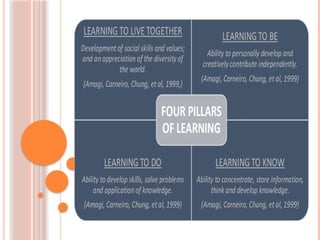
Learning to be, so as to develop one's personality and be
able to act with ever greater autonomy, judgement and
personal responsibility. In that connection, education
must not disregard any aspect of a person's potential:
memory, reasoning, aesthetic sense, physical capacities
and communication skills.
UNESCO believes that education is a human right for
all throughout life and that access must be matched by
quality. The Organization is the only United Nations
agency with a mandate to cover all aspects of education.
It has been entrusted to lead the Global Education 2030
Agenda through Sustainable Development Goal.
CONT….
UNESCO works to ensure that every child and every
citizen has access to quality education. By promoting
cultural heritage and the equal dignity of all cultures,
UNESCO strengthens the bonds between nations.
UNESCO fosters scientific programmes and policies as
platforms for development and cooperation.
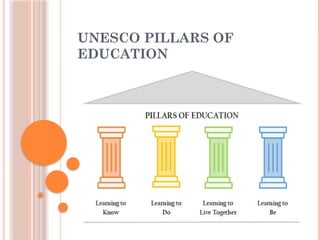
UNESCO PILLARS OF
EDUCATION
WHAT IS LEARNING TO DO?
Learning to do: This pillar focuses on developing skills
and abilities. It is important for individuals to be able to
put what they have learned into practice. This can only
be done if they have developed the necessary skillset.
LEARNING TO BE: THE WORLD OF
EDUCATION TODAY AND
TOMORROW
The report of the International Commission on the
Development of Education aims to assist governments
in formulating national strategies for the development
of education in a changing universe. Emphasis is upon
the need for an international community which reflects
common problems, trends, and goals; the promotion of
democracy through education; the opportunity of every
individual for self actualization; and the need for life-
long education.
LEARNING WITHOUT
BURDEN
WHAT IS LEARNING
WITHOUT BURDEN?
Learning without burden encourages joyful learning
and aims to reduce the burden on students and
encourage the development of concepts through
interactive sessions like debates which can enhance the
ability to analyze sociopolitical realities.
Education can never be burden It will always be a step
to success. Education helps students to raise their IQ
level and of course. It gives them knowledge to raise in
their life and helps to get on to their aim.
CAN LEARNING EVER BE A
BURDEN?
Kids may feel overwhelmed by it all, which is not a good
thing. You see, learning should excite, not burden your
kid. And, when we say learning, we are talking about
the holistic growth of your child; be it classroom
learning, sports or extracurricular activities, everything
comes under its ambit.
YASHPAL COMMITTEE
REPORT
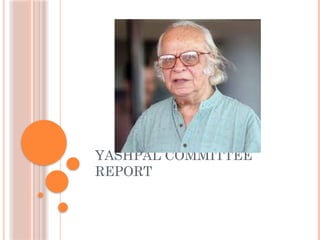
 The Ministry of Human Resource Development
(MHRD) had set up a Committee on Higher
Education known as the Yashpal Committee.
 The chairman of the committee was Dr Yash Pal, and
it was constituted for examining reforms to be
brought about in higher education in India.
 Yash Pal was a globally renowned physicist,
academic, and higher education reformer.
 In its report, the Yashpal Committee laid emphasis
on the idea of a university and advocated a number of
major structural changes.
YASHPAL COMMITTEE
REPORT
RECOMMENDATIONS OF THE
YASHPAL COMMITTEE REPORT
Following are the important recommendations of the
Yashpal Committee Report:
 The process of framing of the curriculum and writing of
textbooks should be decentralised and involve more
teachers.
 Education committees should be constituted at the
village, block and district levels.
 The jurisdiction of CBSE should be restricted to KVs and
the Navodaya Vidyalayas only, and all other schools
should be affiliated with the respective state boards.
 Interview tests and interviews for nursery admissions
should be done away with.
 The norms for giving private schools recognition need to
be more stringent, to avoid commercialisation.
CONT…
 There should be no compulsion for school children to
carry heavy books to school.
 Primary school children should not be given any
homework. And even for the higher classes, it should
be non-textual.
 The teacher-pupil ratio should be reduced to at least
1:30.
 Greater use of electronic media.
 It also recommended many steps for improving
teacher training.
CONCLUSION OF THE YASHPAL
COMMITTEE REPORT
The committee proposed doing away with regulatory
bodies like UGC and AICTE. Instead, it recommended
establishing independent bodies for higher education
regulation. Attracting and retaining quality faculty
members was emphasized by the committee. Its aim was
to address educational burdens and curriculum overload
for Indian students.
CORE ELEMENTS WITH RESPECT TO
THE GENDER
“WOMEN”
SOURCES COLLECTED FROM CLASS 8TH
& 9TH
TEXT BOOKS
STATUS OF WOMEN WITH REFERENCE
TO CLASS 8TH
& 9TH
TEXT BOOKS
Two hundred years ago things were very
different. Most children were married off at an
early age. Both Hindu and Muslim men could
marry more than one wife. In some parts of the
country, widows were praised if they chose death
by burning themselves on the funeral pyre of
their husbands. Women who died in this manner,
whether willingly or otherwise, were called “sati”,
meaning virtuous women. Women’s rights to
property were also restricted. Besides, most
women had virtually no access to education. In
many parts of the country people believed that if
a woman was educated, she would become a
widow.
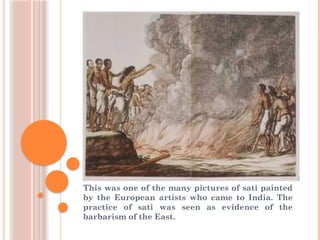
This was one of the many pictures of sati painted
by the European artists who came to India. The
practice of sati was seen as evidence of the
barbarism of the East.
CHANGING THE LIVES OF WIDOWS
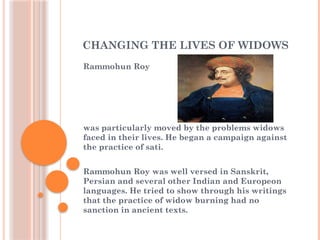
Rammohun Roy
was particularly moved by the problems widows
faced in their lives. He began a campaign against
the practice of sati.
Rammohun Roy was well versed in Sanskrit,
Persian and several other Indian and Europeon
languages. He tried to show through his writings
that the practice of widow burning had no
sanction in ancient texts.
CONT…
By the early nineteenth century, many British
officials had also begun to criticise Indian
traditions and customs.
They were therefore, more than willing to listen
to Rammohun who was reputed to be a learned
man. In 1829, sati was banned.
The strategy adopted by Rammohun was used by
later reformers as well.
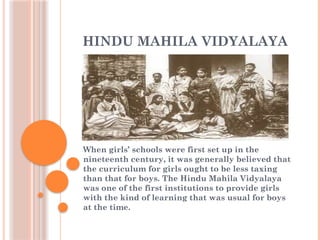
HINDU MAHILA VIDYALAYA
When girls’ schools were first set up in the
nineteenth century, it was generally believed that
the curriculum for girls ought to be less taxing
than that for boys. The Hindu Mahila Vidyalaya
was one of the first institutions to provide girls
with the kind of learning that was usual for boys
at the time.
CONT…
From the early twentieth century,
 Muslim women like the Begums of Bhopal
played a notable role in promoting education
among women. They founded a primary school
for girls at Aligarh.
 Another remarkable woman, Begum Rokeya
Sakhawat Hossain started schools for Muslim
girls in Patna and Calcutta. She was a fearless
critic of conservative ideas, arguing that
religious leaders of every faith accorded an
inferior place to women.
 By the 1880s, Indian women began to enter
universities. Some of them trained to be
doctors, some became teachers. Many women
began to write and publish their critical views
on the place of women in society
LAW AGAINST CHILD
MARRIAGE
With the growth of women’s organisations and
writings on these issues, the momentum for
reform gained strength. People challenged
another established custom – that of child
marriage. There were a number of Indian
legislators in the Central Legislative Assembly
who fought to make a law preventing child
marriage. In 1929, the Child Marriage Restraint
Act was passed without the kind of bitter debates
and struggles that earlier laws had seen.
According to the Act, no man below the age of 18
and woman below the age of 16 could marry.
Subsequently these limits were raised to 21 for
men and 18 for women.
THANK YOU

Core elements with respect to the gender.pptx

  • 1.
    Reading & Reflectingon Texts (Paper-7)  NPE- 1986  NCF- 2005  Learning To Be (UNESCO Report)  Learning Without Burden  Reading of School Text Books Class 8th & 9th and Report Making Session 2023-25
  • 2.
  • 3.
    WHAT IS NATIONALPOLICY ON EDUCATION 1986? The NPE 1986 had a significant impact on the education system in India and served as a guideline for educational reforms and development over the years. It was revised in 1992 to reflect changing educational needs and challenges. The National Policy on Education (NPE) of 1986 is a significant education policy document in India. It was formulated by the Government of India to provide a comprehensive framework for the development of education in the country. The NPE 1986 aimed to promote and improve the education system and access to education at all levels, from primary to higher education.
  • 4.
    NPE 1986 –HIGHLIGHTS  Access, Enrolment and Retention of all children upto the age of 14 years in the schools.  Quality improvement of education by improving the school environment, child cantered and activity- cantered teaching methodology, continuous evaluation throughout the year, removal of all kinds of physical punishment, continuing the  Practice of not failing the students in any class at elementary level and arranging the essential facilities in primary schools.  Arranging non-formal education for children, who left the schools, in between, or are residing at places not having schools.  Setting up of Navodaya Vidyalayas was another landmark in the history of education  Primary schools be opened in remote areas including ashram or residential schools in tribal regions
  • 5.
    NPE 1986 –AIM & OBJECTIVES  Access to Education – Every student has access to an education of good quality under the idea of a national system of education, regardless of caste, creed, locality, or gender.  Structure of a Common Education- It envisions a uniform educational system, the 10+2+3 system that is recognised throughout the nation. Regarding the additional break- up of the first ten years, attempts will be made to move to the elementary system, which consists of two years of high school education, five years of primary education, and three years of primary education.  National Curriculum Framework with a distinctive core – The common core and other adaptable components of a national curricular framework will serve as the foundation for education. The history of India’s freedom struggle, the requirements of the constitution, and other subjects vital to fostering national identity will be part of the common core.
  • 6.
    CONT….  Education &its Vocationalization – In this new education policy, the rationalization of schooling was given priority. The problem of unemployment should be reduced by taking a variety of vocational courses.  Educating weaker sections of the society – In the interest of national growth, emphasis has been placed on the education of SC/ST/differently abled people and girls, and their development has been deemed vital.  Education on Equality of Women – Through residential curricula textbooks, the preparation and orientation of teachers, decision-makers, and administrators, as well as the active participation of the educational investigation – it will promote the creation of new values. Priority will be given to eliminating women’s illiteracy through the provision of particular support services.
  • 7.
    NPE 1986 –IMPORTANT FACTS  The objectives of socialism, democracy, and secularism as outlined in the constitution should be promoted through education.  Education should develop a person’s ability to function at various economic levels.  Education must foster the promotion of national self- reliance.  It adheres to the principle that “education is a special investment in the present and future.”  All students have access to quality education up to a particular level, regardless of caste, creed, location, or sex.  According to the 1986 Policy’s recommendation for the school system, the government should implement effective measures.  A common educational framework is what NPE 1986 seeks to develop.
  • 8.
    NPE 1986 THREELANGUAGE FORMULA  In Hindi-speaking states: English, Hindi, and a modern Indian language.  Non-Hindi speaking states: English, Hindi, and one Indian language.
  • 9.
    NPE 1986 –12 COMPONENTS  Essence & Role of Education – A framework of 10+2+3 breakdown in all areas.  National Education System – Make education accessible irrespective of class, caste, creed, sex.  Education for Equality – Provide equal possibilities and abolish disparities.  Higher Education – Emphasis on open universities and online learning system as a source of higher studies.  Technical & Management Education – Approval of state technical education boards and the All India Council for Technical Education (AICTE) for technical and managerial education.  Redesigning the Education – Involve culturally relevant content and facts that improve teaching plus learning.  Teachers’ Education – Founding of the District Institute of Education and Training (DIET) for the teacher preparation of educators & improve NCERT teacher training programs.
  • 10.
    CONT….  Management ofEducation – National level of management and educational planning.  Reorganization of NPE 1986 – Reorganizing the policy at different levels.  Early childhood care & teaching – Under this, nutrition, health, and the social, mental, physical, moral, and emotional development of children will be focused.  Elementary Education – Public enrollment, regular education for children up to the age of 14, and improvement in educational quality..  Secondary Education – Navodaya Vidyalayas and ‘pace-setting schools’ will be set in various locations.
  • 11.
    CONCLUSION Thus, it isconcluded that The National Policy on Education 1986 has conceived Work Experience as purposive and meaningful manual work that results in goods or services which are useful to society. NPE 1986 proposed a national system of education based on the accepted structure of 10+2+3. It suggested that +2 stage be accepted as part of school education throughout the country.
  • 12.
    BIBLIOGRAPHY Websites & Links; www.adda247.com  www.Livemint.com  www.Oliveboard.in  https://byjus.com  https://ncert.nic.in
  • 13.
  • 14.
    WHAT IS NCF2005? NCF or National Curriculum Framework is a document that seeks to present a framework within which schools and teachers can select and plan experiences that they feel all children should have. Earlier the National Council of Educational Research and Training in India had published three National Curriculum Frameworks in 2000, 1988, and 1975. The latest NCF was published in 2005. The document offers a framework for making textbooks, syllabi, as well as teaching practices within the educational programs in Indian schools.
  • 15.
    SALIENT FEATURES OFNCF 2005 The five basic features of National Curriculum Framework 2005 are as follows :–  Connecting knowledge to life outside school.  Ensuring that students do not just learn mechanically, without thinking.  Enriching the curriculum so that it goes beyond textbooks.  Integrating exams with classroom life to make them more flexible.  Nurturing an identity of prime importance informed by caring concerns within the country’s democratic polity
  • 16.
    OBJECTIVES OF NCF2005  Curriculum should be child-centred.  It should provide a fullness of experience for students.  It should make provisions for flexibility within the framework of accept able principles and values.  The curriculum should be related to the life needs and aspirations of the people.  Develop a rational outlook.  The curriculum should lay emphasis on SUPW.  It should be able to promote social justice, democratic values and national integration.  It should help in self experience and expression and in physical development.  It should be well integrated.  It should provide continuity in the whole programme.
  • 17.
    NCF 2005 MERITS Its approach and recommendations are for the entire system. A number of its recommendation, infact, focus on rural schools.  The framework has taken note of the swiftly changing environment and the need to integrate the essential changes in the curriculum.  It established a rationale for using technology as a tool and an enabler in the teaching-learning environment.  The framework has placed the onus, on teacher education for curriculum renewal in school education.  The document paves the way for learning without burden.  It promotes the theory of inclusive education, which will in a way help to level the inequalities in the social system.
  • 18.
    NCF 2005 DEMERITS It is argued that the document is not sufficiently announced which has led to its incomplete implementations.  Implementing the suggested curriculum would require a huge infrastructure.  The framework does not state the academic, social and political context in which it is framed.  It does not talk about the dangers of community participation and how to ensure the quality of education in such an environment.  It is unrealistic in projecting constructivism as the universal pedagogy for all subjects and for children of all ages.  The suggested examination reforms of all ages would lead to a replacement of one form of evaluation with another. Rather the meaning of assessment should be explained to teachers.
  • 19.
    MAJOR PROBLEMS INTHE NATIONAL CURRICULUM FRAMEWORK 2005  High emphasis on marks and grade system.  Huge burden on the teachers.  Rote based learning approach of students.  Students do not understand what they are learning.  Lack of supervisory staff in institutes.
  • 20.
    NCF EDUCATIONAL IMPLICATIONS It givesa road map for an inclusive, relevant, and holistic education system that caters to the diverse needs of students. The primary aim of an NCF is to provide a unified vision for entire education system, irrespective of the regional, cultural, or linguistic diversity within a country.
  • 21.
    BIBLIOGRAPHY Websites & Links; www.adda247.com  www.Livemint.com  www.Oliveboard.in  https://byjus.com  https://ncert.nic.in
  • 22.
    UNESCO- LEARNING TOBE Learning to be, so as to develop one's personality and be able to act with ever greater autonomy, judgement and personal responsibility. In that connection, education must not disregard any aspect of a person's potential: memory, reasoning, aesthetic sense, physical capacities and communication skills. UNESCO believes that education is a human right for all throughout life and that access must be matched by quality. The Organization is the only United Nations agency with a mandate to cover all aspects of education. It has been entrusted to lead the Global Education 2030 Agenda through Sustainable Development Goal.
  • 23.
    CONT…. UNESCO works toensure that every child and every citizen has access to quality education. By promoting cultural heritage and the equal dignity of all cultures, UNESCO strengthens the bonds between nations. UNESCO fosters scientific programmes and policies as platforms for development and cooperation.
  • 24.
  • 26.
    WHAT IS LEARNINGTO DO? Learning to do: This pillar focuses on developing skills and abilities. It is important for individuals to be able to put what they have learned into practice. This can only be done if they have developed the necessary skillset.
  • 27.
    LEARNING TO BE:THE WORLD OF EDUCATION TODAY AND TOMORROW The report of the International Commission on the Development of Education aims to assist governments in formulating national strategies for the development of education in a changing universe. Emphasis is upon the need for an international community which reflects common problems, trends, and goals; the promotion of democracy through education; the opportunity of every individual for self actualization; and the need for life- long education.
  • 28.
  • 29.
    WHAT IS LEARNING WITHOUTBURDEN? Learning without burden encourages joyful learning and aims to reduce the burden on students and encourage the development of concepts through interactive sessions like debates which can enhance the ability to analyze sociopolitical realities. Education can never be burden It will always be a step to success. Education helps students to raise their IQ level and of course. It gives them knowledge to raise in their life and helps to get on to their aim.
  • 30.
    CAN LEARNING EVERBE A BURDEN? Kids may feel overwhelmed by it all, which is not a good thing. You see, learning should excite, not burden your kid. And, when we say learning, we are talking about the holistic growth of your child; be it classroom learning, sports or extracurricular activities, everything comes under its ambit.
  • 31.
  • 32.
     The Ministryof Human Resource Development (MHRD) had set up a Committee on Higher Education known as the Yashpal Committee.  The chairman of the committee was Dr Yash Pal, and it was constituted for examining reforms to be brought about in higher education in India.  Yash Pal was a globally renowned physicist, academic, and higher education reformer.  In its report, the Yashpal Committee laid emphasis on the idea of a university and advocated a number of major structural changes. YASHPAL COMMITTEE REPORT
  • 33.
    RECOMMENDATIONS OF THE YASHPALCOMMITTEE REPORT Following are the important recommendations of the Yashpal Committee Report:  The process of framing of the curriculum and writing of textbooks should be decentralised and involve more teachers.  Education committees should be constituted at the village, block and district levels.  The jurisdiction of CBSE should be restricted to KVs and the Navodaya Vidyalayas only, and all other schools should be affiliated with the respective state boards.  Interview tests and interviews for nursery admissions should be done away with.  The norms for giving private schools recognition need to be more stringent, to avoid commercialisation.
  • 34.
    CONT…  There shouldbe no compulsion for school children to carry heavy books to school.  Primary school children should not be given any homework. And even for the higher classes, it should be non-textual.  The teacher-pupil ratio should be reduced to at least 1:30.  Greater use of electronic media.  It also recommended many steps for improving teacher training.
  • 35.
    CONCLUSION OF THEYASHPAL COMMITTEE REPORT The committee proposed doing away with regulatory bodies like UGC and AICTE. Instead, it recommended establishing independent bodies for higher education regulation. Attracting and retaining quality faculty members was emphasized by the committee. Its aim was to address educational burdens and curriculum overload for Indian students.
  • 36.
    CORE ELEMENTS WITHRESPECT TO THE GENDER “WOMEN” SOURCES COLLECTED FROM CLASS 8TH & 9TH TEXT BOOKS
  • 37.
    STATUS OF WOMENWITH REFERENCE TO CLASS 8TH & 9TH TEXT BOOKS Two hundred years ago things were very different. Most children were married off at an early age. Both Hindu and Muslim men could marry more than one wife. In some parts of the country, widows were praised if they chose death by burning themselves on the funeral pyre of their husbands. Women who died in this manner, whether willingly or otherwise, were called “sati”, meaning virtuous women. Women’s rights to property were also restricted. Besides, most women had virtually no access to education. In many parts of the country people believed that if a woman was educated, she would become a widow.
  • 38.
    This was oneof the many pictures of sati painted by the European artists who came to India. The practice of sati was seen as evidence of the barbarism of the East.
  • 39.
    CHANGING THE LIVESOF WIDOWS Rammohun Roy was particularly moved by the problems widows faced in their lives. He began a campaign against the practice of sati. Rammohun Roy was well versed in Sanskrit, Persian and several other Indian and Europeon languages. He tried to show through his writings that the practice of widow burning had no sanction in ancient texts.
  • 40.
    CONT… By the earlynineteenth century, many British officials had also begun to criticise Indian traditions and customs. They were therefore, more than willing to listen to Rammohun who was reputed to be a learned man. In 1829, sati was banned. The strategy adopted by Rammohun was used by later reformers as well.
  • 41.
    HINDU MAHILA VIDYALAYA Whengirls’ schools were first set up in the nineteenth century, it was generally believed that the curriculum for girls ought to be less taxing than that for boys. The Hindu Mahila Vidyalaya was one of the first institutions to provide girls with the kind of learning that was usual for boys at the time.
  • 42.
    CONT… From the earlytwentieth century,  Muslim women like the Begums of Bhopal played a notable role in promoting education among women. They founded a primary school for girls at Aligarh.  Another remarkable woman, Begum Rokeya Sakhawat Hossain started schools for Muslim girls in Patna and Calcutta. She was a fearless critic of conservative ideas, arguing that religious leaders of every faith accorded an inferior place to women.  By the 1880s, Indian women began to enter universities. Some of them trained to be doctors, some became teachers. Many women began to write and publish their critical views on the place of women in society
  • 43.
    LAW AGAINST CHILD MARRIAGE Withthe growth of women’s organisations and writings on these issues, the momentum for reform gained strength. People challenged another established custom – that of child marriage. There were a number of Indian legislators in the Central Legislative Assembly who fought to make a law preventing child marriage. In 1929, the Child Marriage Restraint Act was passed without the kind of bitter debates and struggles that earlier laws had seen. According to the Act, no man below the age of 18 and woman below the age of 16 could marry. Subsequently these limits were raised to 21 for men and 18 for women.
  • 44.