


Diego Freniche / @dfreniche / http://www.freniche.com
Core Data Workshop
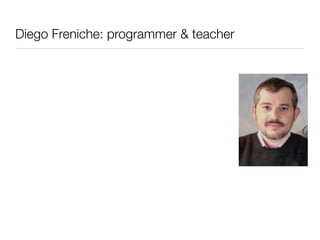
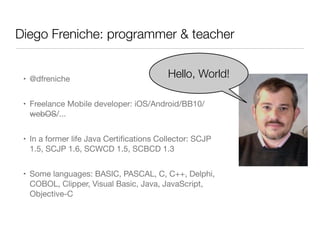
Diego Freniche: programmer & teacher
• @dfreniche
• Freelance Mobile developer: iOS/Android/BB10/
webOS/...
• In a former life Java Certifications Collector: SCJP
1.5, SCJP 1.6, SCWCD 1.5, SCBCD 1.3
• Some languages: BASIC, PASCAL, C, C++, Delphi,
COBOL, Clipper, Visual Basic, Java, JavaScript,
Objective-C
Hello, World!
Before we start...
Before we start...
• Switch OFF phones
Before we start...
• Switch OFF phones
• Been here is funny
Before we start...
• Switch OFF phones
• Been here is funny
• ¡Live the moment!¡Carpe diem!
Before we start...
• Switch OFF phones
• Been here is funny
• ¡Live the moment!¡Carpe diem!
• Ask me a lot. Don’t yawn
Our objective: BUILD things
What you need (checklist)
• a Mac with OS X capable of running Xcode 4.6.1
• last Xcode 4 installed 4.6.1
• You can also use prerelease software, if you are a registered Apple developer.
No support then, sorry :-D
• SimPholders installed: http://simpholders.com
• SQLLite database browser: http://sqlitebrowser.sourceforge.net
• (optional) set $HOME/Library folder visible, using (from a Terminal)
Diego Freniche / http://www.freniche.com
Core Data: developer’s first impression
Diego Freniche / http://www.freniche.com
Core Data: developer’s first impression
Diego Freniche / http://www.freniche.com
Core Data in 547 easy steps slide 6/320
Diego Freniche / @dfreniche / http://www.freniche.com
Core Data terms
• Entity
• an entity in our model == Object in memory == row in table
• Attribute
• Relationship
• Object graph
http://ogre.berniecode.com/ogre_white_paper
Diego Freniche / @dfreniche / http://www.freniche.com
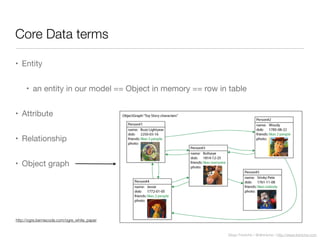
Core Data terms
• Entity
• an entity in our model == Object in memory == row in table
• Attribute
• Relationship
• Object graph
http://ogre.berniecode.com/ogre_white_paper
Diego Freniche / @dfreniche / http://www.freniche.com
To get the most out of Core Data
• KVC, KVO
• ARC, memory management
• delegate & MVC patterns
• singletons are evil (more or less)
Diego Freniche / @dfreniche / http://www.freniche.com
Core Data Hello World!
Diego Freniche / @dfreniche / http://www.freniche.com
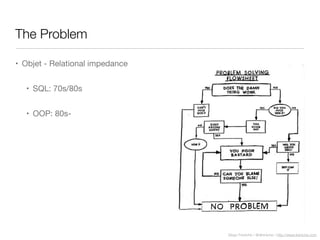
The Problem
• Objet - Relational impedance
• SQL: 70s/80s
• OOP: 80s-
Diego Freniche / @dfreniche / http://www.freniche.com
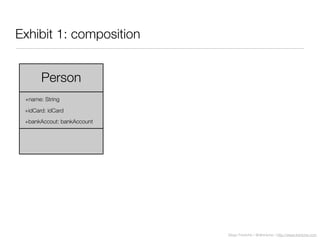
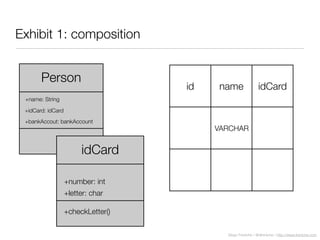
Exhibit 1: composition
Person
+name: String
+idCard: idCard
+bankAccout: bankAccount
Diego Freniche / @dfreniche / http://www.freniche.com
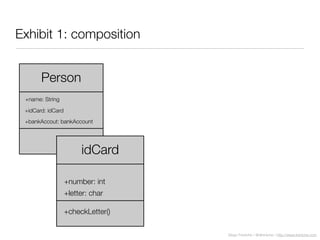
Exhibit 1: composition
Person
+name: String
+idCard: idCard
+bankAccout: bankAccount
idCard
+number: int
+letter: char
+checkLetter()
Diego Freniche / @dfreniche / http://www.freniche.com
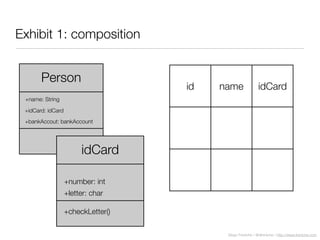
Exhibit 1: composition
id name idCard
Person
+name: String
+idCard: idCard
+bankAccout: bankAccount
idCard
+number: int
+letter: char
+checkLetter()
Diego Freniche / @dfreniche / http://www.freniche.com
Exhibit 1: composition
id name idCard
Person
+name: String
+idCard: idCard
+bankAccout: bankAccount
idCard
+number: int
+letter: char
+checkLetter()
VARCHAR
Diego Freniche / @dfreniche / http://www.freniche.com
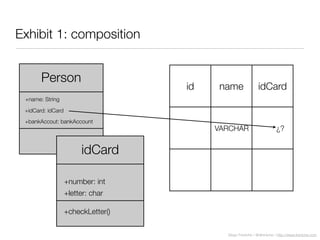
Exhibit 1: composition
id name idCard
Person
+name: String
+idCard: idCard
+bankAccout: bankAccount
idCard
+number: int
+letter: char
+checkLetter()
VARCHAR ¿?
Diego Freniche / @dfreniche / http://www.freniche.com
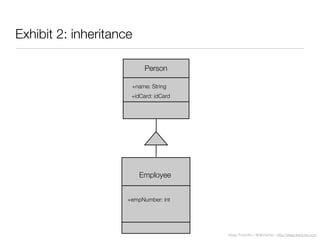
Employee
+empNumber: int
Person
+name: String
+idCard: idCard
Exhibit 2: inheritance
Diego Freniche / @dfreniche / http://www.freniche.com
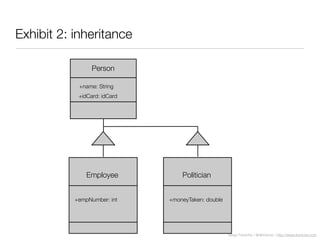
Employee
+empNumber: int
Person
+name: String
+idCard: idCard
Exhibit 2: inheritance
Politician
+moneyTaken: double
Diego Freniche / @dfreniche / http://www.freniche.com
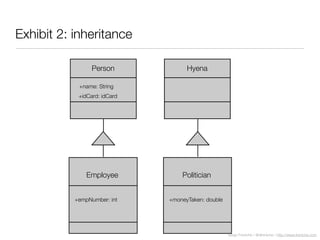
Employee
+empNumber: int
Person
+name: String
+idCard: idCard
Exhibit 2: inheritance
Hyena
Politician
+moneyTaken: double
Diego Freniche / @dfreniche / http://www.freniche.com
Exhibit 3: collection modelling
Person
+name: String
+bills: Bill[]
Bill
0..*1
http://en.wikipedia.org/wiki/First_normal_form
Diego Freniche / @dfreniche / http://www.freniche.com
Relational World
• tables
• cartesian products
• rows/ columns
• normal forms
• Objects
• object collections
• composition
• inheritance
OO World
Diego Freniche / @dfreniche / http://www.freniche.com
Relational World
• tables
• cartesian products
• rows/ columns
• normal forms
• Objects
• object collections
• composition
• inheritance
OO World
Diego Freniche / @dfreniche / http://www.freniche.com
The solution: ORM
• Object Relational Mapper
• Hibernate (Java, .Net)
• Core Data (Cocoa)
• Core Data is our model
• can persist our objects
in several ways
Diego Freniche / @dfreniche / http://www.freniche.com
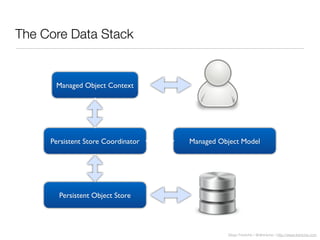
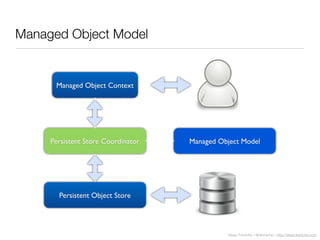
The Core Data Stack
Managed Object Context
Persistent Store Coordinator
Persistent Object Store
Managed Object Model
Diego Freniche / @dfreniche / http://www.freniche.com
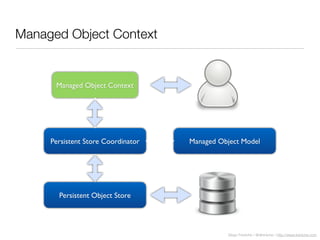
Managed Object Context
Persistent Store Coordinator
Persistent Object Store
Managed Object Model
Diego Freniche / @dfreniche / http://www.freniche.com
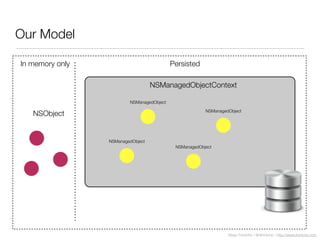
Our Model
NSManagedObjectContext
NSManagedObject
NSManagedObject
NSManagedObject
NSManagedObject
NSObject
PersistedIn memory only
Diego Freniche / @dfreniche / http://www.freniche.com
Managed Object Context: MOC
• Managed Object Context: in-memory space where CD manages all our
model’s objects.
• All CRUD is done against a MOC. We persist data using save:
• Our model’s objects are Managed Objects.
• The MOC needs a Persistent Store Coordinator to save the object graph in
persistent store.
Diego Freniche / @dfreniche / http://www.freniche.com
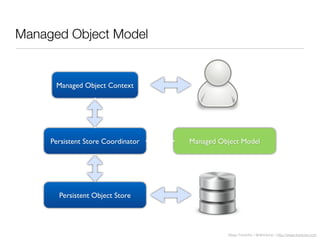
Managed Object Model
Managed Object Context
Persistent Store Coordinator
Persistent Object Store
Managed Object Model
Diego Freniche / @dfreniche / http://www.freniche.com
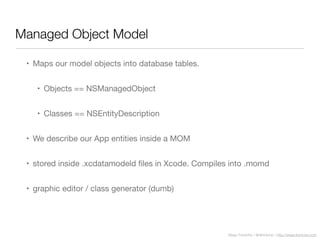
Managed Object Model
• Maps our model objects into database tables.
• Objects == NSManagedObject
• Classes == NSEntityDescription
• We describe our App entities inside a MOM
• stored inside .xcdatamodeld files in Xcode. Compiles into .momd
• graphic editor / class generator (dumb)
Diego Freniche / @dfreniche / http://www.freniche.com
Managed Object Model
Managed Object Context
Persistent Store Coordinator
Persistent Object Store
Managed Object Model
Diego Freniche / @dfreniche / http://www.freniche.com
Persistent Store Coordinador
Managed Object Context
Persistent Store Coordinator
Persistent Object Store
Managed Object Model
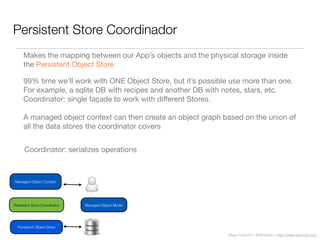
Makes the mapping between our App’s objects and the physical storage inside
the Persistent Object Store.
99% time we’ll work with ONE Object Store, but it’s possible use more than one.
For example, a sqlite DB with recipes and another DB with notes, stars, etc.
Coordinator: single façade to work with different Stores.
A managed object context can then create an object graph based on the union of
all the data stores the coordinator covers
Coordinator: serializes operations
Diego Freniche / @dfreniche / http://www.freniche.com
Persistent Object Store
Managed Object Context
Persistent Store Coordinator
Persistent Object Store
Managed Object Model
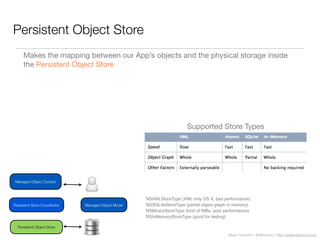
NSXMLStoreType (XML only OS X, bad performance)
NSSQLiteStoreType (partial object graph in memory)
NSBinaryStoreType (kind of NIBs, poor performance)
NSInMemoryStoreType (good for testing)
Makes the mapping between our App’s objects and the physical storage inside
the Persistent Object Store.
Supported Store Types
Diego Freniche / @dfreniche / http://www.freniche.com
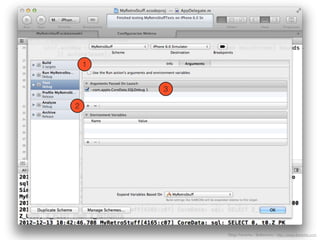
SQL in SQLite
• http://sqlite.org/lang.html
• We can see generated SQL: -com.apple.CoreData.SQLDebug 1
• Schemes > Edit Scheme > Test > Arguments
Diego Freniche / @dfreniche / http://www.freniche.com
1
2
3
Diego Freniche / @dfreniche / http://www.freniche.com
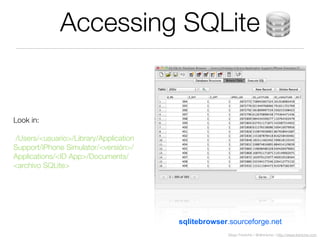
Accessing SQLite
sqlitebrowser.sourceforge.net
Look in:
/Users/<usuario>/Library/Application
Support/iPhone Simulator/<versión>/
Applications/<ID App>/Documents/
<archivo SQLite>
Diego Freniche / @dfreniche / http://www.freniche.com
DDL: Data Definition Language
• CREATE DATABASE, CREATE TABLE, CREATE INDEX, ALTER TABLE, DROP
INDEX, ...
• All written by Core Data
• We DO NOT have to create anything: neither tables nor database
• If we make changes, Core Data alters tables, columns, indexes...
Diego Freniche / @dfreniche / http://www.freniche.com
DDL: Data Definition Language
• CREATE DATABASE, CREATE TABLE, CREATE INDEX, ALTER TABLE, DROP
INDEX, ...
• All written by Core Data
• We DO NOT have to create anything: neither tables nor database
• If we make changes, Core Data alters tables, columns, indexes...
Diego Freniche / @dfreniche / http://www.freniche.com
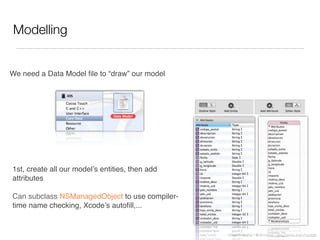
Modelling
We need a Data Model file to “draw” our model
1st, create all our model’s entities, then add
attributes
Can subclass NSManagedObject to use compiler-
time name checking, Xcode’s autofill,...
Diego Freniche / @dfreniche / http://www.freniche.com
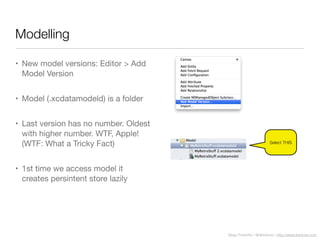
Modelling
• New model versions: Editor > Add
Model Version
• Model (.xcdatamodeld) is a folder
• Last version has no number. Oldest
with higher number. WTF, Apple!
(WTF: What a Tricky Fact)
• 1st time we access model it
creates persintent store lazily
Select THIS
Diego Freniche / @dfreniche / http://www.freniche.com
Versioning and changes
• Activate always lightweight migration
• If we make changes to the model, not changing version, version used in the
model and version used to create DB doesn’t match: delete DB.
• Reseting Content and Settings.. in Simulator
• delete (by hand) .sqlite file
Diego Freniche / @dfreniche / http://www.freniche.com
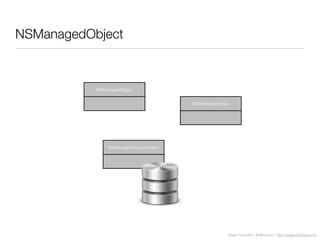
NSManagedObject
NSManagedObject
NSManagedObjectContext
NSEntityDescription
Diego Freniche / @dfreniche / http://www.freniche.com
NSManagedObject
• base class implementing all “basic” object model behavior
• We can NOT use Core Data with NSObject, we HAVE TO use
NSManagedObject
• Our model classes inherit from NSManagedObject
• not mandatory, but...
• allows us to add logic, use @property, get notifications...
• have to be properly configured
Diego Freniche / @dfreniche / http://www.freniche.com
Entities Design
• Always add field order
• Try to create a good UML diagram at first
• Have an NSString constant with every Entity’s name inside .h
Diego Freniche / @dfreniche / http://www.freniche.com
Extend NSManagedObject
• Editor > Create NSManagedObject subclass...
• creates @dynamic properties
• getter / setter generated in runtime (@property in compile time)
• Core Data doesn’t know at compile time if the persistent store is going to
be XML or a DB (or in-memory)
Diego Freniche / @dfreniche / http://www.freniche.com
Extend NSManagedObject
• overwrite init to call designated initializer
Diego Freniche / @dfreniche / http://www.freniche.com
Extend NSManagedObject
• overwrite init to call designated initializer
-(id)init {
NSManagedObjectContext *context = [[CoreDataStack coreDataStack]
managedObjectContext];
return [self initWithEntity:[NSEntityDescription
entityForName:kRETROITEM_ENTITY inManagedObjectContext:context ]
insertIntoManagedObjectContext:context];
}
Diego Freniche / @dfreniche / http://www.freniche.com
Validate Properties
• One for every property, if we want it
• Passing parameter by reference
• It should return YES if validation is passed
Diego Freniche / @dfreniche / http://www.freniche.com
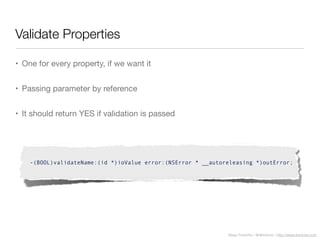
Validate Properties
• One for every property, if we want it
• Passing parameter by reference
• It should return YES if validation is passed
-(BOOL)validateName:(id *)ioValue error:(NSError * __autoreleasing *)outError;
Diego Freniche / @dfreniche / http://www.freniche.com
Validator for operations
• First thing: must call [super ...]
• Useful to check business rules (using several properties)
Diego Freniche / @dfreniche / http://www.freniche.com
Validator for operations
• First thing: must call [super ...]
• Useful to check business rules (using several properties)
- (BOOL)validateForDelete:(NSError **)error
- (BOOL)validateForInsert:(NSError **)error
- (BOOL)validateForUpdate:(NSError **)error
Diego Freniche / @dfreniche / http://www.freniche.com
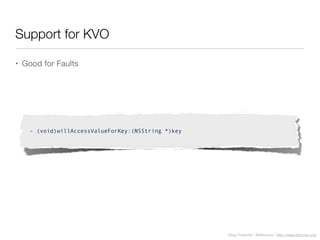
Support for KVO
• Good for Faults
Diego Freniche / @dfreniche / http://www.freniche.com
Support for KVO
• Good for Faults
- (void)willAccessValueForKey:(NSString *)key
Diego Freniche / @dfreniche / http://www.freniche.com
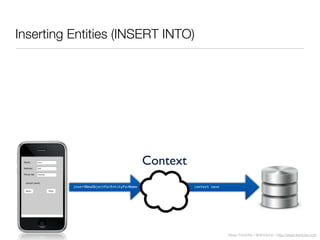
Inserting Entities (INSERT INTO)
insertNewObjectForEntityForName context save
Context
Diego Freniche / @dfreniche / http://www.freniche.com
Inserting Entities (INSERT INTO)
// using NSEntityDescription. Pass: entity name and context
[NSEntityDescription insertNewObjectForEntityForName:@”MyEntity” inManagedObjectContext:context];
[retroItem setValue:@"Spectrum 48K" forKey:@"name"];
[retroItem setValue:@100.00 forKey:@"acquisitionCost"];
[retroItem setValue:[NSDate new] forKey:@"dateAcquired"];
insertNewObjectForEntityForName context save
Context
Diego Freniche / @dfreniche / http://www.freniche.com
Fetching entities (SELECT)
• Query with NSFetchRequest
• SELECT by definition is unordered
• At least we need to provide
• entity
• order by
Diego Freniche / @dfreniche / http://www.freniche.com
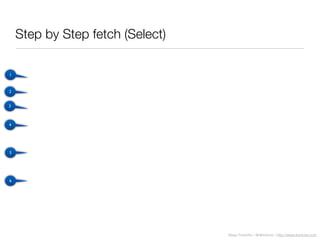
Step by Step fetch (Select)
1
2
3
4
5
6
Diego Freniche / @dfreniche / http://www.freniche.com
Step by Step fetch (Select)
NSManagedObjectContext *context = [[CoreDataStack coreDataStack] managedObjectContext];
NSFetchRequest *fetchRequest = [[NSFetchRequest alloc] init];
NSEntityDescription *entity = [NSEntityDescription entityForName:kRETRO_ITEM_ENTITY
inManagedObjectContext:context];
[fetchRequest setEntity:entity];
NSSortDescriptor *sortDescriptor = [[NSSortDescriptor alloc] initWithKey:@"name" ascending:NO];
[fetchRequest setSortDescriptors:@[sortDescriptor]];
NSError *error = nil;
NSArray *distincResults = [context executeFetchRequest:fetchRequest error:&error];
1
2
3
4
5
6
Diego Freniche / @dfreniche / http://www.freniche.com
Order querys
NSSortDescriptor *sortDescriptor = [[NSSortDescriptor alloc] initWithKey:@"fecha_max" ascending:YES];
NSManagedObject returned inside NSArray are unordered unless otherwise we
provide NSSortDescription.
1st, we create the sort descriptor
[request setSortDescriptors:[NSArray arrayWithObject:sortDescriptor]];
Then we add to our NSFetchRequest the sort descriptors array:
Diego Freniche / @dfreniche / http://www.freniche.com
Filtering querys
NSManagedObjectContext *moc = [self managedObjectContext];
NSEntityDescription *entityDescription = [NSEntityDescription entityForName:@"Employee"
inManagedObjectContext:moc];
NSFetchRequest *request = [[[NSFetchRequest alloc] init] autorelease];
[request setEntity:entityDescription];
NSNumber *minimumSalary = ...;
NSPredicate *predicate = [NSPredicate predicateWithFormat:@"(lastName LIKE[c] 'Worsley') AND (salary
> %@)", minimumSalary];
[request setPredicate:predicate];
NSError *error = nil;
NSArray *array = [moc executeFetchRequest:request error:&error];
NSFetchRequest returns an array of NSManagedObject. We can use a
NSPredicate to filter.
Filter/NSPredicate acts here as the SQL WHERE clause.
We need to add that query with setPredicate.
Diego Freniche / @dfreniche / http://www.freniche.com
Delete Entities (DELETE)
+ (void)deleteInstancesForEntityName:(NSString *)entityName inContext:(NSManagedObjectContext *)context {
NSFetchRequest *fetch = [[NSFetchRequest alloc] init];
[fetch setEntity:[NSEntityDescription entityForName:entityName inManagedObjectContext:context]];
NSError *error = nil;
NSArray *dataObjects = [context executeFetchRequest:fetch error:&error];
for (NSManagedObject *dataObject in dataObjects) {
[context deleteObject:dataObject];
}
NSError *saveError = nil;
[context save:&saveError];
}
Diego Freniche / @dfreniche / http://www.freniche.com
Object identificator
Diego Freniche / @dfreniche / http://www.freniche.com
Object identificator
NSManagedObjectID *moID = [managedObject objectID];
-(NSManagedObject *)existingObjectWithID:(NSManagedObjectID *)objectID
error:(NSError **)error
Diego Freniche / @dfreniche / http://www.freniche.com
Accessing Properties
Sometimes we don’t want the whole object (NSManagedObject) only the value of a property applying a function
(max, min, etc.).
NSFetchRequest *request = [[NSFetchRequest alloc] init];
NSEntityDescription *entity = [NSEntityDescription entityForName:@"Event" inManagedObjectContext:context];
[request setEntity:entity];
1. Create NSFetchRequest as usual
[request setResultType:NSDictionaryResultType];
2. Tell NSFetchRequest to return NSDictionary instead NSArray:
NSExpression *keyPathExpression = [NSExpression expressionForKeyPath:@"creationDate"];
NSExpression *minExpression = [NSExpression expressionForFunction:@"min:" arguments:[NSArray
arrayWithObject:keyPathExpression]];
3. Define the field to calc upon (NSExpression), then the function
Diego Freniche / @dfreniche / http://www.freniche.com
Accessing Properties
NSExpressionDescription *expressionDescription = [[NSExpressionDescription alloc] init];
[expressionDescription setName:@"minDate"];
[expressionDescription setExpression:minExpression];
[expressionDescription setExpressionResultType:NSDateAttributeType];
4. Create a NSExpressionDescription:
[request setPropertiesToFetch:[NSArray arrayWithObject:expressionDescription]];
NSArray *objects = [managedObjectContext executeFetchRequest:request error:&error];
5. Set in the query the properties to fetch
if ([objects count] > 0) {
NSLog(@"Minimum date: %@", [[objects objectAtIndex:0] valueForKey:@"minDate"]);
}
6. Access our result:
Diego Freniche / @dfreniche / http://www.freniche.com
Relationship example
NSManagedObjectContext *context = [self managedObjectContext];
NSManagedObject *failedBankInfo = [NSEntityDescription
insertNewObjectForEntityForName:@"FailedBankInfo"
inManagedObjectContext:context];
[failedBankInfo setValue:@"Test Bank" forKey:@"name"];
[failedBankInfo setValue:@"Testville" forKey:@"city"];
[failedBankInfo setValue:@"Testland" forKey:@"state"];
NSManagedObject *failedBankDetails = [NSEntityDescription
insertNewObjectForEntityForName:@"FailedBankDetails"
inManagedObjectContext:context];
[failedBankDetails setValue:[NSDate date] forKey:@"closeDate"];
[failedBankDetails setValue:[NSDate date] forKey:@"updateDate"];
[failedBankDetails setValue:[NSNumber numberWithInt:12345] forKey:@"zip"];
[failedBankDetails setValue:failedBankInfo forKey:@"info"];
[failedBankInfo setValue:failedBankDetails forKey:@"details"];
NSError *error;
if (![context save:&amp;error]) {
NSLog(@"Whoops, couldn't save: %@", [error localizedDescription]);
}
Escritura
Diego Freniche / @dfreniche / http://www.freniche.com
Relationship example
NSFetchRequest *fetchRequest = [[NSFetchRequest alloc] init];
NSEntityDescription *entity = [NSEntityDescription
entityForName:@"FailedBankInfo" inManagedObjectContext:context];
[fetchRequest setEntity:entity];
NSArray *fetchedObjects = [context executeFetchRequest:fetchRequest error:&error];
for (NSManagedObject *info in fetchedObjects) {
NSLog(@"Name: %@", [info valueForKey:@"name"]);
NSManagedObject *details = [info valueForKey:@"details"];
NSLog(@"Zip: %@", [details valueForKey:@"zip"]);
}
Read
Diego Freniche / @dfreniche / http://www.freniche.com
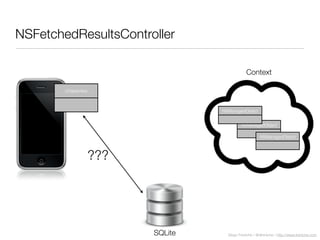
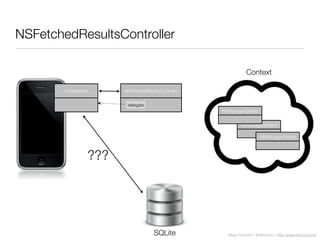
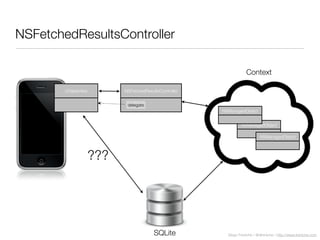
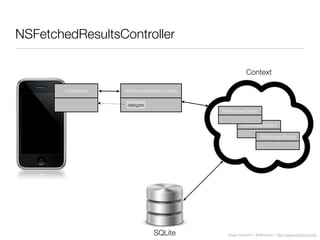
NSFetchedResultsController
• Controller without interface
• Purpose: “feed” with data an UITableView
• Protocol NSFetchedResultsControllerDelegate
• section “Typical Use”: there’s the code found in template
• connected to a Context: if there are changes of any object inside that
context it receives a notification and updates automatically
Diego Freniche / @dfreniche / http://www.freniche.com
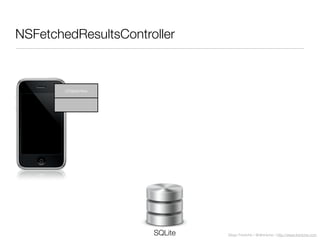
NSFetchedResultsController
SQLite
UITableView
Diego Freniche / @dfreniche / http://www.freniche.com
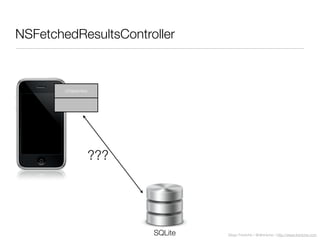
NSFetchedResultsController
SQLite
UITableView
???
Diego Freniche / @dfreniche / http://www.freniche.com
NSFetchedResultsController
Context
NSManagedObject
NSManagedObject
NSManagedObject
SQLite
UITableView
???
Diego Freniche / @dfreniche / http://www.freniche.com
NSFetchedResultsController
Context
NSManagedObject
NSManagedObject
NSManagedObject
SQLite
UITableView NSFetchedResultsController
???
delegate
Diego Freniche / @dfreniche / http://www.freniche.com
NSFetchedResultsController
Context
NSManagedObject
NSManagedObject
NSManagedObject
SQLite
UITableView NSFetchedResultsController
???
delegate
Diego Freniche / @dfreniche / http://www.freniche.com
NSFetchedResultsController
Context
NSManagedObject
NSManagedObject
NSManagedObject
SQLite
UITableView NSFetchedResultsController
delegate
Diego Freniche / @dfreniche / http://www.freniche.com
Attributions
• http://www.flickr.com/photos/paldies/85684217/
• http://www.flickr.com/photos/56380734@N05/6808753611/
• http://www.flickr.com/photos/msimdottv/4339697089/
• http://www.flickr.com/photos/mobilestreetlife/4179063482/
• http://www.flickr.com/photos/owldreams/4428782193/
• http://www.flickr.com/photos/miss_pupik/73160522/
• http://kfannerd713.deviantart.com/art/UNICORN-PUKING-RAINBOWS-WHAAAA-152117816
• http://www.flickr.com/photos/wwworks/4759535950/
• http://www.flickr.com/photos/barto/28135419/sizes/l/in/photolist-3ucFr-7aiwZ-aqWUu-bLebi-cDeVC-jt2YW-jWW1t-kQ25f-m86XP-swafK-yHMbE-yHMcc-yHMda-

Core data basic Workshop slides NSSpain 2013

  • 1.
    Diego Freniche /@dfreniche / http://www.freniche.com Core Data Workshop
  • 2.
  • 3.
    Diego Freniche: programmer& teacher • @dfreniche • Freelance Mobile developer: iOS/Android/BB10/ webOS/... • In a former life Java Certifications Collector: SCJP 1.5, SCJP 1.6, SCWCD 1.5, SCBCD 1.3 • Some languages: BASIC, PASCAL, C, C++, Delphi, COBOL, Clipper, Visual Basic, Java, JavaScript, Objective-C Hello, World!
  • 4.
  • 5.
    Before we start... •Switch OFF phones
  • 6.
    Before we start... •Switch OFF phones • Been here is funny
  • 7.
    Before we start... •Switch OFF phones • Been here is funny • ¡Live the moment!¡Carpe diem!
  • 8.
    Before we start... •Switch OFF phones • Been here is funny • ¡Live the moment!¡Carpe diem! • Ask me a lot. Don’t yawn
  • 9.
  • 10.
    What you need(checklist) • a Mac with OS X capable of running Xcode 4.6.1 • last Xcode 4 installed 4.6.1 • You can also use prerelease software, if you are a registered Apple developer. No support then, sorry :-D • SimPholders installed: http://simpholders.com • SQLLite database browser: http://sqlitebrowser.sourceforge.net • (optional) set $HOME/Library folder visible, using (from a Terminal)
  • 11.
    Diego Freniche /http://www.freniche.com Core Data: developer’s first impression
  • 12.
    Diego Freniche /http://www.freniche.com Core Data: developer’s first impression
  • 13.
    Diego Freniche /http://www.freniche.com
  • 14.
    Diego Freniche /http://www.freniche.com Core Data in 547 easy steps slide 6/320
  • 15.
    Diego Freniche /@dfreniche / http://www.freniche.com Core Data terms • Entity • an entity in our model == Object in memory == row in table • Attribute • Relationship • Object graph http://ogre.berniecode.com/ogre_white_paper
  • 16.
    Diego Freniche /@dfreniche / http://www.freniche.com Core Data terms • Entity • an entity in our model == Object in memory == row in table • Attribute • Relationship • Object graph http://ogre.berniecode.com/ogre_white_paper
  • 17.
    Diego Freniche /@dfreniche / http://www.freniche.com To get the most out of Core Data • KVC, KVO • ARC, memory management • delegate & MVC patterns • singletons are evil (more or less)
  • 18.
    Diego Freniche /@dfreniche / http://www.freniche.com Core Data Hello World!
  • 19.
    Diego Freniche /@dfreniche / http://www.freniche.com The Problem • Objet - Relational impedance • SQL: 70s/80s • OOP: 80s-
  • 20.
    Diego Freniche /@dfreniche / http://www.freniche.com Exhibit 1: composition Person +name: String +idCard: idCard +bankAccout: bankAccount
  • 21.
    Diego Freniche /@dfreniche / http://www.freniche.com Exhibit 1: composition Person +name: String +idCard: idCard +bankAccout: bankAccount idCard +number: int +letter: char +checkLetter()
  • 22.
    Diego Freniche /@dfreniche / http://www.freniche.com Exhibit 1: composition id name idCard Person +name: String +idCard: idCard +bankAccout: bankAccount idCard +number: int +letter: char +checkLetter()
  • 23.
    Diego Freniche /@dfreniche / http://www.freniche.com Exhibit 1: composition id name idCard Person +name: String +idCard: idCard +bankAccout: bankAccount idCard +number: int +letter: char +checkLetter() VARCHAR
  • 24.
    Diego Freniche /@dfreniche / http://www.freniche.com Exhibit 1: composition id name idCard Person +name: String +idCard: idCard +bankAccout: bankAccount idCard +number: int +letter: char +checkLetter() VARCHAR ¿?
  • 25.
    Diego Freniche /@dfreniche / http://www.freniche.com Employee +empNumber: int Person +name: String +idCard: idCard Exhibit 2: inheritance
  • 26.
    Diego Freniche /@dfreniche / http://www.freniche.com Employee +empNumber: int Person +name: String +idCard: idCard Exhibit 2: inheritance Politician +moneyTaken: double
  • 27.
    Diego Freniche /@dfreniche / http://www.freniche.com Employee +empNumber: int Person +name: String +idCard: idCard Exhibit 2: inheritance Hyena Politician +moneyTaken: double
  • 28.
    Diego Freniche /@dfreniche / http://www.freniche.com Exhibit 3: collection modelling Person +name: String +bills: Bill[] Bill 0..*1 http://en.wikipedia.org/wiki/First_normal_form
  • 29.
    Diego Freniche /@dfreniche / http://www.freniche.com Relational World • tables • cartesian products • rows/ columns • normal forms • Objects • object collections • composition • inheritance OO World
  • 30.
    Diego Freniche /@dfreniche / http://www.freniche.com Relational World • tables • cartesian products • rows/ columns • normal forms • Objects • object collections • composition • inheritance OO World
  • 31.
    Diego Freniche /@dfreniche / http://www.freniche.com The solution: ORM • Object Relational Mapper • Hibernate (Java, .Net) • Core Data (Cocoa) • Core Data is our model • can persist our objects in several ways
  • 32.
    Diego Freniche /@dfreniche / http://www.freniche.com The Core Data Stack Managed Object Context Persistent Store Coordinator Persistent Object Store Managed Object Model
  • 33.
    Diego Freniche /@dfreniche / http://www.freniche.com Managed Object Context Managed Object Context Persistent Store Coordinator Persistent Object Store Managed Object Model
  • 34.
    Diego Freniche /@dfreniche / http://www.freniche.com Our Model NSManagedObjectContext NSManagedObject NSManagedObject NSManagedObject NSManagedObject NSObject PersistedIn memory only
  • 35.
    Diego Freniche /@dfreniche / http://www.freniche.com Managed Object Context: MOC • Managed Object Context: in-memory space where CD manages all our model’s objects. • All CRUD is done against a MOC. We persist data using save: • Our model’s objects are Managed Objects. • The MOC needs a Persistent Store Coordinator to save the object graph in persistent store.
  • 36.
    Diego Freniche /@dfreniche / http://www.freniche.com Managed Object Model Managed Object Context Persistent Store Coordinator Persistent Object Store Managed Object Model
  • 37.
    Diego Freniche /@dfreniche / http://www.freniche.com Managed Object Model • Maps our model objects into database tables. • Objects == NSManagedObject • Classes == NSEntityDescription • We describe our App entities inside a MOM • stored inside .xcdatamodeld files in Xcode. Compiles into .momd • graphic editor / class generator (dumb)
  • 38.
    Diego Freniche /@dfreniche / http://www.freniche.com Managed Object Model Managed Object Context Persistent Store Coordinator Persistent Object Store Managed Object Model
  • 39.
    Diego Freniche /@dfreniche / http://www.freniche.com Persistent Store Coordinador Managed Object Context Persistent Store Coordinator Persistent Object Store Managed Object Model Makes the mapping between our App’s objects and the physical storage inside the Persistent Object Store. 99% time we’ll work with ONE Object Store, but it’s possible use more than one. For example, a sqlite DB with recipes and another DB with notes, stars, etc. Coordinator: single façade to work with different Stores. A managed object context can then create an object graph based on the union of all the data stores the coordinator covers Coordinator: serializes operations
  • 40.
    Diego Freniche /@dfreniche / http://www.freniche.com Persistent Object Store Managed Object Context Persistent Store Coordinator Persistent Object Store Managed Object Model NSXMLStoreType (XML only OS X, bad performance) NSSQLiteStoreType (partial object graph in memory) NSBinaryStoreType (kind of NIBs, poor performance) NSInMemoryStoreType (good for testing) Makes the mapping between our App’s objects and the physical storage inside the Persistent Object Store. Supported Store Types
  • 41.
    Diego Freniche /@dfreniche / http://www.freniche.com SQL in SQLite • http://sqlite.org/lang.html • We can see generated SQL: -com.apple.CoreData.SQLDebug 1 • Schemes > Edit Scheme > Test > Arguments
  • 42.
    Diego Freniche /@dfreniche / http://www.freniche.com 1 2 3
  • 43.
    Diego Freniche /@dfreniche / http://www.freniche.com Accessing SQLite sqlitebrowser.sourceforge.net Look in: /Users/<usuario>/Library/Application Support/iPhone Simulator/<versión>/ Applications/<ID App>/Documents/ <archivo SQLite>
  • 44.
    Diego Freniche /@dfreniche / http://www.freniche.com DDL: Data Definition Language • CREATE DATABASE, CREATE TABLE, CREATE INDEX, ALTER TABLE, DROP INDEX, ... • All written by Core Data • We DO NOT have to create anything: neither tables nor database • If we make changes, Core Data alters tables, columns, indexes...
  • 45.
    Diego Freniche /@dfreniche / http://www.freniche.com DDL: Data Definition Language • CREATE DATABASE, CREATE TABLE, CREATE INDEX, ALTER TABLE, DROP INDEX, ... • All written by Core Data • We DO NOT have to create anything: neither tables nor database • If we make changes, Core Data alters tables, columns, indexes...
  • 46.
    Diego Freniche /@dfreniche / http://www.freniche.com Modelling We need a Data Model file to “draw” our model 1st, create all our model’s entities, then add attributes Can subclass NSManagedObject to use compiler- time name checking, Xcode’s autofill,...
  • 47.
    Diego Freniche /@dfreniche / http://www.freniche.com Modelling • New model versions: Editor > Add Model Version • Model (.xcdatamodeld) is a folder • Last version has no number. Oldest with higher number. WTF, Apple! (WTF: What a Tricky Fact) • 1st time we access model it creates persintent store lazily Select THIS
  • 48.
    Diego Freniche /@dfreniche / http://www.freniche.com Versioning and changes • Activate always lightweight migration • If we make changes to the model, not changing version, version used in the model and version used to create DB doesn’t match: delete DB. • Reseting Content and Settings.. in Simulator • delete (by hand) .sqlite file
  • 49.
    Diego Freniche /@dfreniche / http://www.freniche.com NSManagedObject NSManagedObject NSManagedObjectContext NSEntityDescription
  • 50.
    Diego Freniche /@dfreniche / http://www.freniche.com NSManagedObject • base class implementing all “basic” object model behavior • We can NOT use Core Data with NSObject, we HAVE TO use NSManagedObject • Our model classes inherit from NSManagedObject • not mandatory, but... • allows us to add logic, use @property, get notifications... • have to be properly configured
  • 51.
    Diego Freniche /@dfreniche / http://www.freniche.com Entities Design • Always add field order • Try to create a good UML diagram at first • Have an NSString constant with every Entity’s name inside .h
  • 52.
    Diego Freniche /@dfreniche / http://www.freniche.com Extend NSManagedObject • Editor > Create NSManagedObject subclass... • creates @dynamic properties • getter / setter generated in runtime (@property in compile time) • Core Data doesn’t know at compile time if the persistent store is going to be XML or a DB (or in-memory)
  • 53.
    Diego Freniche /@dfreniche / http://www.freniche.com Extend NSManagedObject • overwrite init to call designated initializer
  • 54.
    Diego Freniche /@dfreniche / http://www.freniche.com Extend NSManagedObject • overwrite init to call designated initializer -(id)init { NSManagedObjectContext *context = [[CoreDataStack coreDataStack] managedObjectContext]; return [self initWithEntity:[NSEntityDescription entityForName:kRETROITEM_ENTITY inManagedObjectContext:context ] insertIntoManagedObjectContext:context]; }
  • 55.
    Diego Freniche /@dfreniche / http://www.freniche.com Validate Properties • One for every property, if we want it • Passing parameter by reference • It should return YES if validation is passed
  • 56.
    Diego Freniche /@dfreniche / http://www.freniche.com Validate Properties • One for every property, if we want it • Passing parameter by reference • It should return YES if validation is passed -(BOOL)validateName:(id *)ioValue error:(NSError * __autoreleasing *)outError;
  • 57.
    Diego Freniche /@dfreniche / http://www.freniche.com Validator for operations • First thing: must call [super ...] • Useful to check business rules (using several properties)
  • 58.
    Diego Freniche /@dfreniche / http://www.freniche.com Validator for operations • First thing: must call [super ...] • Useful to check business rules (using several properties) - (BOOL)validateForDelete:(NSError **)error - (BOOL)validateForInsert:(NSError **)error - (BOOL)validateForUpdate:(NSError **)error
  • 59.
    Diego Freniche /@dfreniche / http://www.freniche.com Support for KVO • Good for Faults
  • 60.
    Diego Freniche /@dfreniche / http://www.freniche.com Support for KVO • Good for Faults - (void)willAccessValueForKey:(NSString *)key
  • 61.
    Diego Freniche /@dfreniche / http://www.freniche.com Inserting Entities (INSERT INTO) insertNewObjectForEntityForName context save Context
  • 62.
    Diego Freniche /@dfreniche / http://www.freniche.com Inserting Entities (INSERT INTO) // using NSEntityDescription. Pass: entity name and context [NSEntityDescription insertNewObjectForEntityForName:@”MyEntity” inManagedObjectContext:context]; [retroItem setValue:@"Spectrum 48K" forKey:@"name"]; [retroItem setValue:@100.00 forKey:@"acquisitionCost"]; [retroItem setValue:[NSDate new] forKey:@"dateAcquired"]; insertNewObjectForEntityForName context save Context
  • 63.
    Diego Freniche /@dfreniche / http://www.freniche.com Fetching entities (SELECT) • Query with NSFetchRequest • SELECT by definition is unordered • At least we need to provide • entity • order by
  • 64.
    Diego Freniche /@dfreniche / http://www.freniche.com Step by Step fetch (Select) 1 2 3 4 5 6
  • 65.
    Diego Freniche /@dfreniche / http://www.freniche.com Step by Step fetch (Select) NSManagedObjectContext *context = [[CoreDataStack coreDataStack] managedObjectContext]; NSFetchRequest *fetchRequest = [[NSFetchRequest alloc] init]; NSEntityDescription *entity = [NSEntityDescription entityForName:kRETRO_ITEM_ENTITY inManagedObjectContext:context]; [fetchRequest setEntity:entity]; NSSortDescriptor *sortDescriptor = [[NSSortDescriptor alloc] initWithKey:@"name" ascending:NO]; [fetchRequest setSortDescriptors:@[sortDescriptor]]; NSError *error = nil; NSArray *distincResults = [context executeFetchRequest:fetchRequest error:&error]; 1 2 3 4 5 6
  • 66.
    Diego Freniche /@dfreniche / http://www.freniche.com Order querys NSSortDescriptor *sortDescriptor = [[NSSortDescriptor alloc] initWithKey:@"fecha_max" ascending:YES]; NSManagedObject returned inside NSArray are unordered unless otherwise we provide NSSortDescription. 1st, we create the sort descriptor [request setSortDescriptors:[NSArray arrayWithObject:sortDescriptor]]; Then we add to our NSFetchRequest the sort descriptors array:
  • 67.
    Diego Freniche /@dfreniche / http://www.freniche.com Filtering querys NSManagedObjectContext *moc = [self managedObjectContext]; NSEntityDescription *entityDescription = [NSEntityDescription entityForName:@"Employee" inManagedObjectContext:moc]; NSFetchRequest *request = [[[NSFetchRequest alloc] init] autorelease]; [request setEntity:entityDescription]; NSNumber *minimumSalary = ...; NSPredicate *predicate = [NSPredicate predicateWithFormat:@"(lastName LIKE[c] 'Worsley') AND (salary > %@)", minimumSalary]; [request setPredicate:predicate]; NSError *error = nil; NSArray *array = [moc executeFetchRequest:request error:&error]; NSFetchRequest returns an array of NSManagedObject. We can use a NSPredicate to filter. Filter/NSPredicate acts here as the SQL WHERE clause. We need to add that query with setPredicate.
  • 68.
    Diego Freniche /@dfreniche / http://www.freniche.com Delete Entities (DELETE) + (void)deleteInstancesForEntityName:(NSString *)entityName inContext:(NSManagedObjectContext *)context { NSFetchRequest *fetch = [[NSFetchRequest alloc] init]; [fetch setEntity:[NSEntityDescription entityForName:entityName inManagedObjectContext:context]]; NSError *error = nil; NSArray *dataObjects = [context executeFetchRequest:fetch error:&error]; for (NSManagedObject *dataObject in dataObjects) { [context deleteObject:dataObject]; } NSError *saveError = nil; [context save:&saveError]; }
  • 69.
    Diego Freniche /@dfreniche / http://www.freniche.com Object identificator
  • 70.
    Diego Freniche /@dfreniche / http://www.freniche.com Object identificator NSManagedObjectID *moID = [managedObject objectID]; -(NSManagedObject *)existingObjectWithID:(NSManagedObjectID *)objectID error:(NSError **)error
  • 71.
    Diego Freniche /@dfreniche / http://www.freniche.com Accessing Properties Sometimes we don’t want the whole object (NSManagedObject) only the value of a property applying a function (max, min, etc.). NSFetchRequest *request = [[NSFetchRequest alloc] init]; NSEntityDescription *entity = [NSEntityDescription entityForName:@"Event" inManagedObjectContext:context]; [request setEntity:entity]; 1. Create NSFetchRequest as usual [request setResultType:NSDictionaryResultType]; 2. Tell NSFetchRequest to return NSDictionary instead NSArray: NSExpression *keyPathExpression = [NSExpression expressionForKeyPath:@"creationDate"]; NSExpression *minExpression = [NSExpression expressionForFunction:@"min:" arguments:[NSArray arrayWithObject:keyPathExpression]]; 3. Define the field to calc upon (NSExpression), then the function
  • 72.
    Diego Freniche /@dfreniche / http://www.freniche.com Accessing Properties NSExpressionDescription *expressionDescription = [[NSExpressionDescription alloc] init]; [expressionDescription setName:@"minDate"]; [expressionDescription setExpression:minExpression]; [expressionDescription setExpressionResultType:NSDateAttributeType]; 4. Create a NSExpressionDescription: [request setPropertiesToFetch:[NSArray arrayWithObject:expressionDescription]]; NSArray *objects = [managedObjectContext executeFetchRequest:request error:&error]; 5. Set in the query the properties to fetch if ([objects count] > 0) { NSLog(@"Minimum date: %@", [[objects objectAtIndex:0] valueForKey:@"minDate"]); } 6. Access our result:
  • 73.
    Diego Freniche /@dfreniche / http://www.freniche.com Relationship example NSManagedObjectContext *context = [self managedObjectContext]; NSManagedObject *failedBankInfo = [NSEntityDescription insertNewObjectForEntityForName:@"FailedBankInfo" inManagedObjectContext:context]; [failedBankInfo setValue:@"Test Bank" forKey:@"name"]; [failedBankInfo setValue:@"Testville" forKey:@"city"]; [failedBankInfo setValue:@"Testland" forKey:@"state"]; NSManagedObject *failedBankDetails = [NSEntityDescription insertNewObjectForEntityForName:@"FailedBankDetails" inManagedObjectContext:context]; [failedBankDetails setValue:[NSDate date] forKey:@"closeDate"]; [failedBankDetails setValue:[NSDate date] forKey:@"updateDate"]; [failedBankDetails setValue:[NSNumber numberWithInt:12345] forKey:@"zip"]; [failedBankDetails setValue:failedBankInfo forKey:@"info"]; [failedBankInfo setValue:failedBankDetails forKey:@"details"]; NSError *error; if (![context save:&amp;error]) { NSLog(@"Whoops, couldn't save: %@", [error localizedDescription]); } Escritura
  • 74.
    Diego Freniche /@dfreniche / http://www.freniche.com Relationship example NSFetchRequest *fetchRequest = [[NSFetchRequest alloc] init]; NSEntityDescription *entity = [NSEntityDescription entityForName:@"FailedBankInfo" inManagedObjectContext:context]; [fetchRequest setEntity:entity]; NSArray *fetchedObjects = [context executeFetchRequest:fetchRequest error:&error]; for (NSManagedObject *info in fetchedObjects) { NSLog(@"Name: %@", [info valueForKey:@"name"]); NSManagedObject *details = [info valueForKey:@"details"]; NSLog(@"Zip: %@", [details valueForKey:@"zip"]); } Read
  • 75.
    Diego Freniche /@dfreniche / http://www.freniche.com NSFetchedResultsController • Controller without interface • Purpose: “feed” with data an UITableView • Protocol NSFetchedResultsControllerDelegate • section “Typical Use”: there’s the code found in template • connected to a Context: if there are changes of any object inside that context it receives a notification and updates automatically
  • 76.
    Diego Freniche /@dfreniche / http://www.freniche.com NSFetchedResultsController SQLite UITableView
  • 77.
    Diego Freniche /@dfreniche / http://www.freniche.com NSFetchedResultsController SQLite UITableView ???
  • 78.
    Diego Freniche /@dfreniche / http://www.freniche.com NSFetchedResultsController Context NSManagedObject NSManagedObject NSManagedObject SQLite UITableView ???
  • 79.
    Diego Freniche /@dfreniche / http://www.freniche.com NSFetchedResultsController Context NSManagedObject NSManagedObject NSManagedObject SQLite UITableView NSFetchedResultsController ??? delegate
  • 80.
    Diego Freniche /@dfreniche / http://www.freniche.com NSFetchedResultsController Context NSManagedObject NSManagedObject NSManagedObject SQLite UITableView NSFetchedResultsController ??? delegate
  • 81.
    Diego Freniche /@dfreniche / http://www.freniche.com NSFetchedResultsController Context NSManagedObject NSManagedObject NSManagedObject SQLite UITableView NSFetchedResultsController delegate
  • 83.
    Diego Freniche /@dfreniche / http://www.freniche.com Attributions • http://www.flickr.com/photos/paldies/85684217/ • http://www.flickr.com/photos/56380734@N05/6808753611/ • http://www.flickr.com/photos/msimdottv/4339697089/ • http://www.flickr.com/photos/mobilestreetlife/4179063482/ • http://www.flickr.com/photos/owldreams/4428782193/ • http://www.flickr.com/photos/miss_pupik/73160522/ • http://kfannerd713.deviantart.com/art/UNICORN-PUKING-RAINBOWS-WHAAAA-152117816 • http://www.flickr.com/photos/wwworks/4759535950/ • http://www.flickr.com/photos/barto/28135419/sizes/l/in/photolist-3ucFr-7aiwZ-aqWUu-bLebi-cDeVC-jt2YW-jWW1t-kQ25f-m86XP-swafK-yHMbE-yHMcc-yHMda-