A PUBLICATION OF WING ENGINEERING LIMITED © 2020 1
CORE COMPETENCE PROFESSIONAL
DEVELOPMENT FRAMEWORK
FOR CAMO PERSONNEL
A PUBLICATION OF WING ENGINEERING LIMITED
A PUBLICATION OF WING ENGINEERING LIMITED © 2020 - 2 -
PAGE
COVER PAGE …………………………………………………………………………………………………………………………………………………… 01
TABLE OF CONTENTS ………………………………………………………………………………………………………………………………… 02
SECTION A: ABOUT THIS FRAMEWORK …………………………………………………………………………………………… 03
SECTION B: BASIC ORGANISATIONAL STRUCTURE OF A CAMO ……………………………………… 05
SECTION C: ACCOUNTABLE MANAGER PATHWAY ………………………………………………………………………… 10
SECTION D: CONTINUING AIRWORTHINESS MANAGER PATHWAY ……………………………………… 11
SECTION E: CONTINUING AIRWORTHINESS (MGMT) ENGINEERS PATHWAY ……………… 12
SECTION F: AMP & RELIABILITY MONITORING PERSONNEL PATHWAY ……………………… 13
SECTION G: AIRCRAFT TECHNICAL RECORDS PERSONNEL PATHWAY …………………………… 14
SECTION H: AIRCRAFT MAINTENANCE PLANNING PERSONNEL PATHWAY …………………… 15
SECTION I: AIRWORTHINESS REVIEW PERSONNEL PATHWAY …………………………………………… 16
SECTION J: COMPLIANCE MONITORING MANAGER PATHWAY ……………………………………………… 17
SECTION K: COMPLIANCE MONITORING PERSONNEL PATHWAY ………………………………………… 18
SECTION L: SAFETY MANAGER PATHWAY ……………………………………………………………………………………… 19
SECTION M: SAFETY MANAGEMENT PERSONNEL PATHWAY …………………………………………………… 20
SECTION N: LIST OF ACRONYMS ……………………………………………………………………………………………………… 21
TABLE OF CONTENTS
A PUBLICATION OF WING ENGINEERING LIMITED © 2020 - 3 -
This framework sets out the key knowledge, skills, and experience required
by CAMO professionals for the effective management of airworthiness. It has
been designed as a guidance tool for individuals and managers to facilitate
the evaluation of role specific competence, identifying gaps, and informing
professional development plans.
This framework has been provided for guidance only and should be used in
conjunction with, and not in place of, a training needs assessment as each
unique individual's professional development requirements may vary.
The core competence training lists provided under each pathway is not in-
tended to be exhaustive. Depending on the nature of a CAMO client’s opera-
tions, the type of management tools it uses, or other factors, additional
training requirements may be necessary. For instance:
❑ Extended Twin-engine Operations (ETOPS) training
❑ Continuing Airworthiness Management Software User training
Furthermore, a CAMO’s onboarding process for new personnel should include
an introduction to its CAME, which covers:
❑ Its organisational structure,
❑ An overview of its ops and the new personnel’s role within it, and
❑ The new personnel’s role specific tasks, procedures, and tools.
SECTION A: ABOUT THIS FRAMEWORK
A.1 GUIDANCE NOTES
A PUBLICATION OF WING ENGINEERING LIMITED © 2020 - 4 -
The following key terms used within this framework should be interpreted
as defined below:
This refers to the set of demonstrable characteristics including knowledge
and skills, which are needed to successfully fulfil a role.
This refers to someone with a university degree.
This refers to a minimum of 5 years professional experience in a relevant
discipline in place of a university degree.
Where a professional experience requirement is sighted within a pathway,
this should be considered as surplus to the equivalent status requirement.
This refers to the core competence training requirements for personnel who
are new to a given role and/or inexperienced with its subject matter.
This refers to the core competence training requirements for personnel who
already have a good level of experience as practitioners in a given role.
It is intended to keep such personnel abreast of topical issues, regulatory
updates, contemporary and advanced techniques, and best practices.
This refers to an aerospace, aeronautical, or aircraft engineering degree,
or a degree in other closely related discipline including mechanical and
electrical engineering.
A.2 DEFINITION OF KEY TERMS
A.2.1 COMPETENCE
A.2.2 GRADUATE
A.2.3 EQUIVALENT STATUS
A.2.4 INITIAL PROFESSIONAL DEVELOPMENT
A.2.5 CONTINUING PROFESSIONAL DEVELOPMENT
A.2.6 ENGINEERING DEGREE
NOTE
A PUBLICATION OF WING ENGINEERING LIMITED © 2020 - 5 -
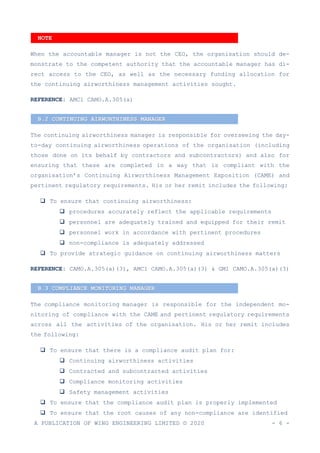
The following diagram depicts a basic continuing airworthiness management
organisational structure that is pertinent to the requirements of Annex Vc
(Part CAMO) of Commission Regulation (EU) No 1321/2014.
FIGURE B: BASIC ORGANISATIONAL STRUCTURE OF A CAMO
The accountable manager, who is typically the Chief Executive Officer (CEO)
of the CAMO, has overall responsibility for running the organisation. His or
her remit includes the following:
❑ To ensure the CAMO has all the resources to fulfil its approval
❑ To establish and promote the organisations safety policy
❑ To nominate the continuing airworthiness manager
❑ To nominate the compliance monitoring manager
❑ To nominate the safety manager
❑ To ensure the above managers have direct access to him or her
REFERENCE: CAMO.A.305(a) & AMC1 CAMO.A.305(a)
B.1 ACCOUNTABLE MANAGER
SECTION B: BASIC ORGANISATIONAL STRUCTURE OF A CAMO
A PUBLICATION OF WING ENGINEERING LIMITED © 2020 - 6 -
When the accountable manager is not the CEO, the organisation should de-
monstrate to the competent authority that the accountable manager has di-
rect access to the CEO, as well as the necessary funding allocation for
the continuing airworthiness management activities sought.
REFERENCE: AMC1 CAMO.A.305(a)
The continuing airworthiness manager is responsible for overseeing the day-
to-day continuing airworthiness operations of the organisation (including
those done on its behalf by contractors and subcontractors) and also for
ensuring that these are completed in a way that is compliant with the
organisation’s Continuing Airworthiness Management Exposition (CAME) and
pertinent regulatory requirements. His or her remit includes the following:
❑ To ensure that continuing airworthiness:
❑ procedures accurately reflect the applicable requirements
❑ personnel are adequately trained and equipped for their remit
❑ personnel work in accordance with pertinent procedures
❑ non-compliance is adequately addressed
❑ To provide strategic guidance on continuing airworthiness matters
REFERENCE: CAMO.A.305(a)(3), AMC1 CAMO.A.305(a)(3) & GM1 CAMO.A.305(a)(3)
The compliance monitoring manager is responsible for the independent mo-
nitoring of compliance with the CAME and pertinent regulatory requirements
across all the activities of the organisation. His or her remit includes
the following:
❑ To ensure that there is a compliance audit plan for:
❑ Continuing airworthiness activities
❑ Contracted and subcontracted activities
❑ Compliance monitoring activities
❑ Safety management activities
❑ To ensure that the compliance audit plan is properly implemented
❑ To ensure that the root causes of any non-compliance are identified
B.2 CONTINUING AIRWORTHINESS MANAGER
B.3 COMPLIANCE MONITORING MANAGER
NOTE
A PUBLICATION OF WING ENGINEERING LIMITED © 2020 - 7 -
❑ To ensure that corrective actions are subsequently requested
❑ To ensure that the corrective actions are completed and closed
❑ To ensure that the audit plan is properly maintained
❑ To ensure that the audit plan is continually reviewed and improved
REFERENCE: CAMO.A.305(a)(4) & AMC1 CAMO.A.305(a)(4)
The compliance monitoring manager cannot be the same person as the conti-
nuing airworthiness manager, as his or her own remit needs to be comple-
tely independent from that of the continuing airworthiness manager.
REFERENCE: AMC1 CAMO.A.305(a)(4)
The safety manager is responsible for managing the development, adminis-
tration and maintenance of the safety aspects of all the activities of the
of the organisation. His or her remit includes the following:
❑ To facilitate:
❑ Hazard identification
❑ Safety risk assessment
❑ Safety management
❑ To monitor the implementation of actions to mitigate safety risks
❑ To provide periodic reports on the organisation’s safety performance
❑ To ensure the availability and standard of safety training to staff
❑ To provide advice on safety matters
❑ To ensure the initiation of internal occurrence investigations
❑ To ensure the follow up and closure of the investigation findings
❑ To ensure the maintenance of safety management documentation
REFERENCE: CAMO.A.305(a)(5) & AMC1 CAMO.A.305(a)(5)
The responsibilities of maintenance programme and reliability monitoring
personnel include:
❑ To develop and control the aircraft maintenance programme
B.4 SAFETY MANAGER
B.5 AMP & RELIABILITY MONITORING PERSONNEL
NOTE
A PUBLICATION OF WING ENGINEERING LIMITED © 2020 - 8 -
❑ To collect, analyse, and evaluate aircraft reliability data
❑ To prepare routine aircraft reliability reports
❑ To investigate aircraft failures, alerts, and abnormal trends
❑ To subsequently establish corrective action(s)
❑ To substantiate the effectiveness of the corrective action(s)
The responsibilities of technical records management personnel include:
❑ To capture aircraft technical records
❑ To store [and backup if electronic] the records
❑ To retrieve the records to support other functions upon request
❑ To prepare the records for transfer e.g. due to sale of aircraft
The responsibilities of maintenance planning personnel include:
❑ To prepare aircraft scheduled maintenance plans and forecasts
❑ To analyse ADs and plan for their accomplishment if applicable
❑ To analyse SBs and plan for their accomplishment if applicable
❑ To evaluate aircraft defects and plan for their rectification
❑ To plan for the accomplishment of operator modification requirements
❑ To prepare maintenance work orders
❑ To liaise with the AMO and suppliers for completion of the work
❑ To carry out maintenance work verification
When the CAMO’s privileges include airworthiness review and permit to fly
(PTF), then it must have appropriately qualified airworthiness review per-
sonnel whose remit include the following:
❑ To carry out an airworthiness review involving:
❑ An aircraft documentation & records survey
❑ A physical aircraft survey
❑ To compile an airworthiness review report or recommendation
❑ To establish conformity with approved flight conditions for PTF
❑ To complete and issue an ARC or PTF as applicable
B.7 AIRCRAFT MAINTENANCE PLANNING PERSONNEL
B.6 AIRCRAFT TECHNICAL RECORDS MANAGEMENT PERSONNEL
B.8 AIRWORTHINESS REVIEW PERSONNEL
A PUBLICATION OF WING ENGINEERING LIMITED © 2020 - 9 -
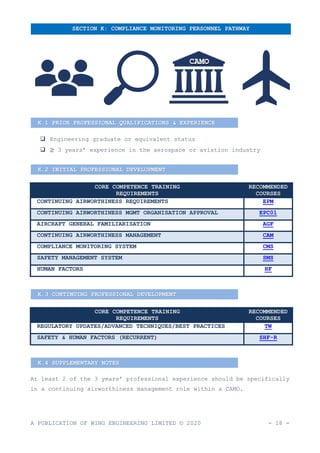
The compliance monitoring personnel are responsible for supporting the com-
pliance monitoring manager in the execution of his or her remit.
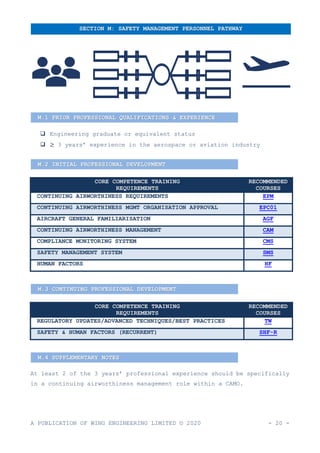
The safety management personnel are responsible for supporting the safety
manager in the execution of his or her remit.
In small organisations with non-complex operations, compliance monitoring
and safety management personnel may not be necessary where the compliance
monitoring and safety managers are able to satisfactorily deliver their re-
mit by themselves.
Furthermore, the compliance monitoring and safety manager may be the same
person. However, the compliance audit plan would need to be setup to ensure
that both functions can be independently audited e.g. using an independent
and appropriately qualified subcontractor. The organisation would also need
to demonstrate that there are adequate resources for the concerned indivi-
dual to execute both functions.
REFERENCE: AMC1 CAMO.A.305(a)(4)&(a)(5)
ALL CAMO personnel must have the appropriate knowledge and experience to
fulfil their role and responsibilities.
REFERENCE: CAMO.A.305(c)&(g) and AMC1 CAMO.A.305(c)& (g)
B.9 COMPLIANCE MONITORING PERSONNEL
B.10 SAFETY MANAGEMENT PERSONNEL
GENERAL NOTES
A PUBLICATION OF WING ENGINEERING LIMITED © 2020 - 10 -
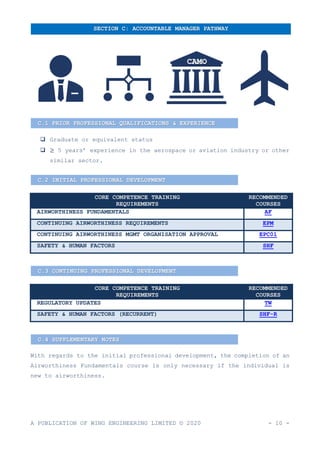
❑ Graduate or equivalent status
❑ ≥ 5 years’ experience in the aerospace or aviation industry or other
similar sector.
CORE COMPETENCE TRAINING
REQUIREMENTS
RECOMMENDED
COURSES
AIRWORTHINESS FUNDAMENTALS AF
CONTINUING AIRWORTHINESS REQUIREMENTS EPM
CONTINUING AIRWORTHINESS MGMT ORGANISATION APPROVAL EPC01
SAFETY & HUMAN FACTORS SHF
CORE COMPETENCE TRAINING
REQUIREMENTS
RECOMMENDED
COURSES
REGULATORY UPDATES TW
SAFETY & HUMAN FACTORS (RECURRENT) SHF-R
With regards to the initial professional development, the completion of an
Airworthiness Fundamentals course is only necessary if the individual is
new to airworthiness.
SECTION C: ACCOUNTABLE MANAGER PATHWAY
C.1 PRIOR PROFESSIONAL QUALIFICATIONS & EXPERIENCE
C.2 INITIAL PROFESSIONAL DEVELOPMENT
C.3 CONTINUING PROFESSIONAL DEVELOPMENT
C.4 SUPPLEMENTARY NOTES
A PUBLICATION OF WING ENGINEERING LIMITED © 2020 - 11 -
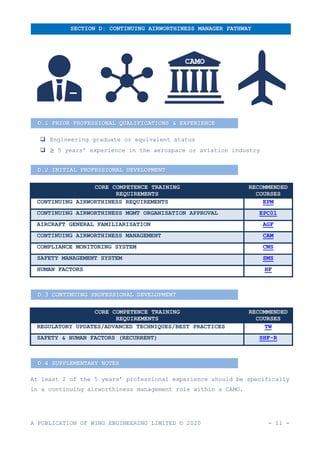
❑ Engineering graduate or equivalent status
❑ ≥ 5 years’ experience in the aerospace or aviation industry
CORE COMPETENCE TRAINING
REQUIREMENTS
RECOMMENDED
COURSES
CONTINUING AIRWORTHINESS REQUIREMENTS EPM
CONTINUING AIRWORTHINESS MGMT ORGANISATION APPROVAL EPC01
AIRCRAFT GENERAL FAMILIARISATION AGF
CONTINUING AIRWORTHINESS MANAGEMENT CAM
COMPLIANCE MONITORING SYSTEM CMS
SAFETY MANAGEMENT SYSTEM SMS
HUMAN FACTORS HF
CORE COMPETENCE TRAINING
REQUIREMENTS
RECOMMENDED
COURSES
REGULATORY UPDATES/ADVANCED TECHNIQUES/BEST PRACTICES TW
SAFETY & HUMAN FACTORS (RECURRENT) SHF-R
At least 2 of the 5 years’ professional experience should be specifically
in a continuing airworthiness management role within a CAMO.
SECTION D: CONTINUING AIRWORTHINESS MANAGER PATHWAY
D.1 PRIOR PROFESSIONAL QUALIFICATIONS & EXPERIENCE
D.2 INITIAL PROFESSIONAL DEVELOPMENT
D.3 CONTINUING PROFESSIONAL DEVELOPMENT
D.4 SUPPLEMENTARY NOTES
A PUBLICATION OF WING ENGINEERING LIMITED © 2020 - 12 -
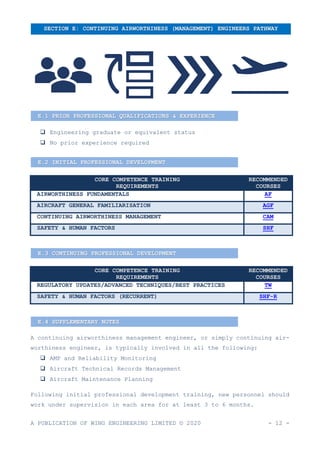
❑ Engineering graduate or equivalent status
❑ No prior experience required
CORE COMPETENCE TRAINING
REQUIREMENTS
RECOMMENDED
COURSES
AIRWORTHINESS FUNDAMENTALS AF
AIRCRAFT GENERAL FAMILIARISATION AGF
CONTINUING AIRWORTHINESS MANAGEMENT CAM
SAFETY & HUMAN FACTORS SHF
CORE COMPETENCE TRAINING
REQUIREMENTS
RECOMMENDED
COURSES
REGULATORY UPDATES/ADVANCED TECHNIQUES/BEST PRACTICES TW
SAFETY & HUMAN FACTORS (RECURRENT) SHF-R
A continuing airworthiness management engineer, or simply continuing air-
worthiness engineer, is typically involved in all the following:
❑ AMP and Reliability Monitoring
❑ Aircraft Technical Records Management
❑ Aircraft Maintenance Planning
Following initial professional development training, new personnel should
work under supervision in each area for at least 3 to 6 months.
SECTION E: CONTINUING AIRWORTHINESS (MANAGEMENT) ENGINEERS PATHWAY
E.1 PRIOR PROFESSIONAL QUALIFICATIONS & EXPERIENCE
E.2 INITIAL PROFESSIONAL DEVELOPMENT
E.3 CONTINUING PROFESSIONAL DEVELOPMENT
E.4 SUPPLEMENTARY NOTES
A PUBLICATION OF WING ENGINEERING LIMITED © 2020 - 13 -
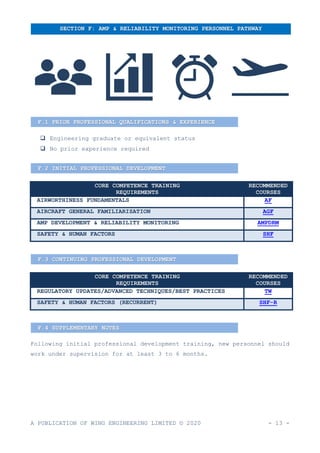
❑ Engineering graduate or equivalent status
❑ No prior experience required
CORE COMPETENCE TRAINING
REQUIREMENTS
RECOMMENDED
COURSES
AIRWORTHINESS FUNDAMENTALS AF
AIRCRAFT GENERAL FAMILIARISATION AGF
AMP DEVELOPMENT & RELIABILITY MONITORING AMPDRM
SAFETY & HUMAN FACTORS SHF
CORE COMPETENCE TRAINING
REQUIREMENTS
RECOMMENDED
COURSES
REGULATORY UPDATES/ADVANCED TECHNIQUES/BEST PRACTICES TW
SAFETY & HUMAN FACTORS (RECURRENT) SHF-R
Following initial professional development training, new personnel should
work under supervision for at least 3 to 6 months.
SECTION F: AMP & RELIABILITY MONITORING PERSONNEL PATHWAY
F.1 PRIOR PROFESSIONAL QUALIFICATIONS & EXPERIENCE
F.2 INITIAL PROFESSIONAL DEVELOPMENT
F.3 CONTINUING PROFESSIONAL DEVELOPMENT
F.4 SUPPLEMENTARY NOTES
A PUBLICATION OF WING ENGINEERING LIMITED © 2020 - 14 -
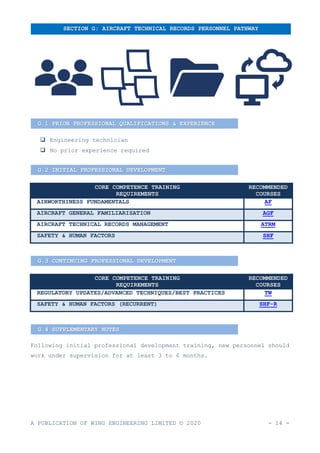
❑ Engineering technician
❑ No prior experience required
CORE COMPETENCE TRAINING
REQUIREMENTS
RECOMMENDED
COURSES
AIRWORTHINESS FUNDAMENTALS AF
AIRCRAFT GENERAL FAMILIARISATION AGF
AIRCRAFT TECHNICAL RECORDS MANAGEMENT ATRM
SAFETY & HUMAN FACTORS SHF
CORE COMPETENCE TRAINING
REQUIREMENTS
RECOMMENDED
COURSES
REGULATORY UPDATES/ADVANCED TECHNIQUES/BEST PRACTICES TW
SAFETY & HUMAN FACTORS (RECURRENT) SHF-R
Following initial professional development training, new personnel should
work under supervision for at least 3 to 6 months.
SECTION G: AIRCRAFT TECHNICAL RECORDS PERSONNEL PATHWAY
G.1 PRIOR PROFESSIONAL QUALIFICATIONS & EXPERIENCE
G.2 INITIAL PROFESSIONAL DEVELOPMENT
G.3 CONTINUING PROFESSIONAL DEVELOPMENT
G.4 SUPPLEMENTARY NOTES
A PUBLICATION OF WING ENGINEERING LIMITED © 2020 - 15 -
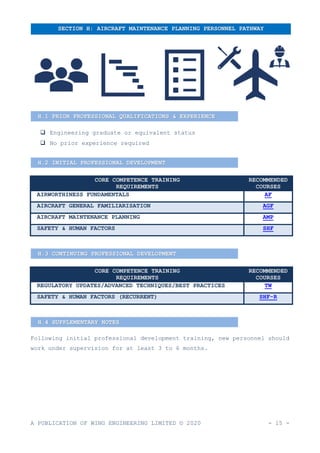
❑ Engineering graduate or equivalent status
❑ No prior experience required
CORE COMPETENCE TRAINING
REQUIREMENTS
RECOMMENDED
COURSES
AIRWORTHINESS FUNDAMENTALS AF
AIRCRAFT GENERAL FAMILIARISATION AGF
AIRCRAFT MAINTENANCE PLANNING AMP
SAFETY & HUMAN FACTORS SHF
CORE COMPETENCE TRAINING
REQUIREMENTS
RECOMMENDED
COURSES
REGULATORY UPDATES/ADVANCED TECHNIQUES/BEST PRACTICES TW
SAFETY & HUMAN FACTORS (RECURRENT) SHF-R
Following initial professional development training, new personnel should
work under supervision for at least 3 to 6 months.
SECTION H: AIRCRAFT MAINTENANCE PLANNING PERSONNEL PATHWAY
H.1 PRIOR PROFESSIONAL QUALIFICATIONS & EXPERIENCE
H.2 INITIAL PROFESSIONAL DEVELOPMENT
H.3 CONTINUING PROFESSIONAL DEVELOPMENT
H.4 SUPPLEMENTARY NOTES
A PUBLICATION OF WING ENGINEERING LIMITED © 2020 - 16 -
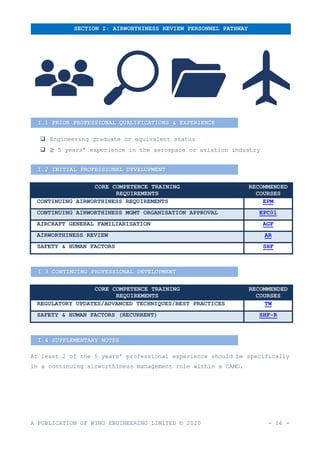
❑ Engineering graduate or equivalent status
❑ ≥ 5 years’ experience in the aerospace or aviation industry
CORE COMPETENCE TRAINING
REQUIREMENTS
RECOMMENDED
COURSES
CONTINUING AIRWORTHINESS REQUIREMENTS EPM
CONTINUING AIRWORTHINESS MGMT ORGANISATION APPROVAL EPC01
AIRCRAFT GENERAL FAMILIARISATION AGF
AIRWORTHINESS REVIEW AR
SAFETY & HUMAN FACTORS SHF
CORE COMPETENCE TRAINING
REQUIREMENTS
RECOMMENDED
COURSES
REGULATORY UPDATES/ADVANCED TECHNIQUES/BEST PRACTICES TW
SAFETY & HUMAN FACTORS (RECURRENT) SHF-R
At least 2 of the 5 years’ professional experience should be specifically
in a continuing airworthiness management role within a CAMO.
SECTION I: AIRWORTHINESS REVIEW PERSONNEL PATHWAY
I.1 PRIOR PROFESSIONAL QUALIFICATIONS & EXPERIENCE
I.2 INITIAL PROFESSIONAL DEVELOPMENT
I.3 CONTINUING PROFESSIONAL DEVELOPMENT
I.4 SUPPLEMENTARY NOTES
A PUBLICATION OF WING ENGINEERING LIMITED © 2020 - 17 -
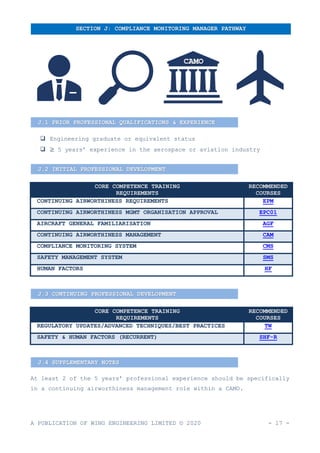
❑ Engineering graduate or equivalent status
❑ ≥ 5 years’ experience in the aerospace or aviation industry
CORE COMPETENCE TRAINING
REQUIREMENTS
RECOMMENDED
COURSES
CONTINUING AIRWORTHINESS REQUIREMENTS EPM
CONTINUING AIRWORTHINESS MGMT ORGANISATION APPROVAL EPC01
AIRCRAFT GENERAL FAMILIARISATION AGF
CONTINUING AIRWORTHINESS MANAGEMENT CAM
COMPLIANCE MONITORING SYSTEM CMS
SAFETY MANAGEMENT SYSTEM SMS
HUMAN FACTORS HF
CORE COMPETENCE TRAINING
REQUIREMENTS
RECOMMENDED
COURSES
REGULATORY UPDATES/ADVANCED TECHNIQUES/BEST PRACTICES TW
SAFETY & HUMAN FACTORS (RECURRENT) SHF-R
At least 2 of the 5 years’ professional experience should be specifically
in a continuing airworthiness management role within a CAMO.
SECTION J: COMPLIANCE MONITORING MANAGER PATHWAY
J.1 PRIOR PROFESSIONAL QUALIFICATIONS & EXPERIENCE
J.2 INITIAL PROFESSIONAL DEVELOPMENT
J.3 CONTINUING PROFESSIONAL DEVELOPMENT
J.4 SUPPLEMENTARY NOTES
A PUBLICATION OF WING ENGINEERING LIMITED © 2020 - 18 -
❑ Engineering graduate or equivalent status
❑ ≥ 3 years’ experience in the aerospace or aviation industry
CORE COMPETENCE TRAINING
REQUIREMENTS
RECOMMENDED
COURSES
CONTINUING AIRWORTHINESS REQUIREMENTS EPM
CONTINUING AIRWORTHINESS MGMT ORGANISATION APPROVAL EPC01
AIRCRAFT GENERAL FAMILIARISATION AGF
CONTINUING AIRWORTHINESS MANAGEMENT CAM
COMPLIANCE MONITORING SYSTEM CMS
SAFETY MANAGEMENT SYSTEM SMS
HUMAN FACTORS HF
CORE COMPETENCE TRAINING
REQUIREMENTS
RECOMMENDED
COURSES
REGULATORY UPDATES/ADVANCED TECHNIQUES/BEST PRACTICES TW
SAFETY & HUMAN FACTORS (RECURRENT) SHF-R
At least 2 of the 3 years’ professional experience should be specifically
in a continuing airworthiness management role within a CAMO.
SECTION K: COMPLIANCE MONITORING PERSONNEL PATHWAY
K.1 PRIOR PROFESSIONAL QUALIFICATIONS & EXPERIENCE
K.2 INITIAL PROFESSIONAL DEVELOPMENT
K.3 CONTINUING PROFESSIONAL DEVELOPMENT
K.4 SUPPLEMENTARY NOTES
A PUBLICATION OF WING ENGINEERING LIMITED © 2020 - 19 -
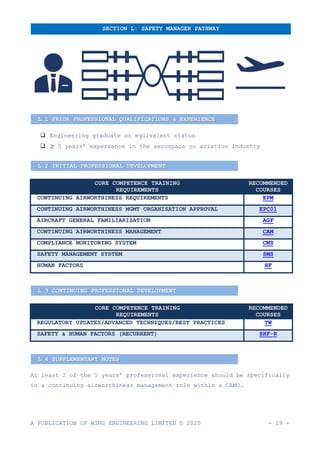
❑ Engineering graduate or equivalent status
❑ ≥ 5 years’ experience in the aerospace or aviation industry
CORE COMPETENCE TRAINING
REQUIREMENTS
RECOMMENDED
COURSES
CONTINUING AIRWORTHINESS REQUIREMENTS EPM
CONTINUING AIRWORTHINESS MGMT ORGANISATION APPROVAL EPC01
AIRCRAFT GENERAL FAMILIARISATION AGF
CONTINUING AIRWORTHINESS MANAGEMENT CAM
COMPLIANCE MONITORING SYSTEM CMS
SAFETY MANAGEMENT SYSTEM SMS
HUMAN FACTORS HF
CORE COMPETENCE TRAINING
REQUIREMENTS
RECOMMENDED
COURSES
REGULATORY UPDATES/ADVANCED TECHNIQUES/BEST PRACTICES TW
SAFETY & HUMAN FACTORS (RECURRENT) SHF-R
At least 2 of the 5 years’ professional experience should be specifically
in a continuing airworthiness management role within a CAMO.
SECTION L: SAFETY MANAGER PATHWAY
L.1 PRIOR PROFESSIONAL QUALIFICATIONS & EXPERIENCE
L.2 INITIAL PROFESSIONAL DEVELOPMENT
L.3 CONTINUING PROFESSIONAL DEVELOPMENT
L.4 SUPPLEMENTARY NOTES
A PUBLICATION OF WING ENGINEERING LIMITED © 2020 - 20 -
❑ Engineering graduate or equivalent status
❑ ≥ 3 years’ experience in the aerospace or aviation industry
CORE COMPETENCE TRAINING
REQUIREMENTS
RECOMMENDED
COURSES
CONTINUING AIRWORTHINESS REQUIREMENTS EPM
CONTINUING AIRWORTHINESS MGMT ORGANISATION APPROVAL EPC01
AIRCRAFT GENERAL FAMILIARISATION AGF
CONTINUING AIRWORTHINESS MANAGEMENT CAM
COMPLIANCE MONITORING SYSTEM CMS
SAFETY MANAGEMENT SYSTEM SMS
HUMAN FACTORS HF
CORE COMPETENCE TRAINING
REQUIREMENTS
RECOMMENDED
COURSES
REGULATORY UPDATES/ADVANCED TECHNIQUES/BEST PRACTICES TW
SAFETY & HUMAN FACTORS (RECURRENT) SHF-R
At least 2 of the 3 years’ professional experience should be specifically
in a continuing airworthiness management role within a CAMO.
SECTION M: SAFETY MANAGEMENT PERSONNEL PATHWAY
M.1 PRIOR PROFESSIONAL QUALIFICATIONS & EXPERIENCE
M.2 INITIAL PROFESSIONAL DEVELOPMENT
M.3 CONTINUING PROFESSIONAL DEVELOPMENT
M.4 SUPPLEMENTARY NOTES
A PUBLICATION OF WING ENGINEERING LIMITED © 2020 - 21 -
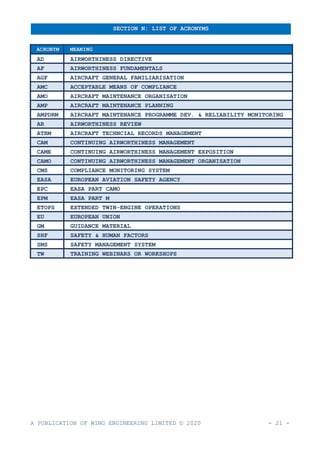
ACRONYM MEANING
AD AIRWORTHINESS DIRECTIVE
AF AIRWORTHINESS FUNDAMENTALS
AGF AIRCRAFT GENERAL FAMILIARISATION
AMC ACCEPTABLE MEANS OF COMPLIANCE
AMO AIRCRAFT MAINTENANCE ORGANISATION
AMP AIRCRAFT MAINTENANCE PLANNING
AMPDRM AIRCRAFT MAINTENANCE PROGRAMME DEV. & RELIABILITY MONITORING
AR AIRWORTHINESS REVIEW
ATRM AIRCRAFT TECHNCIAL RECORDS MANAGEMENT
CAM CONTINUING AIRWORTHINESS MANAGEMENT
CAME CONTINUING AIRWORTHINESS MANAGEMENT EXPOSITION
CAMO CONTINUING AIRWORTHINESS MANAGEMENT ORGANISATION
CMS COMPLIANCE MONITORING SYSTEM
EASA EUROPEAN AVIATION SAFETY AGENCY
EPC EASA PART CAMO
EPM EASA PART M
ETOPS EXTENDED TWIN-ENGINE OPERATIONS
EU EUROPEAN UNION
GM GUIDANCE MATERIAL
SHF SAFETY & HUMAN FACTORS
SMS SAFETY MANAGEMENT SYSTEM
TW TRAINING WEBINARS OR WORKSHOPS
SECTION N: LIST OF ACRONYMS

Core Competence Framework for CAMO Personnel

  • 1.
    A PUBLICATION OFWING ENGINEERING LIMITED © 2020 1 CORE COMPETENCE PROFESSIONAL DEVELOPMENT FRAMEWORK FOR CAMO PERSONNEL A PUBLICATION OF WING ENGINEERING LIMITED
  • 2.
    A PUBLICATION OFWING ENGINEERING LIMITED © 2020 - 2 - PAGE COVER PAGE …………………………………………………………………………………………………………………………………………………… 01 TABLE OF CONTENTS ………………………………………………………………………………………………………………………………… 02 SECTION A: ABOUT THIS FRAMEWORK …………………………………………………………………………………………… 03 SECTION B: BASIC ORGANISATIONAL STRUCTURE OF A CAMO ……………………………………… 05 SECTION C: ACCOUNTABLE MANAGER PATHWAY ………………………………………………………………………… 10 SECTION D: CONTINUING AIRWORTHINESS MANAGER PATHWAY ……………………………………… 11 SECTION E: CONTINUING AIRWORTHINESS (MGMT) ENGINEERS PATHWAY ……………… 12 SECTION F: AMP & RELIABILITY MONITORING PERSONNEL PATHWAY ……………………… 13 SECTION G: AIRCRAFT TECHNICAL RECORDS PERSONNEL PATHWAY …………………………… 14 SECTION H: AIRCRAFT MAINTENANCE PLANNING PERSONNEL PATHWAY …………………… 15 SECTION I: AIRWORTHINESS REVIEW PERSONNEL PATHWAY …………………………………………… 16 SECTION J: COMPLIANCE MONITORING MANAGER PATHWAY ……………………………………………… 17 SECTION K: COMPLIANCE MONITORING PERSONNEL PATHWAY ………………………………………… 18 SECTION L: SAFETY MANAGER PATHWAY ……………………………………………………………………………………… 19 SECTION M: SAFETY MANAGEMENT PERSONNEL PATHWAY …………………………………………………… 20 SECTION N: LIST OF ACRONYMS ……………………………………………………………………………………………………… 21 TABLE OF CONTENTS
  • 3.
    A PUBLICATION OFWING ENGINEERING LIMITED © 2020 - 3 - This framework sets out the key knowledge, skills, and experience required by CAMO professionals for the effective management of airworthiness. It has been designed as a guidance tool for individuals and managers to facilitate the evaluation of role specific competence, identifying gaps, and informing professional development plans. This framework has been provided for guidance only and should be used in conjunction with, and not in place of, a training needs assessment as each unique individual's professional development requirements may vary. The core competence training lists provided under each pathway is not in- tended to be exhaustive. Depending on the nature of a CAMO client’s opera- tions, the type of management tools it uses, or other factors, additional training requirements may be necessary. For instance: ❑ Extended Twin-engine Operations (ETOPS) training ❑ Continuing Airworthiness Management Software User training Furthermore, a CAMO’s onboarding process for new personnel should include an introduction to its CAME, which covers: ❑ Its organisational structure, ❑ An overview of its ops and the new personnel’s role within it, and ❑ The new personnel’s role specific tasks, procedures, and tools. SECTION A: ABOUT THIS FRAMEWORK A.1 GUIDANCE NOTES
  • 4.
    A PUBLICATION OFWING ENGINEERING LIMITED © 2020 - 4 - The following key terms used within this framework should be interpreted as defined below: This refers to the set of demonstrable characteristics including knowledge and skills, which are needed to successfully fulfil a role. This refers to someone with a university degree. This refers to a minimum of 5 years professional experience in a relevant discipline in place of a university degree. Where a professional experience requirement is sighted within a pathway, this should be considered as surplus to the equivalent status requirement. This refers to the core competence training requirements for personnel who are new to a given role and/or inexperienced with its subject matter. This refers to the core competence training requirements for personnel who already have a good level of experience as practitioners in a given role. It is intended to keep such personnel abreast of topical issues, regulatory updates, contemporary and advanced techniques, and best practices. This refers to an aerospace, aeronautical, or aircraft engineering degree, or a degree in other closely related discipline including mechanical and electrical engineering. A.2 DEFINITION OF KEY TERMS A.2.1 COMPETENCE A.2.2 GRADUATE A.2.3 EQUIVALENT STATUS A.2.4 INITIAL PROFESSIONAL DEVELOPMENT A.2.5 CONTINUING PROFESSIONAL DEVELOPMENT A.2.6 ENGINEERING DEGREE NOTE
  • 5.
    A PUBLICATION OFWING ENGINEERING LIMITED © 2020 - 5 - The following diagram depicts a basic continuing airworthiness management organisational structure that is pertinent to the requirements of Annex Vc (Part CAMO) of Commission Regulation (EU) No 1321/2014. FIGURE B: BASIC ORGANISATIONAL STRUCTURE OF A CAMO The accountable manager, who is typically the Chief Executive Officer (CEO) of the CAMO, has overall responsibility for running the organisation. His or her remit includes the following: ❑ To ensure the CAMO has all the resources to fulfil its approval ❑ To establish and promote the organisations safety policy ❑ To nominate the continuing airworthiness manager ❑ To nominate the compliance monitoring manager ❑ To nominate the safety manager ❑ To ensure the above managers have direct access to him or her REFERENCE: CAMO.A.305(a) & AMC1 CAMO.A.305(a) B.1 ACCOUNTABLE MANAGER SECTION B: BASIC ORGANISATIONAL STRUCTURE OF A CAMO
  • 6.
    A PUBLICATION OFWING ENGINEERING LIMITED © 2020 - 6 - When the accountable manager is not the CEO, the organisation should de- monstrate to the competent authority that the accountable manager has di- rect access to the CEO, as well as the necessary funding allocation for the continuing airworthiness management activities sought. REFERENCE: AMC1 CAMO.A.305(a) The continuing airworthiness manager is responsible for overseeing the day- to-day continuing airworthiness operations of the organisation (including those done on its behalf by contractors and subcontractors) and also for ensuring that these are completed in a way that is compliant with the organisation’s Continuing Airworthiness Management Exposition (CAME) and pertinent regulatory requirements. His or her remit includes the following: ❑ To ensure that continuing airworthiness: ❑ procedures accurately reflect the applicable requirements ❑ personnel are adequately trained and equipped for their remit ❑ personnel work in accordance with pertinent procedures ❑ non-compliance is adequately addressed ❑ To provide strategic guidance on continuing airworthiness matters REFERENCE: CAMO.A.305(a)(3), AMC1 CAMO.A.305(a)(3) & GM1 CAMO.A.305(a)(3) The compliance monitoring manager is responsible for the independent mo- nitoring of compliance with the CAME and pertinent regulatory requirements across all the activities of the organisation. His or her remit includes the following: ❑ To ensure that there is a compliance audit plan for: ❑ Continuing airworthiness activities ❑ Contracted and subcontracted activities ❑ Compliance monitoring activities ❑ Safety management activities ❑ To ensure that the compliance audit plan is properly implemented ❑ To ensure that the root causes of any non-compliance are identified B.2 CONTINUING AIRWORTHINESS MANAGER B.3 COMPLIANCE MONITORING MANAGER NOTE
  • 7.
    A PUBLICATION OFWING ENGINEERING LIMITED © 2020 - 7 - ❑ To ensure that corrective actions are subsequently requested ❑ To ensure that the corrective actions are completed and closed ❑ To ensure that the audit plan is properly maintained ❑ To ensure that the audit plan is continually reviewed and improved REFERENCE: CAMO.A.305(a)(4) & AMC1 CAMO.A.305(a)(4) The compliance monitoring manager cannot be the same person as the conti- nuing airworthiness manager, as his or her own remit needs to be comple- tely independent from that of the continuing airworthiness manager. REFERENCE: AMC1 CAMO.A.305(a)(4) The safety manager is responsible for managing the development, adminis- tration and maintenance of the safety aspects of all the activities of the of the organisation. His or her remit includes the following: ❑ To facilitate: ❑ Hazard identification ❑ Safety risk assessment ❑ Safety management ❑ To monitor the implementation of actions to mitigate safety risks ❑ To provide periodic reports on the organisation’s safety performance ❑ To ensure the availability and standard of safety training to staff ❑ To provide advice on safety matters ❑ To ensure the initiation of internal occurrence investigations ❑ To ensure the follow up and closure of the investigation findings ❑ To ensure the maintenance of safety management documentation REFERENCE: CAMO.A.305(a)(5) & AMC1 CAMO.A.305(a)(5) The responsibilities of maintenance programme and reliability monitoring personnel include: ❑ To develop and control the aircraft maintenance programme B.4 SAFETY MANAGER B.5 AMP & RELIABILITY MONITORING PERSONNEL NOTE
  • 8.
    A PUBLICATION OFWING ENGINEERING LIMITED © 2020 - 8 - ❑ To collect, analyse, and evaluate aircraft reliability data ❑ To prepare routine aircraft reliability reports ❑ To investigate aircraft failures, alerts, and abnormal trends ❑ To subsequently establish corrective action(s) ❑ To substantiate the effectiveness of the corrective action(s) The responsibilities of technical records management personnel include: ❑ To capture aircraft technical records ❑ To store [and backup if electronic] the records ❑ To retrieve the records to support other functions upon request ❑ To prepare the records for transfer e.g. due to sale of aircraft The responsibilities of maintenance planning personnel include: ❑ To prepare aircraft scheduled maintenance plans and forecasts ❑ To analyse ADs and plan for their accomplishment if applicable ❑ To analyse SBs and plan for their accomplishment if applicable ❑ To evaluate aircraft defects and plan for their rectification ❑ To plan for the accomplishment of operator modification requirements ❑ To prepare maintenance work orders ❑ To liaise with the AMO and suppliers for completion of the work ❑ To carry out maintenance work verification When the CAMO’s privileges include airworthiness review and permit to fly (PTF), then it must have appropriately qualified airworthiness review per- sonnel whose remit include the following: ❑ To carry out an airworthiness review involving: ❑ An aircraft documentation & records survey ❑ A physical aircraft survey ❑ To compile an airworthiness review report or recommendation ❑ To establish conformity with approved flight conditions for PTF ❑ To complete and issue an ARC or PTF as applicable B.7 AIRCRAFT MAINTENANCE PLANNING PERSONNEL B.6 AIRCRAFT TECHNICAL RECORDS MANAGEMENT PERSONNEL B.8 AIRWORTHINESS REVIEW PERSONNEL
  • 9.
    A PUBLICATION OFWING ENGINEERING LIMITED © 2020 - 9 - The compliance monitoring personnel are responsible for supporting the com- pliance monitoring manager in the execution of his or her remit. The safety management personnel are responsible for supporting the safety manager in the execution of his or her remit. In small organisations with non-complex operations, compliance monitoring and safety management personnel may not be necessary where the compliance monitoring and safety managers are able to satisfactorily deliver their re- mit by themselves. Furthermore, the compliance monitoring and safety manager may be the same person. However, the compliance audit plan would need to be setup to ensure that both functions can be independently audited e.g. using an independent and appropriately qualified subcontractor. The organisation would also need to demonstrate that there are adequate resources for the concerned indivi- dual to execute both functions. REFERENCE: AMC1 CAMO.A.305(a)(4)&(a)(5) ALL CAMO personnel must have the appropriate knowledge and experience to fulfil their role and responsibilities. REFERENCE: CAMO.A.305(c)&(g) and AMC1 CAMO.A.305(c)& (g) B.9 COMPLIANCE MONITORING PERSONNEL B.10 SAFETY MANAGEMENT PERSONNEL GENERAL NOTES
  • 10.
    A PUBLICATION OFWING ENGINEERING LIMITED © 2020 - 10 - ❑ Graduate or equivalent status ❑ ≥ 5 years’ experience in the aerospace or aviation industry or other similar sector. CORE COMPETENCE TRAINING REQUIREMENTS RECOMMENDED COURSES AIRWORTHINESS FUNDAMENTALS AF CONTINUING AIRWORTHINESS REQUIREMENTS EPM CONTINUING AIRWORTHINESS MGMT ORGANISATION APPROVAL EPC01 SAFETY & HUMAN FACTORS SHF CORE COMPETENCE TRAINING REQUIREMENTS RECOMMENDED COURSES REGULATORY UPDATES TW SAFETY & HUMAN FACTORS (RECURRENT) SHF-R With regards to the initial professional development, the completion of an Airworthiness Fundamentals course is only necessary if the individual is new to airworthiness. SECTION C: ACCOUNTABLE MANAGER PATHWAY C.1 PRIOR PROFESSIONAL QUALIFICATIONS & EXPERIENCE C.2 INITIAL PROFESSIONAL DEVELOPMENT C.3 CONTINUING PROFESSIONAL DEVELOPMENT C.4 SUPPLEMENTARY NOTES
  • 11.
    A PUBLICATION OFWING ENGINEERING LIMITED © 2020 - 11 - ❑ Engineering graduate or equivalent status ❑ ≥ 5 years’ experience in the aerospace or aviation industry CORE COMPETENCE TRAINING REQUIREMENTS RECOMMENDED COURSES CONTINUING AIRWORTHINESS REQUIREMENTS EPM CONTINUING AIRWORTHINESS MGMT ORGANISATION APPROVAL EPC01 AIRCRAFT GENERAL FAMILIARISATION AGF CONTINUING AIRWORTHINESS MANAGEMENT CAM COMPLIANCE MONITORING SYSTEM CMS SAFETY MANAGEMENT SYSTEM SMS HUMAN FACTORS HF CORE COMPETENCE TRAINING REQUIREMENTS RECOMMENDED COURSES REGULATORY UPDATES/ADVANCED TECHNIQUES/BEST PRACTICES TW SAFETY & HUMAN FACTORS (RECURRENT) SHF-R At least 2 of the 5 years’ professional experience should be specifically in a continuing airworthiness management role within a CAMO. SECTION D: CONTINUING AIRWORTHINESS MANAGER PATHWAY D.1 PRIOR PROFESSIONAL QUALIFICATIONS & EXPERIENCE D.2 INITIAL PROFESSIONAL DEVELOPMENT D.3 CONTINUING PROFESSIONAL DEVELOPMENT D.4 SUPPLEMENTARY NOTES
  • 12.
    A PUBLICATION OFWING ENGINEERING LIMITED © 2020 - 12 - ❑ Engineering graduate or equivalent status ❑ No prior experience required CORE COMPETENCE TRAINING REQUIREMENTS RECOMMENDED COURSES AIRWORTHINESS FUNDAMENTALS AF AIRCRAFT GENERAL FAMILIARISATION AGF CONTINUING AIRWORTHINESS MANAGEMENT CAM SAFETY & HUMAN FACTORS SHF CORE COMPETENCE TRAINING REQUIREMENTS RECOMMENDED COURSES REGULATORY UPDATES/ADVANCED TECHNIQUES/BEST PRACTICES TW SAFETY & HUMAN FACTORS (RECURRENT) SHF-R A continuing airworthiness management engineer, or simply continuing air- worthiness engineer, is typically involved in all the following: ❑ AMP and Reliability Monitoring ❑ Aircraft Technical Records Management ❑ Aircraft Maintenance Planning Following initial professional development training, new personnel should work under supervision in each area for at least 3 to 6 months. SECTION E: CONTINUING AIRWORTHINESS (MANAGEMENT) ENGINEERS PATHWAY E.1 PRIOR PROFESSIONAL QUALIFICATIONS & EXPERIENCE E.2 INITIAL PROFESSIONAL DEVELOPMENT E.3 CONTINUING PROFESSIONAL DEVELOPMENT E.4 SUPPLEMENTARY NOTES
  • 13.
    A PUBLICATION OFWING ENGINEERING LIMITED © 2020 - 13 - ❑ Engineering graduate or equivalent status ❑ No prior experience required CORE COMPETENCE TRAINING REQUIREMENTS RECOMMENDED COURSES AIRWORTHINESS FUNDAMENTALS AF AIRCRAFT GENERAL FAMILIARISATION AGF AMP DEVELOPMENT & RELIABILITY MONITORING AMPDRM SAFETY & HUMAN FACTORS SHF CORE COMPETENCE TRAINING REQUIREMENTS RECOMMENDED COURSES REGULATORY UPDATES/ADVANCED TECHNIQUES/BEST PRACTICES TW SAFETY & HUMAN FACTORS (RECURRENT) SHF-R Following initial professional development training, new personnel should work under supervision for at least 3 to 6 months. SECTION F: AMP & RELIABILITY MONITORING PERSONNEL PATHWAY F.1 PRIOR PROFESSIONAL QUALIFICATIONS & EXPERIENCE F.2 INITIAL PROFESSIONAL DEVELOPMENT F.3 CONTINUING PROFESSIONAL DEVELOPMENT F.4 SUPPLEMENTARY NOTES
  • 14.
    A PUBLICATION OFWING ENGINEERING LIMITED © 2020 - 14 - ❑ Engineering technician ❑ No prior experience required CORE COMPETENCE TRAINING REQUIREMENTS RECOMMENDED COURSES AIRWORTHINESS FUNDAMENTALS AF AIRCRAFT GENERAL FAMILIARISATION AGF AIRCRAFT TECHNICAL RECORDS MANAGEMENT ATRM SAFETY & HUMAN FACTORS SHF CORE COMPETENCE TRAINING REQUIREMENTS RECOMMENDED COURSES REGULATORY UPDATES/ADVANCED TECHNIQUES/BEST PRACTICES TW SAFETY & HUMAN FACTORS (RECURRENT) SHF-R Following initial professional development training, new personnel should work under supervision for at least 3 to 6 months. SECTION G: AIRCRAFT TECHNICAL RECORDS PERSONNEL PATHWAY G.1 PRIOR PROFESSIONAL QUALIFICATIONS & EXPERIENCE G.2 INITIAL PROFESSIONAL DEVELOPMENT G.3 CONTINUING PROFESSIONAL DEVELOPMENT G.4 SUPPLEMENTARY NOTES
  • 15.
    A PUBLICATION OFWING ENGINEERING LIMITED © 2020 - 15 - ❑ Engineering graduate or equivalent status ❑ No prior experience required CORE COMPETENCE TRAINING REQUIREMENTS RECOMMENDED COURSES AIRWORTHINESS FUNDAMENTALS AF AIRCRAFT GENERAL FAMILIARISATION AGF AIRCRAFT MAINTENANCE PLANNING AMP SAFETY & HUMAN FACTORS SHF CORE COMPETENCE TRAINING REQUIREMENTS RECOMMENDED COURSES REGULATORY UPDATES/ADVANCED TECHNIQUES/BEST PRACTICES TW SAFETY & HUMAN FACTORS (RECURRENT) SHF-R Following initial professional development training, new personnel should work under supervision for at least 3 to 6 months. SECTION H: AIRCRAFT MAINTENANCE PLANNING PERSONNEL PATHWAY H.1 PRIOR PROFESSIONAL QUALIFICATIONS & EXPERIENCE H.2 INITIAL PROFESSIONAL DEVELOPMENT H.3 CONTINUING PROFESSIONAL DEVELOPMENT H.4 SUPPLEMENTARY NOTES
  • 16.
    A PUBLICATION OFWING ENGINEERING LIMITED © 2020 - 16 - ❑ Engineering graduate or equivalent status ❑ ≥ 5 years’ experience in the aerospace or aviation industry CORE COMPETENCE TRAINING REQUIREMENTS RECOMMENDED COURSES CONTINUING AIRWORTHINESS REQUIREMENTS EPM CONTINUING AIRWORTHINESS MGMT ORGANISATION APPROVAL EPC01 AIRCRAFT GENERAL FAMILIARISATION AGF AIRWORTHINESS REVIEW AR SAFETY & HUMAN FACTORS SHF CORE COMPETENCE TRAINING REQUIREMENTS RECOMMENDED COURSES REGULATORY UPDATES/ADVANCED TECHNIQUES/BEST PRACTICES TW SAFETY & HUMAN FACTORS (RECURRENT) SHF-R At least 2 of the 5 years’ professional experience should be specifically in a continuing airworthiness management role within a CAMO. SECTION I: AIRWORTHINESS REVIEW PERSONNEL PATHWAY I.1 PRIOR PROFESSIONAL QUALIFICATIONS & EXPERIENCE I.2 INITIAL PROFESSIONAL DEVELOPMENT I.3 CONTINUING PROFESSIONAL DEVELOPMENT I.4 SUPPLEMENTARY NOTES
  • 17.
    A PUBLICATION OFWING ENGINEERING LIMITED © 2020 - 17 - ❑ Engineering graduate or equivalent status ❑ ≥ 5 years’ experience in the aerospace or aviation industry CORE COMPETENCE TRAINING REQUIREMENTS RECOMMENDED COURSES CONTINUING AIRWORTHINESS REQUIREMENTS EPM CONTINUING AIRWORTHINESS MGMT ORGANISATION APPROVAL EPC01 AIRCRAFT GENERAL FAMILIARISATION AGF CONTINUING AIRWORTHINESS MANAGEMENT CAM COMPLIANCE MONITORING SYSTEM CMS SAFETY MANAGEMENT SYSTEM SMS HUMAN FACTORS HF CORE COMPETENCE TRAINING REQUIREMENTS RECOMMENDED COURSES REGULATORY UPDATES/ADVANCED TECHNIQUES/BEST PRACTICES TW SAFETY & HUMAN FACTORS (RECURRENT) SHF-R At least 2 of the 5 years’ professional experience should be specifically in a continuing airworthiness management role within a CAMO. SECTION J: COMPLIANCE MONITORING MANAGER PATHWAY J.1 PRIOR PROFESSIONAL QUALIFICATIONS & EXPERIENCE J.2 INITIAL PROFESSIONAL DEVELOPMENT J.3 CONTINUING PROFESSIONAL DEVELOPMENT J.4 SUPPLEMENTARY NOTES
  • 18.
    A PUBLICATION OFWING ENGINEERING LIMITED © 2020 - 18 - ❑ Engineering graduate or equivalent status ❑ ≥ 3 years’ experience in the aerospace or aviation industry CORE COMPETENCE TRAINING REQUIREMENTS RECOMMENDED COURSES CONTINUING AIRWORTHINESS REQUIREMENTS EPM CONTINUING AIRWORTHINESS MGMT ORGANISATION APPROVAL EPC01 AIRCRAFT GENERAL FAMILIARISATION AGF CONTINUING AIRWORTHINESS MANAGEMENT CAM COMPLIANCE MONITORING SYSTEM CMS SAFETY MANAGEMENT SYSTEM SMS HUMAN FACTORS HF CORE COMPETENCE TRAINING REQUIREMENTS RECOMMENDED COURSES REGULATORY UPDATES/ADVANCED TECHNIQUES/BEST PRACTICES TW SAFETY & HUMAN FACTORS (RECURRENT) SHF-R At least 2 of the 3 years’ professional experience should be specifically in a continuing airworthiness management role within a CAMO. SECTION K: COMPLIANCE MONITORING PERSONNEL PATHWAY K.1 PRIOR PROFESSIONAL QUALIFICATIONS & EXPERIENCE K.2 INITIAL PROFESSIONAL DEVELOPMENT K.3 CONTINUING PROFESSIONAL DEVELOPMENT K.4 SUPPLEMENTARY NOTES
  • 19.
    A PUBLICATION OFWING ENGINEERING LIMITED © 2020 - 19 - ❑ Engineering graduate or equivalent status ❑ ≥ 5 years’ experience in the aerospace or aviation industry CORE COMPETENCE TRAINING REQUIREMENTS RECOMMENDED COURSES CONTINUING AIRWORTHINESS REQUIREMENTS EPM CONTINUING AIRWORTHINESS MGMT ORGANISATION APPROVAL EPC01 AIRCRAFT GENERAL FAMILIARISATION AGF CONTINUING AIRWORTHINESS MANAGEMENT CAM COMPLIANCE MONITORING SYSTEM CMS SAFETY MANAGEMENT SYSTEM SMS HUMAN FACTORS HF CORE COMPETENCE TRAINING REQUIREMENTS RECOMMENDED COURSES REGULATORY UPDATES/ADVANCED TECHNIQUES/BEST PRACTICES TW SAFETY & HUMAN FACTORS (RECURRENT) SHF-R At least 2 of the 5 years’ professional experience should be specifically in a continuing airworthiness management role within a CAMO. SECTION L: SAFETY MANAGER PATHWAY L.1 PRIOR PROFESSIONAL QUALIFICATIONS & EXPERIENCE L.2 INITIAL PROFESSIONAL DEVELOPMENT L.3 CONTINUING PROFESSIONAL DEVELOPMENT L.4 SUPPLEMENTARY NOTES
  • 20.
    A PUBLICATION OFWING ENGINEERING LIMITED © 2020 - 20 - ❑ Engineering graduate or equivalent status ❑ ≥ 3 years’ experience in the aerospace or aviation industry CORE COMPETENCE TRAINING REQUIREMENTS RECOMMENDED COURSES CONTINUING AIRWORTHINESS REQUIREMENTS EPM CONTINUING AIRWORTHINESS MGMT ORGANISATION APPROVAL EPC01 AIRCRAFT GENERAL FAMILIARISATION AGF CONTINUING AIRWORTHINESS MANAGEMENT CAM COMPLIANCE MONITORING SYSTEM CMS SAFETY MANAGEMENT SYSTEM SMS HUMAN FACTORS HF CORE COMPETENCE TRAINING REQUIREMENTS RECOMMENDED COURSES REGULATORY UPDATES/ADVANCED TECHNIQUES/BEST PRACTICES TW SAFETY & HUMAN FACTORS (RECURRENT) SHF-R At least 2 of the 3 years’ professional experience should be specifically in a continuing airworthiness management role within a CAMO. SECTION M: SAFETY MANAGEMENT PERSONNEL PATHWAY M.1 PRIOR PROFESSIONAL QUALIFICATIONS & EXPERIENCE M.2 INITIAL PROFESSIONAL DEVELOPMENT M.3 CONTINUING PROFESSIONAL DEVELOPMENT M.4 SUPPLEMENTARY NOTES
  • 21.
    A PUBLICATION OFWING ENGINEERING LIMITED © 2020 - 21 - ACRONYM MEANING AD AIRWORTHINESS DIRECTIVE AF AIRWORTHINESS FUNDAMENTALS AGF AIRCRAFT GENERAL FAMILIARISATION AMC ACCEPTABLE MEANS OF COMPLIANCE AMO AIRCRAFT MAINTENANCE ORGANISATION AMP AIRCRAFT MAINTENANCE PLANNING AMPDRM AIRCRAFT MAINTENANCE PROGRAMME DEV. & RELIABILITY MONITORING AR AIRWORTHINESS REVIEW ATRM AIRCRAFT TECHNCIAL RECORDS MANAGEMENT CAM CONTINUING AIRWORTHINESS MANAGEMENT CAME CONTINUING AIRWORTHINESS MANAGEMENT EXPOSITION CAMO CONTINUING AIRWORTHINESS MANAGEMENT ORGANISATION CMS COMPLIANCE MONITORING SYSTEM EASA EUROPEAN AVIATION SAFETY AGENCY EPC EASA PART CAMO EPM EASA PART M ETOPS EXTENDED TWIN-ENGINE OPERATIONS EU EUROPEAN UNION GM GUIDANCE MATERIAL SHF SAFETY & HUMAN FACTORS SMS SAFETY MANAGEMENT SYSTEM TW TRAINING WEBINARS OR WORKSHOPS SECTION N: LIST OF ACRONYMS