Coral reefs, definition, it's types & other examples.pdf
1.
5
What are coralreefs?
Coral reefs are the skeletons of stony coral polyps cemented together. Corals grow very
slowly - some grow only about 3-20mm per year. Therefore, some reefs form over several
million years (Veron, 2000).
As these corals grow and die, they leave behind their calcium carbonate skeletons.
On these skeletons, other corals grow. As the years pass, walls of coral begin to form:
massive walls of rock. As the waves and currents beat upon these reefs, nooks, crannies,
ledges and caverns form in these walls.
Just as there are different types of corals, there are different types of coral reefs. The
three main types of reefs are fringing reefs, barrier reefs and atolls (Veron, 2000).
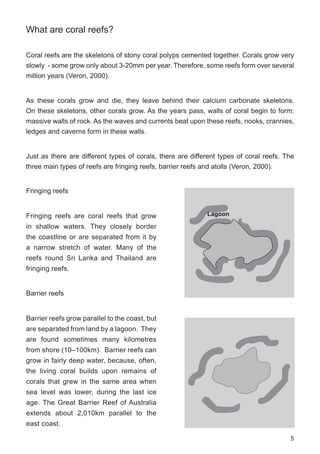
Fringing reefs
Fringing reefs are coral reefs that grow
in shallow waters. They closely border
the coastline or are separated from it by
a narrow stretch of water. Many of the
reefs round Sri Lanka and Thailand are
fringing reefs.
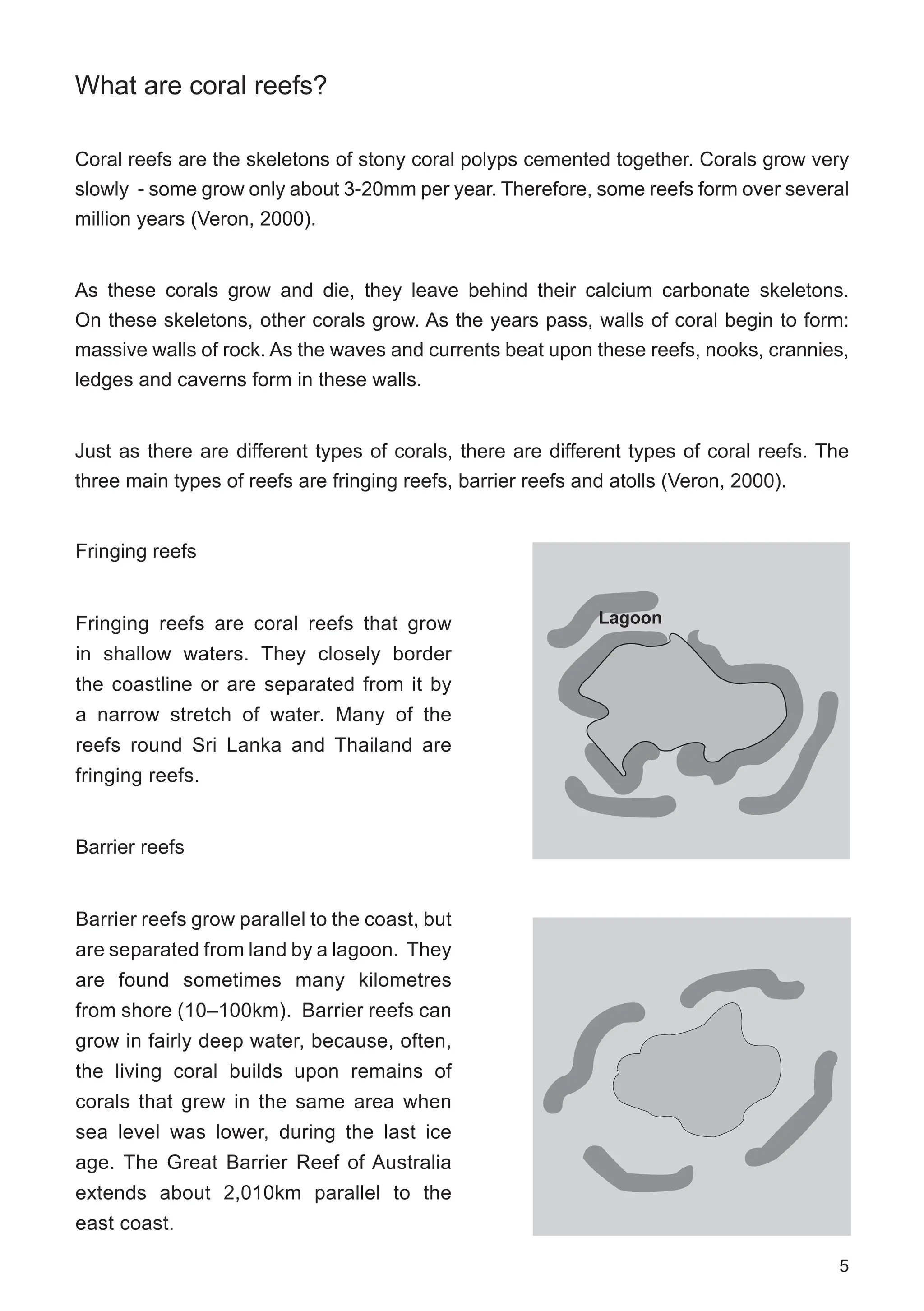
Barrier reefs
Barrier reefs grow parallel to the coast, but
are separated from land by a lagoon. They
are found sometimes many kilometres
from shore (10–100km). Barrier reefs can
grow in fairly deep water, because, often,
the living coral builds upon remains of
corals that grew in the same area when
sea level was lower, during the last ice
age. The Great Barrier Reef of Australia
extends about 2,010km parallel to the
east coast.
Lagoon
2.
6
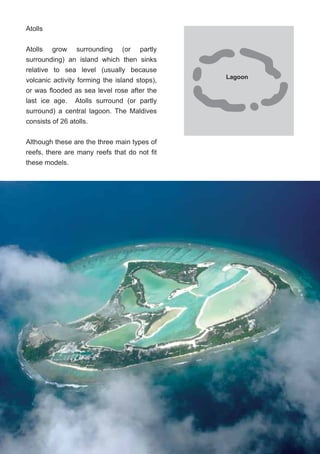
Atolls
Atolls grow surrounding(or partly
surrounding) an island which then sinks
relative to sea level (usually because
volcanic activity forming the island stops),
or was flooded as sea level rose after the
last ice age. Atolls surround (or partly
surround) a central lagoon. The Maldives
consists of 26 atolls.
Although these are the three main types of
reefs, there are many reefs that do not fit
these models.
Lagoon
3.
7
High
diversity
Source: Groombridge andJenkins (2002)
Low
diversity
coral
Where are coral reefs found in the world?
Coral reefs are found
• where the sea is shallow (less than 100m);
• where the sea is warm (usually between 25° and 29°C);
• and therefore, are located within the latitude of 30°N to 30°S i.e., only in tropical seas.
What is the importance of coral reefs?
Coral reefs are extremely productive ecosystems and provide humans with many services.
Provisioning Services:
Coral reefs support human life and livelihoods and are important economically. Nearly
500 million people depend - directly and indirectly – on coral reefs for their livelihoods,
food and other resources (Wilkinson, 2004). Further, it is estimated that nearly 30 million
of the poorest human populations in the world depend entirely on coral reefs for their food
(Wilkinson, 2004).
• A km2
of well-managed coral reef can yield an average of 15 tonnes of fish and other
seafood every year (http://www.panda.org/ about _wwf/ what_we_do/marine/blue_planet/
coasts/coral_reefs/coral_importance/).
• In 1985, the world export value of the marine aquarium trade was estimated at 25-40 million
USD per year. In 1996, the world export value was about 200 million USD. The annual
export of marine aquarium fish from Southeast Asia alone is estimated to be between
10-30 million fish, with a retail value of up to 750 million USD (Bruckner, 2006).
4.
8
Many coral speciesand species associated with coral reefs have medicinal values.
Several species are used in Traditional Chinese Medicine (TCM) and many are now
providing novel resources for allopathic medicine.
Regulating Services:
Coral reefs protect the shoreline and reduce flooding.
Very importantly, coral reefs protect the shoreline, providing a physical barrier – a wall –
against tidal surges, extreme weather events, ocean currents, tides and winds. In doing
so, they prevent coastal erosion, flooding and loss of infrastructure. Because of this, they
serve to reduce huge costs involved with destruction and displacement due to extreme
weather events.
Supporting Services:
Coral reefs are an essential part of land accretion.
The natural action of waves breaks pieces of calcified coral and these are washed up onto
beaches. Through the process of natural physical breakdown, these larger pieces are
broken into smaller and smaller pieces and eventually become part of the rubble, building
these beaches. Corals, therefore, contribute, in part, to the process of accretion - which
is the opposite of erosion.
• In TCM, 394 marine species are collected globally for their medicinal value. The majority of
these species are used in Asia (Hunt & Vincent, 2006).
• Some hard coral species are used in bone grafts. Others contain chemicals which might be
used as natural sunscreen products (Demers et al., 2002; http://www.coralfilm.com/about.
html).
• The Caribbean sea squirt (Ecteinascidia turbinata) has a chemical that is being used to
treat difficult cancers (http://www.ehponline.org).
• There are some 500 species of cone snails that live in and around coral reefs. These
species have a range of venoms which are being investigated currently for use as
non-addictive pain killers (Chivian, 2006).
The value of this protective service of coral reefs is estimated at 314 million USD in Indonesia
(Burke et al., 2002).
5.
9
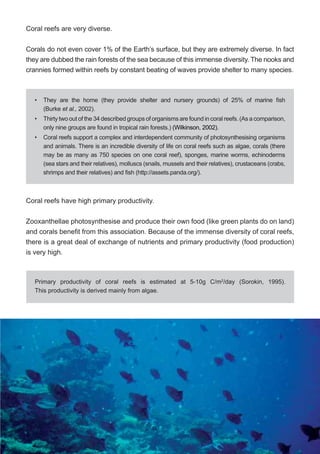
Coral reefs arevery diverse.
Corals do not even cover 1% of the Earth’s surface, but they are extremely diverse. In fact
they are dubbed the rain forests of the sea because of this immense diversity. The nooks and
crannies formed within reefs by constant beating of waves provide shelter to many species.
Coral reefs have high primary productivity.
Zooxanthellae photosynthesise and produce their own food (like green plants do on land)
and corals benefit from this association. Because of the immense diversity of coral reefs,
there is a great deal of exchange of nutrients and primary productivity (food production)
is very high.
• They are the home (they provide shelter and nursery grounds) of 25% of marine fish
(Burke et al., 2002).
• Thirty two out of the 34 described groups of organisms are found in coral reefs. (As a comparison,
only nine groups are found in tropical rain forests.) (Wilkinson, 2002).
• Coral reefs support a complex and interdependent community of photosynthesising organisms
and animals. There is an incredible diversity of life on coral reefs such as algae, corals (there
may be as many as 750 species on one coral reef), sponges, marine worms, echinoderms
(sea stars and their relatives), molluscs (snails, mussels and their relatives), crustaceans (crabs,
shrimps and their relatives) and fish (http://assets.panda.org/).
Primary productivity of coral reefs is estimated at 5-10g C/m2
/day (Sorokin, 1995).
This productivity is derived mainly from algae.
6.
10
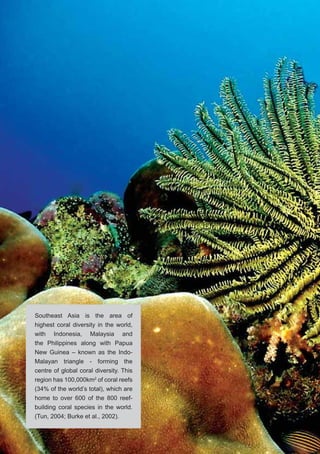
Southeast Asia isthe area of
highest coral diversity in the world,
with Indonesia, Malaysia and
the Philippines along with Papua
New Guinea – known as the Indo-
Malayan triangle - forming the
centre of global coral diversity. This
region has 100,000km2
of coral reefs
(34% of the world’s total), which are
home to over 600 of the 800 reef-
building coral species in the world.
(Tun, 2004; Burke et al., 2002).
12
Cultural services:
Coral reefshave intrinsic, aesthetic and recreational values.
The beauty of coral reefs and their diversity are essential parts of many cultures in different
parts of the world. Because of their easy access, visiting coral reefs is an important
recreation for snorkelers, scuba divers, recreational fishermen and beach lovers.
What are the threats to coral reefs?
Despite their immense ecological, economical and aesthetic values, it is estimated that
20% of the world’s coral reefs have been destroyed (Wilkinson, 2004). Another 24% are
at high risk of collapse, and yet another 26% at risk from long term collapse as a result of
human activities. If the present rate of destruction continues, 70% of the world’s coral reefs
will be destroyed by the year 2050 (http://www.nature.org/joinanddonate/rescuereef/).
The coral reefs of Southeast Asia are the most threatened in the world (Burke et al. 2002).
Overexploitation (Over-fishing):
For food
A recent report states that ‘centuries of over-fishing by man have emptied the world’s
oceans of giant fish, whales and other large sea creatures, destroying coastal
environments’ (Jackson et al., 2001).
• In Seychelles, tourism was estimated to have generated one fifth of GDP and over 60% of
foreign exchange earnings in 1995 (Mathieu et al., 2000).
• In the Maldives, ‘tourism contributes more than 60% of foreign exchange receipts, over
90% of government tax revenue comes from import duties and tourism-related taxes, and
almost 40% of the workforce is employed in the industry’ (Emerton, 1997, 2006).
• In South Asia, 45% of 19,210 km2
of coral reefs have been destroyed, another 10% are
critically threatened and 25% are threatened. Only 20% are at low risk from human activities
(Tun et al., 2004).
• In Southeast Asia, 38% of 91,700 km2
of coral reefs have been destroyed, another 28% are
critically threatened and 29% are threatened. Only 5% are at low risk from human activities
(Tun et al., 2004).
9.
13
The human globalpopulation is expected to double in the next 50 years, and with it, an
ever increasing demand for life essentials such as food. Fish is the primary source of
protein for one fifth of the world’s population. The demand for fish has doubled in the last
50 years, and fish production would have to double again in the next 25 years to keep up
with the demand and population growth.
Because coral reefs are within the reach of small boats, they are especially vulnerable
to over-fishing. Particular groups of coral reef fish such as groupers, snappers and large
wrasses have been overexploited. In Southeast Asia, the live fish trade (both as food fish
and as ornamentals) is estimated to be over a billion USD per year in (mostly) illegal trade.
For the aquarium trade
The practice of keeping marine aquaria as a hobby has increased in the last decade. It
is reported that, globally, between 1.5 -2 million people keep saltwater aquaria (Wabnitz
et al., 2003). As a result, more than 800 species of reef fish, hundreds of coral species
and other invertebrates are exported now for aquarium markets. The majority of fish come
from reefs in the Philippines and Indonesia, while most stony corals come from Indonesia.
The biggest importer is the USA (Sadovy et al, 2003).
• The average wholesale price for reef fish is 20 USD/kg. The estimated total annual value
of live reef fish imported into Hong Kong for food is, therefore, more than 500 million USD
(Sham, 1997 in litt. TRAFFIC, 1999).
• In the 1990s, 60% of the fish caught for the live fish food trade were from the Indonesian
archipelago (Bentley, 1999).
• Hong Kong and other Asian markets are the primary buyers of live reef fish for food
(Donaldson et al., 2003)
• The Giant grouper (Epinephelus lanceolatus) and Humphead wrasse (Cheilinus undulates)
are listed in the 2007 IUCN Red List as Vulnerable and Endangered, respectively, as a
direct consequence of over-fishing (Baillie & Groombridge, 2007).
• A total of 1,471 species of fish are traded globally, comprising 20-40 million individuals.
• One hundred and forty species of stony corals and 61 species of soft corals (comprising
11-12 million and 390,000 pieces respectively) are traded.
• The Banggai cardinal fish (Pterapogon kauderni) is only found in the Banggai Archipelago,
near Sulawesi, Indonesia. It is very valued in the aquarium industry, with approximately
900,000 harvested every year. It is now considered Endangered.
• Barbour’s seahorse (Hippocampus barbouri) is now listed as Vulnerable, mainly as a result
of harvesting for the aquarium trade.
Source: Wabnitz et al., (2003); http://www.iucnredlist.org/
10.
14
For the trinkettrade
Other species are at risk from overexploitation for use as curios or trinkets. As many as
5000 species of molluscs are processed or used raw to make curios and trinkets; some
40 species of coral are also traded for this purpose; and many sea stars, sea urchins,
sand dollars and their relatives are also traded (Vincent, 2006). At least 32 species of fish
or fish parts - such as seahorses, porcupine fish, sharks’ teeth and the ‘noses’ of sawfish
- are also used for the trinket trade.
The USA is the biggest importer of such trinkets. Much of these trinkets are bought by
tourists on holiday in the tropics, who do not know the damage they cause to coral reefs
ecosystems in the tropics (Vincent, 2006).
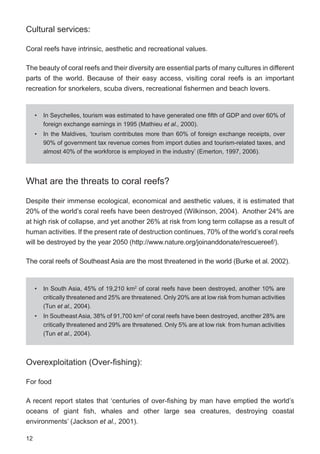
• Six out of seven species of
marine turtles are Red Listed
as Endangered or Critically
Endangered, partly as a result
of overexploitation for the use of
their shells in the trinket trade. The
Hawksbill turtle (Eretmochelys
imbricata), with its ornate shell,
is Critically Endangered (Baillie
& Groombridge, 2007).
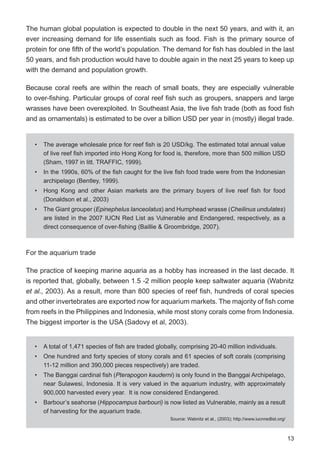
• Corallium spp. are a group of
about 31 species of coral that
have a global distribution, whose
dominant colour ranges from
white to pink, to orange and
red. They are used extensively
to make jewellery and curios
and are now threatened with
extinction due to over-harvesting
(http:/www.iucn.org/).
11.
15
For medicinal purposes
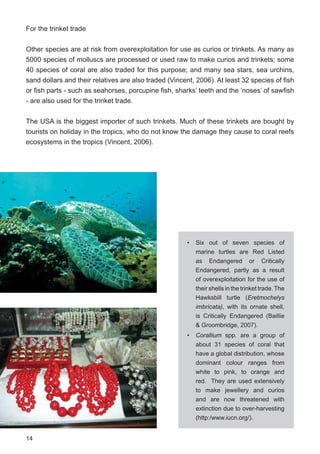
Speciesare also overexploited for medicinal purposes, mainly in traditional medicine.
Many species such as sea horses and pipefish are over-harvested for Traditional Chinese
Medicine (TCM) (Hunt & Vincent, 2006).
Another emerging threat is marine bioprospecting. Coral reefs are relatively easy to
access and have many species of non-moving, soft-bodied organisms, who are armed
with an wide of chemicals as defence weapons. These chemicals have a range of potential
medical and industrial uses and because of this, reefs are targeted for bioprospecting.
In order to extract enough chemicals for development of medicines and clinical trials,
the quantities required are in the order of tons or thousands of tons (Meliane, undated).
Therefore, the potential for overexploitation is very high.
• Thirteen species of seahorses
(Hippocampus spp.) used
in traditional medicine are
Red Listed (Hunt & Vincent,
2006).
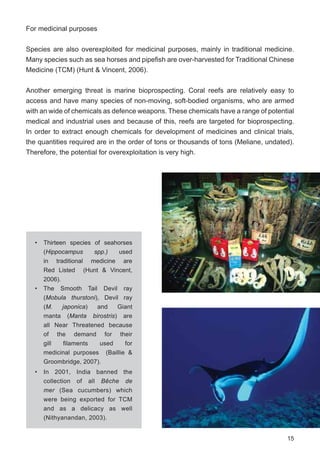
• The Smooth Tail Devil ray
(Mobula thurstoni), Devil ray
(M. japonica) and Giant
manta (Manta birostris) are
all Near Threatened because
of the demand for their
gill filaments used for
medicinal purposes (Baillie &
Groombridge, 2007).
• In 2001, India banned the
collection of all Bêche de
mer (Sea cucumbers) which
were being exported for TCM
and as a delicacy as well
(Nithyanandan, 2003).
12.
16
Destructive fishing practices
Oftenaccompanying over-fishing are destructive fishing practices - such as purse
seining, fine-mesh fishing, ‘moxy’ nets, cyanide fishing and blast fishing - that result in
unsustainable damage (Wilkinson, 2004). It should be noted, though, that all of these
have been made illegal in South and Southeast Asia.
The use of poison (cyanide) stuns fish so that they can be taken for the live fish trade. Such
poison not only affects target species but also has an effect on all living organisms nearby.
‘Moxy’ nets, fine-mesh nets and bottom trawlers all damage coral reefs.
Both over-fishing and destructive fishing disrupt ecological interconnections and upset the
balance of coral reef ecosystems, resulting in changes in species diversity and abundance.
Coral mining (Overexploitation/ Habitat Destruction):
In South and Southeast Asia, corals are mined for limestone and construction materials.
In this process, the reef is blasted and coral removed, causing immediate destruction but
also resulting in indirect detrimental effects such as sand erosion and sedimentation. In
1995, it was estimated that 20,000m3
of coral per year were collected in the Maldives for
construction materials (Brown et al, 1995). Coral mining is prevalent in most South and
Southeast Asian countries (Rajasuriya et al., 2004).
• Burke et al. (2002) estimate that more than 53% of Indonesia’s coral reefs are threatened
by destructive fishing practices.
• In Sulawesi, Indonesia, 15% of the fishermen are blast fishermen, with their catches making
up 10-40% of the total landings (Pet-Soede & Erdmann, 1998).
• In regularly blasted reefs 50-80% of the coral could be dead. The net economic loss to
Indonesia from blast fishing over the next 20 years will be at least 570 million USD (Burke
et al., 2002).
• It is estimated that over 6,000 divers annually use about 150,000kg of cyanide on 33 million
coral polyps worldwide (Briggs, 2003).
• Eighty five percent of the world’s traded aquarium fish are caught using cyanide, mainly
from Indonesia and the Philippines (Licuanan & Gomez, 2000).
• A large percentage of these fish caught using cyanide die – 50% for food fish species and
above 80% of ornamental fish species – and even those that do survive usually die four to
six weeks after capture (Briggs, 2003).
13.
17
Sediment, nutrient andchemical pollution:
One of the greatest threats to coral reefs is human development that alters either the
marine or land-based physical environment. Certain development activities lead to
increases in freshwater runoff, resulting in large amounts of sediment being washed into
the sea. To a limited extent, soil washes naturally into rivers, but poor agricultural and
land use practices intensify this process, resulting in excessive sedimentation. Upland
activities such as logging, land conversion, river modifications (dams and diversions) and
road construction hugely increase erosion. The sediment from such erosion carries with
it not only particulate matter but also high levels of nutrients from agricultural areas or
sewage systems. To make this problem worse, many areas in South and Southeast Asian
countries lack proper sewage systems and waste is discharged directly into the sea.
Direct sedimentation onto the reef increases the turbidity of the water, and this can lead to
the smothering of corals, while associated increases in nutrients can lead to eutrophication1
.
Both turbidity and eutrophication result in a decrease in the amount of sunlight that reaches
the coral. Reef building corals need sunlight for the zooxanthellae that live among them to
photosynthesise and provide them with nutrients. Thus, if corals are unable to get enough
light, they stop growing and eventually die (Nybakken, 1993). In addition to this, changes
in nutrient levels may favour the growth of other organisms such as sponges and algae,
causing a disruption in the balance of the coral reef ecosystem.
1
Eutrophication is the over-enrichment of a water body with nutrients, resulting in excessive growth of organisms and depletion in
the concentration of dissolved oxygen.
In addition to nutrient and sediment pollution, industrial effluents washed into waterways
and agricultural runoff carry with them chemical pollutants such as petroleum products
including oils and insecticides.
• Land reclamation by dumping sand and dirt directly onto coral reefs has been particularly
bad in Singapore, which has lost 60% of its coral reefs to reclamation.
• It is estimated that 25% of the reefs of SoutheastAsia are threatened by coastal development
and 5% are under high threat. Coral reefs of Singapore, Vietnam, Taiwan, the Philippines
and Japan are the most threatened from coastal development in the region, each with over
40% of their reefs under medium or high threat.
• Twenty one percent of Southeast Asia’s reefs are at risk from sedimentation and inland
development; Vietnam, Taiwan and the Philippines are at most risk with 35-50% of their
reefs threatened by sedimentation.
• Indonesia’s coral diversity has decreased 30-60% as a direct result of sedimentation.
Source Burke et al., (2002).
14.
18
Marine based pollution:
Marinepollution in the form of oil (that often leaks into the seas), discharge of ballast
water, dumping of solid waste from ships is also causing damage to coral reefs in the
region. Anti-fouling bottom paints used on boats form toxic compounds harmful to corals
and other species. Of the above forms of pollution, oil pollution is the most common. Oil
damages the life cycle of corals. Although major oil spills make the news, minor spills
occur all the time in the seas of the region, for example, through the discharge of ballast
water, marine traffic and when ship engines are cleaned.
Irresponsible tourism
Tourism is essential for the economic development of many countries in the region. For
example, marine and coastal tourism is the largest industry in the Maldives and accounts
directly for 20% of GDP and its wider effects help produce 74% of national income; almost
40% of the workforce is employed in the industry (Emerton, 2006). When carried out in a
controlled and sustainable manner, tourism can be a positive economic earner and should
be an incentive for countries to invest in managing coral reef ecosystems to continue
attracting tourist revenue.
However, when managed poorly, tourism has both direct and indirect negative effects on
coral reefs. Snorkelling, diving and boating can cause direct physical damage to reefs,
while overexploitation of reef species as food, for aquaria and as curios for tourist markets
can threaten the survival of species. In some cases, bad tourism practices are not
prevented. For example, tourists are allowed to walk on reefs, causing physical damage to
the reef structure and stirring up sediment. Sometimes they even directly collect species
off reefs. Boats carrying tourists can damage reefs by dropping anchors directly onto
reefs, disturbing species and also causing marine pollution through excessive traffic.
Indirectly, careless and irresponsible building of infrastructure directly onto reefs or too
close to beaches, river mouths and lagoons, results in increased sedimentation and
leaves the infrastructure vulnerable to damage from extreme weather events.
• Jakarta Bay, Singapore and Manila Bay are affected by oil pollution. This can affect the
diversity coral reefs.
• In 2006, a 200 tonne oil spill in the Philippines caused damage to 1,100ha of mangrove
forests, 58ha of seaweed farms and 200km of coastline.
Source: http://www.iucn.org/themes/wcpa/ newsbulletins/ webstories/guimarassep2006htm.htm
15.
19
Another indirect effectof tourism is often the irresponsible disposal of sewage and solid
waste. Two decades ago, sewage and solid waste were mostly disposed directly into the
sea but the current situation has improved greatly.
Global warming and climate change:
Global warming and resultant climate change is posing an emerging and severe
additional threat to already stressed coral reefs (Wilkinson, 2004). Sea level rise and
changed weather patterns such as altered El Niño and La Niña events are already
affecting coral reefs.
• It has been estimated globally that the world’s cruise ships discharge 90,000 tons of raw
sewage and garbage each day into the world’s oceans (Mastny, 2001).
• It is reported that every year, plastic bags kill about 100,000 marine animals including
endangered whales and sea turtles. Plastic bags, which resemble edible squid and jellyfish,
choke marine animals that feed on them (http://www.planetark.com/ campaignspage.cfm/
newsid/52/newsDate/7/story.htm).
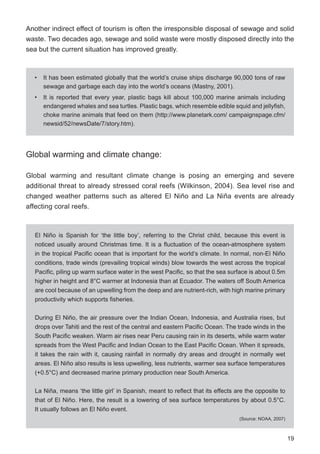
El Niño is Spanish for ‘the little boy’, referring to the Christ child, because this event is
noticed usually around Christmas time. It is a fluctuation of the ocean-atmosphere system
in the tropical Pacific ocean that is important for the world’s climate. In normal, non-El Niño
conditions, trade winds (prevailing tropical winds) blow towards the west across the tropical
Pacific, piling up warm surface water in the west Pacific, so that the sea surface is about 0.5m
higher in height and 8°C warmer at Indonesia than at Ecuador. The waters off South America
are cool because of an upwelling from the deep and are nutrient-rich, with high marine primary
productivity which supports fisheries.
During El Niño, the air pressure over the Indian Ocean, Indonesia, and Australia rises, but
drops over Tahiti and the rest of the central and eastern Pacific Ocean. The trade winds in the
South Pacific weaken. Warm air rises near Peru causing rain in its deserts, while warm water
spreads from the West Pacific and Indian Ocean to the East Pacific Ocean. When it spreads,
it takes the rain with it, causing rainfall in normally dry areas and drought in normally wet
areas. El Niño also results is less upwelling, less nutrients, warmer sea surface temperatures
(+0.5°C) and decreased marine primary production near South America.
La Niña, means ‘the little girl’ in Spanish, meant to reflect that its effects are the opposite to
that of El Niño. Here, the result is a lowering of sea surface temperatures by about 0.5°C.
It usually follows an El Niño event.
(Source: NOAA, 2007)
Unusual warming of sea
surface temperatures
Cooler-than-average sea surface
temperatures, the opposite of El Niño
16.
20
Effects of sealevel rise
Light is essential for zooxanthellae to photosynthesise in coral reefs. Photosynthesis
promotes the production of oxygen, which, in turn, stimulates coral polyp growth and
increased deposition of calcium carbonate and coral reef growth. Changes in sea levels
and associated water depths will change the amount of sunlight reaching coral reefs.
Although healthy reefs are likely to be able to adapt to projected sea level changes,
coral reefs already stressed by other human activities - such as sedimentation and
erosion - will not.
Effects of more dissolved carbon dioxide
Increased CO2
dissolves in the oceans forming a weak acid - carbonic acid - making them
more acidic and reducing calcium carbonate precipitation by coral polyps. It has been
estimated that the precipitation of calcium carbonate has already fallen by an average
of between six and 11% since the industrial revolution. If future atmospheric CO2
levels
reach double the level of pre-industrial times, then it is predicted that calcium precipitation
will fall by a further eight to 17% (Caldeira & Wickett, 2003). This affects the availability of
carbonate atoms for building exoskeletons and with it, reduces reef calcification. This, in
turn, slows down a reef’s ability to grow vertically to keep up with sea-level rise and affects
its protective function.
Ocean acidification will likely disrupt marine food webs and affect the services that coral
reefs provide to humans.
Effects of the increase in ocean temperatures: coral bleaching
Because reef building coral species can live only within a small temperature range, even
a tiny change in temperature causes seriously detrimental effects, as exemplified by the
wide scale coral bleaching of 1998, as a result of an El Niño event. When hermatypic corals
are stressed – such as with an increase in temperature - the critical balance that maintains
their mutualistic relationship with zooxanthellae is lost. The coral may lose some or most
of their zooxanthellae, a major source of nutrition and colour. In this condition, corals are
referred to as ‘bleached.’ In some species, their life cycles are disrupted.
As a result of El Niño event in 1998 and an associated rise in ocean temperatures, coral bleaching
destroyed 16% of the world’s coral reefs and 50% in the Indian Ocean (Wilkinson, 2004).


![Coral reefs[1]](https://cdn.slidesharecdn.com/ss_thumbnails/coralreefs1-140710120225-phpapp02-thumbnail.jpg?width=640&height=640&fit=bounds)


