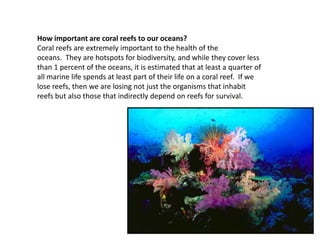
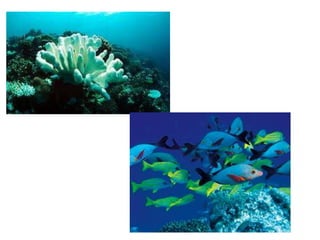
How important are coral reefs to our oceans?
Coral reefs are extremely important to the health of the
oceans. They are hotspots for biodiversity, and while they cover less
than 1 percent of the oceans, it is estimated that at least a quarter of
all marine life spends at least part of their life on a coral reef. If we
lose reefs, then we are losing not just the organisms that inhabit
reefs but also those that indirectly depend on reefs for survival.
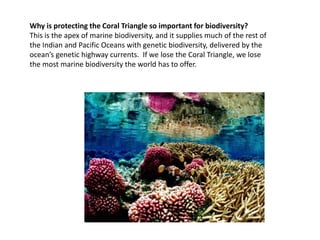
Why is protecting the Coral Triangle so important for biodiversity?
This is the apex of marine biodiversity, and it supplies much of the rest of
the Indian and Pacific Oceans with genetic biodiversity, delivered by the
ocean’s genetic highway currents. If we lose the Coral Triangle, we lose
the most marine biodiversity the world has to offer.
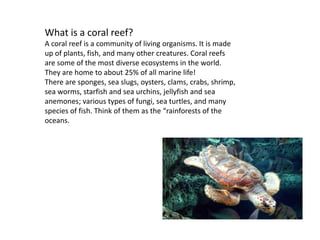
What is a coral reef?
A coral reef is a community of living organisms. It is made
up of plants, fish, and many other creatures. Coral reefs
are some of the most diverse ecosystems in the world.
They are home to about 25% of all marine life!
There are sponges, sea slugs, oysters, clams, crabs, shrimp,
sea worms, starfish and sea urchins, jellyfish and sea
anemones; various types of fungi, sea turtles, and many
species of fish. Think of them as the “rainforests of the
oceans.
Coral reefs are made of tiny animals called
“polyps” that stay fixed in one place and are
the main structure of a reef. Polyps have a hard
outer skeleton made of calcium (similar to a
snail’s shell).
The Great Barrier Reef is the largest coral reef.
It is made up of over 2 900 individual reefs and
900 islands stretching for over 2 600
kilometers off the northeast coast of Australia.
Why are they important?
Coral reefs do a number of amazing things! Reefs
Protect shorelines from big waves by absorbing wave energy
Provide a safe place for fish to spawn (release eggs into the water)
Provide habitats for a large variety of organisms
Provide food (fish and shellfish) for many people living along coastlines
Are a source of medication—some anti-cancer drugs and painkillers come from
reefs
Help in the carbon cycle
Are a good sign of ocean water quality: Healthy reefs = Healthy water.
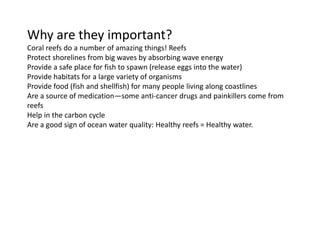
Locations
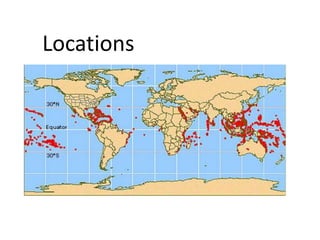
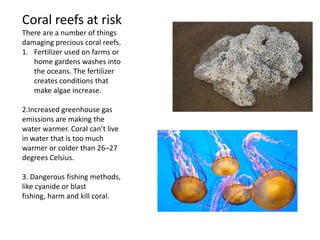
Coral reefs at risk
There are a number of things
damaging precious coral reefs.
1. Fertilizer used on farms or
home gardens washes into
the oceans. The fertilizer
creates conditions that
make algae increase.
2.Increased greenhouse gas
emissions are making the
water warmer. Coral can’t live
in water that is too much
warmer or colder than 26–27
degrees Celsius.
3. Dangerous fishing methods,
like cyanide or blast
fishing, harm and kill coral.
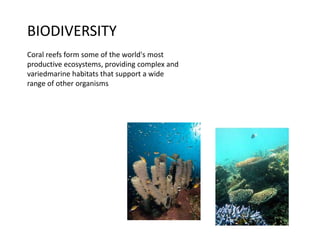
BIODIVERSITY
Coral reefs form some of the world's most
productive ecosystems, providing complex and
variedmarine habitats that support a wide
range of other organisms
THE END

Biodiversity I

  • 2.
    How important arecoral reefs to our oceans? Coral reefs are extremely important to the health of the oceans. They are hotspots for biodiversity, and while they cover less than 1 percent of the oceans, it is estimated that at least a quarter of all marine life spends at least part of their life on a coral reef. If we lose reefs, then we are losing not just the organisms that inhabit reefs but also those that indirectly depend on reefs for survival.
  • 3.
    Why is protectingthe Coral Triangle so important for biodiversity? This is the apex of marine biodiversity, and it supplies much of the rest of the Indian and Pacific Oceans with genetic biodiversity, delivered by the ocean’s genetic highway currents. If we lose the Coral Triangle, we lose the most marine biodiversity the world has to offer.
  • 4.
    What is acoral reef? A coral reef is a community of living organisms. It is made up of plants, fish, and many other creatures. Coral reefs are some of the most diverse ecosystems in the world. They are home to about 25% of all marine life! There are sponges, sea slugs, oysters, clams, crabs, shrimp, sea worms, starfish and sea urchins, jellyfish and sea anemones; various types of fungi, sea turtles, and many species of fish. Think of them as the “rainforests of the oceans.
  • 5.
    Coral reefs aremade of tiny animals called “polyps” that stay fixed in one place and are the main structure of a reef. Polyps have a hard outer skeleton made of calcium (similar to a snail’s shell). The Great Barrier Reef is the largest coral reef. It is made up of over 2 900 individual reefs and 900 islands stretching for over 2 600 kilometers off the northeast coast of Australia.
  • 6.
    Why are theyimportant? Coral reefs do a number of amazing things! Reefs Protect shorelines from big waves by absorbing wave energy Provide a safe place for fish to spawn (release eggs into the water) Provide habitats for a large variety of organisms Provide food (fish and shellfish) for many people living along coastlines Are a source of medication—some anti-cancer drugs and painkillers come from reefs Help in the carbon cycle Are a good sign of ocean water quality: Healthy reefs = Healthy water.
  • 7.
  • 8.
    Coral reefs atrisk There are a number of things damaging precious coral reefs. 1. Fertilizer used on farms or home gardens washes into the oceans. The fertilizer creates conditions that make algae increase. 2.Increased greenhouse gas emissions are making the water warmer. Coral can’t live in water that is too much warmer or colder than 26–27 degrees Celsius. 3. Dangerous fishing methods, like cyanide or blast fishing, harm and kill coral.
  • 9.
    BIODIVERSITY Coral reefs formsome of the world's most productive ecosystems, providing complex and variedmarine habitats that support a wide range of other organisms
  • 11.