Glow Stick(Liquid Light)By: Cheng Wei Loon 2A1 04
IntroductionWhat is glow stick?A translucent plastic tube which emits lightContains isolated substancesWhen the glass capsule inside is broken by bending the stick, light is produced when the substances mixTherefore it can only be used once for a short period of time of about a few hours
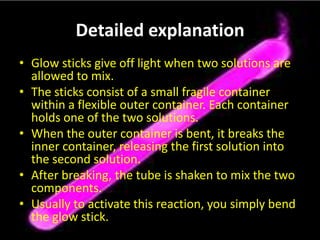
Detailed explanationGlow sticks give off light when two solutions are allowed to mix. The sticks consist of a small fragile container within a flexible outer container. Each container holds one of the two solutions. When the outer container is bent, it breaks the inner container, releasing the first solution into the second solution. After breaking, the tube is shaken to mix the two components. Usually to activate this reaction, you simply bend the glow stick.
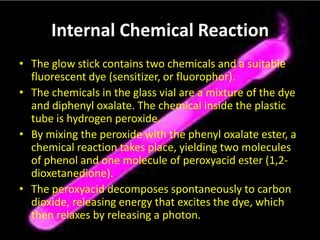
Internal Chemical ReactionThe glow stick contains two chemicals and a suitable fluorescent dye (sensitizer, or fluorophor). The chemicals in the glass vial are a mixture of the dye and diphenyl oxalate. The chemical inside the plastic tube is hydrogen peroxide. By mixing the peroxide with the phenyl oxalate ester, a chemical reaction takes place, yielding two molecules of phenol and one molecule of peroxyacid ester (1,2-dioxetanedione). The peroxyacid decomposes spontaneously to carbon dioxide, releasing energy that excites the dye, which then relaxes by releasing a photon.
Internal Chemical ReactionThe wavelength of the photon—the colour of the emitted light—depends on the structure of the dye. The decomposition is a reverse [2 + 2] cycloaddition, which is a forbidden transition; so the reaction cannot release its energy as heat, but only as a single photon with an exact energy quantum.
Advantages as a light source (1)WaterproofBatteries are not neededGenerate negligible heatInexpensiveReasonably disposableAble to tolerate high pressures, such as those found underwater.
Advantages as a light source (2)Only kind of light source that is ideal safe for use immediately following an earthquake, hurricane, tornado, or other catastrophic emergency situation due to the fact that they do not use any kind of electricity to work and do not create any danger of sparkingUsed in night-time fishing as a lure.
Uses (1)Entertainment (1)Glowsticking– The use of glow sticks in dancingFrequently used for entertainment at parties (particularly raves), concerts and dance clubsCarried by marching band conductors for night-time performancesUsed in Hong Kong during Mid-Autumn FestivalUsed in Iceland during New Year’s Eve
Uses (2)Entertainment (2)Glow sticks carried by Trick-or-Treaters on Halloween neatly serve multiple functions as toys, readily visible and unusual night-time warnings to motorists, and luminous markings which enable parents to keep their brightly colour-coded children in sightUsed in balloon-carried light effectsUsed to create special effects in low light photography and film.
Uses (3)MoviesIn the Star Wars Trilogy, light sabers were made out of giant glow sticks attached to handlesThey would run out of light in a few hours and it was very costly to keep buying new ones
Ways to change life span of glow stickFreezingWhen glow sticks are placed in the freezer, the cold induces a solid-state to the mixture and slows down the photon releaseThis enables the glow stick to be kept for a few daysHeatingIn reverse, microwaving or running hot water over them speeds up the photon release and makes them brighter, but also diminishes the life of the glow stick
DangersGlow sticks contain hydrogen peroxide, and phenol is produced as a by-productIf the chemicals are spilled on the skin, they could cause slight skin irritation, swelling, or, in extreme circumstances, vomiting and nauseaIt is advisable to keep the mixture away from skin and to prevent accidental ingestion if the glow stick case splits or breaks
Pictures
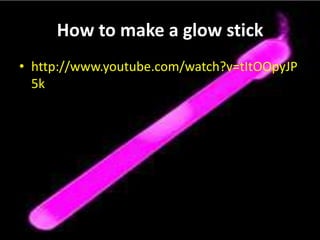
How to make a glow stickhttp://www.youtube.com/watch?v=tItOOpyJP5k
THANK YOU

Glow stick

  • 1.
    Glow Stick(Liquid Light)By:Cheng Wei Loon 2A1 04
  • 2.
    IntroductionWhat is glowstick?A translucent plastic tube which emits lightContains isolated substancesWhen the glass capsule inside is broken by bending the stick, light is produced when the substances mixTherefore it can only be used once for a short period of time of about a few hours
  • 3.
    Detailed explanationGlow sticksgive off light when two solutions are allowed to mix. The sticks consist of a small fragile container within a flexible outer container. Each container holds one of the two solutions. When the outer container is bent, it breaks the inner container, releasing the first solution into the second solution. After breaking, the tube is shaken to mix the two components. Usually to activate this reaction, you simply bend the glow stick.
  • 4.
    Internal Chemical ReactionTheglow stick contains two chemicals and a suitable fluorescent dye (sensitizer, or fluorophor). The chemicals in the glass vial are a mixture of the dye and diphenyl oxalate. The chemical inside the plastic tube is hydrogen peroxide. By mixing the peroxide with the phenyl oxalate ester, a chemical reaction takes place, yielding two molecules of phenol and one molecule of peroxyacid ester (1,2-dioxetanedione). The peroxyacid decomposes spontaneously to carbon dioxide, releasing energy that excites the dye, which then relaxes by releasing a photon.
  • 5.
    Internal Chemical ReactionThewavelength of the photon—the colour of the emitted light—depends on the structure of the dye. The decomposition is a reverse [2 + 2] cycloaddition, which is a forbidden transition; so the reaction cannot release its energy as heat, but only as a single photon with an exact energy quantum.
  • 6.
    Advantages as alight source (1)WaterproofBatteries are not neededGenerate negligible heatInexpensiveReasonably disposableAble to tolerate high pressures, such as those found underwater.
  • 7.
    Advantages as alight source (2)Only kind of light source that is ideal safe for use immediately following an earthquake, hurricane, tornado, or other catastrophic emergency situation due to the fact that they do not use any kind of electricity to work and do not create any danger of sparkingUsed in night-time fishing as a lure.
  • 8.
    Uses (1)Entertainment (1)Glowsticking–The use of glow sticks in dancingFrequently used for entertainment at parties (particularly raves), concerts and dance clubsCarried by marching band conductors for night-time performancesUsed in Hong Kong during Mid-Autumn FestivalUsed in Iceland during New Year’s Eve
  • 9.
    Uses (2)Entertainment (2)Glowsticks carried by Trick-or-Treaters on Halloween neatly serve multiple functions as toys, readily visible and unusual night-time warnings to motorists, and luminous markings which enable parents to keep their brightly colour-coded children in sightUsed in balloon-carried light effectsUsed to create special effects in low light photography and film.
  • 10.
    Uses (3)MoviesIn theStar Wars Trilogy, light sabers were made out of giant glow sticks attached to handlesThey would run out of light in a few hours and it was very costly to keep buying new ones
  • 11.
    Ways to changelife span of glow stickFreezingWhen glow sticks are placed in the freezer, the cold induces a solid-state to the mixture and slows down the photon releaseThis enables the glow stick to be kept for a few daysHeatingIn reverse, microwaving or running hot water over them speeds up the photon release and makes them brighter, but also diminishes the life of the glow stick
  • 12.
    DangersGlow sticks containhydrogen peroxide, and phenol is produced as a by-productIf the chemicals are spilled on the skin, they could cause slight skin irritation, swelling, or, in extreme circumstances, vomiting and nauseaIt is advisable to keep the mixture away from skin and to prevent accidental ingestion if the glow stick case splits or breaks
  • 13.
  • 14.
    How to makea glow stickhttp://www.youtube.com/watch?v=tItOOpyJP5k
  • 15.