COPYRIGHT BASICS FOR
GRAPHIC DESIGNERS
Understanding and
Protecting Your Rights and
the Rights of Others
WHAT IS COPYRIGHT?
Copyright is the exclusive right to control reproduction and
commercial exploitation of your creative work.
Copyright protects any kind of artwork, including illustrations,
photographs and graphic design.
Reference from the American Institute of Graphic Design
COPYRIGHTED WORKS
Link to video about Design & Copyright
YOUR RIGHTS
Except under certain circumstances (see“work made for hire” on
next slide), you own the copyright in your work at the moment you
create it in a “fixed” form of expression.”
A fixed form of expression is any tangible medium that can
be perceived by humans, including traditional forms—such as
paintings, sculptures, writings—and new forms that require a
machine to perceive (e.g., GIF files, CDs, websites).
WORK MADE FOR HIRE
Generally, the person who creates a work is considered its “author” and the
automatic owner of copyright in that work under copyright law.
However, there is a limited exception under the “work made for hire” doctrine:
if you are an employee, your employer is considered the author and automatic
copyright owner of any work you create within the scope of your employment.
In most cases, this doctrine applies only to full-time employees.
If you are doing the work as an independent contractor, your work can legally
be “work made for hire” only if your contract specifically says so, and your
work fits one of a few narrow categories, e.g., a contribution to a collective
work such as an encyclopedia, or a compilation work, such as a website.
WORK NOT MADE FOR HIRE
When you perform graphic art services for a client, your client is paying for
rights to use your work under your copyright. Identifying the scope of such
rights can be the most important part of your contract with your client.
You own your copyright unless you sign a written assignment giving
copyright ownership to someone else. In that case, your contract with your
client will say something like you “assign all rights, including copyright.” But you
can also give (or lend) your client just a piece of your copyright. Copyright is
really a “bundle” of several different exclusive rights.
EXCLUSIVE RIGHTS
For graphic designers, the relevant exclusive rights are the rights to
(1) reproduce, (2) display, and (3) make adaptations (“derivative
works”) based on your work.
Each exclusive right in the copyright bundle can be owned separately. For example,
you can give a newspaper the exclusive right to reproduce your comic strip, and you
can keep the exclusive right to adapt the strip for an animated film.
Moreover, you can give permission, or a “license,” under any of the bundled rights on
a nonexclusive basis. For example, under your reproduction rights, you can grant a
publisher the right to reproduce your painting as a book cover, and you can keep the
right to reproduce it as a giclee print.
EXCLUSIVE RIGHTS CONT'D
Frequently, your client will want to own your copyright. That means your client will own the
entire bundle of rights, and you no longer have the right to control how often, or in what
manner, the work is used. This is not always necessary or appropriate.
Generally, it is better for the scope of the license to closely track the client's intended use of
your work. For example, suppose you are hired to do a spot illustration for an article in a
weekly magazine. Your fee is the standard, reasonable amountfor that one time use.
However, if your contract assigns copyright to the magazine, the magazine can use your
illustration again, for example, it might adapt the illustration to create a logo for an ongoing
weekly column, without any further compensation to you.
On the other hand, if your contract grants a one-time license to reproduce the illustration, the
magazine must seek your permission, in the form of another license with another fee, before it
can legally adapt your illustration for the column logo. This is true even if your license to the
magazine is exclusive, that is, if you agree not to allow any other entity to publish the
illustration. The magazine's rights would still be limited to the one-time use identified in your
contract.
EXCLUSIVE RIGHTS CONT'D
Another important reason to retain copyright is to ensure that you have the right to
create similar works for other clients. If you assign copyright to one client, and then
create a similar illustration for another client, the second illustration could infringe the
first client's copyright in your earlier work. For example, in one case a jury found such
infringement with respect to greeting cards that the same artists had created for
different companies.
Obviously, for some types of work it is appropriate for the client own your entire
copyright, for example, corporate identity packages, logos, websites or any other
works that are intended to have an ongoing, exclusive marketing presence for
your client. It would not be appropriate for you to re-license that kind of work to
another client. In such situations, you should ensure that you have the continuing right
to display and reproduce the work in your print and online portfolios; otherwise, you
no longer need to worry about copyright.
WHAT IS COPYRIGHT INFRINGEMENT?
Copyright infringement happens whenever someone makes copies or commercially
exploits a work without the copyright owner's permission. The second work must
actually be copied from the first work—if you just happen to create a very similar
work independently, that is not infringement. The problems arise when one artist uses
another artist's work as reference.
To be infringing, the second artist's works need not be identical. The standard for
infringement is whether the second work is “substantially similar” to the original work.
(Contrary to popular belief, there is no “20 percent rule,” i.e., you cannot escape
infringement by changing something by 20 percent. Infringement is not a
mathematical calculation.)
COPYRIGHT INFRINGEMENT CONT'D
“Substantially similar” means that an average person viewing
the two works would recognize that the “artistic expression” in
one was copied from the other. The focus on “artistic expression” is
meant to distinguish between illegal copying, which is infringement, and being
inspired by someone else's work, which is not illegal.
“Artistic expression” means the specific artistic choices and details that go into
a work, such as composition, rendering and colors, but not general concepts
such as subject matter or similar artistic style.
However, courts often describe infringing works as having the same “look and
feel” as the originals. Sometimes work depicting similar content in the same
unique artistic style are held infringing, even if specific details are different.
EXAMPLES OF INFRINGEMENT
Unfortunately, infringement is a common occurrence in the graphic arts. Here are
some examples:
•A licensee re-uses the work beyond the scope of the license, as in the example above
where the magazine adapts the illustration for a column logo.
•An illustrator makes a painting from a photograph. Many people think photographs
are just factual records, and thus can be freely copied, or that changing the medium
is sufficient to avoid infringement. This is not correct. Photographs are fully protected
as copyrighted works. If you copy the artistic expression of a photograph, e.g., the
choice of subject matter, props, lighting, point of view, composition, etc., you have
infringed the copyright in the photograph.
•An illustrator copies the unique way another illustrator draws figures.
•An ad campaign uses slogans, images and page designs similar to those of another
ad campaign.
Examples of copyright infringement.
•https://99designs.com/blog/tips/5-famous-copyright-infringement-cases/
EXAMPLES OF INFRINGEMENT
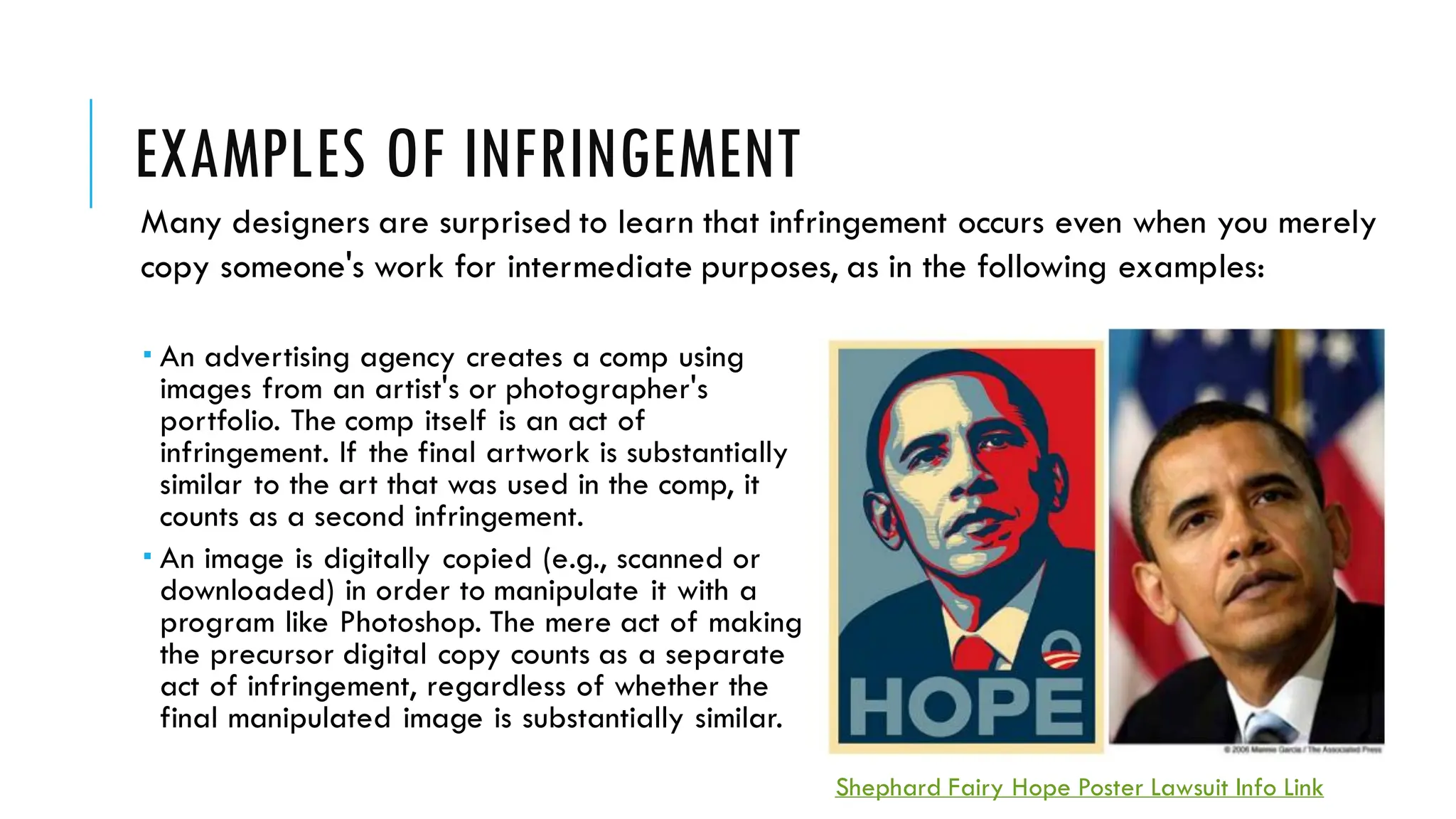
 An advertising agency creates a comp using
images from an artist's or photographer's
portfolio. The comp itself is an act of
infringement. If the final artwork is substantially
similar to the art that was used in the comp, it
counts as a second infringement.
 An image is digitally copied (e.g., scanned or
downloaded) in order to manipulate it with a
program like Photoshop. The mere act of making
the precursor digital copy counts as a separate
act of infringement, regardless of whether the
final manipulated image is substantially similar.
Many designers are surprised to learn that infringement occurs even when you merely
copy someone's work for intermediate purposes, as in the following examples:
Shephard Fairy Hope Poster Lawsuit Info Link
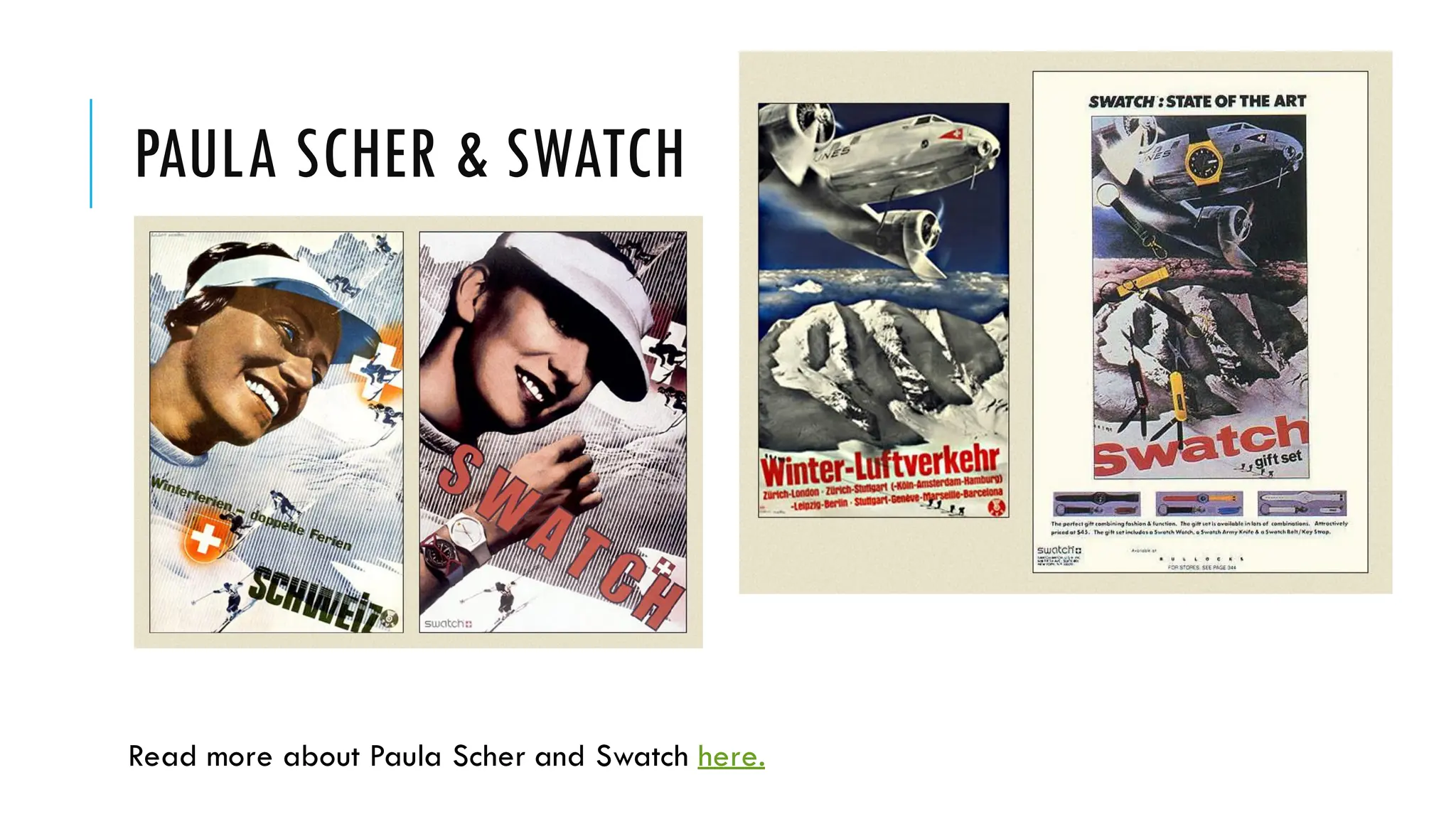
PAULA SCHER & SWATCH
Read more about Paula Scher and Swatch here.
INSPIRATION VS. INFRINGEMENT
Let’s talk about inspiration. Perhaps there’s an
artist out there who really inspires you. If you use
that inspiration in your own work, when exactly
does inspiration become plagiarism?
Plagiarism means imitating another person’s
work and passing it off as your own without
giving credit to the originator.
Inspiration turns into imitation when copying
what is considered the crux—or central idea—of
the work.
INSPIRATION VS. INFRINGEMENT CONT'D
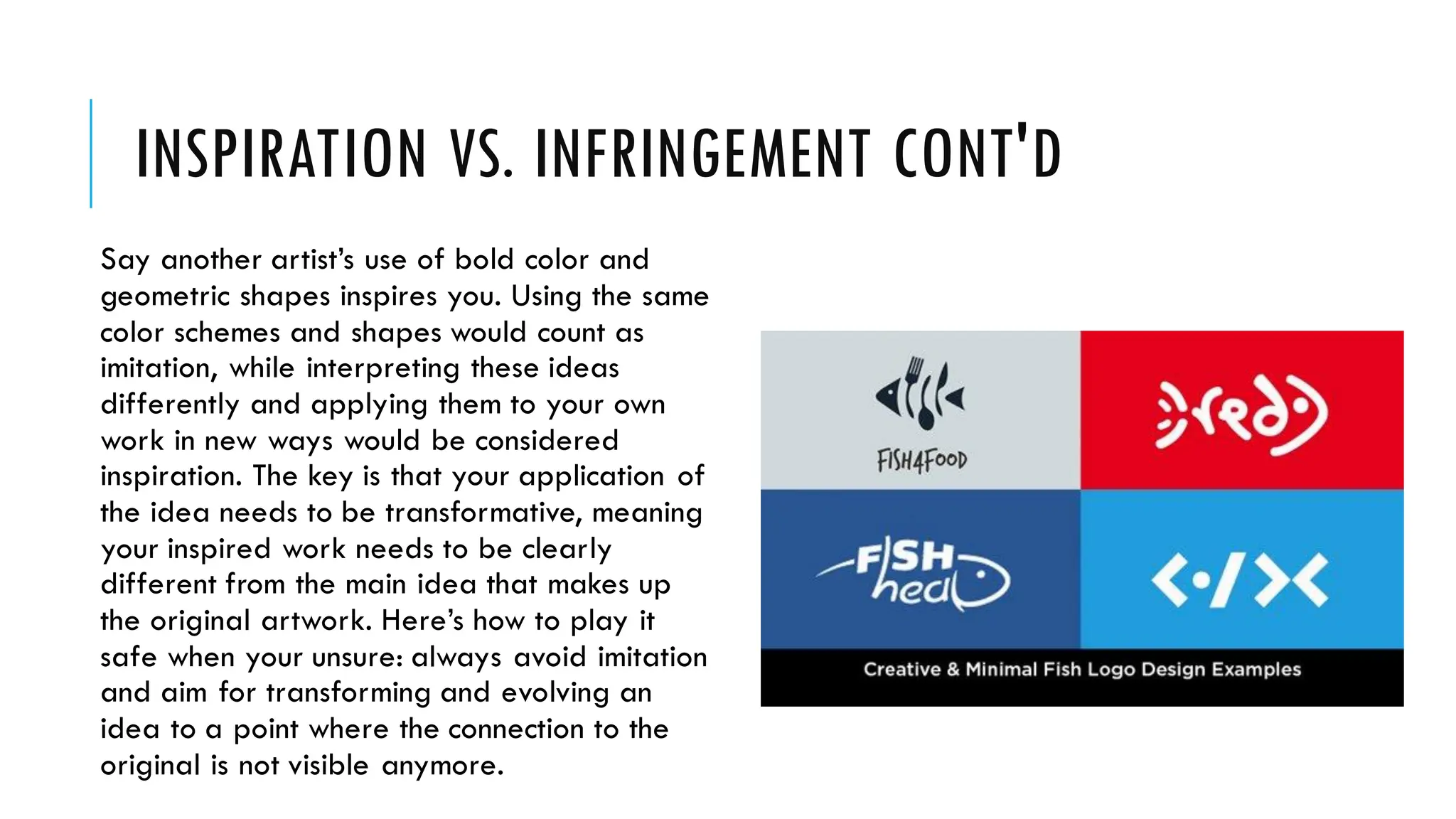
Say another artist’s use of bold color and
geometric shapes inspires you. Using the same
color schemes and shapes would count as
imitation, while interpreting these ideas
differently and applying them to your own
work in new ways would be considered
inspiration. The key is that your application of
the idea needs to be transformative, meaning
your inspired work needs to be clearly
different from the main idea that makes up
the original artwork. Here’s how to play it
safe when your unsure: always avoid imitation
and aim for transforming and evolving an
idea to a point where the connection to the
original is not visible anymore.
WHO IS LIABLE FOR INFRINGEMENT?
Any person or entity involved in the unauthorized use of a copyrighted
work, from the initial copying through publication and distribution, is
liable for infringement.
For example, in one case where a photograph was used in a comp
without permission, the photographer sued the ad agency and the
agency's client for whom the ad was created. The court awarded the
photographer $2,750 in actual damages (the fee he would have
charged had he been given the final assignment), $57,358 for the ad
agency's net revenue earned from the project, his attorneys' fees and an
injunction preventing further use of the infringing ads.
WHAT ABOUT FAIR USE?
“Fair use” will excuse an otherwise
infringing use under certain limited
circumstances. The courts balance several
factors to determine whether a particular
situation qualifies as fair use.
Generally, non-commercial editorial or
educational uses will be fair use.
Parody will also qualify, but only if the
work directly parodies something about the
original work. For example, a Los Angeles
federal court rejected the fair use defense
for a parody entitled “The Cat NOT in the
Hat! A Parody by Dr. Juice,” which used
verses and artwork reminiscent of Dr. Seuss
to mock the O.J. Simpson trial. The court did
not believe the book also critiqued Dr.
Seuss.
TRANSFORMATIVE WORKS
“Transformative” works may also be fair use.
A work is “transformative” when
the copyrighted material is “transformed in the
creation of new information, new aesthetics,
new insights and understanding.” Under this
standard, a New York federal court recently
held that a collage-like painting by Jeff
Koons, which incorporated an image copied
from a fashion photograph with other
disparate images, was fair use.
WHY SHOULD YOU REGISTER YOUR COPYRIGHTS?
Even though you have copyright ownership as soon as you create your work,
under U.S. law you have no rights to enforce your copyright until you register.
Generally you must have filed for copyright registration before the infringement occurs in order to have the full scope of copyright
protection (the exception is if you filed within three months of the first publication of your work; in that case, you have full protection
even if the infringement occurs earlier). Full protectionfor such early registration gives you two important remedies: the right to recover
your attorneys' fees when you win the lawsuit, and the right to an award of statutory damages. Statutory damages means a jurycan
award you an amount of money even if you cannot prove the infringement caused you a specific monetary loss. (Currently, the law sets
a minimum of $750 and a maximum of $150,000 in statutory damages for willful infringement.)
Many artists know that they cannot afford litigation, so they believe these advantages of early registration are not relevant. However,
in most cases it is the possibility of a lawsuit, rather than actual litigation, that gives you the bargaining power to stopan infringement,
and often, obtain a monetary settlement. When defendants receive a letter raising an infringement claim, their first step isto
determine whether you have a copyright registration that predates the infringement. If you do, they know that you are entitled to sue
them for statutory damages and recover your attorney's fees. Your registration enhances their risk of both defending a lawsuit and
incurring monetary damages, so they are motivated to settle. On the other hand, if they learn that you don't have an early registration,
most infringers assume that you will not be able to sue them, and they will be less inclined to negotiate in good faith for areasonable
settlement.
There is no substitute for early registration. (Contrary to a popular myth, there is no “poor man's copyright”—putting a copy of
your work in an envelope and mailing it back to yourself will not provide any legal protection.)The best practice is to register any
work that will be seen by the public or potential clients, including your portfolio and websites. Unauthorized copying is temptingly easy,
and infringements are common. Early registration is the best proactive step you can take to ensure that you will have the full power to
react in the unfortunate event that your work is infringed.
USING COMMERCIAL FREE IMAGES
Understand these terms before using any "free" images
A few things to know before we get started. The following terms will come up often as we discuss free image sources. Read over the
terms and conditions of each site you try so you know exactly when and what type of attribution is required.
What is Creative Commons? Creative Commons is a nonprofit organization that enables the sharing
and use of creativity and knowledge through free legal tools. There are various types of Creative
Commons licenses that range from allowing any type of use with no attribution to allowing only certain
uses and no changes.
What is public domain? Works in the public domain are those whose copyrights have expired, have
been forfeited, or are inapplicable. Finding something on the internet does not mean it is in the public
domain.
What is royalty free? Royalty-free images aren’t necessarily free. In most cases, you’ll have to pay a
one-time fee to obtain the rights to use the image. Then you can use it as many times as you like. The
“free” in “royalty-free” only means that you do not have to pay royalties to the owner of the image
every time you use it. For a comprehensive read on royalty-free images, check out this guide by Amos
Struck. These are also called Stock Images.
(RELATIVELY) FREE
IMAGE SITES TO TRY
Link to 24+ Sites to Find Free Images You
Would Actually Use for Your Marketing
Please check the licensing agreement for each image
before you use it.
Always note the site you got your image from and
grab a copy or screenshot of the image license.
THOUGHTS?
THOUGHTS?
MORE READING ABOUT COPYRIGHTS FOR
DESIGNERS
https://eyeondesign.aiga.org/what-young-designers-need-to-know-about-copyright-
law/
Definite Read:
https://99designs.com/blog/design-resources/copyright-infringement/

Copyright Basics for New Graphic Designers

  • 1.
    COPYRIGHT BASICS FOR GRAPHICDESIGNERS Understanding and Protecting Your Rights and the Rights of Others
  • 2.
    WHAT IS COPYRIGHT? Copyrightis the exclusive right to control reproduction and commercial exploitation of your creative work. Copyright protects any kind of artwork, including illustrations, photographs and graphic design. Reference from the American Institute of Graphic Design
  • 3.
    COPYRIGHTED WORKS Link tovideo about Design & Copyright
  • 4.
    YOUR RIGHTS Except undercertain circumstances (see“work made for hire” on next slide), you own the copyright in your work at the moment you create it in a “fixed” form of expression.” A fixed form of expression is any tangible medium that can be perceived by humans, including traditional forms—such as paintings, sculptures, writings—and new forms that require a machine to perceive (e.g., GIF files, CDs, websites).
  • 5.
    WORK MADE FORHIRE Generally, the person who creates a work is considered its “author” and the automatic owner of copyright in that work under copyright law. However, there is a limited exception under the “work made for hire” doctrine: if you are an employee, your employer is considered the author and automatic copyright owner of any work you create within the scope of your employment. In most cases, this doctrine applies only to full-time employees. If you are doing the work as an independent contractor, your work can legally be “work made for hire” only if your contract specifically says so, and your work fits one of a few narrow categories, e.g., a contribution to a collective work such as an encyclopedia, or a compilation work, such as a website.
  • 6.
    WORK NOT MADEFOR HIRE When you perform graphic art services for a client, your client is paying for rights to use your work under your copyright. Identifying the scope of such rights can be the most important part of your contract with your client. You own your copyright unless you sign a written assignment giving copyright ownership to someone else. In that case, your contract with your client will say something like you “assign all rights, including copyright.” But you can also give (or lend) your client just a piece of your copyright. Copyright is really a “bundle” of several different exclusive rights.
  • 7.
    EXCLUSIVE RIGHTS For graphicdesigners, the relevant exclusive rights are the rights to (1) reproduce, (2) display, and (3) make adaptations (“derivative works”) based on your work. Each exclusive right in the copyright bundle can be owned separately. For example, you can give a newspaper the exclusive right to reproduce your comic strip, and you can keep the exclusive right to adapt the strip for an animated film. Moreover, you can give permission, or a “license,” under any of the bundled rights on a nonexclusive basis. For example, under your reproduction rights, you can grant a publisher the right to reproduce your painting as a book cover, and you can keep the right to reproduce it as a giclee print.
  • 8.
    EXCLUSIVE RIGHTS CONT'D Frequently,your client will want to own your copyright. That means your client will own the entire bundle of rights, and you no longer have the right to control how often, or in what manner, the work is used. This is not always necessary or appropriate. Generally, it is better for the scope of the license to closely track the client's intended use of your work. For example, suppose you are hired to do a spot illustration for an article in a weekly magazine. Your fee is the standard, reasonable amountfor that one time use. However, if your contract assigns copyright to the magazine, the magazine can use your illustration again, for example, it might adapt the illustration to create a logo for an ongoing weekly column, without any further compensation to you. On the other hand, if your contract grants a one-time license to reproduce the illustration, the magazine must seek your permission, in the form of another license with another fee, before it can legally adapt your illustration for the column logo. This is true even if your license to the magazine is exclusive, that is, if you agree not to allow any other entity to publish the illustration. The magazine's rights would still be limited to the one-time use identified in your contract.
  • 9.
    EXCLUSIVE RIGHTS CONT'D Anotherimportant reason to retain copyright is to ensure that you have the right to create similar works for other clients. If you assign copyright to one client, and then create a similar illustration for another client, the second illustration could infringe the first client's copyright in your earlier work. For example, in one case a jury found such infringement with respect to greeting cards that the same artists had created for different companies. Obviously, for some types of work it is appropriate for the client own your entire copyright, for example, corporate identity packages, logos, websites or any other works that are intended to have an ongoing, exclusive marketing presence for your client. It would not be appropriate for you to re-license that kind of work to another client. In such situations, you should ensure that you have the continuing right to display and reproduce the work in your print and online portfolios; otherwise, you no longer need to worry about copyright.
  • 10.
    WHAT IS COPYRIGHTINFRINGEMENT? Copyright infringement happens whenever someone makes copies or commercially exploits a work without the copyright owner's permission. The second work must actually be copied from the first work—if you just happen to create a very similar work independently, that is not infringement. The problems arise when one artist uses another artist's work as reference. To be infringing, the second artist's works need not be identical. The standard for infringement is whether the second work is “substantially similar” to the original work. (Contrary to popular belief, there is no “20 percent rule,” i.e., you cannot escape infringement by changing something by 20 percent. Infringement is not a mathematical calculation.)
  • 11.
    COPYRIGHT INFRINGEMENT CONT'D “Substantiallysimilar” means that an average person viewing the two works would recognize that the “artistic expression” in one was copied from the other. The focus on “artistic expression” is meant to distinguish between illegal copying, which is infringement, and being inspired by someone else's work, which is not illegal. “Artistic expression” means the specific artistic choices and details that go into a work, such as composition, rendering and colors, but not general concepts such as subject matter or similar artistic style. However, courts often describe infringing works as having the same “look and feel” as the originals. Sometimes work depicting similar content in the same unique artistic style are held infringing, even if specific details are different.
  • 12.
    EXAMPLES OF INFRINGEMENT Unfortunately,infringement is a common occurrence in the graphic arts. Here are some examples: •A licensee re-uses the work beyond the scope of the license, as in the example above where the magazine adapts the illustration for a column logo. •An illustrator makes a painting from a photograph. Many people think photographs are just factual records, and thus can be freely copied, or that changing the medium is sufficient to avoid infringement. This is not correct. Photographs are fully protected as copyrighted works. If you copy the artistic expression of a photograph, e.g., the choice of subject matter, props, lighting, point of view, composition, etc., you have infringed the copyright in the photograph. •An illustrator copies the unique way another illustrator draws figures. •An ad campaign uses slogans, images and page designs similar to those of another ad campaign. Examples of copyright infringement. •https://99designs.com/blog/tips/5-famous-copyright-infringement-cases/
  • 13.
    EXAMPLES OF INFRINGEMENT An advertising agency creates a comp using images from an artist's or photographer's portfolio. The comp itself is an act of infringement. If the final artwork is substantially similar to the art that was used in the comp, it counts as a second infringement.  An image is digitally copied (e.g., scanned or downloaded) in order to manipulate it with a program like Photoshop. The mere act of making the precursor digital copy counts as a separate act of infringement, regardless of whether the final manipulated image is substantially similar. Many designers are surprised to learn that infringement occurs even when you merely copy someone's work for intermediate purposes, as in the following examples: Shephard Fairy Hope Poster Lawsuit Info Link
  • 14.
    PAULA SCHER &SWATCH Read more about Paula Scher and Swatch here.
  • 15.
    INSPIRATION VS. INFRINGEMENT Let’stalk about inspiration. Perhaps there’s an artist out there who really inspires you. If you use that inspiration in your own work, when exactly does inspiration become plagiarism? Plagiarism means imitating another person’s work and passing it off as your own without giving credit to the originator. Inspiration turns into imitation when copying what is considered the crux—or central idea—of the work.
  • 16.
    INSPIRATION VS. INFRINGEMENTCONT'D Say another artist’s use of bold color and geometric shapes inspires you. Using the same color schemes and shapes would count as imitation, while interpreting these ideas differently and applying them to your own work in new ways would be considered inspiration. The key is that your application of the idea needs to be transformative, meaning your inspired work needs to be clearly different from the main idea that makes up the original artwork. Here’s how to play it safe when your unsure: always avoid imitation and aim for transforming and evolving an idea to a point where the connection to the original is not visible anymore.
  • 17.
    WHO IS LIABLEFOR INFRINGEMENT? Any person or entity involved in the unauthorized use of a copyrighted work, from the initial copying through publication and distribution, is liable for infringement. For example, in one case where a photograph was used in a comp without permission, the photographer sued the ad agency and the agency's client for whom the ad was created. The court awarded the photographer $2,750 in actual damages (the fee he would have charged had he been given the final assignment), $57,358 for the ad agency's net revenue earned from the project, his attorneys' fees and an injunction preventing further use of the infringing ads.
  • 18.
    WHAT ABOUT FAIRUSE? “Fair use” will excuse an otherwise infringing use under certain limited circumstances. The courts balance several factors to determine whether a particular situation qualifies as fair use. Generally, non-commercial editorial or educational uses will be fair use. Parody will also qualify, but only if the work directly parodies something about the original work. For example, a Los Angeles federal court rejected the fair use defense for a parody entitled “The Cat NOT in the Hat! A Parody by Dr. Juice,” which used verses and artwork reminiscent of Dr. Seuss to mock the O.J. Simpson trial. The court did not believe the book also critiqued Dr. Seuss.
  • 19.
    TRANSFORMATIVE WORKS “Transformative” worksmay also be fair use. A work is “transformative” when the copyrighted material is “transformed in the creation of new information, new aesthetics, new insights and understanding.” Under this standard, a New York federal court recently held that a collage-like painting by Jeff Koons, which incorporated an image copied from a fashion photograph with other disparate images, was fair use.
  • 20.
    WHY SHOULD YOUREGISTER YOUR COPYRIGHTS? Even though you have copyright ownership as soon as you create your work, under U.S. law you have no rights to enforce your copyright until you register. Generally you must have filed for copyright registration before the infringement occurs in order to have the full scope of copyright protection (the exception is if you filed within three months of the first publication of your work; in that case, you have full protection even if the infringement occurs earlier). Full protectionfor such early registration gives you two important remedies: the right to recover your attorneys' fees when you win the lawsuit, and the right to an award of statutory damages. Statutory damages means a jurycan award you an amount of money even if you cannot prove the infringement caused you a specific monetary loss. (Currently, the law sets a minimum of $750 and a maximum of $150,000 in statutory damages for willful infringement.) Many artists know that they cannot afford litigation, so they believe these advantages of early registration are not relevant. However, in most cases it is the possibility of a lawsuit, rather than actual litigation, that gives you the bargaining power to stopan infringement, and often, obtain a monetary settlement. When defendants receive a letter raising an infringement claim, their first step isto determine whether you have a copyright registration that predates the infringement. If you do, they know that you are entitled to sue them for statutory damages and recover your attorney's fees. Your registration enhances their risk of both defending a lawsuit and incurring monetary damages, so they are motivated to settle. On the other hand, if they learn that you don't have an early registration, most infringers assume that you will not be able to sue them, and they will be less inclined to negotiate in good faith for areasonable settlement. There is no substitute for early registration. (Contrary to a popular myth, there is no “poor man's copyright”—putting a copy of your work in an envelope and mailing it back to yourself will not provide any legal protection.)The best practice is to register any work that will be seen by the public or potential clients, including your portfolio and websites. Unauthorized copying is temptingly easy, and infringements are common. Early registration is the best proactive step you can take to ensure that you will have the full power to react in the unfortunate event that your work is infringed.
  • 21.
    USING COMMERCIAL FREEIMAGES Understand these terms before using any "free" images A few things to know before we get started. The following terms will come up often as we discuss free image sources. Read over the terms and conditions of each site you try so you know exactly when and what type of attribution is required. What is Creative Commons? Creative Commons is a nonprofit organization that enables the sharing and use of creativity and knowledge through free legal tools. There are various types of Creative Commons licenses that range from allowing any type of use with no attribution to allowing only certain uses and no changes. What is public domain? Works in the public domain are those whose copyrights have expired, have been forfeited, or are inapplicable. Finding something on the internet does not mean it is in the public domain. What is royalty free? Royalty-free images aren’t necessarily free. In most cases, you’ll have to pay a one-time fee to obtain the rights to use the image. Then you can use it as many times as you like. The “free” in “royalty-free” only means that you do not have to pay royalties to the owner of the image every time you use it. For a comprehensive read on royalty-free images, check out this guide by Amos Struck. These are also called Stock Images.
  • 22.
    (RELATIVELY) FREE IMAGE SITESTO TRY Link to 24+ Sites to Find Free Images You Would Actually Use for Your Marketing Please check the licensing agreement for each image before you use it. Always note the site you got your image from and grab a copy or screenshot of the image license.
  • 23.
  • 24.
  • 25.
    MORE READING ABOUTCOPYRIGHTS FOR DESIGNERS https://eyeondesign.aiga.org/what-young-designers-need-to-know-about-copyright- law/ Definite Read: https://99designs.com/blog/design-resources/copyright-infringement/