Copy Reading andHeadlining
A Guide for Student Journalists
Your Name / Class / Date
2.
Introduction
• Copy Reading:Reviewing written news stories before publication.
• Headlining: Writing the title that summarizes and attracts readers.
• Both are essential for accuracy, clarity, and reader engagement.
3.
Importance of CopyReading
• Ensures accuracy of facts and figures
• Corrects grammar, spelling, and punctuation errors
• Improves sentence clarity and flow
• Checks for ethical standards and fairness
4.
Steps in CopyReading
• Check Facts: Names, dates, numbers, and places
• Review Grammar & Spelling
• Assess Clarity: Remove ambiguous words
• Ensure Consistency: Style, tone, and tense
• Follow the Publication Style Guide
5.
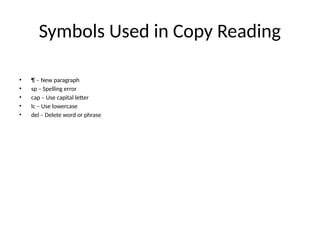
Symbols Used inCopy Reading
• ¶ – New paragraph
• sp – Spelling error
• cap – Use capital letter
• lc – Use lowercase
• del – Delete word or phrase
6.
Headlining Basics
• Definition:Short, catchy statement summarizing the story
• Purpose: Attract readers, Summarize key point, Indicate tone and importance
7.
Qualities of aGood Headline
• Brief and clear
• Accurate and specific
• Uses strong action words
• Avoids sensationalism
• Fits the space available
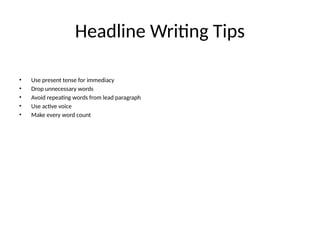
Headline Writing Tips
•Use present tense for immediacy
• Drop unnecessary words
• Avoid repeating words from lead paragraph
• Use active voice
• Make every word count
10.
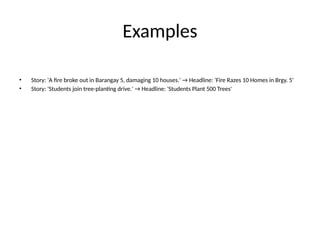
Examples
• Story: 'Afire broke out in Barangay 5, damaging 10 houses.' → Headline: 'Fire Razes 10 Homes in Brgy. 5'
• Story: 'Students join tree-planting drive.' → Headline: 'Students Plant 500 Trees'
11.
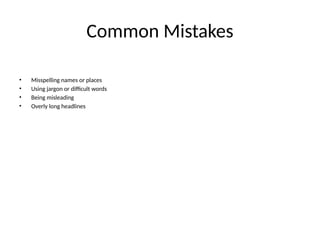
Common Mistakes
• Misspellingnames or places
• Using jargon or difficult words
• Being misleading
• Overly long headlines
12.
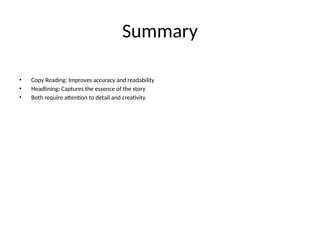
Summary
• Copy Reading:Improves accuracy and readability
• Headlining: Captures the essence of the story
• Both require attention to detail and creativity
13.
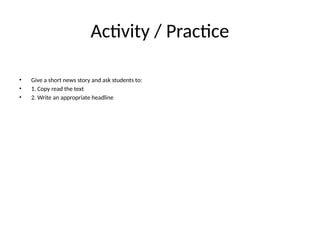
Activity / Practice
•Give a short news story and ask students to:
• 1. Copy read the text
• 2. Write an appropriate headline