COPULA
AND
SUBJECT-
VERB
Presenter: Michelle B. Gepitulan
The copula be poses the greatest problems at the initial stage.
Research on L2 morpheme acquisition has shown that the third
person singular present tense –s inflection causes persistent
problem for learners even at more advanced stages of proficiency.
FORM: THE STRUCTURAL ROLES OF BE
Be functions as an auxiliary verb as well as a copula, so we should first
take stock of these two distinct functions:
Copula: John is
a teacher
tall
in Boston
.
Auxiliary: John is talking to Susan. (progressive aspect)
WHY THE COPULA BE IS DIFFERENT FROM
OTHER VERBS
The rule for expanding the verb phrase makes a clear
distinction between copular verbs like be and all
other verbs in English.
First of all, be, which is the most frequent verb in English,
has more distinct forms with respect to person, number,
and tense than any other verb in English.
The traditional paradigm for be compared with that
for a lexical verb such as walk makes this clear:
COPULA BE
Present Tense Past Tense
Person Singular Plural Singular Plural
1st I am we are I was we were
2nd you are you are you were you were
3rd he/she/it
is
they are he/she/it was they were
VERB WALK
Present Tense Past Tense
Person Singular Plural Singular Plural
1st I walk we walk I walked we walked
2nd you walk you walk you walked you walked
3rd he/she/it
walk
they walk he/she/it walked they walked
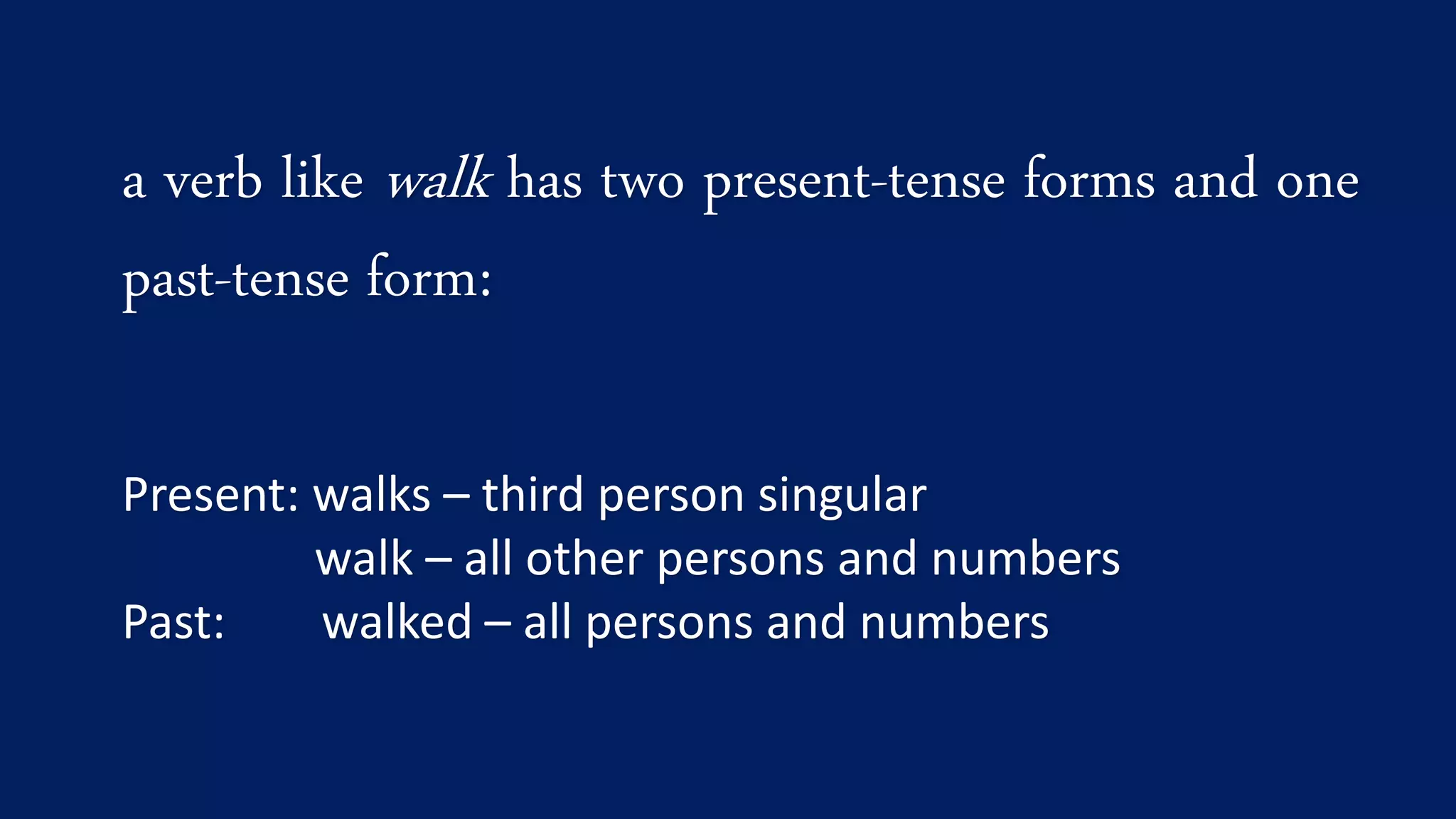
a verb like walk has two present-tense forms and one
past-tense form:
Present: walks – third person singular
walk – all other persons and numbers
Past: walked – all persons and numbers
am
isare
1st person sg. (I)
3rd person sg. (he, she, it)
everything else
Present Tense
was
were everything else
1st and 3rd
Person sg.
(I, he, she, it)
Past Tense
*You is late.
*We was on time.
Second, the copula be may be followed by adjective
phrases, a defining characteristic that it shares with
many other copular verbs.
three other types of copulas
1. perception copulas (mental or sensory). The perceiver is
sometimes expressed.
They
appear
seem
feel
look
smell
sound
taste
funny (to me).
2. state copulas (tend to take participial adjectives)
They
lie
remain
rest
stand
protected.
3. change-of-state copulas (often only one or two adjectives
go with a given copula).
They
become
come
fall
get
go
grow
run
turn
tall.
true.
ill.
wild.
Third, the syntactic behavior of the copula be, which behaves like
an auxiliary verb and has operator function with regard to
question formation, negation, and other constructions, is very
different from that of other verbs like walk, which require the
addition of a do auxiliary as the operator if no other auxiliary
verb is present.
Hal is an engineer. Hall walks to work.
Is Hal an engineer? Does Hal walk to work?
Hal isn’t a teacher. Hal doesn’t walk home.
Finally, the copula be does not occur in all languages, but all
languages have verbs. Especially in the present tense, many
languages have nothing equivalent to the copula be
In sum, a verb is copular if it is followed by a noun
phrase, an adjective phrase, or an adverbial that
specifically predicates something about the subject of the
verb
MEANING
USE
THE COPULA BE AS A LEARNING
PROBLEM
A
N
Y
QUEST
IONS?
Sometimes, you have to get
through
your fears to see the beauty
of the other side.
THANK YOU!

Copula

  • 1.
  • 2.
    The copula beposes the greatest problems at the initial stage. Research on L2 morpheme acquisition has shown that the third person singular present tense –s inflection causes persistent problem for learners even at more advanced stages of proficiency.
  • 3.
    FORM: THE STRUCTURALROLES OF BE Be functions as an auxiliary verb as well as a copula, so we should first take stock of these two distinct functions: Copula: John is a teacher tall in Boston . Auxiliary: John is talking to Susan. (progressive aspect)
  • 4.
    WHY THE COPULABE IS DIFFERENT FROM OTHER VERBS The rule for expanding the verb phrase makes a clear distinction between copular verbs like be and all other verbs in English.
  • 5.
    First of all,be, which is the most frequent verb in English, has more distinct forms with respect to person, number, and tense than any other verb in English.
  • 6.
    The traditional paradigmfor be compared with that for a lexical verb such as walk makes this clear:
  • 7.
    COPULA BE Present TensePast Tense Person Singular Plural Singular Plural 1st I am we are I was we were 2nd you are you are you were you were 3rd he/she/it is they are he/she/it was they were
  • 8.
    VERB WALK Present TensePast Tense Person Singular Plural Singular Plural 1st I walk we walk I walked we walked 2nd you walk you walk you walked you walked 3rd he/she/it walk they walk he/she/it walked they walked
  • 9.
    a verb likewalk has two present-tense forms and one past-tense form: Present: walks – third person singular walk – all other persons and numbers Past: walked – all persons and numbers
  • 10.
    am isare 1st person sg.(I) 3rd person sg. (he, she, it) everything else Present Tense
  • 11.
    was were everything else 1stand 3rd Person sg. (I, he, she, it) Past Tense
  • 12.
    *You is late. *Wewas on time.
  • 13.
    Second, the copulabe may be followed by adjective phrases, a defining characteristic that it shares with many other copular verbs.
  • 14.
    three other typesof copulas 1. perception copulas (mental or sensory). The perceiver is sometimes expressed. They appear seem feel look smell sound taste funny (to me).
  • 15.
    2. state copulas(tend to take participial adjectives) They lie remain rest stand protected.
  • 16.
    3. change-of-state copulas(often only one or two adjectives go with a given copula). They become come fall get go grow run turn tall. true. ill. wild.
  • 17.
    Third, the syntacticbehavior of the copula be, which behaves like an auxiliary verb and has operator function with regard to question formation, negation, and other constructions, is very different from that of other verbs like walk, which require the addition of a do auxiliary as the operator if no other auxiliary verb is present.
  • 18.
    Hal is anengineer. Hall walks to work. Is Hal an engineer? Does Hal walk to work? Hal isn’t a teacher. Hal doesn’t walk home.
  • 19.
    Finally, the copulabe does not occur in all languages, but all languages have verbs. Especially in the present tense, many languages have nothing equivalent to the copula be
  • 20.
    In sum, averb is copular if it is followed by a noun phrase, an adjective phrase, or an adverbial that specifically predicates something about the subject of the verb
  • 21.
    MEANING USE THE COPULA BEAS A LEARNING PROBLEM
  • 22.
  • 23.
    Sometimes, you haveto get through your fears to see the beauty of the other side.
  • 24.