A Randomized Controlled Trial Comparing
Single-Inhaler Triple Therapy versus Dual
Bronchodilator Therapy in Egyptian Patients with
COPD
Shams Samih Albarari, Mohammad Wagdy
Presenter : Mohammad Wagdy
Abstract
PulmoGut 2025 Conference
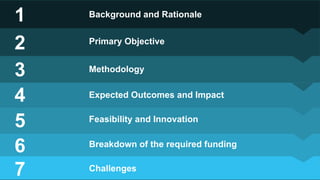
7 Challenges
6 Breakdown of the required funding
5 Feasibility and Innovation
4 Expected Outcomes and Impact
3 Methodology
2 Primary Objective
Table of Content
7 Challenges
6 Breakdown of the required funding
5 Feasibility and Innovation
4 Expected Outcomes and Impact
3 Methodology
2 Primary Objective
1 Background and Rationale
According to recent findings, the landscape of combination inhalers
is expanding, with fixed-dose combinations of LABAs and LAMAs,
with or without ICS, continuing to be refined. COPD affects about
7.5% of Egyptians (2019). Current NICE guidelines encourage a
stepped treatment approach, recommending triple therapy
(LAMA/LABA/ICS) for patients experiencing exacerbations.
However, existing RCTs often use strict eligibility criteria, resulting
in trial populations that may not reflect real-world clinical practice.
Specifically, common criteria related to exacerbations and
medication use exclude a large proportion of patients seen in routine
care. This highlights the need for pragmatic RCTs to understand
treatment effectiveness across the broader COPD population.
Background and Rationale
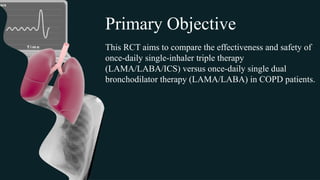
This RCT aims to compare the effectiveness and safety of
once-daily single-inhaler triple therapy
(LAMA/LABA/ICS) versus once-daily single dual
bronchodilator therapy (LAMA/LABA) in COPD patients.
Primary Objective
Methodology
This RCT will be conducted in Banha Hospital with a sample size of 555.
To enhance generalizability, we will apply more pragmatic eligibility criteria, minimizing
exclusions for common comorbidities or recent exacerbations.
Patients will be randomized to triple or dual therapy.
Primary outcome is the rate of moderate to severe COPD exacerbations over 12 months.
Secondary outcomes include changes in lung function (FEV1​
%) and incidence of adverse
events.
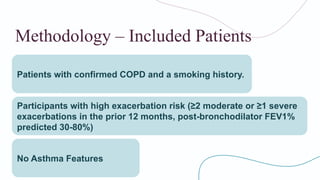
Methodology – Included Patients
No Asthma Features
Patients with confirmed COPD and a smoking history.
Participants with high exacerbation risk (≥2 moderate or ≥1 severe
exacerbations in the prior 12 months, post-bronchodilator FEV1​
%
predicted 30-80%)
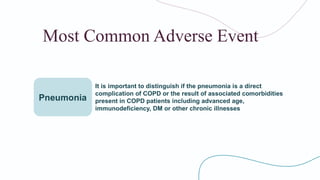
Most Common Adverse Event
Pneumonia
It is important to distinguish if the pneumonia is a direct
complication of COPD or the result of associated comorbidities
present in COPD patients including advanced age,
immunodeficiency, DM or other chronic illnesses
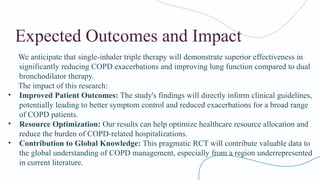
Expected Outcomes and Impact
We anticipate that single-inhaler triple therapy will demonstrate superior effectiveness in
significantly reducing COPD exacerbations and improving lung function compared to dual
bronchodilator therapy.
The impact of this research:
• Improved Patient Outcomes: The study's findings will directly inform clinical guidelines,
potentially leading to better symptom control and reduced exacerbations for a broad range
of COPD patients.
• Resource Optimization: Our results can help optimize healthcare resource allocation and
reduce the burden of COPD-related hospitalizations.
• Contribution to Global Knowledge: This pragmatic RCT will contribute valuable data to
the global understanding of COPD management, especially from a region underrepresented
in current literature.
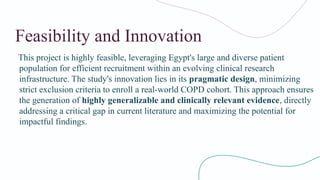
Feasibility and Innovation
This project is highly feasible, leveraging Egypt's large and diverse patient
population for efficient recruitment within an evolving clinical research
infrastructure. The study's innovation lies in its pragmatic design, minimizing
strict exclusion criteria to enroll a real-world COPD cohort. This approach ensures
the generation of highly generalizable and clinically relevant evidence, directly
addressing a critical gap in current literature and maximizing the potential for
impactful findings.
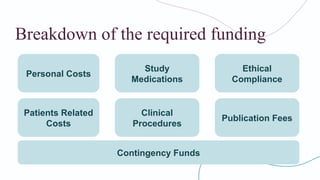
Breakdown of the required funding
Personal Costs
Patients Related
Costs
Study
Medications
Clinical
Procedures
Ethical
Compliance
Publication Fees
Contingency Funds
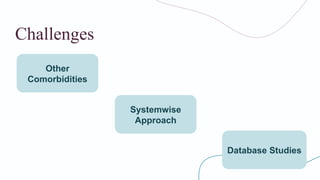
Challenges
Other
Comorbidities
Systemwise
Approach
Database Studies
Thank You!

COPD_Randomized_control_trial_presentation.pptx

  • 1.
    A Randomized ControlledTrial Comparing Single-Inhaler Triple Therapy versus Dual Bronchodilator Therapy in Egyptian Patients with COPD Shams Samih Albarari, Mohammad Wagdy Presenter : Mohammad Wagdy Abstract PulmoGut 2025 Conference
  • 2.
    7 Challenges 6 Breakdownof the required funding 5 Feasibility and Innovation 4 Expected Outcomes and Impact 3 Methodology 2 Primary Objective Table of Content
  • 3.
    7 Challenges 6 Breakdownof the required funding 5 Feasibility and Innovation 4 Expected Outcomes and Impact 3 Methodology 2 Primary Objective 1 Background and Rationale
  • 4.
    According to recentfindings, the landscape of combination inhalers is expanding, with fixed-dose combinations of LABAs and LAMAs, with or without ICS, continuing to be refined. COPD affects about 7.5% of Egyptians (2019). Current NICE guidelines encourage a stepped treatment approach, recommending triple therapy (LAMA/LABA/ICS) for patients experiencing exacerbations. However, existing RCTs often use strict eligibility criteria, resulting in trial populations that may not reflect real-world clinical practice. Specifically, common criteria related to exacerbations and medication use exclude a large proportion of patients seen in routine care. This highlights the need for pragmatic RCTs to understand treatment effectiveness across the broader COPD population. Background and Rationale
  • 5.
    This RCT aimsto compare the effectiveness and safety of once-daily single-inhaler triple therapy (LAMA/LABA/ICS) versus once-daily single dual bronchodilator therapy (LAMA/LABA) in COPD patients. Primary Objective
  • 6.
    Methodology This RCT willbe conducted in Banha Hospital with a sample size of 555. To enhance generalizability, we will apply more pragmatic eligibility criteria, minimizing exclusions for common comorbidities or recent exacerbations. Patients will be randomized to triple or dual therapy. Primary outcome is the rate of moderate to severe COPD exacerbations over 12 months. Secondary outcomes include changes in lung function (FEV1​ %) and incidence of adverse events.
  • 7.
    Methodology – IncludedPatients No Asthma Features Patients with confirmed COPD and a smoking history. Participants with high exacerbation risk (≥2 moderate or ≥1 severe exacerbations in the prior 12 months, post-bronchodilator FEV1​ % predicted 30-80%)
  • 8.
    Most Common AdverseEvent Pneumonia It is important to distinguish if the pneumonia is a direct complication of COPD or the result of associated comorbidities present in COPD patients including advanced age, immunodeficiency, DM or other chronic illnesses
  • 9.
    Expected Outcomes andImpact We anticipate that single-inhaler triple therapy will demonstrate superior effectiveness in significantly reducing COPD exacerbations and improving lung function compared to dual bronchodilator therapy. The impact of this research: • Improved Patient Outcomes: The study's findings will directly inform clinical guidelines, potentially leading to better symptom control and reduced exacerbations for a broad range of COPD patients. • Resource Optimization: Our results can help optimize healthcare resource allocation and reduce the burden of COPD-related hospitalizations. • Contribution to Global Knowledge: This pragmatic RCT will contribute valuable data to the global understanding of COPD management, especially from a region underrepresented in current literature.
  • 10.
    Feasibility and Innovation Thisproject is highly feasible, leveraging Egypt's large and diverse patient population for efficient recruitment within an evolving clinical research infrastructure. The study's innovation lies in its pragmatic design, minimizing strict exclusion criteria to enroll a real-world COPD cohort. This approach ensures the generation of highly generalizable and clinically relevant evidence, directly addressing a critical gap in current literature and maximizing the potential for impactful findings.
  • 11.
    Breakdown of therequired funding Personal Costs Patients Related Costs Study Medications Clinical Procedures Ethical Compliance Publication Fees Contingency Funds
  • 12.
  • 13.