Co-operatives: An Overview
Martin Meteyard
Co-operative Consultant (Scotland)
martin.m@pop3.poptel.org.uk
1
www.nrn.ie
2
Cooperative Definition
“A cooperative is a user owned and user
controlled business that distributes benefits
on the basis of use.”
Co-operatives: An Overview
• Tried and tested business model going back
more than 200 years
• Over 800m co-op members worldwide
• Co-ops provide more than 100m jobs
• Aggregate turnover of top 300 co-ops in world
= 1.1 trillion USD
• Business model based on TRUST
Co-operatives: An Overview
Co-operatives operate according to
seven principles as agreed by the
International Co-operative Alliance (ICA)
• Voluntary and Open Membership
• Democratic Member Control
• Member Economic Participation
• Autonomy and Independence
• Education, Training and Information
• Co-operation among Co-operatives
• Concern for Community
Co-operatives: An Overview
“Co-operatives are a means to provide goods
and services which members need and which
they cannot obtain individually at similarly
favourable conditions, or at all.”
(Prof. Hans-H. Munkner)
Co-operatives: An Overview
Case study 1: The Co-operative Group (UK)
• Established 1863 as Co-op Wholesale Society
• Dominant food supplier up till WW2
• Almost continuous decline till early 1990s
• Decline halted with greater emphasis on
membership and values – ethical positioning
• Strong support for rural retailing
• Now largest consumer co-op in world – Somerfield
takeover & Britannia BS merger
Co-operatives: An Overview
Case study 2: Mondragon (Basque country, Spain)
• Catholic priest set up technical school 1943
• First industrial co-operative with 24 workers 1956
• Caja Laboral bank established 1959
• Retail co-ops form Eroski chain 1969
• Importance of multi-stakeholder model
• Role of members’ capital
• Now 90,000+ employees worldwide
• ‘Green jobs’ initiative in USA with USW trade union
Co-operatives: An Overview
Case study 3: Amul (India)
• First dairy co-op union in Gujarat formed 1946
• Indigenous R&D and technology development
• Success led to formation of other dairy co-ops
• Apex co-op formed 1973: Gujarat Co-operative Milk
Marketing Federation
• Now jointly owned by 2.8m milk producers via more
than 13,000 village dairy co-ops
• Largest food brand in India, turnover of 1.5 bn USD
• Strong consumer branding, now export to 37
countries
Co-operatives: An Overview
Other co-op success stories:
• US rural electricity co-ops – 930 co-ops with
40 million consumer members covering 75%
of land mass in 46 states
• Renewable energy: Denmark and Scotland
• Co-operative banks and credit unions
• Agricultural co-ops
Co-operatives: An Overview
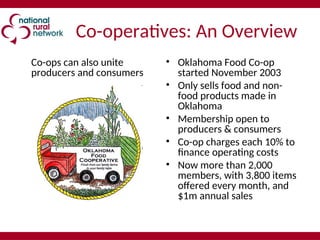
Co-ops can also unite
producers and consumers
• Oklahoma Food Co-op
started November 2003
• Only sells food and non-
food products made in
Oklahoma
• Membership open to
producers & consumers
• Co-op charges each 10% to
finance operating costs
• Now more than 2,000
members, with 3,800 items
offered every month, and
$1m annual sales
Co-operatives: An Overview
Other examples:
• Farmers’ markets – notably Dublin Food
Co-op!
• Fairtrade system, based on consumers
supporting producers – UK sales in 2008 rose
43% to more than £700m
• Can UK and Irish agricultural co-ops (e.g. milk
producers) learn from this?
Co-operatives: An Overview
In the wake of the financial crisis, people are
looking more than ever for business models
that embody accountability and trust.
An opportunity that co-operatives should
seize!
Thank you.
13
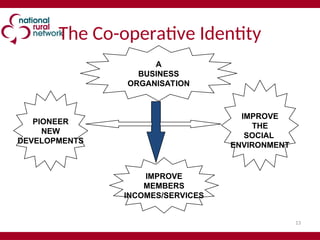
The Co-operative Identity
IMPROVE
MEMBERS
INCOMES/SERVICES
PIONEER
NEW
DEVELOPMENTS
IMPROVE
THE
SOCIAL
ENVIRONMENT
A
BUSINESS
ORGANISATION
14
Co-operatives – a Neglected
Option
• Co-operative way is worth a second look
• Not just a particular corporate form
– A definition
– A set of principles
– A set of values
– Particularly suited to recessionary times
• When the state and markets let you down organise
yourself!
15
Co-operatives Suffer From
Poor Visibility!
• Poorly understood
• Company is the choice of default
– May not suit all purposes
• Public bodies have a responsibility
• Promoters have a responsibility
16
Communication Challenges
• Greater requirement for communication and
education in the co-operative model
– Co-ops usually have a larger membership,
– Some members less knowledgeable in business
– Public, banking and professions less familiar
• An Investment that can pay for itself
• Success and failure on the part of a co-op is
more visible than in a private company
17
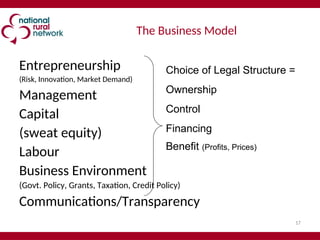
The Business Model
Entrepreneurship
(Risk, Innovation, Market Demand)
Management
Capital
(sweat equity)
Labour
Business Environment
(Govt. Policy, Grants, Taxation, Credit Policy)
Communications/Transparency
Choice of Legal Structure =
Ownership
Control
Financing
Benefit (Profits, Prices)
18
Similarities To Companies
• Legal Framework
• Board Of Directors
• Mission / Objectives / Strategy
• Capital
• Managers
• Surplus [Profits]
• Efficient/effective
19
Choice of Co-op Legal Form
• Industrial and Provident Societies
– Form Most Commonly Used for registering Co-operatives
– Highly Adaptable,
– Accommodates Many Different Types of Co-operative
• Credit Unions
– A Distinctive Form of Co-operative Society
– Members Save Together and Lend to Each Other
• European Co-operative Statute
• Other Business Forms can be used
– Partnerships
– Companies (several variants)
• Evaluate against business plan!
20
Co-operative Organisation
• Traditional co-operatives
• New generation co-operatives
• Subsidiaries with partial public ownership
• Equity seeking joint ventures
• Strategic alliances with plc’s
– Alternative co-operative models differ in the way
ownership rights are defined and assigned to stakeholders
21
When Does the Co-op Model Fit Best?
• Fits best where;
– Where the perspective members are have more
or less the same needs
– Where means exist of ensuring loyalty
– Where the ‘prize’ is worth the effort
22
Diversity of Co-operative
Ventures
• Caravan and Camping and Mobile Home Society
• Independent Hostel Owners Co-operative Society
• Mean Scoil San Nioclas
• North Kerry Arts and Cultural Society
• Roscommon Retail Therapy Society
• Sligo Football and Sport Development Society
• Alpaca Association of Ireland Co-operative Society
• Regional Airport
• Prayer Group!
23
Why Invest In Coops ?
• One of many alternative uses for time and money
• If market failure occurs
– When prices are not fair-to high or too low or
– Goods and services that are demanded cannot be obtained
– Producers, consumers, workers see the benefits of organising
themselves
24
Economic Justification I
Overcoming Market Failure
• The Co-operative Role
– Pooling Resources
– Controlled by Members
“Apparently his idea was to induce people to combine
for business purposes and thereby to help themselves
while they helped one another. Wealth was to be
created by thrift, honest dealing and by the loyalty of
the participants in the partnership with one another”
RA Anderson “With Plunkett in Ireland”
25
Participation of Other Stakeholders
• Co-operative may need ‘investors’ other than the members
• Stakeholders
– The community ( potential customers)
– User firms and businesses ( other private firms, co-ops – hotels,
processing co-op’s etc)
– Public sector ( hospitals, schools, local authority housing)
• Creation of membership categories
– Varying rights and responsibilities
• Share type allocated
• Voting rights
• Board representation
• Financial reward
26
Why Should I Become Involved?
– Do I want a passive or active involvement
• Price taker or price maker?
• Service or no service
– Consider joining existing co-operatives
– Might it be easier to restructure than to start anew?
– Start from new?
– A partnership arrangement may be an option?
• Local, Regional and National Public Bodies may be more attracted
to a ‘co-operative/partnership model’ when seeking to supply a
service
27
When Does the Co-op Model Fit Best?
• Matching ambition to capability
• Taking manageable steps v giant steps!
• Beneficiary led is best
• Fits best where;
– Where members are ‘homogenous’ in their needs
– Where a means exists for members to honour their obligations
– Where the business has an attractive risk/reward ratio
28
Seek Advice
• ICOS
• Solicitor/Accountant
• Teagasc
• Partnership Companies
• County Enterprise Board
• Registry of Friendly Societies
• Other Development Agencies
29
Goodness of Fit
• Is the co-op the best fit?
• Has an evaluation been done?
• Develop business strategy first
• Then examine legal structures
• If co-op is best choice, alignment with business plan will
require analysis and planning to ensure viability
30
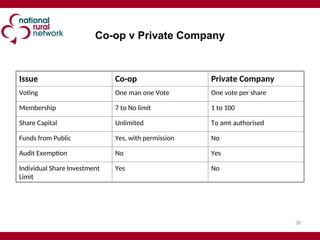
Issue Co-op Private Company
Voting One man one Vote One vote per share
Membership 7 to No limit 1 to 100
Share Capital Unlimited To amt authorised
Funds from Public Yes, with permission No
Audit Exemption No Yes
Individual Share Investment
Limit
Yes No
Co-op v Private Company
31
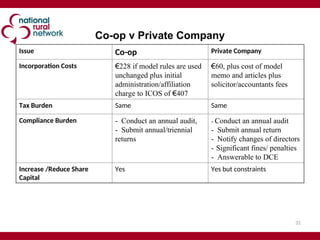
Issue Co-op Private Company
Incorporation Costs €228 if model rules are used
unchanged plus initial
administration/affiliation
charge to ICOS of €407
€60, plus cost of model
memo and articles plus
solicitor/accountants fees
Tax Burden Same Same
Compliance Burden - Conduct an annual audit,
- Submit annual/triennial
returns
- Conduct an annual audit
- Submit annual return
- Notify changes of directors
- Significant fines/ penalties
- Answerable to DCE
Increase /Reduce Share
Capital
Yes Yes but constraints
Co-op v Private Company
32
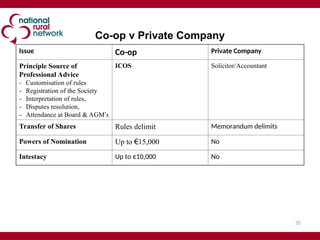
Issue Co-op Private Company
Principle Source of
Professional Advice
- Customisation of rules
- Registration of the Society
- Interpretation of rules,
- Disputes resolution,
- Attendance at Board & AGM’s
ICOS Solicitor/Accountant
Transfer of Shares Rules delimit Memorandum delimits
Powers of Nomination Up to €15,000 No
Intestacy Up to €10,000 No
Co-op v Private Company
33
Adherence to Values Brings
Success
• Co-operatives are based on;
– Self-help, self-responsibility, democracy, equality,
equity and solidarity, honesty, openness and
social responsibility
• Where the members can see value in
committing for the long term,
– The co-operative model will succeed
34
Conclusion
• Choices
– Do nothing and take what the market/state is willing
to offer on their terms and conditions
– Become actively involved in the marketplace and
have some influence over what you are going to be
paid and the terms and conditions that should apply
Co-operatives: An Overview
Some useful websites:
International Co-operative Alliance www.ica.coop
The Co-operative Group www.co-operative.coop
Mondragon Co-operative Corporation www.mondragon-corporation.com
Gujarat Co-operative Milk Marketing Federation www.amul.com
National Rural Electric Co-operative Association www.nreca.org
Energy4All www.energy4all.co.uk
Oklahoma Food Co-op www.oklahomafood.coop
Dublin Food Co-op www.dublinfood.coop
UK Fairtrade Foundation www.fairtrade.org.uk

Cooperatives - An Overview Cooperatives - An Overview.ppt

  • 1.
    Co-operatives: An Overview MartinMeteyard Co-operative Consultant (Scotland) martin.m@pop3.poptel.org.uk 1 www.nrn.ie
  • 2.
    2 Cooperative Definition “A cooperativeis a user owned and user controlled business that distributes benefits on the basis of use.”
  • 3.
    Co-operatives: An Overview •Tried and tested business model going back more than 200 years • Over 800m co-op members worldwide • Co-ops provide more than 100m jobs • Aggregate turnover of top 300 co-ops in world = 1.1 trillion USD • Business model based on TRUST
  • 4.
    Co-operatives: An Overview Co-operativesoperate according to seven principles as agreed by the International Co-operative Alliance (ICA) • Voluntary and Open Membership • Democratic Member Control • Member Economic Participation • Autonomy and Independence • Education, Training and Information • Co-operation among Co-operatives • Concern for Community
  • 5.
    Co-operatives: An Overview “Co-operativesare a means to provide goods and services which members need and which they cannot obtain individually at similarly favourable conditions, or at all.” (Prof. Hans-H. Munkner)
  • 6.
    Co-operatives: An Overview Casestudy 1: The Co-operative Group (UK) • Established 1863 as Co-op Wholesale Society • Dominant food supplier up till WW2 • Almost continuous decline till early 1990s • Decline halted with greater emphasis on membership and values – ethical positioning • Strong support for rural retailing • Now largest consumer co-op in world – Somerfield takeover & Britannia BS merger
  • 7.
    Co-operatives: An Overview Casestudy 2: Mondragon (Basque country, Spain) • Catholic priest set up technical school 1943 • First industrial co-operative with 24 workers 1956 • Caja Laboral bank established 1959 • Retail co-ops form Eroski chain 1969 • Importance of multi-stakeholder model • Role of members’ capital • Now 90,000+ employees worldwide • ‘Green jobs’ initiative in USA with USW trade union
  • 8.
    Co-operatives: An Overview Casestudy 3: Amul (India) • First dairy co-op union in Gujarat formed 1946 • Indigenous R&D and technology development • Success led to formation of other dairy co-ops • Apex co-op formed 1973: Gujarat Co-operative Milk Marketing Federation • Now jointly owned by 2.8m milk producers via more than 13,000 village dairy co-ops • Largest food brand in India, turnover of 1.5 bn USD • Strong consumer branding, now export to 37 countries
  • 9.
    Co-operatives: An Overview Otherco-op success stories: • US rural electricity co-ops – 930 co-ops with 40 million consumer members covering 75% of land mass in 46 states • Renewable energy: Denmark and Scotland • Co-operative banks and credit unions • Agricultural co-ops
  • 10.
    Co-operatives: An Overview Co-opscan also unite producers and consumers • Oklahoma Food Co-op started November 2003 • Only sells food and non- food products made in Oklahoma • Membership open to producers & consumers • Co-op charges each 10% to finance operating costs • Now more than 2,000 members, with 3,800 items offered every month, and $1m annual sales
  • 11.
    Co-operatives: An Overview Otherexamples: • Farmers’ markets – notably Dublin Food Co-op! • Fairtrade system, based on consumers supporting producers – UK sales in 2008 rose 43% to more than £700m • Can UK and Irish agricultural co-ops (e.g. milk producers) learn from this?
  • 12.
    Co-operatives: An Overview Inthe wake of the financial crisis, people are looking more than ever for business models that embody accountability and trust. An opportunity that co-operatives should seize! Thank you.
  • 13.
  • 14.
    14 Co-operatives – aNeglected Option • Co-operative way is worth a second look • Not just a particular corporate form – A definition – A set of principles – A set of values – Particularly suited to recessionary times • When the state and markets let you down organise yourself!
  • 15.
    15 Co-operatives Suffer From PoorVisibility! • Poorly understood • Company is the choice of default – May not suit all purposes • Public bodies have a responsibility • Promoters have a responsibility
  • 16.
    16 Communication Challenges • Greaterrequirement for communication and education in the co-operative model – Co-ops usually have a larger membership, – Some members less knowledgeable in business – Public, banking and professions less familiar • An Investment that can pay for itself • Success and failure on the part of a co-op is more visible than in a private company
  • 17.
    17 The Business Model Entrepreneurship (Risk,Innovation, Market Demand) Management Capital (sweat equity) Labour Business Environment (Govt. Policy, Grants, Taxation, Credit Policy) Communications/Transparency Choice of Legal Structure = Ownership Control Financing Benefit (Profits, Prices)
  • 18.
    18 Similarities To Companies •Legal Framework • Board Of Directors • Mission / Objectives / Strategy • Capital • Managers • Surplus [Profits] • Efficient/effective
  • 19.
    19 Choice of Co-opLegal Form • Industrial and Provident Societies – Form Most Commonly Used for registering Co-operatives – Highly Adaptable, – Accommodates Many Different Types of Co-operative • Credit Unions – A Distinctive Form of Co-operative Society – Members Save Together and Lend to Each Other • European Co-operative Statute • Other Business Forms can be used – Partnerships – Companies (several variants) • Evaluate against business plan!
  • 20.
    20 Co-operative Organisation • Traditionalco-operatives • New generation co-operatives • Subsidiaries with partial public ownership • Equity seeking joint ventures • Strategic alliances with plc’s – Alternative co-operative models differ in the way ownership rights are defined and assigned to stakeholders
  • 21.
    21 When Does theCo-op Model Fit Best? • Fits best where; – Where the perspective members are have more or less the same needs – Where means exist of ensuring loyalty – Where the ‘prize’ is worth the effort
  • 22.
    22 Diversity of Co-operative Ventures •Caravan and Camping and Mobile Home Society • Independent Hostel Owners Co-operative Society • Mean Scoil San Nioclas • North Kerry Arts and Cultural Society • Roscommon Retail Therapy Society • Sligo Football and Sport Development Society • Alpaca Association of Ireland Co-operative Society • Regional Airport • Prayer Group!
  • 23.
    23 Why Invest InCoops ? • One of many alternative uses for time and money • If market failure occurs – When prices are not fair-to high or too low or – Goods and services that are demanded cannot be obtained – Producers, consumers, workers see the benefits of organising themselves
  • 24.
    24 Economic Justification I OvercomingMarket Failure • The Co-operative Role – Pooling Resources – Controlled by Members “Apparently his idea was to induce people to combine for business purposes and thereby to help themselves while they helped one another. Wealth was to be created by thrift, honest dealing and by the loyalty of the participants in the partnership with one another” RA Anderson “With Plunkett in Ireland”
  • 25.
    25 Participation of OtherStakeholders • Co-operative may need ‘investors’ other than the members • Stakeholders – The community ( potential customers) – User firms and businesses ( other private firms, co-ops – hotels, processing co-op’s etc) – Public sector ( hospitals, schools, local authority housing) • Creation of membership categories – Varying rights and responsibilities • Share type allocated • Voting rights • Board representation • Financial reward
  • 26.
    26 Why Should IBecome Involved? – Do I want a passive or active involvement • Price taker or price maker? • Service or no service – Consider joining existing co-operatives – Might it be easier to restructure than to start anew? – Start from new? – A partnership arrangement may be an option? • Local, Regional and National Public Bodies may be more attracted to a ‘co-operative/partnership model’ when seeking to supply a service
  • 27.
    27 When Does theCo-op Model Fit Best? • Matching ambition to capability • Taking manageable steps v giant steps! • Beneficiary led is best • Fits best where; – Where members are ‘homogenous’ in their needs – Where a means exists for members to honour their obligations – Where the business has an attractive risk/reward ratio
  • 28.
    28 Seek Advice • ICOS •Solicitor/Accountant • Teagasc • Partnership Companies • County Enterprise Board • Registry of Friendly Societies • Other Development Agencies
  • 29.
    29 Goodness of Fit •Is the co-op the best fit? • Has an evaluation been done? • Develop business strategy first • Then examine legal structures • If co-op is best choice, alignment with business plan will require analysis and planning to ensure viability
  • 30.
    30 Issue Co-op PrivateCompany Voting One man one Vote One vote per share Membership 7 to No limit 1 to 100 Share Capital Unlimited To amt authorised Funds from Public Yes, with permission No Audit Exemption No Yes Individual Share Investment Limit Yes No Co-op v Private Company
  • 31.
    31 Issue Co-op PrivateCompany Incorporation Costs €228 if model rules are used unchanged plus initial administration/affiliation charge to ICOS of €407 €60, plus cost of model memo and articles plus solicitor/accountants fees Tax Burden Same Same Compliance Burden - Conduct an annual audit, - Submit annual/triennial returns - Conduct an annual audit - Submit annual return - Notify changes of directors - Significant fines/ penalties - Answerable to DCE Increase /Reduce Share Capital Yes Yes but constraints Co-op v Private Company
  • 32.
    32 Issue Co-op PrivateCompany Principle Source of Professional Advice - Customisation of rules - Registration of the Society - Interpretation of rules, - Disputes resolution, - Attendance at Board & AGM’s ICOS Solicitor/Accountant Transfer of Shares Rules delimit Memorandum delimits Powers of Nomination Up to €15,000 No Intestacy Up to €10,000 No Co-op v Private Company
  • 33.
    33 Adherence to ValuesBrings Success • Co-operatives are based on; – Self-help, self-responsibility, democracy, equality, equity and solidarity, honesty, openness and social responsibility • Where the members can see value in committing for the long term, – The co-operative model will succeed
  • 34.
    34 Conclusion • Choices – Donothing and take what the market/state is willing to offer on their terms and conditions – Become actively involved in the marketplace and have some influence over what you are going to be paid and the terms and conditions that should apply
  • 35.
    Co-operatives: An Overview Someuseful websites: International Co-operative Alliance www.ica.coop The Co-operative Group www.co-operative.coop Mondragon Co-operative Corporation www.mondragon-corporation.com Gujarat Co-operative Milk Marketing Federation www.amul.com National Rural Electric Co-operative Association www.nreca.org Energy4All www.energy4all.co.uk Oklahoma Food Co-op www.oklahomafood.coop Dublin Food Co-op www.dublinfood.coop UK Fairtrade Foundation www.fairtrade.org.uk

Editor's Notes

  • #2 There are a number of definitions as to what constitutes a co-operative. The definition that appears to most accurately reflect the ideal which farmer co-operatives is as follows; “A Co-operative is a user owned user controlled business that distributes benefits on the basis of use” For various reasons, very few co-operatives can fully accord in practice with this definition in all respects. This definition however, remains a useful yardstick for measuring the extent to which our various farmer owned businesses are attaining this definition of a co-operative.
  • #13 Cooperatives are essentially economic enterprises with a social concern. Most people agree that this is a practical interpretation of the cooperative idea. Members in a cooperative give varying degrees of emphasis to the economic developmental and social role of their cooperative. Most farmers value primarily the strength and control that their cooperative gives them in the marketplace when operating as an efficient business organisation. There is however a recognition that the social and developmental functions of the cooperative are important to members, their families and the community at large. Farmers see co-operation as a more equitable form of capitalism, providing a countervailing force against the concentration of land and capital into the hands of the few.
  • #23 MARKET FAILURE: For most farmers their first choice if they have surplus cash for investment would be to invest it in their own farm enterprise. In Ireland, however as in many other countries there are many constraints on the scale to which the average farm unit can grow. The price of land and quotas are just two examples of resources whose supply is scarce. Even allowing for these barriers why do farmers to invest their savings in cooperatives when other investments appear to give a higher return on capital ? The most common answer provided to this question by farmers is that without some structure in the market place to protect their interests they would be very weak buyers and sellers of goods and services. What farmers are recognising is that markets do not work perfectly and unless they organise themselves in to some form of association, the marketplace will fail to protect their interest
  • #24  THE COOPERATIVE ROLE In all of the above situations an effective cooperative can service farmers without fear of monopolistic profits being extracted. If operated at cost and effectively controlled by farmers, it would bring the benefits of an efficient plant size to farmers without the adverse affects resulting from loss of competition.