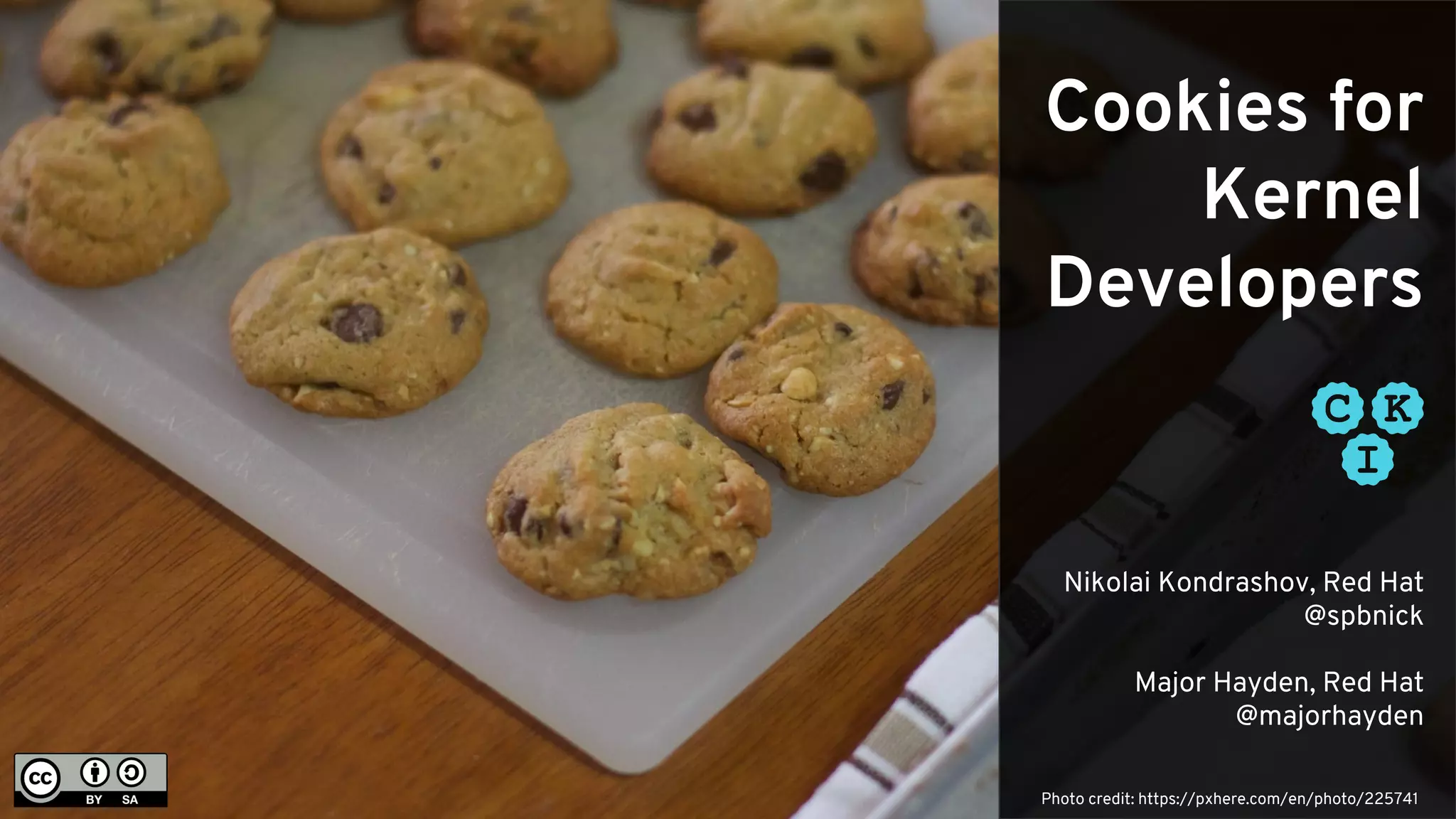
Cookies for
Kernel
Developers
Nikolai Kondrashov, Red Hat
@spbnick
Major Hayden, Red Hat
@majorhayden
Photo credit: https://pxhere.com/en/photo/225741
Who are we?
Nikolai Kondrashov
Senior Software Engineer
Red Hat
DIGImend project maintainer.
Enjoys electronics and
embedded as a hobby.
Major Hayden
Principal Software Engineer
Red Hat
Owner of too many domain
names, including
icanhazip.com.
(Please do not give me any
other ideas for domain names
to buy.) ;)
Continuous Kernel Integration project
A team from Red Hat's
Base Operating Systems and
Global QE
● China
● Czech Republic
● Finland
● United States
“Cookie”
Maintaining stable kernels
is a complex and difficult task
Photo credit: https://en.m.wikipedia.org/wiki/File:SIGABA-patent.png
A developer writes a patchset
that gets merged into the
mainline* kernel tree
* Patches that arrive here are included in the next major kernel release.
Time passes
The patchset becomes part of
Greg’s* stable kernel release
* Possibly the most efficient kernel developer on Earth
Time passes
A Linux distribution maintainer
finds a bug or security problem*
with that patch
* After a lengthy investigation, bisection, and debugging
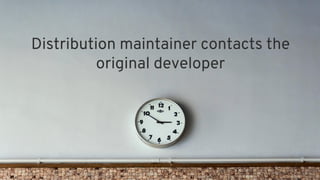
Distribution maintainer contacts the
original developer
Time passes
By this time,
the original developer can’t remember
why they wrote the patch
or what is in the patch
This is a frustrating,
time consuming process.
What if we could find that problematic
patch before it is ever merged?
Photo credit: US Air Force
We built CI for
kernel contributions
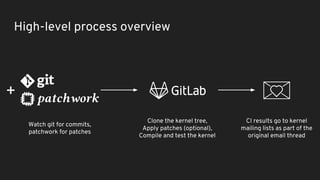
High-level process overview
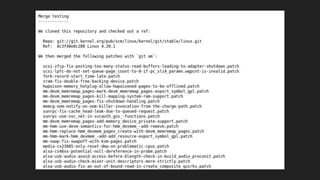
Clone the kernel tree,
Apply patches (optional),
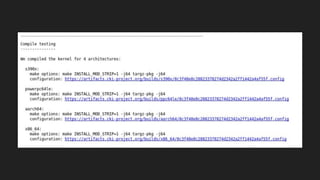
Compile and test the kernel
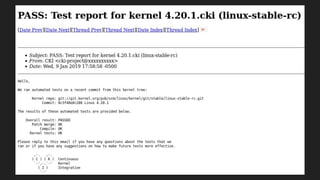
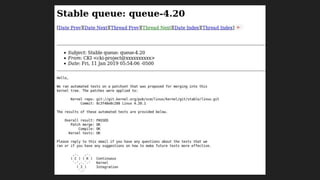
CI results go to kernel
mailing lists as part of the
original email thread
+
Watch git for commits,
patchwork for patches
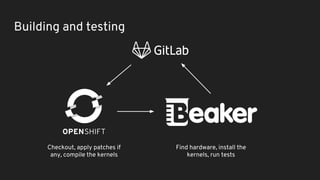
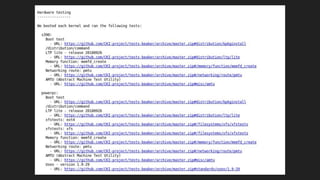
Building and testing
Checkout, apply patches if
any, compile the kernels
Find hardware, install the
kernels, run tests
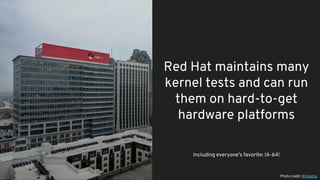
Red Hat maintains many
kernel tests and can run
them on hard-to-get
hardware platforms
Including everyone’s favorite: IA-64!
Photo credit: Wikipedia
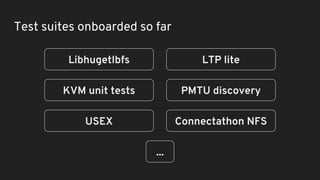
Test suites onboarded so far
PMTU discovery
Connectathon NFS
LTP lite
USEX
Libhugetlbfs
KVM unit tests
...
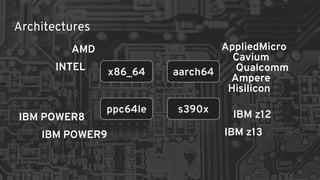
Architectures
x86_64 aarch64
ppc64le s390x
IBM POWER8
IBM POWER9
INTEL
AMD AppliedMicro
Cavium
Ampere
Qualcomm
Hisilicon
IBM z12
IBM z13
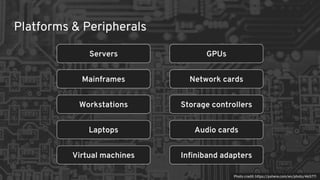
Photo credit: https://pxhere.com/en/photo/465771
Servers
Mainframes
Workstations
Laptops
Virtual machines
Network cards
Storage controllers
Audio cards
Infiniband adapters
GPUs
Platforms & Peripherals
What are we doing
for upstream kernels today?
It all started in a
conversation with Greg KH...
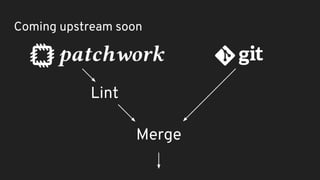
Coming upstream soon
Merge
Lint
Next
tests++
trees++
latency--
Next
open(planning)
open(logs)
open(docs)
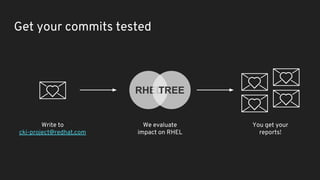
Get your commits tested
Write to
cki-project@redhat.com
We evaluate
impact on RHEL
RHELTREE
You get your
reports!
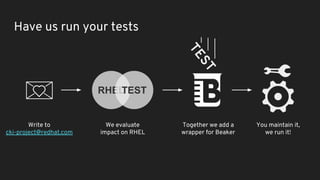
Have us run your tests
Write to
cki-project@redhat.com
We evaluate
impact on RHEL
RHELTEST
Together we add a
wrapper for Beaker
TEST
⚙
🔧
You maintain it,
we run it!
Why is Red Hat doing this?
We want better RHEL*
*Red Hat Enterprise Linux
Photo credit: Wikipedia
Get involved
https://github.com/cki-project
https://gitlab.com/cki-project
cki-project@redhat.com
Thank you!
Ask some questions and get
some (real) cookies. 🍪🍪🍪
Got questions after the talk?
E-mail cki-project@redhat.com
Visit https://cki-project.org/
(slides on the website soon!)

Cookies for kernel developers