Converting Units of
Measurement
of 62
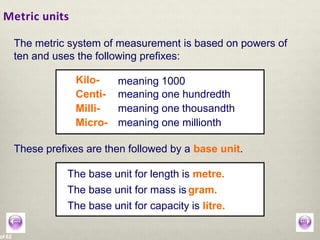
Metric units
The metric system of measurement is based on powers of
ten and uses the following prefixes:
These prefixes are then followed by a base unit.
The base unit for length is metre.
The base unit for mass is gram.
The base unit for capacity is litre.
Kilo-
Centi-
Milli-
Micro-
of 62
meaning 1000
meaning one hundredth
meaning one thousandth
meaning one millionth
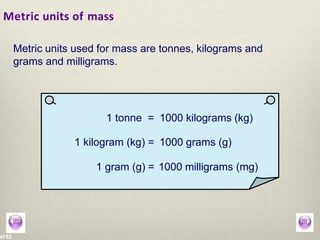
Metric units of mass
Metric units used for mass are tonnes, kilograms and
grams and milligrams.
1 tonne = 1000 kilograms (kg)
1 kilogram (kg) = 1000 grams (g)
1 gram (g) = 1000 milligrams (mg)
of 62
Metric units of mass
of 62
60 tea bags weigh 150 g.
How much would 2000 tea bags weigh in kg?
We can solve this problem using a unitary method.
60 tea bags weigh 150 g
So, 1 tea bag weighs (150 ÷ 60) g = 2.5 g
Therefore, 2000 tea bags weigh (2.5 × 2000) g = 5000 g
= 5 kg
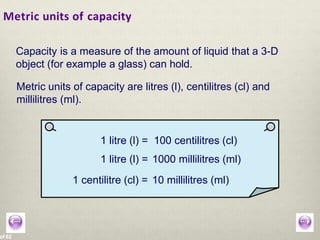
Metric units of capacity
Capacity is a measure of the amount of liquid that a 3-D
object (for example a glass) can hold.
Metric units of capacity are litres (l), centilitres (cl) and
millilitres (ml).
1 litre (l) = 100 centilitres (cl)
1 litre (l) = 1000 millilitres (ml)
1 centilitre (cl) = 10 millilitres (ml)
of 62
Metric units of capacity
of 62
A bottle contains 750 ml of orange squash.
The label says: Dilute 1 part squash with 4 parts water.
How many of litres of drink can be made with one bottle?
If the whole bottle was made up we would have
750 ml of squash + (4 × 750) ml of water
= 750 ml of squash + 3000 ml of water
= 3750 ml of drink
= 3.75 l of drink
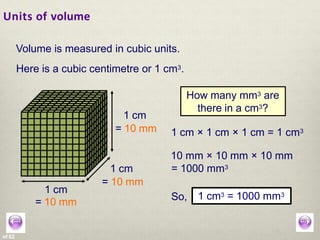
Units of volume
Volume is measured in cubic units.
Here is a cubic centimetre or 1 cm3.
How many mm3 are
there in a cm3?
1 cm
= 10 mm
1 cm
= 10 mm 1 cm × 1 cm × 1 cm = 1 cm3
So, 1 cm3 = 1000 mm3
1 cm3 = 1000 mm3
1 cm
= 10 mm
10 mm × 10 mm × 10 mm
= 1000 mm3
of 62
Units of volume
of 62
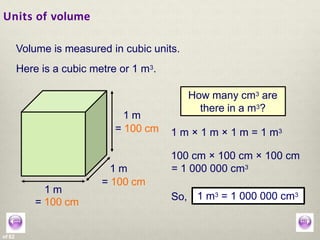
Volume is measured in cubic units.
Here is a cubic metre or 1 m3.
How many cm3 are
there in a m3?
1 m
= 100 cm
1 m
= 100 cm 1 m × 1 m × 1 m = 1 m3
So, 1 m3 = 1 000 000 cm3
1 m3 = 1 000 000 cm3
1 m
= 100 cm
100 cm × 100 cm × 100 cm
= 1 000 000 cm3
Units of volume
We can use the following to convert between units of volume.
1 km3 = 1 000 000 000 m3
1 m3 = 1 000 000 cm3
1 m3 = 1 000 000 000 mm3
1 cm3 = 1000 mm3
of 62
Units of volume
of 62
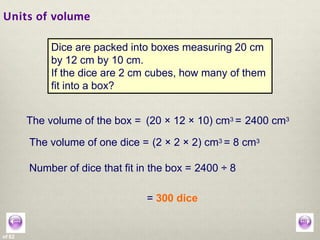
Dice are packed into boxes measuring 20 cm
by 12 cm by 10 cm.
If the dice are 2 cm cubes, how many of them
fit into a box?
The volume of the box = (20 × 12 × 10) cm3 = 2400 cm3
The volume of one dice = (2 × 2 × 2) cm3 = 8 cm3
Number of dice that fit in the box = 2400 ÷ 8
= 300 dice
Volume and capacity
Capacity is a measure of the amount of liquid that a 3-D
object can hold.
A litre of water, for example, would fill a container
measuring 10 cm by 10 cm by 10 cm (or 1000 cm3)
1 l = 1000 cm3
1 ml = 1 cm3
1000 l = 1 m3
of 62
Volume and capacity
of 62
Volume and capacity
of 62
Which holds more juice when full; a litre bottle or
a carton measuring 6 cm by 10 cm by 20 cm?
The volume of the carton is (6 × 10 × 20) cm3 = 1200 cm3
1 litre = 1000 cm3
The carton holds more juice.
Converting units of area, volume and capacity
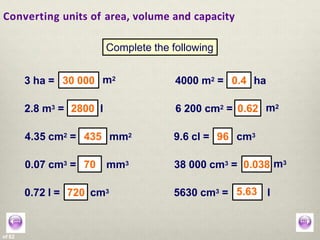
Complete the following
3 ha = m2
4000 m2 = ha
2.8 m3 = l 6 200 cm2 = m2
4.35 cm2 = mm2 9.6 cl = cm3
0.07 cm3 = mm3 38 000 cm3 = m3
0.72 l = cm3 5630 cm3 = l
30 000
of 62
0.4
2800 0.62
435 96
70 0.038
720 5.63
Units of time
Time does not use the metric system.
Units of time include years, months, weeks, days, hours (h),
minutes (min) and seconds (s).
1 minute (min) = 60 seconds (s)
1 hour (h) = 60 minutes (min)
1 day = 24 hours (h)
1 week = 7 days
1 year = 365 days = 52 weeks
1 leap year = 366 days
of 62
Units of time
of 62
A machine takes 4 minutes and 10 seconds to make a
toy car. How long would it take to make 18 toy cars?
4 minutes × 18 = 72 minutes
10 seconds × 18 = 180 seconds = 3 minutes
72 minutes + 3 minutes = 75 minutes
= 1 hour 15 minutes

converting unit measures.pptx

  • 1.
  • 2.
    Metric units The metricsystem of measurement is based on powers of ten and uses the following prefixes: These prefixes are then followed by a base unit. The base unit for length is metre. The base unit for mass is gram. The base unit for capacity is litre. Kilo- Centi- Milli- Micro- of 62 meaning 1000 meaning one hundredth meaning one thousandth meaning one millionth
  • 3.
    Metric units ofmass Metric units used for mass are tonnes, kilograms and grams and milligrams. 1 tonne = 1000 kilograms (kg) 1 kilogram (kg) = 1000 grams (g) 1 gram (g) = 1000 milligrams (mg) of 62
  • 4.
    Metric units ofmass of 62 60 tea bags weigh 150 g. How much would 2000 tea bags weigh in kg? We can solve this problem using a unitary method. 60 tea bags weigh 150 g So, 1 tea bag weighs (150 ÷ 60) g = 2.5 g Therefore, 2000 tea bags weigh (2.5 × 2000) g = 5000 g = 5 kg
  • 5.
    Metric units ofcapacity Capacity is a measure of the amount of liquid that a 3-D object (for example a glass) can hold. Metric units of capacity are litres (l), centilitres (cl) and millilitres (ml). 1 litre (l) = 100 centilitres (cl) 1 litre (l) = 1000 millilitres (ml) 1 centilitre (cl) = 10 millilitres (ml) of 62
  • 6.
    Metric units ofcapacity of 62 A bottle contains 750 ml of orange squash. The label says: Dilute 1 part squash with 4 parts water. How many of litres of drink can be made with one bottle? If the whole bottle was made up we would have 750 ml of squash + (4 × 750) ml of water = 750 ml of squash + 3000 ml of water = 3750 ml of drink = 3.75 l of drink
  • 7.
    Units of volume Volumeis measured in cubic units. Here is a cubic centimetre or 1 cm3. How many mm3 are there in a cm3? 1 cm = 10 mm 1 cm = 10 mm 1 cm × 1 cm × 1 cm = 1 cm3 So, 1 cm3 = 1000 mm3 1 cm3 = 1000 mm3 1 cm = 10 mm 10 mm × 10 mm × 10 mm = 1000 mm3 of 62
  • 8.
    Units of volume of62 Volume is measured in cubic units. Here is a cubic metre or 1 m3. How many cm3 are there in a m3? 1 m = 100 cm 1 m = 100 cm 1 m × 1 m × 1 m = 1 m3 So, 1 m3 = 1 000 000 cm3 1 m3 = 1 000 000 cm3 1 m = 100 cm 100 cm × 100 cm × 100 cm = 1 000 000 cm3
  • 9.
    Units of volume Wecan use the following to convert between units of volume. 1 km3 = 1 000 000 000 m3 1 m3 = 1 000 000 cm3 1 m3 = 1 000 000 000 mm3 1 cm3 = 1000 mm3 of 62
  • 10.
    Units of volume of62 Dice are packed into boxes measuring 20 cm by 12 cm by 10 cm. If the dice are 2 cm cubes, how many of them fit into a box? The volume of the box = (20 × 12 × 10) cm3 = 2400 cm3 The volume of one dice = (2 × 2 × 2) cm3 = 8 cm3 Number of dice that fit in the box = 2400 ÷ 8 = 300 dice
  • 11.
    Volume and capacity Capacityis a measure of the amount of liquid that a 3-D object can hold. A litre of water, for example, would fill a container measuring 10 cm by 10 cm by 10 cm (or 1000 cm3) 1 l = 1000 cm3 1 ml = 1 cm3 1000 l = 1 m3 of 62
  • 12.
  • 13.
    Volume and capacity of62 Which holds more juice when full; a litre bottle or a carton measuring 6 cm by 10 cm by 20 cm? The volume of the carton is (6 × 10 × 20) cm3 = 1200 cm3 1 litre = 1000 cm3 The carton holds more juice.
  • 14.
    Converting units ofarea, volume and capacity Complete the following 3 ha = m2 4000 m2 = ha 2.8 m3 = l 6 200 cm2 = m2 4.35 cm2 = mm2 9.6 cl = cm3 0.07 cm3 = mm3 38 000 cm3 = m3 0.72 l = cm3 5630 cm3 = l 30 000 of 62 0.4 2800 0.62 435 96 70 0.038 720 5.63
  • 15.
    Units of time Timedoes not use the metric system. Units of time include years, months, weeks, days, hours (h), minutes (min) and seconds (s). 1 minute (min) = 60 seconds (s) 1 hour (h) = 60 minutes (min) 1 day = 24 hours (h) 1 week = 7 days 1 year = 365 days = 52 weeks 1 leap year = 366 days of 62
  • 16.
    Units of time of62 A machine takes 4 minutes and 10 seconds to make a toy car. How long would it take to make 18 toy cars? 4 minutes × 18 = 72 minutes 10 seconds × 18 = 180 seconds = 3 minutes 72 minutes + 3 minutes = 75 minutes = 1 hour 15 minutes