Power System Control Centers: Future Trends (Revised 1-16-06) Chen-Ching Liu Iowa State University * F. F. Wu, K. Moslehi and A. Bose, “Power System Control Centers: Past, Present and Future,” Proceedings of the IEEE, Nov. 2005, pp. 1890-1908.
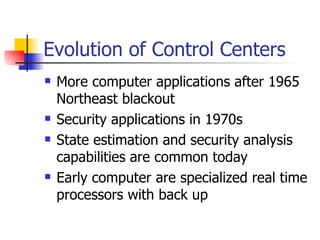
Evolution of Control Centers  More computer applications after 1965 Northeast blackout  Security applications in 1970s State estimation and security analysis capabilities are common today Early computer are specialized real time processors with back up
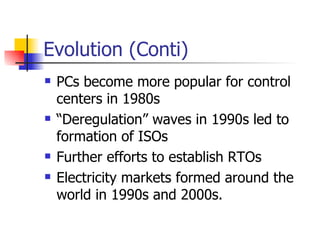
Evolution (Conti) PCs become more popular for control centers in 1980s “ Deregulation” waves in 1990s led to formation of ISOs  Further efforts to establish RTOs Electricity markets formed around the world in 1990s and 2000s.
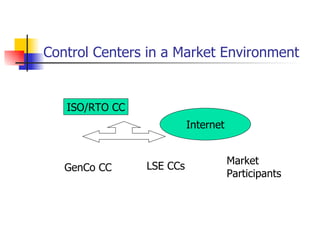
Control Centers in a Market Environment ISO/RTO CC GenCo CC LSE CCs Market Participants Internet
Different Roles ISO / RTO Generation companies Load serving entities  Control centers at different levels play different roles
SCADA / AGC Load frequency control Load forecasting RTU Communication
Network Applications Applications  Topology processor State estimation Contingency analysis Voltage stability Power flow
Data Warehouse Operational  Real time Historical
Market Applications Bilateral transactions management Security constrained economic dispatch Security constrained unit commitment Locational Marginal Price Load forecast Outage management Compliance monitoring
Market Infrastructure Bidding and schedule management Market information publishing
Commercial Systems Settlements Billing and credit Metering systems
Architecture Local area network with PCs or workstations Control center to RTU links SCADA and EMS applications  Market participants communicate through Internet
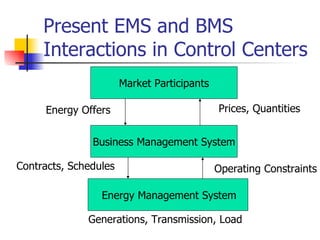
Present EMS and BMS Interactions in Control Centers Market Participants Business Management System Energy Management System Energy Offers Prices, Quantities Contracts, Schedules Operating Constraints Generations, Transmission, Load
Changing Environment Decentralization  Integration  Flexibility  Openness
Decentralization  Market participants play a role in economic and reliability decisions Coordination among ISOs Coordination among ISO / RTO and market participants Data and controls become distributed
Integration  Enterprise architecture incorporating  Control center System planning Distribution management systems, power plant control Business processes
Flexibility  Market participants change over time Market structures also evolve Modular design allows modules to be added, deleted or modified
Openness Dependence on specific vendors is not desirable Portable software to run on various hardware and software platforms
Enabling Technologies Communications protocols Distributed systems Object technology Component technology Middleware Agent technology
Distributed Control Center Separation of SCADA, EMS and BMS IP-Based distributed SCADA Standard CIM based distributed data processing Middleware based distributed EMS and BMS applications
Grid Computing and Grid Service Clustering of a wide variety of distributed resources to be used as a unified resource Seamless global aggregation of of resources Grid service is a convergence of grid computing and web services
Future Control Centers Ultra-fast data acquisition system Greatly expanded applications A partner grid of enterprise grids Dynamic sharing of computational resources of all intelligent devices Use of service oriented architecture Distributed data acquisition and processing services Distributed control center applications Use of grid services architecture
Future Applications Market surveillance and contract compliance Phasor measurement units (PMUs) On-line dynamic security Visualization  Self-healing power grids

Control centers future_trends-revision

  • 1.
    Power System ControlCenters: Future Trends (Revised 1-16-06) Chen-Ching Liu Iowa State University * F. F. Wu, K. Moslehi and A. Bose, “Power System Control Centers: Past, Present and Future,” Proceedings of the IEEE, Nov. 2005, pp. 1890-1908.
  • 2.
    Evolution of ControlCenters More computer applications after 1965 Northeast blackout Security applications in 1970s State estimation and security analysis capabilities are common today Early computer are specialized real time processors with back up
  • 3.
    Evolution (Conti) PCsbecome more popular for control centers in 1980s “ Deregulation” waves in 1990s led to formation of ISOs Further efforts to establish RTOs Electricity markets formed around the world in 1990s and 2000s.
  • 4.
    Control Centers ina Market Environment ISO/RTO CC GenCo CC LSE CCs Market Participants Internet
  • 5.
    Different Roles ISO/ RTO Generation companies Load serving entities Control centers at different levels play different roles
  • 6.
    SCADA / AGCLoad frequency control Load forecasting RTU Communication
  • 7.
    Network Applications Applications Topology processor State estimation Contingency analysis Voltage stability Power flow
  • 8.
    Data Warehouse Operational Real time Historical
  • 9.
    Market Applications Bilateraltransactions management Security constrained economic dispatch Security constrained unit commitment Locational Marginal Price Load forecast Outage management Compliance monitoring
  • 10.
    Market Infrastructure Biddingand schedule management Market information publishing
  • 11.
    Commercial Systems SettlementsBilling and credit Metering systems
  • 12.
    Architecture Local areanetwork with PCs or workstations Control center to RTU links SCADA and EMS applications Market participants communicate through Internet
  • 13.
    Present EMS andBMS Interactions in Control Centers Market Participants Business Management System Energy Management System Energy Offers Prices, Quantities Contracts, Schedules Operating Constraints Generations, Transmission, Load
  • 14.
    Changing Environment Decentralization Integration Flexibility Openness
  • 15.
    Decentralization Marketparticipants play a role in economic and reliability decisions Coordination among ISOs Coordination among ISO / RTO and market participants Data and controls become distributed
  • 16.
    Integration Enterprisearchitecture incorporating Control center System planning Distribution management systems, power plant control Business processes
  • 17.
    Flexibility Marketparticipants change over time Market structures also evolve Modular design allows modules to be added, deleted or modified
  • 18.
    Openness Dependence onspecific vendors is not desirable Portable software to run on various hardware and software platforms
  • 19.
    Enabling Technologies Communicationsprotocols Distributed systems Object technology Component technology Middleware Agent technology
  • 20.
    Distributed Control CenterSeparation of SCADA, EMS and BMS IP-Based distributed SCADA Standard CIM based distributed data processing Middleware based distributed EMS and BMS applications
  • 21.
    Grid Computing andGrid Service Clustering of a wide variety of distributed resources to be used as a unified resource Seamless global aggregation of of resources Grid service is a convergence of grid computing and web services
  • 22.
    Future Control CentersUltra-fast data acquisition system Greatly expanded applications A partner grid of enterprise grids Dynamic sharing of computational resources of all intelligent devices Use of service oriented architecture Distributed data acquisition and processing services Distributed control center applications Use of grid services architecture
  • 23.
    Future Applications Marketsurveillance and contract compliance Phasor measurement units (PMUs) On-line dynamic security Visualization Self-healing power grids