
Contracts of Employment 101
A Presentation by:
Matthew J. G. Curtis
Fraser Milner Casgrain LLP
Tel: (604) 691-6461
Email: Matthew.Curtis@fmc-law.com


Thursday April 19, 2012
Vancouver, B.C.


                                    1
Overview
1. Why do you need a written employment contract?
2. Important terms in an employment contract.
3. Issues to consider and to avoid.


                                                    2
Benefits of a Written Contract
• Certainty, certainty, certainty!
• Severance obligations
• Otherwise, an oral employment contract can be enforceable in
  case of a dispute.


                                                                 3
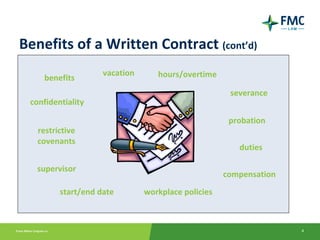
Benefits of a Written Contract (cont’d)
                    vacation      hours/overtime
    benefits
                                                     severance
 confidentiality

                                                     probation
   restrictive
   covenants
                                                       duties

  supervisor
                                                    compensation
         start/end date        workplace policies


                                                                   4
Terms
• If the contract addresses the following subjects, it must
  provide at least what is the minimum under the applicable law
  such as the B.C. Employment Standards Act (“ESA”):
   –   Vacation
   –   Wages
   –   Termination
   –   Hours of Work
   –   Leaves of Absence


                                                                  5
Terms (cont’d)
The Basics:
   –   Position and duties/responsibilities
   –   Who the employee reports to
   –   Following company policies
   –   Hours of work – Leaves of absence
   –   Term of Employment (definite or indefinite)


                                                     6
Terms (cont’d)
• The Basics:
   – Compensation
   – Vacation
   – Benefits → TIP: limit employer obligations to pay premiums only and not to
       act as a self-insurer
   –   Confidentiality/Intellectual Property
   –   Post Employment Obligations
   –   Restrictive Covenants, if applicable
   –   Termination by the Employer and by the Employee


                                                                                  7
Terms (cont’d)
Termination:
Without a Written Contract
Employment Standards Act, section 63:
   – One week’s notice after three months of employment.
   – Two weeks’ notice after twelve months of employment.
   – Three weeks’ notice after three consecutive years of employment, plus
     one additional week for each additional year of employment to a
     maximum of 8 weeks notice.
              Maximum liability = 8 weeks notice or pay in lieu


Canada Labour Code, sections 230 and 235

                                                                             8
Terms (cont’d)
Termination:
Without a Written Contract
Common Law
• No formula but ESA length of service is inadequate.
• Age; length of service; nature of employment; availability of
  alternative employment; any other factor a Court would
  consider relevant.
• Invariably more than ESA and Canada Labour Code.


                                                                  9
Terms (cont’d)
Termination Provision:
• Must meet ESA minimum.
• Can use formula to exceed ESA minimum.
• Lump sum payment, or salary continuation.
• Change of control for executives.


                                              10
Terms (cont’d)
Probation:
• Less than 3 months, no ESA termination pay.
• The common law still applies and may require notice or pay in
  lieu of notice.
• A written contract should clearly define the probationary
  period.


                                                                  11
Terms (cont’d)
Other terms to consider:
• Entire agreement
• Severability
• Modification of the agreement
• Dispute resolution – courts, arbitration?
• Opportunity for employee to seek independent legal advice.
• Governing law


                                                               12
Issues to Consider
1. Enter the written contract before the employment
   relationship begins.
2. Additional consideration is needed if significant changes are
   made later on. An offer of continued employment is not
   enough.
3. Give sufficient time for the employee to review the contract
   and to seek independent legal advice. Do not apply pressure
   to sign the contract.


                                                                   13
Issues (cont’d)
         Be aware of the Contra Proferentem rule
                when drafting a contract


                                                   14
The preceding presentation contains examples of the kinds of
issues companies dealing with employment contacts could face.
If you are faced with one of these issues, please retain
professional assistance as each situation is unique.
Thank You


                 Matthew J. G. Curtis
                 Tel.: (604) 691-6461
 Email: Matthew.Curtis@fmc-law.com

Contracts Employment 101

  • 1.
    Contracts of Employment101 A Presentation by: Matthew J. G. Curtis Fraser Milner Casgrain LLP Tel: (604) 691-6461 Email: Matthew.Curtis@fmc-law.com Thursday April 19, 2012 Vancouver, B.C. 1
  • 2.
    Overview 1. Why doyou need a written employment contract? 2. Important terms in an employment contract. 3. Issues to consider and to avoid. 2
  • 3.
    Benefits of aWritten Contract • Certainty, certainty, certainty! • Severance obligations • Otherwise, an oral employment contract can be enforceable in case of a dispute. 3
  • 4.
    Benefits of aWritten Contract (cont’d) vacation hours/overtime benefits severance confidentiality probation restrictive covenants duties supervisor compensation start/end date workplace policies 4
  • 5.
    Terms • If thecontract addresses the following subjects, it must provide at least what is the minimum under the applicable law such as the B.C. Employment Standards Act (“ESA”): – Vacation – Wages – Termination – Hours of Work – Leaves of Absence 5
  • 6.
    Terms (cont’d) The Basics: – Position and duties/responsibilities – Who the employee reports to – Following company policies – Hours of work – Leaves of absence – Term of Employment (definite or indefinite) 6
  • 7.
    Terms (cont’d) • TheBasics: – Compensation – Vacation – Benefits → TIP: limit employer obligations to pay premiums only and not to act as a self-insurer – Confidentiality/Intellectual Property – Post Employment Obligations – Restrictive Covenants, if applicable – Termination by the Employer and by the Employee 7
  • 8.
    Terms (cont’d) Termination: Without aWritten Contract Employment Standards Act, section 63: – One week’s notice after three months of employment. – Two weeks’ notice after twelve months of employment. – Three weeks’ notice after three consecutive years of employment, plus one additional week for each additional year of employment to a maximum of 8 weeks notice. Maximum liability = 8 weeks notice or pay in lieu Canada Labour Code, sections 230 and 235 8
  • 9.
    Terms (cont’d) Termination: Without aWritten Contract Common Law • No formula but ESA length of service is inadequate. • Age; length of service; nature of employment; availability of alternative employment; any other factor a Court would consider relevant. • Invariably more than ESA and Canada Labour Code. 9
  • 10.
    Terms (cont’d) Termination Provision: •Must meet ESA minimum. • Can use formula to exceed ESA minimum. • Lump sum payment, or salary continuation. • Change of control for executives. 10
  • 11.
    Terms (cont’d) Probation: • Lessthan 3 months, no ESA termination pay. • The common law still applies and may require notice or pay in lieu of notice. • A written contract should clearly define the probationary period. 11
  • 12.
    Terms (cont’d) Other termsto consider: • Entire agreement • Severability • Modification of the agreement • Dispute resolution – courts, arbitration? • Opportunity for employee to seek independent legal advice. • Governing law 12
  • 13.
    Issues to Consider 1.Enter the written contract before the employment relationship begins. 2. Additional consideration is needed if significant changes are made later on. An offer of continued employment is not enough. 3. Give sufficient time for the employee to review the contract and to seek independent legal advice. Do not apply pressure to sign the contract. 13
  • 14.
    Issues (cont’d) Be aware of the Contra Proferentem rule when drafting a contract 14
  • 15.
    The preceding presentationcontains examples of the kinds of issues companies dealing with employment contacts could face. If you are faced with one of these issues, please retain professional assistance as each situation is unique.
  • 16.
    Thank You Matthew J. G. Curtis Tel.: (604) 691-6461 Email: Matthew.Curtis@fmc-law.com