PREPARED AND PRESENTED
BY
NOUSHAD. K
SAFI INSTITUTE OF
ADVANCED STUDY
,VAZHAYOOR
CONTENTS
 Agency
 Creation of agency
 Duties and liabilities of agent and principal
 Termination of agency
According to Sec 182 defines an ‘Agent’ as “a person
employed to do any act for another or to represent another
in dealings with third person”. The person for whom such act
is done or who is represented is called the principal. The
relationship between the agent and the principal is called
“agency”
Rules Of Agency
Contracts of agency are based on two important principles,
namely:
 Whatever a person can do personally shall also be allowed
to be done through an agent except in case of contracts
involving personal services such as painting, marriage,
singing, etc.
 He who does not act through a duly authorized agent does
it by himself, i.e., the act of the agent are considered the
acts of the principal (Sec. 226)
Essentials of Agency
 Competence of the principal
 Any person may become an Agent
 Consideration not necessary
 Free consent
 Other essentials
Who Can Be An Agent
 Any person who is of the age of majority according to the
law to which he is subject and who is of sound mind, may
an agent.
 The function of an agent is to bring his principal into
connectional relations with third parties. The agent is
merely a connecting link between the principal and third
parties .
Difference Between An Agent And
A Servant
 Establishing contractual relations
 Direction , control and supervision
 Binding by the acts
 Wrongful act
 Remuneration
 On whose behalf: An agent may work for several principals
at the same time. A servant can serve only one master at a
time.
Agent and Independent contractor
 Independent working
 Personal liability
 Binding by the acts
 remuneration
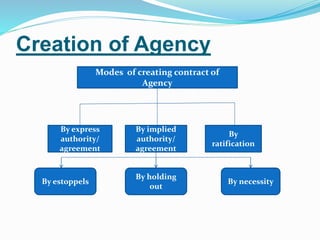
Creation of Agency
Modes of creating contract of
Agency
By express
authority/
agreement
By implied
authority/
agreement
By
ratification
By estoppels
By holding
out
By necessity
Agency Classification
1) Express Agency (sec186) – A person may be appointed
agent, either by word of mouth or by writing. No
particular form is required for appointing an agent.
2) Implied Agency (sec187) - An agency which arises from
the conduct, situation or relationships of parties.
.
Agency by Estoppel (sec237) – When a person has by his
conduct or statements induced others to believe that a
certain person is his agent, he is estopped from
subsequently denying it.
 Ex - A tells B that he is C’s agent, this he does in the
presence of C and within his hearing. C does not object to
the statement of A is actually not his agent. Later B makes a
deal with A as agent of C. C shall be bound by this deal.
Agency by holding out (sec189) – Though part of the law
of estoppel, some affirmative conduct by the principal is
necessary in creation of agency by holding out.
 Ex - A child purchase goods from a shop and desires the
shopkeeper to collect payment from his parents later. The
parents, though not bound to pay, make the payment. After
a few days, the child again makes purchases from the shop
on the credit of the parents. The parents would be bound
this time because, by making payment earlier without
raising any objection, they had held their child out as their
agent for making such purchases.
Agency of necessity (sec189) - This arises where there is
no express or implied appointment of a person as agent for
another but he is forced to act on behalf of a particular
person.
 Ex - A horse was sent by rail at the destination it was not
taken delivery by the owner. The station master had to feed
the horse. Held, station master became the agent by
necessity and hence the owner must compensate him.
3) Agency by ratification (sec197)– Where an agent does
an act for his principal but without knowledge or
authority or where he exceeds the given authority,
the principal is not held bound by the transaction.
 Ex - L made an offer to X, MD of a company. X accepted
the offer though he had no authority to do so. L
subsequently withdrew the offer, but the company ratified
X’s acceptance.
Held – L was bound. The ratification related back to the
time X accepted the offer, thus rendering the revocation of
the offer inoperative. An offer once accepted cannot be
withdrawn.
Essentials of Ratification
 Act on behalf of supposed principal
 Existing principal
 Contractual capacity of the principal
 Full knowledge of all facts
 Within reasonable time
 Lawful acts
 Whole transaction
 Acceptance subject to ratification creates no contract
 Communication
 No damage to third party
 No conditional ratification
 Authority to ratify
Termination of agency
 By the act of parties
by agreement
by revocation by the principal
by remuneration of agency
Cont..
 By operation of law
completion by agency business
death
winding-up or dissolution
insanity
insolvency
expiry of time
destruction of the subject matter
principal becoming an alien enemy
termination by sub agent’s authority
impossibility
Irrevocable agency
 When the agency is coupled with interest
 When the agent has incurred liability
 When the agent has partly exercised his authority
Classification Of Agents
1) General agents
2) special agent
3) Universal agent
4) Mercantile Or Commercial Agents
i. Broker: A broker is a mercantile agent engaged to buy and /or
sell property or to make bargains and contract between the
engager and a third party for commission.
ii. Factor: A factor is a mercantile agent who is entrusted with the
possession of goods with an authority to sell the same.
iii. Commission Agent: A commission agent is an agent who is
employed to buy or sell goods or transact business.
iv. Del Credere Agent: A del credere agent is one who, in
consideration of an extra remuneration, called a del credere
commission, guarantees the performance of the contract by the
other party.
Cont.…
v. Auctioneer: An auctioneer is an agent appointed to sell goods
by auction.
vi. Banker: though the relationship between banker and
customer is ordinarily that of debtor or creditor, he acts as an
agent when he buys or sells securities on his behalf.
vii. Pakka and Katcha Adatias: A pakka Adatia is a person who
guarantees the performance of the contract, not only to his
principal but also to the broker to the other side.
A katcha adatia does not guarantee the performance of the
contract.
v. Indentor: An intentor is commission agent, who,, for a
commission, procures a sale or a purchase on behalf of his
principal, with a merchant in a foreign country.
Cont.…
2) Non-Mercantile or Non Commercial Agents
Wife As The Agent
Sub-Agents
Sub-agent and Co-agent
 A sub-agent is a person employed by and acting under
the control of the original agent in the business of
agency
 Co-agent – Substituted Agent
 Substituted agent is a person ,appointed by the agent
to act for the principal in the business of the agency
with the knowledge and consent of the principal.
 Right to remuneration(Sec 219-220)
 Right of Retainer(Sec 217)
 Right of lien
 Right to be indemnified against consequences of awful acts
 Right to be indemnified against consequences of acts done
in good faith
 Rights of compensation
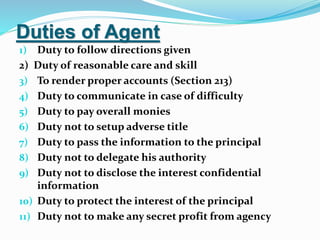
Duties of Agent
1) Duty to follow directions given
2) Duty of reasonable care and skill
3) To render proper accounts (Section 213)
4) Duty to communicate in case of difficulty
5) Duty to pay overall monies
6) Duty not to setup adverse title
7) Duty to pass the information to the principal
8) Duty not to delegate his authority
9) Duty not to disclose the interest confidential
information
10) Duty to protect the interest of the principal
11) Duty not to make any secret profit from agency
Contractofagency

Contractofagency

  • 1.
    PREPARED AND PRESENTED BY NOUSHAD.K SAFI INSTITUTE OF ADVANCED STUDY ,VAZHAYOOR
  • 2.
    CONTENTS  Agency  Creationof agency  Duties and liabilities of agent and principal  Termination of agency
  • 3.
    According to Sec182 defines an ‘Agent’ as “a person employed to do any act for another or to represent another in dealings with third person”. The person for whom such act is done or who is represented is called the principal. The relationship between the agent and the principal is called “agency”
  • 4.
    Rules Of Agency Contractsof agency are based on two important principles, namely:  Whatever a person can do personally shall also be allowed to be done through an agent except in case of contracts involving personal services such as painting, marriage, singing, etc.  He who does not act through a duly authorized agent does it by himself, i.e., the act of the agent are considered the acts of the principal (Sec. 226)
  • 5.
    Essentials of Agency Competence of the principal  Any person may become an Agent  Consideration not necessary  Free consent  Other essentials
  • 6.
    Who Can BeAn Agent  Any person who is of the age of majority according to the law to which he is subject and who is of sound mind, may an agent.  The function of an agent is to bring his principal into connectional relations with third parties. The agent is merely a connecting link between the principal and third parties .
  • 7.
    Difference Between AnAgent And A Servant  Establishing contractual relations  Direction , control and supervision  Binding by the acts  Wrongful act  Remuneration  On whose behalf: An agent may work for several principals at the same time. A servant can serve only one master at a time.
  • 8.
    Agent and Independentcontractor  Independent working  Personal liability  Binding by the acts  remuneration
  • 9.
    Creation of Agency Modesof creating contract of Agency By express authority/ agreement By implied authority/ agreement By ratification By estoppels By holding out By necessity
  • 10.
    Agency Classification 1) ExpressAgency (sec186) – A person may be appointed agent, either by word of mouth or by writing. No particular form is required for appointing an agent. 2) Implied Agency (sec187) - An agency which arises from the conduct, situation or relationships of parties. .
  • 11.
    Agency by Estoppel(sec237) – When a person has by his conduct or statements induced others to believe that a certain person is his agent, he is estopped from subsequently denying it.  Ex - A tells B that he is C’s agent, this he does in the presence of C and within his hearing. C does not object to the statement of A is actually not his agent. Later B makes a deal with A as agent of C. C shall be bound by this deal.
  • 12.
    Agency by holdingout (sec189) – Though part of the law of estoppel, some affirmative conduct by the principal is necessary in creation of agency by holding out.  Ex - A child purchase goods from a shop and desires the shopkeeper to collect payment from his parents later. The parents, though not bound to pay, make the payment. After a few days, the child again makes purchases from the shop on the credit of the parents. The parents would be bound this time because, by making payment earlier without raising any objection, they had held their child out as their agent for making such purchases.
  • 13.
    Agency of necessity(sec189) - This arises where there is no express or implied appointment of a person as agent for another but he is forced to act on behalf of a particular person.  Ex - A horse was sent by rail at the destination it was not taken delivery by the owner. The station master had to feed the horse. Held, station master became the agent by necessity and hence the owner must compensate him.
  • 14.
    3) Agency byratification (sec197)– Where an agent does an act for his principal but without knowledge or authority or where he exceeds the given authority, the principal is not held bound by the transaction.  Ex - L made an offer to X, MD of a company. X accepted the offer though he had no authority to do so. L subsequently withdrew the offer, but the company ratified X’s acceptance. Held – L was bound. The ratification related back to the time X accepted the offer, thus rendering the revocation of the offer inoperative. An offer once accepted cannot be withdrawn.
  • 15.
    Essentials of Ratification Act on behalf of supposed principal  Existing principal  Contractual capacity of the principal  Full knowledge of all facts  Within reasonable time  Lawful acts  Whole transaction  Acceptance subject to ratification creates no contract  Communication  No damage to third party  No conditional ratification  Authority to ratify
  • 16.
    Termination of agency By the act of parties by agreement by revocation by the principal by remuneration of agency
  • 17.
    Cont..  By operationof law completion by agency business death winding-up or dissolution insanity insolvency expiry of time destruction of the subject matter principal becoming an alien enemy termination by sub agent’s authority impossibility
  • 18.
    Irrevocable agency  Whenthe agency is coupled with interest  When the agent has incurred liability  When the agent has partly exercised his authority
  • 19.
    Classification Of Agents 1)General agents 2) special agent 3) Universal agent 4) Mercantile Or Commercial Agents i. Broker: A broker is a mercantile agent engaged to buy and /or sell property or to make bargains and contract between the engager and a third party for commission. ii. Factor: A factor is a mercantile agent who is entrusted with the possession of goods with an authority to sell the same. iii. Commission Agent: A commission agent is an agent who is employed to buy or sell goods or transact business. iv. Del Credere Agent: A del credere agent is one who, in consideration of an extra remuneration, called a del credere commission, guarantees the performance of the contract by the other party.
  • 20.
    Cont.… v. Auctioneer: Anauctioneer is an agent appointed to sell goods by auction. vi. Banker: though the relationship between banker and customer is ordinarily that of debtor or creditor, he acts as an agent when he buys or sells securities on his behalf. vii. Pakka and Katcha Adatias: A pakka Adatia is a person who guarantees the performance of the contract, not only to his principal but also to the broker to the other side. A katcha adatia does not guarantee the performance of the contract. v. Indentor: An intentor is commission agent, who,, for a commission, procures a sale or a purchase on behalf of his principal, with a merchant in a foreign country.
  • 21.
    Cont.… 2) Non-Mercantile orNon Commercial Agents Wife As The Agent Sub-Agents
  • 22.
    Sub-agent and Co-agent A sub-agent is a person employed by and acting under the control of the original agent in the business of agency  Co-agent – Substituted Agent  Substituted agent is a person ,appointed by the agent to act for the principal in the business of the agency with the knowledge and consent of the principal.
  • 24.
     Right toremuneration(Sec 219-220)  Right of Retainer(Sec 217)  Right of lien  Right to be indemnified against consequences of awful acts  Right to be indemnified against consequences of acts done in good faith  Rights of compensation
  • 25.
    Duties of Agent 1)Duty to follow directions given 2) Duty of reasonable care and skill 3) To render proper accounts (Section 213) 4) Duty to communicate in case of difficulty 5) Duty to pay overall monies 6) Duty not to setup adverse title 7) Duty to pass the information to the principal 8) Duty not to delegate his authority 9) Duty not to disclose the interest confidential information 10) Duty to protect the interest of the principal 11) Duty not to make any secret profit from agency