The Future of Testing / QA Richard Bornet [email_address] 416-895-7176 www.scenariotester.com
Can we predict the future? Most people say no. We can predict patterns? Future is not just passive, we can affect the future!
History of World in One Slide You can predict the future. But you have to look at the long term big picture. Stone Age -> Agriculture Age -> Industrial Age -> Information Age The one common element across the ages is CHANGE and change is speeding-up. The reason for change is innovation.
How Innovation Changes Work Home workers  Manual  Cottage Industry Central Workplace Manual Work Tools Assembly line for component assembly Robots / Automation Unit Cost Decreased.  Fewer individuals involved in creating the product.
So Where Are We in QA Manual with tools Word Excel Defect-tracking systems Requirements managers Test automation Change in QA will follow traditional growth patterns. Future Goal Much higher productivity and efficiency. Significantly improved ROI
Return on Investment ROI will be the central driving force behind IT budgets in next decade. QA will have to show a +ve ROI. “ Business units will control virtually all discretionary IT spending. ” Gartner
Return on Investment “ Software defects are costing the U.S. economy 60 billion dollars.” National Institute of Standards and  Technology  “ It is much more cost effective to catch a bug in test than it is in production. About half the cost.” “ Quality must be raised without incurring additional costs.”
Moving to an improved ROI Organizations are employing strategies to increase ROI. If catching the defect in QA is more cost-effective than finding it in production then: Finding it before QA will be even more cost effective Not creating it in the 1 st  place will be preferred.
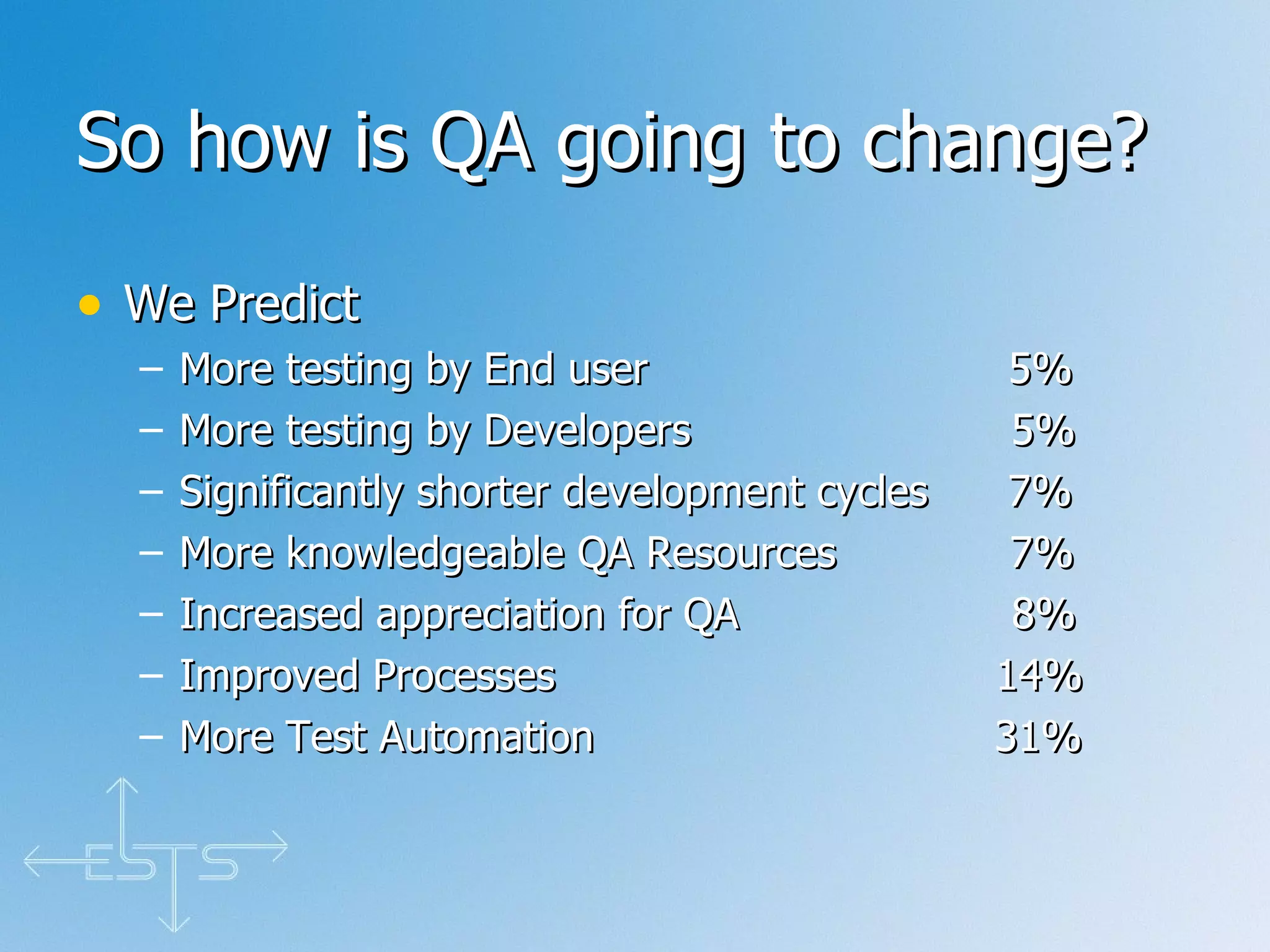
So how is QA going to change? We Predict More testing by End user  5% More testing by Developers  5% Significantly shorter development cycles  7% More knowledgeable QA Resources  7% Increased appreciation for QA    8% Improved Processes  14% More Test Automation  31%
Move to Packaged Software Less in-house development. Buy packages which will execute the functions SAP, BPCS , PeopleSoft. Fewer and larger vendors. Customize for specific business.
What this means for QA Vendors provides a stable application.  Vendors thoroughly test application. QA will need to do less testing. Test A good regression Custom adaptations Concentrate on whether business needs are being met.
Pre-built components   Common model in hardware. Not just objects. Whole functional modules. Storage facility for On Demand videos Database may come for IBM Web Services through .Net Logging and monitoring system through another company.
What this means for QA Vendors provides stable modules. Less testing. Test  A good regression Code that is built in-house Concentrate on whether business needs are being met. Don’t test the video management system, it should work.
Outsourcing   Bring in a third party to develop and maintain your systems. Outsourcers bring: Stable code Libraries of re-usable code Applications tested in various companies Costs shared between clients Faster turnaround.
What this means for QA Outsourcer provides stable code. Outsourcers can perform the QA functions. If testing in house test less testing.  Outsourcer responsible for providing solid code Concentrate on whether business needs are being met.
Offshore development   Same as outsourcing except theoretically cheaper. Again, you can demand stable and defect free code. What this means for QA Less testing
Move testing to the developers   Some companies have moved testing responsibilities onto their developers QA departments shut down or downsized
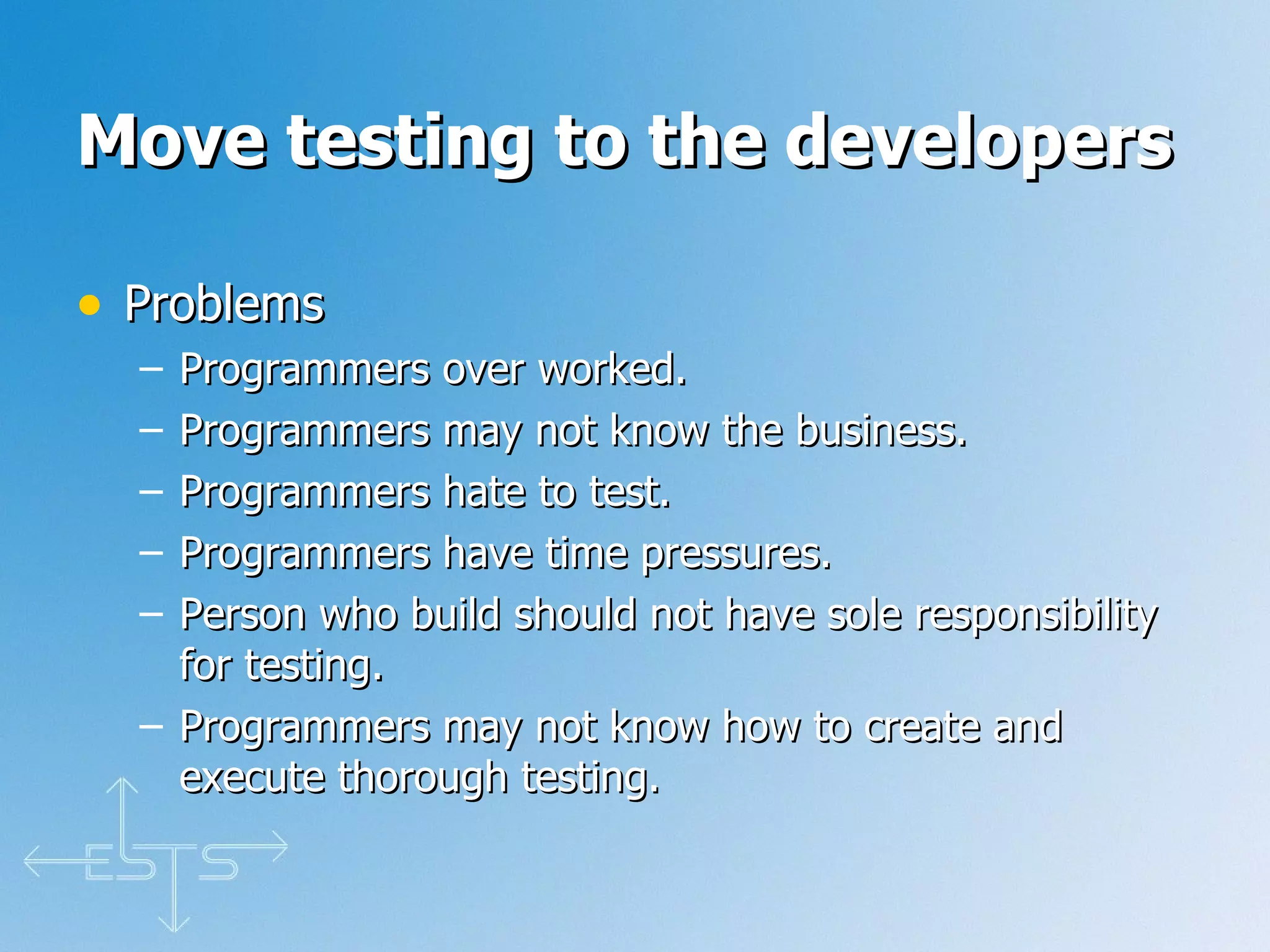
Move testing to the developers Problems Programmers over worked. Programmers may not know the business. Programmers hate to test. Programmers have time pressures. Person who build should not have sole responsibility for testing. Programmers may not know how to create and execute thorough testing.
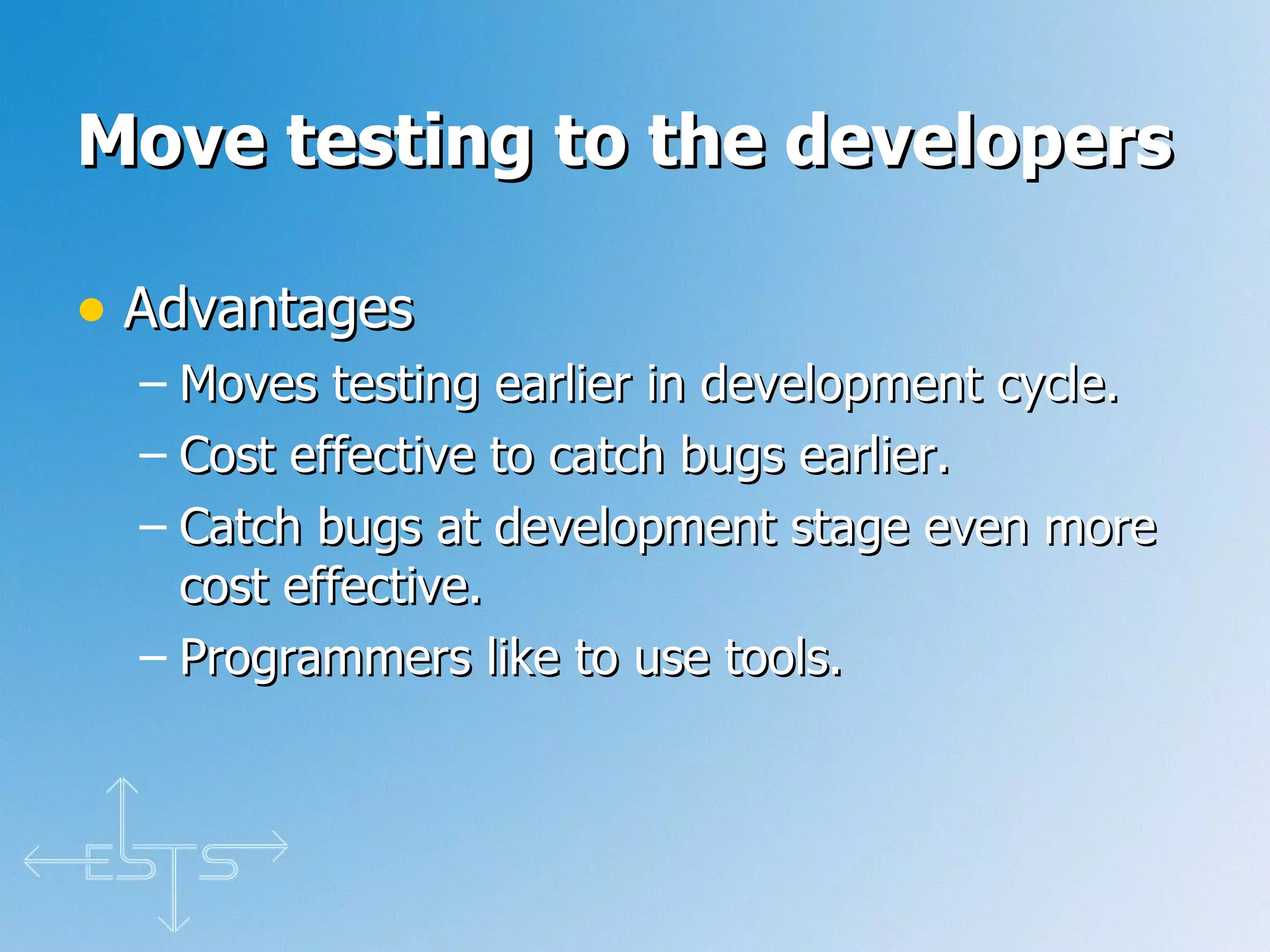
Move testing to the developers Advantages Moves testing earlier in development cycle. Cost effective to catch bugs earlier. Catch bugs at development stage even more cost effective. Programmers like to use tools.
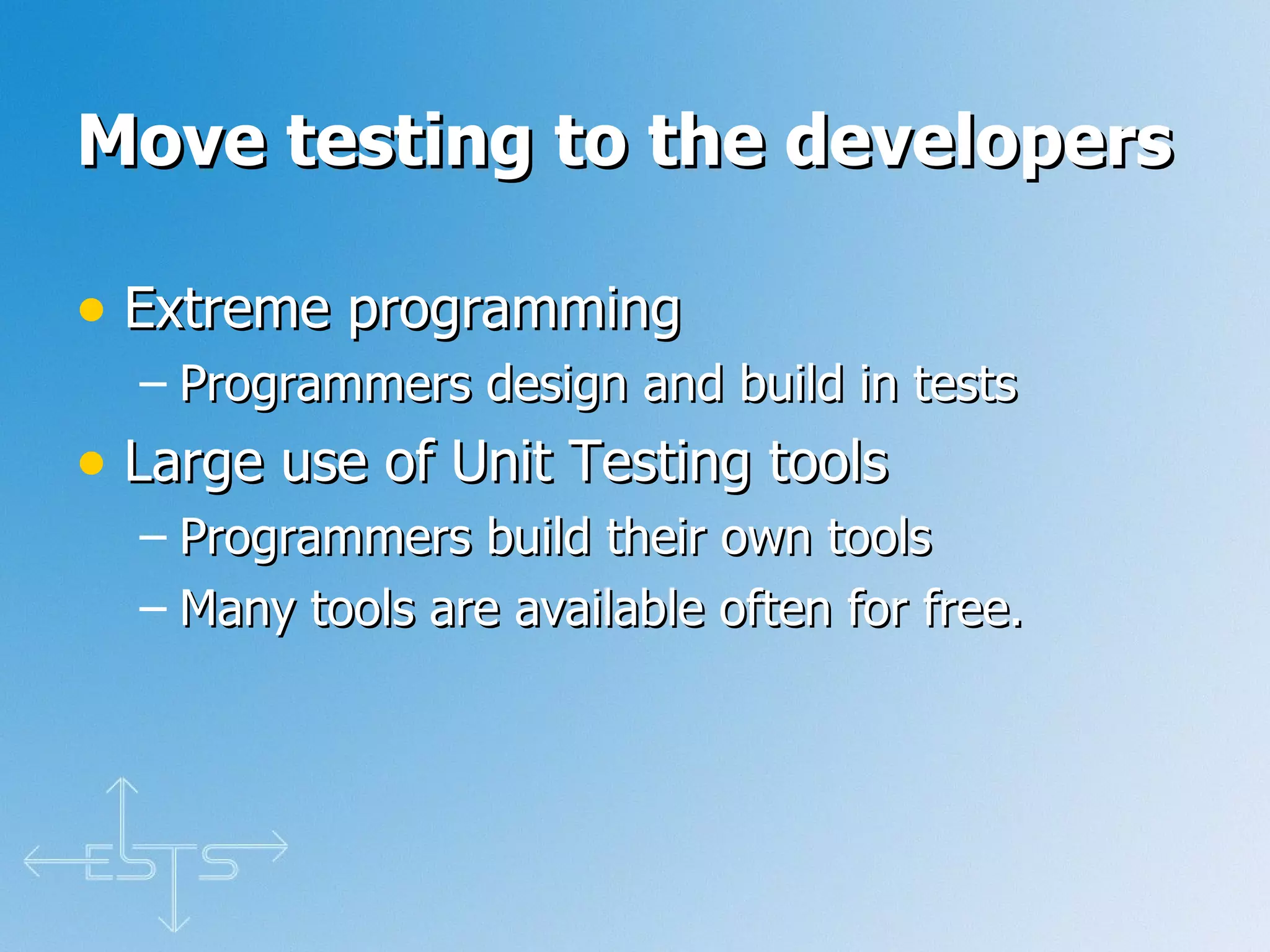
Move testing to the developers Extreme programming Programmers design and build in tests Large use of Unit Testing tools Programmers build their own tools Many tools are available often for free.
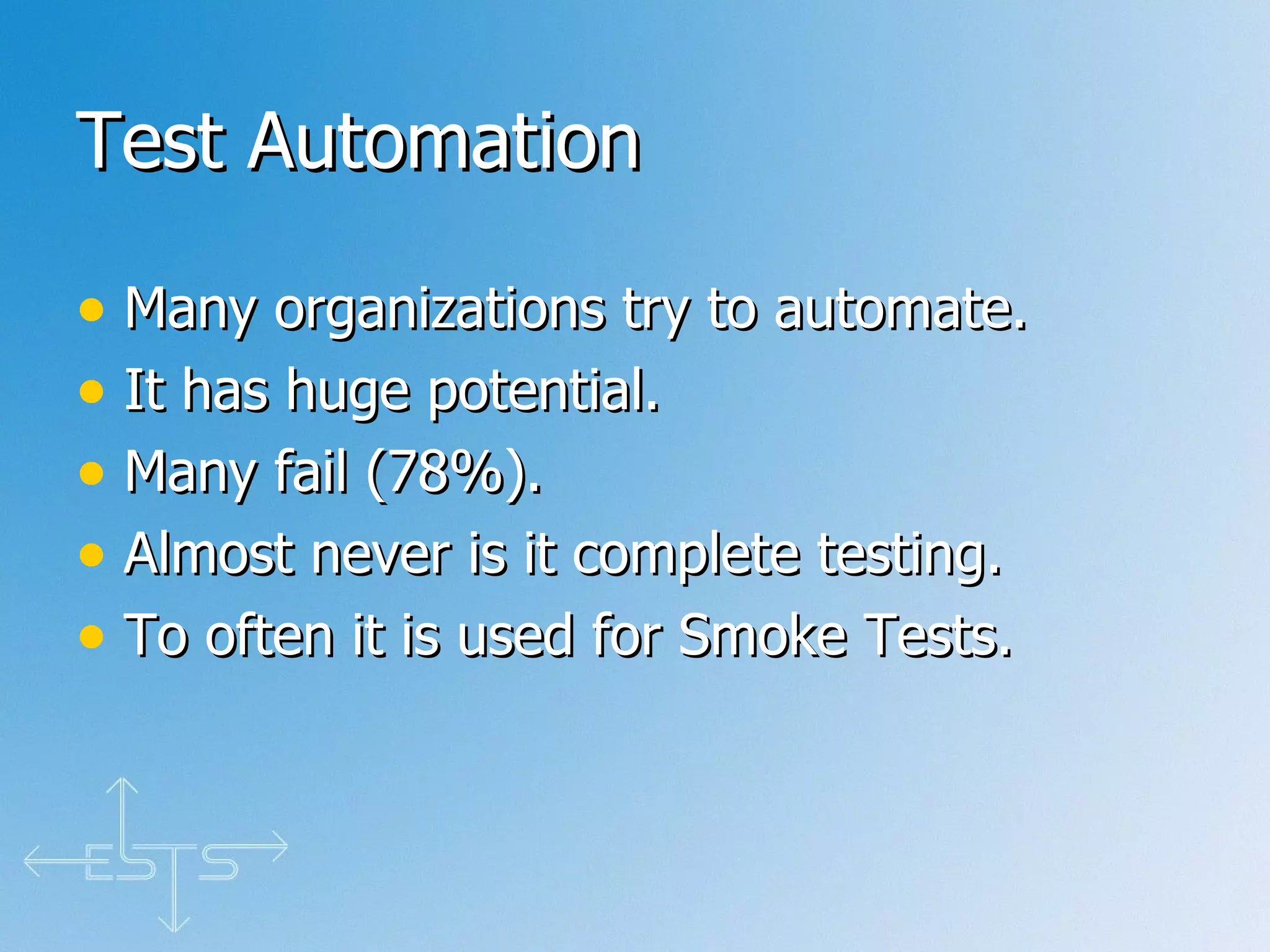
Test Automation Many organizations try to automate. It has huge potential. Many fail (78%). Almost never is it complete testing. To often it is used for Smoke Tests.
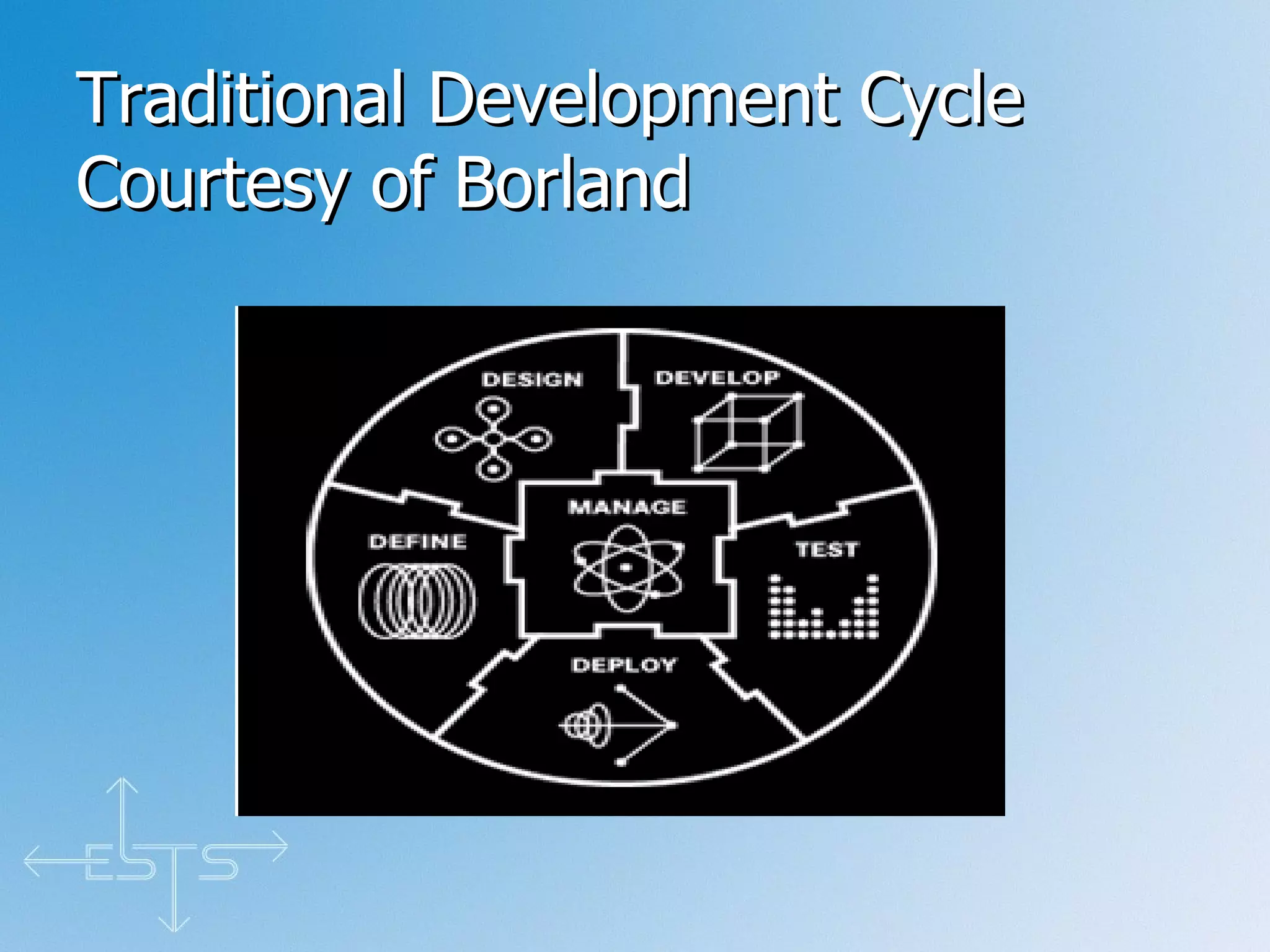
Traditional Development Cycle Courtesy of Borland
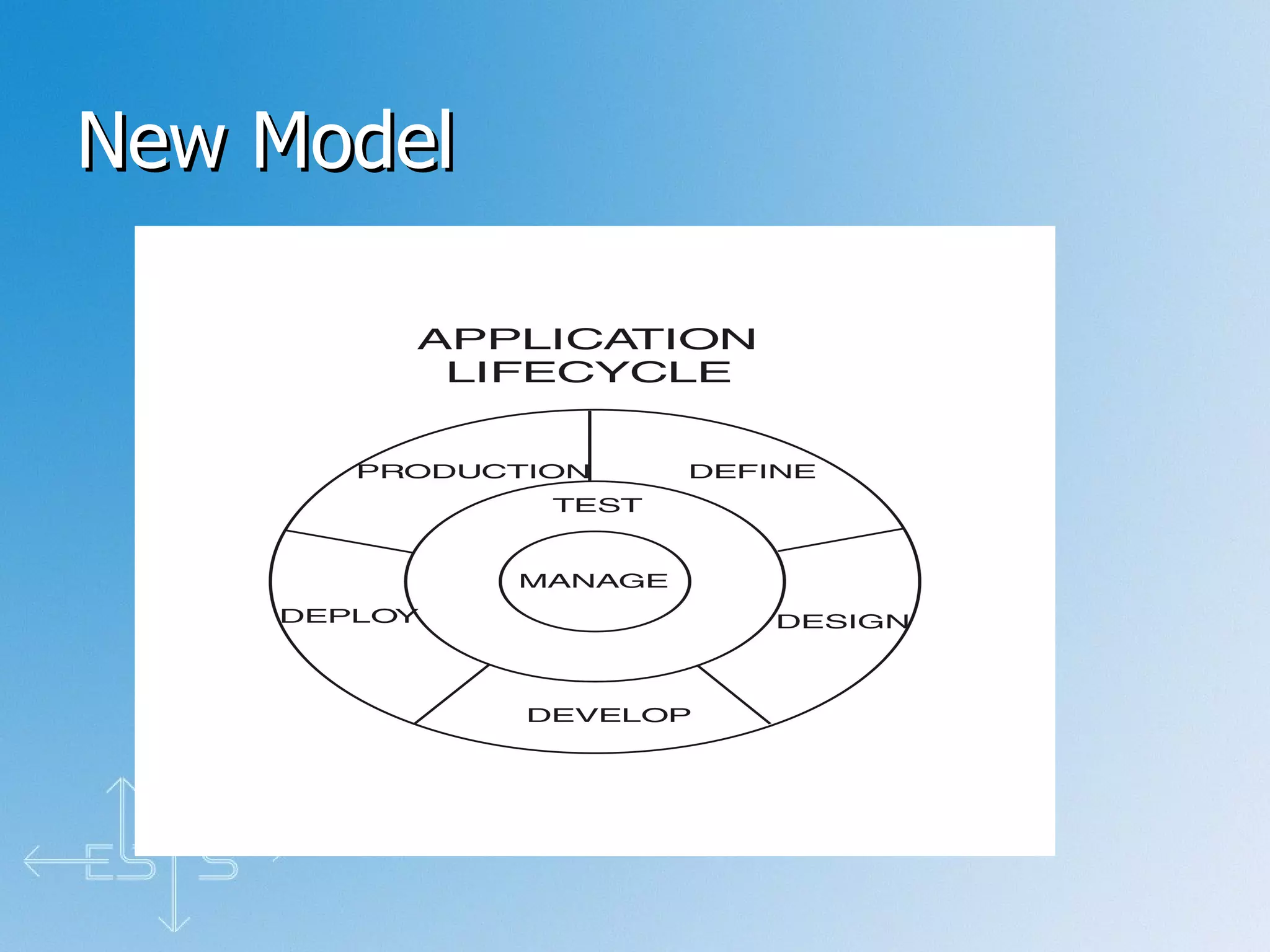
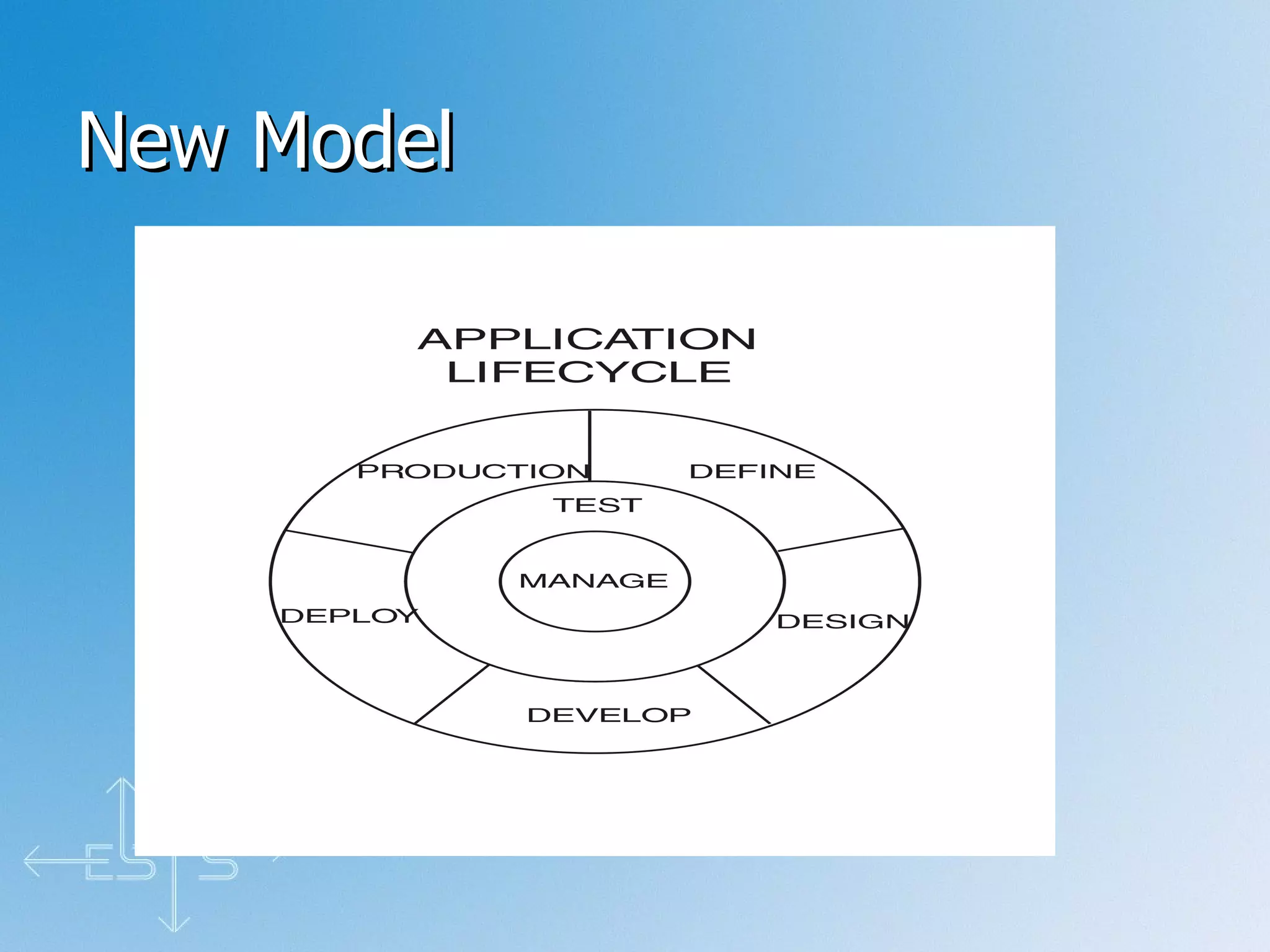
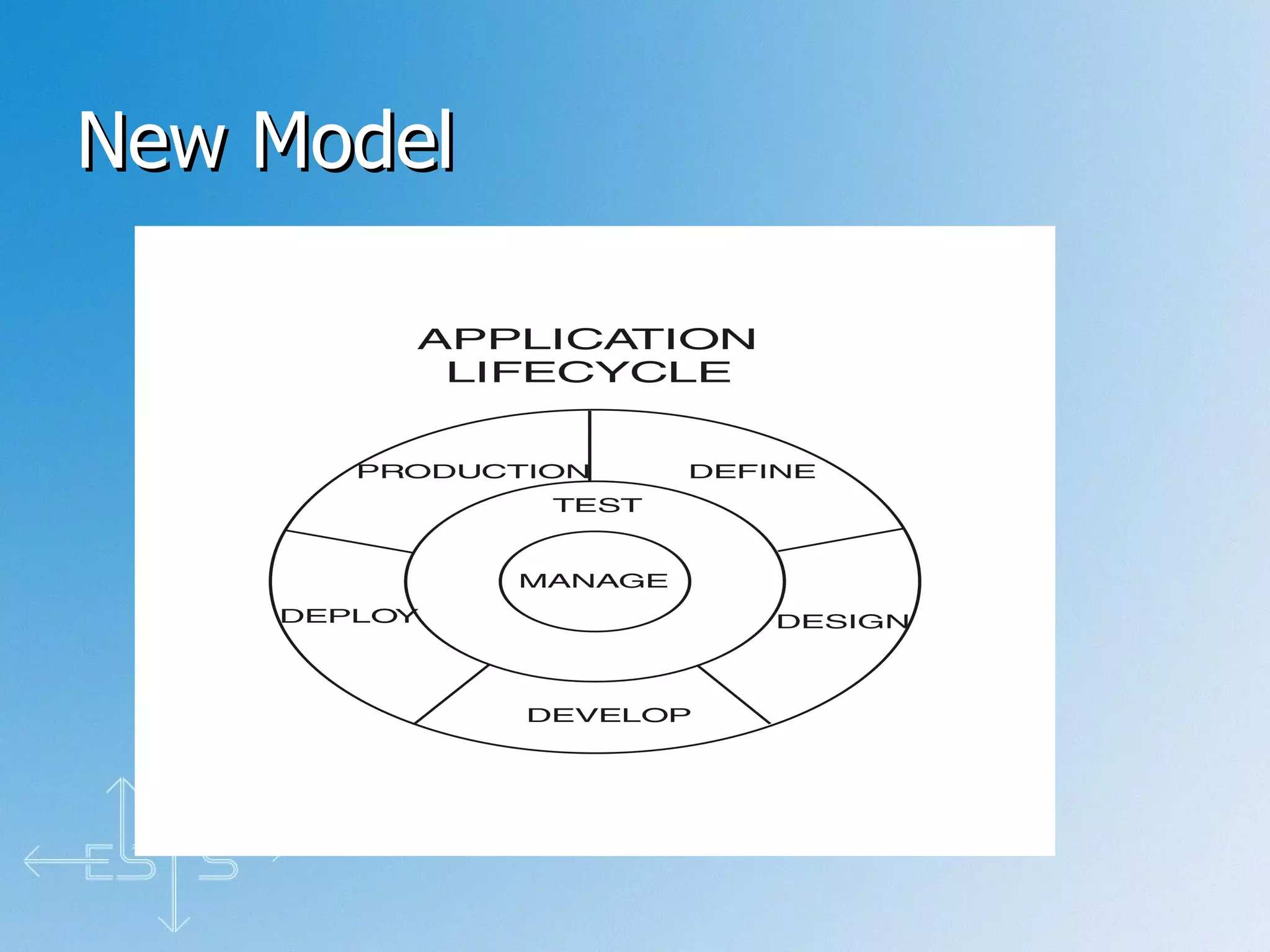
New Model
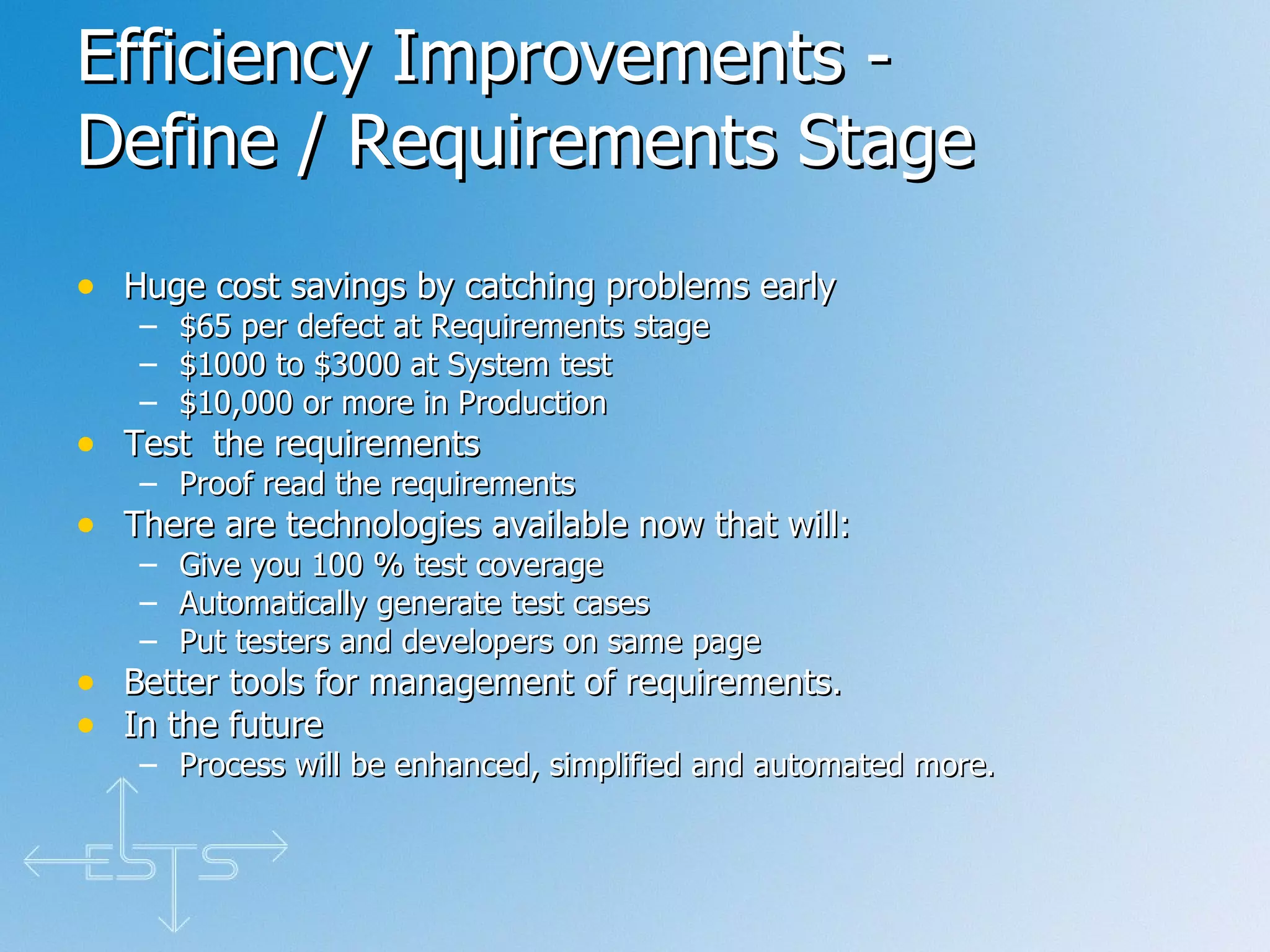
Efficiency Improvements - Define / Requirements Stage Huge cost savings by catching problems early $65 per defect at Requirements stage $1000 to $3000 at System test $10,000 or more in Production Test  the requirements Proof read the requirements There are technologies available now that will: Give you 100 % test coverage Automatically generate test cases Put testers and developers on same page Better tools for management of requirements. In the future  Process will be enhanced, simplified and automated more.
Efficiency Improvements - Design Stage Designers and Developers will build software mindful of  how we are going to test it.  Build tests into the application. Build hooks for testing into application.
Efficiency Improvements Development Stage Unit test automation Automation Deployment Stage Automation Production Automation
TEST AUTOMATION Single biggest change in QA, will be the amount and type of test automation This will include: New types of testing New tools New strategies
Test Automation – Current State Stage 1: Record and Playback Stage 2: Write Code Stage 3: Modularity Stage 4: Data Driven Testing
Test Automation – Who Does What Stage 5: Teach the testers how to program. Stage 6: Make the automation tools simpler Tree view diagrams. “ WinRunner Lite”. Stage 7: Teach programmers the business. Stage 8 : Bring in Automation experts.  Hire a programmer. Bring in an external consultants. Create a test automation team.
Test Automation – Current State None of these stages fit the way testers work. Having to code or handing off your work and responsibilities to a 3 rd  party is not acceptable. Almost never is it complete testing. No wonder many automation efforts fail. (78%).
Stage 9: Empower the TESTERS  Give testers an interface to enter test cases / test scripts. Press a button to execute them. Needs to be simple and powerful. Create test scripts before the application is even built.
Web Services Endorsed by Microsoft, Borland, Sun and IBM. It is the ability to provide hooks to an application which can be utilized by external applications. CIO like it because they can keep their legacy systems. Users like it because they can get new and useful interfaces.
Web Services – Testing  Multiple Inputs GUI application, Palm Pilot, your phone,  your TV, Voice, special devices Testing will be more interesting as new forms of accessibility are developed. Component model of software.
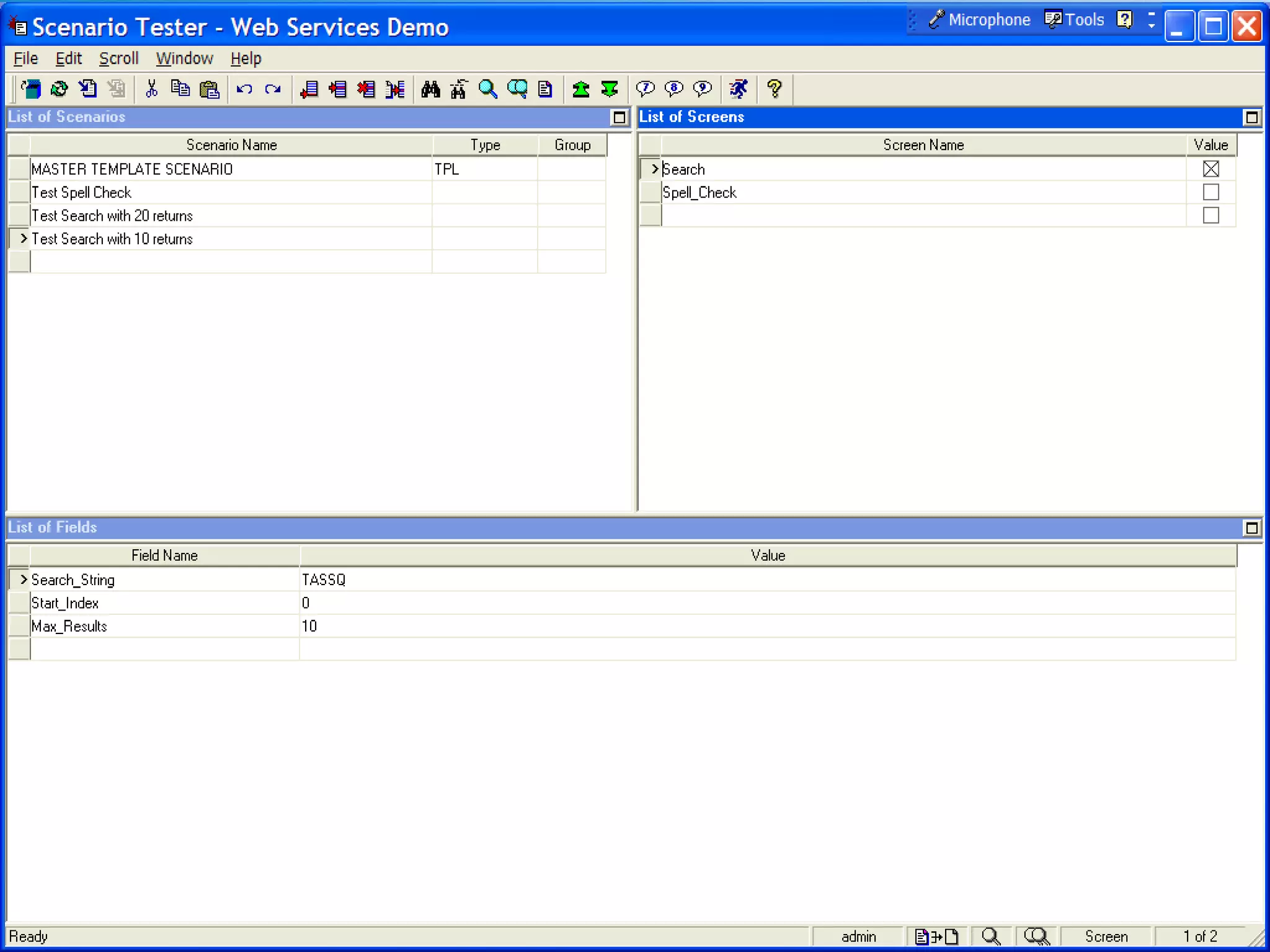
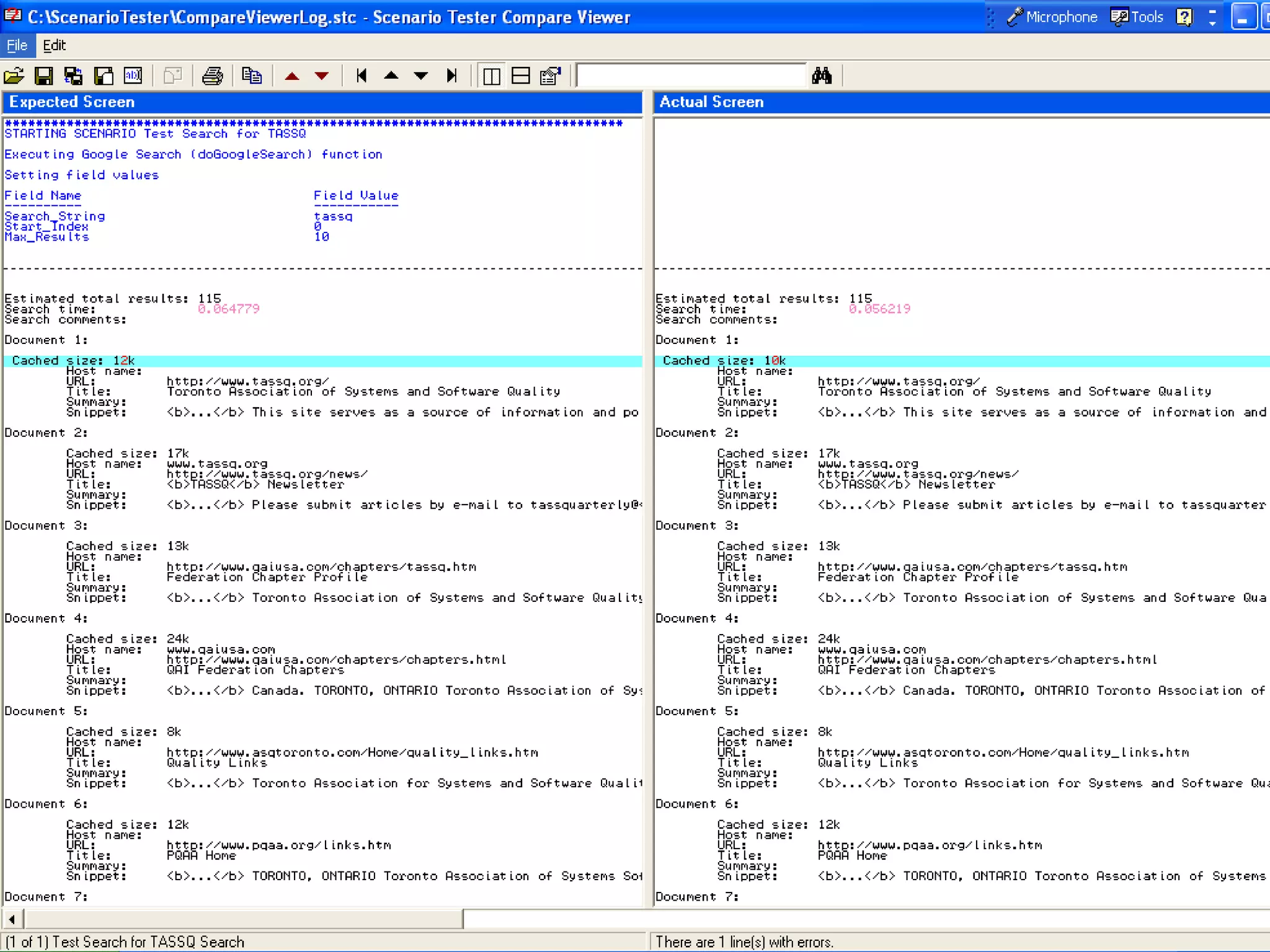
Web Services – Testing Web Services creates a stable environment. Testing components. Testing is split between  Testing the web service Testing the GUI / application Testing the business rules. New simple tools.


New Model
FUTURE: Building the interface between the tests and the app. Currently you Point and Click Building the scripts automatically Screen scrapers Web services test tools will pick up the WSDL file.
FUTURE: Building the interface between the tests and the app. Design Stage Developers when they design application, design hooks into the application to allow for data to be passed to and from the app. Design to expose the application to an outside test tool. Generally straightforward.
FUTURE: Building hooks to test automation into the application  Application arrives automatically automated. Test tool automatically connects test cases and app. Build extra scripts in VB and Java and compile code. Same cost no matter how many testers. Cheaper /more control.
FUTURE: Building testing right into the application.  Hardware manufacturers have been doing this for ages. In Production we call it monitoring. eBay.
Future of QA Test in Production Automatic monitors for functionality and performance. Programs, which can execute tests both automatically and on request. Same set-up can be used at Deployment and Development stage
Future of QA Get requirements right by thoroughly testing them. Automating the writing of the test cases and test scripts. Automated environment for testing  Automatic monitors for functionality and performance. Programs, which can execute tests both automatically and on request. Deployment testing is automated. Production is automatically monitored and tested Automated system allows for Troubleshooting and Diagnostics.
Future QA – Solves problems Increased ROI. Decreased costs. Complete test coverage. Faster turnaround. We need to reinvent ourselves or we will become obsolete. Huge opportunities for QA.
New Model
Contact Information Richard Bornet 416-895-7176 [email_address] Web site www.scenariotester.com Presentation www.scenariotester.com  and go to Articles

Futureofqa

  • 1.
    The Future ofTesting / QA Richard Bornet [email_address] 416-895-7176 www.scenariotester.com
  • 2.
    Can we predictthe future? Most people say no. We can predict patterns? Future is not just passive, we can affect the future!
  • 3.
    History of Worldin One Slide You can predict the future. But you have to look at the long term big picture. Stone Age -> Agriculture Age -> Industrial Age -> Information Age The one common element across the ages is CHANGE and change is speeding-up. The reason for change is innovation.
  • 4.
    How Innovation ChangesWork Home workers Manual Cottage Industry Central Workplace Manual Work Tools Assembly line for component assembly Robots / Automation Unit Cost Decreased. Fewer individuals involved in creating the product.
  • 5.
    So Where AreWe in QA Manual with tools Word Excel Defect-tracking systems Requirements managers Test automation Change in QA will follow traditional growth patterns. Future Goal Much higher productivity and efficiency. Significantly improved ROI
  • 6.
    Return on InvestmentROI will be the central driving force behind IT budgets in next decade. QA will have to show a +ve ROI. “ Business units will control virtually all discretionary IT spending. ” Gartner
  • 7.
    Return on Investment“ Software defects are costing the U.S. economy 60 billion dollars.” National Institute of Standards and Technology “ It is much more cost effective to catch a bug in test than it is in production. About half the cost.” “ Quality must be raised without incurring additional costs.”
  • 8.
    Moving to animproved ROI Organizations are employing strategies to increase ROI. If catching the defect in QA is more cost-effective than finding it in production then: Finding it before QA will be even more cost effective Not creating it in the 1 st place will be preferred.
  • 9.
    So how isQA going to change? We Predict More testing by End user 5% More testing by Developers 5% Significantly shorter development cycles 7% More knowledgeable QA Resources 7% Increased appreciation for QA 8% Improved Processes 14% More Test Automation 31%
  • 10.
    Move to PackagedSoftware Less in-house development. Buy packages which will execute the functions SAP, BPCS , PeopleSoft. Fewer and larger vendors. Customize for specific business.
  • 11.
    What this meansfor QA Vendors provides a stable application. Vendors thoroughly test application. QA will need to do less testing. Test A good regression Custom adaptations Concentrate on whether business needs are being met.
  • 12.
    Pre-built components Common model in hardware. Not just objects. Whole functional modules. Storage facility for On Demand videos Database may come for IBM Web Services through .Net Logging and monitoring system through another company.
  • 13.
    What this meansfor QA Vendors provides stable modules. Less testing. Test A good regression Code that is built in-house Concentrate on whether business needs are being met. Don’t test the video management system, it should work.
  • 14.
    Outsourcing Bring in a third party to develop and maintain your systems. Outsourcers bring: Stable code Libraries of re-usable code Applications tested in various companies Costs shared between clients Faster turnaround.
  • 15.
    What this meansfor QA Outsourcer provides stable code. Outsourcers can perform the QA functions. If testing in house test less testing. Outsourcer responsible for providing solid code Concentrate on whether business needs are being met.
  • 16.
    Offshore development Same as outsourcing except theoretically cheaper. Again, you can demand stable and defect free code. What this means for QA Less testing
  • 17.
    Move testing tothe developers Some companies have moved testing responsibilities onto their developers QA departments shut down or downsized
  • 18.
    Move testing tothe developers Problems Programmers over worked. Programmers may not know the business. Programmers hate to test. Programmers have time pressures. Person who build should not have sole responsibility for testing. Programmers may not know how to create and execute thorough testing.
  • 19.
    Move testing tothe developers Advantages Moves testing earlier in development cycle. Cost effective to catch bugs earlier. Catch bugs at development stage even more cost effective. Programmers like to use tools.
  • 20.
    Move testing tothe developers Extreme programming Programmers design and build in tests Large use of Unit Testing tools Programmers build their own tools Many tools are available often for free.
  • 21.
    Test Automation Manyorganizations try to automate. It has huge potential. Many fail (78%). Almost never is it complete testing. To often it is used for Smoke Tests.
  • 22.
    Traditional Development CycleCourtesy of Borland
  • 23.
  • 24.
    Efficiency Improvements -Define / Requirements Stage Huge cost savings by catching problems early $65 per defect at Requirements stage $1000 to $3000 at System test $10,000 or more in Production Test the requirements Proof read the requirements There are technologies available now that will: Give you 100 % test coverage Automatically generate test cases Put testers and developers on same page Better tools for management of requirements. In the future Process will be enhanced, simplified and automated more.
  • 25.
    Efficiency Improvements -Design Stage Designers and Developers will build software mindful of how we are going to test it. Build tests into the application. Build hooks for testing into application.
  • 26.
    Efficiency Improvements DevelopmentStage Unit test automation Automation Deployment Stage Automation Production Automation
  • 27.
    TEST AUTOMATION Singlebiggest change in QA, will be the amount and type of test automation This will include: New types of testing New tools New strategies
  • 28.
    Test Automation –Current State Stage 1: Record and Playback Stage 2: Write Code Stage 3: Modularity Stage 4: Data Driven Testing
  • 29.
    Test Automation –Who Does What Stage 5: Teach the testers how to program. Stage 6: Make the automation tools simpler Tree view diagrams. “ WinRunner Lite”. Stage 7: Teach programmers the business. Stage 8 : Bring in Automation experts. Hire a programmer. Bring in an external consultants. Create a test automation team.
  • 30.
    Test Automation –Current State None of these stages fit the way testers work. Having to code or handing off your work and responsibilities to a 3 rd party is not acceptable. Almost never is it complete testing. No wonder many automation efforts fail. (78%).
  • 31.
    Stage 9: Empowerthe TESTERS Give testers an interface to enter test cases / test scripts. Press a button to execute them. Needs to be simple and powerful. Create test scripts before the application is even built.
  • 32.
    Web Services Endorsedby Microsoft, Borland, Sun and IBM. It is the ability to provide hooks to an application which can be utilized by external applications. CIO like it because they can keep their legacy systems. Users like it because they can get new and useful interfaces.
  • 33.
    Web Services –Testing Multiple Inputs GUI application, Palm Pilot, your phone, your TV, Voice, special devices Testing will be more interesting as new forms of accessibility are developed. Component model of software.
  • 34.
    Web Services –Testing Web Services creates a stable environment. Testing components. Testing is split between Testing the web service Testing the GUI / application Testing the business rules. New simple tools.
  • 35.
  • 36.
  • 37.
  • 38.
  • 39.
    FUTURE: Building theinterface between the tests and the app. Currently you Point and Click Building the scripts automatically Screen scrapers Web services test tools will pick up the WSDL file.
  • 40.
    FUTURE: Building theinterface between the tests and the app. Design Stage Developers when they design application, design hooks into the application to allow for data to be passed to and from the app. Design to expose the application to an outside test tool. Generally straightforward.
  • 41.
    FUTURE: Building hooksto test automation into the application Application arrives automatically automated. Test tool automatically connects test cases and app. Build extra scripts in VB and Java and compile code. Same cost no matter how many testers. Cheaper /more control.
  • 42.
    FUTURE: Building testingright into the application. Hardware manufacturers have been doing this for ages. In Production we call it monitoring. eBay.
  • 43.
    Future of QATest in Production Automatic monitors for functionality and performance. Programs, which can execute tests both automatically and on request. Same set-up can be used at Deployment and Development stage
  • 44.
    Future of QAGet requirements right by thoroughly testing them. Automating the writing of the test cases and test scripts. Automated environment for testing Automatic monitors for functionality and performance. Programs, which can execute tests both automatically and on request. Deployment testing is automated. Production is automatically monitored and tested Automated system allows for Troubleshooting and Diagnostics.
  • 45.
    Future QA –Solves problems Increased ROI. Decreased costs. Complete test coverage. Faster turnaround. We need to reinvent ourselves or we will become obsolete. Huge opportunities for QA.
  • 46.
  • 47.
    Contact Information RichardBornet 416-895-7176 [email_address] Web site www.scenariotester.com Presentation www.scenariotester.com and go to Articles