Building a
Content Creation
Framework
Why does your
business need a
content creation
framework?
You need to publish a
lot of content for each
of your buyer
personas at different
stages of the
buyer’s journey.
A content creation framework
that’s repeatable, organized,
and agile can make the content
creation process smoother and
more rewarding.
SOURCE: BURST
Content Creation Framework
A structure of processes for publishing content,
from the beginning stages to post-publication
A framework
strikes that perfect
balance between
autonomous
creativity and
long-term content
sustainability.
You need to serve your audience’s needs and
educate them over time depending on what
they’re looking for.
SOURCE: PEXELS
We used Trello boards to keep track of how
changes were moving through the product
team’s pipeline.
When a change was coming closer to launch,
the technical writers had time to collect
content for updating and write drafts of new
content to educate users about the releases.
Remain flexible to account for
the changes that will
inevitably come up.
SOURCE: BURST
How to build a
content creation
framework
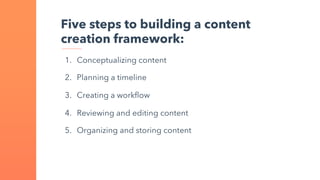
Five steps to building a content
creation framework:
1. Conceptualizing content
2. Planning a timeline
3. Creating a workflow
4. Reviewing and editing content
5. Organizing and storing content
Text here
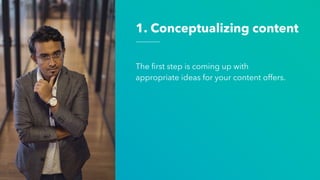
1. Conceptualizing content
RCE: BURST
The first step is coming up with
appropriate ideas for your content offers.
Content Offer
Something you create and publish in exchange for
personal information like a name and email address
Write down frequently asked sales questions or important
industry knowledge that would be helpful for your target market to know.
SOURCE: PIXABAY
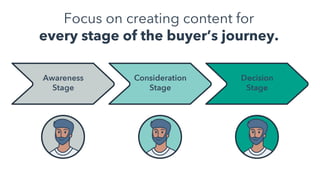
Focus on creating content for
every stage of the buyer’s journey.
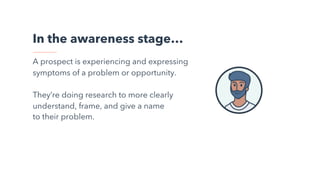
In the awareness stage…
A prospect is experiencing and expressing
symptoms of a problem or opportunity.
They’re doing research to more clearly
understand, frame, and give a name
to their problem.
They’re looking for educational content to help them answer some of
their questions and concerns—think blog posts, ebooks, social content,
and how-to webinars.
SOURCE: BURST
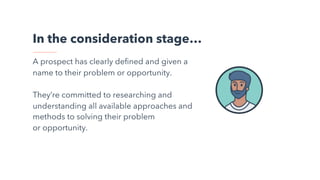
In the consideration stage…
A prospect has clearly defined and given a
name to their problem or opportunity.
They’re committed to researching and
understanding all available approaches and
methods to solving their problem
or opportunity.
Create content that positions you as an expert in your industry. Demo
videos, case studies, and FAQ articles are great resources to build
relationships with readers and establish trust between your audience
and your brand.
SOURCE: BURST
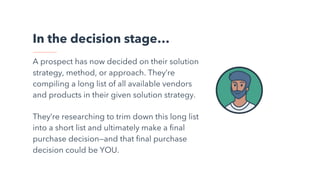
In the decision stage…
A prospect has now decided on their solution
strategy, method, or approach. They’re
compiling a long list of all available vendors
and products in their given solution strategy.
They’re researching to trim down this long list
into a short list and ultimately make a final
purchase decision—and that final purchase
decision could be YOU.
Provide them content such as free trials, consultations, and articles
that provide education on your products or services.
SOURCE: BURST
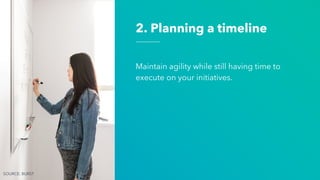
2. Planning a timeline
Maintain agility while still having time to
execute on your initiatives.
SOURCE: BURST
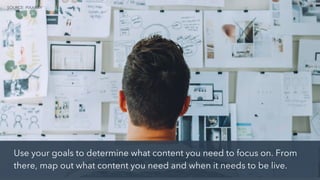
Use your goals to determine what content you need to focus on. From
there, map out what content you need and when it needs to be live.
SOURCE: PIXABAY
Identify any company-wide initiatives that will need support from
content over the next three months.
SOURCE: BURST
3. Creating a workflow
SOURCE: BURST
In the context of content creation, a workflow
is an intuitive breakdown of the content
creation work. It consists of the sequence of
steps a piece of content moves through from
its initial creation to publication.
Because there are multiple components
involved when creating a piece of content,
you’ll want to get pretty granular with your
steps—even if you’re a team of one.
SOURCE: BURST
Pro Tip:
Think about how you created a piece of content in the
past before you had a content creation framework.
Consider what went well, what roadblocks you hit,
and what you’ll need to work into your process to
avoid these roadblocks the next time around.
4. Reviewing and
editing content
SOURCE: BURST
You need a reviewal system in place so that
your content is accurate, well written, and
aligned with your brand.
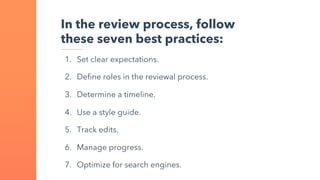
In the review process, follow
these seven best practices:
1. Set clear expectations.
2. Define roles in the reviewal process.
3. Determine a timeline.
4. Use a style guide.
5. Track edits.
6. Manage progress.
7. Optimize for search engines.
Set clear expectations.
The reviewer should know what they’re
looking for: grammatical errors, fact-checking,
story gaps, wordsmithing, and more.
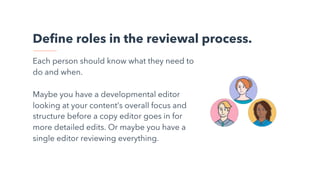
Define roles in the reviewal process.
Each person should know what they need to
do and when.
Maybe you have a developmental editor
looking at your content’s overall focus and
structure before a copy editor goes in for
more detailed edits. Or maybe you have a
single editor reviewing everything.
Determine a timeline.
With so many people involved in publishing
content, set due dates and a high-level
timeline so that each person is held
accountable for their contributions.
Use a style guide.
Your content needs to be consistently
authentic, well written, and aligned with your
company’s brand—even among various writers
with different writing styles, skill levels,
and voices.
Track edits.
Have your content reviewers make
suggestions by tracking changes as opposed
to making edits directly.
This way, the content creator knows where to
make changes as opposed to figuring out
what was altered.
Manage progress.
Use some sort of document, like a project
management software, to track progress.
This document should reflect the roles,
timeline, and deadlines you’ve determined for
your reviewal process.
Pro Tip:
If you’re looking for a place to start, consider using
Trello. It’s free, and—more importantly—Trello makes
collaborating with others easy.
Optimize for search engines.
You put a lot of effort into creating your
content, so you want your audience to find it
in their web searches.
After your content is created, do some spot
edits to search engine optimize your content.
5. Organizing and
storing content
Once your content is done, store it in a
centralized location where your team can
access it—like Google Drive or Dropbox.
SOURCE: BURST
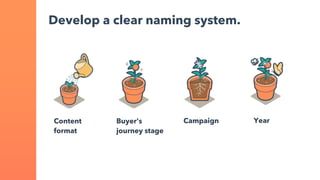
Develop a clear naming system.
Content
format
Buyer’s
journey stage
Campaign Year
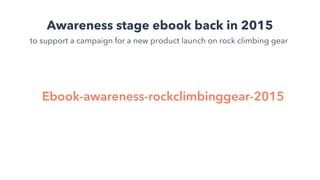
Ebook-awareness-rockclimbinggear-2015
Awareness stage ebook back in 2015
to support a campaign for a new product launch on rock climbing gear
Your content creation framework
should always be evolving.
Your business’s goals will vary
from quarter to quarter and year
to year, so your content creation
framework should align
with those changes.
Keep in mind:
SOURCE: BURST
Determining the
resources you’ll need
for a content creation
framework
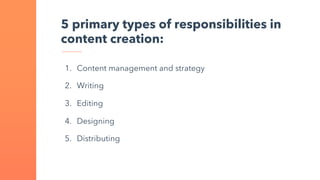
5 primary types of responsibilities in
content creation:
1. Content management and strategy
2. Writing
3. Editing
4. Designing
5. Distributing
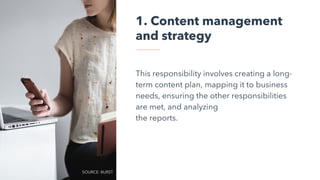
1. Content management
and strategy
This responsibility involves creating a long-
term content plan, mapping it to business
needs, ensuring the other responsibilities
are met, and analyzing
the reports.
SOURCE: BURST
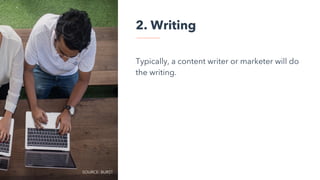
2. Writing
Typically, a content writer or marketer will do
the writing.
SOURCE: BURST
Writers from companies like Scripted or Upwork can create tailored content
for your marketing campaigns.
SOURCE: BURST
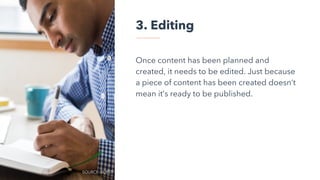
3. Editing
Once content has been planned and
created, it needs to be edited. Just because
a piece of content has been created doesn’t
mean it’s ready to be published.
SOURCE: BURST
If you don’t have an editor, consider having a teammate with a knack for
communication review your content. A fresh set of eyes and a different
perspective can make your content stronger.
SOURCE: BURST
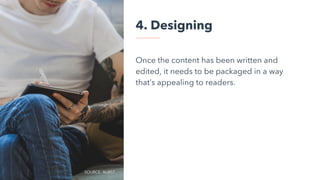
4. Designing
Once the content has been written and
edited, it needs to be packaged in a way
that’s appealing to readers.
SOURCE: BURST
Blink Test
The 3 to 5 seconds an average site visitor spends
scanning a website visually and then deciding if they
want to spend time looking through it
SOURCE: BURST
A good designer can be the difference between a below average blink
test pass rate and consistently getting people to stay on your site.
SOURCE: BURST
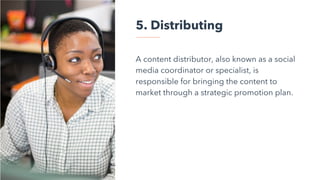
5. Distributing
A content distributor, also known as a social
media coordinator or specialist, is
responsible for bringing the content to
market through a strategic promotion plan.
Have a checks and
balances system
spread amongst
multiple teammates.
If your team members are
already at full capacity,
look into freelancers
to pick up the additional work.
SOURCE: BURST
Pro Tip:
If you’re just getting started with building your team
or looking for resources to help you complete a
project, consider hiring a freelancer as your first team
member.
To build your content framework,
you’ll need 3 main tools:
1. CMS
2. Analytics tools
3. Planning and internal communication tools
1. CMS
A CMS is a tool for creating, editing, and
publishing digital content.
There are different types of content systems—
such as HubSpot and WordPress—so you’ll
need to identify what kind works best for your
company’s needs.
SOURCE: BURST
Whichever CMS you use, be sure you have the ability to edit your
website, create and publish content for your blog and landing pages,
and optimize content for search engines.
SOURCE: BURST
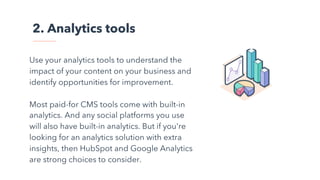
2. Analytics tools
Use your analytics tools to understand the
impact of your content on your business and
identify opportunities for improvement.
Most paid-for CMS tools come with built-in
analytics. And any social platforms you use
will also have built-in analytics. But if you're
looking for an analytics solution with extra
insights, then HubSpot and Google Analytics
are strong choices to consider.
SOURCE: PEXELS
Consider adding tracking links
to all your promotional activities.
3. Planning and internal
communication tools
You’ll use these tools so that your team can
communicate easily, see any updates, avoid
version or draft control issues,
and clearly delineate their responsibilities
and assignments.

Content Creation Framework.pdf

  • 1.
  • 2.
    Why does your businessneed a content creation framework?
  • 3.
    You need topublish a lot of content for each of your buyer personas at different stages of the buyer’s journey.
  • 4.
    A content creationframework that’s repeatable, organized, and agile can make the content creation process smoother and more rewarding. SOURCE: BURST
  • 5.
    Content Creation Framework Astructure of processes for publishing content, from the beginning stages to post-publication
  • 6.
    A framework strikes thatperfect balance between autonomous creativity and long-term content sustainability.
  • 7.
    You need toserve your audience’s needs and educate them over time depending on what they’re looking for. SOURCE: PEXELS
  • 8.
    We used Trelloboards to keep track of how changes were moving through the product team’s pipeline. When a change was coming closer to launch, the technical writers had time to collect content for updating and write drafts of new content to educate users about the releases.
  • 9.
    Remain flexible toaccount for the changes that will inevitably come up. SOURCE: BURST
  • 10.
    How to builda content creation framework
  • 11.
    Five steps tobuilding a content creation framework: 1. Conceptualizing content 2. Planning a timeline 3. Creating a workflow 4. Reviewing and editing content 5. Organizing and storing content
  • 12.
    Text here 1. Conceptualizingcontent RCE: BURST The first step is coming up with appropriate ideas for your content offers.
  • 13.
    Content Offer Something youcreate and publish in exchange for personal information like a name and email address
  • 14.
    Write down frequentlyasked sales questions or important industry knowledge that would be helpful for your target market to know. SOURCE: PIXABAY
  • 15.
    Focus on creatingcontent for every stage of the buyer’s journey.
  • 16.
    In the awarenessstage… A prospect is experiencing and expressing symptoms of a problem or opportunity. They’re doing research to more clearly understand, frame, and give a name to their problem.
  • 17.
    They’re looking foreducational content to help them answer some of their questions and concerns—think blog posts, ebooks, social content, and how-to webinars. SOURCE: BURST
  • 18.
    In the considerationstage… A prospect has clearly defined and given a name to their problem or opportunity. They’re committed to researching and understanding all available approaches and methods to solving their problem or opportunity.
  • 19.
    Create content thatpositions you as an expert in your industry. Demo videos, case studies, and FAQ articles are great resources to build relationships with readers and establish trust between your audience and your brand. SOURCE: BURST
  • 20.
    In the decisionstage… A prospect has now decided on their solution strategy, method, or approach. They’re compiling a long list of all available vendors and products in their given solution strategy. They’re researching to trim down this long list into a short list and ultimately make a final purchase decision—and that final purchase decision could be YOU.
  • 21.
    Provide them contentsuch as free trials, consultations, and articles that provide education on your products or services. SOURCE: BURST
  • 22.
    2. Planning atimeline Maintain agility while still having time to execute on your initiatives. SOURCE: BURST
  • 23.
    Use your goalsto determine what content you need to focus on. From there, map out what content you need and when it needs to be live. SOURCE: PIXABAY
  • 24.
    Identify any company-wideinitiatives that will need support from content over the next three months. SOURCE: BURST
  • 25.
    3. Creating aworkflow SOURCE: BURST In the context of content creation, a workflow is an intuitive breakdown of the content creation work. It consists of the sequence of steps a piece of content moves through from its initial creation to publication.
  • 26.
    Because there aremultiple components involved when creating a piece of content, you’ll want to get pretty granular with your steps—even if you’re a team of one. SOURCE: BURST
  • 27.
    Pro Tip: Think abouthow you created a piece of content in the past before you had a content creation framework. Consider what went well, what roadblocks you hit, and what you’ll need to work into your process to avoid these roadblocks the next time around.
  • 28.
    4. Reviewing and editingcontent SOURCE: BURST You need a reviewal system in place so that your content is accurate, well written, and aligned with your brand.
  • 29.
    In the reviewprocess, follow these seven best practices: 1. Set clear expectations. 2. Define roles in the reviewal process. 3. Determine a timeline. 4. Use a style guide. 5. Track edits. 6. Manage progress. 7. Optimize for search engines.
  • 30.
    Set clear expectations. Thereviewer should know what they’re looking for: grammatical errors, fact-checking, story gaps, wordsmithing, and more.
  • 31.
    Define roles inthe reviewal process. Each person should know what they need to do and when. Maybe you have a developmental editor looking at your content’s overall focus and structure before a copy editor goes in for more detailed edits. Or maybe you have a single editor reviewing everything.
  • 32.
    Determine a timeline. Withso many people involved in publishing content, set due dates and a high-level timeline so that each person is held accountable for their contributions.
  • 33.
    Use a styleguide. Your content needs to be consistently authentic, well written, and aligned with your company’s brand—even among various writers with different writing styles, skill levels, and voices.
  • 34.
    Track edits. Have yourcontent reviewers make suggestions by tracking changes as opposed to making edits directly. This way, the content creator knows where to make changes as opposed to figuring out what was altered.
  • 35.
    Manage progress. Use somesort of document, like a project management software, to track progress. This document should reflect the roles, timeline, and deadlines you’ve determined for your reviewal process.
  • 36.
    Pro Tip: If you’relooking for a place to start, consider using Trello. It’s free, and—more importantly—Trello makes collaborating with others easy.
  • 37.
    Optimize for searchengines. You put a lot of effort into creating your content, so you want your audience to find it in their web searches. After your content is created, do some spot edits to search engine optimize your content.
  • 38.
    5. Organizing and storingcontent Once your content is done, store it in a centralized location where your team can access it—like Google Drive or Dropbox. SOURCE: BURST
  • 39.
    Develop a clearnaming system. Content format Buyer’s journey stage Campaign Year
  • 40.
    Ebook-awareness-rockclimbinggear-2015 Awareness stage ebookback in 2015 to support a campaign for a new product launch on rock climbing gear
  • 41.
    Your content creationframework should always be evolving. Your business’s goals will vary from quarter to quarter and year to year, so your content creation framework should align with those changes. Keep in mind: SOURCE: BURST
  • 42.
    Determining the resources you’llneed for a content creation framework
  • 43.
    5 primary typesof responsibilities in content creation: 1. Content management and strategy 2. Writing 3. Editing 4. Designing 5. Distributing
  • 44.
    1. Content management andstrategy This responsibility involves creating a long- term content plan, mapping it to business needs, ensuring the other responsibilities are met, and analyzing the reports. SOURCE: BURST
  • 45.
    2. Writing Typically, acontent writer or marketer will do the writing. SOURCE: BURST
  • 46.
    Writers from companieslike Scripted or Upwork can create tailored content for your marketing campaigns. SOURCE: BURST
  • 47.
    3. Editing Once contenthas been planned and created, it needs to be edited. Just because a piece of content has been created doesn’t mean it’s ready to be published. SOURCE: BURST
  • 48.
    If you don’thave an editor, consider having a teammate with a knack for communication review your content. A fresh set of eyes and a different perspective can make your content stronger. SOURCE: BURST
  • 49.
    4. Designing Once thecontent has been written and edited, it needs to be packaged in a way that’s appealing to readers. SOURCE: BURST
  • 50.
    Blink Test The 3to 5 seconds an average site visitor spends scanning a website visually and then deciding if they want to spend time looking through it
  • 51.
    SOURCE: BURST A gooddesigner can be the difference between a below average blink test pass rate and consistently getting people to stay on your site. SOURCE: BURST
  • 52.
    5. Distributing A contentdistributor, also known as a social media coordinator or specialist, is responsible for bringing the content to market through a strategic promotion plan.
  • 53.
    Have a checksand balances system spread amongst multiple teammates.
  • 54.
    If your teammembers are already at full capacity, look into freelancers to pick up the additional work. SOURCE: BURST
  • 55.
    Pro Tip: If you’rejust getting started with building your team or looking for resources to help you complete a project, consider hiring a freelancer as your first team member.
  • 56.
    To build yourcontent framework, you’ll need 3 main tools: 1. CMS 2. Analytics tools 3. Planning and internal communication tools
  • 57.
    1. CMS A CMSis a tool for creating, editing, and publishing digital content. There are different types of content systems— such as HubSpot and WordPress—so you’ll need to identify what kind works best for your company’s needs.
  • 58.
    SOURCE: BURST Whichever CMSyou use, be sure you have the ability to edit your website, create and publish content for your blog and landing pages, and optimize content for search engines. SOURCE: BURST
  • 59.
    2. Analytics tools Useyour analytics tools to understand the impact of your content on your business and identify opportunities for improvement. Most paid-for CMS tools come with built-in analytics. And any social platforms you use will also have built-in analytics. But if you're looking for an analytics solution with extra insights, then HubSpot and Google Analytics are strong choices to consider.
  • 60.
    SOURCE: PEXELS Consider addingtracking links to all your promotional activities.
  • 61.
    3. Planning andinternal communication tools You’ll use these tools so that your team can communicate easily, see any updates, avoid version or draft control issues, and clearly delineate their responsibilities and assignments.