Feb 2020
CONSUMERS IN CRISIS
&
Understanding the effect of the Coronavirus on China Consumers
Insights from Machine Learning
We surveyed 900 consumers in Beijing, Shanghai & Guangzhou, showing 3 different
coronavirus outcomes to equal numbers of people to measure changes in sentiment
Purpose to measure how each consumer category is affected by different coronavirus outcomes within next 3 months
Executive summary
Re-Hub utilized Zectr's proprietary Machine Learning
solution to analyze answers from panel respondents and
generate a comprehensive insights report and interactive
dashboard. This whole process took less than 2 days.
2We surveyed 300 people from each city, and asked them to respond based on one of the three scenarios: for each city we asked 100 consumers on Pessimistic,
Base and Optimistic scenarios
Executive summary
Key Findings and Suggested Actions
Consumers perceive
the situation to be
severe and expect to
last for 4-5 months
PESSIMISM AMONG
CONSUMERS
Brands need to proactively
listen to their consumers
and continuously monitor
the market to spot any
changes in behavior
BRAND SUPPORT IS
IMPORTANT
Consumers are
overwhelmingly more
loyal to brands that
show support
Brands should be vocal of
their support for China on
social media. Messages or
efforts of support likely to
yield results
AGGREGATED
CONSUMER DEMAND
REMAINS STRONG…
…BUT BIG DIVERGENCES
WITHIN CATEGORIES
AND SEGMENTS
Each category will face
unique challenges by
segment and under
different scenarios: brands
need to prioritize their
targets
Consumers do not
intend to spend less
than before
Consumer priorities and
preferences radically
changed
3
Brands need to position
themselves now to take
advantage of demand
recovery which could be
rapid if situation improves
We divided respondents within each Tier 1 city into 3 groups, and showed each of
them one of the following scenarios, comparing changes in sentiment for each case
Optimistic Case Base Case Pessimistic Case
Our target Tier 1 cities include Beijing, Shanghai, and Guangzhou with a sample of N900 general population
The 3 scenarios
• Mortality rate from the coronavirus is
likely to be much lower than 1%
• Dramatic reduction in infections may
occur as soon as late February.
• Over 40,000 cases of the coronavirus
and over 1,000 deaths.
• China should recover completely by May
or June.
• Number of coronavirus infections and
deaths continues to grow.
• Wuhan and Hubei Province continue to
be quarantined, with strict restrictions in
place in other Chinese cities.
• Outbreaks have now occurred as far
away as Japan, Singapore, and London.
• Situation may continue to end of year.
4
February 20 · zectr.io
Aggregate results for all Tier 1 Cities
Combined results by scenario & category
Consumers in China on average are extremely worried about the coronavirus
situation and expect it to last another 4-5 months
Consumer sentiment
Consumer behavior will likely reflect this expectation
Perceived severity of situation (1-5) Months needed to return to normal
Q1: How would you rate the current situation with the coronavirus? (1=not so severe, 5=extreme crisis)
Q2: How many months will it take for things to return to normal?
4.43/5 4.75
Consumers perceived the current situation as
extremely serious (1=not so severe, 5=extreme crisis)
On average they expect the current situation to
last until June/July
6
Across the board, regardless of location or segment, a brand’s support for China
during this time is very important to consumers’ purchasing decisions
Brand’s support for China
There is remarkably very little variance on this importance
Q: How important is a brand's support for China during the coronavirus outbreak to you in choosing a consumer brand/product? (0=not important,
10=extremely important)
8.4/10
For all segments in all 3 tier 1 cities we surveyed the
importance was at least 7 or above
7
Consumer’s aggregate spend for the next 3 months vs same period last year remains
consistent regardless of the expected outcome of the coronavirus outbreak
Impact on consumer spending
There seems to be pent up demand built up from consumption fallout from Q1 last year
Q: What is the change in your budget for spending on consumer products for the next 3 months compared to same period last year?
6/10
Consumers likely to spend the same or more in the
next 3 months vs same period last year
8
But there are huge divergences on a category level with household goods, fashion,
and electronics set for the best improvement in the next 3 months vs. last year
Impact by category
Changes in demand of each category strongly influenced by specific segments (target customers)
Q: What is the change in your budget for spending on these consumer product categories for the next 3 months compared to same period last year?
Luxury demand will remain muted
even if situation improves
Travel and dining out poised for a
quick recovery if things improve
Slight uptick in alcoholic
consumption if situation
deteriorates
Packaged food growth faces large
impact if situation lasts past
summer
9
The severity and duration of the coronavirus situation has only slight impact on
consumer’s intention to shop online vs. offline
Online shopping intentions
Categories that do well regardless of scenario (e.g.: household goods) tend to have higher online purchases
Q: How likely will you use online shopping portals (T-Mall, JD.com, Brand online store, etc.) for the following categories? (1=entirely offline
purchases, 5=entirely online purchases)
• Likeliness to buy luxury online increased to 3
(60%) under pessimistic scenario
• Categories like Skincare&Cosmetics and Fashion
have high online shopping likelihood regardless
• Categories that tend to have high repeat
purchases (household good, packaged food,
skincare) have high likelihood to partially absorb
the impact via online
10
February 20 · zectr.io
Individual market segments & their views
Tier 1 city consumer segmentation & sentiment analysis
Our AI has found 4 consumer segments within Tier 1 cities based on psychographic
patterns including personal values, category preferences, and purchase drivers
Consumer segmentation
Most consumers fall into Young Professionals, meaning Tier 1 city consumers have highly similar drivers & preferences
SILVER
FOXES
Appreciate value
for money, health
and quality driven
FASHION-
FORWARD
MOMS
Very interested in
fashion and
cosmetics
TASTEFUL
COSMO-
POLITANS
Interest in luxury,
saving and
investing for future
YOUNG
PROFESSIONALS
Value relationships
with family and
friends
12
Demographically speaking, Tier 1 city consumers can be split into Young
Professionals, Fashion-forward Moms, Tasteful Cosmopolitans and Silver Foxes
Segment demographics
Each segment’s demographic profile align with their psychographic preferences
SILVER
FOXES
Usually retired
males, well-
educated but with
low incomes
FASHION-
FORWARD
MOMS
Fit in with popular
trends while raising
their child well
YOUNG
PROFESSIONALS
Well educated,
upwardly mobile
young white collars
TASTEFUL
COSMO-
POLITANS
Skew older but have
highest income vs
other segments
13
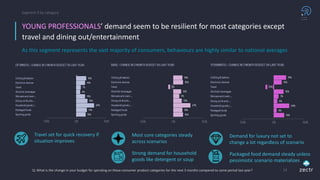
YOUNG PROFESSIONALS’ demand seem to be resilient for most categories except
travel and dining out/entertainment
Segment 3 by category
As this segment represents the vast majority of consumers, behaviours are highly similar to national averages
Q: What is the change in your budget for spending on these consumer product categories for the next 3 months compared to same period last year?
Travel set for quick recovery if
situation improves
Strong demand for household
goods like detergent or soup
Most core categories steady
across scenarios
Demand for luxury not set to
change a lot regardless of scenario
Packaged food demand steady unless
pessimistic scenario materializes
14
FASHION-FORWARD MOMS’ demand for fashion and cosmetics is generally resilient
but if situation substantially worsens then demand takes a dive
Segment 2 by category
They also have relatively low interest for luxury, sporting goods, and electronic devices
Q: What is the change in your budget for spending on these consumer product categories for the next 3 months compared to same period last year?
Fashion and cosmetics demand resilient unless the
situation substantially worsens (Pessimistic Scenario)
Household goods do very well in Optimistic or Pessimistic
Scenarios, hinting at 2 different underlying drivers
15
TASTEFUL COSMOPOLITANS are most interested in luxury and their demand will
take a huge hit should the coronavirus situation continue or worsen
Segment 4 by category
This segment also contain older consumers, and some of their behaviours mirror those of Silver Foxes
Q: What is the change in your budget for spending on these consumer product categories for the next 3 months compared to same period last
year?
Demand for luxury decreases
as the situation worsens
Demand of Electronic devices to
raise under Pessimistic Scenario
Strong consumption of Household
goods across scenarios, while
Packaged Foods demand grows as
situation worsens
16
SILVER FOXES generally have lower demand but if situation gets worse their demand
for household goods and packaged food will increase substantially
Segment 1 by category
Consumption intentions imply they will likely stay a lot more at home if situation gets worse
Q: What is the change in your budget for spending on these consumer product categories for the next 3 months compared to same period last
year?
They will reduce spending on travel and dining
out & entertainment substantially should
situation last until summer
Growth in consumption in household good and
packaged food more than doubles vs optimistic
scenario
17
How we can help
max@rehub.tech
Dive deeper into the insights included
in this report via Zectr online
interactive dashboard
Consultation on how to these insights
are applicable to your industry or line
of business
Understand how to leverage Machine
Learning to generate tailored reports
to monitor your target customers
sentiment evolution
Subscribe to additional industry
reports analyzing the impact of
Coronavirus across industries and
consumer segments
leon@rehub.tech
February 20 · zectr.io
Appendices
Appendix – Who we are
Re-Hub helps Brands in Asia to address business challenges by leveraging
the most relevant AI-powered solutions for any business scenario
GROWTH
EFFICIENCYCUSTOMER
EXPERIENCE
• Marketing automation
• Omnichannel analytics
• Data science
• Location analytics
• CS optimization
• Voice search
• Visual search
• AR/VR
Re-Hub brings agility and efficiency
to problem-solving for brands to
drive sustainable growth and
improve efficiency
We serve global brands in CPG,
fashion and luxury from our offices in
Shanghai and Singapore
• Customer acquisition
• Customer engagement
• Market intelligence
• Forecasting & prediction
Appendix – Who we are
Zectr was envisioned by a strategy consultant, modeled by a Stanford
professor, and built by a Silicon Valley technologist
Zectr can make your project teams faster & more efficient – or run many standardized projects simultaneously
Faster More efficient Massively Parallel
Identify & recruit survey respondents
•Population of Beijing, Shanghai, and Guangzhou residents (i.e. Tier 1 cities)
•Sampled from Toluna panel of survey takers
Conduct surveys and collect data
•Panelists receive a web link to the Zectr survey app
•Each city divided into 3 groups, each exposed to either optimistic, baseline, or pessimistic scenario
Analyze survey data
•Weight respondents by age and gender according to local population characteristics
•Conduct segmentation & other insight-oriented analyses using machine learning
Identify & report key insights
•Identify key insights using machine learning
•Visualize and report insights via a dynamic presentation deck running on modern web browsers
We conducted a N900 survey evenly divided amongst 3 Tier 1 cities in China,
targeting the general population
General public
Appendix - Methodology
1 day
2 days
1 day
Shanghai data is most aligned with expectations on the category level
Appendix – Shanghai data
23
Thanks
max@rehub.tech
leon@rehub.tech
simon@zectr.io
jc@zectr.io
visit www.rehub.tech visit www.zectr.io

Consumers in Crisis

  • 1.
    Feb 2020 CONSUMERS INCRISIS & Understanding the effect of the Coronavirus on China Consumers Insights from Machine Learning
  • 2.
    We surveyed 900consumers in Beijing, Shanghai & Guangzhou, showing 3 different coronavirus outcomes to equal numbers of people to measure changes in sentiment Purpose to measure how each consumer category is affected by different coronavirus outcomes within next 3 months Executive summary Re-Hub utilized Zectr's proprietary Machine Learning solution to analyze answers from panel respondents and generate a comprehensive insights report and interactive dashboard. This whole process took less than 2 days. 2We surveyed 300 people from each city, and asked them to respond based on one of the three scenarios: for each city we asked 100 consumers on Pessimistic, Base and Optimistic scenarios
  • 3.
    Executive summary Key Findingsand Suggested Actions Consumers perceive the situation to be severe and expect to last for 4-5 months PESSIMISM AMONG CONSUMERS Brands need to proactively listen to their consumers and continuously monitor the market to spot any changes in behavior BRAND SUPPORT IS IMPORTANT Consumers are overwhelmingly more loyal to brands that show support Brands should be vocal of their support for China on social media. Messages or efforts of support likely to yield results AGGREGATED CONSUMER DEMAND REMAINS STRONG… …BUT BIG DIVERGENCES WITHIN CATEGORIES AND SEGMENTS Each category will face unique challenges by segment and under different scenarios: brands need to prioritize their targets Consumers do not intend to spend less than before Consumer priorities and preferences radically changed 3 Brands need to position themselves now to take advantage of demand recovery which could be rapid if situation improves
  • 4.
    We divided respondentswithin each Tier 1 city into 3 groups, and showed each of them one of the following scenarios, comparing changes in sentiment for each case Optimistic Case Base Case Pessimistic Case Our target Tier 1 cities include Beijing, Shanghai, and Guangzhou with a sample of N900 general population The 3 scenarios • Mortality rate from the coronavirus is likely to be much lower than 1% • Dramatic reduction in infections may occur as soon as late February. • Over 40,000 cases of the coronavirus and over 1,000 deaths. • China should recover completely by May or June. • Number of coronavirus infections and deaths continues to grow. • Wuhan and Hubei Province continue to be quarantined, with strict restrictions in place in other Chinese cities. • Outbreaks have now occurred as far away as Japan, Singapore, and London. • Situation may continue to end of year. 4
  • 5.
    February 20 ·zectr.io Aggregate results for all Tier 1 Cities Combined results by scenario & category
  • 6.
    Consumers in Chinaon average are extremely worried about the coronavirus situation and expect it to last another 4-5 months Consumer sentiment Consumer behavior will likely reflect this expectation Perceived severity of situation (1-5) Months needed to return to normal Q1: How would you rate the current situation with the coronavirus? (1=not so severe, 5=extreme crisis) Q2: How many months will it take for things to return to normal? 4.43/5 4.75 Consumers perceived the current situation as extremely serious (1=not so severe, 5=extreme crisis) On average they expect the current situation to last until June/July 6
  • 7.
    Across the board,regardless of location or segment, a brand’s support for China during this time is very important to consumers’ purchasing decisions Brand’s support for China There is remarkably very little variance on this importance Q: How important is a brand's support for China during the coronavirus outbreak to you in choosing a consumer brand/product? (0=not important, 10=extremely important) 8.4/10 For all segments in all 3 tier 1 cities we surveyed the importance was at least 7 or above 7
  • 8.
    Consumer’s aggregate spendfor the next 3 months vs same period last year remains consistent regardless of the expected outcome of the coronavirus outbreak Impact on consumer spending There seems to be pent up demand built up from consumption fallout from Q1 last year Q: What is the change in your budget for spending on consumer products for the next 3 months compared to same period last year? 6/10 Consumers likely to spend the same or more in the next 3 months vs same period last year 8
  • 9.
    But there arehuge divergences on a category level with household goods, fashion, and electronics set for the best improvement in the next 3 months vs. last year Impact by category Changes in demand of each category strongly influenced by specific segments (target customers) Q: What is the change in your budget for spending on these consumer product categories for the next 3 months compared to same period last year? Luxury demand will remain muted even if situation improves Travel and dining out poised for a quick recovery if things improve Slight uptick in alcoholic consumption if situation deteriorates Packaged food growth faces large impact if situation lasts past summer 9
  • 10.
    The severity andduration of the coronavirus situation has only slight impact on consumer’s intention to shop online vs. offline Online shopping intentions Categories that do well regardless of scenario (e.g.: household goods) tend to have higher online purchases Q: How likely will you use online shopping portals (T-Mall, JD.com, Brand online store, etc.) for the following categories? (1=entirely offline purchases, 5=entirely online purchases) • Likeliness to buy luxury online increased to 3 (60%) under pessimistic scenario • Categories like Skincare&Cosmetics and Fashion have high online shopping likelihood regardless • Categories that tend to have high repeat purchases (household good, packaged food, skincare) have high likelihood to partially absorb the impact via online 10
  • 11.
    February 20 ·zectr.io Individual market segments & their views Tier 1 city consumer segmentation & sentiment analysis
  • 12.
    Our AI hasfound 4 consumer segments within Tier 1 cities based on psychographic patterns including personal values, category preferences, and purchase drivers Consumer segmentation Most consumers fall into Young Professionals, meaning Tier 1 city consumers have highly similar drivers & preferences SILVER FOXES Appreciate value for money, health and quality driven FASHION- FORWARD MOMS Very interested in fashion and cosmetics TASTEFUL COSMO- POLITANS Interest in luxury, saving and investing for future YOUNG PROFESSIONALS Value relationships with family and friends 12
  • 13.
    Demographically speaking, Tier1 city consumers can be split into Young Professionals, Fashion-forward Moms, Tasteful Cosmopolitans and Silver Foxes Segment demographics Each segment’s demographic profile align with their psychographic preferences SILVER FOXES Usually retired males, well- educated but with low incomes FASHION- FORWARD MOMS Fit in with popular trends while raising their child well YOUNG PROFESSIONALS Well educated, upwardly mobile young white collars TASTEFUL COSMO- POLITANS Skew older but have highest income vs other segments 13
  • 14.
    YOUNG PROFESSIONALS’ demandseem to be resilient for most categories except travel and dining out/entertainment Segment 3 by category As this segment represents the vast majority of consumers, behaviours are highly similar to national averages Q: What is the change in your budget for spending on these consumer product categories for the next 3 months compared to same period last year? Travel set for quick recovery if situation improves Strong demand for household goods like detergent or soup Most core categories steady across scenarios Demand for luxury not set to change a lot regardless of scenario Packaged food demand steady unless pessimistic scenario materializes 14
  • 15.
    FASHION-FORWARD MOMS’ demandfor fashion and cosmetics is generally resilient but if situation substantially worsens then demand takes a dive Segment 2 by category They also have relatively low interest for luxury, sporting goods, and electronic devices Q: What is the change in your budget for spending on these consumer product categories for the next 3 months compared to same period last year? Fashion and cosmetics demand resilient unless the situation substantially worsens (Pessimistic Scenario) Household goods do very well in Optimistic or Pessimistic Scenarios, hinting at 2 different underlying drivers 15
  • 16.
    TASTEFUL COSMOPOLITANS aremost interested in luxury and their demand will take a huge hit should the coronavirus situation continue or worsen Segment 4 by category This segment also contain older consumers, and some of their behaviours mirror those of Silver Foxes Q: What is the change in your budget for spending on these consumer product categories for the next 3 months compared to same period last year? Demand for luxury decreases as the situation worsens Demand of Electronic devices to raise under Pessimistic Scenario Strong consumption of Household goods across scenarios, while Packaged Foods demand grows as situation worsens 16
  • 17.
    SILVER FOXES generallyhave lower demand but if situation gets worse their demand for household goods and packaged food will increase substantially Segment 1 by category Consumption intentions imply they will likely stay a lot more at home if situation gets worse Q: What is the change in your budget for spending on these consumer product categories for the next 3 months compared to same period last year? They will reduce spending on travel and dining out & entertainment substantially should situation last until summer Growth in consumption in household good and packaged food more than doubles vs optimistic scenario 17
  • 18.
    How we canhelp max@rehub.tech Dive deeper into the insights included in this report via Zectr online interactive dashboard Consultation on how to these insights are applicable to your industry or line of business Understand how to leverage Machine Learning to generate tailored reports to monitor your target customers sentiment evolution Subscribe to additional industry reports analyzing the impact of Coronavirus across industries and consumer segments leon@rehub.tech
  • 19.
    February 20 ·zectr.io Appendices
  • 20.
    Appendix – Whowe are Re-Hub helps Brands in Asia to address business challenges by leveraging the most relevant AI-powered solutions for any business scenario GROWTH EFFICIENCYCUSTOMER EXPERIENCE • Marketing automation • Omnichannel analytics • Data science • Location analytics • CS optimization • Voice search • Visual search • AR/VR Re-Hub brings agility and efficiency to problem-solving for brands to drive sustainable growth and improve efficiency We serve global brands in CPG, fashion and luxury from our offices in Shanghai and Singapore • Customer acquisition • Customer engagement • Market intelligence • Forecasting & prediction
  • 21.
    Appendix – Whowe are Zectr was envisioned by a strategy consultant, modeled by a Stanford professor, and built by a Silicon Valley technologist Zectr can make your project teams faster & more efficient – or run many standardized projects simultaneously Faster More efficient Massively Parallel
  • 22.
    Identify & recruitsurvey respondents •Population of Beijing, Shanghai, and Guangzhou residents (i.e. Tier 1 cities) •Sampled from Toluna panel of survey takers Conduct surveys and collect data •Panelists receive a web link to the Zectr survey app •Each city divided into 3 groups, each exposed to either optimistic, baseline, or pessimistic scenario Analyze survey data •Weight respondents by age and gender according to local population characteristics •Conduct segmentation & other insight-oriented analyses using machine learning Identify & report key insights •Identify key insights using machine learning •Visualize and report insights via a dynamic presentation deck running on modern web browsers We conducted a N900 survey evenly divided amongst 3 Tier 1 cities in China, targeting the general population General public Appendix - Methodology 1 day 2 days 1 day
  • 23.
    Shanghai data ismost aligned with expectations on the category level Appendix – Shanghai data 23
  • 24.