First published in Belgium in 2013 by InSites Consulting.
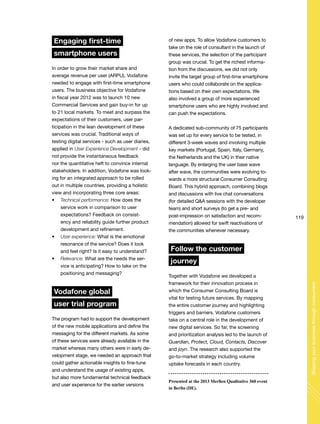
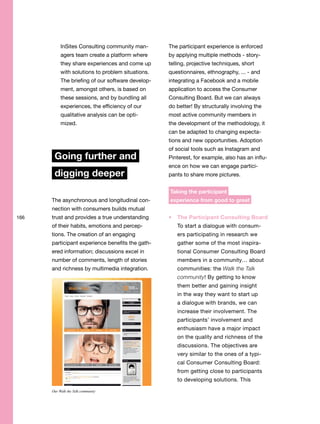
Apart from any fair dealing for the purposes of research or private study, or criticism or review, as permitted under
the Copyright, Designs and Patent Act 1988, this publication may only be reproduced, stored or transmitted, in
any form or by any means, with the prior permission in writing of the publishers, or in the case of reprographic
reproduction in accordance with the terms and licenses issued by the CLA. Enquiries concerning reproduction
outside these terms should be send to the publishers at the undermentioned address:
Evergemsesteenweg 195
9032 Ghent
Belgium
www.insites-consulting.com
© InSites Consulting, 2013
The right of InSites Consulting to be identified as the author of this work has been asserted by the company in
accordance with Copyright, Designs and Patent Act 1988.
ISBN 978 9 0820 5660 0
The
CONSUMER
CONSULTING
BOARD
Consumers shaping your business
‘I periodically leave one
seat open at a conference
table and inform attendees
that they should consider
that seat to be occupied
by their customer, the most
important person in the
room.’
Jeff Bezos,
CEO Amazon
‘Put customers in the
driver’s seat, or be dead
by 2020.’
Jamie Nordstrom,
EVP Nordstrom‘The era of consumer
hierarchy is upon us.’
Brian Solis,
Principal at Altimeter Group
‘The future requires
brands to give control to
consumers.’
Pierre Woreczek,
Chief Brand & Strategy Office
McDonald’s Europe
‘The consumer isn’t a moron;
she’s your wife.’
David Ogilvy,
Founder Ogilvy & Mather
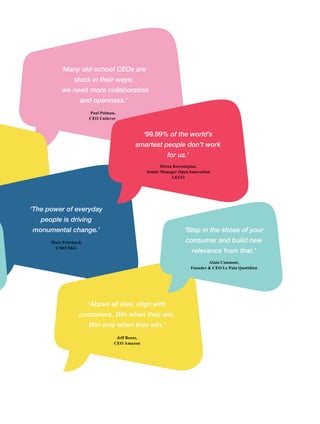
‘Many old-school CEOs are
stuck in their ways;
we need more collaboration
and openness.’
Paul Polman,
CEO Unilever
‘The power of everyday
people is driving
monumental change.’
Marc Pritchard,
CMO P&G
‘Above all else, align with
customers. Win when they win.
Win only when they win.’
Jeff Bezos,
CEO Amazon
‘99.99% of the world’s
smartest people don’t work
for us.’
Stiven Kerestegian,
Senior Manager Open Innovation
LEGO
‘Step in the shoes of your
consumer and build new
relevance from that.’
Alain Coumont,
Founder & CEO Le Pain Quotidien
8
Foreword
I do an awful lot of work on a variety
of fronts to understand how things
are evolving between marketing and
insights professionals. As an observer
of the insights space, there is no greater
barometer of how things are develop-
ing than talking to the key stakeholders
involved and working with them col-
laboratively to help co-create solutions.
In a sense, I consider the research
industry an über-community and engage
with them using many different tools to
understand, engage, solve problems
and deliver a fair value exchange for all
parties for the effort.
That is why I have profound respect for
the pioneering work being done in the
community provider sector, and InSites
Consulting is one of the handful of lead-
ers that I pay attention to the most. They
take the same principles and apply it to
their business: connecting brands and
key stakeholders for mutual benefit via
the rubric of communities.
What is more, they also get the power of
sharing learnings to empower everyone,
and that brings us to this great book.
The InSites Consulting team has put
together a fantastic synthesis of their
hard-won experience, best practices,
wisdom and vision to help raise the
game of everyone in the insights space:
clients and suppliers (including their
competitors!). Kudos to them for leading
the charge in transforming the insights
space through transparency and knowl-
edge sharing!
Through this book we get an interest-
ing peek at how marketing and insights
involving communities can bolster an or-
ganization. For those who are willing to
dip their marketing toes into the insights
pool, the benefits far outweigh any
hesitation. For some marketers, some-
thing as simple as partnering with key
constituents via the community process
has helped focus marketing strategies.
Others have seen substantial growth in
client engagement and interactions just
from sharing with their constituents via
communities.
The conclusion? Bringing together
those with solid ideas and those with a
strong understanding of insights tools is
simply the right thing to do. And InSites
Consulting certainly gets that too. A
strong message contained here (which
is validated by my own experience and
the sky-rocketing growth of providers
in this space due to client adoption of
the community model) is for those using
communities, it clearly has proven to
be worth the time and investment. For
some, this tool has helped reach the
right customer at the right time. As one
client stated in the recent GRIT report:
‘It provides us with a barometer of when
people are engaging, what they are
engaging with and what is driving the
business.’
Communities are a wonderful tool for
supporting brand initiatives. Yes, it
9
works for measuring attitudes and im-
pressions of your brand. However, some
have taken it one step further by using
information derived from their communi-
ties to transform the perception of their
brand among those who engage with it
online. And, to answer the eternal ROI
question, some said the real benefit to
the process was the ability to prove the
value and demonstrate the effective-
ness of their efforts. Additional benefits
of using online research communities
collected in the GRIT data included
user-friendliness, customization and the
fact that they provide a way to keep a
finger on the pulse of customers’ needs
and attitudes.
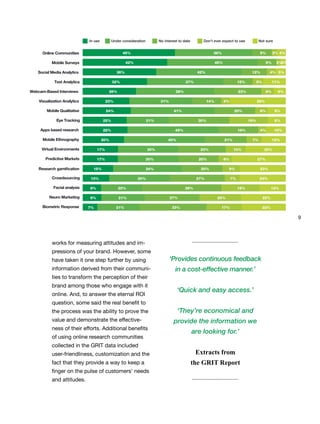
‘Provides continuous feedback
in a cost-effective manner.’
‘Quick and easy access.’
‘They’re economical and
provide the information we
are looking for.’
Extracts from
the GRIT Report
10
Many of you reading this may still struggle
to see how to implement these tech-
niques into your current programs and
worry about customers’ reactions to being
engaged in these ways. All I can say is that
the window for community usage being a
choice is rapidly shrinking.
First, let’s look at things from a strictly busi-
ness strategy standpoint:
In an increasingly competitive and
complex marketing climate, more
and more clients are looking to the
insight function to help fuel competitive
advantage.
Competitive advantage often is fo-
cused on the front end of innovation;
creating new products or services that
will drive target customer engagement
and spending.
Data alone does not deliver insight;
it informs it. Insight is supported and
driven by a variety of factors, but
ultimately it is people who uncover
insights and develop winning strategies
based on them.
Client organizations are not experts
in insights; they are experts in their
business. They need multi-disciplinary
partners to help them get to the point
in the process where their business
expertize can be applied to the insight
process.
Supplier partners that can help client
organizations understand, engage and
deliver value to customers through the
insight process win business and grow.
Communities (and all the various ap-
proaches they enable) help meet that need
for clients in an instantly globally scalable
way. It is the type of integrated offering
they have been clamoring for but has not
been fully delivered on by other techniques
such as surveys, focus groups or even
social media and big data analytics. The
community is rapidly becoming the hub of
the insights wheel.
Consider this quote from Marc Pritchard,
Global Marketing and Brand Building
Officer of P&G regarding the company’s
view on how technology is changing the
game for them:
11
Leonard Murphy
Editor-in-chief at GreenBook Blog
@lennyism
linkedin.com/in/leonardfmurphy
Leonard (Lenny) Murphy is a seasoned and respected
industry leader with an entrepreneurial drive. He is a
visionary entrepreneur and innovator, and has suc-
cessfully established several companies in the market
research space including Rockhopper Research, a
leading full service global research firm and MDM
Associates, a market research consulting firm, before
founding his current company, BrandScan 360. Mr.
Murphy is a key consultant and advisor to numer-
ous market research agencies, and works across
the industry to drive the development of innovative
research practices by developing strategic alliances
with multiple best in class providers. Lenny serves on
the Board of The Market Research Global Alliance,
the premier social network for the global market
research profession. He is the Founder and Executive
Director of the Research Industry Trends Monitoring
Group & Publisher of the Research Industry Trends
Study, the oldest study in the industry devoted to
tracking changing trends in research. Rounding out
his busy professional life, he is the Editor in Chief of
the GreenBook Blog.
It is a perfect validation for why the
growth of a community-driven insight
model, especially one that is focused on
co-creation, is perfect for the new age of
socialized branding.
Consider this your guide book to get
started on building an insight organiza-
tion that will support the development
of a one-to-one relationship with your
key constituents. The value of the effort
is proven, but the potential is far from
fulfilled (yet). The InSites Consulting team
have done a fabulous job here of show-
ing us the power of communities and fir-
ing the imagination on where we may get
to as this model takes its rightful place as
the core driver of the insight function.
‘To address these technology forces, our
vision is to build our brands through lifelong,
one-to-one relationships in real time with
every person in the world. The power of
everyday people is driving monumental
change and people power favors brands
like ours. We have trusted brands that are
part of everyday life. We genuinely care
about serving people with superior benefits
and doing good. Technology will mean that
people will increasingly expect brands to
understand their unique needs and deliver.
We want P&G to be the first to create this
trusted, indispensable relationship because
it will create greater loyalty, more purchases
across categories, and more sales at lower
costs. Achieving this vision requires some
fundamental shifts in how we operate.’
12
Introduction
Back in 2006, we ran our very first
community. It made us a true pioneer
of what has now become one of the
most popular ways to listen to, under-
stand and collaborate with consumers.
Research communities are probably
the fastest growing research methodol-
ogy ever. According to the latest GRIT
study,1
45% of the research market
appeals to communities and another
38% is currently developing them for
the first time. This is causing a funda-
mental shift in the way research is done:
from treating participants as a resource
to using them as a source of inspiration,
from just asking questions to collabora-
tion and from running ad hoc projects
to having a more ongoing dialogue with
the consumer world.
In 2011, we coined the term Consumer
Consulting Board © for the first time; it is
probably a better name to indicate how
we manage research communities and
the position we give them within a com-
pany. It indicates that if you run them
well, communities allow you to make
use of the consulting power of consum-
ers - both current and potential users of
a product or service: they will help you
make more consumer-relevant deci-
sions. Moreover, the name embodies
that companies need to see and treat
their consumer community as a board of
advisors they rely on almost every single
day, for most business decisions taken
across the different departments of the
company. In that sense, it is more than
just another market research tool. A
Consumer Consulting Board gives you
the strategic capability to (re)shape your
business together with consumers.
Today, InSites Consulting builds
and manages over 150 Consumer
Consulting Boards a year, for the world’s
biggest brands. In the past 7 years we
facilitated over 600,000 conversations.
And with our 5 offices and moderation
teams in more than 30 countries, we
are connecting companies with their
consumers worldwide, providing them
with the unique capability to make
better business decisions faster and to
turn their organizations into consumer-
centric thinking ones.
We are proud to present this new book
to you. It is the fruit of years of work
in the field of Consumer Consulting
Boards by the entire InSites Consulting
team. We have a tradition of sharing our
knowledge with the world through pub-
lications and conference talks around
the globe. This book gives an overview
of our collective wisdom in the domain
of communities, based on research-on-
research by our ForwaR&D Lab (our very
own innovation center), more than 40
articles and papers we have published
and presented at conferences, our
ongoing dialogue with research com-
munity members in our Walk the Talk
community, co-creation sessions with
our moderators around the world, col-
laborations with academic institutions
and brainstorms and business projects
13
with clients in a wide range of indus-
tries among different cultures. It is that
overview of our findings and wide global
experience that we will share with you.
In the true spirit of co-creation the book
has been developed jointly by 14 dif-
ferent contributors who give an insight
into their knowledge, our best practices
and results from client projects. A brief
overview of the 5 chapters:
1. Chapter one investigates what peo-
ple expect from brands today and
how organizations can make use of
social channels, tools and platforms
to co-create and structurally collabo-
rate with the consumer world. The
world has changed: how to adapt,
survive and win in the era of the
empowered consumer?
2. In the second chapter we unveil our
secret recipe behind successfully
setting up, managing and getting the
most out of Consumer Consulting
Boards. We share our strategy to
communicate research results in an
impactful way and tell you all about
how to embed structural collabo-
ration with consumers within the
business.
3. Chapter three talks about
Consumer Consulting Boards in
action. It introduces the different
issues companies encounter these
days and describes how consumers
help solving them. Our findings are
illustrated with the visions of senior
executives of leading brands and a
selection of projects we conducted
for our clients.
4. The main subjects of chapter four
are: what does it take to run commu-
nities in different cultures and how
should your brand be adapted to the
new reality of globalization, a shift in
economic power and Gen Y as the
most influential generation ever. It
is an introduction to the brave new
world we are living in.
5. In the final chapter, we take a
closer look at what societal trends
and evolutions within marketing and
research tell us about the future of
Consumer Consulting Boards. We
also give an insight in how we col-
laborate with our key stakeholders
(clients, participants and members)
to already create that future today.
Many people make a publication like
this a success. A special thank you
to our fellow authors, contributors
and reviewers (Niels Schillewaert,
Annelies Verhaeghe, Thomas Troch,
Anouk Willems, Natalie Mas, Joeri
Van den Bergh, Anneleen Boullart,
Liesbeth Dambre, Els Cocquyt, Wim
De Wever, Oana Frentiu, Alexandra
Ardean, Hakim Zemni, Stijn Poffé,
Sorina Badau, Liana Sentici, Pieter
van Remortel, Anne-Laure Simoens
and Ashley Smith), to Lenny Murphy
for writing the preface, to the entire
InSites Consulting team for 7 years of
great work, to Stephan Ludwig (who
14
spent 4 years of his life on understand-
ing communities during his PhD spon-
sored by InSites Consulting), to Dado
Van Peteghem (moderator of our very
first community), to Elias Veris, Steven
Van Belleghem, all the academic institu-
tions we worked with over the years (the
universities of Maastricht, Wageningen
and Nijmegen, the IESEG School of
Management, Lille, and the Vlerick
Business School), the research and
marketing associations who stimulate
us to share our expertise with the rest
of the industry (ESOMAR, MRS, AMA,
CASRO, MRA, MOA, BAQMaR, ARF
and Febelmar), the domain experts and
CxOs we interviewed for this book and
to all our clients and the moderators and
members of the Consumer Consulting
Boards. And last but not least, to Anke
Moerdyck for coordinating the whole
creation process of this book together with
Natalie Mas. Hannes Willaert and Karl
Demoen for making our pieces look great
by their graphic design and our families for
supporting us every single day in living our
passion for helping companies to get the
most out of the voice of the consumer.
We hope this book will inspire you to
make a start with structural collabora-
tion or that it will offer you fresh insights
in order to continue your path towards
becoming an open, agile and consumer-
centric thinking company. It is time to get
to the future… first!
Enjoy your read and we are looking forward
to your feedback, thoughts and ideas.
Tom De Ruyck
Head of Consumer
Consulting Boards
InSites Consulting
@tomderuyck
Kristof De Wulf
CEO and Co-Founder
InSites Consulting
@kristofdewulf
The InSites Consulting team
What people expect
from brands today
Shaping the future
together
1
5
20 Towards structural
collaboration & true
consumer engagement
26 Crowdsourcing,
co-creation & structural
collaboration: what is
all the buzz about?
32 Tweetaways
156 The bright future of
Consumer Consulting
Boards
162 Staying ahead
of the curve
170 Tweetaways
Spread throughout the book we integrated QR codes to offer you additional online information
or audiovisual material to browse through. Look for this symbol in the text, and then scan
the nearest QR code on the page with your smartphone or tablet. Just make sure a QR scanner
application is downloaded on your smartphone/tablet.
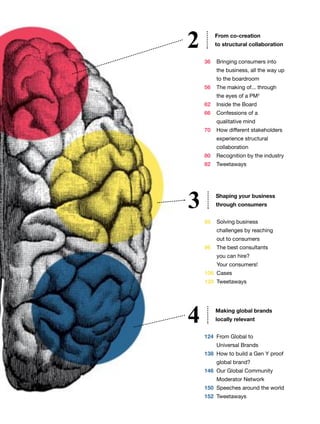
From co-creation
to structural collaboration
Shaping your business
through consumers
Making global brands
locally relevant
2
3
4
36 Bringing consumers into
the business, all the way up
to the boardroom
56 The making of... through
the eyes of a PM2
62 Inside the Board
66 Confessions of a
qualitative mind
70 How different stakeholders
experience structural
collaboration
80 Recognition by the industry
82 Tweetaways
86 Solving business
challenges by reaching
out to consumers
96 The best consultants
you can hire?
Your consumers!
106 Cases
120 Tweetaways
124 From Global to
Universal Brands
138 How to build a Gen Y proof
global brand?
146 Our Global Community
Moderator Network
150 Speeches around the world
152 Tweetaways
1
What people
expect from
brands today
20
Towards
structural collaboration &
true consumer engagement
by Niels Schillewaert
21
Whatpeopleexpectfrombrandstoday
Through instead of
to consumers
In the nineties marketers were in control.
All eyes were focused on effective targeting
via 1-on-1 techniques, direct and database
marketing strategies. Now, everything has
changed. Technological innovation has led
where marketing attention has followed
and consumers have obtained a place in
the driver’s seat more than ever before.
The surge of social media has been a ma-
jor driving force behind consumers gaining
power versus brands. Related behaviors
(as a result or cause) such as participation,
information contribution and sharing, social
networking, brand liking, product review-
ing, user collaboration and co-creation…
have become the new norm when it comes
to consumer behavior.
Marketing anno 2013 has evolved from a
dominantly to consumers approach to a
through consumers approach. Gradually,
we see marketing move up to work to-
gether with consumers, to collaborate with
them, to achieve goals through them. The
days are gone where we send out a mes-
sage and want people to react. Marketers
need to rely on consumers doing things for
brands because they love to do so. Today
we want consumers to want to participate
in our brand activation. The unilateral call to
action no longer works, the call to collabo-
ration is inevitable. Many consumer trends
show that companies have no choice but
to adapt to this reality.1
Human brands with a purpose
Consumers want brands that behave
humanly and have a higher purpose.
Brands should show they care and ad-
mit their flaws. Patagonia for example
shows that good P&L can be com-
bined with serving a bigger cause. The
high-end outdoor clothing company is
embraced by consumers because of its
continued humility, empathy and gen-
erosity in minimizing the environmen-
tal cost of clothing. Patagonia allows
consumers to have clothing repaired at
nominal cost, the brand facilitates do-
nating used clothing to charity or selling
it on eBay’s Common Thread site. Even
more extremely, the brand advertised to
consumers on Black Friday not to buy
their clothes because it takes a lot of
resources to make them. Stimulating
people NOT to consume as much on
the world’s biggest buying day or to
at least think about it, is quite remark-
able. Another example is Domino’s
2011 billboard Twitter campaign. The fast
food retailer hired a billboard on Times
Square which live-streamed consumer
feedback, good or bad. Always a risk,
but consumers appreciate it.
Social status through deal making
Consumers like to have a sense of
mastery in finding that best price, price-
quality or even luxury deal for whatever
need they wish to fulfill. It is a new
sense of accomplishment for consum-
ers if they capture the best deal and
get the recognition of their peers for it.
22
Groupon is probably the most well-
known business model of the dealer-
chic trend as consumers work together
to achieve a specific deal. Other
examples are music-sharing services
such as Songza or Grooveshark.
Finding that unique playlist that makes
an impression on friends is what peo-
ple value. Or just think about how we
travel. Everyone is a travel agent these
days. Traveling with friends and family
is often partly do it yourself and being
able to come up with a nice gem or of-
fer is well received and provides social
status to the finder.
Distributed everything
This refers to the fact that value creation
also becomes more widely distributed.
With easy-to-use technologies in the
hands of amateur consumers, they are
capable of delivering content up to pro-
fessional standards or capture unique
information in the heat of the moment.
Marketers should ask themselves what
cannot be distributed (not what can)
in their process delivery and focus on
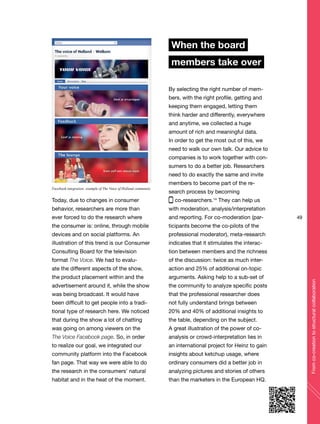
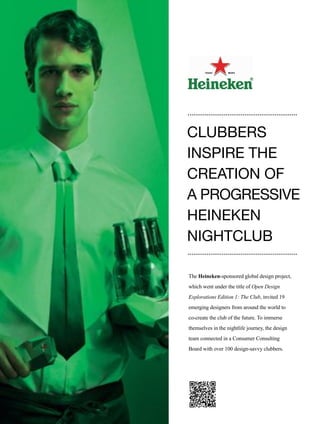
that. The Heineken Open Design
Explorations initiative invited clubbers
and up-and-coming designers to cre-
ate the club of the future. Consumers
identified needs and frictions throughout
the clubbing journey which designers
then leveraged to design the club of the
future.
Social and mobile omnipresent
The new screen culture of consumers
implies that consumers’ media atten-
tion and shopping spending go social
Heineken Open Design Explorations Edition 1: The Club
23
Whatpeopleexpectfrombrandstoday
and mobile. Consumers constantly
tweet and update their status and feel-
ings while watching TV. The new-age
smartphone users use their phone for
(peer-to-peer) payments, barcodes or
couponing. It implies marketers have
to be present everywhere and com-
bine media to convince more than ever
before.
Brands demanding consumers to act
But if done well, brands may swing
the other way and become meaning-
fully demanding towards consumers
too. If consumers believe the bigger
vision of the brand, they will contrib-
ute and collaborate automatically. The
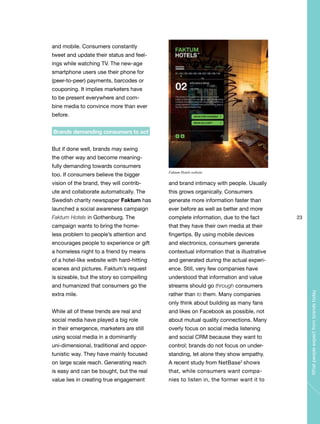
Swedish charity newspaper Faktum has
launched a social awareness campaign
Faktum Hotels in Gothenburg. The
campaign wants to bring the home-
less problem to people’s attention and
encourages people to experience or gift
a homeless night to a friend by means
of a hotel-like website with hard-hitting
scenes and pictures. Faktum’s request
is sizeable, but the story so compelling
and humanized that consumers go the
extra mile.
While all of these trends are real and
social media have played a big role
in their emergence, marketers are still
using scoial media in a dominantly
uni-dimensional, traditional and oppor-
tunistic way. They have mainly focused
on large scale reach. Generating reach
is easy and can be bought, but the real
value lies in creating true engagement
and brand intimacy with people. Usually
this grows organically. Consumers
generate more information faster than
ever before as well as better and more
complete information, due to the fact
that they have their own media at their
fingertips. By using mobile devices
and electronics, consumers generate
contextual information that is illustrative
and generated during the actual experi-
ence. Still, very few companies have
understood that information and value
streams should go through consumers
rather than to them. Many companies
only think about building as many fans
and likes on Facebook as possible, not
about mutual quality connections. Many
overly focus on social media listening
and social CRM because they want to
control; brands do not focus on under-
standing, let alone they show empathy.
A recent study from NetBase2
shows
that, while consumers want compa-
nies to listen in, the former want it to
Faktum Hotels website
24
happen on the consumers own terms.
Consumers do not want companies to
listen in a top-down manner such that
it serves the sole commercial benefit
of companies.
Another example of the demonstra-
tion that marketers do not get the
new model yet is the recent debate
on Coca-Cola revealing that a study
of theirs did not show a correlation
between social buzz and short-term
sales.3
Of course there is no correla-
tion from a general perspective. We
can come up with a number of statis-
tical as well as conceptual reasons for
why there is not, but it also does not
at all mean social media are not valu-
able. For example, consumers like a
brand they buy and consume all the
time at different points in time. When
people like a brand it does not imply
the same thing (it could mean more or
less) as actually buying or adoring the
brand. And they were probably buying
it anyway, so adding likes did not do
anything directly related to sales. The
discussion also should not be about a
single medium. Earned, paid, owned,
online as well as offline media are all
playing together in combination - it
is hard to disentangle. Perhaps more
importantly, what this discussion
shows is the narrow-minded focus
of marketers today. The real success
for Coca-Cola is in brand building,
whether that is through online or
offline media; it should really be via
social in the true sense of the word.
Therefore, marketers need to under-
stand what makes people really iden-
tify, love and engage with a brand.
So what does all this imply for market-
ing research? That is what this book
25
Whatpeopleexpectfrombrandstoday
is all about - it is about humans and
relationships. It is not about technology
or panels but about how we can leverage
consumers to reveal the information and
knowledge we want to get at. Anything
we do should be a positive brand touch-
point experience for consumers and
executives. People do not pay attention
to boring things, so it is time to rethink
research from that perspective. Far and
foremost, we need to create internal
impact among executives and make sure
that research becomes a conversation
starter within companies.
We need to realize that people need a
good reason to participate in research or
pay attention to its results. The only thing
marketers, researchers and brands can
and should do is facilitate human con-
nections in a relevant way. Consumers
are interested in doing things with other
people. The new role of marketing and
research is to provide social currency
to consumers such that they can spend
time together and do what they love
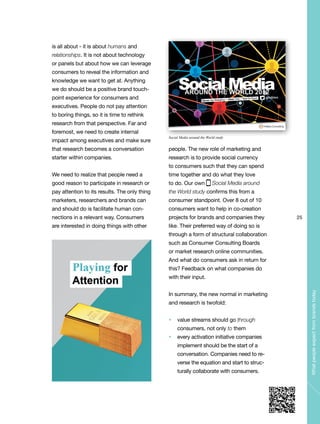
to do. Our own Social Media around
the World study confirms this from a
consumer standpoint. Over 8 out of 10
consumers want to help in co-creation
projects for brands and companies they
like. Their preferred way of doing so is
through a form of structural collaboration
such as Consumer Consulting Boards
or market research online communities.
And what do consumers ask in return for
this? Feedback on what companies do
with their input.
In summary, the new normal in marketing
and research is twofold:
value streams should go through
consumers, not only to them
every activation initiative companies
implement should be the start of a
conversation. Companies need to re-
verse the equation and start to struc-
turally collaborate with consumers.
Social Media around the World study
Crowdsourcing,
co-creation & structural
collaboration: what is
all the buzz about?
by Tom De Ruyck
27
Whatpeopleexpectfrombrandstoday
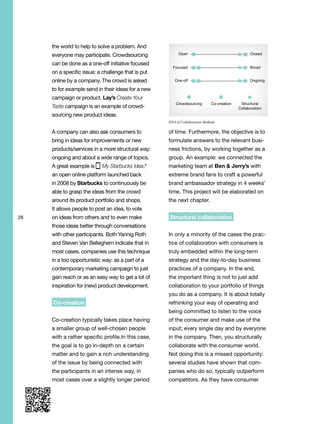
In order to define the state of crowd-
sourcing, co-creation and structural
collaboration with consumers, we
talked with 6 leading experts in the
field: Richard Millington (Managing
Director at Feverbee and author of
Buzzing Communities), Doug Williams
(previously the Co-creation and
Open Innovation Expert at Forrester,
now Principal Analyst at Innovation
Excellence), Charles Leadbeater (au-
thor of the bestselling book We Think),
Steven Van Belleghem (former Partner
at InSites Consulting, author of 2
best-sellers: The Conversation Manager
& The Conversation Company and
now Inspirator at B-Conversational),
Jeremiah Owyang (Principal Analyst
at Altimeter Group and the initiator of
Community Manager Appreciation Day)
& Yannig Roth (Research Fellow at
crowdsourcing expert eYeka).
From trending
to mainstream
In the previous article, we touched upon
the fact that people are more social than
ever before. They share their thoughts,
feelings, experiences and ideas almost
instantly. Consumers are also open to
start a true dialogue with brands and the
companies behind them.4
This trend has
grown over the last decade and is going
mainstream now.5
Moreover, the experts
interviewed agreed that crowdsourcing,
co-creation and structural collaboration
with consumers are gaining ground as
practices in the business world as well.
They all notice a general acceptance
of these principles and see the pool of
true believers and companies that start
implementing it within their organizations
growing by the day, as ‘there are too many
opportunities in it, to just ignore the trend’
(dixit Doug Williams).
To get a grip on the trend, it is crucial to de-
fine the different ways in which brands can
connect and work together with consum-
ers; and to understand how they differ:
Crowdsourcing
Howe describes in his book
Crowdsourcing how companies outsource
tasks to consumers that normally profes-
sionals would do.6
Leadbeater refers to
the consumer as a prosumer in his book
We Think.7
The main characteristic of
crowdsourcing is that it is an open call to
Richard Millington
Charles Leadbeater
Jeremiah Owyang
Doug Williams
Steven Van Belleghem
Yannig Roth
28
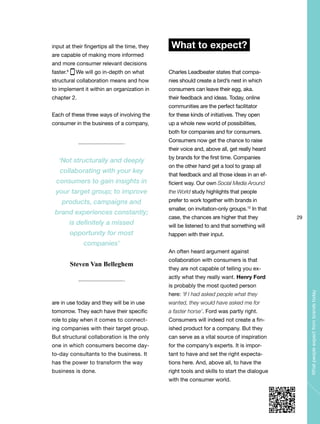
the world to help to solve a problem. And
everyone may participate. Crowdsourcing
can be done as a one-off initiative focused
on a specific issue: a challenge that is put
online by a company. The crowd is asked
to for example send in their ideas for a new
campaign or product. Lay’s Create Your
Taste campaign is an example of crowd-
sourcing new product ideas.
A company can also ask consumers to
bring in ideas for improvements or new
products/services in a more structural way:
ongoing and about a wide range of topics.
A great example is My Starbucks Idea,8
an open online platform launched back
in 2008 by Starbucks to continuously be
able to grasp the ideas from the crowd
around its product portfolio and shops.
It allows people to post an idea, to vote
on ideas from others and to even make
those ideas better through conversations
with other participants. Both Yannig Roth
and Steven Van Belleghem indicate that in
most cases, companies use this technique
in a too opportunistic way: as a part of a
contemporary marketing campaign to just
gain reach or as an easy way to get a lot of
inspiration for (new) product development.
Co-creation
Co-creation typically takes place having
a smaller group of well-chosen people
with a rather specific profile.In this case,
the goal is to go in-depth on a certain
matter and to gain a rich understanding
of the issue by being connected with
the participants in an intense way, in
most cases over a slightly longer period
of time. Furthermore, the objective is to
formulate answers to the relevant busi-
ness frictions, by working together as a
group. An example: we connected the
marketing team at Ben & Jerry’s with
extreme brand fans to craft a powerful
brand ambassador strategy in 4 weeks’
time. This project will be elaborated on
the next chapter.
Structural collaboration
In only a minority of the cases the prac-
tice of collaboration with consumers is
truly embedded within the long-term
strategy and the day-to-day business
practices of a company. In the end,
the important thing is not to just add
collaboration to your portfolio of things
you do as a company. It is about totally
rethinking your way of operating and
being committed to listen to the voice
of the consumer and make use of the
input; every single day and by everyone
in the company. Then, you structurally
collaborate with the consumer world.
Not doing this is a missed opportunity:
several studies have shown that com-
panies who do so, typically outperform
competitors. As they have consumer
Crowdsourcing
Open Closed
Focused Broad
One-off Ongoing
Co-creation Structural
Collaboration
Crowdsourcing
Open Closed
Focused Broad
One-off Ongoing
Co-creation Structural
Collaboration
DNA of Collaboration Methods
29
Whatpeopleexpectfrombrandstoday
input at their fingertips all the time, they
are capable of making more informed
and more consumer relevant decisions
faster.9
We will go in-depth on what
structural collaboration means and how
to implement it within an organization in
chapter 2.
Each of these three ways of involving the
consumer in the business of a company,
are in use today and they will be in use
tomorrow. They each have their specific
role to play when it comes to connect-
ing companies with their target group.
But structural collaboration is the only
one in which consumers become day-
to-day consultants to the business. It
has the power to transform the way
business is done.
What to expect?
Charles Leadbeater states that compa-
nies should create a bird’s nest in which
consumers can leave their egg, aka.
their feedback and ideas. Today, online
communities are the perfect facilitator
for these kinds of initiatives. They open
up a whole new world of possibilities,
both for companies and for consumers.
Consumers now get the chance to raise
their voice and, above all, get really heard
by brands for the first time. Companies
on the other hand get a tool to grasp all
that feedback and all those ideas in an ef-
ficient way. Our own Social Media Around
the World study highlights that people
prefer to work together with brands in
smaller, on invitation-only groups.10
In that
case, the chances are higher that they
will be listened to and that something will
happen with their input.
An often heard argument against
collaboration with consumers is that
they are not capable of telling you ex-
actly what they really want. Henry Ford
is probably the most quoted person
here: ‘If I had asked people what they
wanted, they would have asked me for
a faster horse’. Ford was partly right.
Consumers will indeed not create a fin-
ished product for a company. But they
can serve as a vital source of inspiration
for the company’s experts. It is impor-
tant to have and set the right expecta-
tions here. And, above all, to have the
right tools and skills to start the dialogue
with the consumer world.
‘Not structurally and deeply
collaborating with your key
consumers to gain insights in
your target group; to improve
products, campaigns and
brand experiences constantly;
is definitely a missed
opportunity for most
companies’
Steven Van Belleghem
30
Getting started
The consensus among the interviewees
is that there is not one company that
does everything right in terms of struc-
tural collaboration. A lot of companies
have made a start. In most cases those
initiatives are driven by visionary CxOs
or intrapreneurs with a strong belief in
the power of listening to the consumer.
There is a common belief that there
already is a wide range of best practices
out there and that companies do not
need to reinvent the wheel. They need
to in-source the expertise and bright
people within the company need to be
the driving force behind embedding the
practice into the daily business.
4 stages to make a start with structural
collaboration can be identified:
1. Defining the objectives: it is crucial
to define the objectives properly
from the start. Clear objectives in-
clude agreeing on KPIS that need
to be measured and standards that
need to be reached. Without the
latter, it is impossible to prove what
the initiative adds to the business. It
is important to match the objectives
with the current company culture
and business practices and to move
forward step by step. Change does
not just happen, it needs to be man-
aged.
2. Securing the necessary resources:
it is crucial to have the support from
higher management to make a jump
start and to get the necessary budg-
ets and organizational alignment
from the start. In some companies a
successful pilot will need to be done
before structural resources can be
claimed.
‘All companies should
start working together with
consumers. The ones that tried
it, stopped and now disbelieve,
probably just did
it the wrong way’
Doug Williams
‘Companies must have their
internal teams, resources,
processes and programs
aligned in order to be
successful’
Jeremiah Owyang
31
Whatpeopleexpectfrombrandstoday
3. Creating & managing the
community: Richard Millington
is very clear on this one: ‘There is
a big difference between ena-
bling consumers to collaborate
with you and motivating them to
do it’. Companies are typically
very good at the former and
terrible at the latter. The big-
gest mistake companies make
is offering huge rewards; this
lowers motivation in the long
term. What consumers want
is simply to have greater self-
efficacy. The idea that they are
having an impact on the world.
Recognizing people for the great
contributions they make is what
counts. Moreover, people from
different backgrounds or cultures
will have different expectations,
which implies that managing a
community never follows a one
size fits all formula.
4. Adding value to the business:
in the end it is all about return on
investment. Getting great input is
one thing, making sure it is used
within the company is another. In
order to get everybody on board,
the ambassadors of the initiative
should not only measure its suc-
cess, they should also share and
celebrate it within the organiza-
tion. That will keep the (r)evolu-
tion going.
The future
What will the future bring? Jeremiah
Owyang envisions a different future for the
companies that have and have not gained
this new capability: ‘Consumers want to be
connected with companies and they have
a plethora of ideas to improve products
and services. Companies can source their
energy to improve. The brands that harness
this have the opportunity to thrive’.
Structurally collaborating with consum-
ers has the potential to become the
new norm. But companies need to be
careful. They cannot take the consumers’
willingness to participate in companies’
initiatives for granted. Most communi-
ties do not give members a true sense
of having impact. They let members give
their opinions but then fail to act upon it.
They make the community feel powerless.
When a company develops a community,
it gives the community a sense of power
over the organization. The community
becomes an external Board of Advisors.
It is key to not take this lightly. It is up to
us all, to make sure that we can keep the
true spirit of collaboration alive, also at the
consumers’ side.
32
TWEETAWAYS
33
Whatpeopleexpectfrombrandstoday
Marketing is evolving from a
dominantly ‘to consumers’ approach to
a ‘through consumers’ approach.
@Niels_InSites
Companies should start working to-
gether with consumers: those that tried,
stopped and now disbelieve, probably
just did it the wrong way.
@DougWilliamsMHD
Companies can source their energy
from consumers to improve: brands that
harness this have the opportunity to
thrive.
@jowyang
The difference between crowdsourc-
ing & structural collaboration is what
distinguishes a one-night stand from a
relationship: commitment.
@tomderuyck
Companies should create a bird’s nest
in which consumers can leave their egg,
aka their feedback and ideas.
@LeadbeaterCh
2
From
co-creation
to structural
collaboration
36
Bringing consumers into
the business, all the way
up to the boardroom
by Tom De Ruyck & Niels Schillewaert
37
Fromco-creationtostructuralcollaboration
Becoming an open
and agile company
today, in order to
win tomorrow
Most of you will probably agree: the
past 5 years have been absolutely crazy
for those who are running a business.
Radical changes took place, at a speed
never seen before, leading to a new
reality both in the world of the consumer
and in the context in which business is
done.
Through social media, consumers have
gained the power to make or break
brands. Over the last years, hundreds
of case studies were written on how
consumers can praise a brand and help
out to spread a message or improve a
product. But we know as many cases
where ordinary consumers bring brands
down in only a matter of nanoseconds,
as is stated by Unilever’s CEO Paul
Polman. The lesson here is, as a com-
pany, you no longer have full control of
what is being said about and done with
your brands. Like it or not, consumers
will talk about brands and the products
and services they offer, both in good
and in bad times. Moreover, consumers
do not only want to talk about brands,
they also want to talk with the company
and the people behind it. Our Social
Media around the World study states
that more than 4 out of 5 consumers
want to collaborate with companies they
like, about topics they have an affinity
with.1
They prefer to do this in an intimate
online environment which offers real in-
teraction with the brand and allows them
to really influence the decision-making.
Nowadays, companies have to deal with
truly empowered consumers. This is
even more the case for Generation Y:2
they were born in the digital age and
raised by their parents in such a way
that they feel they can really make their
own choices. Companies need to listen
better to what the empowered consum-
er has to say and take advantage of it to
improve their performance.
From a business perspective, compa-
nies globally are now confronted with
a hard economic climate. But despite
this new situation, expectations from
consumers keep on rising and the com-
petitive landscape keeps on changing,
at an even higher speed than before. In
this climate of harder, better and faster,
companies need to make themselves
stronger every day in order to outper-
form the competition and win.
38
In this new world, it seems to be vital
for companies to embrace the empow-
ered consumer and to be able to react
quickly to what happens both in the
consumer world and in the daily busi-
ness reality. In other words, it is crucial
to become an open and agile company
today, in order to be one of the winners
tomorrow. Only a minority of companies
have already reached this stage. Most
companies are still stuck in one-way
communication with their customers.
Moreover, they jump from one cam-
paign or project to the next. There is no
continuous interaction or dialogue with
the customer. This means that they miss
out on opportunities that are popping up
in-between two marketing campaigns
or ad-hoc research projects. The new
norm we are living in, demands that
companies start a continuous dialogue
with the consumer. To listen constantly,
to work together on projects and to
react quickly to what happens in the
world around them. The latter asks for
an agile organization: one that can move
really fast. However, this is extremely
difficult if you are organized in silos, as
most companies still are. The reality is
that departments pass projects on to
one another. They do not work together
on projects simultaneously. This does
not benefit the overall outcome of those
projects nor the speed at which they
are executed. Think of how long it takes
to bring a new product to the market.
It literally takes years before it makes it
from the R&D labs where it was created
to the marketing team that works on the
launch strategy.
39
Fromco-creationtostructuralcollaboration
It is important to start working today on
becoming an open and agile company.
It is the biggest opportunity ever to out-
perform the competition, by being one
of the first to gain these new strategic
capabilities.
Consumers
to the rescue
In order to become an open company,
you need to start the dialogue with
all your stakeholders, especially with
your consumers. They are probably
the best consultants you could hire.
Consumers have a lot of knowledge
about a brand’s history. Knowing that
most marketers in FMCG companies
change jobs every 2 years, those con-
sumers probably survived several gen-
erations of (brand) managers. People
who have an affinity with your brand
also show an extraordinary engage-
ment: they want their brand to perform
well. In a community we ran for the
ice cream brand Ben & Jerry’s - in
which we worked with highly engaged
brand fans - it was striking to see how
extremely critical they were towards
what the brand managers did.3
And
in the end, customers are always
right. They are the ones who buy the
company’s products and services and
who ensure that the company has a
business.
To make optimal use of their consulting
power, a company needs to start a two-
way dialogue with consumers, rather
than to just listen to what consumers
have to say about their products, ser-
vices or brands on social media, as the
latter does not give them the chance to
work together with consumers on very
specific questions. In order to get the
maximum out of this dialogue, it is best
to bring a larger group of consumers
together on a closed online community
platform over a longer period of time:
a Market Research Online Community
(MROC).4
What is the difference be-
tween this way of listening to and
working with consumers and the more
traditional way of interviews or focus
groups? The similarities and differences
lie in its main characteristics:
Closed or on invitation only: just
like in traditional qualitative research,
a company’s secrets are safe. Other
than on open crowdsourcing plat-
forms, the facilitator decides who
has access to the online community
platform and has full control over the
profile of the people who are taken
on board. Moreover, a confidentiality
agreement between the participant
and the company can be settled.
Nothing different from traditional
techniques so far.
Online community platform: first
of all, online means convenience
for all parties involved. Nobody
needs to travel to take part in or to
follow the research. This leads to
40
a lower cost per participant on the
one hand and a more convenient
way to follow the discussion and be
immersed in the consumer world for
business people on the other hand.
Secondly, a greater geographical
coverage is possible. You can bring
people from one side of a country
together with those from the other
side. Or even work across differ-
ent countries. Thirdly, the online
community platform itself allows to
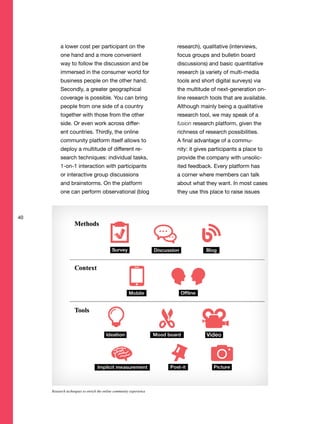
deploy a multitude of different re-
search techniques: individual tasks,
1-on-1 interaction with participants
or interactive group discussions
and brainstorms. On the platform
one can perform observational (blog
research), qualitative (interviews,
focus groups and bulletin board
discussions) and basic quantitative
research (a variety of multi-media
tools and short digital surveys) via
the multitude of next-generation on-
line research tools that are available.
Although mainly being a qualitative
research tool, we may speak of a
fusion research platform, given the
richness of research possibilities.
A final advantage of a commu-
nity: it gives participants a place to
provide the company with unsolic-
ited feedback. Every platform has
a corner where members can talk
about what they want. In most cases
they use this place to raise issues
Research techniques to enrich the online community experience
41
Fromco-creationtostructuralcollaboration
that were not yet discussed within
the research topics started by the
moderator, but that they find relevant
for the sponsoring brand. One could
see this space in the community
as a bird’s nest where participants
can leave their very own thoughts,
feedback and ideas.
Larger group of participants: we
most often work with 50 to 150
members in our communities. The
advantage of working with a larger
group of people is that you can
include a wide diversity of pro-
files, bringing in more and different
opinions. Members also build on
each other’s idea, which leads to
cross-fertilization. All of this brings
more and richer insights to the table.
Working with a limited number of
people still makes it possible to ask
probing questions as a community
moderator and to have an in-depth
qualitative discussion with and
among the members.
Longer period of time (asynchro-
nous engagement): working togeth-
er with your consumers for several
weeks or months or even structurally
on a day-to-day basis helps you to
get to know your target group like
never before and to tackle a wide
range of issues at the same time.
Time gives members the chance
to think, rethink and fine-tune their
opinions throughout, leading to more
elaborated and mature answers.
Having more time also allows
companies to work together with
customers from generating the initial
insight/idea until the preparation of
the product or campaign launch.
This development can happen on an
as-we-go basis: iterative and hands-
on reworking of concepts or stimulus
materials. Structural collaboration
means that you always have cus-
tomers at your side when you need
to make important decisions. Within
24 hours you will have answers to
urgent questions. However the latter
is only possible if your community is
always on.
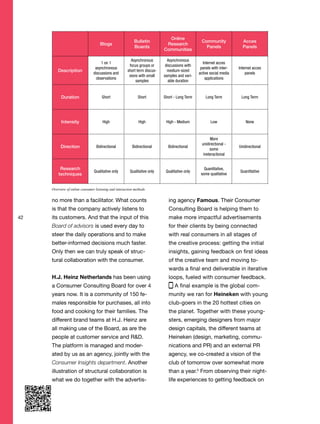
The table on the next page gives an
overview of online consumer listening
and interaction methods. It compares
research communities with other asyn-
chronous - not real time - methods on
the dimensions discussed above.
Having a research community to work
closely with makes you more open as
a company. But it will take more to be-
come agile as well; you need to struc-
turally collaborate with your community
of consumers: almost every single day,
for most business issues and across all
departments dealing with the consumer.
That is why we prefer using the term
Consumer Consulting Board rather than
Market Research Online Community,
as it gives a better summary of what it
is or should become. The name is the
best indication of the place that such a
research community deserves within an
organization. It is not just next-gener-
ation market research technology. It is
not about the technology at all, which is
42
no more than a facilitator. What counts
is that the company actively listens to
its customers. And that the input of this
Board of advisors is used every day to
steer the daily operations and to make
better-informed decisions much faster.
Only then we can truly speak of struc-
tural collaboration with the consumer.
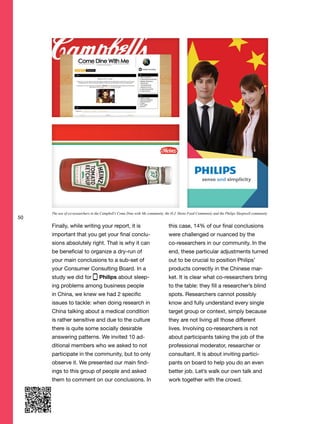
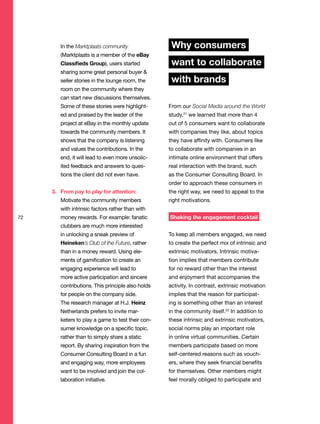
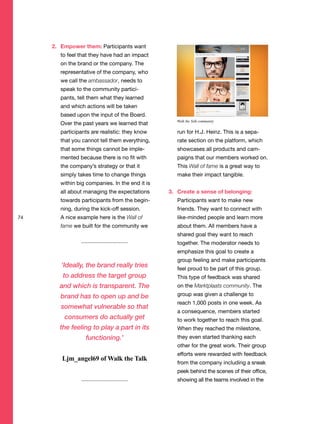
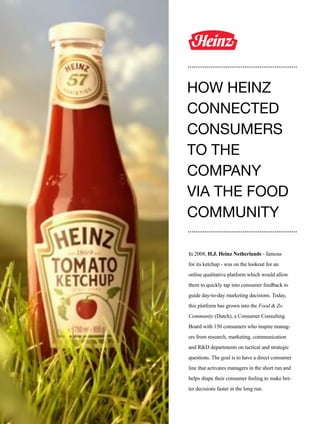
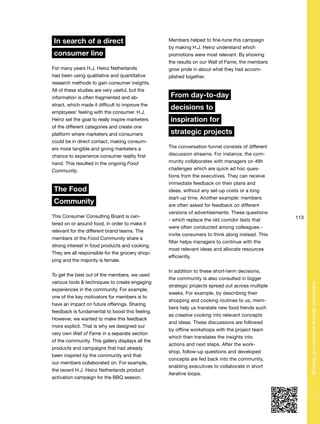
H.J. Heinz Netherlands has been using
a Consumer Consulting Board for over 4
years now. It is a community of 150 fe-
males responsible for purchases, all into
food and cooking for their families. The
different brand teams at H.J. Heinz are
all making use of the Board, as are the
people at customer service and R&D.
The platform is managed and moder-
ated by us as an agency, jointly with the
Consumer Insights department. Another
illustration of structural collaboration is
what we do together with the advertis-
ing agency Famous. Their Consumer
Consulting Board is helping them to
make more impactful advertisements
for their clients by being connected
with real consumers in all stages of
the creative process: getting the initial
insights, gaining feedback on first ideas
of the creative team and moving to-
wards a final end deliverable in iterative
loops, fueled with consumer feedback.
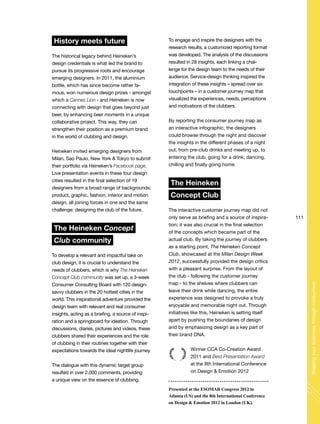
A final example is the global com-
munity we ran for Heineken with young
club-goers in the 20 hottest cities on
the planet. Together with these young-
sters, emerging designers from major
design capitals, the different teams at
Heineken (design, marketing, commu-
nications and PR) and an external PR
agency, we co-created a vision of the
club of tomorrow over somewhat more
than a year.5
From observing their night-
life experiences to getting feedback on
Blogs
Bulletin
Boards
Online
Research
Communities
Community
Panels
Acces
Panels
Description
1 on 1
asynchronous
discussions and
observations
Asynchronous
focus groups or
short term discus-
sions with small
samples
Asynchronous
discussions with
medium-sized
samples and vari-
able duration
Internet acces
panels with inter-
active social media
applications
Internet acces
panels
Duration Short Short Short - Long Term Long Term Long Term
Intensity High High High - Medium Low None
Direction Bidirectional Bidirectional Bidirectional
More
unidirectional -
some
ineteractional
Unidirectional
Research
techniques
Qualitative only Qualitative only Qualitative only
Quantitative,
some qualitative
Quantitative
Overview of online consumer listening and interaction methods
43
Fromco-creationtostructuralcollaboration
sketches and concepts up to the actual
building of the club in Milan during the
annual design fair, consumer input and
feedback was used at all times and by
all parties involved. It is a great exam-
ple of the second meaning of structural
collaboration: different stakeholders
working together around the consumer
community, with only one thing on the
agenda: being successful in the market
by working on what the consumer
needs or expects.
Adapt your
Consumer Consulting
Board to your
company’s DNA
Structural collaboration does not hap-
pen overnight.6
It asks for change man-
agement within the company: budgets
need to be (re)allocated, clear objectives
need to be defined and key people
internally need to be convinced of the
use of the community and the concept
of structural collaboration. Some com-
panies can make a jumpstart; in other
companies it will take a successful pilot
project to get everybody on board. In
that case, it is a matter of thinking big
with the end goal in mind, but starting
small with a pilot project.
One of the misunderstandings about
the use of Consumer Consulting Boards
is that they solely serve the innovation
needs of companies. Nothing is less
true as they are used equally often to
generate insights, develop new prod-
ucts or services, fine-tune brand strate-
gies, co-create advertising campaigns
and improve customer experiences. The
approach is also suitable for every kind
of industry. Although there is a need for
slight adaptations in the method used,
the community approach is successfully
applied to business-to-business envi-
ronments and to the world of patients
and health care professionals.
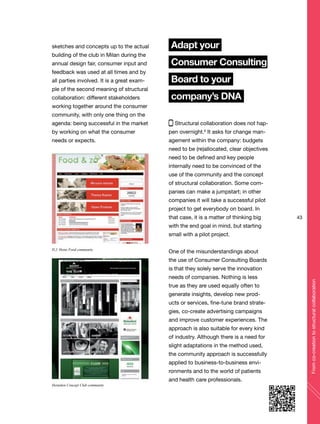
H.J. Heinz Food community
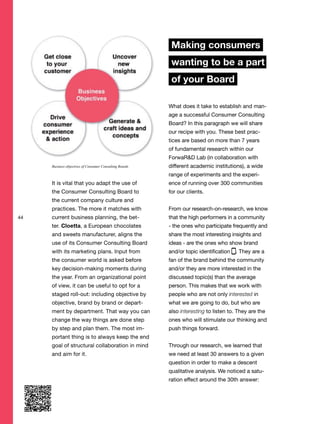
Heineken Concept Club community
44
It is vital that you adapt the use of
the Consumer Consulting Board to
the current company culture and
practices. The more it matches with
current business planning, the bet-
ter. Cloetta, a European chocolates
and sweets manufacturer, aligns the
use of its Consumer Consulting Board
with its marketing plans. Input from
the consumer world is asked before
key decision-making moments during
the year. From an organizational point
of view, it can be useful to opt for a
staged roll-out: including objective by
objective, brand by brand or depart-
ment by department. That way you can
change the way things are done step
by step and plan them. The most im-
portant thing is to always keep the end
goal of structural collaboration in mind
and aim for it.
Making consumers
wanting to be a part
of your Board
What does it take to establish and man-
age a successful Consumer Consulting
Board? In this paragraph we will share
our recipe with you. These best prac-
tices are based on more than 7 years
of fundamental research within our
ForwaR&D Lab (in collaboration with
different academic institutions), a wide
range of experiments and the experi-
ence of running over 300 communities
for our clients.
From our research-on-research, we know
that the high performers in a community
- the ones who participate frequently and
share the most interesting insights and
ideas - are the ones who show brand
and/or topic identification . They are a
fan of the brand behind the community
and/or they are more interested in the
discussed topic(s) than the average
person. This makes that we work with
people who are not only interested in
what we are going to do, but who are
also interesting to listen to. They are the
ones who will stimulate our thinking and
push things forward.
Through our research, we learned that
we need at least 30 answers to a given
question in order to make a descent
qualitative analysis. We noticed a satu-
ration effect around the 30th answer:
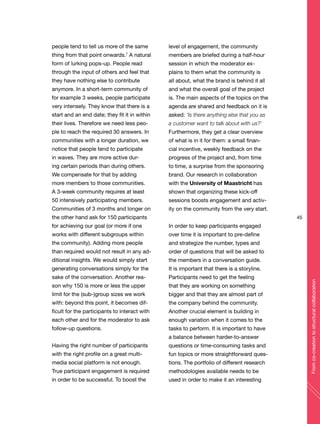
Business objectives of Consumer Consulting Boards
45
Fromco-creationtostructuralcollaboration
people tend to tell us more of the same
thing from that point onwards.7
A natural
form of lurking pops-up. People read
through the input of others and feel that
they have nothing else to contribute
anymore. In a short-term community of
for example 3 weeks, people participate
very intensely. They know that there is a
start and an end date; they fit it in within
their lives. Therefore we need less peo-
ple to reach the required 30 answers. In
communities with a longer duration, we
notice that people tend to participate
in waves. They are more active dur-
ing certain periods than during others.
We compensate for that by adding
more members to those communities.
A 3-week community requires at least
50 intensively participating members.
Communities of 3 months and longer on
the other hand ask for 150 participants
for achieving our goal (or more if one
works with different subgroups within
the community). Adding more people
than required would not result in any ad-
ditional insights. We would simply start
generating conversations simply for the
sake of the conversation. Another rea-
son why 150 is more or less the upper
limit for the (sub-)group sizes we work
with: beyond this point, it becomes dif-
ficult for the participants to interact with
each other and for the moderator to ask
follow-up questions.
Having the right number of participants
with the right profile on a great multi-
media social platform is not enough.
True participant engagement is required
in order to be successful. To boost the
level of engagement, the community
members are briefed during a half-hour
session in which the moderator ex-
plains to them what the community is
all about, what the brand is behind it all
and what the overall goal of the project
is. The main aspects of the topics on the
agenda are shared and feedback on it is
asked: ‘Is there anything else that you as
a customer want to talk about with us?’
Furthermore, they get a clear overview
of what is in it for them: a small finan-
cial incentive, weekly feedback on the
progress of the project and, from time
to time, a surprise from the sponsoring
brand. Our research in collaboration
with the University of Maastricht has
shown that organizing these kick-off
sessions boosts engagement and activ-
ity on the community from the very start.
In order to keep participants engaged
over time it is important to pre-define
and strategize the number, types and
order of questions that will be asked to
the members in a conversation guide.
It is important that there is a storyline.
Participants need to get the feeling
that they are working on something
bigger and that they are almost part of
the company behind the community.
Another crucial element is building in
enough variation when it comes to the
tasks to perform. It is important to have
a balance between harder-to-answer
questions or time-consuming tasks and
fun topics or more straightforward ques-
tions. The portfolio of different research
methodologies available needs to be
used in order to make it an interesting
46
and surprising journey for the members
of the Board.
Another way of turning it into an engag-
ing experience for the participants is
to add gamification elements to the
community: applying the principles and
psychology behind games to motivate
people and enhance their performance.8
This can be done on 4 different levels:9
Question level: turning ordinary
questions into small challenges en-
sures that participants spend more
time on answering them. An exam-
ple is what we did in Crushed Ice,
a global community project for MTV
Networks with 100 cool GenYers
in the 10 hottest cities on earth.
When searching for the hotspots in
their city, the specific question was
turned into a challenge: ‘Can you
come up with as many hotspots in
your city as possible? Based on all
proof that is posted, the MTV jury will
decide which city officially deserves
the title of Hottest City on the Planet.’
The difference in the level of enthu-
siasm about normal questions and
this type of challenges is significant.
Individual level: to reward members
for great achievements in the com-
munity, they receive badges which
give them a certain status. The
badges indicate that they were part
of a specific project or that they sig-
nificantly contributed to an important
breakthrough. The badges appear
on the profile page of the community
members. One could compare it with
how the army honors soldiers for
their bravery and persistence.
Group level: the beauty of work-
ing with a diverse group of people
is that it leads to rich discussions.
In order to stimulate interaction,
which always leads to a better
outcome, one can organize battles
of arguments between groups with
different opinions or ask groups
of people with the same interest
to play against another team. An
illustration of the latter comes from
a community project we conducted
together with the team at Unilever
Global R&D: Consumer&U 10
. In
this 100-participants community we
created 3 sub-groups which could
each ideate around a different prod-
uct category. In order to let them
think harder, we organized a game.
The group which came up with the
highest quality input by the end of
the week got access to a secret
room in the community. We noticed
that the activity level in the com-
munity went up and that members
within each group were stimulat-
ing each other to aim higher. The
winning team got the keys to the
secret room in which the latest
Magnum ice cream innovation was
showcased. And of course there
were a couple of questions about
it. In the end, it is all about making
your agenda of topics a surprising
and engaging experience for the
members.
47
Fromco-creationtostructuralcollaboration
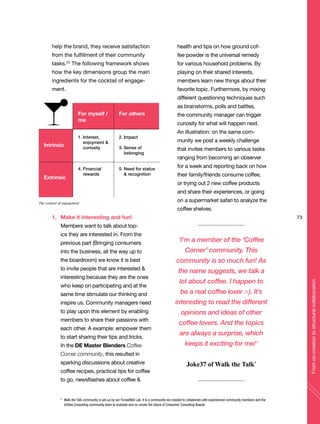
Community level: a last option is to
build milestones that the members
should try and reach by a given date.
If the target is reached, a special
prize or gift is unlocked. In the global
community for Heineken to envi-
sion the Club of Tomorrow, we gave
the participants a target of 2,000
comments by the end of the second
week; if they succeeded, they would
get to see some first ideas and
sketches from the designers.11
This
is something one should do anyway,
but by making it a part of something
bigger, it stimulates curiosity and
pushes people to higher perfor-
mance levels.
By comparing the meta-data of gami-
fied and non-gamified communities, we
learned that if you gamify your com-
munity on the 4 levels described above,
it will lead to 7 times more on-topic
arguments.12
This means that you do not
get more answers, but richer answers.
People just think harder for you by
spending more time while answering the
questions and performing the tasks.
Thinking different,
anywhere and
anytime
Qualitative research is also about letting
people think more emotionally, creative-
ly and contextually. That is why one also
needs to use a series of projective or
creative techniques. Some of them are
online translations of traditional tech-
niques; others are totally new, inspired
by the new possibilities available in the
online world. An illustration of the variety
of options available online is what we
did with Chiquita in a project in which
they wanted to discover the mental and
physical benefits of eating (and drink-
ing) fruit (juices). The outcomes of the
project were used as ammunition for the
launch campaign of their smoothie of-
fering. We started a 3-week community
with 50 participants. Half of them were
living healthily and already eating a lot of
fruit; the other half was living unhealthy,
Examples of rewarding badges
48
eating almost no fruit at all. In the first
week of the community, we explored the
topic and held a discussion about what
a healthy lifestyle is and what the role of
eating/drinking fruit (juices) is. We were
following a more or less typical discus-
sion guide of a traditional focus group.
In the second week, participants were
invited to become part of a scientific
experiment. They were asked to swap
lives. The ones who were already eating
enough fruit were kindly asked to stop
doing so. The unhealthy group on the
other hand received a basket full of fresh
fruit and smoothies, delivered at their
door 3 times in that same week. Over the
course of 7 days, all participants kept a
diary and received short daily surveys on
their mental and physical energy levels.
All of this entailed a rich understanding
into what it is like to change behavior.
This resulted in powerful insights into the
mental and physical benefits of eating/
drinking fruit (juices). In order to under-
stand which of these insights were most
relevant to consumers and to identify
the most important aspects to schedule
in the launch campaign, we organized
a battle of arguments between the 2
groups. They needed to convince one
another to change lifestyles, based on
the list of mental and physical benefits
generated during the first 2 weeks of the
community. This project is a perfect il-
lustration of a community as a true fusion
research platform, which allows to con-
duct research activities that were simply
impossible before via more traditional
research methods.
In order to capture emotions and experi-
ences in the heat of the moment, com-
munities need to be accessible via mo-
bile devices as well. Our meta-research
shows that mobile access boosts the
engagement of participants. Moreover, it
unlocks a new kind of input. Through the
mobile device, members provide us with
more personal and contextual informa-
tion: stories illustrated with photos or
videos, next to in-the-moment reactions
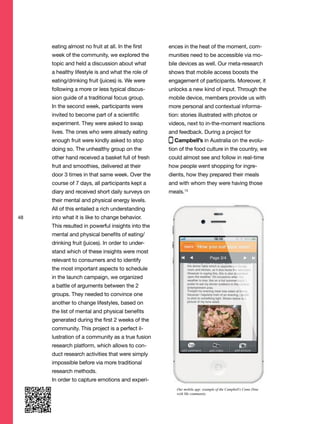
and feedback. During a project for
Campbell’s in Australia on the evolu-
tion of the food culture in the country, we
could almost see and follow in real-time
how people went shopping for ingre-
dients, how they prepared their meals
and with whom they were having those
meals.13
Our mobile app: example of the Campbell’s Come Dine
with Me community
49
Fromco-creationtostructuralcollaboration
Today, due to changes in consumer
behavior, researchers are more than
ever forced to do the research where
the consumer is: online, through mobile
devices and on social platforms. An
illustration of this trend is our Consumer
Consulting Board for the television
format The Voice. We had to evalu-
ate the different aspects of the show,
the product placement within and the
advertisement around it, while the show
was being broadcast. It would have
been difficult to get people into a tradi-
tional type of research here. We noticed
that during the show a lot of chatting
was going on among viewers on the
The Voice Facebook page. So, in order
to realize our goal, we integrated our
community platform into the Facebook
fan page. That way we were able to do
the research in the consumers’ natural
habitat and in the heat of the moment.
When the board
members take over
By selecting the right number of mem-
bers, with the right profile, getting and
keeping them engaged, letting them
think harder and differently, everywhere
and anytime, we collected a huge
amount of rich and meaningful data.
In order to get the most out of this, we
need to walk our own talk. Our advice to
companies is to work together with con-
sumers to do a better job. Researchers
need to do exactly the same and invite
members to become part of the re-
search process by becoming
co-researchers.14
They can help us
with moderation, analysis/interpretation
and reporting. For co-moderation (par-
ticipants become the co-pilots of the
professional moderator), meta-research
indicates that it stimulates the interac-
tion between members and the richness
of the discussion: twice as much inter-
action and 25% of additional on-topic
arguments. Asking help to a sub-set of
the community to analyze specific posts
that the professional researcher does
not fully understand brings between
20% and 40% of additional insights to
the table, depending on the subject.
A great illustration of the power of co-
analysis or crowd-interpretation lies in
an international project for Heinz to gain
insights about ketchup usage, where
ordinary consumers did a better job in
analyzing pictures and stories of others
than the marketers in the European HQ.
Facebook integration: example of The Voice of Holland community
50
Finally, while writing your report, it is
important that you get your final conclu-
sions absolutely right. That is why it can
be beneficial to organize a dry-run of
your main conclusions to a sub-set of
your Consumer Consulting Board. In a
study we did for Philips about sleep-
ing problems among business people
in China, we knew we had 2 specific
issues to tackle: when doing research in
China talking about a medical condition
is rather sensitive and due to the culture
there is quite some socially desirable
answering patterns. We invited 10 ad-
ditional members who we asked to not
participate in the community, but to only
observe it. We presented our main find-
ings to this group of people and asked
them to comment on our conclusions. In
this case, 14% of our final conclusions
were challenged or nuanced by the
co-researchers in our community. In the
end, these particular adjustments turned
out to be crucial to position Philips’
products correctly in the Chinese mar-
ket. It is clear what co-researchers bring
to the table: they fill a researcher’s blind
spots. Researchers cannot possibly
know and fully understand every single
target group or context, simply because
they are not living all those different
lives. Involving co-researchers is not
about participants taking the job of the
professional moderator, researcher or
consultant. It is about inviting partici-
pants on board to help you do an even
better job. Let’s walk our own talk and
work together with the crowd.
The use of co-researchers in the Campbell’s Come Dine with Me community, the H.J. Heinz Food Community and the Philips Sleepwell community
51
Fromco-creationtostructuralcollaboration
The path
towards structural
collaboration
In the previous paragraphs the rea-
sons behind establishing a Consumer
Consulting Board were outlined and
details on how to set it up and run
the community on a daily basis were
discussed. The final part of this article
deals with the question of how to make
the community a real success and let it
be of true value for the company. Here
are some key success factors that we
came across while interviewing (senior)
executives from global brands who have
a Consumer Consulting Board (amongst
others H.J. Heinz, Unilever, Microsoft
and Danone):15
C-level involvement
Support is not enough. Senior execu-
tives need to be involved and to lead by
example. Important decisions are not
made without involving the members of
the Consumer Consulting Board.
Create buy-in & discover
your knowledge gaps
Before starting, it is important to
get everyone on board and to cre-
ate an understanding of the concept
of a Consumer Consulting Board.
Furthermore, it is good to create an
inventory of the knowledge available in
the company about the subjects to work
on. There are several ways of making
this an engaging experience for the
stakeholders involved. At Air France
and KLM for example we did this by
playing a board game with the internal
stakeholders during the kick-off work-
shop.16
Measuring KPIs and
celebrating successes
In order to demonstrate the return on
investment it is important to define KPIs
upfront, based on the objectives, to
measure them smartly and to celebrate
and share success stories. KPIs can be
a mix of aspects linked to one or more
of the following categories: acquiring
fresh and fast knowledge to make better
decisions, creating a consumer-centric-
thinking company culture and showing
the world that the company is listening
to and collaborating with its consumers.
Impactful communication of
results both internally and towards
the external world
Internal leverage: in order to
make sure something is done with
the research results and to build a
consumer-centric thinking culture
within companies, we need to use
a 3-step approach to communicate
to the business: engage, inspire and
activate.17
By doing this, researchers
think more like marketers. Marketers
try to create as many of the right
touchpoints as possible between
52
their brand(ed message) and the
consumer world. In research com-
munication it is beneficial to create
different contact moments between
the voice of the consumer and the
stakeholders in the business. It im-
merses them into the world of the
consumer and positively affects their
hearts, minds and actions.
f Engage is about confronting the
research users with the consumer
world and with their own (lack of)
knowledge about the matter. We try
to create positive disruption: mak-
ing them feel a little bit uncomfort-
able about their current view on
the subject and curious about the
final outcome while the project is
still running. This can be done by
organizing quizzes about the first
outcomes or by distributing offline
posters with striking quotes within
the company’s premises.
f In the Inspire phase we inspire
the internal stakeholders with the
gained insights in an interactive
workshop. Sometimes the audi-
ence is too big to give a presenta-
tion to. This was the case in the
Unilever R&D project where we
needed to report back to a group
of more than 500 people. In order
to do this, we created a consumer
news website on which two articles
about the consumer world were
shared every day, during the
whole duration of the community.18
Another obstacle can be reporting
to very creative audiences, such as
in our Heineken The Club project. To
be impactful among this audience
we turned over 3,000 consumer
stories and pictures into 30
compact insights, in an interac-
tive infographic which guided the
designers through a young club-
goers’ night out.19
f Finally, the research outcome
needs to be used effectively. In
the Activate stage of a workshop
we work with the results and turn
insights into actions through idea-
tion, concept-writing exercises and
the like. In order to make sure that
a project has an after-life we create
deliverables that encourage to be
used afterwards. An example are
the city guides we created for the
senior executives of MTV Networks
based on the tips for hotspots we
received from GenY’ers around the
world. It allowed the MTV execu-
tives to immerse themselves into
the world of their target group when
being on a business trip.20
Interactive infographic of the Heineken Concept Club community
53
Fromco-creationtostructuralcollaboration
f Using this approach of communi-
cating findings makes the results
really well-used. Moreover, it makes
that employees develop a kind of
consumer feeling next to their gut
feeling, by being immersed into the
consumer world.
External leverage: listening to the out-
side world as a company is something
consumers expect nowadays. Grasp
this opportunity and communicate
about the fact that you do it. One can
unlock this untapped communication
potential by communicating about:
f Process: communicate to the
world that you have a Consumer
Consulting Board. One of the ways
to do that is as did the CEO of
Telenet, a Belgian Telco company.
He made an open request to the
world: ‘Who wants to be part of
our board and help us improve our
products?’
f Outcomes: showcase the end
results of your collaboration with
consumers. Heineken launched
the club they co-created during the
Annual Design Fair in Milan.
f Findings: share interesting find-
ings with the world or use them
to tell your story as a brand (to-
gether with the members of your
community). Chiquita used the
findings of our fruit and smoothie
study in their advertisement to
convince consumers to change
behavior.
How we engaged, inspired and activated Air France and KLM, Unilever R&D and MTV Networks
54
What it brings
to the table
What does structural collaboration with
consumers bring to companies who do
it well and who communicate about it
in the best possible way, both internally
and towards the external world?
We see that companies that work
together with consumers come up with
more consumer-relevant products/
services and marketing actions. This
was proven in a project for H.J. Heinz
in which ideas generated by consumers
in a community and ideas generated
by marketers were battling with one
another in a concept screener. Ideas
generated by marketers were signifi-
cantly more perceived as being unique.
Ideas originating through the community
on the other hand were evaluated as
more consumer relevant and obtained
a higher buying intention in the same
test among a representative sample
of the population. In a different study
in collaboration with the University
of Wageningen, we compared two
different pack designs for the same
product. A claim was added to one of
the packs: ‘co-created with consumers’.
The other pack did not carry any such
claim. Again, it was found that the pack
with the claim was perceived as more
consumer-relevant and had a higher
buying intention.
This shows that it is not only about
performing the co-creation exercise;
it is also about communicating wisely
about the fact that you do it. It will lead
to a humanization of your company and
brand. Companies that are open to the
outside world actually do something
consumers expect from companies
nowadays. They are perceived as more
contemporary and genuine. And through
the positive (brand) experience you give
the members, you create positive con-
versations about your brand and mostly
also brand advocates for life.
Last but not least, by having the con-
sumers’ input at your fingertips 24/7,
you gain the ability to move rapidly. It
also makes that departments work on a
project together. And it is the consumer
who determines the agenda, rather than
the hidden agenda of departments with-
in the company. It means that, internally,
things move quicker as well. The end
result is that you become a more agile
company. And that type of company will
be tomorrow’s winners.
Make it an
evolution instead
of a revolution
The way to becoming a truly open and
agile company is a journey that asks
for a step-by-step approach. Some
companies will immediately make a
start with structural collaboration.
55
Fromco-creationtostructuralcollaboration
Others start a pilot project before mov-
ing forward. Some companies start by
using it for a specific product category
or brand or within a specific department
of the company and extend it to other
categories and brands over time, thus
intensifying the frequency and inten-
sity at which the Consumer Consulting
Board is used within different parts of
the business. No matter how you start,
it will always be an evolution rather than
a revolution. Change never happens
overnight.
The main thing is that you move towards
the end goal of structural collaboration.
It is about aiming for the moment that
for most business objectives, almost
every single day and across all depart-
ments, the input from the Consumer
Consulting Board is used to make bet-
ter-informed decisions faster than ever
before. And when that goal is reached,
it’s time for the final stage: having an
ambassador of the voice of the con-
sumer in the boardroom of the company
(the CCO, Chief Consumer Officer).
Let’s start today. The perfect storm is
here: consumers are ready for it; they are
even waiting for us. The technology to
facilitate the ongoing dialogue with your
Board is there as well. And the recipe to
make it all happen has been fine-tuned,
based on years of experience.
Good luck on your journey towards
becoming a truly consumer-centric-
thinking company!
In the second part of this chapter we
examine how all the different stakehold-
ers (our internal community team, our
researchers, our moderators, the commu-
nity participants & our clients, ...) experi-
ence a Consumer Consulting Board.
The planner is responsible
for working out a detailed
project planning based
upon the project needs and
the required and available
resources. The outcome
serves as an essential
framework for all project
stakeholders.
The moderator is in charge
of the actual moderation.
In the case of an interna-
tional project, our research
consultants work together
with a team of local mod-
erators out of our Global
Community Moderator
Network. Our local mod-
erators are briefed by the
planner and the research
consultant.
The content manager holds
the final accountability for
any project. He/she under-
stands the client(‘s needs)
proposes and elaborates
the best research approach
for answering the research
questions.
Content Manager Research Consultant Planning & Network
Management
Moderator
The research consultant
is mainly responsible for
managing the project from
a research perspective. He/
she is omnipresent during
the entire project: from
composing a conversation
guide to the analysis and
reporting afterwards.
Wim De Wever
Oana FrentiuAlexandra Ardean
56
Project & Method Manager
The project & method manager (PM²) is the internal account manager: the liaison between the content
manager, research consultant and moderator on the one hand and the entire project implementation
team on the other hand. He/she is accountable for the full implementation and the community mem-
ber recruitment process within each individual community project. The role of the PM² is not limited to
coordinating the execution of client projects; it also includes working on the continuous improvement of
our operational quality and optimizing our processes. InSites Consulting has 3 PM²’s who coordinate all
community projects from a practical perspective: Wim, Oana and Alexandra.
On the following pages you can follow how a community project comes to life, featuring the following
project team members:
The recruiter ensures that
we find the right commu-
nity members, on time, by
applying to the most suit-
able recruitment sources.
Recruitment includes the
careful screening (or selec-
tion) of the community
members but also builds
the engagement towards
the future participants via
different communication
channels.
Quality Control DesignerRecruiterIT Project Manager
The IT’er takes care of all
technical programming and
implementations required
for a project, including
the online recruitment
survey and the community
platform with the necessary
research tools and plug-ins.
We have introduced
quite some checks in our
implementation processes,
by which we are sure to
guarantee the highest qual-
ity both to our customers
and to our participants.
The quality controller is
involved in all phases of the
implementation process
to perform the necessary
checks and tests.
The designer works out a
unique look-and-feel for the
community platform, suit-
able for the specific brand,
topic and target group, but
also respecting the trusted
InSites Consulting design
framework. The custom
branded community
guarantees an optimal user
experience for both the
participants and the client.
The making of...
...through the eyes of a PM2
57
Fromco-creationtostructuralcollaboration
The project details, includ-
ing the target group and
the most suitable recruit-
ment approach, are deter-
mined during an internal
kick-off with the research
consultant and the project
& method manager (PM²).
PM² and planning draw up
a detailed project planning
and allocate the necessary
capacity in the agendas
of the composed project
team. The PM² organizes
an internal briefing with
the project implementation
team to inform them about
the screening survey and
the recruitment approach.
The IT’er programs the
screening survey while
the recruiter makes the
necessary preparations for
the community member
recruitment. The quality
control team takes care
of some technical and
textual checks before the
online survey is launched.
The PM² keeps an eye on
a smooth implementation
flow.
Client
kick-off
Research questions?
Briefing the team!
Internal
kick-off
Internal planning
and briefing
Recruitment survey
programming1 2 3 4
Kick-off with the client
to discuss the research
questions & needs with
the content manager and
the research consultant,
followed by an intro-
duction to the research
method.
58
The recruiter makes sure
he/she finds the right
community members and
provides regular progress
updates to the PM². The
future community mem-
bers are invited to partici-
pate in the screening sur-
vey via an e-mail. Further
engagement is built via a
subsequent confirmation
e-mail and a moderator
call, all of this followed up
by the recruiter.
Simultaneously with the
recruitment, the research
consultant takes the lead
in working on the detailed
research approach, in
close consultation with the
content manager and the
client. All this results in a
conversation guide func-
tioning as the community
script.
The PM² summarizes the
wishes from the different
stakeholders and briefs
our technical and design
teams. The designer is
informed by the PM² and
works out the look-and-
feel for the community.
After client approval the
final design serves as
‘input’ for the next phase:
the implementation of the
platform.
Right after the PM² has
validated the technical
community specifica-
tions, the IT’er begins
with the technical and
design implementation of
the community platform,
together with the set-up of
the kick-off sessions.
Let’s create a clear guide...
Creating the online platform...
Recruiting com-
munity members
Conversation
guide creation
Briefing of specs
and design
Platform
implementation5 6 7 8
59
Fromco-creationtostructuralcollaboration
The PM² informs the qual-
ity control team, which
comes in for a second
time to do some final
checks on the community
platform right before we
go live!
Kick-off sessions are
planned to allow the mod-
erator to inform the com-
munity members about the
project roadmap and the
participants’ role. The PM²
makes sure the recruiter
sends the necessary log-in
instructions towards the
community members so
they can get access to their
respective kick-off session
and the actual community
right after.
Our enthusiastic commu-
nity members log in after
the kick-off session, start
socializing in the welcome
thread and start to par-
ticipate in the first tasks
the moderator has posted
online.
Fresh discussion threads
and challenges are initiated
by the moderator according
to the schedule prepared
in the conversation guide.
All community members
get regular updates on the
latest tasks and info via
newsletters sent out by the
moderator. The moderator
can consult the PM² who
keeps an eye on the com-
munity activity level as well.
Quality
checks
Kick-off with
members
Community
goes live!
Community
moderation9 10 11 12
Check!
Ready for take-off!
60
During the moderation
period, the research
consultant (in close con-
tact with the moderator)
already does some basic
data analysis and has
intermediary feedback
moments with the client.
This feedback might still
impact and reshape some
future community threads
and tasks.
After a cooling down
period, the PM² asks the
IT’er to officially close
the community for the
members. The recruiter
makes sure that the most
valuable participants get
a reward immediately,
along with a closing e-mail
message referring to a
satisfaction survey.
The research consultant
and the content manager
are in charge of the final
analysis and the report-
ing of the rich community
data, clearly answering
all the client’s research
questions & needs raised
at the start.
The moment of truth! The
final report will be unveiled
to the client. The research
consultant and content
manager will expound the
complete community story
in person, in an interactive
way.
Analysis &
reporting
Closing of the
community
Writing the
full story
Client
workshop13 14 15 16
Eureka!Turning conversations
into insights
61
Fromco-creationtostructuralcollaboration
Rooms
The different discussion top-
ics are featured in dedicated
rooms to focus the mindset
of the participant on the type
or content of the challenges,
ranging from forum discussions
and diaries to ideation chal-
lenges and short surveys.
Latest topics
As not all participants are join-
ing the discussions daily, topics
are posted in clusters and the
most recent topics are featured
on the home page.
Who’s online
Although the discussions on
the Consumer Consulting
Board are asynchronous,
featuring online members en-
hances to the group feeling.
Inside
the
Board
62
Customized skin
The customized design of the
platform intensifies the par-
ticipant idenitification with the
topic and/or the brand. The de-
sign is used in all touchpoints,
from short surveys to newslet-
ters to guarantee a consistent
activation.
Countdown
Awareness around special
events or deadlines is created
by featuring a live countdown
on the home page.
Activating members
It is surprising how many com-
ments consumers share in a
couple of weeks. Featuring
the number of reactions on
the home page provides an
intrinsic motivation to do even
better. Of course, milestone
numbers - 2500 comments for
example - are celebrated!
New blog posts
To guide the attention of
participants to the most im-
portant discussions, they can
be visually highlighted on the
homepage.
63
Fromco-creationtostructuralcollaboration
Designer
At InSites Consulting, we
truly believe in the power of
design. That is why we have a
team of designers who create
custom made skins for all our
Consumer Consulting Boards.
In consultation with the client,
our designers create a look-
and-feel that perfectly fits the
topic of and the brand behind
the community.
Hannes Willaert
Your custom
designed Board
64
65
Fromco-creationtostructuralcollaboration
66
Confessions of a
qualitative mind
by Hakim Zemni
67
Fromco-creationtostructuralcollaboration
Let me start by presenting myself. I am
Hakim Zemni. In the companies I have
worked for I was often referred to as an
‘opinion on legs’. Personally, I prefer the
description ‘the guy who doesn’t like to
leave a question unanswered’. Currently
I am the Managing Director of InSites
Consulting’s Belgian office, which basi-
cally means I make sure we reach our
targets and keep our people happy and
smart whilst doing so.
Since 1998, by sheer coincidence and
luck (the latter being something I’ll only
realize later), I stumbled into the market
research industry. I actually started off
as a call center agent to pay for my
studies, in a small and local market re-
search agency; pretty soon I was offered
a job as a call center supervisor. A few
months later I was given the opportunity
to become one of the project manag-
ers in charge of quantitative studies.
Personally, being a communication sci-
entist, my affinity with words has always
been way higher than with numbers,
but I learned a lot in those first 2 years
of working in a quantitative context. But
deep down I felt I was a qual mind in a
quant body.
In 2000 I shifted from quant to qual and
became a full-time qualitative market
researcher. Between 2000 and 2008 I
conducted 250+ focus groups, 200+
in-depth interviews, gave 100+ work-
shops and lead 50+ brainstorms. By
2006 I even started a qualitative and
independent spin-off within the com-
pany I was working for and we actually
succeeded in doubling our turnover in a
few months’ time.
But in 2008 everything changed. To
make a long story short, our company
was taken over by an international mar-
ket research company for which I didn’t
feel any love and from which I didn’t feel
any passion. So I literally resigned a few
hours after the announcement of the
buy-out.
What to do then? I had heard about
InSites Consulting throughout my 10
years of market research experience
and always had a knack for their sexy
and dynamic look and feel, their knowl-
edge of the Internet in all its complexity
and their academic background. So I
gave them a call and introduced myself
as a qualitative ‘expert’.
What do you think
is the future of
qualitative research?
September 2008. There I sat, in a
room, together with 2 qualitative
InSites Consulting seniors. We had a
great talk, got on really well from the
start. We clicked. The only hiccup in
that talk however was rather crucial.
Magali Geens, then Senior Qualitative
Consultant - and today one of the
Managing Partners - asked me ‘What do
68
you think is the future of qualitative re-
search?’. I gave well-informed and on-
topic answers and elaborated on new
presentation techniques, ethnography,
netnography and web-scraping, doing
research without asking questions, life-
caching through up-and-coming social
media and even talked about ongoing
qualitative panels. All of those answers
were not wrong, but of course the
InSites Consulting people had some-
thing else in mind. I kept guessing and
guessing, but in vain. In the end they
felt sorry for me desperately trying to
find the answer they were looking for.
The answer was actually just around
the corner: ‘The future of qualitative
research is online’, they stated. I was
shocked in disbelief. I couldn’t but
counter it. This idea was way too dis-
ruptive for a qualitative mind like me.
These people were undermining what
I did for 10 years, so I told them online
qual might be interesting to explore
but would never replace focus groups.
What about face-to-face contact? What
about actually seeing your consumer?
What about non-verbal communi-
cation? What about the role of the
moderator? What about clients wanting
to follow groups/interviews? How to
convince clients who do not know or
realize online qualitative actually ex-
ists? I was digging my own grave in the
discussion as I kept going on and on
and on about the disadvantages high-
lighting my skepticism. Luckily, I must
have done something right, because 2
weeks later I got offered a contract.
The first weeks
And that is how it all started for me
and the online qualitative experience.
I started with a research community for
a public service broadcaster for which
I had already done a lot of offline work
before. I felt like a fish on dry land, but
much to my surprise I was transferring
my offline qual skills quite naturally to
the online world from the start. In week
one already I remember telling my wife
I felt the job was the same, only the
medium had changed and the junior
qualitative people knew more than me
this time around. When analyzing and
reporting the findings I even felt I had
already been doing it for years. Which
is exactly the point of course: analyz-
ing data from a (sometimes poorly)
transcribed focus group is in no ways
different from analyzing data from a
conversation in an online community.
Very soon, I felt we were meeting the
client’s expectations. My comfort zone
was literally put to the test but I felt little
to no resistance to organically embed
the online methods in it.
Converted
in 8 weeks
By the end of the first quarter at InSites
Consulting my skepticism had become
passion, my suspicion had turned into
69
Fromco-creationtostructuralcollaboration
belief. At that point, early 2009, I started
realizing the incredible opportunities
ahead for online qualitative. Yes, I was
converted and it only took 8 weeks (and
a new breed of great online only qualita-
tive consultants). Together with my fel-
low colleagues I started evangelizing the
online qualitative word. I talked about
unseen advantages such as user-friend-
liness and convenience for the 21st-
century qualitative participant and going
beyond the classic 2-to-3-hour con-
sumer connection limit. The disappear-
ance of social desirable answers thanks
to the anonymity of online tools struck
me as a radical change from what I was
used to. I particularly became a fan of
the possibility of the holistic approach
online qualitative offers: you can ask
people to upload pictures and videos,
track what they are doing, give them
long-lasting assignments, ask them to
ponder upon something and work with
them on a learning curve, ask them to
go on a shopping safari or ask them
the traditional qualitative questions at
the same time. To me, it all felt like a
revolutionary set of techniques in ad-
dition to the traditional ones I was able
to keep.
The future is here
Today, I am a true believer of Consumer
Consulting Boards as the most efficient
and meaningful connection one can
make with consumers today. I feel lucky
that I am part of this paradigm shift as
my conviction today is very simple: 70
years ago the focus group was invented
as it was the most natural way to ask
consumers why and how they did what
they did. In the 21st century the online
way is the most natural way. With this
change of medium we have unlocked a
whole new world of qualitative tech-
niques and practices enabling us to not
leave any question unanswered. And
coincidentally, that’s what makes me
personally happy.
Hakim Zemni
70
How different
stakeholders experience
structural collaboration
by Anouk Willems, Natalie Mas & Thomas Troch
In one of the previous articles, the experts
stated that a lot of companies have already
made a good start with structural collabo-
ration, but no company is there 100% yet.
In this article, we will explore what it takes
to make structural collaboration a success
and how to motivate both the consumer
and stakeholders at the company side to
keep the spirit of collaboration alive.
Building equal
relationships
In order for a Consumer Consulting
Board to be successful, it is crucial that
an equal relationship between all parties
- consumer, company and moderator/
researcher - is established and that they
see each other as true partners. This
particularly holds for research communi-
ties, more than in other more traditional
research methods. Participants are em-
powered to start their own discussions
and provide the sponsoring company
with both solicited and unsolicited feed-
back, facilitated by the moderator of the
community. In order to collaborate and
build a strong relationship, companies
and researchers need to move away
from the traditional research model and
shift towards a new model on 3 levels:
1. Research is not a secret any-
more: The relationship between the
company, researcher and consumer
should be based on openness,
transparency and honesty. When the
company is willing to share its own
challenges and thoughts, consum-
ers are more motivated to keep on
participating. As an example, the
marketing manager of ING shared
his feedback on ideas generated by
a community with students around
banking, revealing also some of
the findings of previous research to
show the bigger picture. This open-
ness makes it easier for community
members to understand the situa-
tion and triggers them to think along
and help the manager. The same
goes for the moderator: if he/she
is more open and shares personal
stories, this will set the example for
members and it will also put them
at ease. For instance, we often ask
members to share videos and pho-
tos of their homes. In the Unilever
R&D community, we saw it really
helps if the moderator also shows
his/her place and shares some
personal stories. Members feel more
safe and triggered to show their own
place. Overall, a relationship based
on openness will lead to more au-
thentic and valuable contributions.
2. It’s not only about asking
questions: The best relationships
are based on active listening. Apart
from asking questions and observ-
ing, the company and the facilitating
researcher both need to show that
they are truly listening. Only then the
participants will feel like their contri-
butions are worth the effort.
71
Fromco-creationtostructuralcollaboration
In the Marktplaats community
(Marktplaats is a member of the eBay
Classifieds Group), users started
sharing some great personal buyer &
seller stories in the lounge room, the
room on the community where they
can start new discussions themselves.
Some of these stories were highlight-
ed and praised by the leader of the
project at eBay in the monthly update
towards the community members. It
shows that the company is listening
and values the contributions. In the
end, it will lead to even more unsolic-
ited feedback and answers to ques-
tions the client did not even have.
3. From pay to play for attention:
Motivate the community members
with intrinsic factors rather than with
money rewards. For example: fanatic
clubbers are much more interested
in unlocking a sneak preview of
Heineken’s Club of the Future, rather
than in a money reward. Using ele-
ments of gamification to create an
engaging experience will lead to
more active participation and sincere
contributions. This principle also holds
for people on the company side.
The research manager at H.J. Heinz
Netherlands prefers to invite mar-
keters to play a game to test their con-
sumer knowledge on a specific topic,
rather than to simply share a static
report. By sharing inspiration from the
Consumer Consulting Board in a fun
and engaging way, more employees
want to be involved and join the col-
laboration initiative.
Why consumers
want to collaborate
with brands
From our Social Media around the World
study,21
we learned that more than 4
out of 5 consumers want to collaborate
with companies they like, about topics
they have affinity with. Consumers like
to collaborate with companies in an
intimate online environment that offers
real interaction with the brand, such
as the Consumer Consulting Board. In
order to approach these consumers in
the right way, we need to appeal to the
right motivations.
Shaking the engagement cocktail
To keep all members engaged, we need
to create the perfect mix of intrinsic and
extrinsic motivators. Intrinsic motiva-
tion implies that members contribute
for no reward other than the interest
and enjoyment that accompanies the
activity. In contrast, extrinsic motivation
implies that the reason for participat-
ing is something other than an interest
in the community itself.22
In addition to
these intrinsic and extrinsic motivators,
social norms play an important role
in online virtual communities. Certain
members participate based on more
self-centered reasons such as vouch-
ers, where they seek financial benefits
for themselves. Other members might
feel morally obliged to participate and
72
help the brand, they receive satisfaction
from the fulfillment of their community
tasks.23
The following framework shows
how the key dimensions group the main
ingredients for the cocktail of engage-
ment.
1. Make it interesting and fun!
Members want to talk about top-
ics they are interested in. From the
previous part (Bringing consumers
into the business, all the way up to
the boardroom) we know it is best
to invite people that are interested &
interesting because they are the ones
who keep on participating and at the
same time stimulate our thinking and
inspire us. Community managers need
to play upon this element by enabling
members to share their passions with
each other. A example: empower them
to start sharing their tips and tricks.
In the DE Master Blenders Coffee
Corner community, this resulted in
sparking discussions about creative
coffee recipes, practical tips for coffee
to go, newsflashes about coffee &
health and tips on how ground cof-
fee powder is the universal remedy
for various household problems. By
playing on their shared interests,
members learn new things about their
favorite topic. Furthermore, by mixing
different questioning techniques such
as brainstorms, polls and battles,
the community manager can trigger
curiosity for what will happen next.
An illustration: on the same com-
munity we post a weekly challenge
that invites members to various tasks
ranging from becoming an observer
for a week and reporting back on how
their family/friends consume coffee,
or trying out 2 new coffee products
and share their experiences, or going
on a supermarket safari to analyze the
coffee shelves.
For myself /
me
1. Interest,
enjoyment &
curiosity
4. Financial
rewards
Intrinsic
Extrinsic
For others
2. Impact
3. Sense of
belonging
5. Need for status
& recognition
73
Fromco-creationtostructuralcollaboration
‘I’m a member of the ‘Coffee
Corner’ community. This
community is so much fun! As
the name suggests, we talk a
lot about coffee. I happen to
be a real coffee lover :-). It’s
interesting to read the different
opinions and ideas of other
coffee lovers. And the topics
are always a surprise, which
keeps it exciting for me!‘
Joke37 of Walk the Talk*
* Walk the Talk community is set-up by our ForwaR&D Lab. It is a community we created to collaborate with experienced community members and the
InSites Consulting community team to evaluate and co-create the future of Consumer Consulting Boards
The cocktail of engagement
2. Empower them: Participants want
to feel that they have had an impact
on the brand or the company. The
representative of the company, who
we call the ambassador, needs to
speak to the community partici-
pants, tell them what they learned
and which actions will be taken
based upon the input of the Board.
Over the past years we learned that
participants are realistic: they know
that you cannot tell them everything,
that some things cannot be imple-
mented because there is no fit with
the company’s strategy or that it
simply takes time to change things
within big companies. In the end it is
all about managing the expectations
towards participants from the begin-
ning, during the kick-off session.
A nice example here is the Wall of
fame we built for the community we
run for H.J. Heinz. This is a sepa-
rate section on the platform, which
showcases all products and cam-
paigns that our members worked on.
This Wall of fame is a great way to
make their impact tangible.
3. Create a sense of belonging:
Participants want to make new
friends. They want to connect with
like-minded people and learn more
about them. All members have a
shared goal they want to reach
together. The moderator needs to
emphasize this goal to create a
group feeling and make participants
feel proud to be part of this group.
This type of feedback was shared
on the Marktplaats community. The
group was given a challenge to
reach 1,000 posts in one week. As
a consequence, members started
to work together to reach this goal.
When they reached the milestone,
they even started thanking each
other for the great work. Their group
efforts were rewarded with feedback
from the company including a sneak
peek behind the scenes of their office,
showing all the teams involved in the
74
‘Ideally, the brand really tries
to address the target group
and which is transparent. The
brand has to open up and be
somewhat vulnerable so that
consumers do actually get
the feeling to play a part in its
functioning.’
Ljm_angel69 of Walk the Talk
Walk the Talk community
creation of the new Marktplaats plat-
form. In addition to the group feeling
between participants, we also empha-
size the sense of belonging among
participants and the company. To
illustrate, at the start of an online chat
session with the brand, we introduced
all internal stakeholders involved at
PepsiCo Turkey to the Ruffles com-
munity participants. By doing this, the
members feel closer to the company
and the people behind the brand.
4. Reward them with incentives:
While extrinsic rewards with a mon-
etary value are not the main reason for
staying engaged on the community,
our research-on-research has shown
that this type of incentive still needs
to be added to our cocktail. When
members receive their first invita-
tion mail to join the community, this
monetary incentive is considered to
be very important. However, as soon
as the community has kicked off, we
notice a shift in motivations. Members
get hooked to the community; the
weekly challenges and the feedback
they receive from the moderator and
the company keeps them energized
and motivated to continue. But the
monetary reward is not in proportion
anymore with the amount of time
spent. 75
Fromco-creationtostructuralcollaboration
‘All the members gather in the
community and have a sense
of belonging, which I think
is very important. And with
sense of belonging I mean
that we all have the same
goal, but still each individual
has his or her own opinion.’
Hemeltje of Walk the Talk
‘Although it is not about the
reward in the first place,
I do think this is a nice
encouragement to participate
in a community. In my
opinion, the ideal reward
would be a surprise package
of a certain value. But a gift
voucher that can be used
anywhere is also nice’
Vincent1 of Walk the Talk
PepsiCo Turkey Team
When members are only motivated by
tangible rewards, it will put them in the
reward mindset. They link their behav-
ior to the anticipation of the reward.
This does not trigger rich data and
rapidly reduces activity. Therefore, it is
crucial to avoid this type of motivation
becoming dominant at all times and
this once again confirms why we need
to work with people who feel a high
topic and/or brand identification. The
monetary reward is often handed out
as vouchers.
Next to vouchers, the rewards can
also be related to the topic of the
community or even be part of the re-
search. For example, a community for
a national newspaper rewards active
members with free subscriptions for a
whole year. To the beauty lovers in the
Unilever R&D community Skin Beauty,
we sent goodie bags with the newest
skin care products which had only
just been launched onto the market.
Previous experiments have taught us
that most members prefer to receive
these kind of topic- or brand-related
rewards (56%) rather than to receive a
generic voucher (44%).*
5. Give them recognition
and status: Besides monetary
incentives, non-monetary returns are
part of the cocktail, such as the sta-
tus and recognition members receive
from the community. The gratifica-
tion from a successful performance
of the participant’s role motivates
members to participate. Members
like to feel appreciated for their ef-
forts. They want to be recognized as
an expert on the topics they are pas-
sionate about. For example, when a
member posts a great idea that sets
an example for the other members,
they should be rewarded with an ex-
pert badge for making a high-quality
contribution.
Why companies
value structural
collaboration
with consumers
The success of structural collaboration
is not guaranteed with an enthusiastic
bunch of consumers alone. The internal
stakeholders at the company also need
76
‘When I got my expert badge,
I bragged to my kids. It’s
not often we get called such
things so why shouldn’t we be
just pleased with ourselves’
DeeDee of Unilever’s
InspireUs community
* We did an experiment among the community members of the H.J. Heinz Food community (n=141), exploring their preferences regarding incentives:
brand-related (goodie bags, new products, branded presents) vs. non-brand related (money vouchers).
to work on maintaining the relationship.
Today, 83% of decision makers indi-
cated that they have a research commu-
nity or that they want to build one this
year.24
The popularity of the method is
explained by clients in 3 key benefits: it
is flexible, inspiring and impactful.
Flexible: it is a direct consumer line
Contrary to traditional qualitative meth-
ods, the Consumer Consulting Board is
organized on an online closed platform
in an asynchronous way. This enables
all stakeholders to be involved in a
flexible and efficient way, crossing the
boundaries of space and time. Charles
Hageman from KLM considers this a
real success factor: ‘The key to suc-
cess of our community is that the internal
clients are involved and stay connected
throughout the project. In our project,
the internal client was involved with the
community from the first moment of the
kick-off and onwards’.
Clients experience the community as a
flexible and fast gateway to the world
of the consumer. They can use it for a
wide range of questions and for things
they would otherwise not have done
research for. Joella Marsman, in charge
of the community at H.J. Heinz in the
Netherlands explains: ‘One of the key
reasons why our marketers like to col-
laborate with the community is because
it’s flexible. When they post a question,
they receive almost instant feedback. The
community is a very accessible research
tool. It is easy for marketers to check with
the community members if they are on
the right track in different stages of the
product development process.’
Inspiring: it brings the consumer to life
A Consumer Consulting Board gener-
ates richer, more accurate and authen-
tic data which is closer to the real-life
situation. The long-term connection
enables clients to observe the consumer
over time. They can also see the less
frequent consumer behavior and cap-
ture the whole context that is relevant
for understanding the consumer. Tom
Armstrong of Vodafone values this
bigger picture: ‘An increasing number
of teams is no longer interested in one
particular topic, but more in the overall
contextual information, how their target
groups are thinking. They’re starting to
see the benefits of listening to the con-
sumer and integrating that more in their
discussions. It brings their consumer to
life’.
77
Fromco-creationtostructuralcollaboration
Next to this 360° view, the internal
stakeholders start to feel connected
with their consumers. Leo de Groot,
Program manager at SBS Broadcasting
NL, was excited about the impact of
their community: ‘Through the communi-
ty, we felt really connected with this group
of very interested yet critical consumers.
There is no more powerful mirror imagina-
ble than getting feedback from them. No
longer is their vision ‘voluntary’ as it is in
normal ‘focus groups’. The results surely
have a direct impact on the choices we
make. The conclusions are the wallpaper
of our offices.’
Impactful: it is a fresh way of working
The structural nature of a Consumer
Consulting Board allows for a custom-
ized approach that fits with the com-
pany’s culture, internal processes and
business planning. It brings forth a new
way of working. The long-term connec-
tion enables both members and internal
stakeholders to think and re-think their
contributions over time and build on
previous learnings. Carole Lamarque at
bpost considers the community of real
added value to their way of working: ‘It’s
not the snapshot of the questions that has
an impact, but it is the co-creation which
provides the key benefit: you collaborate
with the consumer for a longer period of
time. This enables answers to mature over
time. And that is what I sometimes miss in
research: you just ask someone a question
while there’s no time to think or talk about
it with friends and family. Your environment
also has an influence.’
Besides the iterative approach, we must
also think about the format in which the
results are shared. Most internal stake-
holders like to receive short updates in
an easily accessible format that helps
them stay in touch with the Consumer
Consulting Board. In that way they receive
inspiration on a frequent basis that is still
manageable. Lamarque continues: ‘I think
the way to present and diffuse the com-
munity results is key. It should almost be like
those small magic boxes from McDonald’s,
with all the helpful tools in there such as
results, stories and quotes’.
Building on the results and inspiration
from the Board, internal stakeholders start
asking new questions and together they
help grow the value of the community over
time. Martijn van Kesteren, former CMI
manager of Ben & Jerry’s and other Unilever
Refreshment brands, experienced this as
well: ‘My colleagues and I were highly involved
with the community, constantly following all
the new updates. This made the research
really come to life. The results were received
with open arms and we translated them into
actions. It was great to see that this led to more
questions, so we could continue the collabora-
tion and feed the funnel of the discussions’.
78
H.J. Heinz Netherlands Food Community team
Making the community co-owned
The ambassadors of the communi-
ties, such as Martijn van Kesteren and
Carole Lamarque, play an important role
in growing the value of the community
over time. They are the voice of the
community. They collect all the ques-
tions and challenges of the organization.
And they know which internal stake-
holders should be involved at what time.
Some ambassadors want to fully experi-
ence the consumer dialogue as part of
the immersion and take the collabora-
tion one step further. At Alpro, Unilever
and H.J. Heinz for example they wanted
to talk to the consumers directly as a
co-moderator of the community. They
were trained by the InSites Consulting
Moderator Academy to become com-
munity managers and received weekly
coaching to develop their community
management skills.
The immersion also works the other way
around. The community managers from
InSites Consulting immerse themselves
in the company in order to help the
ambassador with the right positioning
of the community. By being physically
present in the office and talking to dif-
ferent internal stakeholders on a regular
basis, they get a better understanding
of the organization, its culture and the
daily struggles. When the advertising
agency Famous launched its ongoing
community, the project team worked
at the company for a week, to fully
understand their needs. Still today, our
community manager regularly works
from the Famous offices to join strategic
and creative brainstorms. These immer-
sion efforts help grow the relationship
between all parties involved and truly
make the community co-owned.
Growing the
relationship
When we moved on to the new research
model, shook the cocktail of engage-
ment and inspired the internal stake-
holders, we laid the foundation for a
great relationship between the 3 parties.
However, it does not stop here. We must
keep on investing in the relationship
by sharing company challenges on an
ongoing basis. The community is not a
one-off project; it is part of the organi-
zation. Through this solid relationship,
our clients are in a unique position to
make a difference within their company
and leverage the collaboration with the
consumer internally and externally.
79
Fromco-creationtostructuralcollaboration
Everybody Famous community workshop
Recognition
by the industry
Over the past years, InSites Consulting has
been endorsed by the marketing research
industry with more than 25 national and
international awards.
We are proud to showcase the awards and
nominations we received for our expertise and
work in the field of research communities.
Nominated for
ESOMAR Best Case History Award 2012 with Heineken
ARF Great Mind Award 2012 in the category Rising Star for Tom De Ruyck
MOA Innovation Award 2012 with RTL
Finalist Forrester Groundswell Award 2012 with Heineken
Finalist NGMR Award 2010 & 2011 in the category Disruptive Innovator for Tom De Ruyck
ESOMAR Research Effectiveness Award 2011 with Unilever R&D
ESOMAR Congress 2011 Best Methodology Award with Unilever R&D
ESOMAR 2011 Excellence Award with Danone
80
2010 Awards
AMA 4 under 40: Marketing Research
Emerging Leader Award 2010
Tom De Ruyck
ESOMAR Online Research Congress Best
Paper Award 2010
Synergizing natural and research communities
with Danone by Annelies Verhaeghe,
Tom De Ruyck & Niels Schillewaert
2011 Awards
CCA Co-Creation Award 2011
Heineken Open Design Exploration project
Research Live #MRX Tweeter of the Year
Award 2011
@tomderuyck
2012 Awards
MOA Innovation Award 2012
Applying Gamification to research communities
by our ForwaR&D Lab team
CMO Council Asia & USA Leadership Award for
Contribution to Market Research 2012
Tom De Ruyck
Design & Emotion Best Presentation Award 2012
Heineken Nightlife Journey of Clubbers to develop
a visionary concept club by Thomas Troch
ESOMAR 3D Congress Best Presentation
Award 2012
The use of mobile in Online Research Communities
by Annelies Verhaeghe & Anouk Willems
81
Fromco-creationtostructuralcollaboration
TWEETAWAYS
82
Today, consumers should determine the
research agenda much more than inter-
nal organizational departments.
@tomderuyck
Diffusing research results should be like
getting those small magic boxes from
McDonald’s, blending results, stories
and quotes.
@caroberry
Consumers act as the ideal co-
researchers, filling researchers’ blind
spots as they are not living all those
different lives.
@Niels_InSites
70 years ago the focus group was the
most natural way to ask consumers
about the why and how. Today, online is
the most natural way.
@HakimZemni
Research moves from pay to play for
attention: participants are in it for social
reasons, fun & to have a say in
the future of brands.
@kristofdewulf
83
Fromco-creationtostructuralcollaboration
3
Shaping
your business
through
consumers
86
Solving business
challenges by
reaching out
to consumers
by Thomas Troch, Annelies Verhaeghe & Anouk Willems
87
Shapingyourbusinessthroughconsumers
A recent article in Harvard Business
Review claimed that companies are
more able to solve all their main busi-
ness problems when collaborating
closely with their consumers.1
User con-
tribution can tackle challenges from the
technical to the artistic. The emblematic
example of contribution in R&D is open
source software, such as the Linux oper-
ating system and the Mozilla Foundation’s
Firefox web browser, which is created
and regularly upgraded by communities
of unpaid developer volunteers. It is not
only efficient to look outside the organi-
zation for collaborators; it also proves to
be effective. In a compilation of studies
of 1,193 commercially successful inno-
vations across nine industries by MIT’s
Eric von Hippel,2
737 (60%) came from
consumers. One can only imagine the
success if organizations and consumers
actually join forces, instead of generat-
ing ideas separately.
Companies can swiftly provide an-
swers to the changing needs of their
consumers by being more open and
agile. Although these characteristics
are valued any time, there is a sense
of urgency to aspire these in order to
survive in a time in which new competi-
tors can show up and challenge your
business model any day. As consumers
are more connected than ever before,
competitors can also show up from
anywhere in the world and reach your
consumers. Close collaboration with
consumers improves the performance of
organizations as it allows them to make
better informed decisions more rap-
idly. As Marc Pritchard, CMO of P&G,
summarizes; ‘The power of everyday
people is driving monumental change’.
Traditionally the voice of the consum-
mer is only integrated at the very end of
a decision-making flow, missing out on
the opportunity to fail faster and iterate
together with stakeholders.
Co-creating new products and services
is one of the highlights of such collabora-
tion; but the practice moves beyond inno-
vation. Consumers are willing to take up
different roles to help companies - from
being a judge and helping to improve the
proposition to being a peer and sharing
their daily live - allowing you to collaborate
on four key business objectives, incorpo-
rating activities from branding and com-
munication to innovation.
Get close to your consumer Develop a deep and contextual
understanding of behavior and
motivations.
Grow relevance for consumers,
providing stepping stones for
business growth.
Improve consumer experience
and stimulate brand-related
consumer actions.
Tap into the co-creative power
of consumers to craft relevant
marketing solutions.
Uncover new insights
Generate & craft ideas and concepts
Drive consumer experience & action
Key business objectives of structural collaboration
88
While an ad hoc research project typi-
cally combines one of these objectives
with one specific project or department,
the structural element in a Consumer
Consulting Board allows you to tap into
multiple objectives in different consecu-
tive or parallel waves and continuously
build further on previous learnings.
1. Get close to your consumer
How well do you know your consumer?
Consumer centricity is a corporate
value many organizations share, but the
differentiator lies in how the consumer
is brought to life within the company.
To enhance the consumer feeling of
a department, a plant or a complete
company and provide a solid outside-in
perspective, the Consumer Consulting
Board takes a 3-step approach to
change the hearts, mind and actions of
the team; engage, inspire and activate.
Everything starts with the careful selec-
tion of the target group, typically people
with a very high involvement with your
brand and/or with the category. To de-
velop a deep, longitudinal and contex-
tual understanding of their behavior and
motivations, it is recommended to apply
a mix of ethnographic and conversation-
al techniques. Let’s illustrate the 3-step
approach with a case for Unilever.
Engage: creating
eye-opening experiences
The key to change is engagement;
this is the first step in getting close
to your consumers. To engage with
the consumer world, a traditional
research report will not do the trick.
We need to confront employees
with real people, their real stories
and emotions, not only with facts
and figures. As a contrast to factual
information, we linked each of the
Unilever R&D employees to one
individual consumer. Over a period
of 3 weeks, R&D employees had to
play 3 games with questions about
the life of the specific consumer
they were connecting with. Whilst
playing the game, they unlocked the
right answers to the questions and
Changing the hearts, minds
and actions of Unilever R&D
In order to effectively share the rich output from a Consumer Consulting Board in the
organization, internal communication is key, both online and offline. Unilever was one
of the front runners in setting up consumer connect programs. Unilever asked its R&D
workforce managers to get out there and engage with the consumer, in order to experience
their everyday lives. When the focus of their R&D plant in Vlaardingen (NL) shifted from
laundry to beauty products, there was a need to immerse into the beauty habits of their
consumers. But how does one entail a positive disruption in a complete R&D plant?
CASE
89
Shapingyourbusinessthroughconsumers
additional information about their
consumer, which helped them to do
even better in the next consumer
game. Competitions between dif-
ferent teams and the eye-opening
experience of connecting with indi-
vidual people made the initiative the
talk of the Unilever town.
Inspire: filling knowledge gaps
To be inspired and gain fresh
knowledge, the results of the game
and the detected information gaps
were guiding the discussions of the
Consumer Consulting Board. The
results were analyzed on-the-go and
featured in crisp articles on a news
website, available to the whole R&D
organization. At any moment in time,
employees were able to share their
questions, which were featured on
the consumer community to provide
an additional level of depth and
knowledge to the output.
Activate: putting into action
As a round-up, final workshops
were organized in each department
to share learnings and discuss how
they should be turned into concrete
actions for the future. In this stage
we also conducted a post-survey
to measure the impact of the study
in terms of perceived consumer
knowledge and usage levels of the
study. The results were compared
to those of a pre-test we conducted
before the actual start of the project.
The activation phase is not only
about turning the findings into ac-
tion, but also ensures the outcome
of the research to have an afterlife.
The ideation with frequent flyers and
the Air France and KLM team, for
example, resulted in 32 new transfer
concepts. By spreading these in the
format of a printed card deck, the
team has a tangible deliverable to
use when reviewing their service and
communication at regular intervals.
2. Uncover new insights
With the abundance of data currently
available to anyone, turning data into
insights is what really matters. What
sets an insight apart from an observa-
tion is its fresh and new character, its
relevance for the consumer and a desire
to improve the current situation. A
Consumer Consulting Board facilitates
a unique multi-staged approach for
insight activation, maximizing chances
to detect strong and differentiating
insights. Insights generated through re-
search communities have proven to be
82% more effective in the market.3
Once
the insights are available, their rela-
tive strength and potential is assessed
through an in-depth quantitative screen-
ing procedure. Multimedia ethnogra-
phy allows the members of the Board
to share their experience and habits
through stories, pictures and videos on
a private and personal blog. The mean-
ingful observations from this blogging
stage can then be further shaped in the
discussions. Insights are not only vital to
inspire innovation, they are also crucial
in shaping brands that are relevant to
90
consumers. Take a brand like J&B; the
insight that lays at the basis of innova-
tion and communication concepts for
the brand is: ‘In a world of day-to-day
constraints and social pressure, consum-
ers want nights out that offer the promise
that the unexpected can happen’. This
insight is clearly present in campaigns
such as the Start a Party initiative,
launching parties all over the world at
unusual locations from the unfinished
World Cup Stadium in Cape Town to the
forbidden city in Beijing.
The blog stories and forum discussions
are analyzed through info structuring
and pattern detection while visual analy-
sis principles provide understanding of
the visual output. But to get everything
out of the data, the perspective of the
researcher is not enough. By embed-
ding a crowd interpretation game in the
platform, participants are presented
with the observations from their peers
and are asked to analyze them with the
research questions in mind. They take
these observations in three levels from
a description and an interpretation to an
insight. After the analysis, the original
contributor of the post can evaluate the
interpretation and provide additional
feedback. Crowd interpretation is a
powerful mechanism: it helps shed new
light on the data and delivers 20% to
40% complementary insights which are
of a similar quality to the ones derived
from researchers.4
By involving both the participants and
the H.J. Heinz team in the analysis
through such a crowd interpretation
game, we got a holistic perspective on
the data resulting in more and bet-
ter insights. In addition, this approach
also made the insight activation project
more visible for H.J. Heinz. It stimulated
their thinking as it tested their exper-
tise in consumer know-how and also
CASE: Activation and deprivation
of Heinz ketchup consumption
When H.J. Heinz was in need for insights on ketchup and cold sauce usage for the front
end of their innovation funnel, this was exactly the road they took. Four different groups
of consumers in their online community were involved: Heinz ketchup users, consum-
ers who use ketchup but not Heinz, people who use other cold sauces and people who
typically use ketchup out of home but do not buy it for in-home consumption. All partici-
pants were asked to report on personal and family usage of ketchup and cold sauces.
In order to reveal consumers’ latent motivations, we organized activation and depriva-
tion exercises. During activation, people were asked to start using ketchup more often.
During deprivation periods, they couldn’t consume any ketchup for a couple of days and
had to report about the moments when they missed it.
CASE
91
Shapingyourbusinessthroughconsumers
tapped into their inherent competitive-
ness as the game virus hit. Mariken
Kimmels, H.J. Heinz Marketing Director
Continental Europe, described it as fol-
lows in an e-mail to her team:
3. Generate & craft ideas and concepts
Consumers increasingly expect organi-
zations to involve them in defining their
future. By collaborating with them in the
product, campaign or brand develop-
ment flow, you create a sort of self-ful-
filling prophecy. Not every consumer is
fit to co-create. Nothing new there. Eric
von Hippel already coined the notion of
leading-edge users in the 80’s.5
Lead
users sense needs before the entire
market does and they are interested in
finding a solution for them. For innova-
tion research it is advisable to approach
consumers who are among the first to
try new products and are prepared to
take a risk with it. But while we need a
group of innovators, diffusion of innova-
tions happens when an innovation is
‘communicated through certain channels
over time among the members of a social
system’.6
Based on theories from social
psychology and innovation adoption we
therefore add a dimension to our idea-
tion and development approach: social
independence versus interpersonal influ-
ence. As such we propose two comple-
mentary types of consumers to ideate
and develop concepts within a certain
product category:
Independent innovators These
people formulate their vision about
an innovation independently. They
‘I really encourage all of you to
spend this hour as it is not only a
crucial part of the process to get
your thoughts and thinking on
this, but it is also a fun learning
experience for yourself. I just
finished it myself and consider
the time well spent, despite
my busy schedule. Maybe this
is another incentive: I guess
none of you want me to win this
game… :-)’
Mariken Kimmels,
Marketing Director Continental
Europe, H.J. Heinz Company
Crowd interpretation game with consumers and marketers
92
base this vision solely on their own
experience and opinions, without
taking into account what might be
popular. They like to try new things
and generally have more extreme
views than the average consumer.
Social influencers: This group
discusses innovations whilst tak-
ing into account what their social
environment thinks. Influencers are
regarded as creative specialists, who
are quick to see the advantages of
new innovations. Consequently, their
opinions about such innovations are
frequently asked for - and followed.
To generate new ideas, develop
concepts and optimize go-to-market
strategies for products and services,
it is not enough to select consumers
with the right profile. They are not
only there to generate solutions for
the problems they encounter. They
should generate solutions that are
relevant to a wider audience, based
on their experience. Inspire them
with specific insights that already
exist in the company or that follow
from a previous research wave to
reach this point of relevance. The
strengths of the co-created con-
cepts and products can be validated
through a sequential and integrated
innovation flow from idea screening
to concept testing and in-home user
testing.
4. Drive consumer experience & action
A great or even wowing consumer
experience is the best guarantee for
future success. Even when you start
from validated consumer insights and
co-create solutions with your com-
munity, there are still a lot of variables
to get right between defining the
proposition and launching a product,
Air France and KLM
co-create the future transfer
experience with frequent flyers.
The frequent flyers in the Consumer Consulting Board of Air France and KLM are
having a major impact on the new transfer experience vision of both airline companies.
In consecutive waves they explored frictions in the current customer experience and
discovered insights, which were later used to brief another group of frequent travelers to
generate new ideas together with the Air France and KLM team. In complex situations
like transfers, where different stakeholders (travelers, airline, airport, security and cus-
toms) come together, putting the consumer at the center of the marketing process unites
and engages all parties into anticipating consumer needs. Read more about this case on
page 108.
CASE
93
Shapingyourbusinessthroughconsumers
service or campaign to the market.
Therefore getting the prototype or
solution out of the lab as soon as
possible is important in order to un-
derstand the actual consumer experi-
ence. From pre-launching a service
to exploring the shopper journey
and continuously improving existing
services, consumer challenges and
conversations allow you to assess
and develop a delightful customer
experience. The final goal is to drive
the actions of consumers: talking
about your brand, recommending
Smartphone users get
exclusive access to Vodafone
applications before launch.
Vodafone is driving consumer experience and action by involving several communities across
Europe in the improvement of their Internet services, with specific attention to first-time smartphone
users. By giving consumers exclusive access to these services before launch, they can experi-
ence them in a real-life setting. The entire consumer journey related to their different services was
mapped in different waves, highlighting triggers and barriers in three core areas: assessing the
performance of the service, understanding the emotional resonance in the user experience and
defining the go-to-market strategy. The match between the perception of the Vodafone brand and
the experience of the service was driving the development of the messaging. In a first phase, the
consumer insights inspired the creation of the communication campaign. Next, the Vodafone com-
munity shared spontaneous associations on the branding statements before providing feedback on
visual mock-ups. The voice of the consumer is thus integrated in all key phases of the branding and
communication development to ensure the message resonates with what is important to the target
group. Read more about this case on page 118.
CASE
User types of product/service innovations
94
products or services and ultimately
buying them. By actively looking for
elements that are conversational in
these research waves, these can be
emphasized in the positioning and
go-to-market messaging as illustrated
in the Vodafone case.
Structural leverage
of research
To structurally get the consumer
on board, every single day and for
almost all decisions that need to be
taken, there is a need to develop
longer-term connections with them.
By moving away from ad hoc in-
teractions, involving the Consumer
Consulting Board can increase both
efficiency and effectiveness with
the advantages of the consecutive
learning effect, building further on
learnings from previous waves. The
decision on which topics to put on
the agenda will increasingly shift from
the company to the members of the
Board. They like to talk about what’s
important to them. This is true for all
target groups, but particularly for Gen
Y as Joeri Van den Bergh depicts
in chapter 4. As a consequence of
this intense collaboration between
your company and the market, deci-
sions will no longer be imposed from
above. And when the majority of your
decisions are taken after consultation
with the market, the consumer is truly
represented in the boardroom.
Famous creatives get inspired
by the everyday life of consumers.
Famous, a Belgian advertising agency, wanted to become the first co-inspiration agency
in the world to integrate the voice of the consumer in every stage of the creative process.
The Everybody Famous community is giving consumers an active role in advertising.
It serves as a window on the target group and provides inspiration in every stage of the
campaign development. From emerging trends in society and the adoption of new media
and technologies to campaign specific topics, the stories of consumers are at the core of
the Famous creative process. This Consumer Consulting Board is completely customized
to the activities of the agency, providing 24/7 inspiration and feedback. Even in the most
hectic situations such as the moment before a pitch to a client, the strategic team can
count on the stories and opinions of their Everybody Famous members by posting 4,
24 or 48 hour challenges depending on the urgency.
CASE
95
Shapingyourbusinessthroughconsumers
96
The best
consultants
you can
hire?
Your
consumers!
by Kristof De Wulf
97
Shapingyourbusinessthroughconsumers
Unilever’s CMO Keith Weed gained wide-
spread attention stating ‘We must get to the
future first’. The underlying driver for this state-
ment was his realization that consumers are
closer to the future than the Unilever organiza-
tion itself. He was not comparing Unilever with
its direct competitors P&G, Henkel or Nestlé,
but with consumers… Interesting, don’t you
think? We think Keith is right.
The conditions for a perfect storm are here.
New digital technologies are opening up ex-
citing possibilities to connect with consum-
ers every day, there is increased pressure
for brands and organizations to keep up
with consumer trends and competition, and
consumers are increasingly expecting and
even claiming to have a say on the future of
‘their’ brands. Every day, more consumers
are willing and even demanding to co-cre-
ate and collaborate with brands.
That’s why we feel it is of paramount impor-
tance to close the gap between organiza-
tions and their consumers, driving trans-
parency and connecting both worlds with
each other. We believe there is an inherent
consulting potential within each consumer
that can help organizations drive new and
unique added value they may not get to
otherwise. Ultimately, the organization of the
future reserves a seat on its board for the
Chief Consumer Officer, acting as the voice
of the consumer on the highest possible
hierarchical level.
It also implies consumer insights teams
need to reinvent themselves. Market
research typically is a sort of hatch between
consumer and marketer: the researcher
listens to the consumer and translates this
into what a marketer needs. All too often
there is an iron curtain between marketing
and consumers. This model is clearly part
of the past. The researcher of the future will
need to behave more like a coach of both
consumer and marketer and facilitate the
interaction between them. Researchers and
marketers will need to learn to delegate
some of their current responsibilities to con-
sumers, not only because the latter expect
that more and more, but mainly because
they are simply better suited to execute
certain tasks than researchers are.
We had the unique opportunity to talk to
different senior decision makers and learn
from them how they involve consumers in
impacting their organizations. Everyone we
spoke with touched at least one of the 4
areas in which we feel consumers can make
a significant difference for companies.
Jörgen Andersson
Erwin Segers
Tijn van Elderen
Mariken Kimmels
Gaby Vreeken
Frank Abenante
98
1. Getting close
Getting under the skin of users and
fans, really understanding what makes
them tick and allowing the corporate
teams to think, feel and act like them.
Jörgen Andersson, SVP Director
Brand & New Business at Esprit and
Mariken Kimmels, Marketing Director
Continental Europe at H.J. Heinz
Company, share their thoughts on the
strategic importance of staying connect-
ed and of ‘hard listening’ to consumers.
Brands for the people
by the people
By Jörgen Andersson
SVP Director Brand
& New Business, Esprit
Going back to when it all started, in
1968, Esprit was a brand for the peo-
ple by the people. The democratic
movement from that time is very much
reflected in the Esprit brand and we think
this is even more relevant today. Today’s
consumers want to be involved in the
future of companies and brands, engag-
ing themselves to create that future, but
at the same time also coming together as
a group, making themselves heard and
protesting against what they do not like
or consider to be less acceptable. You
could even say that, as a result of the
unlimited openness and transparency in
today’s economy, the consumer is the
brand and the brand is the consumer.
Everything tends to flow together.
But reality is lagging behind: the major-
ity of consumers feels left out yet wants
to make a difference. Simply pushing
your business model to consumers
is quite comparable to the arrogance
many political leaders in the Middle East
are revealing. You will be forced out of
power if you are a politician. Consumers
will stop buying if you are a company.
Relevance is the magic word today. The
minute we start taking our partner for
granted, the minute we stop listening to
them or stop respecting them, will be
the beginning of the end. If you stop lis-
tening, you stop caring. Becoming and
staying relevant requires a continuous
and hardcore listening to and collabo-
rating with consumers. That is why the
true CEO of any company should be the
consumer. We need to tap into consum-
ers’ collaborative instincts and engage
them in our daily thinking and acting:
do they like what we are doing; do they
think we should do things differently;
what ideas do they have for our brand?
If you really start listening to consum-
ers, all the answers are out there. Gather
all the answers, take them back to the
company, start creating with those as
a foundation and give back faster and
better than anyone else.
All of this requires brands to open up
and go beyond just having a great prod-
uct or service. Brands need to have a
personality which allows them to escape
the commodity magnet. Consumers
outpace most brands, copying what
brands are doing and creating their own
new reality from it. Money nor power,
99
Shapingyourbusinessthroughconsumers
nothing stands in their way. If you are
talented and creative, you can make it
happen. From a pure product perspec-
tive, everyone has more or less the same
and there is no kind of secrecy in the
consumer segment anymore. Why make
a distinction between what you tell em-
ployees versus consumers? Our internal
Esprit magazine shared with employees
contains more than 80% content that is
relevant for consumers as well. Just by
opening that up, we can create a whole
new range of possibilities.
Finally, the challenge is to never let your
dialogue with the consumer fade out.
Be prepared to change all the time: the
minute you stand still and lean back,
someone will be coming after you.
Relating it back to personal relation-
ships, most divorces happen when peo-
ple start taking each other for granted.7
Making the individual the hero
instead of the brand
by Mariken Kimmels
Marketing Director
Continental Europe,
H.J. Heinz Company
Too many marketers do not realize that
the gap between brands and consum-
ers is increasing. We are still focusing too
much on making the brand the hero in
everything we do. We love talking about
our brand and telling consumers what we
think is interesting for them and as a result
we forget to really listen to them and to be
relevant in their lives. In this rapidly chang-
ing world fundamentally affecting attitudes
and values of our consumers we need
to transform our thinking from the brand
as the hero to making the individual the
hero in everything we do. We have been
focusing too much on attracting consum-
ers to our brand world, while we should
make our brand present and relevant in
their world, in their daily lives. The only
way to do so is by making consumers an
integrated part of everything we do. That
means we need to stop talking about
ourselves and start listening.
In order to do so we need to connect
with consumers 24/7, not just when we
need an insight for a new concept or
when we want to tell them something
we think they will like about our brand.
Truly understanding and being relevant
in their world means: being with them
and listening to them all the time and
using that as the basis for all the deci-
Esprit is an international fashion brand that
has been bringing style and quality to life
since 1968. Founded in San Francisco by
Susie and Doug Tompkins, Esprit has a
creative and responsible DNA fused with a
sunny Californian attitude. The Esprit label
comprises apparel, footwear, accessories,
jewelry and housewares.
Esprit is present in over 40 countries with
more than 1,000 directly managed stores and
over 10,000 wholesale retailers who share
the company’s quality standards and brand
essence.
100
sions you have to take as a marketer.
As brand owners we all know we need to
put the consumers at the heart of our deci-
sions and we claim we are doing that… but
are we really? That would mean we have
to let go of the control we want to have
over our brands and products. Making the
individual the hero means that we put them
in the driver’s seat of our brands… and
that is a frightening thought for a marketer,
because where does that leave us and our
control over the brand? Actually it leaves
us in a very powerful place, as with all the
new technologies available to us we have
all the tools to make our brands relevant in
the daily life of people. We are the linking
pin between the best consultants you can
have, the consumers, and our brands. It
is our job to truly connect and bond our
brands with everyday consumers in a way
that is relevant to them; as a result you will
start closing the gap…
2. Uncovering insights
Getting to new and relevant consumer
insights that allow brands to drive con-
sumer relevance and generate paths for
renewed growth. Erwin Segers, CMO at
Cloetta and Gaby Vreeken, Global SVP
Marketing at Unilever Food Solutions,
stress the importance of being relevant
in today’s marketing environment, re-
quiring strong consumer-driven insights
as pathways for sustainable long-term
growth.
Putting the C back
in FMCG
by Erwin Segers
CMO, Cloetta
Social media is not a goal in itself, but is
offering us the opportunity to get closer
to the consumer and to improve our in-
novation initiatives and our communica-
tion with our consumers. It is an oppor-
tunity to put the consumer really at the
center of our business. In a world where
traditional media is becoming less ef-
fective and where trade partners are
gaining more power in the relationship
with the consumer/shopper, it is crucial
for a brand to keep a strong relationship
with the consumer in order to maintain
and build brand loyalty. When I took on
the role of CMO at Cloetta, I decided to
use social media to increase consumer
centricity. Social media allows us to
interact at each step of the purchase
funnel and transform funnel thinking into
The H.J. Heinz Company, headquartered in
Pittsburgh, Pennsylvania, is the most global of
all USA-based food companies. Famous for
its iconic brands on six continents, H.J. Heinz
provides delicious, nutritious and convenient
foods for families in 200 countries around
the world. In more than 50 of those countries,
H.J. Heinz Company enjoys the number-one
or number-two market position. Throughout
the world, Heinz is synonym with ketchup.
It sells 650 million bottles of Heinz ketchup
and approximately two single-serve packets
of ketchup for every man, woman and child
on the planet every year. Next to ketchup, H.J.
Heinz also markets an ever-expanding selection
of other great tasting foods including sauces,
meals, snacks, and infant/nutrition. H.J. Heinz
employs 32,000 people around the globe.
101
Shapingyourbusinessthroughconsumers
circular thinking. We drafted, designed
and implemented a holistic social media
strategy delivering value in terms of
insight detection, product ideation, cus-
tomer care handling, brand activation
and brand conversations.
Installing our Consumer Consulting
Board was a first essential step in our
social media journey. Searching for
insights that can provide the basis for
product ideation was the ambition. In
my experience, marketers do not spend
enough time and energy in really defin-
ing insights. What is the problem you
would like to solve? A wrong statement
concerning a consumer problem or
dilemma is often the start of an expen-
sive journey towards market failure.
Spending time and energy in generat-
ing and validating insights is essential
to increase the success of innovation
and thus decrease the total product
development costs. We were happily
surprised to see that brand fans are very
open to share their habits and dilem-
mas, making it a very productive journey
for us. Especially the fact that you are
able to connect with your target audi-
ence in their own habitat during a longer
period is delivering very inspiring and
in-depth consumer data.
Next to insight generation, we wanted
to tackle the declining ROI of traditional
media through social media. As a com-
pany grouping multiple brands, we need
to be very selective in what we spend
our brand communication money on
and the contribution it has in reaching
our marketing objectives. The huge shift
in the way consumers communicate and
the role of social media as an accelera-
tor are creating big opportunities. We
changed the way we communicate on
social media by moving from disrup-
tive communication towards interactive
connection, by translating consumer in-
sights into engagement insights and by
shifting from heavy-weight campaigns
towards a light-weighted but continu-
ous publishing calendar. Using Social
Media pilots (Social Media Speedboats),
we created spin-off effects for other
brands in the commercial organizations.
Being successful really requires setting
up dialogues with our consumers in a
continuous way around topics that are
of genuine interest to them.
We need to bring the C back in FMCG.
And the best way to do that is by
directly involving consumers in what
we are trying to achieve as brands. It is
not a threat, but the largest opportunity
ever, if you do it right.
Cloetta, founded in 1862, is a leading
confectionery company in the Nordics, the
Netherlands and Italy. Cloetta is manufactur-
ing and marketing sugar confectionery, choco-
late products, pastilles and chewing gum. In
total, Cloetta products are sold in more than
50 markets worldwide. Cloetta owns some
of the strongest brands on the market, e.g.
Läkerol, Cloetta, Jenkki, Kexchoklad, Malaco,
Sportlife, Saila, Red Band and Sperlari, all
with a long heritage tradition.
102
Relevance as
the pathway to reach
by Gaby Vreeken
Global SVP Marketing,
Unilever Food Solutions
At Unilever Food Solutions, our vi-
sion is to support chefs and caterers
in satisfying their guests with inspiring,
healthy, nutritious food which keeps
them coming back for more. In order
to deliver against the promise we make
of bringing Inspiration every day, it is
absolutely essential to understand the
daily context our clients are operating
in and to drive relevance from that.
It means that what we do is not only
for chefs, but also by chefs. We work
closely with chefs and caterers in 74
countries, in order to find the critical
balance between impressing guests,
to keep up with people’s changing
tastes, to make a profit and to address
important food issues that have been
identified by consumers.
Being part of Unilever, we are in a
unique position to understand guests
and leverage new insights on guests
to make a difference for chefs and
caterers: our clients. One example of
insight sharing is the release of our
global authority report on the food
service industry. The What’s in Your
Food? report identified the first key
industry issue to be addressed by
chefs, caterers and the food service
industry as a whole: an urgent need
for global transparency when it comes
to information about food. A key find-
ing in the report shows that 9 out of 10
consumers are demanding more infor-
mation about food when eating out of
home, highlighting the growing need
for the food service industry to provide
increased transparency for consum-
ers about what is in their food, about
where the food comes from and about
the safety of the food. Additionally,
the majority of people aspire to live
healthier lifestyles; however, despite
global consensus on the importance
of eating healthily, poor levels of
information were cited as a significant
barrier to leading a healthier lifestyle.
As a follow-up to the report, we also
launched a concrete service,
Unilever Food Solutions is the food service
division of Unilever. Our ingredients are some
of the staples of professional kitchens in 74
countries around the world: Knorr, Hellman’s,
Lipton and more. We provide products that
save precious prep time in the kitchen, without
compromising on flavor or flair.We’ve been in
food since the 1880s. We’re chefs ourselves.
So we understand that critical balance between
impressing your guests and making a profit.
And how to keep your menus and recipes
fresh and exciting, as times and tastes change.
Unilever Food Solutions is committed to
sustainable growth whilst making a positive
impact on the food service industry. That
means creating healthy, nutritious ingredients
using sustainably-sourced packaging that
generates less waste. It also means providing
services that help chefs and operators run a
more sustainable kitchen with healthier menu
options for diners.
103
Shapingyourbusinessthroughconsumers
Seductive Nutrition. Through this ser-
vice we help our customers to make
small changes to their top dishes -
making these healthier but still really
appealing to consumers.
This is an exciting time for Unilever
Food Solutions. We need to keep on
collaborating with both food service
partners and consumers to provide
solutions to real problems, leading the
way in actively giving guests what they
are demanding.
3. Ideating & crafting
Generating new ideas, co-creating new
concepts and refining existing product
propositions, thus enabling to better
respond to consumer needs. Tijn van
Elderen, CEO at Brabantia, talks about
creating real value with real people, not
just from within his own organization,
but also from outside, co-creating new
products with shoppers and consumers.
Creating real value
with real people
by Tijn van Elderen
CEO, Brabantia
Marketing has always been good at us-
ing TLAs: B2B, B2C, DMU, SKU, WOM,
USP and so on. TLA stands for three let-
ter abbreviations. Every time a new guru
or organization comes up with a new
term, the whole marketing community
runs after the latest TLA.
The latest additions to this field are four
letter abbreviations: ZMOT and UMOT.
ZMOT of course stands for the Zero
Moment of Truth. Whereas in the old
days (5 years ago!) shoppers used to
trust the corporation selling a product,
service or idea, today they only trust
people like themselves: other shoppers/
buyers who have left information, opin-
ions, references and testimonials about
a certain product on the Internet. When
shoppers start their (online) search, this
is called the ZMOT. The UMOT (Ultimate
Moment of Truth) is when the object of
their desire has been liked, re-tweeted,
filmed etc. as support for the ZMOT.
How does this all affect Brabantia?
Shoppers often know more about our
products than the salesperson in the
Brabantia has a range of some 1,000 house-
ware products in five core categories: waste
storage, food storage, food preparation, laun-
dry care and hardware, which includes post
boxes and bathroom accessories. Since 1919,
the company has grown and it now has four
production units employing 1,000 employees
across 85 countries. In 1919 it was about
designing and manufacturing metal products
for use around the home - items such as milk
sieves, funnels, buckets and watering cans.
Today the focus is still on beauty and durabil-
ity and, through continued and reliable use,
also on the understanding that even humble
household products can be a pleasure to use
and to look at.
104
store, so confidence and reliance on
salespeople has decreased. They don’t
trust our ads. We need other ways to
communicate the value of our offering.
What it basically boils down to, is that
we need to create and communicate
real value. Has that not been the princi-
ple of doing business successfully since
the beginning of times? So maybe noth-
ing has changed at all?! Or has it?
Over the last 94 years, we have seen the
up-rise of new media such as maga-
zines, radio, TV and outdoor. The big
advantage now is that you can create
value together with your shoppers and
get instant feedback. At Brabantia, we
do this through programs such as creat-
ing designs together with our shoppers.
We call this activity Design your bin.
We took the best designs and simply
started production. We did the same for
our ironing board covers. And we aim to
do this more in the future. I don’t know
of a TLA that covers this. I would sug-
gest a five letter abbreviation: RV-W-RP
or Real Value With Real People.
4. Activating
Activating consumers to live and report
on their experiences, to connect and
share brand content with their peer
groups and to act as brand ambas-
sadors. Frank Abenante, Global VP
Brands & Innovation at AB InBev,
shares different cases, demonstrating
that the communication success does
not just depend on strong insights and
great creativity, but also to a huge ex-
tent on the way consumers are involved
and help spread the word.
Integrating consumers in brand
building and storytelling
Frank Abenante
Global VP Brands,
AB InBev
The evolution of the media landscape
and the surge in the social media arena
have triggered in Anheuser-Busch InBev
both a genuine interest and an urgent
necessity to revisit the role our brands
play in people’s lives and the way these
brands connect with people. We have
fully embraced the concept of Brand
Ideal or Brand Purpose, where every
brand needs to enunciate the defining,
relevant role it should play in people’s
lives: the statement that constitutes the
guiding compass for the positioning.
In the case of Budweiser, that purpose is
the championing of opportunity through
celebration and optimism. One of the
projects aiming at integrating consum-
ers into the story was Budweiser Project
12. The idea was to develop a relevant
line extension, together with our con-
sumers, that would help generate trial
with younger adults while giving our loy-
al consumer a chance to try Budweiser
again, as if for the first time. We briefed
our 12 Budweiser Brew Masters from our
12 breweries in the US. They submit-
105
Shapingyourbusinessthroughconsumers
ted their best brew, and with the help of
consumers in every region, we reduced
the list to 6 variants which we subse-
quently reduced to a final set of 3. Then
we launched these 3 liquid variants in
a mixed 6-pack, under the Budweiser
Project 12 trademark, each variant
named after their original brewing batch
as well as the zip code from the brewery
they came from. Consumers voted for
their preferred brew during a 4-month
period. We entered in a dialogue with
consumers that eventually culminated in
the selection of the brew from our Los
Angeles Brewery, which then became
Budweiser Black Crown, our most recent
national launch under our Budweiser
brand umbrella.
Another example of consumers fully
integrated in our storytelling was the
Clydesdales campaign around the
Superbowl 2013. For years, AB InBev
AB InBev is the leading global brewer, one of
the world’s top five consumer product com-
panies and recognized as first in the beverage
industry on FORTUNE Magazine’s ‘World’s
MostAdmired’companies list. Beer, the original
social network, has been bringing people togeth-
er for thousands of years and its portfolio of well
over 200 beer brands continues to forge strong
connections with consumers. Geographically di-
versified with a balanced exposure to developed
and developing markets,Anheuser-Busch InBev
leverages the collective strengths of its approxi-
mately 118,000 employees based in 23 countries
worldwide. In 2012,AB InBev realized 39.8
billion US dollar revenue.
has used these noble animals as
symbols of tradition, heritage, strength
and resilience. They have always
played, in one way or another, a key
role during those highly expected
Superbowl advertising moments. In
2013, we crafted a beautiful, highly
emotional story about the reunion of a
Clydesdale and his trainer, after some
years of separation. Then we took
advantage of the fact that 2 foals were
born a few days before the Superbowl
night, so we released the story prior to
the national telecast, asking consum-
ers to vote for their favorite name for
the foals. Hundreds of thousands of
responses led to the names of STAN
and HOPE, which in turn energized
our consumer base to search for
Budweiser and Clydesdales on the web,
which we subsequently linked to new
Clydesdales stories they could relate
to. And it worked! The 60-seconds
Clydesdales ad was the most viewed
spot on YouTube during the Superbowl,
surpassing 15 million views; it achieved
3.5 million views before Superbowl
night; it was the 3rd most shared
Superbowl ad of all times, with over 2
million shares on Facebook; it was the
number one Superbowl ad according
to USAToday AdMeter; it generated
the highest ever search interest over
Budweiser in the web.
Do not let consumers stand aside; in-
volve them in creating and sharing your
brand story. If you get it right, it will pay
off big time.
106
CASES
On the following pages we share a
handful of case studies with you.
They nicely illustrate what a Consumer
Consulting Board can be used for and
what impact consumers can have on
decision making within, and on the
success of companies.
107
Shapingyourbusinessthroughconsumers
S
108
In order to further improve the experience of
their travelers, the airline companies Air France
and KLM connected with their frequent flyers
on an emotional level, through a staged innova-
tion approach. During this innovation project,
Air France and KLM gained insights before
developing and validating new concepts to
optimize the transfer experience.
MY TRANSFER
INSIGHT
ACTIVATION
& IDEATION
COMMUNITY
109
Shapingyourbusinessthroughconsumers
Frequent flyers and
their stories
As major airlines are fighting a continu-
ous battle for customers in this period of
economic uncertainty, Air France and KLM
felt the importance of increasing their focus
on customer experience as a way to keep
existing customers and attract new ones.
Transfer flights in particular are perceived
as complex and stressful and they evoke a
lot of negative emotions. For most travelers,
the ‘transfer between connecting flights’ is
a phase in their journey they would be only
too happy to skip. Transfer flights are chosen
mainly because there is no other option
available or when travelers need to make a
trade-off between time and costs. This is why
it is crucial for airports and airline companies
to understand the needs, expectations and
emotions of travelers during transfer.
The My Transfer
Idea Community
In order to turn the current situation into an
opportunity and to demystify the innovation
process, InSites Consulting and Air France
and KLM collaborated with frequent travelers
during 6 weeks in a co-creation project.
By connecting with 40 frequent flyers in
a 3-week Consumer Insight Activation
Community, the passengers shared over
400 observations in text and pictures. Their
personal blogs allowed us to immerse
in the world of transfer. Based on these
insights, 10 insight platforms were defined,
emphasizing their needs, emotions and
expectations.
The insight platforms from the blogging phase
were used during the second stage of the
My Transfer Idea community, where another
group of 50 frequent travelers joined forces
to generate over 450 ideas and comments
to improve the transfer experience. In this
3-week Ideation and Concept Development
Community the travelers were stimulated to
discuss and build further on each other’s initial
ideas. Based on the ideas and the community
discussion we were able to craft 32 concepts
for new transfer services.
In a final phase, the four consumer-generated
concepts that were showing the highest busi-
ness relevance were tested in a quantitative
idea screener among a representative sam-
ple, capturing not only traditional innovation
KPIs but also emotions both in an explicit
and an implicit way.
The transfer experience
of the future
Three of the final service concepts are currently
being investigated by Air France and KLM: a
mobile transfer application including real-time
consumer notifications and communication
about travel details, a new in-flight transfer
video and a concept known as The Agent of the
Future. Furthermore, the insights and the other
29 concepts have laid the blueprint for future
service innovations in the transfer zone and
many other new initiatives.
Presented at the ESOMAR Qualitative Congress
2013 in Amsterdam (NL) and the MIE 2013 event in
Den Haag (NL).
The My Transfer Idea community
110
The Heineken-sponsored global design project,
which went under the title of Open Design
Explorations Edition 1: The Club, invited 19
emerging designers from around the world to
co-create the club of the future. To immerse
themselves in the nightlife journey, the design
team connected in a Consumer Consulting
Board with over 100 design-savvy clubbers.
CLUBBERS
INSPIRE THE
CREATION OF
A PROGRESSIVE
HEINEKEN
NIGHTCLUB
111
Shapingyourbusinessthroughconsumers
History meets future
The historical legacy behind Heineken’s
design credentials is what led the brand to
pursue its progressive roots and encourage
emerging designers. In 2011, the aluminium
bottle, which has since become rather fa-
mous, won numerous design prizes - amongst
which a Cannes Lion - and Heineken is now
connecting with design that goes beyond just
beer, by enhancing beer moments in a unique
collaborative project. This way, they can
strengthen their position as a premium brand
in the world of clubbing and design.
Heineken invited emerging designers from
Milan, Sao Paulo, New York & Tokyo to submit
their portfolio via Heineken’s Facebook page.
Live presentation events in these four design
cities resulted in the final selection of 19
designers from a broad range of backgrounds;
product, graphic, fashion, interior and motion
design, all joining forces in one and the same
challenge: designing the club of the future.
The Heineken Concept
Club community
To develop a relevant and impactful take on
club design, it is crucial to understand the
needs of clubbers, which is why The Heineken
Concept Club community was set up, a 3-week
Consumer Consulting Board with 120 design-
savvy clubbers in the 20 hottest cities in the
world. This inspirational adventure provided the
design team with relevant and real consumer
insights, acting as a briefing, a source of inspi-
ration and a springboard for ideation. Through
discussions, diaries, pictures and videos, these
clubbers shared their experiences and the role
of clubbing in their routines together with their
expectations towards the ideal nightlife journey.
The dialogue with this dynamic target group
resulted in over 2,000 comments, providing
a unique view on the essence of clubbing.
To engage and inspire the designers with the
research results, a customized reporting format
was developed. The analysis of the discussions
resulted in 28 insights, each linking a chal-
lenge for the design team to the needs of their
audience. Service-design thinking inspired the
integration of these insights – spread over six
touchpoints – in a customer journey map that
visualized the experiences, needs, perceptions
and motivations of the clubbers.
By reporting the consumer journey map as
an interactive infographic, the designers
could browse through the night and discover
the insights in the different phases of a night
out, from pre-club drinks and meeting up, to
entering the club, going for a drink, dancing,
chilling and finally going home.
The Heineken
Concept Club
The interactive customer journey map did not
only serve as briefing and a source of inspira-
tion; it was also crucial in the final selection
of the concepts which became part of the
actual club. By taking the journey of clubbers
as a starting point, The Heineken Concept
Club, showcased at the Milan Design Week
2012, successfully provided the design critics
with a pleasant surprise. From the layout of
the club - following the customer journey
map - to the shelves where clubbers can
leave their drink while dancing, the entire
experience was designed to provoke a truly
enjoyable and memorable night out. Through
initiatives like this, Heineken is setting itself
apart by pushing the boundaries of design
and by emphasizing design as a key part of
their brand DNA.
Winner CCA Co-Creation Award
2011 and Best Presentation Award
at the 8th International Conference
on Design & Emotion 2012
Presented at the ESOMAR Congress 2012 in
Atlanta (US) and the 8th International Conference
on Design & Emotion 2012 in London (UK).
112
In 2008, H.J. Heinz Netherlands - famous
for its ketchup - was on the lookout for an
online qualitative platform which would allow
them to quickly tap into consumer feedback to
guide day-to-day marketing decisions. Today,
this platform has grown into the Food & Zo
Community (Dutch), a Consumer Consulting
Board with 150 consumers who inspire manag-
ers from research, marketing, communication
and R&D departments on tactical and strategic
questions. The goal is to have a direct consumer
line that activates managers in the short run and
helps shape their consumer feeling to make bet-
ter decisions faster in the long run.
HOW HEINZ
CONNECTED
CONSUMERS
TO THE
COMPANY
VIA THE FOOD
COMMUNITY
113
Shapingyourbusinessthroughconsumers
In search of a direct
consumer line
For many years H.J. Heinz Netherlands
had been using qualitative and quantitative
research methods to gain consumer insights.
All of these studies are very useful, but the
information is often fragmented and ab-
stract, which made it difficult to improve the
employees’ feeling with the consumer. H.J.
Heinz set the goal to really inspire marketers
of the different categories and create one
platform where marketers and consumers
could be in direct contact, making consum-
ers more tangible and giving marketers a
chance to experience consumer reality first
hand. This resulted in the ongoing Food
Community.
The Food
Community
This Consumer Consulting Board is cen-
tered on or around food, in order to make it
relevant for the different brand teams. The
members of the Food Community share a
strong interest in food products and cooking.
They are all responsible for the grocery shop-
ping and the majority is female.
To get the best out of the members, we used
various tools & techniques to create engaging
experiences in the community. For example,
one of the key motivators for members is to
have an impact on future offerings. Sharing
feedback is fundamental to boost this feeling.
However, we wanted to make this feedback
more explicit. That is why we designed our
very own Wall of Fame in a separate section
of the community. This gallery displays all the
products and campaigns that had already
been inspired by the community and that
our members collaborated on. For example,
the recent H.J. Heinz Netherlands product
activation campaign for the BBQ season.
Members helped to fine-tune this campaign
by making H.J. Heinz understand which
promotions were most relevant. By showing
the results on our Wall of Fame, the members
grow pride in about what they had accom-
plished together.
From day-to-day
decisions to
inspiration for
strategic projects
The conversation funnel consists of different
discussion streams. For instance, the com-
munity collaborates with managers on 48h
challenges which are quick ad hoc ques-
tions from the executives. They can receive
immediate feedback on their plans and
ideas, without any set-up costs or a long
start-up time. Another example: members
are often asked for feedback on different
versions of advertisements. These questions
- which replace the old corridor tests that
were often conducted among colleagues -
invite consumers to think along instead. This
filter helps managers to continue with the
most relevant ideas and allocate resources
efficiently.
In addition to these short-term decisions,
the community is also consulted in bigger
strategic projects spread out across multiple
weeks. For example, by describing their
shopping and cooking routines to us, mem-
bers help us translate new food trends such
as creative cooking into relevant concepts
and ideas. These discussions are followed
by offline workshops with the project team
which then translates the insights into
actions and next steps. After the work-
shop, follow-up questions and developed
concepts are fed back into the community,
enabling executives to collaborate in short
iterative loops.
114
The path towards structural
collaboration
Today, teams from multiple departments collabo-
rate with the Food Community on a structural ba-
sis. In 4 years’ time, the community has grown in
terms of investment, intensity of usage and also
the number of internal stakeholders involved.
The Food Community is successful in the sense
that asking consumer feedback has become
part of the marketers’ day-to-day practice. More
and more executives experience the value of
the community. The community ambassador at
H.J. Heinz, Joëlla Marsman (Market Research
Analyst), plays an important role in growing the
value of the community over time. Her mission
is to ask the right questions and involve the
right stakeholders at the right time. She is also a
part-time moderator, making the community truly
co-owned.
Presented at the Merlien Insight Valley Europe
Summit 2012 in Amsterdam (NL)
The H.J. Heinz Food community
Shapingyourbusinessthroughconsumers
The yearly catalogue is IKEA’s main commu-
nication channel with existing and potential cus-
tomers globally. Through Customer Consulting
Boards in five different countries, the 2013
edition of the IKEA Catalogue was evaluated
around the world.
HOW
CONSUMERS
EXPERIENCE
THE IKEA
CATALOGUE
116
Evaluating the IKEA
Catalogue
The international retailer IKEA has the vision
to create a better everyday life for many peo-
ple by offering a wide range of well-designed,
functional home furnishing products at prices
so low that as many people as possible will
be able to afford them. Since 1951, the IKEA
Catalogue has been a vital part of IKEA
retailing and today, more than 200 million
households around the world receive the
IKEA Catalogue in their letterbox.
For the 2013 edition, significant changes
were made to the format (slightly bigger),
content (offering more inspiration pages, in-
cluding more storytelling and a different way
of picturing the products) and structure of the
Catalogue. Furthermore, a complementary
mobile application was launched. Structural
changes that were made that were making it
even more important to properly understand
people’s emotional and rational reactions to
the new edition.
In order to maximize the impact of this spear-
head touch point, IKEA wanted to assess
the perception, satisfaction and engage-
ment level the 2013 IKEA Catalogue evokes.
Moreover, they wanted to understand how
the IKEA Catalogue can inspire and stimulate
home furnishing interest. In a second phase,
IKEA was aiming to optimize the creative
execution of the 2014 catalogue by measur-
ing and understanding the stomach impact of
new cover ideas.
Over the past years the feeling had grown
within IKEA that the qualitative evaluation of
their catalogue, done through offline focus
groups in different countries around the
world, could potentially be done in a different,
fresher and better way. This resulted in a col-
laboration with InSites Consulting, for a multi-
country project, using Consumer Consulting
Boards. The community was launched right
before the 2013 catalogue was distributed,
giving IKEA the opportunity to test the impact
in a realistic in-home environment and lead-
ing to a much richer understanding
The @home
Community
During a 3-week period, 5 online closed
platforms were set up bringing together par-
ticipants from five different countries around
the world (the US, China, Germany, Italy and
Poland). During the first week of the com-
munity the goal was to meet the reader and
understand the actual and aspirational be-
havior of the participants. Who is the reader
and what are his/her expectations towards
the brand and the catalogue? To get there we
conducted - amongst others - a mood board
exercise in which we asked the members to
map their feelings about the IKEA brand and
creative tasks on the forum of the platform
(e.g. tell us your IKEA Catalogue story).
After the catalogue had been dropped off at
the houses of the participants (in preview, 2
weeks before the real global launch), we as-
sessed the perception, satisfaction and level
of engagement the 2013 catalogue evokes.
First impressions and second thoughts on
particular aspects of the catalogue were
researched (structure, pictures, stories, the
mobile application...) by integrating differ-
ent research techniques (e.g. collage tool,
ethnographic research techniques and polls).
It was important to understand how the cata-
logue offers both inspiration and information
to the reader and whether that was done
to the right extent. Moreover, we wanted to
get a grip on the catalogue’s lifecycle. To
capture the latter, participants had to fill in
a diary, giving the insights department the
unique benefit of understanding the usage of
the IKEA Catalogue to the fullest (e.g. who is
using the catalogue, when is it used, where is it
used). By re-activating the @home community
117
Shapingyourbusinessthroughconsumers
in a later phase, we were able to understand
the second life of the IKEA Catalogue.
In the final week, we investigated whether
the catalogue was meeting the expectations.
This gave us some first clues on the impact
the new catalogue had on the brand percep-
tion and shopper behavior. In other words,
what impact did it have on the business:
was it bringing people to the shops, raising
interest and was there a positive impact on
the perception of the brand among especially
lapsed customers?
Additionally, the @home community was
reactivated (2 months later) to assess dif-
ferent creative executions of the next IKEA
Catalogue cover. Via implicit measurement,
we were able to tap into the minds of the par-
ticipants and to understand their spontaneous
associations and emotions around the new
cover page. By discussing the insights and
results of this test, we managed to understand
the stomach impact to the fullest. To maximize
Presented at the ESOMAR 3D Congress 2013 in
Boston (US).
insights from this research phase, a global
@home community was opened, in which
community members (the ambassadors) of
the different countries helped to better under-
stand inter-country differences.
The IKEA Catalogue
in a new jacket
Based on this research program, IKEA got
a better understanding of how the IKEA
Catalogue is used.
The research results led to significant
changes to the app. And we now know that
the new concept of the catalogue was a big
step into a new and correct direction; im-
provements will be made to the 2014 version,
based on the research results.
The IKEA @home comunity
118
To ensure that the Vodafone new mobile
Internet services continually meet and surpass
consumer expectations, a global user trial
program has been established. By setting up
dedicated Consumer Consulting Boards for the
different services in key markets, user experi-
ences are captured near the moment of truth.
The program supports the developments of the
apps and the go-to-market strategy.
DEVELOPING
GO-TO-MARKET
STRATEGIES
FOR VODAFONE
INTERNET
SERVICES
119
Shapingyourbusinessthroughconsumers
Engaging first-time
smartphone users
In order to grow their market share and
average revenue per user (ARPU), Vodafone
needed to engage with first-time smartphone
users. The business objective for Vodafone
in fiscal year 2012 was to launch 10 new
Commercial Services and gain buy-in for up
to 21 local markets. To meet and surpass the
expectations of their customers, user par-
ticipation in the lean development of these
services was crucial. Traditional ways of
testing digital services - such as user diaries,
applied in User Experience Development - did
not provide the instantaneous feedback
nor the quantitative heft to convince internal
stakeholders. In addition, Vodafone was look-
ing for an integrated approach to be rolled
out in multiple countries, providing a holistic
view and incorporating three core areas:
Technical performance: How does the
service work in comparison to user
expectations? Feedback on consist-
ency and reliability guide further product
development and refinement.
User experience: What is the emotional
resonance of the service? Does it look
and feel right? Is it easy to understand?
Relevance: What are the needs the ser-
vice is anticipating? How to take on the
positioning and messaging?
Vodafone global
user trial program
The program had to support the development
of the new mobile applications and define the
messaging for the different markets. As some
of these services were already available in the
market whereas many others were in early de-
velopment stage, we needed an approach that
could gather actionable insights to fine-tune
and understand the usage of existing apps,
but also more fundamental technical feedback
and user experience for the earlier versions
of new apps. To allow Vodafone customers to
take on the role of consultant in the launch of
these services, the selection of the participant
group was crucial. To get the richest informa-
tion from the discussions, we did not only
invite the target group of first-time smartphone
users who could collaborate on the applica-
tions based on their own expectations. We
also involved a group of more experienced
smartphone users who are highly involved and
can push the expectations.
A dedicated sub-community of 75 participants
was set up for every service to be tested, in
different 3-week waves and involving multiple
key markets (Portugal, Spain, Italy, Germany,
the Netherlands and the UK) in their native
language. By enlarging the user base wave
after wave, the communities were evolving to-
wards a more structural Consumer Consulting
Board. This hybrid approach, combining blogs
and discussions with live chat conversations
(for detailed Q&A sessions with the developer
team) and short surveys (to get a pre- and
post-impression on satisfaction and recom-
mendation) allowed for swift reactivations of
the communities whenever necessary.
Follow the customer
journey
Together with Vodafone we developed a
framework for their innovation process in
which the Consumer Consulting Board is
vital for testing future services. By mapping
the entire customer journey and highlighting
triggers and barriers. Vodafone customers
take on a central role in the development of
new digital services. So far, the screening
and prioritization analysis led to the launch of
Guardian, Protect, Cloud, Contacts, Discover
and joyn. The research also supported the
go-to-market strategy including volume
uptake forecasts in each country.
Presented at the 2013 Merlien Qualitative 360 event
in Berlin (DE).
TWEETAWAYS
120
Organizations should reserve a seat
on their board for the Chief Consumer
Officer, representing consumers on the
highest hierarchical level
@kristofdewulf
We need to make consumers an integral
part of everything we do: we need to
stop talking and start listening.
@MK0903
Insights generated through research
communities have proven to be 82%
more effective in the market
@annaliezze
In a compilation of 1,193 commer-
cially successful innovations by Eric von
Hippel (MIT), 60% came from consumers
@thomastroch
The power of everyday people is driving
monumental change
@PGCMO
121
Shapingyourbusinessthroughconsumers
4Making
global
brands
locally
relevant
124
From Global to
Universal Brands
by Tom De Ruyck & Anneleen Boullart
125
Makingglobalbrandslocallyrelevant
Say Hello to a
brave new world
We are witnessing a true gravitational
shift in how our global society is organ-
ized and lives. One may even speak of
a true tipping point when looking at the
following striking facts and figures:
By 2020 the collective GDP of the
emerging markets will overtake
that of the developed economies
for the very first time. Already today
multinational companies like P&G
and Unilever are generating more
than half of their revenues from
these new economies.1
Unilever
wants to double its turnover in the
next 5 years, and the majority of that
growth needs to come from emerg-
ing markets.
For the first time in the history of
mankind more than half of the
world’s population is living in cities.2
Urbanization seems to be one of
the main recipes behind the success
of the booming markets.
Finally, the world’s population has
never been younger: more than a
third is younger than 30 years old, in
some emerging markets this is even
half of the population.3
An emerg-
ing young urban middle class is the
engine behind the world’s fastest
growing economies.
These are numbers that speak. The
Asian countries are writing a big part of
this new story. According to Bloomberg,
5 of the top 10 emerging economies lie
in Asia.4
China, Indonesia and India are
leading the pack. Other growth regions
are Latin America (with Brazil as the new
giant) and Central & Eastern Europe
(with growing markets Russia, Poland
and Turkey). South-Africa is an example
for the whole Southern part of Africa,
where the term used for the new emerg-
ing middle class - Black Diamonds - is
illustrative for the potential that is break-
ing through.
It is the rising middle class in all of these
regions that is the foundation for signifi-
cant business potential. The OECD (part
of the United Nations) expects that the
middle classes in China and India alone
will grow from 6% of the total global
middle class today to 41% by 2030.5
No
need to say that, given the saturation
of economic growth in Western-Europe
and North-America, future growth for
companies is to grasp in these new
economies. In the old markets nonethe-
less the battle to protect what has been
built over the years has started as well.
Global brands seem to be in pole posi-
tion to get to this future first. In a world
populated by young urban citizens
who are increasingly connected with
the world-wide-web, global brands are
the ones who can probably leverage
the most on their global appeal and
potential scale of their strong brands. A
perfect illustration of the fact that we live
in a globalized and connected world is
the influence online video site YouTube
126
had on music preferences of people
around the globe. Two major things hap-
pened since YouTube gained popularity
as a music streaming channel. On the one
hand a globalization of the hit lists. All of
a sudden, a South-Korean guy scores a
global monster hit out of nowhere. On the
other hand the long tail of music taste is
killed to some extent. We could state that
YouTube has created a more global and
uniform music taste. The question is: are
big global brands as powerful as YouTube
is for our taste in music? With the majority
of the world’s online population being
connected with brands in one way or an-
other,6
it seems as if strong (global) brands
have everything in place to create global
tribes of fans. But is this the whole story
or just one side of the same coin?
Making global
brands locally
relevant
It is probably too easy to say that global
brands with their global appeal and
scale have an easy job in conquering
the world. Worldwide we notice a not
to neglect anti-trend of globalization:
going hyperlocal. Noma in Copenhagen,
the best restaurant in the world, is an
example of this anti-trend. At Noma, only
local or home-grown products are used.
The chef prefers to work with ingredients
authentically produced by craftsmen
and with a certain level of pride for the
local heritage. Signs like this indicate that
although we live in a globalized world, it
is still important to be rooted locally.
The same goes for brands: they need to
be locally relevant and if needed adapt
their product offering and the way brand
and product activation are executed to
the local reality. If they do not do this,
they will fail. An interesting example of a
global brand which experienced this is
McDonald’s in India.7
McDonald’s only
became successful in that huge market
after making two adaptations to their
product portfolio: offering a vegetarian
option and making the food slightly spic-
ier. But it was not enough to only adapt
the product. They also discovered that
Indians want to see how the food is pre-
pared: separate open kitchens are now
used to prepare vegetables and meat
products. The real local breakthrough
came when McDonald’s lowered the
entry price point by introducing special
menus and when they started positioning
themselves as the family restaurant to
have joyful moments together. This case
Restaurant Noma in Copenhagen
127
Makingglobalbrandslocallyrelevant
shows that it is not about slightly tweak-
ing your brand and products; it is about
rethinking and localizing all aspects of
the marketing mix. Different markets
have different cultural codes, preferences
in taste and retail systems that all need
to be taken into account. All of them
will have a major influence on defining
the product portfolio and on creating
successful strategies for local brand and
product activation.
Global or local, or combining both? In
interviews we conducted with 21 senior
executives from international/global
brands (amongst others: Heineken,
Durex, Esprit, Eastpak, H.J. Heinz,
eBay, BBC, MasterCard and PepsiCo),
all of them were touching upon this para-
dox. On the one hand, brands need to go
global and grasp the new opportunities
that are out there. In order to achieve
this one needs global appeal and global
scale. On the other hand, you will never
be successful if you do not succeed in
becoming locally relevant and if you do
not start building local best practices.
Local competition
is strong, fast
& different
In almost every industry and product
category local alternatives for global
brands are created. And it goes even
further. Local companies are creating
products for a whole region. Lenovo is a
Chinese producer of smartphones who
is now conquering the huge markets in
India and Indonesia with their low-cost
smartphones strategy. And the new eco-
nomic giants have the ambition to export
unique high-quality goods to Western
markets as well. Already today, Brazilian
fashion designers proudly celebrate the
heritage of their nation on the catwalks of
the fashion capitals of the world. Local
competition is hard, but also differ-
ent. For some aspects, the emerging
markets take a different route than
their developed counterparts: they are
leapfrogging. Regarding Internet tech-
nology for example, the PC phase was
skipped and they jumped immediately
onto the mobile web. That is only one
of the reasons why one needs to take
an eye on a country like Brazil when
it comes to expertise in successfully
advertising on social networks and
knowledge in the space of mobile
marketing. Another way in which best
practices are transferred between
countries is the practice of reverse
innovation. Strategies applied in or
products created for emerging econo-
128
mies come back to the developed
world. In Southern Europe - a region
suffering from the global economic
crisis - some laundry brands use
strategies they applied with success
in emerging markets like India to make
their high-quality brand affordable for
the lower middle class: smaller packs
with powder or liquid for one week of
laundry.
Finally, the way in which and speed
by which most companies in these
markets are innovating is different as
well: innovation through commercializa-
tion is the norm. Asian companies do
not spend months or even years on
testing and fine-tuning new products
in labs based on big piles of research.
A good enough product is immediately
thrown onto the market and based on
the feedback from the first consumers
the product is fine-tuned in a process
of mostly 4 iterative loops.
It is clear that companies need to
merge global with local and adapt to
the local business reality. Be brave in
this new world and grasp the new op-
portunities, as there is a lot to gain…
and to learn.
Creating a
Universal Brand
To indicate the importance of merging
global with local on different levels,
it is better to speak of a universal
brand than of a global brand. After all,
global appeal is about being able to
build your brand globally based on a
universal insight. An insight that evokes
the same Aha, it’s me feeling among
people from different cultures around
the globe. A strong insight is equal to a
sort of Aha experience: a combination
of surprise and something familiar. It
entails a view on something which was
implicit all that time. The second basic
aspect of a strong consumer insight
is relevance. A strong insight auto-
matically calls for familiarity (It’s me),
sometimes even to the extent that you
may even learn things about yourself
that you were not aware of before. Next
to that, a brand(ed) universe needs
to be created around that (cluster of)
insight(s). The brand’s universe needs
to be wide enough to allow for localiza-
tions on the brand, product & activa-
tion level. Thirdly, the leadership behind
the brand needs to understand how
to make the local teams enthusiastic
about the global strategy. The global
brand leadership team also needs to
stimulate the sharing of best prac-
tices between countries with likewise
challenges. Lastly, local brand team
members who have gained specific
knowledge about a particular domain
129
Makingglobalbrandslocallyrelevant
(because of the specific situation in their
market) need to be put in the global
driver seat to lead that specific capability.
A brand which does this well is Johnnie
Walker. Their tagline Keep on walking
is based on a universal insight that fits
well with their product and the category
they are in: being ambitious in life and
never giving up.8
They created a brand
universe that stays true to this start-
ing point, but that is strong enough to
be adapted locally. In Brazil for exam-
ple the tagline was tweaked to: Keep
on walking, Brazil. Smart move, as it is
touching upon the rise of Brazil as a
new super power, combined with the
strong we-feeling and the national pride
which is typical for Brazilians. Brazil is
a huge and very diverse country, also in
terms of attitudes and ambition levels of
the population. Therefore, it is great to
observe that Johnnie Walker used dif-
ferent activation campaigns in the major
cities of São Paulo and Rio de Janeiro.
The people in the first city are more
focused on personal and professional
ambition, while the citizens of the latter
are generally more family-oriented. The
activation campaigns were taking these
differences between both cities into ac-
count. Another important element in the
campaign’s success was the use of so-
cial media and mobile marketing. Brazil
is one of the leading countries in both
domains, given the high level of adoption
of mobile Internet in the country. This
was leading to best practices that were
useful for local teams in other countries
as well.
The ‘Keep walking, Brazil’campaign
130
Companies behind universal brands
need to be open and agile. First of all,
having an active dialogue with consum-
ers around the world is crucial to under-
stand different cultures, to follow their
evolutions and to grasp the new reality.
And in order to get to the future first, ag-
ile and diverse brand teams are a must
these days. Ideally, a team is a mix of
global strategists and local brand build-
ers who constantly collaborate. They
react quickly to new developments and
base their plan of attack on the global
strategy in combination with strong local
insights and regional best practices.
Getting under the
skin of a different
culture
It remains important to have a global
helicopter view, but gaining local
knowledge and relevance will ultimately
determine whether you will really be
successful in local markets. This is
beautifully summarized in a quote by
Nelson Mandela.
How do you get under the skin of the
population of a country with its cultural
codes and preferences? By taking the
time to observe and interact with a
diverse group of local people:
Observe consumers and start the
dialogue: if you really want to get to
know a target group and its culture,
facts and figures are not enough to
get a holistic view. It is important to
observe local consumers and to have a
‘If you speak A language a man
understands, you speak to his
MIND. If you speak HIS language,
you speak to his HEART’
Nelson Mandela
131
Makingglobalbrandslocallyrelevant
dialogue with them. Only by being con-
nected, one can develop a thorough
understanding of what is going on.
Be connected with a diverse group
of people: it is vital to be connected
with a diverse group of participants
who reflect the diversity of the target
group or country one is dealing with.
Emerging economies are character-
ized by a wide variety of social classes,
life styles and even cultural differ-
ences within the country. The latter is
definitely the case in large countries like
China, Russia and Brazil.
Take your time: it takes time to under-
stand new target groups, cultures and
realities. By taking time with a larger
group of participants whom you get
to know from different angles, you will
truly get under their skin.
Be agile: today’s business reality asks
for fast action and reaction. Especially
in the new Asian economies launching
new products and adapting exist-
ing ones goes at the speed of light.
Therefore, it is important to work with
a research method that allows you to
take better decisions faster.
If we bring all these needs together, we
end up with a Consumer Consulting
Board: a larger group of people brought
together on an online closed community
platform, to structurally collaborate with
each other over a longer period of time.
A group of key consumers who help you
shape your business.
132
Walking
our own talk
In the second chapter of this book, we
outlined our approach for establishing,
managing and analyzing the output of
research communities. The fundamen-
tals of this approach work on a global
scale. But, just like the brands we are
working for, we need to localize our
way of working from country to country.
Research-on-research taught us that
adapting elements of the following di-
mensions is crucial in order to establish
a healthy Consumer Consulting Board:
Language: out of meta-research
on our communities we know that
members participate best if they can
write in their own language. Taking
part in an English-speaking commu-
nity for a non-native speaker can be
hard. It has a rather negative influ-
ence on the intensity of participation
and the level of detail and nuance
when one is writing. That is why our
default option is to conduct com-
munities in the native language of
the participant. For a global project
to evaluate the IKEA Catalogue for
example, we conducted local com-
munities in the US, China, Germany,
Italy and Poland. That being said,
there can be good reasons to opt
for a multi-national English-speaking
community: non-native executives
of the company who want to follow
the discussion, limited budgets
or the fact that one is in search
for global consensus on a given
subject rather than an understand-
ing of local differences. An example
of the latter is our global Shape-It
Consumer Consulting Board for
ketchup giant H.J. Heinz. The goal
of this project was to come to a new
and uniform design for the shape
of the next-generation ketchup bot-
tle. Participants from more than 10
countries took part in the same com-
munity to reach global consensus.
Moderator: the Cultural Iceberg
model of the American anthropolo-
gist Edward Hall suggests that lan-
guage is only a small part of culture.9
In order to grasp the local context
and situation fully, our preference is
to work with a moderator who does
not only speak the language, but
also understands all the other cul-
tural aspects of a country (common
values, beliefs, traditions, attitudes
and perceptions), next to the local
market situation and the business
context.
In order to fully understand to what
extent localization of our methodol-
ogy is needed, we conducted several
studies with moderators from our Global
Community Moderator Network (active
in 30 different countries) and with local
research participants. This way we co-
created best practices for the different
markets we are operating in. We found
that it is important to adapt your com-
munity to the local culture on 5 aspects.
133
Makingglobalbrandslocallyrelevant
The directions in which the adapta-
tions are made can be explained by the
work of the Dutch academic researcher
Geert Hofstede and his 5 dimensions
to explain cultural differences between
countries.10
For each of the 30 countries
we do research in, we have developed a
full overview of best practices for every
single aspect of community manage-
ment. Below we explain the different
dimensions in more detail and illustrate
them with some striking examples.
1. Reason to participate: from the
first invitation e-mail to join the
community and onwards, it needs
to be clear what is in it for the par-
ticipants. In almost all countries,
the main reason to participate is
the possibility to have an influ-
ence on the future of a brand or a
product.
Next to this, we noticed that some
countries are more extrinsically
motivated than others. This is es-
pecially the case in the USA and
Eastern European countries, but
for different reasons. Americans
consider it to be normal that there
is a payment in return for perfor-
mance. In most Eastern European
countries on the other hand a
(monetary) incentive is perceived
as a nice extra on top of their
monthly income. Furthermore, in
Eastern Europe, it is a must to gain
the trust of the members. Trust in
the fact that the agency or com-
pany behind the community will not
harm them in any way. And trust
in the fact that they will really get
their incentive. The preferred type
of incentive differs from country to
country. It is an illusion to think that
PayPal fits all.
In Asian countries such as India
and China, intrinsic motivation is
important: they like to be con-
nected with aspirational brands
and share their wisdom. In Latin-
American countries like Brazil, the
social aspect has a higher impor-
tance in the overall mix of reasons
to become a Board member.
2. Technology: mobile technology
is developing rapidly and adop-
tion of mobile Internet is increasing
worldwide. It is a valuable medium
to get access to another type of
data: more personal and contextual
information. But given the situa-
tion in some markets, where most
consumers only have access to the
web through their mobile phones,
134
we need to change our preferred
medium to reach out to them. As
mobile-only users are the new real-
ity, it is a necessity to adapt our
way of asking questions or giving
tasks. In the scenario of mobile-only
communities, one needs to work
more task-based and ask more
questions that can be answered in
a short and convenient way. Wisely
rethinking the mix of research tools
and adapting them to the small
screen is a final must do.
3. Conversation guide: a different
culture also means different attitudes
and values, leading to a different
way of reacting to certain questions,
tasks and exercises moderators
want participants to perform. Some
cultures for instance love to share
a lot of details about themselves
and their lives. Others prefer to talk
about the group, which is consid-
ered to be a safer option. This could
be seen as a projective technique to
let people talk about their own situa-
tion, free of any pressure. The same
holds for co-creation exercises. It
is not a given in every culture that
people are used to taking initiative.
They feel better when they are only
asked to give feedback about what
already exists. It is important to map
the country that one is working in on
those two axes (me versus we and
feedback versus co-creation) and
to adapt the way of writing and (re)
mixing topics for the conversation
guide to it.
4. Role of the moderator: one does
not only need to adapt the way
of inviting and incentivizing the
members, the medium of data col-
lection and the nature of the topics
in the conversation guide. The role
of the moderator is also perceived
differently from one country to the
other. In Brazil a moderator needs
to facilitate and start the discussion.
His/her role lies more in the back-
ground. But it is also expected from
the moderator that he/she is steering
the discussion in the right direction
when it is going off topic. In Russia
on the other hand, the moderator
needs to be strict and almost liter-
ally direct the members to the next
question or task they need to look
into. The moderator in Brazil is more
a social peer; he/she needs to be
a formal professional in China and
a like-minded person to exchange
135
Makingglobalbrandslocallyrelevant
wisdom with in India. It is crucial to
know and manage all these dif-
ferent expectations when running
(multi-country or global) Consumer
Consulting Boards.
5. Gamification: adding elements
of gamification to the community
brings more richness to the table. In
our research-on-research among our
moderators we learned that the level
of and the intensity by which you
gamify your Consumer Consulting
Board needs to differ between
countries. In Spain for example they
absolutely love the gamification ele-
ments, even to the extent that the
local moderator includes additional
game aspects in the topics and
the newsletters. On the contrary,
in Germany it is wise to limit it to a
minimal level as it is culturally less
accepted.
The above elements show that in multi-
country projects you need to start from
a master conversation guide. But adap-
tations both in content and style of the
topics and the way of moderating will
be key elements in making the commu-
nity a real success. Experience taught
us that, when analyzing the comments
in the community, it is as important to
pay equal attention to how people say
things as to what they say. There is a
lot of symbolism and cultural mean-
ing in the words and metaphors used
by participants to express themselves.
Understanding these can be of great
value to fully grasp the cultural differ-
ences around certain issues. Last but
not least, it is important to walk our own
talk and invite community members to
become a part of the research process
in order to fill our blind spots.11
They can
even become our eyes and ears into the
world around them. They can observe
and share information about groups in
society who until now have been less
capable of taking part in research com-
munities, adding again a totally different
dimension to what we already know.
From global
discoveries to
local impact
How to develop a universal insight? It all
starts with immersing into the local cul-
ture and getting close to the local con-
sumer. One first needs to understand
the cultural context. Next up is gaining
insights about the people in the target
group and understanding the product
category you are operating in: Creating
a holistic view on the lives, dreams and
fears of your consumers and how they
perceive and value the category in gen-
eral and your competitors in specific. In
the final stage of the process one tries
to define how the brand itself is per-
ceived and what it means to people. By
combining and connecting the differ-
ent insights we craft, we can define a
cluster of insights that have potentially
136
global appeal: universal insights.
In our international/global projects,
native moderators run the local commu-
nities and a global project team is con-
necting the dots together with them. By
consequence, we are able to combine
the best insights on a global and a local
level. Moreover, we ask the members
of the Consumer Consulting Board to
help us with detecting which insights
really have global appeal. We do that by
bringing together participants from the
different local communities into a global
English speaking discussion room.
In this global room, we discuss the
global appeal of a cluster of insights in a
qualitative way among the ambassadors
of the different local communities. In a
global community project for a non-al-
coholic beverages producer, we worked
with local communities in 18 different
countries. Near the end of the process,
ambassadors from the 18 countries
gathered in the global room. We tested 5
key insights on their global appeal. Only
2 were accepted by the majority of the
crowd, illustrating the value of this stage
in which we go back to the participants.
The global brand leadership team needs
to make sure that all local teams are
behind the universal insight. It is impor-
tant to create internal enthusiasm and
understanding about it. In a second
stage, the local teams need to get the
full details of the nuances in their market.
The output from their local arm of the
Consumer Consulting Board is a treasure
of information about their target group,
the local competition within the category
and the local perceptions of the brand.
This will help them to see what products
need to be included in the product range
and if adaptations to the local taste are
required. For PepsiCo Turkey a lo-
cal Ruffles community helped the local
brand and marketing team to give brand
and product activation campaigns local
relevance, while staying true to the global
strategy.
137
Makingglobalbrandslocallyrelevant
Stay hungry for
opportunities and
new knowledge
In today’s globalized world it is important
to stay connected with the fast develop-
ments that are going on and to learn and
react quickly. People living in the so-called
developed world need to find inspiration
in what is happening in emerging markets
to grasp the tremendous opportuni-
ties in those new markets and to gain
new knowledge and develop tactics for
counter-balancing the status quo in the
West.
This article outlined how important it is to
understand cultural differences and local
market situations. Members of your local
Consumer Consulting Board will help you
to gain that understanding. They will help
you get to a strong universal insight driv-
ing global brand leadership and will bring
you the agility and localization needed to
connect in the most powerful way with
consumers all over the globe.
Ready to discover some new territory?
138
How to build a
Gen Y proof
global brand?
by Joeri Van den Bergh
139
Makingglobalbrandslocallyrelevant
One in three global citizens is part of
Generation Y, aka the Millennials. In
many emerging markets the sheer size
of this new consumer generation is
even over 50 per cent. With many baby
boomers retiring and some of them al-
ready passing away, future proof global
brands urgently need to adapt to the
Gen Y’s consumer needs.
The AND/AND
generation
In my book How Cool Brands Stay
Hot,12
I refer to Generation Y, aka the
Millennials (born in the 1980s and in
the first half of the 90s), as the ultimate
products of our postmodern society.
They are both individualistic and very
sociable. They have traditional family
values but are very tolerant and open.
They have a strong work ethic but want
a balanced life and lots of leisure time
as well. They do not want to make the
same mistakes as their baby boomer
parents who traded in a fair amount
of their spare time to succeed in life.
They want to get rich and believe they
will earn a lot, but at the same time
they value enriching experiences even
more. They cherish their local roots and
love brands with local anchors but also
think very globally, in career as well as
in friendships and travel. Generation Y
is a far more positive generation than
Generation X, with a stronger belief
in a better future and a better world.
They are more engaged, strongly voice
their opinions and act upon their ideas.
They feel empowered to change the
world themselves (just think of the Arab
Spring, Occupy Wall Street or the UK
student protests) and claim the author-
ship of their own lives in every single
aspect. Gen Y’s social usage of technol-
ogy is one of the big differences with
other generations. On the other hand
it is technology that is unifying them
globally. It connects them to infinite
knowledge, friends and entertainment.
All of this clearly affects the way mar-
keting, branding and research target-
ing this new consumer group should
evolve. GenYers will only stay interested
in your brand if it succeeds in wetting
their curiosity. Keeping your brand cool
by incremental innovations is the key
to winning their loyalty. Gen Y wants
it right here, right now. Their need for
instant gratification must be satisfied
by immediate advantages. At the same
time constantly renewing your brands
and products whilst staying real and
true to your own brand DNA and unique
identity are essential.
How Cool Brands Stay Hot: Branding to Generation Y
140
Marketing and
branding WITH
Millennials
GenYers are more marketing-savvy and
will immediately see through fake mar-
keting strategies. Honesty and transpar-
ency are important aspects of success-
ful and future-proof brands. Again, both
the uniqueness and honesty GenYers
look for in brands are nothing more
than a reflection of the times they were
raised in. They were born in a society
that celebrated individual success and
were stimulated to become unique and
special. Gen Y appreciates directness
and closeness. Instead of making dis-
tant image claims in advertising, brands
should demonstrate what they stand
for by their (locally relevant) deeds. For
Generation X, brands were communicat-
ing status and had to express that they
were winners.
For Generation Y, brands are tools and
creative platforms for communicating
who they are. Brands and products are
seen by this generation as important in
creating their own personal and unique
narrative. They provide them with a
way to stand out from the mass and
stimulate discerning usage. At the same
time, successful brands have to bring
social acceptance for youngsters in their
reference groups. A brand will only be
relevant if Gen Y can participate, co-
create and co-shape the brand identity
whilst receiving the most important
currency to them: content for offline as
well as online conversations. I am what I
create is a strong belief among this new
consumer generation. After sharing text,
pictures, video and audio found online
through social networks, they are now
more interested in creating something
themselves, because it is per definition
more unique and more shareable. It is
comparable to baking your own cake
rather than to buy one and then shar-
ing it with your friends or colleagues.
Creativity became a status symbol.
Creative entrepreneurs are the new
superstars, whether it is in gastronomy,
design, fashion, app development or
any other business. Young people like
to associate with people, brands and
visual formats with a creative image.
That is why Facebook trends such as
owling, planking, leisure diving, tilting and
the Harlem Shake went viral globally.
They are easy-to-copy formats that still
give young people the idea that they
belong to a creative group of people. It
is also the reason why an easy-to-use
photo App like Instagram is so success-
ful. It turns every smartphone snapshot
into a work of art and you can imme-
diately share it with your friends and
instantly enjoy the received likes and
comments. Companies, brands and
products that not only connect young
people with each other but also facilitate
and endorse creativity will be the win-
ners of the next years. GenYers like the
idea of being in full control of everything
and don’t passively accept what is given
to them. They embrace ownership of
141
Makingglobalbrandslocallyrelevant
content and want to be able to edit and
change their environment every minute.
Marketers should adopt the same open
source philosophy. A brand is not what
a company wants it to be, it is what Gen
Y consumers want it to be. The real job
of marketers today is to give the brand
back to its fans and consumers.
Global citizens
rooted in local
communities
Gen Y is certainly the most globally
connected generation ever. Internet,
social media, Skype, FaceTime, instant
and text messaging, cheap airline tick-
ets, couch surfing… They have all the
tools and opportunities to explore the
world and be in touch with a diversity
of cultural influences. Many of them will
spend at least one or two years studying
or working abroad. They see the world
as a global village without borders. On
the other hand, we know from our
research that Millennials care most
about their immediate social circle.13
Their friends and family are key and
they tend to largely identify with their
own village or city and with their own
country. That national feeling of pride
and the need to be in touch with the
local community should not be underes-
timated. As Tom De Ruyck wrote in his
article on universal brands in this book:
‘Successful global brands understand
that they need to have a local relevance
and connection’. ‘The needs of Gen Y in
Turkey are fundamentally different from
those in Sweden, Mexico or India’, says
Peter Jung, Senior Business Leader at
MasterCard International. ‘So it forces
us to tailor our products and services to
142
the region we’re addressing. Turkey is
an enormous Gen Y market, 60% of
the population is under 30. What they
need is a safe way to buy things online
so we’ve developed a product that
addresses this need. In some BRIC
markets shops don’t accept cards, so
instead of swiping or entering a PIN,
we are delivering ways to pay with a
smartphone since the penetration of
mobile devices is much higher than the
penetration of card devices. In Mexico
for instance social status is a major
driver of behavior - Gen Y in Mexico
sees value in being able to access
fashion brands or experience something
that their peers may not.’ Peter Jung
calls this social credibility. Francisco
Bethencourt, Senior Director Strategy
& Marketing at PepsiCo, agrees.
‘Brand execution and activation, and
ultimately sales, are always done in local
communities’, he says in an interview
with us. ‘So you need to be relevant
and authentic in that local setting and
be aware of local issues that are impor-
tant to your consumers. It is a balance
between keeping brand strategy and
positioning but allowing flexibility in lo-
cal execution to develop authentic and
relevant solutions to your consumers
locally. A common building platform in
your communication and brand strategy
to prevent fragmentation of your posi-
tioning is required but you also have to
activate through different cultural cues
to stay relevant with a particular audi-
ence or community. Location-based and
mobile marketing allow to interact with
your consumer depending on where
he is, like a sport’s venue, or movie
theatre or shopping center so that you
can customize promotional activities
and introductions to new products. Big
companies such as McDonald’s and
Coca-Cola create a global emotional
connection with the brand through their
campaigns but they understand that the
local activation is key to connect with
Millennials today. If you look at music
festivals or independent film festivals,
the local flavors became much more im-
portant. So hyperlocalization is a trend
in society and brands need to under-
stand that and come up with new ideas
that cater for that new trend.’
143
Makingglobalbrandslocallyrelevant
Conclusion
Generation Y, or the Millennials, the
children of the large baby boomer
generation, is a much bigger, more
influential generation than the previ-
ous Gen X generation. Their impact on
society, politics and business in the
next 3 decades will soon overshadow
the achievements of their parents. I’d
like to end my contribution with the
point that the new global consumer is
no longer waiting for an invitation to
co-create brands. Gen Y is collaborat-
ing and associating with like-minded
people to build their own unique
brands out of the components that
transparent companies provide them
with. As former global brand director
of Nike SB, Gert Kerkstoel, states
in the foreword of my book: ‘The first
question marketing executives should
ask is: ‘Who cares?’ as in, ‘Really, who
are the people who truly care for my
brand and why? And what can I do for
and with them?’ That is very different
from launching your next idea into the
world being locked up in a meeting
room. Generation Y immediately knows
when something is just a marketing
construction.’
144
Connecting 100
urban Millennials
around the world
In the summer of 2011 InSites
Consulting and MTV Networks teamed
up to create Crushed Ice, a global online
community of influential youth14
discussing what they observed around
them in their local cities during six
consecutive weeks. We selected one
hundred 18- to 29-year-olds living in
15 cities around the world. They were
all screened on both their innovator-
influencer profile and activity degree.
Themes that were tackled included
shopping and fashion, in-home en-
tertainment, going out, food & drinks
and travel. Other general evolutions
and societal trends were derived from
their daily observations. One of those
trends was their desire for responsible
global brands. We learned that being a
responsible brand is also about people.
Creating safe working places and offer-
ing a fair salary rather than exploiting
employees or workers are synonyms to
social branding. They like companies
that put clear societal goals forward
and act upon them without bragging.
They dislike companies that actively
communicate about CSR (Corporate
Social Responsibility) programs, which
is seen as green washing. Because eco
claims became just another advertis-
ing strategy in the first decade of the
2000s, GenYers are very cautious in
really believing what a brand is telling
about protecting the environment. When
sports fashion brand Puma worked
together with Yves Behar’s Fuse project
to design a shoe box that would reduce
the ecological footprint, many of them
reacted skeptically on blogs. Puma’s
viral movie explained that using a bag
instead of a box reduced the card-
board by 65%, eventually resulting in a
lowered usage of paper (trees), energy,
water and a lower carbon dioxide
emissions. However youngsters called
it brand propaganda, questioning the
positive impact of the design, highlight-
ing that 77% of the carbon footprint in
shoes come from raw materials (leather,
rubber and cotton) and only a mere 5%
comes from the packaging. To win cred-
ibility with CSR programs to this genera-
tion, brands and companies should
keep 3 things in mind:
Yves Behar’s Clever Little Bag for PUMA
145
Makingglobalbrandslocallyrelevant
1. Gen Y will rarely deliberately
choose a brand because of its
charity or ecological programs.
A brand’s socially responsible image
will never make up for poor quality
or other basics. Rather than com-
municating green aspects, they want
brands to focus on how an innovation
makes a product itself better and at
the same time it happens to be pro-
duced in a responsible way too.
2. What really makes a difference is
when a company is advocating
responsible actions to other play-
ers in the industry and becoming a
change agent.
Examples are: Cadbury for using fair
trade in all products, Mars commit-
ting to become exploitation-free by
2020 through Rainforest alliance &
UTZ certification, Bodyshop (for its
values), Sainsbury’s (fair trade), and
Johnson & Johnson (minimizing
environmental impact).
3. Gen Y does not like to be marketed
TO but like to do marketing WITH:
Instead of bombarding young people
with programs, they want to make a
difference themselves by owning the
values and choosing themselves how
and where charitable contributions
will go.
146
Our Global Community
Moderator Network
by Liesbeth Dambre & Els Cocquyt
147
Makingglobalbrandslocallyrelevant
Our feet on the
ground in over
30 countries
Market challenges
Today the market research industry is
facing two important challenges. First,
a lot of new research methodologies
are entering the market and according
to the latest GRIT study,15
research
communities are the rising star. Next to
that, a lot of global brands are look-
ing at emerging markets to grasp new
opportunities. It is absolutely critical for
clients that they understand and con-
nect with consumers wherever these
consumers may live around the world.
Global AND local
We are a global company and have
been conducting Consumer Consulting
Boards on a global scale for many
years, bringing in a number of new
challenges. We believe that you can
only get rich insights out of your
Consumer Consulting Boards if they
are moderated by experienced local
moderators who can communicate with
participants in their mother tongue,
who understand their culture, their
brand preferences and the current chal-
lenges in their country. That is why we
created a Global Community Moderator
Network, consisting of experienced
local moderators, consulting our clients
on a global scale, by applying their lo-
cal knowledge and experience.
Open collaboration
As openness is one of InSites
Consulting’s key values, we believe
that open collaboration is the future
for us as well. We are building strong
global capabilities by tapping into the
experience of the best people across
the globe. They have the local knowl-
edge, so we do not only count on them
for moderation, but also for localizing
our moderation approach for each
country, as already stated by Tom De
Ruyck in the beginning of this chapter.
Combining the advantages of being
global - which means having one global
methodology, one global vision and one
global project team - with those of tap-
ping into the local moderator’s knowl-
edge of culture and market, allows us
to service our clients globally, making
their brands relevant on a local scale.
Managing the network
Our network grows via the many con-
tacts we developed throughout years
of experience in running international
qualitative research projects. As you
can see on the map, at this moment
we have InSites Consulting certified
moderators available in over 30 coun-
tries across all continents. This includes
emerging markets such as BRICMIST,
Europe & United Arab Emirates.
148
As the network is becoming larger and
larger we have invested a lot in profes-
sionalizing the network management.
We have introduced several tools and
procedures managing our network in an
effective and efficient way.
Our network management consists of
an internal management system which
includes recruitment and selection
procedures, a centralized information
tool, an evaluation system and contract
handling. This system allows us to gear
up rapidly when setting up new projects
and partnerships in new countries.
A second aspect of efficient network
management is the launch of an e-learn-
ing platform which allows our modera-
tors to learn about our philosophy, tools,
processes and moderation guidelines at
their own pace. This platform contains
e-trainings but also a number of tests
and homework tasks to perform before
becoming a certified member of our net-
work. Of course this is always combined
with a live Q&A session with their coach
at InSites Consulting after the training.
Co-creation
But receiving a certification is not the end;
it is only the start of a continuous relation-
ship. Our certified network members have
access to the Moderator Square, a com-
munity platform built for InSites Consulting
certified moderators only. On this platform,
moderators can stay up-to-date on the lat-
est online moderator techniques and have
unique access to the InSites Consulting
know-how. But this is not a one-way com-
munication channel; this platform is a real
research community which we will use
to do research-about-research, together
with our moderators. So we will not only
bring their knowledge of the local culture
and market into our client projects, we
will also co-create the future of Consumer
Consulting Boards with them.
Overview of our Global Community Moderator Network
149
Makingglobalbrandslocallyrelevant
And a final word from
some of our moderators
‘I’m always very excited when a new
international InSites Consulting project is
about to start because you get to meet
and work with other fellow moderators
from all over the world and share experi-
ences with them. You get to witness the
essential universal human beliefs and atti-
tudes but also the peculiarities and unique
viewpoints of each individual country
locally. And all of this takes place in a vi-
brant and exciting yet relaxed atmosphere
provided by the InSites Consulting team.
The InSites Consulting project manager
is the director orchestrating a symphony
of enthusiastic and well experienced
moderators, offering direction, motiva-
tion, support and the desire to strive for
excellence.’
Silvia Iranzo Ferrandis (Spain)
‘It’s really fascinating to work on a project
where you get to see cross-cultural differ-
ences as they emerge in real time. It’s a
dynamic collaboration which can be more
enjoyable than flying out to observe groups
abroad and being stuck in the dark, eating
crisps behind a one-way mirror!’
Tom Woodnutt (UK)
‘I enjoy getting to know and working
together with moderators abroad and
exchange experiences. I even could brush
up my Spanish a bit with the Mexican
colleague during the last project :-)
InSites Consulting is always open to your
suggestions and recommendations as
they regard YOU as the expert for YOUR
country. To sum it up: as a moderator for
InSites Consulting I really have the feeling
of taking market research to the next step
into the future - and this feels very exciting
and satisfying.’
Jens Krämer (Germany)
‘A privilege to be a part of the moderator
network, working with a great community
of participants and the InSites Consulting
team in an innovative, thought-provoking
and creative way to really generate great
insights for clients. It continues to satisfy
my interest in human nature and behavior
as the energy and enthusiasm from the
participants fully engaged on a project and
with each other is great to be a part of.’
Marie Walters (UK)
‘I enjoyed being in contact with the
moderators of other countries, during the
debrief you can have cultural differences,
you can focus on an axis which you
had not thought of, in short it allows to
improve yourself.’
Patricia Facchin (France)
150
In the past 18 months the InSites Consulting ForwaR&D Lab team
traveled around the world to spread the word about Consumer
Consulting Boards. Some highlights out of more than 150 talks:
We are proud to be the hosts of the workshops on research
communities of ESOMAR, MRS, MOA, BAQMaR, SAMRA,
AMA and SMRD; giving us the unique opportunity to share our
expertise with researchers around the world.
151
Makingglobalbrandslocallyrelevant
TWEETAWAYS
152
We are witnesses of a gravitational shift
in economic and social power towards
new economies and younger consumers.
@AnneleenBoullar
By 2020 the collective GDP of emerging
markets will overtake those of devel-
oped economies for the first time.
@tomderuyck
If you speak a language a man under-
stands, you speak to his mind. If you
speak his language, you speak to his
heart.
@NelsonMandela
Gen Y wants it right here, right now.
Satisfy their need for instant gratifica-
tion with incremental innovations to your
brand.
@Joeri_InSites
A brand is not what you want it to be,
but what consumers want it to be:
marketing’s real job is to give the brand
back to its fans.
@Joeri_InSites
153
Makingglobalbrandslocallyrelevant
5
Shaping
the future
together
156
The bright future
of Consumer
Consulting Boards
by Annelies Verhaeghe & Tom De Ruyck
157
Shapingthefuturetogether
Communities are the rising star within
market research. Whereas initially
many companies started off with a pilot
project, more and more brands are now
going for structural collaboration with
their consumers. Research communities
are more than just a trend. They are here
to stay and will continue to gain ground.
At the same time, they will always be in
a state of perpetual beta. The context
in which consumers live is changing
drastically. It is affecting their behavior
accordingly. Hence, we need to keep on
reinventing ourselves. So what is next
for research communities?
Catch me if you can
Consumers’ online and offline lives are
blending, they use different multi-media
interchangeably, are always on-the-go
and create their very own cocktail of atti-
tudes. They have to spread their attention
across multiple touchpoints that fight for
their attention, making them more difficult
to grasp!
In the future, communities will be con-
ducted where the consumer leads us.
Smartphones are our new buddies.
Whereas today computers are - in most
countries - still the dominant device
to take part in our communities, we
will evolve to mobile-only Consumer
Consulting Boards. Going mobile will
also give us access to new information:
through geo-location, we will be able to
link a conversation to a location. That way,
new and additional data will be available
to contextualize our findings. Consumers
will be able to voice their opinion orally
which will directly be transcribed in a
textual format on the community. Through
video, we will be able to grasp the offline
consumer reality. Most importantly, mobile
communities will create a direct consumer
line that is available 24/7 in the true sense
of the word. This real-time feedback will
empower companies with a Board to
react in a more agile way than ever before.
Mobility will go further than just one
device. We will blend our community with
other social media which are a more natu-
ral touchpoint for consumers. We recently
conducted a community in The Voice of
Holland for RTL & Talpa where we em-
bedded our community in the Facebook
page of the program. The research com-
munity of the future will allow participants
to access the community via the platform
of their choice. This means that there will
no longer be only one community plat-
form. The term community will increasingly
refer to a group of engaged consumers
who have a common goal to help a brand,
but they can be spread across many plat-
forms. We will also approach recruitment
of community members from this perspec-
tive: online access panels will be aban-
doned in favor of approaching consumers
in places where they spontaneously gather.
We will fish the river in which the fish are
swimming. The panel providers of the
future will most likely be Facebook, Twitter
and other influential social media.
Also on the client side, we will need to
158
get more creative in order to grasp their
attention. There is now abundance of data.
The more structural the collaboration with
consumers becomes, the more data will be
collected. The challenge for the future will
be to turn the ever growing amount and
variety of data into insights in a faster pace.
This need for speed will also lead to more
fusion research: through micro surveys -
short surveys containing only a couple of
questions, embedded in a community -
we will be able to summarize the com-
munity members’ opinions in statistics.
Although not representative, this will be
used increasingly for decision making. The
researcher of the future will need to be an
expert in creative cutting. Through text an-
alytics and new visual analysis techniques,
we will reduce big data and detect patterns
across topics, regions and participants
over time. At the same time, it will be about
selecting inspiring content that can change
the hearts, mind and actions of people be-
hind brands. More attention will be needed
for information logistics to ensure that
different stakeholders in the company have
access to the right information, in the right
format at the right time. Applying market-
ing techniques on our research results will
become a must!
We think less than
we think we think
Consumers are bad witnesses of their
own behavior. They have a hard time
expressing their feelings. They say
different things than they do. Recent
evidence from neuropsychology teaches
us that our brain has two parts:1
a
reflective and rational route, also called
system 1 which is activated when we
are really thinking and an automatic and
intuitive route referred to as system 2
which makes very quick effortless deci-
sions based on past behavior and the
emotional evaluation of past actions. In
more than 80% of consumer decisions,
it is the more intuitive emotional system
that takes the lead.
For far too long, we have engaged
consumers in a too rational way. We ask
them to answer questions or to con-
sciously reflect about topics. The next
wave of communities will complement
this with new techniques that tap into
system 2 thinking. Thanks to evolutions
in neuromarketing, we are able to look
into the brain of consumers. Through
reaction time measurement, we can
also measure the implicit attitudes of
consumers. For IKEA, we measured
the community participants’ implicit
emotional reactions towards the new
catalogue. Based on the results, we dis-
covered that one specific communica-
tion evoked a certain emotion. Together
with the community members we were
159
Shapingthefuturetogether
able to reflect on this result. Also online
facial recognition, galvanic skin reaction
and new advances in eye tracking allow
us to even capture behavioral reac-
tions on marketing stimuli shown in the
community or conversations. We will go
beyond the power of the written word
and evolve to more behavioral commu-
nities. Imagine for example the con-
sequences for research if consumers’
smartphones touchscreen and vibration
capabilities could mimic the physical
sensation of touching something. No
more need to rely on purely audio-visual
representations and textual descrip-
tions. Consumer connection will happen
through all the senses.
Consumer
journalists
Today’s consumers voice their opinions
even when not being asked for it. They
can make or break a brand on a scale
never seen before. We see an increas-
ing trend towards life caching where
consumers share their lives on social
media. The empowered consumers
choose their own tools and moments
to do so. In lots of cases they express
themselves outside the Consumer
Consulting Board on open communities
such as Facebook, Twitter and other
social media.
In two-way collaboration, consumers
hence expect us to listen as well. Good
research starts without asking ques-
tions. Open communities can be great
places to find new consumer insights.
Crowdsourcing initiatives deliver the
seeds for a Consumer Consulting Board
where ideas can be developed further
in the community. Creating synergies
between natural and research communi-
ties will be key. We applied this philoso-
phy in our cooperation with Danone
R&D.2
In order to further develop their
formula milk offering, we first listened
to what consumers were already saying
about this topic on forums dedicated
to infant feeding. This information was
shared later on with the members of
the Board. As a result, we could directly
focus the discussion on closing the
knowledge gaps.
Social media listening is not the only
way in which we will recycle existing
conversations. Consumers will come to
the rescue here as well. The members of
your Consumer Consulting Board will go
searching for insights on open platforms
for you. They can act as journalists
reporting back on the bigger social me-
dia space. They are the most powerful
algorithm there is that can easily deal
160
with big amounts of information. They
can easily adapt to the visual revolution
thanks to the popularity of platforms
such as Instagram, Pinterest or Vine. But
above all, they will select those stories
from natural platforms that are relevant
for your brand. They will become your
eyes and ears in the online world.
There is
no way back
Consumers love to collaborate with
brands. But they do not think in silos.
They will not restrict their collaboration
only to the areas we ask their coopera-
tion for. A full engagement means that
they will help out in areas where we do
not involve consumers yet. Today they
already help out in customer service by
giving advice to peers or do pre-sales
by recommending products on social
media. Walmart is even investigating
whether they can outsource part of their
distribution to consumers who are order-
ing online. We will increasingly outsource
tasks to consumers that where never
considered to be outsourced before.
Let’s start with our own industry. Our
community participants already help
us with moderation, interpretation and
contextualizing of the research results.
But what about fully outsourcing the
analysis of results to consumers or mov-
ing to real consumer consultancy where
consumers will help to shape and adapt
marketing models?
As Consumer Consulting Boards are
relatively new, many of them have not
reached full maturity yet. Engagement
on the side of both the brand and the
consumer will only grow. We can expect
a whole new dynamic in the com-
munities of the future. We predict that
161
Shapingthefuturetogether
consumers will increasingly take the
lead within the Consumer Consulting
Board. They will not wait to get acti-
vated by a newsletter or new challenge
on the community. As a real member of
the boardroom, they will put topics on
the table and as such guide the com-
munity themselves. We will see the rise
of the consumer employee, already
coined today as the Insumer.3
They will
be involved in executing some of the
decisions made in the community on
the Board. Tasks will be outsourced to
the community. The company network
will be extended with the Consumer
Consulting Board network. Agility will
get a new meaning in rapid prototyping
or crowdfunding.
Consumer Consulting Boards will become
the central nervous system of the organi-
zation. ‘Always-on, always right’, they will
be involved in a wider range of decisions.
Silos between the departments will van-
ish as the consumer employees will not
only advise marketing departments but
also give consulting on attracting new
workforces (HR), boosting your sales, ...
More direct interaction between brands
and consumers can be expected. This in-
teraction will take place through a variety
of channels: on the community, marketers
will directly address consumers. Through
video conferencing consumers will be
able to give input during certain meetings.
Meet & greets in real life will become a
natural extension of the online platform.
As researchers, we will take up a role in
facilitating and moderating this brand
engagement.
We do not know if all of this will become
reality, but one thing is for sure: the
future of research communities looks
bright! They will remain an exciting
playground for researchers, consum-
ers and clients. In this new ecosystem,
triangulation will be key. The cosmo-
politan consumer will be grasped by a
combination of research techniques and
devices which tackle the same issue
from different angles. Only through a
mix of implicit and explicit techniques
we will be able to understand the ra-
tional, emotional and conative (behav-
ioural) consumer. Consumers will play
a role as journalists. They will become
full members of the board of companies
and report to us about their life and
environment. This new ecosystem will
allow marketers to have a continuous
dialogue where the consumer is avail-
able 24/7 to help out. Isn’t this exciting?
162
Staying ahead
of the curve
by Thomas Troch & Anouk Willems
163
Shapingthefuturetogether
With trends like life caching, the em-
ployee consumer and fusion research
respectively coming from the world of
consumers, business and marketing
research, communities are in a continu-
ous evolution to match the changing
needs and expectations of all stakehold-
ers. Although the goal of a Consumer
Consulting Board is to engage in a
structural collaboration with consum-
ers, the approach is very adaptive and
far from rigid. By working in different
waves, a new wave can easily be cus-
tomized to engage new stakeholders in
the company (additional departments)
or to change the focus; getting close
to your consumer, uncovering new
insights, developing new ideas and con-
cepts or driving customer experience
and action. These adaptations are not
only steered top-down from the com-
pany’s perspective; participants’ spon-
taneous conversations can challenge
the scope along the way. Empowered
consumers do not hesitate to share their
feedback on the topics that are placed
on the agenda.
Our job is
never done
Although every Consumer Consulting
Board is uniquely fitted to the organiza-
tion, some changes and best practices
are relevant to all Boards as they have an
impact on the methodology of research
communities. The ForwaR&D Lab at
InSites Consulting is the driving force
behind the development of fresh and
powerful tools to connect consumers
with the brands and categories they are
involved with. To keep ahead of the curve,
they are reaching out to all stakeholders
to create, refine and rigorously test new
research approaches that add value to
clients and consumers as well as research
consultants. Most of these R&D insights
are the unique result of a co-created effort
involving different stakeholders who share
an interest in taking research forward:
Our clients, ensuring that our innova-
tions provide new and better answers
to real problems and challenges they
are faced with.
Our research participants, help-
ing us to align our methodology and
software to their expectations in order
to provide an engaging experience,
resulting in richer data.
‘The encouraging words of
the moderator are really great.
By stimulating us to start our
own discussions in the social
corner and highlighting the
most interesting ones, we really
feel we have an impact on the
community.’
Ljm_angel69 of Walk the Talk
164
Our team, sharing ideas and best
practices as they come along on a
daily basis and more structurally , in
monthly co-creation sessions.
Our Global Community Moderator
and Consumer Co-researcher
Networks, driving local relevance and
ensuring a user-centric approach.
Academic partners, enabling us to
collaborate with the sharpest minds
in marketing theory (e.g. IESEG
School of Management, University of
Maastricht, University of Wageningen,
University of Nijmegen, Vlerick
Business School). More in particular,
the dynamics of online conversations
and its implications for communities
have been a key research area in the
PhD dissertation of Stephan Ludwig
at the University of Maastricht, finan-
cially supported by InSites Consulting.
By involving all of our stakeholders, we
are walking our own talk in applying the
same principles of being open and agile
to the ongoing development of Consumer
Consulting Boards. This holistic view al-
lows improvements on three levels;4
doing
things more efficiently, going further and
digging deeper and finally doing things
that were not possible before.
Doing things more
efficiently
Recession can prompt unusual levels
of creativity; research faces constraints
to deliver more impactful results within
a shorter timeframe and lower budget.
There is a need to tap into the oppor-
tunities provided by new technological
tools and take maximum advantage of
the researchers’ skills by crossing the
discipline’s boundaries. The end of ad
hoc research is near, making room for
structural consumer collaboration and
allowing companies to be agile whilst
protecting cost efficiency. A research
community will help employees to make
decisions more rapidly; next to their gut
feeling they can also consult non-stop
feedback of consumers.
By using a logic similar to social plat-
forms such as Facebook, the members
of the Consumer Consulting Board
can intuitively find their way around the
portal and focus on what really mat-
ters; sharing their stories and joining the
discussions. Integrated analysis tools
allow the consultant to structure the
information during the moderation and
quickly share the highlights with clients.
In addition to the original discussions
and multimedia output, a customized
communication approach helps the
The Moderator Square
165
Shapingthefuturetogether
brand team focus on the findings that
can really make a difference. To further
increase the efficiency and thus the time
for value-adding activities such as mod-
eration, interpretation and analysis, an
intensive collaboration with community
managers is set up.
Community moderators
The Moderator Square
As you could read in the third chap-
ter, selecting, training and certifying
our external community moderators
is not the end… It is only the begin-
ning of a relationship in which we can
learn from each other and shape the
future of online qualitative research
together. Therefore, we have cre-
ated a platform for connecting and
collaborating with all the members
of our Global Community Moderator
Network: the Moderator Square.
Co-creating with our moderators
Next to some practical pages, a blog
and a social corner, the most impor-
tant part of the Moderator Square is
the co-create corner. In this corner
we are discussing topics such as
the impact of cultural differences on
running research communities. We
are not limiting ourselves to modera-
tion only, but also trigger a deep dive
into recruitment, processes, timings
and incentives. This co-creation
community allows us to tap into the
rich experience of moderators all
over the world, making our research
locally relevant. The learnings of
these topics are being shared on the
Moderator Square and during our
annual Consumer Consulting Board
Festival: an online conference where
the complete network is invited to
submit abstracts for presentations.
Key findings also serve as material for
our papers, webinars and speeches
at congresses.
Continuous learning
Via the Moderator Square we keep
our moderators up-to-speed on all
recent developments, studies and
learnings, so we are able to plug
them into our projects efficiently.
However, the main thing is to learn
from them and tap into their experi-
ence and local knowledge to make
our research locally relevant. Via the
i-deate corner, our external modera-
tors can launch their ideas on how
to improve efficiency and make our
processes and practices better. But
on a project basis as well, we involve
our local moderators early in the
process, so they can immediately
integrate their local knowledge into
our projects, for example by giving
us input on locally relevant incen-
tives, helping us with finding the
right local recruitment partners for
very specific profiles, or by making
sure all communication has the right
tone of voice and style that will en-
courage the members to participate.
Moderator Square, the inside story
The internal counter-part of the
Moderator Square are the so-called
Take a coffee & learn sessions. These
monthly workshop sessions with the
166
InSites Consulting community man-
agers team create a platform where
they share experiences and come up
with solutions to problem situations.
The briefing of our software develop-
ment, amongst others, is based on
these sessions, and by bundling all
experiences, the efficiency of our
qualitative analysis can be opti-
mized.
Going further and
digging deeper
The asynchronous and longitudinal con-
nection with consumers builds mutual
trust and provides a true understanding
of their habits, emotions and percep-
tions. The creation of an engaging
participant experience benefits the gath-
ered information; discussions excel in
number of comments, length of stories
and richness by multimedia integration.
The participant experience is enforced
by applying multiple methods - story-
telling, projective techniques, short
questionnaires, ethnography, ... - and
integrating a Facebook and a mobile
application to access the Consumer
Consulting Board. But we can always
do better! By structurally involving the
most active community members in
the development of the methodology, it
can be adapted to changing expecta-
tions and new opportunities. Adoption
of social tools such as Instagram and
Pinterest, for example, also has an influ-
ence on how we can engage partici-
pants to share more pictures.
Taking the participant
experience from good to great
The Participant Consulting Board
To start a dialogue with consum-
ers participating in research we
gather some of the most inspira-
tional Consumer Consulting Board
members in a community… about
communities: the Walk the Talk
community! By getting to know
them better and gaining insight
in the way they want to start up
a dialogue with brands, we can
increase their involvement. The
participants’ involvement and
enthusiasm have a major impact
on the quality and richness of the
discussions. The objectives are
very similar to the ones of a typi-
cal Consumer Consulting Board:
from getting close to participants
to developing solutions. This
Our Walk the Talk community
167
Shapingthefuturetogether
Consumer Consulting Board is
being reactivated at key moments
throughout the year to continuously
gain insight into their perception
of changes, test software updates
and improve overall communica-
tion.
Driving participant experience
& co-creating solutions
We apply a similar approach to the
development of our software as we
do to the pre-launch of digital ser-
vices for our clients. Our ideation
tool has been developed to an-
ticipate the need of consumers to
share their ideas with us. Through
several iterations, the Walk the Talk
community was sharing ideas on
how to approach co-creation and
they have tested several versions
of the tool before it was rolled
out on all platforms. One of the
key insights was that participants
perceive the practice of developing
ideas as a collaborative effort. To
intrinsically stimulate co-creation,
the tool is not granting a gamifica-
tion status to individual partici-
pants, but to ideas. As participants
comment on each others’ ideas,
they get better and level up from
mining to rough diamond, polished
diamond and eventually a diamond
ring. Another example is the idea of
integrating Facebook-like notifica-
tions on the community, a feature
which will be included in a future
version of the platform.
Doing things that
were just not
possible before
By connecting for a longer time span
with consumers through a Consumer
Consulting Board, the knowledge which
is gained in a first stage can be applied
immediately, which automatically gives
the discussions more depth. As not only
the consumers but the client’s team also
has access to the community during
‘I’d rather not receive numerous
e-mails containing the odd update,
but instead receive 1 clear and
structured mail. But when you
see what a community entails
for a brand, it gives satisfaction
and simply makes you want to
participate even more! :-)’
Leuven21 of Walk the Talk
Ideation badges: from ‘mining’ideas to finished ‘jewels’
168
this longer time span, the boundaries
of the departments in the organization
will fade away, an interdisciplinary col-
laboration will emerge and teams will
be able to make decisions faster and
with more confidence. This co-creation
approach stimulates the development
of new concepts and reinforces the
activities between the brand and its
consumers.
Collaboration with clients
To truly create an impact through such
a consumer connection, the approach
needs to be integrated seamlessly in
a company’s processes. And although
there is room for ongoing improve-
ments, making a head start is crucial
to make this a success. Therefore
innovation projects in the ForwaR&D
Lab are always set up based on a
need that is relevant to our clients. By
organizing regular co-creation work-
shops with clients we are actually
defining the topics for the research
innovation funnel, comparing their
needs and ideas with evolutions we
spot in the world of consumers and
marketing.
Research-on-research projects are
often joined innovation efforts, where
clients are taking a crucial role in chal-
lenging the status quo. Naturally the
communication of results is one of the
challenges where the research indus-
try as a whole can still make a big leap
forward. From engaging the Unilever 5
R&D workforce with games to provid-
ing inspiration to the Heineken design
team 6
with an interactive infographic,
the quest to inspire and engage differ-
ent departments within the company
with insightful content will never end.
But we go beyond communication in
this co-creation approach by challeng-
ing all boundaries of research.
A nice example is the paper we wrote
together with Air France and KLM 7
on our quest to cross the bounda-
ries of research. We moved beyond
the boundaries of time by digging into
the past at the start of the research
project. By taking advantage of the
longitudinal nature of communities we
were not only able to create an impact
faster but also in a better way. We
went beyond the boundaries of meth-
ods by analyzing our data with a quan-
titative mind-set and taking advantage
of (new) ways of measuring emotions
implicitly. We left the boundaries of our
profession behind by using best prac-
‘I like the additional questions
from the moderator, but it’s not
easy to know when and where
they’re being posted. I would
like to have a notification center
on top to be up to date on extra
requests’
Noreen of Walk the Talk
169
Shapingthefuturetogether
tices of related disciplines like adver-
tising or journalism in the presentation
of our results.
The Consumer Consulting Board does
not only provide a structural connec-
tion to consumers, but also to the
research team. Investing in this rela-
tionship is extremely beneficial for the
impact of the research as consecutive
learning effects - in terms of relevant
analysis models and reporting formats
- can customize the approach. We
learn from each other in both ways,
by immersing at the client side to
understand the processes and by giv-
ing training to the client team so they
can have a direct connection with the
consumers on the community. When
Joëlla Marsman changed focus within
H.J. Heinz, she even started an intern-
ship at InSites Consulting to immerse
in the world of consumer collaboration
before taking on the role of dedicated
community manager at H.J. Heinz.
Adaptive
co-creation setting
To involve the different stakehold-
ers in the best possible way, this is
the adaptive co-creation setting the
ForwaR&D Lab has developed. From
these collaboration efforts we learn that
co-creation with moderators, partici-
pants and clients can be translated into
doing things more efficiently, going
further and digging deeper and doing
things that were not possible before.
Of course their contributions are not
limited to one of these objectives and
the power of this co-creation setting
lies in the cross-fertilization of ideas by
the different stakeholders. New topics
on our innovation agenda include ad-
vanced measurement of the impact of
structural collaboration with consumers
on organizations, demystifying sources
and formats that trigger inspiration
for creative minds and marketers and
measuring the power of interaction in
consumer discussions.
In addition to guiding the development
of the communities as a methodol-
ogy, we share these findings in the
articles and presentations we submit
to world-leading conferences. Over the
past years, this has already resulted in
more than 25 national and international
awards. We’re proud to showcase the
awards we received on page 80.
Co-creating the future of Consumer Consulting Boards with clients
170
TWEETAWAYS
171
Shapingthefuturetogether
The researcher of the future will need to
be an expert in creative cutting, detect-
ing patterns in the river of big data.
@annaliezze
Consumer Consulting Boards will
become the central nerve system of an
organization: always on, always right.
@anneliezze
The end of ad hoc research is near,
making room for structural consumer
collaboration.
@AnoukW1
Consumer Consulting Boards are an
integral part of a brand’s eco-system,
creating synergies with internal and
external branding.
@tomderuyck
Communities are no longer about
technology. The future is to the ones
who understand how to inspire business
decisions and cultures.
@tomderuyck
172
173
A Consumer Consulting Board brings your consumers together on
an online closed community to help shape your business. The
end goal is structural collaboration, having a continuous dialogue
with consumers that is 24/7, across departments and objectives.
THE
BASICS OF
CONSUMER
CONSULTING
BOARDS
83% of decision makers have one or want
to build an research community this year 1
8 out of 10 consumers want
to collaborate with brands 2
36% prefer this collaboration to take
place in a branded research community 3
Structural
collaboration
with customers
is HOT!
174
HOW MANY?
HOW LONG?
WHO?
WHY?
To reach the saturation
level of on-topic
arguments at 30 posts
per thread, we need
between 50 and 150
participants. Depending
on the objectives &
duration, we can invite
more members in different
subgroups.
The community is set up for
a long-term collaboration.
The exact duration of the
community depends on the
objectives: ranging from 3
weeks to months, or even
ongoing 24/7.
People that are
interesting
& interested!
Collaborate with
people that have a
specific profile. Fans
of a specific brand or
topic, revealing a high
brand and/or topic
identification.
The community serves
multiple objectives.
We identify 4 types of objectives:
1/ Getting close to the consumer
2/ Uncover new insights
3/ Generate & craft ideas and concept
4/ Activating consumers
The 4 pillars that underpin a
Consumer Consulting Board
175
CONSUMER
C
O
NSULTINGBOARDCAN
C
ROSS
THEBOUNDARIES
O
F
SPACE5TIPSFOR
GOI
N
G
GLOBAL
Work with native moderators who
speak the language and know the
local cultures & market situation.
Go mobile, as in most new markets
it is the default screen/device to
access the web.
Play upon different motivations and
offer custom incentives to adapt
the community to local cultures.
Adapt the conversation guide.
Customize your questions and tasks to local
cultures to get the most out of your members.
Play for attention.
Adjust your game thinking
across countries.
1
2
3 5
4
5 tips for going global:
cross the boundaries of space
176
MIX THE
STORYLINE
& TOOLS
COLLABORATE WITH
CO-RESEARCHERS
MAKE IT
MOBILE
USE
GAMIFICATION &
FUN ELEMENTS
Become a DJ and
create the right mix
of different tasks,
discussions and tools
(diary tasks, photo
tasks, polls). Make your
conversation guide a
true story being told to
the participants.
Give members
24/7 access,
through mobile
applications to get
more contextual
and personal
data.
By integrating play
mechanisms, participants
think harder which leads
up to 7x richer data, but
also think differently
through emotional,
contextual and creative
techniques.
Empower members to become
co-researchers in moderation,
interpretation and analyses which
delivers up to 2x more interactive
discussions, and up to 40%
additional insights and more to
the point conclusions.
4 ways to create an
engaging experience
How to leverage your
Consumer Consulting Board?
Knowledge leverage
The Consumer Consulting Board needs to be an engaging experience to get the richest inspiration
177
Engage the internal
stakeholders with the
consumers by immersing
them in the consumer world.
Invite them to play consumer
games amongst others and
confront them with their current
knowledge gaps to create
positive disruption.
Communicate about the
process. Talk about the fact
that you have a Consumer
Consulting Board.
Communicate about the
insights. Share the learnings
of the project.
Communicate the outcome.
Show the (end) result(s) of the
collaboration: new products
or services co-created with
consumers.
Inspire the internal
stakeholders with new
eye-openers and daily
sparks of inspiration from
the community. Support
interactive reporting through
the consumer platform and
collect questions to close
knowledge gaps.
Activate the internal
stakeholders by
translating results into
actions in workshops,
to enable agile decision
making. Create
materials that ensure
that the research is used
afterwards as well.
Internal leverage
3 essential steps of change management for making
the Consumer Consulting Board impactful within the organization
External leverage
Create impact outside the organization! 3 tips on how to communicate
about your Consumer Consulting Board
178
The power of letting go:
turning consumers
into heroes
Throughout this book, we have stressed
the need to empower your consumers to
start collaborating with your teams, turn-
ing them into the real heroes as opposed
to your brand. This concluding article
acts as a short wrap-up of the book,
highlighting why consumers are the best
consultants any company can hire, what
makes the Consumer Consulting Board
so powerful, and how the future might
look like.
There is a major change happening in
marketing today, with the devastating
force of a tsunami. The scary thing about
a tsunami is that you do not see it com-
ing until it is too late. Three underlying
forces of change are at play. A first one
is technological disruption. The digital
revolution has dramatically changed the
business context we are all operating in,
making the world increasingly open and
transparent and shifting power from or-
ganizations and brands to individuals and
consumers. Existing business models
become obsolete in a split second and
the way we build businesses will never be
the same again. Nothing, neither money
nor power, really stands in the way of
people to create their own reality from the
environmental change around us. If you
are talented and creative, you can make it
happen. More than ever, brands need to
be agile, adjusting to new realities much
faster than they ever were able to.
‘The big old institutions fought the
Internet and the Internet won.’
Don Tapscott, CEO, The Tapscott Group
Author, Speaker and Consultant
Secondly, with one out of three global
citizens being part of Generation Y, the
Millennials are having a deep and pro-
found impact on society at large. They
expect brands to be truthful, transparent
and open. They expect brands to involve
them in the co-creation of their future.
They are marketing-savvy, taking a critical
look at how brands behave. They want
to collaborate and associate with like-
minded people to build their own unique
brands out of the components that
companies provide them with. Finally, we
witness a gravitational shift in how soci-
ety is further globalizing, with companies
such as P&G and Unilever generating
more than half of their revenues from the
‘new’ economies, that are catching up
fast or even outpacing more mature and
established markets. Brands need to
become universal: adapting to different
new cultures, but staying true to what
they stand for.
The amplifying effect of all three forces
of change combined really turns it into a
tsunami: Millennials are the most mature
generation when it comes to having ac-
cess to and using the latest digital and
mobile platforms and applications; in
several emerging markets more than half
of the population is aged under 30; digital
179
technology is connecting people from
anywhere across the globe, acting as a
very convenient transmitter from mature
markets to emerging ones and the other
way round.
Consumer collaboration
is moving into mainstream
We are all well aware of the quote: ‘It is
not the strongest of the species who sur-
vives nor the most intelligent one. It is the
one who is the most adaptable to change.’
But how can or should organizations
adapt to the current and ever accelerat-
ing change we see? Experts, futurists
and trend watchers are teaming up to
deep dive into what society will look like
in 2020, how marketing should reinvent
itself and what the impact is on organiza-
tional capabilities, structures and leader-
ship. Looking at the forces of change
mentioned above, extreme customer
centricity will be an essential component
of future success. More than ever, creat-
ing relevance for and through consumers
is the key to unlocking and earning reach.
‘Many old-school CEOs are stuck in
their ways; we need more collabora-
tion and openness.’
Paul Polman, CEO, Unilever
Organizations of the future will have
learned to let go, tapping into the power
and wisdom of people who are not on
their payroll. Scanning through scientific
articles, conference presentations and
blog posts, we cannot escape the vast
amount of terms such as collaboration,
openness, empowerment and ‘transparen-
cy showing up. And this is not surprising
at all. Embracing an outside-in perspec-
tive, and more specifically a consumer
perspective, delivers the best chances to
create relevance for those consumers. By
listening to and involving a hybrid group
of interested and interesting consumers,
we get to novel and rich ideas for the
future. Compared to other groups, con-
sumer crowds are the most intrinsically
motivated, making it also a very efficient
process of creating new value. Can you
imagine any company paying a salary to
an employee who is just hanging around,
waiting for a problem that will need solv-
ing? In short: collaboration with consum-
ers is moving into mainstream, and even
if you do not take advantage of it, your
competitors will surely will.
‘Crowdsourcing is the only way you
can be successful. Everyone in the
company benefits from decentralizing
the decision-making process.’
Tony Hsieh, CEO, Zappos
Some battles have been won,
but the war is far from over
That being said, several experts still con-
sider the current situation comparable to
teenage sex: ‘Everybody is talking about it,
few are doing it and only a couple are good
at it!’ There seems to be a clear paradox
here: while there is ample evidence we
are in the midst of a perfect storm to
lift on the benefits of collaborating with
consumers, organizations are relatively
slow in adopting collaborative methods.
180
Despite a growing list of successful cases
(for a great overview, check out the
timeline of crowdsourcing by the world’s
best brands), only a minority of compa-
nies have structurally embedded con-
sumers into their value creation process.
‘Above all else, align with customers.
Win when they win. Win only when
they win.’
Jeff Bezos, CEO, Amazon
Today’s consumers have unlimited oppor-
tunities to shout out to brands what they
think, but only a minority of brands are
actually hard listening to them, translating
listening into actual hearing and act-
ing. Managers remain understandably
cautious and relatively little evidence is
available that takes away doubts about
the potential business impact. Several
questions pop up when considering
involving strangers or everyday people in
helping your brand succeed in an ever
complex world: what about intellectual
property, the question how to involve the
right kind of collaborators, what about the
costs, how can idea leaks be prevented,
when do crowds outperform the internal
organization and when not, what kind
of problems or tasks can be handled
effectively and efficiently by consumer
crowds? While this book touches on
quite some evidence already, there is still
a long road ahead of us.
The Consumer Consulting Board
The questions above typically emerge in
open collaboration and co-creation set-
tings. Openness typically implies a lack
of cohesiveness, coordination and control.
The Consumer Consulting Board is differ-
ent given its closed nature. It is custom-
ized towards the culture and structure of
an organization, it is actively moderated
Editorial team: Kristof De Wulf & Tom De Ruyck
181
and managed, the participating board
members are deliberately selected and
refreshed, and dissemination of consum-
er input is optimally facilitated throughout
the organization in a structured way. It
offers an environment that blends the
loose, open and decentralized character
of open collaboration initiatives with the
necessary coordination, focus and expert
knowledge to make it truly relevant and
powerful for your organization.
‘Put customers in the driver’s seat,
or be dead by 2020.’
Jamie Nordstrom, EVP, Nordstrom
Nevertheless, before getting involved in a
structural collaboration with consumers, it
is a good idea for organizations to take a
close look in the mirror. How open is your
company culture today and are you ready
to take it to the next level? Ultimately, the
Consumer Consulting Board is there to
make your consumers feel like insiders
and your insiders like consumers. It takes
guts to get there.
Towards a collaborative
business eco-system
Ultimately, organizations will need to
learn how different stakeholders can
naturally interact with each other and
create corporate value, with various
crowds of people becoming fixed in-
stitutions that are available on demand
or provide support without even being
asked for it. In other words, they will
need to think of building a collabora-
tive eco-system that is balanced, that
limits waste to a minimum and that uses
output from one collaboration source
as input for another. In order to make
this happen, a strong corporate vision
is essential, offering a clear framework
and focus for collaboration through a
set of shared values and objectives.
Ultimately, the collaborative eco-system
means a radical transformation of the
way organizations function, bridging
internal silos and inviting a more diverse
set of actors in creating and delivering
value.
‘The power of everyday people
is driving monumental change’
Marc Pritchard, CMO, P&G
The future is bright and exciting. The
era of consumer hierarchy is upon us
and we will see more and more brands
for the people, by the people. We hope
you enjoyed reading this book and were
able to derive new inspiration for your
own organization and brand. We only
just started this fascinating journey and,
as you know, we never consider our job
to be done. Thanks to our ForwaR&D
Lab, we will continue to go beyond the
boundaries and add to the existing body
of evidence. We want to express a big
thank you to everyone who has walked
together with us so far, with a special
thanks to our clients who were so bold
as to take the first steps into this new
territory.
Kristof De Wulf
Tom De Ruyck
182
About
InSites Consulting
InSites Consulting is a new-generation
agency stretching the boundaries of
marketing research. Being recognized
as one of the most innovative compa-
nies in market research (GRIT report
2012), we love taking things forward
and have been doing so for the last 15
years.
Taking research forward
Marketing research is still at the very
core of what we do. That being said,
we stretch the boundaries of research,
exploring new territories to drive value
for our clients. We believe that consum-
ers are the most effective consultants
for any company. By empowering them,
we unlock their consulting potential and
make brands future-proof. On our jour-
ney to take research forward, we have
been cheered by the industry with more
than 25 international awards so far.
Taking marketing forward
Research is a means to an end.
Ultimately, it is about making a mean-
ingful difference in your market, driving
relevance for consumers and helping
brands grow. In everything we do, we
take a consultative approach. That
is why we write books about what it
means to be successful as a brand
in today’s marketing era. That is why
we inspire our clients to engage and
collaborate creatively with customers
in order to shape the future of their
brands. That is why we start projects
from a deep understanding of our
clients’ challenges via our dedicated
sector teams.
Taking clients forward
We are blessed to have the chance to
work with more than 35% of the best
global brands out there (Interbrand,
2012). Brands that understand that new
approaches are needed to remain suc-
cessful. Brands that seek new growth
opportunities outside of their core
home markets. Brands that embrace
the idea that consumers need to be
involved in defining and crafting their
future.
Taking ourselves forward
We are a crazy blend of academic
visionaries, passionate marketers and
research innovators who are deter-
mined to challenge the status quo.
Over the last 10 years, we have grown
at an amazing 25% a year. Today, more
than 125 enthusiasts working in five
offices (New York, Timisoara, London,
Rotterdam and Ghent) get their energy
from helping world-leading brands
to develop deeper connections with
consumers on a global scale. We live
by our forward values every single
day: Forward, Open, Result-driven,
We-oriented, Adaptive, Respectful and
Daring.
183
Some of our pioneering clients
184
Anke Moerdyck
Marketing Manager
Project manager
@Anke_InSites
be.linkedin.com/in/ankemoerdyck/
anke.moerdyck@insites-consulting.com
Anke joined InSites Consulting in 2006 after study-
ing Communication Management in Ghent. In her
current role as Marketing Manager, she’s mainly
responsible for the corporate brand & communica-
tion, press relations and marketing strategy. Over
the years, Anke has contributed to numerous suc-
cessful marketing initiatives at InSites Consulting:
the (re)branding of the InSites Consulting Smartees
events, the communication and branding of pub-
lications such as The Conversation Company, the
Social Media around the World study, How Cool
Brands Stay Hot and many more.
Anne-Laure Simoens
Senior Client Operations Executive
Copy editor
anne-laure.simoens@insites-consulting.com
Anne-Laure is Senior Client Operations Executive.
She is responsible for the coordination of various
internal and external services: translations and
proofreading, quality checks of online and offline
documents and surveys, preparation of ques-
tionnaires for IT implementation and coding of
open-ended answers. She has a master’s degree
in translations and has been working in the world
of market research since 1996. She joined InSites
Consulting early 2009 and is actively involved in the
expansion of the quality department.
185
Anneleen Boullart
Research Consultant
Co-author
@AnneleenBoullar
be.linkedin.com/in/anneleenboullart
anneleen.boullart@insites-consulting.com
Freshly graduated as a Master in Marketing
Management, Anneleen joined InSites Consulting in
2011 as a Qualitative Research Consultant, focus-
ing on research communities. She is a dedicated
member of the media & entertainment team and she
managed numerous communities, both short-term
(AT&T, Dorel) and continuous (Famous, H.J. Heinz).
Anneleen is focusing on both local and global
projects and she’s also engaged in R&D-related
projects (e.g. she conducted an in-depth qualitative
research about online research communities in the
BRIC countries). Furthermore she’s co-author of the
‘No guts, no glory’ publication, together with Joeri
Van den Bergh. She interviewed close to 20 inter-
national marketers about Generation Y in order to
define the dos and don’ts when communicating with
or doing marketing towards this generation. Next to
that, Anneleen shares her knowledge with a broader
audience through presentations about mobile mar-
keting and gamification at HoGent.
Annelies Verhaeghe
Head of Research Innovation
Co-author
@annaliezze
be.linkedin.com/in/anneliesverhaeghe
annelies.verhaeghe@insites-consulting.com
Annelies is Head of Research Innovation. She
is passionate about consumer insights and
neo-observational research techniques such as
multimedia ethnography and social media netnog-
raphy. In 2009, Annelies won the ESOMAR Young
Researcher of the Year award with her paper on
aging ‘And they lived happily ever after’, using
social media netnography and co-creation to better
understand how health conditions can affect the
elderly and their care givers. Besides that, Annelies
has been a regular speaker at international market-
ing research and technology events. And as an
influential blogger, she has contributed to several
publications in academic and trade journals. Next
to her role as research innovator, Annelies is also in
charge of the InSites Consulting office in Timisoara,
Romania.
186
Els Cocquyt
Community Moderator Network Manager
Co-author
@redalert888
be.linkedin.com/in/elscocquyt
els.cocquyt@insites-consulting.com
Els started her career about 10 years ago in a
recruitment agency specialized in qualitative
research. In 2008 she joined InSites Consulting
where she is managing and experiencing the
growth of online qualitative research in all its forms:
online discussion groups, ethnography, web-facili-
tated interviews and of course research communi-
ties. With InSites Consulting expanding its horizon
and conducting qualitative research on a global
scale, she became an expert in the recruitment of
qualitative freelance consultants. She is focusing
on the ongoing recruitment and management of the
InSites Consulting Global Community Moderator
Network, making sure all our moderators stay
up-to-date on new projects, technologies, specific
trainings, etc.
Anouk Willems
Research Innovation Manager
Co-author
@AnoukW1
nl.linkedin.com/in/anoukwillems
anouk.willems@insites-consulting.com
With an education in marketing and a passion
for co-creation, Anouk connects brands with
consumers through research communities. After
having managed communities for global clients
like Unilever, H.J. Heinz and eBay, she is now
part of the InSites Consulting ForwaR&D lab. In
her current role, Anouk focuses on innovating the
community solutions and exploring new opportuni-
ties in the mobile domain and using co-researcher
techniques. She specializes in consumer immer-
sion solutions and branding & activation projects.
She founded an online platform on DIY, called
‘Klusopedia’ (Dutch) about 4 years ago and she
has great affinity with online marketing and social
media. Anouk is a frequent speaker at marketing
research conferences and has been awarded for
her work by ESOMAR with the Best Presentation
Award at the ESOMAR 3D Digital Dimensions 2012.
187
Hannes Willaert
Head of Design
Design
be.linkedin.com/in/hanneswillaert
hannes.willaert@insites-consulting.com
As Head of Design, Hannes is in charge of all inter-
nal and external design processes such as branding
material, presentations, corporate identity and much
more. Having a broad interest in aesthetics in terms
of graphic design, architecture and interior design,
Hannes co-founded Cookie Collective a few years
ago, a small graphic design company that has
already been working with InSites Consulting since
a number of years. Later on, Hannes joined InSites
Consulting as a full-time designer. In the meantime,
he keeps on running Cookie Collective as a second-
ary profession. Next to that, Hannes is also on the
jury of the final projects of VISO students (a graphic
design school located in Ghent).
Hakim Zemni
Managing Director Belgium
Co-author
@HakimZemni
be.linkedin.com/in/hakimzemni
hakim.zemni@insites-consulting.com
Hakim is Managing Director and Corporate Business
Director of Media & Entertainment. He has been
active in market research and marketing since
1998 and is a specialist in content management
of integrated qualitative and quantitative online
market research. Hakim’s expertise areas today
are media, popular culture, qualitative analysis and
moderation, consumer understanding and brand
positioning. He has been a guest speaker at numer-
ous international seminars, workshops, events and
congresses throughout his 15 years of marketing
and research expertise. He has a master‘s degree in
Communication Sciences.
188
Joeri Van den Bergh
Co-founder & Gen Y expert
Co-author
@Joeri_InSites
be.linkedin.com/in/joerivandenbergh
joeri.vandenbergh@insites-consulting.com
Joeri is co-founder of and managing partner. In his
main domains - marketing communications, brand-
ing and consumer behavior - he has published several
marketing books, such as the AMA Marketing Book of
The Year 2012 ‘How Cool Brands Stay Hot, Branding to
Generation Y’. This bestselling key title of Kogan Page
has been translated into 7 languages and is globally
recognized by both marketing executives and academic
experts. Joeri’s research papers have been published
in academic media such as Journal of Advertising and
International Journal of Consumer Marketing and got
featured in business media such as Forbes, USA Today
and Chicago Tribune. His keynote speeches on Gen Y
marketing and branding were applauded around the
world, from Las Vegas over Toronto to Manila. With his
consumer insights he has inspired global brands in vari-
ous industries, such as PepsiCo, DIESEL, MasterCard,
Yamaha and Absolut. More info on Joeri, his books and
Generation Y on: www.howcoolbrandsstayhot.com
Kristof De Wulf, PhD
CEO & Co-founder
Co-author and final editor
@kristofdewulf
be.linkedin.com/in/dewulfkristof
kristof.dewulf@insites-consulting.com
Kristof started at the Vlerick Business School, obtain-
ing a PhD in Applied Economic Sciences and later
becoming Associate Marketing Professor and Partner at
the same business school. Together with 3 Vlerick col-
leagues, Kristof co-founded InSites Consulting in 1997,
acting as CEO of the company since 2012, providing
strategic direction and energy to the 5 teams and more
than 125 employees. With over 20 years of relevant
experience with world-leading FMCG brands, Kristof is
still very much involved in supporting clients. He is ac-
count director for PepsiCo, Mars, Danone and Unilever,
helping them unlock the consulting potential that
resides in ‘ordinary’ consumers. Kristof has published
numerous articles in academic journals, business books
and trade magazines. In 2010, he has been awarded
with the MOA Agency Researcher of the year award.
He is a regular speaker at various marketing research
events worldwide. He is included in ‘The Ultimate List of
Social CEOs on Twitter’, just a few places behind Oprah
Winfrey, Richard Branson and Rupert Murdoch :-).
189
Natalie Mas
Marketing Operations Executive
Co-author
@MasNatalie
be.linkedin.com/in/nataliemas
natalie.mas@insites-consulting.com
Graduated as a Master after Master in Multilingual
Business Communication, Natalie joined the InSites
Consulting Marketing team in 2012. Having a broad
interest in market research and marketing, Natalie
already spent some time at InSites Consulting in
2012 during a 4 month internship, contributing to
a lot of R&D and marketing projects. Her interests
in the field of qualitative market research in general
and research communities in particular have led
to this being the main theme of her master dis-
sertation about structural collaboration and the
shift from collaboration to communication within
a company, based on in-depth interviews with
marketers from Heineken, H.J. Heinz, Vodafone
and many more. In her current role as Marketing
Operations Executive, she is mainly responsible
for the company’s conversation management, the
organization of InSites Consulting Smartees events
and the support of all internal and external com-
munication flows.
Liesbeth Dambre
Project Resource Manager
Co-author
@LiesbethDambre
be.linkedin.com/in/liesbethdambre/
liesbeth.dambre@insites-consulting.com
Liesbeth is in charge of all external resources used
for InSites Consulting projects. Liesbeth started
her career as a quantitative research consultant
and has supported the InSites Consulting growth
by streamlining processes & leading numerous
quality projects in the function of Quality Manager.
In the past year, in her new role of Project Resource
Manager, she has been in charge of building
and managing the Global Community Moderator
Network, managing our own TalkToChange re-
search panel and all other project supplier relation-
ships.
190
Thomas Troch
Research Innovation Manager
Co-author
@thomastroch
be.linkedin.com/in/thomastroch
thomas.troch@insites-consulting.com
With a background in industrial design and a
passion to understand people, Thomas connects
brands with their consumers through new tech-
niques like research communities. After managing
research projects for global clients such as Unilever,
Philips, Heineken and Vodafone, he is now focusing
on the role of lead users in the innovation funnel.
Thomas develops solutions to shape consumer
insights and translate them into relevant ideas and
concepts. He specializes in co-creation and service
design projects. Thomas is a regular contributor to
the research and design community by speaking at
a variety of conferences, contributing to numerous
journals and by lecturing on consumer-centric inno-
vation at universities. He was recently awarded with
the Best Presentation award at the 8th International
Conference on Design and Emotion. Next to that,
as a board member of The Fringe Factory, Thomas
is also aiming to attract talented graduates into the
research industry.
Niels Schillewaert, PhD
Managing Partner and Co-founder
Co-author
@niels_insites
linkedin.com/in/nielsschillewaert
niels.schillewaert@insites-consulting.com
Niels is co-founder of and Managing Partner. Niels
is based in the US office where he manages client
projects for e.g. MasterCard, Coca-Cola, AB InBev,
AT&T and Pernod Ricard. He was a Professor of
Marketing at the Vlerick Business School and is
an ISBM Research Fellow at PennState University
(US). Niels was awarded several times for his
research, is a frequent speaker at international con-
ferences and a Council member of ESOMAR. His
work was published in leading scientific journals
such as Journal of Marketing, The International
Journal of Research in Marketing, Journal of
Services Research, Journal of the Academy
of Marketing Science, Industrial Marketing
Management, The Journal of Business Research,
Survey Research Methods and Information &
Management.
191
Tom De Ruyck
Head of Consumer Consulting Boards
Co-author and final editor
@tomderuyck
be.linkedin.com/in/tomderuyck
tom.deruyck@insites-consulting.com
Tom is in charge of InSites Consulting’s global activities
in terms of community research: thought leadership,
steering innovation and business development. He has
given more than 200 speeches around the world at
major international marketing, research and technology
conferences. Tom published several white papers as
well as articles in academic journals, business books
and trade magazines. Besides that, he is an influential
blogger/tweeter on social media, industry trends and
research communities. He was awarded for his work
by the American Marketing Association (4 under 40:
Emerging Leader of the Industry Award 2010), the
MRS (ResearchLive Tweeter of the Year 2011) and
the CMO Council USA & Asia (Leadership Award for
Contribution to Market Research 2012). Next to his
work at InSites Consulting, Tom is Adjunct Professor
at IESEG School of Management (Lille, France) &
EHSAL Management School (Brussels, Belgium). He
is also co-founder & President of the Belgian research
association BAQMaR.
Wim De Wever
Project & Method Manager
Co-author
@wimdewever
be.linkedin.com/in/wimdewever
wim.dewever@insites-consulting.com
Wim is Project & Method Manager in the domain of
research communities and other qualitative research
solutions (such as ethno research, online discussion
groups and web facilitated interviews). He joined InSites
Consulting in 2007 and has a wide variety of experience
across all practical aspects of both quantitative and
qualitative online research, mainly in close collaboration
with the R&D department. In 2011, he co-established
the formal position of the ‘Project & Method Manager’
function, a central function in the organization. In his
role, Wim focuses on method & operational quality
management. Firstly, he’s being responsible for the con-
tinuous process and quality maintenance & innovation.
Secondly, he acts as a change agent within the organi-
zation, bringing all internal stakeholders up to speed of
changes efficiently and effectively. And thirdly, he serves
as an internal account manager, taking full project man-
agement accountability for all implementation phases
within the scope of the most complex projects.
192
Chapter 1: What people expect from brands today
1 Trendwatching. (2013). Retrieved from http://trendwatching.com
2 eMarketer (2013). Brand Social Outreach Must Walk a Fine Line. Retrieved from http://www.
emarketer.com/Article/Brand-Social-Outreach-Must-Walk-Fine-Line/1009712
3 Neff, J. (2013). Buzzkill: Coca-Cola Finds No Sales Lift from Online Chatter. AdAge Global.
Retrieved from http://adage.com/article/cmo-strategy/coca-cola-sees-sales-impact-online-buzz-
digital-display-effective-tv/240409
4 Nambisan, S. & Baron, R. (2009). Virtual Customer Environments: Testing a Model on Voluntary
Participation in Value Creation Activities. Journal of Product Innovation Management, 26, 388-406.
5 Howe, J. (2008). Why the power of the crowd is driving the future of business. New York: Crown
Publishing Group.
6 Howe, J. (2008). Why the power of the crowd is driving the future of business. New York: Crown
Publishing Group.
7 Leadbeater, C. (2009). We think: mass innovation, not mass production. London: Profile Books Ltd.
8 My Starbucks Idea. (2013). Retrieved from http://www.mystarbucksidea.com
9 Van Belleghem, S. & De Ruyck, T. (2012). From Co-creation to Structural Collaboration: 5 pillars
for structural collaboration with your customers. InSites Consulting Publication.
10 Van Belleghem, S., De Ruyck, T. & Thijs, D. (2012). Social Media around the World. InSites
Consulting Publication.
Introduction
1. Greenbook Research Industry Trends Report. (2013). Retrieved from http://www.greenbookblog.org/grit
References
Chapter 2: From co-creation to structural collaboration
1 Van Belleghem, S., De Ruyck, T. & Thijs, D. (2012). Social Media around the World. InSites
Consulting Publication.
2 Van den Bergh, J. & Behrer, M. (2011). How Cool Brands Stay Hot: Branding to Generation Y.
London: Kogan Page.
3 Schillewaert, N., De Ruyck, T., Van Kesteren, M. & Ludwig, S. (2010). How Fans became Future
Shapers of an Ice-cream Brand: towards the next frontier in conducting insight communities.
ESOMAR Qualitative Congress.
4 Willems, A., Schillewaert, N. & De Ruyck, T. (2013). Always-on Research. InSites Consulting
Publication.
193
5 (5) De Ruyck, T. et al. (2012). Designing the Club of Tomorrow: Consumer Understanding
Guiding Creativity towards Success. ESOMAR General Congress.
6 Van Belleghem, S. & De Ruyck, T. (2012). From Co-creation to Structural Collaboration: 5 pillars
for structural collaboration with your customers. InSites Consulting Publication.
7 Schillewaert, N. et al. (2011). The Dark Side of Crowdsourcing in Online Research Communities.
CASRO Journal, 5-10.
8 De Ruyck, T. et al. (2011). Engage, Inspire, Act: 3 Step Stones towards Developing more
Impactful Products. ESOMAR General Congress.
9 De Ruyck, T. & Veris E. (2011). Play, Interpret Together, Play again and Create a Win-win-win.
ESOMAR 3D Congress.
10 De Ruyck, T. et al. (2011). Engage, Inspire, Act: 3 Step Stones towards Developing more
Impactful Products. ESOMAR General Congress.
11 De Ruyck, T. et al. (2012). Designing the Club of Tomorrow: Consumer Understanding Guiding
Creativity towards Success. ESOMAR General Congress.
12 De Ruyck, T. et al. (2011). Engage, Inspire, Act: 3 Step Stones towards Developing more
Impactful Products. ESOMAR General Congress.
13 Luke, M. et al. (2012). Come Dine with Me, Australia. AMSRS National Conference.
14 Willems, A., De Ruyck, T. & Schillewaert, N. (2013). What Happens if Community Members Start
Acting as Researchers. Quirk’s Magazine.
15 Van Belleghem, S. & De Ruyck, T. (2012). From Co-creation to Structural Collaboration: 5 pillars
for structural collaboration with your customers. InSites Consulting Publication.
16 Troch, T. et al. (2012). Doing More with Less: Crossing the Boundaries of Qualitative to Increase
Business Impact. ESOMAR Qualitative Congress.
17 De Ruyck, T. et al. (2011). Engage, Inspire, Act: 3 Step Stones towards Developing more
Impactful Products. ESOMAR General Congress.
18 De Ruyck, T. et al. (2011). Engage, Inspire, Act: 3 Step Stones towards Developing more
Impactful Products. ESOMAR General Congress.
19 De Ruyck, T. et al. (2012). Designing the Club of Tomorrow: Consumer Understanding Guiding
Creativity towards Success. ESOMAR General Congress.
20 De Ruyck, T. & Veris E. (2011). Play, Interpret Together, Play again and Create a Win-win-win.
ESOMAR 3D Congress.
21 Van Belleghem, S., De Ruyck, T. & Thijs, D. (2012). Social Media Around the World. InSites
Consulting Publication.
22 Deci, E. & Ryan, R. (1985). Intrinsic motivation and self-determination in human behavior. New
York: Plenum Press.
23 Deutskens, E. (2006). From paper-and-pencil to screen-and-keyboard: studies on the
Effectiveness of Internet-Based Marketing Research, 77-118.
24 Greenbook Research Industry Trends Report (2013). Retrieved from http://www.greenbookblog.org/grit
194
Chapter 3: Reshaping your business through consumers
1 Cook, S. (2008). The Contribution Revolution: Letting Volunteers Build Your Business. Harvard
Business Review, 86(10), 60-69.
2 Von Hippel, E. (1986). Lead Users: A Source of Novel Product Concepts. Management Science,
32(7), 791-806.
3 Peters, A. (2012). From Insight to Foresight. RW Connect.
4 Verhaeghe, A. et al. (2011). Crowd Interpretation: are participants the researchers of the future?
ESOMAR General Congress.
5 Von Hippel, E. (1986). Lead Users: A Source of Novel Product Concepts. Management Science,
32(7), 791-806.
6 Rogers, E. (2003). Diffusion of innovations. New York: Free Press.
7 Andersson, J. (Interview). Esprit. 19 March 2012.
Chapter 4: Making global brands locally relevant
1 (Severin, C. et al. (2011). Finding profits and growth in emerging markets. Retrieved from http://
csi.mckinsey.com/Home/Knowledge_by_region/Global/Finging_profits_and_growth_in_emerg-
ing_markets.aspx
2 Linking population, poverty and development. (2007). Retrieved from http://www.unfpa.org/pds/
urbanization.htm
3 United Nations, Department of Economic and Social Affairs, Population Division (2011). Retrieved
from http://esa.un.org/wpp/population-pyramids/population-pyramids.htm
4 Bloomberg Markets (2013). The Top 20 Emerging Markets. Retrieved from http://www.bloomberg.
com/slideshow/2013-01-30/the-top-20-emerging-markets.html
5 Kharas, H. (2010). The Emerging Middle Class in Developing Countries. Oecd development
Centre Working Paper No. 285. Retrieved from http://www.oecd.org/dev/44457738.pdf
6 Van Belleghem, S., De Ruyck, T. & Thijs, D. (2012). Social Media around the World. InSites
Consulting Publication.
7 Kaur, S. (2012). Strategy and Repositioning the Brand McDonald’s in India. International Journal
of Scientific and Research Publications, 2(9), 1-5.
8 Wentz, L. (2011). Johnnie Walker ‘Rock Giant’ Awakens Sleeping Colossus Brazil. AdAge Global.
Retrieved from http://adage.com/article/global-news/johnnie-walker-awakens-sleeping-colossus-
brazil-spot/230319/
9 Dupuis, C. (2007). The Iceberg Model of Culture. Retrieved from http://ebookbrowse.com/the-
iceberg-model-of-culture-pdf-d219931240
10 Hofstede, G. (n.d.). Geert Hofstede. Retrieved from http://www.geerthofstede.nl
11 Willems, A., De Ruyck, T. & Schillewaert, N. (2013). What Happens if Community Members Start
Acting as Researchers. Quirk’s Magazine.
12 Van den Bergh, J. & Behrer, M. (2011). How Cool Brands Stay Hot: Branding to Generation Y.
London: Kogan Page.
195
Chapter 5: Shaping the future together
1 LeDoux, J. (1998). The emotional brain: the mysterious underpinnings of emotional life. New York:
Simon & Schuster Inc.
2 Verhaeghe, A. et al. (2010). Synergizing natural and research communities: Caring about the
research ecosystem. ESOMAR Online Research Congress.
3 Rix J. (2013). The Insumer. Research Live. Retrieved from http://www.research-live.com/features/
the-insumer/4009533.article
4 Troch, T. et al. (2012). Walking the talk: co-creating the future of market research online communi-
ties. International Journal of Market Research, 54(4), 570–572.
5 De Ruyck, T. et al. (2011). Engage, Inspire, Act: 3 Step Stones towards Developing more
Impactful Products. ESOMAR General Congress.
6 De Ruyck, T. et al. (2012). Designing the Club of Tomorrow: Consumer Understanding Guiding
Creativity towards Success. ESOMAR General Congress.
7 Troch, T. et al. (2012). Doing More with Less: Crossing the Boundaries of Qualitative to Increase
Business Impact. ESOMAR Qualitative Congress.
13 Van den Bergh, J. & Boullart, A. (2013). No guts, no glory: 5 steps to become a brave new mar-
keter. InSites Consulting Publication.
14 Van den Bergh, J. et al. (2012). How to connect with urban Millennials: Engaging Gen Yers from
15 global cities to understand drivers of cool places, products and brands. InSites Consulting
Publication.
15 Greenbook Research Industry Trends Report (2013). Retrieved from http://www.greenbookblog.org/grit
The basics of Consumer Consulting Boards
1 Greenbook Research Industry Trends Report. (2013). Retrieved from http://www.greenbookblog.org/grit
2 Van Belleghem, S., De Ruyck, T. & Thijs, D. (2012). Social Media around the World. InSites
Consulting Publication.
3 Van Belleghem, S., De Ruyck, T. & Thijs, D. (2012). Social Media around the World. InSites
Consulting Publication.
At Anheuser-Busch InBev, we are re-inventing the role our brands play in people’s lives and the way our
brands connect with people. Successful brands invite consumers to directly take part in the brand creation
and sharing process. It was a true pleasure to contribute to this book and I hope readers find  the necessary
inspiration in it to secure an enduring bond between their brands and its consumers.
Frank Abenante Global VP Brands, Anheuser-Busch InBev
Installing our Consumer Consulting Board was an essential step in our transformation to a more consumer
centric organization and making full use of what social media has to offer on both activation and innovation.
Shaped to the unique needs of Cloetta, InSites Consulting is our solid business partner in building and man-
aging our own eco-system of brand fan connection and consumer collaboration in our core markets.
Erwin Segers CMO, Cloetta
As one of the pioneers in using Consumer Consulting Boards to drive brand relevance, the H.J. Heinz
Company has been on an exciting journey together with InSites Consulting, continuously learning what it
takes to make consumers an integral part of everything we do. After reading this book you will be inspired
to reconnect with your most important consultants, the consumers, in a new mind opening way.
Mariken Kimmels Marketing Director Continental Europe, H.J. Heinz Company
InSites Consulting
New York
Timisoara
London
Rotterdam
Ghent
www.insites-consulting.com
For 5 years InSites Consulting has been a leader in promoting debate and disruption within the industry. Their
pioneering open innovation, with academia and clients, has led to some brave results, amongst others this in-
spiring piece of work bundling their leadership in the field of research communities. They are always a welcome
and exciting presence at ESOMAR.
Dan Foreman President, ESOMAR
The InSites Consulting team have put together a fantastic synthesis of their hard won experience, best
practices, wisdom and vision to help raise the game of everyone in the insights space: clients and suppli-
ers (including their competitors)! Kudos to them for leading the charge in transforming the insights space
though transparency and knowledge sharing.
Leonard Murphy Editor-in-chief, GreenBook® & Senior Partner Gen2 Advisors
When asked to draw a pyramid of a business, many draw an organigram with the Board on top, and with
people consuming its brands on the bottom (if ‘consumers’ are in the drawing at all).  Thanks to continuous
experimentation by pioneers like InSites Consulting, blending market research with technology and social
media, this book reminds us not just to turn that pyramid on its head, or not just to swap top and bottom,
but to strategically merge top and bottom to sustainably drive brand health and topline growth.
Chris Burggraeve Founder Vicomte LLC, Former CMO AB InBev & WFA President

consumerconsultingboard1

  • 4.
    First published inBelgium in 2013 by InSites Consulting. Apart from any fair dealing for the purposes of research or private study, or criticism or review, as permitted under the Copyright, Designs and Patent Act 1988, this publication may only be reproduced, stored or transmitted, in any form or by any means, with the prior permission in writing of the publishers, or in the case of reprographic reproduction in accordance with the terms and licenses issued by the CLA. Enquiries concerning reproduction outside these terms should be send to the publishers at the undermentioned address: Evergemsesteenweg 195 9032 Ghent Belgium www.insites-consulting.com © InSites Consulting, 2013 The right of InSites Consulting to be identified as the author of this work has been asserted by the company in accordance with Copyright, Designs and Patent Act 1988. ISBN 978 9 0820 5660 0
  • 5.
  • 6.
    ‘I periodically leaveone seat open at a conference table and inform attendees that they should consider that seat to be occupied by their customer, the most important person in the room.’ Jeff Bezos, CEO Amazon ‘Put customers in the driver’s seat, or be dead by 2020.’ Jamie Nordstrom, EVP Nordstrom‘The era of consumer hierarchy is upon us.’ Brian Solis, Principal at Altimeter Group ‘The future requires brands to give control to consumers.’ Pierre Woreczek, Chief Brand & Strategy Office McDonald’s Europe ‘The consumer isn’t a moron; she’s your wife.’ David Ogilvy, Founder Ogilvy & Mather
  • 7.
    ‘Many old-school CEOsare stuck in their ways; we need more collaboration and openness.’ Paul Polman, CEO Unilever ‘The power of everyday people is driving monumental change.’ Marc Pritchard, CMO P&G ‘Above all else, align with customers. Win when they win. Win only when they win.’ Jeff Bezos, CEO Amazon ‘99.99% of the world’s smartest people don’t work for us.’ Stiven Kerestegian, Senior Manager Open Innovation LEGO ‘Step in the shoes of your consumer and build new relevance from that.’ Alain Coumont, Founder & CEO Le Pain Quotidien
  • 8.
    8 Foreword I do anawful lot of work on a variety of fronts to understand how things are evolving between marketing and insights professionals. As an observer of the insights space, there is no greater barometer of how things are develop- ing than talking to the key stakeholders involved and working with them col- laboratively to help co-create solutions. In a sense, I consider the research industry an über-community and engage with them using many different tools to understand, engage, solve problems and deliver a fair value exchange for all parties for the effort. That is why I have profound respect for the pioneering work being done in the community provider sector, and InSites Consulting is one of the handful of lead- ers that I pay attention to the most. They take the same principles and apply it to their business: connecting brands and key stakeholders for mutual benefit via the rubric of communities. What is more, they also get the power of sharing learnings to empower everyone, and that brings us to this great book. The InSites Consulting team has put together a fantastic synthesis of their hard-won experience, best practices, wisdom and vision to help raise the game of everyone in the insights space: clients and suppliers (including their competitors!). Kudos to them for leading the charge in transforming the insights space through transparency and knowl- edge sharing! Through this book we get an interest- ing peek at how marketing and insights involving communities can bolster an or- ganization. For those who are willing to dip their marketing toes into the insights pool, the benefits far outweigh any hesitation. For some marketers, some- thing as simple as partnering with key constituents via the community process has helped focus marketing strategies. Others have seen substantial growth in client engagement and interactions just from sharing with their constituents via communities. The conclusion? Bringing together those with solid ideas and those with a strong understanding of insights tools is simply the right thing to do. And InSites Consulting certainly gets that too. A strong message contained here (which is validated by my own experience and the sky-rocketing growth of providers in this space due to client adoption of the community model) is for those using communities, it clearly has proven to be worth the time and investment. For some, this tool has helped reach the right customer at the right time. As one client stated in the recent GRIT report: ‘It provides us with a barometer of when people are engaging, what they are engaging with and what is driving the business.’ Communities are a wonderful tool for supporting brand initiatives. Yes, it
  • 9.
    9 works for measuringattitudes and im- pressions of your brand. However, some have taken it one step further by using information derived from their communi- ties to transform the perception of their brand among those who engage with it online. And, to answer the eternal ROI question, some said the real benefit to the process was the ability to prove the value and demonstrate the effective- ness of their efforts. Additional benefits of using online research communities collected in the GRIT data included user-friendliness, customization and the fact that they provide a way to keep a finger on the pulse of customers’ needs and attitudes. ‘Provides continuous feedback in a cost-effective manner.’ ‘Quick and easy access.’ ‘They’re economical and provide the information we are looking for.’ Extracts from the GRIT Report
  • 10.
    10 Many of youreading this may still struggle to see how to implement these tech- niques into your current programs and worry about customers’ reactions to being engaged in these ways. All I can say is that the window for community usage being a choice is rapidly shrinking. First, let’s look at things from a strictly busi- ness strategy standpoint: In an increasingly competitive and complex marketing climate, more and more clients are looking to the insight function to help fuel competitive advantage. Competitive advantage often is fo- cused on the front end of innovation; creating new products or services that will drive target customer engagement and spending. Data alone does not deliver insight; it informs it. Insight is supported and driven by a variety of factors, but ultimately it is people who uncover insights and develop winning strategies based on them. Client organizations are not experts in insights; they are experts in their business. They need multi-disciplinary partners to help them get to the point in the process where their business expertize can be applied to the insight process. Supplier partners that can help client organizations understand, engage and deliver value to customers through the insight process win business and grow. Communities (and all the various ap- proaches they enable) help meet that need for clients in an instantly globally scalable way. It is the type of integrated offering they have been clamoring for but has not been fully delivered on by other techniques such as surveys, focus groups or even social media and big data analytics. The community is rapidly becoming the hub of the insights wheel. Consider this quote from Marc Pritchard, Global Marketing and Brand Building Officer of P&G regarding the company’s view on how technology is changing the game for them:
  • 11.
    11 Leonard Murphy Editor-in-chief atGreenBook Blog @lennyism linkedin.com/in/leonardfmurphy Leonard (Lenny) Murphy is a seasoned and respected industry leader with an entrepreneurial drive. He is a visionary entrepreneur and innovator, and has suc- cessfully established several companies in the market research space including Rockhopper Research, a leading full service global research firm and MDM Associates, a market research consulting firm, before founding his current company, BrandScan 360. Mr. Murphy is a key consultant and advisor to numer- ous market research agencies, and works across the industry to drive the development of innovative research practices by developing strategic alliances with multiple best in class providers. Lenny serves on the Board of The Market Research Global Alliance, the premier social network for the global market research profession. He is the Founder and Executive Director of the Research Industry Trends Monitoring Group & Publisher of the Research Industry Trends Study, the oldest study in the industry devoted to tracking changing trends in research. Rounding out his busy professional life, he is the Editor in Chief of the GreenBook Blog. It is a perfect validation for why the growth of a community-driven insight model, especially one that is focused on co-creation, is perfect for the new age of socialized branding. Consider this your guide book to get started on building an insight organiza- tion that will support the development of a one-to-one relationship with your key constituents. The value of the effort is proven, but the potential is far from fulfilled (yet). The InSites Consulting team have done a fabulous job here of show- ing us the power of communities and fir- ing the imagination on where we may get to as this model takes its rightful place as the core driver of the insight function. ‘To address these technology forces, our vision is to build our brands through lifelong, one-to-one relationships in real time with every person in the world. The power of everyday people is driving monumental change and people power favors brands like ours. We have trusted brands that are part of everyday life. We genuinely care about serving people with superior benefits and doing good. Technology will mean that people will increasingly expect brands to understand their unique needs and deliver. We want P&G to be the first to create this trusted, indispensable relationship because it will create greater loyalty, more purchases across categories, and more sales at lower costs. Achieving this vision requires some fundamental shifts in how we operate.’
  • 12.
    12 Introduction Back in 2006,we ran our very first community. It made us a true pioneer of what has now become one of the most popular ways to listen to, under- stand and collaborate with consumers. Research communities are probably the fastest growing research methodol- ogy ever. According to the latest GRIT study,1 45% of the research market appeals to communities and another 38% is currently developing them for the first time. This is causing a funda- mental shift in the way research is done: from treating participants as a resource to using them as a source of inspiration, from just asking questions to collabora- tion and from running ad hoc projects to having a more ongoing dialogue with the consumer world. In 2011, we coined the term Consumer Consulting Board © for the first time; it is probably a better name to indicate how we manage research communities and the position we give them within a com- pany. It indicates that if you run them well, communities allow you to make use of the consulting power of consum- ers - both current and potential users of a product or service: they will help you make more consumer-relevant deci- sions. Moreover, the name embodies that companies need to see and treat their consumer community as a board of advisors they rely on almost every single day, for most business decisions taken across the different departments of the company. In that sense, it is more than just another market research tool. A Consumer Consulting Board gives you the strategic capability to (re)shape your business together with consumers. Today, InSites Consulting builds and manages over 150 Consumer Consulting Boards a year, for the world’s biggest brands. In the past 7 years we facilitated over 600,000 conversations. And with our 5 offices and moderation teams in more than 30 countries, we are connecting companies with their consumers worldwide, providing them with the unique capability to make better business decisions faster and to turn their organizations into consumer- centric thinking ones. We are proud to present this new book to you. It is the fruit of years of work in the field of Consumer Consulting Boards by the entire InSites Consulting team. We have a tradition of sharing our knowledge with the world through pub- lications and conference talks around the globe. This book gives an overview of our collective wisdom in the domain of communities, based on research-on- research by our ForwaR&D Lab (our very own innovation center), more than 40 articles and papers we have published and presented at conferences, our ongoing dialogue with research com- munity members in our Walk the Talk community, co-creation sessions with our moderators around the world, col- laborations with academic institutions and brainstorms and business projects
  • 13.
    13 with clients ina wide range of indus- tries among different cultures. It is that overview of our findings and wide global experience that we will share with you. In the true spirit of co-creation the book has been developed jointly by 14 dif- ferent contributors who give an insight into their knowledge, our best practices and results from client projects. A brief overview of the 5 chapters: 1. Chapter one investigates what peo- ple expect from brands today and how organizations can make use of social channels, tools and platforms to co-create and structurally collabo- rate with the consumer world. The world has changed: how to adapt, survive and win in the era of the empowered consumer? 2. In the second chapter we unveil our secret recipe behind successfully setting up, managing and getting the most out of Consumer Consulting Boards. We share our strategy to communicate research results in an impactful way and tell you all about how to embed structural collabo- ration with consumers within the business. 3. Chapter three talks about Consumer Consulting Boards in action. It introduces the different issues companies encounter these days and describes how consumers help solving them. Our findings are illustrated with the visions of senior executives of leading brands and a selection of projects we conducted for our clients. 4. The main subjects of chapter four are: what does it take to run commu- nities in different cultures and how should your brand be adapted to the new reality of globalization, a shift in economic power and Gen Y as the most influential generation ever. It is an introduction to the brave new world we are living in. 5. In the final chapter, we take a closer look at what societal trends and evolutions within marketing and research tell us about the future of Consumer Consulting Boards. We also give an insight in how we col- laborate with our key stakeholders (clients, participants and members) to already create that future today. Many people make a publication like this a success. A special thank you to our fellow authors, contributors and reviewers (Niels Schillewaert, Annelies Verhaeghe, Thomas Troch, Anouk Willems, Natalie Mas, Joeri Van den Bergh, Anneleen Boullart, Liesbeth Dambre, Els Cocquyt, Wim De Wever, Oana Frentiu, Alexandra Ardean, Hakim Zemni, Stijn Poffé, Sorina Badau, Liana Sentici, Pieter van Remortel, Anne-Laure Simoens and Ashley Smith), to Lenny Murphy for writing the preface, to the entire InSites Consulting team for 7 years of great work, to Stephan Ludwig (who
  • 14.
    14 spent 4 yearsof his life on understand- ing communities during his PhD spon- sored by InSites Consulting), to Dado Van Peteghem (moderator of our very first community), to Elias Veris, Steven Van Belleghem, all the academic institu- tions we worked with over the years (the universities of Maastricht, Wageningen and Nijmegen, the IESEG School of Management, Lille, and the Vlerick Business School), the research and marketing associations who stimulate us to share our expertise with the rest of the industry (ESOMAR, MRS, AMA, CASRO, MRA, MOA, BAQMaR, ARF and Febelmar), the domain experts and CxOs we interviewed for this book and to all our clients and the moderators and members of the Consumer Consulting Boards. And last but not least, to Anke Moerdyck for coordinating the whole creation process of this book together with Natalie Mas. Hannes Willaert and Karl Demoen for making our pieces look great by their graphic design and our families for supporting us every single day in living our passion for helping companies to get the most out of the voice of the consumer. We hope this book will inspire you to make a start with structural collabora- tion or that it will offer you fresh insights in order to continue your path towards becoming an open, agile and consumer- centric thinking company. It is time to get to the future… first! Enjoy your read and we are looking forward to your feedback, thoughts and ideas. Tom De Ruyck Head of Consumer Consulting Boards InSites Consulting @tomderuyck Kristof De Wulf CEO and Co-Founder InSites Consulting @kristofdewulf The InSites Consulting team
  • 16.
    What people expect frombrands today Shaping the future together 1 5 20 Towards structural collaboration & true consumer engagement 26 Crowdsourcing, co-creation & structural collaboration: what is all the buzz about? 32 Tweetaways 156 The bright future of Consumer Consulting Boards 162 Staying ahead of the curve 170 Tweetaways Spread throughout the book we integrated QR codes to offer you additional online information or audiovisual material to browse through. Look for this symbol in the text, and then scan the nearest QR code on the page with your smartphone or tablet. Just make sure a QR scanner application is downloaded on your smartphone/tablet.
  • 17.
    From co-creation to structuralcollaboration Shaping your business through consumers Making global brands locally relevant 2 3 4 36 Bringing consumers into the business, all the way up to the boardroom 56 The making of... through the eyes of a PM2 62 Inside the Board 66 Confessions of a qualitative mind 70 How different stakeholders experience structural collaboration 80 Recognition by the industry 82 Tweetaways 86 Solving business challenges by reaching out to consumers 96 The best consultants you can hire? Your consumers! 106 Cases 120 Tweetaways 124 From Global to Universal Brands 138 How to build a Gen Y proof global brand? 146 Our Global Community Moderator Network 150 Speeches around the world 152 Tweetaways
  • 19.
  • 20.
    20 Towards structural collaboration & trueconsumer engagement by Niels Schillewaert
  • 21.
    21 Whatpeopleexpectfrombrandstoday Through instead of toconsumers In the nineties marketers were in control. All eyes were focused on effective targeting via 1-on-1 techniques, direct and database marketing strategies. Now, everything has changed. Technological innovation has led where marketing attention has followed and consumers have obtained a place in the driver’s seat more than ever before. The surge of social media has been a ma- jor driving force behind consumers gaining power versus brands. Related behaviors (as a result or cause) such as participation, information contribution and sharing, social networking, brand liking, product review- ing, user collaboration and co-creation… have become the new norm when it comes to consumer behavior. Marketing anno 2013 has evolved from a dominantly to consumers approach to a through consumers approach. Gradually, we see marketing move up to work to- gether with consumers, to collaborate with them, to achieve goals through them. The days are gone where we send out a mes- sage and want people to react. Marketers need to rely on consumers doing things for brands because they love to do so. Today we want consumers to want to participate in our brand activation. The unilateral call to action no longer works, the call to collabo- ration is inevitable. Many consumer trends show that companies have no choice but to adapt to this reality.1 Human brands with a purpose Consumers want brands that behave humanly and have a higher purpose. Brands should show they care and ad- mit their flaws. Patagonia for example shows that good P&L can be com- bined with serving a bigger cause. The high-end outdoor clothing company is embraced by consumers because of its continued humility, empathy and gen- erosity in minimizing the environmen- tal cost of clothing. Patagonia allows consumers to have clothing repaired at nominal cost, the brand facilitates do- nating used clothing to charity or selling it on eBay’s Common Thread site. Even more extremely, the brand advertised to consumers on Black Friday not to buy their clothes because it takes a lot of resources to make them. Stimulating people NOT to consume as much on the world’s biggest buying day or to at least think about it, is quite remark- able. Another example is Domino’s 2011 billboard Twitter campaign. The fast food retailer hired a billboard on Times Square which live-streamed consumer feedback, good or bad. Always a risk, but consumers appreciate it. Social status through deal making Consumers like to have a sense of mastery in finding that best price, price- quality or even luxury deal for whatever need they wish to fulfill. It is a new sense of accomplishment for consum- ers if they capture the best deal and get the recognition of their peers for it.
  • 22.
    22 Groupon is probablythe most well- known business model of the dealer- chic trend as consumers work together to achieve a specific deal. Other examples are music-sharing services such as Songza or Grooveshark. Finding that unique playlist that makes an impression on friends is what peo- ple value. Or just think about how we travel. Everyone is a travel agent these days. Traveling with friends and family is often partly do it yourself and being able to come up with a nice gem or of- fer is well received and provides social status to the finder. Distributed everything This refers to the fact that value creation also becomes more widely distributed. With easy-to-use technologies in the hands of amateur consumers, they are capable of delivering content up to pro- fessional standards or capture unique information in the heat of the moment. Marketers should ask themselves what cannot be distributed (not what can) in their process delivery and focus on that. The Heineken Open Design Explorations initiative invited clubbers and up-and-coming designers to cre- ate the club of the future. Consumers identified needs and frictions throughout the clubbing journey which designers then leveraged to design the club of the future. Social and mobile omnipresent The new screen culture of consumers implies that consumers’ media atten- tion and shopping spending go social Heineken Open Design Explorations Edition 1: The Club
  • 23.
    23 Whatpeopleexpectfrombrandstoday and mobile. Consumersconstantly tweet and update their status and feel- ings while watching TV. The new-age smartphone users use their phone for (peer-to-peer) payments, barcodes or couponing. It implies marketers have to be present everywhere and com- bine media to convince more than ever before. Brands demanding consumers to act But if done well, brands may swing the other way and become meaning- fully demanding towards consumers too. If consumers believe the bigger vision of the brand, they will contrib- ute and collaborate automatically. The Swedish charity newspaper Faktum has launched a social awareness campaign Faktum Hotels in Gothenburg. The campaign wants to bring the home- less problem to people’s attention and encourages people to experience or gift a homeless night to a friend by means of a hotel-like website with hard-hitting scenes and pictures. Faktum’s request is sizeable, but the story so compelling and humanized that consumers go the extra mile. While all of these trends are real and social media have played a big role in their emergence, marketers are still using scoial media in a dominantly uni-dimensional, traditional and oppor- tunistic way. They have mainly focused on large scale reach. Generating reach is easy and can be bought, but the real value lies in creating true engagement and brand intimacy with people. Usually this grows organically. Consumers generate more information faster than ever before as well as better and more complete information, due to the fact that they have their own media at their fingertips. By using mobile devices and electronics, consumers generate contextual information that is illustrative and generated during the actual experi- ence. Still, very few companies have understood that information and value streams should go through consumers rather than to them. Many companies only think about building as many fans and likes on Facebook as possible, not about mutual quality connections. Many overly focus on social media listening and social CRM because they want to control; brands do not focus on under- standing, let alone they show empathy. A recent study from NetBase2 shows that, while consumers want compa- nies to listen in, the former want it to Faktum Hotels website
  • 24.
    24 happen on theconsumers own terms. Consumers do not want companies to listen in a top-down manner such that it serves the sole commercial benefit of companies. Another example of the demonstra- tion that marketers do not get the new model yet is the recent debate on Coca-Cola revealing that a study of theirs did not show a correlation between social buzz and short-term sales.3 Of course there is no correla- tion from a general perspective. We can come up with a number of statis- tical as well as conceptual reasons for why there is not, but it also does not at all mean social media are not valu- able. For example, consumers like a brand they buy and consume all the time at different points in time. When people like a brand it does not imply the same thing (it could mean more or less) as actually buying or adoring the brand. And they were probably buying it anyway, so adding likes did not do anything directly related to sales. The discussion also should not be about a single medium. Earned, paid, owned, online as well as offline media are all playing together in combination - it is hard to disentangle. Perhaps more importantly, what this discussion shows is the narrow-minded focus of marketers today. The real success for Coca-Cola is in brand building, whether that is through online or offline media; it should really be via social in the true sense of the word. Therefore, marketers need to under- stand what makes people really iden- tify, love and engage with a brand. So what does all this imply for market- ing research? That is what this book
  • 25.
    25 Whatpeopleexpectfrombrandstoday is all about- it is about humans and relationships. It is not about technology or panels but about how we can leverage consumers to reveal the information and knowledge we want to get at. Anything we do should be a positive brand touch- point experience for consumers and executives. People do not pay attention to boring things, so it is time to rethink research from that perspective. Far and foremost, we need to create internal impact among executives and make sure that research becomes a conversation starter within companies. We need to realize that people need a good reason to participate in research or pay attention to its results. The only thing marketers, researchers and brands can and should do is facilitate human con- nections in a relevant way. Consumers are interested in doing things with other people. The new role of marketing and research is to provide social currency to consumers such that they can spend time together and do what they love to do. Our own Social Media around the World study confirms this from a consumer standpoint. Over 8 out of 10 consumers want to help in co-creation projects for brands and companies they like. Their preferred way of doing so is through a form of structural collaboration such as Consumer Consulting Boards or market research online communities. And what do consumers ask in return for this? Feedback on what companies do with their input. In summary, the new normal in marketing and research is twofold: value streams should go through consumers, not only to them every activation initiative companies implement should be the start of a conversation. Companies need to re- verse the equation and start to struc- turally collaborate with consumers. Social Media around the World study
  • 26.
    Crowdsourcing, co-creation & structural collaboration:what is all the buzz about? by Tom De Ruyck
  • 27.
    27 Whatpeopleexpectfrombrandstoday In order todefine the state of crowd- sourcing, co-creation and structural collaboration with consumers, we talked with 6 leading experts in the field: Richard Millington (Managing Director at Feverbee and author of Buzzing Communities), Doug Williams (previously the Co-creation and Open Innovation Expert at Forrester, now Principal Analyst at Innovation Excellence), Charles Leadbeater (au- thor of the bestselling book We Think), Steven Van Belleghem (former Partner at InSites Consulting, author of 2 best-sellers: The Conversation Manager & The Conversation Company and now Inspirator at B-Conversational), Jeremiah Owyang (Principal Analyst at Altimeter Group and the initiator of Community Manager Appreciation Day) & Yannig Roth (Research Fellow at crowdsourcing expert eYeka). From trending to mainstream In the previous article, we touched upon the fact that people are more social than ever before. They share their thoughts, feelings, experiences and ideas almost instantly. Consumers are also open to start a true dialogue with brands and the companies behind them.4 This trend has grown over the last decade and is going mainstream now.5 Moreover, the experts interviewed agreed that crowdsourcing, co-creation and structural collaboration with consumers are gaining ground as practices in the business world as well. They all notice a general acceptance of these principles and see the pool of true believers and companies that start implementing it within their organizations growing by the day, as ‘there are too many opportunities in it, to just ignore the trend’ (dixit Doug Williams). To get a grip on the trend, it is crucial to de- fine the different ways in which brands can connect and work together with consum- ers; and to understand how they differ: Crowdsourcing Howe describes in his book Crowdsourcing how companies outsource tasks to consumers that normally profes- sionals would do.6 Leadbeater refers to the consumer as a prosumer in his book We Think.7 The main characteristic of crowdsourcing is that it is an open call to Richard Millington Charles Leadbeater Jeremiah Owyang Doug Williams Steven Van Belleghem Yannig Roth
  • 28.
    28 the world tohelp to solve a problem. And everyone may participate. Crowdsourcing can be done as a one-off initiative focused on a specific issue: a challenge that is put online by a company. The crowd is asked to for example send in their ideas for a new campaign or product. Lay’s Create Your Taste campaign is an example of crowd- sourcing new product ideas. A company can also ask consumers to bring in ideas for improvements or new products/services in a more structural way: ongoing and about a wide range of topics. A great example is My Starbucks Idea,8 an open online platform launched back in 2008 by Starbucks to continuously be able to grasp the ideas from the crowd around its product portfolio and shops. It allows people to post an idea, to vote on ideas from others and to even make those ideas better through conversations with other participants. Both Yannig Roth and Steven Van Belleghem indicate that in most cases, companies use this technique in a too opportunistic way: as a part of a contemporary marketing campaign to just gain reach or as an easy way to get a lot of inspiration for (new) product development. Co-creation Co-creation typically takes place having a smaller group of well-chosen people with a rather specific profile.In this case, the goal is to go in-depth on a certain matter and to gain a rich understanding of the issue by being connected with the participants in an intense way, in most cases over a slightly longer period of time. Furthermore, the objective is to formulate answers to the relevant busi- ness frictions, by working together as a group. An example: we connected the marketing team at Ben & Jerry’s with extreme brand fans to craft a powerful brand ambassador strategy in 4 weeks’ time. This project will be elaborated on the next chapter. Structural collaboration In only a minority of the cases the prac- tice of collaboration with consumers is truly embedded within the long-term strategy and the day-to-day business practices of a company. In the end, the important thing is not to just add collaboration to your portfolio of things you do as a company. It is about totally rethinking your way of operating and being committed to listen to the voice of the consumer and make use of the input; every single day and by everyone in the company. Then, you structurally collaborate with the consumer world. Not doing this is a missed opportunity: several studies have shown that com- panies who do so, typically outperform competitors. As they have consumer Crowdsourcing Open Closed Focused Broad One-off Ongoing Co-creation Structural Collaboration Crowdsourcing Open Closed Focused Broad One-off Ongoing Co-creation Structural Collaboration DNA of Collaboration Methods
  • 29.
    29 Whatpeopleexpectfrombrandstoday input at theirfingertips all the time, they are capable of making more informed and more consumer relevant decisions faster.9 We will go in-depth on what structural collaboration means and how to implement it within an organization in chapter 2. Each of these three ways of involving the consumer in the business of a company, are in use today and they will be in use tomorrow. They each have their specific role to play when it comes to connect- ing companies with their target group. But structural collaboration is the only one in which consumers become day- to-day consultants to the business. It has the power to transform the way business is done. What to expect? Charles Leadbeater states that compa- nies should create a bird’s nest in which consumers can leave their egg, aka. their feedback and ideas. Today, online communities are the perfect facilitator for these kinds of initiatives. They open up a whole new world of possibilities, both for companies and for consumers. Consumers now get the chance to raise their voice and, above all, get really heard by brands for the first time. Companies on the other hand get a tool to grasp all that feedback and all those ideas in an ef- ficient way. Our own Social Media Around the World study highlights that people prefer to work together with brands in smaller, on invitation-only groups.10 In that case, the chances are higher that they will be listened to and that something will happen with their input. An often heard argument against collaboration with consumers is that they are not capable of telling you ex- actly what they really want. Henry Ford is probably the most quoted person here: ‘If I had asked people what they wanted, they would have asked me for a faster horse’. Ford was partly right. Consumers will indeed not create a fin- ished product for a company. But they can serve as a vital source of inspiration for the company’s experts. It is impor- tant to have and set the right expecta- tions here. And, above all, to have the right tools and skills to start the dialogue with the consumer world. ‘Not structurally and deeply collaborating with your key consumers to gain insights in your target group; to improve products, campaigns and brand experiences constantly; is definitely a missed opportunity for most companies’ Steven Van Belleghem
  • 30.
    30 Getting started The consensusamong the interviewees is that there is not one company that does everything right in terms of struc- tural collaboration. A lot of companies have made a start. In most cases those initiatives are driven by visionary CxOs or intrapreneurs with a strong belief in the power of listening to the consumer. There is a common belief that there already is a wide range of best practices out there and that companies do not need to reinvent the wheel. They need to in-source the expertise and bright people within the company need to be the driving force behind embedding the practice into the daily business. 4 stages to make a start with structural collaboration can be identified: 1. Defining the objectives: it is crucial to define the objectives properly from the start. Clear objectives in- clude agreeing on KPIS that need to be measured and standards that need to be reached. Without the latter, it is impossible to prove what the initiative adds to the business. It is important to match the objectives with the current company culture and business practices and to move forward step by step. Change does not just happen, it needs to be man- aged. 2. Securing the necessary resources: it is crucial to have the support from higher management to make a jump start and to get the necessary budg- ets and organizational alignment from the start. In some companies a successful pilot will need to be done before structural resources can be claimed. ‘All companies should start working together with consumers. The ones that tried it, stopped and now disbelieve, probably just did it the wrong way’ Doug Williams ‘Companies must have their internal teams, resources, processes and programs aligned in order to be successful’ Jeremiah Owyang
  • 31.
    31 Whatpeopleexpectfrombrandstoday 3. Creating &managing the community: Richard Millington is very clear on this one: ‘There is a big difference between ena- bling consumers to collaborate with you and motivating them to do it’. Companies are typically very good at the former and terrible at the latter. The big- gest mistake companies make is offering huge rewards; this lowers motivation in the long term. What consumers want is simply to have greater self- efficacy. The idea that they are having an impact on the world. Recognizing people for the great contributions they make is what counts. Moreover, people from different backgrounds or cultures will have different expectations, which implies that managing a community never follows a one size fits all formula. 4. Adding value to the business: in the end it is all about return on investment. Getting great input is one thing, making sure it is used within the company is another. In order to get everybody on board, the ambassadors of the initiative should not only measure its suc- cess, they should also share and celebrate it within the organiza- tion. That will keep the (r)evolu- tion going. The future What will the future bring? Jeremiah Owyang envisions a different future for the companies that have and have not gained this new capability: ‘Consumers want to be connected with companies and they have a plethora of ideas to improve products and services. Companies can source their energy to improve. The brands that harness this have the opportunity to thrive’. Structurally collaborating with consum- ers has the potential to become the new norm. But companies need to be careful. They cannot take the consumers’ willingness to participate in companies’ initiatives for granted. Most communi- ties do not give members a true sense of having impact. They let members give their opinions but then fail to act upon it. They make the community feel powerless. When a company develops a community, it gives the community a sense of power over the organization. The community becomes an external Board of Advisors. It is key to not take this lightly. It is up to us all, to make sure that we can keep the true spirit of collaboration alive, also at the consumers’ side.
  • 32.
  • 33.
    33 Whatpeopleexpectfrombrandstoday Marketing is evolvingfrom a dominantly ‘to consumers’ approach to a ‘through consumers’ approach. @Niels_InSites Companies should start working to- gether with consumers: those that tried, stopped and now disbelieve, probably just did it the wrong way. @DougWilliamsMHD Companies can source their energy from consumers to improve: brands that harness this have the opportunity to thrive. @jowyang The difference between crowdsourc- ing & structural collaboration is what distinguishes a one-night stand from a relationship: commitment. @tomderuyck Companies should create a bird’s nest in which consumers can leave their egg, aka their feedback and ideas. @LeadbeaterCh
  • 35.
  • 36.
    36 Bringing consumers into thebusiness, all the way up to the boardroom by Tom De Ruyck & Niels Schillewaert
  • 37.
    37 Fromco-creationtostructuralcollaboration Becoming an open andagile company today, in order to win tomorrow Most of you will probably agree: the past 5 years have been absolutely crazy for those who are running a business. Radical changes took place, at a speed never seen before, leading to a new reality both in the world of the consumer and in the context in which business is done. Through social media, consumers have gained the power to make or break brands. Over the last years, hundreds of case studies were written on how consumers can praise a brand and help out to spread a message or improve a product. But we know as many cases where ordinary consumers bring brands down in only a matter of nanoseconds, as is stated by Unilever’s CEO Paul Polman. The lesson here is, as a com- pany, you no longer have full control of what is being said about and done with your brands. Like it or not, consumers will talk about brands and the products and services they offer, both in good and in bad times. Moreover, consumers do not only want to talk about brands, they also want to talk with the company and the people behind it. Our Social Media around the World study states that more than 4 out of 5 consumers want to collaborate with companies they like, about topics they have an affinity with.1 They prefer to do this in an intimate online environment which offers real in- teraction with the brand and allows them to really influence the decision-making. Nowadays, companies have to deal with truly empowered consumers. This is even more the case for Generation Y:2 they were born in the digital age and raised by their parents in such a way that they feel they can really make their own choices. Companies need to listen better to what the empowered consum- er has to say and take advantage of it to improve their performance. From a business perspective, compa- nies globally are now confronted with a hard economic climate. But despite this new situation, expectations from consumers keep on rising and the com- petitive landscape keeps on changing, at an even higher speed than before. In this climate of harder, better and faster, companies need to make themselves stronger every day in order to outper- form the competition and win.
  • 38.
    38 In this newworld, it seems to be vital for companies to embrace the empow- ered consumer and to be able to react quickly to what happens both in the consumer world and in the daily busi- ness reality. In other words, it is crucial to become an open and agile company today, in order to be one of the winners tomorrow. Only a minority of companies have already reached this stage. Most companies are still stuck in one-way communication with their customers. Moreover, they jump from one cam- paign or project to the next. There is no continuous interaction or dialogue with the customer. This means that they miss out on opportunities that are popping up in-between two marketing campaigns or ad-hoc research projects. The new norm we are living in, demands that companies start a continuous dialogue with the consumer. To listen constantly, to work together on projects and to react quickly to what happens in the world around them. The latter asks for an agile organization: one that can move really fast. However, this is extremely difficult if you are organized in silos, as most companies still are. The reality is that departments pass projects on to one another. They do not work together on projects simultaneously. This does not benefit the overall outcome of those projects nor the speed at which they are executed. Think of how long it takes to bring a new product to the market. It literally takes years before it makes it from the R&D labs where it was created to the marketing team that works on the launch strategy.
  • 39.
    39 Fromco-creationtostructuralcollaboration It is importantto start working today on becoming an open and agile company. It is the biggest opportunity ever to out- perform the competition, by being one of the first to gain these new strategic capabilities. Consumers to the rescue In order to become an open company, you need to start the dialogue with all your stakeholders, especially with your consumers. They are probably the best consultants you could hire. Consumers have a lot of knowledge about a brand’s history. Knowing that most marketers in FMCG companies change jobs every 2 years, those con- sumers probably survived several gen- erations of (brand) managers. People who have an affinity with your brand also show an extraordinary engage- ment: they want their brand to perform well. In a community we ran for the ice cream brand Ben & Jerry’s - in which we worked with highly engaged brand fans - it was striking to see how extremely critical they were towards what the brand managers did.3 And in the end, customers are always right. They are the ones who buy the company’s products and services and who ensure that the company has a business. To make optimal use of their consulting power, a company needs to start a two- way dialogue with consumers, rather than to just listen to what consumers have to say about their products, ser- vices or brands on social media, as the latter does not give them the chance to work together with consumers on very specific questions. In order to get the maximum out of this dialogue, it is best to bring a larger group of consumers together on a closed online community platform over a longer period of time: a Market Research Online Community (MROC).4 What is the difference be- tween this way of listening to and working with consumers and the more traditional way of interviews or focus groups? The similarities and differences lie in its main characteristics: Closed or on invitation only: just like in traditional qualitative research, a company’s secrets are safe. Other than on open crowdsourcing plat- forms, the facilitator decides who has access to the online community platform and has full control over the profile of the people who are taken on board. Moreover, a confidentiality agreement between the participant and the company can be settled. Nothing different from traditional techniques so far. Online community platform: first of all, online means convenience for all parties involved. Nobody needs to travel to take part in or to follow the research. This leads to
  • 40.
    40 a lower costper participant on the one hand and a more convenient way to follow the discussion and be immersed in the consumer world for business people on the other hand. Secondly, a greater geographical coverage is possible. You can bring people from one side of a country together with those from the other side. Or even work across differ- ent countries. Thirdly, the online community platform itself allows to deploy a multitude of different re- search techniques: individual tasks, 1-on-1 interaction with participants or interactive group discussions and brainstorms. On the platform one can perform observational (blog research), qualitative (interviews, focus groups and bulletin board discussions) and basic quantitative research (a variety of multi-media tools and short digital surveys) via the multitude of next-generation on- line research tools that are available. Although mainly being a qualitative research tool, we may speak of a fusion research platform, given the richness of research possibilities. A final advantage of a commu- nity: it gives participants a place to provide the company with unsolic- ited feedback. Every platform has a corner where members can talk about what they want. In most cases they use this place to raise issues Research techniques to enrich the online community experience
  • 41.
    41 Fromco-creationtostructuralcollaboration that were notyet discussed within the research topics started by the moderator, but that they find relevant for the sponsoring brand. One could see this space in the community as a bird’s nest where participants can leave their very own thoughts, feedback and ideas. Larger group of participants: we most often work with 50 to 150 members in our communities. The advantage of working with a larger group of people is that you can include a wide diversity of pro- files, bringing in more and different opinions. Members also build on each other’s idea, which leads to cross-fertilization. All of this brings more and richer insights to the table. Working with a limited number of people still makes it possible to ask probing questions as a community moderator and to have an in-depth qualitative discussion with and among the members. Longer period of time (asynchro- nous engagement): working togeth- er with your consumers for several weeks or months or even structurally on a day-to-day basis helps you to get to know your target group like never before and to tackle a wide range of issues at the same time. Time gives members the chance to think, rethink and fine-tune their opinions throughout, leading to more elaborated and mature answers. Having more time also allows companies to work together with customers from generating the initial insight/idea until the preparation of the product or campaign launch. This development can happen on an as-we-go basis: iterative and hands- on reworking of concepts or stimulus materials. Structural collaboration means that you always have cus- tomers at your side when you need to make important decisions. Within 24 hours you will have answers to urgent questions. However the latter is only possible if your community is always on. The table on the next page gives an overview of online consumer listening and interaction methods. It compares research communities with other asyn- chronous - not real time - methods on the dimensions discussed above. Having a research community to work closely with makes you more open as a company. But it will take more to be- come agile as well; you need to struc- turally collaborate with your community of consumers: almost every single day, for most business issues and across all departments dealing with the consumer. That is why we prefer using the term Consumer Consulting Board rather than Market Research Online Community, as it gives a better summary of what it is or should become. The name is the best indication of the place that such a research community deserves within an organization. It is not just next-gener- ation market research technology. It is not about the technology at all, which is
  • 42.
    42 no more thana facilitator. What counts is that the company actively listens to its customers. And that the input of this Board of advisors is used every day to steer the daily operations and to make better-informed decisions much faster. Only then we can truly speak of struc- tural collaboration with the consumer. H.J. Heinz Netherlands has been using a Consumer Consulting Board for over 4 years now. It is a community of 150 fe- males responsible for purchases, all into food and cooking for their families. The different brand teams at H.J. Heinz are all making use of the Board, as are the people at customer service and R&D. The platform is managed and moder- ated by us as an agency, jointly with the Consumer Insights department. Another illustration of structural collaboration is what we do together with the advertis- ing agency Famous. Their Consumer Consulting Board is helping them to make more impactful advertisements for their clients by being connected with real consumers in all stages of the creative process: getting the initial insights, gaining feedback on first ideas of the creative team and moving to- wards a final end deliverable in iterative loops, fueled with consumer feedback. A final example is the global com- munity we ran for Heineken with young club-goers in the 20 hottest cities on the planet. Together with these young- sters, emerging designers from major design capitals, the different teams at Heineken (design, marketing, commu- nications and PR) and an external PR agency, we co-created a vision of the club of tomorrow over somewhat more than a year.5 From observing their night- life experiences to getting feedback on Blogs Bulletin Boards Online Research Communities Community Panels Acces Panels Description 1 on 1 asynchronous discussions and observations Asynchronous focus groups or short term discus- sions with small samples Asynchronous discussions with medium-sized samples and vari- able duration Internet acces panels with inter- active social media applications Internet acces panels Duration Short Short Short - Long Term Long Term Long Term Intensity High High High - Medium Low None Direction Bidirectional Bidirectional Bidirectional More unidirectional - some ineteractional Unidirectional Research techniques Qualitative only Qualitative only Qualitative only Quantitative, some qualitative Quantitative Overview of online consumer listening and interaction methods
  • 43.
    43 Fromco-creationtostructuralcollaboration sketches and conceptsup to the actual building of the club in Milan during the annual design fair, consumer input and feedback was used at all times and by all parties involved. It is a great exam- ple of the second meaning of structural collaboration: different stakeholders working together around the consumer community, with only one thing on the agenda: being successful in the market by working on what the consumer needs or expects. Adapt your Consumer Consulting Board to your company’s DNA Structural collaboration does not hap- pen overnight.6 It asks for change man- agement within the company: budgets need to be (re)allocated, clear objectives need to be defined and key people internally need to be convinced of the use of the community and the concept of structural collaboration. Some com- panies can make a jumpstart; in other companies it will take a successful pilot project to get everybody on board. In that case, it is a matter of thinking big with the end goal in mind, but starting small with a pilot project. One of the misunderstandings about the use of Consumer Consulting Boards is that they solely serve the innovation needs of companies. Nothing is less true as they are used equally often to generate insights, develop new prod- ucts or services, fine-tune brand strate- gies, co-create advertising campaigns and improve customer experiences. The approach is also suitable for every kind of industry. Although there is a need for slight adaptations in the method used, the community approach is successfully applied to business-to-business envi- ronments and to the world of patients and health care professionals. H.J. Heinz Food community Heineken Concept Club community
  • 44.
    44 It is vitalthat you adapt the use of the Consumer Consulting Board to the current company culture and practices. The more it matches with current business planning, the bet- ter. Cloetta, a European chocolates and sweets manufacturer, aligns the use of its Consumer Consulting Board with its marketing plans. Input from the consumer world is asked before key decision-making moments during the year. From an organizational point of view, it can be useful to opt for a staged roll-out: including objective by objective, brand by brand or depart- ment by department. That way you can change the way things are done step by step and plan them. The most im- portant thing is to always keep the end goal of structural collaboration in mind and aim for it. Making consumers wanting to be a part of your Board What does it take to establish and man- age a successful Consumer Consulting Board? In this paragraph we will share our recipe with you. These best prac- tices are based on more than 7 years of fundamental research within our ForwaR&D Lab (in collaboration with different academic institutions), a wide range of experiments and the experi- ence of running over 300 communities for our clients. From our research-on-research, we know that the high performers in a community - the ones who participate frequently and share the most interesting insights and ideas - are the ones who show brand and/or topic identification . They are a fan of the brand behind the community and/or they are more interested in the discussed topic(s) than the average person. This makes that we work with people who are not only interested in what we are going to do, but who are also interesting to listen to. They are the ones who will stimulate our thinking and push things forward. Through our research, we learned that we need at least 30 answers to a given question in order to make a descent qualitative analysis. We noticed a satu- ration effect around the 30th answer: Business objectives of Consumer Consulting Boards
  • 45.
    45 Fromco-creationtostructuralcollaboration people tend totell us more of the same thing from that point onwards.7 A natural form of lurking pops-up. People read through the input of others and feel that they have nothing else to contribute anymore. In a short-term community of for example 3 weeks, people participate very intensely. They know that there is a start and an end date; they fit it in within their lives. Therefore we need less peo- ple to reach the required 30 answers. In communities with a longer duration, we notice that people tend to participate in waves. They are more active dur- ing certain periods than during others. We compensate for that by adding more members to those communities. A 3-week community requires at least 50 intensively participating members. Communities of 3 months and longer on the other hand ask for 150 participants for achieving our goal (or more if one works with different subgroups within the community). Adding more people than required would not result in any ad- ditional insights. We would simply start generating conversations simply for the sake of the conversation. Another rea- son why 150 is more or less the upper limit for the (sub-)group sizes we work with: beyond this point, it becomes dif- ficult for the participants to interact with each other and for the moderator to ask follow-up questions. Having the right number of participants with the right profile on a great multi- media social platform is not enough. True participant engagement is required in order to be successful. To boost the level of engagement, the community members are briefed during a half-hour session in which the moderator ex- plains to them what the community is all about, what the brand is behind it all and what the overall goal of the project is. The main aspects of the topics on the agenda are shared and feedback on it is asked: ‘Is there anything else that you as a customer want to talk about with us?’ Furthermore, they get a clear overview of what is in it for them: a small finan- cial incentive, weekly feedback on the progress of the project and, from time to time, a surprise from the sponsoring brand. Our research in collaboration with the University of Maastricht has shown that organizing these kick-off sessions boosts engagement and activ- ity on the community from the very start. In order to keep participants engaged over time it is important to pre-define and strategize the number, types and order of questions that will be asked to the members in a conversation guide. It is important that there is a storyline. Participants need to get the feeling that they are working on something bigger and that they are almost part of the company behind the community. Another crucial element is building in enough variation when it comes to the tasks to perform. It is important to have a balance between harder-to-answer questions or time-consuming tasks and fun topics or more straightforward ques- tions. The portfolio of different research methodologies available needs to be used in order to make it an interesting
  • 46.
    46 and surprising journeyfor the members of the Board. Another way of turning it into an engag- ing experience for the participants is to add gamification elements to the community: applying the principles and psychology behind games to motivate people and enhance their performance.8 This can be done on 4 different levels:9 Question level: turning ordinary questions into small challenges en- sures that participants spend more time on answering them. An exam- ple is what we did in Crushed Ice, a global community project for MTV Networks with 100 cool GenYers in the 10 hottest cities on earth. When searching for the hotspots in their city, the specific question was turned into a challenge: ‘Can you come up with as many hotspots in your city as possible? Based on all proof that is posted, the MTV jury will decide which city officially deserves the title of Hottest City on the Planet.’ The difference in the level of enthu- siasm about normal questions and this type of challenges is significant. Individual level: to reward members for great achievements in the com- munity, they receive badges which give them a certain status. The badges indicate that they were part of a specific project or that they sig- nificantly contributed to an important breakthrough. The badges appear on the profile page of the community members. One could compare it with how the army honors soldiers for their bravery and persistence. Group level: the beauty of work- ing with a diverse group of people is that it leads to rich discussions. In order to stimulate interaction, which always leads to a better outcome, one can organize battles of arguments between groups with different opinions or ask groups of people with the same interest to play against another team. An illustration of the latter comes from a community project we conducted together with the team at Unilever Global R&D: Consumer&U 10 . In this 100-participants community we created 3 sub-groups which could each ideate around a different prod- uct category. In order to let them think harder, we organized a game. The group which came up with the highest quality input by the end of the week got access to a secret room in the community. We noticed that the activity level in the com- munity went up and that members within each group were stimulat- ing each other to aim higher. The winning team got the keys to the secret room in which the latest Magnum ice cream innovation was showcased. And of course there were a couple of questions about it. In the end, it is all about making your agenda of topics a surprising and engaging experience for the members.
  • 47.
    47 Fromco-creationtostructuralcollaboration Community level: alast option is to build milestones that the members should try and reach by a given date. If the target is reached, a special prize or gift is unlocked. In the global community for Heineken to envi- sion the Club of Tomorrow, we gave the participants a target of 2,000 comments by the end of the second week; if they succeeded, they would get to see some first ideas and sketches from the designers.11 This is something one should do anyway, but by making it a part of something bigger, it stimulates curiosity and pushes people to higher perfor- mance levels. By comparing the meta-data of gami- fied and non-gamified communities, we learned that if you gamify your com- munity on the 4 levels described above, it will lead to 7 times more on-topic arguments.12 This means that you do not get more answers, but richer answers. People just think harder for you by spending more time while answering the questions and performing the tasks. Thinking different, anywhere and anytime Qualitative research is also about letting people think more emotionally, creative- ly and contextually. That is why one also needs to use a series of projective or creative techniques. Some of them are online translations of traditional tech- niques; others are totally new, inspired by the new possibilities available in the online world. An illustration of the variety of options available online is what we did with Chiquita in a project in which they wanted to discover the mental and physical benefits of eating (and drink- ing) fruit (juices). The outcomes of the project were used as ammunition for the launch campaign of their smoothie of- fering. We started a 3-week community with 50 participants. Half of them were living healthily and already eating a lot of fruit; the other half was living unhealthy, Examples of rewarding badges
  • 48.
    48 eating almost nofruit at all. In the first week of the community, we explored the topic and held a discussion about what a healthy lifestyle is and what the role of eating/drinking fruit (juices) is. We were following a more or less typical discus- sion guide of a traditional focus group. In the second week, participants were invited to become part of a scientific experiment. They were asked to swap lives. The ones who were already eating enough fruit were kindly asked to stop doing so. The unhealthy group on the other hand received a basket full of fresh fruit and smoothies, delivered at their door 3 times in that same week. Over the course of 7 days, all participants kept a diary and received short daily surveys on their mental and physical energy levels. All of this entailed a rich understanding into what it is like to change behavior. This resulted in powerful insights into the mental and physical benefits of eating/ drinking fruit (juices). In order to under- stand which of these insights were most relevant to consumers and to identify the most important aspects to schedule in the launch campaign, we organized a battle of arguments between the 2 groups. They needed to convince one another to change lifestyles, based on the list of mental and physical benefits generated during the first 2 weeks of the community. This project is a perfect il- lustration of a community as a true fusion research platform, which allows to con- duct research activities that were simply impossible before via more traditional research methods. In order to capture emotions and experi- ences in the heat of the moment, com- munities need to be accessible via mo- bile devices as well. Our meta-research shows that mobile access boosts the engagement of participants. Moreover, it unlocks a new kind of input. Through the mobile device, members provide us with more personal and contextual informa- tion: stories illustrated with photos or videos, next to in-the-moment reactions and feedback. During a project for Campbell’s in Australia on the evolu- tion of the food culture in the country, we could almost see and follow in real-time how people went shopping for ingre- dients, how they prepared their meals and with whom they were having those meals.13 Our mobile app: example of the Campbell’s Come Dine with Me community
  • 49.
    49 Fromco-creationtostructuralcollaboration Today, due tochanges in consumer behavior, researchers are more than ever forced to do the research where the consumer is: online, through mobile devices and on social platforms. An illustration of this trend is our Consumer Consulting Board for the television format The Voice. We had to evalu- ate the different aspects of the show, the product placement within and the advertisement around it, while the show was being broadcast. It would have been difficult to get people into a tradi- tional type of research here. We noticed that during the show a lot of chatting was going on among viewers on the The Voice Facebook page. So, in order to realize our goal, we integrated our community platform into the Facebook fan page. That way we were able to do the research in the consumers’ natural habitat and in the heat of the moment. When the board members take over By selecting the right number of mem- bers, with the right profile, getting and keeping them engaged, letting them think harder and differently, everywhere and anytime, we collected a huge amount of rich and meaningful data. In order to get the most out of this, we need to walk our own talk. Our advice to companies is to work together with con- sumers to do a better job. Researchers need to do exactly the same and invite members to become part of the re- search process by becoming co-researchers.14 They can help us with moderation, analysis/interpretation and reporting. For co-moderation (par- ticipants become the co-pilots of the professional moderator), meta-research indicates that it stimulates the interac- tion between members and the richness of the discussion: twice as much inter- action and 25% of additional on-topic arguments. Asking help to a sub-set of the community to analyze specific posts that the professional researcher does not fully understand brings between 20% and 40% of additional insights to the table, depending on the subject. A great illustration of the power of co- analysis or crowd-interpretation lies in an international project for Heinz to gain insights about ketchup usage, where ordinary consumers did a better job in analyzing pictures and stories of others than the marketers in the European HQ. Facebook integration: example of The Voice of Holland community
  • 50.
    50 Finally, while writingyour report, it is important that you get your final conclu- sions absolutely right. That is why it can be beneficial to organize a dry-run of your main conclusions to a sub-set of your Consumer Consulting Board. In a study we did for Philips about sleep- ing problems among business people in China, we knew we had 2 specific issues to tackle: when doing research in China talking about a medical condition is rather sensitive and due to the culture there is quite some socially desirable answering patterns. We invited 10 ad- ditional members who we asked to not participate in the community, but to only observe it. We presented our main find- ings to this group of people and asked them to comment on our conclusions. In this case, 14% of our final conclusions were challenged or nuanced by the co-researchers in our community. In the end, these particular adjustments turned out to be crucial to position Philips’ products correctly in the Chinese mar- ket. It is clear what co-researchers bring to the table: they fill a researcher’s blind spots. Researchers cannot possibly know and fully understand every single target group or context, simply because they are not living all those different lives. Involving co-researchers is not about participants taking the job of the professional moderator, researcher or consultant. It is about inviting partici- pants on board to help you do an even better job. Let’s walk our own talk and work together with the crowd. The use of co-researchers in the Campbell’s Come Dine with Me community, the H.J. Heinz Food Community and the Philips Sleepwell community
  • 51.
    51 Fromco-creationtostructuralcollaboration The path towards structural collaboration Inthe previous paragraphs the rea- sons behind establishing a Consumer Consulting Board were outlined and details on how to set it up and run the community on a daily basis were discussed. The final part of this article deals with the question of how to make the community a real success and let it be of true value for the company. Here are some key success factors that we came across while interviewing (senior) executives from global brands who have a Consumer Consulting Board (amongst others H.J. Heinz, Unilever, Microsoft and Danone):15 C-level involvement Support is not enough. Senior execu- tives need to be involved and to lead by example. Important decisions are not made without involving the members of the Consumer Consulting Board. Create buy-in & discover your knowledge gaps Before starting, it is important to get everyone on board and to cre- ate an understanding of the concept of a Consumer Consulting Board. Furthermore, it is good to create an inventory of the knowledge available in the company about the subjects to work on. There are several ways of making this an engaging experience for the stakeholders involved. At Air France and KLM for example we did this by playing a board game with the internal stakeholders during the kick-off work- shop.16 Measuring KPIs and celebrating successes In order to demonstrate the return on investment it is important to define KPIs upfront, based on the objectives, to measure them smartly and to celebrate and share success stories. KPIs can be a mix of aspects linked to one or more of the following categories: acquiring fresh and fast knowledge to make better decisions, creating a consumer-centric- thinking company culture and showing the world that the company is listening to and collaborating with its consumers. Impactful communication of results both internally and towards the external world Internal leverage: in order to make sure something is done with the research results and to build a consumer-centric thinking culture within companies, we need to use a 3-step approach to communicate to the business: engage, inspire and activate.17 By doing this, researchers think more like marketers. Marketers try to create as many of the right touchpoints as possible between
  • 52.
    52 their brand(ed message)and the consumer world. In research com- munication it is beneficial to create different contact moments between the voice of the consumer and the stakeholders in the business. It im- merses them into the world of the consumer and positively affects their hearts, minds and actions. f Engage is about confronting the research users with the consumer world and with their own (lack of) knowledge about the matter. We try to create positive disruption: mak- ing them feel a little bit uncomfort- able about their current view on the subject and curious about the final outcome while the project is still running. This can be done by organizing quizzes about the first outcomes or by distributing offline posters with striking quotes within the company’s premises. f In the Inspire phase we inspire the internal stakeholders with the gained insights in an interactive workshop. Sometimes the audi- ence is too big to give a presenta- tion to. This was the case in the Unilever R&D project where we needed to report back to a group of more than 500 people. In order to do this, we created a consumer news website on which two articles about the consumer world were shared every day, during the whole duration of the community.18 Another obstacle can be reporting to very creative audiences, such as in our Heineken The Club project. To be impactful among this audience we turned over 3,000 consumer stories and pictures into 30 compact insights, in an interac- tive infographic which guided the designers through a young club- goers’ night out.19 f Finally, the research outcome needs to be used effectively. In the Activate stage of a workshop we work with the results and turn insights into actions through idea- tion, concept-writing exercises and the like. In order to make sure that a project has an after-life we create deliverables that encourage to be used afterwards. An example are the city guides we created for the senior executives of MTV Networks based on the tips for hotspots we received from GenY’ers around the world. It allowed the MTV execu- tives to immerse themselves into the world of their target group when being on a business trip.20 Interactive infographic of the Heineken Concept Club community
  • 53.
    53 Fromco-creationtostructuralcollaboration f Using thisapproach of communi- cating findings makes the results really well-used. Moreover, it makes that employees develop a kind of consumer feeling next to their gut feeling, by being immersed into the consumer world. External leverage: listening to the out- side world as a company is something consumers expect nowadays. Grasp this opportunity and communicate about the fact that you do it. One can unlock this untapped communication potential by communicating about: f Process: communicate to the world that you have a Consumer Consulting Board. One of the ways to do that is as did the CEO of Telenet, a Belgian Telco company. He made an open request to the world: ‘Who wants to be part of our board and help us improve our products?’ f Outcomes: showcase the end results of your collaboration with consumers. Heineken launched the club they co-created during the Annual Design Fair in Milan. f Findings: share interesting find- ings with the world or use them to tell your story as a brand (to- gether with the members of your community). Chiquita used the findings of our fruit and smoothie study in their advertisement to convince consumers to change behavior. How we engaged, inspired and activated Air France and KLM, Unilever R&D and MTV Networks
  • 54.
    54 What it brings tothe table What does structural collaboration with consumers bring to companies who do it well and who communicate about it in the best possible way, both internally and towards the external world? We see that companies that work together with consumers come up with more consumer-relevant products/ services and marketing actions. This was proven in a project for H.J. Heinz in which ideas generated by consumers in a community and ideas generated by marketers were battling with one another in a concept screener. Ideas generated by marketers were signifi- cantly more perceived as being unique. Ideas originating through the community on the other hand were evaluated as more consumer relevant and obtained a higher buying intention in the same test among a representative sample of the population. In a different study in collaboration with the University of Wageningen, we compared two different pack designs for the same product. A claim was added to one of the packs: ‘co-created with consumers’. The other pack did not carry any such claim. Again, it was found that the pack with the claim was perceived as more consumer-relevant and had a higher buying intention. This shows that it is not only about performing the co-creation exercise; it is also about communicating wisely about the fact that you do it. It will lead to a humanization of your company and brand. Companies that are open to the outside world actually do something consumers expect from companies nowadays. They are perceived as more contemporary and genuine. And through the positive (brand) experience you give the members, you create positive con- versations about your brand and mostly also brand advocates for life. Last but not least, by having the con- sumers’ input at your fingertips 24/7, you gain the ability to move rapidly. It also makes that departments work on a project together. And it is the consumer who determines the agenda, rather than the hidden agenda of departments with- in the company. It means that, internally, things move quicker as well. The end result is that you become a more agile company. And that type of company will be tomorrow’s winners. Make it an evolution instead of a revolution The way to becoming a truly open and agile company is a journey that asks for a step-by-step approach. Some companies will immediately make a start with structural collaboration.
  • 55.
    55 Fromco-creationtostructuralcollaboration Others start apilot project before mov- ing forward. Some companies start by using it for a specific product category or brand or within a specific department of the company and extend it to other categories and brands over time, thus intensifying the frequency and inten- sity at which the Consumer Consulting Board is used within different parts of the business. No matter how you start, it will always be an evolution rather than a revolution. Change never happens overnight. The main thing is that you move towards the end goal of structural collaboration. It is about aiming for the moment that for most business objectives, almost every single day and across all depart- ments, the input from the Consumer Consulting Board is used to make bet- ter-informed decisions faster than ever before. And when that goal is reached, it’s time for the final stage: having an ambassador of the voice of the con- sumer in the boardroom of the company (the CCO, Chief Consumer Officer). Let’s start today. The perfect storm is here: consumers are ready for it; they are even waiting for us. The technology to facilitate the ongoing dialogue with your Board is there as well. And the recipe to make it all happen has been fine-tuned, based on years of experience. Good luck on your journey towards becoming a truly consumer-centric- thinking company! In the second part of this chapter we examine how all the different stakehold- ers (our internal community team, our researchers, our moderators, the commu- nity participants & our clients, ...) experi- ence a Consumer Consulting Board.
  • 56.
    The planner isresponsible for working out a detailed project planning based upon the project needs and the required and available resources. The outcome serves as an essential framework for all project stakeholders. The moderator is in charge of the actual moderation. In the case of an interna- tional project, our research consultants work together with a team of local mod- erators out of our Global Community Moderator Network. Our local mod- erators are briefed by the planner and the research consultant. The content manager holds the final accountability for any project. He/she under- stands the client(‘s needs) proposes and elaborates the best research approach for answering the research questions. Content Manager Research Consultant Planning & Network Management Moderator The research consultant is mainly responsible for managing the project from a research perspective. He/ she is omnipresent during the entire project: from composing a conversation guide to the analysis and reporting afterwards. Wim De Wever Oana FrentiuAlexandra Ardean 56
  • 57.
    Project & MethodManager The project & method manager (PM²) is the internal account manager: the liaison between the content manager, research consultant and moderator on the one hand and the entire project implementation team on the other hand. He/she is accountable for the full implementation and the community mem- ber recruitment process within each individual community project. The role of the PM² is not limited to coordinating the execution of client projects; it also includes working on the continuous improvement of our operational quality and optimizing our processes. InSites Consulting has 3 PM²’s who coordinate all community projects from a practical perspective: Wim, Oana and Alexandra. On the following pages you can follow how a community project comes to life, featuring the following project team members: The recruiter ensures that we find the right commu- nity members, on time, by applying to the most suit- able recruitment sources. Recruitment includes the careful screening (or selec- tion) of the community members but also builds the engagement towards the future participants via different communication channels. Quality Control DesignerRecruiterIT Project Manager The IT’er takes care of all technical programming and implementations required for a project, including the online recruitment survey and the community platform with the necessary research tools and plug-ins. We have introduced quite some checks in our implementation processes, by which we are sure to guarantee the highest qual- ity both to our customers and to our participants. The quality controller is involved in all phases of the implementation process to perform the necessary checks and tests. The designer works out a unique look-and-feel for the community platform, suit- able for the specific brand, topic and target group, but also respecting the trusted InSites Consulting design framework. The custom branded community guarantees an optimal user experience for both the participants and the client. The making of... ...through the eyes of a PM2 57 Fromco-creationtostructuralcollaboration
  • 58.
    The project details,includ- ing the target group and the most suitable recruit- ment approach, are deter- mined during an internal kick-off with the research consultant and the project & method manager (PM²). PM² and planning draw up a detailed project planning and allocate the necessary capacity in the agendas of the composed project team. The PM² organizes an internal briefing with the project implementation team to inform them about the screening survey and the recruitment approach. The IT’er programs the screening survey while the recruiter makes the necessary preparations for the community member recruitment. The quality control team takes care of some technical and textual checks before the online survey is launched. The PM² keeps an eye on a smooth implementation flow. Client kick-off Research questions? Briefing the team! Internal kick-off Internal planning and briefing Recruitment survey programming1 2 3 4 Kick-off with the client to discuss the research questions & needs with the content manager and the research consultant, followed by an intro- duction to the research method. 58
  • 59.
    The recruiter makessure he/she finds the right community members and provides regular progress updates to the PM². The future community mem- bers are invited to partici- pate in the screening sur- vey via an e-mail. Further engagement is built via a subsequent confirmation e-mail and a moderator call, all of this followed up by the recruiter. Simultaneously with the recruitment, the research consultant takes the lead in working on the detailed research approach, in close consultation with the content manager and the client. All this results in a conversation guide func- tioning as the community script. The PM² summarizes the wishes from the different stakeholders and briefs our technical and design teams. The designer is informed by the PM² and works out the look-and- feel for the community. After client approval the final design serves as ‘input’ for the next phase: the implementation of the platform. Right after the PM² has validated the technical community specifica- tions, the IT’er begins with the technical and design implementation of the community platform, together with the set-up of the kick-off sessions. Let’s create a clear guide... Creating the online platform... Recruiting com- munity members Conversation guide creation Briefing of specs and design Platform implementation5 6 7 8 59 Fromco-creationtostructuralcollaboration
  • 60.
    The PM² informsthe qual- ity control team, which comes in for a second time to do some final checks on the community platform right before we go live! Kick-off sessions are planned to allow the mod- erator to inform the com- munity members about the project roadmap and the participants’ role. The PM² makes sure the recruiter sends the necessary log-in instructions towards the community members so they can get access to their respective kick-off session and the actual community right after. Our enthusiastic commu- nity members log in after the kick-off session, start socializing in the welcome thread and start to par- ticipate in the first tasks the moderator has posted online. Fresh discussion threads and challenges are initiated by the moderator according to the schedule prepared in the conversation guide. All community members get regular updates on the latest tasks and info via newsletters sent out by the moderator. The moderator can consult the PM² who keeps an eye on the com- munity activity level as well. Quality checks Kick-off with members Community goes live! Community moderation9 10 11 12 Check! Ready for take-off! 60
  • 61.
    During the moderation period,the research consultant (in close con- tact with the moderator) already does some basic data analysis and has intermediary feedback moments with the client. This feedback might still impact and reshape some future community threads and tasks. After a cooling down period, the PM² asks the IT’er to officially close the community for the members. The recruiter makes sure that the most valuable participants get a reward immediately, along with a closing e-mail message referring to a satisfaction survey. The research consultant and the content manager are in charge of the final analysis and the report- ing of the rich community data, clearly answering all the client’s research questions & needs raised at the start. The moment of truth! The final report will be unveiled to the client. The research consultant and content manager will expound the complete community story in person, in an interactive way. Analysis & reporting Closing of the community Writing the full story Client workshop13 14 15 16 Eureka!Turning conversations into insights 61 Fromco-creationtostructuralcollaboration
  • 62.
    Rooms The different discussiontop- ics are featured in dedicated rooms to focus the mindset of the participant on the type or content of the challenges, ranging from forum discussions and diaries to ideation chal- lenges and short surveys. Latest topics As not all participants are join- ing the discussions daily, topics are posted in clusters and the most recent topics are featured on the home page. Who’s online Although the discussions on the Consumer Consulting Board are asynchronous, featuring online members en- hances to the group feeling. Inside the Board 62
  • 63.
    Customized skin The customizeddesign of the platform intensifies the par- ticipant idenitification with the topic and/or the brand. The de- sign is used in all touchpoints, from short surveys to newslet- ters to guarantee a consistent activation. Countdown Awareness around special events or deadlines is created by featuring a live countdown on the home page. Activating members It is surprising how many com- ments consumers share in a couple of weeks. Featuring the number of reactions on the home page provides an intrinsic motivation to do even better. Of course, milestone numbers - 2500 comments for example - are celebrated! New blog posts To guide the attention of participants to the most im- portant discussions, they can be visually highlighted on the homepage. 63 Fromco-creationtostructuralcollaboration
  • 64.
    Designer At InSites Consulting,we truly believe in the power of design. That is why we have a team of designers who create custom made skins for all our Consumer Consulting Boards. In consultation with the client, our designers create a look- and-feel that perfectly fits the topic of and the brand behind the community. Hannes Willaert Your custom designed Board 64
  • 65.
  • 66.
  • 67.
    67 Fromco-creationtostructuralcollaboration Let me startby presenting myself. I am Hakim Zemni. In the companies I have worked for I was often referred to as an ‘opinion on legs’. Personally, I prefer the description ‘the guy who doesn’t like to leave a question unanswered’. Currently I am the Managing Director of InSites Consulting’s Belgian office, which basi- cally means I make sure we reach our targets and keep our people happy and smart whilst doing so. Since 1998, by sheer coincidence and luck (the latter being something I’ll only realize later), I stumbled into the market research industry. I actually started off as a call center agent to pay for my studies, in a small and local market re- search agency; pretty soon I was offered a job as a call center supervisor. A few months later I was given the opportunity to become one of the project manag- ers in charge of quantitative studies. Personally, being a communication sci- entist, my affinity with words has always been way higher than with numbers, but I learned a lot in those first 2 years of working in a quantitative context. But deep down I felt I was a qual mind in a quant body. In 2000 I shifted from quant to qual and became a full-time qualitative market researcher. Between 2000 and 2008 I conducted 250+ focus groups, 200+ in-depth interviews, gave 100+ work- shops and lead 50+ brainstorms. By 2006 I even started a qualitative and independent spin-off within the com- pany I was working for and we actually succeeded in doubling our turnover in a few months’ time. But in 2008 everything changed. To make a long story short, our company was taken over by an international mar- ket research company for which I didn’t feel any love and from which I didn’t feel any passion. So I literally resigned a few hours after the announcement of the buy-out. What to do then? I had heard about InSites Consulting throughout my 10 years of market research experience and always had a knack for their sexy and dynamic look and feel, their knowl- edge of the Internet in all its complexity and their academic background. So I gave them a call and introduced myself as a qualitative ‘expert’. What do you think is the future of qualitative research? September 2008. There I sat, in a room, together with 2 qualitative InSites Consulting seniors. We had a great talk, got on really well from the start. We clicked. The only hiccup in that talk however was rather crucial. Magali Geens, then Senior Qualitative Consultant - and today one of the Managing Partners - asked me ‘What do
  • 68.
    68 you think isthe future of qualitative re- search?’. I gave well-informed and on- topic answers and elaborated on new presentation techniques, ethnography, netnography and web-scraping, doing research without asking questions, life- caching through up-and-coming social media and even talked about ongoing qualitative panels. All of those answers were not wrong, but of course the InSites Consulting people had some- thing else in mind. I kept guessing and guessing, but in vain. In the end they felt sorry for me desperately trying to find the answer they were looking for. The answer was actually just around the corner: ‘The future of qualitative research is online’, they stated. I was shocked in disbelief. I couldn’t but counter it. This idea was way too dis- ruptive for a qualitative mind like me. These people were undermining what I did for 10 years, so I told them online qual might be interesting to explore but would never replace focus groups. What about face-to-face contact? What about actually seeing your consumer? What about non-verbal communi- cation? What about the role of the moderator? What about clients wanting to follow groups/interviews? How to convince clients who do not know or realize online qualitative actually ex- ists? I was digging my own grave in the discussion as I kept going on and on and on about the disadvantages high- lighting my skepticism. Luckily, I must have done something right, because 2 weeks later I got offered a contract. The first weeks And that is how it all started for me and the online qualitative experience. I started with a research community for a public service broadcaster for which I had already done a lot of offline work before. I felt like a fish on dry land, but much to my surprise I was transferring my offline qual skills quite naturally to the online world from the start. In week one already I remember telling my wife I felt the job was the same, only the medium had changed and the junior qualitative people knew more than me this time around. When analyzing and reporting the findings I even felt I had already been doing it for years. Which is exactly the point of course: analyz- ing data from a (sometimes poorly) transcribed focus group is in no ways different from analyzing data from a conversation in an online community. Very soon, I felt we were meeting the client’s expectations. My comfort zone was literally put to the test but I felt little to no resistance to organically embed the online methods in it. Converted in 8 weeks By the end of the first quarter at InSites Consulting my skepticism had become passion, my suspicion had turned into
  • 69.
    69 Fromco-creationtostructuralcollaboration belief. At thatpoint, early 2009, I started realizing the incredible opportunities ahead for online qualitative. Yes, I was converted and it only took 8 weeks (and a new breed of great online only qualita- tive consultants). Together with my fel- low colleagues I started evangelizing the online qualitative word. I talked about unseen advantages such as user-friend- liness and convenience for the 21st- century qualitative participant and going beyond the classic 2-to-3-hour con- sumer connection limit. The disappear- ance of social desirable answers thanks to the anonymity of online tools struck me as a radical change from what I was used to. I particularly became a fan of the possibility of the holistic approach online qualitative offers: you can ask people to upload pictures and videos, track what they are doing, give them long-lasting assignments, ask them to ponder upon something and work with them on a learning curve, ask them to go on a shopping safari or ask them the traditional qualitative questions at the same time. To me, it all felt like a revolutionary set of techniques in ad- dition to the traditional ones I was able to keep. The future is here Today, I am a true believer of Consumer Consulting Boards as the most efficient and meaningful connection one can make with consumers today. I feel lucky that I am part of this paradigm shift as my conviction today is very simple: 70 years ago the focus group was invented as it was the most natural way to ask consumers why and how they did what they did. In the 21st century the online way is the most natural way. With this change of medium we have unlocked a whole new world of qualitative tech- niques and practices enabling us to not leave any question unanswered. And coincidentally, that’s what makes me personally happy. Hakim Zemni
  • 70.
    70 How different stakeholders experience structuralcollaboration by Anouk Willems, Natalie Mas & Thomas Troch
  • 71.
    In one ofthe previous articles, the experts stated that a lot of companies have already made a good start with structural collabo- ration, but no company is there 100% yet. In this article, we will explore what it takes to make structural collaboration a success and how to motivate both the consumer and stakeholders at the company side to keep the spirit of collaboration alive. Building equal relationships In order for a Consumer Consulting Board to be successful, it is crucial that an equal relationship between all parties - consumer, company and moderator/ researcher - is established and that they see each other as true partners. This particularly holds for research communi- ties, more than in other more traditional research methods. Participants are em- powered to start their own discussions and provide the sponsoring company with both solicited and unsolicited feed- back, facilitated by the moderator of the community. In order to collaborate and build a strong relationship, companies and researchers need to move away from the traditional research model and shift towards a new model on 3 levels: 1. Research is not a secret any- more: The relationship between the company, researcher and consumer should be based on openness, transparency and honesty. When the company is willing to share its own challenges and thoughts, consum- ers are more motivated to keep on participating. As an example, the marketing manager of ING shared his feedback on ideas generated by a community with students around banking, revealing also some of the findings of previous research to show the bigger picture. This open- ness makes it easier for community members to understand the situa- tion and triggers them to think along and help the manager. The same goes for the moderator: if he/she is more open and shares personal stories, this will set the example for members and it will also put them at ease. For instance, we often ask members to share videos and pho- tos of their homes. In the Unilever R&D community, we saw it really helps if the moderator also shows his/her place and shares some personal stories. Members feel more safe and triggered to show their own place. Overall, a relationship based on openness will lead to more au- thentic and valuable contributions. 2. It’s not only about asking questions: The best relationships are based on active listening. Apart from asking questions and observ- ing, the company and the facilitating researcher both need to show that they are truly listening. Only then the participants will feel like their contri- butions are worth the effort. 71 Fromco-creationtostructuralcollaboration
  • 72.
    In the Marktplaatscommunity (Marktplaats is a member of the eBay Classifieds Group), users started sharing some great personal buyer & seller stories in the lounge room, the room on the community where they can start new discussions themselves. Some of these stories were highlight- ed and praised by the leader of the project at eBay in the monthly update towards the community members. It shows that the company is listening and values the contributions. In the end, it will lead to even more unsolic- ited feedback and answers to ques- tions the client did not even have. 3. From pay to play for attention: Motivate the community members with intrinsic factors rather than with money rewards. For example: fanatic clubbers are much more interested in unlocking a sneak preview of Heineken’s Club of the Future, rather than in a money reward. Using ele- ments of gamification to create an engaging experience will lead to more active participation and sincere contributions. This principle also holds for people on the company side. The research manager at H.J. Heinz Netherlands prefers to invite mar- keters to play a game to test their con- sumer knowledge on a specific topic, rather than to simply share a static report. By sharing inspiration from the Consumer Consulting Board in a fun and engaging way, more employees want to be involved and join the col- laboration initiative. Why consumers want to collaborate with brands From our Social Media around the World study,21 we learned that more than 4 out of 5 consumers want to collaborate with companies they like, about topics they have affinity with. Consumers like to collaborate with companies in an intimate online environment that offers real interaction with the brand, such as the Consumer Consulting Board. In order to approach these consumers in the right way, we need to appeal to the right motivations. Shaking the engagement cocktail To keep all members engaged, we need to create the perfect mix of intrinsic and extrinsic motivators. Intrinsic motiva- tion implies that members contribute for no reward other than the interest and enjoyment that accompanies the activity. In contrast, extrinsic motivation implies that the reason for participat- ing is something other than an interest in the community itself.22 In addition to these intrinsic and extrinsic motivators, social norms play an important role in online virtual communities. Certain members participate based on more self-centered reasons such as vouch- ers, where they seek financial benefits for themselves. Other members might feel morally obliged to participate and 72
  • 73.
    help the brand,they receive satisfaction from the fulfillment of their community tasks.23 The following framework shows how the key dimensions group the main ingredients for the cocktail of engage- ment. 1. Make it interesting and fun! Members want to talk about top- ics they are interested in. From the previous part (Bringing consumers into the business, all the way up to the boardroom) we know it is best to invite people that are interested & interesting because they are the ones who keep on participating and at the same time stimulate our thinking and inspire us. Community managers need to play upon this element by enabling members to share their passions with each other. A example: empower them to start sharing their tips and tricks. In the DE Master Blenders Coffee Corner community, this resulted in sparking discussions about creative coffee recipes, practical tips for coffee to go, newsflashes about coffee & health and tips on how ground cof- fee powder is the universal remedy for various household problems. By playing on their shared interests, members learn new things about their favorite topic. Furthermore, by mixing different questioning techniques such as brainstorms, polls and battles, the community manager can trigger curiosity for what will happen next. An illustration: on the same com- munity we post a weekly challenge that invites members to various tasks ranging from becoming an observer for a week and reporting back on how their family/friends consume coffee, or trying out 2 new coffee products and share their experiences, or going on a supermarket safari to analyze the coffee shelves. For myself / me 1. Interest, enjoyment & curiosity 4. Financial rewards Intrinsic Extrinsic For others 2. Impact 3. Sense of belonging 5. Need for status & recognition 73 Fromco-creationtostructuralcollaboration ‘I’m a member of the ‘Coffee Corner’ community. This community is so much fun! As the name suggests, we talk a lot about coffee. I happen to be a real coffee lover :-). It’s interesting to read the different opinions and ideas of other coffee lovers. And the topics are always a surprise, which keeps it exciting for me!‘ Joke37 of Walk the Talk* * Walk the Talk community is set-up by our ForwaR&D Lab. It is a community we created to collaborate with experienced community members and the InSites Consulting community team to evaluate and co-create the future of Consumer Consulting Boards The cocktail of engagement
  • 74.
    2. Empower them:Participants want to feel that they have had an impact on the brand or the company. The representative of the company, who we call the ambassador, needs to speak to the community partici- pants, tell them what they learned and which actions will be taken based upon the input of the Board. Over the past years we learned that participants are realistic: they know that you cannot tell them everything, that some things cannot be imple- mented because there is no fit with the company’s strategy or that it simply takes time to change things within big companies. In the end it is all about managing the expectations towards participants from the begin- ning, during the kick-off session. A nice example here is the Wall of fame we built for the community we run for H.J. Heinz. This is a sepa- rate section on the platform, which showcases all products and cam- paigns that our members worked on. This Wall of fame is a great way to make their impact tangible. 3. Create a sense of belonging: Participants want to make new friends. They want to connect with like-minded people and learn more about them. All members have a shared goal they want to reach together. The moderator needs to emphasize this goal to create a group feeling and make participants feel proud to be part of this group. This type of feedback was shared on the Marktplaats community. The group was given a challenge to reach 1,000 posts in one week. As a consequence, members started to work together to reach this goal. When they reached the milestone, they even started thanking each other for the great work. Their group efforts were rewarded with feedback from the company including a sneak peek behind the scenes of their office, showing all the teams involved in the 74 ‘Ideally, the brand really tries to address the target group and which is transparent. The brand has to open up and be somewhat vulnerable so that consumers do actually get the feeling to play a part in its functioning.’ Ljm_angel69 of Walk the Talk Walk the Talk community
  • 75.
    creation of thenew Marktplaats plat- form. In addition to the group feeling between participants, we also empha- size the sense of belonging among participants and the company. To illustrate, at the start of an online chat session with the brand, we introduced all internal stakeholders involved at PepsiCo Turkey to the Ruffles com- munity participants. By doing this, the members feel closer to the company and the people behind the brand. 4. Reward them with incentives: While extrinsic rewards with a mon- etary value are not the main reason for staying engaged on the community, our research-on-research has shown that this type of incentive still needs to be added to our cocktail. When members receive their first invita- tion mail to join the community, this monetary incentive is considered to be very important. However, as soon as the community has kicked off, we notice a shift in motivations. Members get hooked to the community; the weekly challenges and the feedback they receive from the moderator and the company keeps them energized and motivated to continue. But the monetary reward is not in proportion anymore with the amount of time spent. 75 Fromco-creationtostructuralcollaboration ‘All the members gather in the community and have a sense of belonging, which I think is very important. And with sense of belonging I mean that we all have the same goal, but still each individual has his or her own opinion.’ Hemeltje of Walk the Talk ‘Although it is not about the reward in the first place, I do think this is a nice encouragement to participate in a community. In my opinion, the ideal reward would be a surprise package of a certain value. But a gift voucher that can be used anywhere is also nice’ Vincent1 of Walk the Talk PepsiCo Turkey Team
  • 76.
    When members areonly motivated by tangible rewards, it will put them in the reward mindset. They link their behav- ior to the anticipation of the reward. This does not trigger rich data and rapidly reduces activity. Therefore, it is crucial to avoid this type of motivation becoming dominant at all times and this once again confirms why we need to work with people who feel a high topic and/or brand identification. The monetary reward is often handed out as vouchers. Next to vouchers, the rewards can also be related to the topic of the community or even be part of the re- search. For example, a community for a national newspaper rewards active members with free subscriptions for a whole year. To the beauty lovers in the Unilever R&D community Skin Beauty, we sent goodie bags with the newest skin care products which had only just been launched onto the market. Previous experiments have taught us that most members prefer to receive these kind of topic- or brand-related rewards (56%) rather than to receive a generic voucher (44%).* 5. Give them recognition and status: Besides monetary incentives, non-monetary returns are part of the cocktail, such as the sta- tus and recognition members receive from the community. The gratifica- tion from a successful performance of the participant’s role motivates members to participate. Members like to feel appreciated for their ef- forts. They want to be recognized as an expert on the topics they are pas- sionate about. For example, when a member posts a great idea that sets an example for the other members, they should be rewarded with an ex- pert badge for making a high-quality contribution. Why companies value structural collaboration with consumers The success of structural collaboration is not guaranteed with an enthusiastic bunch of consumers alone. The internal stakeholders at the company also need 76 ‘When I got my expert badge, I bragged to my kids. It’s not often we get called such things so why shouldn’t we be just pleased with ourselves’ DeeDee of Unilever’s InspireUs community * We did an experiment among the community members of the H.J. Heinz Food community (n=141), exploring their preferences regarding incentives: brand-related (goodie bags, new products, branded presents) vs. non-brand related (money vouchers).
  • 77.
    to work onmaintaining the relationship. Today, 83% of decision makers indi- cated that they have a research commu- nity or that they want to build one this year.24 The popularity of the method is explained by clients in 3 key benefits: it is flexible, inspiring and impactful. Flexible: it is a direct consumer line Contrary to traditional qualitative meth- ods, the Consumer Consulting Board is organized on an online closed platform in an asynchronous way. This enables all stakeholders to be involved in a flexible and efficient way, crossing the boundaries of space and time. Charles Hageman from KLM considers this a real success factor: ‘The key to suc- cess of our community is that the internal clients are involved and stay connected throughout the project. In our project, the internal client was involved with the community from the first moment of the kick-off and onwards’. Clients experience the community as a flexible and fast gateway to the world of the consumer. They can use it for a wide range of questions and for things they would otherwise not have done research for. Joella Marsman, in charge of the community at H.J. Heinz in the Netherlands explains: ‘One of the key reasons why our marketers like to col- laborate with the community is because it’s flexible. When they post a question, they receive almost instant feedback. The community is a very accessible research tool. It is easy for marketers to check with the community members if they are on the right track in different stages of the product development process.’ Inspiring: it brings the consumer to life A Consumer Consulting Board gener- ates richer, more accurate and authen- tic data which is closer to the real-life situation. The long-term connection enables clients to observe the consumer over time. They can also see the less frequent consumer behavior and cap- ture the whole context that is relevant for understanding the consumer. Tom Armstrong of Vodafone values this bigger picture: ‘An increasing number of teams is no longer interested in one particular topic, but more in the overall contextual information, how their target groups are thinking. They’re starting to see the benefits of listening to the con- sumer and integrating that more in their discussions. It brings their consumer to life’. 77 Fromco-creationtostructuralcollaboration
  • 78.
    Next to this360° view, the internal stakeholders start to feel connected with their consumers. Leo de Groot, Program manager at SBS Broadcasting NL, was excited about the impact of their community: ‘Through the communi- ty, we felt really connected with this group of very interested yet critical consumers. There is no more powerful mirror imagina- ble than getting feedback from them. No longer is their vision ‘voluntary’ as it is in normal ‘focus groups’. The results surely have a direct impact on the choices we make. The conclusions are the wallpaper of our offices.’ Impactful: it is a fresh way of working The structural nature of a Consumer Consulting Board allows for a custom- ized approach that fits with the com- pany’s culture, internal processes and business planning. It brings forth a new way of working. The long-term connec- tion enables both members and internal stakeholders to think and re-think their contributions over time and build on previous learnings. Carole Lamarque at bpost considers the community of real added value to their way of working: ‘It’s not the snapshot of the questions that has an impact, but it is the co-creation which provides the key benefit: you collaborate with the consumer for a longer period of time. This enables answers to mature over time. And that is what I sometimes miss in research: you just ask someone a question while there’s no time to think or talk about it with friends and family. Your environment also has an influence.’ Besides the iterative approach, we must also think about the format in which the results are shared. Most internal stake- holders like to receive short updates in an easily accessible format that helps them stay in touch with the Consumer Consulting Board. In that way they receive inspiration on a frequent basis that is still manageable. Lamarque continues: ‘I think the way to present and diffuse the com- munity results is key. It should almost be like those small magic boxes from McDonald’s, with all the helpful tools in there such as results, stories and quotes’. Building on the results and inspiration from the Board, internal stakeholders start asking new questions and together they help grow the value of the community over time. Martijn van Kesteren, former CMI manager of Ben & Jerry’s and other Unilever Refreshment brands, experienced this as well: ‘My colleagues and I were highly involved with the community, constantly following all the new updates. This made the research really come to life. The results were received with open arms and we translated them into actions. It was great to see that this led to more questions, so we could continue the collabora- tion and feed the funnel of the discussions’. 78 H.J. Heinz Netherlands Food Community team
  • 79.
    Making the communityco-owned The ambassadors of the communi- ties, such as Martijn van Kesteren and Carole Lamarque, play an important role in growing the value of the community over time. They are the voice of the community. They collect all the ques- tions and challenges of the organization. And they know which internal stake- holders should be involved at what time. Some ambassadors want to fully experi- ence the consumer dialogue as part of the immersion and take the collabora- tion one step further. At Alpro, Unilever and H.J. Heinz for example they wanted to talk to the consumers directly as a co-moderator of the community. They were trained by the InSites Consulting Moderator Academy to become com- munity managers and received weekly coaching to develop their community management skills. The immersion also works the other way around. The community managers from InSites Consulting immerse themselves in the company in order to help the ambassador with the right positioning of the community. By being physically present in the office and talking to dif- ferent internal stakeholders on a regular basis, they get a better understanding of the organization, its culture and the daily struggles. When the advertising agency Famous launched its ongoing community, the project team worked at the company for a week, to fully understand their needs. Still today, our community manager regularly works from the Famous offices to join strategic and creative brainstorms. These immer- sion efforts help grow the relationship between all parties involved and truly make the community co-owned. Growing the relationship When we moved on to the new research model, shook the cocktail of engage- ment and inspired the internal stake- holders, we laid the foundation for a great relationship between the 3 parties. However, it does not stop here. We must keep on investing in the relationship by sharing company challenges on an ongoing basis. The community is not a one-off project; it is part of the organi- zation. Through this solid relationship, our clients are in a unique position to make a difference within their company and leverage the collaboration with the consumer internally and externally. 79 Fromco-creationtostructuralcollaboration Everybody Famous community workshop
  • 80.
    Recognition by the industry Overthe past years, InSites Consulting has been endorsed by the marketing research industry with more than 25 national and international awards. We are proud to showcase the awards and nominations we received for our expertise and work in the field of research communities. Nominated for ESOMAR Best Case History Award 2012 with Heineken ARF Great Mind Award 2012 in the category Rising Star for Tom De Ruyck MOA Innovation Award 2012 with RTL Finalist Forrester Groundswell Award 2012 with Heineken Finalist NGMR Award 2010 & 2011 in the category Disruptive Innovator for Tom De Ruyck ESOMAR Research Effectiveness Award 2011 with Unilever R&D ESOMAR Congress 2011 Best Methodology Award with Unilever R&D ESOMAR 2011 Excellence Award with Danone 80
  • 81.
    2010 Awards AMA 4under 40: Marketing Research Emerging Leader Award 2010 Tom De Ruyck ESOMAR Online Research Congress Best Paper Award 2010 Synergizing natural and research communities with Danone by Annelies Verhaeghe, Tom De Ruyck & Niels Schillewaert 2011 Awards CCA Co-Creation Award 2011 Heineken Open Design Exploration project Research Live #MRX Tweeter of the Year Award 2011 @tomderuyck 2012 Awards MOA Innovation Award 2012 Applying Gamification to research communities by our ForwaR&D Lab team CMO Council Asia & USA Leadership Award for Contribution to Market Research 2012 Tom De Ruyck Design & Emotion Best Presentation Award 2012 Heineken Nightlife Journey of Clubbers to develop a visionary concept club by Thomas Troch ESOMAR 3D Congress Best Presentation Award 2012 The use of mobile in Online Research Communities by Annelies Verhaeghe & Anouk Willems 81 Fromco-creationtostructuralcollaboration
  • 82.
  • 83.
    Today, consumers shoulddetermine the research agenda much more than inter- nal organizational departments. @tomderuyck Diffusing research results should be like getting those small magic boxes from McDonald’s, blending results, stories and quotes. @caroberry Consumers act as the ideal co- researchers, filling researchers’ blind spots as they are not living all those different lives. @Niels_InSites 70 years ago the focus group was the most natural way to ask consumers about the why and how. Today, online is the most natural way. @HakimZemni Research moves from pay to play for attention: participants are in it for social reasons, fun & to have a say in the future of brands. @kristofdewulf 83 Fromco-creationtostructuralcollaboration
  • 85.
  • 86.
    86 Solving business challenges by reachingout to consumers by Thomas Troch, Annelies Verhaeghe & Anouk Willems
  • 87.
    87 Shapingyourbusinessthroughconsumers A recent articlein Harvard Business Review claimed that companies are more able to solve all their main busi- ness problems when collaborating closely with their consumers.1 User con- tribution can tackle challenges from the technical to the artistic. The emblematic example of contribution in R&D is open source software, such as the Linux oper- ating system and the Mozilla Foundation’s Firefox web browser, which is created and regularly upgraded by communities of unpaid developer volunteers. It is not only efficient to look outside the organi- zation for collaborators; it also proves to be effective. In a compilation of studies of 1,193 commercially successful inno- vations across nine industries by MIT’s Eric von Hippel,2 737 (60%) came from consumers. One can only imagine the success if organizations and consumers actually join forces, instead of generat- ing ideas separately. Companies can swiftly provide an- swers to the changing needs of their consumers by being more open and agile. Although these characteristics are valued any time, there is a sense of urgency to aspire these in order to survive in a time in which new competi- tors can show up and challenge your business model any day. As consumers are more connected than ever before, competitors can also show up from anywhere in the world and reach your consumers. Close collaboration with consumers improves the performance of organizations as it allows them to make better informed decisions more rap- idly. As Marc Pritchard, CMO of P&G, summarizes; ‘The power of everyday people is driving monumental change’. Traditionally the voice of the consum- mer is only integrated at the very end of a decision-making flow, missing out on the opportunity to fail faster and iterate together with stakeholders. Co-creating new products and services is one of the highlights of such collabora- tion; but the practice moves beyond inno- vation. Consumers are willing to take up different roles to help companies - from being a judge and helping to improve the proposition to being a peer and sharing their daily live - allowing you to collaborate on four key business objectives, incorpo- rating activities from branding and com- munication to innovation. Get close to your consumer Develop a deep and contextual understanding of behavior and motivations. Grow relevance for consumers, providing stepping stones for business growth. Improve consumer experience and stimulate brand-related consumer actions. Tap into the co-creative power of consumers to craft relevant marketing solutions. Uncover new insights Generate & craft ideas and concepts Drive consumer experience & action Key business objectives of structural collaboration
  • 88.
    88 While an adhoc research project typi- cally combines one of these objectives with one specific project or department, the structural element in a Consumer Consulting Board allows you to tap into multiple objectives in different consecu- tive or parallel waves and continuously build further on previous learnings. 1. Get close to your consumer How well do you know your consumer? Consumer centricity is a corporate value many organizations share, but the differentiator lies in how the consumer is brought to life within the company. To enhance the consumer feeling of a department, a plant or a complete company and provide a solid outside-in perspective, the Consumer Consulting Board takes a 3-step approach to change the hearts, mind and actions of the team; engage, inspire and activate. Everything starts with the careful selec- tion of the target group, typically people with a very high involvement with your brand and/or with the category. To de- velop a deep, longitudinal and contex- tual understanding of their behavior and motivations, it is recommended to apply a mix of ethnographic and conversation- al techniques. Let’s illustrate the 3-step approach with a case for Unilever. Engage: creating eye-opening experiences The key to change is engagement; this is the first step in getting close to your consumers. To engage with the consumer world, a traditional research report will not do the trick. We need to confront employees with real people, their real stories and emotions, not only with facts and figures. As a contrast to factual information, we linked each of the Unilever R&D employees to one individual consumer. Over a period of 3 weeks, R&D employees had to play 3 games with questions about the life of the specific consumer they were connecting with. Whilst playing the game, they unlocked the right answers to the questions and Changing the hearts, minds and actions of Unilever R&D In order to effectively share the rich output from a Consumer Consulting Board in the organization, internal communication is key, both online and offline. Unilever was one of the front runners in setting up consumer connect programs. Unilever asked its R&D workforce managers to get out there and engage with the consumer, in order to experience their everyday lives. When the focus of their R&D plant in Vlaardingen (NL) shifted from laundry to beauty products, there was a need to immerse into the beauty habits of their consumers. But how does one entail a positive disruption in a complete R&D plant? CASE
  • 89.
    89 Shapingyourbusinessthroughconsumers additional information abouttheir consumer, which helped them to do even better in the next consumer game. Competitions between dif- ferent teams and the eye-opening experience of connecting with indi- vidual people made the initiative the talk of the Unilever town. Inspire: filling knowledge gaps To be inspired and gain fresh knowledge, the results of the game and the detected information gaps were guiding the discussions of the Consumer Consulting Board. The results were analyzed on-the-go and featured in crisp articles on a news website, available to the whole R&D organization. At any moment in time, employees were able to share their questions, which were featured on the consumer community to provide an additional level of depth and knowledge to the output. Activate: putting into action As a round-up, final workshops were organized in each department to share learnings and discuss how they should be turned into concrete actions for the future. In this stage we also conducted a post-survey to measure the impact of the study in terms of perceived consumer knowledge and usage levels of the study. The results were compared to those of a pre-test we conducted before the actual start of the project. The activation phase is not only about turning the findings into ac- tion, but also ensures the outcome of the research to have an afterlife. The ideation with frequent flyers and the Air France and KLM team, for example, resulted in 32 new transfer concepts. By spreading these in the format of a printed card deck, the team has a tangible deliverable to use when reviewing their service and communication at regular intervals. 2. Uncover new insights With the abundance of data currently available to anyone, turning data into insights is what really matters. What sets an insight apart from an observa- tion is its fresh and new character, its relevance for the consumer and a desire to improve the current situation. A Consumer Consulting Board facilitates a unique multi-staged approach for insight activation, maximizing chances to detect strong and differentiating insights. Insights generated through re- search communities have proven to be 82% more effective in the market.3 Once the insights are available, their rela- tive strength and potential is assessed through an in-depth quantitative screen- ing procedure. Multimedia ethnogra- phy allows the members of the Board to share their experience and habits through stories, pictures and videos on a private and personal blog. The mean- ingful observations from this blogging stage can then be further shaped in the discussions. Insights are not only vital to inspire innovation, they are also crucial in shaping brands that are relevant to
  • 90.
    90 consumers. Take abrand like J&B; the insight that lays at the basis of innova- tion and communication concepts for the brand is: ‘In a world of day-to-day constraints and social pressure, consum- ers want nights out that offer the promise that the unexpected can happen’. This insight is clearly present in campaigns such as the Start a Party initiative, launching parties all over the world at unusual locations from the unfinished World Cup Stadium in Cape Town to the forbidden city in Beijing. The blog stories and forum discussions are analyzed through info structuring and pattern detection while visual analy- sis principles provide understanding of the visual output. But to get everything out of the data, the perspective of the researcher is not enough. By embed- ding a crowd interpretation game in the platform, participants are presented with the observations from their peers and are asked to analyze them with the research questions in mind. They take these observations in three levels from a description and an interpretation to an insight. After the analysis, the original contributor of the post can evaluate the interpretation and provide additional feedback. Crowd interpretation is a powerful mechanism: it helps shed new light on the data and delivers 20% to 40% complementary insights which are of a similar quality to the ones derived from researchers.4 By involving both the participants and the H.J. Heinz team in the analysis through such a crowd interpretation game, we got a holistic perspective on the data resulting in more and bet- ter insights. In addition, this approach also made the insight activation project more visible for H.J. Heinz. It stimulated their thinking as it tested their exper- tise in consumer know-how and also CASE: Activation and deprivation of Heinz ketchup consumption When H.J. Heinz was in need for insights on ketchup and cold sauce usage for the front end of their innovation funnel, this was exactly the road they took. Four different groups of consumers in their online community were involved: Heinz ketchup users, consum- ers who use ketchup but not Heinz, people who use other cold sauces and people who typically use ketchup out of home but do not buy it for in-home consumption. All partici- pants were asked to report on personal and family usage of ketchup and cold sauces. In order to reveal consumers’ latent motivations, we organized activation and depriva- tion exercises. During activation, people were asked to start using ketchup more often. During deprivation periods, they couldn’t consume any ketchup for a couple of days and had to report about the moments when they missed it. CASE
  • 91.
    91 Shapingyourbusinessthroughconsumers tapped into theirinherent competitive- ness as the game virus hit. Mariken Kimmels, H.J. Heinz Marketing Director Continental Europe, described it as fol- lows in an e-mail to her team: 3. Generate & craft ideas and concepts Consumers increasingly expect organi- zations to involve them in defining their future. By collaborating with them in the product, campaign or brand develop- ment flow, you create a sort of self-ful- filling prophecy. Not every consumer is fit to co-create. Nothing new there. Eric von Hippel already coined the notion of leading-edge users in the 80’s.5 Lead users sense needs before the entire market does and they are interested in finding a solution for them. For innova- tion research it is advisable to approach consumers who are among the first to try new products and are prepared to take a risk with it. But while we need a group of innovators, diffusion of innova- tions happens when an innovation is ‘communicated through certain channels over time among the members of a social system’.6 Based on theories from social psychology and innovation adoption we therefore add a dimension to our idea- tion and development approach: social independence versus interpersonal influ- ence. As such we propose two comple- mentary types of consumers to ideate and develop concepts within a certain product category: Independent innovators These people formulate their vision about an innovation independently. They ‘I really encourage all of you to spend this hour as it is not only a crucial part of the process to get your thoughts and thinking on this, but it is also a fun learning experience for yourself. I just finished it myself and consider the time well spent, despite my busy schedule. Maybe this is another incentive: I guess none of you want me to win this game… :-)’ Mariken Kimmels, Marketing Director Continental Europe, H.J. Heinz Company Crowd interpretation game with consumers and marketers
  • 92.
    92 base this visionsolely on their own experience and opinions, without taking into account what might be popular. They like to try new things and generally have more extreme views than the average consumer. Social influencers: This group discusses innovations whilst tak- ing into account what their social environment thinks. Influencers are regarded as creative specialists, who are quick to see the advantages of new innovations. Consequently, their opinions about such innovations are frequently asked for - and followed. To generate new ideas, develop concepts and optimize go-to-market strategies for products and services, it is not enough to select consumers with the right profile. They are not only there to generate solutions for the problems they encounter. They should generate solutions that are relevant to a wider audience, based on their experience. Inspire them with specific insights that already exist in the company or that follow from a previous research wave to reach this point of relevance. The strengths of the co-created con- cepts and products can be validated through a sequential and integrated innovation flow from idea screening to concept testing and in-home user testing. 4. Drive consumer experience & action A great or even wowing consumer experience is the best guarantee for future success. Even when you start from validated consumer insights and co-create solutions with your com- munity, there are still a lot of variables to get right between defining the proposition and launching a product, Air France and KLM co-create the future transfer experience with frequent flyers. The frequent flyers in the Consumer Consulting Board of Air France and KLM are having a major impact on the new transfer experience vision of both airline companies. In consecutive waves they explored frictions in the current customer experience and discovered insights, which were later used to brief another group of frequent travelers to generate new ideas together with the Air France and KLM team. In complex situations like transfers, where different stakeholders (travelers, airline, airport, security and cus- toms) come together, putting the consumer at the center of the marketing process unites and engages all parties into anticipating consumer needs. Read more about this case on page 108. CASE
  • 93.
    93 Shapingyourbusinessthroughconsumers service or campaignto the market. Therefore getting the prototype or solution out of the lab as soon as possible is important in order to un- derstand the actual consumer experi- ence. From pre-launching a service to exploring the shopper journey and continuously improving existing services, consumer challenges and conversations allow you to assess and develop a delightful customer experience. The final goal is to drive the actions of consumers: talking about your brand, recommending Smartphone users get exclusive access to Vodafone applications before launch. Vodafone is driving consumer experience and action by involving several communities across Europe in the improvement of their Internet services, with specific attention to first-time smartphone users. By giving consumers exclusive access to these services before launch, they can experi- ence them in a real-life setting. The entire consumer journey related to their different services was mapped in different waves, highlighting triggers and barriers in three core areas: assessing the performance of the service, understanding the emotional resonance in the user experience and defining the go-to-market strategy. The match between the perception of the Vodafone brand and the experience of the service was driving the development of the messaging. In a first phase, the consumer insights inspired the creation of the communication campaign. Next, the Vodafone com- munity shared spontaneous associations on the branding statements before providing feedback on visual mock-ups. The voice of the consumer is thus integrated in all key phases of the branding and communication development to ensure the message resonates with what is important to the target group. Read more about this case on page 118. CASE User types of product/service innovations
  • 94.
    94 products or servicesand ultimately buying them. By actively looking for elements that are conversational in these research waves, these can be emphasized in the positioning and go-to-market messaging as illustrated in the Vodafone case. Structural leverage of research To structurally get the consumer on board, every single day and for almost all decisions that need to be taken, there is a need to develop longer-term connections with them. By moving away from ad hoc in- teractions, involving the Consumer Consulting Board can increase both efficiency and effectiveness with the advantages of the consecutive learning effect, building further on learnings from previous waves. The decision on which topics to put on the agenda will increasingly shift from the company to the members of the Board. They like to talk about what’s important to them. This is true for all target groups, but particularly for Gen Y as Joeri Van den Bergh depicts in chapter 4. As a consequence of this intense collaboration between your company and the market, deci- sions will no longer be imposed from above. And when the majority of your decisions are taken after consultation with the market, the consumer is truly represented in the boardroom. Famous creatives get inspired by the everyday life of consumers. Famous, a Belgian advertising agency, wanted to become the first co-inspiration agency in the world to integrate the voice of the consumer in every stage of the creative process. The Everybody Famous community is giving consumers an active role in advertising. It serves as a window on the target group and provides inspiration in every stage of the campaign development. From emerging trends in society and the adoption of new media and technologies to campaign specific topics, the stories of consumers are at the core of the Famous creative process. This Consumer Consulting Board is completely customized to the activities of the agency, providing 24/7 inspiration and feedback. Even in the most hectic situations such as the moment before a pitch to a client, the strategic team can count on the stories and opinions of their Everybody Famous members by posting 4, 24 or 48 hour challenges depending on the urgency. CASE
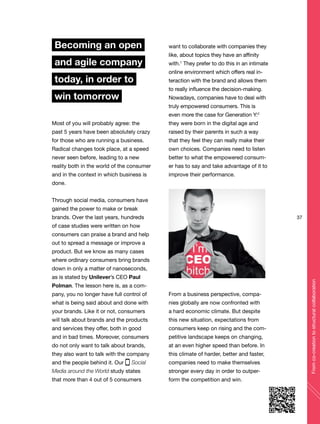
  • 95.
  • 96.
  • 97.
    97 Shapingyourbusinessthroughconsumers Unilever’s CMO KeithWeed gained wide- spread attention stating ‘We must get to the future first’. The underlying driver for this state- ment was his realization that consumers are closer to the future than the Unilever organiza- tion itself. He was not comparing Unilever with its direct competitors P&G, Henkel or Nestlé, but with consumers… Interesting, don’t you think? We think Keith is right. The conditions for a perfect storm are here. New digital technologies are opening up ex- citing possibilities to connect with consum- ers every day, there is increased pressure for brands and organizations to keep up with consumer trends and competition, and consumers are increasingly expecting and even claiming to have a say on the future of ‘their’ brands. Every day, more consumers are willing and even demanding to co-cre- ate and collaborate with brands. That’s why we feel it is of paramount impor- tance to close the gap between organiza- tions and their consumers, driving trans- parency and connecting both worlds with each other. We believe there is an inherent consulting potential within each consumer that can help organizations drive new and unique added value they may not get to otherwise. Ultimately, the organization of the future reserves a seat on its board for the Chief Consumer Officer, acting as the voice of the consumer on the highest possible hierarchical level. It also implies consumer insights teams need to reinvent themselves. Market research typically is a sort of hatch between consumer and marketer: the researcher listens to the consumer and translates this into what a marketer needs. All too often there is an iron curtain between marketing and consumers. This model is clearly part of the past. The researcher of the future will need to behave more like a coach of both consumer and marketer and facilitate the interaction between them. Researchers and marketers will need to learn to delegate some of their current responsibilities to con- sumers, not only because the latter expect that more and more, but mainly because they are simply better suited to execute certain tasks than researchers are. We had the unique opportunity to talk to different senior decision makers and learn from them how they involve consumers in impacting their organizations. Everyone we spoke with touched at least one of the 4 areas in which we feel consumers can make a significant difference for companies. Jörgen Andersson Erwin Segers Tijn van Elderen Mariken Kimmels Gaby Vreeken Frank Abenante
  • 98.
    98 1. Getting close Gettingunder the skin of users and fans, really understanding what makes them tick and allowing the corporate teams to think, feel and act like them. Jörgen Andersson, SVP Director Brand & New Business at Esprit and Mariken Kimmels, Marketing Director Continental Europe at H.J. Heinz Company, share their thoughts on the strategic importance of staying connect- ed and of ‘hard listening’ to consumers. Brands for the people by the people By Jörgen Andersson SVP Director Brand & New Business, Esprit Going back to when it all started, in 1968, Esprit was a brand for the peo- ple by the people. The democratic movement from that time is very much reflected in the Esprit brand and we think this is even more relevant today. Today’s consumers want to be involved in the future of companies and brands, engag- ing themselves to create that future, but at the same time also coming together as a group, making themselves heard and protesting against what they do not like or consider to be less acceptable. You could even say that, as a result of the unlimited openness and transparency in today’s economy, the consumer is the brand and the brand is the consumer. Everything tends to flow together. But reality is lagging behind: the major- ity of consumers feels left out yet wants to make a difference. Simply pushing your business model to consumers is quite comparable to the arrogance many political leaders in the Middle East are revealing. You will be forced out of power if you are a politician. Consumers will stop buying if you are a company. Relevance is the magic word today. The minute we start taking our partner for granted, the minute we stop listening to them or stop respecting them, will be the beginning of the end. If you stop lis- tening, you stop caring. Becoming and staying relevant requires a continuous and hardcore listening to and collabo- rating with consumers. That is why the true CEO of any company should be the consumer. We need to tap into consum- ers’ collaborative instincts and engage them in our daily thinking and acting: do they like what we are doing; do they think we should do things differently; what ideas do they have for our brand? If you really start listening to consum- ers, all the answers are out there. Gather all the answers, take them back to the company, start creating with those as a foundation and give back faster and better than anyone else. All of this requires brands to open up and go beyond just having a great prod- uct or service. Brands need to have a personality which allows them to escape the commodity magnet. Consumers outpace most brands, copying what brands are doing and creating their own new reality from it. Money nor power,
  • 99.
    99 Shapingyourbusinessthroughconsumers nothing stands intheir way. If you are talented and creative, you can make it happen. From a pure product perspec- tive, everyone has more or less the same and there is no kind of secrecy in the consumer segment anymore. Why make a distinction between what you tell em- ployees versus consumers? Our internal Esprit magazine shared with employees contains more than 80% content that is relevant for consumers as well. Just by opening that up, we can create a whole new range of possibilities. Finally, the challenge is to never let your dialogue with the consumer fade out. Be prepared to change all the time: the minute you stand still and lean back, someone will be coming after you. Relating it back to personal relation- ships, most divorces happen when peo- ple start taking each other for granted.7 Making the individual the hero instead of the brand by Mariken Kimmels Marketing Director Continental Europe, H.J. Heinz Company Too many marketers do not realize that the gap between brands and consum- ers is increasing. We are still focusing too much on making the brand the hero in everything we do. We love talking about our brand and telling consumers what we think is interesting for them and as a result we forget to really listen to them and to be relevant in their lives. In this rapidly chang- ing world fundamentally affecting attitudes and values of our consumers we need to transform our thinking from the brand as the hero to making the individual the hero in everything we do. We have been focusing too much on attracting consum- ers to our brand world, while we should make our brand present and relevant in their world, in their daily lives. The only way to do so is by making consumers an integrated part of everything we do. That means we need to stop talking about ourselves and start listening. In order to do so we need to connect with consumers 24/7, not just when we need an insight for a new concept or when we want to tell them something we think they will like about our brand. Truly understanding and being relevant in their world means: being with them and listening to them all the time and using that as the basis for all the deci- Esprit is an international fashion brand that has been bringing style and quality to life since 1968. Founded in San Francisco by Susie and Doug Tompkins, Esprit has a creative and responsible DNA fused with a sunny Californian attitude. The Esprit label comprises apparel, footwear, accessories, jewelry and housewares. Esprit is present in over 40 countries with more than 1,000 directly managed stores and over 10,000 wholesale retailers who share the company’s quality standards and brand essence.
  • 100.
    100 sions you haveto take as a marketer. As brand owners we all know we need to put the consumers at the heart of our deci- sions and we claim we are doing that… but are we really? That would mean we have to let go of the control we want to have over our brands and products. Making the individual the hero means that we put them in the driver’s seat of our brands… and that is a frightening thought for a marketer, because where does that leave us and our control over the brand? Actually it leaves us in a very powerful place, as with all the new technologies available to us we have all the tools to make our brands relevant in the daily life of people. We are the linking pin between the best consultants you can have, the consumers, and our brands. It is our job to truly connect and bond our brands with everyday consumers in a way that is relevant to them; as a result you will start closing the gap… 2. Uncovering insights Getting to new and relevant consumer insights that allow brands to drive con- sumer relevance and generate paths for renewed growth. Erwin Segers, CMO at Cloetta and Gaby Vreeken, Global SVP Marketing at Unilever Food Solutions, stress the importance of being relevant in today’s marketing environment, re- quiring strong consumer-driven insights as pathways for sustainable long-term growth. Putting the C back in FMCG by Erwin Segers CMO, Cloetta Social media is not a goal in itself, but is offering us the opportunity to get closer to the consumer and to improve our in- novation initiatives and our communica- tion with our consumers. It is an oppor- tunity to put the consumer really at the center of our business. In a world where traditional media is becoming less ef- fective and where trade partners are gaining more power in the relationship with the consumer/shopper, it is crucial for a brand to keep a strong relationship with the consumer in order to maintain and build brand loyalty. When I took on the role of CMO at Cloetta, I decided to use social media to increase consumer centricity. Social media allows us to interact at each step of the purchase funnel and transform funnel thinking into The H.J. Heinz Company, headquartered in Pittsburgh, Pennsylvania, is the most global of all USA-based food companies. Famous for its iconic brands on six continents, H.J. Heinz provides delicious, nutritious and convenient foods for families in 200 countries around the world. In more than 50 of those countries, H.J. Heinz Company enjoys the number-one or number-two market position. Throughout the world, Heinz is synonym with ketchup. It sells 650 million bottles of Heinz ketchup and approximately two single-serve packets of ketchup for every man, woman and child on the planet every year. Next to ketchup, H.J. Heinz also markets an ever-expanding selection of other great tasting foods including sauces, meals, snacks, and infant/nutrition. H.J. Heinz employs 32,000 people around the globe.
  • 101.
    101 Shapingyourbusinessthroughconsumers circular thinking. Wedrafted, designed and implemented a holistic social media strategy delivering value in terms of insight detection, product ideation, cus- tomer care handling, brand activation and brand conversations. Installing our Consumer Consulting Board was a first essential step in our social media journey. Searching for insights that can provide the basis for product ideation was the ambition. In my experience, marketers do not spend enough time and energy in really defin- ing insights. What is the problem you would like to solve? A wrong statement concerning a consumer problem or dilemma is often the start of an expen- sive journey towards market failure. Spending time and energy in generat- ing and validating insights is essential to increase the success of innovation and thus decrease the total product development costs. We were happily surprised to see that brand fans are very open to share their habits and dilem- mas, making it a very productive journey for us. Especially the fact that you are able to connect with your target audi- ence in their own habitat during a longer period is delivering very inspiring and in-depth consumer data. Next to insight generation, we wanted to tackle the declining ROI of traditional media through social media. As a com- pany grouping multiple brands, we need to be very selective in what we spend our brand communication money on and the contribution it has in reaching our marketing objectives. The huge shift in the way consumers communicate and the role of social media as an accelera- tor are creating big opportunities. We changed the way we communicate on social media by moving from disrup- tive communication towards interactive connection, by translating consumer in- sights into engagement insights and by shifting from heavy-weight campaigns towards a light-weighted but continu- ous publishing calendar. Using Social Media pilots (Social Media Speedboats), we created spin-off effects for other brands in the commercial organizations. Being successful really requires setting up dialogues with our consumers in a continuous way around topics that are of genuine interest to them. We need to bring the C back in FMCG. And the best way to do that is by directly involving consumers in what we are trying to achieve as brands. It is not a threat, but the largest opportunity ever, if you do it right. Cloetta, founded in 1862, is a leading confectionery company in the Nordics, the Netherlands and Italy. Cloetta is manufactur- ing and marketing sugar confectionery, choco- late products, pastilles and chewing gum. In total, Cloetta products are sold in more than 50 markets worldwide. Cloetta owns some of the strongest brands on the market, e.g. Läkerol, Cloetta, Jenkki, Kexchoklad, Malaco, Sportlife, Saila, Red Band and Sperlari, all with a long heritage tradition.
  • 102.
    102 Relevance as the pathwayto reach by Gaby Vreeken Global SVP Marketing, Unilever Food Solutions At Unilever Food Solutions, our vi- sion is to support chefs and caterers in satisfying their guests with inspiring, healthy, nutritious food which keeps them coming back for more. In order to deliver against the promise we make of bringing Inspiration every day, it is absolutely essential to understand the daily context our clients are operating in and to drive relevance from that. It means that what we do is not only for chefs, but also by chefs. We work closely with chefs and caterers in 74 countries, in order to find the critical balance between impressing guests, to keep up with people’s changing tastes, to make a profit and to address important food issues that have been identified by consumers. Being part of Unilever, we are in a unique position to understand guests and leverage new insights on guests to make a difference for chefs and caterers: our clients. One example of insight sharing is the release of our global authority report on the food service industry. The What’s in Your Food? report identified the first key industry issue to be addressed by chefs, caterers and the food service industry as a whole: an urgent need for global transparency when it comes to information about food. A key find- ing in the report shows that 9 out of 10 consumers are demanding more infor- mation about food when eating out of home, highlighting the growing need for the food service industry to provide increased transparency for consum- ers about what is in their food, about where the food comes from and about the safety of the food. Additionally, the majority of people aspire to live healthier lifestyles; however, despite global consensus on the importance of eating healthily, poor levels of information were cited as a significant barrier to leading a healthier lifestyle. As a follow-up to the report, we also launched a concrete service, Unilever Food Solutions is the food service division of Unilever. Our ingredients are some of the staples of professional kitchens in 74 countries around the world: Knorr, Hellman’s, Lipton and more. We provide products that save precious prep time in the kitchen, without compromising on flavor or flair.We’ve been in food since the 1880s. We’re chefs ourselves. So we understand that critical balance between impressing your guests and making a profit. And how to keep your menus and recipes fresh and exciting, as times and tastes change. Unilever Food Solutions is committed to sustainable growth whilst making a positive impact on the food service industry. That means creating healthy, nutritious ingredients using sustainably-sourced packaging that generates less waste. It also means providing services that help chefs and operators run a more sustainable kitchen with healthier menu options for diners.
  • 103.
    103 Shapingyourbusinessthroughconsumers Seductive Nutrition. Throughthis ser- vice we help our customers to make small changes to their top dishes - making these healthier but still really appealing to consumers. This is an exciting time for Unilever Food Solutions. We need to keep on collaborating with both food service partners and consumers to provide solutions to real problems, leading the way in actively giving guests what they are demanding. 3. Ideating & crafting Generating new ideas, co-creating new concepts and refining existing product propositions, thus enabling to better respond to consumer needs. Tijn van Elderen, CEO at Brabantia, talks about creating real value with real people, not just from within his own organization, but also from outside, co-creating new products with shoppers and consumers. Creating real value with real people by Tijn van Elderen CEO, Brabantia Marketing has always been good at us- ing TLAs: B2B, B2C, DMU, SKU, WOM, USP and so on. TLA stands for three let- ter abbreviations. Every time a new guru or organization comes up with a new term, the whole marketing community runs after the latest TLA. The latest additions to this field are four letter abbreviations: ZMOT and UMOT. ZMOT of course stands for the Zero Moment of Truth. Whereas in the old days (5 years ago!) shoppers used to trust the corporation selling a product, service or idea, today they only trust people like themselves: other shoppers/ buyers who have left information, opin- ions, references and testimonials about a certain product on the Internet. When shoppers start their (online) search, this is called the ZMOT. The UMOT (Ultimate Moment of Truth) is when the object of their desire has been liked, re-tweeted, filmed etc. as support for the ZMOT. How does this all affect Brabantia? Shoppers often know more about our products than the salesperson in the Brabantia has a range of some 1,000 house- ware products in five core categories: waste storage, food storage, food preparation, laun- dry care and hardware, which includes post boxes and bathroom accessories. Since 1919, the company has grown and it now has four production units employing 1,000 employees across 85 countries. In 1919 it was about designing and manufacturing metal products for use around the home - items such as milk sieves, funnels, buckets and watering cans. Today the focus is still on beauty and durabil- ity and, through continued and reliable use, also on the understanding that even humble household products can be a pleasure to use and to look at.
  • 104.
    104 store, so confidenceand reliance on salespeople has decreased. They don’t trust our ads. We need other ways to communicate the value of our offering. What it basically boils down to, is that we need to create and communicate real value. Has that not been the princi- ple of doing business successfully since the beginning of times? So maybe noth- ing has changed at all?! Or has it? Over the last 94 years, we have seen the up-rise of new media such as maga- zines, radio, TV and outdoor. The big advantage now is that you can create value together with your shoppers and get instant feedback. At Brabantia, we do this through programs such as creat- ing designs together with our shoppers. We call this activity Design your bin. We took the best designs and simply started production. We did the same for our ironing board covers. And we aim to do this more in the future. I don’t know of a TLA that covers this. I would sug- gest a five letter abbreviation: RV-W-RP or Real Value With Real People. 4. Activating Activating consumers to live and report on their experiences, to connect and share brand content with their peer groups and to act as brand ambas- sadors. Frank Abenante, Global VP Brands & Innovation at AB InBev, shares different cases, demonstrating that the communication success does not just depend on strong insights and great creativity, but also to a huge ex- tent on the way consumers are involved and help spread the word. Integrating consumers in brand building and storytelling Frank Abenante Global VP Brands, AB InBev The evolution of the media landscape and the surge in the social media arena have triggered in Anheuser-Busch InBev both a genuine interest and an urgent necessity to revisit the role our brands play in people’s lives and the way these brands connect with people. We have fully embraced the concept of Brand Ideal or Brand Purpose, where every brand needs to enunciate the defining, relevant role it should play in people’s lives: the statement that constitutes the guiding compass for the positioning. In the case of Budweiser, that purpose is the championing of opportunity through celebration and optimism. One of the projects aiming at integrating consum- ers into the story was Budweiser Project 12. The idea was to develop a relevant line extension, together with our con- sumers, that would help generate trial with younger adults while giving our loy- al consumer a chance to try Budweiser again, as if for the first time. We briefed our 12 Budweiser Brew Masters from our 12 breweries in the US. They submit-
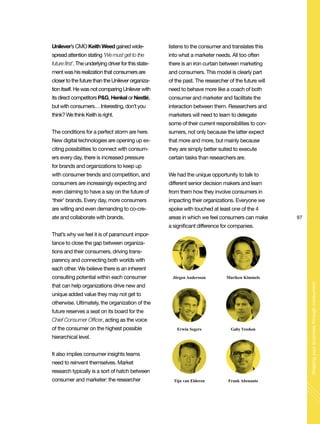
  • 105.
    105 Shapingyourbusinessthroughconsumers ted their bestbrew, and with the help of consumers in every region, we reduced the list to 6 variants which we subse- quently reduced to a final set of 3. Then we launched these 3 liquid variants in a mixed 6-pack, under the Budweiser Project 12 trademark, each variant named after their original brewing batch as well as the zip code from the brewery they came from. Consumers voted for their preferred brew during a 4-month period. We entered in a dialogue with consumers that eventually culminated in the selection of the brew from our Los Angeles Brewery, which then became Budweiser Black Crown, our most recent national launch under our Budweiser brand umbrella. Another example of consumers fully integrated in our storytelling was the Clydesdales campaign around the Superbowl 2013. For years, AB InBev AB InBev is the leading global brewer, one of the world’s top five consumer product com- panies and recognized as first in the beverage industry on FORTUNE Magazine’s ‘World’s MostAdmired’companies list. Beer, the original social network, has been bringing people togeth- er for thousands of years and its portfolio of well over 200 beer brands continues to forge strong connections with consumers. Geographically di- versified with a balanced exposure to developed and developing markets,Anheuser-Busch InBev leverages the collective strengths of its approxi- mately 118,000 employees based in 23 countries worldwide. In 2012,AB InBev realized 39.8 billion US dollar revenue. has used these noble animals as symbols of tradition, heritage, strength and resilience. They have always played, in one way or another, a key role during those highly expected Superbowl advertising moments. In 2013, we crafted a beautiful, highly emotional story about the reunion of a Clydesdale and his trainer, after some years of separation. Then we took advantage of the fact that 2 foals were born a few days before the Superbowl night, so we released the story prior to the national telecast, asking consum- ers to vote for their favorite name for the foals. Hundreds of thousands of responses led to the names of STAN and HOPE, which in turn energized our consumer base to search for Budweiser and Clydesdales on the web, which we subsequently linked to new Clydesdales stories they could relate to. And it worked! The 60-seconds Clydesdales ad was the most viewed spot on YouTube during the Superbowl, surpassing 15 million views; it achieved 3.5 million views before Superbowl night; it was the 3rd most shared Superbowl ad of all times, with over 2 million shares on Facebook; it was the number one Superbowl ad according to USAToday AdMeter; it generated the highest ever search interest over Budweiser in the web. Do not let consumers stand aside; in- volve them in creating and sharing your brand story. If you get it right, it will pay off big time.
  • 106.
    106 CASES On the followingpages we share a handful of case studies with you. They nicely illustrate what a Consumer Consulting Board can be used for and what impact consumers can have on decision making within, and on the success of companies.
  • 107.
  • 108.
    108 In order tofurther improve the experience of their travelers, the airline companies Air France and KLM connected with their frequent flyers on an emotional level, through a staged innova- tion approach. During this innovation project, Air France and KLM gained insights before developing and validating new concepts to optimize the transfer experience. MY TRANSFER INSIGHT ACTIVATION & IDEATION COMMUNITY
  • 109.
    109 Shapingyourbusinessthroughconsumers Frequent flyers and theirstories As major airlines are fighting a continu- ous battle for customers in this period of economic uncertainty, Air France and KLM felt the importance of increasing their focus on customer experience as a way to keep existing customers and attract new ones. Transfer flights in particular are perceived as complex and stressful and they evoke a lot of negative emotions. For most travelers, the ‘transfer between connecting flights’ is a phase in their journey they would be only too happy to skip. Transfer flights are chosen mainly because there is no other option available or when travelers need to make a trade-off between time and costs. This is why it is crucial for airports and airline companies to understand the needs, expectations and emotions of travelers during transfer. The My Transfer Idea Community In order to turn the current situation into an opportunity and to demystify the innovation process, InSites Consulting and Air France and KLM collaborated with frequent travelers during 6 weeks in a co-creation project. By connecting with 40 frequent flyers in a 3-week Consumer Insight Activation Community, the passengers shared over 400 observations in text and pictures. Their personal blogs allowed us to immerse in the world of transfer. Based on these insights, 10 insight platforms were defined, emphasizing their needs, emotions and expectations. The insight platforms from the blogging phase were used during the second stage of the My Transfer Idea community, where another group of 50 frequent travelers joined forces to generate over 450 ideas and comments to improve the transfer experience. In this 3-week Ideation and Concept Development Community the travelers were stimulated to discuss and build further on each other’s initial ideas. Based on the ideas and the community discussion we were able to craft 32 concepts for new transfer services. In a final phase, the four consumer-generated concepts that were showing the highest busi- ness relevance were tested in a quantitative idea screener among a representative sam- ple, capturing not only traditional innovation KPIs but also emotions both in an explicit and an implicit way. The transfer experience of the future Three of the final service concepts are currently being investigated by Air France and KLM: a mobile transfer application including real-time consumer notifications and communication about travel details, a new in-flight transfer video and a concept known as The Agent of the Future. Furthermore, the insights and the other 29 concepts have laid the blueprint for future service innovations in the transfer zone and many other new initiatives. Presented at the ESOMAR Qualitative Congress 2013 in Amsterdam (NL) and the MIE 2013 event in Den Haag (NL). The My Transfer Idea community
  • 110.
    110 The Heineken-sponsored globaldesign project, which went under the title of Open Design Explorations Edition 1: The Club, invited 19 emerging designers from around the world to co-create the club of the future. To immerse themselves in the nightlife journey, the design team connected in a Consumer Consulting Board with over 100 design-savvy clubbers. CLUBBERS INSPIRE THE CREATION OF A PROGRESSIVE HEINEKEN NIGHTCLUB
  • 111.
    111 Shapingyourbusinessthroughconsumers History meets future Thehistorical legacy behind Heineken’s design credentials is what led the brand to pursue its progressive roots and encourage emerging designers. In 2011, the aluminium bottle, which has since become rather fa- mous, won numerous design prizes - amongst which a Cannes Lion - and Heineken is now connecting with design that goes beyond just beer, by enhancing beer moments in a unique collaborative project. This way, they can strengthen their position as a premium brand in the world of clubbing and design. Heineken invited emerging designers from Milan, Sao Paulo, New York & Tokyo to submit their portfolio via Heineken’s Facebook page. Live presentation events in these four design cities resulted in the final selection of 19 designers from a broad range of backgrounds; product, graphic, fashion, interior and motion design, all joining forces in one and the same challenge: designing the club of the future. The Heineken Concept Club community To develop a relevant and impactful take on club design, it is crucial to understand the needs of clubbers, which is why The Heineken Concept Club community was set up, a 3-week Consumer Consulting Board with 120 design- savvy clubbers in the 20 hottest cities in the world. This inspirational adventure provided the design team with relevant and real consumer insights, acting as a briefing, a source of inspi- ration and a springboard for ideation. Through discussions, diaries, pictures and videos, these clubbers shared their experiences and the role of clubbing in their routines together with their expectations towards the ideal nightlife journey. The dialogue with this dynamic target group resulted in over 2,000 comments, providing a unique view on the essence of clubbing. To engage and inspire the designers with the research results, a customized reporting format was developed. The analysis of the discussions resulted in 28 insights, each linking a chal- lenge for the design team to the needs of their audience. Service-design thinking inspired the integration of these insights – spread over six touchpoints – in a customer journey map that visualized the experiences, needs, perceptions and motivations of the clubbers. By reporting the consumer journey map as an interactive infographic, the designers could browse through the night and discover the insights in the different phases of a night out, from pre-club drinks and meeting up, to entering the club, going for a drink, dancing, chilling and finally going home. The Heineken Concept Club The interactive customer journey map did not only serve as briefing and a source of inspira- tion; it was also crucial in the final selection of the concepts which became part of the actual club. By taking the journey of clubbers as a starting point, The Heineken Concept Club, showcased at the Milan Design Week 2012, successfully provided the design critics with a pleasant surprise. From the layout of the club - following the customer journey map - to the shelves where clubbers can leave their drink while dancing, the entire experience was designed to provoke a truly enjoyable and memorable night out. Through initiatives like this, Heineken is setting itself apart by pushing the boundaries of design and by emphasizing design as a key part of their brand DNA. Winner CCA Co-Creation Award 2011 and Best Presentation Award at the 8th International Conference on Design & Emotion 2012 Presented at the ESOMAR Congress 2012 in Atlanta (US) and the 8th International Conference on Design & Emotion 2012 in London (UK).
  • 112.
    112 In 2008, H.J.Heinz Netherlands - famous for its ketchup - was on the lookout for an online qualitative platform which would allow them to quickly tap into consumer feedback to guide day-to-day marketing decisions. Today, this platform has grown into the Food & Zo Community (Dutch), a Consumer Consulting Board with 150 consumers who inspire manag- ers from research, marketing, communication and R&D departments on tactical and strategic questions. The goal is to have a direct consumer line that activates managers in the short run and helps shape their consumer feeling to make bet- ter decisions faster in the long run. HOW HEINZ CONNECTED CONSUMERS TO THE COMPANY VIA THE FOOD COMMUNITY
  • 113.
    113 Shapingyourbusinessthroughconsumers In search ofa direct consumer line For many years H.J. Heinz Netherlands had been using qualitative and quantitative research methods to gain consumer insights. All of these studies are very useful, but the information is often fragmented and ab- stract, which made it difficult to improve the employees’ feeling with the consumer. H.J. Heinz set the goal to really inspire marketers of the different categories and create one platform where marketers and consumers could be in direct contact, making consum- ers more tangible and giving marketers a chance to experience consumer reality first hand. This resulted in the ongoing Food Community. The Food Community This Consumer Consulting Board is cen- tered on or around food, in order to make it relevant for the different brand teams. The members of the Food Community share a strong interest in food products and cooking. They are all responsible for the grocery shop- ping and the majority is female. To get the best out of the members, we used various tools & techniques to create engaging experiences in the community. For example, one of the key motivators for members is to have an impact on future offerings. Sharing feedback is fundamental to boost this feeling. However, we wanted to make this feedback more explicit. That is why we designed our very own Wall of Fame in a separate section of the community. This gallery displays all the products and campaigns that had already been inspired by the community and that our members collaborated on. For example, the recent H.J. Heinz Netherlands product activation campaign for the BBQ season. Members helped to fine-tune this campaign by making H.J. Heinz understand which promotions were most relevant. By showing the results on our Wall of Fame, the members grow pride in about what they had accom- plished together. From day-to-day decisions to inspiration for strategic projects The conversation funnel consists of different discussion streams. For instance, the com- munity collaborates with managers on 48h challenges which are quick ad hoc ques- tions from the executives. They can receive immediate feedback on their plans and ideas, without any set-up costs or a long start-up time. Another example: members are often asked for feedback on different versions of advertisements. These questions - which replace the old corridor tests that were often conducted among colleagues - invite consumers to think along instead. This filter helps managers to continue with the most relevant ideas and allocate resources efficiently. In addition to these short-term decisions, the community is also consulted in bigger strategic projects spread out across multiple weeks. For example, by describing their shopping and cooking routines to us, mem- bers help us translate new food trends such as creative cooking into relevant concepts and ideas. These discussions are followed by offline workshops with the project team which then translates the insights into actions and next steps. After the work- shop, follow-up questions and developed concepts are fed back into the community, enabling executives to collaborate in short iterative loops.
  • 114.
    114 The path towardsstructural collaboration Today, teams from multiple departments collabo- rate with the Food Community on a structural ba- sis. In 4 years’ time, the community has grown in terms of investment, intensity of usage and also the number of internal stakeholders involved. The Food Community is successful in the sense that asking consumer feedback has become part of the marketers’ day-to-day practice. More and more executives experience the value of the community. The community ambassador at H.J. Heinz, Joëlla Marsman (Market Research Analyst), plays an important role in growing the value of the community over time. Her mission is to ask the right questions and involve the right stakeholders at the right time. She is also a part-time moderator, making the community truly co-owned. Presented at the Merlien Insight Valley Europe Summit 2012 in Amsterdam (NL) The H.J. Heinz Food community
  • 115.
    Shapingyourbusinessthroughconsumers The yearly catalogueis IKEA’s main commu- nication channel with existing and potential cus- tomers globally. Through Customer Consulting Boards in five different countries, the 2013 edition of the IKEA Catalogue was evaluated around the world. HOW CONSUMERS EXPERIENCE THE IKEA CATALOGUE
  • 116.
    116 Evaluating the IKEA Catalogue Theinternational retailer IKEA has the vision to create a better everyday life for many peo- ple by offering a wide range of well-designed, functional home furnishing products at prices so low that as many people as possible will be able to afford them. Since 1951, the IKEA Catalogue has been a vital part of IKEA retailing and today, more than 200 million households around the world receive the IKEA Catalogue in their letterbox. For the 2013 edition, significant changes were made to the format (slightly bigger), content (offering more inspiration pages, in- cluding more storytelling and a different way of picturing the products) and structure of the Catalogue. Furthermore, a complementary mobile application was launched. Structural changes that were made that were making it even more important to properly understand people’s emotional and rational reactions to the new edition. In order to maximize the impact of this spear- head touch point, IKEA wanted to assess the perception, satisfaction and engage- ment level the 2013 IKEA Catalogue evokes. Moreover, they wanted to understand how the IKEA Catalogue can inspire and stimulate home furnishing interest. In a second phase, IKEA was aiming to optimize the creative execution of the 2014 catalogue by measur- ing and understanding the stomach impact of new cover ideas. Over the past years the feeling had grown within IKEA that the qualitative evaluation of their catalogue, done through offline focus groups in different countries around the world, could potentially be done in a different, fresher and better way. This resulted in a col- laboration with InSites Consulting, for a multi- country project, using Consumer Consulting Boards. The community was launched right before the 2013 catalogue was distributed, giving IKEA the opportunity to test the impact in a realistic in-home environment and lead- ing to a much richer understanding The @home Community During a 3-week period, 5 online closed platforms were set up bringing together par- ticipants from five different countries around the world (the US, China, Germany, Italy and Poland). During the first week of the com- munity the goal was to meet the reader and understand the actual and aspirational be- havior of the participants. Who is the reader and what are his/her expectations towards the brand and the catalogue? To get there we conducted - amongst others - a mood board exercise in which we asked the members to map their feelings about the IKEA brand and creative tasks on the forum of the platform (e.g. tell us your IKEA Catalogue story). After the catalogue had been dropped off at the houses of the participants (in preview, 2 weeks before the real global launch), we as- sessed the perception, satisfaction and level of engagement the 2013 catalogue evokes. First impressions and second thoughts on particular aspects of the catalogue were researched (structure, pictures, stories, the mobile application...) by integrating differ- ent research techniques (e.g. collage tool, ethnographic research techniques and polls). It was important to understand how the cata- logue offers both inspiration and information to the reader and whether that was done to the right extent. Moreover, we wanted to get a grip on the catalogue’s lifecycle. To capture the latter, participants had to fill in a diary, giving the insights department the unique benefit of understanding the usage of the IKEA Catalogue to the fullest (e.g. who is using the catalogue, when is it used, where is it used). By re-activating the @home community
  • 117.
    117 Shapingyourbusinessthroughconsumers in a laterphase, we were able to understand the second life of the IKEA Catalogue. In the final week, we investigated whether the catalogue was meeting the expectations. This gave us some first clues on the impact the new catalogue had on the brand percep- tion and shopper behavior. In other words, what impact did it have on the business: was it bringing people to the shops, raising interest and was there a positive impact on the perception of the brand among especially lapsed customers? Additionally, the @home community was reactivated (2 months later) to assess dif- ferent creative executions of the next IKEA Catalogue cover. Via implicit measurement, we were able to tap into the minds of the par- ticipants and to understand their spontaneous associations and emotions around the new cover page. By discussing the insights and results of this test, we managed to understand the stomach impact to the fullest. To maximize Presented at the ESOMAR 3D Congress 2013 in Boston (US). insights from this research phase, a global @home community was opened, in which community members (the ambassadors) of the different countries helped to better under- stand inter-country differences. The IKEA Catalogue in a new jacket Based on this research program, IKEA got a better understanding of how the IKEA Catalogue is used. The research results led to significant changes to the app. And we now know that the new concept of the catalogue was a big step into a new and correct direction; im- provements will be made to the 2014 version, based on the research results. The IKEA @home comunity
  • 118.
    118 To ensure thatthe Vodafone new mobile Internet services continually meet and surpass consumer expectations, a global user trial program has been established. By setting up dedicated Consumer Consulting Boards for the different services in key markets, user experi- ences are captured near the moment of truth. The program supports the developments of the apps and the go-to-market strategy. DEVELOPING GO-TO-MARKET STRATEGIES FOR VODAFONE INTERNET SERVICES
  • 119.
    119 Shapingyourbusinessthroughconsumers Engaging first-time smartphone users Inorder to grow their market share and average revenue per user (ARPU), Vodafone needed to engage with first-time smartphone users. The business objective for Vodafone in fiscal year 2012 was to launch 10 new Commercial Services and gain buy-in for up to 21 local markets. To meet and surpass the expectations of their customers, user par- ticipation in the lean development of these services was crucial. Traditional ways of testing digital services - such as user diaries, applied in User Experience Development - did not provide the instantaneous feedback nor the quantitative heft to convince internal stakeholders. In addition, Vodafone was look- ing for an integrated approach to be rolled out in multiple countries, providing a holistic view and incorporating three core areas: Technical performance: How does the service work in comparison to user expectations? Feedback on consist- ency and reliability guide further product development and refinement. User experience: What is the emotional resonance of the service? Does it look and feel right? Is it easy to understand? Relevance: What are the needs the ser- vice is anticipating? How to take on the positioning and messaging? Vodafone global user trial program The program had to support the development of the new mobile applications and define the messaging for the different markets. As some of these services were already available in the market whereas many others were in early de- velopment stage, we needed an approach that could gather actionable insights to fine-tune and understand the usage of existing apps, but also more fundamental technical feedback and user experience for the earlier versions of new apps. To allow Vodafone customers to take on the role of consultant in the launch of these services, the selection of the participant group was crucial. To get the richest informa- tion from the discussions, we did not only invite the target group of first-time smartphone users who could collaborate on the applica- tions based on their own expectations. We also involved a group of more experienced smartphone users who are highly involved and can push the expectations. A dedicated sub-community of 75 participants was set up for every service to be tested, in different 3-week waves and involving multiple key markets (Portugal, Spain, Italy, Germany, the Netherlands and the UK) in their native language. By enlarging the user base wave after wave, the communities were evolving to- wards a more structural Consumer Consulting Board. This hybrid approach, combining blogs and discussions with live chat conversations (for detailed Q&A sessions with the developer team) and short surveys (to get a pre- and post-impression on satisfaction and recom- mendation) allowed for swift reactivations of the communities whenever necessary. Follow the customer journey Together with Vodafone we developed a framework for their innovation process in which the Consumer Consulting Board is vital for testing future services. By mapping the entire customer journey and highlighting triggers and barriers. Vodafone customers take on a central role in the development of new digital services. So far, the screening and prioritization analysis led to the launch of Guardian, Protect, Cloud, Contacts, Discover and joyn. The research also supported the go-to-market strategy including volume uptake forecasts in each country. Presented at the 2013 Merlien Qualitative 360 event in Berlin (DE).
  • 120.
  • 121.
    Organizations should reservea seat on their board for the Chief Consumer Officer, representing consumers on the highest hierarchical level @kristofdewulf We need to make consumers an integral part of everything we do: we need to stop talking and start listening. @MK0903 Insights generated through research communities have proven to be 82% more effective in the market @annaliezze In a compilation of 1,193 commer- cially successful innovations by Eric von Hippel (MIT), 60% came from consumers @thomastroch The power of everyday people is driving monumental change @PGCMO 121 Shapingyourbusinessthroughconsumers
  • 123.
  • 124.
    124 From Global to UniversalBrands by Tom De Ruyck & Anneleen Boullart
  • 125.
    125 Makingglobalbrandslocallyrelevant Say Hello toa brave new world We are witnessing a true gravitational shift in how our global society is organ- ized and lives. One may even speak of a true tipping point when looking at the following striking facts and figures: By 2020 the collective GDP of the emerging markets will overtake that of the developed economies for the very first time. Already today multinational companies like P&G and Unilever are generating more than half of their revenues from these new economies.1 Unilever wants to double its turnover in the next 5 years, and the majority of that growth needs to come from emerg- ing markets. For the first time in the history of mankind more than half of the world’s population is living in cities.2 Urbanization seems to be one of the main recipes behind the success of the booming markets. Finally, the world’s population has never been younger: more than a third is younger than 30 years old, in some emerging markets this is even half of the population.3 An emerg- ing young urban middle class is the engine behind the world’s fastest growing economies. These are numbers that speak. The Asian countries are writing a big part of this new story. According to Bloomberg, 5 of the top 10 emerging economies lie in Asia.4 China, Indonesia and India are leading the pack. Other growth regions are Latin America (with Brazil as the new giant) and Central & Eastern Europe (with growing markets Russia, Poland and Turkey). South-Africa is an example for the whole Southern part of Africa, where the term used for the new emerg- ing middle class - Black Diamonds - is illustrative for the potential that is break- ing through. It is the rising middle class in all of these regions that is the foundation for signifi- cant business potential. The OECD (part of the United Nations) expects that the middle classes in China and India alone will grow from 6% of the total global middle class today to 41% by 2030.5 No need to say that, given the saturation of economic growth in Western-Europe and North-America, future growth for companies is to grasp in these new economies. In the old markets nonethe- less the battle to protect what has been built over the years has started as well. Global brands seem to be in pole posi- tion to get to this future first. In a world populated by young urban citizens who are increasingly connected with the world-wide-web, global brands are the ones who can probably leverage the most on their global appeal and potential scale of their strong brands. A perfect illustration of the fact that we live in a globalized and connected world is the influence online video site YouTube
  • 126.
    126 had on musicpreferences of people around the globe. Two major things hap- pened since YouTube gained popularity as a music streaming channel. On the one hand a globalization of the hit lists. All of a sudden, a South-Korean guy scores a global monster hit out of nowhere. On the other hand the long tail of music taste is killed to some extent. We could state that YouTube has created a more global and uniform music taste. The question is: are big global brands as powerful as YouTube is for our taste in music? With the majority of the world’s online population being connected with brands in one way or an- other,6 it seems as if strong (global) brands have everything in place to create global tribes of fans. But is this the whole story or just one side of the same coin? Making global brands locally relevant It is probably too easy to say that global brands with their global appeal and scale have an easy job in conquering the world. Worldwide we notice a not to neglect anti-trend of globalization: going hyperlocal. Noma in Copenhagen, the best restaurant in the world, is an example of this anti-trend. At Noma, only local or home-grown products are used. The chef prefers to work with ingredients authentically produced by craftsmen and with a certain level of pride for the local heritage. Signs like this indicate that although we live in a globalized world, it is still important to be rooted locally. The same goes for brands: they need to be locally relevant and if needed adapt their product offering and the way brand and product activation are executed to the local reality. If they do not do this, they will fail. An interesting example of a global brand which experienced this is McDonald’s in India.7 McDonald’s only became successful in that huge market after making two adaptations to their product portfolio: offering a vegetarian option and making the food slightly spic- ier. But it was not enough to only adapt the product. They also discovered that Indians want to see how the food is pre- pared: separate open kitchens are now used to prepare vegetables and meat products. The real local breakthrough came when McDonald’s lowered the entry price point by introducing special menus and when they started positioning themselves as the family restaurant to have joyful moments together. This case Restaurant Noma in Copenhagen
  • 127.
    127 Makingglobalbrandslocallyrelevant shows that itis not about slightly tweak- ing your brand and products; it is about rethinking and localizing all aspects of the marketing mix. Different markets have different cultural codes, preferences in taste and retail systems that all need to be taken into account. All of them will have a major influence on defining the product portfolio and on creating successful strategies for local brand and product activation. Global or local, or combining both? In interviews we conducted with 21 senior executives from international/global brands (amongst others: Heineken, Durex, Esprit, Eastpak, H.J. Heinz, eBay, BBC, MasterCard and PepsiCo), all of them were touching upon this para- dox. On the one hand, brands need to go global and grasp the new opportunities that are out there. In order to achieve this one needs global appeal and global scale. On the other hand, you will never be successful if you do not succeed in becoming locally relevant and if you do not start building local best practices. Local competition is strong, fast & different In almost every industry and product category local alternatives for global brands are created. And it goes even further. Local companies are creating products for a whole region. Lenovo is a Chinese producer of smartphones who is now conquering the huge markets in India and Indonesia with their low-cost smartphones strategy. And the new eco- nomic giants have the ambition to export unique high-quality goods to Western markets as well. Already today, Brazilian fashion designers proudly celebrate the heritage of their nation on the catwalks of the fashion capitals of the world. Local competition is hard, but also differ- ent. For some aspects, the emerging markets take a different route than their developed counterparts: they are leapfrogging. Regarding Internet tech- nology for example, the PC phase was skipped and they jumped immediately onto the mobile web. That is only one of the reasons why one needs to take an eye on a country like Brazil when it comes to expertise in successfully advertising on social networks and knowledge in the space of mobile marketing. Another way in which best practices are transferred between countries is the practice of reverse innovation. Strategies applied in or products created for emerging econo-
  • 128.
    128 mies come backto the developed world. In Southern Europe - a region suffering from the global economic crisis - some laundry brands use strategies they applied with success in emerging markets like India to make their high-quality brand affordable for the lower middle class: smaller packs with powder or liquid for one week of laundry. Finally, the way in which and speed by which most companies in these markets are innovating is different as well: innovation through commercializa- tion is the norm. Asian companies do not spend months or even years on testing and fine-tuning new products in labs based on big piles of research. A good enough product is immediately thrown onto the market and based on the feedback from the first consumers the product is fine-tuned in a process of mostly 4 iterative loops. It is clear that companies need to merge global with local and adapt to the local business reality. Be brave in this new world and grasp the new op- portunities, as there is a lot to gain… and to learn. Creating a Universal Brand To indicate the importance of merging global with local on different levels, it is better to speak of a universal brand than of a global brand. After all, global appeal is about being able to build your brand globally based on a universal insight. An insight that evokes the same Aha, it’s me feeling among people from different cultures around the globe. A strong insight is equal to a sort of Aha experience: a combination of surprise and something familiar. It entails a view on something which was implicit all that time. The second basic aspect of a strong consumer insight is relevance. A strong insight auto- matically calls for familiarity (It’s me), sometimes even to the extent that you may even learn things about yourself that you were not aware of before. Next to that, a brand(ed) universe needs to be created around that (cluster of) insight(s). The brand’s universe needs to be wide enough to allow for localiza- tions on the brand, product & activa- tion level. Thirdly, the leadership behind the brand needs to understand how to make the local teams enthusiastic about the global strategy. The global brand leadership team also needs to stimulate the sharing of best prac- tices between countries with likewise challenges. Lastly, local brand team members who have gained specific knowledge about a particular domain
  • 129.
    129 Makingglobalbrandslocallyrelevant (because of thespecific situation in their market) need to be put in the global driver seat to lead that specific capability. A brand which does this well is Johnnie Walker. Their tagline Keep on walking is based on a universal insight that fits well with their product and the category they are in: being ambitious in life and never giving up.8 They created a brand universe that stays true to this start- ing point, but that is strong enough to be adapted locally. In Brazil for exam- ple the tagline was tweaked to: Keep on walking, Brazil. Smart move, as it is touching upon the rise of Brazil as a new super power, combined with the strong we-feeling and the national pride which is typical for Brazilians. Brazil is a huge and very diverse country, also in terms of attitudes and ambition levels of the population. Therefore, it is great to observe that Johnnie Walker used dif- ferent activation campaigns in the major cities of São Paulo and Rio de Janeiro. The people in the first city are more focused on personal and professional ambition, while the citizens of the latter are generally more family-oriented. The activation campaigns were taking these differences between both cities into ac- count. Another important element in the campaign’s success was the use of so- cial media and mobile marketing. Brazil is one of the leading countries in both domains, given the high level of adoption of mobile Internet in the country. This was leading to best practices that were useful for local teams in other countries as well. The ‘Keep walking, Brazil’campaign
  • 130.
    130 Companies behind universalbrands need to be open and agile. First of all, having an active dialogue with consum- ers around the world is crucial to under- stand different cultures, to follow their evolutions and to grasp the new reality. And in order to get to the future first, ag- ile and diverse brand teams are a must these days. Ideally, a team is a mix of global strategists and local brand build- ers who constantly collaborate. They react quickly to new developments and base their plan of attack on the global strategy in combination with strong local insights and regional best practices. Getting under the skin of a different culture It remains important to have a global helicopter view, but gaining local knowledge and relevance will ultimately determine whether you will really be successful in local markets. This is beautifully summarized in a quote by Nelson Mandela. How do you get under the skin of the population of a country with its cultural codes and preferences? By taking the time to observe and interact with a diverse group of local people: Observe consumers and start the dialogue: if you really want to get to know a target group and its culture, facts and figures are not enough to get a holistic view. It is important to observe local consumers and to have a ‘If you speak A language a man understands, you speak to his MIND. If you speak HIS language, you speak to his HEART’ Nelson Mandela
  • 131.
    131 Makingglobalbrandslocallyrelevant dialogue with them.Only by being con- nected, one can develop a thorough understanding of what is going on. Be connected with a diverse group of people: it is vital to be connected with a diverse group of participants who reflect the diversity of the target group or country one is dealing with. Emerging economies are character- ized by a wide variety of social classes, life styles and even cultural differ- ences within the country. The latter is definitely the case in large countries like China, Russia and Brazil. Take your time: it takes time to under- stand new target groups, cultures and realities. By taking time with a larger group of participants whom you get to know from different angles, you will truly get under their skin. Be agile: today’s business reality asks for fast action and reaction. Especially in the new Asian economies launching new products and adapting exist- ing ones goes at the speed of light. Therefore, it is important to work with a research method that allows you to take better decisions faster. If we bring all these needs together, we end up with a Consumer Consulting Board: a larger group of people brought together on an online closed community platform, to structurally collaborate with each other over a longer period of time. A group of key consumers who help you shape your business.
  • 132.
    132 Walking our own talk Inthe second chapter of this book, we outlined our approach for establishing, managing and analyzing the output of research communities. The fundamen- tals of this approach work on a global scale. But, just like the brands we are working for, we need to localize our way of working from country to country. Research-on-research taught us that adapting elements of the following di- mensions is crucial in order to establish a healthy Consumer Consulting Board: Language: out of meta-research on our communities we know that members participate best if they can write in their own language. Taking part in an English-speaking commu- nity for a non-native speaker can be hard. It has a rather negative influ- ence on the intensity of participation and the level of detail and nuance when one is writing. That is why our default option is to conduct com- munities in the native language of the participant. For a global project to evaluate the IKEA Catalogue for example, we conducted local com- munities in the US, China, Germany, Italy and Poland. That being said, there can be good reasons to opt for a multi-national English-speaking community: non-native executives of the company who want to follow the discussion, limited budgets or the fact that one is in search for global consensus on a given subject rather than an understand- ing of local differences. An example of the latter is our global Shape-It Consumer Consulting Board for ketchup giant H.J. Heinz. The goal of this project was to come to a new and uniform design for the shape of the next-generation ketchup bot- tle. Participants from more than 10 countries took part in the same com- munity to reach global consensus. Moderator: the Cultural Iceberg model of the American anthropolo- gist Edward Hall suggests that lan- guage is only a small part of culture.9 In order to grasp the local context and situation fully, our preference is to work with a moderator who does not only speak the language, but also understands all the other cul- tural aspects of a country (common values, beliefs, traditions, attitudes and perceptions), next to the local market situation and the business context. In order to fully understand to what extent localization of our methodol- ogy is needed, we conducted several studies with moderators from our Global Community Moderator Network (active in 30 different countries) and with local research participants. This way we co- created best practices for the different markets we are operating in. We found that it is important to adapt your com- munity to the local culture on 5 aspects.
  • 133.
    133 Makingglobalbrandslocallyrelevant The directions inwhich the adapta- tions are made can be explained by the work of the Dutch academic researcher Geert Hofstede and his 5 dimensions to explain cultural differences between countries.10 For each of the 30 countries we do research in, we have developed a full overview of best practices for every single aspect of community manage- ment. Below we explain the different dimensions in more detail and illustrate them with some striking examples. 1. Reason to participate: from the first invitation e-mail to join the community and onwards, it needs to be clear what is in it for the par- ticipants. In almost all countries, the main reason to participate is the possibility to have an influ- ence on the future of a brand or a product. Next to this, we noticed that some countries are more extrinsically motivated than others. This is es- pecially the case in the USA and Eastern European countries, but for different reasons. Americans consider it to be normal that there is a payment in return for perfor- mance. In most Eastern European countries on the other hand a (monetary) incentive is perceived as a nice extra on top of their monthly income. Furthermore, in Eastern Europe, it is a must to gain the trust of the members. Trust in the fact that the agency or com- pany behind the community will not harm them in any way. And trust in the fact that they will really get their incentive. The preferred type of incentive differs from country to country. It is an illusion to think that PayPal fits all. In Asian countries such as India and China, intrinsic motivation is important: they like to be con- nected with aspirational brands and share their wisdom. In Latin- American countries like Brazil, the social aspect has a higher impor- tance in the overall mix of reasons to become a Board member. 2. Technology: mobile technology is developing rapidly and adop- tion of mobile Internet is increasing worldwide. It is a valuable medium to get access to another type of data: more personal and contextual information. But given the situa- tion in some markets, where most consumers only have access to the web through their mobile phones,
  • 134.
    134 we need tochange our preferred medium to reach out to them. As mobile-only users are the new real- ity, it is a necessity to adapt our way of asking questions or giving tasks. In the scenario of mobile-only communities, one needs to work more task-based and ask more questions that can be answered in a short and convenient way. Wisely rethinking the mix of research tools and adapting them to the small screen is a final must do. 3. Conversation guide: a different culture also means different attitudes and values, leading to a different way of reacting to certain questions, tasks and exercises moderators want participants to perform. Some cultures for instance love to share a lot of details about themselves and their lives. Others prefer to talk about the group, which is consid- ered to be a safer option. This could be seen as a projective technique to let people talk about their own situa- tion, free of any pressure. The same holds for co-creation exercises. It is not a given in every culture that people are used to taking initiative. They feel better when they are only asked to give feedback about what already exists. It is important to map the country that one is working in on those two axes (me versus we and feedback versus co-creation) and to adapt the way of writing and (re) mixing topics for the conversation guide to it. 4. Role of the moderator: one does not only need to adapt the way of inviting and incentivizing the members, the medium of data col- lection and the nature of the topics in the conversation guide. The role of the moderator is also perceived differently from one country to the other. In Brazil a moderator needs to facilitate and start the discussion. His/her role lies more in the back- ground. But it is also expected from the moderator that he/she is steering the discussion in the right direction when it is going off topic. In Russia on the other hand, the moderator needs to be strict and almost liter- ally direct the members to the next question or task they need to look into. The moderator in Brazil is more a social peer; he/she needs to be a formal professional in China and a like-minded person to exchange
  • 135.
    135 Makingglobalbrandslocallyrelevant wisdom with inIndia. It is crucial to know and manage all these dif- ferent expectations when running (multi-country or global) Consumer Consulting Boards. 5. Gamification: adding elements of gamification to the community brings more richness to the table. In our research-on-research among our moderators we learned that the level of and the intensity by which you gamify your Consumer Consulting Board needs to differ between countries. In Spain for example they absolutely love the gamification ele- ments, even to the extent that the local moderator includes additional game aspects in the topics and the newsletters. On the contrary, in Germany it is wise to limit it to a minimal level as it is culturally less accepted. The above elements show that in multi- country projects you need to start from a master conversation guide. But adap- tations both in content and style of the topics and the way of moderating will be key elements in making the commu- nity a real success. Experience taught us that, when analyzing the comments in the community, it is as important to pay equal attention to how people say things as to what they say. There is a lot of symbolism and cultural mean- ing in the words and metaphors used by participants to express themselves. Understanding these can be of great value to fully grasp the cultural differ- ences around certain issues. Last but not least, it is important to walk our own talk and invite community members to become a part of the research process in order to fill our blind spots.11 They can even become our eyes and ears into the world around them. They can observe and share information about groups in society who until now have been less capable of taking part in research com- munities, adding again a totally different dimension to what we already know. From global discoveries to local impact How to develop a universal insight? It all starts with immersing into the local cul- ture and getting close to the local con- sumer. One first needs to understand the cultural context. Next up is gaining insights about the people in the target group and understanding the product category you are operating in: Creating a holistic view on the lives, dreams and fears of your consumers and how they perceive and value the category in gen- eral and your competitors in specific. In the final stage of the process one tries to define how the brand itself is per- ceived and what it means to people. By combining and connecting the differ- ent insights we craft, we can define a cluster of insights that have potentially
  • 136.
    136 global appeal: universalinsights. In our international/global projects, native moderators run the local commu- nities and a global project team is con- necting the dots together with them. By consequence, we are able to combine the best insights on a global and a local level. Moreover, we ask the members of the Consumer Consulting Board to help us with detecting which insights really have global appeal. We do that by bringing together participants from the different local communities into a global English speaking discussion room. In this global room, we discuss the global appeal of a cluster of insights in a qualitative way among the ambassadors of the different local communities. In a global community project for a non-al- coholic beverages producer, we worked with local communities in 18 different countries. Near the end of the process, ambassadors from the 18 countries gathered in the global room. We tested 5 key insights on their global appeal. Only 2 were accepted by the majority of the crowd, illustrating the value of this stage in which we go back to the participants. The global brand leadership team needs to make sure that all local teams are behind the universal insight. It is impor- tant to create internal enthusiasm and understanding about it. In a second stage, the local teams need to get the full details of the nuances in their market. The output from their local arm of the Consumer Consulting Board is a treasure of information about their target group, the local competition within the category and the local perceptions of the brand. This will help them to see what products need to be included in the product range and if adaptations to the local taste are required. For PepsiCo Turkey a lo- cal Ruffles community helped the local brand and marketing team to give brand and product activation campaigns local relevance, while staying true to the global strategy.
  • 137.
    137 Makingglobalbrandslocallyrelevant Stay hungry for opportunitiesand new knowledge In today’s globalized world it is important to stay connected with the fast develop- ments that are going on and to learn and react quickly. People living in the so-called developed world need to find inspiration in what is happening in emerging markets to grasp the tremendous opportuni- ties in those new markets and to gain new knowledge and develop tactics for counter-balancing the status quo in the West. This article outlined how important it is to understand cultural differences and local market situations. Members of your local Consumer Consulting Board will help you to gain that understanding. They will help you get to a strong universal insight driv- ing global brand leadership and will bring you the agility and localization needed to connect in the most powerful way with consumers all over the globe. Ready to discover some new territory?
  • 138.
    138 How to builda Gen Y proof global brand? by Joeri Van den Bergh
  • 139.
    139 Makingglobalbrandslocallyrelevant One in threeglobal citizens is part of Generation Y, aka the Millennials. In many emerging markets the sheer size of this new consumer generation is even over 50 per cent. With many baby boomers retiring and some of them al- ready passing away, future proof global brands urgently need to adapt to the Gen Y’s consumer needs. The AND/AND generation In my book How Cool Brands Stay Hot,12 I refer to Generation Y, aka the Millennials (born in the 1980s and in the first half of the 90s), as the ultimate products of our postmodern society. They are both individualistic and very sociable. They have traditional family values but are very tolerant and open. They have a strong work ethic but want a balanced life and lots of leisure time as well. They do not want to make the same mistakes as their baby boomer parents who traded in a fair amount of their spare time to succeed in life. They want to get rich and believe they will earn a lot, but at the same time they value enriching experiences even more. They cherish their local roots and love brands with local anchors but also think very globally, in career as well as in friendships and travel. Generation Y is a far more positive generation than Generation X, with a stronger belief in a better future and a better world. They are more engaged, strongly voice their opinions and act upon their ideas. They feel empowered to change the world themselves (just think of the Arab Spring, Occupy Wall Street or the UK student protests) and claim the author- ship of their own lives in every single aspect. Gen Y’s social usage of technol- ogy is one of the big differences with other generations. On the other hand it is technology that is unifying them globally. It connects them to infinite knowledge, friends and entertainment. All of this clearly affects the way mar- keting, branding and research target- ing this new consumer group should evolve. GenYers will only stay interested in your brand if it succeeds in wetting their curiosity. Keeping your brand cool by incremental innovations is the key to winning their loyalty. Gen Y wants it right here, right now. Their need for instant gratification must be satisfied by immediate advantages. At the same time constantly renewing your brands and products whilst staying real and true to your own brand DNA and unique identity are essential. How Cool Brands Stay Hot: Branding to Generation Y
  • 140.
    140 Marketing and branding WITH Millennials GenYersare more marketing-savvy and will immediately see through fake mar- keting strategies. Honesty and transpar- ency are important aspects of success- ful and future-proof brands. Again, both the uniqueness and honesty GenYers look for in brands are nothing more than a reflection of the times they were raised in. They were born in a society that celebrated individual success and were stimulated to become unique and special. Gen Y appreciates directness and closeness. Instead of making dis- tant image claims in advertising, brands should demonstrate what they stand for by their (locally relevant) deeds. For Generation X, brands were communicat- ing status and had to express that they were winners. For Generation Y, brands are tools and creative platforms for communicating who they are. Brands and products are seen by this generation as important in creating their own personal and unique narrative. They provide them with a way to stand out from the mass and stimulate discerning usage. At the same time, successful brands have to bring social acceptance for youngsters in their reference groups. A brand will only be relevant if Gen Y can participate, co- create and co-shape the brand identity whilst receiving the most important currency to them: content for offline as well as online conversations. I am what I create is a strong belief among this new consumer generation. After sharing text, pictures, video and audio found online through social networks, they are now more interested in creating something themselves, because it is per definition more unique and more shareable. It is comparable to baking your own cake rather than to buy one and then shar- ing it with your friends or colleagues. Creativity became a status symbol. Creative entrepreneurs are the new superstars, whether it is in gastronomy, design, fashion, app development or any other business. Young people like to associate with people, brands and visual formats with a creative image. That is why Facebook trends such as owling, planking, leisure diving, tilting and the Harlem Shake went viral globally. They are easy-to-copy formats that still give young people the idea that they belong to a creative group of people. It is also the reason why an easy-to-use photo App like Instagram is so success- ful. It turns every smartphone snapshot into a work of art and you can imme- diately share it with your friends and instantly enjoy the received likes and comments. Companies, brands and products that not only connect young people with each other but also facilitate and endorse creativity will be the win- ners of the next years. GenYers like the idea of being in full control of everything and don’t passively accept what is given to them. They embrace ownership of
  • 141.
    141 Makingglobalbrandslocallyrelevant content and wantto be able to edit and change their environment every minute. Marketers should adopt the same open source philosophy. A brand is not what a company wants it to be, it is what Gen Y consumers want it to be. The real job of marketers today is to give the brand back to its fans and consumers. Global citizens rooted in local communities Gen Y is certainly the most globally connected generation ever. Internet, social media, Skype, FaceTime, instant and text messaging, cheap airline tick- ets, couch surfing… They have all the tools and opportunities to explore the world and be in touch with a diversity of cultural influences. Many of them will spend at least one or two years studying or working abroad. They see the world as a global village without borders. On the other hand, we know from our research that Millennials care most about their immediate social circle.13 Their friends and family are key and they tend to largely identify with their own village or city and with their own country. That national feeling of pride and the need to be in touch with the local community should not be underes- timated. As Tom De Ruyck wrote in his article on universal brands in this book: ‘Successful global brands understand that they need to have a local relevance and connection’. ‘The needs of Gen Y in Turkey are fundamentally different from those in Sweden, Mexico or India’, says Peter Jung, Senior Business Leader at MasterCard International. ‘So it forces us to tailor our products and services to
  • 142.
    142 the region we’readdressing. Turkey is an enormous Gen Y market, 60% of the population is under 30. What they need is a safe way to buy things online so we’ve developed a product that addresses this need. In some BRIC markets shops don’t accept cards, so instead of swiping or entering a PIN, we are delivering ways to pay with a smartphone since the penetration of mobile devices is much higher than the penetration of card devices. In Mexico for instance social status is a major driver of behavior - Gen Y in Mexico sees value in being able to access fashion brands or experience something that their peers may not.’ Peter Jung calls this social credibility. Francisco Bethencourt, Senior Director Strategy & Marketing at PepsiCo, agrees. ‘Brand execution and activation, and ultimately sales, are always done in local communities’, he says in an interview with us. ‘So you need to be relevant and authentic in that local setting and be aware of local issues that are impor- tant to your consumers. It is a balance between keeping brand strategy and positioning but allowing flexibility in lo- cal execution to develop authentic and relevant solutions to your consumers locally. A common building platform in your communication and brand strategy to prevent fragmentation of your posi- tioning is required but you also have to activate through different cultural cues to stay relevant with a particular audi- ence or community. Location-based and mobile marketing allow to interact with your consumer depending on where he is, like a sport’s venue, or movie theatre or shopping center so that you can customize promotional activities and introductions to new products. Big companies such as McDonald’s and Coca-Cola create a global emotional connection with the brand through their campaigns but they understand that the local activation is key to connect with Millennials today. If you look at music festivals or independent film festivals, the local flavors became much more im- portant. So hyperlocalization is a trend in society and brands need to under- stand that and come up with new ideas that cater for that new trend.’
  • 143.
    143 Makingglobalbrandslocallyrelevant Conclusion Generation Y, orthe Millennials, the children of the large baby boomer generation, is a much bigger, more influential generation than the previ- ous Gen X generation. Their impact on society, politics and business in the next 3 decades will soon overshadow the achievements of their parents. I’d like to end my contribution with the point that the new global consumer is no longer waiting for an invitation to co-create brands. Gen Y is collaborat- ing and associating with like-minded people to build their own unique brands out of the components that transparent companies provide them with. As former global brand director of Nike SB, Gert Kerkstoel, states in the foreword of my book: ‘The first question marketing executives should ask is: ‘Who cares?’ as in, ‘Really, who are the people who truly care for my brand and why? And what can I do for and with them?’ That is very different from launching your next idea into the world being locked up in a meeting room. Generation Y immediately knows when something is just a marketing construction.’
  • 144.
    144 Connecting 100 urban Millennials aroundthe world In the summer of 2011 InSites Consulting and MTV Networks teamed up to create Crushed Ice, a global online community of influential youth14 discussing what they observed around them in their local cities during six consecutive weeks. We selected one hundred 18- to 29-year-olds living in 15 cities around the world. They were all screened on both their innovator- influencer profile and activity degree. Themes that were tackled included shopping and fashion, in-home en- tertainment, going out, food & drinks and travel. Other general evolutions and societal trends were derived from their daily observations. One of those trends was their desire for responsible global brands. We learned that being a responsible brand is also about people. Creating safe working places and offer- ing a fair salary rather than exploiting employees or workers are synonyms to social branding. They like companies that put clear societal goals forward and act upon them without bragging. They dislike companies that actively communicate about CSR (Corporate Social Responsibility) programs, which is seen as green washing. Because eco claims became just another advertis- ing strategy in the first decade of the 2000s, GenYers are very cautious in really believing what a brand is telling about protecting the environment. When sports fashion brand Puma worked together with Yves Behar’s Fuse project to design a shoe box that would reduce the ecological footprint, many of them reacted skeptically on blogs. Puma’s viral movie explained that using a bag instead of a box reduced the card- board by 65%, eventually resulting in a lowered usage of paper (trees), energy, water and a lower carbon dioxide emissions. However youngsters called it brand propaganda, questioning the positive impact of the design, highlight- ing that 77% of the carbon footprint in shoes come from raw materials (leather, rubber and cotton) and only a mere 5% comes from the packaging. To win cred- ibility with CSR programs to this genera- tion, brands and companies should keep 3 things in mind: Yves Behar’s Clever Little Bag for PUMA
  • 145.
    145 Makingglobalbrandslocallyrelevant 1. Gen Ywill rarely deliberately choose a brand because of its charity or ecological programs. A brand’s socially responsible image will never make up for poor quality or other basics. Rather than com- municating green aspects, they want brands to focus on how an innovation makes a product itself better and at the same time it happens to be pro- duced in a responsible way too. 2. What really makes a difference is when a company is advocating responsible actions to other play- ers in the industry and becoming a change agent. Examples are: Cadbury for using fair trade in all products, Mars commit- ting to become exploitation-free by 2020 through Rainforest alliance & UTZ certification, Bodyshop (for its values), Sainsbury’s (fair trade), and Johnson & Johnson (minimizing environmental impact). 3. Gen Y does not like to be marketed TO but like to do marketing WITH: Instead of bombarding young people with programs, they want to make a difference themselves by owning the values and choosing themselves how and where charitable contributions will go.
  • 146.
    146 Our Global Community ModeratorNetwork by Liesbeth Dambre & Els Cocquyt
  • 147.
    147 Makingglobalbrandslocallyrelevant Our feet onthe ground in over 30 countries Market challenges Today the market research industry is facing two important challenges. First, a lot of new research methodologies are entering the market and according to the latest GRIT study,15 research communities are the rising star. Next to that, a lot of global brands are look- ing at emerging markets to grasp new opportunities. It is absolutely critical for clients that they understand and con- nect with consumers wherever these consumers may live around the world. Global AND local We are a global company and have been conducting Consumer Consulting Boards on a global scale for many years, bringing in a number of new challenges. We believe that you can only get rich insights out of your Consumer Consulting Boards if they are moderated by experienced local moderators who can communicate with participants in their mother tongue, who understand their culture, their brand preferences and the current chal- lenges in their country. That is why we created a Global Community Moderator Network, consisting of experienced local moderators, consulting our clients on a global scale, by applying their lo- cal knowledge and experience. Open collaboration As openness is one of InSites Consulting’s key values, we believe that open collaboration is the future for us as well. We are building strong global capabilities by tapping into the experience of the best people across the globe. They have the local knowl- edge, so we do not only count on them for moderation, but also for localizing our moderation approach for each country, as already stated by Tom De Ruyck in the beginning of this chapter. Combining the advantages of being global - which means having one global methodology, one global vision and one global project team - with those of tap- ping into the local moderator’s knowl- edge of culture and market, allows us to service our clients globally, making their brands relevant on a local scale. Managing the network Our network grows via the many con- tacts we developed throughout years of experience in running international qualitative research projects. As you can see on the map, at this moment we have InSites Consulting certified moderators available in over 30 coun- tries across all continents. This includes emerging markets such as BRICMIST, Europe & United Arab Emirates.
  • 148.
    148 As the networkis becoming larger and larger we have invested a lot in profes- sionalizing the network management. We have introduced several tools and procedures managing our network in an effective and efficient way. Our network management consists of an internal management system which includes recruitment and selection procedures, a centralized information tool, an evaluation system and contract handling. This system allows us to gear up rapidly when setting up new projects and partnerships in new countries. A second aspect of efficient network management is the launch of an e-learn- ing platform which allows our modera- tors to learn about our philosophy, tools, processes and moderation guidelines at their own pace. This platform contains e-trainings but also a number of tests and homework tasks to perform before becoming a certified member of our net- work. Of course this is always combined with a live Q&A session with their coach at InSites Consulting after the training. Co-creation But receiving a certification is not the end; it is only the start of a continuous relation- ship. Our certified network members have access to the Moderator Square, a com- munity platform built for InSites Consulting certified moderators only. On this platform, moderators can stay up-to-date on the lat- est online moderator techniques and have unique access to the InSites Consulting know-how. But this is not a one-way com- munication channel; this platform is a real research community which we will use to do research-about-research, together with our moderators. So we will not only bring their knowledge of the local culture and market into our client projects, we will also co-create the future of Consumer Consulting Boards with them. Overview of our Global Community Moderator Network
  • 149.
    149 Makingglobalbrandslocallyrelevant And a finalword from some of our moderators ‘I’m always very excited when a new international InSites Consulting project is about to start because you get to meet and work with other fellow moderators from all over the world and share experi- ences with them. You get to witness the essential universal human beliefs and atti- tudes but also the peculiarities and unique viewpoints of each individual country locally. And all of this takes place in a vi- brant and exciting yet relaxed atmosphere provided by the InSites Consulting team. The InSites Consulting project manager is the director orchestrating a symphony of enthusiastic and well experienced moderators, offering direction, motiva- tion, support and the desire to strive for excellence.’ Silvia Iranzo Ferrandis (Spain) ‘It’s really fascinating to work on a project where you get to see cross-cultural differ- ences as they emerge in real time. It’s a dynamic collaboration which can be more enjoyable than flying out to observe groups abroad and being stuck in the dark, eating crisps behind a one-way mirror!’ Tom Woodnutt (UK) ‘I enjoy getting to know and working together with moderators abroad and exchange experiences. I even could brush up my Spanish a bit with the Mexican colleague during the last project :-) InSites Consulting is always open to your suggestions and recommendations as they regard YOU as the expert for YOUR country. To sum it up: as a moderator for InSites Consulting I really have the feeling of taking market research to the next step into the future - and this feels very exciting and satisfying.’ Jens Krämer (Germany) ‘A privilege to be a part of the moderator network, working with a great community of participants and the InSites Consulting team in an innovative, thought-provoking and creative way to really generate great insights for clients. It continues to satisfy my interest in human nature and behavior as the energy and enthusiasm from the participants fully engaged on a project and with each other is great to be a part of.’ Marie Walters (UK) ‘I enjoyed being in contact with the moderators of other countries, during the debrief you can have cultural differences, you can focus on an axis which you had not thought of, in short it allows to improve yourself.’ Patricia Facchin (France)
  • 150.
    150 In the past18 months the InSites Consulting ForwaR&D Lab team traveled around the world to spread the word about Consumer Consulting Boards. Some highlights out of more than 150 talks: We are proud to be the hosts of the workshops on research communities of ESOMAR, MRS, MOA, BAQMaR, SAMRA, AMA and SMRD; giving us the unique opportunity to share our expertise with researchers around the world.
  • 151.
  • 152.
  • 153.
    We are witnessesof a gravitational shift in economic and social power towards new economies and younger consumers. @AnneleenBoullar By 2020 the collective GDP of emerging markets will overtake those of devel- oped economies for the first time. @tomderuyck If you speak a language a man under- stands, you speak to his mind. If you speak his language, you speak to his heart. @NelsonMandela Gen Y wants it right here, right now. Satisfy their need for instant gratifica- tion with incremental innovations to your brand. @Joeri_InSites A brand is not what you want it to be, but what consumers want it to be: marketing’s real job is to give the brand back to its fans. @Joeri_InSites 153 Makingglobalbrandslocallyrelevant
  • 155.
  • 156.
    156 The bright future ofConsumer Consulting Boards by Annelies Verhaeghe & Tom De Ruyck
  • 157.
    157 Shapingthefuturetogether Communities are therising star within market research. Whereas initially many companies started off with a pilot project, more and more brands are now going for structural collaboration with their consumers. Research communities are more than just a trend. They are here to stay and will continue to gain ground. At the same time, they will always be in a state of perpetual beta. The context in which consumers live is changing drastically. It is affecting their behavior accordingly. Hence, we need to keep on reinventing ourselves. So what is next for research communities? Catch me if you can Consumers’ online and offline lives are blending, they use different multi-media interchangeably, are always on-the-go and create their very own cocktail of atti- tudes. They have to spread their attention across multiple touchpoints that fight for their attention, making them more difficult to grasp! In the future, communities will be con- ducted where the consumer leads us. Smartphones are our new buddies. Whereas today computers are - in most countries - still the dominant device to take part in our communities, we will evolve to mobile-only Consumer Consulting Boards. Going mobile will also give us access to new information: through geo-location, we will be able to link a conversation to a location. That way, new and additional data will be available to contextualize our findings. Consumers will be able to voice their opinion orally which will directly be transcribed in a textual format on the community. Through video, we will be able to grasp the offline consumer reality. Most importantly, mobile communities will create a direct consumer line that is available 24/7 in the true sense of the word. This real-time feedback will empower companies with a Board to react in a more agile way than ever before. Mobility will go further than just one device. We will blend our community with other social media which are a more natu- ral touchpoint for consumers. We recently conducted a community in The Voice of Holland for RTL & Talpa where we em- bedded our community in the Facebook page of the program. The research com- munity of the future will allow participants to access the community via the platform of their choice. This means that there will no longer be only one community plat- form. The term community will increasingly refer to a group of engaged consumers who have a common goal to help a brand, but they can be spread across many plat- forms. We will also approach recruitment of community members from this perspec- tive: online access panels will be aban- doned in favor of approaching consumers in places where they spontaneously gather. We will fish the river in which the fish are swimming. The panel providers of the future will most likely be Facebook, Twitter and other influential social media. Also on the client side, we will need to
  • 158.
    158 get more creativein order to grasp their attention. There is now abundance of data. The more structural the collaboration with consumers becomes, the more data will be collected. The challenge for the future will be to turn the ever growing amount and variety of data into insights in a faster pace. This need for speed will also lead to more fusion research: through micro surveys - short surveys containing only a couple of questions, embedded in a community - we will be able to summarize the com- munity members’ opinions in statistics. Although not representative, this will be used increasingly for decision making. The researcher of the future will need to be an expert in creative cutting. Through text an- alytics and new visual analysis techniques, we will reduce big data and detect patterns across topics, regions and participants over time. At the same time, it will be about selecting inspiring content that can change the hearts, mind and actions of people be- hind brands. More attention will be needed for information logistics to ensure that different stakeholders in the company have access to the right information, in the right format at the right time. Applying market- ing techniques on our research results will become a must! We think less than we think we think Consumers are bad witnesses of their own behavior. They have a hard time expressing their feelings. They say different things than they do. Recent evidence from neuropsychology teaches us that our brain has two parts:1 a reflective and rational route, also called system 1 which is activated when we are really thinking and an automatic and intuitive route referred to as system 2 which makes very quick effortless deci- sions based on past behavior and the emotional evaluation of past actions. In more than 80% of consumer decisions, it is the more intuitive emotional system that takes the lead. For far too long, we have engaged consumers in a too rational way. We ask them to answer questions or to con- sciously reflect about topics. The next wave of communities will complement this with new techniques that tap into system 2 thinking. Thanks to evolutions in neuromarketing, we are able to look into the brain of consumers. Through reaction time measurement, we can also measure the implicit attitudes of consumers. For IKEA, we measured the community participants’ implicit emotional reactions towards the new catalogue. Based on the results, we dis- covered that one specific communica- tion evoked a certain emotion. Together with the community members we were
  • 159.
    159 Shapingthefuturetogether able to reflecton this result. Also online facial recognition, galvanic skin reaction and new advances in eye tracking allow us to even capture behavioral reac- tions on marketing stimuli shown in the community or conversations. We will go beyond the power of the written word and evolve to more behavioral commu- nities. Imagine for example the con- sequences for research if consumers’ smartphones touchscreen and vibration capabilities could mimic the physical sensation of touching something. No more need to rely on purely audio-visual representations and textual descrip- tions. Consumer connection will happen through all the senses. Consumer journalists Today’s consumers voice their opinions even when not being asked for it. They can make or break a brand on a scale never seen before. We see an increas- ing trend towards life caching where consumers share their lives on social media. The empowered consumers choose their own tools and moments to do so. In lots of cases they express themselves outside the Consumer Consulting Board on open communities such as Facebook, Twitter and other social media. In two-way collaboration, consumers hence expect us to listen as well. Good research starts without asking ques- tions. Open communities can be great places to find new consumer insights. Crowdsourcing initiatives deliver the seeds for a Consumer Consulting Board where ideas can be developed further in the community. Creating synergies between natural and research communi- ties will be key. We applied this philoso- phy in our cooperation with Danone R&D.2 In order to further develop their formula milk offering, we first listened to what consumers were already saying about this topic on forums dedicated to infant feeding. This information was shared later on with the members of the Board. As a result, we could directly focus the discussion on closing the knowledge gaps. Social media listening is not the only way in which we will recycle existing conversations. Consumers will come to the rescue here as well. The members of your Consumer Consulting Board will go searching for insights on open platforms for you. They can act as journalists reporting back on the bigger social me- dia space. They are the most powerful algorithm there is that can easily deal
  • 160.
    160 with big amountsof information. They can easily adapt to the visual revolution thanks to the popularity of platforms such as Instagram, Pinterest or Vine. But above all, they will select those stories from natural platforms that are relevant for your brand. They will become your eyes and ears in the online world. There is no way back Consumers love to collaborate with brands. But they do not think in silos. They will not restrict their collaboration only to the areas we ask their coopera- tion for. A full engagement means that they will help out in areas where we do not involve consumers yet. Today they already help out in customer service by giving advice to peers or do pre-sales by recommending products on social media. Walmart is even investigating whether they can outsource part of their distribution to consumers who are order- ing online. We will increasingly outsource tasks to consumers that where never considered to be outsourced before. Let’s start with our own industry. Our community participants already help us with moderation, interpretation and contextualizing of the research results. But what about fully outsourcing the analysis of results to consumers or mov- ing to real consumer consultancy where consumers will help to shape and adapt marketing models? As Consumer Consulting Boards are relatively new, many of them have not reached full maturity yet. Engagement on the side of both the brand and the consumer will only grow. We can expect a whole new dynamic in the com- munities of the future. We predict that
  • 161.
    161 Shapingthefuturetogether consumers will increasinglytake the lead within the Consumer Consulting Board. They will not wait to get acti- vated by a newsletter or new challenge on the community. As a real member of the boardroom, they will put topics on the table and as such guide the com- munity themselves. We will see the rise of the consumer employee, already coined today as the Insumer.3 They will be involved in executing some of the decisions made in the community on the Board. Tasks will be outsourced to the community. The company network will be extended with the Consumer Consulting Board network. Agility will get a new meaning in rapid prototyping or crowdfunding. Consumer Consulting Boards will become the central nervous system of the organi- zation. ‘Always-on, always right’, they will be involved in a wider range of decisions. Silos between the departments will van- ish as the consumer employees will not only advise marketing departments but also give consulting on attracting new workforces (HR), boosting your sales, ... More direct interaction between brands and consumers can be expected. This in- teraction will take place through a variety of channels: on the community, marketers will directly address consumers. Through video conferencing consumers will be able to give input during certain meetings. Meet & greets in real life will become a natural extension of the online platform. As researchers, we will take up a role in facilitating and moderating this brand engagement. We do not know if all of this will become reality, but one thing is for sure: the future of research communities looks bright! They will remain an exciting playground for researchers, consum- ers and clients. In this new ecosystem, triangulation will be key. The cosmo- politan consumer will be grasped by a combination of research techniques and devices which tackle the same issue from different angles. Only through a mix of implicit and explicit techniques we will be able to understand the ra- tional, emotional and conative (behav- ioural) consumer. Consumers will play a role as journalists. They will become full members of the board of companies and report to us about their life and environment. This new ecosystem will allow marketers to have a continuous dialogue where the consumer is avail- able 24/7 to help out. Isn’t this exciting?
  • 162.
    162 Staying ahead of thecurve by Thomas Troch & Anouk Willems
  • 163.
    163 Shapingthefuturetogether With trends likelife caching, the em- ployee consumer and fusion research respectively coming from the world of consumers, business and marketing research, communities are in a continu- ous evolution to match the changing needs and expectations of all stakehold- ers. Although the goal of a Consumer Consulting Board is to engage in a structural collaboration with consum- ers, the approach is very adaptive and far from rigid. By working in different waves, a new wave can easily be cus- tomized to engage new stakeholders in the company (additional departments) or to change the focus; getting close to your consumer, uncovering new insights, developing new ideas and con- cepts or driving customer experience and action. These adaptations are not only steered top-down from the com- pany’s perspective; participants’ spon- taneous conversations can challenge the scope along the way. Empowered consumers do not hesitate to share their feedback on the topics that are placed on the agenda. Our job is never done Although every Consumer Consulting Board is uniquely fitted to the organiza- tion, some changes and best practices are relevant to all Boards as they have an impact on the methodology of research communities. The ForwaR&D Lab at InSites Consulting is the driving force behind the development of fresh and powerful tools to connect consumers with the brands and categories they are involved with. To keep ahead of the curve, they are reaching out to all stakeholders to create, refine and rigorously test new research approaches that add value to clients and consumers as well as research consultants. Most of these R&D insights are the unique result of a co-created effort involving different stakeholders who share an interest in taking research forward: Our clients, ensuring that our innova- tions provide new and better answers to real problems and challenges they are faced with. Our research participants, help- ing us to align our methodology and software to their expectations in order to provide an engaging experience, resulting in richer data. ‘The encouraging words of the moderator are really great. By stimulating us to start our own discussions in the social corner and highlighting the most interesting ones, we really feel we have an impact on the community.’ Ljm_angel69 of Walk the Talk
  • 164.
    164 Our team, sharingideas and best practices as they come along on a daily basis and more structurally , in monthly co-creation sessions. Our Global Community Moderator and Consumer Co-researcher Networks, driving local relevance and ensuring a user-centric approach. Academic partners, enabling us to collaborate with the sharpest minds in marketing theory (e.g. IESEG School of Management, University of Maastricht, University of Wageningen, University of Nijmegen, Vlerick Business School). More in particular, the dynamics of online conversations and its implications for communities have been a key research area in the PhD dissertation of Stephan Ludwig at the University of Maastricht, finan- cially supported by InSites Consulting. By involving all of our stakeholders, we are walking our own talk in applying the same principles of being open and agile to the ongoing development of Consumer Consulting Boards. This holistic view al- lows improvements on three levels;4 doing things more efficiently, going further and digging deeper and finally doing things that were not possible before. Doing things more efficiently Recession can prompt unusual levels of creativity; research faces constraints to deliver more impactful results within a shorter timeframe and lower budget. There is a need to tap into the oppor- tunities provided by new technological tools and take maximum advantage of the researchers’ skills by crossing the discipline’s boundaries. The end of ad hoc research is near, making room for structural consumer collaboration and allowing companies to be agile whilst protecting cost efficiency. A research community will help employees to make decisions more rapidly; next to their gut feeling they can also consult non-stop feedback of consumers. By using a logic similar to social plat- forms such as Facebook, the members of the Consumer Consulting Board can intuitively find their way around the portal and focus on what really mat- ters; sharing their stories and joining the discussions. Integrated analysis tools allow the consultant to structure the information during the moderation and quickly share the highlights with clients. In addition to the original discussions and multimedia output, a customized communication approach helps the The Moderator Square
  • 165.
    165 Shapingthefuturetogether brand team focuson the findings that can really make a difference. To further increase the efficiency and thus the time for value-adding activities such as mod- eration, interpretation and analysis, an intensive collaboration with community managers is set up. Community moderators The Moderator Square As you could read in the third chap- ter, selecting, training and certifying our external community moderators is not the end… It is only the begin- ning of a relationship in which we can learn from each other and shape the future of online qualitative research together. Therefore, we have cre- ated a platform for connecting and collaborating with all the members of our Global Community Moderator Network: the Moderator Square. Co-creating with our moderators Next to some practical pages, a blog and a social corner, the most impor- tant part of the Moderator Square is the co-create corner. In this corner we are discussing topics such as the impact of cultural differences on running research communities. We are not limiting ourselves to modera- tion only, but also trigger a deep dive into recruitment, processes, timings and incentives. This co-creation community allows us to tap into the rich experience of moderators all over the world, making our research locally relevant. The learnings of these topics are being shared on the Moderator Square and during our annual Consumer Consulting Board Festival: an online conference where the complete network is invited to submit abstracts for presentations. Key findings also serve as material for our papers, webinars and speeches at congresses. Continuous learning Via the Moderator Square we keep our moderators up-to-speed on all recent developments, studies and learnings, so we are able to plug them into our projects efficiently. However, the main thing is to learn from them and tap into their experi- ence and local knowledge to make our research locally relevant. Via the i-deate corner, our external modera- tors can launch their ideas on how to improve efficiency and make our processes and practices better. But on a project basis as well, we involve our local moderators early in the process, so they can immediately integrate their local knowledge into our projects, for example by giving us input on locally relevant incen- tives, helping us with finding the right local recruitment partners for very specific profiles, or by making sure all communication has the right tone of voice and style that will en- courage the members to participate. Moderator Square, the inside story The internal counter-part of the Moderator Square are the so-called Take a coffee & learn sessions. These monthly workshop sessions with the
  • 166.
    166 InSites Consulting communityman- agers team create a platform where they share experiences and come up with solutions to problem situations. The briefing of our software develop- ment, amongst others, is based on these sessions, and by bundling all experiences, the efficiency of our qualitative analysis can be opti- mized. Going further and digging deeper The asynchronous and longitudinal con- nection with consumers builds mutual trust and provides a true understanding of their habits, emotions and percep- tions. The creation of an engaging participant experience benefits the gath- ered information; discussions excel in number of comments, length of stories and richness by multimedia integration. The participant experience is enforced by applying multiple methods - story- telling, projective techniques, short questionnaires, ethnography, ... - and integrating a Facebook and a mobile application to access the Consumer Consulting Board. But we can always do better! By structurally involving the most active community members in the development of the methodology, it can be adapted to changing expecta- tions and new opportunities. Adoption of social tools such as Instagram and Pinterest, for example, also has an influ- ence on how we can engage partici- pants to share more pictures. Taking the participant experience from good to great The Participant Consulting Board To start a dialogue with consum- ers participating in research we gather some of the most inspira- tional Consumer Consulting Board members in a community… about communities: the Walk the Talk community! By getting to know them better and gaining insight in the way they want to start up a dialogue with brands, we can increase their involvement. The participants’ involvement and enthusiasm have a major impact on the quality and richness of the discussions. The objectives are very similar to the ones of a typi- cal Consumer Consulting Board: from getting close to participants to developing solutions. This Our Walk the Talk community
  • 167.
    167 Shapingthefuturetogether Consumer Consulting Boardis being reactivated at key moments throughout the year to continuously gain insight into their perception of changes, test software updates and improve overall communica- tion. Driving participant experience & co-creating solutions We apply a similar approach to the development of our software as we do to the pre-launch of digital ser- vices for our clients. Our ideation tool has been developed to an- ticipate the need of consumers to share their ideas with us. Through several iterations, the Walk the Talk community was sharing ideas on how to approach co-creation and they have tested several versions of the tool before it was rolled out on all platforms. One of the key insights was that participants perceive the practice of developing ideas as a collaborative effort. To intrinsically stimulate co-creation, the tool is not granting a gamifica- tion status to individual partici- pants, but to ideas. As participants comment on each others’ ideas, they get better and level up from mining to rough diamond, polished diamond and eventually a diamond ring. Another example is the idea of integrating Facebook-like notifica- tions on the community, a feature which will be included in a future version of the platform. Doing things that were just not possible before By connecting for a longer time span with consumers through a Consumer Consulting Board, the knowledge which is gained in a first stage can be applied immediately, which automatically gives the discussions more depth. As not only the consumers but the client’s team also has access to the community during ‘I’d rather not receive numerous e-mails containing the odd update, but instead receive 1 clear and structured mail. But when you see what a community entails for a brand, it gives satisfaction and simply makes you want to participate even more! :-)’ Leuven21 of Walk the Talk Ideation badges: from ‘mining’ideas to finished ‘jewels’
  • 168.
    168 this longer timespan, the boundaries of the departments in the organization will fade away, an interdisciplinary col- laboration will emerge and teams will be able to make decisions faster and with more confidence. This co-creation approach stimulates the development of new concepts and reinforces the activities between the brand and its consumers. Collaboration with clients To truly create an impact through such a consumer connection, the approach needs to be integrated seamlessly in a company’s processes. And although there is room for ongoing improve- ments, making a head start is crucial to make this a success. Therefore innovation projects in the ForwaR&D Lab are always set up based on a need that is relevant to our clients. By organizing regular co-creation work- shops with clients we are actually defining the topics for the research innovation funnel, comparing their needs and ideas with evolutions we spot in the world of consumers and marketing. Research-on-research projects are often joined innovation efforts, where clients are taking a crucial role in chal- lenging the status quo. Naturally the communication of results is one of the challenges where the research indus- try as a whole can still make a big leap forward. From engaging the Unilever 5 R&D workforce with games to provid- ing inspiration to the Heineken design team 6 with an interactive infographic, the quest to inspire and engage differ- ent departments within the company with insightful content will never end. But we go beyond communication in this co-creation approach by challeng- ing all boundaries of research. A nice example is the paper we wrote together with Air France and KLM 7 on our quest to cross the bounda- ries of research. We moved beyond the boundaries of time by digging into the past at the start of the research project. By taking advantage of the longitudinal nature of communities we were not only able to create an impact faster but also in a better way. We went beyond the boundaries of meth- ods by analyzing our data with a quan- titative mind-set and taking advantage of (new) ways of measuring emotions implicitly. We left the boundaries of our profession behind by using best prac- ‘I like the additional questions from the moderator, but it’s not easy to know when and where they’re being posted. I would like to have a notification center on top to be up to date on extra requests’ Noreen of Walk the Talk
  • 169.
    169 Shapingthefuturetogether tices of relateddisciplines like adver- tising or journalism in the presentation of our results. The Consumer Consulting Board does not only provide a structural connec- tion to consumers, but also to the research team. Investing in this rela- tionship is extremely beneficial for the impact of the research as consecutive learning effects - in terms of relevant analysis models and reporting formats - can customize the approach. We learn from each other in both ways, by immersing at the client side to understand the processes and by giv- ing training to the client team so they can have a direct connection with the consumers on the community. When Joëlla Marsman changed focus within H.J. Heinz, she even started an intern- ship at InSites Consulting to immerse in the world of consumer collaboration before taking on the role of dedicated community manager at H.J. Heinz. Adaptive co-creation setting To involve the different stakehold- ers in the best possible way, this is the adaptive co-creation setting the ForwaR&D Lab has developed. From these collaboration efforts we learn that co-creation with moderators, partici- pants and clients can be translated into doing things more efficiently, going further and digging deeper and doing things that were not possible before. Of course their contributions are not limited to one of these objectives and the power of this co-creation setting lies in the cross-fertilization of ideas by the different stakeholders. New topics on our innovation agenda include ad- vanced measurement of the impact of structural collaboration with consumers on organizations, demystifying sources and formats that trigger inspiration for creative minds and marketers and measuring the power of interaction in consumer discussions. In addition to guiding the development of the communities as a methodol- ogy, we share these findings in the articles and presentations we submit to world-leading conferences. Over the past years, this has already resulted in more than 25 national and international awards. We’re proud to showcase the awards we received on page 80. Co-creating the future of Consumer Consulting Boards with clients
  • 170.
  • 171.
    171 Shapingthefuturetogether The researcher ofthe future will need to be an expert in creative cutting, detect- ing patterns in the river of big data. @annaliezze Consumer Consulting Boards will become the central nerve system of an organization: always on, always right. @anneliezze The end of ad hoc research is near, making room for structural consumer collaboration. @AnoukW1 Consumer Consulting Boards are an integral part of a brand’s eco-system, creating synergies with internal and external branding. @tomderuyck Communities are no longer about technology. The future is to the ones who understand how to inspire business decisions and cultures. @tomderuyck
  • 172.
  • 173.
    173 A Consumer ConsultingBoard brings your consumers together on an online closed community to help shape your business. The end goal is structural collaboration, having a continuous dialogue with consumers that is 24/7, across departments and objectives. THE BASICS OF CONSUMER CONSULTING BOARDS 83% of decision makers have one or want to build an research community this year 1 8 out of 10 consumers want to collaborate with brands 2 36% prefer this collaboration to take place in a branded research community 3 Structural collaboration with customers is HOT!
  • 174.
    174 HOW MANY? HOW LONG? WHO? WHY? Toreach the saturation level of on-topic arguments at 30 posts per thread, we need between 50 and 150 participants. Depending on the objectives & duration, we can invite more members in different subgroups. The community is set up for a long-term collaboration. The exact duration of the community depends on the objectives: ranging from 3 weeks to months, or even ongoing 24/7. People that are interesting & interested! Collaborate with people that have a specific profile. Fans of a specific brand or topic, revealing a high brand and/or topic identification. The community serves multiple objectives. We identify 4 types of objectives: 1/ Getting close to the consumer 2/ Uncover new insights 3/ Generate & craft ideas and concept 4/ Activating consumers The 4 pillars that underpin a Consumer Consulting Board
  • 175.
    175 CONSUMER C O NSULTINGBOARDCAN C ROSS THEBOUNDARIES O F SPACE5TIPSFOR GOI N G GLOBAL Work with nativemoderators who speak the language and know the local cultures & market situation. Go mobile, as in most new markets it is the default screen/device to access the web. Play upon different motivations and offer custom incentives to adapt the community to local cultures. Adapt the conversation guide. Customize your questions and tasks to local cultures to get the most out of your members. Play for attention. Adjust your game thinking across countries. 1 2 3 5 4 5 tips for going global: cross the boundaries of space
  • 176.
    176 MIX THE STORYLINE & TOOLS COLLABORATEWITH CO-RESEARCHERS MAKE IT MOBILE USE GAMIFICATION & FUN ELEMENTS Become a DJ and create the right mix of different tasks, discussions and tools (diary tasks, photo tasks, polls). Make your conversation guide a true story being told to the participants. Give members 24/7 access, through mobile applications to get more contextual and personal data. By integrating play mechanisms, participants think harder which leads up to 7x richer data, but also think differently through emotional, contextual and creative techniques. Empower members to become co-researchers in moderation, interpretation and analyses which delivers up to 2x more interactive discussions, and up to 40% additional insights and more to the point conclusions. 4 ways to create an engaging experience How to leverage your Consumer Consulting Board? Knowledge leverage The Consumer Consulting Board needs to be an engaging experience to get the richest inspiration
  • 177.
    177 Engage the internal stakeholderswith the consumers by immersing them in the consumer world. Invite them to play consumer games amongst others and confront them with their current knowledge gaps to create positive disruption. Communicate about the process. Talk about the fact that you have a Consumer Consulting Board. Communicate about the insights. Share the learnings of the project. Communicate the outcome. Show the (end) result(s) of the collaboration: new products or services co-created with consumers. Inspire the internal stakeholders with new eye-openers and daily sparks of inspiration from the community. Support interactive reporting through the consumer platform and collect questions to close knowledge gaps. Activate the internal stakeholders by translating results into actions in workshops, to enable agile decision making. Create materials that ensure that the research is used afterwards as well. Internal leverage 3 essential steps of change management for making the Consumer Consulting Board impactful within the organization External leverage Create impact outside the organization! 3 tips on how to communicate about your Consumer Consulting Board
  • 178.
    178 The power ofletting go: turning consumers into heroes Throughout this book, we have stressed the need to empower your consumers to start collaborating with your teams, turn- ing them into the real heroes as opposed to your brand. This concluding article acts as a short wrap-up of the book, highlighting why consumers are the best consultants any company can hire, what makes the Consumer Consulting Board so powerful, and how the future might look like. There is a major change happening in marketing today, with the devastating force of a tsunami. The scary thing about a tsunami is that you do not see it com- ing until it is too late. Three underlying forces of change are at play. A first one is technological disruption. The digital revolution has dramatically changed the business context we are all operating in, making the world increasingly open and transparent and shifting power from or- ganizations and brands to individuals and consumers. Existing business models become obsolete in a split second and the way we build businesses will never be the same again. Nothing, neither money nor power, really stands in the way of people to create their own reality from the environmental change around us. If you are talented and creative, you can make it happen. More than ever, brands need to be agile, adjusting to new realities much faster than they ever were able to. ‘The big old institutions fought the Internet and the Internet won.’ Don Tapscott, CEO, The Tapscott Group Author, Speaker and Consultant Secondly, with one out of three global citizens being part of Generation Y, the Millennials are having a deep and pro- found impact on society at large. They expect brands to be truthful, transparent and open. They expect brands to involve them in the co-creation of their future. They are marketing-savvy, taking a critical look at how brands behave. They want to collaborate and associate with like- minded people to build their own unique brands out of the components that companies provide them with. Finally, we witness a gravitational shift in how soci- ety is further globalizing, with companies such as P&G and Unilever generating more than half of their revenues from the ‘new’ economies, that are catching up fast or even outpacing more mature and established markets. Brands need to become universal: adapting to different new cultures, but staying true to what they stand for. The amplifying effect of all three forces of change combined really turns it into a tsunami: Millennials are the most mature generation when it comes to having ac- cess to and using the latest digital and mobile platforms and applications; in several emerging markets more than half of the population is aged under 30; digital
  • 179.
    179 technology is connectingpeople from anywhere across the globe, acting as a very convenient transmitter from mature markets to emerging ones and the other way round. Consumer collaboration is moving into mainstream We are all well aware of the quote: ‘It is not the strongest of the species who sur- vives nor the most intelligent one. It is the one who is the most adaptable to change.’ But how can or should organizations adapt to the current and ever accelerat- ing change we see? Experts, futurists and trend watchers are teaming up to deep dive into what society will look like in 2020, how marketing should reinvent itself and what the impact is on organiza- tional capabilities, structures and leader- ship. Looking at the forces of change mentioned above, extreme customer centricity will be an essential component of future success. More than ever, creat- ing relevance for and through consumers is the key to unlocking and earning reach. ‘Many old-school CEOs are stuck in their ways; we need more collabora- tion and openness.’ Paul Polman, CEO, Unilever Organizations of the future will have learned to let go, tapping into the power and wisdom of people who are not on their payroll. Scanning through scientific articles, conference presentations and blog posts, we cannot escape the vast amount of terms such as collaboration, openness, empowerment and ‘transparen- cy showing up. And this is not surprising at all. Embracing an outside-in perspec- tive, and more specifically a consumer perspective, delivers the best chances to create relevance for those consumers. By listening to and involving a hybrid group of interested and interesting consumers, we get to novel and rich ideas for the future. Compared to other groups, con- sumer crowds are the most intrinsically motivated, making it also a very efficient process of creating new value. Can you imagine any company paying a salary to an employee who is just hanging around, waiting for a problem that will need solv- ing? In short: collaboration with consum- ers is moving into mainstream, and even if you do not take advantage of it, your competitors will surely will. ‘Crowdsourcing is the only way you can be successful. Everyone in the company benefits from decentralizing the decision-making process.’ Tony Hsieh, CEO, Zappos Some battles have been won, but the war is far from over That being said, several experts still con- sider the current situation comparable to teenage sex: ‘Everybody is talking about it, few are doing it and only a couple are good at it!’ There seems to be a clear paradox here: while there is ample evidence we are in the midst of a perfect storm to lift on the benefits of collaborating with consumers, organizations are relatively slow in adopting collaborative methods.
  • 180.
    180 Despite a growinglist of successful cases (for a great overview, check out the timeline of crowdsourcing by the world’s best brands), only a minority of compa- nies have structurally embedded con- sumers into their value creation process. ‘Above all else, align with customers. Win when they win. Win only when they win.’ Jeff Bezos, CEO, Amazon Today’s consumers have unlimited oppor- tunities to shout out to brands what they think, but only a minority of brands are actually hard listening to them, translating listening into actual hearing and act- ing. Managers remain understandably cautious and relatively little evidence is available that takes away doubts about the potential business impact. Several questions pop up when considering involving strangers or everyday people in helping your brand succeed in an ever complex world: what about intellectual property, the question how to involve the right kind of collaborators, what about the costs, how can idea leaks be prevented, when do crowds outperform the internal organization and when not, what kind of problems or tasks can be handled effectively and efficiently by consumer crowds? While this book touches on quite some evidence already, there is still a long road ahead of us. The Consumer Consulting Board The questions above typically emerge in open collaboration and co-creation set- tings. Openness typically implies a lack of cohesiveness, coordination and control. The Consumer Consulting Board is differ- ent given its closed nature. It is custom- ized towards the culture and structure of an organization, it is actively moderated Editorial team: Kristof De Wulf & Tom De Ruyck
  • 181.
    181 and managed, theparticipating board members are deliberately selected and refreshed, and dissemination of consum- er input is optimally facilitated throughout the organization in a structured way. It offers an environment that blends the loose, open and decentralized character of open collaboration initiatives with the necessary coordination, focus and expert knowledge to make it truly relevant and powerful for your organization. ‘Put customers in the driver’s seat, or be dead by 2020.’ Jamie Nordstrom, EVP, Nordstrom Nevertheless, before getting involved in a structural collaboration with consumers, it is a good idea for organizations to take a close look in the mirror. How open is your company culture today and are you ready to take it to the next level? Ultimately, the Consumer Consulting Board is there to make your consumers feel like insiders and your insiders like consumers. It takes guts to get there. Towards a collaborative business eco-system Ultimately, organizations will need to learn how different stakeholders can naturally interact with each other and create corporate value, with various crowds of people becoming fixed in- stitutions that are available on demand or provide support without even being asked for it. In other words, they will need to think of building a collabora- tive eco-system that is balanced, that limits waste to a minimum and that uses output from one collaboration source as input for another. In order to make this happen, a strong corporate vision is essential, offering a clear framework and focus for collaboration through a set of shared values and objectives. Ultimately, the collaborative eco-system means a radical transformation of the way organizations function, bridging internal silos and inviting a more diverse set of actors in creating and delivering value. ‘The power of everyday people is driving monumental change’ Marc Pritchard, CMO, P&G The future is bright and exciting. The era of consumer hierarchy is upon us and we will see more and more brands for the people, by the people. We hope you enjoyed reading this book and were able to derive new inspiration for your own organization and brand. We only just started this fascinating journey and, as you know, we never consider our job to be done. Thanks to our ForwaR&D Lab, we will continue to go beyond the boundaries and add to the existing body of evidence. We want to express a big thank you to everyone who has walked together with us so far, with a special thanks to our clients who were so bold as to take the first steps into this new territory. Kristof De Wulf Tom De Ruyck
  • 182.
    182 About InSites Consulting InSites Consultingis a new-generation agency stretching the boundaries of marketing research. Being recognized as one of the most innovative compa- nies in market research (GRIT report 2012), we love taking things forward and have been doing so for the last 15 years. Taking research forward Marketing research is still at the very core of what we do. That being said, we stretch the boundaries of research, exploring new territories to drive value for our clients. We believe that consum- ers are the most effective consultants for any company. By empowering them, we unlock their consulting potential and make brands future-proof. On our jour- ney to take research forward, we have been cheered by the industry with more than 25 international awards so far. Taking marketing forward Research is a means to an end. Ultimately, it is about making a mean- ingful difference in your market, driving relevance for consumers and helping brands grow. In everything we do, we take a consultative approach. That is why we write books about what it means to be successful as a brand in today’s marketing era. That is why we inspire our clients to engage and collaborate creatively with customers in order to shape the future of their brands. That is why we start projects from a deep understanding of our clients’ challenges via our dedicated sector teams. Taking clients forward We are blessed to have the chance to work with more than 35% of the best global brands out there (Interbrand, 2012). Brands that understand that new approaches are needed to remain suc- cessful. Brands that seek new growth opportunities outside of their core home markets. Brands that embrace the idea that consumers need to be involved in defining and crafting their future. Taking ourselves forward We are a crazy blend of academic visionaries, passionate marketers and research innovators who are deter- mined to challenge the status quo. Over the last 10 years, we have grown at an amazing 25% a year. Today, more than 125 enthusiasts working in five offices (New York, Timisoara, London, Rotterdam and Ghent) get their energy from helping world-leading brands to develop deeper connections with consumers on a global scale. We live by our forward values every single day: Forward, Open, Result-driven, We-oriented, Adaptive, Respectful and Daring.
  • 183.
    183 Some of ourpioneering clients
  • 184.
    184 Anke Moerdyck Marketing Manager Projectmanager @Anke_InSites be.linkedin.com/in/ankemoerdyck/ anke.moerdyck@insites-consulting.com Anke joined InSites Consulting in 2006 after study- ing Communication Management in Ghent. In her current role as Marketing Manager, she’s mainly responsible for the corporate brand & communica- tion, press relations and marketing strategy. Over the years, Anke has contributed to numerous suc- cessful marketing initiatives at InSites Consulting: the (re)branding of the InSites Consulting Smartees events, the communication and branding of pub- lications such as The Conversation Company, the Social Media around the World study, How Cool Brands Stay Hot and many more. Anne-Laure Simoens Senior Client Operations Executive Copy editor anne-laure.simoens@insites-consulting.com Anne-Laure is Senior Client Operations Executive. She is responsible for the coordination of various internal and external services: translations and proofreading, quality checks of online and offline documents and surveys, preparation of ques- tionnaires for IT implementation and coding of open-ended answers. She has a master’s degree in translations and has been working in the world of market research since 1996. She joined InSites Consulting early 2009 and is actively involved in the expansion of the quality department.
  • 185.
    185 Anneleen Boullart Research Consultant Co-author @AnneleenBoullar be.linkedin.com/in/anneleenboullart anneleen.boullart@insites-consulting.com Freshlygraduated as a Master in Marketing Management, Anneleen joined InSites Consulting in 2011 as a Qualitative Research Consultant, focus- ing on research communities. She is a dedicated member of the media & entertainment team and she managed numerous communities, both short-term (AT&T, Dorel) and continuous (Famous, H.J. Heinz). Anneleen is focusing on both local and global projects and she’s also engaged in R&D-related projects (e.g. she conducted an in-depth qualitative research about online research communities in the BRIC countries). Furthermore she’s co-author of the ‘No guts, no glory’ publication, together with Joeri Van den Bergh. She interviewed close to 20 inter- national marketers about Generation Y in order to define the dos and don’ts when communicating with or doing marketing towards this generation. Next to that, Anneleen shares her knowledge with a broader audience through presentations about mobile mar- keting and gamification at HoGent. Annelies Verhaeghe Head of Research Innovation Co-author @annaliezze be.linkedin.com/in/anneliesverhaeghe annelies.verhaeghe@insites-consulting.com Annelies is Head of Research Innovation. She is passionate about consumer insights and neo-observational research techniques such as multimedia ethnography and social media netnog- raphy. In 2009, Annelies won the ESOMAR Young Researcher of the Year award with her paper on aging ‘And they lived happily ever after’, using social media netnography and co-creation to better understand how health conditions can affect the elderly and their care givers. Besides that, Annelies has been a regular speaker at international market- ing research and technology events. And as an influential blogger, she has contributed to several publications in academic and trade journals. Next to her role as research innovator, Annelies is also in charge of the InSites Consulting office in Timisoara, Romania.
  • 186.
    186 Els Cocquyt Community ModeratorNetwork Manager Co-author @redalert888 be.linkedin.com/in/elscocquyt els.cocquyt@insites-consulting.com Els started her career about 10 years ago in a recruitment agency specialized in qualitative research. In 2008 she joined InSites Consulting where she is managing and experiencing the growth of online qualitative research in all its forms: online discussion groups, ethnography, web-facili- tated interviews and of course research communi- ties. With InSites Consulting expanding its horizon and conducting qualitative research on a global scale, she became an expert in the recruitment of qualitative freelance consultants. She is focusing on the ongoing recruitment and management of the InSites Consulting Global Community Moderator Network, making sure all our moderators stay up-to-date on new projects, technologies, specific trainings, etc. Anouk Willems Research Innovation Manager Co-author @AnoukW1 nl.linkedin.com/in/anoukwillems anouk.willems@insites-consulting.com With an education in marketing and a passion for co-creation, Anouk connects brands with consumers through research communities. After having managed communities for global clients like Unilever, H.J. Heinz and eBay, she is now part of the InSites Consulting ForwaR&D lab. In her current role, Anouk focuses on innovating the community solutions and exploring new opportuni- ties in the mobile domain and using co-researcher techniques. She specializes in consumer immer- sion solutions and branding & activation projects. She founded an online platform on DIY, called ‘Klusopedia’ (Dutch) about 4 years ago and she has great affinity with online marketing and social media. Anouk is a frequent speaker at marketing research conferences and has been awarded for her work by ESOMAR with the Best Presentation Award at the ESOMAR 3D Digital Dimensions 2012.
  • 187.
    187 Hannes Willaert Head ofDesign Design be.linkedin.com/in/hanneswillaert hannes.willaert@insites-consulting.com As Head of Design, Hannes is in charge of all inter- nal and external design processes such as branding material, presentations, corporate identity and much more. Having a broad interest in aesthetics in terms of graphic design, architecture and interior design, Hannes co-founded Cookie Collective a few years ago, a small graphic design company that has already been working with InSites Consulting since a number of years. Later on, Hannes joined InSites Consulting as a full-time designer. In the meantime, he keeps on running Cookie Collective as a second- ary profession. Next to that, Hannes is also on the jury of the final projects of VISO students (a graphic design school located in Ghent). Hakim Zemni Managing Director Belgium Co-author @HakimZemni be.linkedin.com/in/hakimzemni hakim.zemni@insites-consulting.com Hakim is Managing Director and Corporate Business Director of Media & Entertainment. He has been active in market research and marketing since 1998 and is a specialist in content management of integrated qualitative and quantitative online market research. Hakim’s expertise areas today are media, popular culture, qualitative analysis and moderation, consumer understanding and brand positioning. He has been a guest speaker at numer- ous international seminars, workshops, events and congresses throughout his 15 years of marketing and research expertise. He has a master‘s degree in Communication Sciences.
  • 188.
    188 Joeri Van denBergh Co-founder & Gen Y expert Co-author @Joeri_InSites be.linkedin.com/in/joerivandenbergh joeri.vandenbergh@insites-consulting.com Joeri is co-founder of and managing partner. In his main domains - marketing communications, brand- ing and consumer behavior - he has published several marketing books, such as the AMA Marketing Book of The Year 2012 ‘How Cool Brands Stay Hot, Branding to Generation Y’. This bestselling key title of Kogan Page has been translated into 7 languages and is globally recognized by both marketing executives and academic experts. Joeri’s research papers have been published in academic media such as Journal of Advertising and International Journal of Consumer Marketing and got featured in business media such as Forbes, USA Today and Chicago Tribune. His keynote speeches on Gen Y marketing and branding were applauded around the world, from Las Vegas over Toronto to Manila. With his consumer insights he has inspired global brands in vari- ous industries, such as PepsiCo, DIESEL, MasterCard, Yamaha and Absolut. More info on Joeri, his books and Generation Y on: www.howcoolbrandsstayhot.com Kristof De Wulf, PhD CEO & Co-founder Co-author and final editor @kristofdewulf be.linkedin.com/in/dewulfkristof kristof.dewulf@insites-consulting.com Kristof started at the Vlerick Business School, obtain- ing a PhD in Applied Economic Sciences and later becoming Associate Marketing Professor and Partner at the same business school. Together with 3 Vlerick col- leagues, Kristof co-founded InSites Consulting in 1997, acting as CEO of the company since 2012, providing strategic direction and energy to the 5 teams and more than 125 employees. With over 20 years of relevant experience with world-leading FMCG brands, Kristof is still very much involved in supporting clients. He is ac- count director for PepsiCo, Mars, Danone and Unilever, helping them unlock the consulting potential that resides in ‘ordinary’ consumers. Kristof has published numerous articles in academic journals, business books and trade magazines. In 2010, he has been awarded with the MOA Agency Researcher of the year award. He is a regular speaker at various marketing research events worldwide. He is included in ‘The Ultimate List of Social CEOs on Twitter’, just a few places behind Oprah Winfrey, Richard Branson and Rupert Murdoch :-).
  • 189.
    189 Natalie Mas Marketing OperationsExecutive Co-author @MasNatalie be.linkedin.com/in/nataliemas natalie.mas@insites-consulting.com Graduated as a Master after Master in Multilingual Business Communication, Natalie joined the InSites Consulting Marketing team in 2012. Having a broad interest in market research and marketing, Natalie already spent some time at InSites Consulting in 2012 during a 4 month internship, contributing to a lot of R&D and marketing projects. Her interests in the field of qualitative market research in general and research communities in particular have led to this being the main theme of her master dis- sertation about structural collaboration and the shift from collaboration to communication within a company, based on in-depth interviews with marketers from Heineken, H.J. Heinz, Vodafone and many more. In her current role as Marketing Operations Executive, she is mainly responsible for the company’s conversation management, the organization of InSites Consulting Smartees events and the support of all internal and external com- munication flows. Liesbeth Dambre Project Resource Manager Co-author @LiesbethDambre be.linkedin.com/in/liesbethdambre/ liesbeth.dambre@insites-consulting.com Liesbeth is in charge of all external resources used for InSites Consulting projects. Liesbeth started her career as a quantitative research consultant and has supported the InSites Consulting growth by streamlining processes & leading numerous quality projects in the function of Quality Manager. In the past year, in her new role of Project Resource Manager, she has been in charge of building and managing the Global Community Moderator Network, managing our own TalkToChange re- search panel and all other project supplier relation- ships.
  • 190.
    190 Thomas Troch Research InnovationManager Co-author @thomastroch be.linkedin.com/in/thomastroch thomas.troch@insites-consulting.com With a background in industrial design and a passion to understand people, Thomas connects brands with their consumers through new tech- niques like research communities. After managing research projects for global clients such as Unilever, Philips, Heineken and Vodafone, he is now focusing on the role of lead users in the innovation funnel. Thomas develops solutions to shape consumer insights and translate them into relevant ideas and concepts. He specializes in co-creation and service design projects. Thomas is a regular contributor to the research and design community by speaking at a variety of conferences, contributing to numerous journals and by lecturing on consumer-centric inno- vation at universities. He was recently awarded with the Best Presentation award at the 8th International Conference on Design and Emotion. Next to that, as a board member of The Fringe Factory, Thomas is also aiming to attract talented graduates into the research industry. Niels Schillewaert, PhD Managing Partner and Co-founder Co-author @niels_insites linkedin.com/in/nielsschillewaert niels.schillewaert@insites-consulting.com Niels is co-founder of and Managing Partner. Niels is based in the US office where he manages client projects for e.g. MasterCard, Coca-Cola, AB InBev, AT&T and Pernod Ricard. He was a Professor of Marketing at the Vlerick Business School and is an ISBM Research Fellow at PennState University (US). Niels was awarded several times for his research, is a frequent speaker at international con- ferences and a Council member of ESOMAR. His work was published in leading scientific journals such as Journal of Marketing, The International Journal of Research in Marketing, Journal of Services Research, Journal of the Academy of Marketing Science, Industrial Marketing Management, The Journal of Business Research, Survey Research Methods and Information & Management.
  • 191.
    191 Tom De Ruyck Headof Consumer Consulting Boards Co-author and final editor @tomderuyck be.linkedin.com/in/tomderuyck tom.deruyck@insites-consulting.com Tom is in charge of InSites Consulting’s global activities in terms of community research: thought leadership, steering innovation and business development. He has given more than 200 speeches around the world at major international marketing, research and technology conferences. Tom published several white papers as well as articles in academic journals, business books and trade magazines. Besides that, he is an influential blogger/tweeter on social media, industry trends and research communities. He was awarded for his work by the American Marketing Association (4 under 40: Emerging Leader of the Industry Award 2010), the MRS (ResearchLive Tweeter of the Year 2011) and the CMO Council USA & Asia (Leadership Award for Contribution to Market Research 2012). Next to his work at InSites Consulting, Tom is Adjunct Professor at IESEG School of Management (Lille, France) & EHSAL Management School (Brussels, Belgium). He is also co-founder & President of the Belgian research association BAQMaR. Wim De Wever Project & Method Manager Co-author @wimdewever be.linkedin.com/in/wimdewever wim.dewever@insites-consulting.com Wim is Project & Method Manager in the domain of research communities and other qualitative research solutions (such as ethno research, online discussion groups and web facilitated interviews). He joined InSites Consulting in 2007 and has a wide variety of experience across all practical aspects of both quantitative and qualitative online research, mainly in close collaboration with the R&D department. In 2011, he co-established the formal position of the ‘Project & Method Manager’ function, a central function in the organization. In his role, Wim focuses on method & operational quality management. Firstly, he’s being responsible for the con- tinuous process and quality maintenance & innovation. Secondly, he acts as a change agent within the organi- zation, bringing all internal stakeholders up to speed of changes efficiently and effectively. And thirdly, he serves as an internal account manager, taking full project man- agement accountability for all implementation phases within the scope of the most complex projects.
  • 192.
    192 Chapter 1: Whatpeople expect from brands today 1 Trendwatching. (2013). Retrieved from http://trendwatching.com 2 eMarketer (2013). Brand Social Outreach Must Walk a Fine Line. Retrieved from http://www. emarketer.com/Article/Brand-Social-Outreach-Must-Walk-Fine-Line/1009712 3 Neff, J. (2013). Buzzkill: Coca-Cola Finds No Sales Lift from Online Chatter. AdAge Global. Retrieved from http://adage.com/article/cmo-strategy/coca-cola-sees-sales-impact-online-buzz- digital-display-effective-tv/240409 4 Nambisan, S. & Baron, R. (2009). Virtual Customer Environments: Testing a Model on Voluntary Participation in Value Creation Activities. Journal of Product Innovation Management, 26, 388-406. 5 Howe, J. (2008). Why the power of the crowd is driving the future of business. New York: Crown Publishing Group. 6 Howe, J. (2008). Why the power of the crowd is driving the future of business. New York: Crown Publishing Group. 7 Leadbeater, C. (2009). We think: mass innovation, not mass production. London: Profile Books Ltd. 8 My Starbucks Idea. (2013). Retrieved from http://www.mystarbucksidea.com 9 Van Belleghem, S. & De Ruyck, T. (2012). From Co-creation to Structural Collaboration: 5 pillars for structural collaboration with your customers. InSites Consulting Publication. 10 Van Belleghem, S., De Ruyck, T. & Thijs, D. (2012). Social Media around the World. InSites Consulting Publication. Introduction 1. Greenbook Research Industry Trends Report. (2013). Retrieved from http://www.greenbookblog.org/grit References Chapter 2: From co-creation to structural collaboration 1 Van Belleghem, S., De Ruyck, T. & Thijs, D. (2012). Social Media around the World. InSites Consulting Publication. 2 Van den Bergh, J. & Behrer, M. (2011). How Cool Brands Stay Hot: Branding to Generation Y. London: Kogan Page. 3 Schillewaert, N., De Ruyck, T., Van Kesteren, M. & Ludwig, S. (2010). How Fans became Future Shapers of an Ice-cream Brand: towards the next frontier in conducting insight communities. ESOMAR Qualitative Congress. 4 Willems, A., Schillewaert, N. & De Ruyck, T. (2013). Always-on Research. InSites Consulting Publication.
  • 193.
    193 5 (5) DeRuyck, T. et al. (2012). Designing the Club of Tomorrow: Consumer Understanding Guiding Creativity towards Success. ESOMAR General Congress. 6 Van Belleghem, S. & De Ruyck, T. (2012). From Co-creation to Structural Collaboration: 5 pillars for structural collaboration with your customers. InSites Consulting Publication. 7 Schillewaert, N. et al. (2011). The Dark Side of Crowdsourcing in Online Research Communities. CASRO Journal, 5-10. 8 De Ruyck, T. et al. (2011). Engage, Inspire, Act: 3 Step Stones towards Developing more Impactful Products. ESOMAR General Congress. 9 De Ruyck, T. & Veris E. (2011). Play, Interpret Together, Play again and Create a Win-win-win. ESOMAR 3D Congress. 10 De Ruyck, T. et al. (2011). Engage, Inspire, Act: 3 Step Stones towards Developing more Impactful Products. ESOMAR General Congress. 11 De Ruyck, T. et al. (2012). Designing the Club of Tomorrow: Consumer Understanding Guiding Creativity towards Success. ESOMAR General Congress. 12 De Ruyck, T. et al. (2011). Engage, Inspire, Act: 3 Step Stones towards Developing more Impactful Products. ESOMAR General Congress. 13 Luke, M. et al. (2012). Come Dine with Me, Australia. AMSRS National Conference. 14 Willems, A., De Ruyck, T. & Schillewaert, N. (2013). What Happens if Community Members Start Acting as Researchers. Quirk’s Magazine. 15 Van Belleghem, S. & De Ruyck, T. (2012). From Co-creation to Structural Collaboration: 5 pillars for structural collaboration with your customers. InSites Consulting Publication. 16 Troch, T. et al. (2012). Doing More with Less: Crossing the Boundaries of Qualitative to Increase Business Impact. ESOMAR Qualitative Congress. 17 De Ruyck, T. et al. (2011). Engage, Inspire, Act: 3 Step Stones towards Developing more Impactful Products. ESOMAR General Congress. 18 De Ruyck, T. et al. (2011). Engage, Inspire, Act: 3 Step Stones towards Developing more Impactful Products. ESOMAR General Congress. 19 De Ruyck, T. et al. (2012). Designing the Club of Tomorrow: Consumer Understanding Guiding Creativity towards Success. ESOMAR General Congress. 20 De Ruyck, T. & Veris E. (2011). Play, Interpret Together, Play again and Create a Win-win-win. ESOMAR 3D Congress. 21 Van Belleghem, S., De Ruyck, T. & Thijs, D. (2012). Social Media Around the World. InSites Consulting Publication. 22 Deci, E. & Ryan, R. (1985). Intrinsic motivation and self-determination in human behavior. New York: Plenum Press. 23 Deutskens, E. (2006). From paper-and-pencil to screen-and-keyboard: studies on the Effectiveness of Internet-Based Marketing Research, 77-118. 24 Greenbook Research Industry Trends Report (2013). Retrieved from http://www.greenbookblog.org/grit
  • 194.
    194 Chapter 3: Reshapingyour business through consumers 1 Cook, S. (2008). The Contribution Revolution: Letting Volunteers Build Your Business. Harvard Business Review, 86(10), 60-69. 2 Von Hippel, E. (1986). Lead Users: A Source of Novel Product Concepts. Management Science, 32(7), 791-806. 3 Peters, A. (2012). From Insight to Foresight. RW Connect. 4 Verhaeghe, A. et al. (2011). Crowd Interpretation: are participants the researchers of the future? ESOMAR General Congress. 5 Von Hippel, E. (1986). Lead Users: A Source of Novel Product Concepts. Management Science, 32(7), 791-806. 6 Rogers, E. (2003). Diffusion of innovations. New York: Free Press. 7 Andersson, J. (Interview). Esprit. 19 March 2012. Chapter 4: Making global brands locally relevant 1 (Severin, C. et al. (2011). Finding profits and growth in emerging markets. Retrieved from http:// csi.mckinsey.com/Home/Knowledge_by_region/Global/Finging_profits_and_growth_in_emerg- ing_markets.aspx 2 Linking population, poverty and development. (2007). Retrieved from http://www.unfpa.org/pds/ urbanization.htm 3 United Nations, Department of Economic and Social Affairs, Population Division (2011). Retrieved from http://esa.un.org/wpp/population-pyramids/population-pyramids.htm 4 Bloomberg Markets (2013). The Top 20 Emerging Markets. Retrieved from http://www.bloomberg. com/slideshow/2013-01-30/the-top-20-emerging-markets.html 5 Kharas, H. (2010). The Emerging Middle Class in Developing Countries. Oecd development Centre Working Paper No. 285. Retrieved from http://www.oecd.org/dev/44457738.pdf 6 Van Belleghem, S., De Ruyck, T. & Thijs, D. (2012). Social Media around the World. InSites Consulting Publication. 7 Kaur, S. (2012). Strategy and Repositioning the Brand McDonald’s in India. International Journal of Scientific and Research Publications, 2(9), 1-5. 8 Wentz, L. (2011). Johnnie Walker ‘Rock Giant’ Awakens Sleeping Colossus Brazil. AdAge Global. Retrieved from http://adage.com/article/global-news/johnnie-walker-awakens-sleeping-colossus- brazil-spot/230319/ 9 Dupuis, C. (2007). The Iceberg Model of Culture. Retrieved from http://ebookbrowse.com/the- iceberg-model-of-culture-pdf-d219931240 10 Hofstede, G. (n.d.). Geert Hofstede. Retrieved from http://www.geerthofstede.nl 11 Willems, A., De Ruyck, T. & Schillewaert, N. (2013). What Happens if Community Members Start Acting as Researchers. Quirk’s Magazine. 12 Van den Bergh, J. & Behrer, M. (2011). How Cool Brands Stay Hot: Branding to Generation Y. London: Kogan Page.
  • 195.
    195 Chapter 5: Shapingthe future together 1 LeDoux, J. (1998). The emotional brain: the mysterious underpinnings of emotional life. New York: Simon & Schuster Inc. 2 Verhaeghe, A. et al. (2010). Synergizing natural and research communities: Caring about the research ecosystem. ESOMAR Online Research Congress. 3 Rix J. (2013). The Insumer. Research Live. Retrieved from http://www.research-live.com/features/ the-insumer/4009533.article 4 Troch, T. et al. (2012). Walking the talk: co-creating the future of market research online communi- ties. International Journal of Market Research, 54(4), 570–572. 5 De Ruyck, T. et al. (2011). Engage, Inspire, Act: 3 Step Stones towards Developing more Impactful Products. ESOMAR General Congress. 6 De Ruyck, T. et al. (2012). Designing the Club of Tomorrow: Consumer Understanding Guiding Creativity towards Success. ESOMAR General Congress. 7 Troch, T. et al. (2012). Doing More with Less: Crossing the Boundaries of Qualitative to Increase Business Impact. ESOMAR Qualitative Congress. 13 Van den Bergh, J. & Boullart, A. (2013). No guts, no glory: 5 steps to become a brave new mar- keter. InSites Consulting Publication. 14 Van den Bergh, J. et al. (2012). How to connect with urban Millennials: Engaging Gen Yers from 15 global cities to understand drivers of cool places, products and brands. InSites Consulting Publication. 15 Greenbook Research Industry Trends Report (2013). Retrieved from http://www.greenbookblog.org/grit The basics of Consumer Consulting Boards 1 Greenbook Research Industry Trends Report. (2013). Retrieved from http://www.greenbookblog.org/grit 2 Van Belleghem, S., De Ruyck, T. & Thijs, D. (2012). Social Media around the World. InSites Consulting Publication. 3 Van Belleghem, S., De Ruyck, T. & Thijs, D. (2012). Social Media around the World. InSites Consulting Publication.
  • 196.
    At Anheuser-Busch InBev,we are re-inventing the role our brands play in people’s lives and the way our brands connect with people. Successful brands invite consumers to directly take part in the brand creation and sharing process. It was a true pleasure to contribute to this book and I hope readers find  the necessary inspiration in it to secure an enduring bond between their brands and its consumers. Frank Abenante Global VP Brands, Anheuser-Busch InBev Installing our Consumer Consulting Board was an essential step in our transformation to a more consumer centric organization and making full use of what social media has to offer on both activation and innovation. Shaped to the unique needs of Cloetta, InSites Consulting is our solid business partner in building and man- aging our own eco-system of brand fan connection and consumer collaboration in our core markets. Erwin Segers CMO, Cloetta As one of the pioneers in using Consumer Consulting Boards to drive brand relevance, the H.J. Heinz Company has been on an exciting journey together with InSites Consulting, continuously learning what it takes to make consumers an integral part of everything we do. After reading this book you will be inspired to reconnect with your most important consultants, the consumers, in a new mind opening way. Mariken Kimmels Marketing Director Continental Europe, H.J. Heinz Company InSites Consulting New York Timisoara London Rotterdam Ghent www.insites-consulting.com For 5 years InSites Consulting has been a leader in promoting debate and disruption within the industry. Their pioneering open innovation, with academia and clients, has led to some brave results, amongst others this in- spiring piece of work bundling their leadership in the field of research communities. They are always a welcome and exciting presence at ESOMAR. Dan Foreman President, ESOMAR The InSites Consulting team have put together a fantastic synthesis of their hard won experience, best practices, wisdom and vision to help raise the game of everyone in the insights space: clients and suppli- ers (including their competitors)! Kudos to them for leading the charge in transforming the insights space though transparency and knowledge sharing. Leonard Murphy Editor-in-chief, GreenBook® & Senior Partner Gen2 Advisors When asked to draw a pyramid of a business, many draw an organigram with the Board on top, and with people consuming its brands on the bottom (if ‘consumers’ are in the drawing at all).  Thanks to continuous experimentation by pioneers like InSites Consulting, blending market research with technology and social media, this book reminds us not just to turn that pyramid on its head, or not just to swap top and bottom, but to strategically merge top and bottom to sustainably drive brand health and topline growth. Chris Burggraeve Founder Vicomte LLC, Former CMO AB InBev & WFA President