 INTRODUCTION
 CONSUMER DISPUTE REDRESSAL AGENCIES
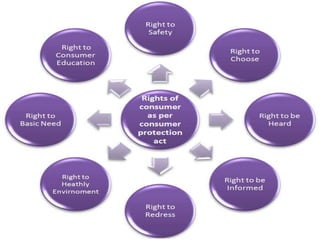
 RIGHTS OF CONSUMER
 MANNER OF COMPLAINING
 LIMITATION PERIOD
 APPEALS
 PENALITIES
 CPA & MEDICAL PROFESSION
 DOCTOR-PATIENT CONTRACT
 DO’S & DON’TS OF A DOCTOR
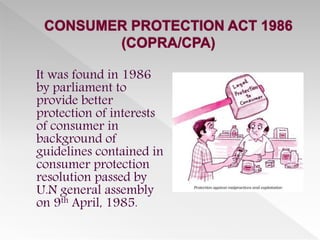
It was found in 1986
by parliament to
provide better
protection of interests
of consumer in
background of
guidelines contained in
consumer protection
resolution passed by
U.N general assembly
on 9th April, 1985.
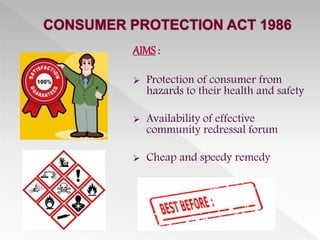
AIMS :
 Protection of consumer from
hazards to their health and safety
 Availability of effective
community redressal forum
 Cheap and speedy remedy
 The National commission in 1993, in a ruling
includes medical services under provision of CPA
 In 1995, supreme court of India( IMA Vs
V.P.Shantha ) includes medical services under ambit
of CPA
 The act covers all private, corporate and public
sector enterprises.
 District, State and National commission(quasi
judicial bodies) have been established.
 They look into complaints of consumers, where
defect or deficiency of services have come to notice
of consumers.
 Quasi judicial bodies observe principles of natural
justice
 They are empowered to give reliefs of specific
nature and award whenever appropriate
compensation to consumers
 They also prescribes penalty for non compliance of
orders
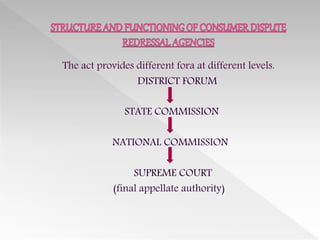
The act provides different fora at different levels.
DISTRICT FORUM
STATE COMMISSION
NATIONAL COMMISSION
SUPREME COURT
(final appellate authority)
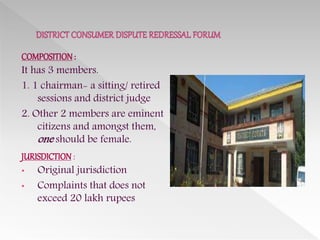
1. District consumer dispute redressal forum
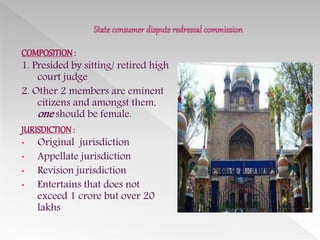
2. State consumer dispute redressal commission
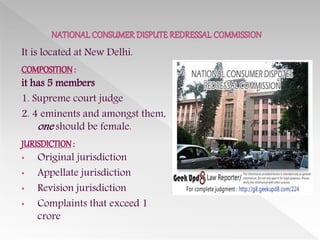
3. National consumer dispute redressal
commission
COMPOSITION:
It has 3 members.
1. 1 chairman- a sitting/ retired
sessions and district judge
2. Other 2 members are eminent
citizens and amongst them,
one should be female.
JURISDICTION :
• Original jurisdiction
• Complaints that does not
exceed 20 lakh rupees
COMPOSITION:
1. Presided by sitting/ retired high
court judge
2. Other 2 members are eminent
citizens and amongst them,
one should be female.
JURISDICTION:
• Original jurisdiction
• Appellate jurisdiction
• Revision jurisdiction
• Entertains that does not
exceed 1 crore but over 20
lakhs
It is located at New Delhi.
COMPOSITION:
it has 5 members
1. Supreme court judge
2. 4 eminents and amongst them,
one should be female.
JURISDICTION:
• Original jurisdiction
• Appellate jurisdiction
• Revision jurisdiction
• Complaints that exceed 1
crore
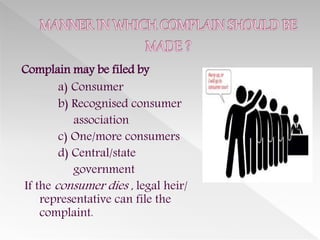
Complain may be filed by
a) Consumer
b) Recognised consumer
association
c) One/more consumers
d) Central/state
government
If the consumer dies , legal heir/
representative can file the
complaint.
PROCEDURE :
 Complaint should be heard as early as possible.
 District forum shall refer copy of such complaint to
opposite party with in 21 days.
 Opposite party should give his/her version within 30
days period.
 Representation of lawyers is not necessary.
 Dispute is settled based on evidence by complainant and
opposition party.
 District forum has same power as vested in civil court(first
class magistrate) under code of civil procedure, 1908.
 Every proceeding before district forum comes under S.193
and S.228 of IPC,1860.
 Ordinarily, no adjournment is granted unless sufficient
cause is shown.
 Reasons for adjournment are recorded.
 Orders for costs of adjournment are passed.
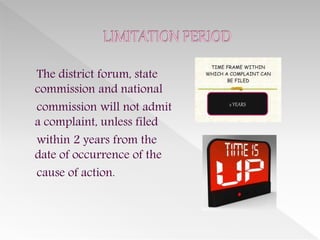
The district forum, state
commission and national
commission will not admit
a complaint, unless filed
within 2 years from the
date of occurrence of the
cause of action.
2 YEARS
• Any appeal against the order of the district
forum or state commission under this act must
be filed within 30 days of the order.
• Any person who is aggrieved by the order of the
national commission has a right to appeal to the
supreme court(appellate authority) within a
period of 30 days from date of the order.
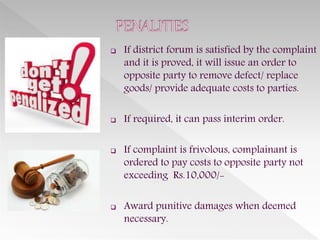
 If district forum is satisfied by the complaint
and it is proved, it will issue an order to
opposite party to remove defect/ replace
goods/ provide adequate costs to parties.
 If required, it can pass interim order.
 If complaint is frivolous, complainant is
ordered to pay costs to opposite party not
exceeding Rs.10,000/-
 Award punitive damages when deemed
necessary.
So far medical service is concerned,
The interest of patient who suffers
damages in hand of his/her treating
physician.
DOCTOR service provider
PATIENT service consumer
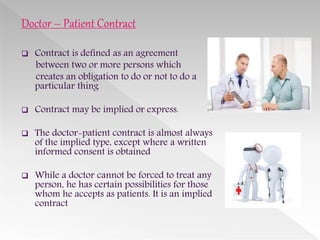
Doctor – Patient Contract
 Contract is defined as an agreement
between two or more persons which
creates an obligation to do or not to do a
particular thing
 Contract may be implied or express.
 The doctor-patient contract is almost always
of the implied type, except where a written
informed consent is obtained
 While a doctor cannot be forced to treat any
person, he has certain possibilities for those
whom he accepts as patients. It is an implied
contract
 The Doctor patient relationship in our country has
undergone a sea change in the last decade and a half.
 The lucky doctors of the past were treated like God and
people revered and respected them.
 We witness today a fast pace of commercialization and
globalization on all spheres of life and
 The medical profession is no exception to these phenomena.
 As a result, the doctor-patients relationship has deteriorated
considerably.
 Earlier too, doctors were covered by various laws, i.e. the
Law of Torts, IPC etc.,
 But since the passing of the Consumer Protection Act in
1986, litigation against doctors is on the increase.
 The medical profession is definitely perturbed by this
 A rethink is necessary on standards of medical practice or
‘defensive medicine’.
Implied contract is not established when :
(i) the doctor renders first-aid in an emergency
(ii) he makes a pre-employment medical examination for a
prospective employer;
(iii) he performs an examination for life insurance purpose ;
(iv) he is appointed by the trial court to examine the accused for
any reason ; and
(v) when he makes an examination at the request of an attorney
for last suit purposes.
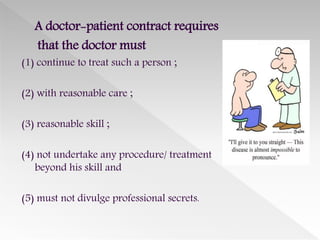
A doctor-patient contract requires
that the doctor must
(1) continue to treat such a person ;
(2) with reasonable care ;
(3) reasonable skill ;
(4) not undertake any procedure/ treatment
beyond his skill and
(5) must not divulge professional secrets.
DO’s :
1. Mention your qualifications on the
prescription. Qualifications mean recognized
degrees / diplomas as regulated by the Indian
Medical Degrees Act, 1916 as amended from
time to time.
2. Mention of scholarships/training /
membership/awards which are not
qualifications should be avoided.
3. Always mention date and timing of the
consultation.
4. Mention age, sex, weight (if child).
5. In complicated cases record precisely
history of illness and substantial physical
findings about the patient on your
prescription.
6. If the patient/attendants are erring on
any count ( history not reliable, refusing
investigations, refusing admission )
make a note of it or seek written refusal
preferably in local language with proper
witness.
7. Mention the condition of patient in
specific /objective terms. Avoid vague /
non-specific terminology.
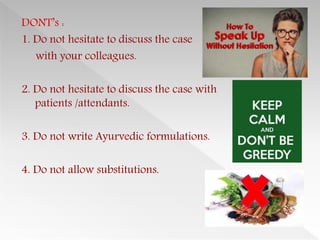
8. Record history of drug allergy.
DONT’s :
1. Do not hesitate to discuss the case
with your colleagues.
2. Do not hesitate to discuss the case with
patients /attendants.
3. Do not write Ayurvedic formulations.
4. Do not allow substitutions.
5. For goodness sake do not examine a
patient if you are sick, exhausted,
under effect of alcohol.
6. Never talk loose of your colleagues,
despite intense professional rivalry.
Never criticize your brother in
profession.
7. The patient /attendants may incite you
to say/do something. They may seek
your comments on the other doctor’s
treatment. There is always a polite
way to set aside their queries.
The doctors are liable to pay compensation to
the patient; if their professional negligence
results in injury or death of the patient.
1. Handbook of forensic medicine and toxicology
by apurba nandy
2. Essentials of forensic medicine and toxicology
by Dr.K.S.Narayan Reddy; 33rd edition
3. Review of forensic medicine and toxicology by
gautam biswas
4. Textbook of forensic medicine and toxicology
by V.V.Pillay;16th edition
Thank you for your patience & kind
attention...!

Consumer protection act 1986

  • 2.
     INTRODUCTION  CONSUMERDISPUTE REDRESSAL AGENCIES  RIGHTS OF CONSUMER  MANNER OF COMPLAINING  LIMITATION PERIOD  APPEALS  PENALITIES  CPA & MEDICAL PROFESSION  DOCTOR-PATIENT CONTRACT  DO’S & DON’TS OF A DOCTOR
  • 3.
    It was foundin 1986 by parliament to provide better protection of interests of consumer in background of guidelines contained in consumer protection resolution passed by U.N general assembly on 9th April, 1985.
  • 4.
    AIMS :  Protectionof consumer from hazards to their health and safety  Availability of effective community redressal forum  Cheap and speedy remedy
  • 5.
     The Nationalcommission in 1993, in a ruling includes medical services under provision of CPA  In 1995, supreme court of India( IMA Vs V.P.Shantha ) includes medical services under ambit of CPA
  • 6.
     The actcovers all private, corporate and public sector enterprises.  District, State and National commission(quasi judicial bodies) have been established.  They look into complaints of consumers, where defect or deficiency of services have come to notice of consumers.
  • 7.
     Quasi judicialbodies observe principles of natural justice  They are empowered to give reliefs of specific nature and award whenever appropriate compensation to consumers  They also prescribes penalty for non compliance of orders
  • 8.
    The act providesdifferent fora at different levels. DISTRICT FORUM STATE COMMISSION NATIONAL COMMISSION SUPREME COURT (final appellate authority)
  • 9.
    1. District consumerdispute redressal forum 2. State consumer dispute redressal commission 3. National consumer dispute redressal commission
  • 10.
    COMPOSITION: It has 3members. 1. 1 chairman- a sitting/ retired sessions and district judge 2. Other 2 members are eminent citizens and amongst them, one should be female. JURISDICTION : • Original jurisdiction • Complaints that does not exceed 20 lakh rupees
  • 11.
    COMPOSITION: 1. Presided bysitting/ retired high court judge 2. Other 2 members are eminent citizens and amongst them, one should be female. JURISDICTION: • Original jurisdiction • Appellate jurisdiction • Revision jurisdiction • Entertains that does not exceed 1 crore but over 20 lakhs
  • 12.
    It is locatedat New Delhi. COMPOSITION: it has 5 members 1. Supreme court judge 2. 4 eminents and amongst them, one should be female. JURISDICTION: • Original jurisdiction • Appellate jurisdiction • Revision jurisdiction • Complaints that exceed 1 crore
  • 14.
    Complain may befiled by a) Consumer b) Recognised consumer association c) One/more consumers d) Central/state government If the consumer dies , legal heir/ representative can file the complaint.
  • 15.
    PROCEDURE :  Complaintshould be heard as early as possible.  District forum shall refer copy of such complaint to opposite party with in 21 days.  Opposite party should give his/her version within 30 days period.  Representation of lawyers is not necessary.  Dispute is settled based on evidence by complainant and opposition party.
  • 16.
     District forumhas same power as vested in civil court(first class magistrate) under code of civil procedure, 1908.  Every proceeding before district forum comes under S.193 and S.228 of IPC,1860.  Ordinarily, no adjournment is granted unless sufficient cause is shown.  Reasons for adjournment are recorded.  Orders for costs of adjournment are passed.
  • 17.
    The district forum,state commission and national commission will not admit a complaint, unless filed within 2 years from the date of occurrence of the cause of action. 2 YEARS
  • 18.
    • Any appealagainst the order of the district forum or state commission under this act must be filed within 30 days of the order. • Any person who is aggrieved by the order of the national commission has a right to appeal to the supreme court(appellate authority) within a period of 30 days from date of the order.
  • 19.
     If districtforum is satisfied by the complaint and it is proved, it will issue an order to opposite party to remove defect/ replace goods/ provide adequate costs to parties.  If required, it can pass interim order.  If complaint is frivolous, complainant is ordered to pay costs to opposite party not exceeding Rs.10,000/-  Award punitive damages when deemed necessary.
  • 20.
    So far medicalservice is concerned, The interest of patient who suffers damages in hand of his/her treating physician. DOCTOR service provider PATIENT service consumer
  • 21.
    Doctor – PatientContract  Contract is defined as an agreement between two or more persons which creates an obligation to do or not to do a particular thing  Contract may be implied or express.  The doctor-patient contract is almost always of the implied type, except where a written informed consent is obtained  While a doctor cannot be forced to treat any person, he has certain possibilities for those whom he accepts as patients. It is an implied contract
  • 22.
     The Doctorpatient relationship in our country has undergone a sea change in the last decade and a half.  The lucky doctors of the past were treated like God and people revered and respected them.  We witness today a fast pace of commercialization and globalization on all spheres of life and  The medical profession is no exception to these phenomena.  As a result, the doctor-patients relationship has deteriorated considerably.
  • 23.
     Earlier too,doctors were covered by various laws, i.e. the Law of Torts, IPC etc.,  But since the passing of the Consumer Protection Act in 1986, litigation against doctors is on the increase.  The medical profession is definitely perturbed by this  A rethink is necessary on standards of medical practice or ‘defensive medicine’.
  • 24.
    Implied contract isnot established when : (i) the doctor renders first-aid in an emergency (ii) he makes a pre-employment medical examination for a prospective employer; (iii) he performs an examination for life insurance purpose ; (iv) he is appointed by the trial court to examine the accused for any reason ; and (v) when he makes an examination at the request of an attorney for last suit purposes.
  • 25.
    A doctor-patient contractrequires that the doctor must (1) continue to treat such a person ; (2) with reasonable care ; (3) reasonable skill ; (4) not undertake any procedure/ treatment beyond his skill and (5) must not divulge professional secrets.
  • 26.
    DO’s : 1. Mentionyour qualifications on the prescription. Qualifications mean recognized degrees / diplomas as regulated by the Indian Medical Degrees Act, 1916 as amended from time to time. 2. Mention of scholarships/training / membership/awards which are not qualifications should be avoided. 3. Always mention date and timing of the consultation. 4. Mention age, sex, weight (if child).
  • 27.
    5. In complicatedcases record precisely history of illness and substantial physical findings about the patient on your prescription. 6. If the patient/attendants are erring on any count ( history not reliable, refusing investigations, refusing admission ) make a note of it or seek written refusal preferably in local language with proper witness. 7. Mention the condition of patient in specific /objective terms. Avoid vague / non-specific terminology. 8. Record history of drug allergy.
  • 28.
    DONT’s : 1. Donot hesitate to discuss the case with your colleagues. 2. Do not hesitate to discuss the case with patients /attendants. 3. Do not write Ayurvedic formulations. 4. Do not allow substitutions.
  • 29.
    5. For goodnesssake do not examine a patient if you are sick, exhausted, under effect of alcohol. 6. Never talk loose of your colleagues, despite intense professional rivalry. Never criticize your brother in profession. 7. The patient /attendants may incite you to say/do something. They may seek your comments on the other doctor’s treatment. There is always a polite way to set aside their queries.
  • 30.
    The doctors areliable to pay compensation to the patient; if their professional negligence results in injury or death of the patient.
  • 31.
    1. Handbook offorensic medicine and toxicology by apurba nandy 2. Essentials of forensic medicine and toxicology by Dr.K.S.Narayan Reddy; 33rd edition 3. Review of forensic medicine and toxicology by gautam biswas 4. Textbook of forensic medicine and toxicology by V.V.Pillay;16th edition
  • 32.
    Thank you foryour patience & kind attention...!