Consumer Modeling
Prof. Girish Mude
MAEER’s MIT School of Management, Pune
girishmude@mitsom.com
Consumer Modeling
• Model is very often referred to as an abstract
representation of a process of relationship.
• How they help:
– In development of theories
– To understand complex relationship
– Provide framework for discussions and research
work.
Girish Mude MITSOM, Pune
Lets study Models then….
Models
Girish Mude MITSOM, Pune
Models in consumer Behavior
• Psychoanalytical model
• Economic model
• Sociological model
• Howard Seth model
• Nicosia model
• Engel Blackwell model
• VALS2 Stadford model
Girish Mude MITSOM, Pune
The psychoanalytical model
The psychoanalytical model draws from Freudian
psychology
Individual consumer has a complex set of deep
seated motives which drive him towards certain
buying decisions.
The buyer has a private world with all his hidden
fears, suppressed desires and totally subjective
longings.
His buying action can be influenced by appealing
to those desires and longings.
Girish Mude MITSOM, Pune
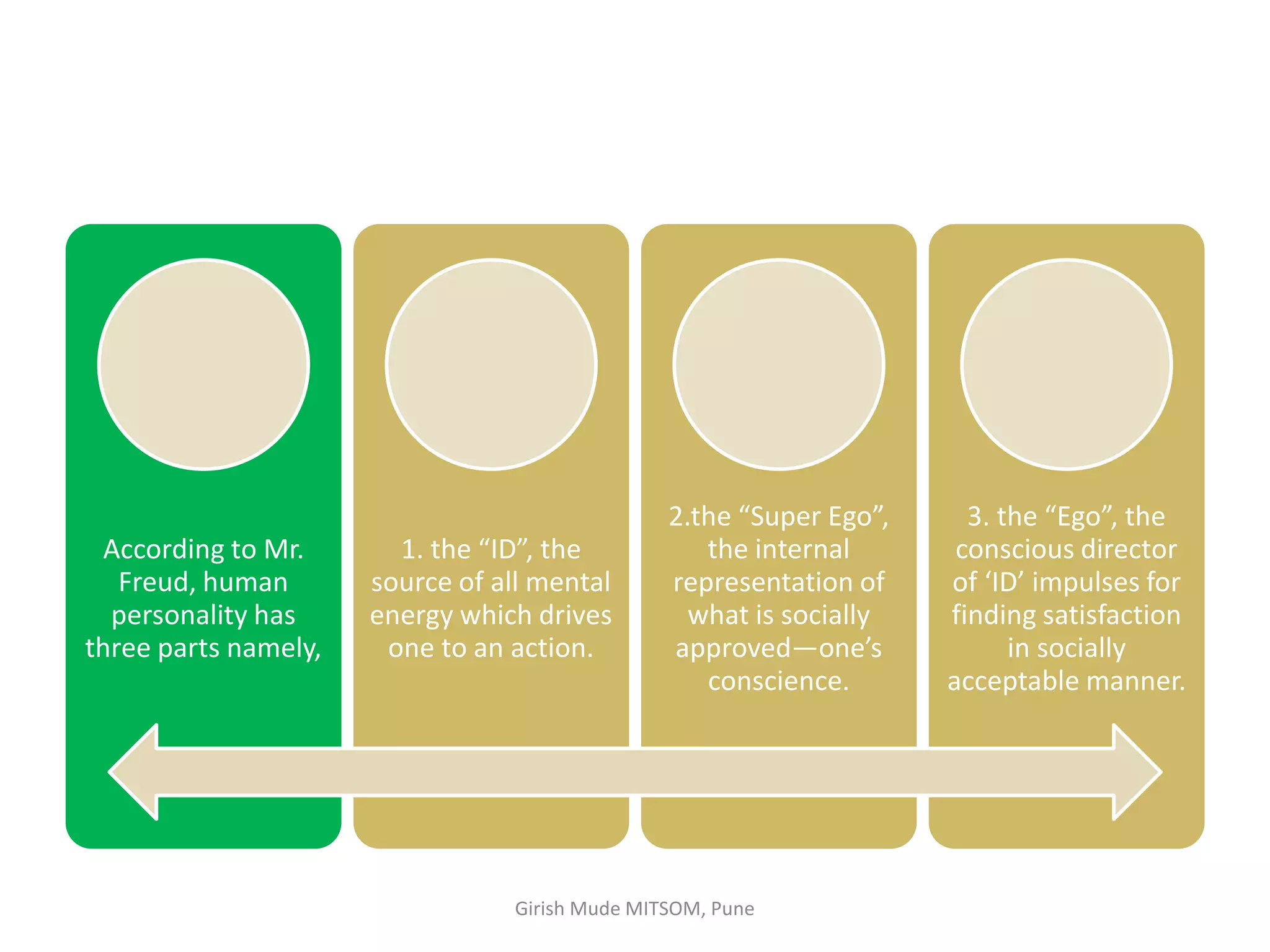
According to Mr.
Freud, human
personality has
three parts namely,
1. the “ID”, the
source of all mental
energy which drives
one to an action.
2.the “Super Ego”,
the internal
representation of
what is socially
approved—one’s
conscience.
3. the “Ego”, the
conscious director
of ‘ID’ impulses for
finding satisfaction
in socially
acceptable manner.
Girish Mude MITSOM, Pune
In other words, ‘ID’ represents one’s animal or
basic impulses, ‘instincts’ and cravings for
immediate and total satisfaction.
Marketers have been using this Approach to
generate new ideas for developing product-
design, features, advertising and promotional
techniques.
Girish Mude MITSOM, Pune
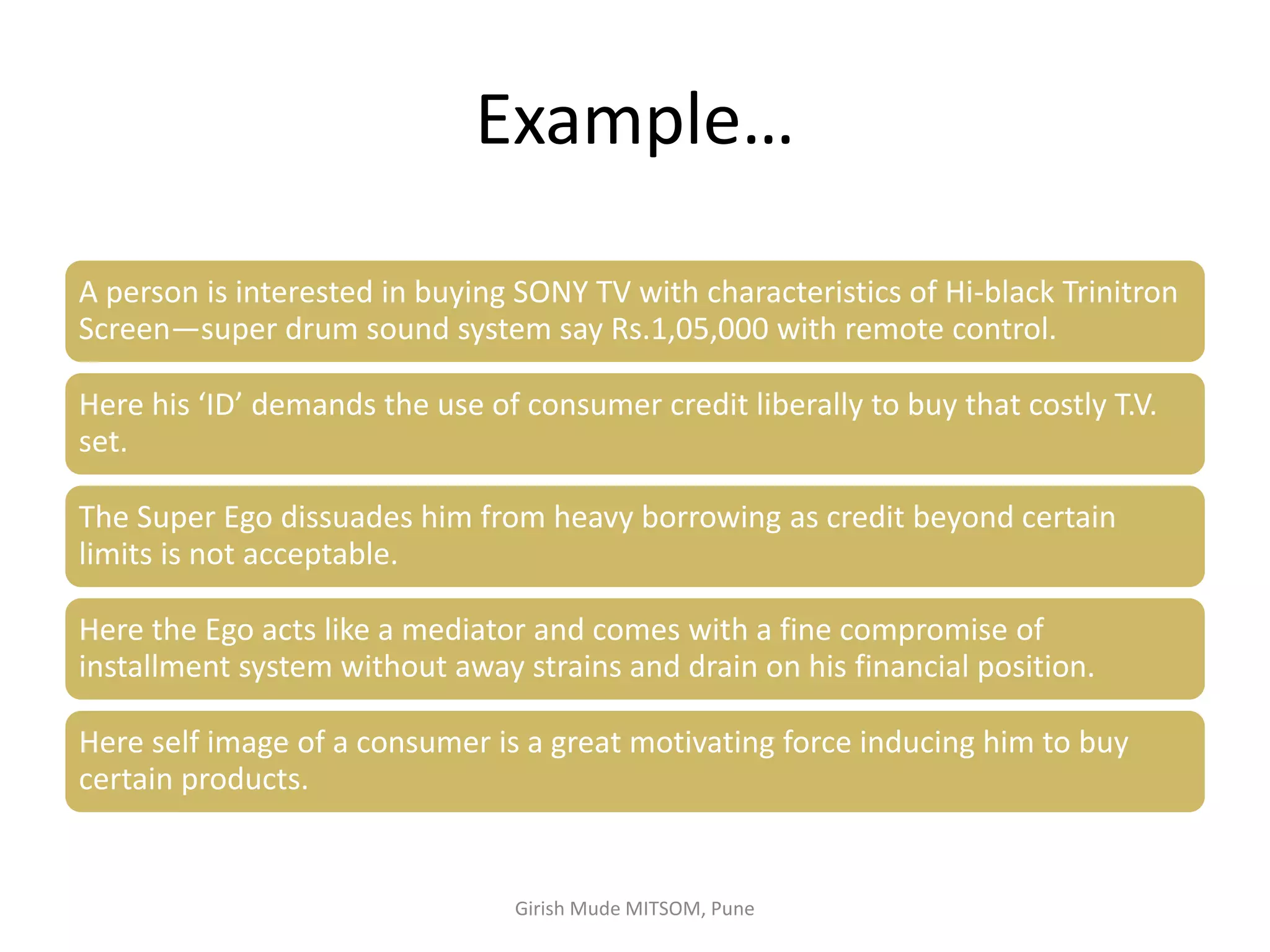
Example…
A person is interested in buying SONY TV with characteristics of Hi-black Trinitron
Screen—super drum sound system say Rs.1,05,000 with remote control.
Here his ‘ID’ demands the use of consumer credit liberally to buy that costly T.V.
set.
The Super Ego dissuades him from heavy borrowing as credit beyond certain
limits is not acceptable.
Here the Ego acts like a mediator and comes with a fine compromise of
installment system without away strains and drain on his financial position.
Here self image of a consumer is a great motivating force inducing him to buy
certain products.
Girish Mude MITSOM, Pune
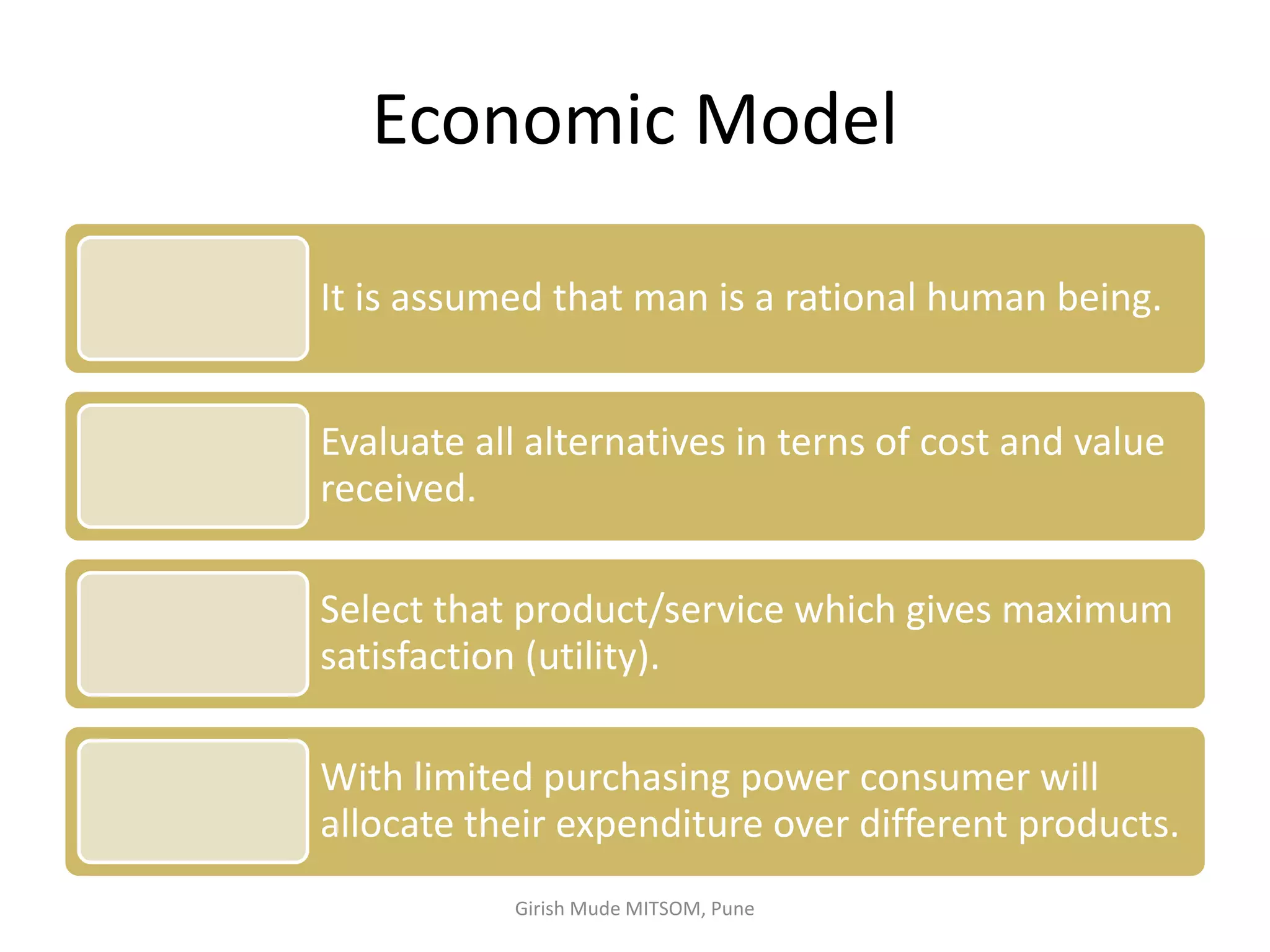
Economic Model
It is assumed that man is a rational human being.
Evaluate all alternatives in terns of cost and value
received.
Select that product/service which gives maximum
satisfaction (utility).
With limited purchasing power consumer will
allocate their expenditure over different products.
Girish Mude MITSOM, Pune
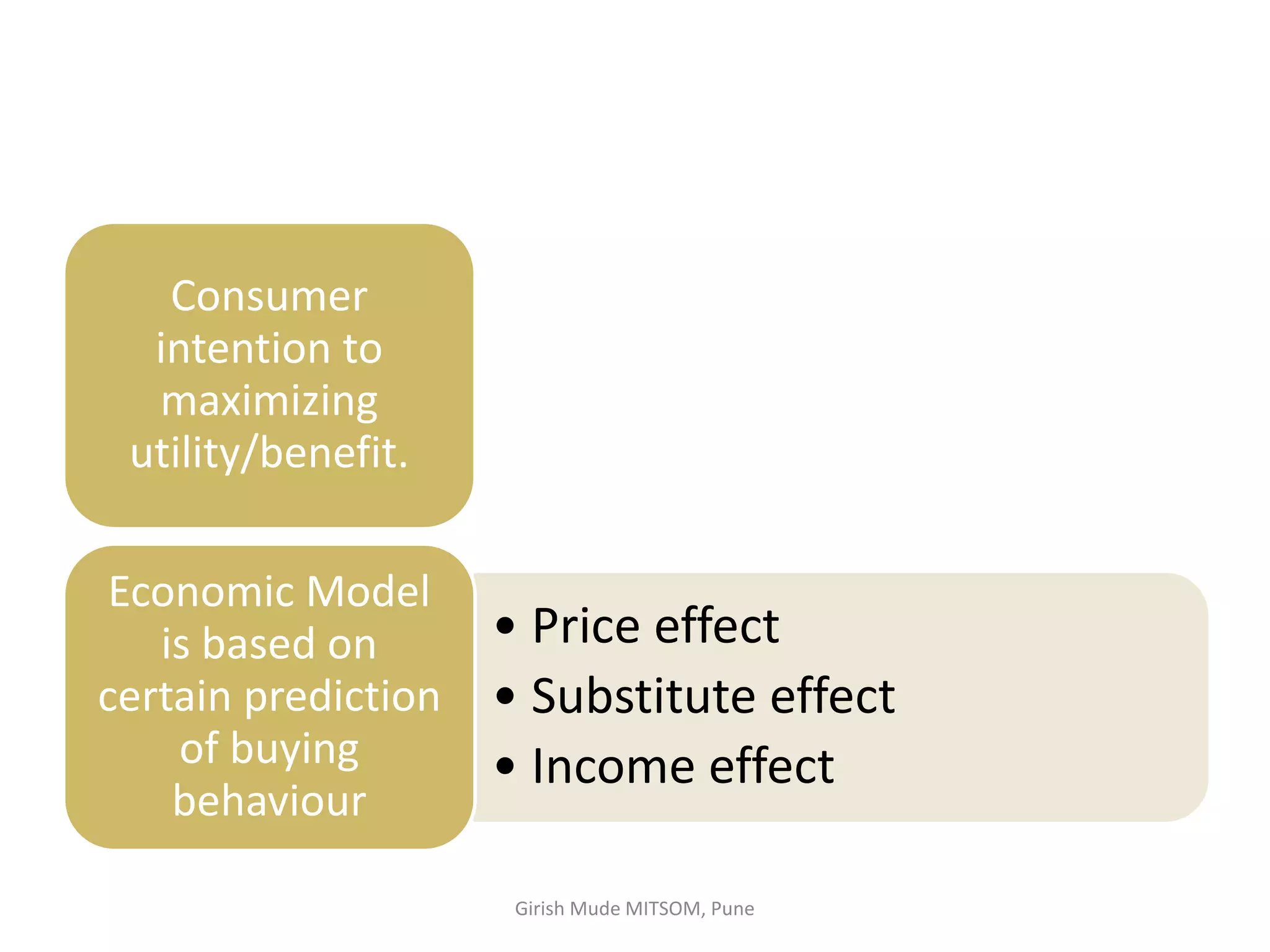
Consumer
intention to
maximizing
utility/benefit.
• Price effect
• Substitute effect
• Income effect
Economic Model
is based on
certain prediction
of buying
behaviour
Girish Mude MITSOM, Pune
Sociological Model
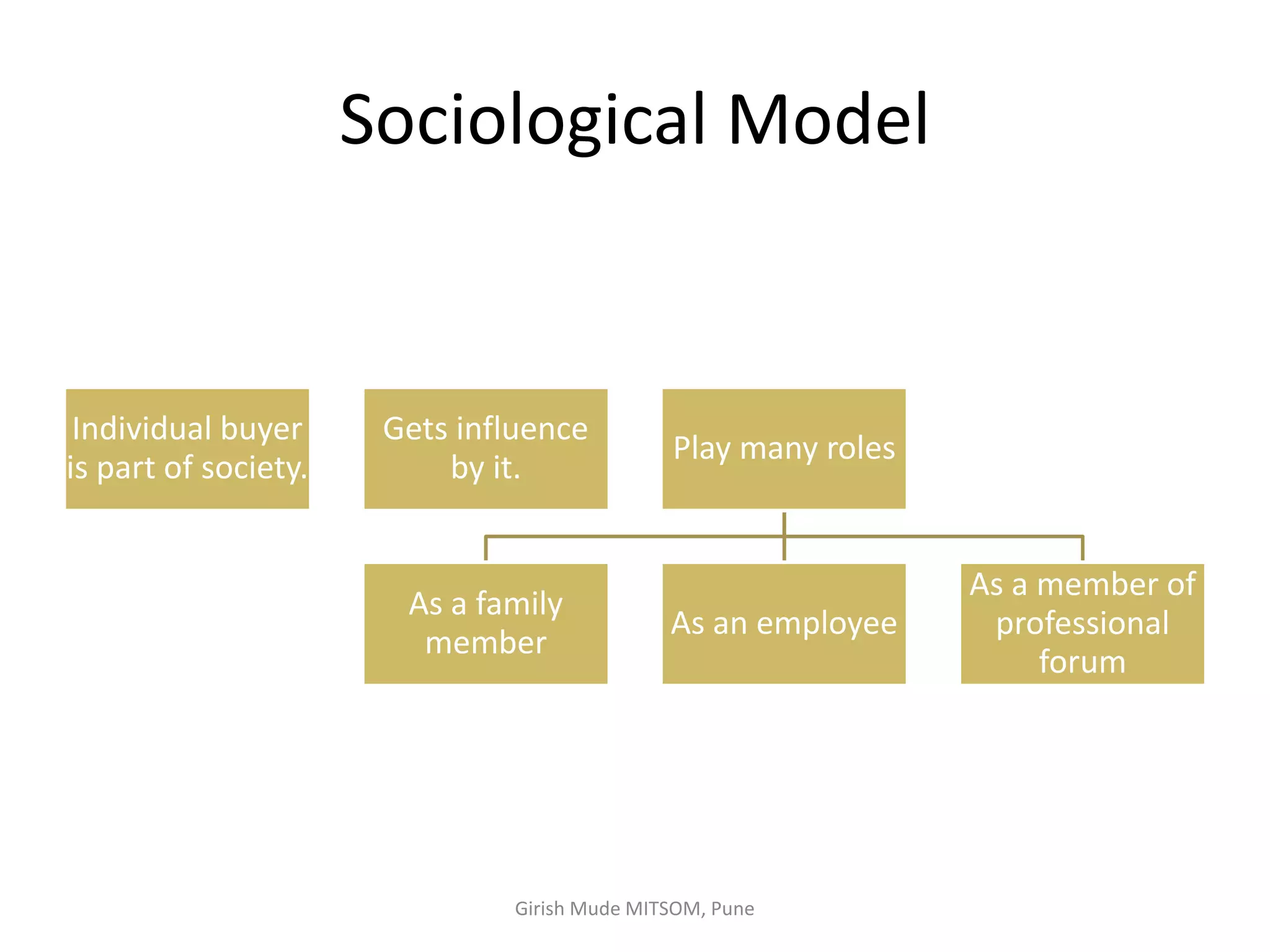
Individual buyer
is part of society.
Gets influence
by it.
Play many roles
As a family
member
As an employee
As a member of
professional
forum
Girish Mude MITSOM, Pune
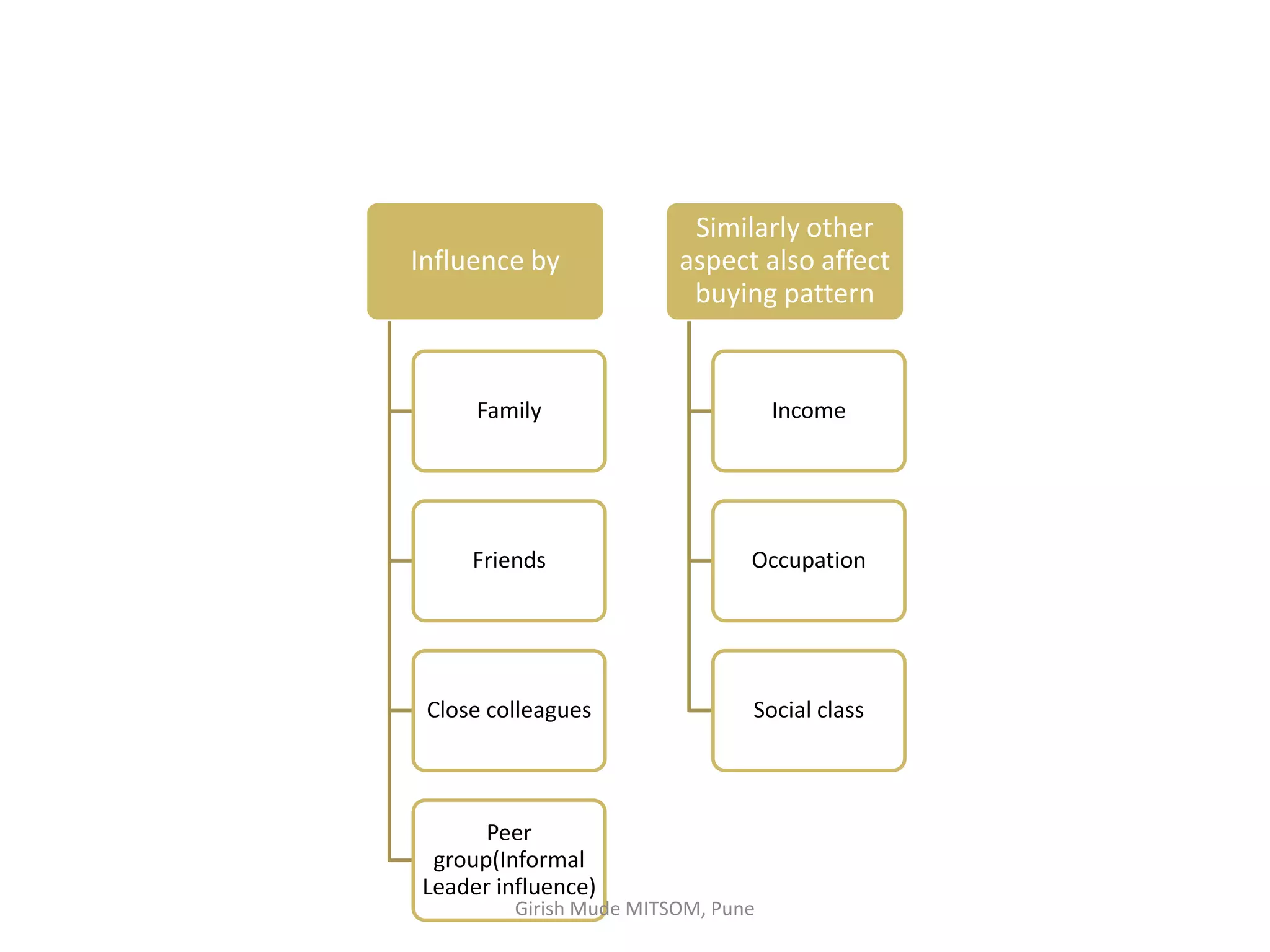
Influence by
Family
Friends
Close colleagues
Peer
group(Informal
Leader influence)
Similarly other
aspect also affect
buying pattern
Income
Occupation
Social class
Girish Mude MITSOM, Pune
Nicosia Model
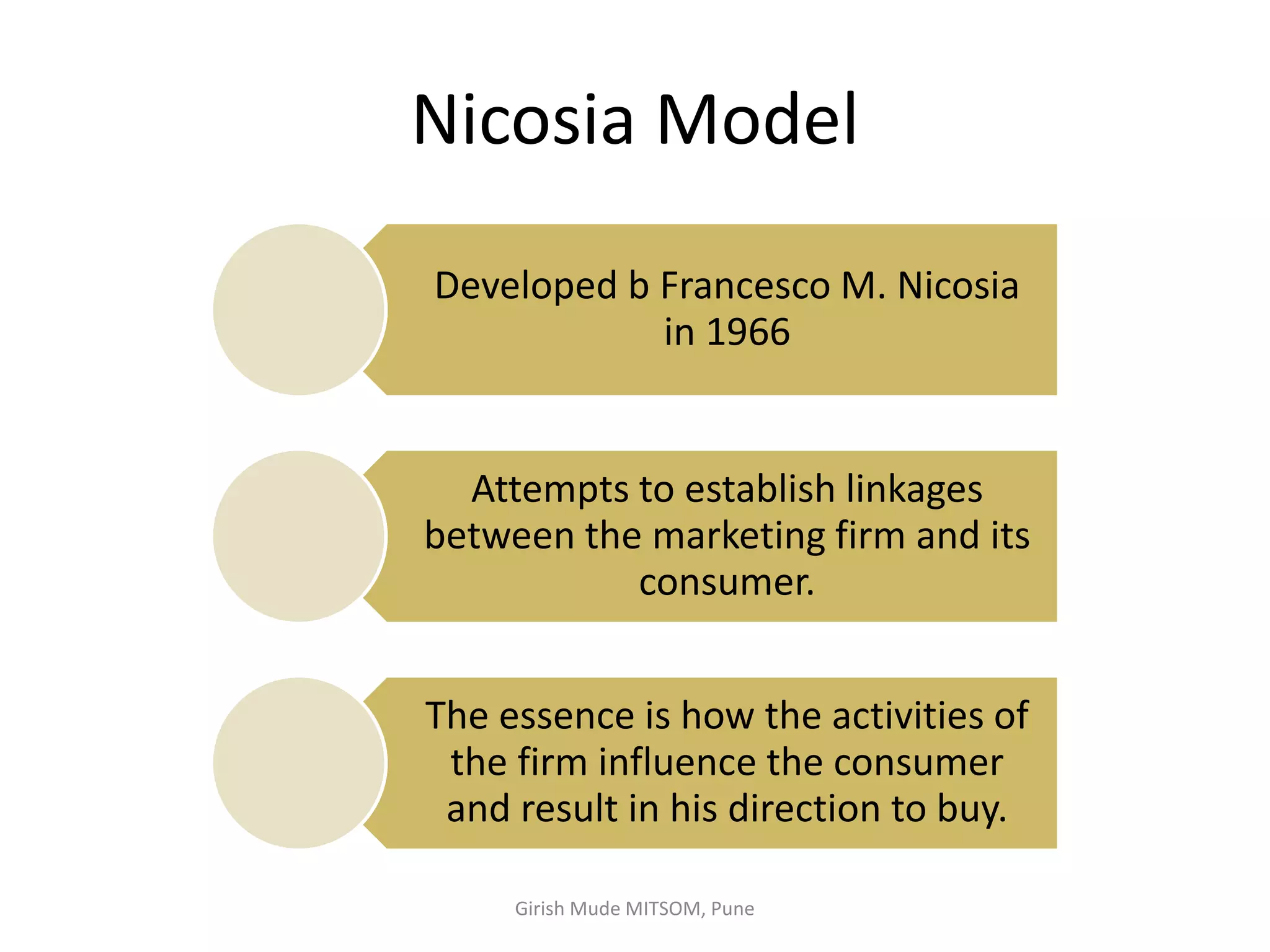
Developed b Francesco M. Nicosia
in 1966
Attempts to establish linkages
between the marketing firm and its
consumer.
The essence is how the activities of
the firm influence the consumer
and result in his direction to buy.
Girish Mude MITSOM, Pune
Nicosia Model ..Continued
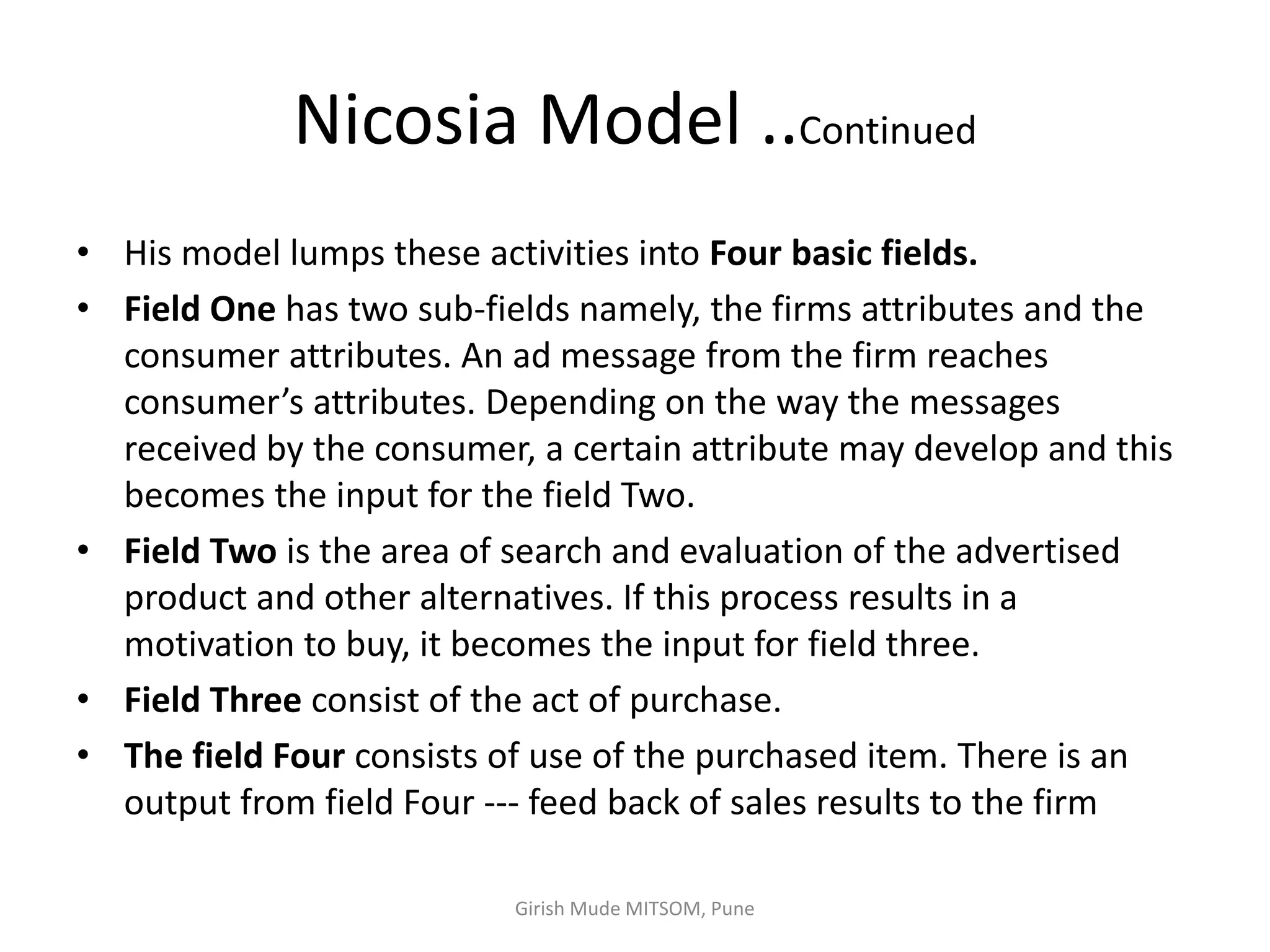
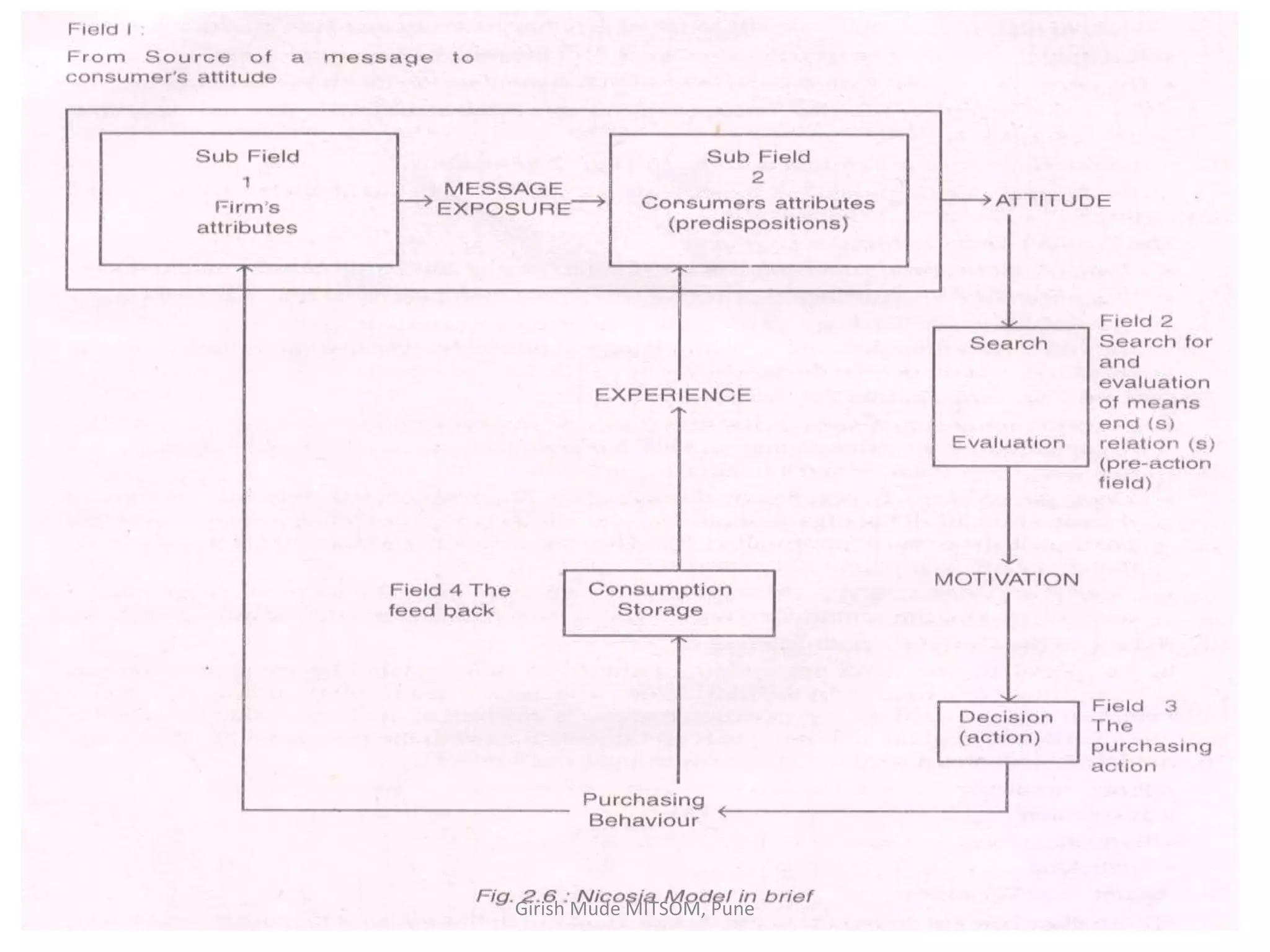
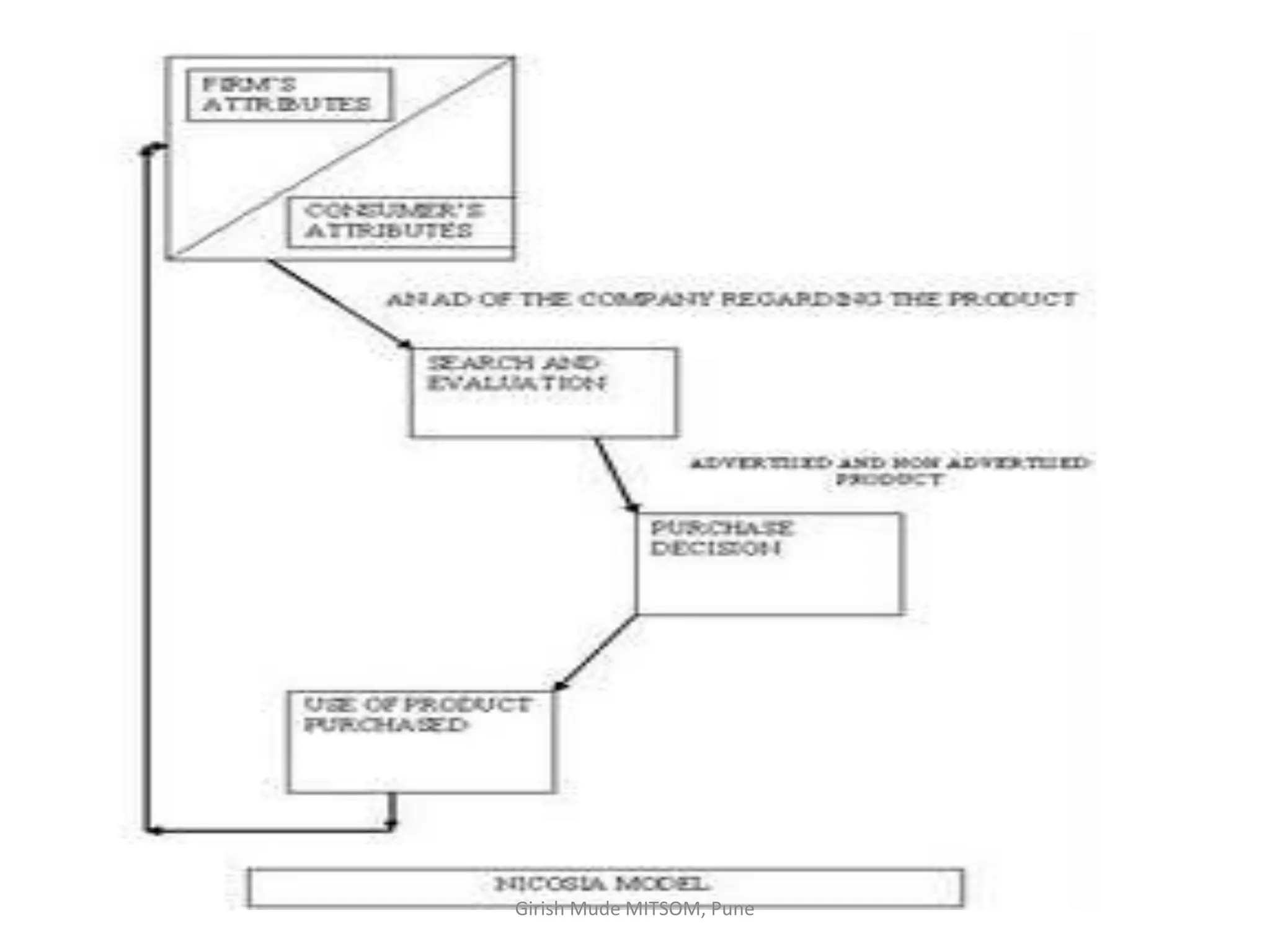
• His model lumps these activities into Four basic fields.
• Field One has two sub-fields namely, the firms attributes and the
consumer attributes. An ad message from the firm reaches
consumer’s attributes. Depending on the way the messages
received by the consumer, a certain attribute may develop and this
becomes the input for the field Two.
• Field Two is the area of search and evaluation of the advertised
product and other alternatives. If this process results in a
motivation to buy, it becomes the input for field three.
• Field Three consist of the act of purchase.
• The field Four consists of use of the purchased item. There is an
output from field Four --- feed back of sales results to the firm
Girish Mude MITSOM, Pune
Engel, Kollat, and Blackwell (EKB)
Model
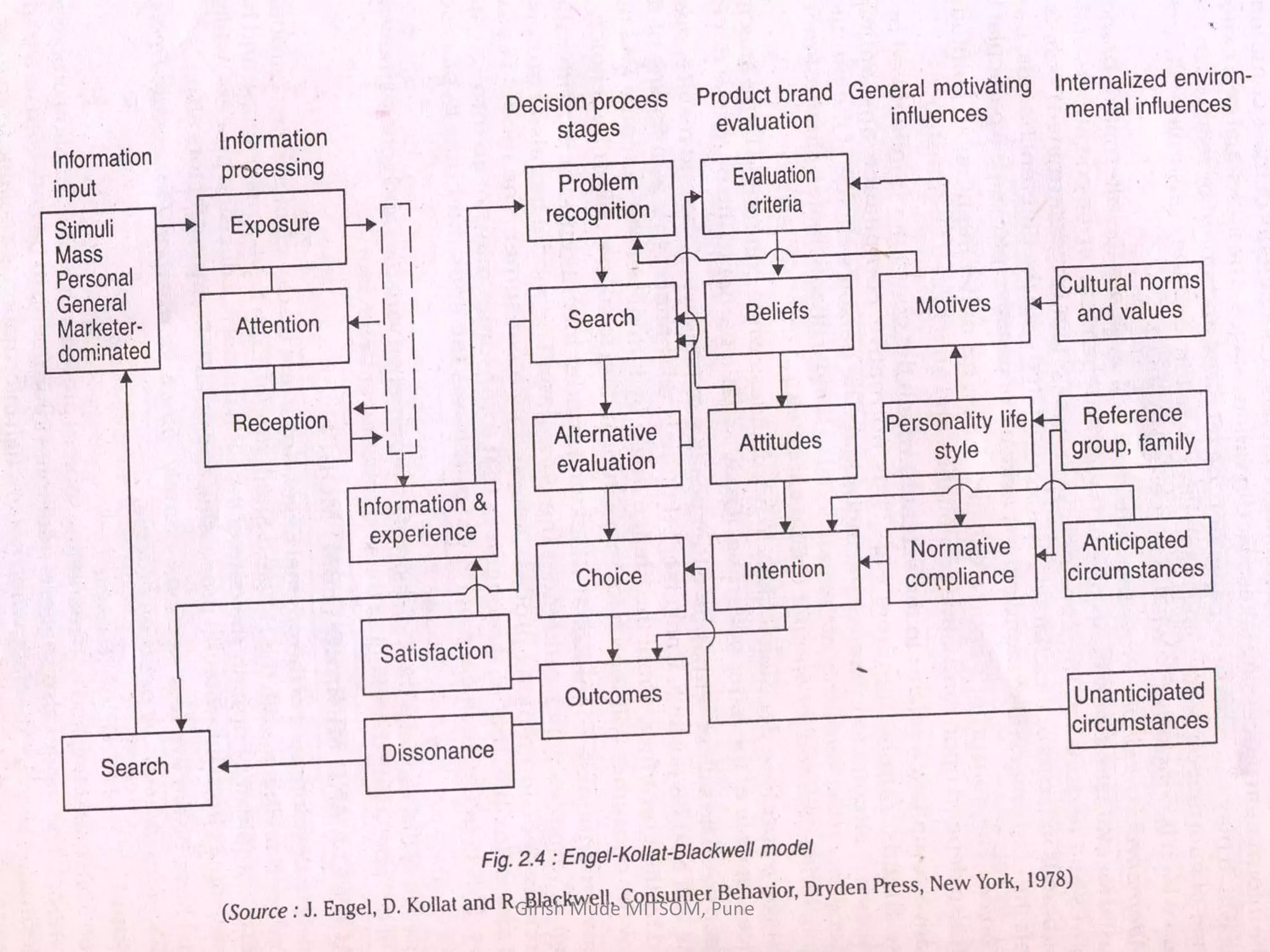
The EKB model is comprehensive and
shows the components of decision
making and the relationships and
interactions among them.
The five distinct parts of consumer
decision making presented are:
• Input, information processing, a decision process,
decision process variables, and external
influences
Girish Mude MITSOM, Pune
One of the important features of the
Engel, Kollat, and Blackwell model is
the description of consumer
purchasing as a process comprised of
several stages rather than a single act
of buying or not buying.
Girish Mude MITSOM, Pune
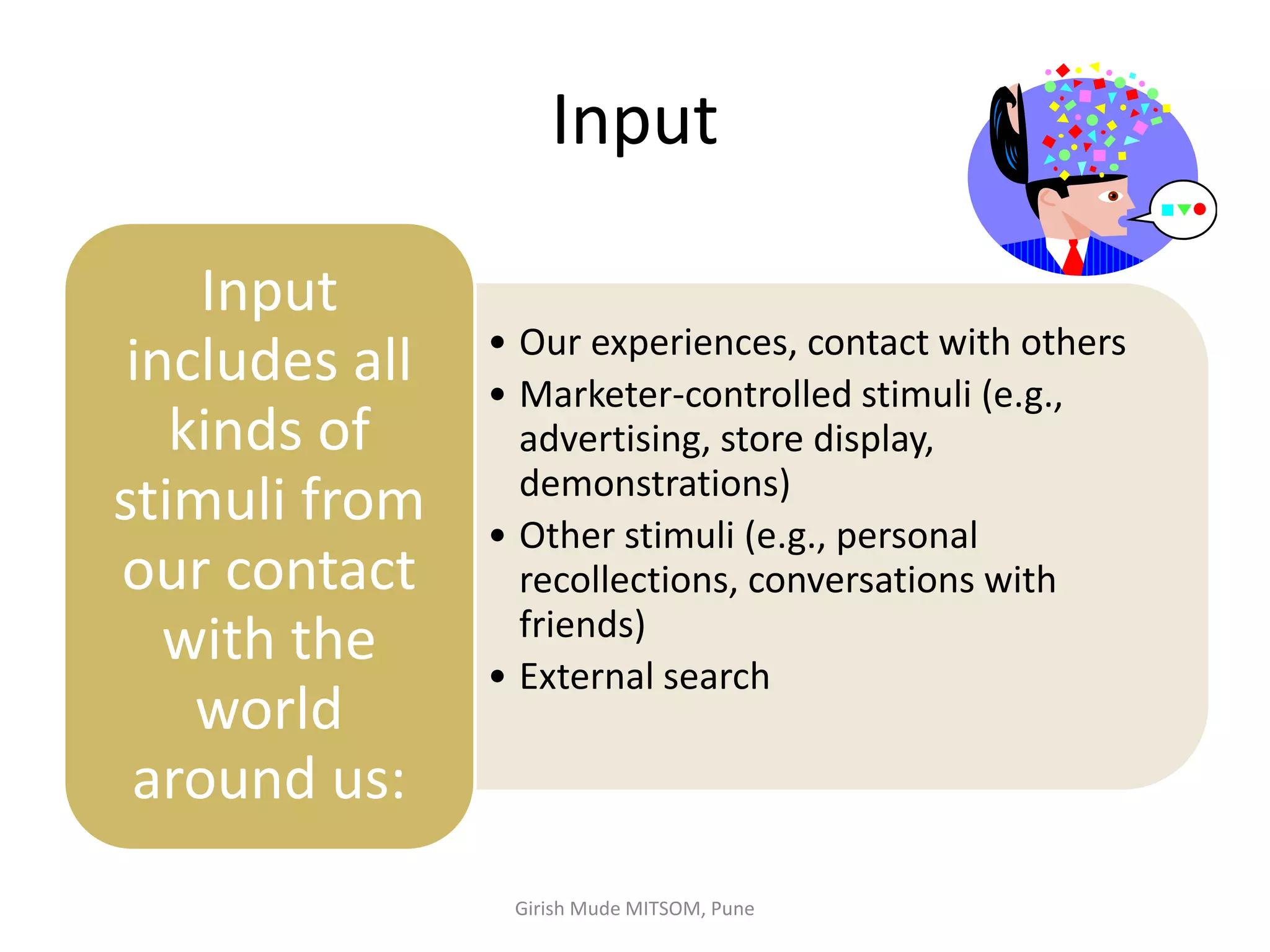
Input
• Our experiences, contact with others
• Marketer-controlled stimuli (e.g.,
advertising, store display,
demonstrations)
• Other stimuli (e.g., personal
recollections, conversations with
friends)
• External search
Input
includes all
kinds of
stimuli from
our contact
with the
world
around us:
Girish Mude MITSOM, Pune
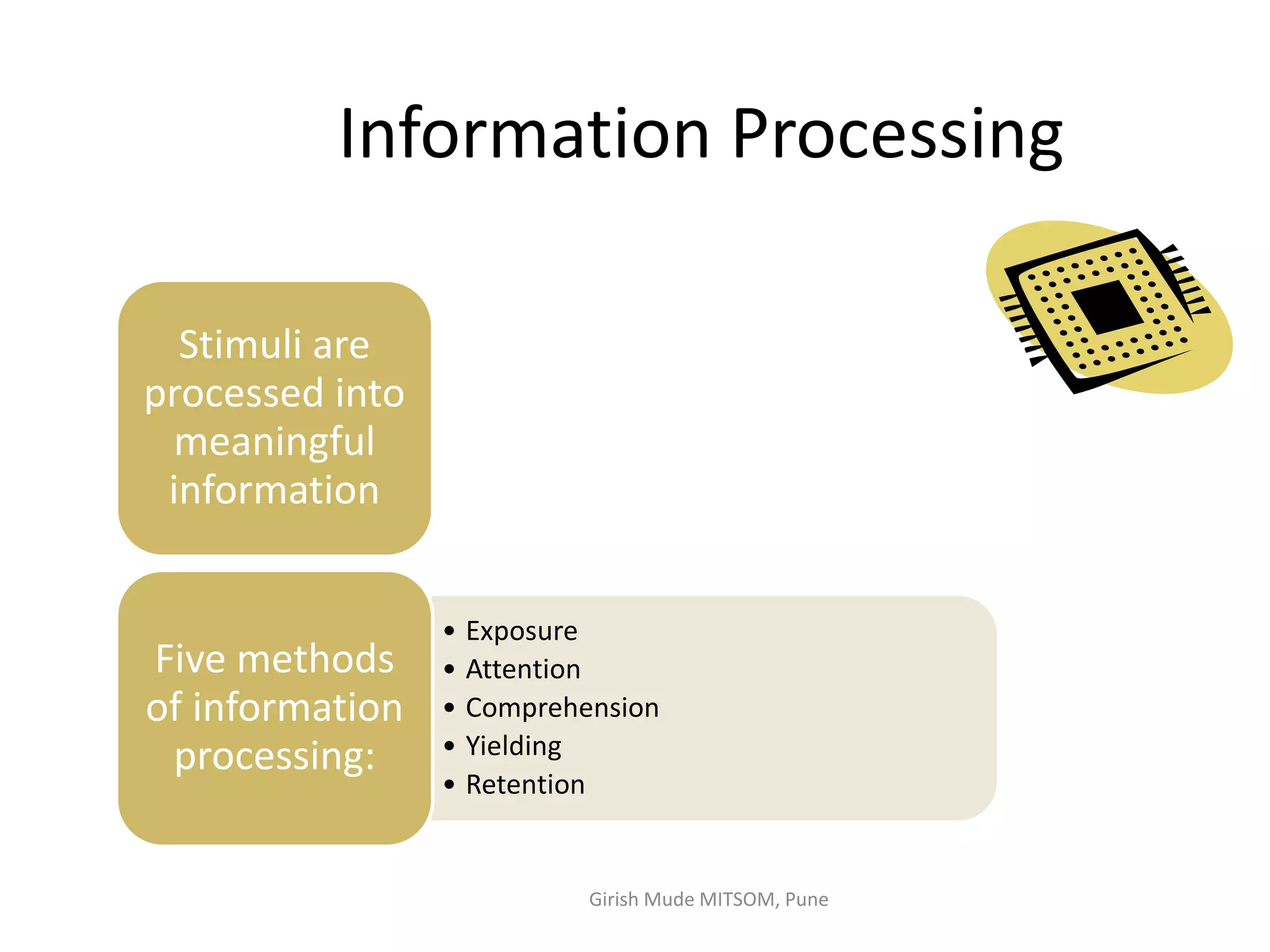
Information Processing
Stimuli are
processed into
meaningful
information
• Exposure
• Attention
• Comprehension
• Yielding
• Retention
Five methods
of information
processing:
Girish Mude MITSOM, Pune
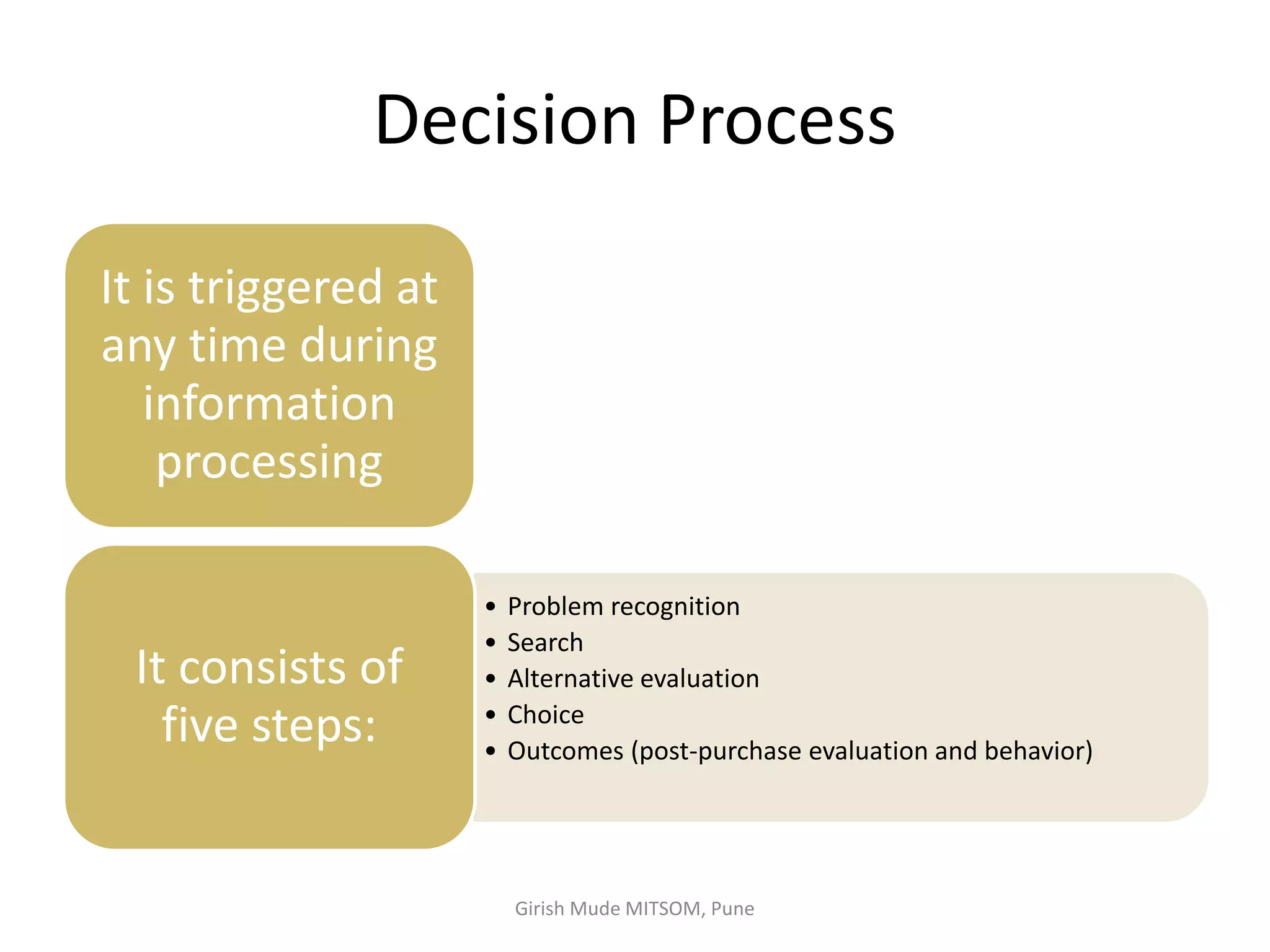
Decision Process
It is triggered at
any time during
information
processing
• Problem recognition
• Search
• Alternative evaluation
• Choice
• Outcomes (post-purchase evaluation and behavior)
It consists of
five steps:
Girish Mude MITSOM, Pune
Decision Process Variables
Those individual
qualities that make
people/consumers
unique.
• Motives
• Beliefs
• Attitudes
• Lifestyles
• Intentions
• Evaluative criteria
• Normative compliance and informational influence
• Other aspects of self
Decision process
variables include
Girish Mude MITSOM, Pune
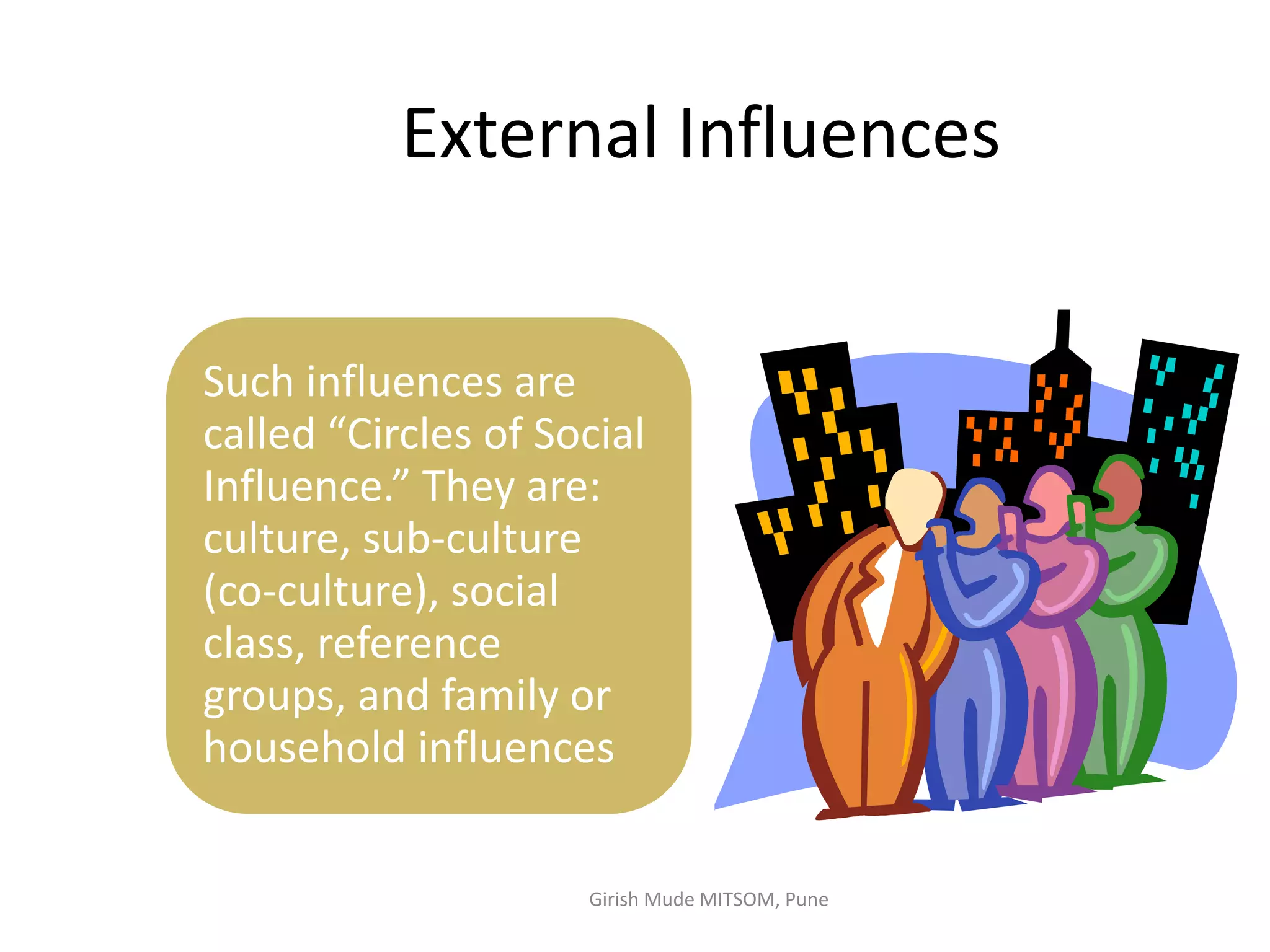
External Influences
Such influences are
called “Circles of Social
Influence.” They are:
culture, sub-culture
(co-culture), social
class, reference
groups, and family or
household influences
Girish Mude MITSOM, Pune
This model is an individual decision
process model since it views a single
consumer as the basic decision
making unit. The model does
recognize influences from other
people, but the central focus is still on
the individual.
Girish Mude MITSOM, Pune
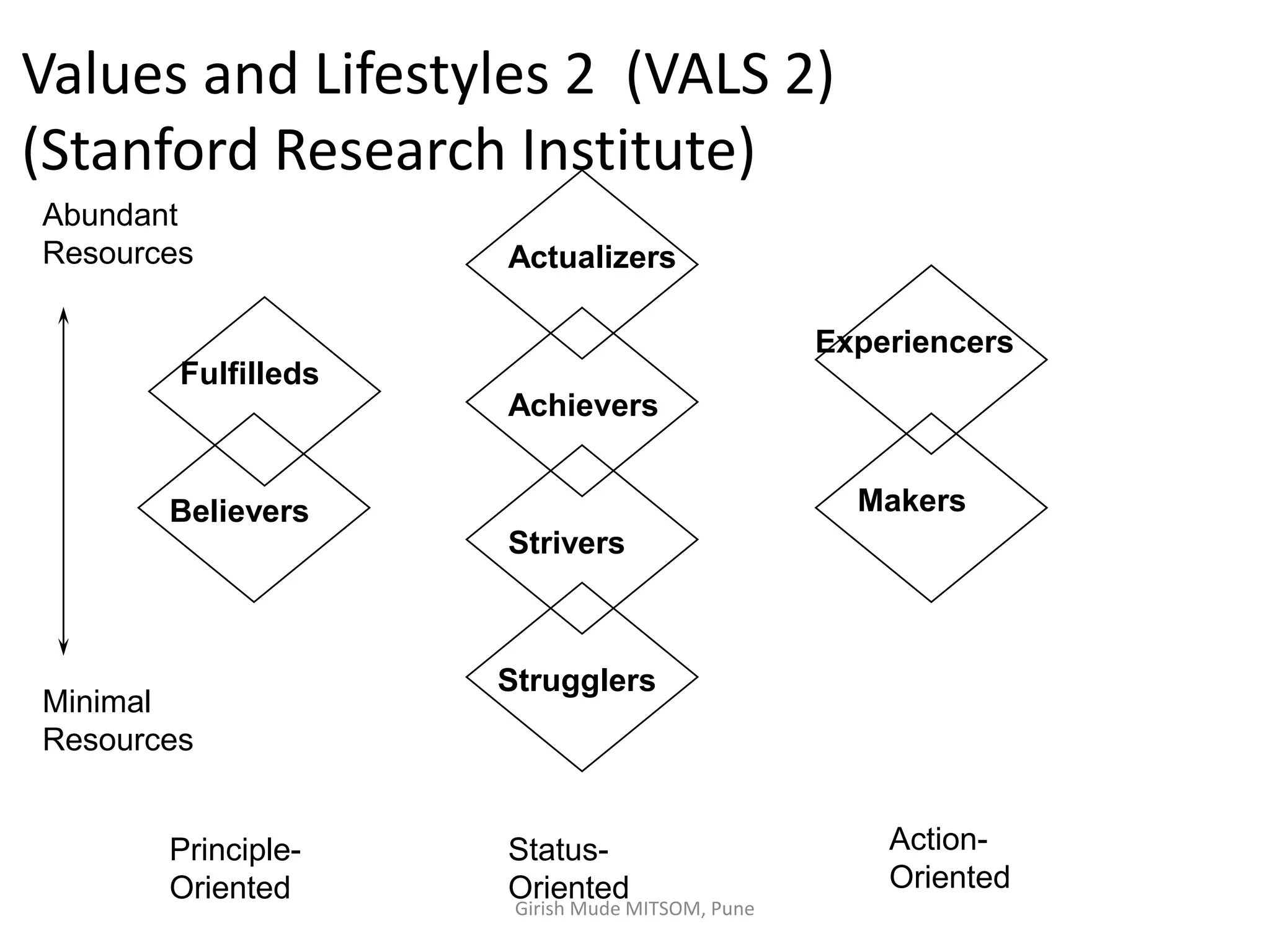
VALS2 Stadford model
VALS-2 was developed by the US
consulting firm Stanford Research
Institute (SRI) as an improvement on its
original VALS (introduced in 1978), a
system that divided people into three
basic lifestyle groups (Need driven,
Outer directed, and Inner directed).
Girish Mude MITSOM, Pune
VALS 2 (VALUES AND LIFESTYLES
SYSTEMS) -- Basic Categories
• Principle - oriented: guided by their view
of how the world should be
• Status - oriented: guided by actions and
opinions of others
• Action - oriented: guided by desire for
social or physical activity, variety,
risk-takingGirish Mude MITSOM, Pune
VALS 2: Available Resources Relevant
to Psychographic Profiles
• Education
• Income
• Health
• Energy Level
• Self Confidence
• Degree of Consumerism
Girish Mude MITSOM, Pune
Fulfilleds
Believers
Actualizers
Achievers
Strivers
Strugglers
Experiencers
Makers
Abundant
Resources
Minimal
Resources
Values and Lifestyles 2 (VALS 2)
(Stanford Research Institute)
Principle-
Oriented
Status-
Oriented
Action-
Oriented
Girish Mude MITSOM, Pune
• Eight basic lifestyle groups on the basis of two
dimensions: resources and self-orientation.
• Resource dimension includes education, income,
intelligence, health, energy level, and eagerness to
purchase resources that, in general, increase from
youth to middle age decline afterwards.
• Self-orientation is divided into three parts (1)
Principle oriented: having set views. (2) Status
oriented: influenced by other's thinking. (3) Action
oriented: seeks activity, adventure, and variety.
•
Girish Mude MITSOM, Pune
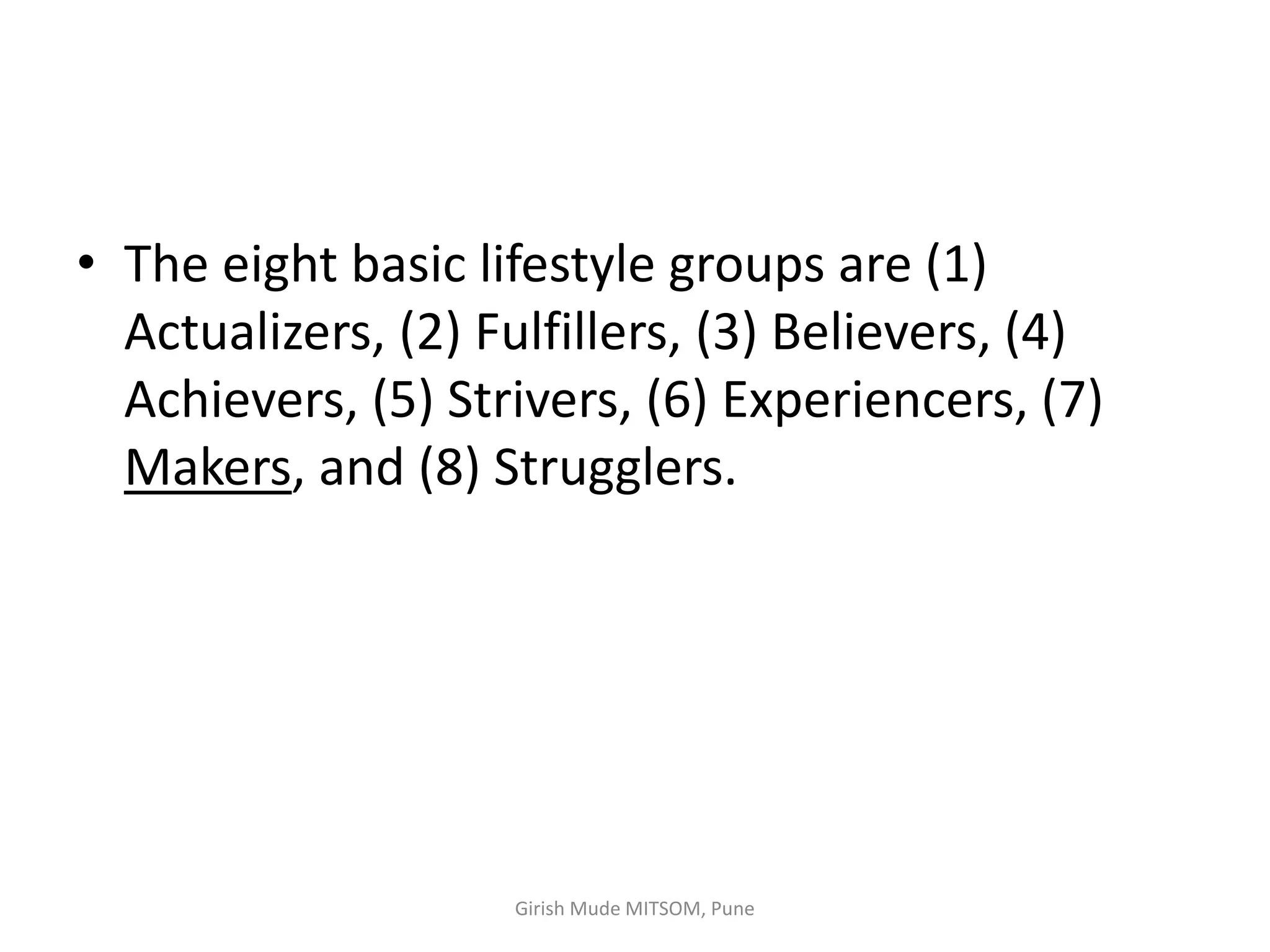
• The eight basic lifestyle groups are (1)
Actualizers, (2) Fulfillers, (3) Believers, (4)
Achievers, (5) Strivers, (6) Experiencers, (7)
Makers, and (8) Strugglers.
Girish Mude MITSOM, Pune
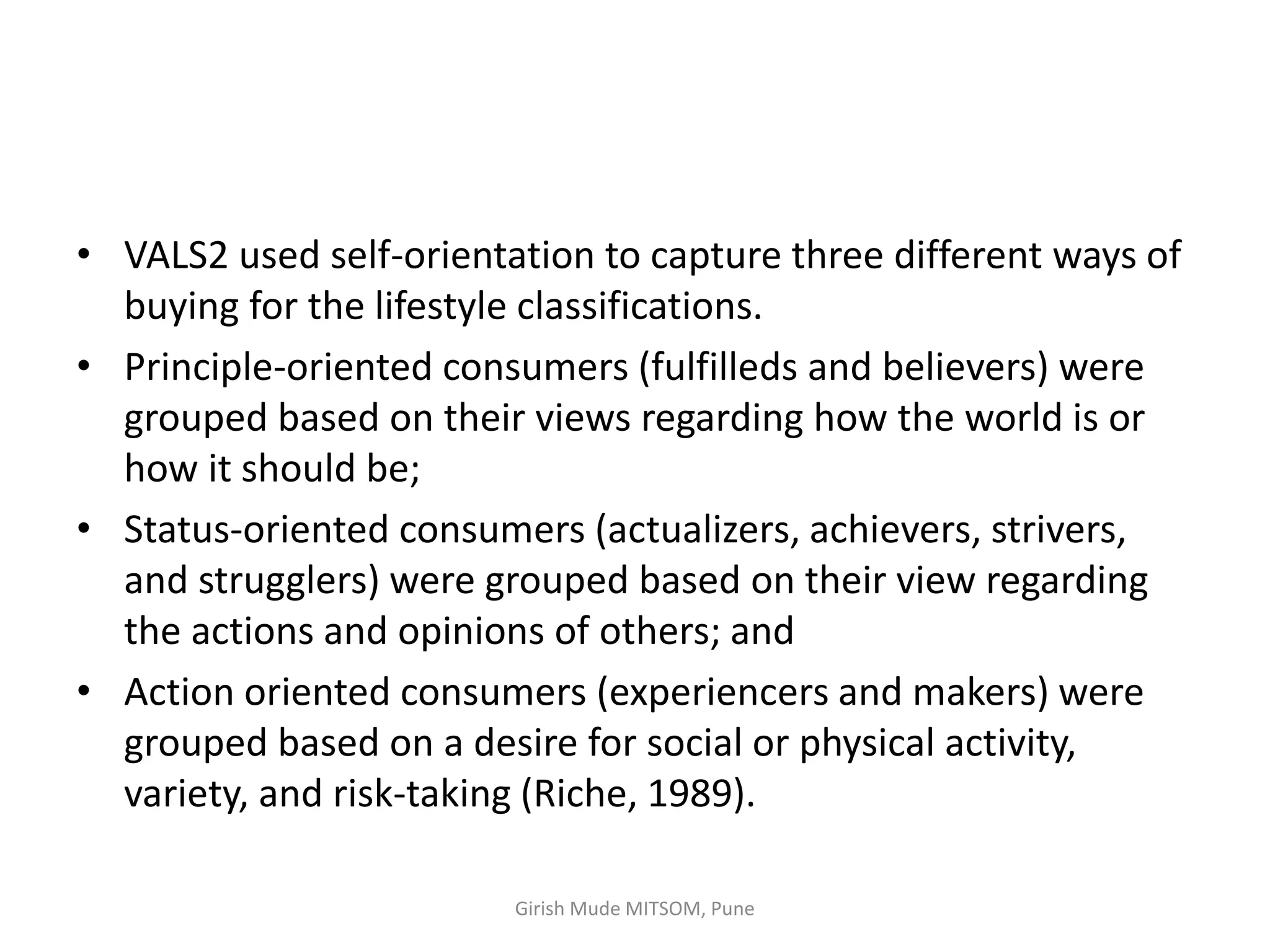
• VALS2 used self-orientation to capture three different ways of
buying for the lifestyle classifications.
• Principle-oriented consumers (fulfilleds and believers) were
grouped based on their views regarding how the world is or
how it should be;
• Status-oriented consumers (actualizers, achievers, strivers,
and strugglers) were grouped based on their view regarding
the actions and opinions of others; and
• Action oriented consumers (experiencers and makers) were
grouped based on a desire for social or physical activity,
variety, and risk-taking (Riche, 1989).
Girish Mude MITSOM, Pune
Any Questions ???
Girish Mude MITSOM, Pune
Thank You !!!
Girish Mude MITSOM, Pune

Consumer modeling girish mude

  • 1.
    Consumer Modeling Prof. GirishMude MAEER’s MIT School of Management, Pune girishmude@mitsom.com
  • 2.
    Consumer Modeling • Modelis very often referred to as an abstract representation of a process of relationship. • How they help: – In development of theories – To understand complex relationship – Provide framework for discussions and research work. Girish Mude MITSOM, Pune Lets study Models then….
  • 3.
  • 4.
    Models in consumerBehavior • Psychoanalytical model • Economic model • Sociological model • Howard Seth model • Nicosia model • Engel Blackwell model • VALS2 Stadford model Girish Mude MITSOM, Pune
  • 5.
    The psychoanalytical model Thepsychoanalytical model draws from Freudian psychology Individual consumer has a complex set of deep seated motives which drive him towards certain buying decisions. The buyer has a private world with all his hidden fears, suppressed desires and totally subjective longings. His buying action can be influenced by appealing to those desires and longings. Girish Mude MITSOM, Pune
  • 6.
    According to Mr. Freud,human personality has three parts namely, 1. the “ID”, the source of all mental energy which drives one to an action. 2.the “Super Ego”, the internal representation of what is socially approved—one’s conscience. 3. the “Ego”, the conscious director of ‘ID’ impulses for finding satisfaction in socially acceptable manner. Girish Mude MITSOM, Pune
  • 7.
    In other words,‘ID’ represents one’s animal or basic impulses, ‘instincts’ and cravings for immediate and total satisfaction. Marketers have been using this Approach to generate new ideas for developing product- design, features, advertising and promotional techniques. Girish Mude MITSOM, Pune
  • 8.
    Example… A person isinterested in buying SONY TV with characteristics of Hi-black Trinitron Screen—super drum sound system say Rs.1,05,000 with remote control. Here his ‘ID’ demands the use of consumer credit liberally to buy that costly T.V. set. The Super Ego dissuades him from heavy borrowing as credit beyond certain limits is not acceptable. Here the Ego acts like a mediator and comes with a fine compromise of installment system without away strains and drain on his financial position. Here self image of a consumer is a great motivating force inducing him to buy certain products. Girish Mude MITSOM, Pune
  • 9.
    Economic Model It isassumed that man is a rational human being. Evaluate all alternatives in terns of cost and value received. Select that product/service which gives maximum satisfaction (utility). With limited purchasing power consumer will allocate their expenditure over different products. Girish Mude MITSOM, Pune
  • 10.
    Consumer intention to maximizing utility/benefit. • Priceeffect • Substitute effect • Income effect Economic Model is based on certain prediction of buying behaviour Girish Mude MITSOM, Pune
  • 11.
    Sociological Model Individual buyer ispart of society. Gets influence by it. Play many roles As a family member As an employee As a member of professional forum Girish Mude MITSOM, Pune
  • 12.
    Influence by Family Friends Close colleagues Peer group(Informal Leaderinfluence) Similarly other aspect also affect buying pattern Income Occupation Social class Girish Mude MITSOM, Pune
  • 13.
    Nicosia Model Developed bFrancesco M. Nicosia in 1966 Attempts to establish linkages between the marketing firm and its consumer. The essence is how the activities of the firm influence the consumer and result in his direction to buy. Girish Mude MITSOM, Pune
  • 14.
    Nicosia Model ..Continued •His model lumps these activities into Four basic fields. • Field One has two sub-fields namely, the firms attributes and the consumer attributes. An ad message from the firm reaches consumer’s attributes. Depending on the way the messages received by the consumer, a certain attribute may develop and this becomes the input for the field Two. • Field Two is the area of search and evaluation of the advertised product and other alternatives. If this process results in a motivation to buy, it becomes the input for field three. • Field Three consist of the act of purchase. • The field Four consists of use of the purchased item. There is an output from field Four --- feed back of sales results to the firm Girish Mude MITSOM, Pune
  • 15.
  • 16.
  • 17.
    Engel, Kollat, andBlackwell (EKB) Model The EKB model is comprehensive and shows the components of decision making and the relationships and interactions among them. The five distinct parts of consumer decision making presented are: • Input, information processing, a decision process, decision process variables, and external influences Girish Mude MITSOM, Pune
  • 18.
    One of theimportant features of the Engel, Kollat, and Blackwell model is the description of consumer purchasing as a process comprised of several stages rather than a single act of buying or not buying. Girish Mude MITSOM, Pune
  • 19.
  • 20.
    Input • Our experiences,contact with others • Marketer-controlled stimuli (e.g., advertising, store display, demonstrations) • Other stimuli (e.g., personal recollections, conversations with friends) • External search Input includes all kinds of stimuli from our contact with the world around us: Girish Mude MITSOM, Pune
  • 21.
    Information Processing Stimuli are processedinto meaningful information • Exposure • Attention • Comprehension • Yielding • Retention Five methods of information processing: Girish Mude MITSOM, Pune
  • 22.
    Decision Process It istriggered at any time during information processing • Problem recognition • Search • Alternative evaluation • Choice • Outcomes (post-purchase evaluation and behavior) It consists of five steps: Girish Mude MITSOM, Pune
  • 23.
    Decision Process Variables Thoseindividual qualities that make people/consumers unique. • Motives • Beliefs • Attitudes • Lifestyles • Intentions • Evaluative criteria • Normative compliance and informational influence • Other aspects of self Decision process variables include Girish Mude MITSOM, Pune
  • 24.
    External Influences Such influencesare called “Circles of Social Influence.” They are: culture, sub-culture (co-culture), social class, reference groups, and family or household influences Girish Mude MITSOM, Pune
  • 25.
  • 26.
    This model isan individual decision process model since it views a single consumer as the basic decision making unit. The model does recognize influences from other people, but the central focus is still on the individual. Girish Mude MITSOM, Pune
  • 27.
    VALS2 Stadford model VALS-2was developed by the US consulting firm Stanford Research Institute (SRI) as an improvement on its original VALS (introduced in 1978), a system that divided people into three basic lifestyle groups (Need driven, Outer directed, and Inner directed). Girish Mude MITSOM, Pune
  • 28.
    VALS 2 (VALUESAND LIFESTYLES SYSTEMS) -- Basic Categories • Principle - oriented: guided by their view of how the world should be • Status - oriented: guided by actions and opinions of others • Action - oriented: guided by desire for social or physical activity, variety, risk-takingGirish Mude MITSOM, Pune
  • 29.
    VALS 2: AvailableResources Relevant to Psychographic Profiles • Education • Income • Health • Energy Level • Self Confidence • Degree of Consumerism Girish Mude MITSOM, Pune
  • 30.
    Fulfilleds Believers Actualizers Achievers Strivers Strugglers Experiencers Makers Abundant Resources Minimal Resources Values and Lifestyles2 (VALS 2) (Stanford Research Institute) Principle- Oriented Status- Oriented Action- Oriented Girish Mude MITSOM, Pune
  • 31.
    • Eight basiclifestyle groups on the basis of two dimensions: resources and self-orientation. • Resource dimension includes education, income, intelligence, health, energy level, and eagerness to purchase resources that, in general, increase from youth to middle age decline afterwards. • Self-orientation is divided into three parts (1) Principle oriented: having set views. (2) Status oriented: influenced by other's thinking. (3) Action oriented: seeks activity, adventure, and variety. • Girish Mude MITSOM, Pune
  • 32.
    • The eightbasic lifestyle groups are (1) Actualizers, (2) Fulfillers, (3) Believers, (4) Achievers, (5) Strivers, (6) Experiencers, (7) Makers, and (8) Strugglers. Girish Mude MITSOM, Pune
  • 33.
    • VALS2 usedself-orientation to capture three different ways of buying for the lifestyle classifications. • Principle-oriented consumers (fulfilleds and believers) were grouped based on their views regarding how the world is or how it should be; • Status-oriented consumers (actualizers, achievers, strivers, and strugglers) were grouped based on their view regarding the actions and opinions of others; and • Action oriented consumers (experiencers and makers) were grouped based on a desire for social or physical activity, variety, and risk-taking (Riche, 1989). Girish Mude MITSOM, Pune
  • 34.
    Any Questions ??? GirishMude MITSOM, Pune
  • 35.
    Thank You !!! GirishMude MITSOM, Pune