The Consumer
Protection Act, 2019
Source:
http://egazette.nic.in/WriteReadData/2019/210422.pdf
"BUYS ANY GOODS"
AND
"HIRES OR AVAILS ANY SERVICES"
Includes offline or online transactions through
electronic means or by teleshopping or direct selling or
multi-level marketing
HIGHLIGHTS
1. District Consumer Disputes Redressal Forum ('DCDRF') has been
renamed as District Consumer Disputes Redressal Commission
('DCDRC'/'District Commission').
2. The Opposite Party must now deposit 50% of the amount ordered by the
District Commission before preferring an appeal to the State Consumer
Disputes Redressal Commission ('SCDRC'/'State Commission') as opposed
to the previous ceiling was of maximum of Rs. 25,000/-, which has now
been done away with.
3. The period of limitation for preferring an appeal to the State Commission
from an order of the District Commission has been increased from 30 days
under the old Act to 45 days under the Act.
4. The SCDRC shall now have a minimum of 1 President and 4 Members.
5. The original pecuniary jurisdiction of the consumer commissions has now
been revised as follows:
1. DCDRC shall be upto Rs. 1 crore;
2. SCDRC from Rs. 1 crore to Rs. 10 crore; and
3. National Consumer Disputes Redressal Commission ('NCDRC'/'National
Commission') to be more than Rs. 10 crore.
6. . An aggrieved consumer can file complaints about a defect in goods or
deficiency in services from where she lives, instead of the place of business
or residence of the seller or service provider. The new law provides for
e-filing of consumer complaint as well.
7.The provisions in Sections 49(2) and 59(2) of the Act empower both the
State Commission and National Commission to deem any terms of the
contract between the consumer and the service provider/manufacturer as the
case may be, which are unfair to any consumer, to be ineffective and void.
This is a new provision/power vested upon the SCDRC and the NCDRC
which was not a part of the old Act.
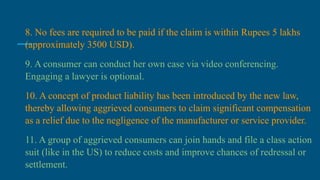
8. No fees are required to be paid if the claim is within Rupees 5 lakhs
(approximately 3500 USD).
9. A consumer can conduct her own case via video conferencing.
Engaging a lawyer is optional.
10. A concept of product liability has been introduced by the new law,
thereby allowing aggrieved consumers to claim significant compensation
as a relief due to the negligence of the manufacturer or service provider.
11. A group of aggrieved consumers can join hands and file a class action
suit (like in the US) to reduce costs and improve chances of redressal or
settlement.
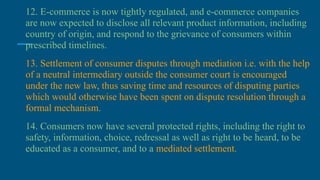
12. E-commerce is now tightly regulated, and e-commerce companies
are now expected to disclose all relevant product information, including
country of origin, and respond to the grievance of consumers within
prescribed timelines.
13. Settlement of consumer disputes through mediation i.e. with the help
of a neutral intermediary outside the consumer court is encouraged
under the new law, thus saving time and resources of disputing parties
which would otherwise have been spent on dispute resolution through a
formal mechanism.
14. Consumers now have several protected rights, including the right to
safety, information, choice, redressal as well as right to be heard, to be
educated as a consumer, and to a mediated settlement.
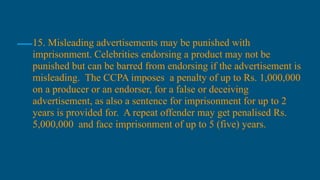
15. Misleading advertisements may be punished with
imprisonment. Celebrities endorsing a product may not be
punished but can be barred from endorsing if the advertisement is
misleading. The CCPA imposes a penalty of up to Rs. 1,000,000
on a producer or an endorser, for a false or deceiving
advertisement, as also a sentence for imprisonment for up to 2
years is provided for. A repeat offender may get penalised Rs.
5,000,000 and face imprisonment of up to 5 (five) years.
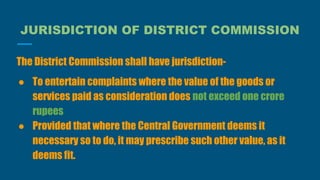
JURISDICTION OF DISTRICT COMMISSION
The District Commission shall have jurisdiction-
● To entertain complaints where the value of the goods or
services paid as consideration does not exceed one crore
rupees
● Provided that where the Central Government deems it
necessary so to do, it may prescribe such other value, as it
deems fit.
APPEAL AGAINST ORDER OF DISTRICT
COMMISSION
● Any person aggrieved by an order made by the District
Commission may prefer an appeal against such order to
the State Commission on the grounds of facts or law
within a period of forty-five days from the date of the
order, in such form and manner, as may be prescribed
JURISDICTION OF STATE COMMISSION
The State Commission shall have jurisdiction—
● Complaints where the value of the goods or services paid as
consideration, exceeds rupees one crore, but does not exceed
rupees ten crore
● Provided that where the Central Government deems it necessary so
to do, it may prescribe such other value, as it deems fit
● Complaints against unfair contracts, where the value of goods or
services paid as consideration does not exceed ten crore rupees;
JURISDICTION OF NATIONAL COMMISSION
The National Commission shall have jurisdiction—
● Complaints where the value of the goods or services paid as
consideration exceeds rupees ten crore
● Provided that where the Central Government deems it
necessary so to do, it may prescribe such other value, as it
deems fit
● Complaints against unfair contracts, where the value of goods
or services paid as consideration exceeds ten crore rupees
Corporates entities that cater to consumers will have to exercise
greater care and caution in terms of quality, quantity, and product
safety. The boards of corporates that manufacture or trade
consumer goods must create a Consumer Affairs Committee to
periodically review consumer complaints and address the need
to proactively offer mediated settlements by holding online
mediation and save themselves the expenses of defending a
matter in Consumer Courts, in some remote part of India besides
incurring the collateral damage to reputation.

The Consumer Protection Act, 2019 AMENDMENT.pdf

  • 1.
    The Consumer Protection Act,2019 Source: http://egazette.nic.in/WriteReadData/2019/210422.pdf
  • 2.
    "BUYS ANY GOODS" AND "HIRESOR AVAILS ANY SERVICES" Includes offline or online transactions through electronic means or by teleshopping or direct selling or multi-level marketing
  • 3.
    HIGHLIGHTS 1. District ConsumerDisputes Redressal Forum ('DCDRF') has been renamed as District Consumer Disputes Redressal Commission ('DCDRC'/'District Commission'). 2. The Opposite Party must now deposit 50% of the amount ordered by the District Commission before preferring an appeal to the State Consumer Disputes Redressal Commission ('SCDRC'/'State Commission') as opposed to the previous ceiling was of maximum of Rs. 25,000/-, which has now been done away with.
  • 4.
    3. The periodof limitation for preferring an appeal to the State Commission from an order of the District Commission has been increased from 30 days under the old Act to 45 days under the Act. 4. The SCDRC shall now have a minimum of 1 President and 4 Members. 5. The original pecuniary jurisdiction of the consumer commissions has now been revised as follows: 1. DCDRC shall be upto Rs. 1 crore; 2. SCDRC from Rs. 1 crore to Rs. 10 crore; and 3. National Consumer Disputes Redressal Commission ('NCDRC'/'National Commission') to be more than Rs. 10 crore.
  • 5.
    6. . Anaggrieved consumer can file complaints about a defect in goods or deficiency in services from where she lives, instead of the place of business or residence of the seller or service provider. The new law provides for e-filing of consumer complaint as well. 7.The provisions in Sections 49(2) and 59(2) of the Act empower both the State Commission and National Commission to deem any terms of the contract between the consumer and the service provider/manufacturer as the case may be, which are unfair to any consumer, to be ineffective and void. This is a new provision/power vested upon the SCDRC and the NCDRC which was not a part of the old Act.
  • 6.
    8. No feesare required to be paid if the claim is within Rupees 5 lakhs (approximately 3500 USD). 9. A consumer can conduct her own case via video conferencing. Engaging a lawyer is optional. 10. A concept of product liability has been introduced by the new law, thereby allowing aggrieved consumers to claim significant compensation as a relief due to the negligence of the manufacturer or service provider. 11. A group of aggrieved consumers can join hands and file a class action suit (like in the US) to reduce costs and improve chances of redressal or settlement.
  • 7.
    12. E-commerce isnow tightly regulated, and e-commerce companies are now expected to disclose all relevant product information, including country of origin, and respond to the grievance of consumers within prescribed timelines. 13. Settlement of consumer disputes through mediation i.e. with the help of a neutral intermediary outside the consumer court is encouraged under the new law, thus saving time and resources of disputing parties which would otherwise have been spent on dispute resolution through a formal mechanism. 14. Consumers now have several protected rights, including the right to safety, information, choice, redressal as well as right to be heard, to be educated as a consumer, and to a mediated settlement.
  • 8.
    15. Misleading advertisementsmay be punished with imprisonment. Celebrities endorsing a product may not be punished but can be barred from endorsing if the advertisement is misleading. The CCPA imposes a penalty of up to Rs. 1,000,000 on a producer or an endorser, for a false or deceiving advertisement, as also a sentence for imprisonment for up to 2 years is provided for. A repeat offender may get penalised Rs. 5,000,000 and face imprisonment of up to 5 (five) years.
  • 9.
    JURISDICTION OF DISTRICTCOMMISSION The District Commission shall have jurisdiction- ● To entertain complaints where the value of the goods or services paid as consideration does not exceed one crore rupees ● Provided that where the Central Government deems it necessary so to do, it may prescribe such other value, as it deems fit.
  • 10.
    APPEAL AGAINST ORDEROF DISTRICT COMMISSION ● Any person aggrieved by an order made by the District Commission may prefer an appeal against such order to the State Commission on the grounds of facts or law within a period of forty-five days from the date of the order, in such form and manner, as may be prescribed
  • 11.
    JURISDICTION OF STATECOMMISSION The State Commission shall have jurisdiction— ● Complaints where the value of the goods or services paid as consideration, exceeds rupees one crore, but does not exceed rupees ten crore ● Provided that where the Central Government deems it necessary so to do, it may prescribe such other value, as it deems fit ● Complaints against unfair contracts, where the value of goods or services paid as consideration does not exceed ten crore rupees;
  • 12.
    JURISDICTION OF NATIONALCOMMISSION The National Commission shall have jurisdiction— ● Complaints where the value of the goods or services paid as consideration exceeds rupees ten crore ● Provided that where the Central Government deems it necessary so to do, it may prescribe such other value, as it deems fit ● Complaints against unfair contracts, where the value of goods or services paid as consideration exceeds ten crore rupees
  • 13.
    Corporates entities thatcater to consumers will have to exercise greater care and caution in terms of quality, quantity, and product safety. The boards of corporates that manufacture or trade consumer goods must create a Consumer Affairs Committee to periodically review consumer complaints and address the need to proactively offer mediated settlements by holding online mediation and save themselves the expenses of defending a matter in Consumer Courts, in some remote part of India besides incurring the collateral damage to reputation.